Hubbry Logo
Maryland State HouseMaryland State HouseMain
Open search
Maryland State House
Community hub
Maryland State House
logo
8 pages, 0 posts
0 subscribers
Be the first to start a discussion here.
Maryland State House
from Wikipedia

Maryland State House
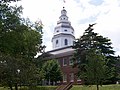
Maryland State House in Annapolis, Maryland
LocationAnnapolis, Maryland, U.S.
Coordinates38°58′44″N 76°29′28″W / 38.97889°N 76.49111°W / 38.97889; -76.49111
Built1772; 253 years ago (1772)
ArchitectJoseph Horatio Anderson
Architectural styleGeorgian
NRHP reference No.66000385
Added to NRHPOctober 15, 1966[1]

The Maryland State House is located in Annapolis, Maryland. It is the oldest U.S. state capitol in continuous legislative use, dating to 1772, and houses the Maryland General Assembly, plus the offices of the Governor and Lieutenant Governor. In 1783 and 1784 it served as the capitol building of the United States Congress of the Confederation, and is where Ratification Day, the formal end of the American Revolutionary War, occurred.

The capitol has the distinction of being topped by the largest wooden dome in the United States constructed without nails. The current building, which was designated a National Historic Landmark in 1960,[2] is the third statehouse on its site.[3] The building is administered by the State House Trust, established in 1969.

Construction and history

[edit]

Construction began in 1772, but was not completed until 1797[3] due to the ongoing American Revolutionary War. The two-story brick Georgian style structure, located inside State Circle, was designed by architect Joseph Horatio Anderson. A small portico juts out from the center of the building, topped by a pediment, with two high arched windows framing the entrance. On both floors, large rectangular windows line the facade. A cornice is topped by another pediment and the sloping roof gives way for a central octagonal drum atop which rests a dome. The large dome is topped by a balustraded balcony, another octagonal drum and a lantern capped by a lightning rod. The rod was constructed and grounded according to the direct specifications of its inventor, Benjamin Franklin.[4][5][6]

The building was surrounded by a low brick wall in 1818 to prevent cattle incursions. This was replaced by an iron fence with a granite base in 1836.[7] The dome of the statehouse is depicted on the Maryland state quarter.[8]

An annex to the State House was constructed between 1902 and 1906 under the supervision of Baltimore architects Baldwin & Pennington; the new annex replaced earlier 19th-century annexes. The current state House of Delegates and Senate chambers are part of the annex, which is clad in black and gold Italian marble.[9] The annex includes the Grand Staircase from the first to the second floors; above the staircase is the painting Washington Resigning His Commission by Edwin White, executed in 1858. In 2017, two additional paintings, both from the collection of the Enoch Pratt Free Library, were hung above the staircase.[10] These additions were a portrait of Charles Calvert, 5th Baron Baltimore by Allan Ramsay (c. 1740)[11] and a portrait of Frederick Calvert, 6th Baron Baltimore by Johann Ludwig Tietz (c. 1750).[12]

In the mid-1990s, the cypress dome underwent a structural renovation and repainting. However, the latex paint that was used failed to bond due to preceding layers, causing it to flake. In 2011, the old paint was removed and replaced with white oil-based paint.[8]

Grounds

[edit]
Women's March on January 20, 2018, on Lawyers Mall near the State House. Lawyers Mall is frequently used for protests and other gatherings.

Adjacent to the State House is Lawyers Mall, an open space which was designated in 1973 after the demolition of the Court of Appeals building, which had sat at the location since 1906. Statues of Baltimore native Thurgood Marshall, the first black U.S. Supreme Court justice, as well as Donald Gaines Murray, the first African-American to enter the University of Maryland School of Law since 1890, and a bench with statues of two anonymous children symbolizing the victory of Marshall's litigation in Brown v. Board of Education, all sit on Lawyers Mall. The space is the focal point of First Amendment activities on capitol grounds.

Until 2017, there was a statue of Roger B. Taney, Chief Justice of the United States, on the lawn of the State House. The statue was erected in 1872. The statue of Taney, a Marylander, was controversial because of Taney's support for slavery and his authorship of the U.S. Supreme Court decision in Dred Scott v. Sandford (1857), which upheld the denial of citizenship to African Americans. As a result, a movement in support of removing the statue emerged.[13] At first, the State House Trust—made up of the governor, the speaker of the state house, the president of the state senate, and the chair of the Maryland Historical Trust Board of Trustees—responded by adding interpretive plaques "explaining the controversy over his divisive opinion and its place in the evolution of the nation's stance toward slavery."[13] The Trust also added a statue of Marshall on Lawyers Mall, and agreed in 2016 to place statues of abolitionists Harriet Tubman and Frederick Douglass in the State House.[13] In the wake of the Charlottesville car attack in 2017, House Speaker Michael E. Busch called for the removal of the Taney statue,[14] as did Governor Larry Hogan a day later.[15] It was removed just after midnight on August 18, 2017.[16]

Rotunda

[edit]

The front entrance of the State House opens onto the Rotunda. Large Corinthian columns support the arches bracing the large dome above. A balustrade lines the second floor balcony. On the walls of the Rotunda are a number of commemorative plaques, including one commemorating Matthew Alexander Henson, co-discoverer of the North Pole.[17]

In the summer of 2012, the original handwritten text of George Washington's resignation letter was on display in the rotunda. It was again put on display in March 2020 alongside the original Star-Spangled Banner by Francis Scott Key on loan from the Maryland Center for History and Culture.[18]

Chambers

[edit]

Old Senate Chamber

[edit]
The Old Senate Chamber
Washington, Lafayette & Tilghman at Yorktown, by Charles Willson Peale, 1784

To the right of the entrance is the old Senate Chamber. Chairs and desks were added to the room in the exact number (16) as originally furbished. The desk for the president is an original piece made by John Shaw in 1797.[19] Above the fireplace is the painting Washington, Lafayette & Tilghman at Yorktown by Charles Willson Peale; the work was commissioned by the Maryland Legislature in 1783 and added to the State House collection the following year. The painting depicts General George Washington, Lafayette and Washington's aide-de-camp Tench Tilghman.[20][21]

It was in the Old Senate Chamber that Washington resigned his commission as commander-in-chief of the Continental Army on December 23, 1783. A bronze statue of Washington stands in the room.[20]

On February 2, 1781, Governor Thomas Sim Lee signed and sealed the "act to empower the delegates of this state in Congress to subscribe and ratify the Articles of Confederation."[22] The decision established the requisite unanimous consent of all thirteen states for the formation of a Perpetual Union.

On September 11, 1786, the Annapolis Convention, an interstate convention to discuss ways to facilitate commerce between the states and the establishment standard rules and regulations, convened here. The convention laid the groundwork for the 1787 Constitutional Convention.[23]

The chamber had extensive investigation beginning in 2007 to solve water leakage problems. As a result of this study, restorers have determined that previous restoration attempts in 1905 and 1940 did not accurately recreate many elements of the room. A report of their findings was issued in January 2010.[24] The restoration work was completed in 2015 and the chamber reopened to the public.

Working Senate Chamber

[edit]
Chamber of the Maryland State Senate

The Senate chamber is located in a wing added to the original structure between 1902 and 1905. The room is illuminated by a Tiffany-style skylight above. Red carpet emblazoned with the state seal covers the entire floor. Large Ionic columns line the walls and support the viewing gallery. The marble along the walls and the columns are flecked with rust and black, Maryland's official colors.

Two famous Marylanders are featured in statues flanking the podium: John Hanson, the first president by the Articles of Confederation, and Charles Carroll, one of the signers of the Declaration of Independence. Four portraits of Declaration of Independence signatories for Maryland hang on the walls: William Paca, Thomas Stone, Samuel Chase, and Charles Carroll. Portraits of Thomas V. Mike Miller Jr. and Verda Welcome were installed on January 13, 2020, replacing the portraits of Edwin Warfield and John Walter Smith.[25]

Working House Chamber

[edit]

The House of Delegates chamber is also in the new wing to the building. The carpet is navy blue and designed with a diamond and olive sheaths[clarification needed]. The same rust and black marble lines the chamber and forms the Ionic columns along the walls. A spectators' gallery is above the rostrum. The speaker sits in front of a broken marble pediment supporting a clock. Portraits of former Speakers of the House hang on the walls.

Governor's Reception Room

[edit]

The Governor's Reception Room is on the second floor. The room is mainly ceremonial and used for bill signings. Portraits of former governors hang on the walls. Portraits of Henrietta Maria and Queen Anne hang nearby. The room was originally used as the Council Chamber for Maryland's executive council, which was abolished in state constitutional reforms in 1838; it became known as the Governor's Reception Room in the 1860s.[26]

State House Caucus Room

[edit]

What is now known as the State House Caucus Room was originally divided into two rooms housing the records of the Land Office and the General Court (which later became Court of Appeals of Maryland). After the Old House of Delegates Chamber was expanded in 1858, the room was divided between the private office of the speaker of the House of Delegates (rear half) and a cloakroom (front half). In 1905–06, the room was likely renovated, and became known as the Flag Room, which housed various Civil War battle flags and ceremonial weapons. The room was later used by the Department of Legislative Reference and became known as the "Bill Room" by the 1940s. From the early 1980s until 2008, the room was used as the Maryland State House Visitor Center. In 2011, the room was renamed the State House Caucus Room, and is now used for meetings.[27]

The Caucus Room houses most of the 48-piece silver service from the armored cruiser USS Maryland, which was decommissioned in 1947.[20] The pieces in the set show 167 scenes from Maryland history, with each piece focusing on one of Maryland's 23 counties and Baltimore. The silver was transferred from the Maryland Historical Society to the State House in 1962. In 1992, four pieces from the service were given to the submarine USS Maryland.[28] In addition to the silver, the Caucus Room contains a 19th-century bust of Reverdy Johnson.[29]

Paintings in the Caucus Room include both portraits and landscapes. Portraits in the room are originals depicting Oden Bowie (by Katherine Walton),[30] Frank Brown (by Louis P. Dieterich),[31] Leonard Calvert (attributed to Jacob van Oost or Jacob van Oost the Younger),[32] Elihu Emory Jackson (by Ida Foster),[33] Robert M. McLane (by George Peter Alexander Healy),[34] Thomas Swann (by Florence Mackubin),[35] Francis Thomas (by Franklin Barber Clark),[36] William Pinkney Whyte (by David Bendann),[37] and Levin Winder (by Florence Mackubin).[38] The room also contains reproductions of portraits of Clarence W. Blount (by Simmie Knox)[39] and Mary Eliza Watters Risteau (by Talmadge of New York).[40]

National capital

[edit]

From November 26, 1783, to August 13, 1784, Annapolis was the capital of the United States. The Congress of the Confederation met in the Maryland State House. Subsequently, Annapolis was a candidate to become the new permanent national capital before Washington, D.C., was built.

It was in the Old Senate Chamber that Congress ratified the Treaty of Paris on January 14, 1784, formally ending the American Revolutionary War.[20]

United States district court

[edit]

The United States District Court for the District of Maryland met there for the first decade of its existence.[41] In 1800, judge Samuel Chase tried a local postmaster for embezzlement and sentenced him to thirty-nine lashes. To execute the sentence, the defendant was tied to one of the statehouse columns.[41]

[edit]

See also

[edit]

References

[edit]

Further reading

[edit]
[edit]
Revisions and contributorsEdit on WikipediaRead on Wikipedia
from Grokipedia

The Maryland State House is the capitol building of the U.S. state of Maryland, located in Annapolis, and the oldest state capitol in continuous legislative use in the nation. Construction of the current structure began with the laying of its cornerstone on March 28, 1772, by Governor Robert Eden, and the main building was completed in 1779, though the iconic wooden dome was added between 1785 and 1797. This dome, designed by Joseph Clark and fashioned from cypress wood held together by wooden pegs and iron straps without the use of nails, stands as the largest of its kind in North America. The State House holds unique national historical significance as the first peacetime capitol of the United States, hosting the Continental Congress from November 1783 to August 1784, where it witnessed George Washington's resignation of his commission and the ratification of the Treaty of Paris on January 14, 1784, formally ending the Revolutionary War. Designated a National Historic Landmark in 1960, the building continues to serve as the seat of the Maryland General Assembly, comprising the Senate and House of Delegates.

Historical Development

Construction and Initial Design (1772-1779)

Construction of the third Maryland State House commenced on , 1772, following the demolition of the second structure, completed in 1709, which had proven inadequate for the colony's expanding governmental needs after approximately 60 years of use. The was laid by Governor Eden on that date, marking the formal initiation under the oversight of the colonial legislature. Joseph Horatio Anderson served as the , providing the design for a two-story edifice in the Georgian style, characterized by symmetrical proportions and a wood-and-plaster interior suited to legislative functions. Charles Wallace acted as the undertaker, or primary contractor, managing the build with locally sourced materials including for the exterior walls. The initial plan omitted a prominent dome, focusing instead on the rectangular main block to house the General Assembly and executive offices efficiently. Progress was intermittent due to natural disruptions, including a hurricane, and escalating tensions leading to the , which diverted labor and resources. By late , the structure was sufficiently advanced for occupancy, though incomplete, with Wallace's financial strain halting further immediate work. This phase established the building's foundational form, later augmented but retaining Anderson's core layout as the seat of Maryland's government.

Dome Erection and 19th-Century Modifications

The original , completed in , featured a modest or small dome that proved inadequate in scale, proportion, and weatherproofing, leading to persistent leaks and structural concerns. In 1785, the contracted carpenter to demolish the existing structure and erect a new wooden dome approximately 60 feet taller, drawing inspiration from a similar wooden dome in , . Construction commenced that year amid financial difficulties for Clark, who relied on heavy without nails, creating what remains the largest surviving 18th-century wooden dome in the . The dome's exterior, including its slate-shingled roof and cedar siding, was substantially finished by the summer of 1788, though interior work lagged due to ongoing funding shortages and Clark's eventual abandonment of the project in 1794. Architect John Shaw then oversaw completion of the interior rotunda and elements after 1794, incorporating an inner dome rising 113 feet from the floor. During , a tragic incident occurred in 1793 when Thomas Dance fell over 90 feet from to his death. The structure's innovative design distributed weight efficiently onto the building's walls, ensuring stability without internal supports. Throughout the , the dome endured periodic repairs for weathering and leaks, including repainting an estimated 20 to 30 times over its lifespan to protect the wood. Stylistic modifications incorporated Victorian-era decorative elements, such as enhanced balustrades and , alongside earlier Neoclassical influences, adapting the original design to evolving architectural tastes while preserving the core timber framework. These changes addressed deterioration in components like the wooden sheathed in lead sheets, originally added circa 1788, but required ongoing maintenance to mitigate exposure to Annapolis's humid climate. No major structural overhauls occurred until the , reflecting the dome's robust engineering despite financial constraints on upkeep.

Role During Key National Periods

From November 26, 1783, to August 13, 1784, the served as the capitol of the under the , hosting sessions of the Continental Congress in the after the body relocated from war-torn . On December 23, 1783, General appeared before Congress in this chamber to resign his commission as commander-in-chief of the , marking a pivotal moment in civilian control of the military. Less than a month later, on January 14, 1784—known as Ratification Day—the Congress ratified the Treaty of Paris in the same room, formally concluding the Revolutionary War and recognizing American independence from . The State House also hosted the Annapolis Convention from September 11 to 14, 1786, where delegates, including and , addressed interstate commerce issues under the weak Confederation government, issuing a call for a broader al convention that convened in the following year. During the Civil War, as a border state legislature, the convened in the State House amid intense Union efforts to prevent secession, with federal troops arresting pro-Confederate members in to secure sessions and maintain loyalty. In 1864, a al convention met there to draft a new state , ratified by voters on October 12 and effective November 1, which abolished in —the first such action among border states—aligning the state firmly with the Union ahead of the national Thirteenth Amendment. During the , while Annapolis faced British naval threats and blockades in the , the State House remained the seat of without direct military engagement, though the city experienced evacuations and escapes by enslaved individuals to British ships.

20th- and 21st-Century Adaptations

In the early , the Maryland State House underwent expansions to address overcrowding and functional inadequacies from prior annexes. Between and , a new annex was constructed to replace two poorly built 19th-century structures that had proven insufficient in size for legislative needs, thereby modernizing administrative space while preserving the core historic building. Concurrently, in 1905, the received architectural restoration focused on structural and aesthetic elements, though it did not yet incorporate period furnishings reflective of its late 18th-century configuration. Mid- to late-20th-century efforts emphasized preservation amid ongoing use, with a major restoration in the aimed at returning the to its original 18th-century appearance, including repairs to address cumulative from nearly two centuries of service. These adaptations balanced the building's role as a continuous legislative seat—the oldest such in the U.S.—with maintenance of its wooden dome and interior chambers, which had accumulated multiple layers of modifications. Entering the 21st century, adaptations prioritized comprehensive restoration projects to sustain functionality without compromising historic integrity. The Old House of Delegates Chamber was restored in phases, incorporating new lighting, furniture, draperies, carpet, and decorative paint based on extensive historical research to enhance visitor access while evoking its 19th-century form. Similarly, the Old Senate Chamber underwent a multi-year, state-of-the-art restoration to replicate its 18th-century appearance as closely as possible, guided by archival evidence. A $34 million multi-phase project launched in March 2022 targeted the exterior, grounds, and dome, completing the dome phase by January 2023 with new slate roofing, paint restoration revealing original elements beneath 17 prior coats, and structural reinforcements to prevent deterioration. This effort, directed by the Department of General Services, extended to gutter repairs, walkway expansions along State Circle, and perimeter grounds restoration, with full completion projected for late 2024. Such initiatives reflect a commitment to empirical preservation techniques, ensuring the building's endurance as both a working capitol and national without introducing non-reversible modern alterations like extensive retrofits that could alter its authentic form.

Architectural and Structural Elements

Exterior Features and Grounds

The Maryland State House exterior is constructed primarily of red brick masonry, characteristic of late 18th-century . The main facade features a central two-story supported by white Corinthian columns, topped by a bearing the state seal. This provides the primary entrance, flanked by symmetrical wings that emphasize the building's balanced proportions. The structure culminates in a prominent wooden dome, designed by colonial Clark and completed in 1794, which remains the largest of its kind in the United States built without nails or metal fasteners. Recent restoration efforts have focused on preserving these elements, including repairs to the brick retaining walls around State Circle, window restorations on the dome base, and replacement of slate and to maintain and structural integrity. The dome's exterior, visible from much of Annapolis, dominates the skyline and has undergone structural reinforcements to address historical engineering challenges without altering its original appearance. The grounds surrounding the State House encompass a formal plaza and landscaped areas that enhance its historic setting in Annapolis. Key features include several memorials and statues, such as the bronze statue of Baron Johann deKalb on the east side, erected in 1886 to honor the Revolutionary War general mortally wounded at the in 1780. Other notable elements are the St. Mary's City Cannon, presented in 1840 from the 1634 colonial settlement and marked with a tablet added in 1908, and the USS Bell installed in 1960 from the decommissioned battleship. The POW/MIA Memorial, known as "The Freedom Tree," features a commemorative tree with a raised on designated days. Restoration has also improved landscaping, walkways, ramps, lighting, and railings to ensure accessibility while preserving the 18th-century aesthetic.

Rotunda and Dome Mechanics

The rotunda constitutes the Maryland State House's central circular vestibule and entrance hall, extending upward approximately 113 feet from the floor to the soffit of the inner dome, which retains elements of its original late-18th-century finish. Structurally, it functions as the load-bearing core of the building, with robust masonry walls that anchor the dome's base drum and distribute vertical and lateral forces from the to the foundation. This integration allows the rotunda to serve both ceremonial and supportive roles, enclosing a spacious volume that visually amplifies the dome's prominence while providing inherent stability against wind and seismic loads through its geometric symmetry and mass. The dome itself, erected from 1785 to 1797 under the direction of builder Joseph Clark and completed by carpenter John Shaw, represents the largest surviving 18th-century wooden dome in the United States. Fabricated from timbers harvested from Maryland's Eastern Shore, the structure eschews metal fasteners in favor of wooden pegs for its pinned joints, supplemented by straps to tension key members and resist shear. This heavy-timber truss system—comprising a cylindrical base drum, a conical lower swept transitioning to curved ribs, and an upper drum supporting the and —spans the rotunda's aperture and self-supports its 121-foot height via arched ribs and diagonal bracing that transfer compressive loads radially to the perimeter walls. The design, elevated 60 feet higher than the inadequate original of 1777, achieves equilibrium through geometric form and material redundancy, minimizing tensile stresses in an era predating modern . Engineered without reliance on internal columns, the dome's mechanics hinge on the interplay of its layered components: the base drum rigidly ties into the rotunda's , while the lattice above employs king-post and scissor configurations to counter outward , preventing collapse under self-weight and environmental loads. A central iron rod, anchored from the dome's apex through the and extending 28 feet skyward, originally served as a conductor per Benjamin Franklin's specifications, grounding strikes to mitigate risk in the combustible frame. Subsequent restorations, including those in the 20th and 21st centuries, have reinforced select joints with compatible materials to preserve this causal load path without altering the original kinetic equilibrium.

Materials and Engineering Challenges

The Maryland State House features a exterior laid in Flemish bond, with the original 1772-1779 structure incorporating wood framing and plaster interiors, while the dome utilizes a heavy-timber frame assembled without metal nails, relying instead on wooden pegs and straps for . The dome's roof originally employed shingles, later supplemented with during restorations to enhance durability against . These organic materials, sourced locally including timber from Somerset County, prioritized cost efficiency over permanence, reflecting 18th-century colonial resource constraints. Engineering challenges arose during initial , as the original shallow dome—intended as a modest —was deemed inadequate and "contrary to all rules of ," prompting a steepened in 1785 to address water runoff but exacerbating leaks. The Revolutionary War interrupted work from 1776 onward, depleting skilled labor and delaying completion until 1779 for the main building and 1788 for the dome's exterior, which reached 121 feet in height using a self-supporting wooden lattice—a feat of that avoided iron fasteners to economize amid wartime shortages. By 1792, the dome's limited size and six small windows caused insufficient interior lighting, necessitating expansion under Joseph Clark's design and John Shaw's execution, finalized in 1797. Ongoing structural vulnerabilities stemmed from the wooden dome's exposure to elements, with leaks persisting into the and contributing to rot in timber joints by the , when general wear prompted assessments of weakness in the aging frame. The reliance on pegs and straps, while innovative for stability without nails, demanded precise craftsmanship to distribute loads across the 40-foot-diameter span, rendering the structure susceptible to differential settling and requiring periodic iron reinforcements. Later interventions, such as the 1785 lightning rod installation per Benjamin Franklin's principles—grounded through a copper-clad —mitigated fire risks but highlighted the engineering trade-offs of wood over in achieving the tallest freestanding wooden dome in the United States at the time.

Interior Layout and Functional Spaces

Old Senate Chamber

The Old Senate Chamber, part of the original 1772–1779 construction of the Maryland State House, initially served as the meeting space for the Maryland Senate. It features a simple yet elegant design, including a semi-elliptical dais supported by Ionic columns, a spectators' gallery added in 1777, and a yellow-pine floor. A reproduction chandelier and period-appropriate furnishings reflect its 18th-century character. From November 1783 to August 1784, the chamber hosted sessions of the Continental Congress, designating Annapolis as the nation's first peacetime capital. On December 23, 1783, General resigned his commission as commander-in-chief of the Continental Army before Congress, an event symbolizing the voluntary central to republican ideals. The Treaty of Paris was ratified there on January 14, 1784, formally ending the Revolutionary War, and on May 7, 1784, was appointed minister plenipotentiary to France. In September 1786, the chamber likely accommodated the Annapolis Convention, which called for the Constitutional Convention of 1787. A multi-year restoration project, completed in July 2015, returned the room to its appearance on , 1783, using traditional craftsmanship for , , flooring, and painting based on historic records, photographs, and physical evidence. The effort, led by the Department of General Services, Historical Trust, and architectural firms, recreated elements like the gallery's and president's niche. Furniture is arranged per protocols for the 1783 resignation, with Washington positioned facing the rostrum. Current displays include a 2014 bronze of Washington, a of Molly Ridout in the gallery, and paintings such as one of William Pitt. The chamber now functions primarily for ceremonial events, including annual President's Day observances, and public tours as part of the .

Current Senate and House Chambers

The current Senate chamber occupies space in the 1902–1905 annex to the Maryland State House, designed by architects J. Frederick Baldwin and J. Crawford Neilson under the firm Baldwin & Pennington. It seats 47 senators at individual wooden desks arranged in a semi-circular formation facing the president's elevated dais, facilitating debate during the Maryland General Assembly's annual 90-day session beginning the second Wednesday in January. The chamber's decor emphasizes red and white, the Crossland colors of the Maryland state flag, with these hues integrated into the carpet, which bears a woven depiction of Maryland's Great Seal as adopted in 1648. Prominent wall portraits include Maryland's four signers of the Declaration of Independence: William Paca, Thomas Stone, Charles Carroll of Carrollton, and Samuel Chase, positioned to evoke the state's revolutionary heritage. Additional portraits honor former Senate President Thomas V. Mike Miller Jr. and Senator Verda Welcome, installed on January 13, 2020. Overhead, a stained-glass skylight produced by Tiffany & Co. provides natural illumination, originally fitted during the annex construction and restored between 1989 and 1990 to preserve its opalescent effects. Two public galleries, accessible from the second floor, offer limited seating for observers on a first-come, first-served basis. The House of Delegates chamber, likewise situated in the 1902–1905 annex on the first floor of that extension, accommodates 141 delegates in a scaled-up semi-circular seating arrangement akin to the 's, with desks oriented toward the Speaker's dais. Walls are clad in black and gold Italian , echoing the Calvert colors of the , complemented by a featuring a custom design and rust accents in the marble veining. Like the Senate, it incorporates a from the studio, selected for its reflective qualities that harmonize with the chamber's palette, and supports the bicameral legislative process alongside committee referrals and floor votes. Public galleries on the second floor provide viewing access, though capacity constraints apply during sessions.

Administrative and Ceremonial Rooms

The 's Reception Room, located in the southeast corner of the original 1772–1779 wing of the Maryland State House, serves as the primary ceremonial space for the executive branch. Originally functioning as the Council Chamber until 1779 and later as the Executive Chamber following 1838 constitutional amendments that reorganized the governorship, it was redesignated the 's Reception Room in the 1860s to emphasize its public and symbolic role. The room features colonial revival restorations from 1905 under Edwin Warfield, which returned it to an 18th-century aesthetic, and further enhancements in 1914–1915 under Phillips Lee Goldsborough, including a custom 4-by-9-foot bill-signing table sourced from The J.G. Valiant Company. It houses portraits of past governors and secretaries of state, underscoring Maryland's executive history, and has hosted bill signings since the Warfield administration (1904–1908). Adjacent to the Reception Room, the Governor's Office provides private administrative space for the governor, distinct from the public-facing Reception Room. Constructed between and , with its current configuration solidified after reforms that established a singular elected governorship, the office suite includes areas for the governor's private work and the secretary of state's staff. From 1827 to 1835, the space temporarily accommodated the state library, but by 1861, a dedicated private gubernatorial office was formalized; in 1905, operations shifted to more secluded quarters to preserve the Reception Room's ceremonial purity. This arrangement has persisted with minimal interruption since , supporting core executive functions like policy deliberation and official correspondence. The State House Room, marking the terminus of the 18th-century State House structure, originally comprised two divided spaces for storing Land and General Court (later Court of Appeals) records by the early . By 1841, it housed the Land with an external entrance; post-1858, the rear served as the speaker's and the front as a . Renamed the Flag Room in 1906 to display Civil War battle flags, it evolved into the Bill Room by the 1940s, a in the early 1980s, and finally the Room in 2011 following redecoration with red velvet walls, custom display cases, and furnishings from the Historical Society. Today, it facilitates non-session caucuses and exhibits artifacts like the USS silver , retaining a possibly original vaulted ceiling beneath plaster and undergoing major renovations in and 2011. Other administrative spaces include the Senate Committee Room, built in 1779 for senatorial meetings and constituent entertainment, now repurposed as a gallery for state-owned portraits from Charles Willson Peale's foundational collection. It features hard pine flooring from 1948 Old Senate Chamber renovations and a mantel-fireplace added in 1976 for the U.S. Bicentennial, alongside a wallpaper mural depicting George Washington's 1783 resignation based on period protocol research. The Archives Room, established in 1858 with fireproof brick flooring and vaulted ceilings for state record preservation, was restored in 1983–1984 to mid-19th-century specifications for Maryland's 350th anniversary, housing exhibits on early State House history, dome engineering models, and State Circle architecture. These rooms collectively support legislative coordination, executive protocol, and archival administration while preserving historical artifacts.

Role in American Governance

Service as U.S. Capitol (1783-1784)

Following the Pennsylvania Mutiny of June 1783, during which unpaid soldiers protested in Philadelphia and the Pennsylvania executive refused to deploy militia to protect the Continental Congress, the body fled to Princeton, New Jersey, for safety. In August 1783, Maryland Governor William Paca offered Annapolis as a temporary seat of government, citing the state's facilities including the State House, which prompted Congress to relocate there on November 26, 1783. The Congress of the Confederation convened in the Old Senate Chamber of the Maryland State House, a modestly appointed room suitable for deliberations, until adjourning on August 13, 1784. During this tenure, the State House hosted pivotal events affirming the young nation's sovereignty. On January 14, 1784, Congress ratified the Treaty of Paris, which had been signed by American and British commissioners on September 3, 1783, thereby formally concluding the Revolutionary War and recognizing United States independence; this action met the treaty's deadline and exchanged ratifications later that year. Earlier, on December 23, 1783, General George Washington appeared before Congress to resign his commission as Commander-in-Chief of the Continental Army, an act underscoring civilian control over the military and his commitment to republican principles. Annapolis thus temporarily served as the capital, accommodating a hampered by low attendance—often fewer than a —and regional disputes, reflecting the Articles of Confederation's weaknesses in central authority. The period highlighted logistical challenges of a peripatetic , with delegates relying on state hospitality amid fiscal strains, before moving to Trenton and eventually .

Federal District Court Operations (1790-1800)

The for the District of was established under the , which created federal district courts nationwide to handle admiralty, maritime, revenue, and minor criminal matters, as well as seizures and forfeitures. , a native, signer of the Declaration of Independence, and former state governor, received a as the district's first judge on December 22, 1789, with confirmation on August 3, 1790; he served until his death on October 13, 1799. Early sessions occurred in Annapolis, leveraging the Maryland State House as a venue for federal judicial proceedings amid the nascent federal system's reliance on state facilities. A documented instance in July 1790 involved a case shifted to the federal district court in Annapolis after state judges invoked Maryland law, highlighting the court's role in resolving conflicts between state and federal authority, particularly in and capture disputes from the Revolutionary War era. The State House's or adjacent rooms likely accommodated these operations, given its prior use for congressional and state functions and the absence of dedicated federal courthouses. Under 's oversight, the court processed admiralty suits, customs enforcement actions, and diversity cases, enforcing federal statutes like duties on imports and . Operations emphasized uniformity in federal law application, with Paca drawing on his state judicial experience to navigate jurisdictional overlaps; for example, the court adjudicated seizures under revenue laws, fining violators and forfeiting goods valued in the thousands of dollars annually across Maryland ports. Sessions in Annapolis facilitated access for Eastern Shore litigants before the court's primary venues stabilized in and Easton by the mid-1790s. By 1800, with James Winchester succeeding in 1799, district court activities had shifted predominantly westward, but the 1790s Annapolis sessions underscored the State House's interim role in embedding federal judiciary within state infrastructure, predating permanent federal buildings. Records from this period, including dockets and proceedings, reflect modest caseloads—typically dozens annually—focused on maritime amid post-war recovery. This phase reinforced federal supremacy in enumerated domains while respecting state in unassigned areas.

Influence on Federalism and State Sovereignty

The Maryland State House served as the seat of the Confederation Congress from November 26, 1783, to August 13, 1784, functioning as the temporary capitol of the United States under the Articles of Confederation, a framework that emphasized state sovereignty by granting Congress limited powers while reserving most authority to the states. During this period, the Congress, hosted within a state capitol, ratified the Treaty of Paris on January 14, 1784, formally ending the Revolutionary War and affirming the young nation's independence, an act that highlighted the interdependent yet sovereign relationship between the federal entity and hosting state. In the Old Senate Chamber of the State House, General resigned his commission as commander-in-chief on December 23, 1783, a voluntary act that established a critical precedent for civilian control over the military within the federal structure, reinforcing the principle that even under a weak , federal authority superseded personal or military power while operating at the sufferance of state facilities. This event, occurring amid the Articles' operational challenges—such as Congress's inability to compel state compliance or regulate interstate —underscored the need for a revised union, influencing the shift toward a constitutional that balanced enhanced national powers with preserved state sovereignty. The State House also hosted Maryland's ratifying convention for the U.S. on April 28, 1788, making it the seventh state to approve the document, which created a more robust federal government while explicitly reserving undelegated powers to the states via the Tenth Amendment. Debates within the , including Anti-Federalist arguments by emphasizing state sovereignty against expansive federal commerce powers, reflected tensions resolved in the compromise. As the oldest state capitol in continuous legislative use since its completion in 1779, the embodies the enduring sovereignty of states within the federal system, having housed the General Assembly's deliberations on laws, taxes, and amendments independent of federal oversight. This continuity demonstrates causal persistence of state-level governance, where local legislatures retain primary authority over intrastate matters, complementing federal jurisdiction as delineated in the Constitution.

Preservation Efforts and Contemporary Use

Major Restoration Projects and Criticisms

The Maryland State House underwent significant interior remodeling between 1877 and 1878 under architect George A. Frederick, which included alterations to chambers such as the by removing 18th-century features like the gallery, window and door frames, , and columns, while installing new flooring and . This project drew contemporary for stripping the building's original character, prompting legislative consideration of a return to earlier designs just 16 years later. In 1905, architect J. Appleton Wilson led a restoration effort to revert the to its approximate 18th-century configuration, guided by limited evidence including 1868 stereoviews and John Trumbull's painting of George Washington's commission resignation; however, the work has been critiqued as a Colonial Revival-era reliant on incomplete historical documentation rather than precise original fidelity. A comprehensive restoration of the Old House of Delegates Chamber occurred in the early , incorporating extensive research to install new lighting, furniture, draperies, carpet, and decorative paint while aiming to evoke its 19th-century appearance for improved visitor experience. The most recent major project, initiated with preliminary planning in mid-2018, encompasses a $49 million exterior and grounds restoration led by the Christman Company, focusing on replacing slate and on the wooden dome, repairing structural elements, trim, windows, facade, cornices, and waterproofing, alongside restorations to the balustrade, , weathervane, and adjacent Old Treasury Building, with landscaping, walkways, lighting, and railings improvements; completion is anticipated by the end of 2024 to preserve the 18th-century historic appearance of the nation's oldest continuously used state capitol. This multiphase effort, beginning with the dome as the building neared its 250th anniversary, addressed deterioration in the wood-framed structure designed by Joseph Clark and completed in 1794. No major public criticisms of cost, methods, or outcomes have been widely documented for this ongoing work, though historical precedents highlight recurring tensions between preservation authenticity and practical modernization.

Ongoing Maintenance and Security Measures

The Maryland State House, as the oldest state capitol in continuous legislative use, receives ongoing maintenance coordinated by the Maryland Department of General Services to address wear from environmental exposure and public access while preserving its status as a National Historic Landmark. Recent efforts include the $49 million exterior and grounds restoration project, undertaken by contractor The Christman Company, which encompassed replacement of slate and wood shingles on the wooden dome, repairs to the dome substrate, trim, windows, and structural elements, restoration of the lantern balustrade, lightning rod, and weathervane, as well as improvements to waterproofing, masonry, roofing, landscaping, and accessibility features. Funding derived from the Maryland Consolidated Capitol Bond Loan in 2015, 2021, and 2023, along with FY 2023 capital appropriations. Major construction phases concluded by December 2024, transitioning to perimeter grounds work in July 2024, with full site restoration projected for February 2025 and delayed to March 2025 due to weather dependencies. The adjacent Old Treasury Building restoration continued into spring 2025. Routine interventions persist, such as partial road closures on State Circle from –24, 2025, for crosswalk repairs, and conservation of grounds statues, including a sword blade replacement on the statue identified during June 2025 maintenance. These measures minimize disruptions to legislative functions, with temporary parking reallocations and plaza closures facilitating safe access. Security protocols at the State House emphasize controlled entry to protect occupants and historic assets, requiring all visitors to present valid picture identification and pass through operating metal detectors during from 8:30 a.m. to 5:00 p.m., excluding and . maintain vigilance, with heightened measures implemented in response to specific threats, such as evacuations and lockdowns following anonymous reports in March 2024 and February 2024, where no suspicious items were found after sweeps. Additional reinforcements, including federal monitoring of online threats, have been activated during national unrest, as in January 2021 amid Capitol riot fallout. These procedures align with broader state capitol practices, incorporating restrictions on firearms and screening where applicable, though the building remains open to the public under supervised conditions.

Public Access, Education, and Symbolic Role

The Maryland State House provides broad public access as the seat of Maryland's government, open daily from 8:30 a.m. to 5:00 p.m. except on Christmas and New Year's Day, with visitors required to present picture identification and pass through metal detectors at designated entrances on the Lawyer's Mall side. Self-guided explorations utilize brochures and maps available in the first-floor Archives Room or via downloadable PDFs from the Maryland State Archives, allowing independent examination of legislative chambers, historical exhibits, and architectural features. For structured visits, the Department of Legislative Services offers free guided tours exclusively for groups of at least 10, requiring reservations two weeks in advance for weekdays only; these 60-minute sessions accommodate up to 60 participants across multiple guides, covering the building's layout, General Assembly operations, and the nearby Thurgood Marshall Memorial when feasible, with school groups needing one adult chaperone per 12 students to ensure oversight. Educational programming emphasizes the State House's role in fostering civic awareness, with the Maryland State Archives supplying K-12 teachers and students specialized resources including lesson plans, primary documents, and professional development workshops on and U.S. history through the dedicated platform teaching.msa.maryland.gov. Curated exhibits within the building, produced by the Archives, detail pivotal events such as the Continental Congress sessions and state legislative milestones, serving as on-site teaching aids for public school curricula. The Department of Legislative Services integrates these elements into group tours, focusing on the mechanics of lawmaking and historical precedents to promote understanding of representative government, while additional opportunities like the non-partisan Student Page Program enable high school participants from public and nonpublic schools to observe proceedings firsthand during legislative sessions. As a enduring emblem of and state sovereignty, the Maryland State House symbolizes institutional continuity, functioning as the oldest capitol in uninterrupted legislative operation since its completion in 1779 and uniquely hosting the national government as the first peacetime U.S. Capitol from November 26, 1783, to August 13, 1784, where resigned his commission and the Treaty of Paris was ratified. Its iconic wooden dome—the nation's oldest and largest, rising 181 feet to a weather vane and capped by an denoting —embodies Enlightenment-era ingenuity, originally fitted with a advocated by to affirm rational defiance of superstition. Designated a in 1960, the structure continues to host gubernatorial inaugurations, ceremonial events, and official state functions, reinforcing its practical and representational centrality to Maryland's body politic without succumbing to transient ideological overlays.

References

Add your contribution
Related Hubs
User Avatar
No comments yet.