Measurable function
Measurable function
Main page

Measurable function

logo
Community Hub0 subscribers
Read side by side
from Wikipedia

In mathematics, and in particular measure theory, a measurable function is a function between the underlying sets of two measurable spaces that preserves the structure of the spaces: the preimage of any measurable set is measurable. This is in direct analogy to the definition that a continuous function between topological spaces preserves the topological structure: the preimage of any open set is open. In real analysis, measurable functions are used in the definition of the Lebesgue integral. In probability theory, a measurable function on a probability space is known as a random variable.

Formal definition

[edit]

Let and be measurable spaces, meaning that and are sets equipped with respective -algebras and A function is said to be measurable if for every the pre-image of under is in ; that is, for all

That is, where is the σ-algebra generated by f. If is a measurable function, one writes to emphasize the dependency on the -algebras and

Term usage variations

[edit]

The choice of -algebras in the definition above is sometimes implicit and left up to the context. For example, for or other topological spaces, the Borel algebra (generated by all the open sets) is a common choice. Some authors define measurable functions as exclusively real-valued ones with respect to the Borel algebra.[1]

If the values of the function lie in an infinite-dimensional vector space, other non-equivalent definitions of measurability, such as weak measurability and Bochner measurability, exist.

Notable classes of measurable functions

[edit]
  • Random variables are by definition measurable functions defined on probability spaces.
  • If and are Borel spaces, a measurable function is also called a Borel function. Continuous functions are Borel functions but not all Borel functions are continuous. However, a measurable function is nearly a continuous function; see Luzin's theorem. If a Borel function happens to be a section of a map it is called a Borel section.
  • A Lebesgue measurable function is a measurable function where is the -algebra of Lebesgue measurable sets, and is the Borel algebra on the complex numbers Lebesgue measurable functions are of interest in mathematical analysis because they can be integrated. In the case is Lebesgue measurable if and only if is measurable for all This is also equivalent to any of being measurable for all or the preimage of any open set being measurable. Continuous functions, monotone functions, step functions, semicontinuous functions, Riemann-integrable functions, and functions of bounded variation are all Lebesgue measurable.[2] A function is measurable if and only if the real and imaginary parts are measurable.


Properties of measurable functions

[edit]
  • The sum and product of two complex-valued measurable functions are measurable.[3] So is the quotient, so long as there is no division by zero.[1]
  • If and are measurable functions, then so is their composition [1]
  • If and are measurable functions, their composition need not be -measurable unless Indeed, two Lebesgue-measurable functions may be constructed in such a way as to make their composition non-Lebesgue-measurable.
  • The (pointwise) supremum, infimum, limit superior, and limit inferior of a sequence (viz., countably many) of real-valued measurable functions are all measurable as well.[1][4]
  • The pointwise limit of a sequence of measurable functions is measurable, where is a metric space (endowed with the Borel algebra). This is not true in general if is non-metrizable. The corresponding statement for continuous functions requires stronger conditions than pointwise convergence, such as uniform convergence.[5][6]


Non-measurable functions

[edit]

Real-valued functions encountered in applications tend to be measurable; however, it is not difficult to prove the existence of non-measurable functions. Such proofs rely on the axiom of choice in an essential way, in the sense that Zermelo–Fraenkel set theory without the axiom of choice does not prove the existence of such functions.

In any measure space with a non-measurable set one can construct a non-measurable indicator function: where is equipped with the usual Borel algebra. This is a non-measurable function since the preimage of the measurable set is the non-measurable  

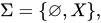
As another example, any non-constant function is non-measurable with respect to the trivial -algebra since the preimage of any point in the range is some proper, nonempty subset of which is not an element of the trivial

See also

[edit]

Notes

[edit]
[edit]
Revisions and contributorsEdit on WikipediaRead on Wikipedia
from Grokipedia
In measure theory, a measurable function is a mapping between two measurable spaces that preserves measurability in the sense that the preimage of every measurable set in the codomain is a measurable set in the domain.[1] This concept generalizes the notion of continuity from topology, where continuous functions pull back open sets to open sets, to the broader framework of measure spaces where measurable functions pull back measurable sets to measurable sets.[1] Measurable functions form the foundation for integration theory, enabling the definition and study of integrals over spaces equipped with measures, such as the Lebesgue integral on the real line.[2] For real-valued functions f:XRf: X \to \mathbb{R} defined on a measurable space (X,A)(X, \mathcal{A}), measurability is typically with respect to the Borel σ\sigma-algebra on R\mathbb{R}, and it is equivalent to the condition that for every real number aa, the set {xX:f(x)>a}\{x \in X : f(x) > a\} is in A\mathcal{A}.[3] A key subclass consists of simple functions, which are finite linear combinations of indicator functions of measurable sets and serve as building blocks for approximating more general measurable functions.[1] Measurable functions exhibit several important algebraic and limit properties that facilitate their use in analysis. The sum and product of two measurable functions are measurable, as are scalar multiples, though the class is not closed under composition unless the outer function is continuous.[3] Pointwise limits of sequences of measurable functions are also measurable, which underpins theorems like the monotone convergence theorem for integration.[1] In complete measure spaces, functions that agree almost everywhere with measurable functions are themselves measurable, allowing for equivalence classes modulo sets of measure zero.[1] These properties ensure that measurable functions are robust under the operations central to probability and analysis, extending beyond continuous functions to handle phenomena like discontinuities on sets of measure zero.[4]

Foundations of Measure Theory

Measure Spaces

A measure space is a basic structure in measure theory, consisting of a triple (X,Σ,μ)(X, \Sigma, \mu), where XX is an arbitrary set, Σ\Sigma is a σ\sigma-algebra on XX (the collection of measurable sets), and μ\mu is a measure defined on Σ\Sigma.[5][6] A measure μ\mu is a non-negative extended real-valued set function on Σ\Sigma satisfying μ()=0\mu(\emptyset) = 0 and countable additivity: for any countable collection of pairwise disjoint sets {An}n=1Σ\{A_n\}_{n=1}^\infty \subset \Sigma, μ(n=1An)=n=1μ(An)\mu\left(\bigcup_{n=1}^\infty A_n\right) = \sum_{n=1}^\infty \mu(A_n).[7][5] This ensures that μ\mu assigns a consistent notion of "size" or "volume" to the measurable subsets of XX, generalizing concepts like length, area, and probability.[6] Prominent examples include the Lebesgue measure on Rn\mathbb{R}^n, which assigns to each measurable set its "volume" in the sense of integration, such as the length of intervals in R\mathbb{R}.[8] The counting measure on a countable set XX defines μ(A)\mu(A) as the cardinality of AA if AA is finite and \infty otherwise, effectively counting elements.[6] Another example is the Dirac measure δx\delta_x at a point xXx \in X, where δx(A)=1\delta_x(A) = 1 if xAx \in A and 00 otherwise, concentrating all mass at xx.[7] These structures provide the foundational framework for defining integrals and analyzing functions by quantifying the sizes of sets in a rigorous, additive manner.[5]

Measurable Sets and Sigma-Algebras

In measure theory, a σ-algebra on a set XX is a collection F\mathcal{F} of subsets of XX that includes the empty set \emptyset and XX itself, and is closed under complementation and countable unions. Specifically, if AFA \in \mathcal{F}, then its complement XAFX \setminus A \in \mathcal{F}, and if A1,A2,FA_1, A_2, \dots \in \mathcal{F}, then n=1AnF\bigcup_{n=1}^\infty A_n \in \mathcal{F}.[9] These axioms ensure that F\mathcal{F} forms a Boolean algebra extended to countable operations, providing the foundational structure for defining measurable sets.[10] Key properties of σ-algebras include closure under countable intersections, which follows from De Morgan's laws applied to complements of unions, and closure under finite unions and intersections as special cases of the countable versions. Additionally, σ-algebras are monotone in the sense that if ABA \subseteq B with A,BFA, B \in \mathcal{F}, then BAFB \setminus A \in \mathcal{F} via differences, though not all subsets between elements need be included. The closure under countable unions ensures that arbitrary countable collections of sets in F\mathcal{F} yield unions still in F\mathcal{F}, without requiring disjointness. Measures are defined as countably additive set functions on σ-algebras and satisfy subadditivity for general countable unions.[9][10] The σ-algebra generated by a family of sets BP(X)\mathcal{B} \subseteq \mathcal{P}(X) (the power set of XX) is the smallest σ-algebra containing B\mathcal{B}, obtained as the intersection of all σ-algebras that include B\mathcal{B}. This generated σ-algebra, denoted σ(B)\sigma(\mathcal{B}), captures the minimal extension needed for measurability starting from B\mathcal{B}. For example, the power set P(X)\mathcal{P}(X) itself is a σ-algebra, as it includes all subsets and is closed under all required operations, serving as the largest possible σ-algebra on XX.[9][10] In topological spaces, the Borel σ-algebra B(X)\mathcal{B}(X) is generated by the open sets of the topology, making it the smallest σ-algebra containing all open subsets; this construction is fundamental for Borel measurability in Rn\mathbb{R}^n or more general spaces. The Lebesgue σ-algebra on R\mathbb{R} extends the Borel σ-algebra by completion with respect to Lebesgue measure, incorporating all subsets of Borel null sets to form a larger collection while preserving measure properties.[11][12]

Definition and Variations

Formal Definition

In measure theory, a measurable function is defined between two measurable spaces. Let (X,ΣX)(X, \Sigma_X) and (Y,ΣY)(Y, \Sigma_Y) be measurable spaces, where ΣX\Sigma_X and ΣY\Sigma_Y are σ\sigma-algebras on sets XX and YY, respectively. A function f:XYf: X \to Y is measurable if the preimage f1(E)ΣXf^{-1}(E) \in \Sigma_X for every set EΣYE \in \Sigma_Y.[1] This condition ensures that the function preserves the structure of measurability under inverse images. A key property underlying this definition is the behavior of preimages under set operations. For a countable collection of sets {Ei}iIΣY\{E_i\}_{i \in I} \subset \Sigma_Y, the preimage satisfies f1(iIEi)=iIf1(Ei)f^{-1}\left( \bigcup_{i \in I} E_i \right) = \bigcup_{i \in I} f^{-1}(E_i), which aligns with the closure properties of σ\sigma-algebras.[1] For real-valued functions, the definition specializes to the Borel σ\sigma-algebra on R\mathbb{R}. Consider a measurable space (X,Σ)(X, \Sigma) and a function f:XRf: X \to \mathbb{R}. The function ff is measurable if f1(B)Σf^{-1}(B) \in \Sigma for every Borel set BB(R)B \in \mathcal{B}(\mathbb{R}), where B(R)\mathcal{B}(\mathbb{R}) is generated by the open intervals of R\mathbb{R}.[1] An equivalent condition is that f1((a,))Σf^{-1}((a, \infty)) \in \Sigma for all aRa \in \mathbb{R}, since the half-lines generate the Borel σ\sigma-algebra.[1] This framework extends to the extended real line R=R{±}\overline{\mathbb{R}} = \mathbb{R} \cup \{\pm \infty\}. A function f:XRf: X \to \overline{\mathbb{R}} is measurable if f1(B)Σf^{-1}(B) \in \Sigma for every Borel set BB(R)B \in \mathcal{B}(\overline{\mathbb{R}}), or equivalently, if {xX:f(x)<b}Σ\{x \in X : f(x) < b\} \in \Sigma for all bRb \in \overline{\mathbb{R}}.[1] For complex-valued functions, f:XCf: X \to \mathbb{C}, measurability holds if and only if both the real part Ref\operatorname{Re} f and the imaginary part Imf\operatorname{Im} f are measurable as real-valued functions.[13]

Terminology and Contextual Usage

In measure theory, the term "measurable function" typically refers to a function f:XRf: X \to \mathbb{R} defined on a measurable space (X,A)(X, \mathcal{A}) such that the preimage f1(B)f^{-1}(B) belongs to A\mathcal{A} for every Borel set BRB \subseteq \mathbb{R}.[1] A key distinction arises between Borel measurability and Lebesgue measurability on Rn\mathbb{R}^n. A function is Borel measurable if the preimage of every Borel set is a Borel set, whereas it is Lebesgue measurable if the preimage of every Borel set is Lebesgue measurable; the latter class is larger because the Lebesgue σ\sigma-algebra includes all Borel sets plus certain null sets and their complements.[1] In probability theory, measurable functions play a central role as random variables, defined on a probability space (Ω,F,P)(\Omega, \mathcal{F}, P) and taking values in R\mathbb{R} (or more generally, a measurable space), such that the preimage of every Borel set in R\mathbb{R} lies in F\mathcal{F}.[14] This usage allows probabilities to be assigned to events of the form {ωΩ:X(ω)B}\{ \omega \in \Omega : X(\omega) \in B \}, where XX is the random variable, facilitating the analysis of stochastic processes and expectations.[14] Historically, the concept of measurability was formalized by Constantin Carathéodory in 1914 through his extension theorem, which constructs measures from outer measures and defines measurable sets via a splitting condition, thereby linking measurability directly to the foundations of integration theory.[15] In more advanced contexts, such as Bochner integration on Banach spaces, variations like "weakly measurable" and "strongly measurable" functions emerge. A function ff with values in a Banach space XX is weakly measurable if its composition with every continuous linear functional from the dual space XX' is scalar measurable, while it is strongly measurable if it is the almost everywhere pointwise limit of simple functions with values in XX.[16] Additionally, two functions are often considered equivalent if they agree almost everywhere with respect to the underlying measure, preserving measurability properties in LpL^p spaces.[1]

Properties of Measurable Functions

Algebraic and Arithmetic Properties

Measurable functions exhibit closure under various algebraic and arithmetic operations, forming a vector space over the real or complex numbers when restricted to finite-valued functions. Specifically, if ff and gg are measurable functions from a measurable space (X,M)(X, \mathcal{M}) to R\mathbb{R}, then their pointwise sum f+gf + g is also measurable. This follows from expressing the preimage (f+g)1((,b))=q,rQq+r<bf1((,q))g1((,r))(f + g)^{-1}((-\infty, b)) = \bigcup_{\substack{q, r \in \mathbb{Q} \\ q + r < b}} f^{-1}((-\infty, q)) \cap g^{-1}((-\infty, r)), which is a countable union of intersections of measurable sets, hence measurable.[1] Similarly, scalar multiplication preserves measurability: for any constant kRk \in \mathbb{R} and measurable f:XRf: X \to \mathbb{R}, the function kfk f is measurable. If k>0k > 0, then (kf)1((,b))=f1((,b/k))(k f)^{-1}((-\infty, b)) = f^{-1}((-\infty, b/k)), which is measurable; the case k<0k < 0 follows analogously by reflecting the preimage, and k=0k = 0 yields the constant zero function, which is measurable.[1] More generally, the set of finite-valued measurable functions on (X,M)(X, \mathcal{M}) is closed under pointwise addition and scalar multiplication, making it a vector space.[17] Composition of measurable functions also preserves measurability. If f:(X,MX)(Y,MY)f: (X, \mathcal{M}_X) \to (Y, \mathcal{M}_Y) and g:(Y,MY)(Z,MZ)g: (Y, \mathcal{M}_Y) \to (Z, \mathcal{M}_Z) are measurable, then gf:XZg \circ f: X \to Z is measurable, since for any EMZE \in \mathcal{M}_Z, (gf)1(E)=f1(g1(E))(g \circ f)^{-1}(E) = f^{-1}(g^{-1}(E)), and both g1(E)MYg^{-1}(E) \in \mathcal{M}_Y and its preimage under ff are in MX\mathcal{M}_X.[1] This property extends to cases where the codomain is equipped with the Borel σ\sigma-algebra, such as when composing with Borel measurable functions on R\mathbb{R}.[18] The class of measurable functions is stable under pointwise limits. If {fn}\{f_n\} is a sequence of measurable functions from (X,M)(X, \mathcal{M}) to R\overline{\mathbb{R}} (the extended reals) converging pointwise to f:XRf: X \to \overline{\mathbb{R}}, then ff is measurable. This holds because ff can be expressed using limsup and liminf operations, each of which is measurable as a pointwise supremum or infimum of measurable functions: for instance, lim supnfn=infn1supknfk\limsup_{n \to \infty} f_n = \inf_{n \geq 1} \sup_{k \geq n} f_k, and such countable suprema and infima preserve measurability.[1] Consequently, uniform limits, monotone limits, and other sequential limits of measurable functions remain measurable, facilitating approximations in integration theory.[19]

Continuity and Topological Relations

In measure theory, the relationship between continuity and measurability highlights how topological regularity aligns with σ-algebra structures. A continuous function f:XYf: X \to Y between topological spaces equipped with their Borel σ-algebras is Borel measurable, as the preimage f1(U)f^{-1}(U) of any open set UYU \subseteq Y is open in XX, hence Borel.[20] This follows directly from the definition of the Borel σ-algebra generated by open sets and the continuity condition that preserves openness under inverse images.[20] Lusin's theorem further bridges measurability and continuity by asserting that every finite-valued Borel measurable function on a compact metric space is continuous on a subset whose complement has arbitrarily small measure.[21] Specifically, for any ϵ>0\epsilon > 0, there exists a compact set KK with measure at least μ(X)ϵ\mu(X) - \epsilon such that ff restricted to KK is continuous.[21] This result underscores that Borel measurability implies near-continuity in the measure-theoretic sense on compact domains. Extending to Lebesgue measurable functions on R\mathbb{R}, the Denjoy-Young-Saks theorem implies that such functions are approximately continuous almost everywhere.[22] Approximate continuity at a point xx means that for every ϵ>0\epsilon > 0, the density of f1(B(f(x),ϵ))f^{-1}(B(f(x), \epsilon)) at xx is 1, where density is taken with respect to Lebesgue measure; this holds except on a set of measure zero, reflecting the theorem's classification of Dini derivatives almost everywhere.[22] Regarding Baire category, measurable functions avoid certain pathological discontinuities prevalent in the first category. In particular, every Lebesgue measurable function coincides almost everywhere with a function of Baire class 2, ensuring that its discontinuities do not form a comeager set and thus sidestep the dense-in-itself irregularities that plague non-measurable examples.[23] This topological regularity complements measure-theoretic properties, as the Baire category theorem guarantees that residual sets of discontinuities are meager, aligning measurable functions with "generic" continuous-like behavior in complete metric spaces.[24]

Classes of Measurable Functions

Simple and Step Functions

In measure theory, a simple function on a measurable space (X,A)(X, \mathcal{A}) is a measurable function ϕ:XR\phi: X \to \mathbb{R} that can be expressed as a finite linear combination of indicator functions of measurable sets, specifically ϕ=i=1nciχEi\phi = \sum_{i=1}^n c_i \chi_{E_i}, where each ciRc_i \in \mathbb{R}, the EiAE_i \in \mathcal{A} are measurable sets (often taken to be disjoint in a canonical representation), and χEi\chi_{E_i} is the characteristic function of EiE_i.[1] This form ensures that ϕ\phi takes only finitely many values, and every simple function admits such a representation with finitely many nonzero cic_i.[25] Simple functions form an algebra under pointwise addition and multiplication, preserving measurability and the finite-range property.[25] In the specific context of functions on R\mathbb{R} (or intervals thereof) equipped with the Lebesgue σ\sigma-algebra, a step function is a simple function that is constant on a finite collection of subintervals, meaning the sets EiE_i are finite unions of intervals.[26] Thus, every step function is simple, as intervals are Lebesgue measurable, but the converse does not hold in general, since simple functions can involve arbitrary measurable sets rather than just intervals.[26] Step functions arise naturally in Riemann integration as piecewise constant approximations but gain broader utility in Lebesgue theory for their role in foundational constructions.[27] Simple functions play a central role in defining the Lebesgue integral on Rd\mathbb{R}^d. For a nonnegative simple function ϕ=i=1nciχEi\phi = \sum_{i=1}^n c_i \chi_{E_i} with ci0c_i \geq 0 and Lebesgue measurable EiE_i, the Lebesgue integral is defined as Rdϕdm=i=1ncim(Ei)\int_{\mathbb{R}^d} \phi \, dm = \sum_{i=1}^n c_i m(E_i), where mm denotes Lebesgue measure; this extends linearly to general simple functions and provides the basis for integrating arbitrary nonnegative measurable functions via monotone approximation by simple functions.[27] Under Lebesgue measure on Rd\mathbb{R}^d, the simple functions are dense in the LpL^p spaces for 1p<1 \leq p < \infty, meaning that for any fLp(Rd)f \in L^p(\mathbb{R}^d) and ϵ>0\epsilon > 0, there exists a simple function ϕ\phi such that fϕp<ϵ\|f - \phi\|_p < \epsilon.[28] This density follows from the pointwise approximation of measurable functions by increasing sequences of simple functions and the dominated convergence theorem applied to the pp-th powers.[28]

Borel and Lebesgue Measurable Functions

In real analysis, a function f:RnRf: \mathbb{R}^n \to \mathbb{R} is Borel measurable if the preimage f1(B)f^{-1}(B) is a Borel set for every Borel set BRB \subseteq \mathbb{R}, where the Borel σ\sigma-algebra on Rn\mathbb{R}^n is generated by the open sets.[1] This class includes all continuous functions, as the preimage under a continuous map of an open set (and hence any Borel set) is open and thus Borel.[1] Polynomials, being continuous, are therefore Borel measurable.[1] A function f:RnRf: \mathbb{R}^n \to \mathbb{R} is Lebesgue measurable if f1(B)f^{-1}(B) belongs to the Lebesgue σ\sigma-algebra for every Borel set BRB \subseteq \mathbb{R}.[1] The Lebesgue σ\sigma-algebra is the completion of the Borel σ\sigma-algebra with respect to Lebesgue measure, consisting of all sets of the form ANA \cup N or ANA \setminus N, where AA is Borel and NN is contained in a Borel set of measure zero.[12] Every Borel measurable function is Lebesgue measurable, since Borel sets are Lebesgue measurable, but the converse does not hold.[1] However, every Lebesgue measurable function equals a Borel measurable function almost everywhere with respect to Lebesgue measure.[1] Lusin's theorem characterizes Lebesgue measurable functions through their near-continuity. Specifically, for a Lebesgue measurable set ERdE \subseteq \mathbb{R}^d and a function f:ECf: E \to \mathbb{C}, ff is measurable if and only if for every ε>0\varepsilon > 0, there exists a compact set KEK \subseteq E with m(EK)<εm(E \setminus K) < \varepsilon such that ff restricted to KK is continuous.[29] Lusin spaces generalize this property to broader topological settings. A topological measure space (X,μ)(X, \mu) is a Lusin space if μ(X)<\mu(X) < \infty and every real-valued μ\mu-measurable function on XX equals a continuous function μ\mu-almost everywhere.[30] In such spaces, the topology ensures that measurability implies near-continuity for all finite Borel measures.[31]

Non-Measurable Functions

Existence and Axiom of Choice

The existence of non-measurable functions is closely tied to the existence of non-measurable sets, as the characteristic function of a non-measurable set is itself non-measurable with respect to the Lebesgue σ-algebra.[32] In 1905, Giuseppe Vitali provided the first construction of a non-Lebesgue measurable subset of the real line, relying implicitly on the axiom of choice to select representatives from equivalence classes under rational translations.[32] This marked the historical recognition that the axiom of choice enables the formation of sets outside the Lebesgue measurable class. The axiom of choice (AC), which asserts that for any collection of nonempty sets there exists a choice function selecting one element from each, implies the existence of non-Lebesgue measurable subsets of Rn\mathbb{R}^n for any n1n \geq 1.[32] Specifically, AC allows the construction of a set that intersects every interval in a way that defies additive measure properties, leading to non-measurable indicator functions.[](https://e.math.cornell.edu/people/belk/measure theory/NonMeasurableSets.pdf) A striking illustration of this implication is the Banach-Tarski paradox, proved in 1924, which uses AC to decompose the unit ball in R3\mathbb{R}^3 into finitely many pieces that can be reassembled via rigid motions into two copies of the original ball. These pieces are non-measurable sets, as any measurable decomposition preserving Lebesgue measure would violate volume additivity, thus yielding non-measurable functions when considering their indicators or transformations. The necessity of AC for non-measurability is underscored by results in set theory without choice. In 1970, Robert M. Solovay constructed a model of Zermelo-Fraenkel set theory (ZF) plus the axiom of dependent choices (DC) in which every set of real numbers is Lebesgue measurable, demonstrating that the existence of non-measurable sets (and hence non-measurable functions) is not provable in ZF alone and requires AC. This model, built using an inaccessible cardinal in the base theory, preserves DC for countable choice while ensuring all subsets of R\mathbb{R} belong to the Lebesgue σ-algebra, highlighting AC's role in permitting pathological non-measurable phenomena.

Constructions and Examples

One prominent construction of a non-measurable set, and thus a non-measurable function, is the Vitali set, introduced by Giuseppe Vitali in 1905. Consider the real numbers R\mathbb{R} modulo the rationals Q\mathbb{Q}, forming equivalence classes where xyx \sim y if xyQx - y \in \mathbb{Q}. Using the axiom of choice, select one representative from each equivalence class intersected with the interval [0,1)[0,1) to form the set V[0,1)V \subset [0,1). This set VV is dense in [0,1)[0,1) and intersects every subinterval of [0,1)[0,1) with positive length.[33] To see that VV is non-Lebesgue measurable, consider the countable collection of disjoint sets Vn=(V+rn)[0,1)V_n = (V + r_n) \cap [0,1), where {rn}\{r_n\} enumerates Q(1,1)\mathbb{Q} \cap (-1,1). These sets are measurable with the same measure as VV (by translation invariance), and their union is [0,1)[0,1). If μ(V)>0\mu(V) > 0, then μ([0,1))=μ(Vn)=>1\mu([0,1)) = \sum \mu(V_n) = \infty > 1, a contradiction. If μ(V)=0\mu(V) = 0, then μ([0,1))=0<1\mu([0,1)) = 0 < 1, another contradiction. Thus, VV is non-measurable, and its indicator function 1V:R{0,1}1_V: \mathbb{R} \to \{0,1\}, defined by 1V(x)=11_V(x) = 1 if xVx \in V and 0 otherwise, is non-measurable since the preimage of {1}\{1\} is VV, which fails the measurability condition for Borel sets.[33] Another construction yields non-measurable functions via a Hamel basis for R\mathbb{R} as a vector space over Q\mathbb{Q}. The axiom of choice guarantees the existence of such a basis BB, an uncountable set where every real number has a unique finite linear combination representation with rational coefficients from elements of BB. Define a linear functional f:RRf: \mathbb{R} \to \mathbb{R} by assigning arbitrary values to basis elements (e.g., f(b)=1f(b) = 1 for all bBb \in B) and extending linearly. This ff is Q\mathbb{Q}-linear but discontinuous everywhere, hence non-measurable, as continuous linear functionals on R\mathbb{R} are merely multiplication by a constant.[34] The Sierpiński–Mazurkiewicz paradox provides further examples of non-measurable sets through paradoxical decompositions in the plane. In 1914, Sierpiński and Mazurkiewicz showed that there exists a set ER2E \subset \mathbb{R}^2 that can be partitioned into two disjoint subsets E1E_1 and E2E_2, each congruent to EE via isometries, implying EE is non-measurable under Lebesgue measure since measurable sets cannot satisfy such equidecomposability without measure preservation. The indicator functions 1E11_{E_1} and 1E21_{E_2} are likewise non-measurable. This construction relies on the axiom of choice to select representatives in a decomposition involving free groups acting on the plane.[35]

References

User Avatar
No comments yet.







