Hubbry Logo
Sega Genesis MiniSega Genesis MiniMain
Open search
Sega Genesis Mini
Community hub
Sega Genesis Mini
logo
8 pages, 0 posts
0 subscribers
Be the first to start a discussion here.
Sega Genesis Mini
Sega Genesis Mini
from Wikipedia

Sega Genesis Mini
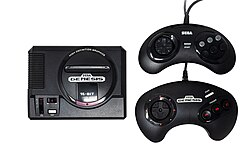
The Sega Genesis Mini with official 6 button and 3 button controllers
Also known asMega Drive Mini
DeveloperSega, M2
ManufacturerSega
TypeDedicated home video game console
Release date
  • WW: September 19, 2019
  • EU, ME: October 4, 2019
Lifespan2019–present
Introductory price
MediaInternal flash memory
Operating systemLinux kernel
System on a chipZUIKI Z7213
Memory256 MB of RAM
Storage512 MB flash storage
Controller input2 controller ports
PowerAXP223
Dimensions154 mm × 39 mm × 116 mm
SuccessorSega Genesis Mini 2

The Sega Genesis Mini, known as the Mega Drive Mini in regions outside of North America, is a dedicated console modeled on the Sega Genesis. The Mini emulates the original console's 16-bit hardware, and includes 42 games made available through emulation software by M2. It was released in North America and Japan in September 2019 and in Europe and the Middle East in October 2019. A follow-up, Sega Genesis Mini 2, was released in October 2022 and includes 60 games from the Genesis and Sega CD.

Hardware and accessories

[edit]

The Mini is half the size of the original Sega Genesis. Inside the unit is an ARM-based SOC ZUIKI Z7213[4] and 512 MB of flash memory.[1] It includes either one or two (dependent on region's bundle options) full-size replica controllers that connect through USB (thus original controllers are incompatible),[5] a USB-to-Micro-B power cable (USB AC adapter in North America), and an HDMI video cable.[1] There are separate releases for North America, Europe, Asia and Japan, as the Mini reproduces the original console's decal and color variations in those regions.[1][6] Korea is a slight exception, as the Mega Drive was released there by Samsung as the Super Gam*Boy and Super Aladdin Boy; none of these names appear on the Korean Mini.[7]

All of the games have a save state feature to pause and resume progress and can be played in either the original 4:3 aspect ratio with optional wallpapers or stretched to 16:9 widescreen with HUD elements modified to fit onto the screen.[8] Certain games have regional variants that can be accessed by changing the system's language settings (e.g. switching the system language from English to Japanese will change Dr. Robotnik's Mean Bean Machine into Puyo Puyo.)[2][9]

The North American and European models of the Genesis Mini come bundled with two three-button controllers, while the Japanese model comes with two six-button controllers.[5] Officially licensed six-button controllers made specifically for the Mini are also sold separately in North America and Europe.[10] Official model accessories of a miniature Mega-CD, a miniature Super 32X, a miniature Sonic & Knuckles lock-on Genesis cartridge, and a miniature Sonic the Hedgehog standard Mega Drive cartridge were also sold separately in Japan.[11] Miniature replicas of the Sega CD and Sega 32X in both the North American and European versions were also manufactured but only distributed to select members of the media.[12]

The Mini 2 system is modeled after the Mega Drive 2 variant of the original console and comes bundled with over 50 games and a single six-button controller in all regions. It uses the same SOC chip as the first Mini, albeit with more memory and storage. In addition to the first Mini's emulation features, the Mini 2 includes the option to emulate the sound outputs of the original Genesis or Genesis 2. Like with the original Mega Drive Mini, a set of model accessories consisting of a miniature Mega-CD 2, a miniature Virtua Racing cartridge, and a miniature Sonic CD disc was released in Japan alongside the system, including compatibility parts with the first Mega Drive Mini and its accessories.[1] Additionally, a USB-powered Cyber Stick controller based on the original flight stick controller produced by Sharp was released alongside the system in Japan and provides analog input for After Burner II, Night Striker, and Starblade.[13][14]

Games

[edit]

Sega Genesis Mini

[edit]

The Sega Genesis Mini features 40 Sega Genesis games, with the selection varying depending on the region. In addition to these titles, the game includes two bonus games, Darius and Tetris, which are new conversions made for the Mini system that were previously never released for the original console.[15]

Games Copyright NA/EU[16] Japan[17] Asia[18][19]
Alex Kidd in the Enchanted Castle Sega Yes No No
Alien Soldier Sega No No Yes
Alisia Dragoon Game Arts Yes Yes Yes
Altered Beast Sega Yes No No
Beyond Oasis Sega Yes Yes Yes
Castle of Illusion Starring Mickey Mouse Sega / Disney Yes No Yes
Castlevania: Bloodlines Konami Yes Yes Yes
Columns Sega Yes Yes Yes
Comix Zone Sega Yes Yes Yes
Contra: Hard Corps Konami Yes Yes Yes
Darius[a] Taito Yes Yes Yes
Dr. Robotnik's Mean Bean Machine[b] Sega Yes No Yes
Dyna Brothers 2 Sega No Yes No
Dynamite Headdy Sega Yes Yes No
Earthworm Jim Interplay Entertainment Yes No No
Ecco the Dolphin Sega Yes No No
Eternal Champions Sega Yes No No
Game no Kanzume Otokuyou[c] Sega No Yes Yes
Ghouls 'n Ghosts Capcom Yes Yes Yes
Golden Axe Sega Yes Yes Yes
Gunstar Heroes Sega Yes Yes Yes
The Hybrid Front Sega No Yes No
Kid Chameleon Sega Yes No No
Landstalker: The Treasures of King Nole Sega Yes Yes Yes
Langrisser II Extreme No Yes Yes
Light Crusader Sega Yes No No
Lord Monarch Nihon Falcom No Yes No
Madō Monogatari I Sega / D4 Enterprise No Yes No
Mega Man: The Wily Wars Capcom Yes Yes Yes
Monster World IV Sega / LAT Yes Yes Yes
MUSHA Sega / M2 No Yes Yes
OutRun 2019 Sega No No Yes
Party Quiz Mega Q Sega No Yes No
Phantasy Star IV: The End of the Millennium Sega Yes Yes Yes
Powerball Namco No Yes Yes
Puyo Puyo 2 Sega No Yes Yes
Puzzle & Action: Tant-R Sega No Yes Yes
Rent a Hero Sega No Yes No
The Revenge of Shinobi Sega No Yes Yes
Road Rash II Electronic Arts Yes Yes Yes
Shining Force Sega Yes Yes Yes
Shining Force II Sega No No Yes
Shinobi III: Return of the Ninja Master Sega Yes No No
Slap Fight MD Tatsujin No Yes Yes
Snow Bros. Tatsujin No Yes Yes
Sonic Spinball Sega Yes No No
Sonic the Hedgehog Sega Yes No Yes
Sonic the Hedgehog 2 Sega Yes Yes Yes
Space Harrier II Sega Yes Yes Yes
Street Fighter II': Special Champion Edition Capcom Yes Yes No
Streets of Rage 2 Sega Yes Yes Yes
Strider Capcom Yes No Yes
Super Fantasy Zone Sunsoft Yes Yes Yes
Sword of Vermilion Sega No No Yes
Target Earth Extreme No Yes Yes
Tetris[d] Sega / The Tetris Company Yes Yes Yes
Thunder Force III Sega Yes Yes Yes
ToeJam & Earl ToeJam & Earl Productions Yes No No
Vectorman Sega Yes No No
Virtua Fighter 2 Sega Yes No No
Wonder Boy in Monster World Sega / LAT Yes No Yes
World of Illusion Sega / Disney Yes Yes Yes
Yu Yu Hakusho Makyō Tōitsusen Sega No Yes No

Sega Genesis Mini 2

[edit]

The Sega Genesis Mini 2 features 53 games released for both the Genesis and the Sega CD add-on peripheral. Like the original Mini, the Mini 2 also features seven additional games that were never released for the Genesis, including both unreleased games and new arcade ports.[20][21]

Games Copyright Platform NA/EU[22] Japan[23]
Aah! Harimanada Sega Genesis No Yes
After Burner II Sega Genesis Yes Yes
Alien Soldier Sega Genesis Yes Yes
Atomic Runner Chelnov Paon DP Genesis Yes Yes
Bonanza Bros. Sega Genesis Yes Yes
Captain Tsubasa Koei Tecmo Sega CD No Yes
ClayFighter Interplay Genesis Yes No
Columns III: Revenge of Columns Sega Genesis No Yes
Crusader of Centy Sega Genesis Yes Yes
Desert Strike: Return to the Gulf Electronic Arts Genesis Yes No
Devi & Pii[e] Sega Genesis Yes Yes
Earthworm Jim 2 Interplay Genesis Yes No
Ecco the Dolphin Sega Sega CD Yes Yes
Ecco: The Tides of Time Sega Sega CD Yes Yes
Elemental Master Sega Genesis Yes No
Fantasy Zone[a] Sega Genesis Yes Yes
Fatal Fury 2 SNK Genesis Yes Yes
Final Fight CD Capcom Sega CD Yes Yes
Gain Ground Sega Genesis Yes Yes
Gambler Jiko Chuushinha[f] Game Arts Genesis No Yes
Golden Axe II Sega Genesis Yes No
Granada Edia Genesis Yes Yes
Hellfire Tatsujin Genesis Yes No
Herzog Zwei Sega Genesis Yes No
Honō no Tōkyūji: Dodge Danpei Sega Genesis No Yes
Lunar: Eternal Blue Game Arts Sega CD No Yes
Lunar: The Silver Star Game Arts Sega CD No Yes
Magical Taruruto-kun Sega Genesis No Yes
Mahou no Shoujo Edia Sega CD No Yes
Mansion of Hidden Souls Sega Sega CD Yes Yes
Megapanel Namco Genesis No Yes
Midnight Resistance G-Mode Genesis Yes Yes
Nadia: The Secret of Blue Water Namco Genesis No Yes
Night Striker Taito Sega CD Yes Yes
Night Trap Hasbro Sega CD Yes Yes
The Ninja Warriors Taito Sega CD Yes Yes
The Ooze Sega Genesis Yes No
Out Run Sega Genesis Yes Yes
OutRunners Sega Genesis Yes No
Party Quiz Mega Q 2022[g] Sega Genesis No Yes
Party Quiz Sega Q[g] Sega Genesis No Yes
Phantasy Star II[h] Sega Genesis Yes Yes
Popful Mail Nihon Falcom Sega CD No Yes
Populous Electronic Arts Genesis Yes Yes
Puzzle & Action: Ichidant-R Sega Genesis No Yes
Rainbow Islands Extra Taito Genesis Yes No
Ranger X Sega Genesis Yes Yes
The Revenge of Shinobi Sega Genesis Yes No
Ristar Sega Genesis Yes No
Robo Aleste Sega / M2 Sega CD Yes Yes
Rolling Thunder 2 Namco Genesis Yes No
Romance of the Three Kingdoms III: Dragon of Destiny Koei Tecmo Genesis / Sega CD No Yes
Sewer Shark Hasbro Sega CD Yes No
Shadow Dancer: The Secret of Shinobi Sega Genesis Yes No
Shin Megami Tensei Atlus Sega CD No Yes
Shining Force CD Sega Sega CD Yes Yes
Shining Force II Sega Genesis Yes No
Shining in the Darkness Sega Genesis Yes Yes
Silpheed Game Arts Sega CD Yes Yes
Sonic 3D Blast Sega Genesis Yes No
Sonic CD[i] Sega Sega CD Yes Yes
Sorcerian Nihon Falcom Genesis No Yes
Space Harrier II[j] Sega Genesis Yes Yes
Spatter[a] Sega Genesis Yes Yes
Splatterhouse 2 Namco Genesis Yes Yes
Star Cruiser Extreme Genesis No Yes
Star Mobile[k] Mindware Genesis Yes Yes
Starblade Namco Sega CD No Yes
Streets of Rage 3 Sega Genesis Yes No
Super Hang-On Sega Genesis Yes No
Super Locomotive[a] Sega Genesis Yes Yes
Super Street Fighter II: The New Challengers Capcom Genesis Yes Yes
Tenka Fubu: Eiyūtachi no Hōkō Game Arts Sega CD No Yes
Thunder Force IV Sega Genesis Yes Yes
ToeJam & Earl in Panic on Funkotron ToeJam & Earl Productions Genesis Yes No
Tōgi Ō: King Colossus Sega Genesis No Yes
Truxton Tatsujin Genesis Yes Yes
Vectorman 2 Sega Genesis Yes No
Viewpoint[l] Sega Genesis Yes Yes
Virtua Racing Sega Genesis Yes Yes
VS Puyo Puyo Sun[m] Sega Genesis Yes Yes
Warsong Extreme Genesis Yes No
Wondermega Collection[n] Sega Sega CD No Yes

Production and release

[edit]

The Sega Genesis Mini was first announced at the Sega Fes show in April 2018.[1] The announcement was part of a trend of releasing smaller versions of retro video game consoles.[5] It was delayed in September, missing the console's 30th-anniversary window,[24] when Sega dropped its partnership with AtGames,[1] whose 2017 Sega Genesis Flashback was critically panned for its production quality.[2][5] Instead of using AtGames's Flashback software on a Japan-exclusive Mini, Sega handled the entire production of the system.[2] The system was released worldwide on September 19, 2019,[1] except in Europe and the Middle East, where it was delayed until October 4, 2019, due to distribution issues.[25]

M2, who previously collaborated with Sega on the Sega Ages and Sega 3D Classics Collection series, produced the Mini's ports.[1] Sega emphasized first-party production quality in its marketing for the Mini,[5] as the company returns to the hardware business after last producing the Sega Dreamcast in 2001.[26] The menu music was written by Yuzo Koshiro, who was also the composer of the compilation's Beyond Oasis, Streets of Rage 2, and The Revenge of Shinobi.[2] The Sega Genesis Mini had sold over 300,000 units by the end of March 2020.[27]

A followup, the Sega Genesis Mini 2, was released worldwide on October 27, 2022.[28][29] Koshiro returned to write the menu music.[30]

Notes

[edit]

References

[edit]
[edit]
Revisions and contributorsEdit on WikipediaRead on Wikipedia
from Grokipedia
The Sega Genesis Mini is a dedicated retro developed by as a downsized of the original 16-bit (known as the Mega Drive in regions outside ), emulating its hardware to run classic titles from the late 1980s and 1990s. Released in 2019, it connects to modern televisions via and comes pre-loaded with 42 built-in games, eliminating the need for physical cartridges while providing a plug-and-play experience for nostalgic gamers. The device measures approximately 1.2 by 6.2 by 4.7 inches, featuring detailed cosmetic elements like faux cartridge slots and expansion port covers that mimic the original hardware. Announced in 2018 and launched on September 19, 2019, in and (with a European release on October 4, 2019), the console retailed for $79.99 in the United States, including two wired 3-button controllers, an cable, and a micro-USB power adapter. Powered by a low-energy ARM-based processor with 256 MB of RAM and a ZUIKI Z7213 system-on-chip, it outputs video at up to resolution and supports customizable screen filters like CRT scanlines for an authentic retro look. Emulation is handled by Sega's partner studio , ensuring high-fidelity recreation of the original system's audio and visuals, with two USB ports for the included controllers or additional peripherals. The game library spans a variety of genres, including platformers like and , beat 'em ups such as , shooters like , and puzzles including . A firmware update added features like save states, rewind functionality, and regional game access, enhancing usability without requiring external modifications. While limited to its built-in titles and lacking a 6-button controller option out of the box, the console was praised upon release for its diverse selection—twice that of competitors like the SNES Classic—and straightforward setup, earning scores of 9/10 from and 8.8/10 from for delivering accessible 16-bit nostalgia.

Overview

Sega Genesis Mini

The Sega Genesis Mini is a dedicated that replicates the original 16-bit system—known internationally as the Sega Mega Drive—in a compact, miniature form factor. Developed by as part of its efforts to revive classic hardware, the device serves as a retro emulation platform, enabling users to experience authentic Genesis gameplay through software-based recreation of the original hardware. Released on September 19, 2019, in and , with a European release on October 4, 2019, the Sega Genesis Mini comes pre-loaded with 42 emulated games from the Genesis library, allowing players to access iconic titles directly without requiring the original console or physical cartridges. Its core purpose targets nostalgia among gamers from the era, providing an accessible entry point to revisit the system's library of fast-paced action, sports, and adventure games that defined Sega's 16-bit dominance. The console measures approximately 1.2 by 6.2 by 4.7 inches (height by width by depth), roughly half the size of the original Genesis model for easy integration into modern setups. The package includes the console itself, two wired three-button controllers modeled after the originals, an HDMI cable for modern TV connectivity, a power cable, and an AC adapter to ensure plug-and-play convenience right out of the box. Outside North America, the system is marketed as the Sega Mega Drive Mini in regions such as Europe, Asia, and other international markets, reflecting the original console's global branding. A successor, the Sega Genesis Mini 2, was later released as an expanded version with additional features and a larger game selection.

Sega Genesis Mini 2

The Sega Genesis Mini 2 serves as the successor to the original Sega Genesis Mini, expanding retro gaming capabilities with enhanced emulation features. It was released on October 27, 2022, in , , and select other regions, though production was significantly limited outside , resulting in high demand and widespread popularity through imports for Western consumers. Outside , the console is branded as the Mega Drive Mini 2 to align with regional naming conventions for the original hardware. A primary expansion of the Sega Genesis Mini 2 is its support for 60 pre-installed games, including 12 titles from the library, 7 bonus games consisting of previously unreleased titles and ports, and the remaining from the core library. This iteration introduces optical disc emulation, enabling playback of CD-based titles originally designed for the add-on, thereby broadening access to a wider array of 16-bit era content without requiring physical media. The console retains the miniature form factor of the original while adopting a design inspired by the Model 2, including a top-loading aesthetic element that simulates a disc drive to evoke the attachment. It ships with six-button controllers as standard, an upgrade from the three-button variants of the first Mini, and includes compatibility for peripherals such as a in supported titles, enhancing interactivity for specific emulation scenarios.

Hardware

Design and technical specifications

The Sega Genesis Mini features a compact designed to replicate the styling of the original Model 1 console, measuring approximately 154 mm × 39 mm × 116 mm and representing about 55% of the original's size, with non-functional expansion ports and a cartridge slot for aesthetic purposes. The unit includes a power indicator LED and is powered via a micro-USB port requiring 5V DC input, alongside two USB-A ports dedicated to controller connections. Internally, it employs an ARM-based ZUIKI Z7213 system-on-chip (SoC), consisting of a quad-core Cortex-A7 processor clocked at 1.3 GHz paired with a Mali-400 GPU, running a to handle emulation tasks. The console provides 256 MB of DDR3 RAM and 512 MB of NAND flash storage for the operating system and pre-installed games, with no support for expandable storage. Video and audio output is managed through a single port supporting up to resolution at 60 Hz, which upscales the original 240p games while offering a 16:9 widescreen mode that applies pillarboxing to maintain the native 4:3 aspect ratio of most titles; composite AV output is available only via third-party HDMI-to-composite adapters. The Sega Genesis Mini 2 adopts a similar but styled after the original Genesis Model 2, maintaining the compact form factor with a power switch and LED indicator, while retaining the micro-USB power input and two USB-A controller ports, though with limited additional USB functionality for save state management. It utilizes the same ZUIKI Z7213 SoC architecture at 1.3 GHz but with upgraded resources, including 512 MB of RAM and 8 GB of NAND flash storage to accommodate emulation of titles. The Mini 2's key hardware distinction lies in its enhanced processing capabilities for simulated hardware emulation, featuring improved audio processing to replicate the original add-on's PCM expansion and CD-DA playback. Video and audio outputs mirror the original , with at /60 Hz, widescreen pillarboxing options, and adapter-based composite support.

Controllers and accessories

The Sega Genesis Mini includes two wired 3-button USB controllers modeled after the original Genesis , enabling immediate multiplayer support for compatible titles. These controllers feature a classic layout with , start button, and three action buttons, connected via approximately 6-foot USB cables for direct plug-in to the console's ports. An official 6-button variant, licensed by and produced by Retro-Bit, is available separately for enhanced control in fighting games and other titles requiring additional inputs. In contrast, the Sega Genesis Mini 2 ships with a single wired 6-button USB controller, also approximately 6 feet in length, prioritizing the upgraded layout for its expanded library including games. Both models limit native multiplayer to two players without additional controllers or adapters, and they do not support connectivity out of the box, though third-party USB options like the 8BitDo M30 can be used with compatible receivers. Both consoles support original Sega Genesis controllers through third-party USB adapters that convert the proprietary 9-pin ports to USB, allowing retro enthusiasts to use authentic peripherals for a period-accurate experience. The Sega Genesis Mini 2 extends compatibility to include the Sega Mouse for point-and-click titles like and the Justifier light gun for shooting games such as , provided compatible USB versions or adapters are employed. Additionally, the Mini 2 features an on-screen for text input in select games originally requiring external keyboards, such as Snatcher. Official accessories bundled with both models include an cable for video output and a 5V/1A to 2A micro-USB for power, ensuring straightforward setup on modern displays. Third-party options, such as controller extension cables, display stands, and AV cables for older TVs, enhance usability but are not officially endorsed by . SD card adapters for custom firmware modifications exist in the community but void warranty and are unsupported by the manufacturer. Neither model features a functional cartridge slot, as all content is preloaded digitally, rendering incompatible.

Software

Included games

The Sega Genesis Mini includes a pre-installed library of 42 games, consisting of 40 titles from the original Sega Genesis console and two additional bonus games: a new port of Tetris and a port of Darius from Taito. Key representative titles highlight the system's diverse offerings, such as the platformer Sonic the Hedgehog, the beat 'em up Streets of Rage 2, and the hack-and-slash adventure Golden Axe. The bonus games are unlocked through a specific menu sequence rather than being immediately accessible. The Sega Genesis Mini 2 expands the collection to 60 games, including 46 titles from the Genesis library and seven from the library in the main selection, plus seven unlockable unreleased prototypes and new ports. Notable additions include the Sega CD platformer , the beat 'em up , and enhanced versions of and . Among these are unlockable unreleased prototypes, such as the arcade port of . Regional variations exist in the game selections for both models, with European and Japanese versions swapping certain titles to align with local preferences while maintaining the overall count. For instance, the n library features International Superstar Soccer '94, whereas the Japanese version includes J-League Champion Soccer '94 in its place; no titles are exclusive to beyond minor branding differences. Across both consoles, the libraries emphasize a mix of genres, with platformers (e.g., Sonic the Hedgehog series and Gunstar Heroes), shooters (e.g., Thunder Force III and Alien Soldier), and the remainder covering RPGs (Phantasy Star II), fighters (Street Fighter II), puzzles (Columns), and sports titles. The official game libraries for both the Sega Genesis Mini and Mini 2 are fixed at launch, with no support for downloadable content or post-release updates.

Emulation and interface

The emulation software for the Sega Genesis Mini and its successor, the Sega Genesis Mini 2, was developed by the Japanese studio , running on a custom Linux-based operating system to faithfully replicate the original console's 16-bit hardware , including accurate and visual rendering. This setup provides core features such as save states, with up to four slots per game allowing users to capture and load progress at any moment during . The emulation prioritizes hardware authenticity over modern enhancements, resulting in minor audio delays of 3-4 frames and slight input lag in certain titles, though overall compatibility with the pre-installed library is high. The user interface launches with a boot sequence mimicking the original startup, transitioning to a main menu that presents games as selectable tiles or box art spines, with sorting options by , release year, , or number of supported players. Navigation includes quick access to save and load functions via controller inputs (such as holding the Start button), alongside a region toggle for switching between English and Japanese versions of titles. Video output is handled via at a fixed upscaling to , supporting 4:3 or 16:9 aspect ratios to accommodate various televisions, along with customizable borders and frames for aesthetic enhancement; however, controller button remapping is not available, and the system lacks online connectivity, achievements, or post-launch updates. The Sega Genesis Mini 2 builds on this foundation with enhanced emulation for games, incorporating support for original audio tracks and interactive branching narratives in compatible titles, as well as a dedicated CD game browser and virtual disc-swapping mechanic to simulate multi-disc experiences without . Both models are compatible with third-party 4-player adapters for multiplayer-enabled games, expanding local co-op options beyond the included controllers. These features emphasize offline, nostalgic play, though the absence of higher resolutions beyond and occasional emulation-induced lag remain consistent limitations across versions.

Development and release

Announcement and production

The Sega Genesis Mini was first announced on April 14, 2018, during Sega Fes 2018 in , , as part of celebrations marking the 30th anniversary of the original console's launch in 1988. The initial reveal positioned the device as a compact, plug-and-play featuring built-in emulation of classic titles, with a planned release in late 2018. Development of the original Sega Genesis Mini began in 2017, with initially partnering with AtGames for hardware manufacturing and emulation under license, though concerns over emulation quality led to a mid-project shift. subsequently collaborated with , a long-time partner known for its work on and 3D Classics collections, to handle the emulation and porting of games using original ROM files from 's library. This partnership ensured more accurate reproduction of the original 16-bit hardware experience, with retaining full ownership of the core IP and licensing arrangements facilitating the inclusion of first- and third-party titles. Production for the original Mini spanned 2017 to 2019, but faced significant challenges, including a delay from the fall 2018 target to September 2019 to allow for enhanced on emulation accuracy and hardware . cited unexpectedly high global interest and the need for internal refinements as key factors in the postponement. The Sega Genesis Mini 2 was announced on June 3, 2022, building on the original's success with expanded emulation support for titles and a development process that incorporated lessons from the first model. Its production, amid ongoing post-COVID-19 disruptions, was severely limited by global shortages, resulting in only about one-tenth the units of the original Mini for North American and European markets. Like its predecessor, the Mini 2 relied on Sega's IP ownership for core games sourced from original ROMs, supplemented by new ports of select arcade titles developed by to enhance compatibility and authenticity.

Marketing and regional launches

The Sega Genesis Mini was marketed heavily around nostalgia for the 16-bit era, with promotional campaigns featuring iconic characters like to evoke memories of classic gaming. Advertisements emphasized the console's "plug-and-play" simplicity, allowing users to instantly access 42 pre-loaded games without additional setup, positioning it as an accessible entry into retro gaming. Sega recreated elements of its advertising style, including a modern take on vintage commercials that highlighted the console's compact design and connectivity for modern TVs. Pricing for the original Sega Genesis Mini was set at $79.99 in the United States and £69.99 in the , making it competitively priced against similar retro consoles like the NES and SNES Classics. In , it launched as the Mega Drive Mini at ¥6,980 (approximately $64 USD at the time). The console was distributed through major retailers including Amazon, , and , with pre-orders opening in April to capitalize on holiday season demand. Promotions included bundle offers with additional controllers and during the 2019 holiday period to boost sales as a gift item. The original model launched on September 19, 2019, in and , followed by and the on October 4, 2019, due to a brief regional delay for final preparations. This staggered rollout allowed to align marketing efforts with local retailer availability and build anticipation through region-specific announcements. For the Sega Genesis Mini 2, marketing focused on expanding the retro library with titles and enhanced emulation, again leveraging Sonic branding through trailers featuring games like . Priced at ¥9,980 (approximately $67 USD) in , it was positioned as a premium upgrade with 60 games, including rarities. In , it retailed for $99.99 exclusively through Amazon, while European pricing aligned closely with the U.S. at around €99.99, though availability was limited compared to the original. Distribution emphasized online channels, with gray market imports filling gaps in regions without official stock. The Mini 2 launched simultaneously in , , and on October 27, 2022, with promotions highlighting its vertical design reminiscent of the original Mega Drive Model 2 and bundled six-button controller, aimed at collectors during the fall release window.

Reception

Critical reviews

The Sega Genesis Mini received generally positive reviews upon its 2019 release. Critics praised its strong selection of 42 built-in games, faithful recreation of the original hardware's design, and overall build quality, which contributed to high marks for nostalgic value and ease of use. awarded it a 9/10, highlighting the diverse library and intuitive interface as standout features that surpassed competitors like the SNES Classic Edition. Similarly, gave it 4 out of 5 stars, commending the excellent emulation and robust game lineup while noting the included controllers' solid construction despite their three-button limitation. However, reviewers pointed out several shortcomings, including the absence of native cartridge support, which limited expandability for owners of original Genesis games. Early critiques also highlighted a lack of save states in certain titles at launch, though this was addressed via a subsequent firmware update that added the feature across the library. Additionally, initial 2019 reviews frequently noted audio synchronization issues, such as a noticeable delay between sound and visuals, which disrupted immersion in fast-paced games; Sega resolved these through a firmware patch later that year. The Sega Genesis Mini 2, released in 2022 primarily in as the Mega Drive Mini 2, garnered more limited Western coverage due to its import-only status outside . It was lauded for incorporating emulation, allowing access to 12 CD-based titles alongside 49 cartridge games, as well as enhanced ports of classics like The Revenge of Shinobi. EGM rated it 4 out of 5, praising the expanded library's quality and the nostalgic appeal of rare inclusions, though it critiqued import barriers like region-specific packaging and higher costs for non-Japanese buyers. Faults included elevated emulation lag in CD games, with input latency around 3-5 frames higher than the original hardware, and persistent audio delays that were more pronounced in multimedia-heavy titles. Across both models, reviewers consistently highlighted the accurate emulation handled by developer , which preserved the originals' 16-bit visuals and gameplay feel while adding modern conveniences like output. The nostalgic draw was a common theme, with describing the original as "a faithful tribute to one of the greatest eras in gaming history." Shortcomings in expandability, such as no support for external cartridges or peripherals beyond basic controllers, and the lack of native resolution (capped at ), were recurrent criticisms that tempered enthusiasm for more technical users. No major professional reviews emerged between 2023 and 2025, though retrospective coverage of the Mini 2 in 2022 reinforced its positives for dedicated fans.

Commercial performance and legacy

The Sega Genesis Mini achieved moderate commercial success upon its September 2019 launch, particularly during the holiday season, with pre-orders selling out quickly on major retailers like Amazon , indicating strong initial demand among retro gaming enthusiasts. By March 2020, it had sold over 300,000 units globally, and lifetime sales reached an estimated 1.5 million units worldwide by 2022. This performance positioned it as a solid competitor to Nintendo's SNES Classic Edition, which sold over 5 million units, though the Genesis Mini's sales were more modest but sufficient to establish Sega's foothold in the retro mini-console market. The Sega Genesis Mini 2, released in October 2022, saw significantly lower production volumes, estimated at around one-tenth of the original model's output, or approximately 150,000 to 200,000 units, primarily targeted at the Japanese market with limited Western availability through Amazon Japan due to semiconductor shortages. It sold out rapidly in by late 2024, reflecting niche appeal but constrained supply. As of 2025, neither model has seen official re-releases from , whose CEO confirmed in December 2024 no plans for future mini consoles, yet both maintain strong resale values on secondary markets, with original units fetching $100 or more. The Genesis Mini's legacy endures through its role in reviving interest in the original library, fostering a vibrant homebrew community that produced notable titles in , such as those highlighted in annual retrospectives. Community-driven mods, using tools like Hakchi2 and Project Lunar, enable users to add hundreds of additional ROMs and expand functionality, indirectly supporting the ongoing homebrew boom by making new Genesis-compatible games playable via emulation hacks. Despite no official updates since 2022, the consoles remain popular entry-level retro options, featured in cultural retrospectives that celebrate their contribution to 16-bit gaming nostalgia.

References

Add your contribution
Related Hubs
User Avatar
No comments yet.