


Community hub
Recent from talks
Contribute something
Nothing was collected or created yet.
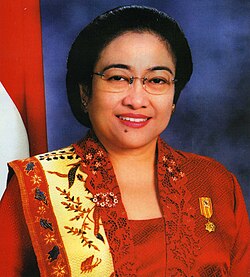
Megawati Sukarnoputri
View on Wikipedia
Diah Permata Megawati Setiawati Sukarnoputri (Indonesian: [meɡawati sukarnɔputri] ⓘ; born 23 January 1947) is an Indonesian politician who served as the fifth president of Indonesia from 2001 to 2004 and the eighth vice president under President Abdurrahman Wahid from 1999 to 2001. She is Indonesia's first and only female president to date.
Key Information


Megawati Sukarnoputri became president in 2001 when Abdurrahman Wahid was impeached and removed from office. She ran for re-election in the 2004 presidential election, but was defeated by Susilo Bambang Yudhoyono. She ran again against Yudhoyono in the 2009 presidential election, and was defeated a second time. She is the first and current leader of the Indonesian Democratic Party of Struggle (PDI-P), one of Indonesia's largest political parties. She is the eldest daughter of Indonesia's first president, Sukarno.
Name
[edit]Megawati's last name (Sukarnoputri, meaning "daughter of Sukarno") is a patronym, not a family name. Javanese often do not have family names, similarly Minang living outside of traditional nagari society often do not carry on matrilineal clan names. She is often referred to as simply Megawati or Mega, derived from Sanskrit meaning 'cloud goddess.' In a speech to the students of the Sri Sathya Sai Primary School, she mentioned that Indian politician Biju Patnaik named her at Sukarno's request.[2][3]
Early life and education
[edit]Early life and family
[edit]
Megawati Sukarnoputri was born in Yogyakarta to Sukarno and his wife Fatmawati. Sukarno had declared Indonesia's independence from the Netherlands 2 years prior in 1945. Fatmawati, a Minang descended from Inderapura aristocracy, was one of his nine wives. Megawati Sukarnoputri was Sukarno's second child and eldest daughter. She grew up in her father's Merdeka Palace. She danced for her father's guests and developed a gardening hobby. Megawati Sukarnoputri was 19 when her father relinquished power in 1966 and was succeeded by a government which eventually came to be led by President Suharto.[4]
Education
[edit]Megawati Sukarnoputri attended Universitas Padjadjaran in Bandung to study agriculture but dropped out in 1967 to be with her father following his fall. In 1970, the year her father died, Megawati Sukarnoputri went to the Universitas Indonesia to study psychology but dropped out after two years.[5]
Political career
[edit]Member of parliament
[edit]
In 1986, Suharto gave the status of Proclamation Hero to Sukarno in a ceremony attended by Megawati Sukarnoputri.[6] Suharto's acknowledgment enabled the Indonesian Democratic Party (PDI), a government-sanctioned party, to campaign on Sukarno nostalgia in the lead-up to the 1987 legislative elections. Up to that time, Megawati Sukarnoputri had seen herself as a housewife, but in 1987 she joined PDI and ran for a People's Representative Council (DPR) seat.[4] The PDI accepted Megawati Sukarnoputri to boost their own image. Megawati Sukarnoputri quickly became popular, her status as Sukarno's daughter offsetting her lack of oratorical skills. Although PDI came last in the elections, Megawati Sukarnoputri was elected to the DPR. Like all members of the DPR she also became a member of the People's Consultative Assembly (MPR).[7]
Indonesian Democratic Party chair
[edit]
Megawati Sukarnoputri was not reelected, but continued as a PDI member. In December 1993, the PDI held a national congress. As was always the case when New Order opposition parties held their congresses, the government actively interfered. As the Congress approached, three individuals contended for the PDI chair. The incumbent, Suryadi, had become critical of the government. The second was Budi Harjono a government-friendly figure whom the government backed. The third was Megawati Sukarnoputri. Her candidacy received such overwhelming support that her election at the Congress became a formality.[8]
When the congress assembled, the government stalled and delayed attempts to hold the election.[8] The congress faced a deadline when their permit to assemble would run out. As the hours ticked down to the end of the congress, troops began gathering. With only two hours remaining, Megawati Sukarnoputri called a press conference, stating that because she enjoyed the support of a majority of PDI members, she was now the de facto chair.[8] Despite her relative lack of political experience, she was popular in part for her status as Sukarno's daughter and because she was seen as free of corruption with admirable personal qualities. Under her leadership, PDI gained a large following among the urban poor and both urban and rural middle classes.[9]
Split in the party
[edit]The government was outraged at its failure to prevent Megawati's rise. They never acknowledged Megawati Sukarnoputri although her self-appointment was ratified in 1994. In 1996, the government convened a special national congress in Medan that reelected Suryadi as chair. Megawati Sukarnoputri and her camp refused to acknowledge the results and the PDI divided into pro-Megawati and anti-Megawati camps.[10]
27 July 1996 incident
[edit]Suryadi began threatening to take back PDI's Headquarters in Jakarta. This threat was carried on the morning of 27 July 1996.[11] Suryadi's supporters (reportedly with the government's backing) attacked PDI Headquarters and faced resistance from Megawati Sukarnoputri supporters stationed there. In the ensuing fight, Megawati's supporters held on to the headquarters. A riot ensued, followed by a government crackdown. The government later blamed the riots on the People's Democratic Party (PRD), and continued to recognize Suryadi's faction as the official party.[12]
1997 legislative election
[edit]Despite what seemed to be a political defeat, Megawati Sukarnoputri scored a moral victory and her popularity grew. When the time came for the 1997 legislative election, Megawati Sukarnoputri and her supporters threw their support behind the United Development Party (PPP), the other approved opposition party.[13]
Reformasi era
[edit]1999 legislative election
[edit]In mid-1997, Indonesia began to be affected by the Asian Financial Crisis and showed severe economic distress. By late January 1998 the rupiah fell to nearly 15,000 against the US dollar, compared to only 4,000 in early December. Increasing public anger at pervasive corruption culminated with Suharto's resignation and the assumption of the presidency by Vice President B. J. Habibie in May 1998, starting the Reformation era (Reformasi). The restrictions on Megawati Sukarnoputri were removed and she began to consolidate her political position. In October 1998, her supporters held a National Congress whereby Megawati's PDI faction would now be known as the Indonesian Democratic Party of Struggle (PDI-P). Megawati Sukarnoputri was elected chair and was nominated as PDI-P's presidential candidate.[14]
PDI-P, together with Abdurrahman Wahid's National Awakening Party (PKB) and Amien Rais' National Mandate Party (PAN), became the leading reform forces. Despite their popularity, Megawati Sukarnoputri, Abdurrahman Wahid and Amien Rais adopted a moderate stance, preferring to wait until the 1999 legislative election to begin major changes.[15] In November 1998, Megawati Sukarnoputri, together with Abdurrahman Wahid, Amien Rais and Hamengkubuwono X reiterated their commitment to reform through the Ciganjur Statement.[16]
Result and aftermath
[edit]As the elections approached, Megawati Sukarnoputri, Abdurrahman Wahid and Amien Rais considered forming a political coalition against President Habibie and Golkar. In May, Alwi Shihab held a press conference at his house during which Megawati Sukarnoputri, Abdurrahman Wahid and Amien Rais were to announce that they would work together. At the last minute, Megawati Sukarnoputri chose not to attend, because she decided that she could not trust Amien.[17] In June, the elections were held and PDI-P came first with 33% of the votes.[18]
With the victory, Megawati's presidential prospects solidified. She was opposed by PPP who did not want a female president.[19] In preparation for the 1999 MPR General Session, PDI-P formed a loose coalition with PKB. As the MPR General Session approached, it seemed as if the presidential election would be contested between Megawati Sukarnoputri and B. J. Habibie, but by late June Amien Rais had drawn the Islamic parties into a coalition called the Central Axis.[17] The presidential election became a three-way race when Amien Rais floated the idea of nominating Wahid for president; but Abdurrahman Wahid did not provide a clear response to the proposal.[citation needed]
1999 indirect presidential election
[edit]Election of Wahid as president
[edit]Megawati's PDI-P and PKB coalition faced its first test when the MPR assembled to choose its chair. Megawati Sukarnoputri threw her support behind Matori Abdul Djalil, the Chair of PKB. He was overwhelmingly defeated by Amien Rais, who in addition to enjoying Central Axis support was backed by Golkar.[19] The Golkar and Central Axis coalition struck again when they secured Akbar Tandjung's election as Head of DPR. At this stage, people became wary that Megawati Sukarnoputri, who best represented reform, was going to be obstructed by the political process and that the status quo was going to be preserved. PDI-P supporters began to gather in Jakarta.
B. J. Habibie made a poorly received speech on political accountability that led him to withdraw. The presidential election held on 20 October 1999 came down to Megawati Sukarnoputri and Abdurrahman Wahid. Megawati Sukarnoputri took an early lead, but was overtaken and lost with 313 votes compared to Wahid's 373. Megawati's loss provoked her supporters to revolt.[19] Riots raged in Java and Bali. In the city of Solo, PDI-P masses attacked Amien's house.
Selection as vice president
[edit]The next day, the MPR assembled to elect the vice president. PDI-P had considered nominating Megawati Sukarnoputri, but were concerned that the Central Axis and Golkar coalition would again thwart her. Instead, PKB nominated Megawati Sukarnoputri. She faced stiff competition from Hamzah Haz, Akbar Tandjung, and General Wiranto.[19] Well aware of the riots, Akbar Tandjung and Wiranto withdrew. Hamzah Haz stayed in the race, but Megawati defeated him 396 to 284. In her inauguration speech, she called for calm.
Vice presidency (1999–2001)
[edit]Tenure
[edit]
As vice president, Megawati Sukarnoputri had considerable authority by virtue of her commanding many seats in the DPR. Abdurrahman Wahid delegated to her the problems in Ambon, although she was not successful.[20] By the time the MPR Annual Session assembled in August 2000, many considered Abdurrahman Wahid to be ineffective as president or as an administrator. Abdurrahman Wahid responded to this by issuing a presidential decree, giving Megawati Sukarnoputri day-to-day control of the government.[20]
2000 PDI-P National Congress
[edit]The First PDI-P Congress was held in Semarang, Central Java, in April 2000, at which Megawati Sukarnoputri was re-elected as chair for a second term.[21]
Megawati Sukarnoputri consolidated her position within PDI-P by taking harsh measures to remove potential rivals.[22] During the election for the chair, two other candidates emerged; Eros Djarot and Dimyati Hartono. They ran because they did not want Megawati Sukarnoputri to serve concurrently as both chair and vice president. Eros' nomination from the South Jakarta branch was voided by membership problems. Eros was not allowed to participate in the Congress. Disillusioned with what he perceived to be a cult of personality developing around Megawati, Eros left PDI-P. In July 2002, he formed the Freedom Bull National Party. Although Dimyati's candidacy was not opposed as harshly as Eros, he was removed as Head of PDI-P's Central Branch. He kept his position as a People's Representative Council (DPR) member, but left the party to become a university lecturer.[23] In April 2002, Dimyati formed the Our Homeland of Indonesia Party (PITA).[24]
Rise to the presidency
[edit]Megawati Sukarnoputri had an ambivalent relationship with Abdurrahman Wahid. During the cabinet reshuffle of August 2000 for example, Megawati was not present for the announcement of the new line-up.[25] At another occasion, when the political tide began to turn against Abdurrahman Wahid, Megawati Sukarnoputri defended him and lashed out against critics.[26] In 2001, Megawati Sukarnoputri began to distance herself from Abdurrahman Wahid as a Special Session of the MPR approached and her prospects of becoming president improved. Although she refused to make any specific comments, she showed signs of preparing herself, holding a meeting with party leaders a day before the Special Session was to start.[citation needed]
Presidency (2001–2004)
[edit]Tenure
[edit]
On 23 July 2001, the People's Consultative Assembly (MPR) removed Wahid from office and subsequently swore in Megawati as the new president.[27] She thus became the sixth woman to lead a Muslim-majority country. On 10 August 2001, she announced her Mutual Assistance Cabinet.[28]
.jpg)
The rise of an icon of opposition against the Suharto regime to the presidency was initially widely welcomed, however it soon became apparent that her presidency was marked with indecisiveness, lack of clear ideological direction, and "a reputation for inaction on important policy issues".[29][30][31] The good side of slow progress of reforms and avoiding confrontations was that she stabilized the overall democratization process and relationship between legislative, executive, and military.[29]
Political and legal arrangements
[edit]Reforms conducted from Abdurrahman Wahid's presidency has become Megawati's important agenda in restoring political stability and democracy. In doing so, her administration passed 2 more constitutional amendments with the third amendment being held on 10 November 2001 and the fourth amendment held on 1–11 August 2002.[32] These amendments contributed to the formation of the Constitutional Court[33] and the dissolution of the Supreme Advisory Council.[32] As a contribution to these amendments, her government has drafted many laws that will fulfill the mandate of the amendments made to the Indonesian Constitution, especially in the areas of regional government, political parties, and general elections.[34]
Megawati Sukarnoputri also established the first general election system, where the Indonesian people can directly elect the president and vice president, in addition to electing legislative candidates. As a result, she was given the title "Mother of Upholding the Constitution".[35]
Megawati Sukarnoputri also played an important role in the formation of the Corruption Eradication Commission, an institution tasked with eradicating corruption in Indonesia. In eradicating the rampant corruption inherited from the New Order, she formed the Corruption Eradication Commission (KPK).[36] The formation of the KPK was based on Megawati's view that many legal institutions at that time were not clean, so the KPK needed to be formed. Long before that, the initial idea for forming the Corruption Eradication Committee emerged in the era of President BJ Habibie who issued Law Number 28 of 1999 concerning State Administration that was clean and free from corruption, collusion and nepotism.[36]
Home Affairs Minister Hari Sabarno outlined her administration's focus on decentralization, where the implementation of regional autonomy is carried out fairly to give authority to regions to manage their own regions while maintaining national unity and integrity.[34] In guiding such autonomy and to preserve national unity, her government implements regional autonomy policies that are proportional and consistent, implementing fair financial balance, increasing the distribution of easily accessible public services, correcting gaps in economic development and regional income, and respects regional cultural values based on the mandate of the amendment to the Constitution.[37]
Military
[edit]The Indonesian National Armed Forces has undergone changes in order to suit their new roles in the democratic administration to be a military force that is more dynamic, ever-ready and flexible to changes. This is specified by Megawati on the following quote:[34]
The TNI has pledged its commitment to continue carrying out its internal reforms by way of taking concrete measures to position itself professionally and functionally as the instrument of state defense and to uphold the enforcement of democracy as well as to abide by the law and to respect human rights
— Megawati Sukarnoputri
One of the roles of the TNI in the democratic political system carried out by President Megawati was also specifically deciding to transfer the authority to carry out security operations in Maluku from the hands of the Police to the hands of the TNI which proved effective in restoring stability in 2002. President Megawati also revived the Iskandar Muda Regional Military Command in February 2002.[34]
She passed Law No. 3 2002 on National Defense which outlines huge changes to the military. The policy stated in the law then became the forerunner of the definitions, goals, roles, targets and implementation of Indonesia's defenses. Apart from making Indonesia a safe country for its people and build peace with, the defense policy also includes Indonesia's geographical aspects as an archipelagic country as a consideration to make preparations on national defense. In this policy, the Indonesian National Armed Forces is placed as the main defense component, supported by reserves and supporting components.[34] Megawati also involved non-governmental organizations to assist the military in non-military threats.[37] In 2002, she prepared a budget of IDR 7,5 billion for TNI/POLRI's welfare programs which includes housing for personnels of each branch and facility improvements.[34]
Internationally, the military was hit by an arms embargo imposed by the United States and US President Bill Clinton accused Indonesia of conducting human rights violation in East Timor.[34] The embargo affected Indonesia's ability to purchase spare parts for strategic arsenals such as F-16 Fighting Falcon and Northrop F-5 owned by the Indonesian Air Force and reduced combat readiness of all Indonesian military units down to 50%.[34] As a result, Megawati turned to Russia for military cooperation, resulting in the acquisition of military equipment such as Sukhoi Su-27 fighters and Mil Mi-35 attack helicopters in order to effectively defend Indonesia from external threats.[34][38]
2003 Aceh offensive
[edit]On 19 May 2003, in response of GAM refusal of the Tokyo peace deal which planned to end the decades long insurgency in Aceh, Megawati gave the 12th Indonesian Military Chief General Endriartono Sutarto, permission to commence military operations against the GAM separatist. General Sutarto also imposed martial law in Aceh for a period of six months and the Indonesian government subsequently deployed 1,500 soldiers and 12,000 police to the province.[39] During the military operation, government forces would conduct numerous human rights abuses including torture, rape, forced disappearances, and murder.[40] An estimated 1,159 rebels died with 147 civilians were killed and 155 wounded during the operation.[41]
Economic arrangement
[edit]Since her inauguration, Megawati's administration strive to provide conditions that conducive to rebuilding the economy that has been in ruins ever since the 1997 Asian financial crisis and the political crisis since Suharto's fall between 1998 and 2001. During the early periods of her administration, Indonesia has US$105.8 billion in debt which was inherited from Suharto's regime.[42] As president, she attended Paris Club and London Club meetings in an attempt to renegotiate Indonesia's outstanding debts which result in Megawati able to delay the payments of US$5.8 billion of debts in a Paris Club meeting in 12 April 2002 and prepared a debt payment of Rp.116.3 billion on 2003.[34]
Her administration is widely known for privatizations of state owned enterprises (SOE).[43] According to Megawati, the privatization of SOEs is done to defend SOEs from public intervention and debt payments, to increase efficiency and competitiveness of the SOEs and to speed up economic growth from the private sector.[34][43] Numerous state enterprises such as Semen Gresik, Bank Negara Indonesia, Kimia Farma and most controversially, Indosat were privatized.[43][44] In her own journal, Megawati's privatization drive has successfully increased economic growth by 4.1% and suppressed inflation by 5.06%.[34] However, her privatization on SOEs especially on Indosat generated criticisms and Megawati was accused as a neoliberal.[45]
Megawati restored cooperative relations with the International Monetary Fund (IMF) which has been delayed during Wahid's presidency[46] by tasking Coordinating Minister for Economic Affairs Dorodjatun Kuntjoro-Jakti, Minister of Finance Boediono and Governor of Bank Indonesia Burhanuddin Abdullah to fulfill 20 letters of intent from the IMF and World Bank which affects with the disbursement of an IMF loan of around SDR 400 million to strengthen the position of foreign exchange reserves for each LOI received.[34] The partnership itself ends in 2003 due to her criticisms on IMF and World Bank's "confusing" suggestions in recovering Indonesia's economy.[47]
One of her national development focus and leading sector is Indonesia's marine and fisheries economy. On 7 June 2003, Megawati on board KRI Tanjung Dalpele launched the National Movement for Maritime and Fisheries Development (GERBANG MINA BAHARI). In essence, the movement establishes the Maritime and Fisheries sector, Maritime Tourism, Maritime Industry and Services, and Maritime Transportation as the prime mover of national economic development. Simultaneously, other development sectors and political-economic policies support these prime mover sectors. Meanwhile, the basis of Maritime and Fisheries development is Sustainable Development, namely harmonizing efforts to increase economic growth, equal distribution of welfare and environmental preservation.[34]
Domestic issues
[edit]Under Megawati, Indonesia reaffirmed its presence in Papua and positioned itself as the central government and ensured that the doctrine of independence and the ideas of freedom and self-determination did not emerge.[48] Under the Megawati’s administration, West Papuan independence activist Theys Eluay was assassinated. Megawati’s government also postponed the implementing regulations for the establishment of the Papuan People’s Assembly (Majelis Rakyat Papua), and favored the issuance of a presidential decree to implement Law No. 45/1999[49] to divide Papua into three distinct provinces.[50][51]
Environment
[edit]In 2003, Megawati launched a reforestation program in the form of the National Movement for Forest and Terrain Rehabilitation (GERHAN). This program aimed to address the need for rehabilitation of degraded areas which are increasing in size and the destruction of forests and land that has occurred.[37] According to Minister of Marine Affairs and Fisheries Rokhmin Dahuri, Megawati has long loved gardening. Rokhmin said that her personal hobby has also made Megawati to be more aware and concerned about policies related to environmental conservation.[52]
Foreign policy
[edit]Her administration's foreign policy largely maintained the notion of non-alignment while conducting partnerships in efforts to quell terrorist attacks at the aftermath of the September 11 attacks and 2002 Bali bombings. Shortly after her inauguration, Megawati visited the United States on September 19, 2001 and had a meeting with President George W. Bush where both countries pledged to cooperate against radical Islamic terrorism based on shared democratic values.[53][54] She also sent her condolences to the victims of the September 11 attacks while telling Bush Indonesia also has the same mission against terrorism.[55] The engagement with President Bush marked a renewal of ties which were previously strained under President Bill Clinton, including discussions on military cooperation and training programs with Indonesia.[56]
The 2002 Bali bombings which killed 202 people, among them 88 Australians prompted Megawati to intensify international cooperation against terrorism. Her administration issued two presidential decrees in lieu of legislation to address terrorism and arrested key suspects, including radical Islamic cleric Abu Bakar Ba'asyir.[57] In a joint press conference on 2003, President Bush commended Megawati's leadership in confronting terrorism and supported her reforms in civil-military administration while also proposed to send a $157 million aid to support basic education for Indonesia.[58] The United States also reaffirmed commitments to military education exchanges and partnerships in regional security.[59]
2004 general election
[edit]Incumbent president Megawati Sukarnoputri was the PDI-P's top nominee, seeking to become the first woman elected in her own right as president of a Muslim-majority country. She was joined by vice-presidential candidate Hasyim Muzadi, general chairman of Indonesia's largest Islamic organisation Nahdlatul Ulama (NU). The pair was assigned the number 2 for its ballot.[60] However, she was decisively defeated by Susilo Bambang Yudhoyono in the second round, by 61 percent to 39 percent,[27] on 20 September 2004. She did not attend the new president's inauguration and never congratulated him.[61]
Post-presidency (2004–present)
[edit]Leader of the PDI-P
[edit]2009 general election
[edit]On 11 September 2007 Megawati Sukarnoputri announced her candidacy in the 2009 presidential election at a PDI-P gathering. Soetardjo Soerjoguritno confirmed her willingness to be nominated as her party's presidential candidate.[62] Her nomination for president was announced on 15 May 2009, with Gerindra Party leader Prabowo Subianto as her running mate.[63]
Megawati's 2009 race was overshadowed by her calls to change Indonesia's voter registration procedure, obliquely suggesting that Yudhoyono's supporters were trying to manipulate the vote.[64] Megawati Sukarnoputri and Prabowo Subianto lost the election to Susilo Bambang Yudhoyono, coming in second with 26.79% of the vote.[65]
2014 general election
[edit]
On 24 February 2012, Megawati Sukarnoputri distanced herself from polls[66] that placed her as a top contender for the 2014 presidential election.[67] As Chair of PDI-P, she appealed to her party at a gathering in Yogyakarta to focus on its current priorities. Nonetheless, a domain name appeared to have been registered in her name.[68] On 27 December 2012, the daily edition of the Jakarta Post hinted at a possible reconciliation in the 2014 general election between the families of Megawati Sukarnoputri and President Susilo Bambang Yudhoyono and their political parties, her PDI-P and his Democratic Party respectively.[69]
For the 2014 general election, the PDI-P and their coalition partners nominated Joko Widodo as their candidate for president. Joko Widodo defeated his opponent Prabowo Subianto in a hotly contested election.[70] Later, the relationship between Megawati Sukarnoputri and Joko Widodo became strained as she pushed for Police Commissary General Budi Gunawan for the post of the Indonesian Police Chief, despite him being investigated for corruption by the Corruption Eradication Commission (KPK). Budi Gunawan was Megawati's adjutant during her tenure as president.[71] Megawati later criticize Jokowi's decision, quipping him for not carrying out the party line of struggle, which resulted in a controversy.[72] Budi Gunawan was eventually appointed as the Director of the State Intelligence Agency.[73]
At the 4th PDI-P National Congress on 20 September 2014, Megawati Sukarnoputri was reappointed Chair of PDI-P for 2015-2020.[74]
2024 general election
[edit]On 10 January 2024, during the 51st anniversary of PDI-P, Megawati Sukarnoputri made a speech about several strategic issues, such as neutrality of the authorities, democracy, elections and volunteers.[75] She then gave a satirical speech for Joko Widodo, touching on the stigma of the role of volunteers in winning the presidential election and emphasizing that only parties have the authority to nominate president and vice president.[75] At the end of her speech, Megawati Sukarnoputri said that she was confident that the presidential and vice-presidential candidates from her party coalition, Ganjar Pranowo and Mahfud MD, would win in just one round in the 2024 presidential election. She added that Ganjar Pranowo and Mahfud MD were energetic, intelligent and cared about the little people.[75]
Post-presidency appointments
[edit].jpg)
So far, Megawati Sukarnoputri is the only former president which somehow retained her influence within the government and even appointed to strategic positions with advisory capabilities. On 22 March 2018, she was appointed as Head of Steering Committee of Pancasila Ideology Development Agency. She also gained position as Head of National Research and Innovation Agency Steering Committee since 5 May 2021, and she was formally appointed on 13 September 2021.[76][77]
Other activities
[edit]On 4 October 2023, Megawati Sukarnoputri had a meeting with former Malaysian Prime Minister Mahathir Mohamad in Kuala Lumpur. During their discussion, the two senior politicians covered various topics, including Indonesia's plan to relocate its capital city to East Kalimantan.[78]
Personal life
[edit]
Megawati's first husband was First Lieutenant Surindro Supjarso, whom she married on 1 June 1968. He perished in a plane crash in Biak, West Irian, on 22 January 1970. On 27 June 1972, she married Hassan Gamal Ahmad Hassan, an Egyptian diplomat. The marriage was annulled by the Religious Court less than 3 months later.[5] She then married Taufiq Kiemas on 25 March 1973. He died on 8 June 2013.[79] She has three children, Mohammad Rizki Pratama, Muhammad Prananda Prabowo, and Puan Maharani. The sons are from her marriage with Surindro, while Puan Maharani is the only child from Megawati's marriage to Taufiq.[80][81]
Honours
[edit]National honours
[edit]_(cropped).jpg)
 Star of the Republic of Indonesia, 1st Class (Indonesian: Bintang Republik Indonesia Adipurna) (8 August 2001)[82]
 Star of the Republic of Indonesia, 2nd Class (Indonesian: Bintang Republik Indonesia Adipradana) (3 February 2001)[82]
 Star of Mahaputera, 1st Class (Indonesian: Bintang Mahaputera Adipurna) (3 February 2001)[82]
 Star of Merit, 1st Class (Indonesian: Bintang Jasa Utama) (8 August 2001)[82]
 Star of Culture Parama Dharma (Indonesian: Bintang Budaya Parama Dharma) (8 August 2001)[82]
 Star of Yudha Dharma, 1st Class (Indonesian: Bintang Yudha Dharma Utama) (8 August 2001)[82]
 Star of Kartika Eka Paksi, 1st Class (Indonesian: Bintang Kartika Eka Paksi Utama) (8 August 2001)[82]
 Star of Jalasena, 1st Class (Indonesian: Bintang Jalasena Utama) (8 August 2001)[82]
 Star of Swa Bhuwana Paksa, 1st Class (Indonesian: Bintang Swa Bhuwana Paksa Utama) (8 August 2001)[82]


Foreign honours
[edit]
 30th Anniversary of the Independence of the Republic of Kazakhstan Jubilee Medal (12 August 2022)[83][84]


 Order of the National Flag, 1st Class (28 March 2002)[85]


 Order of Friendship (2 June 2021)[86]

References
[edit]- ^ Romi, J (24 November 2020) [11 May 2020]. Hendra (ed.). "Penasaran Tidak, Berapa Sih Tinggi Badan Semua Presiden Indonesia" [Are You Curious, How Tall Are All the Presidents of Indonesia]. BertuahPos (in Indonesian). Archived from the original on 12 August 2020. Retrieved 6 February 2024.
- ^ "Speech by Indian President R K Narayanan in honor of Megawati Sukarnoputri". Archived from the original on 5 May 2009. Retrieved 5 May 2009.
- ^ "Obituary: Biju Patnaik ". The Economist. 24 April 1997.
- ^ a b "Megawati Sukarnoputri, Mbak Pendiam itu Emas | Biografi Tokoh Indonesia". Retrieved 23 March 2007.
{{cite web}}: CS1 maint: deprecated archival service (link) - ^ a b East & Thomas 2003, p. 233
- ^ Artaria, Myrtati Diah (2002). The Potent Dead: Ancestors, Saints and Heroes in Contemporary Indonesia. University of Hawaii Press. pp. 538–540. ISBN 978-1-86508-739-9.
- ^ Eklöf, Stefan (2003). Power and Political Culture in Suharto's Indonesia: The Indonesian Democratic Party (PDI) and Decline of the New Order (1986–98). Denmark: NIAS Press. pp. 93–96. ISBN 87-91114-50-0.
- ^ a b c "Megawati Sukarnoputri, Pemimpin Berkepribadian Kuat | Biografi Tokoh Indonesia". Retrieved 23 March 2007.
{{cite web}}: CS1 maint: deprecated archival service (link) - ^ Ricklefs, M.C. (2008) [1981]. A History of Modern Indonesia Since c.1300 (4th ed.). London: MacMillan. p. 517. ISBN 978-0-230-54685-1.
- ^ Eklöf, Stefan (2003). Power and Political Culture in Suharto's Indonesia: The Indonesian Democratic Party (PDI) and Decline of the New Order (1986–98). Denmark: NIAS Press. p. 271. ISBN 87-91114-50-0.
- ^ B., Edy (10 August 1996). "Kronologi Peristiwa 27 Juli 1996". Tempo. Archived from the original on 27 September 2007. Retrieved 31 October 2006.
- ^ Ricklefs, M.C. (2008) [1981]. A History of Modern Indonesia Since c.1300 (4th ed.). London: MacMillan. p. 519. ISBN 978-0-230-54685-1.
- ^ Eklöf, Stefan (2003). Power and Political Culture in Suharto's Indonesia: The Indonesian Democratic Party (PDI) and Decline of the New Order (1986–98). Denmark: NIAS Press. pp. 280–281. ISBN 87-91114-50-0.
- ^ "KOMPAS-11: PARTAI DEMOKRASI INDONESIA PERJUANGAN (PDI PERJUANGAN)". Seasite.niu.edu. Archived from the original on 4 February 2020. Retrieved 5 November 2011.
- ^ Barton, Greg (2002). Abdurrahman Wahid: Muslim Democrat, Indonesian President. Singapore: UNSW Press. p. 255. ISBN 0-86840-405-5.
- ^ Friend, Theodore (2003). Indonesian Destinies. Belknap Press of Harvard University Press. p. 397. ISBN 0-674-01137-6.
- ^ a b Barton, Greg (2002). Abdurrahman Wahid: Muslim Democrat, Indonesian President. Singapore: UNSW Press. p. 270. ISBN 0-86840-405-5.
- ^ Ricklefs, M.C. (2008) [1981]. A History of Modern Indonesia Since c.1300 (4th ed.). London: MacMillan. p. 38. ISBN 978-0-230-54685-1.
- ^ a b c d "Indonesia in Transition: The 1999 Presidential Elections" (PDF). Archived from the original (PDF) on 25 September 2012. Retrieved 29 March 2007.
- ^ a b "Fighting in the Malukus heightens tensions across Indonesia and within the Wahid cabinet". Wsws.org. 10 January 2000. Archived from the original on 27 October 2012. Retrieved 5 November 2011.
- ^ "Megawati Beri Pengarahan Peserta Rakermas PDIP (Megawati Gives Guidance to Participants at the PDIP National Coordinating Meeting)". Tempo (in Indonesian). 29 July 2003. Archived from the original on 18 May 2022. Retrieved 5 August 2018.
- ^ Firmansyah, Arif (11 February 2005). "Kisah Para Penantang Yang Terpental (The Story of the Ousted Challengers)". Tempo. Archived from the original on 17 October 2009. Retrieved 2 November 2006.
- ^ Litbang Kompas (2016). Parti Politik Indonesia 1999–2019: Konsentrasi dan Dekonsentrasi Kuasa (Indonesian Political Parties 1999–2019: Concentration and Deconcentration of Power) (in Indonesian). Jakarta: Kompas. p. 92. ISBN 978-602-412-005-4.
- ^ Deannova, Alfito; Indradi, Donni (7 April 2002). "Dimyati Hartono Mendeklarasikan PITA". Liputan 6 (in Indonesian). SCTV. Archived from the original on 17 April 2022. Retrieved 22 July 2018.
- ^ Barton, Greg (2002). Abdurrahman Wahid: Muslim Democrat, Indonesian President. Singapore: UNSW Press. p. 327. ISBN 0-86840-405-5.
- ^ Barton, Greg (2002). Abdurrahman Wahid: Muslim Democrat, Indonesian President. Singapore: UNSW Press. p. 342. ISBN 0-86840-405-5.
- ^ a b Monshipouri, Mahmood (1 January 2011). Muslims in Global Politics: Identities, Interests, and Human Rights. University of Pennsylvania Press. p. 206. ISBN 9780812202830.
- ^ Mydans, Seth (10 August 2001). "With Politics and Market in Mind, Megawati Picks a Cabinet". The New York Times. Archived from the original on 17 April 2022. Retrieved 29 January 2009.
- ^ a b Ziegenhain, Patrick (1 January 2008). The Indonesian Parliament and Democratization. Institute of Southeast Asian Studies. p. 146. ISBN 9789812304858.
- ^ Beittinger-Lee, Verena (2009). (Un) Civil Society and Political Change in Indonesia: A Contested Arena. Routledge. p. 78. ISBN 9780415547413. Archived from the original on 24 March 2023. Retrieved 13 August 2015.
- ^ Lindsey, Timothy (2008). Indonesia: Law and Society. Federation Press. pp. 17–19. ISBN 9781862876606.
- ^ a b Iswara N. Raditya (14 October 2019). "Amandemen UUD 1945: Sejarah & Isi Perubahan Ketiga Tahun 2001". Tirto.id.
- ^ "Latar Belakang Pembentukan Mahkamah Konstitusi RI" (in Indonesian). Constitutional Court of Indonesia. 13 August 2015.
- ^ a b c d e f g h i j k l m n Sukarnoputri, Megawati (April 2021). "Kepemimpinan Presiden Megawati Pada Era Krisis Multidimensi, 2001-2004". Jurnal Pertahanan Dan Bela Negara. 11 (1): 49–66. doi:10.33172/jpbh.v11i1.1211.
- ^ "Ini 7 Julukan Presiden Indonesia, Dari Soekarno Sampai Jokowi : Okezone Edukasi". edukasi.okezone.com/. 28 November 2022. Archived from the original on 23 April 2023.
- ^ a b "Presiden Megawati dan Pembentukan KPK". Museum Kepresidenan. 19 July 2022. Retrieved 20 June 2024.
- ^ a b c Dahuri, Rokhmin; Samah, Kristin (2019). The Brave Lady: Megawati dalam Catatan Kabinet Gotong Royong. Jakarta: Gramedia Pustaka Utama (published 11 February 2019).
- ^ Kusumadewi, Anggi; Armenia, Resty (2 March 2016). "Kisah Embargo AS dan Sukhoi Rusia di Balik Jet Tempur RI". CNN Indonesia. Retrieved 20 June 2024.
- ^ "Melawan Lupa, 19 Mei 2003, Megawati Berlakukan DOM di Aceh".
- ^ "KAIROS-Conflict in Aceh". Archived from the original on 28 October 2008.
- ^ "Indonesia: 'Nearly 1,160 Aceh rebels killed in 10 months' - Indonesia | ReliefWeb". 18 August 2004.
- ^ Robinson, Richard; Rosser, Andrew (2 December 1998). "Contesting reform: Indonesia's new order and the IMF". World Development. 26 (8): 1593–1609. doi:10.1016/S0305-750X(98)00056-4.
- ^ a b c Nailufar, Nibras Nada; Margianto, Heru (26 July 2019). "Perjalanan Politik Megawati, 3 Warisannya yang Dipuji dan Di-bully". Kompas. Retrieved 21 June 2024.
- ^ Ma'arif, Syamsul (2019). "PRIVATISASI BUMN DAN REORIENTASI PERAN NEGARA DI SEKTOR BISNIS PASCA ORDE BARU (Studi Komparasi Tiga Masa Pemerintahan)" (PDF). Jurnak Analisis Sosial Politik. 5 (1): 45–58.
- ^ Sarwanto, Agus; Mar'iyah, Chusnul (2004). "Studi politik ekonomi terhadap pemerintahan Megawati Soekarnoputri : Studi kasus privatisasi PT. Indosat Tbk. (2002-2003)". Universitas Indonesia.
- ^ Aswicahyono, Haryo; Christian, David. "Perjalanan Reformasi Ekonomi Indonesia 1997-2016" (PDF). CSIS Economics Working Paper. 2. Center for Strategic and International Studies.
- ^ Hidayat, Bagja (16 August 2004). "Presiden Kritik IMF". Tempo. Retrieved 20 June 2024.
- ^ Fujikawa, K. (2017). Drifting between Accommodation and Repression: Explaining Indonesia’s Policies towards its Separatists. The Pacific Review, 30(5), 655-673. DOI: https://doi.org/10.1080/09512748.2017.1293713
- ^ "KEPPRES No. 45 Tahun 1999".
- ^ McGibbon, R. (2004) Secessionist Challenges in Aceh and Papua: is Special Autonomy the Solution? Washington: East-West Centre
- ^ "The Papua Conflict: The Different Perspectives of The Indonesian Government and International Communities—Review from The English School Theory". Global: Jurnal Politik Internasional. 24 (2). 30 November 2022. doi:10.7454/global.v24i2.1253.
 This article incorporates text from this source, which is available under the CC BY 4.0 license.
- ^ Lee, Antony (27 August 2019). "Megawati, Tanaman, dan Pembangunan". kompas (in Indonesian). Retrieved 21 June 2024.
- ^ "Presiden Megawati Tiba di Washington - 2001-09-17". VOA Indonesia (in Indonesian). 17 September 2001. Retrieved 29 October 2025.
- ^ "U.S. and Indonesia Pledge Cooperation". georgewbush-whitehouse.archives.gov. Retrieved 29 October 2025.
- ^ "Pertemuan Megawati Soekarnoputri dan George Walker Bush di Amerika Serikat, 19 September 2001: Membahas Soal Perang Lawan Terorisme". VOI - Waktunya Merevolusi Pemberitaan (in Indonesian). Retrieved 29 October 2025.
- ^ "U.S. to Renew Relationship With Military in Indonesia". www.etan.org. Retrieved 29 October 2025.
- ^ "Human Rights Watch World Report 2003: Asia: Indonesia". www.hrw.org. Retrieved 29 October 2025.
- ^ "The President's News Conference With President Megawati Sukarnoputri of Indonesia in Bali, Indonesia | The American Presidency Project". www.presidency.ucsb.edu. Retrieved 29 October 2025.
- ^ "U.S. and Indonesia Joint Statement". georgewbush-whitehouse.archives.gov. Retrieved 29 October 2025.
- ^ "5 Pasang Capres-Cawapres Peroleh Nomor Urut". Kompas (in Indonesian). 24 May 2004. Archived from the original on 18 June 2004. Retrieved 10 September 2009.
- ^ Abuza, Zachary (25 September 2006). Political Islam and Violence in Indonesia. Routledge. p. 110. ISBN 9781134161256.
- ^ ""Indonesia's Megawati in presidential comeback bid"". Forbes. Archived from the original on 4 June 2011. Retrieved 4 June 2011., Forbes, 11 September 2007.
- ^ Febriamy Hutapea Sihaloho; Markus Junianto (16 May 2009). "With Mega and Prabowo In, A Three-Horse Race Begins". Jakarta Globe. Archived from the original on 19 May 2009. Retrieved 16 May 2009.
- ^ "Megawati cries foul in Indonesian election battle". Channel News Asia. 6 July 2009. Archived from the original on 7 July 2009. Retrieved 27 February 2012.
- ^ Pasandaran, Camelia (23 July 2009). "Final Election Results Confirm Victory For SBY-Boediono, But Protests Linger". Jakarta Globe. Archived from the original on 18 July 2011. Retrieved 23 July 2009.
- ^ "Indonesian Survey Institute (LSI)". Lembaga Survei Indonesia. 23 February 2012. Archived from the original on 27 February 2012. Retrieved 27 February 2012.
- ^ "Dihembuskan 'Angin Surga' Megawati Tak Mau Terlena". Suara Pembaruan. 24 February 2012. Archived from the original on 26 July 2013. Retrieved 27 February 2012.
- ^ "PERJUANGAN ADALAH PELAKSANAAN KATA KATA". Archived from the original on 7 December 2021. Retrieved 27 February 2012.
- ^ "Megawati, SBY hint at reconciliation". Jakarta Post. 27 December 2012. Archived from the original on 30 December 2012. Retrieved 27 December 2012.
- ^ "Joko Widodo wins Indonesia presidential election". BBC News. 22 July 2014. Archived from the original on 27 July 2014. Retrieved 6 December 2017.
Jakarta Governor Joko Widodo has been declared the winner of Indonesia's hotly contested presidential election.
- ^ Brummitt, Chris (21 January 2015). "Indonesia Police Chief Furor Hurts Widodo's Anti-Graft Image". Bloomberg. Archived from the original on 25 March 2023. Retrieved 10 March 2017.
- ^ "Sindiran Megawati ke Jokowi, kritik atau campur tangan?". BBC News Indonesia (in Indonesian). 13 April 2015. Retrieved 20 June 2024.
- ^ "Presiden ingin posisi Kepala BIN dijabat Budi Gunawan, bekas tersangka KPK". BBC News Indonesia (in Indonesian). 3 September 2016. Retrieved 20 June 2024.
- ^ Akuntono, Indra (20 September 2014). "Megawati Didukung karena Sanggup Persatukan PDI-P". Kompas. Archived from the original on 23 April 2022. Retrieved 15 November 2018.
- ^ a b c "Poin-poin Pidato Megawati di HUT PDIP, Kritik Keras untuk Penguasa". CNN Indonesia (in Indonesian). Retrieved 12 January 2024.
- ^ "2 Jabatan Dewan Pengarah Megawati Pemberian Jokowi". detiknews (in Indonesian). 13 October 2021. Archived from the original on 13 October 2021. Retrieved 13 October 2021.
- ^ Erwanti, Marlinda Oktavia (13 October 2021). "Diketuai Megawati, Ini Daftar Dewan Pengarah BRIN". detiknews (in Indonesian). Archived from the original on 14 October 2021. Retrieved 13 October 2021.
- ^ "Megawati, Mahathir meet in in[sic] Kuala Lumpur, discuss new capital city". www.thejakartapost.com. 4 October 2023.
- ^ Guerin, Bill (17 August 2002). "Indonesia's First Man". Asia Times Online. Archived from the original on 19 August 2002. Retrieved 23 June 2009.
- ^ Kusumadewi, Anggi; Pratama, Aulia Bintang (12 April 2015). "Akhir Kerja 'Sunyi' Prananda Prabowo, Putra Mahkota Megawati" (in Indonesian). CNN Indonesia. Archived from the original on 17 April 2022. Retrieved 13 December 2020.
- ^ Mappapa, Pasti Liberti (24 January 2017). "Tiga Laki-laki Megawati". Detik.com (in Indonesian). Archived from the original on 28 March 2022. Retrieved 13 December 2020.
- ^ a b c d e f g h i "Award – President of Indonesia Collection Website". Indonesian Presidential Library Materials. National Library of Indonesia. Archived from the original on 19 July 2021. Retrieved 18 July 2021.
- ^ "Jubilee Medal presented to Ex-President of Indonesia in Jakarta". dknews.kz. 22 August 2022. Retrieved 24 June 2024.
- ^ "Megawati Terima Penghargaan Medali Yobel dari Presiden Kazakstan". mpr.go.id (in Indonesian). 13 August 2022. Retrieved 24 June 2024.
- ^ "Indonesian President Megawati Visits DPRK; Meets Kim Jong Il for 1st Time in 37 Years". Co.jp. Archived from the original on 2 March 2012. Retrieved 8 March 2011.
- ^ Hakim, Syaiful (2 June 2021). "Soekarno, Megawati, dan penghargaan "Order of Friendship" dari Rusia". antaranews.com (in Indonesian). Retrieved 24 June 2024.
Further reading
[edit]- East, Roger; Thomas, Richard (5 August 2003). Profiles of People in Power: the World's Government Leaders. Routledge. pp. 232–234. ISBN 1-85743-126-X.
- Gerlach, Ricarda (2013): 'Mega' Expectations: Indonesia's Democratic Transition and First Female President. In: Derichs, Claudia/Mark R. Thompson (eds.): Dynasties and Female Political Leaders in Asia. Berlin et al.: LIT, p. 247–290.
- Skard, Torild (2014) "Megawati" in Women of power – half a century of female presidents and prime ministers worldwide. Bristol: Policy Press, ISBN 978-1-44731-578-0.
- Wichelen, Sonja van (University of Amsterdam). "Contesting Megawati: The Mediation of Islam and Nation in Times of Political Transition." () Westminster Papers in Communication and Culture. 2006 (University of Westminster, London), Vol. 3(2): 41–59. ISSN 1744-6708 (Print); 1744–6716 (Online). p. 41–59.
External links
[edit]

- (Archive) Westminster Papers in Communication and Culture. 2006 (University of Westminster, London), Vol. 3(2): 41–59. ISSN 1744-6708 (Print); 1744–6716 (Online). p. 41–59.
- Gerlach, Ricarda (2013): 'Mega' Expectations: Indonesia's Democratic Transition and First Female President. In: Derichs, Claudia/Mark R. Thompson (eds.): Dynasties and Female Political Leaders in Asia. Berlin et al.: LIT, p. 247–290.
- Skard, Torild (2014) "Megawati" in Women of power – half a century of female presidents and prime ministers worldwide. Bristol: Policy Press, ISBN 978-1-44731-578-0.
- ""Most Powerful Women 2004 No. 8 Megawati Sukarnoputri"". Forbes. Archived from the original on 13 August 2010. Retrieved 20 October 2004.
{{cite web}}: CS1 maint: bot: original URL status unknown (link). Forbes. - Karon, Tony. "The Princess Who Settled for the Presidency." TIME Magazine. Friday 27 July 2001.
- Biography of Megawati Sukarnoputri at SekolahVirtual
 | ||


 | ||
 Leaders of Indonesian political parties Leaders of Indonesian political parties | |
|---|---|
| Parties in the national legislature | |
| Parties in regional legislatures | |
| Regional parties in Aceh legislature | |
| Family |
|  | ||||||||
|---|---|---|---|---|---|---|---|---|---|---|
| Alma mater |
| |||||||||
| International | |
|---|---|
| National | |
| Academics | |
| People | |
| Other | |

Megawati Sukarnoputri
View on GrokipediaEarly Life and Education
Family Background and Sukarno's Influence
Dyah Permata Megawati Setiawati Sukarnoputri was born on January 23, 1947, in Yogyakarta to Kusno Sosrodihardjo, better known as Sukarno, Indonesia's first president who proclaimed the country's independence from Dutch colonial rule on August 17, 1945, and his second wife, Fatmawati, a Minangkabau noblewoman who served as the nation's first First Lady.[8][3][9] As Sukarno's second child and first daughter with Fatmawati, Megawati was part of a family that included siblings Guntur Soekarnoputra, Rachmawati Soekarnoputri, Sukmawati Soekarnoputri, and Guruh Soekarnoputra from the same union, amid Sukarno's polygamous marriages that produced additional half-siblings.[9][10] Megawati's early years were marked by the privileges and political turbulence of her father's presidency, as she resided in the Merdeka Palace in Jakarta, surrounded by luxury and frequent interactions with national and international figures.[9] Sukarno, a charismatic nationalist and architect of Indonesia's post-independence identity, often included her in palace events, exposing her to governance and diplomacy from childhood, including opportunities to perform dances for guests, which fostered an early familiarity with public life.[9][4] This paternal legacy profoundly shaped Megawati's worldview and political trajectory, positioning her as a symbolic heir to Sukarno's vision of national unity amid the burdens of his controversial rule, which ended in 1967 under military pressure.[3] Her identity as the daughter of the founding father evoked Sukarno's enduring influence, later influencing perceptions of her as a stabilizing force in Indonesian politics, though it also invited scrutiny of dynastic elements in her career.[11][12]Childhood and Early Political Exposure
Megawati Sukarnoputri was born on January 23, 1947, in Yogyakarta to Sukarno, Indonesia's founding president who proclaimed independence in 1945, and his second wife Fatmawati, who had sewn the national flag.[12][13] As Sukarno's first daughter and second child with Fatmawati, she relocated with her family to Jakarta two years later, entering the Merdeka Palace, the presidential residence that became her childhood home amid the turbulence of the new republic's formation.[12][3] Her early years unfolded in the palace's formal environment, surrounded by servants and the constant influx of political figures, international dignitaries, and state events during Sukarno's presidency from 1945 to 1967.[13][3] Sukarno frequently took her on overseas travels to countries including India, China, the Soviet Union, and Eastern Europe, exposing her from a young age to global diplomacy and non-aligned movement politics central to her father's foreign policy.[13][14] This proximity to power instilled an implicit understanding of governance and nationalism, though Megawati remained largely apolitical in her youth, shaped more by familial legacy than active involvement; the family's circumstances shifted dramatically after Sukarno's 1967 ouster, prompting her voluntary house arrest alongside him for three years in support.[3] The Sukarno household, including siblings Guntur, Rachmawati, Sukmawati, and Guruh from Fatmawati's marriage, navigated poverty and restrictions under Suharto's regime, underscoring the personal costs of political upheaval she observed firsthand.[3]Formal Education and Pre-Political Activities
Megawati Sukarnoputri completed her secondary education at Cikini College in Jakarta. In 1965, at age 18, she enrolled in the Faculty of Agriculture at Padjadjaran University in Bandung, but discontinued her studies in 1967 amid the political crisis that resulted in her father Sukarno's ouster from the presidency. She later pursued psychology at the University of Indonesia, though she did not earn a degree from either institution.[4][9][15] Following her departure from university, Megawati maintained a low public profile, focusing on family life as a housewife without pursuing a formal career or employment. The Sukarno family endured financial hardship in the years after 1967, lacking resources for higher education or stable jobs. She developed an interest in gardening during this time. Her personal life included three marriages: the first to Indonesian Air Force pilot Surindro Supjarso on June 1, 1968, with whom she had two sons before his death in a 1970 plane crash near Biak; a brief union in 1972 with Egyptian diplomat Hassan Gamal Ahmad Hasan, annulled shortly thereafter; and her marriage to businessman Taufik Kiemas around 1973, producing a daughter, Puan Maharani.[3][9][16]Pre-Presidency Political Career
Entry into the Indonesian Democratic Party
Megawati Sukarnoputri's political involvement began in 1984 when she and her brother Guruh Soekarnoputra were recruited by Indonesian Democratic Party (PDI) chairman Soerjadi Soedirdja, capitalizing on the enduring popularity of their father, Sukarno, Indonesia's founding president.[4] This recruitment occurred within the New Order regime's tightly controlled multiparty system, where PDI served as the nominal opposition fusing nationalist and formerly socialist groups. Her entry into the party reflected efforts to revive Sukarnoist nationalism amid restrictions on overt political dissent. By 1986, Megawati had risen to chair the PDI's Jakarta branch, a position that positioned her as a prominent figure in the party's urban base and leveraged her familial legacy to attract supporters nostalgic for Sukarno's era.[6] Despite her initial reluctance—having prioritized family life after Sukarno's ouster in 1967—she engaged in grassroots organizing, focusing on community issues and party mobilization under the regime's authoritarian constraints. In 1987, aged 40, Megawati formally entered elective politics by running as a PDI candidate for the People's Representative Council (DPR), securing a seat in the legislative elections held that year.[12][3] This victory marked her transition from behind-the-scenes involvement to a national platform, though she reportedly deferred taking the DPR seat to concentrate on party duties. Her candidacy boosted PDI's appeal, drawing on anti-Suharto sentiments channeled through subtle nationalist rhetoric, as the party navigated Golkar's dominance in the fused elections.[3]Ascension to PDI Chairmanship
Megawati Sukarnoputri's rise within the Indonesian Democratic Party (PDI) accelerated after her appointment as chair of the party's Jakarta branch in 1986, followed by her election to the People's Representative Council in 1987.[6][15] Her prominence stemmed from her lineage as the daughter of Indonesia's founding president Sukarno, which resonated with PDI's nationalist base amid the controlled political environment of Suharto's New Order regime.[3] By the early 1990s, grassroots support for Megawati had grown, positioning her as a potential national leader despite the regime's preference for more pliable figures.[6] The pivotal moment came during the PDI's national congress on December 22, 1993, where Megawati was elected as the party's chairperson for a five-year term, defeating the incumbent backed by President Suharto.[17][18][6] This extraordinary congress, marked by significant enthusiasm among delegates, highlighted Megawati's appeal as a symbol of opposition to Suharto's authoritarian control over political parties, which were limited to three under the regime's fusion policy.[19] Her victory, achieved through strong internal party support rather than state manipulation, elevated her status and led to her nomination as the PDI's presidential candidate, signaling a shift toward more autonomous party dynamics.[15][17] Suharto's government viewed Megawati's ascension warily, as it empowered a figure whose popularity drew on Sukarno's legacy and threatened the regime's dominance over opposition parties.[15] Despite this, her leadership consolidated PDI's position as a vehicle for mild dissent within the constrained multiparty system, setting the stage for future conflicts that culminated in the 1996 party split.[3] The election underscored the limits of regime interference in party internals when faced with genuine member sentiment, though it did not immediately alter the broader authoritarian framework.[6]1996 Party Split and Jakarta Riots
In early 1996, amid growing tensions within the Indonesian Democratic Party (PDI) under President Suharto's New Order regime, the government sought to undermine Megawati Sukarnoputri's chairmanship, which she had held since 1993 and which had drawn increasing urban and youth support due to her lineage as Sukarno's daughter.[20] The regime viewed her popularity as a threat to controlled opposition within the fusion party system, prompting orchestration of an extraordinary congress in Medan, North Sumatra, from June 20 to 22, 1996.[21] At this government-backed gathering, attended by high officials including the Home Affairs Minister, Soerjadi (also spelled Suryadi) was elected as PDI general chairman, replacing Megawati whose term was not set to expire until 1998.[4] [22] Megawati immediately rejected the Medan congress as illegitimate and a product of state manipulation, asserting her continued leadership and filing legal challenges.[23] Her loyalists, numbering in the hundreds, occupied the PDI central headquarters at Jalan Diponegoro 58 in Jakarta starting in June, preventing Soerjadi's faction from assuming control and symbolizing resistance to regime interference.[22] This standoff heightened political friction, with the government recognizing Soerjadi's election while Megawati's camp accused authorities of engineering the split to suppress dissent.[24] The crisis peaked on July 27, 1996, when Soerjadi supporters, backed by police and military elements, launched a raid on the occupied PDI headquarters around dawn, using vehicles to ram barricades and engaging in armed clashes with occupants.[25] The assault resulted in at least five deaths, including PDI activists shot or beaten, with reports of gunfire from security forces and injuries to dozens more amid hand-to-hand fighting.[26] Violence rapidly spread into widespread riots across Jakarta, as protesters—primarily students and PDI sympathizers—set fire to buildings, hurled stones at police, and clashed with security personnel, marking the most severe unrest in the capital since the 1984 Tanjung Priok incident.[27] In the aftermath, Indonesian authorities arrested over 180 individuals linked to the events, charging many under anti-subversion laws and attributing the riots to communist agitators or the underground People's Democratic Party (PRD), though independent accounts emphasized the raid's provocation as the causal trigger.[25] [22] The incident, known as the Kudatuli tragedy, fractured the PDI irreparably—leading Megawati to form the Indonesian Democratic Party of Struggle (PDI-P) in 1999—but elevated her national profile as a symbol of opposition to authoritarian overreach, galvanizing broader calls for reform that contributed to Suharto's eventual downfall in 1998.[28]Reformasi Period and 1999 Elections
Following Suharto's resignation on May 21, 1998, which ushered in the Reformasi era of political liberalization and demands for democratic accountability, Megawati Sukarnoputri, as chairwoman of the Indonesian Democratic Party–Struggle (PDI-P), positioned herself as a stabilizing nationalist figure amid ongoing unrest. Drawing on her identity as the daughter of Indonesia's founding president Sukarno, she issued public statements endorsing the pro-democracy protests that had toppled the New Order regime, though she emphasized restraint to prevent escalation into anarchy.[29] Her supporters among PDI-P ranks actively participated in demonstrations, but Megawati prioritized party consolidation under interim President B.J. Habibie, focusing on electoral preparations rather than radical institutional overhauls.[30] PDI-P's platform during this transitional phase blended reformasi aspirations with appeals to Indonesian unity and secular nationalism, attracting voters alienated by Suharto-era corruption and economic collapse, which had triggered the 1997–1998 Asian financial crisis. Megawati's leadership helped the party navigate Habibie's concessions, such as pledges for free elections, while avoiding direct confrontation with the military, which retained significant influence. This approach contrasted with more activist opposition factions, positioning PDI-P as a moderate force capable of governing post-authoritarianism. The legislative elections of June 7, 1999—the first multiparty contests since 1955—validated PDI-P's strategy, as the party captured 34% of the vote, translating to 153 seats in the 500-member People's Representative Council (DPR), far outpacing Golkar's 22% and the National Awakening Party's 12%.[31] This plurality reflected Megawati's personal popularity and the electorate's desire for a return to Sukarnoist ideals amid decentralization debates and human rights reckonings. Official results, announced on July 15, 1999, by the General Elections Commission, underscored PDI-P's dominance in Java and urban areas, though logistical challenges like vote counting delays tested the nascent democratic process. Anticipation built for Megawati's presumed ascension to the presidency via the People's Consultative Assembly (MPR), but on October 20, 1999, she lost in a surprise upset to Abdurrahman Wahid (Gus Dur), who secured 373 votes to her 313 in the assembly's balloting.[32] The defeat stemmed from Wahid's coalition-building with Islamic parties and Golkar remnants, diluting PDI-P's parliamentary edge despite its leading bloc. Riots erupted in Jakarta and other cities by Megawati loyalists protesting perceived elite maneuvering, but she urged calm, accepted the outcome, and was elected vice president the following day with near-unanimous support, stabilizing the transition.[33] This sequence highlighted Reformasi's incomplete consolidation, where popular mandates clashed with assembly horse-trading.Vice Presidency under Abdurrahman Wahid
Megawati Sukarnoputri was inaugurated as Vice President of Indonesia on October 21, 1999, after the People's Consultative Assembly (MPR) elected her to the position alongside Abdurrahman Wahid as president, following the June 1999 legislative elections in which her Indonesian Democratic Party of Struggle (PDI-P) secured 34 percent of the vote and the largest bloc in the People's Representative Council (DPR).[34] Wahid, chairman of the National Awakening Party (PKB), achieved the presidency through cross-party coalitions despite PDI-P's dominance, outmaneuvering Megawati who had been favored for the top role based on electoral results.[35] The Wahid-Megawati pairing united Islamic and secular nationalist elements in post-Suharto Indonesia, though their ideological differences—Wahid's pluralist Islam versus Megawati's Sukarnoist nationalism—foreshadowed friction.[34] In the vice presidential office, which carried largely ceremonial duties under the 1945 Constitution, Megawati initially played a subdued role, focusing on party consolidation rather than active governance amid Indonesia's economic recovery from the 1997-1998 Asian financial crisis.[36] By August 2000, amid criticisms of Wahid's leadership, an informal division emerged where Megawati oversaw domestic coordination and development projects, while Wahid retained foreign policy and symbolic authority, aiming to stabilize the administration.[37] She avoided direct involvement in Wahid's early initiatives, such as decentralization laws and military reforms, prioritizing PDI-P's parliamentary influence to counterbalance the president's reliance on ad hoc alliances.[35] Tensions escalated in 2001 over Wahid's response to corruption scandals, including Buloggate—involving the alleged misuse of $4 million in food agency funds—and Bruneigate, where $2 million from Brunei's sultan was purportedly diverted to Wahid's mass organization.[38] The DPR issued a first censure motion against Wahid on February 28, 2001, for these improprieties and economic mismanagement, with a second on May 29 citing incompetence.[39] Megawati remained publicly silent until May 23, 2001, when she joined critics, stating Wahid's actions undermined constitutional order, positioning herself as a stabilizing successor while leveraging PDI-P and military support.[40] Wahid's erratic moves, including threats to declare a state of emergency and a short-lived decree on July 23, 2001, to dissolve the DPR and MPR, accelerated his downfall as the MPR rejected it and voted 591-0 to impeach him that day for corruption and failure to address national crises.[41] Megawati, as constitutional successor, was immediately sworn in as president, ending her vice presidency after 21 months marked by restraint and strategic patience amid Wahid's chaotic tenure, which had eroded investor confidence and exacerbated separatist unrest in regions like Aceh and Papua.[38][42]Presidency (2001–2004)
Impeachment of Wahid and Ascension
The impeachment of President Abdurrahman Wahid stemmed primarily from two corruption scandals: "Buloggate," involving the alleged misuse of 35 billion rupiah from the state logistics agency Bulog, and "Bruneigate," concerning a 2 million USD donation from Brunei's Sultan that Wahid claimed was for humanitarian aid but was reportedly diverted.[43] Investigations by the DPR revealed inconsistencies in Wahid's explanations, prompting the legislature to initiate accountability proceedings under Article 7B of the 1945 Constitution, which allowed for presidential removal for incompetence or misconduct.[44] On 1 February 2001, the DPR issued its first censure (memo I) against Wahid by a vote of 393 to 4, urging him to address the scandals transparently.[43] Wahid dismissed the allegations and reshuffled his cabinet multiple times—dismissing 18 ministers during his tenure—exacerbating perceptions of erratic governance and alienating coalition partners, including elements of Megawati's PDI-P.[45] A second censure (memo II) followed on 30 April 2001, which Wahid refused to acknowledge, prompting the DPR to request a special session of the MPR to consider impeachment.[46] Amid rising tensions, Wahid threatened a state of emergency and, on 23 July 2001, issued a decree dissolving the DPR and MPR while calling for snap elections; however, the military declined to enforce it, and the decree was widely ignored.[46] The MPR convened that day and voted overwhelmingly—591 members in favor, with zero against and some abstentions—to remove Wahid from office, citing his failure to respond adequately to the censures and broader governance failures.[45] As vice president, Megawati Sukarnoputri acceded to the presidency constitutionally later that same day during a ceremony at the parliamentary complex in Jakarta, becoming Indonesia's fifth president and the first woman to hold the office.[1] Megawati's ascension marked a shift toward more stable leadership, though it drew protests from Wahid's supporters, particularly Nahdlatul Ulama followers, who viewed the process as politically motivated by rival factions seeking to consolidate power.[45] Despite her PDI-P holding significant seats, Megawati had maintained a relatively neutral stance during the impeachment, focusing on parliamentary consensus rather than direct confrontation, which facilitated a smoother transition without widespread violence.[1]Political and Legal Reforms
Upon ascending to the presidency on 23 July 2001, Megawati Sukarnoputri's administration oversaw the completion of Indonesia's constitutional amendment process, enacting the third amendment on 10 November 2001 and the fourth on 1 August 2002, which collectively reduced presidential authority, introduced direct elections for the president and vice president starting in 2004, strengthened legislative oversight, and affirmed human rights protections.[1] These changes built on prior amendments under Habibie and Wahid but faced criticism for insufficient checks on executive power amid ongoing political instability.[47] The government continued implementing decentralization laws enacted in 1999 (Laws No. 22 and 25), devolving significant fiscal and administrative authority to regional governments effective 1 January 2001, though Megawati expressed concerns that the process had devolved excessively, risking national unity and prompting calls for recentralization measures by 2003.[48] This framework transferred responsibilities in sectors like education, health, and infrastructure to districts and provinces, aiming to address separatist pressures in regions such as Aceh and Papua, but implementation revealed inefficiencies, including uneven capacity at local levels and increased corruption opportunities without adequate oversight.[49] In anti-corruption efforts, Megawati signed Law No. 30 of 2002 on 27 December 2002, establishing the Corruption Eradication Commission (KPK) as an independent body empowered to investigate and prosecute graft cases, marking a formal institutional response to endemic corruption inherited from the New Order era. However, the administration's commitment was questioned, with appointments signaling reluctance for aggressive enforcement and reports indicating corruption levels worsened compared to predecessors, as tracked by watchdogs like Indonesian Corruption Watch in early 2003.[1][50] Legal and judicial reforms progressed minimally, with the administration failing to overhaul the corrupt and inefficient court system despite pledges to uphold the rule of law; Human Rights Watch noted in 2002 that little headway had been made in addressing prosecutorial misconduct or judicial independence.[47] On security matters, parliament under Megawati passed the 2002 State Defense Law and the 2004 Indonesian National Armed Forces (TNI) Law, which theoretically enhanced civilian supremacy by subordinating the military to elected officials and prohibiting active-duty officers from holding legislative seats, though enforcement remained uneven amid ongoing communal violence.[51] These measures prioritized stability over deeper structural changes, reflecting a cautious approach to democratization amid economic recovery pressures.Economic Policies and Outcomes
Upon ascending to the presidency on July 23, 2001, Megawati Sukarnoputri inherited an economy still recovering from the 1997 Asian financial crisis, characterized by high public debt, a fragile banking sector, and modest growth under her predecessor Abdurrahman Wahid.[52] Her administration prioritized macroeconomic stabilization over aggressive structural reforms, continuing engagement with the International Monetary Fund (IMF) by signing a loan agreement on November 20, 2001, to maintain access to external financing amid ongoing fiscal vulnerabilities.[53] Key measures included enhancing financial sector credibility through a twentyfold increase in deposit insurance to IDR 2 billion (approximately USD 235,000) and pursuing prudent fiscal policies to curb inflation and rebuild investor confidence.[54] The government focused on normalizing economic activity by soliciting foreign investment through Megawati's extensive international travels in her first year, though progress on broader governance and structural reforms remained limited in the initial months.[55] Policies emphasized continuity in post-crisis financial reforms, such as banking recapitalization and debt restructuring, but deferred deeper liberalization due to political coalition-building demands and resistance from entrenched interests.[56] This approach aligned with IMF and World Bank recommendations for fiscal discipline, yet World Bank assessments noted insufficient advancement in reducing bureaucratic inefficiencies and corruption, which hindered private sector dynamism.[57] Economic outcomes reflected stabilization rather than robust recovery: real GDP growth accelerated modestly to 4.5% in 2002 from 3.6% in 2001, reaching 4.8% in 2003, supported by commodity exports and domestic demand but lagging behind regional peers due to weak investment and export performance.[58] [59] Inflation declined sharply from over 15% in early 2002 to 6.4% by the end of 2004, aided by tighter monetary policy and subsidy rationalization, though rising fuel prices posed risks.[60] Poverty incidence fell from 27% in 1999 to around 15% by 2003, driven by initial post-crisis rebound and rural growth, but real wage stagnation signaled halting progress amid uneven distribution, with the Gini coefficient at approximately 31 in 2001 indicating relatively low but persistent inequality.[61] [62] Overall, the period marked a return to pre-crisis growth trajectories without transformative acceleration, constrained by security disruptions and incomplete reforms.[35][60]Security and Military Operations
Megawati's administration prioritized national unity and territorial integrity, granting the Indonesian National Armed Forces (TNI) significant operational latitude in addressing separatist insurgencies and emerging terrorist threats, while military reforms initiated under prior governments largely stalled. Upon assuming the presidency in July 2001, Megawati committed to advancing TNI professionalization, including reducing the military's political role, but her government made limited progress amid ongoing conflicts in regions like Aceh and Papua, where security operations intensified.[63] Her reliance on military advisors, who emphasized uncompromising defense of state sovereignty, shaped a security doctrine that favored kinetic responses over negotiated settlements undermined by insurgent intransigence.[64] The October 12, 2002, bombings in Bali, which killed 202 people and were perpetrated by Jemaah Islamiyah militants linked to al-Qaeda, prompted a swift legislative response to bolster counterterrorism capabilities. On October 18, 2002, Megawati signed into law the Anti-Terrorism Law, establishing specialized legal frameworks for prosecuting terrorism offenses, including expanded investigative powers and penalties up to death for perpetrators.[65] This measure followed international pressure and domestic calls for action, though critics, including human rights organizations, warned against provisions that risked eroding civil liberties through broad definitions of terrorism.[66] Subsequent arrests and trials under the law targeted key figures like Abu Bakar Ba'asyir, but operational coordination between police and military remained hampered by institutional silos, reflecting incomplete post-Suharto separation of forces.[1] In Aceh, where the Free Aceh Movement (GAM) separatists had waged a decades-long insurgency, Megawati authorized escalated military engagement after peace talks collapsed. In February 2002, she revived the Iskandar Muda Regional Military Command to centralize TNI operations, deploying up to 15,000 troops by mid-2002 amid reports of intensified clashes.[67] Following GAM's rejection of a December 2002 Cessation of Hostilities Agreement, Megawati declared martial law on May 19, 2003, granting the TNI sweeping powers for a six-month offensive involving airstrikes, ground assaults, and village-level sweeps that reportedly killed hundreds of combatants and civilians.[68][69] The operation, extended multiple times, aimed to dismantle GAM infrastructure but drew accusations of excessive force and human rights abuses, with independent monitors documenting extrajudicial killings and displacement of over 200,000 people.[70] Security operations in Papua similarly emphasized military dominance to counter independence activism, with Megawati's government contracting political space for dialogue after the 2000 establishment of the Papuan Presidium Council. In 2002-2003, TNI forces conducted raids and arrests targeting Organisasi Papua Merdeka (OPM) guerrillas, resulting in scores of deaths and internal displacement, while special autonomy legislation failed to quell underlying grievances over resource exploitation and migration.[71] Megawati transferred authority for security in Maluku from police to TNI in a parallel move to consolidate control in volatile eastern provinces, reflecting a broader pattern of reverting to military-led stabilization amid perceived threats to national cohesion.[72] These actions, while temporarily suppressing insurgent activities, perpetuated cycles of violence due to inadequate accountability mechanisms and unresolved root causes like economic disparities.[1]Foreign Policy and International Relations
Megawati Sukarnoputri's foreign policy emphasized continuity with Indonesia's traditional non-aligned stance while prioritizing counter-terrorism cooperation following the September 11, 2001 attacks and the 2002 Bali bombings. Shortly after assuming the presidency on July 23, 2001, she visited the United States on September 19, 2001, meeting President George W. Bush to pledge bilateral cooperation against terrorism based on shared democratic values.[73] This engagement marked a renewal of ties strained under prior administrations, including discussions on resuming U.S. military training programs with Indonesia.[74] The October 12, 2002 Bali bombings, which killed 202 people including 88 Australians, prompted intensified international collaboration on counter-terrorism. Megawati's government arrested key suspects linked to Jemaah Islamiyah, such as cleric Abu Bakar Ba'asyir, though initial charges focused on prior attacks rather than Bali directly, drawing criticism from Western allies for perceived leniency.[67] President Bush commended her leadership in confronting terrorism during a 2003 joint press conference, highlighting U.S. support for Indonesia's civil-military reforms amid these efforts.[75] A subsequent U.S.-Indonesia joint statement in October 2003 reaffirmed commitments to military education exchanges and regional stability.[76] Within ASEAN, Megawati reaffirmed the organization's centrality to Indonesian foreign policy, hosting the Ninth ASEAN Summit in Bali on October 7-8, 2003, where leaders addressed economic integration and regional security amid post-Bali concerns.[77] Despite domestic crises, her administration navigated tensions with neighbors, such as border disputes with Malaysia, while maintaining multilateral dialogues to bolster ASEAN's role.[78] Overall, her approach balanced sovereignty assertions with pragmatic engagement, particularly with the U.S., to secure aid and intelligence support for internal security challenges.[79]2004 Elections and Handover
Incumbent President Megawati Sukarnoputri sought re-election in Indonesia's first direct presidential vote, which proceeded in two rounds due to no candidate securing a majority in the initial contest.[80] Her candidacy was weakened by the Indonesian Democratic Party of Struggle (PDI-P)'s poor performance in the preceding April parliamentary elections, where the party received fewer seats than anticipated amid voter dissatisfaction with economic stagnation and governance issues during her term.[81] Megawati campaigned on continuity of stability and her nationalist legacy as the daughter of founding president Sukarno, partnering with Vice President Hamzah Haz, but faced strong competition from Susilo Bambang Yudhoyono (SBY), a retired general and former security minister who emphasized anti-corruption measures, economic recovery, and security reforms.[82] In the first round on 5 July 2004, SBY led with approximately 33% of the vote, while Megawati garnered about 26%, necessitating a runoff against SBY on 20 September 2004.[83] The runoff resulted in a decisive victory for SBY, who secured 60.6% of the votes compared to Megawati's 39.4%, reflecting widespread public preference for change after her administration's handling of ongoing challenges like terrorism threats and sluggish growth.[84] Megawati conceded defeat on 19 September 2004 in an emotional address, acknowledging the electorate's choice without contesting the outcome, which helped maintain national calm during the transition period.[85] The General Elections Commission certified SBY's win on 1 October 2004, paving the way for his inauguration as president on 20 October 2004, when Megawati formally handed over power in a ceremony at the People's Consultative Assembly.[86] This handover marked Indonesia's first peaceful democratic transfer of the presidency via direct election, underscoring the consolidation of post-Suharto reforms despite Megawati's reluctance to fully endorse the results immediately after certification.[87] The process avoided the instability of prior transitions, though it highlighted PDI-P's diminished influence, as the party's vote share in the presidential race trailed far behind SBY's Democratic Party coalition.[88]Post-Presidency Activities (2004–Present)
PDI-P Leadership and Party Dynamics
Following her presidency, Megawati Sukarnoputri maintained unchallenged control as General Chairwoman of the Indonesian Democratic Party of Struggle (PDI-P), a position she has held since 1999, with successive re-elections reinforcing her dominance. At the party's fifth national congress in 2015, she was re-elected by acclamation for the 2015–2020 term, emphasizing continuity in party ideology rooted in Marhaenism and Sukarno's nationalist legacy. This pattern repeated at the sixth congress in Bali on August 1, 2025, where the 78-year-old Megawati secured another term through 2030 via unanimous acclamation, prioritizing internal stability over generational succession amid calls for renewal.[89][90][91] PDI-P's internal dynamics under Megawati reflect a highly centralized structure, with decision-making authority concentrated in her office and loyalty oaths to her leadership as a core ritual, often framed as fidelity to the party's founding principles rather than democratic contestation. The party has exhibited resilience through cadre loyalty, but occasional tensions arise from factional alignments, such as the 2020 Surakarta mayoral election dispute involving recruitment preferences that exposed strains between central directives and local branches. Megawati's reinstatement of Hasto Kristiyanto as secretary-general on August 15, 2025, following the Bali congress, underscored efforts to consolidate executive roles amid post-electoral adjustments.[92][93][94] Post-2024 elections, where PDI-P secured the largest legislative share but its presidential candidate Ganjar Pranowo finished third, party dynamics shifted toward a "balancing" role outside formal opposition or coalition, as articulated by Megawati on August 2, 2025, rejecting cabinet participation rumors. This positioning followed internal reflections on electoral setbacks, with Megawati acknowledging in May 2025 that the party had been "black and blue" from the losses, yet emphasizing ideological cadre-building over reactive opposition. Challenges persist in balancing dynastic elements—evident in communications with her daughter Puan Maharani, who holds key party and legislative roles—against broader regeneration needs, though Megawati's enduring authority has forestalled major schisms.[95][96][97][98]Electoral Campaigns and Results
Megawati Sukarnoputri, as the incumbent president and chair of the Indonesian Democratic Party of Struggle (PDI-P), campaigned for re-election in the 2004 presidential election, emphasizing continuity in democratic reforms and economic recovery following the 1997 Asian financial crisis. The first round on July 5 resulted in her receiving 26% of the votes, insufficient for a majority and leading to a runoff against Susilo Bambang Yudhoyono on September 20.[99][100] In the runoff, she secured 39% against Yudhoyono's 61%, conceding defeat on September 19 amid reports of voter preference for Yudhoyono's anti-corruption platform.[85][101] Concurrently, PDI-P's performance in the April 2004 legislative elections declined to around 18.5% of votes from 33.7% in 1999, reflecting public dissatisfaction with economic stagnation and security issues during her presidency.[81] In the 2009 presidential election on July 8, Megawati again ran as PDI-P's candidate, partnering with Prabowo Subianto and focusing on nationalist themes tied to her father Sukarno's legacy while critiquing Yudhoyono's governance. She obtained 26.8% of the votes, placing second to Yudhoyono's 60.8%, with the remaining share going to a minor ticket.[102] PDI-P's legislative results that April further weakened to 14% of votes and 94 seats in the 560-seat People's Representative Council, underscoring challenges in mobilizing support beyond Java and urban bases.[103] As PDI-P chair from 1999 onward, Megawati shifted to endorsing party-aligned candidates rather than personal runs, contributing to recoveries in subsequent cycles. In 2014, PDI-P nominated and campaigned for Joko Widodo (Jokowi), who won the presidency with 53% in the runoff, while the party topped legislative polls with 19% of votes, securing 109 seats and establishing itself as the largest parliamentary bloc.[104] PDI-P repeated legislative dominance in 2019 with 19.3% and 128 seats, supporting Jokowi's re-election victory at 55.5%. By 2024, under her strategic oversight, PDI-P nominated Ganjar Pranowo for president, who garnered 16.5% against Prabowo Subianto's 58%, but the party achieved a third consecutive legislative win with 16.7% and 110 seats, maintaining its position as the leading opposition force.[105][106] These outcomes highlight PDI-P's resilience in legislative arenas through Megawati's emphasis on grassroots mobilization and Sukarnoist symbolism, despite inconsistent presidential success attributable to fragmented coalitions and competition from reformist outsiders.[107]Recent Political Stance and Engagements (2024–2025)
In the aftermath of the February 2024 presidential election, where PDI-P's candidate Ganjar Pranowo placed third, Megawati Sukarnoputri positioned her party outside President Prabowo Subianto's ruling coalition, emphasizing an independent role focused on national interests over formal alignment.[108] PDI-P, holding 110 seats in the 580-member House of Representatives, declined to join the Advanced Indonesia Coalition, citing ideological differences and a commitment to serve as a check on executive power without endorsing opposition binaries.[109] This stance reflected tensions stemming from the nomination of Joko Widodo's son Gibran Rakabuming Raka as Prabowo's vice president, which PDI-P viewed as a breach of political norms.[110] During the November 2024 simultaneous regional elections, Megawati publicly criticized the process, warning that Indonesian democracy was "at risk of dying" due to the mobilization of state resources and security apparatuses by incumbents. She highlighted reports of police mutations for electoral gain, particularly in PDI-P strongholds like Central Java, and urged adherence to Constitutional Court rulings on apparatus neutrality.[111] In February 2025, following the arrest of PDI-P Secretary-General Hasto Kristiyanto on bribery charges linked to a 2019 case, Megawati directed the party's 97 regional heads to postpone attendance at Prabowo's February 21–28 leadership retreat, interpreting the timing as an effort to undermine PDI-P ahead of its April congress; most leaders ultimately participated after negotiations, underscoring internal debates over opposition depth.[110] At PDI-P's national congress in Nusa Dua, Bali, concluding on August 2, 2025, Megawati was re-elected as party chair for the 2025–2030 term, extending her leadership tenure to over three decades and prioritizing internal stability amid regeneration challenges.[90] In her address, she formalized PDI-P's role as a "constitutional counterbalance" to the Prabowo administration, pledging support for policies advancing Pancasila principles and social justice while opposing deviations, and rejecting cabinet positions or full coalition membership.[112] This positioning persisted into late 2025, with PDI-P maintaining scrutiny of government actions as Prabowo marked his first year in office, amid speculation of selective enforcement against party figures.[109]Non-Partisan Roles and Public Activities
Since 2018, Megawati Sukarnoputri has served as chair of the steering committee of the Badan Pembinaan Ideologi Pancasila (BPIP), a state agency established in 2017 to promote and educate on Indonesia's foundational Pancasila ideology, emphasizing national unity and ideological resilience.[113][114] In this role, she has advocated for integrating Pancasila principles into public discourse, including during international visits to Russia and Uzbekistan in September 2024, where she highlighted its role in fostering civilized politics and cultural preservation.[115] Her continued leadership was reaffirmed by President Joko Widodo in June 2022, positioning BPIP as a non-governmental advisory body independent of partisan politics.[116] Megawati has engaged in global cultural heritage initiatives, including her 2016 call for UNESCO to designate the Non-Aligned Movement's archives as a "Memory of the World" to preserve its historical contributions to decolonization and international cooperation.[117] That year, she opened the World Culture Forum in Bali, underscoring the need to safeguard cultural identities amid globalization.[118] In May 2024, she critiqued the commercialization of Bali's tourism sector for eroding traditional dances and cultural authenticity, urging a balance between economic development and heritage protection.[119] On September 21, 2024, she received an honorary professorship in tourism and cultural heritage from Silk Road International University of Tourism and Cultural Heritage in Uzbekistan, recognizing her efforts to link Pancasila with civilizational politics.[120] As a member of the Council of Women World Leaders, a network of former female heads of state focused on advancing leadership and humanitarian goals, Megawati has participated in non-partisan dialogues on global women's roles since her presidency.[2] In February 2025, she publicly supported humanitarian efforts for children surviving conflicts, emphasizing aid without political affiliation.[121] These activities reflect her emphasis on national symbolism and ideological continuity, drawing from her lineage as Sukarno's daughter, while avoiding direct partisan endorsements.[3]Controversies and Criticisms
Corruption Tolerance and Governance Failures
Megawati Sukarnoputri's administration from July 2001 to October 2004 faced criticism for insufficient efforts to combat entrenched corruption, with observers noting a perceived tolerance stemming from political alliances with remnants of the Suharto-era elite. Indonesian Corruption Watch, a non-governmental monitoring organization, reported in January 2003 that corruption levels had worsened under her presidency compared to the Suharto dictatorship, citing unchecked graft in public procurement and resource allocation as key indicators.[50] This assessment aligned with Transparency International's Corruption Perceptions Index, which ranked Indonesia among the world's most corrupt nations, scoring 1.9 out of 10 in 2001—reflecting perceptions among business leaders and analysts of rampant bribery and nepotism—and dipping to a record low of 1.3 in 2002 before a marginal recovery to 1.9 in 2003 and 2.0 in 2004.[122][123] The establishment of the Corruption Eradication Commission (KPK) in December 2002 marked a formal anti-corruption initiative during her tenure, but its early operations were hampered by limited resources, political interference, and a lack of high-profile prosecutions, leading analysts to attribute governance shortcomings to inadequate enforcement mechanisms and reluctance to alienate coalition partners.[124] Specific scandals underscored this tolerance, including the 2003 Sukhoi fighter jet procurement deal valued at $192.6 million, where allegations of overpricing and kickbacks implicated defense officials close to the administration, though no senior convictions followed during her term.[125] Similarly, her alleged receipt of oil vouchers in the UN Iraq Oil-for-Food program—estimated at 8 million barrels—drew accusations of favoritism, exacerbating perceptions of elite impunity despite her denials.[126] Broader governance failures compounded these issues, as judicial corruption undermined investor confidence and economic recovery; a June 2002 Constitutional Court ruling acquitting a Canadian mining firm amid bribery claims highlighted systemic flaws in legal accountability, prompting foreign investors to withhold commitments totaling billions.[127] Critics, including Human Rights Watch, pointed to a deficient political will to dismantle Suharto-era networks, resulting in stalled bureaucratic reforms and persistent military involvement in lucrative businesses, which perpetuated rent-seeking and inefficient resource distribution.[67] These lapses contributed to sluggish GDP growth averaging 4.1% annually—below regional peers—and rising public disillusionment, as evidenced by parliamentary censures and stalled legislation on transparency. Despite these critiques, defenders argued her stabilizing approach prioritized consensus over aggressive purges, avoiding the instability seen in predecessor Abdurrahman Wahid's tenure.[128]Nepotism and Dynastic Influence
Megawati Sukarnoputri's political prominence has been inextricably linked to the legacy of her father, Indonesia's founding president Sukarno, enabling her rise within the Indonesian Democratic Party of Struggle (PDI-P), which she has led since 1999.[129] This familial heritage has fostered perceptions of dynastic politics, with PDI-P functioning as a platform for the Sukarno clan's enduring influence, as Megawati has maintained absolute control over the party for over three decades.[130] Critics contend that this structure prioritizes bloodline over merit, embedding nepotistic tendencies in party leadership and candidate selection.[6] During her presidency from 2001 to 2004, Megawati's second husband, Taufik Kiemas, amassed significant political and business influence, prompting accusations of nepotism from observers who highlighted his role in securing government contracts and advising on policy matters typically reserved for formal officials.[131] Taufik's involvement extended to mediating disputes and leveraging his proximity to power for economic gains, which fueled public and media scrutiny over favoritism toward family members.[131] Although no formal charges resulted, such dynamics exemplified broader concerns about cronyism in post-Suharto Indonesia, where familial ties often supplanted institutional accountability.[132] Post-presidency, dynastic patterns persisted through Megawati's children, notably her daughter Puan Maharani, who serves as Speaker of the People's Representative Council (DPR) since 2019 and is positioned as a potential PDI-P chairwoman successor.[133][134] Puan's ascent within PDI-P and her legislative role have been attributed to maternal endorsement, with party dynamics reflecting preferential treatment for Sukarno descendants.[135] Her son, Prananda Prabowo, contributes to party activities by drafting Megawati's speeches, further illustrating familial entrenchment in core operations despite limited formal positions for other siblings.[132] Analysts argue this perpetuates a hereditary model, undermining democratic renewal by confining leadership pipelines to the family.[136]Separatism Policies and Human Rights Claims
Megawati Sukarnoputri's administration adopted a policy of combining special autonomy concessions with military suppression to counter separatist insurgencies in Aceh and Papua, prioritizing Indonesia's territorial integrity amid post-Suharto fragility.[137][138] In Aceh, the government passed a special autonomy law in August 2001 granting wider powers to the province, following which Megawati visited on September 7, 2001, apologizing for past security force abuses while offering economic incentives and rejecting independence demands.[139][140] A December 2002 Cessation of Hostilities Agreement with the Free Aceh Movement (GAM) briefly halted fighting but collapsed due to mutual violations, prompting Megawati to declare martial law on May 19, 2003, and launch a major offensive involving 45,000 troops that killed over 1,000 GAM fighters and displaced tens of thousands of civilians by year's end.[137][141][142] Human rights organizations documented widespread abuses by Indonesian security forces during the Aceh offensive, including extrajudicial executions, torture, arbitrary arrests, and village burnings targeting suspected GAM sympathizers, with Human Rights Watch estimating hundreds of civilian deaths and labeling the operations a "secret war" marked by impunity.[70][143] Amnesty International highlighted recurring patterns of grave violations reminiscent of prior conflicts, criticizing the government's failure to prosecute perpetrators despite Megawati's earlier pledges for accountability.[144] While GAM rebels also committed atrocities such as executions and kidnappings, critics argued Megawati's reliance on the military exacerbated civilian suffering and entrenched impunity, as no high-level security personnel faced trial for these incidents during her tenure.[145][67][142] In Papua, Megawati's government enacted a special autonomy law in October 2001 to devolve powers and revenue sharing, but implementation faltered amid ongoing Free Papua Movement (OPM) violence, leading her to issue a January 2003 decree dividing the province into three entities—a move decried by Papuan leaders as diluting autonomy and fueling resentment.[146][147][148] Human rights groups accused her administration of tolerating arbitrary killings, torture, and kidnappings by security forces against suspected separatists, with little progress on investigating past abuses like the 1998 Biak massacre.[149][150] These policies drew condemnation for prioritizing national unity over addressing root grievances, contributing to heightened separatist sentiment despite Megawati's August 2001 apology for historical violations in both regions.[151][67] Defenders noted the dual threats from armed groups and economic instability justified decisive action, but reports from Amnesty International and Human Rights Watch underscored a systemic failure to reform military practices, allowing abuses to persist.[152][153]Economic and Social Policy Shortcomings
During Megawati Sukarnoputri's presidency from 2001 to 2004, Indonesia's annual GDP growth averaged approximately 4.5 percent, with rates of 3.6 percent in 2001, 4.5 percent in 2002, 4.1 percent in 2003, and 5.0 percent in 2004, reflecting modest recovery from the 1997-1998 financial crisis but falling short of the 6 percent or higher threshold required for substantial reductions in unemployment and poverty.[154] This growth was driven primarily by commodity exports and domestic consumption rather than structural reforms, limiting job creation amid a burgeoning labor force and resulting in persistent open unemployment rising to 10.2 percent by early 2004.[61] The administration's economic policies emphasized macroeconomic stabilization through fiscal prudence and adherence to International Monetary Fund (IMF) programs, yet implementation of key reforms such as bank privatization, labor market liberalization, and reduction of non-tariff barriers stalled due to political resistance and bureaucratic inertia.[155] Critics attributed this to Megawati's perceived indecisiveness and reluctance to confront entrenched interests, including state-owned enterprises and military-linked conglomerates, which deterred foreign direct investment and perpetuated inefficiencies in sectors like manufacturing and infrastructure.[156] Corruption remained rampant, with scandals involving government contracts and resource allocation undermining fiscal resources and public trust, as evidenced by the failure to prosecute high-profile cases despite anti-corruption rhetoric.[156] On the social front, poverty rates declined gradually from 18.4 percent in 2002 to around 17.8 percent by 2004, but real wage stagnation and inadequate safety nets meant progress stalled for vulnerable groups, with urban-rural disparities widening due to uneven regional development.[157] Social welfare expenditures were constrained by budget priorities favoring debt servicing over expanded programs in health, education, or direct transfers, leading to criticisms that the government neglected systemic issues like child malnutrition and access to basic services in outer islands.[59] Gender-specific policies were particularly absent, with no significant initiatives addressing female trafficking, violence against women, or the exploitation of migrant workers, despite Indonesia's high female labor participation in informal sectors.[158] Human rights and legal reforms lagged, exacerbating social tensions through unaddressed military impunity and weak judicial enforcement, which hindered equitable resource distribution and community stability.[47] Overall, these shortcomings stemmed from a prioritization of political consolidation over transformative interventions, resulting in entrenched inequality and limited human development gains.[159]Legacy and Assessment
Stabilizing Role Post-Suharto
Megawati Sukarnoputri became Indonesia's fifth president on July 23, 2001, following the People's Consultative Assembly's impeachment of Abdurrahman Wahid, averting potential escalation of the political instability that had intensified under his erratic leadership marked by frequent cabinet reshuffles and policy inconsistencies. As head of the Indonesian Democratic Party of Struggle (PDI-P), which had won 33.74% of the vote in the June 1999 legislative elections—securing 153 seats in the 500-member People's Representative Council—Megawati commanded significant parliamentary support, enabling her to assemble a broad "rainbow coalition" that included Golkar and other parties, thus fostering governmental continuity and reducing inter-elite conflicts.[3][160] Her administration prioritized economic stabilization in the wake of the 1997-98 Asian financial crisis, which had contracted GDP by 13.1% in 1998. Under Megawati, annual GDP growth rebounded to 3.7% in 2001, 4.5% in 2002, 5.0% in 2003, and 5.0% in 2004, supported by fiscal prudence, debt restructuring agreements with the Paris Club in 2002, and renewed foreign investment inflows amid controlled inflation rates averaging below 10%. These measures, building on International Monetary Fund programs, helped restore macroeconomic balances and investor confidence, though structural issues like banking sector weaknesses persisted.[154][161] Institutionally, Megawati oversaw the completion of four rounds of constitutional amendments between 1999 and 2002, transforming the 1945 Constitution to limit presidential terms, establish direct popular elections for the presidency starting in 2004, and devolve powers through regional autonomy laws enacted in 2001, which aimed to address separatist pressures in provinces like Aceh and Papua by decentralizing fiscal and administrative authority. On security, she recommitted to post-Suharto military reforms in an August 16, 2001, address, advancing the 2000 separation of national police from the Indonesian National Armed Forces (TNI) and signing Law No. 34/2004 on October 16, 2004, which mandated TNI divestment from businesses—though implementation lagged—and restricted active-duty officers from civilian posts. Following the October 12, 2002, Bali bombings that killed 202 people, her government intensified counter-terrorism efforts, cooperating with the United States and Australia to dismantle Jemaah Islamiyah networks, thereby bolstering internal security.[162][163][164] Observers have credited Megawati's pragmatic nationalism, rooted in her lineage as Sukarno's daughter, with embodying continuity and unity during a fragile transition, stabilizing the polity after Suharto's 1998 fall and Wahid's turbulence, and paving the way for consolidated democracy, even as challenges like communal violence and corruption lingered.[3][165][7]Long-Term Policy Impacts and Critiques
Megawati Sukarnoputri's administration advanced Indonesia's post-crisis economic stabilization by restoring cooperative ties with the International Monetary Fund and pursuing privatization of state-owned enterprises, such as the sale of a stake in Indosat in 2002, which contributed to renewed GDP growth averaging around 4 percent annually during her term and laid groundwork for sustained recovery thereafter.[1][166] However, critics argue these measures reflected a neoliberal orientation that exacerbated income disparities without addressing structural vulnerabilities like weak banking regulations and cronyism remnants from the New Order era, resulting in persistent poverty rates above 15 percent into the mid-2000s and limited long-term industrial diversification.[167][165] The rollout of "big bang" decentralization under Laws No. 22/1999 and No. 25/1999 during her presidency devolved significant fiscal and administrative powers to regional governments, transferring oversight of approximately 2.4 million civil servants and over 40 percent of national expenditures to local levels by 2001. This policy fostered greater regional autonomy and political pluralism in the short term, enabling localized responses to diverse needs across Indonesia's archipelago. Long-term assessments, however, reveal mixed outcomes: while it curbed some separatist pressures by accommodating ethnic diversity, it spurred a proliferation of new districts—from 336 in 1999 to over 500 by 2010—often driven by elite capture for patronage, leading to fragmented governance, escalated local corruption, and suboptimal public service delivery in underperforming regions.[168][169] Constitutional amendments ratified by the Majelis Permusyawaratan Rakyat (MPR) in 2002 under Megawati's oversight marked a pivotal shift, introducing direct popular elections for the president and vice president starting in 2004, embedding a human rights chapter, and establishing checks on executive power through a stronger bicameral legislature and constitutional court. These reforms entrenched democratic accountability, reducing the risk of authoritarian backsliding and enabling competitive multiparty politics that persisted through subsequent administrations.[35][170] Critiques highlight that such changes, while stabilizing the transition from Suharto's rule, inadvertently fostered legislative-executive gridlock and policy inconsistency, as evidenced by stalled reforms on corruption and judicial independence, where Megawati's government prioritized consensus over aggressive enforcement, allowing entrenched interests to dilute anti-graft institutions like the nascent Corruption Eradication Commission established in 2002.[1][171] Overall, her policy framework prioritized incremental stability over transformative overhaul, yielding enduring democratic mechanisms but at the cost of unresolved inefficiencies in economic equity and governance integrity.[172]Influence on Nationalism and PDI-P Ideology
Megawati Sukarnoputri has shaped the Indonesian Democratic Party of Struggle (PDI-P) as a vehicle for nationalist ideology rooted in her father Sukarno's legacy, emphasizing Marhaenism—a doctrine promoting national unity, cultural preservation, and collectivist economics centered on the empowerment of the "wong cilik" (ordinary people). Under her chairmanship since 1993, following her ouster from the original PDI by the Suharto regime, PDI-P emerged as an opposition force that revived Sukarno-era principles of self-reliance and anti-imperialism, positioning the party as the ideological heir to Indonesia's founding struggle against colonialism. Supporters maintain that only Sukarno's descendants hold the authority to safeguard Marhaenism, framing Megawati's leadership as essential to countering liberal individualism with collective national identity.[130] A cornerstone of PDI-P's ideology under Megawati is fidelity to the June 1, 1945 version of Pancasila, Sukarno's original articulation prioritizing belief in one God, humanitarianism, nationalism (including territorial unity), democracy, and social justice, which the party views as uncorrupted by later authoritarian dilutions. This commitment was reinforced at PDI-P congresses, including the 2015 event where Megawati inaugurated the party's new headquarters on June 1—designated Pancasila Day—to symbolize ideological purity and national foundationalism.[173] Her advocacy distinguishes PDI-P from rivals by insisting on this unaltered state ideology, which integrates nationalism with populism to mobilize grassroots support against perceived elite capture.[174] Megawati's influence manifests in PDI-P's consistent portrayal of nationalism as the nationalism of the "wong cilik," fostering resilience through symbolic appeals to Sukarno's charisma and anti-New Order militancy, as seen in youth-led protests she inspired in 1998. This approach has sustained the party's secular-nationalist orientation, critiquing power structures that undermine sovereignty while promoting unity amid ethnic and regional diversity, though critics note its dynastic undertones prioritize familial legitimacy over broader ideological evolution.[175][130]Personal Life
Marriages and Immediate Family
Megawati Sukarnoputri's first marriage was to First Lieutenant Surindro Supjarso, an Indonesian Air Force officer, on June 1, 1968, in Jakarta.[4] Supjarso died in a plane crash in Biak, Irian Jaya (now Papua), in 1970.[14] Her second marriage, to Egyptian diplomat Hassan Gamal Ahmad Hasan in 1972, was annulled shortly thereafter.[4] In late March 1973, Megawati married Taufiq Kiemas, a businessman from Palembang who later entered politics and served as Speaker of the Indonesian People's Consultative Assembly from 2004 to 2009.[4] Kiemas died on June 10, 2013, from complications related to leukemia treatment in the United States. Megawati has three children: two sons from her first marriage, Mohammad Rizki Pratama and Muhammad Prananda Prabowo, and one daughter from her marriage to Kiemas, Puan Maharani, who has held positions including Speaker of the House of Representatives since 2019.[176] Kiemas played a role in raising all three children following his marriage to Megawati.[4]Health, Interests, and Later Personal Developments
Megawati Sukarnoputri was hospitalized in October 2005 for exhaustion following intensive political activities, with aides reporting her condition as stable and non-critical.[177] In October 2024, at age 77, she declined to attend President Prabowo Subianto's inauguration due to flu-like symptoms, choosing rest over public appearance as advised by party representatives.[178] Speculation about her health has periodically surfaced, including unverified 2021 rumors dismissed as hoaxes, often linked to her advanced age and political stature rather than confirmed medical diagnoses.[179] From childhood, Megawati developed an interest in gardening, tending plants in the presidential palace, which later informed her policy perspectives on environmental protection.[9] She also pursued dancing as a young girl, performing for state guests during her father Sukarno's presidency.[180] In adulthood, cooking emerged as a favored pastime, with skills inherited directly from her mother, Fatmawati, emphasizing traditional Indonesian dishes prepared at home.[181] Following the death of her husband, Taufiq Kiemas, on June 8, 2013, Megawati maintained a low-profile personal routine centered on family and residence in Jakarta, consistent with her longstanding reputation for modesty despite political prominence.[3] By 2023, at age 76, she continued overseeing familial political involvement while navigating age-related vulnerabilities, including hoax-driven health narratives that underscored her enduring symbolic role in Indonesian nationalism.[129] Her sister Rachmawati Sukarnoputri's death from COVID-19 in July 2021 marked a personal loss amid national pandemic strains, though Megawati herself avoided similar public health disclosures.[182]Honours
National Honours
Megawati Sukarnoputri received several high-level national honours from the Indonesian government, primarily in recognition of her roles as Vice President and President. These state decorations, conferred via presidential decrees, reflect contributions to national leadership and stability during the post-Suharto transition. Among the most prominent is the Bintang Republik Indonesia Adipradana, the first-class Star of the Republic of Indonesia, awarded on 23 February 2001 shortly after assuming the vice presidency under President Abdurrahman Wahid.[183] This honour acknowledges exceptional service to the state and is among Indonesia's highest civilian awards.[184] She was also granted the Bintang Mahaputera Adipurna, the first-class Star of Mahaputera, on 3 February 2001, honouring outstanding achievements in public service and devotion to the nation's ideals.[184] [185] Additional recognitions include the Bintang Jasa Republik Indonesia Adipurna, awarded on 8 August 2001, for meritorious contributions to national development and governance.[185] In 2020, she received the Tanda Jasa Medali Kepeloporan from President Joko Widodo, acknowledging pioneering leadership in resolving multidimensional crises and advancing democratic processes.[186]Foreign Honours
Megawati Sukarnoputri has been awarded several foreign state decorations in recognition of her contributions to bilateral relations.[115] From Kazakhstan, she received the Jubilee Medal "30th Anniversary of the Independence of the Republic of Kazakhstan" in 2022, presented by the Kazakh Ambassador to Indonesia on August 12.[187] Russia conferred upon her the Order of Friendship for strengthening ties between the two nations.[115][188]| Country | Honour | Year |
|---|---|---|
| Kazakhstan | 30th Anniversary of Independence Jubilee Medal | 2022 |
| Russia | Order of Friendship | 2021 |