Hubbry Logo
Owl NebulaOwl NebulaMain
Open search
Owl Nebula
Community hub
Owl Nebula
logo
8 pages, 0 posts
0 subscribers
Be the first to start a discussion here.
Owl Nebula
Owl Nebula
from Wikipedia
Messier 97, Owl Nebula
Emission nebula
Planetary nebula
Owl Nebula Messier 97
Observation data: J2000.0 epoch
Right ascension11h 14m 47.734s[1]
Declination+55° 01′ 08.50″[1]
Distance2,030 ly (621 pc)[2]
2,800 ly (870 pc)[3] ly
Apparent magnitude (V)9.9[4]
Apparent dimensions (V)3′.4 × 3′.3
ConstellationUrsa Major
Physical characteristics
Radius0.91 ly (0.28 pc)[5] ly
Notable featuresOwl-like "eyes" visible through larger telescopes
DesignationsM97, NGC 3587, PN G148.4+57.0
See also: Lists of nebulae

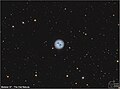
The Owl Nebula (also known as Messier 97, M97 or NGC 3587) is a planetary nebula approximately 2,030 light years away in the constellation Ursa Major.[2] Estimated to be about 8,000 years old,[6] it is approximately circular in cross-section with a faint internal structure. It was formed from the outflow of material from the stellar wind of the central star as it evolved along the asymptotic giant branch.[5] The nebula is arranged in three concentric shells, with the outermost shell being about 20–30% larger than the inner shell.[7] The owl-like appearance of the nebula is the result of an inner shell that is not circularly symmetric, but instead forms a barrel-like structure aligned at an angle of 45° to the line of sight.[5]

The nebula holds about 0.13 solar masses (M) of matter, including hydrogen, helium, nitrogen, oxygen, and sulfur;[5] all with a density of less than 100 particles per cubic centimeter.[7] Its outer radius is around 0.91 ly (0.28 pc) and it is expanding with velocities in the range of 27–39 km/s into the surrounding interstellar medium.[5]

The 14th magnitude central star has passed the turning point in its evolution and is condensing to form a white dwarf.[7][8] It has 55–60% of solar mass, is 41 to 148 times solar luminosity (L),[5] and has an effective temperature of 123,000 K.[9] The star has been successfully resolved by the Spitzer Space Telescope as a point source that does not show the infrared excess characteristic of a circumstellar disk.[10]

History

[edit]

The Owl Nebula was discovered by French astronomer Pierre Méchain on February 16, 1781.[8] Pierre Méchain was Charles Messier's observing colleague, and the nebula was observed by Messier himself a few weeks following the initial sighting.[11] Thus, the object was named Messier 97, and included in his catalog on March 24, 1781.[12] Of the object, he noted:[13][14][15][16]

Nebula in the great Bear, near Beta: It is difficult to see, reports M. Méchain, especially when one illuminates the micrometer wires: its light is faint, without a star. M. Méchain saw it the first time on Feb 16, 1781, & the position is that given by him. Near this nebula he has seen another one, [the position of] which has not yet been determined [Messier 108], and also a third which is near Gamma of the Great Bear [Messier 109]. (diam. 2′).

In 1844, Admiral William H. Smyth classified the object as a planetary nebula.[12][17] When William Parsons, 3rd Earl of Rosse, observed the nebula in Ireland in 1848, his hand-drawn illustration resembled an owl's head. In his notes, the object was described as "Two stars considerably apart in the central region, dark penumbra round each spiral arrangement, with stars as apparent centres of attraction. Stars sparkling in it; resolvable."[18][19] It has been known as the Owl Nebula ever since.[20] More recent developments in the late 1900s include the discovery of a giant red halo of wind extended around its inner shells,[21] and the mapping of the nebula's structure.[17][22][23]

Observing

[edit]

Although the Owl Nebula can not be seen with the naked eye, a faint image of it can be observed under remarkably good conditions with a small telescope or 20×80 binoculars. To make out the nebula's more distinctive owl like eye features, a telescope with an aperture 10" or better is required. To locate the nebula in the night sky, look to the southwest corner of the Big Dipper's bowl, marked by the star Beta Ursae Majoris. From there, M97 lies just over 2.5 degrees in the southeast direction towards the star positioned opposite Beta Ursae Majoris in the other bottom corner of the Big Dippers Bowl, Gamma Ursae Majoris; which marks the constellations southwest corner. M97, together with Alpha Ursae Majoris, point the way to Polaris.[24]

[edit]

See also

[edit]

References

[edit]
[edit]
Revisions and contributorsEdit on WikipediaRead on Wikipedia
from Grokipedia
The Owl Nebula (Messier 97 or M97), also cataloged as NGC 3587, is a located in the constellation , approximately 2,030 light-years from . Discovered by French Pierre Méchain on February 16, 1781, and independently observed by shortly thereafter, it derives its name from the distinctive owl-like appearance noted by William Parsons, 3rd , in 1848, who resolved its two dark "eye" cavities using his 72-inch at . This glowing shell of ionized gas and dust represents the final evolutionary stage of a low- to intermediate-mass star similar to the Sun, which shed its outer layers before collapsing into a core. With an apparent size of 3.4 by 3.3 arcminutes, the nebula spans a physical diameter of about 1.8 light-years, enclosing a complex structure of three concentric shells, including an inner barrel-shaped torus and an outer faint halo. Its estimated dynamical age is around 8,000 years, during which it has been expanding at velocities ranging from 27 to 39 km/s, driven by the intense ultraviolet radiation from its central star. The central white dwarf, visible at magnitude 16, has a mass of 0.55 to 0.6 solar masses, a luminosity 41 to 148 times that of the Sun, and an effective surface temperature of about 123,000 K, which excites the nebula's emission lines in hydrogen, oxygen, and other elements.

Physical Characteristics

Morphology and Structure

The Owl Nebula, also known as M97 or NGC 3587, derives its name from its distinctive owl-like appearance, which arises from two prominent dark "eyes" manifested as absorption regions approximately 50 arcseconds in size within the inner shell. These features, along with brighter regions resembling a "" and "beak," create the characteristic visage when viewed in optical wavelengths, particularly in [O III] emission. The absorption is attributed to denser neutral material obscuring the ionized gas behind it, as revealed by deep narrowband imaging in Hα, [O III], and [N II]. The nebula's comprises three concentric shells: an outer shell forming a faint, nearly circular ; a middle shell that is spherically symmetric and slightly elliptical; and a barrel-like inner shell responsible for the higher excitation emission. The inner barrel-shaped shell is tilted at an inclination of approximately 45 degrees relative to the , contributing to the observed asymmetry and the illusion of depth in the owl-like form. This configuration is supported by excitation and mapping, which delineates the shells based on emission line ratios and varying from about 300 to 1000 cm⁻³ across the . Overall, the displays an asymmetric morphology, with non-uniform shell thicknesses and enhanced brightness along certain axes, such as the northwest-southeast elongation of the inner shell. Clumpy regions of ionized gas are evident, particularly in low-excitation lines like [N II] and [S II], where knots of higher density material appear at the interfaces between shells, indicating interactions and shocks within the expanding . High-dispersion spectra confirm these clumps through variations in expansion velocities around 40–45 km s⁻¹. The total angular size of the measures 3'.4 × 3'.3 arcminutes, encompassing the primary shells while the outermost halo extends slightly beyond this.

Dimensions and Physical Parameters

The Owl Nebula exhibits a physical radius of approximately 0.91 light-years, corresponding to its outer shell as measured from deep narrowband imaging. This size is derived from an angular diameter of about 3.4 arcminutes observed in visible light, combined with distance estimates to convert to physical extents. Distance measurements to the Owl Nebula have varied, with trigonometric parallax and statistical methods providing key constraints. Stanghellini et al. (2008) estimated a distance of 2,030 light-years (0.621 kpc) using infrared photometry of the central star from the 2MASS survey, calibrated against known planetary nebula distances in the Magellanic Clouds. More recent statistical analysis by Frew et al. (2016), based on the Hα surface brightness-radius relation applied to a large sample of Galactic planetary nebulae, yields a distance of 2,800 light-years (0.87 kpc). A parallax measurement from Gaia DR2 (2018) suggests ~2,860 light-years (0.879 kpc), highlighting ongoing uncertainties in individual measurements for faint central stars. These methods emphasize the nebula's location in the Galactic disk, influencing interpretations of its physical scale. Kinematic models of the nebula's expansion, derived from high-dispersion echelle spectroscopy in emission lines such as Hα and [O III], indicate an age of about 8,000 years. This estimate assumes a uniform expansion velocity of around 40 km/s for the main shell, scaled by the distance-dependent dynamical age formula t = r / v_exp, where r is the physical radius. The total mass of the Owl Nebula is estimated at 0.13 solar masses, encompassing ionized gas in the inner and outer shells plus the faint halo. This value is obtained through photoionization modeling of emission-line intensities, accounting for the nebula's filling factor and electron temperature, with mass scaling as M ∝ d^{2.5} where d is the distance in kpc (typically referenced to ~2,000 light-years). The average electron density is around 600 cm⁻³, with local variations: higher (~1000 cm⁻³) in inner clumpy structures and lower (<100 cm⁻³) in the outer halo, consistent with its evolved stage and diffuse structure as probed by forbidden-line ratios. Observationally, the Owl Nebula has an apparent visual magnitude of 9.9, making it visible in moderate-sized telescopes under . This integrated magnitude reflects the combined brightness of the ionized shells, dominated by [O III] emission in the green band.

Central Star

Properties

The central star of the Owl Nebula is a hot, hydrogen-rich DAO-type precursor with an of approximately 123,000 K, in the post-asymptotic giant branch phase. Its is log g = 7.0 (in cm s⁻²), corresponding to a mass of approximately 0.6 M_⊙. The star's is estimated at 41 to 148 L_⊙, based on a of approximately 620 pc. With an apparent visual magnitude of about 16, the central star is difficult to resolve separately from the nebula without high-resolution imaging, as its light is overwhelmed by the surrounding ionized gas. The star exhibits strong emission features in the far-ultraviolet spectrum, including P Cygni profiles from a stellar wind with a mass-loss rate of approximately 10⁻⁹ M_⊙ yr⁻¹, and soft X-ray emission consistent with shock-heated plasma at temperatures exceeding 100 million K. This intense ultraviolet output ionizes the ejected envelope, sustaining the nebula's optical emission lines.

Evolutionary Stage

The central star of the Owl Nebula is currently in the post-asymptotic giant branch (post-AGB) phase of its evolution, having exhausted its nuclear fuel and shed its outer envelope to expose a hot core that is contracting toward the stage. This transition marks the end of the star's active mass-loss period, leaving the core to evolve along post-AGB tracks toward lower luminosities as it cools and densifies. The star's progenitor was likely a low- to intermediate-mass star (initial mass around 1-2 solar masses) that ascended the before entering the AGB phase, where thermal pulses drove the ejection of material that now forms the nebula. The nebula's visible glow arises from the ionization of the ejected envelope by the central 's intense , driven by its surface exceeding 100,000 , which excites atoms and causes them to emit upon recombination. As the progresses further, its diminishing ionizing will lead to recombination zones within the , with denser knots casting ionization shadows that contribute to the observed . This process sustains the 's emission for a limited time, highlighting its role as a brief transitional phenomenon in the 's lifecycle. Looking ahead, the central star will continue contracting into a of approximately 0.6 solar masses, gradually cooling over billions of years through radiative losses, while its fades from the current 41 to 148 solar luminosities. The surrounding , with a kinematical age of about 8,000 years based on its expansion velocity of 27-39 km/s and distance of ~0.62 kpc, represents only a snapshot in the star's much longer post-main-sequence evolution spanning tens of thousands of years for the phase alone. Over the next ~10,000-20,000 years, the ionized gas will disperse into the via expansion and interactions with ambient material, leaving the isolated remnant.

History and Discovery

Initial Discovery

The Owl Nebula, cataloged as Messier 97 (M97), was first detected by French astronomer Pierre Méchain on February 16, 1781, during his systematic sweeps for comets. Méchain, a close collaborator of , identified the object as a faint, diffuse patch of light in the constellation , situated between the stars Beta and Gamma Ursae Majoris. Méchain communicated his finding to Messier, who independently verified the nebula on March 24, 1781, using his own observations. Messier incorporated it as the 97th entry in his renowned catalog of nebulae and star clusters, describing it as "Nebula in the great Bear [Ursa Major], near Beta: It is difficult to see, reports M. Méchain, especially when one illuminates the micrometer wires: its light is faint, without a star... (diam. 2')." At the time, no internal structure was resolved, appearing simply as an unresolved glow against the night sky. This discovery formed part of a prolific period in late 18th-century astronomy, amid the compilation of the Messier catalog from 1758 to 1782, when Méchain and Messier documented numerous deep-sky objects to assist comet hunters in avoiding confusion with non-cometary phenomena. In 1781 alone, Méchain contributed several key entries, including M97, reflecting the era's growing interest in systematic celestial surveys.

Naming and Cataloging

The Owl Nebula received its popular name in 1848 from , who observed the object using his 72-inch reflector telescope at in Ireland and noted its resemblance to an owl's face due to prominent dark "eye-like" cavities within the brighter central region. This informal designation quickly gained acceptance among astronomers for its evocative description of the nebula's morphology as revealed in larger instruments. The nebula holds several formal catalog designations reflecting its inclusion in key astronomical surveys. It is listed as Messier 97 (M97) in Charles Messier's 1781 catalog of nebulae and star clusters, where it was recorded as a faint, round nebulous object. It was independently observed by in 1789, who described it as a globular body of equal light throughout. In the (NGC), compiled by John Louis Emil Dreyer and published in 1888, it appears as NGC 3587, providing a more precise positional reference based on earlier observations by and others. Additional identifiers include PK 148+57.1 from the 1967 Perek-Kohoutek Catalogue of True and Possible Planetary Nebulae, which systematically coordinates planetary nebulae using galactic latitude and longitude. Early observations of the Owl Nebula contributed to broader confusion in classifying faint deep-sky objects. This ambiguity persisted until the mid-19th century, when improved spectroscopic and telescopic studies, including those by Admiral William Henry Smyth in 1844, firmly established it as a —a shell of ionized gas ejected from an aging star. By the late 1800s, with the NGC's publication, such objects were more accurately cataloged and distinguished from stellar aggregates, advancing the understanding of their nature as post-asymptotic giant branch phenomena.

Observation and Visibility

Locating and Observing Tips

The Owl Nebula (M97) resides in the constellation , positioned approximately 2.5° east-southeast of Beta Ursae Majoris (Merak), one of the stars forming the bowl of the asterism, with precise J2000 coordinates of 11h 14m 47.7s and +55° 01′ 09″. To locate it, amateur astronomers can draw an from Merak toward Phecda (Gamma Ursae Majoris) and scan southward about one-third of the distance between them, where M97 appears near the edge-on galaxy under clear conditions. Optimal viewing occurs during spring evenings in the , particularly in when reaches a high altitude in the evening , making the nebula easier to spot from latitudes north of 35° N; it remains visible year-round in northern locations due to its circumpolar position for observers above about 35° N, though summer months place it lower on the northern horizon. Dark-sky sites far from urban light pollution are essential, as the nebula's low demands minimal atmospheric interference and high transparency for successful observation. With an of 9.9, M97 can be detected as a faint, hazy patch in large (50mm or larger) from Bortle Class 4 skies or better, while small telescopes of 4- to 6-inch reveal it as a diffuse, disk-like glow at moderate magnifications around 50x to 100x, ideally using a wide-field to frame the surrounding star field. Larger apertures (8-inch or more) enhance contrast, but techniques—shifting gaze slightly off-center—help in discerning its subtle form against the background.

Imaging and Telescopic Views

The distinctive owl-like appearance of the Owl Nebula was first documented in a detailed sketch by William Parsons, the Third Earl of Rosse, during observations on March 11, 1848, using his 72-inch Leviathan reflector telescope at Birr Castle, which captured the two prominent dark "eyes" within the brighter envelope. This historical drawing highlighted the nebula's central structure, resembling an owl's face, and established its popular moniker. In the 20th century, advancements in observational techniques included photoelectric photometry, which provided precise measurements of the nebula's brightness profile and emission characteristics, as conducted by Torres-Peimbert and Peimbert in 1977 using narrow slits across the object to derive surface brightness distributions. For detailed telescopic views, an of at least 10 inches (250 mm) is recommended to resolve the owl-like "eyes"—dark cavities on either side of the central star—and the inner barrel-shaped structure tilted at approximately 45 degrees, which smaller telescopes may only hint at as a fuzzy disk. Instruments with 6-inch can detect the nebula's overall form under , but higher magnifications (around 100-200x) and an OIII filter are advised to boost contrast and reveal the concentric shells. Modern imaging of the Owl Nebula typically involves CCD or DSLR cameras paired with OIII filters to isolate the dominant green oxygen emission lines, enhancing the nebula's ethereal hues against the sky background. Effective captures require total exposure times of 2-5 hours, often achieved through 5-10 minute sub-exposures to minimize noise, followed by stacking dozens of frames in software like PixInsight or DeepSkyStacker to accumulate signal and suppress gradients. Post-processing steps, including stretching and selective , are crucial for accentuating the faint outer halo and inner details without introducing artifacts. The nebula's low , resulting from its light being spread over a 3.4 arcminute disk, presents key challenges for both visual and photographic observation, often demanding to perceive subtle features through the or extensive to overcome . Dark sites with minimal are essential, as urban environments can render the object nearly invisible even in larger scopes, while image stacking remains indispensable for revealing the full extent of its structure.

Formation and Evolution

General Planetary Nebula Processes

Planetary nebulae represent shells of ionized gas expelled from low- to intermediate-mass stars (typically 0.8 to 8 solar masses) during their terminal evolutionary phases, prior to the formation of a remnant. These structures arise as the star exhausts its nuclear fuel and undergoes dramatic changes in its envelope, leading to the ejection of outer layers enriched with elements processed through . The formation process begins during the (AGB) phase, where the star experiences thermal pulses that destabilize its , triggering intense mass loss at rates of 10^{-8} to 10^{-4} solar masses per year. This mass ejection forms an expanding shell of gas and , sculpted by on dust grains and stellar pulsations, which remove up to 50-70% of the star's initial mass. As the is stripped away, the exposed core rapidly heats up, reaching temperatures exceeding 30,000 , which initiates the of the surrounding material. The key physical mechanism sustaining the nebula's visibility is , where photons from the hot central strip electrons from atoms in the ejected gas, creating a plasma that recombines and emits characteristic spectral lines. Prominent among these are recombination lines, such as the Balmer series and lines, which arise from the cascade of electrons back to lower energy states, providing diagnostics of the nebula's , , and composition. The central 's intense UV output maintains this balance until its luminosity fades. These nebulae have a brief , typically lasting 10,000 to 50,000 years, after which hydrodynamic expansion and recombination disperse the ionized gas into the , leaving the core behind. This short timescale, relative to the star's overall lifetime, makes planetary nebulae rare snapshots of stellar death.

Specific Dynamics of the Owl Nebula

The Owl Nebula displays an expansion in the range of 27–39 km/s, as measured through Doppler shifts observed in key emission lines including Hα at 28.5 km/s and [N II] at 39.4 km/s. These measurements, derived from long-slit echelle , reveal a homologous expansion pattern where increases proportionally with distance from the central . The nebula's shell dynamics feature a prominent inner shell undergoing expansion that shapes its characteristic barrel-like morphology, with the structure comprising an elongated ellipsoidal inner shell and a coexpanding spherical outer . Evidence of bipolar outflows from the pre-planetary nebula phase is apparent in the form of multipolar cavities within the inner shell, excavated by earlier fast stellar winds and indicating a complex ejection history. A kinematic age of approximately 8,000 years has been estimated for the Owl Nebula using the expansion parallax method, which combines measurements from with the nebula's angular size to infer its dynamical evolution. In 2023, observations revealed the presence of H2_2 molecular gas clumps embedded within the ionized shell, suggesting the survival of high-density condensations from the AGB ejection phase that have resisted full ionization. The observed asymmetries in the nebula's structure, such as the tilted inner shell and bipolar cavities, may arise from interactions with a possible binary companion during the mass-ejection phase or from the influence of shaping the outflow.

Scientific Significance

Composition and Spectroscopy

The Owl Nebula consists primarily of ionized and , with notable abundances of , oxygen, and derived from spectroscopic analyses of its . These elements reflect the chemical processing in the progenitor star, where nitrogen enhancement arises from the third dredge-up phase during its evolution, mixing CNO-cycled material to the surface. The total ionized mass is approximately 0.13–0.15 solar masses, distributed in a low-density . Spectroscopically, the nebula is classified as a Type I according to the Peimbert scheme, characterized by helium-to-hydrogen ratios exceeding 0.125 and nitrogen-to-oxygen ratios greater than 0.5, indicative of the progenitor's nucleosynthetic history. Its spectrum features prominent forbidden emission lines, including strong [O III] at 500.7 nm (responsible for the characteristic green hue), [N II] lines near 658.4 nm, and recombination lines like Hα at 656.3 nm. These forbidden transitions, such as those in [O III] and [N II], arise in the low-density of the nebula, with electron densities typically around 600 particles per cm³. The structure varies radially, with the inner regions dominated by high- species like O³⁺ from the central star's intense flux ( of about 123,000 K), while outer layers show lower states, such as neutral or singly ionized species, due to decreasing radiation intensity and recombination effects. This zonal differentiation is evident in imaging, where [O III] emission traces the highly ionized core and Hα/[N II] highlight the transitional envelopes.

Research and Measurements

In the early , pioneering spectroscopic studies by I.S. Bowen identified the origins of prominent nebular emission lines in planetary nebulae, including those in the Owl Nebula (NGC 3587), attributing them to forbidden transitions from metastable states in ions such as N II, O II, and O III. This work, published in , provided the foundational understanding of the excitation mechanisms driving the nebula's glow, resolving long-standing puzzles about the nature of these lines. Subsequent ground-based imaging in the late began to reveal the complex shell structure, but high-resolution observations in the early 2000s confirmed the triple-shell morphology, with a faint outer bow-shaped halo and inner cavities resembling owl eyes. Distance measurements to the Owl Nebula have evolved significantly with advancing techniques. Early estimates based on spectroscopic parallaxes placed it around 2,000 light-years away, but a 2008 analysis using expansion parallax refined this to 2,030 light-years (621 parsecs). By 2016, updated hydrodynamic models incorporating proper motion data suggested a greater distance of approximately 2,800 light-years (870 parsecs), better aligning with the nebula's observed size and expansion rate. More recently, Gaia Data Release 2 parallaxes in 2018 yielded a distance of about 2,865 light-years (879 parsecs), providing a trigonometric benchmark that supports these expansion-based revisions. Post-2016 research has leveraged observatories to probe cooler components of the nebula. and (WISE) observations revealed weak continuum emission amid strong high-ionization lines, indicating sparse grains in the outer shells that contribute minimally to the overall flux but hint at asymmetric distribution linked to the multipolar cavities. These findings, detailed in a 2018 study, highlight the nebula's low content compared to younger planetary nebulae, consistent with its estimated age of around 10,000 years. Additionally, photometric monitoring has uncovered variability in the central star's brightness, suggesting possible binary companionship that could influence the nebula's asymmetric shaping, as proposed in earlier models and revisited in recent analyses. In 2024, observations revealed three groups of dense, cold molecular (H₂) clumps embedded in the nebular shell, located at projected distances of 0.26–0.29 pc from the central star. These clumps, with negligible content, suggest the persistence of high-density condensations from the nebula's formation, supporting a kinematic age of approximately 10,400 years. Professional investigations employ advanced spectrographs for detailed kinematic studies. Long-slit echelle on mid-sized telescopes, such as the 4.2-meter , has mapped radial velocities across the nebula, revealing expansion rates of 27–39 km/s in the inner shell. While 8-meter-class facilities like the have not yet targeted the Owl Nebula specifically for velocity mapping, similar techniques on these instruments are increasingly applied to comparable planetary nebulae to resolve fine-scale dynamics and ionization stratification. Ongoing surveys continue to refine these measurements, integrating multi-wavelength data to model the nebula's evolutionary stage.

References

Add your contribution
Related Hubs
User Avatar
No comments yet.