


Community hub
Recent from talks
Contribute something
Nothing was collected or created yet.
Microfiber
View on Wikipedia | This article needs additional citations for verification. (March 2023) |


Microfiber (US) or microfibre (UK) is synthetic fiber finer than one denier or decitex/thread, having a diameter of less than ten micrometers.
The most common types of microfiber are made variously of polyesters; polyamides (e.g., nylon, Kevlar, Nomex); and combinations of polyester, polyamide, and polypropylene. Microfiber is used to make mats, knits, and weaves, for apparel, upholstery, industrial filters, and cleaning products. The shape, size, and combinations of synthetic fibers are chosen for specific characteristics, including softness, toughness, absorption, water repellence, electrostatics, and filtering ability.
They are commonly used for cleaning scratch-prone surfaces such as displays, glass, and lenses. Microfiber cloth makes use of van der Waals force to remove dirt without scratches.
History
[edit]Production of ultra-fine fibers (finer than 0.7 denier) dates to the late 1950s, using melt-blown spinning and flash spinning techniques. Initially, only fine staples of random length could be manufactured and very few applications were found.[1] Then came experiments to produce ultra-fine fibers of a continuous filament: the most promising experiments were made in Japan in the 1960s, by Miyoshi Okamoto, a scientist at Toray Industries.[2] Okamoto's discoveries and those of Toyohiko Hikota led to many industrial applications, including Ultrasuede, one of the first successful synthetic microfibers, which entered the market in the 1970s. Microfiber's use in the textile industry then expanded. Microfibers were first publicized in the early 1990s, in Sweden, and saw success as a product in Europe over the course of the decade.
Apparel
[edit]Clothing
[edit]Microfiber fabrics are man-made and frequently used for athletic wear, such as cycling jerseys, because the microfiber material wicks moisture (perspiration) away from the body; subsequent evaporation cools the wearer.
Microfiber can be used to make tough, very soft fabric for clothing, often used in skirts, jackets, bathrobes, and swimwear. Microfiber can be made into Ultrasuede, a synthetic imitation of suede leather, which is cheaper and easier to clean and sew than natural suede leather.
Accessories
[edit]Microfiber is used to make many accessories that traditionally have been made from leather: wallets, handbags, backpacks, book covers, shoes, cell phone cases, and coin purses. Microfiber fabric is lightweight, durable, and somewhat water repellent, so it makes a good substitute.
Another advantage of microfiber fabric (compared to leather) is that it can be coated with various finishes and can be treated with antibacterial chemicals. Fabric can also be printed with various designs, embroidered with colored thread, and heat-embossed.
Other uses
[edit]Textiles for cleaning
[edit]

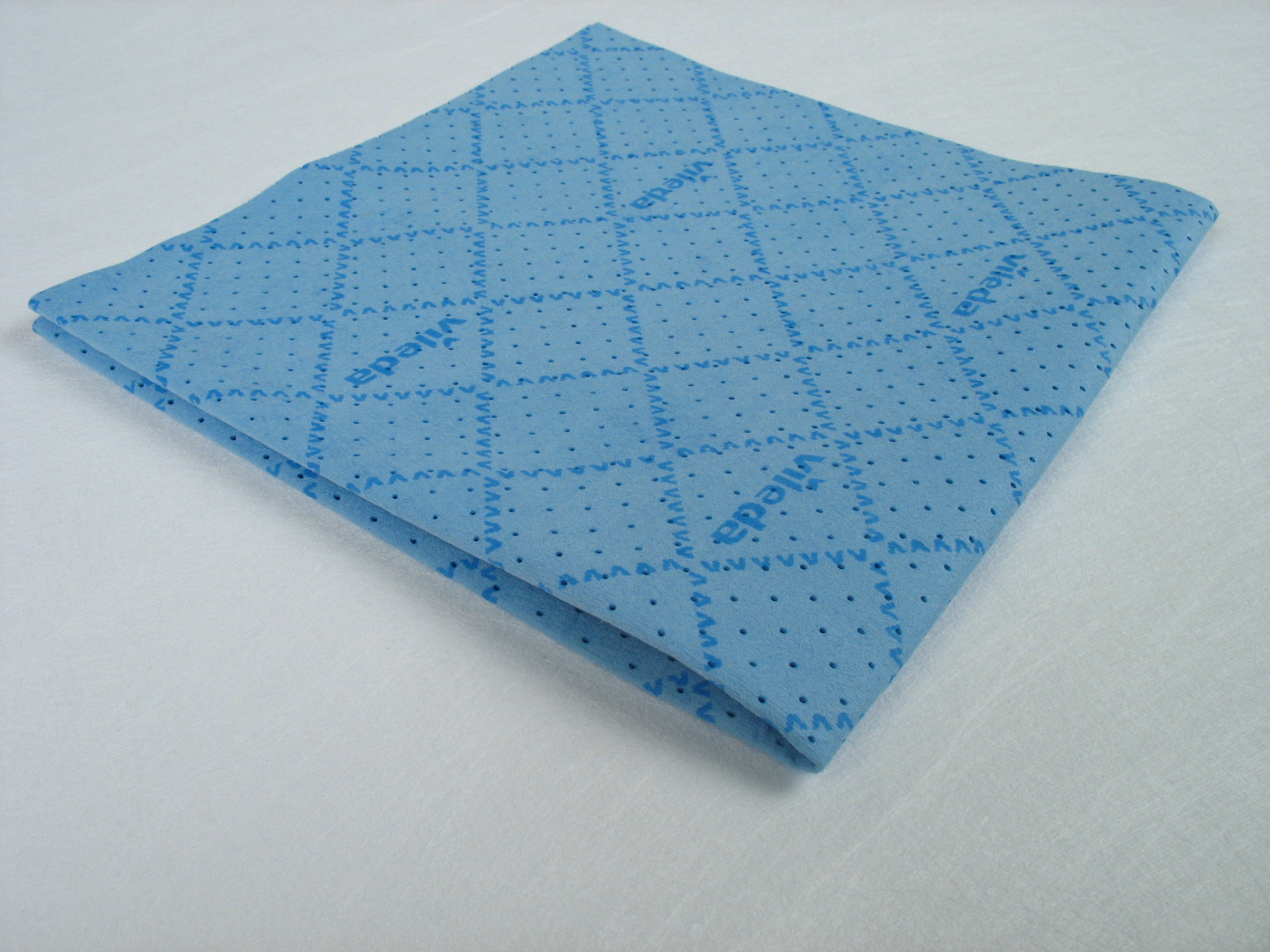
In cleaning products, microfiber can be 100% polyester, or a blend of polyester and polyamide (nylon). It can be either a woven product or a non woven product, the latter most often used in limited use or disposable cloths. In the highest-quality fabrics for cleaning applications, the fiber is split during the manufacturing process to produce multi-stranded fibers. A cross section of the split microfiber fabric under high magnification would look like an asterisk.[citation needed]
The split fibers and the size of the individual filaments make the cloths more effective than other fabrics for cleaning purposes. The structure traps and retains the dirt and also absorbs liquids. Unlike cotton, microfiber leaves no lint, the exception being some micro suede blends, where the surface is mechanically processed to produce a soft plush feel.[citation needed]
For microfiber to be most effective as a cleaning product, especially for water-soluble soils and waxes, it should be a split microfiber. Non-split microfiber is little more than a very soft cloth. The main exception is for cloths used for facial cleansing and for the removal of skin oils (sebum), sunscreens, and mosquito repellents from optical surfaces such as cameras, phones and eyeglasses wherein higher-end proprietary woven, 100% polyester cloths using 2 μm filaments, will absorb these types of oils without smearing.[citation needed]
Microfiber used in non-sports-related clothing, furniture, and other applications is not split because it is not designed to be absorbent, just soft. When buying, microfiber may not be labeled to designate whether it is split. One method to determine the type of microfiber is to run the cloth over the palm of the hand. A split microfiber will cling to imperfections of the skin and can be either heard or felt as it does. Alternatively, a small amount of water can be poured onto a hard, flat surface and pushed with the microfiber. If the water is pushed rather than absorbed, it is not split microfiber.[citation needed]
Microfiber can be electrostatically charged for special purposes like filtration.[3][better source needed]
Cloths and mops
[edit]Microfiber products used for consumer cleaning are generally constructed from split conjugated fibers of polyester and polyamide. Microfiber used for commercial cleaning products also includes many products constructed of 100% polyester. Microfiber products are able to absorb oils especially well and are not hard enough to scratch even paintwork unless they have retained grit or hard particles from previous use. Due to hydrogen bonding, microfiber cloth containing polyamide absorbs and holds more water than other types of fibers.
Microfiber is widely used by car detailers to handle tasks such as removing wax from paintwork, quick detailing, interior cleaning, glass cleaning, and drying. Because of their fine fibers which leave no lint or dust, microfiber towels are used by car detailers and enthusiasts in a similar manner to a chamois leather.
Microfiber is used in many professional cleaning applications, for example in mops and cleaning cloths. Although microfiber mops cost more than non-microfiber mops, they may be more economical because they last longer and require less effort to use.[4][5]
Microfiber textiles designed for cleaning clean on a microscopic scale. According to tests, using microfiber materials to clean a surface reduces bacteria by 99%, whereas a conventional cleaning material reduces bacteria by only 33%.[6] Microfiber cleaning tools also absorb fat and grease and their electrostatic properties allow them to attract dust strongly.
Microfiber cloths are also used to clean photographic lenses as they absorb oily matter without being abrasive or leaving a residue, and are sold by major manufacturers such as Sinar, ZEISS, Nikon and Canon. Small microfiber cleaning cloths are commonly sold for cleaning computer screens, cameras, phones and eyeglasses.

Microfiber is unsuitable for some cleaning applications as it accumulates dust, debris, and particles. Sensitive surfaces (such as all high-tech coated surfaces e.g. CRT, LCD and plasma screens) can easily be damaged by a microfiber cloth if it has picked up grit or other abrasive particles during use. One way to minimize the risk of damage to flat surfaces is to use a flat, non-rugged microfiber cloth, as these tend to be less prone to retaining grit.
Rags made of microfiber must only be washed with regular laundry detergent, not oily, self-softening, soap-based detergents. Fabric softener must not be used;[7] the oils and cationic surfactants in the softener and self-softening detergents will clog up the fibers and make them less absorbent until the oils are washed out. Hot temperatures may also cause microfiber cloth to melt or become wrinkled.[7]
Insulation
[edit]Microfiber materials such as PrimaLoft are used for thermal insulation as a replacement for down feather insulation in sleeping bags and outdoor equipment, because of their better retention of heat when damp or wet. Microfiber is also used for water insulation in automotive car covers. Depending on the technology the fiber manufacturer is using, such material may contain from 2 up to 5 thin layers, merged. Such combination ensures not only high absorption factor, but also breathability of the material, which prevents the greenhouse effect.
Basketballs
[edit]With microfiber-shelled basketballs already used by FIBA, the NBA introduced a microfiber ball for the 2006–07 season.[8] The ball, which is manufactured by Spalding, does not require a "break-in" period of use as leather balls do and has the ability to absorb water and oils, meaning that sweat from players touching the ball is better absorbed, making the ball less slippery.[8] Over the course of the season, the league received many complaints from players who found that the ball bounced differently from leather balls, and that it left cuts on their hands.[9] On January 1, 2007, the league scrapped the use of all microfiber balls and returned to leather basketballs.[9]
Other
[edit]Microfibers used in tablecloths, furniture, and car interiors are designed to repel wetting and consequently are difficult to stain. In furniture, microfiber is a close alternative to leather due to the simple upkeep of the qualities of the material. Easy to wipe off liquids and better suited for individuals with pets. Microfiber tablecloths will bead liquids until they are removed and are sometimes advertised showing red wine on a white tablecloth that wipes clean with a paper towel. This and the ability to mimic suede economically are common selling points for microfiber upholstery fabrics (e.g., for couches).[citation needed]
Microfibers are used in towels especially those to be used at swimming pools as even a small towel dries the body quickly. They dry quickly and are less prone than cotton towels to become stale if not dried immediately. Microfiber towels need to be soaked in water and pressed before use, as they would otherwise repel water as microfiber tablecloths do.[citation needed]
Microfiber is also used for other applications such as making menstrual pads, cloth diaper inserts, body scrubbers, face mitts, whiteboard cleaners, and various goods that need to absorb water and/or attract small particles.
In the medical world, the properties of microfibers are used in the coating of certain fabric sheets used to strengthen the original material.[10]
Environmental and safety issues
[edit]Microfiber textiles tend to be flammable if manufactured from hydrocarbons (polyester) or carbohydrates (cellulose) and emit toxic gases when burning, more so if aromatic (PET, PS, ABS) or treated with halogenated flame retardants and azo dyes.[11] Their polyester and nylon stock are made from petrochemicals, which are not a renewable resource and are not biodegradable.
For most cleaning applications they are designed for repeated use rather than being discarded after use.[12] An exception to this is the precise cleaning of optical components where a wet cloth is drawn once across the object and must not be used again as the debris collected are now embedded in the cloth and may scratch the optical surface.
Microfiber products also enter the oceanic water supply and food chain similarly to other microplastics.[13] Synthetic clothing made of microfibers that are washed release materials and travel to local wastewater treatment plants, contributing to plastic pollution in water. A study by the clothing brand Patagonia and University of California, Santa Barbara, found that when synthetic jackets made of microfibers are washed, on average 1.7 grams (0.060 oz) of microfibers are released from the washing machine. These microfibers then travel to local wastewater treatment plants, where up to 40% of them enter into rivers, lakes, and oceans where they contribute to the overall plastic pollution.[14][15] Microfibers account for 85% of man-made debris found on shorelines worldwide.[16][13] Fibers retained in wastewater treatment sludge (biosolids) that are land-applied can persist in soils.[17]
See also
[edit]References
[edit]- ^ Nakajima T, Kajiwara K, McIntyre J E, 1994. Advanced Fiber Spinning Technology Archived 2020-01-26 at the Wayback Machine. Woodhead Publishing, pp. 187–188
- ^ Kanigel, Robert, 2007. Faux Real: Genuine Leather and 200 Years of Inspired Fakes Archived 2018-10-11 at the Wayback Machine. Joseph Henry Press, pp. 186–192
- ^ "SYNTHETIC SPLIT MICROFIBER TECHNOLOGY FOR FILTRATION " by Jeff Dugan, Vice President Research and Development Fiber Innovation Technologies and Ed Homonoff President Edward C. Homonoff & Associates, LLC
- ^ UC Davis Health System: Newroom. UC Davis Pioneers Use of Microfiber Mops in Hospitals: Mops reduce injuries, kill more germs and reduce costs. Archived 2010-07-06 at the Wayback Machine June 23, 2006.
- ^ Sustainable Hospitals Project, University of Massachusetts Lowell. 10 Reasons to Use Microfiber Mopping. Archived 2007-04-10 at the Wayback Machine
- ^ UC Davis Health System: Newroom UC Davis Pioneers Use Of Microfiber Mops In Hospitals. Ucdmc.ucdavis.edu. Retrieved on 2010-12-01.
- ^ a b "Discover Microfiber Clothes and Linens and How to Use and Wash Them". The Spruce.
- ^ a b NBA Introduces New Game Ball Archived 2012-03-17 at the Wayback Machine. NBA.com, June 28, 2006.
- ^ a b Josh Hart, NBA to Take Microfiber Basketball and Go Home Archived 2008-12-12 at the Wayback Machine. National Ledger, December 12, 2006.
- ^ Mukhopadhyay, Samrat (September 2002). "Microfibres—An overview". Indian Journal of Fibre and Textile Research. 27: 312. ISSN 0975-1025. Retrieved October 20, 2023 – via NIScPR.
- ^ Braun, Emil; Levin, Barbara C. (1986). "Polyesters: A Review of the Literature on Products of Combustion and Toxicity" (PDF). Fire and Materials. 10 (3–4): 107–123. doi:10.1002/fam.810100304. Archived (PDF) from the original on May 30, 2010. Retrieved December 2, 2012.
- ^ Barbara Flanagan, The Case of the Missing Microfiber. I.D., April 22, 2008.
- ^ a b Browne, Mark Anthony; Crump, Phillip; Niven, Stewart J.; Teuten, Emma; Tonkin, Andrew; Galloway, Tamara; Thompson, Richard (2011). "Accumulation of microplastic on shorelines worldwide: Sources and sinks". Environmental Science & Technology. 45 (21): 9175–9179. doi:10.1021/es201811s. PMID 21894925. S2CID 19178027.
- ^ "Project Findings". Microfiber Pollution & the apparel industry. Archived from the original on March 26, 2017. Retrieved March 25, 2017.
- ^ O'Connor, Mary Catherine (June 20, 2016). "Patagonia's New Study Finds Fleece Jackets Are a Serious Pollutant". Outside Online. Archived from the original on March 26, 2017. Retrieved March 25, 2017.
- ^ Paddison, Laura (September 26, 2016). "Single clothes wash may release 700,000 microplastic fibres, study finds". The Guardian. ISSN 0261-3077. Archived from the original on February 10, 2020. Retrieved June 15, 2017.
- ^ Zubris, Kimberly Ann V.; Richards, Brian K. (November 2005). "Synthetic fibers as an indicator of land application of sludge". Environmental Pollution. 138 (2): 201–211. doi:10.1016/j.envpol.2005.04.013. PMID 15967553.


| Authority control databases: National |
|---|

Microfiber
View on GrokipediaDefinition and Properties
Composition and Structure
Microfiber consists primarily of synthetic polymers such as polyester (polyethylene terephthalate, PET) and polyamide (nylon), which are extruded into ultra-fine filaments with a linear density of approximately 1 decitex (dtex) or less per filament, typically ranging from 0.3 to 1 dtex.[11][5] The polyester component imparts structural integrity and hydrophobicity, while polyamide contributes absorbency and elasticity due to its amide linkages enabling hydrogen bonding.[12] These filaments exhibit diameters finer than 10 micrometers, often achieving effective fineness below 1 denier, enabling high surface area-to-volume ratios that enhance properties like wicking and trapping.[12][13] At the structural level, microfiber filaments are engineered through conjugate spinning, where molten polyester and polyamide are co-extruded in alternating wedge- or pie-shaped segments within a single filament, separated by a dissolvable lubricant like oil to prevent premature bonding.[14] This multiblock or islands-in-the-sea configuration results in cross-sections with 8 to 16 segments per polymer type, which are later mechanically or chemically split (microfiberized) to yield individual sub-filaments as fine as 0.1 dtex.[3][15] The resulting structure features a high degree of fibrillation, with split fibers forming a networked, brush-like surface that increases mechanical interlocking with particles and liquids.[5] Variations include pure polyester microfiber for durability or blended forms where polyamide ratios (e.g., 20-80%) optimize specific traits like moisture retention without altering the core filament architecture.[12][16]Key Physical and Chemical Characteristics
Microfibers are synthetic fibers characterized by their ultra-fine diameters, typically less than 10 micrometers, with individual filaments often measuring below 1 denier per filament, enabling a high surface area-to-volume ratio that distinguishes them from conventional fibers.[12] This fineness results in enhanced capillary action, allowing microfibers to absorb liquids up to several times their weight—commonly 7 to 8 times for polyester-based variants used in cleaning applications—through wicking and retention mechanisms rather than bulk volume.[17] Physically, they exhibit softness, flexibility, and smoothness due to the reduced fiber diameter, which minimizes stiffness while maintaining brilliance and high covering power in fabrics.[18] Mechanically, microfibers demonstrate exceptional tensile strength relative to their size, with polyester microfibers often retaining properties comparable to thicker counterparts but benefiting from increased fiber density per unit area for improved durability and resistance to abrasion.[19] They are breathable, wrinkle-resistant, and quick-drying, attributes stemming from their low moisture regain (typically 0.4% for polyester) and ability to release water rapidly via evaporation, making them suitable for applications requiring rapid moisture management.[20] Specific gravity is low, around 1.38 for polyester microfibers, contributing to lightweight fabrics with densities that support high yarn counts without added bulk.[19] Chemically, microfibers are predominantly composed of polymers such as polyester (polyethylene terephthalate) or polyamides (nylon), which provide inherent stability and resistance to degradation under normal environmental conditions, including mild acids, bases, and solvents.[20] These polymers are non-biodegradable, persisting in ecosystems due to strong covalent bonds that resist microbial breakdown, though they can adsorb environmental pollutants like heavy metals or organic compounds onto their surfaces.[21] Untreated polyester microfibers are hydrophobic, with contact angles exceeding 90 degrees, but surface modifications—such as splitting or chemical finishes—can impart hydrophilic properties for enhanced wettability without altering the core polymer's chemical inertness to hydrolysis or oxidation at ambient temperatures.[22] Additives used during manufacturing, including dyes and flame retardants, may introduce reactivity, but the base fiber matrix remains largely unreactive to common household chemicals.[23]History
Early Invention and Research (1950s–1970s)
Techniques for producing ultra-fine synthetic fibers, finer than 0.7 denier, emerged in the late 1950s through innovations in polymer processing, including melt-blown spinning and flash spinning methods that extruded polymers under high pressure to form thin filaments.[24][6] These early efforts laid groundwork for microfiber by demonstrating feasibility of sub-micrometer diameters, though initial applications targeted nonwovens like filters and medical fabrics rather than textiles, due to challenges in durability and weaving.[25] In the 1960s, Japanese researchers at Toray Industries advanced conjugate fiber technology, blending polyester and polyamide polymers to create bicomponent filaments that could be chemically or mechanically split into finer strands, achieving diameters under 10 micrometers—finer than silk.[12] This period saw experimental focus on enhancing fiber surface area for superior absorbency and softness, driven by demands for synthetic alternatives to natural leathers and suedes.[6] The pivotal invention occurred in 1970, when Dr. Miyoshi Okamoto at Toray developed the first commercial microfiber fabric, Ultrasuede, via a splitting process that produced non-woven sheets of ultra-fine polyester fibers impregnated with polyurethane for suede-like texture and water resistance.[26] Okamoto's colleague, Dr. Toyohiko Hikota, refined the splitting technique shortly thereafter, enabling scalable production of microfibers with enhanced tensile strength and capillary action for liquid retention.[26] Early research emphasized empirical testing of fiber fineness against properties like wicking and dirt-trapping efficacy, establishing microfibers' causal advantages in filtration and wiping over coarser synthetics.[12] By the mid-1970s, these innovations expanded to apparel prototypes, though commercialization remained limited until process optimizations addressed fibrillation and laundering durability.[27]Commercialization and Widespread Adoption (1980s–Present)
Following pioneering developments by Japanese firms like Toray Industries in the 1970s, microfiber production expanded commercially in Europe during the 1980s, with Swedish innovators marketing the first viable products for cleaning and textiles around the mid-decade.[11][28] European manufacturers invested heavily in the technology throughout the 1980s and 1990s, leveraging its ultra-fine filaments—typically polyester or polyamide blends—to create durable, high-performance fabrics.[25] By the late 1980s, microfiber entered the cleaning sector with specialized cloths and mops, which required less detergent and water compared to traditional cotton alternatives, driving initial adoption in professional hygiene applications.[28][29] In the 1990s, American companies such as DuPont began producing microfibers, accelerating global dissemination into consumer markets including apparel, upholstery, and automotive care.[11][30] The material's stain resistance, quick-drying properties, and superior absorbency—up to seven times its weight in liquid—fueled its integration into household products, with microfiber towels and shammies becoming staples for detailing and polishing by the early 2000s.[31][32] Adoption surged in industrial filters and technical textiles due to enhanced filtration efficiency from the fibers' high surface area.[33] By the 2010s, microfiber dominated segments like cleaning cloths, with global markets reflecting sustained demand; for instance, the microfiber cleaning cloth sector reached approximately USD 979 million in 2025, underscoring its entrenched role in eco-conscious and efficient practices across residential, commercial, and institutional settings.[34] Its proliferation has been attributed to empirical advantages in reducing chemical use and improving dirt-trapping via electrostatic properties, though concerns over microfiber shedding into waterways emerged as production scaled to billions of tons annually in synthetic textiles.[4][35]Manufacturing
Raw Materials and Fiber Extrusion
Microfiber production primarily utilizes synthetic polymers derived from petrochemical sources, with polyester (polyethylene terephthalate, PET) and polyamide (nylon 6 or nylon 66) as the dominant raw materials.[11][12] These polymers are supplied as pellets or chips, which are melted for processing; polyester accounts for the majority of microfiber output due to its cost-effectiveness and versatility, while nylon provides enhanced abrasion resistance in blended forms.[36][37] The fiber extrusion process employs melt spinning, a technique where polymer pellets are heated to their melting point—typically 250–290°C for polyester and 220–260°C for nylon—and extruded through a spinneret, a metal plate with precisely engineered orifices ranging from 0.2 to 0.4 mm in diameter.[38][39] This vertical extrusion occurs in multi-story facilities (often 5–7 stories tall) to allow gravitational draw-down, where the molten polymer stream is attenuated into continuous filaments that solidify upon cooling with air jets.[39] The resulting filaments achieve microfiber fineness through high draw ratios (up to 1:5 or greater) and reduced extrusion rates, yielding diameters below 10 micrometers (equivalent to less than 1 denier per filament).[11][40] To attain ultra-fine diameters, bicomponent extrusion is commonly applied, co-extruding two incompatible polymers in configurations such as islands-in-sea (where dissolvable "sea" polymer encases finer "island" filaments) or side-by-side (for later mechanical splitting).[40] Post-extrusion, the secondary polymer is chemically removed (e.g., via alkali dissolution for polyester-nylon blends), splitting or isolating filaments to diameters as low as 0.3–1 denier.[11][41] This method, pioneered in the 1970s by Japanese firms like Toray, enables commercial scalability while controlling variables like orifice diameter, melt viscosity, and cooling rate to ensure uniform filament cross-sections and prevent defects such as die swell.[40][38] Additives, including delustrants (e.g., titanium dioxide for opacity) and antistatic agents, are incorporated into the polymer melt prior to extrusion to tailor properties like luster and conductivity.[36] The process demands precise control of temperature, pressure (up to 100–200 bar), and throughput rates (e.g., 0.5–2 g/min per hole) to produce high-tenacity filaments suitable for downstream drawing and texturing.[42][43] Yields from extrusion typically exceed 95% efficiency in modern facilities, though energy-intensive melting and potential volatile emissions from petrochemical feedstocks pose operational challenges.[36]Processing and Fabric Formation
Following fiber extrusion, the molten polymer filaments are rapidly quenched in air or water to solidify them, then drawn or stretched at elevated temperatures to align polymer chains, improving crystallinity, tensile strength, and fineness; this drawing process typically elongates filaments 2 to 5 times their initial length, reducing diameter to below 10 micrometers for microfiber classification.[44][36] Drawn filaments, frequently produced as bicomponent conjugates (e.g., islands-in-the-sea or segmented-pie configurations using polyester and polyamide), are textured via false-twist or air-jet methods to introduce crimp for bulk and cohesion, then either wound as continuous multifilament yarns or cut into staple fibers (typically 3-8 cm lengths) for subsequent spinning.[40][3] To generate individual microfibers from bundles, the yarns or woven/knitted fabrics undergo chemical splitting: an alkaline bath (pH >10) or solvent selectively dissolves the sacrificial matrix polymer (e.g., polyamide in polyester-polyamide blends), separating finer filaments (0.1-1 denier per filament); this hydrolysis step, conducted at 80-100°C for 30-60 minutes, yields fabrics with split fibers enhancing surface area and capillary action.[40][39] Yarns are then interlaced into fabrics primarily through knitting (e.g., circular or warp knitting for looped terry structures) or weaving (plain or satin weaves for smooth sheets), with knitting preferred for absorbent products due to yarn loop entanglement providing mechanical interlocking without dense crimp; nonwoven processes, involving needle-punching or hydroentangling of staple webs, are used for bulkier mats.[11][12] Final formation includes heat-setting at 180-220°C to stabilize dimensions and dye uptake, followed by scouring to remove spinning oils and jet dyeing under high pressure for uniform color penetration and fabric bulking; mechanical finishes like sanding or emerizing raise split fiber ends for improved wipeability, while silicone emulsions may be applied for lubricity.[11][39]Applications
Apparel and Consumer Textiles
Microfiber fabrics are extensively utilized in apparel, particularly for athletic and performance-oriented garments, owing to their fine fiber structure—typically less than 1 denier per filament—which enables superior moisture management through capillary action that draws sweat away from the skin and promotes rapid evaporation.[45] In sportswear, these properties result in drying rates up to 2-3 times faster than comparable cotton or standard polyester fabrics, as demonstrated in evaluations of microfiber's water drop absorbency and total moisture transport efficiency.[11] Common applications include moisture-wicking shirts, shorts, and base layers for activities like running and cycling, where breathability reduces perceived exertion by maintaining lower skin humidity levels during prolonged use.[46] Beyond activewear, microfiber appears in everyday clothing such as jackets, skirts, swimwear, and underwear, valued for its lightweight construction (often 100-200 gsm), abrasion resistance exceeding 10,000 cycles in Martindale tests, and water-repellent finishes that enhance durability without added weight.[47] Polyester-based microfiber, comprising over 80% of apparel variants, provides thermal insulation superior to coarser synthetics due to trapped air in its porous structure, contributing to a warmer tactile feel while remaining breathable.[11] These attributes have driven adoption in performance outerwear, where fabrics maintain shape retention and resist pilling after repeated laundering.[48] In consumer textiles, microfiber excels in towels, bedding, and upholstery for its high absorbency—holding up to seven times its weight in water—and quick-drying characteristics, making it suitable for bath linens that dry in under two hours post-use compared to cotton equivalents.[49] Microfiber sheet sets and duvet covers offer a soft, non-abrasive surface with inherent wrinkle resistance, reducing ironing needs and maintaining loft through machine washing at temperatures up to 60°C.[48] Microfiber bed sheets, made from synthetic polyester fibers, are affordable and provide a soft, smooth, silky feel, durability with wrinkle resistance and longevity under proper care, low-maintenance ease including quick drying and minimal shrinking, lightweight construction, and hypoallergenic resistance to dust mites and allergens. However, they are less breathable than natural fibers like cotton, potentially trapping heat and causing overheating for hot sleepers; they generate static electricity attracting lint and pet hair, are prone to staining and odor retention, and may feel less natural or slippery due to their synthetic nature and lower eco-friendliness. High-quality microfiber variants exhibit enhanced durability and moisture-wicking, appealing to budget-conscious users prioritizing care ease over optimal temperature regulation.[50][51] For upholstery, microfiber's stain-resistant properties, derived from its split-fiber morphology that minimizes liquid penetration, provide longevity in high-traffic areas, with fabrics enduring over 50,000 abrasion cycles without significant fading.[52] Global production of microfiber for these textile segments supports a market valued at approximately USD 14.2 billion in 2023, reflecting demand for its economic efficiencies in manufacturing and end-use performance.[53]Cleaning and Hygiene Products
Microfiber cloths and mops are widely used in cleaning and hygiene applications due to their ability to effectively capture dust, dirt, and microorganisms through electrostatic attraction and capillary action provided by fibers typically 1 denier or finer in diameter.[54] These products outperform traditional cotton alternatives in initial microbial removal, with studies demonstrating up to 95% reduction in surface bioburden using microfiber mops compared to 68% for cotton string mops when paired with detergent cleaners.[55] In healthcare settings, microfiber cloths have shown superior decontamination efficacy over cotton and sponge cloths in new condition, removing organic soil and microbes from hospital surfaces like stainless steel and vinyl.[56] For hygiene maintenance, microfiber facilitates reduced cross-contamination; research indicates microfiber wipes transfer fewer Clostridium difficile spores to consecutive surfaces (0.8 log₁₀ reduction) versus cotton cloths (1.80 log₁₀).[57] Disposable microfiber variants achieve 99.99% microbe removal, minimizing infection risks in clinical environments without requiring extensive chemical disinfectants.[58] Split microfiber blends, combining polyester and polyamide, enhance bacterial and viral removal by penetrating surface crevices inaccessible to coarser materials.[59] However, repeated laundering can diminish efficacy, with reprocessed microfiber sometimes underperforming cotton after multiple cycles due to fiber degradation.[60] To mitigate this, microfiber cleaning cloths should be washed separately using mild, unscented detergents, avoiding fabric softeners, dryer sheets, and high-pH additives to preserve electrostatic charge and absorbency; small amounts of gentler alternatives like Sal Suds may be used over abrasive options. Washing in warm or hot water with ½ cup white vinegar added to the rinse cycle helps remove residues, and air drying is recommended over high-heat drying to prevent fiber damage.[61][62] Common hygiene products include eyeglass cleaning cloths, which utilize dry microfiber to remove smudges and fingerprints via static cling without streaks. In a discussion thread on Reddit's r/OLED_Gaming subreddit, MagicFiber and Fosmon microfiber cloths are listed alongside e-cloth and Elite Tech Gear as solid choices for cleaning OLED screens, considered better than Zeiss cloths, with no direct head-to-head comparison or stated preference between MagicFiber and Fosmon.[63] and wet mops for floor sanitation in homes and facilities.[64] Microfiber's absorbency—holding up to seven times its weight in liquid—supports efficient spill cleanup and damp wiping, reducing moisture residue that could foster bacterial growth.[65] In professional cleaning, these products lower disinfectant consumption by 34% less than cotton in some protocols, promoting economic hygiene practices while maintaining surface integrity.[66]Sports Equipment and Recreation
Microfiber fabrics are employed in athletic apparel primarily for their moisture-wicking capabilities, which enable sweat to be drawn away from the skin to the outer surface for swift evaporation, thereby reducing discomfort and chafing during physical activities such as running, cycling, and team sports. Polyester microfiber, a common variant, enhances breathability and maintains dryness under exertion, outperforming natural fibers like cotton in humid or high-intensity conditions due to its capillary action facilitated by ultra-fine fiber structure.[67][68] Microfiber towels dominate sports and gym applications owing to their superior absorbency—retaining up to seven times their weight in liquid—and rapid drying, which prevents bacterial growth by minimizing moisture retention compared to traditional cotton towels that can weigh up to 50% more when saturated. These attributes make them ideal for wiping sweat during workouts, drying after swimming, or cleaning equipment like bicycles, with added benefits of lightweight portability and durability under repeated use.[37][69][70] In recreational contexts, microfiber insulation synthetics such as PrimaLoft replace down in sleeping bags and outerwear for camping and hiking, providing consistent thermal performance even when wet, as the material resists water absorption and retains loft through mechanical structure rather than natural quill alignment. Microfiber chamois pads in cycling shorts feature skin-contact layers that promote ventilation and friction reduction, often eliminating the need for lubricating creams by leveraging the fabric's smooth, stretchable properties. Beach and travel towels made from microfiber offer sand repellence, compactness for packing, and quick-dry functionality, enhancing usability in outdoor leisure without lint or residue issues common in coarser materials.[11][71][72]Industrial and Technical Uses
Microfiber's fine fiber diameter, typically less than 1 denier per filament, enables its use in industrial filtration media, where electrostatic properties facilitate the capture of submicron particles with low airflow resistance. Synthetic split microfiber structures enhance filtration efficiency by increasing surface area and fluid-holding capacity, making them suitable for applications in air and liquid purification systems.[11][12][73] In composite filter elements, microfiber layers are integrated with other materials to form disposable cartridges for gas and liquid filtration, providing high dirt-holding capacity and resistance to chemical degradation in demanding industrial environments such as chemical processing and wastewater treatment. These composites leverage microfiber's compact packing to achieve pressure drops as low as 10-20% of traditional media while maintaining particle retention above 99% for aerosols in the 0.3-1 micron range.[74][75] Technical applications extend to cleanroom environments in electronics, pharmaceutical, and medical device manufacturing, where microfiber wipes minimize particle generation and lint, effectively removing contaminants like oils and residues from sensitive surfaces. In medical industries, microfiber fabrics act as bacterial barriers in protective garments and linens, with polyamide-polyester blends trapping microorganisms through capillary action and electrostatic adhesion, reducing infection transmission risks by up to 99% compared to cotton alternatives in controlled studies.[76][77][11]Advantages and Benefits
Superior Performance Metrics
Microfiber fabrics exhibit exceptional liquid absorption capabilities, with cleaning cloths able to hold up to seven times their weight in water or other liquids, owing to the ultra-fine fiber diameter (typically 1-10 micrometers) that maximizes capillary action and surface area.[54] This structure provides a microfiber cloth with surface area equivalent to that of a cotton cloth four times its size, enabling efficient wicking and retention without sagging under load.[65] Furthermore, cleaning cloths with comparable polyester/polyamide blends (e.g., 80/20 or 70/30) and densities of 300 GSM or higher exhibit similar performance across brands, as verified by comparative tests; standard claims such as absorbing up to eight times their weight in liquid and achieving one-wipe cleaning efficacy stem primarily from inherent material properties rather than proprietary branding.[78] In cleaning performance, microfiber outperforms traditional cotton or disposable wipes by more effectively removing particulate matter, organic soils, and microorganisms from surfaces, often through electrostatic charge generated by the fibers' split morphology, which traps particles as small as 3 micrometers.[64] Comparative tests demonstrate that microfiber cloths achieve higher microbial reduction rates, with efficacy persisting or even improving after 75 laundering cycles under standard conditions, though slight declines occur beyond 150 cycles.[79] Durability metrics further highlight superiority, as microfiber's synthetic composition—primarily polyester or polyamide—confers higher resistance to abrasion and tensile stress compared to natural fibers like cotton, which degrade faster under repeated mechanical stress.[80] Fabrics reinforced with microfiber variants show tensile strengths enhanced by factors related to fiber volume and length, maintaining integrity over extended use in high-wear applications.[81]| Property | Microfiber Metric | Comparison to Cotton | Source |
|---|---|---|---|
| Absorption Capacity | Up to 7x weight in liquid | Equivalent surface area to 4x larger cotton cloth | [65] [54] |
| Cleaning Efficacy | Superior soil/microbe removal via electrostatic trapping | Outperforms conventional materials in direct tests | [64] |
| Wash Durability | Functional after 150+ cycles | Higher abrasion resistance; less degradation | [79] [80] |