Hubbry Logo
Mike WallaceMike WallaceMain
Open search
Mike Wallace
Community hub
Mike Wallace
logo
8 pages, 0 posts
0 subscribers
Be the first to start a discussion here.
Mike Wallace
Mike Wallace
from Wikipedia

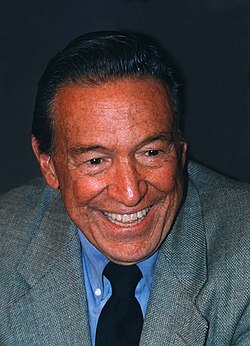
Myron Leon Wallace (May 9, 1918 – April 7, 2012) was an American broadcast journalist, and television personality. Known for his investigative journalism,[1] he interviewed a wide range of prominent newsmakers during his seven-decade career. He was one of the original correspondents featured on CBS news program 60 Minutes, which debuted in 1968. Wallace retired as a regular full-time correspondent in 2006, but still appeared occasionally on the series until 2008. He is the father of Chris Wallace.

Key Information

Wallace interviewed many politicians, celebrities, and academics throughout his life.[2][3][4]

Early life

[edit]

Wallace, whose family's surname was originally Wallik, was born on May 9, 1918, in Brookline, Massachusetts, to Russian Jewish immigrant parents.[5][6] He identified as Jewish and claimed it was his ethnicity (instead of religion) throughout his life. His father was a grocer and insurance broker.[7] Wallace attended Brookline High School, graduating in 1935.[8] He graduated from the University of Michigan four years later with a Bachelor of Arts degree. While a college student, he was a reporter for the Michigan Daily and belonged to the Alpha Gamma chapter of the Zeta Beta Tau fraternity.[9]

Career

[edit]

1930s–1940s: Radio

[edit]

Wallace appeared as a guest on the popular radio quiz show Information Please on February 7, 1939, when he was in his last year at the University of Michigan. He spent his first summer after graduation working on-air at Interlochen Center for the Arts.[10] His first radio job was as a newscaster and continuity writer for WOOD radio in Grand Rapids, Michigan. This lasted until 1940, when he moved to WXYZ radio in Detroit, Michigan, as an announcer. He then became a freelance radio worker in Chicago.

Wallace enlisted in the United States Navy in 1943 and during World War II served as a communications officer on the USS Anthedon, a submarine tender. He saw no combat but traveled to Hawaii, Australia, and Subic Bay in the Philippines, then patrolling the South China Sea, the Philippine Sea and south of Japan. After being discharged in 1946, Wallace returned to Chicago.

Wallace announced for the radio shows Curtain Time,[11] Ned Jordan: Secret Agent, Sky King, The Green Hornet,[12] and The Spike Jones Show.[13] It is sometimes reported Wallace announced for The Lone Ranger,[14] but Wallace said that he never had done so.[15] From 1946 through 1948, he portrayed the title character on The Crime Files of Flamond on WGN and in syndication.

Wallace announced wrestling in Chicago in the late 1940s and early 1950s, sponsored by Tavern Pale beer.

In the late 1940s, Wallace was a staff announcer for the CBS radio network. He had displayed his comic skills when he appeared opposite Spike Jones in dialogue routines. He was also the voice of Elgin-American in the company's commercials on Groucho Marx's You Bet Your Life. As Myron Wallace, he portrayed New York City detective Lou Kagel on the short-lived radio drama series Crime on the Waterfront.

1940s–1960s: Television

[edit]

In 1949, Wallace began to move to the new medium of television. In that year, he starred under the name Myron Wallace in a short-lived police drama, Stand By for Crime.[16]

Wallace hosted a number of game shows in the 1950s, including The Big Surprise, Who's the Boss? and Who Pays?. Early in his career, Wallace was not known primarily as a news broadcaster. It was not uncommon during that period for newscasters to announce, to deliver commercials and to host game shows; Douglas Edwards, John Daly, John Cameron Swayze and Walter Cronkite hosted game shows as well. Wallace also hosted the pilot episode of Nothing but the Truth, which was helmed by Bud Collyer when it aired under the title To Tell the Truth. Wallace occasionally served as a panelist on To Tell the Truth in the 1950s. He also made commercials for a variety of products, including Procter & Gamble's Fluffo brand shortening.[citation needed] In the summer of 1959, he was the host on the NBC game show Who Pays?.[17]

Publicity photo for the television program Mike Wallace Interviews, 1957

Wallace also hosted two late-night interview programs, Night Beat (broadcast in New York City during 1955–1957, only on DuMont's WABD)[18] and The Mike Wallace Interview on ABC in 1957–1958. See also Profiles in Courage, section: Authorship controversy.

In 1959, Louis Lomax told Wallace about the Nation of Islam. Lomax and Wallace produced a five-part documentary about the organization, The Hate That Hate Produced, which aired during the week of July 13, 1959. The program marked the first time that most white people heard about the Nation, its leader, Elijah Muhammad, and its charismatic spokesman, Malcolm X.[19]

By the early 1960s, Wallace's primary income came from commercials for Parliament cigarettes, touting their "man's mildness" (he had a contract with Philip Morris to pitch their cigarettes as a result of the company's original sponsorship of The Mike Wallace Interview).

Between June 1961 and June 1962, Wallace and Joyce Davidson hosted a New York-based nightly interview program for Westinghouse Broadcasting[20] called PM East for one hour; it was paired with the half-hour PM West, which was hosted by San Francisco Chronicle television critic Terrence O'Flaherty. Westinghouse syndicated the series to television stations that it owned and to a few other cities. WFAA channel 8 in Dallas, Texas carried it, but viewers in other southwestern states, in the Deep South and in the metropolitan areas of Chicago and Philadelphia were unable to watch it.

A frequent guest on the PM East segment was Barbra Streisand, though only the audio of some of her conversations with Wallace survives,[20] as Westinghouse wiped the videotapes and kinescopes were never made or were thrown away.

Also in the early 1960s, Wallace was the host of the David Wolper–produced Biography series.

After his elder son's death in 1962, Wallace decided to get back into news and hosted an early version of CBS Morning News from 1963 through 1966. In 1964 he interviewed Malcolm X, who, half-jokingly, commented "I probably am a dead man already."[21] The black leader was assassinated a few months later in February 1965.

1960s–2000s: 60 Minutes

[edit]
Wallace and Harry Reasoner on the 60 Minutes premiere, 1968
Wallace interviewing President Ronald Reagan in 1989

Wallace's career as the lead reporter on 60 Minutes led to some run-ins with the people interviewed and claims of misconduct by female colleagues. Wallace was critical of feminism. In the 1950s, Wallace was quoted as saying, "It helps if a wife walks one step behind her husband. European women have that by-your-leave-my-lord attitude that you just don’t find in American women. They’re infinitely more self-absorbed. European women let the men run things and quite right they are too!" When questioned in a 1977 interview with Good Housekeeping, Wallace claimed to "stand by every word" of what he had said, but by 1979, he had softened that view somewhat. He also claimed feminism made women more unattractive, saying, "So many feminists in our business lose that soft, round, appealing quality—I don’t know how else to define it."[22]

While interviewing Louis Farrakhan, Wallace alleged that Nigeria was the most corrupt country in the world. Farrakhan immediately shot back that Americans were in no moral position to judge, declaring "Has Nigeria dropped an atomic bomb that killed people in Hiroshima and Nagasaki? Have they killed off millions of Native Americans?" "Can you think of a more corrupt country?" asked Wallace. "I'm living in one," said Farrakhan.[23]

Wallace interviewed General William Westmoreland for the CBS special The Uncounted Enemy: A Vietnam Deception that aired on January 23, 1982.[24] Westmoreland then sued Wallace and CBS for libel. The trial ended in February 1985 when the case was settled out of court just before it would have gone to the jury. Each side agreed to pay its own costs and attorney fees, and CBS issued a clarification of its intent with respect to the original story.

In 1981, Wallace was forced to apologize for a racial slur he had made about Blacks and Hispanics. During a break while preparing a 60 Minutes report on a bank that had been accused of duping low-income Californians, Wallace was caught on tape joking that "You bet your ass [the contracts are] hard to read if you're reading them over the watermelon or the tacos!"[25][26][27][28]

Attention was again drawn to that incident several years later when protests were raised after Wallace was selected to deliver a university commencement address during a ceremony within which Nelson Mandela was awarded an honorary doctorate in absentia for his fight against racism. Wallace initially called the protesters' complaint "absolute foolishness".[29] However, he subsequently apologized for his earlier remark and added that when he had been a student decades earlier on the same university campus, "though it had never really caused me any serious difficulty here ... I was keenly aware of being Jewish, and quick to detect slights, real or imagined.... We Jews felt a kind of kinship [with blacks]", but "Lord knows, we weren't riding the same slave ship."[30]

Wallace in 2007

Wallace's reputation has been retrospectively affected by his admission that he had harassed female colleagues at 60 Minutes over many years. In the 1970s and 1980s, he was known for putting his hand on the backs of his female CBS News co-workers and unsnapping the clasps on their bras, as well as inquiring about their sex lives. Wallace admitted this in Rolling Stone magazine in 1991: 'It wasn't a secret. I have done that'.[31] In 2018, claims of sexual misconduct at 60 Minutes led to the resignation of executive producer Jeff Fager, who had assumed the role of Executive Producer following the retirement of the show's creator, Don Hewitt. He resigned several months after a July 27 story by Ronan Farrow in The New Yorker.[32] Not only did Farrow's story accuse Fager of ignoring and enabling misconduct by several high-ranking male producers at 60 Minutes, but Farrow also cited former employees who accused Fager himself of misconduct.[33]

Former 60 Minutes producer Ira Rosen wrote that, in addition to the aforementioned sexual harassment, Wallace would also verbally abuse his colleagues. Rosen painted the 60 Minutes working environment during his tenure as a toxic workplace with frequent incidents of sexual and verbal harassment.[34]

On March 14, 2006, Wallace announced his retirement from 60 Minutes after 37 years with the program. He continued working for CBS News as a "Correspondent Emeritus", albeit at a reduced pace.[35] In August 2006, Wallace interviewed Iranian President Mahmoud Ahmadinejad.[36] Wallace's last CBS interview was with retired baseball star Roger Clemens in January 2008 on 60 Minutes.[37] Wallace's previously vigorous health (Morley Safer described him in 2006 as "having the energy of a man half his age") began to fail, and in June 2008 his son Chris said that his father would not be returning to television.[38]

Wallace expressed regret for not having secured an interview with First Lady Pat Nixon.[39]

Personal life

[edit]
Wallace with his second wife, Buff Cobb, in 1951.
Mike and his soon-to-be fourth wife, Mary, on Martha's Vineyard in 1985.

Wallace had two children with his first wife, Norma Kaphan.[40] Their younger son, Chris, is also a journalist. Their elder son, Peter, died at age 19 in a mountain-climbing accident in Greece in 1962.[41]

From 1949 to 1954, Wallace was married to his second wife, Patrizia "Buff" Cobb, an actress and stepdaughter of Gladys Swarthout. The couple hosted the Mike and Buff Show on CBS television in the early 1950s. They also hosted All Around Town in 1951 and 1952.[42] She died in 2010.[5]

He was married to his third wife, Lorraine Perigord, from 1955 until their divorce in 1986.[5]

The same year as his divorce from his third wife (1986), he married his fourth and final wife, Mary Yates, the widow of one of his best friends and television producer, Ted Yates, who died in 1967 while on assignment for NBC News during the Six-Day War.[5]

In addition to his two sons, Wallace had a stepdaughter, Pauline Dora, and two stepsons, Eames and Angus Yates.[5]

For many years, Wallace unknowingly suffered from depression. In an article that he wrote for Guideposts, Wallace related, "I'd had days when I felt blue and it took more of an effort than usual to get through the things I had to do."[43] His condition worsened in 1984 after General William Westmoreland filed a $120 million libel lawsuit against Wallace and CBS over statements that were made in the documentary The Uncounted Enemy: A Vietnam Deception (1982). Westmoreland claimed that the documentary made him appear as if he had manipulated intelligence. The lawsuit, Westmoreland v. CBS, was later dropped after CBS issued a statement explaining they never intended to portray the general as disloyal or unpatriotic. During the proceedings, Wallace was hospitalized with what was diagnosed as exhaustion. His wife Mary forced him to go to a doctor, who diagnosed Wallace with clinical depression. He was prescribed an antidepressant and underwent psychotherapy. Out of a belief that it would be perceived as weakness, Wallace kept his depression a secret until he revealed it in an interview with Bob Costas on Costas' late-night talk show, Later.[43] In a later interview with colleague Morley Safer, he admitted having attempted suicide circa 1986.[44]

Wallace received a pacemaker more than 20 years before his death, and underwent triple bypass surgery in January 2008.[5] He lived in a care facility the last several years of his life.[5] In 2011, CNN host Larry King visited him and reported that he was in good spirits, but that his physical condition was noticeably declining.

Politics

[edit]

Wallace considered himself a political moderate. He was a friend of Nancy Reagan and her family for over 75 years.[45] Fox News said, "He didn't fit the stereotype of the Eastern liberal journalist." Interviewed by his son on Fox News Sunday, he was asked if he understood why people feel disaffection toward mainstream news media. "They think they're wide-eyed commies; liberals," Mike replied, a notion he dismissed as "damned foolishness".[46]

In a 1979 interview with Mother Jones magazine, Wallace lamented the idea that he was regarded by peers as the "in-house conservative" at CBS News, saying he had "liberal inclinations" and had come from a family of "Roosevelt Democrats." However, covering Richard Nixon and Spiro Agnew on the 1968 presidential campaign trail made him more sympathetic to their points of view, and Wallace developed positive relationships with both men, and was also close with Henry Kissinger and William F. Buckley. Nixon wanted Wallace to be his press secretary.[22]

Wallace rejected the notion that the United States was a structurally flawed society, citing his humble upbringing and later success (as well as the success of 60 Minutes) as proof the American Dream worked. He was critical of socialism and government intervention in the economy, calling the United Kingdom a "sad country to visit" due to its stagnating economy, which he blamed on Britain at the time being a "planned economy", and warned the United States would soon follow down the same path.[22]

Death

[edit]

Wallace died at his residence in New Canaan, Connecticut, from natural causes on April 7, 2012.[5][47] The night after Wallace's death, Morley Safer announced his death on 60 Minutes. On April 15, 2012, a full episode of 60 Minutes aired that was dedicated to remembering Wallace's life.[48][49][50] He is buried at West Chop Cemetery in Tisbury, Massachusetts.[51]

Awards

[edit]

In 1989, Wallace was awarded an honorary Doctor of Laws from the University of Pennsylvania.[52] Wallace's professional honors included 21 Emmy Awards,[5] among them a report just weeks before the September 11 attacks for an investigation on the former Soviet Union's smallpox program and concerns about terrorism. He also won three Alfred I. duPont-Columbia University Awards, three George Foster Peabody Awards, a Robert E. Sherwood Award, a Distinguished Achievement Award from the University of Southern California School of Journalism, the Golden Plate Award of the American Academy of Achievement,[53] and a Robert F. Kennedy Journalism Award in the international broadcast category. In September 2003, Wallace received a Lifetime Achievement Emmy, his 20th.[citation needed] Most recently, on October 13, 2007, Wallace was awarded the University of Illinois Prize for Lifetime Achievement in Journalism.

Fictional portrayals

[edit]

Wallace was played by actor Christopher Plummer in the 1999 feature film The Insider. The screenplay was based on the Vanity Fair article "The Man Who Knew Too Much" by Marie Brenner, which was about Wallace caving in to corporate pressure to kill a story about Jeffrey Wigand, a whistle-blower trying to expose Brown & Williamson's dangerous business practices in the manufacture of cigarettes. Wallace disliked his on-screen portrayal and maintained that he was in fact very eager to have Wigand's story aired in full.

Wallace was played by actor Stephen Rowe in the stage version of Frost/Nixon, but he was omitted from the screenplay of the 2008 film adaptation and thus the movie itself. In the 1999 American broadcast television movie Hugh Hefner: Unauthorized, Wallace is portrayed by Mark Harelik. In the film A Face in the Crowd (1957), Wallace portrayed himself. In 2020, Greg Dehm played Wallace in episode 6 of the second season of Manhunt, re-creating Wallace's 1996 interview on 60 Minutes with Richard Jewell, the security guard who discovered a bomb at Atlanta's Centennial Olympic Park in July 1996. In the film The Apprentice (2024), Wallace was portrayed by Stuart Hughes.

See also

[edit]

Further reading

[edit]

References

[edit]
[edit]
Revisions and contributorsEdit on WikipediaRead on Wikipedia
from Grokipedia
Myron Leon "Mike" Wallace (May 9, 1918 – April 7, 2012) was an American broadcast and television personality renowned for his pioneering role in investigative television journalism, particularly as a longtime on CBS's , where his relentless, confrontational interviewing style elicited revelations from powerful figures across , business, and culture. Beginning his career in radio announcing after naval service, Wallace transitioned to television in the , hosting programs like Night Beat and The Mike Wallace Interview, which featured aggressive, unscripted questioning that contrasted sharply with the era's deferential media norms and laid the groundwork for modern adversarial reporting. Joining at its 1968 launch, he contributed to its status as television's highest-rated primetime program for decades, conducting landmark interviews with subjects including Ayatollah Khomeini, , and Soviet leaders, often exposing inconsistencies or defending unpopular positions through direct confrontation rather than narrative framing. Wallace's career yielded 21 , including a Lifetime Achievement Emmy in 2003, though his methods sparked debates over journalistic ethics, such as in a 1982 documentary that prompted a libel suit from Gen. , settled out of court after highlighting tensions between aggressive reporting and institutional narratives. Later accounts from colleagues revealed a demanding workplace demeanor, including verbal intensity and, in some cases, inappropriate conduct, reflecting the unpolished intensity that defined his on-air persona but raising questions about personal versus professional boundaries in high-stakes journalism.

Early Life

Birth and Upbringing

Myron Leon Wallace was born on May 9, 1918, in , to Frank and Zina Wallace, Jewish immigrants from the shtetls of Tsarist who had arrived in the United States in the late nineteenth century. He was the fourth and youngest child in the family. Wallace's father initially worked as a grocer before becoming a successful , enabling the family to establish roots in Brookline, a suburb characterized by its upwardly mobile immigrant communities of Irish, Italian, and Eastern European Jews—described by Wallace as "an O'Connor and Goldberg town." The area provided a relatively tolerant environment for such groups amid broader society's class-conscious prejudices, and Wallace grew up in the same neighborhood as future President . Raised in this Jewish immigrant milieu, Wallace maintained a lifelong connection to his heritage, identifying strongly as Jewish despite his later professional successes. His early years reflected the aspirations of a striving family, with his father's career progression underscoring themes of common among such households.

Education

Wallace graduated from in Brookline, Massachusetts, in 1935. He then enrolled at the , encouraged by his uncle, economist Isaiah Leo Sharfman, a longtime faculty member there. At the , Wallace pursued studies in journalism and broadcasting. He worked as a reporter for the student newspaper, , and gained early radio experience as an announcer at the campus station, WUOM. He earned a degree in 1939. In later years, Wallace received honorary degrees, including a from the in 1978 and a Doctor of Laws from the .

Broadcasting Career

Radio Beginnings (1930s–1940s)

Wallace entered shortly after graduating from the in 1939, securing his first position as a newscaster and continuity writer at WOOD-AM in . In this role during the late , he primarily read "rip-and-read" news directly from teletype wires without verification, a common practice for entry-level announcers at the time. He also appeared on a radio show in 1939 while still completing his studies. By 1940, Wallace relocated to WXYZ radio in , continuing as a newscaster amid the expanding commercial radio landscape. In 1941, he joined the Chicago Sun's "Air Edition" as a news announcer, freelancing across stations in the Midwest before enlisting in the U.S. . During , he served as a naval communications officer, interrupting his civilian broadcasting until after the war's end in 1945. Resuming his career in the mid-, Wallace diversified into multiple radio formats, including quiz shows, talk programs, serial dramas, commercials, and news segments, which honed his versatile on-air delivery. By the late , he worked as a staff announcer for the network, where he showcased comedic timing in exchanges with bandleader . These early experiences emphasized and rapid delivery over investigative depth, reflecting the era's radio emphasis on broad appeal and sponsorship-driven content.

Early Television and Entertainment Roles (1940s–1950s)

Wallace entered television in 1949, starring as Myron Wallace in the ABC police drama Stand By for Crime, one of the network's earliest programs. He continued acting in dramatic roles, appearing in episodes of the anthology series (1949–1954) and Studio One (1948–1958). In the early , Wallace shifted to hosting game shows, including Majority Rules (1949–1950), Guess Again (1951), and I'll Buy That (1953–1954). He hosted the short-lived ABC quiz What's in a Word? in 1954 and Who's the Boss? the same year, where contestants identified employers from clues. Later, he emceed NBC's The Big Surprise from 1955 to 1957, featuring large cash prizes and celebrity guests like , and Who Pays? in summer 1959, a panel format determining contestant expenses. Beyond hosting, Wallace voiced commercials for products such as Golden Fluffo shortening and performed in comic sketches, including banter with bandleader on and television. These entertainment pursuits, typical for radio veterans transitioning to the visual medium, honed his on-camera skills amid television's rapid expansion post-World War II.

Transition to Serious Journalism (1950s–1960s)

In the mid-1950s, Mike Wallace shifted from hosting game shows and commercials to more substantive interviewing formats, marking his entry into adversarial journalism. This transition began with Night Beat, an hour-long program on New York City's WABD-TV (channel 5, DuMont Network), which premiered on October 9, 1956, and aired Tuesday through Friday from 11 p.m. to midnight until May 31, 1957. Replacing the station's 11 o'clock news slot under news director Ted Yates, the show featured Wallace in close-up, confrontational interviews with guests from politics, arts, and society, often accompanied by his signature cigarette smoke, establishing a raw, unfiltered style that contrasted with prior light entertainment. The success of Night Beat led to national syndication as The Mike Wallace Interview on ABC, a 30-minute series running from April 28, 1957, to September 14, 1958, totaling 72 episodes. These broadcasts delved into controversial topics, including interviews with figures like on societal issues and , Imperial Wizard of the , probing racial attitudes in the South. The program's provocative approach drew both acclaim for its depth and criticism for its intensity, solidifying Wallace's reputation as a tough questioner willing to challenge powerful guests. Following the ABC series' end in 1958, Wallace briefly co-produced an interview show hosted by Ben Hecht on ABC with Ted Yates, but faced professional setbacks amid the era's sponsor sensitivities to controversy. By the early 1960s, personal tragedy—the 1962 death of his son Peter in a mountain-climbing accident in Greece—further motivated a pivot away from entertainment toward investigative work. Wallace joined CBS News in 1963 as a correspondent, contributing to documentaries under the CBS Reports banner, such as explorations of social issues that foreshadowed his later rigor on 60 Minutes. This period entrenched his commitment to fact-driven, confrontational reporting over performative broadcasting.

60 Minutes and Peak Career

Joining 60 Minutes (1968–1980s)

Mike Wallace joined at its inception, serving as one of the original correspondents alongside under producer . The program debuted on , 1968, as a bi-weekly newsmagazine airing on Tuesday evenings, featuring in-depth reports on topical issues in a format that combined with on-location segments. Wallace's contributions from the outset emphasized confrontational interviews, as seen in the premiere episode where he questioned Attorney General on urban policing amid rising civil unrest. Initially, struggled with low viewership, competing in a prime-time slot against established entertainment programming, which limited its reach during the late and early . Wallace continued to anchor hard-hitting pieces, often probing public figures on matters of accountability, such as government responses to social issues and emerging scandals. By the mid-, following a shift to Sunday evenings in December 1975, the show's ratings surged, with Wallace's segments playing a key role in attracting audiences seeking substantive reporting over lighter fare. Wallace's work in this era included investigations into municipal corruption, exemplified by his 1976 report on Detroit's , which exposed systemic graft and influenced local reforms. The program's success culminated in 1978 when 60 Minutes reached the top of the Nielsen ratings for the first time, buoyed by Wallace's prosecutorial style that held powerful entities to account through relentless questioning. This period marked the transition from experimental format to television staple, with Wallace conducting over a dozen segments per season on diverse topics from to domestic . Into the early 1980s, Wallace's interviews maintained momentum, including high-profile encounters like his 1979 discussion with Ayatollah Khomeini shortly after the , which highlighted tensions in U.S.- relations and drew millions of viewers. These years solidified Wallace's reputation as the face of adversarial on 60 Minutes, contributing to the show's Emmy wins and cultural impact, though his approach occasionally sparked debates over journalistic aggression.

Mature Years on 60 Minutes (1980s–2000s)

During the 1980s, Wallace solidified his reputation on 60 Minutes through high-profile interviews with world leaders and controversial figures, maintaining his signature adversarial approach. In 1981, he conducted a notable segment with then-President , probing policy decisions amid ongoing national debates. By 1985, Wallace questioned real estate developer on his political ambitions, pressing him on potential presidential aspirations and . That same year, he interviewed former President , eliciting reflections on post-presidency life and . These encounters exemplified Wallace's technique of using pointed questions to challenge subjects directly, often eliciting defensive responses that heightened viewer engagement. A pivotal investigation in 1982 involved General , where Wallace's report "The Uncounted Enemy: A Vietnam Deception" alleged the U.S. military understated enemy troop strength during the . Westmoreland sued for libel, claiming factual inaccuracies and bias; the case settled in with issuing an apology and payment, highlighting risks in Wallace's aggressive reporting style, as the network conceded certain editorial judgments had erred. Despite such setbacks, Wallace's work contributed to 60 Minutes' dominance, with the program consistently ranking among top-rated shows. In 1989, he interviewed outgoing President Reagan and in the Oval Office, discussing legacy and personal reflections on eight years in power. Entering the 1990s, Wallace faced internal network pressures during a 1996 exposé on the , featuring whistleblower , who revealed Big Tobacco's knowledge of nicotine's addictive properties. executives, citing potential litigation from parent company Philip Morris, initially censored the segment; Wallace threatened resignation, leading to a diluted airing that drew criticism for over journalistic integrity. In 1998, he interviewed UN Secretary-General on Iraq sanctions and Dr. , including footage of a patient-assisted , which sparked ethical debates on broadcasting . A 1991 interview with turned contentious, with Wallace challenging her on career choices and , resulting in an emotional exchange that underscored his unrelenting probing. In the 2000s, Wallace persisted despite advancing age and health challenges, including in 2005. He interviewed leader and Malcolm X's daughter Atallah Shabazz in 2000 regarding unresolved assassination questions. In 2005, Wallace confronted baseball player on steroid use in MLB, contributing to broader doping scandals. His final major full-time segment in 2006 featured Iranian President , earning Wallace his 21st Emmy Award for probing nuclear ambitions and claims. Wallace retired as a regular correspondent in March 2006 after 38 years and over 800 reports, transitioning to emeritus status with occasional appearances, such as a 2008 interview with pitcher amid steroid allegations. This period marked the culmination of his career, blending enduring vigor with reflections on journalism's adversarial ethos.

Journalistic Style

Confrontational Interview Techniques

![President Ronald Reagan during an interview with Mike Wallace.jpg][float-right] Mike Wallace's confrontational interview techniques on emphasized relentless pursuit of facts through adversarial questioning, often refusing to allow subjects to evade . He prepared meticulously, compiling extensive lists of up to 50 questions probing ambitions, power dynamics, family matters, and ethical lapses to unsettle interviewees and elicit unguarded responses. This approach contrasted with more deferential journalistic norms, positioning Wallace as an inquisitor who prioritized exposure over rapport. In the , Wallace pioneered interviews, surprising subjects with cameras and accusations without prior notice to capture authentic reactions and prevent scripted defenses. These tactics, involving undercover elements, yielded raw footage but drew criticism for staging confrontations that prioritized drama over fairness. Over time, his method evolved toward sit-down sessions backed by documents and evidence, confronting subjects directly with verifiable contradictions to their public statements. Wallace employed skeptical follow-ups, such as "forgive me, but..." or "come on," to challenge inconsistencies and probe deeper, often focusing on for signs of . His tone was unyielding, browbeating subjects into admissions by leveraging thorough and persistent pressure on controversial topics. This style, while effective in uncovering hidden truths, sometimes verged on , as critics argued it tricked interviewees into revelations through psychological leverage rather than neutral inquiry. Wallace defended the approach as essential for holding power accountable, claiming it shed light on deceptions that polite questioning would miss.

Philosophy of Adversarial Reporting

Mike Wallace's philosophy of adversarial reporting emphasized the journalist's duty to aggressively challenge powerful figures and institutions to extract truths, rejecting in favor of as essential for . He argued that polite or advance-noticed inquiries often elicited rehearsed responses rather than genuine revelations, necessitating surprise tactics and persistent probing to disrupt evasion. This approach, which he described as involving "nasty questions, questions, confrontational questions," marked a departure from earlier, more deferential broadcast styles, positioning the reporter as an insistent adversary who voiced the unspoken queries of the audience. Wallace defended his methods against charges of or "drama for drama's sake," contending that such criticisms overlooked the practical realities of sourcing stories from reluctant subjects: "Had we come foursquare at the and told them ahead of time just exactly what we knew and what we were after, we would have gotten a carefully rehearsed, PR answer to our questions." He maintained that fairness lay not in neutrality of tone but in honorable presentation of evidence, allowing facts to dictate outcomes regardless of personal views, while admitting the style's dramatic elements but deeming them secondary to journalistic integrity. In practice, this involved provocative language and unyielding follow-ups, as when he bluntly told that the had "fucked" his presidency to elicit a candid two-minute retort, underscoring his belief that confrontation pierced superficial defenses to access deeper insights. Central to Wallace's was an unapologetic nosiness and refusal to yield ground, traits he encapsulated as being "nosy and insistent and not to be pushed aside." He viewed adversarial reporting not as personal combat but as a viewer-proxy mechanism: "Let's ask the questions that might be on the minds of the people looking in. They would love to feel that if I were there in that chair where Wallace is, here's what I would want to know." This philosophy elevated from passive narration to active , influencing generations by demonstrating that tough scrutiny of served democratic transparency, even if it invited ethical debates over techniques.

Major Interviews and Investigations

Iconic Confrontations

Wallace's confrontational style reached its zenith in interviews that directly challenged powerful figures on sensitive issues, often eliciting defensive or evasive responses. In a landmark 1979 60 Minutes segment aired on November 18, Wallace secured the first post-revolution interview with Iran's Ayatollah in , , just two weeks after the U.S. embassy and onset of the . To obtain the sit-down, Wallace agreed to pose only pre-approved questions from Khomeini's aides, yet he still confronted the leader by quoting Egyptian President Anwar 's description of Khomeini as a "lunatic" and "madman," prompting Khomeini to denounce Sadat as an "ignorant" American puppet. Khomeini further labeled the U.S. the "Great Satan" and justified the embassy seizure as retaliation for American support of the Shah, while Wallace pressed on whether sought war with the . A particularly acrimonious exchange unfolded in the January 1982 60 Minutes report "The Uncounted Enemy," where Wallace accused U.S. Army General William Westmoreland of systematically underreporting North Vietnamese troop strengths during the 1967-1968 Tet Offensive to maintain public support for the Vietnam War. Wallace cited declassified documents and former intelligence officers alleging that Westmoreland had capped enemy estimates at 300,000 despite evidence of up to 600,000, leading Westmoreland to retort that Washington officials lacked the sophistication to grasp battlefield realities and that the figures were adjusted for "duplicate counting." The general vehemently denied orchestration of a cover-up, calling the accusations "unjust" and walking out mid-interview after Wallace implied deceit; the segment drew over 120,000 viewer complaints and sparked a $120 million libel lawsuit against CBS, settled out of court in 1985 without retraction. In a 1998 broadcast that ignited ethical debates within , Wallace interviewed assisted-suicide advocate Dr. , airing graphic footage of Kevorkian administering a to terminally ill Thomas Youk, the first such depiction on major U.S. network television. Wallace challenged Kevorkian by labeling the procedure a "political, medical, macabre publicity venture" and deeming it "ghoulish," questioning whether the doctor's motivations stemmed from genuine mercy or spectacle. Kevorkian, convicted of second-degree murder in Youk's death shortly after the April 1998 airing, defended the act as compassionate and accused opponents of hypocrisy in allowing animal suffering; the segment, viewed by 22 million Americans, amplified national discourse on end-of-life choices but drew criticism for potentially inciting copycat deaths. Wallace's 1996 interview with leader exemplified his probing of controversial ideologies, confronting Farrakhan on allegations of , including praise for as a "very great man" in prior speeches and theories blaming for the slave trade. Farrakhan defended his as metaphorical and accused Jewish media figures of distorting his words to suppress black empowerment, while Wallace cited specific quotes and pressed on Farrakhan's refusal to repudiate Hitler unequivocally, eliciting admissions of past "unkind" statements but no full apology. The exchange, rooted in Farrakhan's organizing, highlighted Wallace's technique of using archival clips to corner subjects on inconsistencies.

Investigative Reports

Wallace's investigative reports for frequently targeted institutional failures, corruption, and hidden truths through fieldwork, document review, and persistent questioning of officials and witnesses. These segments combined on-site footage with evidence of systemic wrongdoing, often prompting public outrage and policy scrutiny, though critics occasionally accused Wallace of prioritizing drama over nuance. In a 1976 report titled "Hell Upon ," Wallace examined the U.S. Department of Housing and Urban Development's (HUD) role in exacerbating the city's . He documented how federal mortgage approvals enabled practices, resulting in thousands of defaults, foreclosures, and abandoned properties that fueled . Wallace entered residents' homes to capture personal testimonies of financial ruin and confronted HUD officials, revealing lax oversight and inspector corruption that prioritized volume over viability. The piece aired on December 19, , and contributed to congressional probes into HUD mismanagement. Wallace's 1969 coverage of the marked an early pinnacle of his investigative work, drawing on military records, eyewitness accounts, and direct interviews to expose U.S. Army atrocities in . Interviewing participant Paul Meadlo on November 24, 1969, Wallace elicited admissions of killing unarmed civilians, including an iconic exchange where Meadlo confirmed shooting "old men, women and children," prompting Wallace's follow-up: "And babies?" This revelation, based on Meadlo's on-camera breakdown, amplified Seymour Hersh's print reporting and intensified national debate over war crimes, leading to Lt. William Calley's . Wallace revisited My Lai in 1999, interviewing Vietnamese survivors and U.S. helicopter crew members Hugh Thompson and , who had intervened to halt the killings of over 500 villagers on March 16, 1968; the segment highlighted attempted cover-ups and partial reconciliations. A 1995 report centered on tobacco industry whistleblower , whom Wallace interviewed after extensive verification of internal documents showing executives knowingly manipulated levels for addiction. Despite CBS executives' initial fears of libel suits from , which had threatened Wallace and surveilled him, the November 12, 1995, broadcast detailed suppression of health risks and spurred class-action lawsuits, state settlements totaling over $200 billion, and FDA regulatory pushes. The exposé, protected by Wallace's adversarial sourcing, underscored corporate deception but faced backlash for delayed airing amid legal pressures.

Controversies

Libel Suits and Ethical Disputes

In January 1982, broadcast "The Uncounted Enemy: A Vietnam Deception," a segment narrated by Wallace and produced by , which alleged that General , as commander of U.S. forces in from 1964 to 1968, had directed subordinates to systematically underreport enemy troop strength—revising estimates from approximately 200,000 to 100,000—to mislead the American public and government about the war's progress. The report relied on interviews with former officers, including Gains Hawkins and others who claimed a deliberate policy to cap figures at 100,000 for political reasons. On September 13, 1982, Westmoreland filed a $120 million libel suit against , Wallace, and Crile in U.S. District Court in , asserting the broadcast falsely portrayed him as engaging in a to deceive, damaging his as a . During pretrial discovery, conceded that terms like "" and "" overstated the , which centered on a intelligence reorganization rather than proven falsification of data; Wallace testified that the segment aimed to expose perceived command failures but maintained its core claims were supported by sources. The trial began on October 9, 1984, with Westmoreland arguing the report ignored contextual of enemy infiltration tactics inflating counts, while invoked the New York Times v. Sullivan standard requiring proof of ""—knowledge of falsity or reckless disregard—which the judge partially upheld by dismissing claims against individual sources but allowing the core suit to proceed. The case settled on February 18, , before Wallace could fully testify, with issuing a statement expressing regret "if any program concerning General Westmoreland... caused him any distress or harm to his reputation," though no monetary damages were paid, no broadcast retraction occurred, and both parties claimed vindication—Westmoreland for highlighting media overreach, for defending against what Wallace called an attempt to "intimidate" reporting. The dispute underscored ethical tensions in adversarial reporting, as critics argued the segment prioritized dramatic over nuanced assessments, while Wallace defended it as necessary scrutiny of official narratives, later reflecting in 1997 that the ordeal reinforced journalism's role in despite risks of litigation. Beyond libel litigation, Wallace faced ethical scrutiny over tactics like interviews and selective , which detractors claimed distorted subjects' responses to fit preconceived stories, though he consistently rejected such charges as misunderstanding rigorous . In a reflection, Wallace acknowledged early career uses of in reporting—such as posing undercover—had evolved under stricter network standards, but maintained they served truth-seeking when direct access failed, without admitting ethical lapses. No additional major libel suits directly naming Wallace emerged from his tenure, though the Westmoreland case set precedents influencing how outlets balanced aggressive inquiry against risks for public officials.

Allegations of Bias and Selective Reporting

Critics from conservative media organizations have alleged that Mike Wallace displayed a consistent liberal bias in his 60 Minutes reporting, manifested through partisan affiliations and dismissive attitudes toward accusations of ideological slant. For example, Wallace voted for independent presidential candidate in 2000, a choice aligned with left-leaning critiques of the Democratic Party, and lent his name to a fundraiser for a advocacy group, actions cited as evidence of personal political leanings influencing . He rejected claims of liberal bias in as "damn foolishness" during a 2005 appearance on , particularly in defending CBS's handling of the disputed Bush National Guard memos story. Specific instances of selective reporting have fueled these charges. In a February 2006 segment on the , Wallace featured extended commentary from an anti-war veteran while providing minimal airtime to pro-war veterans, a disparity interpreted by media watchdogs as unbalanced portrayal favoring dovish perspectives. Similarly, during a 1987 PBS series Ethics in America, Wallace articulated that, if accompanying enemy forces, he would not alert U.S. troops to an ambush, prioritizing story acquisition over national allegiance—a stance that drew rebukes for eroding journalistic in favor of adversarial detachment. Allegations extended to coverage of judicial nominations, where Wallace's March 2004 60 Minutes profile of George W. Bush nominee Charles Pickering for the Fifth Circuit Court of Appeals was condemned by the Leadership Conference on Civil Rights for distorting opponents' substantive critiques of Pickering's record on voting rights and civil protections. The segment emphasized claims of racially motivated opposition while omitting documented judicial decisions and legislative history raising concerns about Pickering's approach to constitutional safeguards, thereby selectively advancing a of exaggerated partisanship. Broader critiques, such as those in , portrayed Wallace's adversarial style as intertwined with egotism that amplified anti-establishment narratives disproportionately targeting conservative figures, as seen in his Watergate-era interrogations of Nixon aides like , while aligning with CBS's historically liberal-leaning institutional culture under figures like . Wallace countered such perceptions by insisting on reporters' inherent patriotism and denying systemic bias, as expressed in a 2002 forum. These disputes highlight ongoing debates over whether Wallace's confrontational methodology masked ideological selectivity rather than purely pursuing empirical truth.

Personal Conduct Issues

Former 60 Minutes producer Ira Rosen described Wallace's workplace demeanor as tyrannical, recounting in his 2021 memoir Ticking Clock: Behind the Scenes at 60 Minutes how Wallace routinely screamed profanities at subordinates and erupted in unprovoked rages. Rosen detailed Wallace's habit of snapping women's bra straps in the office and physically grabbing female colleagues by the arm during fits of anger. He further alleged that Wallace persistently interrogated staff about their personal sex lives, contributing to a toxic environment that exacerbated health issues among producers, including early-onset heart disease and cancer. On August 10, 2004, Wallace, then 86, was arrested outside Manhattan's Luke's Lobster restaurant after clashing with Taxi and Limousine Commission inspectors over his vehicle's credentials, which they suspected violated regulations. Wallace refused to provide documentation and argued aggressively, leading to his handcuffing and issuance of a summons; he was released without bail and denied posing any threat. The charges were later dropped following an August 27, 2004, apology from commission officials, who attributed the arrest to agents acting "somewhat overzealously" amid heightened scrutiny of unlicensed cabs post-9/11.

Personal Life

Marriages and Family

Wallace married four times. His first marriage was to Norma Kaphan on August 27, 1940; the couple had two sons, Peter and (later known as ), before divorcing in 1948. His second marriage, to actress Patrizia "Buff" , lasted from 1949 to 1954; the pair co-hosted the radio and television program Mike and Buff. Wallace's third marriage was to Lorraine Perigord in 1955, ending in divorce in 1986 with no children from the union. In 1986, he married Mary Yates, the widow of CBS producer Ted Yates, who had died in 1967; this marriage lasted until Wallace's death in 2012. Yates brought two children from her prior —stepson Eames Yates and stepdaughter Pauline Dora—into Wallace's life. Wallace's elder son, Peter Wallace, died at age 19 on August 31, 1962, after falling into a while mountain climbing near , . The tragedy profoundly affected Wallace, influencing his shift toward more serious journalism. His younger son, , followed in his father's footsteps as a , notably anchoring programs at and .

Health Challenges

Wallace experienced severe clinical depression beginning in 1984, which he attributed to professional stress and personal factors, including that led him to seek psychiatric treatment. He publicly disclosed his condition in the 1990s, testifying before the U.S. in 1996 to advocate for increased federal funding for depression research and treatment, emphasizing its debilitating effects on concentration, , and decision-making. Throughout his later career, Wallace faced ongoing cardiac difficulties, including the implantation of a pacemaker in the early 1990s and a triple coronary artery bypass graft surgery on January 22, 2008, at age 89, which his physicians described as successful but required a recovery period of approximately six weeks. These issues contributed to his gradual withdrawal from regular reporting on 60 Minutes after 2006, though he made occasional appearances until the 2008 procedure limited his activity. In his final years, Wallace was diagnosed with , which impaired his mental acuity while his physical condition remained relatively stable, prompting his residence in a care facility in . His son, , noted in 2012 that the condition marked a significant decline from his father's characteristic sharpness, affecting one in eight individuals over age 65 according to contemporary epidemiological data.

Death and Immediate Aftermath

Final Years and Passing

Wallace retired as a full-time correspondent for in 2006, after 38 years on the program, at age 88; he transitioned to correspondent emeritus status and made occasional contributions until 2008. In 2007, he received his 21st Emmy Award at age 89 for lifetime achievement in . Following his retirement, Wallace's health declined progressively; he had endured cardiac issues for decades, including implantation of a pacemaker in the early 1980s and triple bypass heart surgery in early 2008. He resided in a care facility in , during his final years, where he managed ongoing health challenges amid a history of clinical depression that had persisted for approximately the last 25 years of his life. Wallace died on April 7, 2012, at the New Canaan care facility at age 93; while initially reported the death without specifying a cause, accounts consistent with his indicate cardiac-related complications, including a reported heart attack.

Tributes and Initial Legacy Assessments

Colleagues at , where Wallace had worked for over four decades, immediately commemorated his contributions through a dedicated broadcast segment titled "Remembering Mike Wallace," featuring correspondents recounting his most memorable interviews and the rigorous standards he set for the program. This tribute emphasized Wallace's role in establishing as a cornerstone of , with its confrontational style that held public figures accountable. A star-studded memorial service held on May 1, 2012, in drew tributes from family and peers, including his son , a anchor, who described the personal challenges of his father's demanding career while affirming his stature as an unrelenting truth-seeker in reporting. Broadcaster , among others, praised Wallace's tenacity in an segment, noting how his interviews exposed hypocrisies among the powerful. Early legacy evaluations positioned Wallace as a pivotal figure in the evolution of American , credited with shifting the medium toward adversarial encounters that prioritized evidence over deference. Analysts highlighted his hard-hitting approach on , which debuted in and became television's longest-running primetime show, as instrumental in popularizing in-depth scrutiny of institutions and individuals. These assessments, drawn from contemporaries in the field, underscored his self-made determination and influence on subsequent reporters, though they also implicitly acknowledged the era's looser ethical boundaries in pursuit of stories.

Awards and Honors

Key Professional Accolades

Wallace received 21 Primetime Emmy Awards over his career, including for outstanding interview and investigative reporting on 60 Minutes. In September 2003, he was awarded the Lifetime Achievement Emmy by the National Academy of Television Arts and Sciences, recognizing his contributions to broadcast journalism. He earned five George Foster Peabody Awards, with early honors including one in 1963 for The Mike Wallace Interview and subsequent ones for 60 Minutes segments, such as the 1971 award for the program's investigative depth. Similarly, Wallace and his 60 Minutes colleagues secured five Alfred I. duPont-Columbia University Awards, including in 1971 and 1983, for excellence in broadcast journalism. Additional key recognitions include the Paul White Award in 1991 from the Radio Television Digital News Association, its highest honor for contributions to electronic journalism, and induction into the Television Academy Hall of Fame. In 2007, he became the inaugural recipient of the Illinois Prize for Lifetime Achievement in Journalism from the University of Illinois. Earlier, in 1958, Wallace won a Golden Globe Award for his work on the game show The Big Surprise.

Philanthropic and Educational Contributions

Wallace provided substantial financial and advisory support to the Knight-Wallace Fellows program at the , his , where he earned a in 1939. In 2002, he donated $1 million to the program, which offers mid-career journalists a year of study and reflection, complementing a $5 million grant from the to enhance its endowment and operations. His involvement extended beyond funding; Wallace regularly visited fellows, offered mentorship, and advocated for the program's expansion, contributing to its role in fostering journalistic excellence. Earlier, in 1992, Wallace gave $500,000 to establish a dedicated facility for the program's predecessor initiatives in business and government at , following a grant. He also donated his extensive collection of professional papers, including scripts, research files, and correspondence from four decades at , to the University of 's Historical Library in the early 2000s, preserving primary sources for scholarly research on . In , Wallace served as a longtime spokesperson for the National Alliance for Research on and Depression (NARSAD, now the Brain & Behavior Research Foundation), leveraging his public profile to advocate for research funding after publicly disclosing his own struggles with clinical depression in the . This role, spanning over a decade, included participating in fundraising events and media campaigns that raised awareness and supported grants for scientific studies, earning him the foundation's Humanitarian Award in 1998 and its inaugural Luminary Award in 2003 for advancing destigmatization efforts.

Legacy

Positive Impacts on Journalism

Mike Wallace advanced television journalism by pioneering the confrontational interview format in the late , transforming passive news broadcasts into dynamic accountability tools that challenged public figures directly. His early programs, such as Night-Beat (1956–1958) on New York’s WABD and the ABC network's The Mike Wallace Interview (1959–1961), featured , probing sessions with celebrities, politicians, and controversial figures, setting a precedent for adversarial reporting that prioritized revelation over entertainment. This approach influenced subsequent journalists by demonstrating how television could expose inconsistencies and elicit admissions unavailable in print media, thereby elevating viewer expectations for journalistic rigor. As a on from its debut on September 24, 1968, Wallace contributed to the program's establishment as the archetype of long-form investigative television news, which amassed over 100 and drew audiences exceeding 20 million weekly by the . His segments often dismantled official narratives through meticulous preparation and relentless follow-up questions, as seen in exposés on corporate malfeasance and government misconduct, fostering a competitive environment that compelled other networks to adopt similar depth and skepticism in their reporting. Colleagues like credited Wallace with making TV news "more investigative, more aggressive and relevant," a shift that sustained public trust in amid rising commercial pressures. Wallace's emphasized empirical verification and causal , refusing to accept evasions and thereby modeling a standard where journalists functioned as skeptics rather than conduits for unchallenged claims. This legacy is evident in how under his influence prompted legal precedents, such as the 1979 U.S. ruling in Herbert v. Lando, which affirmed reporters' rights to discuss editorial processes, protecting investigative practices from libel suits. By embodying fearless scrutiny of power—interviewing figures from Ayatollah Khomeini in 1979 to in 2008—Wallace reinforced journalism's role in democratic oversight, inspiring generations to prioritize evidence over access or deference.

Criticisms and Broader Repercussions

Wallace faced significant criticism for his role in the 1982 60 Minutes segment "The Uncounted Enemy," which alleged that General , as commander in , had systematically underreported enemy troop strengths to the U.S. , prompting Westmoreland to file a $120 million libel suit against and producer , with Wallace as a key figure in the reporting. The suit, filed on September 13, 1982, contended the broadcast distorted classified documents and witness testimonies to portray a deliberate , leading to a protracted that began in 1984 and highlighted journalistic standards for sourcing and editing in wartime reporting. Although the case ended in a settlement on February 18, 1985, without a retraction—CBS issued a joint statement acknowledging Westmoreland's honorable service—the episode drew accusations of sensationalism and selective editing from military analysts and conservative commentators, who argued it unfairly maligned a public figure without sufficient evidence of malice under New York Times v. Sullivan standards. Critics within and outside journalism also targeted Wallace's confrontational "ambush" interview style, which involved surprise questioning and hidden cameras to elicit admissions, as ethically dubious and prone to entrapment, potentially prioritizing drama over balanced inquiry. This technique, evident in segments targeting figures like tobacco executives and political operatives, was faulted for eroding subject trust and fostering adversarial rather than informative exchanges, with some peers viewing it as a departure from traditional objectivity toward prosecutorial theater. Wallace defended the approach as necessary to pierce evasions by powerful interests, but detractors, including journalism ethicists, contended it blurred lines between reporting and advocacy, occasionally leading to lost friendships and internal CBS rebukes for overreach. Broader repercussions of Wallace's methods included a perceived normalization of "gotcha" , which some analysts link to the proliferation of tabloid-style programs in the and 1990s, such as and , that emulated his high-stakes confrontations but often sacrificed depth for ratings-driven spectacle. Documentaries and retrospectives have questioned whether his revolution in television interviewing—shifting from deferential formats to interrogative ones—contributed to public cynicism toward media, as aggressive tactics amplified perceptions of bias against figures, particularly in and conservative circles, amid broader institutional distrust. While Wallace's exposés uncovered corporate and governmental malfeasance, the style's legacy prompted debates on causal trade-offs: enhanced accountability versus diminished nuance, with empirical declines in viewer trust for broadcast news correlating to the era's rise in adversarial formats.

References

Add your contribution
Related Hubs
User Avatar
No comments yet.