Hubbry Logo
TabernacleTabernacleMain
Open search
Tabernacle
Community hub
Tabernacle
logo
8 pages, 0 posts
0 subscribers
Be the first to start a discussion here.
Tabernacle
Tabernacle
from Wikipedia
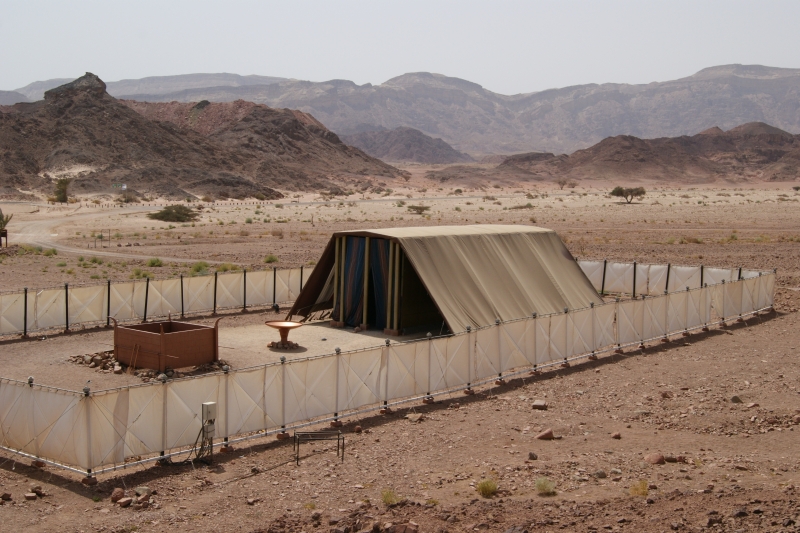
Model of the tabernacle in Timna Valley Park, Israel
The tabernacle, engraving from Robert Arnauld d'Andilly's 1683 translation of Josephus.

According to the Hebrew Bible, the tabernacle (Hebrew: מִשְׁכָּן, romanizedmiškān, lit.'residence, dwelling place'), also known as the Tent of the Congregation (Hebrew: אֹהֶל מוֹעֵד, romanized: ʔohel mōʕēḏ, also Tent of Meeting), was the portable earthly dwelling of God used by the Israelites from the Exodus until the conquest of Canaan. Moses was instructed at Mount Sinai to construct and transport the tabernacle[1] with the Israelites on their journey through the wilderness and their subsequent conquest of the Promised Land. After 440 years, Solomon's Temple in Jerusalem superseded it as the dwelling-place of God.

The main source describing the tabernacle is the biblical Book of Exodus, specifically Exodus 25–31 and 35–40. Those passages describe an inner sanctuary, the Holy of Holies, created by the veil suspended by four pillars. This sanctuary contained the Ark of the Covenant, with its cherubim-covered mercy seat. An outer sanctuary (the "Holy Place") contained a gold lamp-stand or candlestick. On the north side stood a table, on which lay the showbread. On the south side was the Menorah, holding seven oil lamps to give light. On the west side, just before the veil, was the golden altar of incense.[2] It was constructed of 4 woven layers of curtains and 48 4.6 m (15 ft) tall standing wood boards overlaid in gold and held in place by its bars and silver sockets and was richly furnished with valuable materials taken from Egypt at God's command.

Historically, according to scholars like Mark S. Smith, William G. Dever and archaeological discoveries, the tabernacle is based on similar tent shrines from other cultures in the ancient near-east, such as the Canaanites, Babylonians and Egyptians.[3][4] These portable shrines would house respective deities, with this custom both predating and surrounding the ancient Israelites.[5][6]

Meaning

[edit]

The English word tabernacle derives from the Latin tabernāculum (meaning "tent" or "hut"), which in ancient Roman religion was a ritual structure.[7][8][9] The Hebrew word mishkan implies "dwell", "rest", or "to live in".[10][11] In Greek, including the Septuagint, the Hebrew is translated σκηνή (skēnē), itself a Semitic loanword meaning "tent".[12]

Biblical scholar Michael B. Hundley argues that the Priestly source uses the terms "tabernacle" and "tent of meeting" in a complementary way to emphasize the sacred tent’s dual function as a divine dwelling place on earth and a place where the resident deity meets with his people.[13]

Dr. Hacham Isaac S. D. Sassoon argued that the Priestly source’s focus on the Tabernacle, rather than the Temple, serves as a post-exilic critique of the idea of rebuilding a stationary Temple, presenting the mobile Tabernacle as a divinely-ordained permanent structure for the Israelites.[14]

Description

[edit]

A detailed description of a tabernacle, located in Exodus chapters 25–27 and Exodus chapters 35–40, refers to an inner shrine, the Holy of Holies, housing the ark, and an outer chamber with the six-branch seven-lamp Temple menorah, table for showbread, and an altar of incense.[2] An enclosure containing the sacrificial altar and bronze laver for the priests to wash surrounded these chambers.[2]

Layout of the tabernacle with the Holy of Holies

Traditional scholars contend that it describes an actual tabernacle used in the time of Moses and thereafter.[10] This view is based on the existence of significant parallels between the biblical Tabernacle and similar structures from ancient Egypt during the Late Bronze Age.[15][16]

The detailed outlines for the tabernacle and its priests are enumerated in the Book of Exodus:

  • Exodus 25: Materials needed: the Ark, the table for 12 showbread, the menorah.
  • Exodus 26: The tabernacle, the bars, partitions.
  • Exodus 27: The copper altar, the enclosure, oil.
  • Exodus 28: Vestments for the priests, ephod garment, ring settings, the breastplate, robe, head-plate, tunic, turban, sashes, pants.
  • Exodus 29: Consecration of priests and altar.
  • Exodus 30: Incense altar, washstand, anointing oil, incense.

Liane Feldman holds that there are contrasting descriptions of the Meeting Tent in the Pentateuch, where the Priestly source presents a large, ornate tent at the center of the Israelite community, while a non-priestly strand describes a smaller, simpler tent for Moses, which in her view demonstrates the composite nature of the Pentateuch and differing perspectives within it.[17][page needed]

Benjamin D. Sommer suggests that while the Holy of Holies in the tabernacle was reserved for God’s presence, the main room featured a metal menorah with six branches on each side, potentially echoing the asherah, which he thinks was used in the cult of Yahweh.[18]

Tent of the Presence

[edit]

Some interpreters assert the Tent of the Presence was a special meeting place outside the camp, unlike the Tabernacle which was placed in the center of the camp.[19][20] According to Exodus 33:7–11, this tent was for communion with Yahweh, to receive oracles and to understand the divine will.[21] The people's elders were the subject of a remarkable prophetic event at the site of this tent in Numbers 11:24–30.[22]

Builders

[edit]
The erection of the tabernacle and the Sacred vessels, as in Exodus 40:17–19; from the 1728 Figures de la Bible

In Exodus 31, the main builder and maker of the priestly vestments is specified as Bezalel, son of Uri son of Hur of the tribe of Judah, who was assisted by Oholiab and a number of skilled artisans.[23]

Plan

[edit]

During the Exodus, the wandering in the desert and the conquest of Canaan, the Tabernacle was in part a portable tent, and in part a wooden enclosure draped with ten curtains, of blue (tekhelet תְּכֵלֶת), purple (’argāmān אַרְגָּמָן), and scarlet (šānî שָׁנִי) fabric. It had a rectangular, perimeter fence of fabric, poles and staked cords. This rectangle was always erected when the Israelite tribes would camp, oriented to the east as the east side had no frames. In the center of this enclosure was a rectangular sanctuary draped with goat-hair curtains, with the roof coverings made from rams' skins.[23]

Holy of Holies

[edit]

Beyond this curtain was the cube-shaped inner room, the Kodesh Hakedashim (Holy of Holies). This area housed the Ark of the Covenant, inside which were the two stone tablets brought down from Mount Sinai by Moses on which were written the Ten Commandments, a golden urn holding the manna, and Aaron's rod which had budded and borne ripe almonds (Exodus 16:33–34, Numbers 17:1–11, Deuteronomy 10:1–5; Hebrews 9:2–5).

Tachash

[edit]

Tachash is referred to fifteen times in the Hebrew Bible;[24][25] 13 of these refer to the roof coverings.

Restrictions

[edit]
  • Wine forbidden to priests in the tabernacle: Leviticus 10:8–15
  • Individuals with the Tzaraat skin affliction were not permitted entry to the tabernacle: Leviticus 22:4
  • Sacrifice only at the tabernacle: Leviticus 17
  • Priests could only enter into the third room of the tent once a year: Leviticus 16

There is a strict set of rules to be followed for transporting the tabernacle laid out in the Hebrew Bible. For example:

You must put the Levites in charge of the tabernacle of the Covenant, along with its furnishings and equipment. They must carry the tabernacle and its equipment as you travel, and they must care for it and camp around it. Whenever the Tabernacle is moved, the Levites will take it down and set it up again. Anyone else who goes too near the tabernacle will be executed.

Rituals

[edit]

Twice a day, a priest would stand in front of the golden prayer altar and burn fragrant incense.[26] Other procedures were also carried out in the tabernacle:

An Israelite healed of tzaraath would be presented by the priest who had confirmed his healing "at the door of the tabernacle of meeting",[27] and a woman healed of prolonged menstruation would present her offering (two turtledoves or two young pigeons) to the priest "at the door of the tabernacle of meeting".[28]

It was at the door of the tabernacle that the community wept in sorrow when all the chiefs of the people were impaled and the men who had joined in worship to the Baal of Peor were killed on God's orders.[29]

Subsequent history

[edit]
Location and remains of the Tabernacle at Shiloh, 2019

During the conquest of Canaan, the main Israelite camp was at Gilgal (Joshua 4:19; 5:8–10) and the tabernacle was probably erected within the camp: Joshua 10:43ESV "…and returned into the camp" (see Numbers 1:52–2:34 "…they shall camp facing the tent of meeting on every side").

After the conquest and division of the land among the tribes, the tabernacle was moved to Shiloh in Ephraimite territory (Joshua's tribe) to avoid disputes among the other tribes (Joshua 18:1; 19:51; 22:9; Psalm 78:60). It remained there during most of the rule of the Judges.[30][31] According to a possible translation of Judges 20:26–28, the Ark, and thus the tabernacle, was at Bethel while Phinehas, grandson of Aaron, was alive.

After the Ark of the Covenant was captured by the Philistines, the subsequent history of the tabernacle is separate from that of the Ark, even after the latter was returned. Under King Saul, the tabernacle was eventually moved to Nob, near Saul's home town of Gibeah, but after he massacred the priests there (1 Samuel 21–22), it was moved to Gibeon, a hill-shrine (1 Chronicles 16:39; 21:29; 2 Chronicles 1:2–6, 13).[32] Just prior to David's moving the ark to Jerusalem, the ark was located in Kiriath-Jearim (1 Chronicles 13:5–6).

The Ark was eventually brought to Jerusalem, where it was placed "inside the tent David had pitched for it" (2 Samuel 6:17; 1 Chronicles 15:1), not in the tabernacle, which remained at Gibeon. The altar of the tabernacle at Gibeon was used for sacrificial worship (1 Chronicles 16:39; 21:29; 1 Kings 3:2–4), until Solomon brought the structure and its furnishings to Jerusalem to furnish and dedicate the Temple (1 Kings 8:4).[33]

There is no mention of the tabernacle in the Tanakh after the destruction of Jerusalem and the Temple by the Babylonians in c. 587 BCE.

Relationship to the golden calf

[edit]

Some rabbis have commented on the proximity of the narrative of the tabernacle with that of the episode known as the sin of the golden calf recounted in Exodus 32:1–6. Maimonides asserts that the tabernacle and its accoutrements, such as the golden Ark of the Covenant and the golden Menorah were meant as "alternates" to the human weakness and needs for physical idols as seen in the golden calf episode.[34] Other scholars, such as Nachmanides, disagree and maintain that the tabernacle's meaning is not tied in with the golden calf, but instead symbolizes higher mystical lessons that symbolize God's constant closeness to the Children of Israel.[35]

The Mishkan Shilo synagogue in Shilo is a replica of the Jewish Temple
Zu den heiligen Engeln, Hanover, completed 1964
Mandaean Mashkhanna (Beth Manda) in Nasiriya, Iraq

Blueprint for synagogues

[edit]

Synagogue construction over the last two thousand years has followed the outlines of the original tabernacle.[36][37] Every synagogue has at its front an ark, aron kodesh, containing the Torah scrolls, comparable to the Ark of the Covenant which contained the tablets with Ten Commandments. This is the holiest spot in a synagogue, equivalent to the Holy of Holies.

There is also usually a constantly lighted lamp, Ner tamid, or a candelabrum, lighted during services, near a spot similar to the position of the original Menorah. At the center of the synagogue is a large elevated area, known as the bimah, where the Torah is read. This is equivalent to the tabernacle's altars upon which incense and animal sacrifices were offered. On the main holidays the priests gather at the front of the synagogue to bless the congregation as did their priestly ancestors in the tabernacle from Aaron onwards (Numbers 6:22–27).[38]

Inspiration for churches

[edit]

Some Christian churches are built like a tent, to symbolize the tent of God with men, including St. Matthew Cathedral, São Mateus, Brazil, Zu den heiligen Engeln (To the Holy Angels), Hanover, Germany and the Cardboard Cathedral, Christchurch, New Zealand.[39]

Mandaeism

[edit]

A mashkhanna ࡌࡀࡔࡊࡍࡀ maškna (Hebrew cognate מִשְׁכַּן mishkān),[40] Beth Manda ࡁࡉࡕ ࡌࡀࡍࡃࡀ, Beit Manda, or Mandi ('house of knowledge'),[41] is a cultic hut and place of worship for followers of Mandaeism. A Mashkhanna must be built beside a river in order to perform maṣbuta (baptism) and other ceremonies because Living Water is an essential element in the Mandaean faith.[41]

See also

[edit]

References

[edit]
[edit]
Revisions and contributorsEdit on WikipediaRead on Wikipedia
from Grokipedia
The Tabernacle (Hebrew: מִשְׁכָּן mishkan; Greek: σκηνή skēnē) was a portable tent-like constructed by the ancient in the Sinai wilderness under the direction of , serving as the earthly dwelling place for their deity, YHWH (Hebrew: יהוה; Paleo-Hebrew: 𐤉𐤄𐤅𐤄), during their exodus from and wanderings before entering the . Detailed in approximately 400 verses across Exodus chapters 25–31 and 35–40 of the , it was designed by divine blueprint revealed to Moses on and erected in nine months, symbolizing God's presence and covenant with the people while facilitating worship through sacrifices and priestly rituals. Structurally, the Tabernacle consisted of a central enclosure measuring about 30 cubits in length, 10 cubits in width, and 10 cubits in height (roughly 13.7 meters by 4.6 meters by 4.6 meters), framed with wood planks overlaid in , silver, or , and covered with layers of fine , hair, and dyed ram skins. It was divided into two main chambers by a : the outer Holy Place, containing the golden Table of Showbread, the seven-branched Menorah lampstand, and the Altar of Incense; and the inner , housing the as the throne of God's presence, accessible only by the once a year. Surrounding the was a rectangular , 100 cubits long and 50 cubits wide, enclosed by curtains and featuring a altar for sacrifices and a laver for priestly washing, all oriented eastward for entry. The Tabernacle's portability, achieved through disassemblable components carried on poles by priests, enabled it to accompany the on their journeys, as noted in Numbers 10, and it was later stationed at Shiloh during the period of the Judges before its furnishings were incorporated into in around 950 BCE. Scholarly analysis places it within ancient Near Eastern contexts, drawing parallels to Late Egyptian royal tent encampments and Mesopotamian tents, suggesting it reflected real-world cultic practices adapted to nomadic life while emphasizing graded zones of holiness to mediate divine and human access. Its construction, funded by voluntary offerings of precious metals and materials from the people, underscored communal participation in establishing a regulated for and encounter with the divine, resolving themes of and restoration from earlier biblical narratives.

Etymology and Terminology

Biblical Names

The English word "Tabernacle," used to describe the structure in translations, derives from the Latin tabernaculum, meaning "tent" or "hut," as employed in the Bible to render Hebrew terms for the . The primary Hebrew term for the Tabernacle in the is mishkan, which appears over 130 times in the Pentateuch and literally translates to "dwelling place" or "tabernacle," derived from the shakan meaning "to dwell" or "settle." This term is first introduced in Exodus 25:8, where God instructs the , "Let them make me a , that I may dwell (shakan) in their midst," emphasizing the structure as a portable site for God's presence among the nomadic community. An alternative designation is ohel mo'ed, often rendered as "Tent of Meeting," used approximately 130 times, primarily in Priestly texts, and denoting the location for appointed encounters between and the or , as in Exodus 27:21, which refers to the ongoing service "in the Tent of Meeting (ohel mo'ed) outside the that is before the ." The of ohel traces to Semitic roots for "tent" or "covering," while mo'ed stems from ya'ad, meaning "to appoint" or "fix a time/place," highlighting the functional aspect of divine communication rather than mere residence. Another related term is ohel ha'edut, translated as "Tent of Testimony," appearing in contexts like Numbers 9:15, where the divine cloud covers "the Tent of the Testimony (ohel ha'edut)," linking the structure to the housing of the covenant tablets as a witness to God's . Here, 'edut derives from 'ud, signifying "" or "witness," underscoring the Tabernacle's role in preserving sacred artifacts. Scholarly analysis of these terms' etymological roots reveals connections to broader ancient Near Eastern vocabulary, such as Assyrian maskanu for "" and Ugaritic parallels for ohel as a tent-like enclosure, but debates persist on whether they denote distinct structures, separate components of a single edifice, or an evolving nomenclature across biblical sources. For instance, some researchers, like Richard Elliott Friedman, propose mishkan refers to the inner fabric layers within an overarching ohel, while others, drawing on textual distinctions in Exodus 26:7, argue for complementary but non-identical designations reflecting different emphases—place of versus site of meeting—without implying multiple physical entities. These linguistic variations later influenced Jewish theological interpretations, portraying the names as multifaceted symbols of divine and .

Symbolic Interpretations

The Tabernacle is interpreted in biblical scholarship as a microcosm of creation, reflecting the ordered structure of the described in Genesis 1. The narrative of its construction in Exodus 25–40 echoes the seven-day creation account, with phrases like "and it was so" and divine approbation ("it was very good") underscoring its role in establishing an ideal, sacred order amid chaos. This symbolism extends to mirroring heavenly realms, as seen in 43:1-5, where the prophet's vision of divine glory entering a temple parallels the cloud filling the Tabernacle in Exodus 40:34-35, portraying it as a terrestrial counterpart to the celestial dwelling of God. The portability of the Tabernacle, known in Hebrew as Mishkan meaning "dwelling place," symbolizes God's dynamic and accompanying presence among the nomadic during their journey. Unlike the fixed stone temples of surrounding ancient Near Eastern cultures, which emphasized permanence and urban stability, the Tabernacle's design as a collapsible highlighted divine mobility, allowing YHWH to travel as a protective with the (Numbers 10:35-36). This feature underscored the intimacy of God's commitment to , adapting to their transient life rather than requiring a sedentary society to approach the divine. In , the Tabernacle is viewed as an act of for the sin of the , transforming materials of idolatry into instruments of reconciliation. According to Tanhuma (Parashat Terumah 8), the gold donated for the Tabernacle directly expiated the gold used in forging the calf, with God commanding its construction on to signal forgiveness and the restoration of . Similarly, Sifrei Deuteronomy links the kappōret () to kippur (), interpreting its golden form as a deliberate counter to the calf's gold, thereby redirecting Israel's misguided zeal toward proper worship. This perspective, echoed in Louis Ginzberg's compilation of midrashim, portrays the Tabernacle as a redemptive structure that heals the breach in the covenantal bond. Modern scholars emphasize the Tabernacle as a profound symbol of the covenantal relationship between God and , embodying divine —the idea that God dwells accessibly among the people without compromising transcendence. L. Michael Morales argues that it fulfills narrative by restoring mediated access to God's presence, lost since Eden, through priestly cultus that fosters a holy community (Exodus 25:8, 29:45-46). Gary A. Anderson highlights its ambivalent symbolism, where the structured space affirms God's nearness while regulating it to prevent overfamiliarity, thus balancing with the covenant's demands for holiness. These interpretations position the Tabernacle not merely as a ritual site but as a theological blueprint for ongoing divine-human partnership.

Biblical Account

Divine Commission

The Divine Commission for the Tabernacle is detailed in the , chapters 25 through 31, where reveals instructions to during his time on following the giving of the Ten Commandments. This revelation occurs as part of the covenant establishment between and the , emphasizing the Tabernacle as a for 's presence among His people. explicitly commands : "Exactly as I show you concerning the pattern of the tabernacle, and of all its furniture, so you shall make it," underscoring that the earthly structure must replicate a heavenly to maintain divine holiness. Central to the commission is the call for voluntary offerings from the Israelite , presented as an expression of willing devotion rather than obligation. instructs to "speak to the people of , that they take for me a contribution. From every man whose heart moves him you shall receive the contribution for me," listing materials such as , silver, , fine fabrics, and oils to be gathered freely. This participatory element highlights the communal role in creating a place for the divine, fostering a sense of shared spiritual investment. The instructions unfold in a deliberate sequence, beginning with the most sacred elements and progressing outward. God first details the as the core item, followed by the table for , the golden lampstand, and then the Tabernacle's structural components including its framework, coverings, and veils. Subsequent directives cover the bronze altar, the courtyard enclosure, and finally the priestly garments and consecration rites for and his sons, ensuring the entire operates as a unified system of worship. Theologically, this commission reflects God's initiative in bridging the divine-human divide, providing a precise blueprint to safeguard the sanctity of His presence amid a nomadic people. By dictating every aspect—from dimensions to materials—God ensures the Tabernacle serves not merely as a but as a microcosm of heavenly order, enabling atonement, communion, and instruction for the Israelites. This motif of divine authorship underscores the Tabernacle's role in Israel's covenantal life, distinct from human invention.

Materials and Specifications

The specifications for the Tabernacle's construction, as outlined in the biblical account, required a precise array of materials to create a portable yet symbolically rich , with inner components emphasizing purity and through precious overlays and fine fabrics, while outer elements prioritized practicality for travel. These included metals, textiles, wood, and supplementary items like gems and spices, all detailed in Exodus 25–31 to ensure the structure's holiness and functionality. Precious metals formed the core of the structural and symbolic elements: was applied as beaten sheets overlaying wood frames, the mercy seat, and inner to signify ; silver, totaling 100 talents and 1,775 shekels, was cast into sockets for the tabernacle boards and hooks; and , amounting to 70 talents and 2,400 shekels, supported the pillars, , and laver for external durability against environmental exposure. These metals' usage, particularly the overlay technique, reflects Egyptian metallurgical practices common in the New Kingdom period. Textiles provided layered coverings for protection and aesthetic sanctity, starting with ten curtains of fine twisted linen—each measuring 28 cubits in length and 4 cubits in width—embroidered with blue, purple, and scarlet yarns depicting cherubim for the innermost layer; an additional eleven curtains of goat hair formed the tent covering; and outer layers of rams' skins dyed red and tachash (likely fine leather) skins offered weatherproofing. The terms for linen (šēš) and the dyed yarns, associated with royal and divine contexts, are Egyptian loanwords, indicating cultural influences from post-Exodus interactions. Acacia wood (šitti m), the sole timber specified, was used for the upright frames (48 boards, each 10 cubits high and 1.5 cubits wide), crossbars, and altar due to its density, insect resistance, and longevity in arid conditions, sourced from Sinai flora like nilotica. This wood's Hebrew designation is an Egyptian loanword (šnḏ.t), linking it to regional availability and Egyptian trade networks. Gems and spices complemented the construction for priestly service within the Tabernacle: onyx stones for settings in the high priest's , alongside other semiprecious stones; and aromatic spices such as (500 shekels), , aromatic cane, cassia (500 shekels), and (a hin) for oil and to consecrate the space. These elements, while not structural, were integral to the Tabernacle's sacred operations and drew from Levantine and Egyptian botanical sources. Overall, the materials' selection underscores a blend of in the wilderness and symbolic hierarchy, with scholarly consensus attributing sourcing patterns—evident in 100% availability during the New Kingdom—to Egyptian influences, including linguistic borrowings and parallels in royal tent shrines like those of Ramses II.

Architectural Design

Overall Structure

The Tabernacle served as a portable for the during their wilderness journey, featuring a tripartite division into an outer measuring 100 cubits in length by 50 cubits in width, the Holy Place at 20 cubits long by 10 cubits wide, and the at 10 cubits square, as specified in the divine instructions of Exodus 26–27. The inner tent structure overall spanned 30 cubits in length, 10 cubits in width, and 10 cubits in height, constructed with wood boards overlaid in and draped with finely woven curtains. To facilitate mobility across the , the Tabernacle incorporated disassemblable held by silver sockets—100 talents of silver in total for the bases—allowing the boards and pillars to be dismantled and the curtains suspended from poles for easy packing. These components, along with protective coverings of ram skins and fine leather, were assigned to specific clans for transport on poles and carts during the ' migrations, ensuring the could be relocated without permanent fixtures. The Tabernacle was oriented with its entrance facing east, aligning the courtyard gate and the tent's doorway toward the rising sun, while a veil embroidered with cherubim motifs divided the Holy Place from the , demarcating progressively sacred zones. This layout emphasized a progression from the accessible outer area to the most restricted inner chamber. Biblical accounts indicate the Tabernacle's construction spanned approximately seven months, from the gathering of materials after the Sinai revelation to its completion and erection on the first day of the first month in the second year following . Scholarly estimates place the total weight of the structure and its metal components at around 10 to 15 tons, based on the quantified materials like the silver sockets and overlay, necessitating organized labor for assembly and disassembly, which could be accomplished in a matter of days once materials were prepared.

Holy of Holies

The , known in Hebrew as Qōdeš haQăḏōšîm, served as the innermost and most sacred chamber of the , representing the dwelling place of God's presence among the . This cubic space measured 10 cubits in length, width, and height, forming a perfect cube that underscored its symbolic perfection and divine seclusion. Access to this chamber was strictly prohibited except under divine command, emphasizing its role as the epicenter of holiness within the 's overall structure. Entry into the was barred by a meticulously crafted , woven from , , and scarlet yarn intertwined with finely twisted and embroidered with cherubim by skilled artisans. This was suspended from hooks attached to four wood posts overlaid with , which stood on silver bases, effectively partitioning the chamber from the adjacent Holy Place. The 's design not only blocked physical access but also symbolized the separation between the transcendent divine realm and the human sphere, with the cherubim motifs evoking guardianship over God's throne. The sole furnishing within the was the , a gold-overlaid wood chest measuring 2.5 cubits long, 1.5 cubits wide, and 1.5 cubits high, topped by a solid gold cover flanked by two cherubim with outstretched wings. Positioned directly behind the , the Ark housed the tablets of the Ten Commandments and served as the earthly footstool or , where His presence manifested between the cherubim to communicate with the . This singular element reinforced the chamber's purpose as the focal point of divine covenant and , devoid of any other objects to maintain absolute purity. Only the was permitted to enter the , and even then, solely on —the Day of —once per year, after offering a for his own sin and a goat for the people's, to sprinkle blood on the atonement cover as an act of . God explicitly warned that unauthorized entry would result in death, highlighting the peril of approaching His unmediated presence without ritual purification. This annual ritual underscored the chamber's function in facilitating national forgiveness and reconciliation with God. The ' inaccessibility was further amplified by the multilayered coverings overhead, comprising four protective layers: an inner of fine twisted embroidered with cherubim, an outer of hair, ram skins dyed , and an outermost layer of durable hides. These successive barriers, draped over the gold-covered frame, created a profound sense of isolation and sanctity, shielding the from external elements and profane intrusion.

Outer Chambers and Courtyard

The Holy Place formed the outer chamber of the Tabernacle's tent structure, separated from the inner by a and serving as the primary area for priestly ministry. This space measured 20 cubits in length, 10 cubits in width, and 10 cubits in height, constructed with acacia wood frames overlaid in and draped with fine curtains embroidered with , , and scarlet . It housed the golden lampstand for illumination, the table for the bread of the Presence, and the altar of for offerings, enabling to perform daily rituals in God's presence. As a transitional area, the Holy Place restricted access to consecrated , symbolizing the mediation between the divine and human realms. The surrounding courtyard provided an enclosed outer zone that extended the sacred precinct beyond the tent, acting as a buffer between the Israelite camp and the Tabernacle's interior to maintain holiness. Measuring 100 cubits long by 50 cubits wide and 5 cubits high, it was formed by curtains of fine twisted linen hung from 40 bronze pillars equipped with silver hooks, bands, and fillets for structural stability, with all bases cast in bronze. The enclosure featured an east-facing gate 20 cubits wide, screened with a curtain of blue, purple, and scarlet yarn woven with fine linen, allowing controlled entry for worship and sacrifices. At its center stood a bronze basin for priestly washing, positioned between the entrance and the sacrificial altar, ensuring ritual purity before approaching the sacred spaces. This courtyard design emphasized progression from the profane outer world to the sacred, permitting priests to conduct initial purifications and offerings while barring general access.

Construction and Builders

Key Personnel

The construction of the Tabernacle was divinely directed through specific individuals endowed with exceptional skills. God instructed Moses to appoint Bezalel, son of Uri and grandson of Hur from the tribe of Judah, as the chief artisan, filling him with the Spirit of God, wisdom, understanding, knowledge, and proficiency in various crafts including artistic designs in gold, silver, and bronze, as well as stone-cutting, woodwork, and other artistic endeavors. Bezalel was tasked with overseeing the intricate metalwork, engraving, and overall craftsmanship required for the Tabernacle's components. Assisting Bezalel was Oholiab, son of Ahisamak from the , who was similarly gifted by with skills in design, , , and others these arts, enabling the production of textiles in blue, , scarlet yarn, and fine linen. Together, they instructed the Israelite community in these specialized techniques, ensuring the Tabernacle's elements met the precise divine specifications. The broader workforce comprised skilled , including women who contributed significantly by spinning yarns and materials such as , , and scarlet threads, fine , and goat hair, using their expertise to supply essential fabrics for the Tabernacle's coverings and garments. While and his sons from the priestly lineage of were designated as future overseers of the Tabernacle's sacred functions, their formal occurred after the structure's completion, with their involvement limited to preparatory aspects like the design of priestly garments during the construction phase.

Process and Timeline

The construction of the Tabernacle began with an outpouring of voluntary contributions from the Israelite community, who brought offerings of , silver, , fine fabrics, and other materials in such abundance that the skilled workers informed the supplies had exceeded the requirements, prompting him to command the people to cease their donations. Under the direction of and , the assembly proceeded methodically: the wooden frames and overlays were fabricated first (Exodus 36), followed by the layered coverings and veils (Exodus 36:8-38), then the internal furnishings such as the ark, table, and lampstand (Exodus 37), the outer and courtyard elements (Exodus 38), and finally the priestly garments (Exodus 39). This sequential process ensured the structure adhered closely to the divine specifications previously relayed to . The Tabernacle was erected by on the first day of the first month in the second year following from , marking the culmination of the building efforts that had spanned approximately seven months from the initiation of work after the divine instructions at Sinai. Upon completion, the affirmed the Tabernacle's acceptance as a of glory filled the space, preventing from entering until the manifestation subsided, signifying God's approval and the sanctuary's readiness for sacred use.

Furnishings and Contents

Ark of the Covenant

The served as the central and most sacred artifact within the Tabernacle, representing the and the covenant between and the . Constructed under explicit instructions from to on , it was designed as a rectangular chest to house key covenantal elements and facilitate communication with the divine. The Ark's form emphasized purity and holiness, with its materials and craftsmanship reflecting the separation between the sacred and the profane. The Ark was made from , a durable timber, overlaid both inside and outside with pure to signify its heavenly significance. It measured two and a half s in length, one and a half s in width, and one and a half s in height—approximately 3.75 feet long, 2.25 feet wide, and 2.25 feet high based on the standard of about 18 inches. Four rings were affixed to its corners, through which passed two carrying poles of also covered in ; these poles were to remain inserted permanently, ensuring the Ark was never directly handled. Atop the Ark was the mercy seat, a solid gold lid serving as the throne for God's invisible presence. Two cherubim—winged angelic figures—were hammered from a single piece of gold on the mercy seat, their wings outstretched upward and facing inward toward each other, with their faces directed at the cover. This site was designated for God's annual atonement with the high priest and for direct communication, as God declared He would meet there and give commands to the Israelites. Inside the Ark, placed the two stone tablets inscribed with the Ten Commandments, symbolizing the foundational law of the covenant. Later tradition describes additional contents: a gold jar containing from the provision and that had miraculously budded to affirm his priesthood, though the original Exodus account mentions only the tablets, prompting scholarly discussion on whether these items were incorporated during the wilderness period or later in the Temple era. Transportation of the Ark was strictly regulated to maintain its sanctity during the ' journeys. It could not be touched by human hands, under penalty of death; instead, the Kohathite clan of Levites bore it on their shoulders using the poles, but only after the and his sons had veiled it with the inner curtain, animal skins, and a blue cloth to shield the holy objects from view. This protocol underscored the Ark's role as an untouchable emblem of divine otherness. The Ark was positioned in the , the innermost sanctuary of the Tabernacle.

Altars and Lamps

The altar, also known as the altar of burnt offering, was situated in the outer of the Tabernacle and served as the primary site for animal sacrifices. Constructed from acacia wood and overlaid entirely with , it measured five cubits in , five cubits in width, and three cubits in height, forming a square base elevated on a ledge. Four horns protruded from its corners, integral to the structure, and a with rings allowed for portability using overlaid poles; utensils such as pots, shovels, and forks were also made of . This altar facilitated the burnt offerings central to Israelite rituals. The golden altar of , positioned inside the Holy Place just before the separating it from the , was smaller and dedicated to aromatic offerings. Made of acacia wood overlaid with pure gold, it stood one square and two cubits high, topped with horns and a molding, with gold-covered poles for transport inserted through rings on its sides. burned specially composed fragrant on it twice daily—morning and evening—exclusively for this purpose, with annual applied to its horns using sacrificial blood, rendering it most holy. The menorah, or golden lampstand, illuminated the Holy Place and was crafted as a single hammered piece of pure weighing one talent. It featured a central shaft with six branches—three extending from each side—adorned with seven lamps set in flowerlike cups shaped like , buds, and calyxes for a total of twenty-two such motifs. Positioned opposite the table of , the menorah included wick trimmers and trays, all of , to ensure continuous light before the . Maintenance of the menorah required the priests, and his sons, to use clear pressed from olives provided by the , trimming the wicks to keep the seven lamps burning from evening until morning as a perpetual . This daily ritual ensured the sacred space remained lit, symbolizing divine presence amid the Tabernacle's functions.

Table of Showbread and Other Items

The table of showbread, also known as the table of the bread of the Presence, was constructed from wood measuring two s in length, one in width, and one and a half s in height, then overlaid with pure , including a gold molding around its edges, a rim, and rings for carrying poles also made of gold-overlaid wood. Positioned in the Holy Place of the Tabernacle opposite the lampstand, it served as a central furnishing for a perpetual offering to . The table held twelve loaves of bread made from fine flour, with each loaf consisting of two-tenths of an , arranged in two stacks of six on the pure table and accompanied by pure as a portion to be burned as an offering. These loaves, known as the bread of the Presence, were to be set out fresh every day by and his sons as a before the , symbolizing God's ongoing provision and sustenance for the . After their weekly renewal, the previous loaves were eaten only by in a holy place, underscoring their sacred status as a most holy portion. Another key furnishing was the , or basin, along with its stand, made entirely of and placed between the entrance to the Tent of Meeting and . Crafted from the bronze mirrors donated by the women who served at the Tabernacle's entrance, it was designated for the ritual washing of hands and feet by Aaron and his sons before performing priestly duties, serving as a perpetual to prevent through impurity. The Tabernacle also incorporated specially prepared anointing oil, a holy mixture consisting of five hundred shekels of liquid , two hundred fifty shekels each of sweet and aromatic cane, five hundred shekels of cassia, and one hin of , blended by a for consecrating the Tabernacle, its furnishings, and the priests. This oil was reserved exclusively for sacred use, with strict prohibitions against its replication for personal purposes. Complementing the oil was the sacred incense, compounded from equal parts of , , , and pure , seasoned with salt, ground into a fine blend, and used solely in the Tent of Meeting as a most holy offering before the . Like the anointing oil, its recipe was not to be duplicated for common use, ensuring its unique role in Tabernacle worship.

Rituals and Functions

Priestly Roles

The , consisting of and his descendants, was responsible for the core sacred duties within the Tabernacle, including entering to burn and perform rituals that maintained divine presence among the . These priests alone had access to the and the altar of , ensuring the sanctity of and for the community. In contrast, the Levites—non-Aaronic members of the —served as assistants to , handling logistical and preparatory tasks to support Tabernacle operations without direct access to the most holy elements. The Levites were divided into three clans with specific responsibilities: the Kohathites cared for sacred objects such as the ark, table, lampstand, and altars; the Gershonites managed the tabernacle's fabrics, including curtains and coverings; and the Merarites oversaw the structural frames, bars, and pillars. This division ensured efficient transportation and assembly during Israel's journeys while upholding ritual purity. The process for both and Levites established their consecrated status through a seven-day ceremony involving with oil, sacrificial blood applications, and washing, symbolizing purification and dedication to service. Conducted by at the Tabernacle entrance, this rite included offerings and seclusion to affirm their separation from the . This hierarchical structure—high priest Aaron at the apex, followed by Aaronic priests, and subordinate Levites—prevented unauthorized access to sacred spaces, with severe penalties for violations to preserve holiness. The and Levites performed essential sacrifices as part of their duties, bridging the divine and human realms.

Sacrificial Practices

The sacrificial practices in the Tabernacle formed a central component of Israelite , facilitating , purification, and communion with through ritual offerings at the bronze altar in the . These practices, detailed primarily in Leviticus chapters 1–7, involved the presentation of animals, grains, and libations by the priests, emphasizing the sanctity of life and the need for after . The burnt offering, or olah, was a foundational sacrifice requiring the complete burning of an unblemished animal—such as a , sheep, , or birds—on , symbolizing total dedication and general for . Performed voluntarily or as part of regular rites, it represented the offerer's complete surrender to (Leviticus 1:1–17). The grain offering, or minchah, complemented animal sacrifices with offerings of fine mixed with oil and , either baked into loaves or presented raw, signifying and provision from the land (Leviticus 2:1–16). Peace offerings, or shelamim, fostered fellowship through partially consumed animals from the herd or flock, with portions shared among the offerer, , and , highlighting communal gratitude (Leviticus 3:1–17). Sin offerings addressed unintentional transgressions, using varying animals based on the offender's status (e.g., a for the , a for the congregation), with the fat burned on and the rest disposed outside the camp (Leviticus 4:1–35). Guilt offerings, prescribed for specific violations requiring restitution, followed similar procedures but included repayment plus a fifth to the offended party before the (Leviticus 5:14–6:7; 7:1–10). A distinctive feature across these offerings was the handling of , viewed as the of and essential for . For offerings, the would dip a finger in the blood and sprinkle it on the horns of the altar of , then pour the remainder at the base of the altar of burnt offering, purifying both the and the people (Leviticus 4:7, 18, 25, 30, 34). This manipulation underscored the transfer of guilt from the offerer to the victim, enabling . The daily tamid offering ensured continual worship, mandating two unblemished year-old lambs—one in the morning and one at twilight—fully burned on the altar, accompanied by a grain offering of flour mixed with oil and a drink offering of wine. This perpetual rite maintained the Tabernacle's holiness around the clock (Numbers 28:3–8). Priests performed all sacrifices meticulously to uphold these protocols.

Daily and Annual Observances

The daily observances in the Tabernacle centered on maintaining the sacred furnishings within the Holy Place to symbolize continual communion with . Priests replaced the —twelve loaves representing the tribes of —every , ensuring fresh bread was continually set before the as a perpetual covenant. The golden lampstand, or menorah, was tended twice daily: was replenished, and the lamps were lit in the morning and evening to provide perpetual light. Similarly, fragrant was burned on the golden every morning and evening, creating a sweet aroma that filled the and signified ascending to . These routines underscored the Tabernacle's role as a place of unceasing . On the , observances intensified with doubled offerings to honor the day of rest. In addition to the regular daily burnt offerings of two , an extra pair of unblemished was sacrificed as a pleasing aroma to the , accompanied by offerings and drink offerings. This duplication emphasized the Sabbath's sanctity, distinguishing it from ordinary days while reinforcing themes of renewal and divine provision. Annual observances marked pivotal moments of atonement and remembrance, with the Tabernacle serving as the focal point for national s. The Day of Atonement, or , observed on the tenth day of the seventh month, involved the entering the once a year to sprinkle blood on the mercy seat for the atonement of Israel's sins. A central element was the scapegoat : after lots were cast, one goat was sacrificed for the Lord, while the other, bearing the sins of the people confessed by the , was released into the to carry away communal guilt. This dual-goat ceremony symbolized comprehensive purification, with ancient Near Eastern parallels in rituals expelling impurity. Earlier in the year, the was observed at the Tabernacle on the fourteenth day of the first month, where the entire assembly slaughtered lambs at the sanctuary and dashed their blood against the altar in commemoration of , with provisions for those ritually unclean or traveling to participate a month later. The festival cycle integrated these annual events into a broader rhythm of sacred time, with the Tabernacle's courtyard accommodating communal assemblies during feasts like . Observed from the fifteenth to twenty-second day of the seventh month, involved dwelling in booths and presenting escalating daily offerings of bulls, rams, and lambs over seven days, culminating in rejoicing before the at the . The open courtyard space facilitated these gatherings, allowing the to circle the Tabernacle in processions and evoking God's provision during the wilderness journey.

Access and Restrictions

Purity Requirements

The ritual purity laws outlined in the of the were essential prerequisites for any Israelite approaching the Tabernacle, ensuring that individuals did not defile the sacred space through contact with sources of impurity. These laws, primarily detailed in Leviticus 12–15, categorized impurities arising from natural bodily processes and conditions, such as postpartum states, genital discharges, skin diseases, and contact with corpses, all of which rendered a person ritually unclean and prohibited entry into the Tabernacle courtyard or inner areas until purification was complete. Specific impurities included those from , where a was unclean for seven days after delivering a male child or fourteen days after a female, followed by an extended period of purification during which she could not touch sacred objects or enter the (Leviticus 12:2–5). Bodily discharges, such as menstrual blood or seminal emissions, also caused impurity lasting until evening or longer, depending on the severity, with genital flows requiring isolation and cleansing to prevent of the site (Leviticus 15:2–33). Skin diseases, often translated as "," and contact with human corpses similarly barred access, as these states were seen as threats to the Tabernacle's holiness, with corpse impurity persisting for seven days and necessitating special rites involving the ashes of a (Leviticus 13–14; Numbers 19:11–13). Purification rituals emphasized immersion in water and prescribed waiting periods to restore cleanliness, such as bathing the entire body and waiting seven days for major impurities like discharges or corpse contact, after which a purification offering was typically required to atone and reaffirm eligibility for worship (Leviticus 15:13; 15:14–15). For postpartum impurity, the process concluded with a lamb and pigeon offering, or alternatives for the poor, symbolizing the transition from uncleanness to readiness for communal participation (Leviticus 12:6–8). These rites underscored a graduated system where the proximity to the Tabernacle's holiness demanded corresponding levels of purity, with lesser impurities resolved through washing alone and greater ones requiring sacrificial expiation. Violating these requirements by entering sacred areas while unclean carried severe consequences, including death, as an unclean person who failed to purify after corpse contact would "defile the Lord's tabernacle" and bear guilt leading to being cut off from the community (Numbers 19:13). This penalty highlighted the gravity of maintaining the sanctuary's sanctity, where unresolved impurities could accumulate and provoke divine abandonment of the (Leviticus 15:31; 16:16). At its core, the purity system in Leviticus linked personal holiness to the broader communal at the Tabernacle, viewing ritual cleanliness not merely as but as a theological preparation that mirrored God's separation from chaos and death, thereby enabling the ' covenantal relationship with the divine. Levites enforced these laws to safeguard the sacred boundaries.

Levitical Guarding Protocols

The Levitical guarding protocols established a structured system to safeguard the Tabernacle from unauthorized intrusion during the ' wilderness encampments, positioning the as a dedicated protective barrier around the . The was divided into three principal clans—Gershon, Kohath, and —each assigned specific positions encircling the Tabernacle to form an immediate defensive perimeter. The encamped to the west, responsible for the Tabernacle's coverings, hangings, and entrance screens; the Kohathites to the south, tasked with transporting the holy furnishings such as the Ark, table, and lampstand; and the to the north, handling the structural frames, bars, pillars, and bases. This arrangement, totaling 22,000 males aged one month and older, ensured comprehensive coverage and symbolized the ' role as intermediaries between the and the broader Israelite camp. To enforce these protocols, severe penalties were imposed on non-Levites who violated the boundaries, underscoring the sanctity of the holy items and the exclusivity of Levitical service. Non-Levites faced immediate death if they touched the sacred objects, even during transport, as the Kohathites were explicitly warned against direct contact with uncovered vessels to avoid fatal consequences. Similarly, any outsider attempting to perform priestly duties, such as offering or approaching , incurred the death penalty, reinforcing that only Aaron's descendants could officiate while Levites assisted in auxiliary roles. These measures protected the Tabernacle's holiness, with purity serving as a foundational prerequisite for all participants. The incident involving Aaron's sons, , exemplified the stringent enforcement of these protocols even among the priestly elite, serving as a cautionary for adherence to divine instructions. In a moment of presumption, they offered unauthorized "strange fire" before the using their censers, deviating from the prescribed , which resulted in fire from the consuming them instantly. This event, occurring shortly after the Tabernacle's consecration, highlighted the lethal risks of improvising sacred procedures and prompted further commands to distinguish between holy and profane, ensuring that future service remained rigidly compliant. Following the Tabernacle's era, these guarding protocols evolved into formalized Temple service roles during the , where Levites transitioned from mobile protection to stationary duties in the permanent sanctuaries. In the First Temple period, Levites were organized into 24 divisions or mishmarot, rotating weekly to guard the gates, courts, and inner chambers against unauthorized entry, a system that persisted into the Second Temple with enhanced emphasis on vigilance and musical accompaniment during watches. This adaptation maintained the core principle of Levitical exclusivity, adapting the model to an urban, fixed structure while preserving the death penalty threat for violations until the Temple's destruction.

Historical Development

Relation to the Golden Calf Incident

The construction of the Tabernacle is temporally linked to the incident, as the narrative in the places the and its aftermath in chapters 32–34, interrupting the initial divine instructions for the in chapters 25–31 and resuming with the actual building process in chapters 35–40. This sequence underscores the Tabernacle's role as a corrective measure following the destruction of the calf, with rallying the people to contribute materials only after the sin's resolution. Scholars interpret the Tabernacle as a redemptive structure designed to atone for the loss of caused by the sin, restoring God's covenantal relationship with through a sanctioned . Prior to the Tabernacle's completion, an interim tent of meeting—described in Exodus 33:7 as pitched outside the camp—served as a temporary locus for divine communication, highlighting the disruption and the need for . The Tabernacle thus functions theologically as a means of expiation, channeling the people's devotion into a divinely ordained framework rather than idolatrous improvisation. A key parallel emerges in the contrasting imagery of forbidden and approved representations: the Golden Calf, fashioned as a molten image in Exodus 32:4 to serve as a tangible deity, stands in opposition to the cherubim sculpted atop the Ark of the Covenant in Exodus 25:18, which symbolize guarded divine mystery without idolatry. This dichotomy illustrates the Tabernacle's emphasis on invisible, mediated divine presence over the calf's visible, anthropomorphic form, transforming potential symbols of apostasy into elements of holiness. Rabbinic tradition, particularly in Midrash Tanchuma (Terumah 8:3), posits that the gold donated for the Tabernacle atoned for the gold used in the calf, with the Holy One declaring that the sanctuary's precious metals would redeem the sin by repurposing the same material for sacred purposes. This view frames the Tabernacle's contributions as an act of collective repentance, where the melted remnants of idolatry are integrated into the redemptive edifice.

Transition to the Temple

Following the construction of the Tabernacle at during the ' wilderness wanderings, it served as a portable that was dismantled and reassembled multiple times as the community journeyed toward the . This mobility was essential during the period of conquest, allowing the structure to be relocated as the tribes secured territory. By the time the land was largely subdued, the Tabernacle was erected at Shiloh in the territory of , where it became the central place of worship for the nascent Israelite confederation. The Tabernacle remained at Shiloh for several generations until the destruction of Shiloh during conflicts with the around the 11th century BCE, after which it was relocated, prompting further moves. It was then moved to Nob, where it functioned under the priesthood during Saul's reign, as evidenced by David's encounter with the priest , who provided sacred bread from the . Scholars debate whether the full Tabernacle or only its key elements, such as , were relocated to these sites. Following the massacre of the priests at Nob by Saul's forces, the Tabernacle was transferred to Gibeon, a that served as its final pre-Temple site, where of burnt offering continued to be used for sacrifices. With the establishment of the monarchy and the need for a fixed, enduring worship center, the Tabernacle's temporary nature rendered it obsolete, culminating in its integration into Solomon's permanent Temple in Jerusalem during the 10th century BCE. Key elements, including the Ark of the Covenant and the tent of meeting itself, were transported from Gibeon to the new Temple site, symbolizing continuity between the wilderness sanctuary and the monumental structure. The bronze altar from the Tabernacle's courtyard was likely relocated to the Temple, where it influenced the design of the new bronze altar, ensuring the sacrificial practices persisted in the centralized cult. The fate of the Tabernacle's remaining structure after its incorporation into the Temple remains uncertain, with scholarly traditions suggesting it was either dismantled and stowed away in storage or gradually decayed due to its perishable materials by the late 10th century BCE. This transition marked the shift from a nomadic, tent-based to a fixed architectural edifice, reflecting Israel's evolving national and religious identity.

Theological and Cultural Influences

Blueprint for Synagogues

The Tabernacle's architectural and ritual elements profoundly shaped synagogue design, creating structural echoes that symbolize continuity between the ancient portable sanctuary and later Jewish worship spaces. The Torah ark, a ornate cabinet housing the sacred scrolls, directly mirrors the Ark of the Covenant from the Tabernacle, which contained the stone tablets inscribed with the Ten Commandments and served as the focal point of divine presence. Positioned on the eastern wall facing Jerusalem in most synagogues, this aron kodesh evokes the Tabernacle's Holy of Holies, where the Ark resided behind a veil, emphasizing the enduring covenant between God and Israel. Likewise, the bimah—a raised platform used for Torah reading and leading prayers—parallels the Tabernacle's altar, the site of sacrificial offerings, by elevating the communal interaction with scripture to a sacred, central act akin to priestly duties. These features transform the synagogue into a microcosm of the Tabernacle, adapting its holiness to dispersed communities without a fixed central shrine. After the Roman destruction of the Second Temple in 70 CE, the assumed the role of a "portable Temple," inheriting the Tabernacle's mobility to enable as a substitute for sacrifices, thus preserving Jewish religious life amid and . Rabbinic authorities viewed as impermanent yet sanctified spaces through their use for study and supplication, much like the Tabernacle's tent-like structure that accompanied the in the . This functional continuity is evident in , which emulates Temple and Tabernacle services; for example, the morning prayers include recitation of the order of daily sacrifices (korbanot) to maintain ritual rhythm without actual offerings. Archaeological evidence underscores this influence through the in , excavated in 1932 and dating to 244–256 CE, where wall frescoes prominently feature Tabernacle motifs alongside Temple imagery. These paintings depict the Tent of Meeting as a gabled edifice with Corinthian columns and gates, complete with interior furnishings like the golden menorah and Ark, blending Exodus narratives (e.g., Exodus 40) with Numbers 7 dedications to affirm the synagogue's spiritual lineage. Such iconography, preserved amid the site's Sassanian siege, reflects midrashic interpretation and cultural adaptation, portraying the as the rightful successor to the Tabernacle's legacy in a Hellenistic-Roman context.

Inspiration for Christian Churches

In , the Tabernacle of the is frequently interpreted typologically as a foreshadowing of Jesus Christ and the Church, with the book of presenting it as a "shadow of the heavenly things" and a copy of the true sanctuary established by . Specifically, 8–9 describes the Tabernacle's structure and rituals—such as the and the high priest's annual entry—as symbolic precursors to Christ's superior priesthood and sacrifice, which provide eternal and direct access to , rendering the old system obsolete. This typological reading, rooted in early patristic and elaborated in Reformation-era commentaries, underscores the Tabernacle as a divine revealing progressive revelation culminating in the and ecclesial community. The Tabernacle's design elements profoundly influenced early architecture, particularly in basilicas, where spatial divisions echoed its layout to symbolize progression toward . Altars in these structures often mirrored the Tabernacle's bronze altar for sacrifices, serving as the focal point for Eucharistic rites that viewed as fulfilling Levitical offerings. The veil separating the Holy Place from the found parallels in screens or barriers in basilicas, but early theologians emphasized its removal at ' crucifixion—torn from top to bottom—as signifying unrestricted access to through Christ's mediation, a motif integrated into church orientations directing worshipers eastward toward the altar as the new . In medieval cathedrals, Tabernacle imagery permeated visual programs, reinforcing typological connections between worship and Christian sacraments. For instance, the windows in the choir of evoke the Tabernacle and in relation to Eucharistic functions and divine indwelling. These elements, part of broader Gothic , used Tabernacle motifs to educate on salvation history while architecturally evoking the portable sanctuary's sanctity in fixed stone edifices. Protestant reformers and theologians reinterpreted the Tabernacle to emphasize God's spiritual indwelling in believers rather than physical structures, drawing on John 1:14's declaration that "the Word became flesh and dwelt [tabernacled] among us." Figures like highlighted this as the ultimate fulfillment, where the now "tabernacles" in the Church as a living temple, rejecting ornate rituals in favor of personal faith and communal priesthood. This view influenced minimalist Protestant worship spaces, prioritizing scriptural exposition over architectural symbolism to affirm God's presence in the gathered believers.

Parallels in Mandaeism

In , a monotheistic Gnostic religion originating in the , the concept of the mashkhanna (also spelled mishkana or mandi) refers to a temporary serving as a for rituals, particularly baptisms known as maṣbuta. These structures are constructed from reeds and palm leaves, designed for easy assembly and disassembly, which underscores their portability and reflects a nomadic or migratory ritual tradition. The term mashkhanna is etymologically cognate with the Hebrew mishkan, denoting a place or tabernacle, suggesting a shared linguistic and conceptual heritage in portraying a portable for divine encounter. The mashkhanna typically features a central baptismal pool called the yardna, a flowing or running water basin used for ritual immersions that symbolize purification and spiritual rebirth. This pool parallels the Tabernacle's , a vessel dedicated to priestly washing and cleansing before entering sacred areas, both emphasizing water as a medium for ritual purity and preparation for divine service. Mandaean texts, such as the Qolasta (a liturgical ), describe the erection of these huts during baptismal ceremonies, invoking prayers that highlight their role as transient enclosures for communal rites, much like the Tabernacle's mobility during the Israelites' wilderness journey. Theologically, both the Tabernacle and the Mandaean mashkhanna represent spaces where divine presence manifests through ritual elements, particularly water, facilitating communion between the human and the transcendent. In Mandaeism, the yardna embodies living waters infused with ethereal light (menda), drawing the soul toward salvation, akin to the Tabernacle's role in housing God's glory amid purification rites. Central to this is the veneration of John the Baptist (Yahia Yuhana) as the greatest prophet and initiator of baptismal practices, whose teachings underscore water's sanctity for spiritual ascent, linking Mandaean rituals to a broader tradition of immersion for divine proximity. The Right Ginza (Book 15) further elaborates on cosmological and purificatory themes, portraying ritual spaces as arenas for cosmic order and soul cleansing through water. Scholars debate the historical influences on Mandaean practices, with evidence pointing to possible Jewish or exilic Jewish in the 1st to CE, potentially from baptizing sects in the , which may have adapted portable sanctuary concepts amid migrations to . This period aligns with Mandaean self-accounts of fleeing and establishing communities, incorporating elements like structured ritual enclosures that echo earlier Semitic traditions.

References

Add your contribution
Related Hubs
User Avatar
No comments yet.