.svg/1658px-Mysore_in_India_(1951).svg.png)

Mysore State
View on Wikipedia
Mysore State, colloquially Old Mysore, was a political territory within the Dominion of India and the subsequent Republic of India from 1947 until 1956. The state was formed by renaming the Kingdom of Mysore, and Bangalore replaced Mysore as the state's capital when Parliament passed the States Reorganisation Act in 1956.[1] Mysore State was considerably enlarged when it became a linguistically homogeneous Kannada-speaking state within the Republic of India by incorporating territories from Andhra, Bombay, Coorg, Hyderabad, and Madras States, as well as other petty fiefdoms, It was subsequently renamed Karnataka in 1973.[2]
Key Information


.svg)
.svg)

History
[edit]The Kingdom of Mysore was one of the three largest princely states in British India. Upon India's independence from Britain in 1947, Maharaja Jayachamarajendra Wadiyar signed the instrument of accession, incorporating his realm with the Union of India, on 15 August 1947. The territories of the erstwhile princely state of Mysore were then reconstituted into a state within the Union.[3]
In 1953 during the formation of Andhra, the Bellary district was transferred from Madras to Mysore.
Reorganisation
[edit]In 1956, the Government of India effected a comprehensive re-organisation of provincial boundaries, based upon the principle of shared language. As a result of the States Reorganisation Act on 1 November 1956, the Kannada-speaking districts of Belgaum (exclusing Chandgad), Bijapur, Dharwad, and North Canara were transferred from Bombay to Mysore.[4] South Canara was transferred from Madras; and Koppal, Raichur, Kalaburagi and Bidar districts from Hyderabad. Also, the small Coorg State was merged, becoming a district in Mysore.[5] The state was renamed Karnataka on 1 November 1973.[6]
-
 Map of southern India before the reorganisation of 1956 with the blue outline of the expanded Mysore State (after 1956)
 -
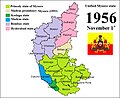 Unified Mysore State


Maharaja of Mysore
[edit]| No | Portrait | Name | Term of office | Duration | Selected former office(s) | |
|---|---|---|---|---|---|---|
| 1 | 
|
Jayachamarajendra Wadiyar | 15 August 1947 | 25 January 1950 | 2 years, 163 days | Yuvaraja of Mysore |
RajPramukh of Mysore
[edit]| No | Portrait | Name | Term of office | Duration | Selected former office(s) | |
|---|---|---|---|---|---|---|
| 1 |
|
Jayachamarajendra Wadiyar | 26 January 1950 | 31 October 1956 | 6 years, 279 days | Maharaja of Mysore |
Governors of Mysore
[edit]| No | Portrait | Name | Term of office | Duration | Selected former office(s) | |
|---|---|---|---|---|---|---|
| 1 |
|
Jayachamarajendra Wadiyar | 1 November 1956 | 4 May 1964 | 7 years, 185 days | Maharaja of Mysore, Rajpramukh of Mysore |
| 2 | 
|
S. M. Shrinagesh | 4 May 1964 | 2 April 1965 | 333 days | Chief of the Army Staff |
| 3 | .jpg)
|
V. V. Giri | 2 April 1965 | 13 May 1967 | 2 years, 41 days | Fourth President of India |
| 4 | 
|
Gopal Swarup Pathak | 13 May 1967 | 30 August 1969 | 2 years, 109 days | Fourth Vice-president of India |
| - | – | Justice A. R. Somanath Iyer (Acting) | 30 August 1969 | 23 October 1969 | 54 days | Chief Justice of Karnataka High Court |
| 5 | 
|
Dharma Vira | 23 October 1970 | 1 February 1972 | 1 year, 101 days | Governor of Punjab, Haryana, and West Bengal |
| 6 | 
|
Mohanlal Sukhadia | 1 February 1972 | 31 October 1976 | 4 years, 273 days | Chief Minister of Rajasthan, Governor of United Andhra Pradesh and Tamil Nadu |
Prime ministers of Mysore
[edit]| #[a] | Portrait | Name | Constituency | Term[7] (tenure length) |
Assembly[8] (election) |
Party[b] | |||
|---|---|---|---|---|---|---|---|---|---|
| 1 | 
|
K. Chengalaraya Reddy | Kolar | 25 October 1947 | 26 January 1950 | 2 years, 93 days | Not established yet | Indian National Congress | |
Chief ministers of Mysore
[edit]| #[c] | Portrait | Name | Constituency | Term[7] (tenure length) |
Assembly[8] (election) |
Party[d] | |||
|---|---|---|---|---|---|---|---|---|---|
| 1 |
|
K. Chengalaraya Reddy | N/A | 26 January 1950 | 30 March 1952 | 2 years, 64 days | Not established yet | Indian National Congress | |
| 2 | 
|
Kengal Hanumanthaiah | Ramanagara | 30 March 1952 | 19 August 1956 | 4 years, 142 days | 1st (1952 election) continued... | ||
| 3 | Kadidal Manjappa | Tirthahalli | 19 August 1956 | 31 October 1956 | 73 days | ||||
| Chief Minister of Mysore (following the state's reorganisation)[e] | |||||||||
| 4 | .jpg)
|
S. Nijalingappa | Molakalmuru | 1 November 1956 | 16 May 1958 | 1 year, 197 days | ...continued 1st (1952) |
Indian National Congress | |
| 2nd (1957) | |||||||||
| 5 | 
|
B. D. Jatti | Jamkhandi | 16 May 1958 | 14 March 1962 | 3 years, 302 days | |||
| 6 | S. R. Kanthi | Hungud | 14 March 1962 | 21 June 1962 | 99 days | 3rd (1962) | |||
| (4) |
|
S. Nijalingappa | Bagalkot[10] | 21 June 1962 | 29 May 1968 | 5 years, 343 days | |||
| Shiggaon | 4th (1967) | ||||||||
| 7 | Veerendra Patil | Chincholi | 29 May 1968 | 18 March 1971 | 2 years, 293 days | Indian National Congress (O) | |||
| – | 
|
Vacant[f] (President's rule) |
N/A | 19 March 1971 | 20 March 1972 | 1 year, 1 day | Dissolved | N/A | |
| 8 | .JPG)
|
D. Devaraj Urs[g] | Hunsur | 20 March 1972 | 31 December 1977 | 5 years, 286 days | 5th
(1972) |
Indian National Congress (R) | |
See also
[edit]Note
[edit]- ^ A parenthetical number indicates that the incumbent has previously held office.
- ^ This column only names the chief minister's party. The state government he headed may have been a complex coalition of several parties and independents; these are not listed here.
- ^ A parenthetical number indicates that the incumbent has previously held office.
- ^ This column only names the chief minister's party. The state government he headed may have been a complex coalition of several parties and independents; these are not listed here.
- ^ On 1 November 1956, via the States Reorganisation Act, Mysore State was significantly expanded along linguistic lines. The Kannada-speaking districts of Bombay, Hyderabad and Madras states, as well as the entirety of Coorg, were added to it.[9]
- ^ President's rule may be imposed when the "government in a state is not able to function as per the Constitution", which often happens because no party or coalition has a majority in the assembly. When President's_rule#Karnataka
- ^ On 1 November 1973, via the Mysore State (Alteration of Name) Act, Mysore State was renamed as Karnataka.[9] Thus, Devaraj Urs was Chief Minister of Mysore between 20 March 1972 and 31 October 1973, and Chief Minister of Karnataka after that.
References
[edit]- ^ "Indian states since 1947". 1 July 2014. Archived from the original on 1 July 2014. Retrieved 13 December 2024.
- ^ "Rajyotsava: The hows and whys of Karnataka". Bangalore Mirror. 1 November 2017. Retrieved 13 December 2024.
- ^ Sadasivan, S. N. (2005). Political and administrative integration of princely states By S. N. Sadasivan. Mittal Publications. ISBN 978-81-7099-968-3.
- ^ "States Reorganization Act 1956". Commonwealth Legal Information Institute. Archived from the original on 25 July 2011. Retrieved 1 July 2008.
- ^ Ramaswamy, Harish (1 June 2007). Karnataka Government and Politics. Concept Publishing Company. ISBN 978-81-8069-397-7 – via Google Books.
- ^ Ninan, Prem Paul (1 November 2005). "History in the making". Deccan Herald. Archived from the original on 22 December 2015. Retrieved 31 July 2020.
- ^ a b Chief Ministers of Karnataka since 1947. Karnataka Legislative Assembly. Archived on 6 December 2016.
- ^ a b Assemblies from 1952. Karnataka Legislative Assembly. Archived on 6 December 2016.
- ^ a b M. S. Prabhakara. "New names for old". The Hindu. 24 July 2007.
- ^ "Third Karnataka Legislative Assembly". Karnataka Legislature. Retrieved 6 November 2021.
12°18′N 76°39′E / 12.30°N 76.65°E
| Part A States |  | |
|---|---|---|
| Part B States | ||
| Part C States | ||
| Part D States | ||
Mysore State
View on GrokipediaHistory
Formation of the Princely State
The Kingdom of Mysore was founded in 1399 CE by Yaduraya Wodeyar, who established the Wodeyar dynasty as rulers of a small principality centered around the modern city of Mysuru (formerly Mysore).[8][9] Yaduraya, also known as Adi Yaduraya, was installed as a vassal ruler by the Vijayanagara emperor Harihara II (r. 1377–1404 CE) to govern the region and suppress local opposition, marking the formal inception of the state amid the broader feudal structure of South Indian polities.[10][11] This origin positioned Mysore initially as a subordinate entity under Vijayanagara suzerainty, with its territory limited to a modest area encompassing the fort and surrounding villages near Mysuru, rather than the expansive domain it later acquired.[12] The founding reflected the fragmented political landscape of late 14th-century South India, following the decline of earlier dynasties like the Hoysalas and Western Gangas, which had previously influenced the region since around 350 CE.[13] Yaduraya's rule, extending until approximately 1423 CE, focused on consolidating authority through administrative and military measures suited to a nascent state, laying the groundwork for dynastic continuity despite intermittent challenges from neighboring powers.[8][10] Historical accounts attribute the dynasty's longevity to this early emphasis on loyalty to imperial overlords while fostering local governance, though primary evidence remains tied to later Wodeyar chronicles rather than contemporaneous inscriptions, underscoring the need for caution in assessing the precision of foundational narratives.[9] By the early 15th century, under successors like Hiriya Bettada Chamaraja Wodeyar I (r. 1423–1459 CE), the state began modest territorial expansions, acquiring nearby villages and establishing a pattern of incremental growth that transformed Mysore from a Vijayanagara feudatory into an independent kingdom by the 17th century.[11] This formative phase was characterized by agrarian-based revenue systems and alliances with imperial forces, enabling survival amid the Vijayanagara Empire's eventual fragmentation after the Battle of Talikota in 1565 CE.[14]British Suzerainty and Internal Reforms
Following the Fourth Anglo-Mysore War, the British East India Company restored the Wodeyar dynasty to power in 1799 under Maharaja Krishna Raja Wodeyar III, establishing Mysore as a princely state under British suzerainty through a subsidiary alliance.[15] This arrangement required the Maharaja to disband his army, pay an annual tribute of 33 lakhs of rupees to the British, and accept a Resident at his court to oversee foreign relations and ensure compliance, while retaining autonomy in internal administration subject to British paramountcy.[16] The suzerainty framework preserved the state's nominal independence but integrated it into the British Indian empire's political order, with Mysore providing troops and resources for British campaigns when needed.[17] By the 1820s, misgovernance, heavy taxation, and corruption under Krishna Raja Wodeyar III led to widespread unrest, culminating in the 1830-1831 rebellion in Nagar and other districts.[18] In response, the British deposed the Maharaja in 1831 and assumed direct control via a Board of Commissioners, administering the state until 1881 to restore fiscal stability and order.[18] During this period, revenue collection improved through systematic land assessments, reducing the state's debt from over 88 lakhs of rupees in 1862; judicial reforms established district courts and a high court in Bangalore; and public works expanded, including 1,500 miles of roads and early irrigation projects.[19] Sir Mark Cubbon, Commissioner from 1834 to 1861, centralized administration by dividing the state into four divisions, introducing Kannada as the official language in lower courts, and promoting engineering surveys that laid foundations for later infrastructure.[20] The Mysore Commission of 1876-1879 recommended restoring administration to the Wodeyars, leading to the investiture of Chamarajendra Wadiyar X as Maharaja in 1881 under British oversight via a Dewan.[21] Chamarajendra enacted early representative reforms, establishing the Mysore Legislative Council in 1881 as the first such body in any princely state, with 19 elected members advising on budgets and laws.[22] His rule emphasized fiscal prudence, reducing tribute payments and funding schools, though direct British influence persisted through the Dewan's veto power. Under Krishnaraja Wadiyar IV, who assumed full powers in 1902 after a regency, Mysore underwent transformative internal reforms, earning it recognition as India's most progressive princely state.[23] With Dewan Sir M. Visvesvaraya (1912-1918), the state invested in heavy industry, founding the Mysore Iron Works in 1918 and Bhadravati Steel Works; irrigation expanded via the Krishnarajasagara Dam (completed 1932), irrigating 145,000 acres and generating hydroelectric power.[23] Education reforms included compulsory primary schooling by 1912, establishing over 5,000 schools and the University of Mysore in 1916, raising literacy from 6% in 1901 to 16% by 1931.[24] Social measures banned child marriage for girls under eight in 1894 (enforced rigorously post-1902), improved sanitation with model villages, and reserved 70% of jobs for non-Brahmins to counter caste imbalances, fostering merit-based bureaucracy.[25] These reforms, funded by efficient revenue systems yielding annual surpluses, prioritized empirical planning over ideology, though British Residents occasionally curbed expansions like railway autonomy.[23]Accession to India and Transition to Democratic Rule
The Maharaja of Mysore, Jayachamarajendra Wadiyar, signed the Instrument of Accession on 9 August 1947, formally integrating the princely state into the Dominion of India effective 15 August 1947.[26] This agreement ceded control over defense, external affairs, and communications to the central government while allowing Mysore to retain autonomy in internal administration under a standstill arrangement. Despite the accession, demands for responsible democratic government intensified, led by the Mysore State Congress through nonviolent agitations and satyagraha campaigns starting in September 1947.[27] The movement, rooted in long-standing calls for elected rule dating back to the 1930s Praja Paksha efforts, culminated in widespread protests against the Maharaja's initial reluctance to abolish autocratic elements.[27] On 25 October 1947, the Maharaja issued a proclamation accepting the principle of responsible government, marking the end of absolute monarchical rule.[28][29] Kyasamballi Chengalaraya Reddy (K.C. Reddy) was sworn in as the first Chief Minister on 27 October 1947, heading an interim Congress ministry drawn from the existing representative assembly.[28][30] The Maharaja assumed the ceremonial role of Raj Pramukh, overseeing the transition. With India's Constitution taking effect on 26 January 1950, Mysore was designated a Part B state, formalizing ministerial responsibility to a legislative assembly.[31] The first direct elections to the Mysore Legislative Assembly occurred between 25 February and 2 March 1952 as part of India's inaugural general elections, with the Indian National Congress securing a majority of 87 out of 99 seats.[30] K.C. Reddy's ministry continued post-elections until June 1952, establishing democratic precedents amid the state's administrative continuity from princely times.[30] This shift replaced the diwan-led executive with elected governance, though the Maharaja retained privy purse and titular status until 1971.[31]Administrative Developments 1947-1956
Following the accession of the princely state of Mysore to the Dominion of India on 9 August 1947, administrative authority transitioned from the Diwan's office to a Council of Ministers responsible to a popular assembly. Amid public agitation led by the Mysore State Congress, including the "Mysore Chalo" satyagraha commencing on 1 September 1947, Maharaja Jayachamarajendra Wadiyar yielded to demands for responsible government. On 24 October 1947, he issued a proclamation forming a new cabinet, with K. C. Reddy sworn in as Chief Minister on 27 October 1947, marking the establishment of ministerial accountability to the legislative assembly rather than the throne.[27][32] This shift abolished the hereditary Diwan system, previously headed by figures like Arcot Ramasamy Mudaliar, and aligned executive functions with elected representatives.[33] On 29 October 1947, the Maharaja convened a Constituent Assembly to draft a transitional framework for Mysore, facilitating integration into India's governance structure while retaining local legislative continuity from the pre-independence representative assembly. The first general elections under this system occurred on 25 March 1952, with the Indian National Congress securing 99 of 99 contested seats in the 168-member unicameral legislature, leading to Kengal Hanumanthaiah's appointment as Chief Minister on 21 April 1952, succeeding Reddy. Administratively, Mysore's civil services began merging with central frameworks; Mysore Civil Service officers were progressively absorbed into the Indian Administrative Service, exemplified by appointments like Puttaranga Shetty as Chief Secretary. The Mysore Public Service Commission was established in 1951 to oversee recruitment, formalizing rules for state administrative positions.[22][33][4] With the adoption of India's Constitution on 26 January 1950, Mysore was designated a Part B state, comprising the former princely territory with nine districts and classified under Article 238 for partial autonomy. The Maharaja assumed the ceremonial role of Raj Pramukh until 1 November 1956, appointing and dismissing ministers on the advice of the Chief Minister while the real executive power vested in the Council of Ministers. Hanumanthaiah's tenure emphasized developmental administration, including land reforms such as the Mysore Tenancy Act (1952) and Inam Abolition Act (1955), which redistributed agrarian rights and abolished feudal grants, administered through district deputy commissioners to enhance revenue efficiency and equity. These measures built on pre-independence welfare traditions but introduced democratic oversight, with district administration retaining taluk-level subdivisions for local governance.[33][4] No major district boundary alterations occurred prior to 1956, preserving the territorial configuration inherited from the princely era.[34] Throughout 1950–1956, preparations for linguistic reorganization influenced administrative planning, as demands for a unified Kannada-speaking state prompted surveys and boundary delineations aligned with the States Reorganisation Commission's recommendations. This period solidified bureaucratic modernization, including the initiation of codified service rules and infrastructure projects like the Vidhana Soudha legislative complex, symbolizing the shift to a professional, elected administration. By 1956, Mysore's governance model—blending continuity in welfare-oriented policies with integration into federal structures—facilitated its expansion under the States Reorganisation Act, effective 1 November 1956, without prior internal jurisdictional upheavals.[33][4]Geography
Territorial Extent and Borders
Mysore State was established on 15 August 1947 following the accession of the princely state of Mysore to the Dominion of India, initially comprising the core territories of the former kingdom, which covered approximately 30,000 square miles (78,000 km²). This landlocked region was bounded by the Madras Presidency to the east and south, the Bombay Presidency to the north and northwest, Hyderabad State to the northeast, and the princely states of Cochin and Travancore to the southwest.[35] Between 1947 and 1956, the state's territory underwent limited adjustments, including the integration of select adjacent areas from British-administered provinces to consolidate administrative boundaries, though these changes did not substantially alter its overall extent or introduce coastal access.[4] The States Reorganisation Act of 1956, effective 1 November 1956, profoundly expanded Mysore State's territory by incorporating predominantly Kannada-speaking districts from neighboring provinces and states, elevating its area to roughly 192,000 square kilometers, or 5.84% of India's total landmass. This reconfiguration added regions such as Belgaum, Bijapur, and Dharwar from Bombay State; Raichur and Gulbarga from Hyderabad State; Bellary and South Kanara from Madras State; and the entirety of Coorg State.[36][37] Post-reorganisation, Mysore State's borders extended northward to abut Bombay and Hyderabad States, eastward to Madras State, southward to Madras State and Travancore-Cochin, westward to Bombay State and the Arabian Sea via the newly acquired coastal South Kanara district, thereby transforming it from an inland entity into one with maritime frontiers. These boundaries persisted with minor modifications until the state's renaming to Karnataka in 1973.[38]Physical Features and Natural Resources
The terrain of Mysore State primarily comprised the southern Deccan Plateau, characterized by undulating plains, plateaus, and dissected hill ranges with elevations typically between 600 and 900 meters above sea level. The Western Ghats formed a prominent escarpment along the western boundary, attaining heights over 1,000 meters and giving way eastward to drier peneplains. Major river systems included the Cauvery, originating from the Brahmagiri Range in Kodagu district and flowing southeastward for approximately 800 kilometers through the state, along with tributaries such as the Kabini and Hemavati; northern tributaries of the Krishna, like the Tungabhadra, also traversed the region. Soil profiles varied regionally, with red sandy and loamy soils predominant in upland crystalline rock areas, deep black cotton soils in riverine valleys suited for cotton and millet cultivation, and lateritic soils in hilly zones.[39][40] Natural resources were abundant, particularly in minerals and forests. Gold mining at the Kolar Gold Fields, operational since the late 19th century, yielded significant output—peaking at around 900 kilograms annually in the early 1900s—before gradual decline, with the fields located in Kolar district under state administration. Iron ore deposits in Bellary and Chitradurga districts supported early industrial development, while chromite, manganese, and limestone occurred in Shimoga, Hassan, and Tumkur areas. Forests covered substantial portions of the Malnad (hilly) tracts, including teak, rosewood, and bamboo, with Mysore district alone estimated to produce over 30,000 tonnes of bamboo yearly from its bamboo-bearing areas. These resources underpinned agricultural and extractive economies, though exploitation was limited by pre-1956 infrastructure.[41][42]Demographics
Population Size and Growth
The population of Mysore State, encompassing the former princely state territory, stood at 7,329,140 persons as per the 1941 census.[43] This figure reflected a decadal increase of 11.8% from the 1931 census total of 6,557,302, a rate lower than the all-India average of 14.2% owing to factors including rural-to-urban migration, recurrent plague outbreaks, and relatively higher density in certain districts leading to emigration. Density averaged 100 persons per square kilometer across the state's 73,937 square kilometers, with rural areas comprising over 90% of the populace and urban centers like Bangalore and Mysore city accounting for the remainder. Between 1941 and 1951, the population grew by approximately 13.3%, consistent with the national decadal rate, yielding an estimated total of around 8.3 million by the 1951 census amid post-World War II recovery, expanded famine relief, and initial public health interventions that curbed mortality from infectious diseases. Annual growth during this inter-censal period averaged about 1.2%, driven primarily by declining death rates rather than elevated birth rates, as crude birth rates hovered near 35 per 1,000 while death rates fell from 25 to 20 per 1,000 due to better access to quinine for malaria control and improved grain distribution networks.[44] From 1947 to 1956, under democratic administration, population expansion persisted at roughly 1.5% annually, fueled by state-led initiatives such as expanded irrigation under the Krishna Raja Sagara dam, which boosted food availability and reduced famine risks, alongside vaccination drives against smallpox and cholera that further lowered infant mortality from 150 to under 120 per 1,000 live births.[44] This growth pattern underscored causal links between infrastructural investments and demographic stability, though challenges like uneven district-wise distribution—higher in fertile southern taluks versus arid northern ones—persisted, with no evidence of overpopulation pressures materializing during the state's brief existence.[44]| Census Year | Population | Decadal Growth Rate (%) |
|---|---|---|
| 1931 | 6,557,302 | - |
| 1941 | 7,329,140 | 11.8 |
| 1951 (est.) | ~8,300,000 | 13.3 |
Ethnic, Linguistic, and Religious Composition
The linguistic composition of Mysore State, as recorded in the 1951 Census, featured Kannada as the dominant mother tongue, spoken by approximately 66% of the population, reflecting the core Dravidian linguistic base of the region's Kannadiga majority.[45] Significant minorities included Telugu speakers, particularly in eastern districts such as Kolar where they formed substantial communities due to historical migrations and administrative ties to neighboring Telugu areas; Tamil speakers along the southern borders; and Urdu among Muslim populations. Smaller groups reported Tulu, Marathi, or other languages, contributing to a multilingual landscape that underscored the pre-reorganization state's incomplete linguistic homogeneity and fueled demands for redrawing boundaries to consolidate Kannada-speaking territories.[46] Ethnically, the population was predominantly Dravidian, with Kannadigas comprising the principal group, subdivided into communities such as Lingayats and Vokkaligas who held prominent social and economic roles in agrarian and mercantile spheres. Scheduled Castes, often referred to as "Depressed Classes" in contemporary terminology, accounted for a notable share, estimated through caste enumerations that highlighted their integration into Hindu society amid ongoing social reform efforts. Scheduled Tribes, including forest-dwelling groups like the Jenu Kuruba and Soliga, represented a smaller fraction, with enumerated numbers around 15,000 in select estimates, primarily inhabiting hilly and remote areas with distinct cultural practices tied to subsistence economies.[47] Religiously, Hinduism overwhelmingly predominated, aligning with the state's historical Wodeyar rulers and temple-centric culture, though exact state-level breakdowns from the 1951 Census emphasized broad Hindu majorities across South Indian states exceeding 90% in comparable princely territories. Muslims, the largest minority, clustered in urban centers like Bangalore and Mysore city, often engaged in trade and artisanal occupations, while Christians, influenced by missionary activities, formed pockets in coastal and mission-station vicinities. Jains, known for their mercantile prominence, maintained communities in trading hubs, preserving distinct sectarian traditions within the broader Indic religious framework. This composition reflected limited proselytization and enduring Hindu cultural hegemony, with minorities integrated yet distinct in occupational niches.[48]Government and Politics
Monarchical Institutions and Privy Purse
The monarchical institutions of Mysore State, centered on the hereditary Wadiyar dynasty, underwent a transformation following the state's accession to the Dominion of India on August 9, 1947. Jayachamarajendra Wadiyar, who had ascended the throne in 1940 as the 25th ruling Maharaja, signed the Instrument of Accession, integrating Mysore as a Part B state under the constitutional framework of independent India.[3][22] In this capacity, the Maharaja retained a ceremonial role, with executive authority vesting in a Council of Ministers led by an appointed Dewan until the establishment of responsible government.[27] Upon the adoption of the Indian Constitution in 1950, Jayachamarajendra Wadiyar was appointed Raj Pramukh, the constitutional head of state for Mysore, a position he held until 1956 when the office was abolished following the States Reorganisation Act.[49][50] The Raj Pramukh's role was largely titular, involving formal assent to legislation and representation of the state, while real power shifted to the elected legislative assembly and chief minister. The dynasty's palace at Mysore continued as a private residence and cultural institution, preserving monarchical traditions such as the annual Dasara celebrations under royal patronage. The privy purse system provided financial maintenance to the former ruler, fixed at 26 lakh rupees annually for Mysore—the highest among princely states—intended to cover personal and family expenses in exchange for relinquishing sovereign revenues and properties.[51][52] Enshrined in Article 291, this payment was tax-free and hereditary, ensuring the Maharaja's economic stability amid the loss of state control. The arrangement persisted until the 26th Constitutional Amendment in 1971 abolished privy purses nationwide, stripping rulers of official recognition and stipends, a move upheld by the Supreme Court despite initial challenges.[53] This abolition marked the definitive end of monarchical financial privileges, though the Wadiyar family retained private assets and cultural influence.Executive Leadership: Raj Pramukh, Governors, and Chief Ministers
The executive leadership of Mysore State initially vested in the Raj Pramukh, a ceremonial head of state position held by the former ruling Maharaja following the state's accession to the Dominion of India on 15 August 1947. Jayachamarajendra Wadiyar, the 25th Maharaja of Mysore, served as Raj Pramukh from that date until 31 October 1956, overseeing the transition to democratic governance while retaining symbolic authority under the 1935 Government of India Act initially and later the 1950 Constitution for Part B states.[54] [55] With the passage of the States Reorganisation Act on 1 November 1956, the office of Raj Pramukh was abolished, and executive headship shifted to a Governor appointed by the President of India. Wadiyar himself was reappointed as the first Governor, serving from 1 November 1956 to 4 May 1964, during which the enlarged Mysore State stabilized post-reorganization. Subsequent Governors included military and civil service figures, reflecting central oversight amid regional political dynamics.[56] [57]| No. | Name | Term Start | Term End | Prior Role |
|---|---|---|---|---|
| 1 | Jayachamarajendra Wadiyar | 1 November 1956 | 4 May 1964 | Raj Pramukh of Mysore |
| 2 | Satyawant Mallanna Srinagesh | 4 May 1964 | 2 April 1965 | Chief of the Army Staff |
| 3 | V. V. Giri | 2 April 1965 | 2 April 1967 | Labour Minister, Government of India |
| 4 | Dharma Vira | 2 April 1967 | 20 August 1967 | Governor of Punjab |
| 5 | Gopal Swarup Pathak | 21 August 1967 | 31 August 1969 | Member of Parliament |