Hubbry Logo
Messier 94Messier 94Main
Open search
Messier 94
Community hub
Messier 94
logo
8 pages, 0 posts
0 subscribers
Be the first to start a discussion here.
Messier 94
Messier 94
from Wikipedia

Messier 94[1][2][3]
Galaxy Messier 94 in Canes Venatici
Observation data (J2000 epoch)
ConstellationCanes Venatici[4]
Right ascension12h 50m 53.1s[5]
Declination+41° 07′ 14″[5]
Redshift0.001027±0.000005[5]
Heliocentric radial velocity308±1 km/s[5]
Galactocentric velocity360±3 km/s[5]
Distance16.0 ± 1.3 Mly (4.91 ± 0.40 Mpc)
Apparent magnitude (V)8.2[6]
Characteristics
Type(R)SA(r)ab,[5] LINER[5]
Apparent size (V)11.2 × 9.1 moa[5]
Other designations
NGC 4736, UGC 7996, PGC 43495[5]

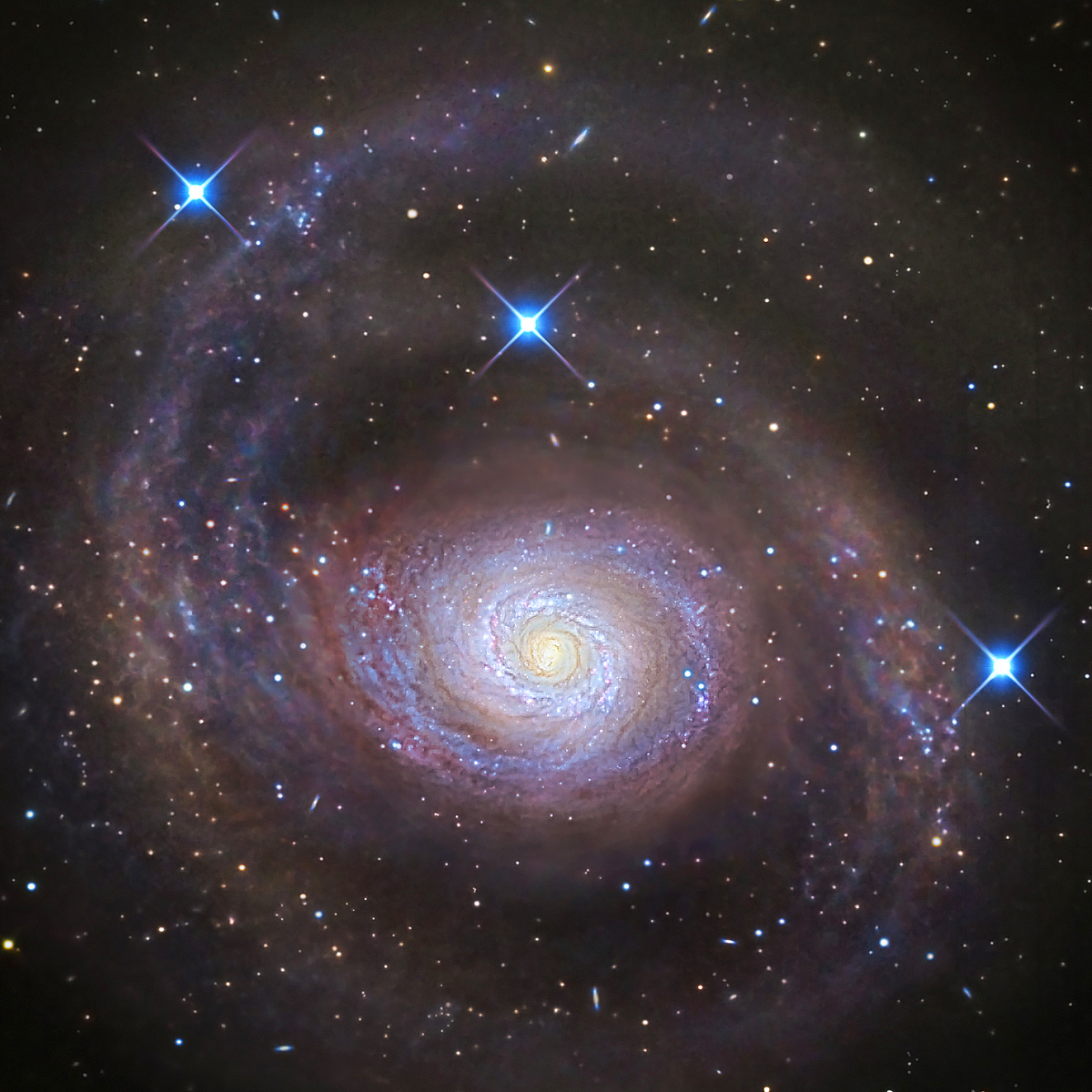
Messier 94 (also known as NGC 4736, Cat's Eye Galaxy, Crocodile Eye Galaxy, or Croc's Eye Galaxy[7][8]) is a spiral galaxy in the mid-northern constellation Canes Venatici. It was discovered by Pierre Méchain in 1781,[9] and catalogued by Charles Messier two days later. Although some references describe M94 as a barred spiral galaxy, the "bar" structure appears to be more oval-shaped.[10] The galaxy has two ring structures.[5]

Structure

[edit]
Detail of the central area of M94

M94 is classified as having a low ionization nuclear emission region (LINER) nucleus.[11] LINERs in general are characterized by optical spectra that reveal that ionized gas is present but the gas is only weakly ionized (i.e. the atoms are missing relatively few electrons).

M94 hosts a supermassive black hole (SMBH) with mass of 1.60 х 107 Mʘ [12] as measured using stellar kinematics derived from James Webb Space Telescope (JWST) data. This result is consistent with the current MBH-σ and - MBH-M☆, gal relations

M94 has an inner ring with a diameter of 70 arcseconds (″) (given its distance, about 5,400 light-years (1,700 pc)) and an outer ring with a diameter of 600″ (about 45,000 light-years (14,000 pc)). These rings appear to form at resonance points in the disk of the galaxy. The inner ring is the site of strong star formation activity and is sometimes referred to as a starburst ring. This star formation is fueled by gas driven dynamically into the ring by the inner oval-shaped bar-like structure.[13]

A 2009 study[14] conducted by an international team of astrophysicists revealed that the outer ring of M94 is not a closed stellar ring, as historically attributed in the literature, but a complex structure of spiral arms when viewed in mid-IR and UV. The study found that the outer disk of this galaxy is active. It contains approximately 23% of the galaxy's total stellar mass and contributes about 10% of the galaxy's new stars. In fact, the star formation rate of the outer disk is approximately two times greater than the inner disk because it is more efficient per unit of stellar mass.

There are several possible external events that could have led to the origin of M94's outer disk including the accretion of a satellite galaxy or the gravitational interaction with a nearby star system. However, further research found problems with each of these scenarios. Therefore, the report concludes that the inner disk of M94 is an oval distortion which led to the creation of this galaxy's peripheral disk.

In a paper published in 2004, John Kormendy and Robert Kennicutt argued that M94 contains a prototypical pseudobulge.[10] A classical spiral galaxy consists of a disk of gas and young stars that intersects a large sphere (or bulge) of older stars. In contrast, a galaxy with a pseudobulge does not have a large bulge of old stars but instead contain a bright central structure with intense star formation that looks like a bulge when the galaxy is viewed face-on. In the case of M94, this pseudobulge takes the form of a ring around a central oval-shaped region.

In 2008 a study was published[15] showing that M94 had very little or no dark matter present. The study analyzed the rotation curves of the galaxy's stars and the density of hydrogen gas and found that ordinary luminous matter appeared to account for all of the galaxy's mass. This result was unusual and somewhat controversial, as current models do not indicate how a galaxy could form without a dark matter halo or how a galaxy could lose its dark matter. Other explanations for galactic rotation curves, such as MOND, also have difficulty explaining this galaxy.[16] This result has yet to be confirmed or accepted by other research groups, however, and has not actually been tested against the predictions of standard galaxy formation models.

Location

[edit]
M94 as seen in at various wavelengths of light

At least two techniques have been used to measure distances to M94. The surface brightness fluctuations distance measurement technique estimates distances to spiral galaxies based on the graininess of the appearance of their bulges. The distance measured to M94 using this technique is 17.0 ± 1.4 Mly (5.2 ± 0.4 Mpc).[1] However, M94 is close enough that the Hubble Space Telescope can be used to resolve and measure the fluxes of the brightest individual stars within the galaxy. These measured fluxes can then be compared to the measured fluxes of similar stars within the Milky Way to measure the distance. The estimated distance to M94 using this technique is 15 ± 2 Mly (4.7 ± 0.6 Mpc).[2] Averaged together, these distance measurements give a distance estimate of 16.0 ± 1.3 Mly (4.9 ± 0.4 Mpc).

Messier 94, May 2024

M94 is one of the brightest galaxies within the M94 Group, a group of galaxies that contains between 16 and 24 galaxies.[17][18][19] This group is one of many that lie within the Virgo Supercluster (i.e. the Local Supercluster).[20] Although a large number of galaxies may be associated with M94, only a few galaxies near M94 appear to form a gravitationally bound system. Most of the other nearby galaxies appear to be moving with the expansion of the universe.[2][21]

See also

[edit]

References

[edit]
[edit]
Revisions and contributorsEdit on WikipediaRead on Wikipedia
from Grokipedia
Messier 94 (M94), also known as NGC 4736, is a face-on located approximately 16 million light-years away in the constellation . Discovered by French Pierre Méchain in 1781 and subsequently cataloged by , it is renowned for its striking morphology featuring a bright central nucleus encircled by a prominent starburst ring where intense occurs at a rate far exceeding typical . This ring, composed of young, hot stars glowing in ultraviolet light, gives the galaxy its distinctive "" appearance and spans about 5,400 light-years in diameter, while the outer ring extends to roughly 45,000 light-years. The galaxy's spiral arms, laced with dark dust lanes, wind outward from the core, and recent observations have revealed two faint, extended arms that effectively triple its previously estimated diameter from about 30,000 light-years to nearly 90,000 light-years across. M94 exhibits an of 9.0, making it accessible to amateur astronomers with small to moderate telescopes under , particularly during its optimal viewing period in May. One of its most intriguing properties is a relative deficiency of compared to other spirals, as indicated by analyses of its rotation curves, which suggest that visible baryonic matter accounts for most of its mass without the need for substantial dark halo contributions—a puzzle that continues to drive research into .

Overview

General Description

Messier 94 is a classified as (R)SA(r)ab, featuring a prominent inner ring and tightly wound spiral arms, with a low-ionization nuclear emission-line region (LINER) nucleus characterized by emission from hot gas and low-level nuclear activity. This classification reflects its structured morphology, including an outer ring that encloses much of the disk, distinguishing it from more typical unbarred spirals. The galaxy's nucleus shows spectral lines indicative of LINER activity, likely driven by accretion onto a or stellar processes. In the sky, Messier 94 appears as a bright, with an apparent size of 11.2 × 9.1 arcminutes and a visual magnitude of 8.2, making it visible to astronomers under . Its distinctive ringed structure, formed by density waves that trigger in the inner regions, gives it a striking, eye-like appearance in telescopes—earning the nicknames Cat's Eye Galaxy and Crocodile Eye Galaxy due to the bright central bulge surrounded by luminous rings resembling an iris and pupil. Discovered by Pierre Méchain in 1781, it was added to the Messier catalog as the 94th entry. Messier 94 plays a role in the as a member of the nearby M94 Group, contributing to the large-scale structure of galaxies in our local cosmic neighborhood. This positioning highlights its proximity and accessibility for study, revealing insights into evolution within environments.

Nomenclature and Cataloging

Messier 94, commonly abbreviated as M94, was cataloged by French astronomer on March 24, 1781, as the 94th entry in his renowned catalog of deep-sky objects, initially described as a without stars located above the heart of the constellation . The Messier catalog, finalized with 103 entries by 1781, served primarily to document non-cometary celestial phenomena—such as nebulae, star clusters, and galaxies—that could be mistaken for comets, thereby streamlining comet searches for astronomers. This inclusion followed a brief report from Messier's collaborator Pierre Méchain, who first noted the object on March 22, 1781. In the of Nebulae and Clusters of Stars, compiled by Danish-Irish astronomer J. L. E. Dreyer and published in 1888, Messier 94 received the designation NGC 4736, reflecting its position and appearance in 19th-century observations. Additional catalog entries include UGC 7996 in the Uppsala General Catalogue of Galaxies (1961–1962) and PGC 43495 in the Principal Galaxies Catalogue from the Lyon-Meudon Extragalactic Database, now integrated into HyperLEDA. These identifiers are cross-referenced in major astronomical databases, enabling systematic study across optical, radio, and surveys. The object has acquired informal nicknames that evoke its distinctive morphology: the Galaxy, owing to the prominent, luminous inner ring that mimics a feline eye in telescopic views, and the alternative Eye Galaxy (or Croc's Eye Galaxy), which emphasizes the ring's elongated, reptilian form.

Discovery and Observation History

Initial Discovery

Messier 94 was discovered during the height of 18th-century comet-hunting efforts in , a period when astronomers like systematically scanned the skies to identify potential s while cataloging fixed, non-cometary objects to avoid confusion in future searches. This endeavor culminated in the Messier catalog, a landmark compilation of deep-sky objects that began as a practical tool for comet observers and evolved into a foundational reference for astronomy. On March 22, 1781, French astronomer Pierre Méchain, Messier's collaborator and frequent contributor to the catalog, independently spotted the object while conducting routine observations from . Using a modest achromatic refractor with a 3.5-foot focal length—typical for the era's deep-sky surveys—Méchain noted its position in the constellation but discerned little detail due to its faint appearance under limited instrumental power. His initial observation captured what appeared as a subtle, unresolved patch of light amid the starry field. Méchain promptly reported the discovery to Messier via letter, prompting the latter to verify it two days later on , 1781, and formally add it as the 94th entry in his catalog. In his documentation, Méchain described it simply as a very faint without visible stars or , reflecting the rudimentary understanding of such objects at the time before photographic or spectroscopic analysis. This entry, later designated NGC 4736 in the , marked another addition from Méchain's prolific observations to the growing Messier list. In 1787, observed it with his larger reflector telescope, describing it as a bright with discernible .

Historical Observations

In the , following its cataloging by in 1781, Messier 94 (NGC 4736) was subject to detailed visual examinations with improving ground-based telescopes. British astronomer William Henry Smyth observed it in April 1834 using a 5.9-inch refractor, describing it as a "large bright , above the left thigh of Charles's Wain [[Ursa Major](/page/Ursa Major)]," noting its considerable size, central condensation, and hazy outline without resolvable stars. These early accounts emphasized its bright nucleus and elliptical form, contributing to the recognition of its face-on spiral morphology amid broader studies of "nebulae" during the era. The marked a shift toward spectroscopic and radio observations, revealing Messier 94's gaseous components beyond optical limits. In the , multi-frequency radio continuum studies began mapping its structure, with observations at wavelengths from 21 cm to 6 cm detecting extended emission linked to star-forming regions. Ground-based radio telescope surveys in the and 1980s, including neutral hydrogen (HI) mapping with the Westerbork Synthesis Radio Telescope, quantified the galaxy's gas distribution and rotation curve, showing a massive HI disk extending beyond the optical arms and indicating radial inflows in the inner regions. These efforts, such as Rots' 1980 survey, highlighted Messier 94's rich , with total HI mass estimated at around 8 × 10^8 solar masses. Advancements in space-based imaging during the late further refined views of its inner dynamics. The Hubble Space Telescope's Wide Field and Planetary Camera 2 captured high-resolution images in the and early , resolving the prominent inner ring as a site of intense with young, hot stars illuminating dust lanes. This marked a transition to multi-wavelength approaches, integrating optical data with radio for gas and emerging observations to trace cooler dust and molecular gas, enabling comprehensive models of its ringed structure by the early .

Location and Visibility

Coordinates and Distance

Messier 94 has equatorial coordinates of 12h 50m 53.1s and +41° 07′ 14″ in the J2000.0 epoch. The galaxy lies at a of 16.0 ± 1.3 million light-years (4.9 ± 0.4 Mpc) from , obtained by averaging independent measurements from the tip-of-the-red-giant-branch (TRGB) method and surface brightness fluctuations (SBF), as of measurements in the 2000s and 2010s. The TRGB distance, derived from the luminosity of the brightest stars observed with the , yields 15.2 ± 1.0 million light-years (4.66 ± 0.25 Mpc). The SBF distance, which quantifies the statistical fluctuations in the of unresolved stellar populations, gives 17.0 ± 1.4 million light-years (5.2 ± 0.4 Mpc). These methods provide robust geometric indicators calibrated against nearby stellar populations, with uncertainties dominated by photometric errors and effects. Messier 94 exhibits a spectroscopic of z = 0.001027 ± 0.000005, corresponding to a heliocentric of 308 ± 1 km/s. This recession velocity, measured from optical emission lines, places the within the local Hubble flow, though its proximity requires corrections for peculiar motions relative to Group. Distance estimates to Messier 94 have undergone significant refinement since the , when Hubble's pioneering use of brightest cluster galaxies and early Cepheid calibrations placed nearby clusters in the Virgo region at roughly 2–5 million light-years based on apparent magnitudes and assumed luminosities. By the mid-20th century, group membership analyses and the Tully-Fisher relation yielded distances around 14 million light-years, as compiled in comprehensive nearby catalogs. Modern photometric techniques, including TRGB and SBF applied in the late and early , have increased the accepted value to approximately 16 million light-years, reflecting improved resolution from space-based observatories and better calibration of standard candles.

Visibility and Group Membership

Messier 94 is situated in the constellation , a mid-northern celestial feature, rendering it observable primarily from locations north of the . Its apparent visual magnitude of 8.0 allows detection with of 40-50 mm aperture or small telescopes under clear, , appearing as a compact, fuzzy patch. The galaxy reaches peak visibility during spring evenings, particularly from to May in the , when it culminates high in the after sunset. Observers in urban or suburban areas affected by may find it challenging, often requiring or relocation to Bortle scale 4 or darker sites for optimal contrast against the background . Messier 94 serves as the brightest member of the M94 Group, also called the Canes Venatici I Group, a loose aggregation of approximately 20 galaxies spanning the constellations and at a distance of about 16 million light-years. Notable companions include NGC 4214 and NGC 4244, contributing to studies of group-scale interactions. This group resides within the , a vast structure of thousands of galaxies that traces a filamentary segment of the local cosmic web, linking our to broader large-scale structures.

Physical Characteristics

Morphological Classification

Messier 94 is classified as an (R)SA(r)ab in the revised Hubble-de Vaucouleurs system, indicating an unbarred spiral with tightly wound arms (ab subtype), an inner pseudoring (r), and an outer ring structure (R). Some sources suggest a weak bar, leading to classifications like SAB(r)ab, but the consensus favors unbarred due to the oval-shaped inner structure. This classification highlights the galaxy's multi-component disk, where the inner ring surrounds a bright pseudobulge, transitioning into prominent spiral arms that contribute to its distinctive "cat's eye" appearance in optical images. The morphological classification of Messier 94 has evolved from Edwin Hubble's original scheme, which placed it as an early-type Sab spiral based on its compact bulge and smooth arms, to Gérard de Vaucouleurs' more detailed revision that incorporated bar, ring, and lens features for greater precision. De Vaucouleurs' system emphasized the galaxy's ringed morphology, refining it to account for the inner and outer ring components observed in deeper imaging, which distinguish it from simpler spiral archetypes. Modern updates, informed by high-resolution surveys like those from the , affirm this (R)SA(r)ab type while noting subtle variations in arm winding due to projection effects. At its core, Messier 94 hosts a low-ionization nuclear emission-line region (LINER) nucleus, characterized by optical spectra showing weak emission lines from lowly ionized species such as [N II] and [O I], indicative of excitation by an aging or low-luminosity rather than intense or quasar-like activity. This LINER signature aligns with the galaxy's overall quiescent morphology outside the inner ring, where gas dynamics are subdued compared to more active spirals. In comparison to similar nearby galaxies like , also classified as SA(s)ab, Messier 94 shares the unbarred, tightly wound spiral structure but stands out due to its well-defined inner and outer rings, which enhance its layered disk appearance and suggest distinct dynamical histories influenced by minor mergers or internal resonances.

Size, Mass, and Composition

Messier 94 exhibits a multi-layered structure, with its inner disk measuring approximately 30,000 light-years in diameter, as determined from early estimates of its bright central region. This dimension corresponds to the prominent inner ring and pseudobulge, converted from angular sizes observed at a of about 16 million light-years using standard astronomical scaling. The galaxy's overall physical diameter extends significantly farther due to its outer ring and recently discovered faint spiral arms, reaching roughly 90,000 light-years across. This expanded size, effectively tripling prior assessments, reflects the full extent of the stellar disk and highlights how the galaxy's morphological classification as an (R)SA(r)ab spiral influences interpretations of its boundaries, emphasizing the role of faint outer features in defining total dimensions. Total mass estimates for Messier 94 place it at around 6 × 10^{10} solar masses, encompassing stellar, gas, and minimal components, which is notably lower than in many comparable spirals. This dynamical mass derives from rotation curve analyses and suggests limited dark halo contribution, consistent with spectral modeling that reproduces observed without substantial non-baryonic . The composition of Messier 94 is dominated by older in the disk, which form the bulk of its , alongside interstellar gas and that fuel localized , particularly in the rings. gradients are evident, with a shallow decline of approximately -0.005 dex kpc^{-1} observed in the stellar halo, indicating variations in heavy element abundance from the center outward. These features underscore the galaxy's evolutionary history, where older disk comprise the primary mass reservoir while gas and distributions trace dynamic processes.

Internal Structure

Nucleus and Central Black Hole

The nucleus of Messier 94 (NGC 4736) hosts a compact stellar cluster surrounding a , with the cluster exhibiting properties typical of dense, old stellar populations that contribute to the galaxy's central light profile. This nuclear is closely associated with low-level (AGN) activity, evidenced by broad emission lines such as Hα observed in high-resolution spectra, indicating a weakly accreting rather than dominant . The emission lines, including those from low-ionization species, align with the galaxy's overall LINER classification, but nuclear-specific diagnostics reveal a bolometric of approximately 2.5×10402.5 \times 10^{40} erg s1^{-1}, marking it as one of the least luminous broad-line LINERs. Recent spectroscopy with the (JWST) has precisely measured the mass of the central at (1.60±0.16)×107(1.60 \pm 0.16) \times 10^7 M_\odot, utilizing integral-field observations to resolve stellar absorption features and dynamical modeling. This measurement confirms the black hole's influence on the immediate nuclear environment, where gas kinematics reveal orbital velocities reaching up to several hundred km s1^{-1} within the central few parsecs, derived from ionized gas tracers like [S II] and Hα. These velocities indicate a Keplerian rotation profile dominated by the black hole's , with deviations suggesting minor contributions from the surrounding stellar cluster. In comparison to other LINER nuclei, Messier 94's central and activity levels are modest, resembling those in nearby spirals like NGC 4258, where low accretion rates (104\sim 10^{-4} of the Eddington limit) produce similar weak emission-line signatures without prominent radio or outflows. This low-level AGN contributes negligibly to the galaxy's overall energy budget, distinguishing it from more luminous Seyfert nuclei while highlighting the role of supermassive s in maintaining quiescent nuclear dynamics in LINER galaxies.

Inner Ring and Pseudobulge

Messier 94 features a prominent inner ring, spanning a of 70 arcseconds, which corresponds to approximately 5,400 light-years at the galaxy's of about 4.9 Mpc (16 million light-years). This structure is characterized as a resonant pattern formed by density waves, driven by the gravitational influence of a triaxial bulge and an inner bar-like feature with a semimajor axis of 19.5 arcseconds. The ring's thickness measures around 10 arcseconds (320 pc), and it exhibits a sharp inner edge with gradual fading at larger radii, indicative of ongoing dynamical processes compressing interstellar material. The inner ring is closely associated with a pseudobulge, a non-classical bulge resulting from secular evolution processes rather than major mergers. This pseudobulge has a radius of approximately 1 kpc and contains about 50% of the galaxy's total , estimated at 5.37 × 10¹⁰ M⊙, with evidence of intense recent driven by inward gas flows along the oval distortion. Despite the galaxy's unbarred classification, bar-like instabilities from the global oval shape facilitate these secular mechanisms, transporting gas to the central regions and building the pseudobulge over billions of years. Dust lanes are visible within the inner ring, inferred from color maps showing spiral-shaped absorptions that trace the gas dynamics. Concentrations of molecular gas are prominent in the ring, with CO emission peaking near and reaching a maximum within about 30 arcseconds, supporting the ring's role as a site of enhanced density and potential star-forming activity. The inner ring encircles the compact nucleus, linking these extended features to the central engine of the galaxy's evolution.

Outer Structure and Arms

Spiral Arms and Outer Ring

Messier 94 exhibits a distinctive outer ring structure formed by its extended spiral arms, which appear nearly circular due to the galaxy's orientation and the tight winding of the arms. This outer ring measures approximately 600 arcseconds in diameter, corresponding to a physical size of about 45,000 light-years given the galaxy's of roughly 16 million light-years. Observations across multiple wavelengths, including and , reveal that the feature is not a continuous stellar ring but instead consists of two main symmetric spiral arms emerging from the inner disk. These arms are traced by enhanced emissions from dust and gas, highlighting their role as a dynamic extension of the galaxy's disk. The spiral arms are characterized by symmetric morphology, with each arm displaying knots of intense activity. They contain numerous H II regions—ionized clouds excited by massive young —as well as clusters of hot, blue stellar populations less than 10 million years old. These features indicate a recent burst of along the arms, contributing significantly to the galaxy's overall and mid-infrared . The arms' tight winding suggests they are influenced by the galaxy's inner potential, possibly resonating with orbital dynamics in the disk. The outer disk of Messier 94, encompassing these spiral arms, shows no sharp inner boundary but extends outward to a truncation radius of approximately 40 kpc, beyond which the stellar density drops markedly. This truncation may result from tidal interactions with companion galaxies in the M94 Group, which could strip outer material or compress the disk edges. A 2009 panchromatic study of the outer region found that star formation efficiency is notably higher here than in the inner disk, with a specific star formation rate of about 0.012 Gyr⁻¹ compared to 0.006 Gyr⁻¹ inward, allowing thresholds for star formation to be reached at lower gas densities despite the sparser environment. This enhanced efficiency accounts for 10–15% of the galaxy's total star formation rate, underscoring the outer arms' importance in the galaxy's evolutionary processes.

Disk and Halo Features

The galactic disk of Messier 94 (NGC 4736) exhibits a thin stellar component that flares outward, increasing in thickness beyond about 4 optical scale lengths (roughly 5 kpc from ). This flaring is evidenced by kinematic data. The HI gas disk, mapped via radio observations, has an average of about 360 pc across the extent, with exponential flaring that becomes prominent at larger radii where and gas dynamics dominate. The interstellar medium in Messier 94 includes an extended HI gas envelope, detected through high-sensitivity radio mapping such as the THINGS survey using the VLA, which reveals neutral hydrogen extending well beyond the optical disk. This envelope shows low column densities and irregular distributions, consistent with a warped or flared outer layer influenced by the galaxy's dynamics. Messier 94's stellar halo is characterized by low surface brightness and an old, metal-poor population with a median metallicity of [M/H] = −1.4, dominated by blue red giant branch stars. It extends detectably to about 50 kpc, with a flatter radial profile than the underlying disk, and shows mild asymmetries hinting at substructures from past accretion events. Recent HI observations have identified tidal features, including a prominent filament and several high-velocity clouds within 50 kpc, interpreted as debris from a major merger approximately 5 Gyr ago during group encounters in the M94 subgroup. These gas streams are consistent with the merger history inferred from the stellar halo, which has a total accreted stellar mass of roughly 2.8 × 10⁸ M⊙.

Activity and Dynamics

Star Formation Regions

Messier 94's inner ring serves as the primary site of active within the , characterized as a starburst region with a surface star formation rate of approximately 0.4 M⊙ yr⁻¹ kpc⁻². This elevated activity is triggered by inflows of molecular gas accumulating at the inner Lindblad , compressing the and initiating bursts of star birth along the ring's structure. The total star formation rate in the ring reaches about 0.95 M⊙ yr⁻¹, significantly outpacing the central region's rate of 0.11 M⊙ yr⁻¹, despite comparable gas surface densities in both areas. Observations of young star clusters in the inner ring reveal a mix of populations aged between 10 and 100 million years, identified through and photometry that highlights ongoing and recent massive . These clusters, numbering over 550 with ages under 100 Myr, contribute to the ring's bright appearance in Hα and far-infrared emissions, underscoring the region's role as a prolific stellar nursery. Supernovae explosions from these young, massive stars drive outflows that inject energy into the , helping to maintain and shape the inner ring's morphology through expansion and disruption of gas clouds. This feedback mechanism limits further collapse in dense regions while propagating shocks that may trigger secondary sites along the ring. In contrast, in the outer disk beyond approximately 10 kpc remains low, with a total rate of about 0.15 M⊙ yr⁻¹ contributing only 10–15% to the galaxy's overall activity, attributed to the disk's gravitational stability that suppresses gas fragmentation. A 2009 study highlights this stability, noting a specific star formation rate of ~0.012 Gyr⁻¹ in the outer regions—twice that of the inner disk per unit mass but insufficient to drive widespread bursts due to the absence of strong perturbations.

LINER Activity and Gas Dynamics

Messier 94's nucleus displays low-ionization nuclear emission-line region (LINER) activity, with its optical spectrum dominated by low-ionization lines such as [N II] λ6584 and [O I] λ6300, which exceed the strength of higher-ionization lines like [O III] λ5007 relative to Hα. These line ratios, with [N II]/Hα > 0.6 and [O I]/Hα > 0.25, place the firmly in the LINER regime of standard diagnostic diagrams and suggest excitation primarily from shocks or post-asymptotic giant branch stars in an evolved rather than by a young starburst or powerful AGN. Seminal surveys of nearby galaxies confirm this classification for Messier 94, highlighting its low-luminosity nuclear emission as typical of LINERs, which comprise about one-third of all galaxies. Gas in Messier 94 reveal non-circular motions, including radial inflows toward the inner ring at velocities up to 40 km/s, driven by the gravitational influence of a nuclear bar and large-scale oval distortion. The overall rotation curve, derived from CO and H I observations, rises steeply in the central regions before flattening at approximately 200 km/s beyond 1 kpc, while the inner inflows support gas accumulation in the ring. CO(2–1) mapping from the survey traces the molecular gas distribution, yielding a total mass of approximately 10^9 M_⊙ across the disk and rings, with the majority concentrated in the inner regions where it fuels the observed dynamics. The LINER activity drives ionized gas outflows from the nuclear region, manifesting as bipolar structures aligned with the minor axis and extending several hundred parsecs, consistent with low-level feedback from the central of mass (1.6 ± 0.2) × 10^7 M_⊙ as of 2025.

Scientific Studies and Controversies

Key Research Findings

In 2025, observations from the (JWST) using the NIRSpec instrument provided the first dynamical mass measurement of the (SMBH) at the center of Messier 94 (NGC 4736), yielding a mass of (1.60±0.16)×107M(1.60 \pm 0.16) \times 10^7 \, M_\odot. This measurement, derived from via CO band heads at ~2.3 μm and Jeans anisotropic modeling, confirms the presence of an intermediate-mass SMBH, aligning with the MBHM_{\rm BH}-σ\sigma and MBHM_{\rm BH}-MM_\star relations for nearby galaxies. The result resolves prior discrepancies from emission-line estimates and highlights JWST's capability for precise dynamical studies in nearby spirals. A 2009 multi-wavelength study of Messier 94's outer region, spanning 0.15–160 μm, revealed that the specific star formation rate (sSFR) in the outer disk is approximately 0.012 Gyr1^{-1}, roughly twice that of the inner disk, indicating higher star formation efficiency per unit stellar mass. This efficiency arises from the outer ring's gas-rich environment, where molecular clouds fuel enhanced star birth, contributing about 10% of the galaxy's total new stars despite holding only ~23% of its stellar mass. The analysis integrated data from Spitzer's infrared observations, which mapped warm dust emission linked to these processes. Multi-wavelength campaigns have further illuminated Messier 94's . Spitzer infrared data from 3.6 to 160 μm trace dust heated by young stars in the inner ring, revealing a distribution of polycyclic aromatic hydrocarbons and silicate grains that absorb and re-emit radiation from star-forming regions. Complementing this, X-ray observations detect diffuse hot gas (kT ≈ 0.3–0.7 keV) across the disk, likely energized by remnants and nuclear activity, with Fe XXVI emission lines indicating temperatures up to 4 keV in the central regions. These findings, from surveys of nearby spirals, show the hot gas comprises ~10–20% of the total luminosity, influencing gas dynamics and feedback. Evolutionary models of Messier 94 incorporate its ring structures and to suggest it is either an isolated spiral with secular or a post-merger remnant. Recent neutral (HI) mapping with the FAST telescope detects extended, warped gas envelopes and kinematic asymmetries consistent with a minor merger ~1–2 Gyr ago, supporting the post-merger scenario and explaining the pseudobulge growth. Earlier simulations favored isolated driven by bar instabilities, but the merger better accounts for the stellar halo's substructure and dual rings.

Debates and Unresolved Questions

One significant debate surrounding Messier 94 (NGC 4736) concerns the presence and extent of in its mass distribution. A 2008 study employing an iterative to derive the galaxy's mass profile from its rotation curve concluded that no nonbaryonic was required, as the baryonic components alone could account for the observed . However, subsequent analyses of high-resolution rotation curves, including those from the THINGS survey, have not confirmed this absence and instead indicate a with a lower-than-average fraction relative to other spiral galaxies, though the reasons for this deficiency remain unclear. The origin of Messier 94's prominent inner ring, a bright starburst structure encircling the central pseudobulge, also remains unresolved. One hypothesis attributes it to a density wave triggered by the galaxy's bar, where rotating density enhancements compress gas and induce , consistent with pressure waves propagating outward from the core. An alternative view posits a minor merger event, in which tidal interactions with a deposit material that forms kinematically cold inner rings and disks, as simulated in N-body models of spiral galaxies. Distinguishing between these internal dynamical and external accretion scenarios requires higher-resolution kinematic mapping of the ring's stellar populations. As the dominant member of the M94 Group, a loose association of 16–24 galaxies located approximately 13 million light-years away, Messier 94's evolutionary role involves potential future gravitational interactions that could reshape . While its stellar halo suggests a quiet merger with limited past accretion (total accreted mass ~3 × 10^8 M_⊙), simulations of similar loose groups predict ongoing tidal encounters and possible mergers among members, potentially triggering enhanced or morphological changes in Messier 94 over gigayear timescales. Key gaps persist in understanding Messier 94's extended structure, particularly its stellar halo, where deeper is needed to resolve metallicities and kinematics of faint stars beyond current ground-based limits. Observations with the (JWST) could provide this, enabling integrated-light analysis of halo populations to trace accretion histories more precisely, as existing surveys detect the disk out to 30 kpc but struggle with diffuse halo candidates. Additionally, imaging analyses from mid-2024, such as those resolving the outer ring's faint stellar features, are now outdated amid advancing multiwavelength data, highlighting the need for refreshed high-resolution mappings to refine models of the galaxy's disk-halo interface.

References

Add your contribution
Related Hubs
User Avatar
No comments yet.