


Community hub
Recent from talks
Contribute something
Nothing was collected or created yet.
Northrop Grumman
View on Wikipedia
Northrop Grumman Corporation, headquartered in West Falls Church, Virginia, is an American aerospace and defense company that designs and manufactures systems for aeronautics, defense, missions, and space. The company is the 5th largest contractor of the U.S. federal government; it receives over 2% of total spending by the federal government of the United States on contractors.[3][4][5]
Key Information


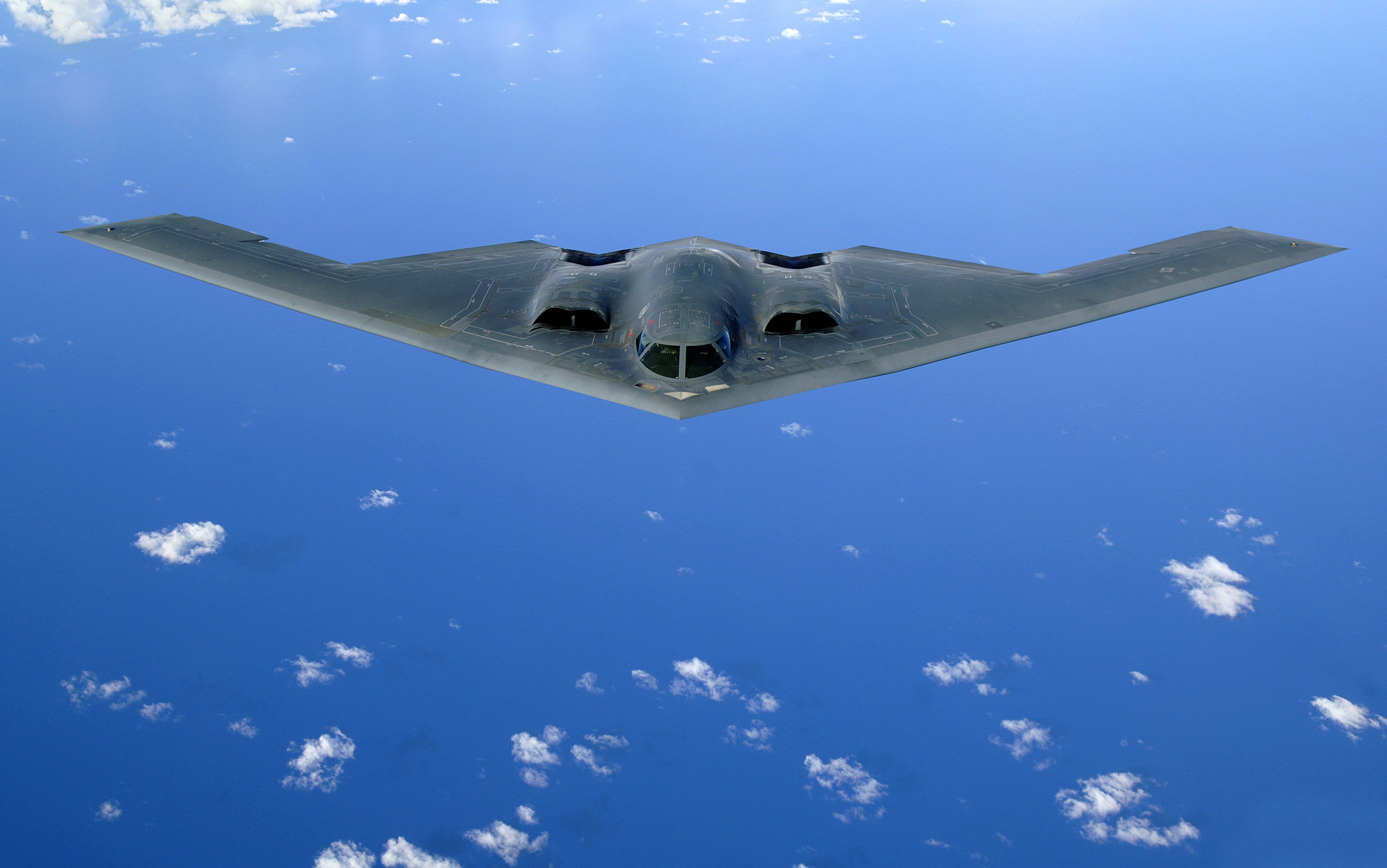
The company's Aeronautics Systems division (29% of 2024 revenues) develops the B-21 Raider strategic bomber that can drop conventional and thermonuclear weapons (forecasted to be ready for combat in 2029), the B-2 Spirit strategic bomber (which will be replaced by the B-21), fuselage and radar production for the Lockheed Martin F-35 Lightning II Joint Strike Fighter and F/A-18 Super Hornet, Grumman E-2 Hawkeye airborne early warning and control, MQ-4C Triton unmanned aerial vehicle, and the NATO Alliance Ground Surveillance Force.[2] The company's defense systems division (19% of 2024 revenues) designs the modernization of the intercontinental ballistic missile system including the LGM-35 Sentinel, the Integrated Air and Missile Defense Battle Command System, Vinnell training, and the M1156 precision guidance kit.[2] The company's mission systems division (25% of 2024 revenues) creates military radar, sensors, and related products, including C4I radar systems for air defense, Airspace Management radar systems such as AWACS, Multi-Platform Radar Technology Insertion Program, night vision goggles, Airport Movement Area Safety System, and battlefield surveillance systems like the Airborne Reconnaissance Low (ARL). Tactical aircraft sensors include the AN/APG-68 radar, the AN/APG-80 Active electronically scanned array radar, and the AN/APG-83 AESA radar upgrade for the F-16 Fighting Falcon, the AN/APG-77 AESA radar for the F-22 Raptor, and the AN/APG-81 AESA radar for the F-35 Lightning II, and the AN/AAQ-37 electro-optical Distributed Aperture System (DAS) for the F-35, and the APQ-164 Passive Electronically Scanned Array (PESA) radar for the B-1 Lancer.[2] The company's space systems division (27% of 2024 revenues) develops Satcom communications satellites, Next-Generation Overhead Persistent Infrared satellites, the Cygnus uncrewed spacecraft, motors for the NASA Space Launch System, logistics support for the Lunar Gateway, Graphite-Epoxy Motor solid rocket boosters, and satellites for the Norwegian Space Agency.[2]
The company is ranked 110th on the Fortune 500 list of America's largest corporations.[6] In 2024, 87% of the company's revenues came from the federal government of the United States, while 12% was from international sources.[2]
Northrop Grumman and its industry partners have won the Collier Trophy nine times, including for the development and production of the James Webb Space Telescope, a space telescope launched in 2021.[2]
The company was formed in 1994 through the merger of Northrop Corporation and Grumman Aerospace.
History
[edit]
Northrop Grumman can trace its lineage back to the beginning of the 20th century when the Grumman Corporation was founded on Long Island, New York. Here, Leroy R. Grumman established the Grumman Aircraft Engineering Corporation in December 1929.[8] By 1939, the company has expanded and relocated to Bethpage, New York.[8] Among Grumman's well known naval aviation products was the F-14 Tomcat.[9] During World War II the company built most US Navy aircraft, including the TBF Avenger,[10] F4F Wildcat,[11] and F6F Hellcat.[12] After the war it branched out into making the first aluminum canoes using left-over materials no longer needed for aircraft. Later the firm created a myriad of products such as ballistic missiles, all-weather radars, the Apollo Lunar Module, land and sea-based fighter aircraft and Stealth bombers.[13]

Founded in California in 1939 by Jack Northrop, the Northrop Corporation was reincorporated in Delaware in 1985.[14] Northrop made a series of light-weight fighter aircraft such as the F-5, YF-17, and F-20. However, Northrop was best known for its experimental flying wing aircraft, the XB-35 and YB-49 of the late 1940s and early 1950s. These flying wing aircraft, while unsuccessful, would pave the way for the B-2 Spirit Stealth Bomber, on which Northrop was the prime contractor.[15][16] During World War II, Northrop made the P-61 Black Widow, the first aircraft designed as a night fighter.[17] After the end of the Cold War, Northrop made a series of acquisitions, buying Grumman Aerospace, Westinghouse and TRW Inc. in addition to a number of other enterprises.[13][18]
In 2018, Northrop Grumman completed the purchase of Orbital ATK, which was renamed to Northrop Grumman Innovation Systems.[19] Innovation Systems was integrated into other parts of the business in a reorganization the following year.[20]
1990s
[edit]In 1994, Northrop Aircraft bought Grumman Aerospace, which built the Apollo Lunar Module[21] to create Northrop Grumman (NG) at a cost of $2.1 billion.[22] After 1994, Northrop Grumman made several major acquisitions, including Vought,[23] Logicon,[24] Xetron Corporation,[25] the defense electronics business of Westinghouse Electronic Systems,[26] and Ryan Aeronautical.[27]
Northrop has competed in the Advanced Tactical Fighter program, submitting the YF-23 to compete against the F-22 Raptor in 1991.[28]
Northrop partnered with Lockheed on the F-35 and serves as a principal member of the Lockheed Martin industry led team.[29]

In 1998, a merger between Northrop Grumman and competitor Lockheed Martin was considered but abandoned after resistance from the Department of Defense and Department of Justice.[30] That same year, it acquired Inter-National Research Institute Inc. In 1999, the company acquired Teledyne Ryan, developer of surveillance systems and unmanned aircraft, California Microwave, Inc., and the Data Procurement Corporation.[31][32][33] In 1999, Northrop Grumman and SAIC created AMSEC LLC as a joint venture, which grew "from $100 million in revenue in 2000 to approximately $500 million in fiscal year 2007."[34]
2000s
[edit]In 2000, NG acquired Federal Data Corporation, Navia Aviation As, Comptek Research, Inc., and Sterling Software, Inc.[35]
In 2001, the company acquired Litton Industries, a shipbuilder and defense electronics systems provider for the U.S. Navy.[36] During the acquisition process, a new Delaware holding company, NNG, Inc., was formed, which merged with Northrop Grumman through a one-for-one common shares exchange in April 2001. Both Northrop Grumman and Litton became subsidiaries of the new holding company. The original Northrop Grumman Corporation then changed its name to "Northrop Grumman Systems Corporation"; the holding company, NNG, Inc., changed its name to "Northrop Grumman Corporation". Later that year, Northrop Grumman acquired Newport News Shipbuilding.[37]
In 2002, Northrop Grumman acquired TRW Inc.[38] Northrop incorporated TRW's space and laser capabilities and system manufacturing infrastructure into its newly created Space Technology sector based in Redondo Beach, California (Space Park[39]), and the Mission Systems sector based in Reston, Virginia.[40]

In July 2003, the company received a $48 million contract to train the Iraqi Army.[41]
In August 2005, the United Kingdom paid $1.2 billion in a contract with the company to provide maintenance of its AWACS radar.[42]
In November 2005, the company won a $2 billion contract with Virginia to overhaul most of the state's IT operations.[43]
On January 1, 2006, Northrop Grumman opened its business sector called 'Technical Services'.[44] Northrop Grumman and Boeing collaborated on a design concept for NASA's upcoming Orion spacecraft (previously the Crew Exploration Vehicle), but the contract went to rival Lockheed Martin on August 31, 2006.[45]

In 2006, Northrop Grumman had intended to bid for the U.S. Air Force's Next-Generation Bomber. Though it has not built a large manned aircraft since wrapping up B-2 Spirit production in the 1990s, the company has "been working hard to turn that perception around, with the skills and capabilities that back it up."[46] However, by 2009, the teams working on that project were dispersed, as USAF's focus turned to a long-range strike instead. Northrop Grumman was one of two teams competing for the Long Range Strike Bomber, and in October 2015 won that contract.[47][48]

On July 20, 2007, Northrop Grumman became the sole owner of Burt Rutan's Scaled Composites.[49]
In 2007, Northrop Grumman created 'National Workforce Centers' as an alternative to offshoring.[50] Locations are Auburn, Alabama; Corsicana, Texas; Fairmont, West Virginia; Helena, Montana; Johnstown, Pennsylvania; and Lebanon, Virginia. The Rapid City, South Dakota location closed in January 2012.[51]
In August 2007, Northrop Grumman acquired Scaled Composites in which it had previously owned a 40% stake.[52]
In June 2008, Northrop Grumman began working with DHS Systems LLC, manufacturer of the Deployable Rapid Assembly Shelter (DRASH) in New York, as part of the U.S. Army's Standard Integrated Command Post System program.[53]
In July 2008, three of four Northrop Grumman employees (Thomas Howes, Marc Gonsalves and Keith Stansell) were freed during Operation Jaque after five years of captivity following their 2003 aircraft crash in the Colombian jungle.[54] The fourth employee, Tom Janis, had been killed by the FARC shortly after the crash.[55]

2010s
[edit]In March 2011, Northrop Grumman spun off its Shipbuilding unit as Huntington Ingalls Industries.[56]
In July 2013, Northrop Grumman won a training-simulation contract potentially worth $490 million to support the U.S. Air Force's next-generation aerial warfare virtual-training network.[57]
In 2015, Northrop Grumman won a contract for the DARPA Tactically Exploited Reconnaissance Node (TERN) program.[58]
In March 2015, the company delivered the first shipset for Australian EA-18G Growler.[59]
In October 2015, the US Military awarded Northrop Grumman the contract for the successor to the B-1 and B-52, subsequently identified as the B-21. The initial value is $21.4 billion, and could eventually be worth up to $80 billion.[60]
In September 2017, Northrop announced the acquisition of missile and rocket manufacturer Orbital ATK Inc for $9.2 billion: $7.8 billion in cash plus $1.4 billion in net debt.[61] On November 29, 2017, the acquisition was approved by Orbital ATK stockholders[62] and on June 6, 2018, the merger closed after final FTC approval. The acquired company assets and naming were absorbed and become a division named Northrop Grumman Innovation Systems.[63]
In January 2018, Northrop Grumman became the primary contractor for the James Webb Space Telescope.[64][65]
On June 7, 2018, the acquisition of Orbital ATK was completed, and it was absorbed in Northrop Grumman as a new business sector called Northrop Grumman Innovation Systems.[66][67]
2020s
[edit]Effective January 1, 2020, the NGIS division was split, with most of the sector merging with other Northrop Grumman businesses into a new Space Systems sector.[68][69]
In June 2020, NASA granted a $935 million contract to Northrop Grumman for the Lunar Gateway Habitation and Logistics Outpost (HALO) module, based on its Cygnus cargo spacecraft.[70] In July 2022, Northrop subcontracted Solstar to provide the wireless-enabling technology to enable a Wi-Fi access for employees and equipment in the module.[71][72]
In September 2020, Northrop ended development of the OmegA space launch vehicle, intended to carry the U.S. government's national security satellites into space.[73]
In September 2020, Northrop Grumman won a $298 million sole-source contract for the Evolved Strategic Satcom program, an anti-jam communications satellite program intended to replace the Advanced Extremely High Frequency (AEHF) satellite program where Northrop Grumman was a subcontractor to Lockheed Martin.[74][75]
In February 2021, Northrop sold its federal IT and mission support business to Veritas Capital for $3.4 billion.[76][77]
In March 2021, NASA awarded Northrop Grumman the contract to develop the Mars Ascent Propulsion System for a Mars sample-return mission.[78] Northrop designed a solid-fueled rocket to launch samples collected by the Perseverance rover from Mars to Earth.[79]

.jpg)
In August 2022, Northrop Grumman announced it was moving production of the engines and structures for its Antares rockets to the U.S. from Russia and Ukraine in partnership with Texas-based Firefly Aerospace.[80] Northrop Grumman and Firefly Aerospace are jointly producing an upgraded version of the Antares rocket, the Antares 330.[80]
Northrop Grumman's B-21 Raider entered test flights in 2023,[81] with the goal of delivering the first plane by the end of the decade.[82]
On September 15, 2023, Northrop Grumman was sanctioned by the Chinese government due to U.S. arms sales to Taiwan.[83]
In May 2024, Northrop Grumman unveiled the Manta Ray, an underwater drone developed for the Defense Advanced Projects Research Agency (DARPA). The drone, which resembles its namesake sea creature, was designed to carry out long-duration, long-range military missions, including extended loitering on the sea bottom.[84] The craft uses two four-bladed propellers on the wings to enhance the propulsion provided by its gliding system, which glides forward while moving up and down in the water column by changing its buoyancy.[85] With an emphasis on minimal human oversight, the creation of the Manta Ray represents a significant advancement in unmanned underwater vehicles (UUV) technology.[84]
In September 2024, Northrop Grumman won the U.S. Missile Defense Agency (MDA) competition to develop and build the Glide Phase Interceptor (GPI).[86] In 2025, the company secured a contract with the U.S. Space Force to test in-space satellite refueling technology Northrop developed.[87] Northrop Grumman is also constructing ground stations to support the Next-Generation Overhead Persistent Infrared program.[88] In May 2025, the company invested $50 million in space startup Firefly to support production of their "Eclipse" rocket.[89]
Remotec
[edit]Remotec, a Tennessee-based subsidiary, is a manufacturer of remote control vehicles for explosive ordnance disposal and hazardous material handling.[90] A UK-based subsidiary, Park Air Systems, provides VHF and UHF ground-to-air communications systems for the civil and defense markets. Northrop Grumman has also worked closely with Antenna Associates, Inc., a manufacturer of Identification friend or foe (IFF)/Secondary Surveillance Radar (SSR) antennas located in Massachusetts.[91]
Finances
[edit]| Year | Revenue in mil. US$ |
Operating income in mil. US$ |
Total assets in mil. US$ |
Employees |
|---|---|---|---|---|
| 2014[92] | 23,979 | 3,196 | 26,545 | 64,300 |
| 2015[92] | 23,526 | 3,076 | 24,424 | 65,000 |
| 2016[92] | 24,508 | 3,193 | 25,614 | 67,000 |
| 2017[92] | 25,803 | 3,299 | 34,917 | 70,000 |
| 2018[93] | 30,095 | 3,780 | 37,653 | 85,000 |
| 2019[94] | 33,841 | 3,969 | 41,089 | 90,000 |
| 2020[95] | 36,799 | 4,065 | 44,469 | 97,000 |
| 2021[95] | 35,667 | 5,651 | 42,579 | 88,000 |
| 2022[96] | 36,602 | 3,601 | 43,755 | 95,000 |
| 2023[97] | 39,290 | 2,537 | 46,544 | 101,000 |
| 2024[2] | 41,033 | 4,370 | 49,359 | 97,000 |
Corporate governance
[edit]From 1990 to 2003, before the merger with Grumman in 1994, Kent Kresa was the CEO of the company, who led the serial-acquisition strategy with a total of 15 additional acquisitions from 1994 to 2003, including Litton, Logicon, Westinghouse's defense electronics business, Ryan Aeronautical and Newport News Shipbuilding, and TRW. He then retired in 2003 at age 65.
In 2003 Ronald Sugar, the former chief operating officer, took over as CEO.[98] Effective October 1, 2003, Sugar also served as the company chairman of the board.[99]
In January 2010, Wes Bush succeeded as CEO and became company president.[100]
In November 2015, Gloria Flach was named COO. She is the former president of the company's electric services sector.[101]
On July 12, 2018, Wes Bush announced that he would step down as CEO effective January 1, 2019, and would remain chairman of the board until July 2019. His successor is Kathy J. Warden, who has served in numerous roles at the company, most recently president and COO.
Board of directors
[edit]As of July 22, 2022:[102]
- Kathy J. Warden, CEO and president of Northrop Grumman
- David Abney, former chairman and CEO of UPS
- Marianne C. Brown, COO of SunGard
- Donald E. Felsinger, former chairman and CEO of Sempra Energy
- Ann M. Fudge, former chairman and CEO of VMLY&R
- William Hernandez, former CFO of PPG
- Madeleine Kleiner, former general counsel of Hilton
- Karl Krapek, former president and COO of United Technologies
- Graham N. Robinson, president of Stanley Industrial, a business segment of Stanley Black & Decker
- Gary Roughead, former Chief of Naval Operations
- Thomas Schoewe, former CFO of Wal-Mart
- Jim Turley, former chairman and CEO of Ernst & Young
- Mark Welsh, former Chief of Staff of the United States Air Force
Corporate headquarters
[edit]Since 2011, Northrop Grumman's headquarters are in West Falls Church, Virginia (previously Jefferson), unincorporated Fairfax County, Virginia.[103][104]
Prior to 2010, the company was headquartered in Century City, Los Angeles,[105] but announced plans on January 4, 2010, to move to the Washington Metropolitan Area by 2011[106] to be closer to government customers.[107] CEO Wesley Bush stated that the company needed to be located close to Capitol Hill lawmakers and officials from intelligence and military communities.[108] Northrop Grumman considered sites in Washington, D.C., and in suburbs in Maryland and Virginia.[107] The Los Angeles Business Journal wrote "In a way, the announcement was not a surprise" due to the trend of aerospace companies moving to the DC area, the fact that the new CEO is from West Virginia and that CEOs often move corporate headquarters to places that they want the headquarters located. A Los Angeles area economic development consultant described the move announcement as a "structural failure at all levels for Los Angeles County."[108]
District of Columbia economic development officials were "pitching the city's urban hipness and proximity to Capitol Hill power brokers" to Northrop Grumman. Maryland promoted its highly educated workforce and its large number of federal facilities, while Virginia marketed itself as a state with relatively low taxes.[109]
In July 2010, the company announced its purchase of an existing building in Fairfax County and its move in summer 2011. It planned to consolidate its Century City headquarters and its existing Arlington County, Virginia, offices into the new headquarters. It employed about 40,000 in the Washington DC metropolitan area, including DC and surrounding Maryland and Virginia.[103]
Accolades and criticism
[edit]Northrop Grumman was named Forbes's Company of the Year in 2002.[98] Forbes's announcement credited the company with "master[ing] the art of innovation."[110] As of 2019, the company is included on Forbes' list of "America's Best Large Employers".[111]
Since 2005 Northrop Grumman credits itself with sponsoring educational programs[112] and donating thousands of dollars to various charities.[113][114]
Many members of the U.S. government have attended company events and spoken highly of the company and its contributions, for example John McCain.[115] In December 2007, Northrop Grumman Corporation was awarded the Ron Brown Award for Corporate Leadership, the only presidential award recognizing companies for outstanding achievement in employee and community relations.[116]
Environmental record
[edit]In 2000, Northrop Grumman was designated a Primary Responsible Party under federal Superfund laws at 13 hazardous waste sites and under state Superfund laws at eight sites.[117] The corporation has also been linked to 52 superfund toxic waste sites.[118] Based on 2008 data, Northrop Grumman was the 62nd-largest corporate producer of air pollution in the United States, per the Political Economy Research Institute of the University of Massachusetts Amherst. Northrop Grumman facilities released more than 23,798 pounds of toxic chemicals into the air in that year.[119]
In 2002, the Bethpage Community Park in Bethpage, New York, owned by the company until the 1960s, was closed due to soil contamination with polychlorinated biphenyls (PCBs).[120] The company dumped cadmium, arsenic, chromium-tainted sludge, solvents, paints and PCBs at the site between 1949 and 1962.[120] Additionally, two toxic chemical plumes centered under Bethpage Community Park and other surrounding land formerly owned by Grumman or Northrop Grumman have spread to under neighboring houses.[120] In November 2013, the Bethpage Water District filed a multimillion-dollar lawsuit against Northrop Grumman in Federal Court for the Eastern District of New York for contaminating the groundwater in Bethpage.[121][122]
In 2003, the company was among 84 parties with which the United States Environmental Protection Agency, the U.S. Department of Justice, and the state of New York reached an estimated US$15 million settlement for the rehabilitation of the Mattiace Petrochemical Company Superfund site in Glen Cove, Long Island.[123] In the same year, Northrop Grumman agreed to pay $33,214 after EPA inspectors found hazardous waste violations at the Capistrano test site.[124]
As a response to many of the previous claims, the company has stood up as an organization for social responsibility.[citation needed] In 2008, Northrop Grumman launched its Environmental Sustainability program and an EHS Leadership Council, to advance its commitment to environmental performance both internally and externally. The Greenhouse Gas Inventory Project was launched to accurately quantify company-wide greenhouse gas emissions and to reduce the carbon footprint of Northrop Grumman operations, in anticipation of upcoming regulations.[125]
In October 2010, the company was named one of Computerworld's Top 12 Green-IT Organizations for its large-scale data center migration effort.[126]
In 2019, Northrop Grumman was named the US's largest corporate contributor to water pollution by the Political Economy Research Institute of the University of Massachusetts Amherst.[127]
Political contributions and governmental ties
[edit] |
From 1990 to 2002, Northrop Grumman contributed $8.5 million to federal campaigns.[128] According to Political action committee (PAC) summary data compiled by Source Watch, the company gave US$1,011,260 to federal candidates in the 2005–2006 election cycle, compared to $10,612,837 given by all defense contractors in the same cycle.[129] This donation amount was only behind that of General Dynamics and Lockheed Martin in the defense industry. The majority of the contributions, 63%, went to Republicans.[130] Former Northrop Grumman Electronics Systems chief James G. Roche served as Secretary of the Air Force for two years under George W. Bush. Roche would eventually be nominated to head the Army, but withdrew his nomination among accusations of mismanaging a contract with Boeing and for failing to properly handle the Air Force sexual assault scandals of 2003.[131] According to CorpWatch, "at least seven former officials, consultants, or shareholders of Northrop Grumman" have held posts "in the Bush administration...including Deputy Secretary of Defense Paul Wolfowitz, Vice-Presidential Chief of Staff I. Lewis Libby, Pentagon Comptroller Dov S. Zakheim, and Sean O'Keefe, director of NASA." Wolfowitz and Libby have both since left the government amid scandals.[132]
The company engages third-party lobbying firms in jurisdictions where it has interests. For example, in South Australia it works with lobbying firm CMAX Communications.[133]
Controversies
[edit]In the late 1980s and early 1990s, Northrop was the target of several high-profile criminal and civil cases.[134]
In 1995, Robert Ferro, an employee for TRW Inc., a company Northrop Grumman acquired in 2002, discovered that satellite components manufactured for the U.S. Air Force (USAF) were faulty and likely to fail in operation. TRW suppressed Ferro's report of the problem and hid the information from the USAF, even after a satellite in space equipped with the faulty components experienced serious anomalies. Ferro later sued Northrop Grumman in federal court under the federal whistle-blower law.[135]
In 1999, the company was sued for knowingly giving the Navy defective aircraft. This suit sought $210 million in damages.[136] Ten years later, on April 2, 2009, Northrop Grumman agreed to pay $325 million to settle the suit.[137] Ferro was awarded $48.8 million of the settlement. Northrop Grumman stated, "it believed that TRW had 'acted properly under its contracts' and that the company had substantive defenses against the claims."[138]
In 2001, federal investigators probed NG for fraud of more than $100 million, systematic overcharging for radar jammers and other high-tech devices used in the B-1 bomber, the F-15 fighter and the B-2 Stealth bomber.[139] In 2003, the company was sued for overcharging the U.S. government for space projects in the 1990s.[140] Northrop Grumman paid $111.2 million to settle out of court.[141]
From August 25 to September 2, 2010, Virginia's computer system operated by NG, under a $2.4 billion contract, experienced an outage which resulted in around 45,000 citizens not being able to renew their drivers licenses prior to their expiration. Computer systems for 26 of the state's 89 agencies were affected and Governor Bob McDonnell announced that some data may have been permanently lost.[142][143] In 2010 Northrop Grumman apologized for the outage, and agreed to fund an investigation.
In 2012, controversy began over Northrop Grumman's Integrated Air and Missile Defense Battle Command System (IBCS), when it missed its first deadline. Since then, the system has had a number of controversial developments.[144] In 2016, a Director, Operational Test and Evaluation found a number of major faults with the system, concluding it was "neither mature nor stable".[145]
Northrop Grumman's supply of weapons to Israel led to protests against the company during the Gaza war, including blocking the entrances at facilities in San Diego and Plymouth, Minnesota.[146][147][148][149] Students on hunger strike at Brown University named Northrop Grumman as a company to divest from.[150]
International Traffic in Arms Regulations (ITAR) violations
[edit]U.S. State Department investigators found that Litton Industries, a subsidiary acquired by Northrop Grumman in 2000, had provided portions of source code used by guidance and navigation system interfaces aboard Air Force One to a company in Russia in 1998. Northrop Grumman agreed to pay a $15 million fine for 110 violations, occurring between September 1998 and November 1998, of the Arms Export Control Act and the International Traffic in Arms Regulations (ITAR).[151]
Additionally, documents filed by the State Department state that between 1994 and 2003, Northrop Grumman failed to notify the U.S. State Department about the computer guidance systems also being transferred to Angola, Indonesia, Israel, China, Ukraine and Yemen.[152]
See also
[edit]- IMETS
- Northrop Grumman RQ-180 Unmanned Aircraft System
- Top 100 contractors of the U.S. federal government – $30.1 billion in FY2018[93]
- Northrop Grumman M-ACE
References
[edit]- ^ Rosenbaum, Eric (February 24, 2025). "CNBC Changemakers: Kathy Warden". CNBC. Retrieved July 1, 2025.
- ^ a b c d e f g h "Northrop Grumman Corporation 2024 Annual Report (Form 10-K)". U.S. Securities and Exchange Commission. January 30, 2025.
- ^ "Top 100 | Defense News, News about defense programs, business, and technology". people.defensenews.com.
- ^ SIPRI Top 100 Arms-Producing and Military Services Companies SIPRI. Retrieved December 18, 2019.
- ^ "Northrop Grumman Rises 10 Spots on DiversityInc's 2011 Top 50 Companies for Diversity List (NYSE:NOC)". Irconnect.com. March 10, 2011. Retrieved July 25, 2012.
- ^ "Northrop Grumman". Fortune.
- ^ Parker 2013, pp. 93–94.
- ^ a b Society, American Astronautical (2010). Space Exploration and Humanity: A Historical Encyclopedia [2 volumes]: A Historical Encyclopedia. Westport, CT: Greenwood Publishing Group. p. 501. ISBN 978-1-85109-519-3.
- ^ Madore, James T. (June 7, 2022). "F-14 Tomcat to be moved from Bethpage to Uniondale museum". Newsday. Retrieved June 24, 2025.
- ^ Polmar, Norman (September 20, 2005). "The Deadly Avenger". U.S. Naval Institute. Retrieved June 24, 2025.
- ^ Dwyer, Larry (February 19, 2014). "Grumman F4F Wildcat". The Aviation History Online Museum. Retrieved June 24, 2025.
- ^ Lazarus, Allan M. (July 1989). "The Hellcat-Zero Myth". U.S. Naval Institute. Retrieved June 24, 2025.
- ^ a b "Our Heritage". Archived from the original on February 23, 2013. Retrieved February 10, 2019.
- ^ Parker 2013, pp. 25, 93.
- ^ Sweetman, Bill (1999). Inside the Stealth Bomber. Osceola, Wi, USA: MBI Publishing Company. pp. 19–33. ISBN 0-7603-0627-3.
- ^ Coleman, Ted (1988). Jack Northrop and the Flying Wing. New York, NY: Paragon House Publishing. pp. 228–242. ISBN 1-55778-079-X.
- ^ Lee, Russell (May 26, 2023). "Northrop P-61 Black Widow: First American Airplane Designed and Built to Fight at Night, Part II". National Air and Space Museum. Retrieved June 24, 2025.
- ^ "U.S. Naval Aircraft Marking." Archived 15 November 2010 at the Wayback Machine U.S. Naval Historical Center. Retrieved 11 March 2008.
- ^ Erwin, Sandra (June 6, 2018). "Acquisition of Orbital ATK approved, company renamed Northrop Grumman Innovation Systems". SpaceNews. Retrieved July 13, 2025.
- ^ Kirkland, Rachel (September 25, 2019). "Northrop Grumman Announces Realigned Operating Sectors". Washington Exec. Retrieved July 13, 2025.
- ^ "Grumman Apollo Lunar Module Propulsion Reports and Photographs [Arons], Accession number 2005-0010". National Air and Space Museum, Smithsonian Institution. Archived from the original on January 27, 2020. Retrieved February 20, 2019.
- ^ Sims, Calvin (April 5, 1994). "Northrop bests Martin Marietta to buy Grumman". The New York Times. Retrieved February 20, 2019.
- ^ Peltz, James F. (July 13, 1994). "Northrop to Buy Rest of Vought". Los Angeles Times. Retrieved June 24, 2025.
- ^ Gilpin, Kenneth N. (May 6, 1997). "Northrop to Purchase Logicon in a $750 Million Stock Swap". The New York Times. Retrieved February 20, 2019.
- ^ McLaughlin, Jenna (March 30, 2017). "Meet the Midwestern Contractor That Appears Hundreds of Times in the CIA WikiLeaks Dump". The Intercept. Retrieved June 24, 2025.
- ^ Gilpin, Kenneth N. (January 4, 1996). "2 Westinghouse Industrial Units Sold to Northrop for $3 Billion". The New York Times. Retrieved February 20, 2019.
- ^ "Northrop Grumman completes acquisition of Ryan Aeronautical". Aviation Week. July 21, 1999. Retrieved June 24, 2025.
- ^ Majumdar, Dave (April 18, 2018). "The Story of the F-23 Fighter: The Plane That Would Have Replaced the F-22". The National Interest. Retrieved February 11, 2019.
- ^ "Lockheed, Northrop to Establish F-35 Assembly Line in Germany". Assembly Magazine. March 1, 2023.
- ^ Becker, David G.; Sklar, Richard L. (January 1, 1999). Postimperialism and World Politics. Greenwood Publishing Group. p. 92. ISBN 9780275966133.
Having lost the battle with Raytheon, Northrop Grumman agreed in late 1997 to be acquired by Lockheed Martin for $11.6 billion. The deal was abandoned by Lockheed in July 1998 when it became apparent that the Department of Justice and the Department of Defense were determined to prevent the merger, which would have given Lockheed a monopolistic position in key defense technologies.
- ^ Gara, Antoine (June 29, 2017). "M&A Flashback: Northrop's Takeover of Grumman Led Defense Stocks Out Of The Cold War". Forbes. Retrieved February 20, 2019.
- ^ Schneider, Greg (March 12, 1999). "Northrop builds 'empire'; Company to purchase defense units from California Microwave". Baltimore Sun. Retrieved February 20, 2019.
- ^ Johnston, Margret (May 30, 1999). "Northrop to merge DPC into Logicon". FCW. Archived from the original on February 9, 2020. Retrieved February 20, 2019.
- ^ Hubler, David (July 16, 2007). "SAIC, Northrop divvy up Amsec". Washington Technology. Retrieved February 20, 2019.
- ^ "Mergers And Acquisitions". The Washington Post. February 20, 2003. Retrieved February 20, 2019.
- ^ Schneider, Greg (April 4, 2001). "Northrop Completes Purchase of Litton". The Washington Post. Retrieved February 20, 2019.
- ^ Merle, Renae (November 9, 2001). "Northrop Seals Deal to Buy Newport News". The Washington Post. Retrieved February 20, 2019.
- ^ Wayne, Leslie (July 2, 2002). "Northrop to Buy TRW for $7.8 Billion". The New York Times. Retrieved February 20, 2019.
- ^ Hennigan, W. J. (December 14, 2011). "Space Park in Redondo Beach will get the star treatment". Los Angeles Times. Retrieved June 24, 2025.
- ^ Wait, Patience (December 13, 2002). "Northrop Grumman creates two new sectors out of TRW, names leaders". Washington Technology. Retrieved February 20, 2019.
- ^ "$48 Million To Train Iraqi Army". Defense News. July 7, 2003.[dead link]
- ^ "Britain Issues $1.2B E-3D AWACS Support Contract". Defense Industry Daily. August 16, 2005. Archived from the original on April 4, 2006.
- ^ McDougall, Paul (November 15, 2005). "Virginia Taps Northrop Grumman for $2 Billion IT Overhaul". Information Week. Archived from the original on February 2, 2017.
- ^ "Northrop Grumman Creates Support Unit". Los Angeles Times. January 6, 2006. Retrieved February 20, 2019.
- ^ Borenstein, Seth (September 1, 2006). "Lockheed MArtin Wins NASA Contract". The Associated Press. Retrieved February 20, 2019.
- ^ Christie, R. "Northrop Grumman Hopes for Big Role in DoD Bomber Plan." The Wall Street Journal. July 10, 2006.
- ^ Brendan McGarry (n.d.). "Air Force Delays New Bomber Contract by 'Couple of Months'". DOD Buzz. Archived from the original on October 2, 2015. Retrieved September 29, 2015.
- ^ Cohen, Zachary (October 27, 2015). "Pentagon awards Northrop Grumman stealth bomber contract - CNNPolitics". CNN. Retrieved July 29, 2018.
- ^ "Northrop Grumman Buys Builder of SpaceShipOne". SPACE.com. July 20, 2007. Retrieved July 25, 2012.
- ^ "Northrop Grumman's National Work Force Center Initiative". Archived from the original on January 3, 2011. Retrieved April 22, 2009.
- ^ "Rapid City". Keloland.com. December 6, 2011. Archived from the original on May 17, 2013. Retrieved July 25, 2012.
- ^ "Northrop Grumman Corporation". National Info. Archived from the original on September 13, 2016. Retrieved August 29, 2016.
- ^ "NG, DHS Technologies to support SICPS/TMSS." United Press International, June 18, 2008.
- ^ "Betancourt, U.S. contractors rescued from FARC". CNN. July 3, 2008. Retrieved June 24, 2025.
- ^ Kraul, Chris (September 24, 2008). "Slain U.S. pilot may be honored". Los Angeles Times. Retrieved June 24, 2025.
- ^ Jacobs, Karen (March 31, 2011). "Northrop ship spin-off expects flat sales". Reuters. Retrieved June 24, 2025.
- ^ Military.com (July 4, 2013). "Northrop Fends Off Lockheed to Win Big AF Contract". Military.com.
- ^ Trimble, Stephen (December 28, 2015). "Northrop Grumman wins DARPA TERN programme". Flight Global. Retrieved June 24, 2025.
- ^ Tomkins, Richard. "Northrop Grumman delivers first shipset for Australian Growler" UPI, March 26, 2015.
- ^ Cooper, Helene (October 27, 2015). "Northrop Grumman Wins $21.4 Billion Pentagon Contract". The New York Times. ISSN 0362-4331. Retrieved October 28, 2015.
- ^ Michael Bruno (September 18, 2017). "Northrop To Buy Orbital For More Than $9B". Aviation Week & Space Technology.
- ^ "Orbital Stockholders Approve Acquisition By Northrop Grumman Corporation". Reuters. November 29, 2017. Retrieved November 29, 2017.
- ^ Insinna, Valerie (January 29, 2018). "Northrop Grumman to create new 'innovation' business sector". Defense News. Retrieved February 20, 2019.
- ^ Kremer, Ken (July 26, 2014). "James Webb Space Telescope's Giant Sunshield Test Unit Unfurled First Time". Universe Today.
- ^ "The James Webb Space Telescope finally takes shape - SpaceNews.com". SpaceNews.com. January 31, 2018.
- ^ Clark, Stephen (June 7, 2018). "Northrop Grumman completes Orbital ATK acquisition". Spaceflightnow.com.
- ^ Erwin, Sandra (June 5, 2018). "Acquisition of Orbital ATK approved, company renamed Northrop Grumman Innovation Systems". Spacenews.com. Archived from the original on March 1, 2019.
- ^ "Northrop launches new divisions focused on space, cyber, unmanned tech". September 20, 2019. Archived from the original on September 23, 2019. Retrieved April 17, 2020.
- ^ "Northrop Grumman Announces Realigned Operating Sectors". Washington Exec. September 25, 2019. Retrieved November 25, 2020.
- ^ Foust, Jeff (June 6, 2020). "NASA issues contract to Northrop Grumman for Gateway module". SpaceNews. Retrieved January 4, 2023.
- ^ Werner, Debra (July 18, 2022). "Northrop Grumman taps Solstar for HALO Module Wi-Fi". SpaceNews. Retrieved January 4, 2023.
- ^ "NM firm builds Wi-Fi 'hotspot' for NASA moon station". news.yahoo.com. August 3, 2022. Retrieved January 4, 2023.
- ^ Erwin, Sandra (September 9, 2020). "Northrop Grumman to terminate OmegA rocket program". SpaceNews.
- ^ "Northrop Grumman wins $298 million contract to develop jam-resistant military satellite". SpaceNews. September 16, 2020. Retrieved September 21, 2020.
- ^ "U.S. Space Command to begin testing the last satellite of the AEHF-MILSTAR constellation". SpaceNews. September 16, 2020. Retrieved September 21, 2020.
- ^ Lake, Sidney (February 1, 2021). "Peraton closes on $3.4B cash purchase of Northrop Grumman biz". Virginia Business.
- ^ Insinna, Valerie (December 8, 2020). "Northrop sells IT business to Veritas Capital for $3.4B". Defense News.
- ^ Rivers, Brenda Marie (March 5, 2021). "Northrop to Supply Propulsion for Mars Sample Collection Effort Under $85M NASA Contract". GovCon Wire. Retrieved June 24, 2025.
- ^ "Mars Ascent Vehicle from Northrop Grumman takes shape for Mars Sample Return mission". NASA Spaceflight. June 4, 2021. Retrieved June 4, 2021.
- ^ a b Sheetz, Michael (August 9, 2022). "Northrop Grumman moves Antares rocket work to U.S. from Russia and Ukraine with Firefly partnership". CNBC. Retrieved August 10, 2022.
- ^ Copp, Tara (November 10, 2023). "Nuclear stealth bomber, the B-21 Raider, takes first test flight". Defense News. Retrieved May 2, 2024.
- ^ Novelly, Thomas (September 20, 2024). "Air Force's B-21 Raider Making More Test Flights as Service Eyes 2 New Basing Locations". Military.com. Retrieved June 24, 2025.
- ^ Cash, Joe; Lee, Liz (September 15, 2023). "China sanctions Northrop Grumman, Lockheed Martin for arms sales to Taiwan". Reuters. Retrieved January 2, 2025.
- ^ a b "The Pentagon Created a New Kind of Underwater Predator: The Mysterious Manta Ray". Popular Mechanics. April 11, 2024. Retrieved May 8, 2024.
- ^ Szondy, David (June 14, 2024). "First look at DARPA's massive Manta Ray drone in action". New Atlas. Retrieved June 14, 2024.
- ^ "Northrop selected to develop anti-hypersonic Glide Phase Interceptor". September 25, 2024.
- ^ Erwin, Sandra (March 31, 2025). "Space Force to test satellite refueling technologies in orbit". SpaceNews. Retrieved June 24, 2025.
- ^ Domingo, Juster (May 6, 2025). "Northrop Grumman to Build New US Space Force Ground Stations". The Defense Post. Retrieved June 24, 2025.
- ^ "Northrop Grumman invests $50 million in space startup Firefly Aerospace". Reuters. May 29, 2025. Retrieved July 5, 2025.
- ^ Kenen, Isaiah L. (2002). Near East Report. Near East Report, Incorporated. p. 10.
- ^ "Providing innovative solutions". Antenna Associates. Archived from the original on September 1, 2016. Retrieved August 29, 2016.
- ^ a b c d "2017 Annual Report" (PDF). Northrop Grumman. Archived from the original (PDF) on December 22, 2018. Retrieved July 22, 2022.
- ^ a b "Northrop Grumman Reports Fourth Quarter and Full-Year 2018 Financial Results" (Press release). Northrop Grumman. January 31, 2019. Retrieved July 22, 2022.
- ^ "Northrop Grumman 2019 Annual Report". U.S. Securities and Exchange Commission. January 30, 2020.
- ^ a b "Northrop Grumman Corporation 2021 Annual Report (Form 10-K)". U.S. Securities and Exchange Commission. January 27, 2022.
- ^ "Northrop Grumman Corporation 2022 Annual Report (Form 10-K)". U.S. Securities and Exchange Commission. January 26, 2023.
- ^ "Northrop Grumman Corporation 2023 Annual Report (Form 10-K)". U.S. Securities and Exchange Commission. January 25, 2024.
- ^ a b Lubove, Seth (January 6, 2003). "Company of the Year: Northrop—We See You, Saddam". Forbes. Archived from the original on February 24, 2003. Retrieved August 24, 2011.
- ^ "Northrop Grumman Elects Ronald D. Sugar Chairman of the Board" (Press release). September 17, 2003. Retrieved December 10, 2015.
- ^ "Northrop's Sugar to Retire; Wesley Bush Named Chief (Update2)". Bloomberg. September 16, 2009. Archived from the original on October 17, 2015.
- ^ Cameron, Doug. "Northrop Grumman Realigns Sectors, Restores COO Post". Wall Street Journal. ISSN 0099-9660. Retrieved November 9, 2015.
- ^ "Company Leadership". Northrop Grumman. Retrieved July 22, 2022.
- ^ a b "Northrop Grumman Selects Falls Church Location for New Corporate Office (NYSE:NOC) Archived December 8, 2011, at the Wayback Machine." Northrop Grumman. July 12, 2010. Retrieved: September 6, 2011. "[...]2980 Fairview Park Drive, Falls Church, Va.[...]"
- ^ "Contact Us". Northrop Grumman. Retrieved October 15, 2025.
Global Headquarters Northrop Grumman Corporation 2980 Fairview Park Drive Falls Church, VA 22042
- Even though the postal address says "Falls Church, VA", the place is physically in the West Falls Church, Virginia census-designated place in Fairfax County. See map here. - ^ "Company Locations Archived January 20, 2013, at the Wayback Machine." Northrop Grumman. Retrieved May 12, 2009.
- ^ "The Ticker." The Washington Post, January 4, 2010. Retrieved January 4, 2010.
- ^ a b Crowe, Deborah. "Northrop to Move Corporate Office to D.C.[dead link]." Los Angeles Business Journal. January 4, 2010. Retrieved January 10, 2010.
- ^ a b Proctor, Charles. "Northrop Flew Under the Radar." Los Angeles Business Journal. January 11, 2010. Retrieved: January 10, 2010.(subscription required)
- ^ Haynes, V. Dion. "D.C. area jurisdictions vie to become the new home of Northrop Grumman headquarters." Washington Post, January 11, 2010. Retrieved: February 13, 2010.
- ^ "Forbes Names Northrop Grumman Company of the Year". Forbes. December 19, 2002. Archived from the original on April 16, 2004. Retrieved April 4, 2006.
- ^ "America's Best Employers". Forbes. Retrieved July 1, 2019.
- ^ Northrop Grumman (March 20, 2006). Northrop Grumman Becomes Co-pilot for NASA's Great Moonbuggy Race. Press release.
- ^ Northrop Grumman (March 31, 2006). Northrop Grumman Makes $25,000 Donation to Boys and Girls Club of Annapolis and Anne Arundel County. Press release.
- ^ "Northrop Grumman Employees Charity Organization". Reading to Kids. 2005. Retrieved April 4, 2006.
- ^ "Photo Release -- Sen. John McCain Thanks Northrop Grumman Shipbuilders at Commissioning of Aegis Destroyer Halsey (DDG 97)." Northrop Grumman press release, August 1, 2005.
- ^ "The Ron Brown Award for Corporate Leadership". www.ron-brown-award.org. Archived from the original on November 24, 2007.
- ^ Security and Exchange Commission (July 24, 2000). "Northrop Grumman Corp. announces restatement". SEC.gov.
- ^ "Center for Public Integrity analysis of EPA documents". Publicintegrity.org. Archived from the original on October 22, 2007. Retrieved July 25, 2012.
- ^ "Political Economy Research Institute". Peri.umass.edu. Archived from the original on July 25, 2012. Retrieved July 25, 2012.
- ^ a b c Dooley, Emily (April 1, 2013). "State to treat pollution plume in Bethpage". Newsday. Retrieved April 7, 2014.
- ^ Dooley, Emily (November 18, 2013). "Bethpage Water District to sue Northrop Grumman over contamination". Newsday. Retrieved April 7, 2014.
- ^ Gil de Rubio, Dave (April 30, 2022). "Bethpage Water District To Receive Plume Settlement". Farmingdale Observer. Retrieved June 21, 2022.
The settlement will have the [Bethpage Water District] receiving $20 million from the United States government and $29 million from Northrop Grumman to treat chemicals that leaked from the Naval Weapons Reserve Plant in Bethpage and the former Grumman site, removing financial burdens from taxpayers for this expensive treatment process.
- ^ "Environmental Protection Agency". Yosemite.epa.gov. June 19, 2003. Archived from the original on August 5, 2012. Retrieved July 25, 2012.
- ^ "Environmental Protection Agency". Yosemite.epa.gov. Archived from the original on August 5, 2012. Retrieved July 25, 2012.
- ^ "Corporate social responsibility" (PDF). Archived from the original on September 28, 2011. Retrieved September 28, 2011.
{{cite web}}: CS1 maint: bot: original URL status unknown (link) - ^ "The Top Green-IT Organizations: Green from the ground up". Computerworld. October 25, 2010. Retrieved July 25, 2012.
- ^ "PERI: Toxic 100 Index". grconnect.com. Retrieved May 17, 2022.
- ^ Northrop Grumman Archived November 21, 2017, at the Wayback Machine. CorpWatch.org
- ^ "Defense PAC Contributions". Opensecrets.org. June 4, 2007. Archived from the original on November 18, 2007. Retrieved July 25, 2012.
- ^ "Northrop PAC Contribution". Opensecrets.org. Archived from the original on October 16, 2007. Retrieved July 25, 2012.
- ^ Schrader, Esther (March 11, 2004). "Roche Bails Out as Pick for Top Army Job". Los Angeles Times.
- ^ "Company Profile: Northrop Grumman." Archived January 19, 2018, at the Wayback Machine Corpwatch. Retrieved: December 6, 2014.
- ^ "South Australian Register of Lobbyists - CMAX Communications" (PDF). April 9, 2018. Archived from the original (PDF) on May 11, 2018.
- ^ "US: Court Documents Unsealed in Northrop Grumman Case." Archived December 8, 2014, at the Wayback Machine CorpWatch, April 22, 2004. Retrieved: December 5, 2014.
- ^ Drew, Christopher (April 2, 2009). "Military Contractor Agrees to Pay $325 Million to Settle Whistle-Blower Lawsuit". The New York Times. Retrieved August 29, 2016.
- ^ Flynn, Michael (2004). "Northrop Grumman". Right Web Profiles. Archived from the original on February 23, 2006. Retrieved April 4, 2006.
- ^ "Scientist blew whistle on faulty military satellite parts; Northrop Grumman pays $325 million to settle case." Phillips & Cohen LLP Press Release, April 2, 2009.
- ^ Drew, Christopher. "Military Contractor Agrees To Pay $325 Million To Settle Whistle-Blower Lawsuit." The New York Times, April 3, 2009, p. B4.
- ^ Corfman, Thomas A. "Feds probe Northrop in defense fraud case." Chicago Tribune, August 30, 2001. Retrieved: December 5, 2014.
- ^ Merle, Renae (August 9, 2003). "Northrop Settles Billing Case: Shipbuilding Unit Allegedly Overbilled U.S. by $72 Million". The Washington Post. Archived from the original on March 9, 2012. Retrieved April 4, 2006.
- ^ "Northrop Grumman pays $111 million to settle qui tam case against recent acquisition, TRW." Phillips and Cohen Press Release, June 9, 2003.
- ^ Helderman, Rosalind; Anita Kumar (September 2, 2010). "Computer crash has tech world watching". The Washington Post. p. B1.
- ^ Kumar, Anita (September 2, 2010). "McDonnell: Some data may be lost as a result of computer outage". The Washington Post. Archived from the original on September 27, 2011. Retrieved September 3, 2010.
- ^ Kiley, Gregory T. (May 17, 2017). "Congress and the Administration Must Reassess Failing Missile Defense Programs". RealClearDefense.
- ^ Judson, Jen (February 6, 2017). "Army falls behind with new anti-missile command system". Defense News.[dead link]
- ^ "Israel war boosts Lockheed Martin, Northrup Grumman, other defense stocks". Fox Business. October 9, 2023.
- ^ "San Diegans join in global protests to end war in Gaza". KPBS. November 9, 2023.
- ^ "Protesters Are Targeting Defense Contractors That Bragged About Profits from Gaza". Vice. November 17, 2023.
- ^ Swanson, Stephen (February 8, 2024). "Pro-Palestinian activists protest outside Plymouth's Northrop Grumman - CBS Minnesota". www.cbsnews.com. Retrieved February 13, 2024.
- ^ Gabbatt, Adam (February 7, 2024). "Students on hunger strike call for Brown University to divest from pro-Israel companies". The Guardian. ISSN 0261-3077. Retrieved February 13, 2024.
- ^ "Consent Agreement, 2008: Northrop Grumman Corporation". U.S. Department of State, March 14, 2008. Archived October 10, 2009, at the Wayback Machine
- ^ Ryan, Jason. "Air Force One Guidance Systems Allegedly Sent to Russia." ABC News, April 18, 2008.
Bibliography
[edit]- Parker, Dana T. Building Victory: Aircraft Manufacturing in the Los Angeles Area in World War II. Cypress, California: Dana T. Parker Books, 2013. ISBN 978-0-9897906-0-4.
Further reading
[edit]External links
[edit]| External videos | |
|---|---|
 "Manta Ray, Making Waves in Autonomy", Northrop Grumman video "Manta Ray, Making Waves in Autonomy", Northrop Grumman video |
 Media related to Northrop Grumman at Wikimedia Commons
- Official website

- Business data for Northrop Grumman:
- Northrop Grumman Corporation – recipient profile on USAspending.gov
- "Patents owned by Northrop Grumman". US Patent & Trademark Office. Retrieved December 6, 2005.


| International | |
|---|---|
| National | |
| Other | |
Northrop Grumman
View on GrokipediaOverview
Corporate Profile and Mission
Northrop Grumman Corporation is an American aerospace and defense technology company headquartered in Falls Church, Virginia.[13] The firm employs approximately 97,000 personnel and generated trailing twelve-month sales of $40.9 billion as of September 30, 2025.[14] It operates across four primary business sectors—aeronautics systems, mission systems, space systems, and defense systems—focusing on the design, development, production, and sustainment of advanced military platforms, including aircraft, unmanned systems, missiles, and space technologies.[9] In fiscal year 2024, 87 percent of its revenue derived from U.S. federal government contracts, underscoring its central role in national security programs.[15] The company's mission centers on solving complex challenges in space, aeronautics, defense, and cyberspace to fulfill evolving customer requirements globally.[2] Northrop Grumman commits to enhancing global security and advancing human discovery by delivering pioneering solutions that transform concepts into operational capabilities.[1] Its values prioritize relentless innovation, curiosity, and dedication, enabling teams to tackle the most demanding technical problems through expertise in cyber-secure systems, autonomous technologies, and integrated mission solutions.[16] This approach positions the company as a key provider of strategic technologies, such as stealth bombers, missile defense systems, and space exploration payloads, primarily supporting defense and intelligence missions.[6]Strategic Focus and Market Position
Northrop Grumman maintains a strategic emphasis on developing advanced technologies in space, aeronautics, defense, and cyberspace to solve complex national security challenges for the United States and its allies.[1] The company's priorities include sustaining technological superiority through innovation, rigorous performance execution, and targeted capital investments that prioritize value creation, such as expanding manufacturing scale for accelerated development and cost-efficient production of critical components like solid rocket motors.[17][18] A core focus involves transitioning high-profile programs, including the B-21 Raider long-range strike bomber, while fostering industrial readiness and cross-sector collaboration to transform concepts into deployable systems.[19][20] In the global defense market, Northrop Grumman occupies a leading position among prime contractors, with primary revenue from U.S. government contracts, particularly the Department of Defense and intelligence agencies.[1] As of September 30, 2025, its funded backlog stood at $91.4 billion following $12.2 billion in third-quarter net awards, underscoring sustained demand for aeronautics, mission systems, and space capabilities.[21] Third-quarter sales reached $10.4 billion, up 4% from the prior year, driven by organic growth in key segments, though full-year 2025 sales guidance was refined to $41.7-41.9 billion due to award timing shifts.[22][23] The company's market strength is bolstered by elevated demand for missile defense and strategic platforms, enabling upward revisions to 2025 profit forecasts and positioning it for mid-single-digit organic sales growth in 2026, with operating margins targeted in the low- to mid-11% range.[24][23] Employing around 100,000 personnel, Northrop Grumman leverages its expertise in autonomous and networked systems to compete effectively against peers like Lockheed Martin and RTX, while pursuing international and commercial opportunities to diversify beyond core U.S. defense reliance.[1][25]History
Founding and Pre-Merger Developments
The Northrop Corporation originated from Northrop Aircraft, Inc., established in 1939 in Hawthorne, California, by aviation engineer Jack Northrop, who sought to advance his long-held vision of tailless "flying wing" designs that minimized drag and radar detectability through blended wing-body configurations.[26][27] Northrop's prior ventures, including a 1928 Avion Corporation absorbed into United Aircraft and a 1930s partnership with Douglas Aircraft, laid groundwork for these innovations, but the 1939 entity marked the focused pursuit of all-wing prototypes like the N-1M, which achieved its first flight in 1940.[27] During World War II, Northrop shifted to production demands, manufacturing components for other firms and developing the P-61 Black Widow, the U.S. military's first dedicated night fighter, with over 700 units produced by war's end, incorporating radar and heavy armament for intercept roles.[27] Postwar, the company revived flying wing concepts, securing Air Force contracts for the YB-35 and YB-49 bombers in the late 1940s, though program cancellations in 1949 due to technical challenges and competing jet designs strained finances, leading to Northrop's temporary focus on missiles and electronics.[27] Independently, the Grumman Aircraft Engineering Corporation was founded on December 5, 1929, in Valley Stream, New York, by Leroy R. Grumman and partners, initially as a repair shop for Navy aircraft before transitioning to design with the two-seat FF-1 biplane fighter, which secured a U.S. Navy contract in 1931 and entered service in 1933 as the first monoplane fighter for carrier operations.[27][28] Grumman's emphasis on rugged, retractable-gear naval aircraft propelled wartime expansion, producing approximately 18,000 F4F Wildcats, 12,000 F6F Hellcats, and 10,000 TBF Avengers, which proved instrumental in Pacific naval battles for their durability and combat effectiveness.[27] In the postwar era, Grumman diversified into jets like the F9F Panther and F11F Tiger, while venturing into space with the Lunar Excursion Module for Apollo missions, contracting in 1962 to build the vehicle that enabled the 1969 moon landing, alongside continued naval strike aircraft such as the A-6 Intruder.[27][28] By the 1980s, both firms navigated defense budget fluctuations and industry consolidation, with Northrop excelling in stealth technologies precursor to the B-2 Spirit and Grumman in electronic warfare systems, setting the stage for their 1994 combination amid post-Cold War pressures.[27]Key Mergers and Acquisitions
In April 1994, Northrop Corporation merged with Grumman Corporation, forming Northrop Grumman Corporation and establishing a diversified aerospace and defense firm with combined revenues exceeding $5 billion annually at the time.[26][29] The transaction involved Northrop acquiring Grumman shares at $62 each, integrating Grumman's expertise in naval aircraft and electronics systems.[30] Northrop Grumman pursued further consolidation in the defense sector during the 1990s and early 2000s. In March 1996, it acquired the defense and electronics systems businesses of Westinghouse Electric Corporation, adding radar and avionics technologies.[29] This was followed by the 1997 purchase of Logicon Inc., a provider of defense information technology and simulation services, which enhanced battlefield management capabilities.[29][27] Major expansions continued into shipbuilding and systems integration. In January 2001, Northrop Grumman completed the acquisition of Litton Industries for $5.1 billion, including $1.3 billion in assumed net debt, bolstering electronics, ship repair, and command-and-control systems for the U.S. Navy.[31] The company also acquired Newport News Shipbuilding in 2001, gaining nuclear-powered aircraft carrier and submarine construction expertise, though this asset was later divested in 2008.[32] In December 2002, it acquired TRW Inc. for $7.8 billion in stock, incorporating advanced space systems, missile defense, and automotive operations (the latter sold off shortly thereafter), positioning Northrop Grumman as the second-largest U.S. defense contractor by revenue.[33][34] A significant modern acquisition occurred in June 2018, when Northrop Grumman purchased Orbital ATK for $9.2 billion ($7.8 billion in cash plus $1.4 billion in assumed debt), integrating rocket propulsion, satellites, and munitions production to strengthen space and hypersonic capabilities.[35] These transactions reflected a strategy of vertical integration amid post-Cold War industry rationalization, with Northrop Grumman executing over 20 acquisitions since 1994 to achieve scale in high-barrier defense markets.[36]1990s Consolidation
The formation of Northrop Grumman Corporation occurred on July 1, 1994, through the merger of Northrop Corporation and Grumman Corporation, valued at $2.17 billion with Northrop paying $62 per share in a deal that outbid rival Martin Marietta's $55 per share offer.[30][37] This merger integrated Northrop's expertise in advanced aircraft such as the B-2 Spirit bomber with Grumman's strengths in naval aviation and electronics, creating a more diversified defense contractor amid post-Cold War budget cuts that prompted widespread industry consolidation to achieve economies of scale and maintain competitiveness for shrinking Pentagon contracts.[38] The combined entity reported initial annual revenues of approximately $5 billion, positioning it as a mid-tier player behind giants like Lockheed and Boeing but enhancing its bid capabilities across multiple domains.[36] Building on this foundation, Northrop Grumman pursued strategic acquisitions to expand into electronics and systems integration, acquiring Westinghouse Electric Corporation's defense and electronics systems business on March 1, 1996, for $3 billion in cash plus assumption of about $600 million in pension and post-retirement liabilities.[39][40] This purchase added key assets including radar systems, air traffic control equipment, and over 8,000 employees primarily at facilities in Linthicum, Maryland, shifting the company's focus from pure aerospace toward integrated electronic warfare and sensor technologies essential for modern defense platforms.[41][42] In 1997, Northrop Grumman further consolidated its information technology capabilities by acquiring Logicon Inc. in a $750 million stock-for-stock transaction completed later that year, incorporating Logicon's expertise in military training simulations, battlefield management systems, and defense IT services.[43][44] This move aligned with the era's emphasis on command, control, communications, computers, intelligence, surveillance, and reconnaissance (C4ISR) systems, as the U.S. Department of Defense prioritized networked warfare over legacy platforms. The acquisition spree reflected broader industry trends, where mergers reduced the number of major prime contractors from over 50 in 1990 to fewer than 10 by decade's end, driven by antitrust scrutiny but enabled by government approvals to foster efficiency.[45] A proposed $11.6 billion merger with Lockheed Martin in 1997, which would have created the world's largest defense firm, collapsed in 1998 due to U.S. Department of Justice antitrust concerns over reduced competition in key sectors like fighter aircraft and electronics.[27] Smaller deals in 1998 and 1999, including the purchase of Inter-National Research Institute and Teledyne Ryan Aeronautical (a developer of unmanned surveillance systems), further bolstered niche capabilities in data analysis and aerial reconnaissance without triggering similar regulatory hurdles.[26] By the end of the decade, these consolidations had diversified Northrop Grumman's portfolio, mitigating risks from fluctuating aircraft procurement while establishing it as a leader in high-technology defense solutions amid a contracting market.[46]2000s Growth and Challenges
![RQ-4 Global Hawk][float-right] In the early 2000s, Northrop Grumman pursued aggressive expansion through strategic acquisitions to bolster its defense capabilities. The company completed its merger with Litton Industries in May 2001, enhancing its electronics and shipbuilding expertise.[47] In January 2002, it finalized the acquisition of Newport News Shipbuilding, gaining significant naval vessel production capacity.[48] The capstone was the 2002 merger with TRW for approximately $7.8 billion, which integrated advanced space and automotive systems, though full operational integration extended into 2003.[45][36] These moves, following the sale of non-core Vought Aircraft in 2000 for $1.2 billion to refocus on defense electronics and information technology, positioned the company for growth amid rising post-9/11 U.S. military spending.[37][49] Defense contract awards surged during this period, reflecting heightened demand for aerospace and surveillance systems. In the second quarter of 2001 alone, Northrop Grumman secured $10.1 billion in contracts, including funded backlog from acquisitions.[50] Programs like the RQ-4 Global Hawk unmanned aerial vehicle achieved operational status, supporting intelligence and reconnaissance needs in ongoing conflicts. Revenue growth was sustained through these integrations and federal contracts, with the company reorganizing into focused segments by mid-decade to streamline operations across aeronautics, space, and mission systems. However, growth brought challenges, including legal and financial scrutiny. Northrop Grumman faced multiple False Claims Act settlements, such as $1.4 million in 2000 for alleged overcharging on government contracts and $62 million in 2005 for similar billing irregularities—the largest such settlement at the time.[51][52] In 2009, it paid $325 million over defective parts supplied for National Reconnaissance Office satellites.[53] Acquisition integrations posed operational hurdles, with reports of implementation difficulties in merging cultures and systems.[54] The 2008 financial crisis exacerbated pressures, leading to a $2.2 billion fourth-quarter operating loss that year due to charges, though recovery followed in 2009 with improved margins.[55] These issues highlighted risks in government-dependent revenue and compliance demands, yet the company's scale enabled resilience.2010s Technological Focus
During the 2010s, Northrop Grumman emphasized advancements in unmanned aerial systems, building on the RQ-4 Global Hawk platform with expanded production and integration capabilities; the company declared 2010 as "the year of the Global Hawk," securing contracts for additional Block 40 variants equipped with enhanced multi-intelligence sensors for persistent surveillance.[56] The X-47B demonstrator, part of the U.S. Navy's UCAS-D program, achieved key milestones including autonomous carrier landings in 2013, validating technologies for carrier-based unmanned combat air systems with reduced pilot risk.[57] These efforts prioritized autonomy, low-observable designs, and sensor fusion to support intelligence, surveillance, and reconnaissance missions in contested environments.[58] In aeronautics, the company shifted focus toward next-generation stealth platforms, contributing to U.S. Air Force planning for the Long Range Strike Bomber starting in 2011 and securing the engineering and manufacturing development contract for the B-21 Raider in September 2015.[59] The B-21 incorporated open systems architecture for rapid upgrades, emphasizing low-risk integration of advanced stealth materials, digital engineering, and networked warfare capabilities to ensure penetration of sophisticated air defenses.[60] This program leveraged lessons from prior stealth aircraft like the B-2 Spirit, focusing on affordability through modular design and competition for subsystems.[61] Space systems development accelerated with contributions to NASA's James Webb Space Telescope, where Northrop Grumman led the optical telescope element assembly, completing the primary mirror structure by 2011 for infrared deep-space observation.[62] The company also advanced launch and cargo capabilities through partnerships, including the Transiting Exoplanet Survey Satellite (TESS) bus integration launched in 2018 for exoplanet detection, and solid rocket motor production for the Space Launch System beginning in the mid-2010s.[63][64] These initiatives underscored a commitment to precision optics, cryogenic systems, and heavy-lift propulsion for scientific and national security missions.[8] Mission systems innovations targeted cyber resilience and electronic warfare, with releases like the SPEED software version 11.1.1 in 2013 incorporating 3D mission planning and interference analysis for spectrum management.[65] Northrop Grumman promoted workforce development in cybersecurity through public-private initiatives in 2010, addressing threats via full-spectrum solutions including threat detection and secure networking.[66] These technologies integrated with platforms like the E-2D Hawkeye for airborne early warning, enhancing command-and-control in cyber-contested domains.[67]2020s Recent Advancements
In 2020, Northrop Grumman secured a $298 million sole-source contract from the U.S. Space Force for the Evolved Strategic SATCOM program, developing anti-jam communications satellites to enhance secure military data links in contested environments. This built on the company's expertise in protected satellite architectures, with the first satellite's design emphasizing resilience against electronic warfare threats. Subsequent modifications expanded the program's scope, reflecting sustained investment in space-based command and control amid rising great-power competition. The B-21 Raider stealth bomber program marked a pivotal advancement, with the aircraft's public rollout on December 2, 2022, at Northrop Grumman's Palmdale facility, showcasing its sixth-generation design for deep penetration strikes. The first flight occurred in late November 2023 from Plant 42 in Palmdale, California, validating low-observable features and open systems architecture for rapid upgrades. By March 2025, production was reported ahead of schedule and on budget, with low-rate initial production underway at facilities in Melbourne, Florida, and expansion planned for fiscal year 2026 to support at least 100 aircraft. A second Raider prototype flew on September 11, 2025, incorporating advanced digital engineering to accelerate testing and integration of sensors and weapons. Initial operational capability is targeted for the mid-2020s at Ellsworth Air Force Base, positioning the B-21 as a backbone for long-range strike amid evolving threats from peer adversaries.[59][68][69][70] In hypersonics, Northrop Grumman progressed scramjet propulsion and guidance technologies, with a key milestone in September 2025 when its Advanced Hypersonic Technology Inertial Measurement Unit completed a third successful rocket test within six months, demonstrating reusability and precision navigation at speeds exceeding Mach 5. This unit supports boost-glide and cruise missile variants, addressing gaps in maneuverability and survivability against advanced air defenses. The company also advanced counter-hypersonic defenses, integrating space-based tracking with ground interceptors to detect and engage threats traveling at hypersonic velocities.[71][72] Space systems saw contract wins bolstering missile warning capabilities, including a $1.8 billion extension in October 2024 for next-generation overhead persistent infrared satellites, bringing total program value to $4.1 billion and enhancing early detection of ballistic and hypersonic launches. In October 2024, Northrop received an additional $1.8 billion for missile defense satellites under the Space Development Agency's tracking layer program. These efforts underscore Northrop's role in layered space architectures, with over $2 billion invested by October 2025 in digital ecosystems to streamline satellite production and mission integration.[73][74][75]Business Segments
Aeronautics Systems
Northrop Grumman Aeronautics Systems designs, develops, produces, integrates, sustains, and modernizes military aircraft, autonomous systems, and aerospace structures for surveillance, strike, and electronic warfare applications.[76] The segment supports U.S. military branches with advanced platforms emphasizing stealth, high-altitude endurance, and multi-role capabilities, including bombers and unmanned aerial vehicles (UAVs).[77] Key facilities include production sites in Palmdale, California, where stealth aircraft assembly occurs.[78] The B-2 Spirit, a strategic stealth bomber developed by Northrop Grumman, represents a cornerstone of the segment's portfolio, capable of delivering conventional and nuclear munitions with low-observable technology for penetrating advanced air defenses.[78] Production spanned from 1988 to 2000, resulting in 21 aircraft at a total program cost of $44.75 billion, with each unit's flyaway cost exceeding $737 million when excluding development and support expenses.[79] The platform has served as the U.S. Air Force's primary long-range strike asset for over three decades, undergoing continuous upgrades for mission effectiveness.[80] Emerging as the successor to the B-2, the B-21 Raider is a next-generation stealth bomber under development, with initial test flights commencing in 2023 and low-rate initial production aimed for delivery by the end of the decade.[77] This program focuses on affordability, rapid production, and integration of advanced sensors and networking for multi-domain operations.[81] In unmanned systems, the RQ-4 Global Hawk provides high-altitude, long-endurance intelligence, surveillance, and reconnaissance (ISR), operating at altitudes up to 60,000 feet with a range exceeding 14,000 miles and endurance over 30 hours.[82] Northrop Grumman sustains and upgrades Global Hawk fleets for U.S. and allied forces, including adaptations like the RQ-4D RangeHawk for hypersonic testing.[83] Additional naval-focused platforms include the MQ-4C Triton for maritime ISR and the E-2D Advanced Hawkeye for airborne early warning.[84] The segment also contributes to aerospace structures for commercial and military applications, leveraging expertise in composite materials and advanced manufacturing to support partner programs like the F-35 Joint Strike Fighter.[85] Ongoing efforts emphasize autonomy, sensor fusion, and sustainment contracts to ensure platform reliability amid evolving threats.[86]Mission Systems
Northrop Grumman Mission Systems develops and integrates advanced technologies for command, control, communications, computers, intelligence, surveillance, and reconnaissance (C4ISR) applications, emphasizing cyber-secure, software-defined systems for defense and intelligence missions.[87] The sector provides multi-domain solutions including battle management, electronic warfare, sensing, connectivity, processing, maritime systems, and navigation technologies to support global security operations.[88] Its headquarters is located in Linthicum, Maryland.[87] Key programs include the Integrated Battle Command System (IBCS), a U.S. Army initiative that connects sensors and effectors across air defense platforms to enable rapid threat response and multi-mission adaptability.[89] IBCS enhances battlespace awareness by integrating diverse radar and missile systems, allowing operators to engage threats more effectively than legacy architectures.[89] The sector also contributes to missile defense through networks of sensors, satellites, and ground systems for threat detection, tracking, and interception.[90] In fiscal year 2024, Mission Systems generated $12.2 billion in sales, representing approximately 30% of Northrop Grumman's total revenue of $41.03 billion.[91][92] Sales growth continued into 2025, with the segment driving a 4% increase in third-quarter company-wide sales, fueled by higher volumes in cyber, intelligence, and targeting programs.[21] Second-quarter 2025 sales for the segment rose 14% to $3.16 billion, supported by restricted awards and expanded mission planning capabilities incorporating data analysis and automation for Air Force, Navy, and Marine Corps customers.[93] The sector's cyber solutions focus on resilient, end-to-end hardware and software for national security, including secure communications and space security architectures.[94] It invests in microelectronics and advanced sensing to enable next-generation processing and electronic warfare systems, ensuring interoperability across allied forces.[88] These efforts align with U.S. Department of Defense priorities for open architectures that reduce integration costs and improve operational agility.[87]Space Systems
Northrop Grumman Space Systems designs, builds, and delivers space, defense, and aviation-related systems, providing end-to-end capabilities for national security, civil, and commercial customers.[95] The segment encompasses spacecraft manufacturing, launch vehicles, satellite systems, and ground infrastructure, supporting missions from low-Earth orbit to deep space exploration.[96] In civil space endeavors, Northrop Grumman serves as the prime contractor for NASA's James Webb Space Telescope (JWST), leading the industry team that developed the spacecraft bus, integrated the sunshield, and provided the aft optics subsystem.[97] Launched on December 25, 2021, JWST has delivered unprecedented infrared observations of the early universe, exoplanets, and galaxy formation, with Northrop Grumman continuing support for operations and sustainment under a $31.2 million NASA contract awarded in 2022.[98] [99] The company also builds science and environmental satellites for astrophysics and Earth remote sensing, contributing to NASA's fleet for climate monitoring and planetary science.[100] For commercial resupply to the International Space Station, Northrop Grumman operates the Antares rocket and Cygnus spacecraft under NASA's Commercial Resupply Services program.[101] Antares, a two-stage vehicle with optional third-stage capability, has launched multiple Cygnus missions, including NG-19 on August 1, 2023, from Wallops Island, delivering over 8,000 pounds of cargo such as scientific experiments and crew supplies.[102] NG-18 followed on November 7, 2022, marking continued reliability in uncrewed cargo delivery.[103] Development of the Antares 330 variant, incorporating advanced engines, targets operational readiness by 2026 to enhance payload capacity to low-Earth orbit.[104] In national security applications, the segment focuses on proliferated space architectures for missile warning and tracking. Northrop Grumman holds a U.S. Space Force contract to deliver 16 infrared sensor-equipped satellites for the Next-Generation Overhead Persistent Infrared (OPIR) program, with initial launches planned for 2028 to detect hypersonic and ballistic threats.[105] [73] An October 2024 $1.8 billion extension supports production scaling for resilient, low-Earth orbit constellations.[73] Additional efforts include Hypersonic and Ballistic Tracking Space Sensor satellites and protected tactical communications systems based on the GEOStar-3 platform, providing secure X-band and Ka-band links.[106] [107] Northrop Grumman advances satellite longevity through services like the Mission Extension Vehicle (MEV), which has docked with client satellites to extend operational life, and the Elixir program for in-space refueling demonstrations.[108] [109] These capabilities also encompass future robotic debris removal and propulsion module integrations, enhancing sustainability in crowded orbital regimes.[108] The segment's work integrates advanced infrared sensing and communication technologies, prioritizing resilient architectures against adversarial threats.[96]Defense Systems
The Defense Systems segment of Northrop Grumman delivers integrated solutions across weapons systems, global battle management, operational readiness, and strategic deterrence to support national security objectives.[110] This includes precision-guided munitions, advanced interceptors, command-and-control architectures, and nuclear modernization technologies designed to counter evolving threats such as hypersonic and ballistic missiles.[90] In fiscal year 2024, the segment recorded sales of $8.56 billion, comprising about 21% of the company's total revenue of $41.0 billion, with growth in subsequent quarters driven by heightened demand for missile defense and deterrence capabilities.[111][112] Effective July 1, 2024, Northrop Grumman realigned its Strategic Deterrent Systems division—including the LGM-35A Sentinel program for ground-based strategic deterrence—from Space Systems to Defense Systems to streamline focus on land-based nuclear infrastructure and command enhancements.[21] A core capability lies in missile defense, where the segment provides end-to-end systems like the Ground-Based Midcourse Defense (GMD), the sole operational U.S. defense against intercontinental ballistic missiles launched from long-range distances.[113] Complementing this is the Integrated Battle Command System (IBCS), a modular command-and-control platform that fuses data from disparate sensors and effectors to enable rapid threat detection and engagement across air and missile domains.[89] In February 2025, the U.S. Army awarded Northrop Grumman $1.4 billion in contracts for IBCS advancements: a $481 million deal for software expansion integrating allied systems like Poland's sensors and the UK's CAMM missile, with $347.6 million allocated to Polish initiatives and $133.7 million to U.S. and Guam defenses; plus an $899.6 million fixed-price contract to supply IBCS for Poland's Wisła medium-range and Narew short-range air defense programs, enhancing NATO interoperability.[114] In strategic deterrence, the Sentinel program replaces aging Minuteman III ICBMs through 2075, incorporating new missiles, digital command infrastructure, and over 450 silo upgrades, with Northrop Grumman completing the critical design review for the Launch Support System—a digital control network for testing and operations—in October 2025.[115][116] The segment also sustains battle management via logistics and readiness services, including sustainment for Army systems out of Huntsville, Alabama, as evidenced by a $481 million hybrid contract awarded in January 2025 for fixed-price production and cost-reimbursable engineering.[117] These efforts underscore Defense Systems' role in addressing systemic gaps in threat response, prioritizing verifiable interceptor performance and networked integration over unproven alternatives.[90]Financial Performance
Revenue Trends and Segment Contributions
Northrop Grumman's total sales grew from $36.6 billion in 2022 to $39.3 billion in 2023 and $41.0 billion in 2024, reflecting annual increases of 7.3% and 4.4%, respectively, amid sustained U.S. Department of Defense demand for advanced systems.[112] [118] This expansion aligned with broader defense budget priorities, though offset in some areas by program transitions and supply chain constraints. In the third quarter of 2025, quarterly sales reached $10.4 billion, up 4% year-over-year, indicating continued momentum into the current fiscal year.[21] Segment contributions varied, with Aeronautics Systems emerging as the largest revenue generator by 2024, driven by production ramps on fixed-wing aircraft programs. The following table summarizes sales by segment:| Segment | 2022 ($M) | 2023 ($M) | 2024 ($M) | 2022–2024 Growth |
|---|---|---|---|---|
| Aeronautics Systems | 10,531 | 10,786 | 12,030 | +14.2% |
| Mission Systems | 10,396 | 10,895 | 11,399 | +9.7% |
| Space Systems | 10,570 | 11,873 | 11,731 | +11.0% |
| Defense Systems | 7,629 | 8,289 | 8,560 | +12.2% |
Profitability and Operational Metrics
Northrop Grumman's profitability metrics reflect consistent margin expansion driven by cost efficiencies and favorable program mix in its defense-oriented segments. For the trailing twelve months ending September 30, 2025, the company's profit margin stood at 9.82%, while the operating margin reached 13.22%.[119] In the third quarter of 2025, segment operating income increased 11% year-over-year to $1.28 billion, with the segment operating margin improving to 12.3%, up 80 basis points from the prior year, attributed to higher volume and productivity gains across segments.[120][121] Adjusted earnings per share for the quarter were $7.67, surpassing analyst expectations, prompting an upward revision to the full-year 2025 earnings outlook.[122][123] Operational metrics underscore the company's robust order pipeline and liquidity position. As of September 2025, funded and unfunded backlog totaled $91.4 billion, with approximately 40% anticipated to convert to revenue within the next 12 months, supported by net awards of $12.2 billion in the third quarter.[124][125] Free cash flow guidance for full-year 2025 was reaffirmed at $3.05 billion to $3.35 billion, reflecting strong cash generation from operations of $860 million year-to-date through the third quarter, after adjustments for capital expenditures.[121][124] Return on common equity has averaged 32.9% over the 2020-2024 period, indicating efficient capital deployment amid sustained defense spending.[126]| Key Metric | Q3 2025 Value | Year-over-Year Change |
|---|---|---|
| Segment Operating Margin | 12.3% | +80 basis points[121] |
| Backlog | $91.4 billion | +7.6%[127] |
| Free Cash Flow Guidance (FY 2025) | $3.05B–$3.35B | Reaffirmed[121] |
Market and Investor Metrics
Northrop Grumman Corporation's common stock trades on the New York Stock Exchange under the ticker symbol NOC. As of February 6, 2026, the stock closed at $709.11, with a market capitalization of approximately $101.1 billion.[129] The company's trailing price-to-earnings (P/E) ratio stood at 22.33, reflecting earnings per share (EPS) of $27.81 on a trailing twelve-month basis, while the forward P/E was 20.70.[119][130] The stock reached an all-time high closing price of $709.11 on February 6, 2026, amid broader market gains in defense sector equities driven by geopolitical tensions and increased U.S. defense spending. Year-to-date through October 2025, NOC shares delivered a total return of 31.14%, outperforming the S&P 500's approximate 20% gain in the same period, supported by steady contract wins and backlog growth. Over the past five years (2020-2025), the stock generated a total return of 111.18%, compounding annual growth through dividends and price appreciation amid rising demand for advanced defense technologies.[131][132][133] Northrop Grumman maintains a dividend policy yielding 1.53% forward, with an annual payout of $9.24 per share as of October 2025, ex-dividend date September 2, 2025. In the second quarter of 2025 alone, the company returned over $700 million to shareholders via dividends and share repurchases, bolstering total shareholder yield amid a record backlog exceeding $80 billion. Institutional investors hold approximately 85% of outstanding shares, with major holders including Vanguard Group (9.33%) and State Street Global Advisors (9.38%), indicating strong confidence from large asset managers in the firm's long-term defense market positioning.[130][134][135][136][137]| Metric | Value (as of Feb 2026) |
|---|---|
| Market Capitalization | $101.1B |
| Trailing P/E Ratio | 22.33 |
| Forward P/E Ratio | 20.70 |
| Dividend Yield (Fwd) | 1.53% |
| Institutional Ownership | 85% |
| 5-Year Total Return | 111.18% |
Leadership and Governance
Executive Leadership
Kathy J. Warden has served as chair, chief executive officer, and president of Northrop Grumman Corporation since January 1, 2019.[138] She joined the company in 2008, following executive roles at General Dynamics, Veridian Corporation, and General Electric, and previously held the position of president and chief operating officer, overseeing the company's four business sectors.[139] Warden was elected chairman of the board of directors in 2020.[138] Kenneth B. Crews serves as corporate vice president and chief financial officer, responsible for financial planning, reporting, and strategy.[140] The company's four business segments are led by the following presidents, each reporting to the CEO:- Thomas H. Jones, corporate vice president and president, Aeronautics Systems, overseeing military aircraft programs including the B-21 Raider.[141]
- Roshan Roeder, corporate vice president and president, Mission Systems, appointed effective July 1, 2024, managing command, control, and cybersecurity solutions.[142]
- Dr. Robert Fleming, corporate vice president and president, Space Systems, directing satellite and launch vehicle development.[143]
- Ben R. Davies, corporate vice president and president, Defense Systems, leading missile defense and tactical systems production.[144]
Board of Directors
The Board of Directors of Northrop Grumman Corporation oversees the company's strategic direction, governance, and risk management, with a composition emphasizing expertise in aerospace, defense, finance, technology, and national security.[17] As of the 2025 annual shareholders' meeting on May 21, 2025, the board comprises 12 nominees, including the Chair and one non-independent director in addition to the CEO; the remaining directors are independent, bringing diverse backgrounds from military leadership, corporate executive roles, and technical innovation.[17] Madeleine A. Kleiner serves as Lead Independent Director, focusing on governance and risk oversight.[17]| Name | Year First Elected | Principal Occupation | Key Qualifications and Background |
|---|---|---|---|
| Kathy J. Warden | 2018 | Chair, CEO, and President, Northrop Grumman Corporation | Operational leadership in aerospace and defense; prior roles in strategy and business development at Northrop Grumman.[17] |
| David P. Abney | 2020 | Former Executive Chairman and CEO, United Parcel Service, Inc. | Multinational enterprise leadership; expertise in global logistics and international operations.[17] |
| Marianne C. Brown | 2015 | Former COO, Global Financial Solutions, Fidelity National Information Services, Inc. | IT services, cybersecurity, and business management experience.[17] |
| Ann M. Fudge | 2016 | Former Chairman and CEO, Young & Rubicam Brands | Business leadership in consumer products and international markets.[17] |
| Madeleine A. Kleiner | 2008 | Former EVP and General Counsel, Hilton Hotels Corporation | Corporate governance, risk management, and mergers/acquisitions expertise.[17] |
| Arvind Krishna | 2022 | Chairman and CEO, International Business Machines Corporation | Global technology leadership; knowledge in AI, computing, and innovation.[17] |
| Kimberly A. Ross | 2023 | Former CFO, WeWork and Baker Hughes Company | Financial reporting, auditing, and international business operations.[17] |
| Gary Roughead | 2012 | Retired Admiral, U.S. Navy; Former Chief of Naval Operations | Senior military leadership; national security and cyber operations expertise.[17] |
| Thomas M. Schoewe | 2011 | Former EVP and CFO, Wal-Mart Stores, Inc. | Financial management, risk oversight, and global operations.[17] |
| James S. Turley | 2015 | Former Chairman and CEO, Ernst & Young | Accounting, finance, and risk management proficiency.[17] |
| Mark A. Welsh III | 2016 | President, Texas A&M University; Retired General, U.S. Air Force | Military command experience; global security and higher education administration.[17] |
| Mary A. Winston | 2023 | President and Founder, WinsCo Enterprises, Inc. | Corporate governance, financial analysis, and operational leadership.[17] |
Compliance and Ethical Frameworks
Northrop Grumman maintains a comprehensive ethics and compliance program centered on its Standards of Business Conduct, which outlines expectations for integrity, legal compliance, and ethical decision-making across all operations.[146][147] The program emphasizes principles beyond mere legal adherence, aiming to foster a culture of accountability and respect for stakeholders, with core values guiding employee interactions and business practices.[148] Oversight is provided by a dedicated Chief Ethics and Compliance Officer, currently Jay Cox, who leads efforts to integrate ethical standards into daily operations, supported by sector-level Business Conduct Officers and Ethics Committees.[149][150] The framework includes mandatory training programs, risk assessments, and monitoring mechanisms to address potential violations, applying uniformly to employees, officers, directors, and suppliers.[151][152] A key component is the anti-corruption compliance initiative, which enforces strict adherence to laws such as the Foreign Corrupt Practices Act through policies prohibiting bribery, clear due diligence protocols for third parties, and robust auditing processes.[153] Reporting channels, including the anonymous OpenLine hotline, enable confidential escalation of concerns related to ethics, accounting irregularities, or human rights issues, with investigations handled independently to ensure impartiality.[148] The program extends to suppliers via contractual requirements for equivalent ethics standards, including conflict minerals disclosures and cybersecurity compliance aligned with defense regulations like DFARS.[154] Annual reviews and updates to the Standards document adaptations to evolving regulatory landscapes, such as data privacy frameworks for international operations.[155][156]Facilities and Operations
Headquarters and Administrative Centers
Northrop Grumman's corporate headquarters is situated at 2980 Fairview Park Drive, Falls Church, Virginia 22042, serving as the central hub for executive leadership, strategic decision-making, and overall corporate administration.[157] This location in Northern Virginia positions the company proximate to U.S. government agencies and defense clients in the Washington, D.C. metropolitan area.[158] The company's four primary business sectors—Aeronautics Systems, Defense Systems, Mission Systems, and Space Systems—each operate dedicated headquarters that function as key administrative centers for division-specific management, program oversight, and operational coordination.[159] Aeronautics Systems is headquartered at 3520 E. Avenue M, Palmdale, California 93550, focusing on aircraft design, production, and sustainment activities.[76] Defense Systems maintains its headquarters in McLean, Virginia, handling ground-based systems, munitions, and mission readiness programs.[159] Mission Systems is based in Linthicum, Maryland, in the Baltimore area, where it administers cyber, intelligence, and electronic warfare initiatives across more than 20,000 employees.[87] Space Systems, responsible for satellite systems, launch vehicles, and space exploration technologies, is headquartered in McLean, Virginia, supporting approximately 31,000 employees and facilities in 48 states.[95] These sector-specific centers enable decentralized administration while aligning with the corporate headquarters' overarching governance.[159]Manufacturing and R&D Facilities
Northrop Grumman maintains over 70 manufacturing sites across all 50 U.S. states, totaling more than 30 million square feet of production space dedicated to advanced defense and aerospace systems.[160] The company has allocated $13.5 billion toward infrastructure improvements and research and development in the United States over the past five years, enabling rapid transitions from design to production for mission-critical components such as aircraft fuselages and propulsion systems.[160] These facilities emphasize digital manufacturing techniques, including automation and robotics, to achieve high-volume output, as exemplified by the production of one F-35 center fuselage every 30 hours at the Integrated Assembly Line in Palmdale, California.[160] In Palmdale, located at U.S. Air Force Plant 42, Northrop Grumman conducts final assembly and modifications for stealth aircraft, including the B-21 Raider bomber, with recent milestones such as the rollout of production models for testing as of September 2025.[161] Propulsion manufacturing occurs at a 550-acre campus in Elkton, Maryland, focused on rocket motors and controls.[162] A new 113,000-square-foot missile integration facility opened in Rocket Center, West Virginia, in September 2025 to accelerate production of tactical rocket motors and ammunition.[163] Additionally, the 175,500-square-foot Air and Missile Defense Integration Center in Madison, Alabama, supports integrated systems assembly, expanding capacity as of May 2025.[164] Microelectronics production, integral to sensors and electronics, spans facilities like the Space Park Foundry in Redondo Beach, California, for microwave and millimeter-wave technologies; Baltimore, Maryland, for semiconductors and packaging; and Apopka, Florida, for wafer processing.[165] These sites produce millions of chips annually using over 800 materials, with two government-accredited semiconductor fabs opened for broader access in September 2025.[166][165] Research and development efforts are embedded within these manufacturing hubs and specialized labs, leveraging expertise in physics, materials science, optics, and electrical engineering for prototyping and testing.[167] The Advanced Technology Lab in Linthicum, Maryland, provides over 50 years of foundry services split between R&D and production, including innovations like the Super-Lattice Castellated Field Effect Transistor for RF applications.[165] Redondo Beach's Space Park supports systems engineering and advanced microelectronics R&D for space and satellite technologies.[168] Woodland Hills, California, focuses on navigation gyroscopes, while Research Labs offer custom tools such as atomic force microscopy and rapid printed electronics prototyping to validate designs under extreme conditions.[167][160]Innovations and Defense Contributions
Technological Breakthroughs
Northrop Grumman pioneered stealth technology through the B-2 Spirit bomber, which achieved its first flight on July 17, 1989, introducing low-observable features that minimized radar detection via specialized composite materials, coatings, and the flying wing configuration derived from earlier Northrop designs.[78][169] This breakthrough enabled all-altitude penetration of advanced air defenses, carrying both conventional and nuclear payloads over intercontinental ranges, marking a leap in strategic bombing capabilities.[79] In unmanned aerial systems, Northrop Grumman developed the RQ-4 Global Hawk, originating as an Advanced Concept Technology Demonstration in 1995, becoming the U.S. Air Force's first operational high-altitude, long-endurance UAV for intelligence, surveillance, and reconnaissance.[82] Capable of 60,000-foot altitudes and 30+ hour missions, it provides persistent ISR with advanced sensors, influencing subsequent drone technologies despite initial development by Ryan Aeronautical before Northrop's acquisition.[83][170] Northrop Grumman led the James Webb Space Telescope (JWST) program as prime contractor, designing and building the spacecraft bus, deployable sunshield, and integrating the observatory, which launched on December 25, 2021, to enable infrared observations of distant cosmic phenomena.[171] This effort, recognized with the 2023 Collier Trophy for aeronautical achievement, advanced cryogenic cooling and precision deployment technologies, facilitating breakthroughs in exoplanet studies and early universe imaging.[97][98] Additional innovations include advancements in autonomous systems and AI integration, such as adopting NVIDIA tools in 2025 to accelerate AI applications in design and operations, enhancing defense capabilities amid evolving threats.[172] In manufacturing, the company employs electron beam powder bed fusion for titanium 3D printing, producing over 5,000 parts to reduce production times and costs.[173]R&D Investments and Patents
Northrop Grumman allocates substantial resources to research and development (R&D), with company-funded expenditures reaching $3.0 billion in 2023, focused on advancing defense technologies such as autonomous systems, hypersonics, and space architectures.[174] In 2024, the company invested $2.8 billion collectively in R&D and capital projects, supporting the design, manufacturing, and sustainment of next-generation platforms amid escalating geopolitical demands.[118] Over the preceding five years through 2024, cumulative investments in U.S.-based infrastructure and R&D exceeded $13.5 billion, including expansions in advanced manufacturing facilities to enhance production scalability for strategic programs.[175] These efforts prioritize self-funded innovation to complement government contracts, enabling proprietary advancements in areas like artificial intelligence integration for navigation in GPS-denied environments and kinetic missile defense for stealth aircraft.[176][177] The company's patent portfolio underscores its technological leadership, encompassing over 11,000 global filings, of which approximately 6,500 have been granted, with more than 58% remaining active as of recent assessments.[178] Northrop Grumman maintains a proactive intellectual property strategy, routinely pursuing U.S. and foreign patents tied to core competencies in aerospace, electronics, and mission systems.[174] Notable examples include patents for pod-deployed spacecraft servicing systems, enabling on-orbit maintenance and extension of satellite lifespans, granted in 2025.[179] Other innovations protected by patents involve coherent LiDAR imaging for enhanced aerospace sensing and robot intelligence engines for autonomous operations in contested domains.[180][181] This portfolio, spanning 286 families with 314 grants and 280 applications, primarily targets U.S., European, and other international jurisdictions to safeguard competitive edges in defense applications.[182]| Year | Company-Funded R&D Expenditure (USD Billion) | Key Focus Areas |
|---|---|---|
| 2023 | 3.0 | AI, hypersonics, space systems[174] |
| 2024 | 2.8 (R&D + capital) | Next-gen manufacturing, autonomous tech[118] |