


Community hub
Recent from talks
Contribute something
Nothing was collected or created yet.

An ogre (feminine: ogress) is a legendary monster depicted as a large, hideous, man-like being that eats ordinary human beings, especially infants and children.[1] Ogres frequently feature in mythology, folklore, and fiction throughout the world. They appear in many classic works of literature, and are most often associated in fairy tales and legend.
In mythology, ogres are often depicted as inhumanly large, tall, and having a disproportionately large head, abundant hair, unusually colored skin, a voracious appetite, and a strong body. Ogres are closely linked with giants and with human cannibals in mythology. In both folklore and fiction, giants are often given ogrish traits (such as the giants in "Jack and the Beanstalk" and "Jack the Giant Killer", the Giant Despair in The Pilgrim's Progress, and the Jötunn of Norse mythology); while ogres may be given giant-like traits.
Famous examples of ogres in folklore include the ogre in "Puss in Boots" and the ogre in "Hop-o'-My-Thumb". Other characters sometimes described as ogres include the title character from "Bluebeard", the Beast from Beauty and the Beast, Humbaba from the Epic of Gilgamesh, Grendel from Beowulf, Polyphemus the Cyclops from Homer's Odyssey, the man-eating giant in "Sinbad the Sailor" and the oni of Japanese folklore.
Etymology
[edit]
The word ogre is of French origin, originally derived from the Etruscan god Orcus.[2][3] Its earliest attestation is in Chrétien de Troyes' late 12th-century verse romance Perceval, li contes del graal, which contains the lines:
Et s'est escrit que il ert ancore
que toz li reaumes de Logres,
qui jadis fu la terre as ogres,
ert destruite par cele lance.
"And it is written that he will come again,
to all the realms of Logres,
which was formerly land of ogres,
and destroy them with that lance."
The "ogres" in this rhyme may refer to the ogres who were, in the pseudohistorical work History of the Kings of Britain by Geoffrey of Monmouth, the inhabitants of Britain prior to human settlement.
The word orco was widely used in Italy at least since 13th century, as attested by Jacomo Tolomei who, in the sonnet "Le favole, compar, ch'om dice tante" ("The many fables, my friend, people tell" – before 1290), compares popular characters of fairy tales, like ogres (whose specific characteristic was to eat people), giants, witches and talking animals, to real people he could see in his city of Siena.[4] The Italian author Giambattista Basile (1575–1632) used the related Neapolitan word uerco, or in standard Italian, orco in some of his tales, and first talks of female orcs (e.g. in "Petrosinella"). This word is also documented[5] in earlier Italian works (Fazio degli Uberti, 14th century; Luigi Pulci, 15th century; Ludovico Ariosto, 15th–16th centuries). An even older related word is Old English orcnēas found in Beowulf lines 112–113, which inspired J.R.R. Tolkien's orc.[6]
The word ogre came into wider usage in the works of Charles Perrault (1628–1703) or Marie-Catherine Jumelle de Berneville, Comtesse d' Aulnoy (1650–1705), both of whom were French authors. The first appearance of the word ogre in Perrault's work occurred in his Histoires ou Contes du temps Passé (1696). It later appeared in several of his other fairy tales, many of which were based on the Neapolitan tales of Basile. The first example of a female ogre being referred to as an ogress is found in his version of Sleeping Beauty, where it is spelled ogresse. Madame d'Aulnoy first employed the word ogre in her story L'Orangier et l'Abeille (1698), and was the first to use the word ogree to refer to the creature's offspring.
In modern fiction
[edit]In modern times, ogres have appeared in the Dungeons & Dragons role-playing game as large, powerful humanoid creatures, with slightly below average intelligence,[7]: 249, 257 [8] throughout its editions as adversaries[9][10][11][12][13][14][15][16][7] but also playable characters.[17][18][19] The ogre was counted among the ten best low-level monsters by the authors of Dungeons & Dragons for Dummies. They posit that the ogre "teaches players about fighting big, powerful, stupid monsters, which is an iconic D&D experience".[20]
The green-skinned ogre Shrek is a fictional character created by the American author William Steig that since 1990 has appeared in a book, several movies by DreamWorks Animation, a TV series, and a musical.
The Ogre Mulgarath is the main antagonist in The Spiderwick Chronicles books series (also adapted into a film and a TV series).
Ogres make up the army of Duke Igthorn, antagonists in Adventures of the Gummi Bears.[21] In this children's TV series, they are presented as anthropomorphized creatures, emphasized through neomedieval trappings in clothing and equipment.[22]
In Smurfs, ogres appear human-like but are stouter than humans.
Fairy tales that feature ogres
[edit]
- "Bearskin"
- "The Bee and the Orange Tree"
- "Corvetto"
- "The Dove"
- "The Enchanted Doe"
- "Finette Cendron" or "Cunning Cinders"
- "The Flea"
- "Garulfo"
- "Hop-o'-My-Thumb"
- "Liisa and the Prince"
- "Mr Miacca"
- "Puss in Boots"
- "The Selfish Giant"
- "Sleeping Beauty"
- "Tale of the Ogre"
- "The Three Crowns"
- "Violet"
Gallery
[edit]In illustration
[edit]-
 Puss in Boots before the ogre (illustrated by Walter Crane).
 -
 Gustave Doré (1832–1883): Bluebeard, woodcut from an 1862 edition of Histoires ou contes du temps passé
 -
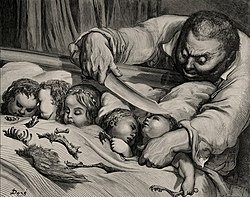 Gustave Doré: Illustration for Le Petit Poucet, 1862
 -
 Gustave Doré: Illustration for Le Petit Poucet, 1862
 -
 Alexander Zick (1845–1907): Illustration for Der kleine Däumling
 -
 The ogre and his wife, illustration for Hop-o'-My-Thumb from a late-19th-century German fairy tale book
 -
 An oni in pilgrim's clothing
 -
 Kawanabe Kyōsai (1831–1889): An oni in wandering Buddhist priest's robes, 1864
 -
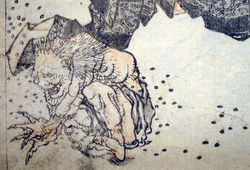 Katsushika Hokusai (1760–1849): An oni being chased away by scattered beans, detail of a print
 -
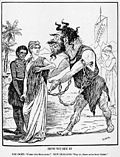 Political cartoon from 1900 depicting Australia as an ogre and referencing its origins as a penal colony


.jpg)


In sculpture
[edit]-

-
 An ogre king represented at Mandalay Hill, Myanmar
 -
 The ogress Sanda Muhki represented at Mandalay Hill
 -
 A Japanese oni
 -

-
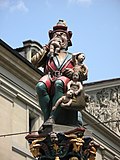 Ogre Fountain (lit. "Child Eater Fountain") at Corn House Square, Bern, Switzerland .


See also
[edit]References
[edit]- ^ Warner, Marina. Why do Ogres Eat Babies?. SpringerLink. doi:10.1007/978-1-349-13816-6_18.
- ^ "Definition of 'ogre'". Merriam-Webster. 14 February 2025. Retrieved 19 February 2025.
- ^ "Etymology of 'ogre'". Etymonline.com. Retrieved 19 February 2025.
- ^ Ruggiero, Federico (2019). "Tolomei, Iacomo". Dizionario Biografico degli Italiani. Vol. 96.
- ^ Vocabolario Degli Accademici Della Crusca Archived 2007-10-13 at the Wayback Machine
- ^ "Beowulf". Humanities.mcmaster.ca. Retrieved 2012-03-28.
- ^ a b Ammann, Keith (2019). The Monsters Know What They're Doing. Saga Press. ISBN 978-1982122669.
- ^ Croitoriu, Michaël (May–June 1998). "Aide Au Jouer: Talents & Pouvoirs". Backstab (in French). Vol. 9. p. 54.
- ^ Gygax, Gary, and Dave Arneson. Dungeons & Dragons (3-Volume Set) (TSR, 1974)
- ^ Gygax, Gary. Monster Manual (TSR, 1977)
- ^ Gygax, Gary, and Dave Arneson [1974], edited by J. Eric Holmes. Dungeons & Dragons Basic Set (TSR, 1977)
- ^ Gygax, Gary, and Dave Arneson [1974], edited by Frank Mentzer. Dungeons & Dragons Set 1: Basic Rules (TSR, 1983)
- ^ Witwer, Michael; Newman, Kyle; Peterson, Jonathan; Witwer, Sam; Manganiello, Joe (October 2018). Dungeons & Dragons Art & Arcana: a visual history. Ten Speed Press. p. 236. ISBN 9780399580949. OCLC 1033548473.
- ^ Slavicsek, Bill. Dungeons & Dragons Adventure Game (TSR, 1999)
- ^ Cook, Monte, Jonathan Tweet, and Skip Williams. Monster Manual (Wizards of the Coast, 2000)
- ^ Mearls, Mike, Stephen Schubert, and James Wyatt. Monster Manual (Wizards of the Coast, 2008)
- ^ Slavicsek, Bill. The Complete Book of Humanoids (TSR, 1993)
- ^ Croitoriu, Michaël (November 2000). "Dungeon Master's Guide". Backstab (in French). No. 24. pp. 74–75.
- ^ Eckelberry, David, Rich Redman, and Jennifer Clarke Wilkes. Savage Species (Wizards of the Coast, 2003)
- ^ Slavicsek, Bill; Baker, Rich; Grubb, Jeff (2005). Dungeons & Dragons for Dummies. Indianapolis, IN: Wiley Publishing. p. 356. ISBN 978-0-7645-8459-6. Retrieved 27 March 2012.
- ^ Burak, Alexander (2011). "Some Like It Hot – Goblin-Style: 'Ozhivliazh' in Russian Film Translations". Russian Language Journal. 61 (1): 5–31.
- ^ Mussies, Martine (2021). "'Dashing and daring, courageous and caring': Neomedievalism as a Marker of Anthropomorphism in the Parent Fan Fiction Inspired by Disney's Adventures of the Gummi Bears". Dzieciństwo. Literatura i Kultura. 3 (2): 60–83.
Further reading
[edit]- Briggs, Kathrine Mary. The Fairies in Tradition and Literature. London: Routledge, 2002.
- "Ogre." Encyclopædia Britannica Online. 15 May 2006, search.eb.com
- Rose, Carol. Giants, Monsters, & Dragons: An Encyclopedia of Folklore, Legend, and Myth. New York: W. W. Norton & Company, 2001. ISBN 0-393-32211-4
- Shippey, Tom. The Road to Middle-earth. London: HarperCollins, 1992 (rev.). ISBN 0-261-10275-3
- South, Malcolm, ed. Mythical and Fabulous Creatures: A Source Book and Research Guide. Westport, CT: Greenwood Press, 1987. Reprint, New York: Peter Bedrick Books, 1988. ISBN 0-87226-208-1
External links
[edit]
 Media related to Ogre at Wikimedia Commons


| Media | |
|---|---|
| Types |
|
| Monsters | |
| Related genres | |
| Other | |
| Related | |

| International | |
|---|---|
| National | |
| People | |
| Other | |

Etymology and Origins
Etymology
The term "ogre" entered the French language as ogre in the late 12th century, with its earliest known attestation appearing in Chrétien de Troyes's romance Perceval, le Conte du Graal (c. 1190), where it refers to a fearsome, man-eating creature associated with wilderness and peril.[6] This Middle French form is widely regarded as deriving from the Latin Orcus, the name of the Roman god of the underworld, who was depicted as a punisher of broken oaths and a devourer of the dead, evoking themes of death and monstrous appetite.[3] The Latin Orcus itself likely stems from Etruscan roots, possibly related to underworld deities or figures like ucare, representing infernal or cannibalistic entities in pre-Roman mythology.[7] Alternative etymological theories propose influences from other languages, including a possible connection to Hungarian ögre or similar terms denoting "man-eater," reflecting medieval European fears of nomadic invaders like the Magyars, whose raids may have inspired monstrous imagery.[8] However, the dominant scholarly consensus favors the Latin-Etruscan lineage through Italian orco (a demon or goblin), which paralleled the French adoption and reinforced the ogre's role as a flesh-devouring fiend in folklore.[3] By the 17th century, the word had evolved to denote a specific type of giant humanoid monster in literary contexts. The term gained widespread popularity through Charles Perrault's Histoires ou contes du temps passé (1697), where ogres appear as cannibalistic antagonists in tales like "Le Petit Poucet" and "La Belle au bois dormant," standardizing the archetype in French literature and embedding it in European cultural imagination.[9] Translations into English in the early 18th century, such as those by Robert Samber in 1729, introduced "ogre" to English speakers, marking its transition from a niche medieval term to a staple of fairy-tale lexicon.[10] The feminine counterpart, ogress, first emerged in Perrault's "La Belle au bois dormant," spelled as ogresse, to describe female ogres with similar voracious traits. While related to "orc," which derives from Old English orc (demon) in Beowulf (c. 8th–11th century) and shares the Latin Orcus root, "ogre" distinctly emphasizes the man-eating giant of continental folklore, whereas "orc" evolved into a broader term for infernal beings, later popularized by J.R.R. Tolkien for his goblin-like creatures. This distinction highlights how the ogre's etymology crystallized around themes of gluttony and terror in French romance traditions.[7]Historical Development
The concept of the ogre draws from ancient mythological figures embodying man-eating or child-devouring traits, particularly in Greek and Roman traditions. In Greek lore, the Cyclopes, such as Polyphemus in Homer's Odyssey, appear as one-eyed giants who capture and consume humans, establishing a prototype for brutish, cannibalistic monsters encountered by heroes. Similarly, the Titan Cronus swallows his offspring to avert a prophecy of overthrow, as detailed in Hesiod's Theogony, reflecting fears of tyrannical devouring forces that parallel later ogre motifs. Roman mythology features Orcus, an underworld deity associated with death and punishment of souls, whose name ties etymologically to the French "ogre" as a fearsome eater of the living. The ogre proper emerged in medieval European literature during the 12th century, marking its transition from mythic precursor to a distinct folkloric entity. The term first appears in Chrétien de Troyes' Perceval, or the Story of the Grail (c. 1180–1190), where "ogres" denote destructive giants terrorizing lands in Arthurian contexts, blending chivalric romance with oral monster traditions.[11] By the Renaissance, Italian folklore solidified the figure through Giambattista Basile's Lo cunto de li cunti (The Pentamerone, 1634–1636), a Neapolitan tale collection featuring ogresses and ogres as cunning, flesh-hungry antagonists in stories like "The Three Fairies," influencing broader European narrative patterns. In the 17th and 18th centuries, literary adaptations by French and German authors consolidated the ogre as a staple fairy tale villain, embedding it deeply in oral traditions across Western Europe. Charles Perrault's Histoires ou contes du temps passé (1697) prominently features ogres, as in "Le Petit Poucet" (Hop-o'-My-Thumb), where a child-devouring ogre family serves as a moral peril for the impoverished, drawing from French countryside lore to warn against vulnerability. The Brothers Grimm, in their Kinder- und Hausmärchen (1812–1857), incorporated ogre-like giants from German folktales, such as in "Sweetheart Roland" and "The Brave Little Tailor," where outwitting massive cannibals reinforces themes of cleverness over brute strength, perpetuating the archetype through collected oral variants from France, Italy, and Germany.[12]Characteristics in Folklore
Physical Appearance
In traditional European folklore, ogres are typically portrayed as inhumanly large humanoids with grotesque features.[13] Their physique is marked by abundant body hair and sometimes slimy skin, with sharp teeth contributing to their fearsome appearance.[13] Bodily traits emphasize brute strength, with a muscular build.[14] Traditional textual descriptions of ogres are often sparse, with many details derived from illustrations and later interpretations.[15] Regional variations reflect diverse influences. In French folklore, particularly in tales by Charles Perrault such as "Hop-o'-My-Thumb," ogres appear as wealthy giants, though often more anthropomorphic. Germanic versions, akin to trolls in Norse and Scandinavian lore, emphasize a rugged, monstrousness, sometimes with large noses and bulgy eyes.[16] Ogresses, the female counterparts, appear in narratives alongside male ogres but are not consistently distinguished by form.[13]Behavior and Abilities
In folklore, ogres are frequently depicted as cannibalistic creatures with a particular appetite for human children, driven by insatiable hunger during times of scarcity. This behavior is exemplified in French tales where ogres sharpen their knives in anticipation of devouring captives, reflecting gluttonous and predatory instincts that terrorize rural communities. Ogres are also portrayed as lazy and slothful, preferring to rely on brute force or the labor of their families rather than cunning, which often leads to their downfall at the hands of resourceful humans. Rather than being overcome through physical combat, ogres are typically defeated by wit and deception, underscoring the triumph of intellect over raw power in these narratives.[13] Ogres possess superhuman strength, enabling them to wield massive clubs or uproot trees as weapons, a trait that amplifies their role as formidable antagonists in remote wilderness settings. Some accounts attribute limited magical abilities to ogres, such as shapeshifting into animals like lions or mice, allowing them to entertain guests or pursue prey, though this power is often turned against them through clever exploitation. Ogresses, their female counterparts, feature in tales but do not typically demonstrate distinct magical abilities. However, these abilities are not infallible; ogres show vulnerability through their limited intellect, exploited by riddles and verbal trickery, forcing them into self-defeating actions.[17] Socially, ogres inhabit isolated castles or forest lairs, often alongside ogress wives who prepare and cook human flesh for meals, forming familial units that include ogre children. These households highlight a dim-witted, brute-like dynamic, where the male ogre dominates through intimidation while the ogress manages domestic horrors, sometimes displaying fleeting compassion toward victims. This structure symbolizes unchecked savagery, with ogres embodying force without foresight, making them easy prey for human stratagems. Weaknesses like poor eyesight—leading to fatal misidentifications in dim light—and profound gullibility render them susceptible to simple deceptions, such as swapped identities or false flattery. In rarer tales, ogres exhibit hints of moral redeemability, sparing lives under persuasion, though this is overshadowed by their inherent brutality.[18]Ogres in Traditional Literature
Early Literary Depictions
The term "ogre" first appears in literature in Chrétien de Troyes' Perceval, the Story of the Grail (c. 1180–1190), where it describes the monstrous, giant-like inhabitants of ancient Logres, a wild land plagued by man-eating creatures before Arthurian civilization tamed it. In this Arthurian romance, ogres embody the perilous wilderness and serve as guardians of forbidden realms or treasures, confronting knights like Perceval in tests of valor that highlight chivalric triumph over primal disorder. Similar antagonists populate 12th-century French chansons de geste and related epics, such as those in the broader Arthurian cycle, where such figures represent uncivilized threats to feudal society, often defeated to affirm Christian and courtly values. During the Renaissance, Giambattista Basile's Lo cunto de li cunti (1634–1636), also known as the Pentamerone, introduced "orchi" as versatile demonic figures in Neapolitan tales, blending grotesque horror with satirical elements to critique human vices like greed and deception. Later, Charles Perrault's Contes de ma mère l'Oye (1697) refined folklore into polished literary narratives, portraying ogres as brutish, cannibalistic lords whose folly underscores moral contrasts between savagery and ingenuity. These works elevated oral traditions into courtly entertainment, using ogres to explore themes of social hierarchy and human frailty within a structured allegorical framework. In the 19th century, the Brothers Grimm's Kinder- und Hausmärchen (1812 and subsequent editions) adapted Germanic folklore, featuring ogre-like monsters in stories that emphasize moral instruction, such as the triumph of cleverness and piety over gluttonous evil. Ogres here symbolize unchecked appetites and societal ills, with their downfalls reinforcing lessons in obedience, resourcefulness, and justice for young readers. Victorian literature further expanded this trope metaphorically; in Charles Dickens' Hard Times (1854), the rigid schoolmaster Mr. M'Choakumchild is depicted as a "dry Ogre" imposing mechanical facts, critiquing industrialization's dehumanizing effects on imagination and individuality.[19] Across these pre-20th-century depictions, ogres consistently function as embodiments of chaos and external threats, from barbaric wilderness invaders in medieval epics to allegories of moral and social disruption in later works, their inevitable defeats signifying the victory of civilized order and rational progress. This symbolic role underscores a broader literary pattern where ogres guard liminal spaces—forests, castles, or abstract vices—challenging protagonists to restore harmony.Notable Fairy Tales
In Charles Perrault's 1697 collection Histoires ou contes du temps passé, the fairy tale "Le Petit Poucet" (Hop-o'-My-Thumb) features an ogre as a central antagonist who attempts to devour seven lost children after they stumble upon his home in the forest.[2] The resourceful youngest child, Poucet, outwits the ogre by stealing his magical seven-league boots and leading his siblings to safety, highlighting the ogre's brute strength contrasted with human cunning.[2] Similarly, in Perrault's "La Belle au bois dormant" (Sleeping Beauty), published in the same volume, the prince's mother-in-law is revealed as an ogress queen with cannibalistic urges, who secretly orders the slaughter and consumption of her daughter-in-law and grandchildren while the prince is away at war.[5] Her plot is thwarted by a compassionate cook who substitutes animal meat, leading to the ogress's downfall in a vat of venomous reptiles.[5] Giambattista Basile's Lo cunto de li cunti (The Pentamerone), first published between 1634 and 1636, features ogresses in several tales, such as "The Golden Root," where an ogress, the sister of the protagonist's wife, attempts to kill and devour the young girl Parmetella out of jealousy. The ogress's malevolent schemes are ultimately foiled through magical intervention and the girl's cleverness. This narrative helped establish ogresses as familial betrayers driven by appetite in European folklore.[20] The Brothers Grimm's Kinder- und Hausmärchen (1812 edition) presents "Der Teufel mit den drei goldenen Haaren" (The Devil with the Three Golden Hairs) as tale 29, featuring a devil figure akin to an ogre-like giant who guards a fiery underworld and terrorizes a young hero tasked with plucking three golden hairs from his head. The protagonist survives by cleverly exploiting the devil's absences and the aid of the devil's grandmother, securing the hairs and averting a royal scheme against him. In Russian folklore, Alexander Afanasyev's collection Narodnye russkie skazki (1855–1863) includes "Vasilisa the Beautiful," where Baba Yaga serves as an ogress analog—a bony, iron-toothed witch who dwells in a hut on chicken legs and initially threatens to eat the heroine Vasilisa for failing her impossible tasks.[21] Vasilisa escapes through diligence and the protective magic of a doll from her late mother, transforming Baba Yaga's hut into a source of aid rather than destruction.[21] Across these tales, recurring motifs define ogre households as sites of peril equipped with magical artifacts, such as the seven-league boots in Perrault's story that enable rapid travel, or enchanted objects like the golden hairs and Baba Yaga's skull-lantern that test human resolve.[2][21] Ogres invariably meet their downfall through the ingenuity of protagonists, often children or underdogs, who exploit the creatures' overconfidence and gluttony, reinforcing themes of wit triumphing over raw power in European folklore traditions.[2][20][21]Ogres in Modern Media
Film and Animation
The portrayal of ogres in film and animation began in the early 20th century with silent adaptations of classic fairy tales. One of the earliest examples is the 1905 French short film Hop o' My Thumb, directed by Vincent Lorant-Heilbronn and produced by Pathé Frères, which directly adapts Charles Perrault's tale of the same name. In this work, the ogre is depicted as a menacing, child-devouring antagonist who shelters the lost brothers but ultimately reveals his cannibalistic intentions, staying true to the folkloric monster archetype.[22] Similar silent-era productions, such as the 1909 Le Petit Poucet by Étienne Arnaud, reinforced this villainous image by emphasizing the ogre's brutality and magical elements like seven-league boots, setting a precedent for ogres as terrifying foes in visual storytelling.[23] By the 1930s, animation introduced more stylized ogre figures, often in comedic or exaggerated forms within fairy tale parodies. Ub Iwerks' ComiColor series featured the 1934 short Puss in Boots, where the ogre king serves as a pompous, shape-shifting villain who imprisons rivals and hoards treasure, blending menace with slapstick humor typical of the era's cartoons. These early animated depictions, influenced by European folklore, portrayed ogres as hulking, grotesque brutes but began hinting at vulnerability through magical defeats, paving the way for later character development. A pivotal shift occurred in the 21st century with DreamWorks Animation's Shrek franchise (2001–2010), which reimagined the ogre as a green-skinned, relatable anti-hero challenging traditional stereotypes. In the original Shrek (2001), directed by Andrew Adamson and Vicky Jenson, the titular character—voiced by Mike Myers—is a solitary swamp-dweller who rescues Princess Fiona not for heroism but self-preservation, ultimately embracing love and friendship while subverting fairy tale norms like true love's kiss. Subsequent films, including Shrek 2 (2004), Shrek the Third (2007), and Shrek Forever After (2010), evolve Shrek into a family-oriented protagonist, portraying ogres as misunderstood outcasts rather than inherent monsters and critiquing societal prejudices through humor and pop culture references. This series grossed over $2.9 billion worldwide and won the first Academy Award for Best Animated Feature, influencing a generation of family films by humanizing mythical creatures. In July 2024, DreamWorks announced Shrek 5, slated for release on December 23, 2026, continuing the franchise's exploration of ogre characters. Other animations expanded ogre-inspired portrayals in diverse cultural contexts. Studio Ghibli's Spirited Away (2001), directed by Hayao Miyazaki, incorporates spirits drawn from Japanese yokai folklore, including oni (ogre-like demons) such as the Ushioni—bull-headed, antlered bathhouse patrons—and the massive, polluted River Spirit, which evoke the hulking, otherworldly menace of ogres while exploring themes of environmental harmony and transformation. In Pixar's fantasy blends, large monstrous figures reminiscent of ogres appear as sympathetic guardians, such as the furry, protective Sulley in Monsters, Inc. (2001), who shifts from a scarer to a benevolent protector of children, blending horror tropes with emotional depth. Live-action adaptations like Steven Spielberg's The BFG (2016), based on Roald Dahl's novel, contrast the gentle, dream-capturing Big Friendly Giant with his brutish, human-flesh-devouring kin—explicitly ogre-like in their savagery—highlighting the spectrum from terror to tenderness in giant folklore. Throughout these decades, ogre depictions have evolved from one-dimensional villains in silent films to complex, comedic, or empathetic characters in modern animation, reflecting broader trends in family entertainment toward subversion and inclusivity. This transformation, exemplified by Shrek's satire of Disney-style tales, has made ogres symbols of self-acceptance and anti-conformity, impacting how mythical monsters are animated to appeal to diverse audiences.[24]Literature and Games
In modern literature, ogres have evolved beyond traditional folklore antagonists into multifaceted characters in fantasy and urban settings. Neil Gaiman's Norse Mythology (2017) reimagines ogres from ancient tales, portraying figures like Thrym as cunning adversaries who steal divine artifacts and challenge the gods, blending mythological roots with accessible prose.[25] Similarly, A. Lee Martinez's In the Company of Ogres (2006) presents ogres as boisterous members of a misfit monster legion in a satirical military fantasy, where their brute strength contrasts with comedic incompetence under undead leadership. In horror-infused works, ogres revert to terrifying villains, as seen in anthology stories like Sofia Samatar's "Ogres of East Africa" from Long Hidden (2014), where they embody colonial brutality through speculative historical fiction.[26] Comics and graphic novels have integrated ogres into diverse narratives, often as embodiments of raw power or otherworldly threats. In Neil Gaiman's The Sandman series, issue #38 ("The Parliament of Rooks," 1992) references ogres alongside ghouls in a dreamlike folklore tale, highlighting their role in blending myth with human fears during a journey through perilous landscapes.[27] Japanese manga equivalents expand this, with Ogre Slayer (1992–1999) by Kei Kusunoki featuring a protagonist cursed as an ogre who hunts his kin to reclaim humanity, exploring themes of monstrosity and redemption in a dark fantasy world.[28] In superhero comics, ogre-like mutants appear as formidable foes; Marvel's Ogre (Brian Dunlap), introduced in X-Men #62 (1969), is a genius inventor enhanced for villainy, using intellect and brawn against teams like the X-Men as part of the terrorist group Factor Three.[29] Video games and role-playing games (RPGs) have codified ogres as archetypal antagonists since the 1970s, evolving their portrayals through interactive mechanics. In Dungeons & Dragons (first edition, 1974), ogres are defined as chaotic evil humanoids with low-average intelligence (typically 5-12), 4+1 hit dice for resilience, and strength equivalent to 18, serving as disposable low-level monsters in dungeon crawls.[30] The Warcraft series features ogres as brutish, two-headed humanoids native to Draenor, initially as Horde minions and boss enemies in Warcraft II (1995), but later gaining nuanced lore as cunning warlords and potential allies in expansions like The Burning Crusade (2007).[31] Similarly, the Final Fantasy franchise depicts ogres as recurring boss-like enemies, such as the hulking brutes in Final Fantasy I (1987) that wield clubs and resist magic, or void-born variants in Final Fantasy XIV (2013 onward) with high physical prowess but limited wits.[32] This interactive evolution reflects player agency, transforming ogres from mere fodder in early RPGs like D&D—where they are slain for experience points—into customizable or allied figures in modern titles. In World of Warcraft (2004), ogres appear in player quests as quest-givers or faction members, such as the Laughing Skull clan, allowing alliances that deepen their cultural backstory of shamanism and empire-building.[31] Ogres even become playable in limited forms, like half-ogre hunter Rexxar, emphasizing strategic depth over brute disposability. Film crossovers, such as the Shrek video games (2001 onward), further enable players to control ogre protagonists in platforming adventures.[33]Cultural Impact and Representations
Symbolism and Interpretations
In traditional European folklore, ogres symbolize gluttony and insatiable consumption, often depicted as man-eating giants who devour humans, particularly children, to embody fears of unchecked hunger and moral depravity.[34] They also represent tyranny and brute oppression, standing as primitive forces of social exploitation that threaten civilized order and exploit the weak.[34] Furthermore, ogres serve as the archetypal "other," embodying barbarism and the dangers beyond societal boundaries, such as foreign invaders or uncivilized outsiders in medieval tales.[35] In Bruno Bettelheim's analysis, the ogre often functions as a father figure, reflecting Oedipal dynamics in tales like "Jack and the Beanstalk," allowing children to confront fears of authority through heroic triumph.[36] Modern literary analyses extend these symbols to embody parental anxieties and societal vices like greed, where ogres in fairy tales mirror fears of neglectful or tyrannical caregivers and the excesses of capitalism.[37] Postcolonial readings, as in Ngũgĩ wa Thiong'o's Wizard of the Crow, portray ogres as grotesque embodiments of neocolonial tyranny and internalized racial hierarchies, with characters' transformations into ogre-like figures critiquing elite greed for whiteness and power that perpetuates alienation and exploitation in African contexts.[38] Globally, ogres find parallels in Japanese oni, demon-like beings born from wicked humans and serving as underworld tormentors, symbolizing chaotic evil and the consequences of moral excess.[39] In contemporary narratives, ogres are used to critique prejudice against the monstrous "other," challenging stereotypes of ugliness and savagery and promoting themes of acceptance and subversion of societal biases.[40]Visual Arts and Sculpture
In the 19th century, French artist Gustave Doré created renowned engravings for Charles Perrault's Les Contes de Perrault (1862), particularly illustrating the ogre in "Hop-o'-My-Thumb" as an obese, bloated, and gargantuan bully figure, drunk and violent, with exaggerated features that caricature menacing male behavior and evoke domestic threat.[41] These works emphasized the ogre's grotesque physicality—such as a staring, mad-eyed gaze reminiscent of Perrault's Bluebeard—to amplify the tale's horror and moral undertones. Doré's detailed wood engravings, blending realism with dramatic shading, influenced subsequent fairy tale illustrations by portraying ogres not merely as monsters but as allegorical symbols of unchecked appetite and brutality. Romantic-era paintings drew on monstrous imagery, as seen in Francisco Goya's Black Paintings (1819–1823), where works like Saturn Devouring His Son depict a figure consuming his offspring in a frenzied, cannibalistic rage, capturing the era's fascination with primal terror and human depravity.[42] Sculptural representations of ogre-like demons appear prominently in medieval European church architecture, such as the 15th-century grotesques discovered in the nave roof of St. Clement's Church in Outwell, England, featuring hybrid figures with human bodies merged into animalistic forms—clawed hands, elongated noses, and demonic visages—that symbolize the eternal struggle between good and evil.[43] These carvings, blackened by centuries of exposure and now threatened by decay, served both decorative and didactic purposes, looming over worshippers as reminders of infernal threats. By the 19th century, French garden statues incorporated similar grotesque elements, with stone figures of devouring ogres placed in landscaped parks to evoke whimsical yet eerie folklore, blending neoclassical elegance with monstrous whimsy.[44] In the modern era, public art has embraced lighter, pop-culture interpretations, exemplified by life-sized concrete Shrek statues installed in community spaces post-2001, such as the 200-pound figure placed outside a home in Hatfield, Massachusetts, which was reported missing in 2023.[45] Depictions of ogres in visual arts have shifted from the terrifying realism of medieval marginalia and Romantic canvases to cartoonish exaggeration, influenced by films like Shrek.References
- https://en.wikisource.org/wiki/The_Russian_Fairy_Book/Vasilisa_the_Beauty