Hubbry Logo
Passion (music)Passion (music)Main
Open search
Passion (music)
Community hub
Passion (music)
logo
8 pages, 0 posts
0 subscribers
Be the first to start a discussion here.
Passion (music)
Passion (music)
from Wikipedia
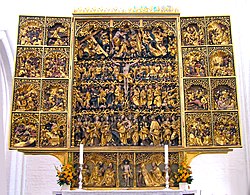
Carved wood Passion altarpiece, Odense Cathedral

In Christian music, a Passion is a setting of the Passion of Christ. Liturgically, most Passions were intended to be performed as part of church services in the Holy Week.

Passion settings developed from medieval intoned readings of the Gospel texts relating Christ's Passion, to which later polyphonic settings were added. Passion Plays, another tradition that originated in the Middle Ages, could be provided with music such as hymns, contributing to Passion as a genre in music.

While Passion music in Catholic countries had to compete with other devotions such as the Stations of the Cross, the Improperia and Tenebrae, in Protestant Germany settings of the Gospels became a focal point of Passiontide services, with Passion cantatas (and later Passions in oratorio format) performed on Passion Sunday, Palm Sunday and Good Friday. Its best known examples, the Bach Passions, date from the first half of the 18th century.

Later musical settings of the Passion of Christ, such as the Jesus Christ Superstar Rock opera, or Arvo Pärt's Passio refer to these earlier Christian traditions to varying degrees.

History

[edit]

The reading of the Passion from one of the Gospels during Holy Week dates back at least to the 4th century[1] and is described by Egeria. In the 5th century Pope Leo the Great specified that the gospel of Matthew be used on Palm Sunday and the following Wednesday and that of John on Good Friday; by the 10th century Luke replaced Matthew on Wednesday and Mark was added on Tuesday.

The passion began to be intoned (rather than just spoken) in the Middle Ages, at least as early at the 8th century. 9th-century manuscripts have "litterae significativae" indicating interpretive chant, and later manuscript begin to specify exact notes to be sung. By the 13th century different singers were used for different characters in the narrative, a practice which became fairly universal by the 15th century, when polyphonic settings of the turba passages began to appear also (Turba, while literally meaning "crowd," is used in this case to mean any passage in which more than one speaker speaks simultaneously). The formula of the present Graduale Romanum was the most widespread, with Christ singing in the lowest register and Synagogus (denoting not only the high priest but all characters besides Christ) singing higher than the evangelist/narrator. In Spain a Toledan tone with the evangelist's part recto tono (on a monotone) was used in Castile and a Saragossan tone with a bass evangelist and a florid tenor Christus was used in much of Aragon, where the Roman tone also had a foothold in Valencia.

Testimony – in parallel fifths – of the false witnesses from Guerrero's responsorial Matthew's Passion (1585).

In the later 15th century a number of new styles began to emerge:

  • 'Responsorial Passions in which the narration is chanted but the turba parts and sometimes Christ's words are set polyphonically.
  • Through-composed Passions, also called motet Passions, in which all text is set polyphonically. The earliest extant example of this type is sometimes attributed to Jacob Obrecht .
  • Summa Passionis settings, drawing on all four Gospels. These were never incorporated into the liturgy of the church use but circulated widely nonetheless. The Seven Last Words (a text later set by Haydn and Théodore Dubois) are included in this category.

Roman Catholic music

[edit]

In the 16th century many settings, chiefly of the responsorial type, were written by William Byrd (St. John, 3vv), Jacobus Gallus, Francisco Guerrero (five including second St. John, mostly 5vv), Orlando di Lasso (all four, 4vv), Cypriano de Rore (St John) and Victoria.

In Roman Catholicism settings of (parts of) the Tenebrae service however became the leading format for music to commemorate Christ's Passion and death during Holy Week, with for example Leçons de ténèbres, Tenebrae responsories, and settings of the Miserere psalm. Notable examples of such music, like Gesualdo's Tenebrae Responsoria, are sometimes characterized as "a Passion in all but name".[2]

A later development of the Catholic passion was the reflective passion-oratorio such as Metastasio's Italian libretto La passione di Gesù Cristo set by Caldara, Salieri and many other composers between 1730 and 1812.

Latin passions continued in parallel with the style of Metastasio, often set by minor composers such as little known Carlo Sturla, music master at the Convent of Santa Brigida, who also set a Latin passion in 18th Century operatic style, Passio di Venerdì Santo, for the Oratory of St Philip Neri in Genoa in 1736.

Protestant music

[edit]

Martin Luther wrote, "The Passion of Christ should not be acted out in words and pretense, but in real life." Luther felt that elaborate polyphony would distract from the importance of the sacred passion text. Despite this, sung Passion performances were common in Lutheran churches right from the start, in both Latin and German, beginning as early as Laetare Sunday (three weeks before Easter) and continuing through Holy Week. Luther's friend and collaborator Johann Walther wrote responsorial Passions which were used as models by Lutheran composers for centuries, and “summa Passionis” versions continued to circulate, despite Luther's express disapproval. Later sixteenth-century passions by G.M. Asola, Samuel Besler, William Byrd, Leonard Lechner, and Jakob Meiland included choral “exordium” (introduction) and “conclusio” sections with additional secular texts.[3]

Thomas Strutz wrote a passion (1664) with arias for Jesus himself, pointing to the standard oratorio tradition of Schütz and Carissimi. The practice of using recitative for the Evangelist (rather than plainsong) was a development of court composers in northern Germany, such as Johann Meder and Schütz, and only crept into church compositions at the end of the 17th century. The recitative was used for dramatic expression.[3]

In the 17th century came the development of “oratorio” passions which led to J.S. Bach’s passions, accompanied by instruments, with interpolated instrumental interludes (often called "sinfonias" or "sonatas") or with interpolated texts (then called “madrigal” movements) such as other Scripture passages, Latin motets, chorale arias, and more. Such settings were created by Bartholomäus Gesius and Heinrich Schütz.

The best known Protestant musical settings of the Passion are by Johann Sebastian Bach, who, according to his obituary, wrote five Passions in his lifetime. Two have survived to the present day: one based on the Gospel of John (the St John Passion), the other on the Gospel of Matthew (the St Matthew Passion). Additionally, a libretto for the St Mark Passion survives. Although Bach's settings are now among the most popular Passions today, they were rarely performed during his lifetime.

The Passion continued to be very popular in Protestant Germany in the 18th century, with Bach's second son Carl Philipp Emanuel composing over twenty settings. Major composers of passions included Graun, Telemann, Keiser, Stölzel, Mattheson and Handel - these last five also composing Brockes-Passions after the text of Barthold Heinrich Brockes.

Romantic and Modern music

[edit]

In the 19th century, Passion settings were less popular. Some examples of such works are the Oratorio Christus (Op. 97, 1847) by Felix Mendelssohn, Das Suhnopfer des neuen Bundes (1847) and Kleine Passionsmusik (?) of Carl Loewe, Les sept paroles du Christ (?) of Cesar Franck, John Stainer's The Crucifixion (1887), Die Passion (Op. 93, 1896) of Heinrich von Herzogenberg, and Christus. Mysterium in a Prelude and Three Oratorios (Opp. 70–73, 1899) by Felix Draeseke. However, in the 20th century, they have again come into fashion. Two notable settings are the St. Luke Passion (1965) by Polish composer Krzysztof Penderecki and the Passio (1982) by Estonian composer Arvo Pärt. Another is the Passionsmusik nach dem Lukasevangelium of Rudolf Mauersberger.

In 2000 Helmuth Rilling and the Internationale Bachakademie commissioned four modern composers to compose passions on the four Gospels; Matthew was allocated to Tan Dun - Water Passion After St Matthew, Mark to Osvaldo Golijov - La Pasión Según San Marcos, Luke to Wolfgang Rihm - Deus Passus, and John to Sofia Gubaidulina - St John Passion (Страсти по Иоанну).

Examples

[edit]

A relative of the musical Passion is the custom of setting the text of Stabat Mater to music.[citation needed]

English

[edit]

In the English repertoire, the two classics are The Crucifixion (1887) by Sir John Stainer and Olivet to Calvary (1904) by John Henry Maunder. Other works include Sir Arthur Somervell's The Passion of Christ (1914), Charles Wood's St Mark Passion (1921) and Eric Thiman's The Last Supper (1930).

More recent examples include James MacMillan's Seven Last Words from the Cross (1993), the Passion According to St. Matthew (1997) by Mark Alburger, The Passion According to the Four Evangelists by Scott King The Passion and Resurrection According To St. Mark (2015/2017) by Christian Asplund, and St. Mark Passion (2024)[4] by Douglas Balliett.

Andrew Lloyd Webber's Jesus Christ Superstar (book and lyrics by Tim Rice), and Stephen Schwartz's Godspell both contain elements of the traditional passion accounts. Another modern version is by Adrian Snell (1980). Peter Gabriel's score to Martin Scorsese's 1988 film the Last Temptation of Christ was released as an album under the title Passion: Music for The Last Temptation of Christ.

German

[edit]

German Passion cantatas include Der Tod Jesu (1755), with text by Karl Wilhelm Ramler and music by Georg Philipp Telemann, Carl Philipp Emanuel Bach, and by Carl Heinrich Graun, and the Passion Cantatas Die letzten Leiden des Erlösers (1770), with text by various people and music by Carl Philipp Emanuel Bach (taken largely from his St Matthew Passion of 1769) and Gottfried August Homilius's cantata Ein Lämmlein geht und trägt die Schuld HoWV 12 (1775). A later example is Das Sühnopfer des neuen Bundes by Carl Loewe (1847). In Danish there are also passion cantatas with music by the Bach critic Johann Adolf Scheibe to the text, Vor Harpe er bleven til Sorrig by Johannes Ewald, and the Sørge-Cantata ved Christi Grav Herrens Salvede, som var vor Næses Aand by the same librettist and composer.

Latin

[edit]

Stanzas of the medieval hymn Salve mundi salutare[5] – also known as the Rhythmica oratio –, a poem formerly ascribed to St. Bonaventure or Bernard of Clairvaux, but now thought more likely to have been written by medieval poet Arnulf of Leuven (died 1250) was arranged as a cycle of seven cantatas in 1680 by Dieterich Buxtehude, Membra Jesu Nostri. Franz Liszt included an arrangement of Paul Gerhardt's O Haupt voll Blut und Wunden in the sixth station of his Via crucis (Stations of the Cross), Saint Veronica wipes the Holy Face.

A notable work in Latin is Arvo Pärt's Passio Domini Nostri Jesu Christi secundum Joannem (The Passion of Our Lord Jesus Christ according to John) of 1982.

Other

[edit]
  • St. Luke Passion (1966) of Penderecki
  • Passion Cantata "Vor Harpe er bleven til Sorrig" with text by Johannes Ewald and music by the Bach critic Johann Adolf Scheibe,
  • Sørge-Cantata ved Christi Grav "Herrens Salvede, som var vor Næstes Aand" by the same librettist and composer.

References

[edit]
Revisions and contributorsEdit on WikipediaRead on Wikipedia
from Grokipedia
In Christian sacred music, a Passion is a that sets the narrative of the (passio), trial, , and of Christ as described in the Gospels, often performed as part of liturgical services during , particularly on . The genre originated in the early as chanted readings of texts during , with evidence of its use dating back to the , initially in plainchant form without additional music. By the , these readings incorporated notational elements like pitch, , and dynamic indications to enhance dramatic expression. In the , the tradition evolved within Catholic contexts, transitioning from monophonic chant to polyphonic settings by the , influenced by composers such as Orlande de Lassus, who created motet-style Passions using Gospel texts; following the , Protestant traditions also adopted and developed the form. The period marked a significant expansion, with the introduction of oratorio-like structures featuring recitatives, arias, chorales, and instrumental accompaniment, as seen in Heinrich Schütz's dramatic Passions and Reinhard Keiser's forms. Johann Sebastian Bach's (1727) and (1724) represent pinnacles of the genre, combining liturgical elements with profound emotional depth and large-scale forces including double choirs and orchestras, performed annually in Lutheran churches like those in . In the 20th and 21st centuries, the Passion form has persisted and diversified, incorporating secular themes of and social conscience, as in Krzysztof Penderecki's St. Luke Passion (1965) and David Lang's Pulitzer Prize-winning the little match girl passion (2007), which reinterprets the narrative through Hans Christian Andersen's tale.

Overview

Definition and Etymology

In music, a Passion is a musical composition that narrates the , specifically the events of his suffering, trial, crucifixion, and death as recounted in the Gospels. This genre typically employs biblical texts, either chanted or set polyphonically, and may incorporate additional poetic reflections, choruses, arias, and recitatives to dramatize the narrative. Historically intended for performance during in Christian liturgical services, Passions evolved from simple responsorial readings to more elaborate oratorio-like forms, blending sacred storytelling with expressive musical elements to evoke devotion and contemplation. The term "Passion" derives from the Latin passio, meaning "" or "endurance," rooted in the verb pati ("to suffer" or "to endure"). In early Christian contexts, passio was used from the A.D. in Latin to describe Christ's and martyrdom, emphasizing passive submission to rather than active . This theological usage entered Old English religious texts by the via Norman French influences post-1066, retaining its focus on Christ's ordeal before broadening in the 13th century to encompass general martyrdom and intense feelings. By the late , under influences from Latin passio (as "affection of the mind") and Greek pathos, the word acquired connotations of ardent and desire, though in musical contexts, it consistently refers to the narrative of suffering. The application of "Passion" to music specifically denotes settings of this scriptural account, with the earliest documented uses of the English phrase "Passion music" appearing in the 19th century, though the tradition traces back to medieval liturgical practices.

Role in Christian Liturgy

In Christian liturgy, Passion music functions primarily as a musical proclamation of the Gospel narratives detailing Jesus Christ's suffering, death, and burial, serving to deepen congregational meditation and participation during Holy Week observances, especially on Palm Sunday and Good Friday. This role emphasizes the dramatic and theological weight of the Passion story, integrating chant, polyphony, and later oratorio elements to convey reverence and communal reflection on redemption. The practice originated with the chanted reading of the Passion Gospels as integral parts of the , traceable to the in , where the pilgrim Egeria described the solemn recitation of these texts during services to immerse the faithful in the events of Christ's final days. Over centuries, these readings evolved from monophonic chants using traditional Passion tones—distinct melodic lines for the Evangelist (narrator), Christ's direct speech, and the turba (crowd responses)—to more elaborate settings that fulfilled liturgical prescriptions without altering the scriptural text. In the Roman Catholic tradition, the specifies that the Passion be sung by multiple readers to distinguish voices, enhancing clarity and emotional engagement, as seen in the long-standing use of Gregorian tones for Matthew, Mark, Luke, and John across the . In , particularly within Lutheran worship, Passion music expanded this role by incorporating the narrative into broader musical frameworks during or special services, blending biblical recitation with congregational hymns and meditative arias to proclaim Lutheran doctrines of grace and . Composers like and J.S. Bach adapted these settings for church use, with Bach's exemplifying a liturgical summation of the tradition through its integration of chorales for communal singing and polyphonic turba sections to evoke the crowd's turmoil, thereby fostering active devotion among the assembly. Throughout its history, Passion music has maintained a subsidiary yet essential position in , subordinate to the proclaimed Word while elevating the ritual's affective power; medieval responsorial forms and , such as those by , added harmonic richness to the turba parts without overshadowing the text, ensuring the music served evangelization and unity in worship. This enduring liturgical function underscores Passion music's capacity to sanctify the faithful by making the salvific mystery audibly and emotionally present.

Historical Development

Origins in Early Christianity

The Passion narrative, recounting the suffering, death, and burial of Jesus Christ as described in the four Gospels, formed a central element of early Christian liturgical practice, particularly during Holy Week observances. This musical tradition originated in the 4th century in Jerusalem, where the texts were chanted as part of Gospel readings in services commemorating Christ's Passion. The earliest detailed account comes from the pilgrim Egeria, whose travels around 381–384 AD describe Holy Week liturgies involving the chanting of Passion passages at key sites, such as the reading of the crucifixion narrative before the Cross on Golgotha on Good Friday, interspersed with hymns, antiphons, and lessons from the Psalms, Acts of the Apostles, and prophetic books. These practices reflected a broader early Christian emphasis on scriptural recitation to evoke communal reflection on Christ's sacrifice, drawing from Jewish synagogue traditions of melodic cantillation adapted for Christian worship. In these initial forms, the Passion was typically chanted by a single in a monophonic style, using simple melodic inflections to convey the text's dramatic intensity without or elaborate notation. Egeria's descriptions highlight processional elements, such as hymns sung during movements between locations like the and the Anastasis (Church of the Holy Sepulchre), where portions of the Passion—such as Jesus' prayer in or his —were proclaimed to foster emotional engagement among the faithful. This solitary chanting emphasized the narrative's solemnity, with variations in pitch or tone occasionally distinguishing speakers, as evidenced in later 7th-century sources like the Bobbio Missal (c. 650 AD), which prescribed a lower register for Christ's words to their . By the late patristic and early medieval periods, this practice had disseminated from across , becoming a fixture in and liturgies by the Merovingian era (c. 700 AD), as documented in the of . The chanting evolved into more structured forms, influencing the development of and laying the groundwork for later polyphonic settings, while preserving the core function of immersing worshippers in the scriptural drama of the Passion.

Medieval and Renaissance Forms

In the medieval period, Passion music primarily consisted of monophonic chant settings of the Gospel narratives recounting Christ's suffering, death, and burial, performed during Holy Week liturgies such as Palm Sunday, Spy Wednesday, and Good Friday masses. These settings followed established recitation tones: the evangelist's narrative used a mediant voice (media vox) in a neutral, recitative-like style; Christ's words employed a lower, more somber bass voice (bassa vox); and the crowd's exclamations (turba) or other speakers adopted a higher, more emphatic pitch (alta vox). This responsorial structure, rooted in early Christian practices, emphasized textual clarity and dramatic contrast to engage the congregation emotionally and devotionally. By the , these chanted Passions evolved into more elaborate liturgical dramas, incorporating troped elements and simple actions to heighten the narrative's theatricality. The Visitatio sepulchri, an trope depicting the women at the , featured polyphonic tropes in some regions, blending with emerging two-voice for angelic dialogues or alleluias. Similarly, planctus Mariae—lamentations attributed to the Virgin Mary—emerged as poignant additions, often as dialogues between Mary and John, with examples like the 14th-century Cividale del Friuli manuscript including staging directions. The , a 13th-century sequence originating in Franciscan circles, became a staple for Passion meditations, initially monophonic but later inspiring polyphonic elaborations. Complex Latin Passion plays, such as those in the (ca. 1230), integrated hymns, antiphons, and vernacular laude for broader accessibility. The Renaissance marked a shift toward polyphonic Passion settings, particularly in the late 15th century, as composers began applying imitative counterpoint and fuller textures to sacred narratives, though full settings remained less common than motets or mass ordinaries. In England, under the Sarum rite, polyphony enriched turba sections and interpolated motets while preserving chant for the evangelist and Christ, creating a hybrid form that underscored dramatic tension. Richard Davy's St. Matthew Passion (ca. 1490–1500), preserved in the Eton Choirbook, stands as the earliest surviving complete polyphonic Passion by a known composer, featuring four-voice polyphony for crowd responses and expressive motets like O vos omnes, blending Sarum chant with mensural notation for liturgical performance. On the Continent, Renaissance Passion music focused more on partial settings and motets drawn from Passion texts, reflecting a preference for balanced, non-dramatic polyphony over extended narratives until the Baroque era. Franco-Flemish composers like Guillaume Dufay (ca. 1397–1474) contributed isolated polyphonic responsories and lamentations, such as settings of Tristis est anima mea, emphasizing harmonic consonance and modal subtlety. By the late 16th century, figures like Orlande de Lassus (1532–1594) and Tomás Luis de Victoria (1548–1611) produced polyphonic Stabat Mater and Holy Week motets with subtle word-painting to evoke sorrow, though full Gospel settings were rare and often limited to two- or three-voice elaborations of turba choruses. This period's innovations, including cyclic structures and expressive dissonance, laid groundwork for the more operatic Passions of the 17th century.

Denominational Traditions

Roman Catholic Passions

In the Roman Catholic tradition, Passion music consists of settings of the Gospel narratives recounting the suffering, death, and Christ, primarily drawn from the accounts in . These works have been integral to liturgy since the early Church, emphasizing solemn reflection and devotion rather than dramatic narrative. Unlike Protestant Passions, which often developed into concert oratorios, Catholic settings remained closely aligned with liturgical rubrics, using Latin texts and focusing on enhancing the scriptural proclamation during or the . The earliest Roman Catholic Passions were monophonic chants in the Gregorian tradition, emerging by the as part of the readings. (440–461) referenced the sung Passion lessons for , establishing a practice of intoning the narrative to foster congregational participation in the mystery of Christ's Passion. By the , notations distinguished voices for the Evangelist (narrator), Christ, and the turba (crowd), chanted in style using specific modes—typically mode VIII for the Evangelist and mode II for Christ—to convey gravity and pathos. This threefold division persisted in the , with the Passion of Matthew sung on , Mark on , Luke on , and John on . The rubrics required at least three clerics (deacons or priests) for the roles, though simplifications in the allowed the celebrant to chant alone. Polyphonic developments began in the , transitioning from to -style settings where the entire narrative or select sections received harmonic treatment. The first known extended polyphonic Passion is attributed to (c. 1450–1505), whose Passio secundum Matthaeum (c. 1490) sets the text for multiple voices, marking an early fusion of liturgical with emerging . In the , responsorial Passions became prominent, retaining plain for the narrative while setting turba dialogues and solo parts polyphonically to heighten emotional intensity. Orlande de Lassus (1532–1594), a leading Catholic composer, produced several such works, including Passio secundum Joannem for four to eight voices (published 1585), which alternates and to underscore dramatic confrontations like before Pilate. Other key figures include Tomás Luis de Victoria (1548–1611), whose Latin settings emphasize contrapuntal clarity in line with Tridentine reforms, and Jacob Handl (1550–1591), who composed three multi-voice Passions blending and responsorial elements. The (1545–1563) reinforced these styles by prioritizing textual intelligibility and sacred solemnity in . During the era, Catholic Passion music evolved toward forms, often performed extra-liturgically in oratories or courts while retaining sacred intent. (1605–1674) pioneered the historia sacra genre with works like Job and Passion-related oratorios, using recitatives, arias, and choruses to evoke compassion without staging. (1660–1725) composed over a dozen Passion oratorios, such as Passio secundum Joannem (c. 1680), which integrated operatic techniques like arias while adhering to Catholic devotional norms. The La passione di Gesù Cristo (1730) by became seminal, set by 54 composers including Antonio Caldara (1670–1736) and Johann Adolf Hasse (1699–1783), and performed in Roman Catholic venues across for its meditative focus on Christ's suffering. These works, often premiered during in Jesuit institutions or noble chapels, balanced dramatic expression with liturgical restraint, distinguishing them from secular . By the 18th century, such settings influenced Viennese sepolcro devotions, semi-staged Passion plays with music from 1660 to 1705. In the , Roman Catholic have largely reverted to simplified or vernacular readings post-Vatican II (1962–1965), though polyphonic and traditions persist in traditionalist communities and choral repertoires. Composers like (b. 1935), a convert to but influenced by , have contributed contemplative settings such as Passio (1982), echoing responsorial forms. Overall, the tradition prioritizes the Passion's role in and prayer, with music serving to illuminate the scriptural text rather than overshadow it.

Protestant Passions

Protestant Passions emerged during the in the 16th century, primarily within the Lutheran tradition in , where championed music as a vital tool for worship and education in the faith. Luther's emphasis on congregational singing and the use of vernacular German in liturgy facilitated the shift from Latin to German-language settings of the Passion narrative, drawn from the Gospels. This allowed for more direct engagement with the scriptural account of Christ's suffering, death, and , integrating chorales—simple, hymn-like tunes—to reinforce doctrinal points during services. The earliest known Lutheran Passion setting was composed by Johann Walter around 1530, a polyphonic rendition of the St. Matthew Passion that blended chant-like recitation with choral elements, performed in . This work marked the beginning of a distinctly Protestant approach, emphasizing emotional accessibility and scriptural fidelity over elaborate Catholic . By the mid-16th century, composers like Lucas Osiander further developed these forms by incorporating melodies into Passion texts, creating hybrid pieces that alternated narrative recitations with congregational hymns to foster personal reflection on the Passion. In the , Protestant evolved toward greater expressivity while remaining tied to liturgical use, particularly in northern German Protestant churches. , a pivotal figure, composed three unaccompanied Passions—on the texts of Matthew, Luke, and John—around 1665–1666, employing simple recitatives for the Evangelist's narration and turba choruses for crowd scenes to heighten dramatic tension without instrumental accompaniment. These works reflected the Lutheran focus on the Word, prioritizing textual clarity and affective piety. Contemporaries like Thomas Selle contributed similarly restrained settings, such as his (1642) and (1643), which maintained a homophonic style to support preaching on Christ's . The late 17th and 18th centuries saw the rise of the Oratorio Passion, a more expansive form influenced by but adapted for sacred contexts, featuring arias, choruses, and orchestral elements to explore theological themes like sin, redemption, and grace. Composers such as Reinhard Keiser and produced numerous such works; Telemann alone composed over 40 Oratorio Passions between 1716 and 1767, with 22 surviving, often premiered during in Hamburg's churches to draw large congregations. This period's innovations culminated in Johann Sebastian Bach's masterpieces: the (1724) and (1727), which interwove recitatives, chorales (including Luther's own hymns), and reflective arias to create a profound meditation on Lutheran . Bach's settings, performed in Leipzig's St. Thomas Church, balanced dramatic narrative with introspective piety, influencing subsequent Protestant music. Later 18th-century developments included Carl Philipp Emanuel Bach's 21 Passions (1768–1788), which emphasized lyrical expression and Enlightenment-era sentiment while upholding . These works, often set for soloists, chorus, and , were performed in and , extending the tradition's reach. Overall, Protestant Passions distinguished themselves through their integration of music with sermon-like , use of chorales for communal participation, and evolution from austere liturgical pieces to emotionally rich oratorios, all while centering on the Gospel's core message of justification by faith.

Later Musical Developments

Baroque and Classical Periods

The Baroque period marked a significant evolution in Passion music, transitioning from the a cappella responsorial styles of the to more dramatic, operatic forms influenced by the emerging genre. Composers began incorporating recitatives, arias, choruses, and instrumental accompaniment to heighten emotional expression and narrative flow, reflecting the era's rhetorical emphasis on affective music. One early milestone was Thomas Selle's St. Matthew Passion (1642), which introduced orchestral elements to accompany the Gospel text, setting a precedent for the German Passion. This development was further advanced by , whose three Passion settings—based on the Gospels of St. Matthew, St. Luke, and St. John (c. 1665)—employed expressive, declamatory recitatives for the Evangelist and fugal choruses (turbae) for crowd scenes, blending Italian monodic influences with German while adhering to performance due to wartime constraints at the court. Schütz's works, noted for their dramatic intensity and textual fidelity, bridged earlier historia traditions and later Passions, influencing subsequent generations including J.S. Bach. In the late Baroque, particularly in Protestant , the Passion oratorio flourished as a concert-like form with interpolated poetic arias and chorales, often performed during services. Georg Philipp composed over 40 such works between 1716 and 1767, with 22 surviving, including his Brockes-Passion (1716), a setting of Barthold Heinrich Brockes's poetic that emphasized meditative arias and vivid depictions of Christ's suffering; these pieces expanded the genre's scope beyond liturgical use, incorporating secular operatic elements for broader appeal. The pinnacle of this tradition came with Johann Sebastian Bach's (1724) and (1727), premiered in Leipzig's St. Thomas Church for Good Friday . Bach's , scored for double choir, orchestra, and organ, interweaves Gospel narration with Lutheran chorales and Picander's contemplative arias, creating a profound theological and emotional on redemption; its large-scale structure and polyphonic complexity exemplified the synthesis of drama and devotion. These works, rooted in the North German organ school (influenced by predecessors like Dietrich ), represented the genre's zenith before shifting tastes diminished its prominence in the Classical era. During the Classical period (c. 1750–1820), Passion music saw a decline in the Protestant north German tradition, where large-scale s gave way to more concise sacred forms amid Enlightenment rationalism and secular trends. In contrast, the Catholic south, particularly and , sustained the genre through settings of Pietro Metastasio's influential La passione di Gesù Cristo (1730), a meditative focusing on Christ's Passion without direct recitation; this text inspired at least 35 composers from 1730 to 1799, emphasizing affective arias and choruses over narrative. Notable early settings include Antonio Caldara's original version (1730), premiered in Vienna's Imperial chapel, and Niccolò Jommelli's La Passione di Nostro Signore Gesù Cristo (1749), which integrated expressiveness with galant elegance. Performances increasingly moved to halls, reflecting the period's emphasis on public accessibility and emotional restraint compared to exuberance. Joseph Haydn's contributions bridged instrumental and vocal traditions, culminating in his The Seven Last Words of Our Saviour on the (1786), originally an orchestral meditation commissioned for Cadiz Cathedral's service, featuring seven sonatas framing Christ's utterances from the with an earthquake finale. Haydn later adapted it into a vocal (1796) with added chorus, solos, and a Pater Noster introduction by Joseph Friebert, transforming the work into a compact Passion narrative that balanced Classical clarity with profound ; this version, premiered in and , influenced later settings. While composed no full Passion, his sacred works like the Mass in C minor (1782) echoed elements, and the Metastasio inspired over a dozen settings during his era, underscoring the genre's persistence in Viennese court and ecclesiastical circles despite the era's preference for symphonic and operatic innovation.

Romantic and Modern Eras

In the Romantic era, composers expanded the Passion form beyond liturgical settings, incorporating orchestral grandeur, emotional expressiveness, and narrative depth influenced by operatic and symphonic traditions. Felix Mendelssohn's unfinished Christus (Op. 97, 1847) exemplifies this shift, with its second part focusing on the Passion narrative drawn from the , featuring recitatives, choruses, and arias for soloists and to evoke Christ's suffering in a concert-hall context. Franz Liszt's Via Crucis (1876–1879), a cycle for chorus, soloists, and organ, structures the work around the 14 , blending with Romantic chromaticism to convey introspective piety and dramatic tension. Similarly, John Stainer's The Crucifixion: A Meditation on the Sacred Passion of the Holy Redeemer (1887), composed for chorus, tenor and bass soloists, and organ, became a staple for English choral societies, emphasizing accessible hymn-like sections and vivid depictions of key events to foster devotional reflection. These works reflect a broader 19th-century trend toward secularized performances and heightened emotionalism, often prioritizing choral accessibility over complex . The transition to the Modern era (20th and 21st centuries) saw Passion compositions embrace techniques, diverse cultural influences, and innovative structures, moving further from traditional toward experimental and expressions. Krzysztof Penderecki's St. Luke Passion (1966), commissioned for Poland's millennium celebrations, integrates , tone clusters, and microtonal effects in its orchestration for chorus, soloists, , and instruments, creating a stark, dissonant that underscores the Passion's brutality while echoing Bach's structural model. Arvo Pärt's Passio Domini Nostri Jesu Christi secundum Joannem (1982), employing his technique—a minimalist style of interlocking melodic lines and bell-like harmonies—sets the for vocal soloists, chorus, and a small ensemble of , , , , and organ, emphasizing spiritual stillness and ritualistic repetition over dramatic narrative. A notable initiative in the late 20th century was the "Passions 2000" project by conductor Helmuth Rilling and the Internationale Bachakademie , commemorating J.S. Bach's 250th death anniversary by commissioning four new Passions: Wolfgang Rihm's Deus passus (1999, based on St. Luke), Tan Dun's Water Passion according to St. Matthew (2000, incorporating water sounds and Asian influences), Sofia Gubaidulina's Johannes-Passion (2000), part of a with Johannes-Ostern, draws on Orthodox liturgical rhythms for , , , bass, two mixed choirs, organ, and , exploring themes of divine light and human darkness through layered textures and symbolic instrumentation. Osvaldo Golijov's La Pasión según San Marcos (2000), blending Latin American folk rhythms, African percussion, and influences, features soloists, chorus, and a large ensemble to reimagine the St. Mark Passion as a vibrant, multicultural on and redemption. These compositions highlight the genre's evolution toward pluralism, with techniques like and electronic elements expanding its expressive range while maintaining ties to sacred texts. The tradition continues into the 21st century, as seen in commissions like Jessica French's (2025), premiered at Trinity Church in New York, offering a contemporary choral reimagining of narrative.

Notable Examples

German-Language Works

German-language Passion settings emerged prominently in the Baroque era, reflecting the Lutheran tradition's emphasis on vernacular texts for devotional music. (1585–1672), often regarded as the most significant German composer before Bach, composed three Passions based on the Gospel accounts: the Matthäus-Passion (SWV 479, c. 1666), Johannes-Passion (SWV 481, 1665), and Lukas-Passion (SWV 480, c. 1655). These works, set entirely to Martin Luther's German translation, feature simple recitatives for the Evangelist, turba choruses for crowd scenes, and interpolated chorales, prioritizing textual clarity and emotional directness without instrumental accompaniment. Schütz's Passions, performed during services, bridged and emerging forms, influencing subsequent German sacred music. Georg Philipp Telemann (1681–1767), a prolific composer, expanded the genre with over 40 Passion settings for Hamburg's churches, of which about 22 survive. Notable examples include the Brockes-Passion (TWV 5:1, 1712), a dramatic using Barthold Heinrich Brockes's poetic in German, blending narrative with meditative arias, recitatives, and choruses accompanied by . This work, one of the most performed of its time, exemplifies Telemann's integration of French, Italian, and German styles, emphasizing affective expression and accessibility for congregational devotion. His Der Tod Jesu (TWV 5:6, 1731), another Brockes adaptation, further popularized the form, achieving widespread appeal across Protestant . Johann Sebastian Bach (1685–1750) elevated German-language Passions to monumental artistic heights with his two surviving masterpieces: the Johannes-Passion (BWV 245, 1724, revised 1725 and 1749) and (BWV 244, 1727, with revisions up to 1742). Both use Luther's German text for the Biblical narrative, framed by poetic interpolations from librettists like Christian Weise and Picander, featuring double choruses, orchestras, expressive arias, and chorales that invite congregational participation. The , premiered on 1727 in 's St. Thomas Church, unfolds in two parts totaling over three hours, with the Evangelist (tenor) narrating events, arias reflecting on Christ's suffering, and choruses evoking crowd turmoil or theological reflection. Its revival in 1829 under sparked renewed interest in Bach's oeuvre, establishing it as a cornerstone of Western sacred music for its profound dramatic and contrapuntal depth. The , more concise and operatic, similarly integrates turba choruses and solo commentaries, performed annually in . These works represent the apex of Protestant Passion composition, blending , theater, and .

English and Other Vernacular Works

In the English-speaking tradition, Passion settings emerged prominently in the as accessible choral works for church performance, often incorporating congregational hymns and simple orchestration to suit amateur ensembles. These compositions shifted from the elaborate Latin or German models toward meditative narratives in the vernacular, emphasizing devotional reflection over dramatic intensity. Sir John Stainer's The Crucifixion: A Meditation on the Sacred Passion of the Holy Redeemer (1887), scored for and bass soloists, choir, and organ, exemplifies this approach; premiered at in , it interweaves recitatives with hymns like "Cross of Jesus" to evoke Christ's suffering. This work quickly became a staple of Anglican Lenten services, valued for its emotional directness and ease of performance, and remains widely sung in English cathedrals and parishes today. Building on Stainer's model, John Henry Maunder's Olivet to Calvary: A Choir Cantata (1904) further popularized the genre with its straightforward structure for tenor and bass soloists, choir, and organ, recounting Christ's final days through sections interspersed with hymns such as "The King of Grief." Published by Novello and frequently alternated with The Crucifixion in church repertoires, it prioritizes lyrical accessibility for smaller , contributing to the enduring appeal of Victorian-era Passion music in Britain. In the early 20th century, Irish-born composer Charles Wood advanced the form with more sophisticated settings rooted in Anglican liturgical traditions. His St. Mark Passion (1920), for tenor (Evangelist), baritone (Christ), SATB choir, and organ, draws directly from the Gospel of Mark in English translation, blending recitatives, chorales, and reflective arias to create a concise yet profound meditation on the Passion narrative. As a pupil of and , Wood's work reflects the English musical renaissance, integrating modal harmonies and expressive ; it continues to feature in repertoires as a significant contribution to vernacular sacred music. In the 21st century, American composer David Lang reinterpreted the Passion form through secular and literary lenses in the little match girl passion (2007), scored for 36 unaccompanied voices in four groups. This choral work parallels the narrative with Hans Christian Andersen's tale of and redemption, incorporating elements of lamentation, reflection, and procession; premiered in New York, it won the 2008 and exemplifies modern diversification of the genre with minimalist textures and emotional intensity. Beyond English works, Passion settings in other languages are less common in the tradition but include notable examples in French. In modern times, Kaija Saariaho's La Passion de Simone (2006), an in French for soloist (portraying philosopher ), , , and electronics, reinterprets Passion themes through Weil's writings on suffering and redemption, premiered at the Luminato Festival in ; it innovates the genre by blending contemporary electronics with text to explore ethical and existential dimensions.

Latin and Multilingual Works

Latin-language musical settings of the Passion have formed a cornerstone of sacred music since the medieval period, evolving from monophonic recitations of the Gospel narratives to elaborate polyphonic compositions in the and beyond. These works, primarily associated with the Roman Catholic liturgy, emphasize the universal accessibility of Latin as the Church's official language, allowing them to transcend national boundaries. Early polyphonic developments began in the , with composers enhancing the chanted text through added voices for the turba () sections, while preserving the of the Evangelist's and Christ's words in plainchant. One of the earliest notable polyphonic settings is attributed to (c. 1400–1460), a Burgundian composer who around 1438 introduced multiple voices to the Passion narrative, marking a shift from purely monodic to textured choral writing. This innovation influenced subsequent generations, leading to the height of polyphony in the late 15th and early 16th centuries with works by (1450–1505), who composed responsorial Passions that alternated with polyphonic episodes to heighten dramatic tension. In the late Renaissance, Tomás Luis de Victoria (c. 1548–1611), a Spanish composer and priest, produced significant Latin Passions, including the Passio secundum Matthaeum and Passio secundum Joannem, featured in his Officium Hebdomadae Sanctae (1585). These settings integrate for solo roles with polyphonic turba choruses in four to six voices, creating a meditative balance of austerity and expressiveness suited to liturgies. Similarly, (c. 1525–1594) contributed polyphonic settings of the turba sections for the Passions according to Matthew and John. (1532–1594), a Franco-Flemish master, composed four complete Latin Passions—one for each Evangelist—between 1560 and 1575, innovating by occasionally replacing traditional chant melodies with original polyphonic lines in up to five voices, as noted in historical analyses of his liturgical output. Modern Latin Passions revive this tradition with contemporary techniques while retaining liturgical roots. Krzysztof Penderecki's (1933–2020) Passio et mors Domini nostri Jesu Christi secundum Lucam (1965), premiered in Münster Cathedral, employs avant-garde sonorities—such as clustered strings and aleatoric elements—alongside Latin text from St. Luke's Gospel, evoking the chaos of Christ's suffering in a post-World War II context; it won the UNESCO Rostrum of Composers prize in 1967 for its impact. Arvo Pärt's Passio Domini Nostri Jesu Christi secundum Joannem (1982), structured in tintinnabuli style, features sparse, bell-like textures for choir, soloists, and instruments, drawing on medieval models to convey spiritual introspection through the Latin John Passion narrative. Multilingual works, though rarer, blend Latin with vernacular elements to broaden accessibility or add interpretive layers. Sofia Gubaidulina's Johannes-Passion (2000), originally composed with Russian texts from of John but adapted into German versions at the request of conductor Helmuth Rilling, incorporates multilingual interpolations alongside Latin-derived passages, reflecting the composer's intercultural dialogue between Eastern Orthodox and Western traditions. This approach echoes earlier hybrid forms but adapts them for 21st-century ensembles, emphasizing universal themes of redemption.

References

Add your contribution
Related Hubs
User Avatar
No comments yet.