
.jpg/250px-Pensacola_Beach,_United_States_(Unsplash).jpg)


.jpg/2000px-Pensacola_Beach,_United_States_(Unsplash).jpg)
Community hub
Recent from talks
Contribute something
Nothing was collected or created yet.
Pensacola Beach, Florida
View on Wikipedia | This article has multiple issues. Please help improve it or discuss these issues on the talk page. (Learn how and when to remove these messages)
|


Key Information

.jpg)


Pensacola Beach is an unincorporated community located on Santa Rosa Island, a barrier island, in Escambia County, Florida, United States. It is situated south of Pensacola (and Gulf Breeze connected via bridges spanning to the Fairpoint Peninsula and then to the island) in the Gulf of Mexico. As of the 2000 census, the community had a total population of 2,738. It has been described as "famous" for its ultra-white sand beaches.[1][2]
Pensacola Beach occupies land bound by a 1947 deed from the United States Department of Interior that it be administered in the public interest by the county or leased, but never "disposed"; its businesses and residents are thus long-term leaseholders and not property owners.[3]
Pensacola Beach is part of the Pensacola–Ferry Pass–Brent Metropolitan Statistical Area, which includes all of Escambia and Santa Rosa counties.
History
[edit]- Also see: History of Pensacola, Florida.
Francisco Maldonado, a lieutenant[4] under Conquistador Hernando de Soto, visited the area during the early Spanish exploration of North America. He anchored in Pensacola Bay for the winter of 1539–1540.[5][6]
In 1559, Don Tristan de Luna y Arellano led the first settlement of the region.[4] His 11 ships, with 1500 settlers,[4] anchored in the bay and established a colony on the site of today's Naval Air Station Pensacola. Shortly after their arrival, on August 15, 1559, Friar Dominic de la Anunciacion conducted what is believed to be the first Christian religious service in the present-day United States.[7] This event is commemorated by a marker near the possible site of the service, indicating the historical significance of the location as a place of early religious and cultural exchange.
A hurricane decimated the colony a few weeks later, killing hundreds and sinking five of the 11 ships.[4] Suffering long-term famine and fighting, this first settlement was finally abandoned in 1561.[4] A presidio was constructed on Santa Rosa Island in 1722 near the location of the more recent Fort Pickens. Hurricanes in 1741 and 1752[5] forced its relocation to the mainland.
Pensacola Beach remained largely undeveloped for many years. The Casino Resort was the first tourist destination constructed on the island (at the present day location of Casino Beach) where a variety of special events including beauty pageants, fishing tournaments, and boxing matches were held from the 1930s through 1950s. With a bar, tennis courts, bath houses, and a restaurant, it was a popular resort until it eventually closed in the 1960s.
The entire island was initially owned by the federal government. In order to promote infrastructure and growth on the island, the federal government leased the lands now encompassing Pensacola Beach to the Santa Rosa Island Authority (SRIA), which in turn has leased the property to homeowners. As a result, all structures on the island have 99-year renewable leases with the SRIA rather than ownership of the land itself.
Geography
[edit]Pensacola Beach is located at 30°20′00″N 87°08′15″W / 30.33333°N 87.13750°W, on the barrier island of Santa Rosa. It is bordered to the south by the Gulf of Mexico, to the north by Santa Rosa Sound and Pensacola Bay, and to the east and west by the Gulf Islands National Seashore.
_(cropped).jpg)
Climate
[edit]
While generally cooler than most of peninsular Florida, Pensacola Beach maintains a more stable temperature year round than inland areas of Pensacola and Escambia County. As such, winter lows are several degrees warmer than Pensacola proper and summer highs are generally cooler as a result of the surrounding waters.
As with many islands, Pensacola Beach enjoys sea breezes which begin around noon and end around sunset in the summer, and there are often afternoon thunderstorms. The average temperature ranges from 44 °F (7 °C) in January to 89 °F (32 °C) in July.[8]
Hurricanes
[edit]As a community located on a low-lying barrier island, Pensacola Beach is vulnerable to hurricanes. Landfalling storms have been known to drive storm surge over the island, damaging or destroying man-made structures and causing beach erosion.[9] In 1995, two hurricanes made landfall on the island. Hurricane Erin made landfall in August, and Hurricane Opal blasted the island just two months later, leveling some dunes and destroying a number of homes.[10]
On September 16, 2004, Hurricane Ivan devastated the Pensacola Beach area, destroying more than 650 homes and damaging many others. Ivan was the last hurricane to make Florida landfall in 2004, one of the most destructive hurricane seasons in decades.[11]
On July 10, 2005, Hurricane Dennis made landfall between Pensacola Beach and eastern Navarre Beach. However, as with Erin almost a decade earlier, the damage on Pensacola Beach was not nearly as extensive as predicted.
In 2020, Pensacola Beach took the brunt of the storm from Hurricane Sally, seeing widespread wind damage, storm surge flooding, and over 20 inches (510 mm) of rainfall.[12][13] A section of the Pensacola Bay Bridge (known to locals as the Three Mile Bridge) was destroyed during Hurricane Sally.[14]
The island has been subject to mandatory evacuation orders during some of these hurricanes.[15]
Oil spill
[edit]The Deepwater Horizon, a BP-operated oil-drilling rig in the Gulf of Mexico off the Louisiana coast, exploded April 20, 2010, eventually releasing almost 5 million barrels of oil into the Gulf before being capped on August 4, 2010.[16] Oil from the explosion did not reach Pensacola beaches until June 4, 2010.[17] Crews posted along Escambia County's coastline quickly cleaned much of the oil that was evident along the beaches.[18] Tourism in the Pensacola Beach area was adversely affected during the summer of 2010.[19] BBC News reported that swimmers at Pensacola Beach "encountered an oil sheen and children picked up tar blobs as big as tennis balls."[20]
Public transportation
[edit]
Escambia County Area Transit (ECAT) provides bus transportation seven days per week.[21]
Government and infrastructure
[edit]Escambia County Fire Rescue operates Fire Station #13 in Pensacola Beach.[22]
The Escambia County Sheriff's Office has Precinct 1 covering Pensacola Beach, operated out of the Pensacola Beach Sheriff's Substation.[23]
Attractions
[edit]Casino Beach
[edit]
The hub of beach activity, Casino Beach, on Pensacola Beach, is named after the original casino that stood in this location and is a popular beach access.[25] The location is dotted with restaurants and family entertainment areas.[citation needed] It is situated next to the Pensacola Beach Gulf Pier, which at 1,471 feet is described as the longest pier on the Gulf of Mexico.[26] The beach is equipped with lifeguard stands and station, volleyball courts, snack bar and large parking lot. The Gulfside Pavilion hosts a "Bands on the Beach" concert series during the summer tourist season.[27]
Gulf Pier
[edit]
The Gulf Pier has been called an iconic part of Pensacola Beach by residents. It is maintained by Escambia County Public Works and the Santa Rosa Island Authority.[28] In addition to fishing,[29] the pier offers sightseeing marine wildlife such as dolphins and stingrays.[30][31] It has been closed and renovated a number of times due to storm and hurricane damage.[32][33][34]

Blue Angels
[edit]Pensacola beach is known for flyovers by the Blue Angels demonstration team from the nearby Pensacola Naval Air Station base. An annual air show is held each summer.[35]
Quietwater Beach Boardwalk
[edit]The boardwalk is on the Santa Rosa Sound side of the island, directly across from Casino Beach. Retail shops, restaurants, nightclubs, street musicians and sidewalk artists line it. The boardwalk has a large sea shell stage where concerts are held several times a year.[36]
Fort Pickens
[edit]Located at the western end of Santa Rosa Island, Fort Pickens was completed in 1834 and used until World War II, when modern weapons made traditional coastal defenses obsolete. It is open to the public as part of the Gulf Islands National Seashore, with a fee required for entry; campsites are also available for a fee.
Architecture
[edit]Commercial buildings
[edit]
Pensacola Beach is home to some of the tallest buildings between Tallahassee and Mobile, Alabama.[37] The list below ranks the buildings in height.
- Portofino Towers (255 feet, 78 m).
- Verandas Tower (255 feet, 78 m).
- Beach Club (243 feet, 74 m).
- Hilton Pensacola Beach Resort (206 feet, 63 m).
- Santa Rosa Towers (206 feet, 63 m).
- Emerald Isle Condominium (206 feet, 63 m).
- Santa Rosa Towers (206 feet, 63 m).
- Tristan Towers (194 feet, 59 m).
Landmarks
[edit]Pensacola Beach welcome sign
[edit]Another historical landmark is the vintage Pensacola Beach sign just outside Pensacola Beach in Gulf Breeze. It was a 60s-era neon sign that directs drivers towards Pensacola Beach's "scenic" views of the coast of the Gulf of Mexico, as well as towards its white sand beaches, motels, and restaurants.[38] The sign was renovated in 2019 to look exactly like the old sign but feature LED lights instead of neon.[39][40]
Beach ball water tower
[edit]The beach ball painted water tower is an iconic symbol of Pensacola Beach.[41] Today the water tower is no longer in use, but has been preserved by the city as a historical landmark.[42]
Novelty houses
[edit]

Pensacola Beach is home to several novelty houses, which are homes built with unusual shapes for purposes such as publicity or to copy other famous buildings in parody.
One of the novelty houses in Pensacola is the house "Dome of a Home", built in 2002 using a monolithic dome in the form of a large concrete dome, designed to structurally withstand storm surge and hurricane-force winds of 133 metres per second (300 mph). It withstood hurricanes Ivan and Dennis. It is also known as the "Flintstone Home" due to the fact it resembles a rock home.[43]
Another novelty house is the house with a UFO-shaped Futuro attached as a second story. This Futuro house is sometimes known as the "Spaceship House". It was designed in the 1960s by Finnish architect Matti Suuronen. About a hundred of them were constructed.[44]
Education
[edit]
There is one school on Pensacola Beach. The Pensacola Beach Elementary School, within the Escambia County School District (ECSD), is for children from kindergarten through fifth grade. This school has an enrollment ranging from 120 to 140 students. All elementary-school age children on Pensacola Beach are eligible to attend the school. The first year the school was open, for the school year 1977–1978, classes were held in an empty A-frame house. The Pensacola Beach Volunteer Fire Department building was also used in aiding the teachers and administrators. In November 1977, four portable buildings were moved to the present site. They school has received the 5 Star School award since 1998.[citation needed] In 2001 the Pensacola Beach Elementary lost its direct district operational control and became a charter school.[45] In September 2004 Hurricane Ivan destroyed an office and four classrooms. Jeff Castleberry, the principal, argued that ECSD would have closed the school if it had direct operational control. The costs to fix the damage at Pensacola Beach Elementary was $1.5 million. The campus is adjacent to the Gulf of Mexico and is built on stilt. The school has been described as one of several Escambia County charter schools that "exemplify charter schools at their finest".[46]
Pensacola Beach is zoned for (assigned to) a different ECSD elementary school, Suter Elementary School,[47] as well as Workman Middle School,[48] and Pensacola High School.[49] However, most middle- and high-school students in Pensacola Beach attend Gulf Breeze Middle School and Gulf Breeze High School, operated by Santa Rosa County School District.[45] In addition, some attend Pensacola-area magnet schools.[50]
Religion
[edit]There are only two traditional churches on the island of Pensacola Beach. It is under the laws and guidelines of the Santa Rosa Island Authority that these be the only churches on the island. However, since around 2011, at least two other area churches have held satellite church meetings and openly worshipped on the water's edge on Sunday mornings.[citation needed]
See also
[edit]References
[edit]- ^ "Pensacola Beach". Pensacola News Journal. Archived from the original on August 16, 2021. Retrieved August 16, 2021.
- ^ Kelly, Leslie. "How Is The Margarita At Jimmy Buffett's Margaritaville?". Forbes. Archived from the original on August 16, 2021. Retrieved August 16, 2021.
- ^ "Beach Leaseholders' Lawsuit Filed" Archived May 31, 2008, at the Wayback Machine Pensacola Beach Blog (December 21, 2004). Retrieved October 18, 2007.
- ^ a b c d e "The Spanish Presence in Northwest Florida – 1513 to 1705" (history), University of West Florida, 2006, webpage: UWF-hist Archived December 9, 2012, at the Wayback Machine.
- ^ a b "Santa Rosa Island – A History (Part 1)" (PDF). Archived (PDF) from the original on June 14, 2007. Retrieved January 24, 2007.
- ^ "Pensacola" (in Italian). Archived from the original on June 5, 2008. Retrieved January 24, 2007.
- ^ Moon, Troy. "Pensacola was site of first Christian service in New World". Pensacola News Journal. Retrieved December 27, 2023.
- ^ "Global Summary of the Year Location Details: Pensacola, FL US, CITY:US120032 | Climate Data Online (CDO) | National Climatic Data Center (NCDC)". www.ncdc.noaa.gov. Archived from the original on July 18, 2018. Retrieved July 17, 2018.
- ^ Eliott C. McLaughlin, Christina Maxouris, Eric Levenson and Amir Vera (October 12, 2020). "Hurricane Delta leaves at least four dead and knocks out power for hundreds of thousands". CNN. Archived from the original on January 27, 2021. Retrieved September 2, 2021.
{{cite web}}: CS1 maint: multiple names: authors list (link) - ^ Peck, Lee. "TS Fred a minor inconvenience for Pensacola Beach". FOX10 News. Archived from the original on September 2, 2021. Retrieved September 2, 2021.
- ^ Miller, Kimberly. "Hurricane Sally's storm surge in Pensacola was historic, but we still don't know how bad it got". The Palm Beach Post. Archived from the original on February 2, 2021. Retrieved September 2, 2021.
- ^ "Hit by COVID, Gulf tourism now gets slammed by Hurricane Sally". www.aljazeera.com. Archived from the original on September 2, 2021. Retrieved September 2, 2021.
- ^ "Photos: Hurricane Sally causes widespread flooding". CNN. September 16, 2020. Archived from the original on September 2, 2021. Retrieved September 2, 2021.
- ^ Harmeet Kaur and Tina Burnside (September 16, 2020). "A section of Pensacola's Three Mile Bridge is missing as Hurricane Sally lashes Gulf Coast". CNN. Archived from the original on September 2, 2021. Retrieved September 2, 2021.
- ^ CNN reporter struggles to brave Hurricane Sally winds - CNN Video, September 16, 2020, archived from the original on September 2, 2021, retrieved September 2, 2021
- ^ "Oil From Deepwater Horizon Spill Could Take At Least 30 Years to Decompose, Study Finds". Yale E360. Archived from the original on September 2, 2021. Retrieved September 2, 2021.
- ^ Gabriel, Melissa Nelson. "Tar balls on Pensacola Beach from 2010 BP oil spill could last at least 30 years, study says". Pensacola News Journal. Archived from the original on September 2, 2021. Retrieved September 2, 2021.
- ^ "Oil outrage on Pensacola Beach - CNN.com". www.cnn.com. Archived from the original on September 2, 2021. Retrieved September 2, 2021.
- ^ "Oil soaks miles of Pensacola Beach - CNN.com". www.cnn.com. Archived from the original on September 2, 2021. Retrieved September 2, 2021.
- ^ "BBC News - Barack Obama cautious on new move to halt Gulf oil leak". June 4, 2010. Archived from the original on September 2, 2021. Retrieved September 2, 2021.
- ^ "Archived copy" (PDF). Archived from the original (PDF) on September 17, 2013. Retrieved November 26, 2013.
{{cite web}}: CS1 maint: archived copy as title (link) - ^ "Escambia Fire Stations Archived February 1, 2017, at the Wayback Machine." Escambia County. Retrieved on January 31, 2017.
- ^ "Precincts Archived January 13, 2017, at the Wayback Machine." Escambia County Sheriff's Office. Retrieved on January 31, 2017.
- ^ "Pensacola Beach Fishing Pier". Visit Pensacola. Retrieved March 8, 2022.
- ^ Cosson, Derek (February 22, 2016). "Remembering Pensacola Beach the Way it Was". Archived from the original on November 29, 2018. Retrieved November 28, 2018.
- ^ Hu, Winnie (December 23, 2005). "36 Hours in Pensacola, Fla". The New York Times. ISSN 0362-4331. Archived from the original on September 2, 2021. Retrieved September 2, 2021.
- ^ "Santa Rosa Island Authority: Bands on the Beach". visitpensacolabeach.com. Archived from the original on November 29, 2018. Retrieved November 28, 2018.
- ^ WEAR Staff (June 24, 2021). "Pensacola Beach fishing pier set to reopen Saturday morning". WEAR. Retrieved March 8, 2022.
- ^ Warren-Hicks, Colin. "REWIND: Blue Angels take to skies over Pensacola Beach for final show of season". Pensacola News Journal. Retrieved March 8, 2022.
- ^ Newby, Jake. "Why zillions of stingrays are gathering off this Fla. beach". USA TODAY. Retrieved March 8, 2022.
- ^ Blair, Kimberly. "Dolphin eludes would-be rescuers off Florida pier". USA TODAY. Retrieved March 8, 2022.
- ^ Henderson, Kristie (September 5, 2018). "Pensacola Beach Gulf Pier closed due to storm damage". WEAR. Retrieved March 8, 2022.
- ^ "Tropical Storm Damage Closes Pensacola Beach Pier : NorthEscambia.com". Retrieved March 8, 2022.
- ^ "Escambia Beaches Reopen Friday. Here's What You Need To Know. : NorthEscambia.com". Retrieved March 8, 2022.
- ^ "Santa Rosa Island Authority | What's Happening Blue Angels". Archived from the original on July 19, 2021. Retrieved July 19, 2021.
- ^ "Pensacola Beach Boardwalk". Archived from the original on August 20, 2021. Retrieved November 28, 2018.
- ^ "Buildings in Pensacola Beach (existing)". Emporis. Archived from the original on August 16, 2021. Retrieved August 16, 2021.
- ^ "Pensacola News Journal". www.pnj.com. Archived from the original on August 16, 2021. Retrieved August 16, 2021.
- ^ "Iconic Pensacola Beach welcome sign to be replaced with new model". Pensacola News Journal. Archived from the original on August 16, 2021. Retrieved August 18, 2021.
- ^ "Win The Chance To Be The First To Flip The Lights On The New Pensacola Beach Sign : NorthEscambia.com". Archived from the original on August 18, 2021. Retrieved August 18, 2021.
- ^ "What's this landmark worth to you?" Pensacola News Journal, February 23, 2007.
- ^ "Beachball land mark saved from demolition." Pensacola News Journal, March 3, 2005.
- ^ monolithic.com - There’s a Dome of a Home Going Up On Pensacola Beach! Archived November 12, 2012, at the Wayback Machine, 2008-12-30
- ^ "The Futuro House - Pensacola Beach, Florida, USA - Information, Photographs, History, Maps". Archived from the original on November 30, 2018. Retrieved November 29, 2018.
- ^ a b Home Archived March 28, 2017, at the Wayback Machine. Pensacola Beach Elementary School. Retrieved on January 31, 2017. "After completing Fifth Grade at the Beach School, most children attend Middle and High School in nearby Gulf Breeze which is part of the Santa Rosa County School District."
- ^ St. Myer, Thomas (January 23, 2016). "Local charter schools worth taxpayer money?". Pensacola News Journal. Archived from the original on September 12, 2017. Retrieved January 31, 2017.
- ^ "Elementary School Attendance Zones Archived March 22, 2015, at the Wayback Machine" (2011-2012). Escambia County School District. Retrieved on January 31, 2017.
- ^ "Middle School Attendance Zones Archived February 1, 2017, at the Wayback Machine" (2016). Escambia County School District. Retrieved on January 31, 2017.
- ^ "High School Attendance Zones Archived February 1, 2017, at the Wayback Machine" (2016). Escambia County School District. Retrieved on January 31, 2017.
- ^ "Pensacola Beach". Pensacola News Journal. November 19, 2015. Archived from the original on September 19, 2020. Retrieved January 31, 2017.
External links
[edit]
 Pensacola Beach travel guide from Wikivoyage
- Monolithic Dome Homes
- Tourism website
- Pensacola Beach Preservation & Historical Society Archived December 22, 2005, at the Wayback Machine
- Pensacola Beach Webcam

| Topics |  | |
|---|---|---|
| Government | ||
| Region | ||

| Counties |  | |
|---|---|---|
| Major city | ||
| Incorporated cities | ||
| Unincorporated | ||
Municipalities and communities of Escambia County, Florida, United States | ||
|---|---|---|
| City | 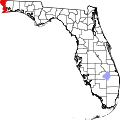 | |
| Town | ||
| CDPs | ||
| Unincorporated communities | ||
| Ghost town | ||
| Indian reservation | ||
| Footnotes | ‡This populated place also has portions in an adjacent county or counties | |
| International | |
|---|---|
| National | |

Pensacola Beach, Florida
View on GrokipediaHistory
Pre-20th Century Origins
The region encompassing Pensacola Beach on Santa Rosa Island was utilized by indigenous groups, particularly the Panzacola people, for millennia prior to European contact, relying on the bay's resources for fishing, hunting, and trade. These Muskogean-speaking inhabitants, whose name derives from the local term for the bay and may signify "hairy people" or "bread people," maintained villages and seasonal camps along the coastal barrier, integrating the island's dunes and lagoons into their subsistence economy. Archaeological evidence indicates continuous Native American presence in the Pensacola Bay area dating back over 10,000 years, with the Panzacola emerging as a distinct group by the late prehistoric period.[7][8][9] European exploration reached the area in the mid-16th century, with Spanish forces under Tristán de Luna y Arellano establishing the first attempted settlement in the continental United States at Pensacola Bay on August 15, 1559. The expedition, comprising 1,500 colonists aboard 12 ships—including Spanish settlers, free and enslaved Africans, and allied Natives—aimed to secure a Gulf Coast foothold and overland route to Mexico, landing near the modern site overlooking the bay rather than on Santa Rosa Island itself. Successive hurricanes in September 1559 and again in 1561 devastated supplies, vessels, and morale, forcing abandonment by 1561 and marking the failure of this early colonial venture due to environmental hazards and logistical challenges.[10][11][12] In the 18th century, Spanish authorities fortified Santa Rosa Island directly with the Presidio Isla de Santa Rosa Punta de Siguenza, constructed in 1722 as a defensive outpost amid conflicts with French and British rivals. This wooden fortification, garrisoned by approximately 100 soldiers and families, guarded the harbor entrance and replaced earlier mainland positions vulnerable to attack, reflecting Spain's strategic emphasis on barrier island control for naval protection. A major hurricane in 1752 obliterated the presidio, prompting relocation to the mainland Presidio San Miguel de Panzacola and underscoring the persistent threat of coastal storms to early infrastructure on the island.[13][14][15]Mid-20th Century Development and Infrastructure
The Santa Rosa Island Authority (SRIA) was established by the Florida Legislature on June 16, 1947, to oversee the development and management of Santa Rosa Island, including the area designated as Pensacola Beach.[16] This followed the U.S. Department of the Interior deeding approximately 18.5 miles of the island to Escambia County in 1947, with conditions restricting resale and emphasizing leasing for public use and tourism promotion.[17] The SRIA's formation addressed the need for coordinated infrastructure planning amid growing post-World War II interest in coastal recreation, leveraging proximity to Naval Air Station Pensacola to attract military personnel and civilians. In 1949, the Florida Legislature enacted Chapter 25810, empowering the SRIA to issue 99-year leases for residential and commercial construction on the island.[16] This leasing system facilitated rapid private investment in hotels, motels, and vacation homes, transforming previously undeveloped barrier island sections into a tourist destination. By the 1950s, Escambia County officials actively promoted Pensacola Beach as a family-oriented resort area, capitalizing on white-sand beaches and Gulf of Mexico access, which spurred construction of amenities like restaurants and piers.[18] Infrastructure advancements supported this expansion, including upgrades to access routes. The original 1931 bridges connecting the mainland to Santa Rosa Island were supplemented by improvements to U.S. Highway 98 through Gulf Breeze, culminating in a new Pensacola Bay Bridge segment opening on October 31, 1960, which enhanced vehicular traffic flow to the beach.[19] The SRIA also initiated early projects for roads, utilities, and erosion control, laying the groundwork for sustained tourism growth into the 1960s, though the modern Bob Sikes Bridge to Pensacola Beach proper was not completed until the mid-1970s.[20] These efforts marked a shift from limited ferry-dependent access to automobile-oriented development, aligning with broader mid-century Florida coastal urbanization trends.Late 20th and Early 21st Century Events
On October 4, 1995, Hurricane Opal made landfall near Pensacola Beach as a Category 3 storm with sustained winds of 115 mph (185 km/h).[21] The hurricane produced a storm surge that destroyed sections of Highway 399 linking Pensacola Beach to Navarre and inflicted severe erosion on beaches and dunes across Santa Rosa Island.[22] Rainfall measured 7.27 inches (185 mm) in nearby Pensacola, exacerbating inland effects, while gusts reached high velocities that damaged coastal structures.[21] Nearly a decade later, Hurricane Ivan struck on September 16, 2004, as a Category 3 hurricane with maximum sustained winds of 130 mph (210 km/h) and a storm surge of 10 to 15 feet (3 to 4.5 m).[23] In Pensacola Beach, the surge and winds led to the destruction or major damage of 58 habitable structures on Santa Rosa Island, including single-family homes and condominiums seaward of the coastal construction control line.[24] The event contributed to broader regional devastation, with over 75,000 homes affected across Escambia and Santa Rosa counties.[25] Hurricane Dennis followed less than a year later, making landfall on July 10, 2005, as a Category 3 storm with winds near 120 mph (193 km/h) between Pensacola Beach and Navarre Beach.[26] The cyclone generated surges of 5 to 7 feet (1.5 to 2.1 m), with estimates up to 10 feet (3 m) in some areas, causing extensive beach erosion that undermined dune restoration projects implemented after Ivan.[27] Coastal overwash and flooding impacted Santa Rosa Island, further stressing the barrier island's infrastructure.[26]Geography
Location and Physical Features
Pensacola Beach occupies a portion of Santa Rosa Island, a narrow barrier island in Escambia County, northwestern Florida, United States.[28] The community is situated approximately at coordinates 30.3333°N, 87.1358°W.[29] It is bordered to the south by the Gulf of Mexico, to the north by Pensacola Bay via Little Sabine Bay and Big Sabine Bay, and connected to the mainland by the Bob Sikes Bridge and other causeways from Pensacola.[28] Santa Rosa Island extends eastward for about 40 miles (64 km) from near the Alabama-Florida border, sheltering the inland bays and contributing to the region's coastal morphology.[30] The developed area of Pensacola Beach spans roughly 8 miles (13 km) along the island's Gulf-facing shoreline and covers approximately 1,474 acres, representing about 30% of Escambia County's holdings on Santa Rosa Island.[31] The island's width in this vicinity averages around 500 meters (0.3 miles), narrowing in places due to its barrier nature, with maximum elevations rarely exceeding 10-20 feet (3-6 meters) above sea level, making it highly susceptible to storm surges and tidal influences.[32] Physical features include extensive stretches of fine, white quartz sand beaches, formed from eroded Appalachian quartz deposits transported by rivers and waves, which reflect sunlight to produce the waters' vivid turquoise hues over the shallow continental shelf.[33] Dunes, stabilized by native sea oats and other vegetation, provide natural barriers against erosion, though the dynamic coastal environment requires ongoing management.[1]Coastal Geology and Beach Dynamics
Pensacola Beach occupies the western portion of Santa Rosa Island, a low-lying, wave-dominated barrier island approximately 40 miles long situated along the northwestern Florida Gulf Coast. The island's geologic framework consists of Holocene barrier sands deposited atop Pleistocene coastal plain sediments during post-glacial sea-level rise, forming a dynamic system responsive to fluctuations in relative sea level and sediment supply. Beach sediments are predominantly fine- to medium-grained quartz sand with high purity, resulting from the erosion of ancient quartzites in the Appalachian Mountains, followed by fluvial transport southward via rivers such as the Apalachicola and subsequent marine redistribution along the continental shelf.[34][35] The characteristic white coloration stems from the quartz's resistance to chemical weathering and minimal admixture of darker minerals or carbonates, with grain sizes typically ranging from 0.125 to 0.25 mm, conducive to the soft, powdery texture observed.[36] Beach dynamics are governed by seasonal wave regimes, tidal influences, and episodic storms within a micro-tidal environment (mean range ~0.4 m). Moderate to high wave energy prevails, with significant wave heights often reaching 1 m or more, driving longshore currents that result in net westward sediment transport rates estimated at 100,000–300,000 cubic yards per year regionally, fostering progradation of downdrift spits while maintaining equilibrium profiles under fair-weather conditions.[37] This transport direction aligns with predominant easterly wave approach angles, though reversals occur near structural features like jetties, leading to localized accretion updrift and erosion downdrift of Pensacola Pass.[38] Features such as rhythmic beach cusps and inner bars form under oblique wave incidence, with longshore drift velocities averaging 0.2–0.5 m/s.[37] Hurricanes and tropical storms introduce disequilibrium through surge-driven overwash, dune scarping, and offshore bar formation, eroding up to 10–30 m of shoreline width in severe events; for example, Hurricane Ivan in September 2004 removed significant dune volumes across Santa Rosa Island, with recovery via cross-shore and alongshore accretion occurring over months to years depending on post-storm wave energy and sediment availability.[39] Such disturbances highlight the barrier's vulnerability to accelerated sea-level rise, which exacerbates erosion by steepening profiles and reducing sediment budgets, though natural resilience is evident in historical progradation rates of 1–2 m/year in accretionary zones.[40][37] Inlet stabilization structures have modulated these patterns since the mid-20th century, altering pre-existing transport continuity.[38]Climate
Meteorological Characteristics
Pensacola Beach features a humid subtropical climate (Köppen classification Cfa), with long hot summers, mild winters, and significant year-round precipitation influenced by its Gulf of Mexico location. The proximity to the Gulf moderates temperature extremes through sea breezes, which typically develop in the afternoon and provide localized cooling during summer months, while also contributing to higher humidity levels. Annual average temperatures range from a high of 79°F to a low of 60°F, based on 1991-2020 normals recorded at nearby Pensacola stations.[41] [42] Summer temperatures from May to September average above 84°F daily highs, peaking at 89°F in July with nighttime lows around 76°F, creating oppressive heat index values often exceeding 100°F due to dew points frequently above 72°F. Winters from December to February see average highs below 67°F, with January's low of 45°F marking the coldest period, though freezes occur infrequently, averaging fewer than 5 nights per year. The hot season spans approximately 3.8 months, while the cool season lasts about 3 months, reflecting the stabilizing maritime influence that reduces diurnal temperature swings compared to inland areas.[42] Precipitation totals average 68.31 inches annually, occurring on about 111 days, with no distinctly dry season but a wetter period from June to September driven by convective thunderstorms from sea breeze convergence and tropical moisture. July records the highest monthly average at around 5.8 inches, often from brief, intense afternoon storms, while October is driest at 3.6 inches. Relative humidity averages 70-86% diurnally, with muggy conditions (dew point >65°F) persisting from mid-April to late October, peaking at over 30 muggy days in July.[41] [42] [43] Wind patterns feature prevailing southerly to southeasterly flows year-round, with average speeds ranging from 6.5 mph in calm summer months like July to 9.9 mph in January, the windiest period influenced by frequent frontal passages. Annual average wind speeds hover around 8-9 mph, with gusts commonly exceeding 20 mph during thunderstorms or winter fronts. Cloud cover is partly cloudy overall, cloudiest in July (59% overcast or mostly cloudy) due to convective activity, and clearest in October (66% clear or mostly clear).[42] [44]| Month | Avg High (°F) | Avg Low (°F) | Precipitation (in) | Wet Days |
|---|---|---|---|---|
| Jan | 61 | 45 | 4.5 | 10.5 |
| Feb | 65 | 48 | 4.2 | 9.0 |
| Mar | 71 | 54 | 4.1 | 8.5 |
| Apr | 77 | 60 | 3.8 | 7.0 |
| May | 84 | 68 | 4.5 | 8.5 |
| Jun | 88 | 73 | 5.5 | 12.0 |
| Jul | 89 | 76 | 5.8 | 17.8 |
| Aug | 89 | 76 | 5.6 | 16.0 |
| Sep | 87 | 73 | 5.0 | 12.0 |
| Oct | 80 | 64 | 3.6 | 6.8 |
| Nov | 71 | 54 | 4.0 | 7.5 |
| Dec | 64 | 48 | 4.3 | 9.5 |
| Annual | 79 | 60 | 68.31 | 111 |
Hurricane Vulnerability and Historical Storms
Pensacola Beach's position on the low-lying Santa Rosa barrier island renders it particularly susceptible to hurricane impacts, including storm surge, high winds exceeding 100 mph, and resultant coastal erosion. The island's narrow width—typically 0.5 to 1 mile—and elevations rarely surpassing 10 feet above sea level facilitate overwash during surges over 5-10 feet, breaching dunes and redistributing sand inland. Since 1975, the area has endured eight direct hurricane strikes and numerous tropical storms, contributing to its ranking among the top U.S. cities for hurricane risk, with empirical models projecting continued exposure due to Gulf warming and sea-level rise amplifying surge heights by 1-2 feet per decade in vulnerability assessments.[45][46][47] Barrier island dynamics exacerbate this vulnerability, as storms erode frontal beaches and deposit sediment rearward, temporarily widening back-barrier areas but compromising structural integrity; recovery of dune volumes post-event averages 20-50% within two years without intervention, per surveys of Ivan-affected sites. High wind events, with 437 recorded instances including a 1917 tropical storm equivalent to Category 4, have historically generated gusts up to 130 mph, damaging lightweight beachfront constructions and utilities. Flooding compounds risks, with impermeable development accelerating runoff and surge propagation across the island.[48][49][50] Notable historical storms underscore these patterns. Hurricane Opal made landfall on October 4, 1995, at Pensacola Beach as a Category 3 with sustained winds of 115 mph and a 12-15 foot storm surge, eroding beaches by up to 200 feet, destroying 300 homes, and causing $3 billion in regional damage including dune breaching along Santa Rosa Island.[51][52][53] Hurricane Ivan struck nearby on September 16, 2004, as a Category 3 with 130 mph winds, generating 10-13 foot surges that caused extensive overwash, barrier island breaching at Gulf Islands National Seashore, and the destruction of over 50% of Pensacola Beach's condominiums and infrastructure, with total costs exceeding $18 billion across the Gulf Coast.[24][54] Hurricane Sally, the most recent major event, stalled over the region on September 16, 2020, delivering Category 2 winds, a 6.5-foot surge at Pensacola Beach, and over 20 inches of rainfall, resulting in record flooding, road washouts, and $2 billion in damages, marking the first direct Gulf hit since Ivan.[55][56]| Storm | Date | Category at Landfall | Key Impacts on Pensacola Beach |
|---|---|---|---|
| Opal | October 4, 1995 | 3 | 12-15 ft surge; 200 ft beach erosion; 300 homes destroyed[51] |
| Ivan | September 16, 2004 | 3 (nearby) | 10-13 ft surge; widespread breaching; >50% structures damaged[24] |
| Sally | September 16, 2020 | 2 | 6.5 ft surge; >20 in rain; flooding and washouts[55] |