Hubbry Logo
Plains IndiansPlains IndiansMain
Open search
Plains Indians
Community hub
Plains Indians
logo
8 pages, 0 posts
0 subscribers
Be the first to start a discussion here.
Plains Indians
Plains Indians
from Wikipedia

Stumickosúcks of the Kainai.
George Catlin, 1832
Comanches capturing wild horses with lassos, approximately July 16, 1834
Spotted Tail of the Lakota Sioux

Plains Indians or Indigenous peoples of the Great Plains are the Native American tribes and First Nations peoples who have historically lived on the Interior Plains (the Great Plains) of North America.[1] While hunting-farming cultures have lived on the Great Plains for centuries prior to European contact, the region is known for the horse cultures that flourished from the 17th century through the late 19th century. Their historic nomadism and armed resistance to domination by the government and military forces of Canada and the United States have made the Plains Indian culture groups an archetype in literature and art for Native Americans everywhere.

The Plains tribes are usually divided into two broad classifications which overlap to some degree. The first group became a fully nomadic horse culture during the 18th and 19th centuries, following the vast herds of American bison, although some tribes occasionally engaged in agriculture. These include the Arapaho, Assiniboine, Blackfoot, Cheyenne, Comanche, Crow, Gros Ventre, Kiowa, Lakota, Lipan, Plains Apache (or Kiowa Apache), Plains Cree, Plains Ojibwe, Sarsi, Nakoda (Stoney), and Tonkawa. The second group were sedentary and semi-sedentary, and, in addition to hunting bison, they lived in villages, raised crops, and actively traded with other tribes. These include the Arikara, Hidatsa, Iowa, Kaw (or Kansa), Kitsai, Mandan, Missouria, Omaha, Osage, Otoe, Pawnee, Ponca, Quapaw, Wichita, and the Santee Dakota, Yanktonai and Yankton Dakota.

History

[edit]
Bison hunt under the wolf-skin mask, George Catlin, c. 1832
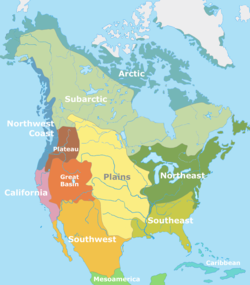
Early Native American tribal territories color-coded by linguistic group

The earliest people of the Great Plains mixed hunting and gathering wild plants. The cultures developed horticulture, then agriculture, as they settled in sedentary villages and towns. Maize, originally from Mesoamerica and spread north from the Southwest, became widespread in the south of the Great Plains around 700 CE.[2]

Numerous Plains peoples hunted the American bison (or buffalo) to make items used in everyday life, such as food, cups, decorations, crafting tools, knives, and clothing. The tribes followed the seasonal grazing and migration of the bison. The Plains Indians lived in tipis because they were easily disassembled and allowed the nomadic life of following game.

The Spanish explorer Francisco Vásquez de Coronado was the first European to describe the Plains Indian culture. He encountered villages and cities of the Plains village cultures. While searching for a reputedly wealthy land called Quivira in 1541, Coronado came across the Querechos in the Texas panhandle. The Querechos were the people later called Apache. According to the Spaniards, the Querechos lived "in tents made of the tanned skins of the cows (bison). They dry the flesh in the sun, cutting it thin like a leaf, and when dry they grind it like meal to keep it and make a sort of sea soup of it to eat. ... They season it with fat, which they always try to secure when they kill a cow. They empty a large gut and fill it with blood, and carry this around the neck to drink when they are thirsty."[3] Coronado described many common features of Plains Indians culture: skin tepees, travois pulled by dogs, Plains Indian Sign Language, and staple foods such as jerky and pemmican.

Siouan language speakers may have originated in the lower Mississippi River region. They were agriculturalists and may have been part of the Mound Builder civilization during the 9th–12th centuries. Wars with the Ojibwe and Cree peoples pushed the Lakota (Teton Sioux) west onto the Great Plains in the mid- to late 17th century.[4] The Shoshone originated in the western Great Basin and spread north and east into present-day Idaho and Wyoming. By 1500, some Eastern Shoshone had crossed the Rocky Mountains into the Great Plains. After 1750, warfare and pressure from the Blackfoot, Crow, Lakota, Cheyenne, and Arapaho pushed Eastern Shoshone south and westward. Some of them migrated as far south as Texas, emerging as the Comanche by 1700.[5]

European explorers and hunters (and later, settlers) brought diseases against which the Indians had no resistance. Between a half and two-thirds of the Plains Indians are thought to have died of smallpox by the time of the Louisiana Purchase.[6] The 1837 Great Plains smallpox epidemic spread across the Great Plains, killing many thousands between 1837 and 1840. In the end, it is estimated that two-thirds of the Blackfoot population died, along with half of the Assiniboines and Arikaras, a third of the Crows, and a quarter of the Pawnees.[7]

Horses

[edit]
Spread of the horse. The black line defines the distribution of the bison.

The Plains Indians historically lived without horses, which went extinct in the Americas 15,000–13,000 years ago.[8] However, the reintroduction of the horse in the 16th century had a profound impact on the culture of the Great Plains. When horses were obtained, the Plains tribes rapidly integrated them into their daily lives. People in the southwest began to acquire horses in the 16th century by trading or stealing them from Spanish colonists in New Mexico. As horse culture moved northward, the Comanche were among the first to commit to a fully mounted nomadic lifestyle. This occurred by the 1730s, when they had acquired enough horses to put all their people on horseback.[9]

The horse enabled the Plains Indians to gain their subsistence with relative ease from the seemingly limitless bison herds. Riders were able to travel faster and farther in search of bison herds and to transport more goods, thus making it possible to enjoy a richer material environment than their pedestrian ancestors. For the Plains peoples, the horse became an item of prestige as well as utility. They were extravagantly fond of their horses and the lifestyle they permitted.

The first Spanish conqueror to bring horses to the new world was Hernán Cortés in 1519. However, Cortés only brought about sixteen horses with his expedition. Coronado brought 558 horses with him on his 1539–1542 expedition. At the time, the Indians of these regions had never seen a horse. Only two of Coronado's horses were mares, so he was highly unlikely to have been the source of the horses that Plains Indians later adopted as the cornerstone of their culture.[10]: 429  In 1592, however, Juan de Oñate brought 7,000 head of livestock with him when he came north to establish a colony in New Mexico. His horse herd included mares as well as stallions.

Stump Horn of the Cheyenne and his family with a horse and travois, c. 1871–1907

Pueblo Indians learned about horses by working for Spanish colonists. The Spanish attempted to keep knowledge of riding away from Native people, but nonetheless, they learned and some fled their servitude to their Spanish employers—and took horses with them. Some horses were obtained through trade in spite of prohibitions against it. Other horses escaped captivity for a feral existence and were captured by Native people. In all cases, the horse was adopted into their culture and herds multiplied. By 1659, the Navajo from northwestern New Mexico were raiding the Spanish colonies to steal horses. By 1664, the Apache were trading captives from other tribes to the Spanish for horses. The real beginning of the horse culture of the plains began with the Pueblo Revolt of 1680 in New Mexico and the capture of thousands of horses and other livestock. They traded many horses north to the Plains Indians.[10]: 429–431  In 1683 a Spanish expedition into Texas found horses among Native people. In 1690, a few horses were found by the Spanish among the Indians living at the mouth of the Colorado River of Texas and the Caddo of eastern Texas had a sizeable number.[11][10]: 432 

The French explorer Claude Charles Du Tisne found 300 horses among the Wichita on the Verdigris River in 1719, but they were still not plentiful. Another Frenchman, Bourgmont, could only buy seven at a high price from the Kaw in 1724, indicating that horses were still scarce among tribes in Kansas. While the distribution of horses proceeded slowly northward on the Great Plains, it moved more rapidly through the Rocky Mountains and the Great Basin. The Shoshone in Wyoming had horses by about 1700 and the Blackfoot people, the most northerly of the large Plains tribes, acquired horses in the 1730s.[10]: 429–437  By 1770, Plains horse culture was established, consisting of mounted bison-hunting nomads from Saskatchewan and Alberta southward nearly to the Rio Grande. Soon afterward, pressure from Europeans and Euro-Americans on all sides and European diseases caused its decline.

This painting by Alfred Jacob Miller portrays Plains Indians chasing buffalo over a small cliff.[12] The Walters Art Museum.

It was the Comanche, coming to the attention of the Spanish in New Mexico in 1706, who first realized the potential of the horse. As nomads, hunters, and pastoralists, well supplied with horses, they swept most of the mixed-economy Apaches from the plains and by the 1730s were dominant in the Great Plains south of the Arkansas River.[13]: 3–4 (835–836)  The success of the Comanche encouraged other Indian tribes to adopt a similar lifestyle. The southern Plains Indians acquired vast numbers of horses. By the 19th century, Comanche and Kiowa families owned an average of 35 horses and mules each – and only six or seven were necessary for transport and war. The horses extracted a toll on the environment as well as required labor to care for the herd. Formerly egalitarian societies became more divided by wealth with a negative impact on the role of women. The richest men would have several wives and captives who would help manage their possessions, especially horses.[14]

The milder winters of the southern Plains favored a pastoral economy by the Indians.[15] On the northeastern Plains of Canada, the Indians were less favored, with families owning fewer horses, remaining more dependent upon dogs for transporting goods, and hunting bison on foot. The scarcity of horses in the north encouraged raiding and warfare in competition for the relatively small number of horses that survived the severe winters.[16]

The Lakota, also called Teton Sioux, enjoyed the happy medium between North and South and became a dominant Plains tribe by the mid-19th century. They had relatively small horse herds, thus having less impact on their ecosystem. At the same time, they occupied the heart of prime bison range which was also an excellent region for furs, which could be sold to French and American traders for goods such as guns. The Lakota became a highly powerful Plains tribe.[17]

Slaughter of the bison

[edit]
This map of the extermination of bison to 1889 is based on William Temple Hornaday's late-nineteenth-century research.

By the 19th century, the typical year of the Lakota and other northern nomads was a communal buffalo hunt as early in spring as their horses had recovered from the rigors of the winter. In June and July the scattered bands of the tribes gathered together into large encampments, which included ceremonies such as the Sun Dance. These gatherings afforded leaders to meet to make political decisions, plan movements, arbitrate disputes, and organize and launch raiding expeditions or war parties. In the fall, people would split up into smaller bands to facilitate hunting to procure meat for the long winter. Between the fall hunt and the onset of winter was a time when Lakota warriors could undertake raiding and warfare. With the coming of winter snows, the Lakota settled into winter camps, where activities of the season ceremonies and dances as well as trying to ensure adequate winter feed for their horses.[18] On the southern plains, with their milder winters, the fall and winter was often the raiding season. Beginning in the 1830s, the Comanche and their allies often raided for horses and other goods deep into Mexico, sometimes venturing 1,000 miles (1,600 km) south from their homes near the Red River in Texas and Oklahoma.[19]

The U.S. federal government and local governments promoted bison hunting for various reasons: to allow ranchers to range their cattle without competition from other bovines and to starve and weaken the Plains Indian population to pressure them to remain on reservations.[20][21] The bison herds formed the basis of the economies of the Plains tribes. Without bison, they were forced to move onto reservations or starve.[20]

Bison were slaughtered for their skins, with the rest of the animal left behind to decay on the ground. After the animals rotted, their bones were collected and shipped back east in large quantities.[22]

A pile of bison skulls in the 1870s.

The railroad industry also wanted bison herds culled or eliminated. Herds of bison on tracks could damage locomotives when the trains failed to stop in time. Herds often took shelter in the artificial cuts formed by the grade of the track winding through hills and mountains in harsh winter conditions. As a result, bison herds could delay a train for days.[citation needed]

The slaughter of the bison had substantial adverse impacts on the Native American people who relied on them. These impacts were both immediate and persistent. By the early 20th century, bison nations had greater child mortality and unemployment compared to Indian nations that were never reliant on the bison. By the late 20th century, income per capita was 25% lower for bison nations. Whereas people in bison-hunting communities were once among the tallest people in the world, generations born after the slaughter of the bison had lost all their height advantage.[23]

As the great herds began to wane, proposals to protect the bison were discussed. Buffalo Bill Cody, among others, spoke in favor of protecting the bison because he saw that the pressure on the species was too great. But these were discouraged since it was recognized that the Plains Indians, often at war with the United States, depended on bison for their way of life. In 1874, President Ulysses S. Grant "pocket vetoed" a federal bill to protect the dwindling bison herds. In 1875, General Philip Sheridan pleaded to a joint session of Congress to slaughter the herds, to deprive the Plains Indians of their source of food.[24] This meant that the bison were hunted almost to extinction during the 19th century and were reduced to a few hundred by the early 1900s.

Indian Wars

[edit]
The Ghost Dance ritual, which the Lakota believed would reunite the living with spirits of the dead, cause the white invaders to vanish, and bring peace, prosperity, and unity to Indian peoples throughout the region

Armed conflicts intensified in the late 19th century between Native American nations on the plains and the U.S. government, through what were called generally the Indian Wars.[25] Notable conflicts in this period include the Dakota War, Great Sioux War, Snake War and Colorado War. Comanche power peaked in the 1840s when they conducted large-scale raids hundreds of miles into Mexico proper, while also warring against the Anglo-Americans and Tejanos who had settled in independent Texas. Expressing the frontier anti-Indian sentiment, Theodore Roosevelt believed the Indians were destined to vanish under the pressure of white civilization, stating in an 1886 lecture:

I don't go so far as to think that the only good Indians are dead Indians, but I believe nine out of ten are, and I shouldn't like to inquire too closely into the case of the tenth.[26]

Among the most notable events during the wars was the Wounded Knee Massacre in 1890.[27] In the years leading up to it the U.S. government had continued to seize Lakota lands. A Ghost Dance ritual on the Northern Lakota reservation at Wounded Knee, South Dakota, led to the U.S. Army's attempt to subdue the Lakota. The dance was part of a religious movement founded by the Northern Paiute spiritual leader Wovoka that told of the return of the Messiah to relieve the suffering of Native Americans and promised that if they would live righteous lives and perform the Ghost Dance properly, the European American colonists would vanish, the bison would return, and the living and the dead would be reunited in an Edenic world.[27] On December 29 at Wounded Knee, gunfire erupted, and U.S. soldiers killed up to 300 Indians, mostly old men, women, and children.[27]

Material culture

[edit]

Agriculture and plant foods

[edit]
The Wichita were an agrarian Southern Plains tribe, who historically lived in beehive-shaped houses thatched with grass surrounded by extensive maize fields. They were skilled farmers who traded agricultural products with the nomadic tribes in exchange for meat and hides.

The semi-sedentary, village-dwelling Plains Indians depended upon agriculture for a large share of their livelihood, particularly those who lived in the eastern parts of the Great Plains which had more precipitation than the western side. Corn was the dominant crop, followed by squash and beans. Tobacco, sunflower, plums and other plants were also cultivated or gathered in the wild.[28][29] Among the wild crops gathered the most important were probably berries to flavor pemmican and the Prairie Turnip.

The first indisputable evidence of maize cultivation on the Great Plains is about 900 AD.[30] The earliest farmers, the Southern Plains villagers were probably Caddoan speakers, the ancestors of the Wichita, Pawnee, and Arikara of today. Plains farmers developed short-season and drought resistant varieties of food plants. They did not use irrigation but were adept at water harvesting and siting their fields to receive the maximum benefit of limited rainfall. The Hidatsa and Mandan of North Dakota cultivated maize at the northern limit of its range.[31]

The farming tribes also hunted buffalo, deer, elk, and other game. Typically, on the southern Plains, they planted crops in the spring, left their permanent villages to hunt buffalo in the summer, returned to harvest crops in the fall, and left again to hunt bison in the winter. The farming Indians also traded corn to the nomadic tribes for dried buffalo meat.

With the arrival of the horse, some tribes, such as the Lakota and Cheyenne, gave up agriculture to become full-time, buffalo-hunting nomads.[citation needed]

By the 1870s bison herds were depleted and beef, cereal grains, fats and starchy vegetables became more important in the diet of Plains Indians. Fruits and nuts were, especially plums and grapes were dried as winter store. Flour was made from the Indian breadroot (Pediomelum esculentum). Indian tea (lespedeza) is still sometimes consumed by Plains Indians who have retained these cultural traditions. Plums were one of the most important wild plant foods on the Oklahoma reservation.[32]

Hunting

[edit]
"Assiniboine hunting buffalo", painting by Paul Kane

Although people of the Plains hunted other animals, such as elk or pronghorn, buffalo was the primary game food source. Before horses were introduced, hunting was a more complicated process. Hunters would surround the bison, and then try to herd them off cliffs or into confined places where they could be more easily killed. The Plains Indians constructed a v-shaped funnel, about a mile long, made of fallen trees or rocks. Sometimes bison could be lured into a trap by a person covering himself with a bison skin and imitating the call of the animals.[33]

Before their adoption of guns, the Plains Indians hunted with spears, bows, and various forms of clubs. The use of horses by the Plains Indians made hunting (and warfare) much easier. With horses, the Plains Indians had the means and speed to stampede or overtake the bison. The Plains Indians reduced the length of their bows to three feet to accommodate their use on horseback. They continued to use bows and arrows after the introduction of firearms because guns took too long to reload and were too heavy. In the summer, many tribes gathered for hunting in one place. The main hunting seasons were fall, summer, and spring. In winter, adverse weather such as snow and blizzards made it more difficult to locate and hunt bison.

Clothing

[edit]

Hides, with or without fur, provided material for much clothing. Most of the clothing consisted of the hides of buffalo and deer, as well as numerous species of birds and other small game.[34] Plains moccasins tended to be constructed with soft braintanned hide on the vamps and tough rawhide for the soles. Men's moccasins tended to have flaps around the ankles, while women's had high tops, which could be pulled up in the winter and rolled down in the summer. Honored warriors and leaders earn the right to wear war bonnets, headdresses with feathers, often of golden or bald eagles.

Society and culture

[edit]

Religion

[edit]
An Oglala Lakota Ghost Dance at Pine Ridge. Illustration by Frederic Remington
Rainmaking among the Mandan, by George Catlin, 1830s

While there are some similarities among linguistic and regional groups, different tribes have their own cosmologies and world views. Some of these are animist in nature, with aspects of polytheism, while others tend more towards monotheism or panentheism. Prayer is a regular part of daily life, for regular individuals as well as spiritual leaders, alone and as part of group ceremonies. One of the most important gatherings for many of the Plains tribes is the yearly Sun Dance, an elaborate spiritual ceremony that involves personal sacrifice, multiple days of fasting and prayer for the good of loved ones and the benefit of the entire community.[35]

Certain people are considered to be wakan (Lakota: "holy"), and go through many years of training to become medicine men or women, entrusted with spiritual leadership roles in the community. The buffalo and eagle are particularly sacred to many of the Plains peoples, and may be represented in iconography, or parts used in regalia. In Plains cosmology, certain items may possess spiritual power, particularly medicine bundles which are only entrusted to prominent religious figures of a tribe, and passed down from keeper to keeper in each succeeding generation.

Gender roles

[edit]

Historically, Plains Indian women had distinctly defined gender roles that were different from, but complementary to, men's roles. They typically owned the family's home and the majority of its contents.[36] In traditional culture, women tanned hides, tended crops, gathered wild foods, prepared food, made clothing, and took down and erected the family's tepees. In the present day, these customs are still observed when lodges are set up for ceremonial use, such as at pow wows. Historically, Plains women were not as engaged in public political life as were the women in the coastal tribes. However, they still participated in an advisory role and through the women's societies.[37]

"Indian women moving", painting by Charles Marion Russell

In contemporary Plains cultures, traditionalists work to preserve the knowledge of these traditions of everyday life and the values attached to them.[38]

Plains women in general have historically had the right to divorce and keep custody of their children.[36] Because women own the home, an unkind husband can find himself homeless.[36] A historical example of a Plains woman divorcing is Making Out Road, a Cheyenne woman, who in 1841 married non-Native frontiersman Kit Carson. The marriage was turbulent and formally ended when Making Out Road threw Carson and his belongings out of her tepee (in the traditional manner of announcing a divorce). She later went on to marry, and divorce, several additional men, both European-American and Indian.[39]

Warfare

[edit]
This painting depicts the speed and violence of an encounter between the U.S. cavalry and Plains Indians.

The earliest 16th-century Spanish explorers did not find the Plains Indians especially warlike. The Wichita in Kansas and Oklahoma lived in dispersed settlements with few defensive works. The Spanish initially had friendly contacts with the Apache (Querechos) in the Texas Panhandle.[3]

Three factors led to a growing importance of warfare in Plains Indian culture. First, was the Spanish colonization of New Mexico which stimulated raids and counter-raids by Spaniards and Indians for goods and slaves. Second, was the contact of the Indians with French fur traders which increased rivalry among Indian tribes to control trade and trade routes. Third, was the acquisition of the horse and the greater mobility it afforded the Plains Indians.[40] What evolved among the Plains Indians from the 17th to the late 19th century was warfare as both a means of livelihood and a sport. Young men gained both prestige and plunder by fighting as warriors, and this individualistic style of warfare ensured that success in individual combat and capturing trophies of war were highly esteemed [41]: 20 

The Plains Indians raided each other, the Spanish colonies, and, increasingly, the encroaching frontier of the Anglos for horses, and other property. They acquired guns and other European goods primarily by trade. Their principal trading products were buffalo hides and beaver pelts.[42] The most renowned of all the Plains Indians as warriors were the Comanche whom The Economist noted in 2010: "They could loose a flock of arrows while hanging off the side of a galloping horse, using the animal as protection against return fire. The sight amazed and terrified their white (and Indian) adversaries."[43] The American historian S. C. Gwynne called the Comanche "the greatest light cavalry on the earth" in the 19th century whose raids in Texas terrified the American settlers.[43]

War on the Plains: Comanche (right) trying to lance an Osage warrior, painting by George Catlin, 1834

Although they could be tenacious in defense, Plains Indians warriors took the offensive mostly for material gain and individual prestige. The highest military honors were for "counting coup"—touching a live enemy. Battles between Indians often consisted of opposing warriors demonstrating their bravery rather than attempting to achieve concrete military objectives. The emphasis was on ambush and hit and run actions rather than closing with an enemy. Success was often counted by the number of horses or property obtained in the raid. Casualties were usually light. "Indians consider it foolhardiness to make an attack where it is certain some of them will be killed."[44] Given their smaller numbers, the loss of even a few men in battle could be catastrophic for a band, and notably at the battles of Adobe Walls in Texas in 1874 and Rosebud in Montana in 1876, the Indians broke off battle despite the fact that they were winning as the casualties were not considered worth a victory.[41]: 20  The most famous victory ever won by the Plains Indians over the United States, the Battle of Little Bighorn, in 1876, was won by the Lakota (Sioux) and Cheyenne fighting on the defensive.[41]: 20  Decisions whether to fight or not were based on a cost-benefit ratio; even the loss of one warrior was not considered to be worth taking a few scalps, but if a herd of horses could be obtained, the loss of a warrior or two was considered acceptable.[41]: 20  Generally speaking, given the small sizes of the bands and the vast population of the United States, the Plains Indians sought to avoid casualties in battle, and would avoid fighting if it meant losses.[41]: 20 

Southern Cheyenne Chiefs Lawrence Hart, Darryl Flyingman and Harvey Pratt in Oklahoma City, 2008

Due to their mobility, endurance, horsemanship, and knowledge of the vast plains that were their domain, the Plains Indians were often victors in their battles against the U.S. army in the American era from 1803 to about 1890. However, although Indians won many battles, they could not undertake lengthy campaigns. Indian armies could only be assembled for brief periods of time as warriors also had to hunt for food for their families.[45] The exception to that was raids into Mexico by the Comanche and their allies in which the raiders often subsisted for months off the riches of Mexican haciendas and settlements. The basic weapon of the Indian warrior was the short, stout bow, designed for use on horseback and deadly, but only at short range. Guns were usually in short supply and ammunition scarce for Native warriors.[46] The U.S. government through the Indian Agency would sell the Plains Indians guns for hunting, but unlicensed traders would exchange guns for buffalo hides.[41]: 23  The shortages of ammunition together with the lack of training to handle firearms meant the preferred weapon was the bow and arrow.[41]: 23 

Research

[edit]

The people of the Great Plains have been found to be the tallest people in the world during the late 19th century, based on 21st century analysis of data collected by Franz Boas for the World Columbian Exposition. This information is significant to anthropometric historians, who usually equate the height of populations with their overall health and standard of living.[47]

List of peoples

[edit]
Pawnee warrior, by George Catlin, 1832

Indigenous peoples of the Great Plains are often separated into Northern and Southern Plains tribes.

See also

[edit]

References

[edit]

Further reading

[edit]

See also

[edit]
[edit]
Revisions and contributorsEdit on WikipediaRead on Wikipedia
from Grokipedia
The Plains Indians comprise diverse Native American tribes that historically inhabited the vast region of , spanning from the to the and from the in present-day to . These groups, numbering over 30 distinct tribes such as the , , , Blackfeet, and , each maintained unique languages, customs, and social structures but shared a post-contact nomadic lifestyle predicated on equestrian mobility and intensive exploitation of the for sustenance, tools, clothing, and shelter. The introduction of s, originating from Spanish colonies and diffusing northward by the mid-18th century, revolutionized their societies by enabling efficient communal bison hunts, expanded territorial raiding for resources and captives, and the accumulation of wealth through horse herds, which supplanted earlier pedestrian or semi-sedentary patterns and fostered warrior-centric hierarchies. Central to Plains Indian economies and cultures was the , whose herds provided nearly all material needs and supported populations through hides for tipis and robes, for food, bones for implements, and sinew for cordage, with techniques evolving from pedestrian surrounds and drives to high-speed mounted pursuits that maximized yields but intensified competition and intertribal warfare over prime hunting grounds. emphasized bands, age-graded warrior societies, and frequent raids for , women, and prestige via —touching an enemy in battle without killing—rather than large-scale conquests, though practices like and enslavement of captives underscored a martial ethos that predated but amplified with European contact. This adaptation yielded notable prowess in horsemanship and tactical warfare, allowing dominance over vast ranges, yet rendered tribes vulnerable when industrial slaughter in the —reducing herds from tens of millions to near extinction by 1889—collapsed their self-sufficiency, precipitating forced relocations, reservation confinement, and cultural upheavals amid conflicts with expanding American settlement. Defining controversies include the deliberate U.S. policy of eradication to undermine tribal resistance, as articulated by military figures, alongside persistent intertribal hostilities that hindered unified opposition, culminating in events like the movement and Wounded Knee Massacre of 1890.

Overview and Definition

Tribes and Linguistic Groups

The tribes associated with Plains culture prior to European dominance belonged to several major linguistic families, primarily Siouan, Algonquian, and Caddoan, with linguistic diversity arising from long-term occupations and migrations into the region. Siouan and Caddoan speakers had established presence in the central and southern Plains for centuries before 1500 CE, while Algonquian groups expanded westward from areas between approximately 1500 and 1700 CE, often displacing or interacting with earlier inhabitants. Siouan-speaking tribes included the Lakota (Teton), Dakota (Santee-Sisseton and Yankton-Yanktonai divisions), subgroups, , , , and , occupying territories along the and northern Plains. These groups formed the core of northern Plains populations, with historical records suggesting the alone numbered around 15,000 at initial European contact in the . Algonquian-affiliated tribes encompassed the , , , (Atsina), and , primarily in the northern and central Plains. The , for instance, migrated from the to the Plains in the late 1600s, driven by competition with neighboring groups like the . Athabaskan speakers, such as the (Plains Apache), represented smaller allied groups integrated into Plains networks, often associating with Uto-Aztecan or Kiowa-Tanoan through alliances rather than large-scale migrations. Caddoan tribes like the Pawnee, , and Wichita maintained semi-sedentary villages in the central Plains, predating the nomadic shifts of later horse-era arrivals.
Linguistic FamilyKey TribesHistorical Notes
SiouanLakota, Dakota, , Established along pre-1500 CE; agricultural bases in villages.
Algonquian, Blackfoot, Western expansions 1500–1700 CE from eastern woodlands.
AthabaskanKiowa ApacheSouthern Plains allies; post-1700 integrations.
CaddoanPawnee, Wichita, Among oldest Plains occupants; central riverine settlements.

Geographic and Environmental Context

The form a expansive physiographic province characterized by flat to undulating terrain east of the , extending northward from the through the into the Canadian Prairies of , , and , and covering approximately 1.3 million square kilometers in the core region. This area spans from the 96th to 104th meridians west, with boundaries marked by the Interior Lowlands to the east and the Rockies to the west, encompassing low annual precipitation gradients from 500 mm in the east to under 300 mm in the west, which delineate transitions in vegetation and support seasonal herd movements of herbivores like along natural corridors tied to grass regrowth. Ecologically, the Plains feature grassland biomes, with shortgrass prairie dominating the semi-arid western sectors through species such as blue grama (Bouteloua gracilis) and buffalograss (Bouteloua dactyloides), adapted to periodic droughts and intensive grazing that maintain open landscapes conducive to large-scale faunal congregations. These shortgrass systems, prevalent in areas like eastern Colorado and the High Plains, sustain nutrient cycling via fire and herbivory, while mixed- and tallgrass variants occur eastward where higher moisture allows denser cover; bison historically traversed these zones following ephemeral green-up patterns rather than fixed migratory paths, shaping vegetation mosaics through wallowing and trail formation. Perennial rivers including the and Platte originate in montane headwaters, meandering across the Plains to deposit alluvial sediments and sustain riparian corridors amid surrounding aridity, with the Platte draining over 130,000 square kilometers of central and the channeling flows that moderate local microclimates. records indicate high variability, exemplified by the Medieval Drought (approximately 900–1300 CE), a multi-century episode of diminished and elevated temperatures across the , driven by altered teleconnections like La Niña-like Pacific conditions, which reduced soil moisture and contracted productivity.

Pre-Horse Era

Archaic and Woodland Periods

The earliest documented human occupation of the occurred during the Paleo-Indian period, with the representing initial widespread colonization around 13,050 to 12,750 calibrated years (approximately 11,100–10,800 BCE). These big-game hunters employed distinctive fluted projectile points attached to spears or atlatls for pursuing now-extinct such as mammoths and mastodons, as evidenced by kill sites across the region including those in and . Archaeological assemblages from this era indicate small, mobile bands exploiting post-glacial landscapes, with technological adaptations persisting into later Folsom and Plano complexes until roughly 8,000 BCE. By the onset of the Archaic period around 8,000 BCE, climatic warming and megafaunal extinctions prompted a shift to generalized economies focused on smaller , and wild plants, marking a transition from specialized to broader subsistence strategies. Projectile point styles diversified, reflecting localized adaptations and possibly distinct cultural groups, with sites like those in the High Plains showing reduced emphasis on large herds in favor of seasonal camps and atlatl use. This period, extending to about 500 BCE, featured semi-permanent settlements in resource-rich areas, underscoring technological continuity in ground stone tools for processing gathered foods amid stabilizing environments. The , spanning approximately 500 BCE to 1000 CE, introduced key innovations including the , which enhanced hunting efficiency over the atlatl, and cord-impressed for storage and cooking. Sites such as Signal in western yield artifacts like small triangular points and ceramic sherds, indicating expanded networks for materials like chert and the beginnings of semi-sedentary village life in river valleys. These developments reflect gradual intensification of resource use without agriculture's dominance in the Plains core, maintaining as primary until later influences. Recent genomic analyses affirm deep ancestral continuity in the region, with from ancestors showing linkage to lineages persisting from the around 18,000 years ago, including shared alleles with populations and minimal admixture until historic times. This evidence, derived from sampled remains in and , supports persistent occupation by related groups through Paleo-Indian, Archaic, and phases, countering models of large-scale population replacements.

Subsistence and Settlement Patterns

Prior to the widespread adoption of horses, many Plains Indians, particularly riverine groups such as the Mandan, Hidatsa, and Arikara, resided in semi-sedentary earthlodge villages situated along major waterways like the Missouri River. These settlements featured circular, dome-shaped dwellings constructed from wooden frames covered in earth, measuring 30 to 60 feet in diameter and accommodating extended families of 10 to 30 individuals. Villages often comprised dozens to over a hundred lodges, surrounded by palisade fortifications for protection against raids, with summer villages on bluffs and winter camps in sheltered bottomlands to optimize resource access and defense. Subsistence relied on a dominated by , , and pedestrian . Women managed fields, cultivating resilient varieties of corn, beans, squash, pumpkins, sunflowers, and through and labor-intensive tending, yielding surpluses for storage and . This agricultural base was augmented by gathering wild such as berries and roots, in rivers, and smaller game like deer and rabbits with bows and traps, ensuring dietary diversity during non-hunting seasons. Bison procurement involved seasonal communal expeditions on foot, tracking herds across the plains in small bands before converging for large-scale drives. Hunters employed pishkuns—elaborate V-shaped drive lanes of rocks and markers funneling into corrals or over cliffs—where disguised callers imitated calves to lure animals, followed by drivers herding them for slaughter with arrows, lances, clubs, and knives. These labor-intensive methods restricted harvest volumes to immediate needs, fostering sustainable herd utilization through selective and avoidance of , as evidenced by stable pre-contact populations. Pedestrian mobility constrained territorial ranges and group sizes, resulting in sparse overall densities across the expansive grasslands, with villages supporting hundreds locally but vast inter-village areas remaining lightly inhabited by bands of a few dozen. Seasonal rounds alternated between village-based farming and temporary camps, adapting to migrations and environmental cycles while minimizing ecological strain.

The Horse Revolution

Introduction of Horses

The horse (Equus caballus), extinct in the Americas since the end of the Pleistocene epoch around 10,000 years ago, was reintroduced by Spanish colonizers in the early 16th century. Spanish expeditions, such as Hernando de Soto's in 1539-1543 and Francisco Vázquez de Coronado's in 1540-1542, brought hundreds of horses to the continent, with some animals escaping, straying, or being captured by indigenous groups during these incursions. However, the scale of dissemination remained limited until the Pueblo Revolt of 1680, when Pueblo peoples in present-day New Mexico overthrew Spanish rule, seizing thousands of horses from missions and settlements—estimates suggest over 1,500 horses were captured in the immediate aftermath. These events provided a critical stock for subsequent diffusion, as excess horses were traded or raided northward from Pueblo and Spanish frontier settlements around Santa Fe. From the Southwest, horses proliferated into Plains societies primarily through intertribal trade networks and raiding parties in the late 17th and early 18th centuries. Southern Plains groups like the , who acquired horses via raids on Spanish ranches and villages as early as the 1680s, became pivotal intermediaries, rapidly mastering capture, breeding, and selective husbandry to build expansive herds. By the 1690s, horses had reached Ute and bands, who exchanged them for goods with northern neighbors; this chain extended to the by around 1700 and further to the , Blackfoot, and other northern Plains tribes by the 1730s. French trading records from posts along the , such as those documented in the 1730s, confirm the influx, noting and caravans bartering horses—often numbering in the hundreds per transaction—for European goods like guns and metal tools. Initially valued as practical tools for transport and load-bearing via , horses soon transitioned into markers of status and wealth among acquiring tribes, with herd sizes reflecting a band's raiding prowess and breeding acumen. This shift was evident in practices, where selective breeding for speed and endurance produced strains superior for Plains conditions, fueling further diffusion through raids on pedestrian tribes like the Osage and Pawnee. By the early 1700s, the horse's integration had established a foundational equestrian economy across the southern and central Plains, setting the stage for broader adoption without reliance on direct Spanish control.

Transformation of Mobility and Warfare

The adoption of horses by Plains tribes, accelerating after their spread from Spanish colonies following the Pueblo Revolt of 1680, enabled a profound shift from semi-sedentary village life to fully nomadic patterns. Prior to widespread horse use, many groups relied on earthlodges and pedestrian or dog-travois transport, limiting mobility to seasonal forays. With horses, tribes could transport heavier loads via horse-drawn travois, facilitating the use of lightweight, portable tipis over fixed dwellings and allowing year-round pursuit of bison herds across expansive ranges. This increased territorial reach supported more reliable access to protein-rich resources, contributing to population expansions among nomadic groups; for instance, by the early 19th century, horse-dependent societies had developed economies that sustained larger bands compared to pre-horse eras. Warfare transformed similarly, as mounted mobility permitted swift, long-distance raids that intensified inter-tribal rivalries. Horse-mounted warriors could strike deep into enemy territories to seize herds, captives for adoption or trade, and other valuables, escalating conflicts beyond the localized skirmishes of the pedestrian era. Oral traditions and archaeological , including painted rawhide ledgers documenting coup counts—tallies of brave acts like touching an enemy—illustrate how prestige derived from successful raids reinforced cultures. Smithsonian accounts note that capturing enemy horses became a primary objective, perpetuating cycles of retaliation and herd expansion among tribes like the and Lakota. Horse ownership also introduced economic stratification, as herds served as accumulable conferring status and influence. Ethnographic studies of Blackfoot reveal that individuals with large equine holdings gained advantages in , alliances, and , widening disparities from the more egalitarian pre-horse distributions of portable . This concentration, tied to raiding prowess and breeding success, altered , with horse-poor families often reliant on kin networks or captive labor for survival.

Economy and Subsistence

Bison Hunting and Nomadism

The adoption of horses transformed bison hunting into a cornerstone of Plains Indian subsistence, enabling mounted pursuits that maximized efficiency in harvesting the herds central to their economy. Hunters rode swift "buffalo runner" horses, using surround tactics where groups encircled migrating herds to induce panic, then closed in to shoot arrows from composite bows at close range, often targeting the tongue or heart for quick kills. Communal strategies persisted, including drives into pounds—fenced corrals—or over cliffs via jumps, though horses reduced reliance on these fixed sites by allowing year-round mobility. These hunts yielded vast quantities of resources; a single communal effort could slaughter 100 , producing about 26 tons of raw meat to sustain bands through processing into for storage. cows, in particular, provided 400-600 pounds of meat each, forming the bulk of dietary and fat, supplemented by organs and marrow essential for in the harsh Plains environment. Nomadic encampments followed migrations seasonally—northward in summer for , southward in winter for shelter—necessitating portable tipis that could be erected or dismantled in hours to track calving grounds and rutting seasons. Hides, tanned into robes and tip covers, supported ; by the , Plains tribes supplied hundreds of thousands annually to markets, far exceeding domestic needs and indicating scaled production tied to prowess. Archaeological kill sites reveal dense bone accumulations from repeated communal drives, evidencing localized overhunting pressures that depleted herds in specific valleys prior to European contact, as inferred from faunal patterns and site chronologies. This intensive exploitation underscored the ecological demands of nomadism, where band sizes and herds amplified resource strain on ranges.

Agriculture and Gathering

Certain Plains tribes, particularly those in the northern regions along the such as the , , and , maintained semi-sedentary agricultural practices well into the 19th century, cultivating crops including , beans, squash, sunflowers, and melons in riverine villages. These "Three Affiliated Tribes" produced agricultural surpluses, stored in earth lodges, which supported trade with nomadic groups and buffered against hunting shortfalls. Women primarily managed these fields, using techniques like burning to clear and fertilize land, though declined over successive plantings without rotation. Among both village-dwelling and nomadic Plains Indians, wild plant gathering supplemented diets, with women harvesting prairie turnips (Psoralea esculenta), chokecherries (), wild plums, and other edibles using digging sticks. turnips, dug from hard soil in summer, were sliced, dried, and ground into flour for bread or porridge, providing carbohydrates and . Chokecherries were pounded with dried meat for , a portable high-energy food. Nutrient analyses of these plants reveal high contents exceeding 10 grams per serving for prairie turnips and chokecherries, contributing essential vitamins and minerals alongside caloric needs. The introduction and spread of from the late onward accelerated a shift toward nomadism for many tribes, reducing reliance on as mobility favored bison hunting over fixed-field farming. This transition diminished cultivated crop production among formerly semi-agricultural groups like the Pawnee and Wichita, fostering greater nutritional dependence on hunted game and gathered wild plants, though village tribes like the persisted with into the 1800s before pressures from disease and conflict eroded these practices. Ethnohistorical accounts indicate that while gathering remained vital, providing seasonal caloric boosts—potentially 20-30% in pre-horse pedestrian economies—the nomadic prioritized protein from , leading to dietary shifts evident in skeletal remains showing varied nutritional profiles across eras.

Trade Networks

Prior to the widespread adoption of horses, Plains nomadic groups maintained trade networks with semi-sedentary villages along the , such as those of the and , exchanging bison-derived products including robes, dried meat, and tallow for agricultural staples like corn, beans, squash, and sunflowers. These exchanges facilitated access to riverine cultigens in return for hunted goods, supporting seasonal mobility patterns among pedestrian hunters. The introduction of horses in the 18th century expanded these systems, enabling longer-distance commerce; for instance, the Comanche-dominated Comanchería in the Southern Plains controlled regional trade by bartering surplus bison hides and horses with Pueblo and Hispanic communities in the Southwest for metal tools, textiles, and livestock. Horses themselves emerged as a primary currency, with Comanche networks extending influences northward and eastward, integrating hides as a standardized medium for value in intra-Plains exchanges. European trading posts, including French and British establishments and later American sites like Fort Laramie founded in 1834, amplified these dynamics by offering firearms, metal goods, and other manufactures in exchange for robes, with estimates indicating approximately 100,000 robes exported annually from the western prairies by the 1840s. Raiding complemented formal trade as an economic mechanism, particularly among horse-mounted groups like the , who targeted settlements for captives, horses, and plunder to bolster trade inventories and ransom values, as evidenced in historical accounts of cross-border incursions into .

Social and Political Organization

Kinship and Band Structures

) The fundamental social units of Plains Indians were bands formed around extended , which provided the basis for cooperation in , migration, and daily life. These bands were flexible, allowing individuals to join or leave based on familial ties, personal alliances, and seasonal needs, rather than rigid territorial or political boundaries. reckoning varied across tribes but often followed bilateral patterns, as seen among the Lakota Sioux, where descent and obligations extended through both maternal and paternal lines, fostering broad of relatives known as tiospaye or extended families. Band sizes typically ranged from dozens to a few hundred members, enabling adaptive responses to herds and environmental shifts through seasonal aggregations and dispersals into smaller camps. emphasized , with prestige derived from demonstrated abilities in warfare, , and generosity, rather than ; accomplished individuals gained influence by distributing resources, reinforcing reciprocity over hierarchy. The adoption of , widespread by around 1800, introduced elements of stratification, as herds became a primary measure of and power, enabling some families to amass surpluses that altered traditional egalitarian dynamics and created disparities in mobility and provisioning. This shift marked a departure from pure skill-based status, with horse-rich leaders emerging who could support larger followings, though bands retained fluid, kinship-driven cohesion.

Leadership and Decision-Making

Leadership among Plains Indians was characterized by decentralized authority, with no paramount chiefs holding coercive power over autonomous bands or kinship groups; instead, influence derived from personal merit, demonstrated through bravery, generosity, and wisdom. Peace chiefs, often selected for their oratorical skills and mediation abilities, convened in councils to deliberate communal decisions, such as camp movements or dispute resolutions, aiming for consensus rather than majority rule. War leaders, by contrast, gained followers through proven prowess in raids and battles, attracting voluntary adherents without formal appointment; for instance, Lakota warrior amassed a dedicated following by age 21 via successful horse-stealing exploits against enemies starting at age 12 and subsequent combat achievements. Military societies, frequently organized as age-grade groups, supplemented by enforcing edicts and maintaining camp discipline, functioning as internal constabularies during peacetime and elite units in conflict. Among the , the exemplified this, emerging as a prominent contragency society in the mid-19th century that policed adherence to peace agreements while asserting autonomy from conciliatory chiefs like . The Council of 44, comprising elected representatives from each of the ten bands plus elder overseers, epitomized deliberative governance, rotating membership every decade to balance tenure with renewal and prioritizing collective harmony over individual dominance. This fragmented structure often impeded unified action against external pressures, as evidenced in 19th-century U.S. treaty negotiations where signatory leaders lacked authority to bind dissenting bands, leading to repeated violations and internal schisms; for example, agreements like those in 1865 faltered because individualistic elements rejected concessions made by select headmen. Such divisions, rooted in voluntary allegiance rather than hierarchical command, underscored the causal primacy of personal reputation over institutional enforcement in sustaining tribal cohesion.

Captives and Slavery Practices

Plains Indian tribes, including the , , and Blackfeet, routinely captured women and children during intertribal raids and warfare from the 18th to 19th centuries, integrating many into their societies through to offset losses from conflict and . Adopted captives, particularly young females like seized by in 1836, often assimilated fully, marrying into families and contributing to kinship networks, with some achieving status as adults. Male captives faced higher mortality, subjected to ritual —such as slow burning, , or prolonged ordeals—to test , instill fear in enemies, and affirm valor, as described in survivor accounts from and encounters. These practices served , replenishing labor and warriors while psychologically dominating rivals. Enslaved captives provided essential labor, with women processing bison hides, tending horses, and performing domestic tasks, forming a captive workforce that underpinned nomadic economies. Intertribal trade networks extended this system, as tribes like the raided Pawnee and others for slaves sold southward to Spanish and markets via Santa Fe, where records from the 17th to 19th centuries document thousands of Indigenous captives exchanged for goods, horses, and firearms. By the early 1800s, bands held dozens of and captives for barter, amplifying their economic power in borderlands commerce. This trade, peaking in the , involved not only labor extraction but also strategic alliances with European powers, though captives retained potential for ransom or resale among tribes.

Cultural Practices

Religion and Worldview

The religious worldview of Plains Indians tribes, such as the Lakota, , and Blackfeet, centered on , wherein natural elements, animals, and celestial bodies were imbued with spirits possessing agency and influence over human affairs. The held particular sacrality as the primary sustainer of life, providing food, shelter, and tools, with its ritually honored to ensure tribal continuance rather than idealized as mere harmonious coexistence. Ethnographic records indicate these beliefs pragmatically aligned rituals with ecological imperatives, such as timing ceremonies to migrations, fostering adaptive strategies for nomadic hunting over passive environmental attunement. Vision quests formed a core initiatory practice, typically undertaken by adolescent males through and isolation on remote buttes or prairies to solicit guardian spirits granting medicine power—personal supernatural aid for prowess, warfare success, or . Historical accounts from 19th-century observers document quests motivated by the pursuit of such empowering visions, often repeated in adulthood for renewed strength, underscoring a proactive quest for efficacy amid precarious subsistence rather than contemplative . The Sun Dance, performed annually in early summer by tribes like the Lakota and , involved communal erection of a sacred pole within a lodge, where participants danced, fasted, and underwent voluntary piercings of flesh to wooden skewers attached to the pole, symbolizing for tribal renewal and fulfillment of vows for communal welfare, including bountiful hunts. This rite, corroborated in ethnographic descriptions from the 1800s, emphasized and reciprocity with solar and earthly forces, empirically linking self-inflicted trials to reinforced social cohesion essential for coordinated seasonal pursuits. Pipe ceremonies, employing the sacred calumet or čhaŋnúŋpa among groups, invoked spiritual sanction through tobacco smoke offered skyward as prayers, frequently to ratify intertribal pacts, personal commitments, or pre-hunt invocations, binding participants under of mutual accountability. These rituals, detailed in trader and journals from the early , served causal functions in and coordination, mitigating conflict risks during resource-scarce periods. Shamans, or , mediated supernatural intervention via trance-induced invocations of entities like thunderbirds—storm-bringing avian spirits in Lakota cosmology—employing chants, herbs, and dances to summon rain for crops or repel ailments, as recorded in George Catlin's 1830s Mandan observations of weather rites. Such practices, rooted in empirical trial of ritual efficacy for survival outcomes, prioritized tangible results like precipitation timing with planting or herd vitality over abstract harmony, with 19th-century ethnographies noting shamans' status tied to verifiable successes in averting or .

Art and Symbolism

Plains Indian art emphasized functional objects that conveyed personal achievements, spiritual power, and historical narratives through symbolic motifs painted or attached to hides, tools, and regalia. Pre-contact expressions included hide paintings on robes and tipis, where warriors depicted coup counts—touches on enemies during battle—using stick-figure humans and animals to signify valor without abstract exaggeration. Quillwork, employing dyed porcupine quills wrapped or embroidered onto leather pouches, cradles, and clothing, featured geometric patterns like zigzags representing lightning or mountains, symbolizing protection and endurance derived from natural observations. These forms prioritized narrative utility over decoration, with designs often tied to vision quests or clan identities, as evidenced by archaeological finds dating quill techniques back over 3,000 years in the region. Following European contact around 1800, trade-introduced glass supplanted for finer, more durable symbolism on parfleches—painted rawhide containers—and cradles, incorporating motifs like the thunderbird, a bird-like figure evoking storm power and renewal in tribes such as the Lakota. colors and shapes encoded status: red for war success, blue for sacred water, arranged in or patterns to denote tribal affiliations or personal exploits. This evolution maintained causal links to pre-contact aesthetics but amplified visibility through brighter materials, as became abundant via networks by the 1830s. In the , amid confinement and decline, Plains artists shifted to drawings on traders' accounting paper, producing realistic, sequential scenes of battles and hunts—such as depictions of the 1876 Little Bighorn victory—using pencil and watercolor to chronicle events with linear perspective absent in earlier hide art. These works, often by imprisoned warriors like those at Fort Marion in 1875–1878, served as unadorned historical , prioritizing factual recounting of horse counts, scalps, and U.S. encounters over symbolic abstraction. Regalia integrated art as status markers: war shirts painted with handprints for killed foes or quilled with motifs for touches, while eagle- bonnets tallied coups via upright positions, restricted to proven leaders in tribes like the and . Lances and shields bore beaded tallies of achievements, visually enforcing social hierarchies through verifiable martial records rather than hereditary claims. This pragmatic symbolism reinforced causal incentives for bravery, as regalia's elaboration directly correlated with witnessed exploits, per ethnographic accounts from the 1830s onward.

Gender Roles and Division of Labor

In Plains Indian tribes, such as the Lakota and , men bore primary responsibility for bison hunting and warfare, activities demanding physical strength, skill with bows or later firearms, and risk exposure to sustain the group's protein needs and territorial security. Women, conversely, managed essential post-hunt processing, including scraping fat and flesh from hides, tanning them through labor-intensive methods like brain-smearing and , and fabricating tipis, clothing, and utensils from the results. This allocation extended to women overseeing camp logistics—erecting and dismantling tipis during seasonal migrations—child-rearing, and minor gathering of roots or berries when yields permitted. The gendered division facilitated nomadic efficiency, as men's mobile pursuits complemented women's stationary yet portable labor, enabling swift herd tracking across vast prairies without encumbering the group with undeveloped resources. Each role's interdependence maximized caloric output and material durability; for instance, a single cow yielded approximately 100 pounds of dried meat and a hide convertible to 20-30 square feet of shelter material after women's , supporting bands of 100-500 individuals. Rigid norms prevailed, with cross-role participation rare outside crises, reflecting adaptive specialization honed over generations for high-mobility survival rather than egalitarian fluidity. Exceptions included documented female combatants, notably Northern Cheyenne warrior (c. 1844-1879), who in June 1876 rescued her wounded brother Chief Comes in Sight during the and fought at the Little Bighorn, challenging norms amid existential threats. Post-European contact, firearms amplified men's hunting efficacy from the onward, concentrating prestige and resources among skilled male providers, while extermination by the 1880s forced on reservations, where plow-based farming occasionally drew women into field labor, eroding traditional hide-processing economies and complementary dynamics. These shifts, compounded by wealth disparities from horse and gun ownership, diminished women's prior economic leverage derived from controlling processed goods.

Warfare and Intertribal Relations

Pre-Contact Conflict Patterns

Archaeological investigations of pre-contact sites across the , particularly from the Plains Village tradition spanning approximately 1000 to 1700 CE, document endemic intertribal warfare through defensive fortifications and skeletal evidence of violence. Villages along river valleys, such as those in the and drainages, featured walls, bastions, and encircling ditches designed to repel raiders, indicating persistent threats from neighboring groups competing for prime hunting territories and arable lands adjacent to bison migration routes. Burned village remains and mass graves, like the Crow Creek site in dated to around 1325 CE, reveal episodes of large-scale attacks resulting in hundreds of deaths, with victims exhibiting perimortem trauma from clubs, arrows, and blades. Central to these conflicts were practices of and captive-taking, rooted in securing trophies for honor and replenishing group numbers. Prehistoric crania from Plains sites display characteristic cut marks and drilled holes from , a predating European arrival by centuries and serving to demoralize enemies while accruing prestige among warriors. Captives, primarily women and children seized during ambushes on parties or village assaults, were often adopted into kin networks or exploited for labor, fueling retaliatory cycles as kin groups sought vengeance or ransom equivalents in resources like hides or tools. These raids targeted mobile bands, such as proto-Shoshonean groups, clashing with semi-sedentary villagers over control of seasonal calving grounds and riverine fisheries. Alliance structures remained fluid and opportunistic, with tribes forming temporary coalitions against immediate rivals encroaching on patches, only to dissolve them when pressures shifted. For instance, linguistic relatives like early Shoshonean speakers maintained pragmatic pacts for joint defense of zones but dissolved into rivalries over diminishing game as populations grew. While precise annual casualty metrics are elusive due to incomplete skeletal samples, bioarchaeological analyses indicate elevated male mortality, with projectile and blunt-force injuries affecting 10-25% of adult male remains in fortified village ossuaries, underscoring the demographic strain from recurrent low-intensity raids interspersed with catastrophic assaults. This warfare, driven by resource scarcity and status competition rather than territorial conquest, entrenched patterns of opportunistic violence across the region.

Raiding and Scalping

Raiding constituted a core element of , functioning as an economic strategy to acquire and while enhancing prestige through demonstrated bravery. Small war parties, often comprising young men seeking to prove themselves, conducted swift nighttime incursions into enemy camps to drive off herds, which served as vital measures of and mobility. These raids deterred rivals by depleting their resources and asserting dominance over contested territories, with success conferring status via the coup system, where acts such as touching an enemy or stealing a prized counted as honors. , particularly women and children, were taken for into the or enslavement to bolster labor and networks, while adult male prisoners faced execution to eliminate threats. Scalping emerged as a tangible proof of a kill within this framework, with warriors excising the scalp to validate their coup and display it as a during celebrations, thereby intimidating adversaries and elevating personal standing. Unlike mere touching, which risked less but yielded prestige for audacity, confirmed lethality and was ritually prepared—dried, painted, and adorned—for use in dances that reinforced tribal morale and deterrence. This practice underscored the inherent in Plains conflicts, where visible emblems of propagated fear across tribes. Intertribal rivalries exemplified these tactics, as seen in 19th-century Lakota raids against Pawnee villages and hunting parties, aimed at seizing slaves, horses, and prime bison-hunting grounds along rivers like the Platte. In events such as the 1873 ambush, Lakota warriors overwhelmed a Pawnee buffalo hunt, killing over 100 and victims to claim coups, reflecting ongoing struggles for territorial control amid resource scarcity. Captive accounts, including John Tanner's 1830 narrative of adoption among Ojibwa and Lakota, detail the brutality of post-raid rituals, where condemned enemies endured prolonged at stakes—bound and subjected to , mutilation, and mockery—serving as communal and warnings against future incursions. Such practices, rooted in reciprocal vengeance, maintained equilibrium through terror without necessitating full-scale battles.

Alliances and Enemies

Alliances among Plains Indian tribes were typically temporary and pragmatic, formed to counter rivals in contests over herds, prime hunting territories, and access to acquired through raids or beginning in the late . These coalitions shifted with changing power dynamics, prioritizing resource control over enduring ideological bonds; for instance, the diffusion of equestrian culture intensified competition, as mounted groups like the expanded ranges into areas held by pedestrian societies, prompting defensive pacts elsewhere. In the northern Plains, the Blackfoot Confederacy—comprising the Siksika, Kainai, and Piikani—frequently coordinated with allies such as the Atsina (Gros Ventre) and Sarcee against the Shoshone, whose early horse adoption around 1700 enabled territorial incursions into present-day Montana and Alberta by the mid-18th century. Conflicts escalated between 1785 and 1805, with raids targeting horse herds and encampments to disrupt Shoshone dominance over river valleys and grasslands critical for bison interception. Southern counterparts mirrored this pattern, as the Comanche leveraged horsemanship to assert hegemony from roughly 1750 to 1850 across the southern Plains, displacing Apaches southward while forging opportunistic ties with subdued groups like the Kiowa after decades of enmity, thereby monopolizing trade corridors and buffalo ranges extending into Texas and New Mexico. Periodic trade truces mitigated outright hostilities, particularly at established neutral sites; and villages along the functioned as hubs from the , where adversaries exchanged corn, squash, and tools for dried meat and hides under informal ceasefires, as documented in trader ledgers and explorer journals, allowing despite underlying rivalries. Tribal unity was frequently undermined by internal band factions prioritizing over collective strategy, exemplified in the 1851 Fort Laramie Treaty deliberations, where only three Sioux divisions—, , and —ratified the agreement amid disputes over annuity distributions and territorial delineations, excluding eastern Dakota bands and fracturing broader Lakota cohesion; analogous divisions among subgroups similarly eroded consensus, fostering vulnerabilities in power balances.

European Contact and Expansion

Early Trade and Alliances

French traders established initial contact with Plains-adjacent tribes through alliances with in the late 17th century, using these groups as middlemen to acquire hides and furs from western tribes such as the Osage and . By the 1670s, direct French exploration and trade extended southward and westward, fostering relationships with Plains tribes including the Wichita, Osage, and Pawnee, where European goods like metal tools, kettles, and beads were exchanged for robes and pelts. These interactions provided Plains Indians with durable materials superior to traditional stone and implements, while French traders gained access to high-value commodities for European markets. Allied with the French against common rivals, the (Dakota) obtained firearms as early as the late 1660s through direct trade at posts near , leveraging these weapons to overpower pedestrian tribes lacking horses or guns, such as the Omaha and . This military edge enabled expansion westward into Plains territories previously contested by foot-based hunters, shifting intertribal power dynamics in favor of armed allies of the French. The exchange mutually benefited both parties: gained technological advantages for raiding and defense, while French secured loyalty and a steady supply of furs amid competition with British traders. In the Southwest, Spanish records first noted presence in 1706, marking the onset of horse raids that evolved into barter networks exchanging horses and for Spanish silver, textiles, and other goods from settlements. By the mid-18th century, these interactions formalized into alliances, including treaties in 1762 and 1772 targeting rivals, where received gifts and trade privileges in return for curbing raids on Spanish frontiers. This trade empowered mobility and wealth through , while providing with buffers against other nomadic threats and access to equestrian resources.

The Fur Trade Era

The fur trade era on the , from the late through the 1840s, centered on commercial networks exchanging robes for European and American manufactured goods, transforming tribal economies. Trading posts like Bent's Fort, constructed in 1833 along the by the Bent brothers and partners, served as key hubs where Plains tribes such as the and bartered robes for items including metal tools, cloth, and beads. These exchanges expanded after the widespread adoption of , enabling tribes to hunt more efficiently and supply robes in greater volumes to meet eastern market demands. Trade volumes peaked in the 1830s and 1840s, with contemporary observers like Gregg estimating around 100,000 robes exported annually from the western prairies, while firms handled nearly 98,000 robes in 1850 alone. Sedentary tribes like the functioned as profitable middlemen along the , leveraging their villages as trade centers to exchange corn surpluses and relayed furs or robes with nomadic hunters from farther afield, amassing goods that bolstered their influence until epidemics disrupted these networks. However, the system increasingly ensnared tribes in dependency, as the allure of guns, which required ongoing supplies of powder and lead, shifted reliance from self-sufficient hunting to trader provisions. Traders' credit practices exacerbated this, extending goods on promise of future deliveries of robes, often hunters in cycles of where outstanding balances compelled and eroded . Alcohol, supplied illicitly despite federal prohibitions, fostered and social breakdown; Francis Chardon's journals from Fort Clark (1834–1839) document his own sales to , leading to charges against him and accounts of heightened intertribal tensions and personal violence linked to intoxication. This causal chain—credit-fueled access to addictive substances and ammunition-dependent weaponry—undermined traditional , prioritizing short-term gains over long-term without equivalent reciprocal value from traders.

Impact of Diseases and Technology

European-introduced diseases, particularly , caused severe demographic declines among Plains tribes, with s often exceeding 50% in affected bands due to lack of prior exposure and immunity. The 1781–1782 epidemic, spreading from Spanish trade routes into the northern Plains, decimated populations of the , , and , killing an estimated 13,000 individuals—approximately 68% of their combined population—while some regional bands experienced losses up to 95%. This wave weakened village-based societies, disrupting social structures and facilitating subsequent intertribal displacements. The 1837 epidemic, originating from infected steamboat passengers on the , proved even more catastrophic for the , reducing their population from around 2,000 to fewer than 30 survivors—a over 98%—and halving numbers among the and . Overall, these outbreaks contributed to a broader pattern of acute infectious disease epidemics between 1774 and 1839 that halved or more the populations of major Plains groups like the Blackfeet and Cree-Assiniboine. Technological introductions from European contact enhanced short-term hunting and trapping capabilities but introduced dependencies and competitive pressures. Firearms, adopted alongside traditional bows, improved big-game harvest rates for buffalo and deer by enabling more distant and rapid kills, making more efficient than with arrows alone, though bows persisted for their reliability in close-range pursuits. This efficiency supported population recovery in some nomadic bands but fueled arms races, as tribes vied for superior weaponry to maintain hunting territories and deter rivals, escalating procurement demands. traps, introduced in the early , similarly boosted fur yields by capturing and other pelts more effectively than snares or deadfalls, allowing higher output per effort in riparian zones. However, reliance on these metal tools for sustained yields strained local resources, contributing to localized overhunting before broader ecological shifts.

The 19th Century Conflicts

Bison Decline and Economic Collapse

The population, estimated at 30 to 60 million in the early , plummeted to fewer than 1,000 individuals by 1889, marking a near-extinction event driven by multiple factors including intensified commercial exploitation and indigenous hunting practices. This decline accelerated in the 1860s and 1870s, with southern herds largely eliminated by 1875 and northern herds following suit by the mid-1880s. Market hunting emerged as a dominant force, fueled by demand for hides used in manufacturing industrial belts for machinery during the post-Civil War economic boom. Hunters, enabled by railroads that facilitated transport to eastern markets, killed an estimated 4 to 5 million over three years in the mid-1870s alone, often leaving carcasses to rot after removing only the hides and tongues. This industrial-scale slaughter wasted resources on a massive scale, with reports indicating that for every hide processed, three to five additional animals were killed inefficiently. The expansion of ranching and farming further fragmented habitats, compounding the pressure on remaining herds. Plains Indians also contributed to the overhunting through traditional communal drives amplified by access to and firearms, leading to large-scale but often wasteful slaughters where not all animals were fully utilized. Eyewitness accounts, such as those from fur trader Alexander Ross, described summer hunts resulting in thousands of killed but much meat left uneaten, challenging narratives of universal resource conservation. Artist similarly criticized "profligate waste" in observed Native hunts, where entire herds were driven over cliffs or into enclosures, leaving surplus carcasses behind. These practices, while effective for short-term provisioning, intensified pressure on herds already stressed by European-introduced diseases and environmental changes. The resultant scarcity triggered widespread starvation among Plains tribes, eroding their economic self-sufficiency and compelling surrenders to U.S. authorities for rations. For the Southern Cheyenne, the collapse of local bison herds between 1874 and 1875 exacerbated conditions, hastening their capitulation during conflicts over remaining resources and forcing relocation to reservations. This dependency shift dismantled nomadic hunting economies reliant on for , , tools, and shelter, leading to cultural and nutritional disruptions that persisted into the reservation era.

Indian Wars with the United States

The escalation of conflicts between Plains Indians and the United States intensified in the 1850s as wagon trails like the Oregon and Bozeman routes traversed traditional hunting territories, prompting construction of military forts that disrupted Sioux, Cheyenne, and Arapaho lands. By the mid-1860s, these incursions led to organized resistance, exemplified by Red Cloud's War (1866-1868), where Oglala Sioux leader Red Cloud coordinated attacks against U.S. forces protecting the Bozeman Trail. Sioux warriors ambushed supply trains and isolated garrisons, culminating in the Fetterman Fight on December 21, 1866, where Captain William J. Fetterman and 80 soldiers were killed after pursuing a decoy party. These victories forced the U.S. to abandon the forts in 1868, marking a rare instance of Native success in compelling treaty concessions without decisive field battles. The Treaty of Fort Laramie, signed on April 29, 1868, between the U.S. and , , and nations, ceded the and much of present-day and to the tribes while guaranteeing their right to hunt in unceded territories north of the . However, the agreement unraveled due to mutual non-compliance: U.S. miners and settlers violated boundaries following the 1874 gold discovery, prompting military expeditions, while some tribal bands conducted raids and seasonal migrations into treaty-forbidden zones, exacerbating tensions. This breakdown ignited the , during which a coalition of Lakota , Northern , and under leaders like and clashed with U.S. columns seeking to enforce reservation confinement. A pivotal engagement occurred at the on June 25, 1876, where George Armstrong Custer's , numbering approximately 210 men in his immediate command, divided forces and attacked a village estimated at 8,000-10,000 people with 1,500-2,500 warriors. Custer's underestimation of enemy numbers and resolve—stemming from prior scouting intelligence failures—resulted in the annihilation of his battalion, with all officers and men killed in under an hour amid superior Native tactics leveraging terrain and numerical superiority. Despite this tactical defeat, U.S. forces regrouped with reinforcements, pursuing winter campaigns that fragmented the coalition by January 1877. Strategically, U.S. campaigns benefited from industrialized , including rail-supplied depots and telegraph networks enabling rapid coordination across vast distances, contrasting with Plains tribes' reliance on decentralized bands lacking sustained supply chains or unified command structures. Tribal forces excelled in hit-and-run raids using for mobility but struggled against fortified posts and multi-column offensives that denied winter refuge, gradually eroding their capacity for prolonged resistance by the late 1870s. By 1877, most major hostilities subsided as surviving leaders surrendered, confining tribes to reservations amid overwhelming demographic and infrastructural disparities.

Atrocities and Military Realities

Plains Indian frequently involved raids on settler communities, resulting in civilian deaths, for trophies, and the or killing of to avenge fallen warriors or demonstrate prowess. raiders, for example, were notorious for capturing women and children, subjecting some to prolonged mutilation such as cutting off fingers or noses before or execution, as recounted in survivor narratives from attacks in the 1830s and 1840s. was a widespread Plains practice, with warriors removing scalps from slain enemies—often settlers—to claim victory, a custom predating European contact but intensified during conflicts over territory. In the of 1864, and bands conducted multiple raids that killed dozens of settlers, including families, prompting territorial militia mobilization. United States forces responded with operations that sometimes targeted non-combatants, as in the Sand Creek Massacre on November 29, 1864, when Volunteers under Colonel attacked a and encampment flying a U.S. flag, killing approximately 150 to 200 people, predominantly women, children, and elders, with troops later mutilating bodies for souvenirs. Similarly, at the Wounded Knee Massacre on December 29, 1890, the engaged a band of about 350 Lakota during disarmament, resulting in the deaths of 150 to 300 Lakota, including over 100 women and children caught in crossfire from Hotchkiss guns, amid tensions over the movement. Reservation policies exacerbated suffering, with enforced confinement and inadequate rations leading to widespread starvation among Plains tribes in the 1880s and 1890s, compounded by the near-extinction of herds. Militarily, post-1870 U.S. Army campaigns against Plains Indians shifted toward professionalized operations, leveraging Civil War veterans, repeating rifles, and Native scouts to counter guerrilla with winter pursuits, supply destruction, and concentration policies that forced surrenders. This yielded lopsided casualty ratios favoring the U.S., as Indian warriors avoided decisive engagements but suffered heavy losses in pursuits; for instance, Army records from 1869 onward show annual frontier casualties dropping below 20 soldiers amid intensified operations, while Plains tribes like the and incurred hundreds of warrior deaths in campaigns such as the (1874–1875). Superior and enabled the U.S. to sustain prolonged pressure, contrasting with the decentralized, horse-mounted Plains warfare that prioritized mobility over sustained battles.

Controversies in Historical Interpretation

The Noble Savage Myth and Realities

The concept of the "," inspired by Jean-Jacques Rousseau's 18th-century philosophy portraying pre-civilized humans as inherently virtuous and harmonious, has persistently idealized Plains Indians as peaceful stewards of nature, untainted by hierarchy or aggression. This romanticization overlooks empirical evidence from archaeological, ethnographic, and historical records documenting a culture centered on warfare, where status derived from martial achievements and intertribal raids were routine for resource acquisition and prestige. Plains warriors operated within structured military societies that enforced discipline during campaigns, contradicting depictions of egalitarian . Intertribal conflicts often escalated to near-genocidal levels, as exemplified by campaigns against bands in the southern Plains during the mid-18th century. Comanches conducted systematic slave raids and warfare that displaced Apaches, leading to the disappearance of their villages from the region by the 1750s and 1760s through relentless pressure and enslavement of captives. was integral to Plains economies, with captives from raids integrated as laborers or traded, a practice predating European influence and fueled by competition over horses, territory, and bison hunting grounds. Scalping served as a ritualized of victory, with archaeological evidence from prehistoric sites indicating healed scalping wounds and perimortem removals dating to before European contact around 1000-1500 CE. Ethnographic observations among 19th-century Plains tribes confirm 's role in validating exploits, often accompanied by of captives to affirm communal resolve and spiritual power. These practices, rooted in cultural ideologies of vengeance and honor, directly challenge harmony tropes by highlighting adaptive aggression in a resource-scarce environment. Popular media perpetuates the myth, as in the 1990 film Dances with Wolves, which portrays Lakota as uniformly noble and pacifistic toward whites while downplaying their historical raids, , and conflicts with tribes like the Pawnee and . Scholarly critiques note such narratives stem from selective 19th-century accounts influenced by European romanticism, ignoring primary records of Plains violence documented by traders and explorers. Modern , drawing on indigenous oral traditions and Spanish colonial archives, emphasizes these warriors' strategic ferocity over idealized innocence.

Environmental Stewardship vs. Overexploitation

Prior to the introduction of around the late , Plains Indians' bison hunting practices were constrained by pedestrian mobility and rudimentary technologies such as drives and jumps, limiting annual kills to levels that maintained herd sustainability despite occasional waste from mass kills at sites like , where ratios of up to 2:1 unused meat to consumed portions occurred in communal hunts. These methods supported populations estimated at 86,000 to 130,000 people without systemic depletion, as low human density and labor-intensive processing enforced restraint. The adoption of , originating from Spanish colonial introductions and spreading northward by the , transformed dynamics by enabling rapid pursuit and larger harvests, with mounted warriors killing far more per effort than on foot, leading to increased waste from gunshot carcasses left unprocessed and local herd reductions in overexploited ranges by the early . herds themselves competed with for , exacerbating forage pressure, while tribal population growth and intergroup raids for equine wealth intensified demand, resulting in numbers declining in some southern Plains regions before widespread Euro-American commercial in the . By the 1840s, approximately 60,000 Plains Indians were harvesting around 500,000 annually, often prioritizing robes for trade over full utilization of meat, with kill efficiencies dropping as hides became a key commodity exchanged with European traders. Plains Indians employed controlled burns to regenerate prairie grasses for bison foraging and to facilitate hunting drives, which effectively boosted short-term productivity but altered fire regimes, suppressing woody succession and contributing to landscape homogenization in frequently burned areas, though evidence of direct species extinctions remains limited to localized habitat shifts rather than wholesale depletion. This practice, while adaptive for nomadic horse-bison economies, reflected opportunistic rather than unvarying harmony, as intensified firing post-horse contact amplified risks in overgrazed zones without mitigating the broader enabled by enhanced mobility.

Victimhood Narratives vs. Agency

Many historical interpretations emphasize Plains Indians as inevitable victims of European technological superiority and demographic pressures, yet this overlooks the tribes' demonstrated agency in perpetuating cycles of violence through intertribal conflicts that long predated sustained European contact. Archaeological and ethnographic evidence indicates that warfare among Plains groups, such as raids for , (post-contact intensification), and territorial control, was endemic and often more lethal than later U.S. engagements, with practices like and village attacks rooted in pre-Columbian traditions. For instance, rivalries between tribes like and Lakota involved ongoing skirmishes for dominance over hunting grounds, driven by resource scarcity rather than external imposition. Plains Indians frequently exercised choice in rejecting U.S. assimilation policies that promoted sedentary , opting instead for mobile raiding economies that sustained warrior prestige and communal autonomy. Government agents reported persistent resistance to farming allotments on reservations, as nomadic groups like the and prioritized bison-dependent lifestyles and cross-border raids into for livestock, viewing agricultural transition as cultural erasure despite incentives like annuities. This preference contributed to prolonged conflicts, as tribes leveraged —acquired through intertribal trade and theft—to expand raiding ranges, amplifying intra-Indian violence independently of settler expansion. The movement of 1890 exemplifies such proactive agency, originating from Paiute prophet Wovoka's visions promising spiritual renewal and the restoration of traditional lifeways through ritual dances, which Lakota adherents adapted as overt defiance against reservation confinement and cultural suppression. Rather than passive submission, participants envisioned a supernatural eradication of white settlers to reclaim sovereignty, prompting U.S. military intervention at Wounded Knee but underscoring deliberate resistance over victimhood. Empirical outcomes further highlight strategic alliances as exercises of agency: the tribe, facing existential threats from Lakota and incursions, enlisted as U.S. scouts during the –1877, providing intelligence that aided campaigns like the Battle of Little Bighorn. In return, the Crow retained approximately 9 million acres of their territory under the 1887 agreement, a comparatively favorable reservation size that preserved core hunting lands, contrasting with land losses suffered by non-cooperating rivals. Similar pacts by and against foes yielded tactical advantages and treaty recognitions, demonstrating how intra-Indian dynamics and calculated diplomacy shaped territorial realities more than unidirectional European aggression.

Legacy and Modern Descendants

Reservations and Sovereignty

Following the major conflicts of the late 19th century, including the Wounded Knee Massacre on December 29, 1890, which marked the effective end of armed Plains Indian resistance, surviving populations of tribes such as the Lakota , , , and were confined to designated reservations under federal treaties and executive orders. These reservations, established primarily between 1851 and 1889 via agreements like the Fort Laramie Treaty of 1868, reduced tribal land bases from vast territories to fragmented holdings totaling less than 50 million acres by the early , with Plains tribes sharing in the overall loss of over 90 million acres of communally held lands due to subsequent policies. The General Allotment Act of 1887, known as the , accelerated this fragmentation by dividing reservation lands into individual 160-acre allotments for heads of households, ostensibly to promote farming and assimilation, but resulting in widespread loss of tribal control as "surplus" lands were opened to non-Indian homesteaders and heirs sold or lost allotments through tax defaults and incompetence. By , when the policy was halted, Plains tribes had seen their communal holdings diminish by two-thirds in many cases, exacerbating economic dependency and internal divisions as some individuals profited from sales while collectives suffered from checkerboard ownership that hindered unified . This imposed policy, combined with self-inflicted factors like intra-tribal disputes over allotments, contributed to persistent , with reservation unemployment rates often exceeding 50% into the due to limited and isolation from markets. The Indian Reorganization Act of June 18, 1934, sought to reverse some allotment-era damage by ending further divisions, authorizing the return of surplus lands to tribal ownership, and enabling tribes to adopt constitutions for self-governance under federal oversight, thereby affirming limited sovereignty for Plains tribes like the Blackfeet and Crow. However, adoption was not universal—some Plains groups, wary of federal strings attached, rejected reorganization—and tribal authority remains subordinate to plenary federal power, as upheld in cases like Oliphant v. Suquamish Indian Tribe (1978), preventing full criminal jurisdiction over non-Indians. Today, descendants of Plains Indians, with enrolled tribal memberships across more than 20 reservations in states like South Dakota, Montana, and Oklahoma totaling several hundred thousand individuals, exercise sovereignty in areas like civil regulation but rely heavily on Bureau of Indian Affairs funding, which constitutes over 70% of many reservation budgets, perpetuating a cycle of administrative dependency amid governance challenges including corruption and factionalism in some tribal councils. Economic diversification efforts include bison reintroduction programs, which have succeeded on reservations like the Rosebud Sioux's Wolakota Buffalo Range and lands, restoring herds to thousands of animals since the 1990s and generating revenue through sustainable harvesting and eco-tourism while ecologically rehabilitating overgrazed prairies. These initiatives, supported by federal grants and tribal management, demonstrate partial agency in adapting to reservation constraints, though scalability is limited by ongoing land fractionation and federal regulatory hurdles.

Cultural Preservation Efforts

Efforts to revive traditional ceremonies among Plains tribes gained momentum following the passage of the (AIRFA) in 1978, which aimed to protect Native religious practices previously suppressed by federal policies, including bans on rituals like the Sun Dance. The Sun Dance, central to tribes such as the Lakota, , and , had been outlawed under the 1883 Code of Indian Offenses and only intermittently practiced underground or in modified forms thereafter; post-AIRFA, it resurged openly in the late as a communal renewal rite involving fasting, dancing, and symbolic self-sacrifice, though some versions omit historical elements of piercing to comply with modern health concerns. Powwows, evolving from pre-reservation intertribal gatherings, emerged as key venues for preserving songs, dances, and regalia specific to Plains cultures, with events like those hosted by the and fostering intergenerational transmission of oral traditions and social cohesion. Language revitalization programs have targeted endangered Plains tongues, such as , through documentation and immersion initiatives funded by federal grants, aiming to counter near-total loss among younger speakers due to assimilation policies from the late 19th to mid-20th centuries. Similar efforts for Lakota and dialects incorporate community-led curricula and digital archives, though fluency rates remain low, with fewer than 10% of tribal members under 40 proficient in many cases. Cultural adaptations have integrated historical equestrian prowess into contemporary forms like rodeos, where Plains descendants from tribes including the Lakota and compete in events echoing herding and horse-handling skills acquired in the 18th-19th centuries, thereby sustaining identity amid economic shifts. These activities, such as the Indian National Finals Rodeo, blend competition with traditional values of horsemanship, providing a non-assimilative outlet post-reservation era. Notwithstanding these revivals, assimilation's legacies persist in socioeconomic challenges, with American Indian and poverty rates at approximately 20.9% in recent data—roughly twice the national average of 10%—concentrated on Plains reservations due to factors including limited resource access and historical land loss. Alcohol-related issues exacerbate cultural erosion, as Native Americans face alcohol-induced death rates 520% higher than the U.S. average from 2016-2020, linked to intergenerational trauma and inadequate treatment on reservations. These realities underscore the tension between preservation initiatives and ongoing barriers rooted in 19th-century federal policies.

Recent Archaeological Insights

A 2024 genomic study of seven historic ancestors and six contemporary members sequenced full genomes, revealing a distinct genetic lineage diverging approximately 18,000 years ago during the , supporting long-term continuity in the northern Plains rather than recent migrations. This ancient lineage, previously unidentified, aligns with Blackfoot oral traditions of enduring presence on ancestral lands and challenges models of uniform post-Clovis dispersal across . Archaeological evidence from village sites, including earthlodge complexes at locations like Knife River in , indicates pre-contact defensive adaptations such as palisades and strategic placements, reflecting endemic intergroup warfare among semi-sedentary Plains groups like the and . Recent analyses of these structures, built from the 14th to 19th centuries, highlight timber-framed fortifications integrated with earthlodges, underscoring societal complexity beyond nomadic stereotypes. Excavations at the River Bend site in southeastern Wyoming, dated to the early 1700s, document shifts in Plains Indian adornment practices coinciding with initial European trade goods, including glass beads and metal fragments incorporated into traditional shell and bone pendants. Over 5,000 artifacts from the site reveal increased personalization in regalia, signaling status and alliances amid horse diffusion and indirect contact, without evidence of direct settler disruption at that stage. Isotopic and macrobotanical analyses from sites demonstrate intensive pre-contact agriculture in riverine margins, with , squash, and native crops like sunflower cultivated alongside bison hunting as early as 1000 CE among groups like the ancestral Wichita. This hybrid , evidenced by field furrows and storage pits at sites such as Etzanoa—a multi-mound settlement housing up to 20,000 people—contradicts portrayals of uniform nomadism, revealing diversified subsistence that supported population densities exceeding 1 person per square kilometer in fertile zones. Drone surveys confirming earthworks at Etzanoa since 2015 further illuminate urban-scale organization predating equestrian adaptations.

References

Add your contribution
Related Hubs
User Avatar
No comments yet.