


Community hub
Recent from talks
Contribute something
Nothing was collected or created yet.
Yantai
View on Wikipedia37°27′53″N 121°26′52″E / 37.4646°N 121.4478°E
Key Information


| Yantai | |||||||||||
|---|---|---|---|---|---|---|---|---|---|---|---|
 "Yantai" in Chinese | |||||||||||
| Simplified Chinese | 烟台 | ||||||||||
| Traditional Chinese | 煙臺 煙台 | ||||||||||
| Hanyu Pinyin | Yāntái | ||||||||||
| Literal meaning | "Smoke Tower" | ||||||||||
| |||||||||||
| Former names | |||||||
|---|---|---|---|---|---|---|---|
,_Qing_Dynasty_postage_stamp.gif) postage stamp of Chefoo (called by the Europeans only) | |||||||
| Zhifu | |||||||
| Chinese | 芝罘 | ||||||
| Hanyu Pinyin | Zhīfú | ||||||
| Postal | Chefoo | ||||||
| |||||||
Yantai, formerly known by the Europeans as Chefoo, is a coastal prefecture-level city on the Shandong Peninsula in China. Lying on the southern coast of the Bohai Strait, Yantai borders Qingdao on the southwest and Weihai on the east, with sea access to both the Bohai Sea (via the Laizhou Bay and the Bohai Strait) and the Yellow Sea (from both north and south sides of the Shandong Peninsula). It is the largest fishing seaport in Shandong. Its population was 7,102,116 during the 2020 census, of whom 3,184,299 lived in the built-up area made up of the 5 urban districts of Zhifu, Laishan, Fushan, Muping, and Penglai.
Names
[edit]The name Yantai (lit. "Smoke Tower") derives from the watchtowers constructed on Mount Qi in 1398 by locals. The towers were used to light signal fires and send smoke signals, called langyan from their supposed use of wolf dung for fuel. At the time, the area was troubled by the Japanese pirates, initially raiders from the warring states in Japan but later principally disaffected Chinese. It was also formerly romanized as Yen-tai.[2]
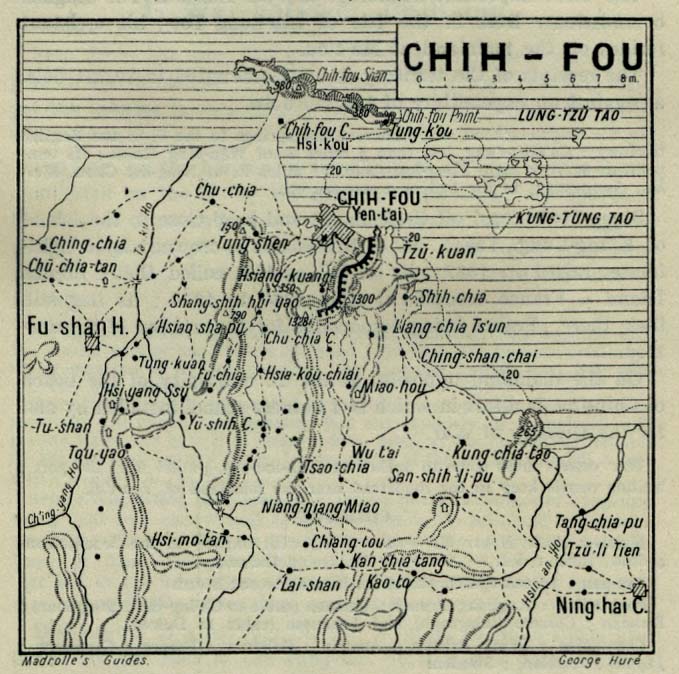
The major district of Yantai is Zhifu, which used to be the largest independent city in the area. It was romanized by the Europeans as Chefoo[note 1], Che-foo,[2] Chi-fu,[3] and Chih-fou. Although this name was used for the city by the Europeans prior to the Communist victory in the Chinese Civil War, the locals referred to the settlement as Yantai throughout.[2][3]
History
[edit]
During the Xia and Shang dynasties, the region was inhabited by indigenous people vaguely known to the Chinese as the "Eastern Barbarians" (Dongyi). Under the Zhou, they were colonized and sinicized as the state of Lai. Lai was annexed by Qi in 567 BC. Under the First Emperor (Shi Huangdi), the area was administered as the Qi Commandery. Under the Han, this was renamed as the Donglai Commandery (東萊郡). Following the Three Kingdoms period, the area was organized by the Jin as the Donglai Kingdom or Principality, later returning to prefecture status as a jùn and then zhōu. Under the Tang and during the Five Dynasties and Ten Kingdoms period, it was known as Deng Prefecture and organized with the Henan Circuit. It was then organized as the Laizhou (萊州府) and then, under the Qing, Dengzhou Prefecture (登州府).
Up to the 19th century, however, the Zhifu area consisted of nothing but small unwalled fishing villages of little importance.[2] Under the Ming, these were first troubled by the Wokou and then by the overreacting "Sea Ban", which required coastal Chinese to give up trading and most fishing and relocate inland upon pain of death.
Following the Second Opium War, the Qing Empire was obliged to open more treaty ports by the unequal 1858 Treaty of Tianjin, including Tengchow (now Penglai). Its port being found inadequate, Zhifu—about 30 miles (48 km) away—was selected to act as the seat of the area's foreign commerce.[2] The mooring was at considerable distance from shore, necessitating more time and expense in loading and unloading, but the harbor was deep and expansive and business grew rapidly.[2] The harbor opened in May 1861, with its status as an international port affirmed on 22 August. The official decree was accompanied by the construction of the Donghai Customs House (東海關).[4] It quickly became the residence of a circuit intendant ("taotai"), customs house, and a considerable foreign settlement located between the old native town and the harbor.[2] Britain and sixteen other nations established consulates in the town.[4] The town was initially expanded with well-laid streets and well-built stone houses, even for the poorer classes, a Catholic and a Protestant church were erected, and a large hotel did business with foreigners who employed the town as a summer resort.[2]

The principal traders were the British and Americans, followed by the Germans and Thais.[note 2] In the 1870s, the principal imports were woolen and cotton goods, iron, and opium and the principal exports were tofu, soybean oil, peas, coarse vermicelli, vegetables, and dried fruit from Zhifu itself, raw silk and straw braid from Laizhou, and walnuts from Qingzhou. The town also traded Chinese liquors and sundries for the edible seaweed grown in the shallows of the Russian settlements around Port Arthur (now Dalian's Lüshunkou District).[2] In 1875, the murder of the British diplomat Augustus Margary in Tengchong, Yunnan, led to a diplomatic crisis that was resolved in Zhifu by Thomas Wade and Li Hongzhang the next year.[5] The resultant Chefoo Convention gave British subjects extraterritoriality throughout China and exempted the foreign merchants' enclaves from the likin tax on internal commerce. Its healthy situation and good anchorage made it a favorite coaling station for foreign fleets, giving it some importance in the conflicts over Korea, Port Arthur, and Weihaiwei.[5]

Award-winning Chefoo bobbin lace was produced following the introduction of the craft by British missionaries,[6] reportedly becoming a popular export.[7] Chefoo lace was exhibited at the 1904 St. Louis World's Fair.[8]
Yantai received German economic activities and investments for about 20 years.[9] In the run-up to the First World War, its trade continued to grow[note 3] but was limited by the poor roads of the area's hinterland and the necessity of using pack animals for portage.[5] The trade items remained largely the same as before.[5] After the Germans were defeated by Allied forces in World War I, Qingdao and Yantai were occupied by the Japanese, who turned Yantai into a summer station for their Asian fleet. They also set up a trading establishment in the town.[10] The different foreign influences that shaped this city are explored at the Yantai Museum, which used to be a guild hall. However, the city's colourful history has not left a distinctive architectural mark, there has never been a foreign concession, and though there are a few grand 19th-century European buildings, most of the town is of much more recent origin.[11] After 1949, the town's name was changed from Chefoo to Yantai, and it was opened to the world as an ice-free trade port in 1984.[12]
On 12 November 1911, the eastern division of Tongmeng Hui declared itself a part of the revolutionary movement. The next day, it established the Shandong Military Government (山東軍政府) and, the day after that, renamed itself the Yantai Division of the Shandong Military Government (山東煙台軍政分府). In 1914, Jiaodong Circuit (膠東道) was established with Yantai as the capital. Jiaodong Circuit was renamed Donghai Circuit (東海道) in 1925. On 19 January 1938, Yantai participated as part of an anti-Japanese revolutionary committee.
After the creation of the People's Republic of China, Yantai was officially awarded city status with the outlying towns of Laiyang and Wendeng tacked on as "Special Regions" (专区) in 1950. Wendeng was merged into Laiyang six years later, and this larger Laiyang Special Region was combined with Yantai City to become Yantai Prefecture (烟台地区). Yantai is of strategic importance to China's defense, as it and Dalian, directly across the Bohai Sea from it, are primary coastal guard points for Beijing. In November 1983, the prefecture became a prefecture-level city.[13]
Geography
[edit]

Yantai is located along the north coast of the Shandong Peninsula, south of the junction of Bohai Sea and Yellow Sea and parallel to the southern coast of Liaoning. The topographical breakdown consists of:
- 36.62% mountainous
- 39.7% hilly
- 50.23% plain
- 2.90% basin
About 2,643.60 km2 (1,020.70 sq mi) is urbanized. Only Qixia City is located entirely inland. All other county-level entities are coastal, with Changdao consisting entirely of islands. The total coastline of the prefecture is 909 kilometers (565 mi).
The summits in the hill country vary from 100–300 meters (330–980 ft); the average peak in the mountainous region is 500 meters (1,600 ft), and the highest point of elevation is the summit of Mount Kunyu (昆崳山) at 922.8 meters (3,028 ft).
There are 121 rivers over 5 kilometers (3.1 mi) in length, the largest being:
- Wulong River (五龙河)
- Dagu River (大沽河)
- Dagujia River (大沽夹河)
- Wang River (王河)
- Jie River (界河)
- Huangshui River (黄水河)
- Xin'an River (辛安河)
The core of the old town of Zhifu was located above the mouth of the Yi (沂河, Yí Hé).[2]
Climate
[edit]Yantai has a monsoon-influenced climate which under the Köppen climate classification, Yantai falls within either a hot-summer humid continental climate (Dwa) if the 0 °C (32 °F) isotherm is used or a humid subtropical climate (Cwa) if the −3 °C (27 °F) isotherm is used. Summers are hot, humid, and rainy while winters are cold and dry. Extremes since 1951 have ranged from −12.8 °C (9 °F) (unofficial record of −15 °C (5 °F) was set on 10 January 1931) to 38.4 °C (101 °F).[14][15]
| Climate data for Yantai, elevation 47 m (154 ft), (1991–2020 normals, extremes 1971–2014) | |||||||||||||
|---|---|---|---|---|---|---|---|---|---|---|---|---|---|
| Month | Jan | Feb | Mar | Apr | May | Jun | Jul | Aug | Sep | Oct | Nov | Dec | Year |
| Record high °C (°F) | 15.5 (59.9) |
19.8 (67.6) |
26.5 (79.7) |
33.6 (92.5) |
35.8 (96.4) |
38.0 (100.4) |
38.4 (101.1) |
36.2 (97.2) |
35.1 (95.2) |
30.4 (86.7) |
26.0 (78.8) |
18.8 (65.8) |
38.4 (101.1) |
| Mean daily maximum °C (°F) | 2.4 (36.3) |
4.7 (40.5) |
10.8 (51.4) |
17.5 (63.5) |
23.5 (74.3) |
26.9 (80.4) |
28.8 (83.8) |
28.5 (83.3) |
25.3 (77.5) |
19.6 (67.3) |
12.1 (53.8) |
4.8 (40.6) |
17.1 (62.7) |
| Daily mean °C (°F) | −0.9 (30.4) |
0.9 (33.6) |
6.0 (42.8) |
12.4 (54.3) |
18.5 (65.3) |
22.3 (72.1) |
25.2 (77.4) |
25.3 (77.5) |
21.7 (71.1) |
15.7 (60.3) |
8.5 (47.3) |
1.6 (34.9) |
13.1 (55.6) |
| Mean daily minimum °C (°F) | −3.4 (25.9) |
−1.9 (28.6) |
2.4 (36.3) |
8.4 (47.1) |
14.4 (57.9) |
18.9 (66.0) |
22.4 (72.3) |
22.8 (73.0) |
18.9 (66.0) |
12.6 (54.7) |
5.6 (42.1) |
−1.0 (30.2) |
10.0 (50.0) |
| Record low °C (°F) | −12.8 (9.0) |
−12.6 (9.3) |
−8.1 (17.4) |
−2.6 (27.3) |
6.6 (43.9) |
11.5 (52.7) |
14.7 (58.5) |
15.0 (59.0) |
10.7 (51.3) |
0.8 (33.4) |
−4.9 (23.2) |
−10.8 (12.6) |
−12.8 (9.0) |
| Average precipitation mm (inches) | 15.5 (0.61) |
13.8 (0.54) |
16.9 (0.67) |
38.3 (1.51) |
52.1 (2.05) |
65.5 (2.58) |
160.1 (6.30) |
143.9 (5.67) |
56.7 (2.23) |
27.8 (1.09) |
35.1 (1.38) |
24.4 (0.96) |
650.1 (25.59) |
| Average precipitation days (≥ 0.1 mm) | 6.4 | 4.5 | 4.0 | 5.4 | 6.8 | 7.9 | 10.6 | 10.1 | 6.1 | 5.6 | 5.5 | 8.0 | 80.9 |
| Average snowy days | 10.9 | 6.5 | 2.4 | 0.2 | 0 | 0 | 0 | 0 | 0 | 0 | 2.4 | 10.9 | 33.3 |
| Average relative humidity (%) | 61 | 59 | 53 | 53 | 58 | 69 | 80 | 81 | 70 | 62 | 61 | 61 | 64 |
| Mean monthly sunshine hours | 156.0 | 174.2 | 233.5 | 240.4 | 267.7 | 244.1 | 202.0 | 215.4 | 217.0 | 202.8 | 163.4 | 141.7 | 2,458.2 |
| Percentage possible sunshine | 51 | 57 | 63 | 61 | 61 | 56 | 46 | 52 | 59 | 59 | 54 | 48 | 56 |
| Source 1: China Meteorological Administration[16][17] | |||||||||||||
| Source 2: Weather China[18] | |||||||||||||
Administration
[edit]The prefecture-level city of Yantai administers 12 county-level divisions, including 5 districts, 6 county-level cities, and one development zone. (开发区)
- Zhifu District (芝罘区)
- Fushan District (福山区)
- Muping District (牟平区)
- Laishan District (莱山区)
- Penglai District (蓬莱区)
- Laiyang City (莱阳市)
- Laizhou City (莱州市)
- Zhaoyuan City (招远市)
- Qixia City (栖霞市)
- Haiyang City (海阳市)
- Longkou City (龙口市)
- Yantai Economic and Technological Development Zone
- Yantai Hi-tech Industrial Development Zone
These are further divided into 148 township-level divisions, including 94 towns, six townships, and 48 subdistricts.
| Map |
|---|

Economy
[edit]
Yantai is currently the second largest industrial city in Shandong, next to Qingdao. However, the region's largest industry is agriculture. It is famous throughout China for a particular variety of apple and Laiyang pear, and is home to the country's largest and oldest grape winery, Changyu.[19]

The county-level city of Longkou is well known throughout China for its production of cellophane noodles.[citation needed]
Power
[edit]Yantai derives most of its energy from a large coal power plant using bituminous coal, and fitted with coal gasification technology to minimize pollution.[20] The plant is located close to Yantai port.[21] An attempt to switch northern China from coal to natural gas resulted in shortages, and in 2017 the Chinese government implemented a new plan to convert half of northern China to clean energy for winter heating.[22] Haiyang, a city under Yantai's prefecture, is anticipated to meet its total winter heating needs with nuclear power by 2021.[23]

Industrial zones
[edit]Yantai Economic and Technological Development Area
[edit]Yantai Economic and Technological Development Area is one of the earliest approved state-level economic development zones in China. It now has a planned area of 10 km2 (3.9 sq mi) and a population of 115,000. It lies on the tip of the Shandong Peninsula facing the Yellow Sea. It adjoins downtown Yantai, merely 6 kilometers away from Yantai Port and 6 kilometers away from Yantai Railway Station (not to be confused with Yantai South Railway Station).[24]
Yantai Export Processing Zone
[edit]Yantai Export Processing Zone (YTEPZ) is one of the first 15 export processing zones approved by the State Council. The total construction area of YTEPZ is 4.17 km2 (1.61 sq mi), in which the initial zone covers 3 km2 (1.2 sq mi). After developing for several years, YTEPZ is completely constructed. At present, the infrastructure has been completed, with standard workshops of 120,000 m2 (1,300,000 sq ft) and bonded warehouses of 40,000 m2 (430,000 sq ft). Up to now, owing to an excellent investment environment, YTEPZ has attracted investors from foreign countries and regions such as Japan, Korea, Singapore, Hong Kong, Taiwan, Sweden, the United States, Canada, etc., as well as domestic investors, to operate in the zone.[25]
Education
[edit]
The following is a list of prominent Yantai higher education institutions.
China Agricultural University and Binzhou Medical College house campuses in Yantai.
It houses a Korean international school, Korean School in Yantai.
Chefoo School previously educated foreign children.
Transport
[edit]Yantai Penglai International Airport provides scheduled flights to major airports in China as well as Seoul, Osaka, and Hong Kong.[26] The Lancun–Yantai railway ends at Yantai.[27] The Qingrong Intercity Railway, the first intercity high-speed railway in Shandong Province, has been put into operation, cutting the travel time of the fastest train from Qingdao to Yantai from about 4 hours and 30 minutes to about 1 hour and 15 minutes.
Tourism
[edit]

Penglai City's Dan Cliffs (丹崖) is said to be the departure point of the Eight Immortals on their trip to the Conference of the Magical Peach. [citation needed] It is important to note that Penglai is around 80 km from the city centre of Yantai.
Yangma Island[28] is located in the north of Muping District, Yantai and has a large area. The climate on the island is pleasant, with no severe cold in winter and no scorching heat in summer, making it suitable for leisure and vacation. It can be called the Maldives in China. Yangma Island has a long history. It is said that Emperor Qin Shihuang raised royal horses here during his eastward tour and was named the "Royal Horse Island", hence the name of Yangma Island.
Twin towns – sister cities
[edit]Notable people
[edit]- Qiu Chuji (1148–1227), leading Quanzhen Taoist priest and founder of Dragon Gate Taoism
- Qi Jiguang (1528–1588), Ming dynasty military general most remembered for defending coastal China against Japanese pirates
- Wang Yirong (1845–1900), Qing dynasty official and historian who was first to recognize the oracle bone script
- Henry Luce (1898–1967), founder of Time Magazine, Sports Illustrated, and owned many magazine publications such as Life Magazine
- Peter Stursberg (1913–2014), Canadian writer and journalist
- Chou Wen-chung (1923–2019), composer
- Liu Zewen (b. 1943), artist
- Lin Qingxia (b. 1954), actress
- Wang Zhengpu (b. 1963), politician
- Dong Jun (b.1963), People's Liberation Army Navy commander
- Li Yunze (b. 1970), politician and first post 70's ministerial-level leader
- Huo Jianhua (b. 1979), actor
- Wang Yaping (b. 1980), People's Liberation Army Astronaut Corps astronaut
- Fan Bingbing (b. 1981), actress
- Guanqun Yu (b. 1982), Opera singer
- Zhao Yingzi (b. 1990), actress
See also
[edit]
Notes
[edit]- ^ Postal Map Romanization
- ^ In 1872, 233 British vessels entered the port with 97,239 tons of cargo valued at £144,887 and 348 ships of all other nationalities entered with 149,197 tons of cargo valued at £177,168.[2]
- ^ Total imports and exports were valued at £2,724,000 in 1880, £4,228,000 in 1899, and £4,909,908 in 1904. The 905 vessels in 1895 had a total tonnage of 835,248; the 1842 in 1905 held 1,492,514 tons.[5]
References
[edit]Citations
[edit]- ^ "Shandong Statistical Yearbook-2016". www.stats-sd.gov.cn. Archived from the original on 5 May 2018. Retrieved 28 February 2024.
- ^ a b c d e f g h i j k EB (1878).
- ^ a b EB (1911), p. 132.
- ^ a b 烟台概览:烟台名称源于烟台山, QQ News (in Chinese (China)), 19 June 2008, archived from the original on 15 November 2012, retrieved 19 November 2012
- ^ a b c d e EB (1911), p. 133.
- ^ ""CHEFOO" LACE: SHANTUNG CLUNY AND TORCHON". The North - China Herald and Supreme Court & Consular Gazette (1870-1941). 19 July 1919. p. 188. ProQuest 1369871292. Archived from the original on 24 February 2023. Retrieved 24 February 2023.
- ^ "Lengths of bobbin lace, export goods from China". collection.maas.museum. Archived from the original on 24 February 2023. Retrieved 24 February 2023.
- ^ Skiff, Frederick (1904). Official Catalogue of Exhibitors, Universal Exposition of St. Louis, USA (PDF) (Department D Manufactures ed.). St. Louis: The Official Catalogue Company, Inc. p. 69. Archived (PDF) from the original on 11 June 2023. Retrieved 24 February 2023.
- ^ Zhou, Yingjie (24 July 2006). 开放,三次保全了近代烟台(下). Sina Finance (in Chinese (China)). Archived from the original on 19 November 2012. Retrieved 19 November 2012.
- ^ Jin, Long (24 July 2006). 东炮台现日军侵占烟台罪证 大理石上留印记(图). Archived from the original on 16 April 2014. Retrieved 19 November 2012.
- ^ Wang, Xin (24 July 2006). 郭显德:把西方文化传播到烟台. Archived from the original on 1 January 2013. Retrieved 19 November 2012.
- ^ Liu, Xinguo (24 July 2006). 中国首批沿海开放城市之一—烟台(图). Archived from the original on 2 January 2013. Retrieved 19 November 2012.
- ^ 优越的地理环境及人文历史造成就旅游圣地烟台. 24 July 2006. Archived from the original on 18 April 2014. Retrieved 19 November 2012.
- ^ "中国各地城市的历史最低气温". weibo.com. Retrieved 15 September 2024.
- ^ "山东烟台入选十大避暑胜地 气候凉爽风景优美 _新浪山东资讯_新浪山东". sd.sina.com.cn. Retrieved 1 January 2025.
- ^ 中国气象数据网 – WeatherBk Data (in Simplified Chinese). China Meteorological Administration. Archived from the original on 5 September 2018. Retrieved 12 August 2023.
- ^ "Experience Template" 中国气象数据网 (in Simplified Chinese). China Meteorological Administration. Archived from the original on 4 April 2023. Retrieved 12 August 2023.
- ^ "烟台 - 气象数据 -中国天气网". Archived from the original on 16 November 2018. Retrieved 15 November 2018.
- ^ Will Lyons (5 April 2013). "Indulge in China's Latest Export". The Wall Street Journal. Archived from the original on 27 August 2016. Retrieved 8 August 2017.
- ^ "China's Coal Future". www.technologyreview.com/. MIT Technology Review. Archived from the original on 7 September 2018. Retrieved 17 July 2018.
- ^ Fairley, Peter (1 January 2007). China's coal future. USA: MIT Technology review. Archived from the original on 7 September 2018. Retrieved 17 July 2018.
- ^ "China unveils 2017-2021 winter clean heating plan: media". Reuters. Retrieved 1 December 2020.[dead link]
- ^ "Haiyang nuclear plant furthers nation's green push - Chinadaily.com.cn". www.chinadaily.com.cn. Archived from the original on 30 November 2020. Retrieved 1 December 2020.
- ^ "RightSite.asia | Yantai Economic and Technological Development Area". Archived from the original on 9 May 2010. Retrieved 6 May 2010.
- ^ "RightSite.asia | Yantai Export Processing Zone". Archived from the original on 10 May 2010. Retrieved 6 May 2010.
- ^ "Yantai Chaoshui International Airport project". Archived from the original on 8 February 2012. Retrieved 25 October 2011.
- ^ (Chinese) "蓝烟铁路电气化工程完工 时速提高到120公里" 齐鲁网 Archived 8 October 2011 at the Wayback Machine 30 August 2010
- ^ Bbkaishan (26 November 2013). "养马岛旅游简介" [Yangma Island Tourism Introduction]. 本地宝 (in Chinese). Retrieved 24 September 2023.
Sources
[edit]- Baynes, T. S., ed. (1878), , Encyclopædia Britannica, vol. 5 (9th ed.), New York: Charles Scribner's Sons, p. 455.
- Chisholm, Hugh, ed. (1911), , Encyclopædia Britannica, vol. 6 (11th ed.), Cambridge University Press, pp. 132–3.
External links
[edit]

- Government website of Yantai Archived 23 January 2002 at the Wayback Machine (available in Chinese, English, German, French, Japanese and Korean)
- Old photos of Yantai (Chefoo)
- 1912 historical map of Yantai
| National Famous Historical and Cultural Cities in Shandong Province |
| Qufu | Jinan | Qingdao | Liaocheng | Zoucheng | Linzi | Tai'an | Yantai | Penglai | Qingzhou |
Shandong topics | |||||||||
|---|---|---|---|---|---|---|---|---|---|
| General | |||||||||
| Geography |
| ||||||||
| Education | |||||||||
| Culture | |||||||||
| Cuisine | |||||||||
| Ethno-Linguistic groups |
| ||||||||
| Attractions | |||||||||

| Special Economic Zones |  | |
|---|---|---|
| Open Coastal Cities | ||
| International | |
|---|---|
| National | |
| Geographic | |
| Other | |

Yantai
View on GrokipediaYantai is a prefecture-level city located on the southern coast of the Bohai Sea in northeastern Shandong Province, People's Republic of China.[1]
The city covers a land area of 13,746.5 square kilometers, features 1,038 kilometers of coastline, and includes over 230 islands.[1][2]
As of the 2020 national census, its permanent resident population stood at 7,102,116.[3]
Historically known to Europeans as Chefoo, Yantai was opened to foreign trade as a treaty port in 1861 under the provisions of the Treaty of Tianjin, fostering early international commerce and leading to the signing of the Chefoo Convention in 1876 between Britain and the Qing dynasty.[4]
In the modern era, Yantai serves as a vital hub for China's marine economy, with key industries encompassing modern fisheries, equipment manufacturing, electronic information, and food processing; it is particularly noted for its apple orchards and the Changyu winery, established in 1892 as one of the nation's pioneering wine producers.[5][6]
The city's gross domestic product reached 1,016.246 billion yuan in 2023, marking its entry into the trillion-yuan GDP club and underscoring its role in regional economic development.[7][8]
Etymology and Names
Historical and alternative names
The name Yantai (Chinese: 烟台; pinyin: Yāntái), literally meaning "smoke tower" or "beacon tower," derives from a coastal defense structure erected in 1398 during the 31st year of the Hongwu Emperor's reign in the Ming Dynasty. This beacon tower, built on Yantai Hill (also known as Qi Hill) south of the present urban area, served to signal threats from Japanese pirates (wokou) by burning wolf dung to produce thick smoke plumes during the day or fires at night, alerting neighboring posts along the Shandong coast.[9][10] The practice of using such yantai (smoke-signal towers) for maritime vigilance was widespread in Ming-era defenses, but this specific site's nomenclature persisted as the locality's enduring identifier despite the tower's later reconstruction and the addition of a lighthouse in 1901.[11] Prior to widespread adoption of Yantai, the core settlement and its protective harbor were known as Zhifu (Chinese: 芝罘; pinyin: Zhīfú), a name tied to Zhifu Island (now a peninsula connected by landfill), which formed a natural breakwater for the deepwater port.[12] Zhifu designated the administrative subprefecture established under the Qing Dynasty, encompassing the fishing village and surrounding areas that predated formal urban development.[13] In 19th-century Western interactions, following the port's designation as a treaty port under the Treaty of Tianjin in 1858 and its formal opening on August 22, 1861, Zhifu was romanized primarily as Chefoo in English and other European languages, a transliteration reflecting Wade-Giles conventions and generalizing the islet's name to the entire region.[14] Alternative spellings such as Che-foo appeared in diplomatic and trade documents, emphasizing the site's role in foreign commerce rather than local toponymy, though Chinese residents consistently used Yantai or Zhifu interchangeably for the mainland locale.[12] This Western nomenclature faded post-1949 as official usage standardized on Yantai.Modern official nomenclature
Yāntái Shì (Chinese: 烟台市) is the official designation for Yantai in standard Mandarin Chinese, romanized using Hanyu Pinyin as adopted by the People's Republic of China since 1958 for official transliterations.[15] As a dìjíshì (prefecture-level city), it holds sub-provincial administrative status directly under Shandong Province, overseeing multiple urban districts, county-level cities, and a county.[16] This structure was formalized in the administrative reforms following the establishment of the PRC in 1949, emphasizing standardized Chinese nomenclature over foreign-influenced variants.[10] The primary urban core falls under Zhifu District (芝罘区; Zhīfú Qū), historically the nucleus of the city but now integrated as one of six urban districts, alongside Laishan District (莱山区; Láishān Qū) to the east, which handles suburban and developmental zones.[16] Official mappings and governance documents consistently employ Yāntái Shì as the overarching name, with district-level subdivisions appended for precision, such as Yāntái Shì Zhīfú Qū.[15] Post-1949 standardization discarded colonial-era English renderings like "Chefoo," restricting them to archival or historical references in favor of phonetic Pinyin consistency across government, international trade, and diplomatic contexts.[17]History
Pre-modern periods
The Yantai region, situated along the Bohai Sea coast, hosted early human settlements during the Neolithic period, with archaeological traces of the White Stone Culture emerging around 7,000 years ago; these communities relied heavily on fishing and coastal resources for sustenance.[17] Inhabitants, associated with the broader Dongyi ethnic groups of eastern ancient China, developed rudimentary maritime practices suited to the local topography, marking the area's initial strategic value as a littoral outpost.[17] By the Warring States period (475–221 BCE), the territory integrated into the state of Qi, which exerted control over much of the Shandong Peninsula including the northeastern coastal zones near modern Yantai; Qi leveraged this position for military fortifications and limited seafaring against rivals such as Yan to the north.[18] Following Qin's conquest in 221 BCE, the region retained its administrative ties to former Qi territories, transitioning into imperial structures that emphasized coastal defense.[19] Under the Han dynasty (206 BCE–220 CE), Yantai's vicinity supported emerging maritime logistics as part of the broader Bohai economic sphere, though primary naval expansions focused southward; local outposts aided in fisheries and short-range voyages.[19] This role intensified during the Tang dynasty (618–907 CE), when adjacent Dengzhou—encompassing Yantai's early port facilities—ranked among China's four premier seaports and initiated routes along the nascent Maritime Silk Road, facilitating trade in commodities like silk and ceramics with Northeast Asian partners.[19]Modern era and foreign concessions
Yantai, known to foreigners as Chefoo, was designated a treaty port and opened to international trade on August 22, 1861, following its occupation by Anglo-French forces in August 1860 amid the Second Opium War and in accordance with Article 10 of the Treaty of Tientsin signed in 1858.[14] This status granted extraterritorial rights to foreign traders, primarily British and American, who established residences and consular facilities without a formal delimited concession area, fostering direct economic engagement with local merchants.[20] The port's coastal position facilitated steamship access, enabling rapid export of regional commodities and import of manufactured goods, which accelerated commercialization of Shandong's hinterland agriculture but also entrenched unequal treaty provisions limiting Chinese sovereignty over tariffs and jurisdiction.[20] Trade volume expanded significantly in the late 19th century, with principal exports including silk piece-goods, beans and bean products, groundnuts, straw braids for hat-making, and vermicelli, alongside coastal seafood such as dried fish and seaweed processed for international markets. By the 1890s, Chefoo handled annual exports valued at over 10 million taels, driven by British firms dominating shipping and comprador networks that integrated local production into global supply chains, though tea exports remained marginal compared to southern ports due to Shandong's climatic unsuitability for large-scale cultivation. This influx of foreign capital and technology introduced mechanized processing for silk reeling and bean oil extraction, boosting productivity but concentrating benefits among coastal elites and foreign interests while exposing inland farmers to volatile prices.[13] German economic penetration increased after 1897, coinciding with the Kiaochow lease nearby, through investments in shipping, breweries, and consular infrastructure like the old post office, though without a formal leasehold in Yantai itself.[21] These activities complemented the regional Jiaozhou-Jinan railway, constructed by German engineers between 1901 and 1904, which enhanced connectivity to Yantai's port by linking inland resources to coastal export routes over 400 kilometers.[22] Pre-World War I development thus hinged on foreign-driven logistics, yielding modern wharves and telegraph lines by 1910, yet reinforcing economic dependency as local industry lagged behind extractive trade patterns.Republican and wartime developments
Following the Xinhai Revolution and establishment of the Republic of China in 1912, Yantai, then commonly known internationally as Chefoo, experienced political instability under shifting warlord control in Shandong province, which disrupted local commerce but maintained its role as a key fishing and trade port.[23] Foreign concessions, established during the late Qing era, were returned to Chinese sovereignty by 1922 as part of the Washington Naval Conference agreements ending Japanese administration of Shandong railways and ports. This reversion allowed greater Nationalist influence after the Northern Expedition unified much of China under the Kuomintang by 1928. During the Nanjing Decade (1928–1937), the Nationalist government pursued port modernization and economic reforms, including infrastructure upgrades in treaty ports like Yantai to boost trade and fisheries, though efforts were limited by fiscal constraints and regional priorities favoring larger hubs such as Shanghai.[24] Yantai's commercial districts, such as Chaoyang Street, remained active with artifacts and trade from the 1920s reflecting growing local business in marine products and exports.[25] The Second Sino-Japanese War profoundly disrupted Yantai's economy and society, as Japanese forces occupied the city as part of their rapid advance into Shandong following the 1937 Marco Polo Bridge Incident and capture of northern ports.[26] The occupation, lasting until Japan's 1945 surrender, commandeered port facilities and fisheries—central to Yantai's identity as Shandong's primary fishing hub—for military logistics, leading to resource exploitation, forced labor, and trade collapse that exacerbated local famine and displacement.[14] Industrial activities, including nascent processing of marine goods, halted amid wartime destruction. Postwar recovery in 1945–1949 was undermined by the Chinese Civil War, with U.S. Marines of Operation Beleaguer landing in the Chefoo-Qingdao area to repatriate Japanese troops and support Nationalist garrisons against advancing Communist forces.[27] Despite initial aid efforts, hyperinflation, supply shortages, and Communist offensives in Shandong stalled economic revival, culminating in Yantai's capture by People's Liberation Army units in late 1948–early 1949.[28]Contemporary era since 1949
Following the establishment of the People's Republic of China in October 1949, Yantai, like other rural regions, implemented land reform campaigns from 1950 to 1952, confiscating and redistributing landholdings from landlords to peasant households to abolish feudal tenancy systems.[29] This was followed by agricultural collectivization starting in 1953, organizing farmers into mutual aid teams, elementary cooperatives by 1955, and higher cooperatives by 1956, which emphasized collective production of staple grains such as wheat and corn alongside emerging cash crops.[30] In Yantai's fertile coastal plains, these efforts included the development of state-directed orchards, particularly for apples—introduced commercially in the region since the late 19th century but scaled up under socialist planning—positioning the area as a key national producer of the fruit by the late 1950s.[31] The Great Leap Forward (1958–1962) intensified collectivization through people's communes, though it led to inefficiencies and famine impacts in Shandong Province, prompting adjustments toward more pragmatic household-based responsibility systems after 1962.[29] Post-Cultural Revolution recovery in the 1970s focused on stabilizing agriculture, with Yantai's output of apples and grains supporting local food security and export. Economic reforms initiated in 1978 under Deng Xiaoping accelerated industrialization; in 1984, Yantai was designated one of China's 14 open coastal cities, enabling preferential policies for foreign direct investment (FDI).[32] This spurred the creation of the Yantai Economic and Technological Development Area (YEDA), approved that year, which attracted FDI into manufacturing sectors including electronics—such as semiconductor and information technology assembly—and bolstered the wine industry through joint ventures expanding on established producers like Changyu.[33] By 2024, these reforms had propelled Yantai's regional GDP to 1.08 trillion CNY (approximately 148.9 billion USD), reflecting 6.1% year-on-year growth driven by advanced manufacturing, high-tech industries, and agriculture.[34] Recent initiatives underscore a shift toward green and cultural development: the Sun Tower, a 50-meter multifunctional cultural landmark in YEDA featuring exhibition spaces, a library, and an outdoor theater inspired by solar movements, opened for trial operations in December 2024 to enhance urban vibrancy.[35] Concurrently, construction began in March 2025 on a state-backed 1 GW/2 GWh hybrid lithium-ion and redox flow battery energy storage hub in Yantai, aimed at integrating renewables into the grid and supporting Shandong's energy transition targets.[36] These projects align with national priorities for technological self-reliance and sustainable growth amid global supply chain shifts.Geography
Physical location and topography
Yantai occupies the northeastern portion of the Shandong Peninsula in eastern China, bordering the Bohai Sea to the north and the Yellow Sea to the south.[16] The municipal jurisdiction covers 13,864.5 square kilometers of land area and features a convoluted coastline measuring 1,038 kilometers in length, encompassing 230 offshore islands and seven natural bays.[37][16] Prominent among these bays is Yantai Bay, whose sheltered waters have historically supported maritime activities and port infrastructure development.[37] The region's topography consists primarily of hilly terrain with gentle slopes, where elevations in the hill country range from 100 to 300 meters and average 500 meters in more mountainous zones.[38] The highest point is Taiding Peak on Mount Kunyu, reaching 923 meters above sea level and marking the maximum elevation in the eastern Shandong Peninsula.[39] This undulating interior contrasts with the flat coastal plains, contributing to Yantai's strategic position approximately 200 kilometers northeast of Qingdao and 550 kilometers southeast of Beijing by road.[40]Climate and weather patterns
Yantai experiences a temperate monsoon climate under the Köppen classification Cwa, marked by cold, dry winters and warm, humid summers influenced by the East Asian monsoon. The annual mean temperature averages 12.9 °C, with total precipitation around 713 mm, predominantly falling between June and September.[41][42] Winters, spanning December to February, feature average January temperatures near 0–2 °C, with minimums occasionally dropping to –5 °C under northerly winds from Siberia. Summers peak in July, with average temperatures of 25–26 °C, highs reaching 29 °C, and increased humidity fostering convective rainfall.[43][44] Precipitation patterns show a pronounced seasonal contrast, with summer months accounting for over 60% of annual totals, often exceeding 100 mm in July and August due to monsoon fronts. The region faces typhoon risks from the western Pacific, with the Shandong Peninsula experiencing frequent landfalls or near-misses; historical data indicate a greater than 20% probability of damaging winds (exceeding 17 m/s) over any 10-year period, amplifying storm surges and localized flooding.[43][45][46] Long-term meteorological observations from 1951 to 2020 reveal warming trends in Yantai consistent with eastern China, where mean surface air temperatures have risen at rates of 0.26–0.44 °C per century, driven by anthropogenic factors and regional circulation changes. These shifts extend frost-free periods, enhancing viability for temperate crops like apples and grapes that require 700–800 mm annual precipitation and moderate winter chilling hours.[47][48]Natural resources and geology
Yantai lies within the Jiaodong Peninsula, characterized by Precambrian basement rocks intruded by Mesozoic granites, such as the Linglong granite, which host extensive mineralization along NE-trending fault zones like the Zhaoping and Jiaojia faults.[49][50] These structures facilitate quartz vein-type and altered rock-type gold deposits, making the region part of China's premier gold province with over 5,800 metric tons of identified reserves across multiple sites.[51] Notable deposits include the supergiant Dayin'gezhuang (over 50 tons Au), Linglong, and Jiaojia mines, where gold occurs in pyrite-sericite-quartz altered cataclasites and veins.[52] Quartz and granite are also abundant, with the Linglong granite serving as a key host for vein systems and broader extractive potential.[53] The Penglai-Weihai fault zone, extending through Yantai's coastal areas, influences local tectonics and contributes to moderate seismic risks, as evidenced by integrated geophysical surveys detecting active slip and potential for earthquakes up to magnitude 6-7 in the Shandong Peninsula.[54][55] While historic seismicity remains low, these faults bisect sedimentary basins underlying the Bohai Sea, where Yantai's offshore jurisdiction includes significant hydrocarbon reserves; the Bohai region holds China's primary offshore oil and gas fields, such as the Shengli complex and recent discoveries like Kenli 10-2 with over 100 million tons of oil equivalent.[56] Yantai's geology supports extractable non-metallics and biological resources tied to terrain and coastal sediments. Fertile loessial soils derived from Quaternary deposits enable extensive orchards, with Yantai producing 5.59 million tons of apples annually from 188,400 hectares, positioning it as China's top apple-producing prefecture-level city.[57] Marine sediments and shallow shelves in the adjacent Bohai and Yellow Seas foster scallop habitats, contributing to over 1 million tons of annual bivalve shell production in China's coastal aquaculture zones, including Yantai's fisheries.[58]Demographics
Population statistics and trends
As of the 2020 national census, Yantai's prefecture-level municipality had a permanent resident population of 7,102,116.[3] This marked a modest annual growth rate of 0.19% from the 2010 census figure of approximately 6.96 million.[59] Urban residents accounted for about 67% of the total, with roughly 4.78 million living in urban areas, reflecting ongoing urbanization driven by internal migration and natural increase.[3] The urban core population, concentrated in districts like Zhifu and Laishan, stood at around 3.18 million in 2020.[3] Estimates project a slight stabilization or minor decline for the urban core by 2025, at approximately 2.90 million, amid broader national demographic pressures including net out-migration from some coastal areas and decelerating birth rates.[60] Historically, Yantai's population expanded dramatically from about 92,000 in 1950 to over 7 million by 2020, fueled primarily by post-1949 rural-to-urban shifts and elevated birth rates during the mid-20th century, though growth has since tapered to below 1% annually.[60] Demographic trends indicate an aging profile, with the proportion of residents aged 60 and above rising in line with provincial and national patterns; China's total fertility rate hovered around 1.2 in recent years, well below the 2.1 replacement level, contributing to a dependency ratio strain in Yantai similar to other eastern Chinese municipalities.[61] This low fertility, combined with improved life expectancy to about 78 years, has led to a shrinking working-age cohort, projecting a potential population peak and subsequent decline without policy interventions.[62]Ethnic composition and migration patterns
Yantai's population is overwhelmingly composed of Han Chinese, aligning with the ethnic structure of Shandong Province, where Han individuals accounted for 99.2% of the total population according to the 2000 census.[63] Small ethnic minorities, representing less than 1% collectively, include Hui, Manchu, and Korean (Chaoxianzu) groups, with historical Manchu settlements tracing back to the Qing Dynasty era and Korean communities linked to proximity with Northeast China regions.[63][64] Up to 47 or 50 minority nationalities are present in scattered distributions, though their numbers remain negligible relative to the Han majority, reflecting limited ethnic diversity in this coastal Han-dominated area.[65] Internal migration patterns in Yantai have primarily involved rural-to-urban flows, accelerating urbanization since the 1980s reform period, with urban land area expanding significantly due to influxes from surrounding rural counties into core districts.[66] This migration has concentrated in developed urban areas such as Zhifu District, supporting industrial and port-related growth, though specific inflows are embedded within broader Shandong trends where rural migrants contribute to urban population increases without altering ethnic dominance.[66] Post-2000, targeted talent attraction policies have drawn skilled workers, including college graduates, to high-tech and economic development zones, fostering selective in-migration for sectors like manufacturing and innovation hubs amid China's national push for urban upgrading.[67] External migration remains minimal, with no significant international or inter-provincial ethnic shifts documented, maintaining the stable Han-centric composition.[68]Administration and Government
Administrative divisions
Yantai has held prefecture-level city status since its establishment in 1949 following the founding of the People's Republic of China, with subsequent adjustments to its subdivisions aimed at improving administrative efficiency. A notable recent change occurred in June 2020, when the State Council approved the merger of Penglai City and Changdao County to create Penglai District, reducing fragmented governance and consolidating coastal management.[69] The city's current structure includes five urban districts—Zhifu District, Fushan District, Mouping District, Laishan District, and Penglai District—and six county-level cities: Haiyang City, Longkou City, Laiyang City, Laizhou City, Qixia City, and Zhaoyuan City. These 11 county-level divisions oversee local affairs, with districts primarily encompassing the urban core and county-level cities covering more expansive rural and agricultural areas.[70][71] Per the Seventh National Population Census conducted in 2020, Yantai's total permanent resident population stood at 7,102,116. Distribution across divisions shows higher densities in urban districts forming the continuous built-up area, while county-level cities host larger overall populations due to broader territories; for instance, Laiyang City reported 897,681 residents and Laizhou City 889,361.[3][72]| Division Type | Name | Notes |
|---|---|---|
| Districts | Zhifu, Fushan, Mouping, Laishan, Penglai | Urban-focused, core of Yantai's metropolitan area |
| County-level Cities | Haiyang, Longkou, Laiyang, Laizhou, Qixia, Zhaoyuan | Include rural townships and town centers |
Governance structure and policies
The governance of Yantai operates under the integrated party-state system of the People's Republic of China, with the CPC Yantai Municipal Committee exercising ultimate authority over policy formulation and implementation. The municipal Party secretary, as the top leader, directs ideological adherence, cadre appointments, and alignment with central and provincial directives from the Shandong Provincial CPC Committee, ensuring local decisions prioritize national priorities such as economic restructuring and social stability.[73] [74] The Yantai Municipal People's Government, led by the mayor—who typically serves concurrently as a deputy secretary of the municipal CPC committee—handles administrative execution, including budgeting, infrastructure, and service delivery, but remains subordinate to Party oversight to prevent deviations from central mandates.[75] This structure enforces causal chains from Beijing's policies, where local non-compliance risks cadre demotions or investigations, as seen in broader CCP mechanisms for municipal control.[76] A pivotal policy milestone occurred in April 1984, when Yantai was designated one of 14 open coastal cities by the State Council, granting preferential measures like reduced customs duties, income tax exemptions for foreign enterprises, and streamlined investment approvals to attract foreign direct investment and integrate into global trade networks.[77] These incentives causally boosted FDI inflows, port expansion, and export-oriented manufacturing, transforming Yantai from a planned economy outpost into a coastal economic hub by enabling technology transfers and capital accumulation not feasible under interior provinces' constraints.[78] In the 2020s, Yantai has implemented national "high-quality development" directives from the 19th CPC Central Committee, focusing on innovation-driven growth, private sector vitality, and low-carbon transitions over raw GDP expansion.[79] Local measures include cultivating leading private enterprises and reviewing policies for business environment optimization, yielding Yantai's top ranking among Shandong's 16 cities in high-quality development metrics for 2022.[80] [81] By 2030, municipal plans target a "fully green, low-carbon" model, aligning with central carbon neutrality goals through integrated industrial upgrades and ecological governance, though outcomes depend on enforcing state-owned enterprise reforms amid persistent reliance on directives.[82]Economy
Economic overview and growth metrics
Yantai's regional gross domestic product (GDP) reached 1.078 trillion yuan in 2024, marking a year-on-year increase of 6.1 percent from 1.016 trillion yuan in 2023.[7][34] This growth positioned Yantai among China's 27 cities exceeding 1 trillion yuan in GDP for that year, reflecting sustained expansion driven by post-reform liberalization since the 1980s, when the city's economy transitioned from agriculture-dominated output to a balanced structure emphasizing secondary and tertiary sectors.[83] Per capita GDP in Yantai approximated 150,000 yuan in 2024, up from 144,241 yuan in 2023, based on a stable population base of roughly 7 million residents.[84] The primary sector contributed around 10 percent to GDP, while secondary industries (manufacturing and construction) and tertiary services together accounted for 60-70 percent, underscoring a structural shift away from agrarian reliance following China's economic reforms that opened coastal areas like Yantai to foreign investment and industrial development.[85] As a core component of the Shandong Peninsula Blue Economic Zone, established to leverage marine resources for regional development, Yantai has integrated into broader provincial strategies promoting ocean-based economic activities, contributing to Shandong's overall coastal growth framework since the zone's formal guidelines in 2009.[86] Recent growth rates, including 5.1 percent in 2022 and approximately 6.7 percent from 2022 to 2023, indicate resilience amid national economic fluctuations, with fixed asset investments and urban consumption supporting aggregate expansion.[87][7]Primary industries and agriculture
Yantai's agriculture sector is anchored in fruit cultivation, particularly apples, which benefit from the region's loess soil and temperate monsoon climate conducive to high yields. The city maintains approximately 188,000 hectares of apple orchards, producing around 5.88 million metric tons annually as of 2020, representing over 13% of China's total apple output.[88] Recent figures indicate expansion to 6.3 million tons in 2023, supported by integrated pest management and technological advancements that enhance yield and quality.[89] Cultivation involves a mix of state-backed cooperatives for standardized practices and private orchards emphasizing export-oriented varieties, though private operations often drive innovation in branding and deep processing.[90] The wine industry, a niche within horticulture, originated with the establishment of Changyu Pioneer Wine Company in 1892 by overseas Chinese businessman Zhang Bishi, who imported European grape varieties and winemaking techniques to Yantai's coastal terroir.[91] This pioneering effort produced China's first Cabernet Gernischt dry red wine in 1931, laying the foundation for a sector now integrated with apple byproducts for distillation.[92] Government initiatives promote terroir-specific viticulture, but output remains modest compared to fruits, with emphasis on quality over volume amid global competition.[93] Fisheries form the other pillar, exploiting Yantai's 726-kilometer coastline and Yellow Sea proximity for capture and aquaculture. Total aquatic product output reached 1.99 million metric tons in 2024, driven by aquaculture expansion in species like scallops, abalone, and sea cucumbers.[94] Innovations include deep-sea platforms and smart ranching systems, reducing environmental strain from nearshore overexploitation while boosting efficiency through state-subsidized equipment and breeding programs.[94] Private enterprises dominate processing, contrasting with cooperative models in farming, though regulatory oversight ensures traceability for export markets.[95]Manufacturing and industrial sectors
Yantai's shipbuilding industry features prominent facilities such as the CIMC Raffles Shipyard, which constructs offshore engineering vessels, heavy-lift ships, and other specialized maritime structures, benefiting from proximity to major global shipbuilding markets in East Asia.[96] Large-scale projects, including multi-vessel orders for international clients, underscore the sector's role in China's overall dominance in commercial ship production.[97] The high-tech manufacturing segment, supported by the Yantai High-Tech Industrial Development Zone, emphasizes electronics and information technologies, with initiatives fostering intelligent manufacturing and aerospace-related electronic components that enable import substitution and exports.[98][99] Enterprises under the national Torch Program, such as those in nanomaterials and specialized ceramics for industrial applications, integrate advanced R&D to produce components for electronics and high-temperature processes.[100] Automotive parts and machinery manufacturing include production of auto repair systems, lifts, tire equipment, and die-mold engineering, with firms like Yantai Jintuo and Luji specializing in development and assembly for domestic and export markets.[101][102] These sectors feature a mix of private enterprises driving innovation and efficiency alongside state-owned operations, as private firms contribute to high-quality development through new productive forces in equipment manufacturing.[103] Export processing zones in Yantai support assembly-line operations for light manufacturing, hosting foreign-invested firms in components and finished goods oriented toward overseas shipment, enhancing integration into global supply chains.[104]Energy production and resources
The Haiyang Nuclear Power Plant in Haiyang City, administered under Yantai, operates two AP1000 Generation III+ pressurized water reactors. Unit 1 achieved commercial operation on October 17, 2018, with a net capacity of 1,170 MWe, while Unit 2 followed on November 8, 2019, at equivalent capacity.[105][106] Construction of Units 3 and 4, each with 1,170 MWe net capacity, started in July 2022 under China's CAP1000 design localization, with grid connection projected for 2027 and annual output reaching 40 billion kWh across all four units upon completion.[107][108] These nuclear assets have diminished Yantai's reliance on coal-fired generation, mirroring national shifts where coal constituted under 60% of electricity production in 2024 for the first time, driven by expanded low-carbon capacity.[109] To support grid reliability amid rising nuclear and intermittent renewables, construction began in March 2025 on the 1 GW / 2 GWh Yantai Energy Storage Center (Western) in Laizhou, integrating lithium-ion and vanadium redox flow batteries for peak shaving and frequency regulation.[36][110] Yantai's position along the Bohai Sea affords high offshore wind potential, integrated within China's eastern coastal estimates of 200 GW in shallow waters (<25 m depth) plus 300 GW deeper, but exploitation lags due to centralized permitting delays and policy uncertainties hindering project approvals.[111][112]Trade, ports, and special economic zones
Yantai Port, a major gateway for international trade in eastern China, handled a cargo throughput of 450 million tons in 2024, marking a 6.4% increase from the previous year and ranking it among the top 10 global coastal ports.[113] The port's container throughput exceeded 5 million twenty-foot equivalent units (TEUs) in the same year, supporting diverse commodities including bauxite imports surpassing 50 million tons annually.[114][115] As part of the Shandong Port Group, it facilitates routes to Africa and other regions, with the China-Africa general cargo line achieving a record 4 million tons in a recent year.[116] Special economic zones in Yantai enhance its role as a trade hub by offering incentives for foreign direct investment (FDI). The Yantai Economic and Technological Development Area (YEDA), established in 1984 and approved by the State Council, spans coastal locations ideal for export-oriented industries and has attracted numerous international projects, including 20 key investments in the first quarter of 2022 alone, reflecting a 43% year-on-year growth in zone investment.[85] The Yantai Area of the China (Shandong) Pilot Free Trade Zone, operational since 2019, positions the city as the closest such zone to South Korea, promoting cross-border trade and innovation through streamlined customs and investment policies.[117] Overlapping developments like the Yantai Huang-Bohai New Area further integrate national economic zones to draw FDI in strategic sectors.[118] Yantai serves as a node in China's Belt and Road Initiative, particularly the 21st-Century Maritime Silk Road, leveraging its geographic proximity to Japan, South Korea, and Europe-Asia sea lanes to boost connectivity and overseas expansion of local enterprises.[119] In October 2025, Shandong Port Group Yantai Port signed a preliminary strategic partnership with Abu Dhabi's AD Ports Group to develop green automotive industrial parks, aiming to integrate sustainable logistics, manufacturing assembly, and export facilities to enhance eco-friendly vehicle trade along Belt and Road corridors.[120][121]Economic challenges and state dependencies
Yantai's economy is characterized by significant dependence on state-owned enterprises (SOEs) for core functions such as infrastructure development and urban renewal, which has fostered inefficiencies and elevated debt burdens. The Yantai Chefoo Finance Holding Group Co., Ltd., the city's largest SOE by asset size, bears primary responsibility for land consolidation, urban renewal, and infrastructure projects, illustrating the state's central role in directing resource allocation over market-driven initiatives.[122] This SOE-led approach, while enabling rapid physical expansion, has contributed to substantial local government debt, with outstanding obligations reaching RMB 251.2 billion as of December 2024, or 23.3% of gross regional product.[123] Similarly, entities like Yantai Guofeng Investment Holdings and Yantai Blue Sky Investment Development Group face concentrated debt maturities in 2024–2025, reliant on implicit state support amid fiscal pressures from infrastructure financing.[124][125] SOE dominance extends to stifling private sector innovation, as state entities prioritize policy objectives over competitive efficiency, crowding out entrepreneurial dynamism in Yantai's industrial clusters. Nationally, SOEs' expansion into private firms via share acquisitions undermines independent risk-taking and technological advancement, a pattern evident in Yantai where business associations remain embedded in state agencies, subordinating private initiatives to government oversight.[126][127] This structural bias favors SOE control in strategic areas like energy and manufacturing, limiting private firms' access to resources and markets, despite Yantai's efforts to promote small- and medium-sized enterprises in innovation-driven sectors.[128] The city's export-oriented industries, particularly through its port handling machinery, electronics, and agricultural goods, expose it to global trade volatilities, as seen in the US-China trade war starting in 2018. US tariffs reduced profitability for affected Chinese exporters by an average of 1% per 1% tariff increase, hitting coastal manufacturing hubs like Yantai amid retaliatory measures and supply chain shifts.[129] Escalating tariffs, reaching up to 245% on Chinese exports by 2025, have further pressured Yantai's trade-dependent growth, with national exports to the US dropping 21% in early 2025, amplifying vulnerabilities in state-subsidized sectors.[130][131] Growth disparities persist between Yantai's urban cores and rural peripheries, with urban booms in port-adjacent industries outpacing rural income and productivity gains. At a medium level of urban-rural integration, Yantai mirrors national patterns where rural areas lag due to limited industrial spillover and state focus on urban priorities, exacerbating income gaps that peaked nationally around 2009 before partial narrowing.[132][133] Rural counties experience slower development amid urban influxes for employment, perpetuating dependency on state agricultural subsidies rather than diversified private opportunities.[134]Environment and Sustainability
Ecological systems and biodiversity
Yantai's coastal ecosystems feature a mosaic of bays, islands, and wetlands along its approximately 1,000-kilometer shoreline, spanning the Bohai Sea to the north and the Yellow Sea to the south. These habitats support diverse marine and intertidal communities, including macrobenthic organisms that form the foundation of food webs in the northern Yellow Sea and Bohai Sea regions adjacent to the city.[135] [136] The seven natural bays, such as those in the Laizhou Bay area, create sheltered environments conducive to algal and seagrass growth, enhancing habitat complexity for fish and invertebrates.[1] Offshore islands, numbering over 230, host significant terrestrial and avian biodiversity, exemplified by the Changdao National Nature Reserve in the Bohai Strait. This reserve encompasses island chains with more than 3,500 recorded biological species from surveys conducted between 2019 and 2021, including vascular plants, insects, and vertebrates adapted to insular conditions.[137] Although few strictly endemic species are documented, the isolation fosters unique assemblages, such as diverse Enteromorpha algae variants along coastal rocks.[138] Coastal wetlands in eastern Yantai serve as vital stopover and wintering grounds for migratory waterbirds on the East Asian-Australasian Flyway, accommodating diverse overwintering communities with varying structures across wetland types.[139] These areas, integrated with marine fisheries in the Bohai Sea, sustain commercially important species through productive benthic and pelagic ecosystems, though baseline diversity reflects natural temperate marine patterns rather than tropical richness.[135]Pollution issues and industrial impacts
Yantai's coastal sediments exhibit elevated levels of heavy metals such as Pb, Cr, Cu, As, Cd, and Zn, primarily sourced from industrial activities including mining, smelting, and manufacturing emissions.[140] [141] A 2024 study of nearshore surface sediments north of Yantai found moderate contamination at 38% of sites, with pollution load indices linking these metals to anthropogenic inputs from local industries.[142] Similarly, sediments in the Yixun River Basin, influenced by Yantai's industrial zones, show heavy metal pollution where mining contributes 39.86% and industrial activities 18.24% of the load.[140] Groundwater in rural Yantai suffers from nitrate pollution, with qualification rates for drinking water standards at only 48.59% between 2015 and 2018, driven by fertilizer applications in agriculture but compounded by industrial discharges and geological factors that facilitate leaching.[143] High nitrate concentrations exceed safe thresholds in many wells, posing health risks through methemoglobinemia, particularly in areas adjacent to manufacturing and agricultural intensification.[144] Intensive scallop aquaculture in Yantai's coastal waters contributes to marine benthic degradation through organic waste deposition, altering sedimentary organic carbon mineralization and dissolved organic matter cycles.[145] [146] Macro-benthos communities in northern Yantai's coastal areas show reduced abundance, biomass, and species diversity, linked to eutrophication from aquaculture effluents and sewage inputs, impairing ecological functions.[147] [148] Urbanization and industrial expansion in Yantai have eroded farmland through land-use conversion, with urban land increasing at rates that displaced agricultural areas between 1974 and 2009, intensifying pressure from manufacturing zones.[149] This shift, documented via remote sensing, reduces arable land sustainability and heightens vulnerability to soil degradation in peri-urban interfaces.[150] Industrial-related air pollutants, including PM2.5 from manufacturing emissions, correlate with urbanization-driven spikes, though specific indices reflect broader regional patterns exacerbated by Yantai's port and factory activities.[151]Conservation efforts and recent initiatives
In 2021, Yantai authorities designated Changdao County, an archipelago under its jurisdiction, as an International Zero-Carbon Island, targeting a full transition to renewable energy sources including wind, solar, and tidal power to achieve net-zero emissions.[152] This state-led initiative expanded globally through the International Zero-Carbon Island Cooperation Initiative launched at COP29 in November 2024, emphasizing clean energy systems, green infrastructure, and climate resilience for islands worldwide.[153] By May 2025, Yantai partnered with the Maldives on a joint smart energy project, involving Dongfang Electronics and the State Power Company of the Maldives to construct renewable facilities and upgrade energy structures, though long-term emission reduction metrics remain under evaluation.[154][155] Yantai maintains multiple marine protected areas to safeguard coastal ecosystems, including the 1,465.2-hectare Yantai Muping Sandy Coast National Special Marine Protected Area and the Haiyang Wanmi Haitan Ocean Resources National Special Marine Protected Area.[156] In Changdao, a 1,731-square-kilometer sanctuary for spotted seals was established by 2025, featuring monitoring equipment and restrictions on human activity to protect breeding grounds.[157] Complementary efforts include the Genghai No. 1 marine ranching project, initiated to restore degraded seafloors, enhance biodiversity, and support sustainable fisheries through artificial habitats and stock releases.[158] Technological and policy measures have driven reductions in Yantai's grey water footprint, a metric of pollution assimilation volume, which fell from 116 million cubic meters annually in 2015 to 46 million in 2019, with per-unit economic intensity dropping below 10 cubic meters per 10,000 CNY due to improved wastewater treatment and industrial efficiencies.[159] Afforestation drives, formalized in a 2022 action plan, have increased urban and rural green coverage by planting native species to combat soil erosion and enhance carbon sequestration, aligning with broader provincial greening targets.[160] Empirical assessments reveal mixed effectiveness of these state initiatives, with fishery resources persisting in decline amid ongoing environmental degradation from industrial discharges and historical overexploitation, despite marine ranching and protected zones.[161][136] While pollution metrics like grey water show progress, localized fishery yields have not rebounded proportionally, pointing to challenges in enforcement and underlying causal pressures such as nutrient overload, suggesting that reported compliance often prioritizes targets over sustained ecological recovery.[162]Infrastructure
Transportation networks
Yantai's rail network integrates with China's high-speed system, providing efficient connectivity to regional hubs. The Weifang–Yantai high-speed railway, operational since October 2024, spans 237 kilometers with nine stations and a maximum design speed of 350 kilometers per hour, enabling shortest journey times of 24 minutes between endpoints. By October 2025, it had served 3.25 million passengers in its first year, with service frequency expanded to 17 train pairs per day since January 2025, including direct routes to major cities. High-speed services to Qingdao typically take 1 to 2 hours depending on stops and routing via the Qingdao–Rongcheng intercity line. In May 2025, Yantai introduced its first sea-rail intermodal freight train using a single bill of lading, reducing cross-border transit times from 25 days to 12 days and enhancing multimodal capacity.[163][164][165][166] Air transport centers on Yantai Penglai International Airport, which underwent significant expansion with Terminal 2 opening in June 2024, boosting annual passenger handling capacity to 23 million from previous levels. The new terminal incorporates sustainable design features and supports future growth, including potential additions like a second runway and expanded concourses. Domestic and international flights connect to over 50 destinations, with infrastructure upgrades facilitating increased cargo and passenger volumes aligned with regional economic demands.[167][168] Road infrastructure includes integration with national expressways, such as the G18 Rongwu Expressway, which links Yantai to ports and inland routes for freight and passenger movement. China National Highway 204 originates in Yantai and extends 1,031 kilometers southward to Shanghai, supporting heavy vehicle traffic to industrial zones. Local enhancements, including rural road renovations totaling 500 kilometers planned in recent infrastructure drives, improve connectivity to peripheral areas and ports.[169] Sea links feature Yantai Port's ferry operations to Dalian across the Bohai Strait, with daily car ferry services taking approximately 6.5 hours and accommodating vehicles and passengers. Passenger ferries run multiple times daily from terminals like Yantai Salvage Bureau Port, with up to 22 departures reported on peak schedules. The port also handles rail-integrated ferries for train cars, operating six round trips daily to maintain supply chain efficiency.[170][171]Utilities and urban development
Yantai's electricity infrastructure relies heavily on integration with regional nuclear and renewable sources, including the Haiyang Nuclear Power Plant, which initiated a pioneering district heating pilot in 2019 to supply clean heat to approximately 700,000 square meters of residential and public buildings, replacing coal-fired boilers and reducing fossil fuel dependence.[106] [172] By November 2021, Haiyang became the first city in China to rely entirely on nuclear-powered district heating for winter needs, with expansions in subsequent phases extending coverage to multiple prefecture-level cities and achieving carbon reductions equivalent to planting over 134,000 hectares of broadleaf forest by 2025.[173] [108] State Grid Yantai has supported this through tailored power plans, advanced transmission lines, and smart grid initiatives like the Yantai Digital Virtual Power Plant, which enhances energy security and integrates renewables such as solar, with cumulative grid-connected solar capacity reaching 6.12 million kilowatts by late 2024.[174] [175] [176] Water supply systems in Yantai face pressures from industrialization and coastal urbanization, with studies quantifying a significant grey water footprint—indicating pollution dilution requirements—that underscores sustainability challenges in balancing industrial demands with limited freshwater resources.[159] Despite desalination and inter-basin transfers aiding supply, rapid growth in manufacturing and population has exacerbated scarcity, prompting efficiency measures but highlighting vulnerabilities where pollution from industrial effluents reduces usable water volumes.[159] Urban development emphasizes housing upgrades and eco-oriented projects, as seen in Yantai's municipal-led initiatives financed through government borrowing to improve infrastructure and retrofit older districts, transforming low-quality housing into modern units while expanding facilities.[68] The Yeda Development Zone exemplifies renewal with the 2024 completion of the Sun Tower, a multi-functional public structure incorporating exhibition spaces, libraries, and theaters to foster community integration amid coastal expansion.[177] Complementary efforts include the Yantai Hammarby Eco City, spanning 880,000 square meters and modeled on sustainable Scandinavian principles to incorporate advanced waste, energy, and water management in new residential areas.[178] These projects address housing demands driven by urbanization, though overall efficiency in utilizing existing stock remains a concern amid national trends of over-construction.[179]Education and Science
Higher education institutions
Yantai hosts several public and private higher education institutions, primarily focused on comprehensive programs in arts, sciences, engineering, and specialized fields like marine studies. The sector is dominated by state-funded universities, which receive substantial provincial and national support, supplemented by private partnerships in select programs. Enrollment across major institutions totals approximately 70,000 to 80,000 students, reflecting Yantai's role as an educational hub in eastern Shandong.[180][181] Yantai University, established in 1984 with initial aid from Peking University and Tsinghua University, is a key public comprehensive institution offering 66 undergraduate majors across 10 disciplines, including liberal arts, science, engineering, law, agriculture, medicine, economics, management, education, and fine arts. It enrolls over 29,000 students and emphasizes multidisciplinary education, with notable strengths in chemical engineering and marine-related fields. The university maintains a School of International Education that admits international students for programs in Chinese linguistics, business, and engineering, supported by scholarships from provincial and national governments.[182][183][184] Ludong University, tracing its origins to Yantai Normal College founded in 1930 and elevated to university status in 2006, is another public institution under Shandong Provincial Government oversight, with around 20,000 students enrolled in majors spanning arts, sciences, engineering, and education. It specializes in marine science, leveraging Yantai's coastal location for programs in oceanography, coastal ecology, and fisheries, including algae research and geomorphology studies. International collaborations are limited but include exchange programs focused on environmental sciences.[185][186][187] Yantai Nanshan University, a private institution, enrolls 20,000 to 25,000 students in business, management, and technology programs, relying on tuition and corporate partnerships rather than direct state funding. Other smaller entities, such as Shandong Technology and Business University, contribute to vocational and applied education but emphasize practical training over research-oriented degrees.[181][188]Research and technological advancements
Yantai hosts several research institutions specializing in marine and coastal technologies, with the Yantai Institute of Coastal Zone Research (YIC), affiliated with the Chinese Academy of Sciences, leading efforts in marine biology, environmental engineering, and coastal science; it maintains doctoral programs in marine chemistry and biology, has published over 700 academic articles including 430 SCI-indexed papers, and applied for 136 patents with 27 authorized as of recent reports.[189][190] The institute's work emphasizes empirical advancements in marine resource utilization and ecological modeling, contributing to national priorities in ocean development. Similarly, the Yantai Research Institute of Harbin Engineering University focuses on marine engineering and shipbuilding R&D, forming innovation teams for technologies aligned with advanced vessel design and propulsion systems, drawing on the university's expertise in naval architecture.[191][192] In biotechnology, local firms like Yantai Jiahui Marine Biotechnology and Yantai Longpu Biotechnology conduct R&D on marine-derived products, including collagen extraction and bioactive substances from aquatic resources, supported by dedicated centers for process optimization and health applications.[193][194] Shipbuilding research integrates with national initiatives, as Yantai's coastal position facilitates testing for hull materials and offshore structures under programs like "Made in China 2025," which targets high-end manufacturing in marine equipment; the city contributes through prototypes and key component development in engineering labs.[195][196] Renewable energy clusters feature patents from entities such as Yantai Chungway New Energy Technology, which holds innovations in battery charging systems for electric vehicles, and Yantai Green Energy Technology with 20 registered patents in green tech applications.[197][198] Artificial intelligence integration appears in specialized facilities, including the 2020-launched national nuclear testing center in Yantai, which includes AI labs for instrumentation and environmental simulation alongside radiation and power electronics research.[199] Patent filings in these areas have grown empirically since 2010, mirroring national trends but localized to marine and energy sectors, with YIC's 136 applications reflecting institutional output amid broader Chinese surges in utility-model patents.[190][200] However, Yantai's R&D ecosystem shows heavy reliance on central government grants through programs like the National Key Research and Development Plan, which prioritize state-directed projects and joint central-local funding, often constraining entrepreneurial spin-offs by emphasizing compliance over market-driven commercialization; high subsidy dependence correlates with reduced firm-level innovation diversion in Chinese contexts.[201][202] This structure supports targeted advancements in "Made in China 2025" pillars like new materials and intelligent manufacturing but limits independent venture formation outside state ecosystems.[203][204]Culture and Society
Local cuisine and agricultural products
Yantai's agricultural sector prominently features apple production, with approximately 186,660 hectares of orchards yielding 5.6 million metric tons annually, positioning the region as a leading supplier in China.[205][206] Yantai apples are noted for their uniform shape, vibrant color, crisp texture, and sweet flavor, supporting 46 processing enterprises capable of handling over 4 million tons per year.[205][206] The orchards also function as coastal windbreaks, mitigating erosion from sea winds.[207] Grape cultivation underpins the local wine industry, exemplified by producers like Changyu, which leverages the temperate climate for varietal growth, though experimental ice-harvest apple wines have emerged in nearby areas.[208] Seafood forms the cornerstone of Yantai's cuisine, drawing from Shandong traditions emphasizing fresh marine ingredients prepared simply to highlight natural flavors.[209] Signature dishes include braised sea cucumber with scallions, a delicacy featuring locally sourced sea cucumbers prized for their high amino acid content and low cholesterol levels.[209][210] Yantai sea cucumbers rank among China's premier varieties, often exported after processing, alongside other products like squid tubes and rings handled by numerous specialized firms.[210][211][212] In Zhifu District, street foods reflect everyday coastal fare, with markets like Xingfu Night Market offering skewers, grilled seafood, and items such as sea urchin-filled baked wheat cakes.[213][214] Export-oriented processing dominates, with companies focusing on frozen seafood and fruits for international markets, including squid products from firms like Yantai Lead Foods and vegetable exporters like Yantai Aofeng.[212][215] Despite nutritional benefits touted for seafood, contamination risks persist due to industrial and urban pollution; studies in Sishili Bay have detected elevated heavy metals in sediments and economic marine species, potentially bioaccumulating in food chains.[216][217] Semi-enclosed bays like Yantai's exhibit poor pollutant dilution, heightening ecological and health concerns for consumers.[218][219]Traditions, festivals, and arts
The Fishing Lantern Festival, observed in coastal villages such as Luyang in Yantai's Huang-Bohai New District, dates back over 500 years and has been recognized as a national intangible cultural heritage item.[220] This event honors the sea goddess Mazu and involves fishermen parading with illuminated fish-shaped lanterns, accompanied by dragon dances, stilt walking, and folk performances featuring gongs, drums, and traditional songs that recount maritime folklore and safe voyages.[221] Rural communities maintain these customs more vibrantly than urban areas, where modernization has diluted participation, though annual revivals draw tourists and preserve oral histories of fishing perils and bounties.[222] Yantai hosts the annual International Wine Exposition, rebranded from the former Wine Festival, which celebrates the region's viticultural heritage established since the late 19th century with European introductions.[223] Held typically in summer at venues like Bajiaowan International Convention Center, the event features over 20,000 wine bottles from local producers, trade forums, and cultural exhibits blending Han agrarian rituals with modern enotourism, attracting global participants and underscoring Yantai's status as Asia's sole "International Grape and Wine City."[224] Preservation efforts highlight urban initiatives to integrate these into festivals, contrasting with rural folk practices tied to seasonal harvests.[225] Folk arts in Yantai include paper-cutting, originating in the Qing Dynasty and using red paper to depict auspicious motifs like fish, flowers, and deities symbolizing prosperity and protection.[226] Yangko dance, a lively Han communal performance with twisting steps and colorful attire, enlivens Spring Festival and temple fairs, often performed by rural troupes to invoke good fortune amid urban-rural divides where city adaptations incorporate contemporary elements while villages retain authentic choreography passed orally.[227] The China (Yantai) Folk Arts and Crafts Expo annually showcases these alongside other crafts, fostering preservation amid challenges from urbanization.[228]Social structure and urban life
The hukou household registration system significantly constrains social mobility in Yantai, differentiating rural migrants from urban residents and limiting access to public services like education and healthcare despite national reforms aimed at easing conversions. Although China's 2024 five-year plan seeks to integrate rural migrants into urban economies by overhauling hukou restrictions, implementation in coastal cities like Yantai remains gradual, with local urbanization drives focusing on integrated rural-urban development rather than wholesale elimination of barriers.[229][230] This perpetuates a stratified social structure, where rural-origin individuals in Yantai's urban workforce often lack equivalent rights, hindering upward class transitions tied to permanent urban residency.[231] Urban life in Yantai reflects a burgeoning middle class, classified as part of China's emerging middle-income cities, which drives a shift from Mao-era collectivist norms emphasizing communal production to post-1978 reform-era consumerist values prioritizing individual acquisition and lifestyle enhancement. Economic liberalization has fostered this transition, with urban households increasingly engaging in retail consumption, housing upgrades, and leisure activities, eroding traditional collective dependencies in favor of market-driven personal aspirations.[232][233] Family structures have correspondingly evolved toward nuclear units, as urbanization and family planning policies in Yantai have reduced extended kin reliance, promoting smaller households focused on dual-income nuclear models over multi-generational stems.[234][235] Community organizations under Chinese Communist Party oversight, such as residents' committees and grid-based systems, maintain grassroots control in Yantai's neighborhoods, coordinating self-governance while enforcing state directives on services and surveillance. In districts like Qishan Street, party-led grid mechanisms have intensified post-2020 to streamline resident management, blending administrative oversight with localized volunteer efforts to sustain social order amid urban expansion.[236] Gender imbalances, with China's 2020 census reporting 105.07 males per 100 females nationally—a pattern echoed in Shandong Province—exacerbate marriage market pressures in Yantai, contributing to delayed unions and heightened competition within class structures.[237][238]Tourism and International Ties
Major attractions and heritage sites
Penglai Pavilion, situated on Danya Mountain in Penglai District, Yantai, was constructed in 1061 during the Jiayou era of the Northern Song Dynasty. Recognized as one of China's Four Great Towers, it holds historical significance tied to Taoist mythology, particularly the legend of the Eight Immortals crossing the sea and ancient reports of sea mirages symbolizing immortal realms. The preserved complex encompasses approximately 32,800 square meters, featuring ancient structures such as Sanqing Palace, Lvzu Palace, and Tianhou Palace, maintained as a key cultural heritage site.[239][240] Kunyu Mountain, located in the eastern part of Yantai, was established as a national nature reserve in 2008 to protect its biodiversity and Taoist heritage, with trails spanning forested peaks and ancient religious sites. The mountain, considered a cradle of Taoism, includes hiking paths leading to temples and scenic viewpoints, with ongoing preservation involving nine ecological monitoring stations to safeguard its natural and cultural features.[241] Yantai Hill preserves colonial architecture from the city's designation as a treaty port in 1862, when representatives from seventeen countries established consulates, banks, and villas in European styles. Surviving structures, including the Old German Post Office and other concession-era buildings, reflect this foreign influence and are maintained amid the hill's historical district.[242] Golden Beach, a coastal stretch near central Yantai, features fine sands and shallow waters, integrated with preserved natural coastal elements dating to the region's maritime history. While primarily a natural attraction, its development respects underlying geological heritage from ancient port activities.[243]Visitor economy and development
Yantai's domestic tourism revenue reached 101.188 billion RMB in 2023, up 33.8% from 75.634 billion RMB in 2022, signaling robust post-pandemic recovery driven by domestic travel demand.[244] Pre-COVID data from 2014–2019 showed annual trip volumes exceeding 80 million, with revenue contributions supporting broader economic growth amid the city's coastal appeal.[245] The sector's expansion has integrated with local industries like agriculture and manufacturing, generating indirect effects through supply chains and employment, though precise GDP shares remain tied to fluctuating visitor spending patterns.[246] Infrastructure investments have accelerated to sustain this growth, including enhancements in transport networks and hospitality capacity as part of municipal projects valued at over 2 trillion RMB planned for 2023 onward.[247] Yantai has emphasized eco-tourism initiatives since 2022, promoting low-carbon transitions and green zoning to align development with environmental limits, with 2025 strategies focusing on sustainable marine and rural attractions to diversify beyond peak-season reliance.[248] Despite these advances, the visitor economy faces drawbacks, including heavy seasonal concentration in summer months that exacerbates overcrowding at beaches and heritage areas, straining local resources.[249] Environmental pressures, such as coastal erosion and waste from high footfall, highlight capacity constraints, with studies urging optimized resource allocation to prevent overexploitation in tourism-dependent zones.[250] These issues underscore the need for data-driven limits on visitor inflows to preserve long-term viability.Sister cities and global partnerships
Yantai has established sister city and friendly cooperation relationships with over 40 cities and regions worldwide as of early 2023, fostering exchanges in trade, culture, and technology.[251] Notable partnerships include Gunsan in South Korea, Miyako in Japan, Phuket in Thailand, and Angus in the United Kingdom, which have facilitated bilateral trade growth and joint cultural events since their formalization in the late 20th and early 21st centuries.[252] These ties emphasize economic collaboration, with Japanese and South Korean investments contributing to Yantai's manufacturing and high-tech sectors, including a reported $150 million influx from these nations in related regional zones by 2022.[253] In addition to traditional sister city arrangements, Yantai pursues broader global partnerships focused on sustainable development and infrastructure. In May 2025, Yantai collaborated with the Maldives' Ministry of Tourism and Environment on zero-carbon island initiatives, sharing models like Changdao District for renewable energy and climate resilience projects to support mutual sustainable growth.[254] This aligns with Yantai's 2024 launch of the International Zero-Carbon Island Cooperation Initiative, which invites global stakeholders to joint efforts in green pathways and marine science, enhancing diplomatic ties amid shared environmental challenges.[255] Such engagements yield technology transfers in renewables and logistics, as seen in a 2025 preliminary agreement with UAE's AD Ports Group for green automotive parks at Yantai Port, boosting FDI while navigating geopolitical tensions in the Yellow Sea through diversified economic diplomacy.[256]Notable Individuals
Historical figures
Qi Jiguang (1528–1588), born in Penglai—now a district within Yantai municipality—was a Ming dynasty general instrumental in defending China's eastern seaboard against wokou (Japanese pirate) raids. Serving as commander in chief of Shandong's coastal defenses from 1552 onward, he repelled multiple invasions, including a decisive victory at the Battle of Tumu in 1558, through reformed training methods and the creation of the elite Qi Family Army, which emphasized discipline, archery, and pike formations tailored to amphibious threats.[257][258] His fortifications and naval patrols stabilized trade routes along the Yellow Sea, directly safeguarding ports in the Yantai region from recurrent 16th-century depredations that had disrupted local fisheries and commerce.[257] Qi authored treatises like the Jixiao Xinshu (New Book of Effective Discipline), documenting practical martial innovations derived from empirical battlefield adaptations, which influenced subsequent Chinese military doctrine.[259] Local annals record his ancestral ties to Penglai's gentry, underscoring his role as a native son whose campaigns preserved regional autonomy amid imperial vulnerabilities to maritime incursions.[257] While specific pre-20th-century scholars from Yantai excelling in imperial examinations are sparsely documented in surviving records, the area's integration into Dengzhou Prefecture yielded administrators who contributed to Ming-Qing governance, though without standout figures rivaling Qi's verifiable impact.Contemporary notables
Sun Liqiang, born in March 1947 in Fushan District of Yantai, served as chairman of Yantai Changyu Pioneer Wine Co., Ltd., China's oldest modern winery, from the early 2000s until 2016, overseeing expansions that solidified its position as a leading producer of wine, brandy, and sparkling wines with international operations in France, Spain, and Chile.[260][261] Fan Bingbing, born in 1981 and raised in Yantai after her family's relocation there, rose to prominence as an actress and producer in Chinese cinema, starring in over 50 films including international collaborations like X-Men: Days of Future Past (2014) and earning acclaim for her roles that boosted her status as one of China's highest-paid entertainers before a 2018 tax scandal.[262][263] Chou Wen-chung (1923–2019), born in Yantai, became a pivotal figure in fusing Chinese musical traditions with Western avant-garde composition after emigrating to the United States in 1946; he composed works like Andante Semplice (1956) and taught at Columbia University, influencing generations of composers through his emphasis on sonic geometries and cross-cultural synthesis.[264] Chi Ming, born in 1984 in Yantai, is a painter whose works depict nostalgic scenes of contemporary Chinese urban and rural life, graduating from the Central Academy of Fine Arts in 2011 and exhibiting internationally to explore themes of memory and social transformation through oil and mixed media.[265]References
- https://wiki.openstreetmap.org/wiki/Yantai