Hubbry Logo
Power MOSFETPower MOSFETMain
Open search
Power MOSFET
Community hub
Power MOSFET
logo
8 pages, 0 posts
0 subscribers
Be the first to start a discussion here.
Power MOSFET
Power MOSFET
from Wikipedia
Power MOSFET
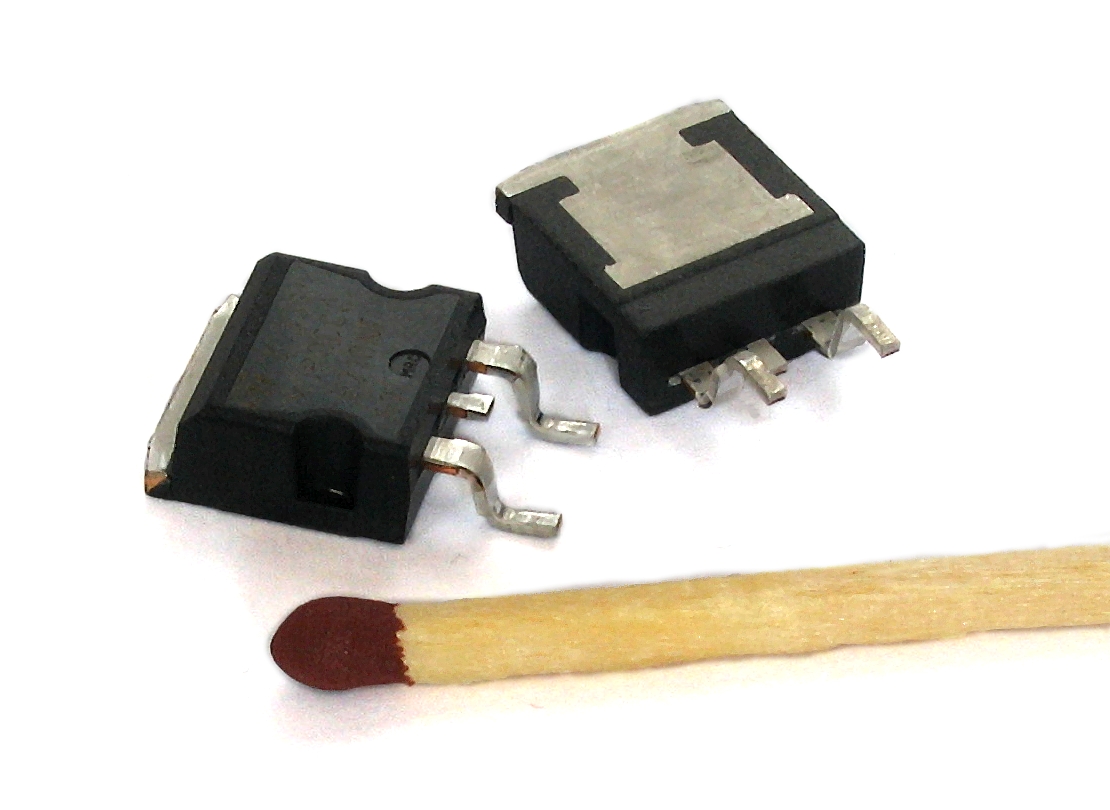
Two power MOSFETs in the surface-mount package D2PAK. Each of these components can sustain a blocking voltage of 120 volts and a continuous current of 30 amperes with appropriate heatsinking.
Working principleSemiconductor
IRLZ24N Power MOSFET in a TO-220AB through-hole package. Pins from left to right are: gate (logic-level), drain, source. The top metal tab is the drain, same as pin 2.[1]

A power MOSFET is a type of metal–oxide–semiconductor field-effect transistor (MOSFET) designed to handle significant power levels. Compared to the other power semiconductor devices, such as an insulated-gate bipolar transistor (IGBT) or a thyristor, its main advantages are high switching speed and good efficiency at low voltages. It shares with the IGBT an isolated gate that makes it easy to drive. They can exhibit low gain, sometimes to the extent that the gate voltage needs to be higher than the voltage being controlled.

The design of power MOSFETs was made possible by the evolution of MOSFET and CMOS technology, used for manufacturing integrated circuits since the 1960s. The power MOSFET shares its operating principle with its low-power counterpart, the lateral MOSFET. The power MOSFET, which is commonly used in power electronics, was adapted from the standard MOSFET and commercially introduced in the 1970s.[2]

The power MOSFET is the most common power semiconductor device in the world, due to its low gate drive power, fast switching speed,[3] easy advanced paralleling capability,[3][4] wide bandwidth, ruggedness, easy drive, simple biasing, ease of application, and ease of repair.[4] In particular, it is the most widely used low-voltage (less than 200 V) switch. It can be found in a wide range of applications, such as most power supplies, DC-to-DC converters, low-voltage motor controllers, and many other applications.

History

[edit]

The MOSFET was invented at Bell Labs between 1955 and 1960.[5][6][7][8][9][10] It was a breakthrough in power electronics. Generations of MOSFETs enabled power designers to achieve performance and density levels not possible with bipolar transistors.[11]

In 1969, Hitachi introduced the first vertical power MOSFET,[12] which would later be known as the VMOS (V-groove MOSFET).[13] The same year, the DMOS (double-diffused MOSFET) with self-aligned gate was first reported by Y. Tarui, Y. Hayashi and Toshihiro Sekigawa of the Electrotechnical Laboratory (ETL).[14][15] In 1974, Jun-ichi Nishizawa at Tohoku University invented a power MOSFET for audio, which was soon manufactured by Yamaha Corporation for their high fidelity audio amplifiers. JVC, Pioneer Corporation, Sony and Toshiba also began manufacturing amplifiers with power MOSFETs in 1974.[16] Siliconix commercially introduced a VMOS in 1975.[13]

The VMOS and DMOS developed into what has become known as VDMOS (vertical DMOS).[16] John Moll's research team at HP Labs fabricated DMOS prototypes in 1977, and demonstrated advantages over the VMOS, including lower on-resistance and higher breakdown voltage.[13] The same year, Hitachi introduced the LDMOS (lateral DMOS), a planar type of DMOS. Hitachi was the only LDMOS manufacturer between 1977 and 1983, during which time LDMOS was used in audio power amplifiers from manufacturers such as HH Electronics (V-series) and Ashly Audio, and were used for music and public address systems.[16] With the introduction of the 2G digital mobile network in 1995, the LDMOS became the most widely used RF power amplifier in mobile networks such as 2G, 3G,[17] and 4G.[18]

Alex Lidow co-invented the HexFET, a hexagonal type of Power MOSFET, at Stanford University in 1977,[19] along with Tom Herman.[20] The HexFET was commercialized by International Rectifier in 1978.[13][20] The insulated-gate bipolar transistor (IGBT), which combines elements of both the power MOSFET and the bipolar junction transistor (BJT), was developed by Jayant Baliga at General Electric between 1977 and 1979.[21]

The superjunction MOSFET is a type of power MOSFET that uses P+ columns that penetrate the N− epitaxial layer. The idea of stacking P and N layers was first proposed by Shozo Shirota and Shigeo Kaneda at Osaka University in 1978.[22] David J. Coe at Philips invented the superjunction MOSFET with alternating p-type and n-type layers, for which a US patent was awarded in 1988.[23]

Applications

[edit]
NXP 7030AL - N-channel TrenchMOS logic level FET
IRF640 Power Mosfet die

The power MOSFET is the most widely used power semiconductor device in the world.[3] As of 2010, the power MOSFET accounts for 53% of the power transistor market, ahead of the insulated-gate bipolar transistor (27%), RF power amplifier (11%) and bipolar junction transistor (9%).[24] As of 2018, over 50 billion power MOSFETs are shipped annually.[25] These include the trench power MOSFET, which sold over 100 billion units up until February 2017,[26] and STMicroelectronics' MDmesh (superjunction MOSFET) which has sold 5 billion units as of 2019.[22]

Power MOSFETs are commonly used for a wide range of consumer electronics.[27][28]

RF DMOS, also known as RF power MOSFET, is a type of DMOS power transistor designed for radio-frequency (RF) applications. It is used in various radio and RF applications.[29][30]

Power MOSFETs are widely used in transportation technology,[31][32][33] which include a wide range of vehicles.

Power MOSFETs are widely used in automotive electronics.[34][35][27]

Power MOSFETs (including DMOS, LDMOS and VMOS) are commonly used for a wide range of other applications. [36][37][38]

Basic structure

[edit]
Fig. 1: Cross section of a VDMOS, showing an elementary cell. Note that a cell is very small (some micrometres to some tens of micrometres wide), and that a power MOSFET is composed of several thousand of them.

Several structures had been explored in the 1970s, when the first commercial power MOSFETs were introduced. However, most of them have been abandoned (at least until recently) in favour of the Vertical Diffused MOS (VDMOS) structure (also called Double-Diffused MOS or simply DMOS) and the LDMOS (laterally diffused MOS) structure.

The cross section of a VDMOS (see figure 1) shows the "verticality" of the device: it can be seen that the source electrode is placed over the drain, resulting in a current mainly vertical when the transistor is in the on-state. The "diffusion" in VDMOS refers to the manufacturing process: the P wells (see figure 1) are obtained by a diffusion process (actually a double diffusion process to get the P and N+ regions, hence the name double diffused).

Power MOSFETs have a different structure from the lateral MOSFET: as with most power devices, their structure is vertical and not planar. In a planar structure, the current and breakdown voltage ratings are both functions of the channel dimensions (respectively width and length of the channel), resulting in inefficient use of the "silicon real estate". With a vertical structure, the voltage rating of the transistor is a function of the doping and thickness of the N epitaxial layer (see cross section), while the current rating is a function of the channel width. This makes it possible for the transistor to sustain both high blocking voltage and high current within a compact piece of silicon.

LDMOS are power MOSFETs with a lateral structure. They are mainly used in high-end audio power amplifiers,[16] and RF power amplifiers in wireless cellular networks, such as 2G, 3G,[17] and 4G.[18] Their advantage is a better behaviour in the saturated region (corresponding to the linear region of a bipolar junction transistor) than the vertical MOSFETs. Vertical MOSFETs are designed for switching applications, so they are only used in on- or off-states.

On-state resistance

[edit]
Fig.2: Contribution of the different parts of the MOSFET to the on-state resistance.

When the power MOSFET is in the on-state (see MOSFET for a discussion on operation modes), it exhibits a resistive behaviour between the drain and source terminals. It can be seen in figure 2 that this resistance (called RDSon for "drain-to-source resistance in on-state") is the sum of many elementary contributions:

  • RS is the source resistance. It represents all resistances between the source terminal of the package to the channel of the MOSFET: resistance of the bond wires, of the source metallisation, and of the N+ wells;
  • Rch. This is the channel resistance. It is inversely proportional to the channel width, and for a given die size, to the channel density. The channel resistance is one of the main contributors to the RDSon of low-voltage MOSFETs, and intensive work has been carried out to reduce their cell size in order to increase the channel density;
  • Ra is the access resistance. It represents the resistance of the epitaxial zone directly under the gate electrode, where the direction of the current changes from horizontal (in the channel) to vertical (to the drain contact);
  • RJFET is the detrimental effect of the cell size reduction mentioned above: the P implantations (see figure 1) form the gates of a parasitic JFET transistor that tend to reduce the width of the current flow;
  • Rn is the resistance of the epitaxial layer. As the role of this layer is to sustain the blocking voltage, Rn is directly related to the voltage rating of the device. A high voltage MOSFET requires a thick, low-doped layer, i.e., highly resistive, whereas a low-voltage transistor only requires a thin layer with a higher doping level, i.e., less resistive. As a result, Rn is the main factor responsible for the resistance of high-voltage MOSFETs;
  • RD is the equivalent of RS for the drain. It represents the resistance of the transistor substrate (the cross section in figure 1 is not at scale, the bottom N+ layer is actually the thickest) and of the package connections.

Breakdown voltage/on-state resistance trade-off

[edit]
Fig. 3: The RDSon of MOSFETs increases with their voltage rating.

When in the off-state, the power MOSFET is equivalent to a PIN diode (constituted by the P+ diffusion, the N epitaxial layer and the N+ substrate). When this highly non-symmetrical structure is reverse-biased, the space-charge region extends principally on the lightly-doped side, i.e., over the N layer. This means that this layer has to withstand most of the MOSFET's off-state drain-to-source voltage.

However, when the MOSFET is in the on-state, this N layer has no function. Furthermore, as it is a lightly-doped region, its intrinsic resistivity is non-negligible and adds to the MOSFET's on-state drain-to-source resistance (RDSon) (this is the Rn resistance in figure 2).

Two main parameters govern both the breakdown voltage and the RDSon of the transistor: the doping level and the thickness of the N epitaxial layer. The thicker the layer and the lower its doping level, the higher the breakdown voltage. On the contrary, the thinner the layer and the higher the doping level, the lower the RDSon (and therefore the lower the conduction losses of the MOSFET). Therefore, it can be seen that there is a trade-off in the design of a MOSFET, between its voltage rating and its on-state resistance.[citation needed] This is demonstrated by the plot in figure 3.

Body diode

[edit]

It can be seen in figure 1 that the source metallization connects both the N+ and P+ implantations, although the operating principle of the MOSFET only requires the source to be connected to the N+ zone. However, if it were, this would result in a floating P zone between the N-doped source and drain, which is equivalent to a NPN transistor with a non-connected base. Under certain conditions (under high drain current, when the on-state drain-to-source voltage is in the order of some volts), this parasitic NPN transistor would be triggered, making the MOSFET uncontrollable. The connection of the P implantation to the source metallization shorts the base of the parasitic transistor to its emitter (the source of the MOSFET) and thus prevents spurious latching. This solution, however, creates a diode between the drain (cathode) and the source (anode) of the MOSFET, making it able to block current in only one direction.

Body diodes may be utilized as freewheeling diodes for inductive loads in configurations such as H bridge or half bridge. While these diodes usually have rather high forward voltage drop, they can handle large currents and are sufficient in many applications, reducing part count, and thus, device cost and board space. To increase efficiency, synchronous rectification is often used to minimize the amount of time that the body diode conducts current.

Switching operation

[edit]
Fig. 4: Location of the intrinsic capacitances of a power MOSFET.

Because of its unipolar nature, the power MOSFET can switch at very high speed. Indeed, there is no need to remove minority carriers as with bipolar devices. The only intrinsic limitation in commutation speed is due to the internal capacitances of the MOSFET (see figure 4). These capacitances must be charged or discharged when the transistor switches. This can be a relatively slow process because the current that flows through the gate capacitances is limited by the external driver circuit. This circuit will actually dictate the commutation speed of the transistor (assuming the power circuit has sufficiently low inductance).

Capacitances

[edit]

In the MOSFET datasheets, the capacitances are often named Ciss (input capacitance, drain and source terminal shorted), Coss (output capacitance, gate and source shorted), and Crss (reverse transfer capacitance, source connected to ground). The relationship between these capacitances and those described below is:

Where CGS, CGD and CDS are respectively the gate-to-source, gate-to-drain and drain-to-source capacitances (see below). Manufacturers prefer to quote Ciss, Coss and Crss because they can be directly measured on the transistor. However, as CGS, CGD and CDS are closer to the physical meaning, they will be used in the remaining of this article.

Gate-to-source capacitance

[edit]

The CGS capacitance is constituted by the parallel connection of CoxN+, CoxP and Coxm (see figure 4). As the N+ and P regions are highly doped, the two former capacitances can be considered as constant. Coxm is the capacitance between the (polysilicon) gate and the (metal) source electrode, so it is also constant. Therefore, it is common practice to consider CGS as a constant capacitance, i.e., its value does not depend on the transistor state.

Gate-to-drain capacitance

[edit]

The CGD capacitance can be seen as the connection in series of two elementary capacitances. The first one is the oxide capacitance (CoxD), constituted by the gate electrode, the silicon dioxide and the top of the N epitaxial layer. It has a constant value. The second capacitance (CGDj) is caused by the extension of the space-charge zone when the MOSFET is in off-state. Therefore, it is dependent upon the drain to gate voltage. From this, the value of CGD is:

The width of the space-charge region is given by[39]

where is the permittivity of the Silicon, q is the electron charge, and N is the doping level. The value of CGDj can be approximated using the expression of the plane capacitor:

Where AGD is the surface area of the gate-drain overlap. Therefore, it comes:

It can be seen that CGDj (and thus CGD) is a capacitance whose value is dependent upon the gate-to-drain voltage. As this voltage increases, the capacitance decreases. When the MOSFET is in on-state, CGDj is shunted, so the gate-to-drain capacitance remains equal to CoxD, a constant value.

Drain-to-source capacitance

[edit]

As the source metallization overlaps the P-wells (see figure 1), the drain and source terminals are separated by a P-N junction. Therefore, CDS is the junction capacitance. This is a non-linear capacitance, and its value can be calculated using the same equation as for CGDj.

Other dynamic elements

[edit]
Equivalent circuit of a power MOSFET, including the dynamic elements (capacitors, inductors), the parasitic resistors, the body diode.

Packaging inductances

[edit]

To operate, the MOSFET must be connected to the external circuit, most of the time using wire bonding (although alternative techniques are investigated). These connections exhibit a parasitic inductance, which is in no way specific to the MOSFET technology, but has important effects because of the high commutation speeds. Parasitic inductances tend to maintain their current constant and generate overvoltage during the transistor turn off, resulting in increasing commutation losses.

A parasitic inductance can be associated with each terminal of the MOSFET. They have different effects:

  • the gate inductance has little influence (assuming it is lower than some hundreds of nanohenries), because the current gradients on the gate are relatively slow. In some cases, however, the gate inductance and the input capacitance of the transistor can constitute an oscillator. This must be avoided, as it results in very high commutation losses (up to the destruction of the device). On a typical design, parasitic inductances are kept low enough to prevent this phenomenon;
  • the drain inductance tends to reduce the drain voltage when the MOSFET turns on, so it reduces turn on losses. However, as it creates an overvoltage during turn-off, it increases turn-off losses;
  • the source parasitic inductance has the same behaviour as the drain inductance, plus a feedback effect that makes commutation last longer, thus increasing commutation losses.
    • at the beginning of a fast turn-on, due to the source inductance, the voltage at the source (on the die) will be able to jump up as well as the gate voltage; the internal VGS voltage will remain low for a longer time, therefore delaying turn-on.
    • at the beginning of a fast turn-off, as current through the source inductance decreases sharply, the resulting voltage across it goes negative (with respect to the lead outside the package) raising the internal VGS voltage, keeping the MOSFET on, and therefore delaying turn-off.

Limits of operation

[edit]

Gate oxide breakdown

[edit]

The gate oxide is very thin (100 nm or less), so it can only sustain a limited voltage. In the datasheets, manufacturers often state a maximum gate-to-source voltage, around 20 V, and exceeding this limit can result in destruction of the component. Furthermore, a high gate-to-source voltage reduces significantly the lifetime of the MOSFET, with little to no advantage on RDSon reduction.

To deal with this issue, a gate driver circuit is often used.

Maximum drain-to-source voltage

[edit]

Power MOSFETs have a maximum specified drain-to-source voltage (in the off-state), beyond which breakdown may occur. Exceeding the breakdown voltage causes the device to conduct, potentially damaging it and other circuit elements due to excessive power dissipation.

Maximum drain current

[edit]

The drain current must generally stay below a certain specified value (maximum continuous drain current). It can reach higher values for very short durations of time (maximum pulsed drain current, sometimes specified for various pulse durations). The drain current is limited by heating due to resistive losses in internal components such as bond wires, and other phenomena such as electromigration in the metal layer.

Maximum temperature

[edit]

The junction temperature (TJ) of the MOSFET must stay under a specified maximum value for the device to function reliably, determined by MOSFET die layout and packaging materials. The packaging often limits the maximum junction temperature, due to the molding compound and (where used) epoxy characteristics.

The maximum operating ambient temperature is determined by the power dissipation and thermal resistance. The junction-to-case thermal resistance is intrinsic to the device and package; the case-to-ambient thermal resistance is largely dependent on the board/mounting layout, heatsinking area and air/fluid flow.

The type of power dissipation, whether continuous or pulsed, affects the maximum operating temperature, due to thermal mass characteristics; in general, the lower the frequency of pulses for a given power dissipation, the higher maximum operating ambient temperature, due to allowing a longer interval for the device to cool down. Models, such as a Foster network, can be used to analyze temperature dynamics from power transients.

Safe operating area

[edit]

The safe operating area defines the combined ranges of drain current and drain-to-source voltage the power MOSFET is able to handle without damage. It is represented graphically as an area in the plane defined by these two parameters. Both drain current and drain-to-source voltage must stay below their respective maximum values, but their product must also stay below the maximum power dissipation the device is able to handle. Thus, the device cannot be operated at its maximum current and maximum voltage simultaneously.[40]

Latch-up

[edit]

The equivalent circuit for a power MOSFET consists of one MOSFET in parallel with a parasitic BJT. If the BJT turns ON, it cannot be turned off, since the gate has no control over it. This phenomenon is known as "latch-up", which can lead to device destruction. The BJT can be turned on due to a voltage drop across the p-type body region. To avoid latch-up, the body and the source are typically short-circuited within the device package.

Technology

[edit]
This power MOSFET has a meshed gate, with square cells
The gate layout of this MOSFET is composed of parallel strips.

Layout

[edit]

Cellular structure

[edit]

As described above, the current handling capability of a power MOSFET is determined by its gate channel width. The gate channel width is the third (Z-axis) dimension of the cross-sections pictured.

To minimize cost and size, it is valuable to keep the transistor's die area size as small as possible. Therefore, optimizations have been developed to increase the width of the channel surface area, i.e., increase the "channel density". They mainly consist of creating cellular structures repeated over the whole area of the MOSFET die. Several shapes have been proposed for these cells, the most famous being the hexagonal shape used in International Rectifier's HEXFET devices.

Another way to increase the channel density is to reduce the size of the elementary structure. This allows for more cells in a given surface area, and therefore more channel width. However, as the cell size shrinks, it becomes more difficult to ensure proper contact of every cell. To overcome this, a "strip" structure is often used (see figure). It is less efficient than a cellular structure of equivalent resolution in terms of channel density, but can cope with smaller pitch. Another advantage of the planar stripe structure is that it is less susceptible to failure during avalanche breakdown events in which the parasitic bipolar transistor turns on from sufficient forward bias. In the cellular structure, if the source terminal of any one cell is poorly contacted, then it becomes much more likely that the parasitic bipolar transistor latches on during an avalanche breakdown event. Because of this, MOSFETs utilizing a planar stripe structure can only fail during avalanche breakdown due to extreme thermal stress.[41]

Structures

[edit]
The VMOS structure has a V-groove at the gate region
The UMOS has a trench gate. It is intended to increase the channel density by making the channel vertical

P-substrate power MOSFET

[edit]

A P-substrate MOSFET (also called a P-channel MOSFET or PMOS) is a MOSFET with opposite doping types (N instead of P and P instead of N in the cross-section in figure 1). This MOSFET is made using a P-type substrate, with a P epitaxy. As the channel sits in a N-region, this transistor is turned on by a negative gate-to-source voltage. This makes it desirable in a buck converter, where one of the terminals of the switch is connected to the high side of the input voltage: with an N-channel (or NMOS) MOSFET, this configuration requires a gate voltage equal to , whereas no voltage over is required with a P-channel MOSFET.

The main disadvantage of this type of MOSFET is the inferior on-state performance, as it uses holes as charge carriers, which have a much lower mobility than electrons. As resistivity is directly related to mobility, a given P-channel device will have a three times higher than an N-channel MOSFET with the same dimensions.

VMOS

[edit]

The VMOS structure has a V-groove at the gate region and was used for the first commercial devices.[42]

UMOS

[edit]

In this power MOSFET structure, also called trench-MOS, the gate electrode is buried in a trench etched in the silicon. This results in a vertical channel. The main interest of the structure is the absence of the JFET effect. The name of the structure comes from the U-shape of the trench.

Super-junction deep-trench technology

[edit]

Especially for voltages beyond 500 V, some manufacturers, including Infineon Technologies with its CoolMOS products, have begun to use a charge compensation principle. With this technology, the resistance of the epitaxial layer, which is the biggest contributor (more than 95%) to the device resistance of high-voltage MOSFETs, can be reduced by a factor of greater than 5.

Seeking to improve the manufacturing efficiency and reliability of super-junction MOSFETs, Renesas Electronics developed a super-junction structure with a deep-trench process technique. This technology entails etching trenches in the low-impurity N-type material to form P-type regions. This process overcomes problems inherent to the multi-level epitaxial growth approach and results in extremely low on-resistance and reduced internal capacitance.

Due to the increased p-n junction area, a super-junction structure has a smaller reverse recovery time but larger reverse recovery current compared to a conventional planar power MOSFET.

See also

[edit]

References

[edit]

Further reading

[edit]
Revisions and contributorsEdit on WikipediaRead on Wikipedia
from Grokipedia
A power MOSFET (metal–oxide– field-effect transistor) is a type of specifically engineered for high-power applications, capable of switching and amplifying electrical signals at high voltages (typically up to several hundred volts) and currents (often exceeding 1 A). It functions as a voltage-controlled device with three primary terminals—, drain, and source—where the is electrically insulated from the channel by a thin layer, allowing control of current flow between the drain and source without drawing significant gate current. Unlike low-power MOSFETs used in integrated circuits, power MOSFETs are optimized for efficient power handling through features like low on-state resistance (R_DS(on)) and high (BV_DSS), making them essential in modern . Power MOSFETs originated in the as an evolution of the basic concept, developed to address the speed and efficiency limitations of bipolar junction transistors (BJTs) in switching applications. They typically employ a vertical double-diffused metal-oxide-semiconductor (DMOS) structure, featuring millions of parallel cells integrated into a single die to minimize conduction losses while supporting high current densities. Key structural variants include planar and trench-gate designs, with trench types enabling very high cell densities (up to 200 million per square inch or more) for improved performance in compact packages. Notable characteristics of power MOSFETs include fast switching times (typically 50–200 ns), high requiring minimal gate drive power, and a positive for safe paralleling without . They exhibit no minority carrier storage delay, unlike BJTs, and are immune to second breakdown, allowing reliable operation at high frequencies and temperatures. Threshold voltages range from 1–4 V depending on the voltage rating, with on-resistance dominated by region in high-voltage devices (>200 V). These devices are widely applied in switching power supplies, DC-DC converters, motor drives, inverters, and , where their and contribute to reduced size and energy consumption. N-channel enhancement-mode configurations predominate for their superior performance, though P-channel variants exist for specific low-voltage needs. Ongoing advancements, such as superjunction and CoolMOS technologies, continue to enhance their (R_DS(on) × BV_DSS²) for even higher in emerging applications like electric vehicles and .

Fundamentals

Device Structure

Power MOSFETs employ a vertical channel structure to optimize high-voltage and high-current performance, with the source terminal located at the top surface, the gate terminal adjacent to the channel region, and the drain terminal at the bottom of the device. This configuration allows for a larger effective die area dedicated to current conduction while minimizing the channel length, enabling efficient power handling in applications such as switching converters and motor drives. The device is fabricated on a heavily doped substrate, typically n+ for n-channel variants, which serves as the drain contact. An n- epitaxial layer is grown on this substrate to form the drift region, responsible for blocking high voltages—up to several hundred volts—by supporting the without breakdown. The p-body region is diffused into the epitaxial layer, creating the channel inversion layer under the and defining the body-drain junction. N-channel power MOSFETs, which use electrons as majority carriers, dominate due to their lower on-resistance compared to p-channel variants that rely on holes; p-channel devices are less common but used in specific complementary circuits. A key feature of the structure is the intrinsic body , formed by the p-n junction between the p-body region and the n- epitaxial layer (or n+ source regions in the case of the source-body junction). This provides a path for reverse conduction when the device is off and the drain voltage is negative relative to the source, essential for freewheeling in inductive loads like those in buck converters. The body typically exhibits a forward of about 0.7-1.5 V, depending on the device and operating current, with its characteristics influencing reverse recovery behavior during switching. The is insulated from the channel by a thin (SiO₂) layer grown on the surface, acting as the insulator to enable voltage-controlled operation without significant gate current. For voltage ratings up to 600 V, the typical thickness ranges from 50-100 nm, balancing control (around 2-4 V) with to withstand gate-source voltages of ±20-30 V. The overall cross-section resembles a vertical stack: starting from the bottom n+ drain substrate, the n- epitaxial drift layer, p-body with n+ source diffusions at the top, and polysilicon electrode over the oxide-etched channel , often arranged in cellular or striped patterns for uniform current distribution. This design inherently contributes to the on-state resistance through the combined resistance of the channel and drift .

DC Characteristics

The on-state resistance, denoted as RDS(on)R_{DS(on)}, represents the total drain-to-source resistance when the power MOSFET is fully conducting in the linear region, with the gate-source voltage exceeding the threshold voltage and a specified drain current applied. This resistance comprises contributions from several components, including the channel resistance RCHR_{CH}, which is inversely proportional to the electron mobility in the inversion layer; higher channel mobility reduces RCHR_{CH} and thus RDS(on)R_{DS(on)}. Additionally, the drift region resistance RDR_D is influenced by the doping concentration in the n-drift layer; increased doping lowers RDR_D but must be balanced against breakdown voltage requirements. For low-voltage devices (e.g., rated below 100 V), typical RDS(on)R_{DS(on)} values are below 10 mΩ at 25°C, enabling efficient conduction in applications like DC-DC converters. The breakdown voltage BVDSSBV_{DSS} is the drain-to-source voltage at which the reverse-biased body-drift p-n junction undergoes , allowing significant current flow (typically measured at 250 μA with gate and source shorted). This mechanism occurs primarily in the drift region, where the high exceeds the critical field strength ECE_C (approximately 3 × 10^5 V/cm for ), triggering that generates electron-hole pairs and sustains the avalanche process. A fundamental trade-off exists between BVDSSBV_{DSS} and RDS(on)R_{DS(on)}, as higher breakdown voltages require a thicker, lower-doped drift region to support the , which increases resistance; this is quantified by the silicon limit relating specific on-resistance ρ\rho (on-resistance per unit area) to breakdown voltage. For unoptimized drift regions in conventional power MOSFETs, the relationship follows ρBV2.5\rho \approx BV^{2.5}, representing the 1D silicon limit derived from one-dimensional and physics. The derivation begins with for the E(z)E(z) in the drift region: E(z)=qND(Wz)εsE(z) = \frac{q N_D (W - z)}{\varepsilon_s}, where qq is the electron charge, NDN_D is the donor concentration, WW is the drift thickness, and εs\varepsilon_s is 's ; integration yields the potential V(z)=qND(Wzz2/2)εsV(z) = \frac{q N_D (W z - z^2 / 2)}{\varepsilon_s}. occurs when the maximum field reaches the critical value, leading to BV=εsEC22qNDBV = \frac{\varepsilon_s E_C^2}{2 q N_D} for a triangular field profile. The specific drift resistance is ρdrift=WqμnND\rho_{drift} = \frac{W}{q \mu_n N_D}, where μn\mu_n is ; substituting WεsECqNDW \approx \frac{\varepsilon_s E_C}{q N_D} and solving for NDN_D from the BV equation gives ρdriftBV2.5\rho_{drift} \propto BV^{2.5} after accounting for the coefficient and field scaling in the rate. This curve illustrates the performance boundary for devices, with modern structures like superjunctions approaching or exceeding it by optimizing charge balance. The intrinsic body in power MOSFETs exhibits a forward typically ranging from 0.7 V to 1.0 V at moderate currents (e.g., 1 A), similar to a standard p-n , due to the p-body/n-drift junction. Its recovery characteristics involve a reverse recovery time trrt_{rr} (often 100-200 ns) and charge QrrQ_{rr} (typically 0.5-2 μC), which can contribute to switching losses but are minimized in advanced designs. To verify the functionality of the inherent body diode in an N-channel power MOSFET, a multimeter set to diode mode can be used, with the gate shorted to the source to ensure the channel is off. Connect the red probe to the source and the black probe to the drain; a voltage drop of 0.6 to 1.2 V indicates conduction through the diode. Reversing the probes (red to drain, black to source) should yield an open circuit (OL) reading, confirming no conduction in reverse bias.

Switching Behavior

Parasitic Capacitances

Power MOSFETs exhibit several parasitic capacitances that arise from their internal structure, significantly influencing switching performance, gate drive power requirements, and overall circuit efficiency. These capacitances store charge during transients, leading to delays in voltage transitions and contributing to phenomena such as the . The primary parasitic capacitances are the gate-to-source capacitance (C_{GS}), gate-to-drain capacitance (C_{GD}), and drain-to-source capacitance (C_{DS}), each with distinct physical origins and voltage dependencies. The -to-source , C_{GS}, primarily results from the overlap of the polysilicon over the source region and the underlying channel area. This is largely independent of applied voltages and remains relatively constant during operation. C_{GS} plays a key role in the initial charging phase of the during and contributes to the , where feedback from drain-source voltage swings amplifies the effective input , slowing switching speeds and increasing drive losses. The gate-to-drain , C_{GD}, also known as the feedback or , consists of two components: the overlap between the gate and the drain extension in the region, and a voltage-dependent portion from the beneath the gate. C_{GD} acts as a feedback path, coupling drain voltage changes to the gate and exacerbating the during switching. Its value is highly nonlinear and decreases with increasing drain-to-source voltage (V_{DS}), as the widens, reducing the effective overlap area. This voltage-dependent charging requires careful consideration in gate drive design to minimize switching times and . A common analytical model for C_{GD} variation treats it as a hyperbolic function of gate-drain voltage (V_{GD}), such as C_{GD} \approx C_{GD,\max} \cdot \tanh(a \cdot V_{GD}) for positive V_{GD}, where a is a fitting and C_{GD,\max} is the maximum value at low bias; for negative V_{GD}, an arctangent form may be used to capture the asymmetry. Full capacitance-voltage (C-V) curves, which plot these capacitances against V_{DS} at fixed gate bias, reveal the nonlinear behavior and are essential for modeling high-frequency operation. The drain-to-source capacitance, C_{DS}, originates from the p-n junction of the body diode between drain and source regions and dominates in the off-state. It behaves as a typical junction capacitance, varying inversely with the square root of the applied reverse bias: C_{DS} = \frac{C_{DS0}}{\sqrt{1 + \frac{V_{DS}}{\phi}}}, where C_{DS0} is the zero-bias capacitance and \phi is the built-in potential (typically 0.7-1 V). This voltage dependence affects energy recovery in soft-switching circuits and contributes to output capacitance during turn-off. These individual capacitances combine to form the total small-signal capacitances reported in datasheets: the input capacitance (with drain and source shorted), the output capacitance C_{oss} = C_{DS} + C_{GD} (with and source shorted), and the reverse transfer capacitance (with and source shorted). These totals are measured using standard C-V profiling techniques, where is assessed as a function of voltage via at 1 MHz, providing insights into doping profiles and integrity. For typical 100 V power MOSFETs, C_{iss} ranges from 1 to 10 , depending on die size and process technology, with C_{GD} often being the smallest but most impactful component (e.g., 10-100 pF).

Inductive Effects

In power MOSFETs, parasitic inductances arise primarily from elements such as bond wires, leads, and interconnects, which store energy during rapid current changes and degrade high-frequency performance while contributing to (EMI). The source inductance LSL_S and drain inductance LDL_D, typically ranging from 1 to 10 nH, originate from these bond wires and package leads, influencing the device's switching dynamics. Similarly, gate inductance LGL_G in the drive circuit can induce ringing, where oscillations occur due to the interaction between the inductive path and the MOSFET's during fast transients. These inductances cause significant effects during switching, including voltage overshoots across the device. The fundamental relation governing this is V=LdidtV = L \frac{di}{dt}, where rapid current changes (di/dtdi/dt) generate inductive voltages that add to the applied drain-source voltage. Specifically, the peak overshoot voltage is given by ΔV=LS(didt)max,\Delta V = L_S \left( \frac{di}{dt} \right)_{\max}, with (didt)max\left( \frac{di}{dt} \right)_{\max} estimated from the load current , potentially exceeding hundreds of volts in high-power applications and risking device or failure. Additionally, these parasitics slow switching transitions, thereby increasing overall switching losses by extending the time spent in the high-loss linear region. Parasitic inductances can also interact with device capacitances to form LC resonances, exacerbating through unwanted oscillations. In common packages like TO-247, the total loop inductance is typically several nH, which becomes particularly critical in high-current applications. To mitigate these inductive effects, Kelvin connections are employed, providing a dedicated low-inductance path for gate drive sensing that bypasses the power source inductance in the .

Operational Limits

Electrical Limits

The electrical limits of a power MOSFET define the absolute maximum voltage and current values that the device can withstand without permanent damage, ensuring safe operation within specified boundaries. These ratings are critical for preventing breakdown or excessive stress during both steady-state and transient conditions. Key parameters include the drain-to-source voltage (V_DS), drain current (I_D), and gate-to-source voltage (V_GS), each derived from the device's internal structure and material properties. The maximum drain-to-source voltage, denoted as V_DS(max) or BV_DSS ( drain-to-source), represents the highest voltage the MOSFET can block in the off-state before entering . For instance, BV_DSS is typically rated at a low drain current (e.g., 250 μA) and 25°C , with values ranging from 30 V to over 1000 V depending on the application. During transients, such as inductive load switching, the voltage may exceed BV_DSS briefly, but the device is designed to handle this via avalanche ruggedness, with applied to limit duration and energy to avoid . Avalanche energy ratings, such as single-pulse E_AS, quantify this capability; E_AS = \frac{1}{2} L I_{AS}^2 \left( \frac{BV_{DSS}}{BV_{DSS} - V_{DD}} \right) under unclamped inductive switching (UIS) test conditions, often specified with parameters like L = 10 mH, V_{DD} = 50 V, I_{AS} = rated value, starting from T_J = 25°C. The maximum drain current I_D(max) specifies the highest continuous or pulsed current the device can carry while maintaining operation, primarily by on-state resistance (R_DS(on)) induced heating. Continuous I_D is rated at specified case temperatures (e.g., 25°C or 100°C), with pulsed ratings allowing higher values for short durations due to reduced average power. The power dissipation in the on-state is given by: P=ID2RDS(on)P = I_D^2 \cdot R_{DS(on)} This illustrates how I_D(max) is constrained by the maximum allowable power dissipation, which must be dissipated as heat without exceeding thermal limits. For a representative 600 V device, continuous I_D(max) typically ranges from 20 A to 50 A at 25°C, with pulsed values up to four times higher, and E_AS around 200-500 mJ for inductive clamping scenarios. The gate-to-source voltage V_GS(max) is limited to prevent dielectric breakdown of the , commonly rated at ±20 V for most power MOSFETs. Exceeding this can cause oxide puncture or charge trapping, leading to reliability issues; thus, gate drive circuits must incorporate such as clamping diodes or zeners to stay within this envelope.

Thermal and Power Limits

The maximum , TJmaxT_{J \max}, for power MOSFETs is typically rated between 150°C and 175°C to ensure reliable operation, with 175°C being common for -based devices. Exceeding this limit can degrade performance and lead to , as high temperatures reduce carrier mobility due to increased , thereby increasing on-state resistance and lowering switching efficiency. Additionally, leakage current rises exponentially with temperature because of the increased intrinsic carrier concentration in the , which exacerbates power dissipation and heat generation. While on-state resistance exhibits a positive , helping to share current evenly in parallel configurations, the overall impact at elevated temperatures limits safe operation. Thermal resistance quantifies the temperature rise per unit of dissipated power in power MOSFETs and is denoted as RθJAR_{\theta JA} for the path from junction to ambient and RθJCR_{\theta JC} for junction to case. These parameters are defined by the equation θ=ΔTP\theta = \frac{\Delta T}{P}, where ΔT\Delta T is the difference and PP is the power dissipation, typically expressed in . RθJAR_{\theta JA} includes contributions from the die, package, and external heatsinking, often ranging from –100 depending on package type and mounting, while RθJCR_{\theta JC} is lower, around 0.5–2 , focusing on internal heat flow to the case. Effective management of these resistances through heatsinks or is essential for maintaining junction temperatures below TJmaxT_{J \max}. The power curve illustrates how maximum allowable power dissipation decreases linearly with increasing ambient , given by the equation Pmax=TJmaxTARθJAP_{\max} = \frac{T_{J \max} - T_A}{R_{\theta JA}}, where TAT_A is the ambient . For example, a device with TJmax=175T_{J \max} = 175^\circC and RθJA=50R_{\theta JA} = 50^\circC/W can dissipate up to 3 W at TA=25T_A = 25^\circC but only 1 W at TA=125T_A = 125^\circC, emphasizing the need for in hot environments to prevent . A comprehensive thermal model for power MOSFETs treats the device as an RC analog, incorporating thermal resistance RθR_\theta for steady-state heat flow and thermal capacitance CθC_\theta (in J/°C) for , enabling prediction of temperature during pulsed operation. The transient junction temperature TJ(t)T_J(t) evolves according to the CθdTJdt+TJTARθ=P(t)C_\theta \frac{dT_J}{dt} + \frac{T_J - T_A}{R_\theta} = P(t), where P(t)P(t) is the time-varying power input; this model captures the time constant τ=RθCθ\tau = R_\theta C_\theta, typically milliseconds to seconds for the die. Such models are vital for simulating short-pulse conditions where peak temperatures may exceed steady-state limits without violating TJmaxT_{J \max}. Reliability issues arise above 150°C due to the coefficient of thermal expansion (CTE) mismatch between silicon (approximately 2.6 ppm/°C) and common plastic package materials (15–20 ppm/°C), inducing thermo-mechanical stresses that can cause delamination, wire bond lift-off, or die cracking during thermal cycling.

Safe Operating Area

The safe operating area (SOA) delineates the combined DC and transient voltage-current boundaries within which a power MOSFET can operate reliably without incurring damage from electrical or thermal stress. The forward-biased (FBSOA) establishes the current-voltage limits applicable during linear-mode operation, where the device simultaneously sustains significant drain-source voltage and drain current, resulting in elevated power dissipation that must remain below thresholds. The reverse-biased SOA (RBSOA) characterizes safe operation during inductive load switching, particularly the device's ruggedness to absorb energy from voltage transients exceeding the rated at turn-off. SOA boundaries are graphically depicted in log-scale plots of drain current IDI_D versus drain-source voltage VDSV_{DS}, featuring distinct curves for DC conditions and pulsed operation at various durations to illustrate permissible excursions. Time-dependent SOA limits stem from diffusion dynamics, permitting higher ratings when the pulse duration tt satisfies t<τthermalt < \tau_{\mathrm{thermal}}, where τthermal\tau_{\mathrm{thermal}} denotes the thermal time constant before significant heat spreading elevates the junction temperature. In high-voltage linear operation, second breakdown arises from localized hot spots that trigger thermal runaway via current filamentation, a failure mode largely eliminated in modern vertical power MOSFET structures due to their inherent positive temperature coefficient, which enhances current distribution and stability. Parasitic inductances may amplify voltage overshoots during switching, thereby challenging adherence to RBSOA constraints.

Failure Mechanisms

Latch-Up

Latch-up in power MOSFETs refers to a destructive failure mode where a parasitic bipolar junction transistor (BJT), typically an NPN structure inherent to the vertical n-channel device, turns on uncontrollably, creating a low-impedance path between drain and source. This parasitic thyristor-like p-n-p-n path forms from the p-body/drain n-epitaxial junction and the source/p-body junction, leading to regenerative feedback that sustains high current conduction even after the triggering stimulus is removed. The mechanism is triggered primarily through the body-drain and source-body junctions under conditions of high dV/dt (voltage slew rate) during switching or high dI/dt (current slew rate) during transients, where the rapid changes forward-bias the base-emitter junction of the parasitic NPN, injecting carriers and amplifying current flow. The conditions for latch-up activation often involve high current crowding at the device periphery or avalanche injection during unclamped inductive switching (UIS), where localized hot spots generate hole current that forward-biases the parasitic BJT base-emitter junction, exceeding approximately 0.7 V and initiating snapback behavior. This is exacerbated in scenarios with insufficient gate control or excessive energy dissipation, resulting in thermal runaway if not interrupted. Susceptibility increases in devices rated above 100 V due to thicker epitaxial layers that can enhance carrier multiplication and reduce the threshold for parasitic triggering, though modern designs mitigate this through optimized structures. Prevention strategies focus on design elements that increase the holding voltage of the parasitic structure, such as optimized p-body doping to raise the base resistance of the NPN BJT and suppress its current gain, thereby preventing regenerative turn-on. Additional measures include implementing guard rings around the active cell area to collect minority carriers and reduce current crowding, as well as P+ sinkers to shorten the current path and enhance latch-up immunity. This failure mode was particularly common in early planar power MOSFETs due to higher susceptibility to parasitic BJT activation from uneven current distribution across the cell array, but it has been significantly mitigated in modern trench-gate designs through deeper body regions and improved cell pitch that distribute current more uniformly and reduce the effective β of the parasitics.

Gate Oxide Degradation

Gate oxide degradation in power MOSFETs primarily arises from electrical stresses that compromise the insulating properties of the gate dielectric, typically silicon dioxide (SiO₂), leading to progressive reliability failures over operational lifetimes. One key mechanism is time-dependent dielectric breakdown (TDDB), where high electric fields exceeding 10 MV/cm induce Fowler-Nordheim tunneling of electrons through the oxide, creating defects and eventually causing catastrophic breakdown. This process is particularly pronounced in power MOSFETs due to their thicker oxides (often 50-100 nm) designed to withstand elevated voltages, yet still vulnerable under repeated high-field exposure. Another significant contributor is hot carrier injection, wherein channel electrons accelerated by the lateral electric field near the drain gain sufficient energy (>3 eV) to overcome the Si-SiO₂ barrier, injecting into the oxide and charging preexisting or generated traps. This injection predominantly occurs during switching transients, trapping negative charge that alters the oxide's electrostatics and interface properties. Both TDDB and hot carrier effects manifest as stress-induced degradation, including positive shifts in threshold voltage (ΔV_th up to several volts) and reductions in peak transconductance (g_m degradation by 10-30% over aging cycles), which diminish on-state performance and increase switching losses. Reliability modeling for gate oxide lifetime under TDDB often employs the exponential field-acceleration model: τ=Aexp(BEox)\tau = A \exp\left( \frac{B}{E_{\mathrm{ox}}} \right) where τ\tau is the time to breakdown, AA and BB are material- and process-dependent constants, and EoxE_{\mathrm{ox}} is the . This 1/E model captures the strong field dependence, with full reliability assessment incorporating Weibull statistics to account for statistical variations in defect paths across the area. Degradation is further accelerated by gate ringing—oscillatory voltage overshoots induced by package inductances during fast switching—which can transiently exceed rated V_GS limits and amplify field stresses. Modern power MOSFETs mitigate these issues through nitrided SiO₂ s, which incorporate to reduce defect generation and improve TDDB resistance, achieving lifetimes exceeding 20 years at operational fields of 5 MV/cm.

Technology and Fabrication

Design Layout

The design layout of power MOSFETs centers on a highly integrated array of thousands to millions of microscopic cells connected in parallel across the die surface, enabling efficient current distribution and low on-state resistance. These cells are typically arranged in hexagonal or stripe patterns to optimize packing density and minimize conduction path lengths, with individual cell widths ranging from 1 to 10 μm. In modern low-voltage devices (e.g., below 200 V), cell densities exceed 10^6 cells/cm², which significantly reduces the specific on-resistance RDS(on)R_{DS(on)} by shortening the drift region and channel lengths, thereby improving overall efficiency in power switching applications. This parallel cellular architecture builds on the vertical device structure, where current flows perpendicularly from drain to source through the substrate. Gate interconnects, known as gate runners, are critical for uniform voltage distribution across the cell array and are typically implemented using low-resistance polysilicon or metal layers to minimize gate delay and resistive losses. These runners often form a meshed or surrounding pattern around the active area, sometimes incorporating additional fingers for enhanced uniformity in larger dies. Source contacts are designed to short the body region directly to the source metallization, preventing unintended turn-on of the parasitic NPN bipolar transistor by clamping the body potential and suppressing under high current conditions. This shorting is achieved through aligned metal overlays that contact both the n+ source diffusions and the p-body, ensuring reliable operation during fast switching transients. A key trade-off in layout design involves balancing cell density with parasitic capacitances; while higher densities lower RDS(on)R_{DS(on)} by increasing channel width per unit area, they also elevate (e.g., CGSC_{GS} and CGDC_{GD}), which can increase switching losses and gate drive requirements. Designers thus optimize geometries—such as hexagonal arrays for better area utilization over stripes—to achieve a compromise that suits specific voltage ratings and application demands, often prioritizing low-voltage performance where density gains yield the most benefit.

Structural Evolutions

The evolution of power MOSFET structures began with the P-substrate configuration in the early , which featured a P-type substrate topped with P-epitaxy and an N-channel formed in the epitaxial layer, resulting in a lateral-like current path that limited blocking voltages to below 100 V due to high resistance and field crowding at the surface. This design, while enabling initial high-current handling, suffered from poor scalability for higher voltages, prompting the need for vertical architectures to improve efficiency and . In the mid-1970s, the V-groove (VMOS) introduced a vertical channel etched via anisotropic V-shaped grooves in the , allowing current to flow perpendicular to the wafer surface and achieving higher cell densities compared to planar designs, which reduced on-resistance and supported voltages up to 400 V. The grooved gate structure minimized surface field effects and increased channel width per unit area, marking a significant step toward commercial power switching applications. By the , the U-groove MOSFET (UMOS) or trench-gate design advanced this further with deeper, U-shaped trenches that enabled even tighter cell pitches—down to around 1-2 μm—while maintaining vertical conduction, thereby lowering specific on-resistance (R_DS(on)) by up to 50% over VMOS for low- to medium-voltage devices (up to 250 V). This structure eliminated the JFET region resistance inherent in earlier vertical DMOS variants, facilitating higher packing densities and faster switching. The superjunction (SJ) architecture, commercialized in the late , revolutionized high-voltage performance (>600 V) by incorporating alternating charge-balanced P- and N-type pillars in the drift region, which depleted more uniformly under reverse bias to break the limit on doping versus trade-off. Ideal charge balance requires the positive charge in N-pillars to equal the negative charge in P-pillars, leading to a uniform ; this allows for 2-3 times lower R_DS(on) than conventional unipolar structures at the same voltage rating. For instance, SJ enables 600 V devices with R_DS(on) below 50 mΩ, approximately three times better than equivalent planar MOSFETs, enhancing efficiency in power supplies and converters. Recent advances through 2025 have focused on optimized designs incorporating shielding layers, such as split-gate or fin-channel configurations, to reduce gate-drain charge (Q_GD) by 20-30% and mitigate stress, improving switching speeds and reliability in high-frequency applications. Additionally, hybrid integration of silicon with (SiC) elements in co-packaged modules has emerged, combining Si's cost-effectiveness with SiC's superior thermal and voltage handling, supporting the growing SiC power device market projected to reach approximately $3.8 billion in 2025 amid demand for electric vehicles and renewables.

Applications

Power Conversion

Power MOSFETs are integral to DC-DC converters, particularly in buck and boost configurations, where they facilitate synchronous rectification by replacing Schottky diodes in the low-side switch position. This substitution leverages the MOSFET's low on-state resistance (R_DS(on)) to significantly reduce conduction losses, enabling overall converter efficiencies greater than 95% in low-voltage applications such as point-of-load . For instance, in a typical synchronous , the high-side MOSFET conducts during the on-time to transfer energy to the , while the low-side MOSFET handles the freewheeling path, with its inherent body diode briefly conducting during dead time to maintain current continuity. In more complex switched-mode power supplies (SMPS), power MOSFETs are employed in half-bridge and full-bridge topologies to achieve isolated or non-isolated power conversion with high efficiency. These configurations require precise dead-time management between complementary MOSFET pairs to avoid shoot-through currents that could lead to excessive losses or device failure; adaptive or fixed dead times on the order of tens of nanoseconds are optimized based on switching speed and load conditions. The low gate charge (Q_G) of modern power MOSFETs, often below 50 nC for 40-100 V devices, supports switching frequencies up to 1 MHz, which minimizes the size of inductors and capacitors while maintaining low switching losses. Key applications highlight the versatility of power MOSFETs in power conversion. In server power supplies, they deliver low voltages (e.g., 1-12 ) at high currents exceeding 100 A to feed microprocessors and memory, utilizing multiphase buck converters for thermal management and ripple reduction. For solar inverters, power MOSFETs or their wide-bandgap counterparts provide robust high-voltage blocking (up to 600-1200 ) in the DC-AC inversion stage, ensuring efficient and grid synchronization with minimal harmonic distortion. In automotive 48 V-to-12 V DC-DC converters, these devices handle peak currents of 100 A during transient loads like engine starting, achieving minimal conduction and switching losses to support mild-hybrid electrification systems.

Motor Control

Power MOSFETs are integral to systems, particularly in driving brushless DC (BLDC) and permanent magnet synchronous motors (PMSM) through three-phase inverter bridges. These bridges typically employ six power MOSFETs arranged in three half-bridges, enabling the conversion of DC power from a battery or supply to three-phase AC for motor operation. This configuration allows precise control of motor speed and torque by modulating the switching of the MOSFETs, which handle high currents and voltages required for applications like electric propulsion. Pulse-width modulation (PWM) techniques are employed to generate the desired AC waveforms while minimizing losses and harmonics. Sinusoidal PWM produces a sine wave approximation by varying the duty cycle of the MOSFET switches, but it can introduce higher harmonic distortion. Space vector PWM, an advanced method, utilizes vector representations of the three-phase voltages to optimize switching patterns, achieving lower harmonics and higher DC bus utilization compared to sinusoidal PWM. Switching capacitances in power MOSFETs contribute to PWM losses by influencing turn-on and turn-off times during modulation. In (EV) traction systems, (SiC)-enhanced power MOSFETs support 800 V architectures, enabling compact inverters with faster switching and reduced losses for high-power motor drives. Industrial servo drives also leverage power MOSFETs for precise position and control in , where their low on-resistance supports high-efficiency operation in compact designs. Key challenges in these inverters include preventing shoot-through, where simultaneous conduction in high- and low-side MOSFETs of a half-bridge causes short circuits, addressed via dead time insertion in gate drivers. Overcurrent protection is implemented through voltage drain-source (VDS) monitoring to detect faults and shut down switching promptly, the MOSFETs and motor. In the 2025 EV market, power MOSFET-based inverters achieve over 98% , allowing smaller battery packs while maintaining range and performance.

Historical Development

The concept of the (FET) dates back to the 1920s, but practical development began in the mid-20th century. The (MOSFET), the foundation for power MOSFETs, was invented in 1959 by and at Bell Laboratories. Their silicon-based MOSFET demonstrated reliable operation with an insulated gate, enabling high and low power consumption. Power MOSFETs, optimized for high-voltage and high-current applications, emerged in the 1970s to overcome limitations of bipolar junction transistors (BJTs) in switching power supplies and motor controls. In 1974, Japanese engineer Jun-ichi Nishizawa at invented an early power MOSFET structure for audio amplifiers, which was commercialized by . However, widespread adoption followed the introduction of vertical structures for better power handling. A pivotal milestone occurred in 1979 when (IR) launched the HEXFET, the first commercially viable power MOSFET series, featuring a double-diffused metal-oxide-semiconductor (DMOS) structure. This vertical planar-gate design achieved cell densities of around 0.5 million per and supported voltages up to 500 V with low on-resistance, revolutionizing high-frequency switching. The 1980s saw rapid advancements, with companies like Siliconix and IR refining DMOS technology for broader applications. By the , trench-gate structures, such as Siliconix's TrenchFET introduced around 1991, increased cell densities to over 8 million per , reducing conduction losses and enabling compact, efficient devices for DC-DC converters. Subsequent innovations include superjunction MOSFETs in the early 2000s, pioneered by ' CoolMOS in 1998, which improved the for high-voltage (>600 V) applications by balancing drift region charge. As of 2025, ongoing developments focus on wide-bandgap alternatives like (SiC) and (GaN) MOSFETs, though silicon power MOSFETs remain dominant in cost-sensitive markets.

References

Add your contribution
Related Hubs
User Avatar
No comments yet.