Hubbry Logo
VaristorVaristorMain
Open search
Varistor
Community hub
Varistor
logo
8 pages, 0 posts
0 subscribers
Be the first to start a discussion here.
Contribute something
Varistor
Varistor
from Wikipedia
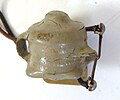
Metal-oxide varistor manufactured by Siemens & Halske AG.
Modern varistor schematic symbol, which is the same as a thermistor symbol[1]

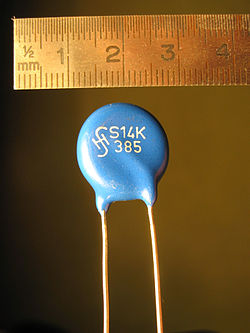
A varistor (a.k.a. voltage-dependent resistor (VDR)) is a surge protecting electronic component with an electrical resistance that varies with the applied voltage.[2] It has a nonlinear, non-ohmic current–voltage characteristic that is similar to that of a diode. Unlike a diode however, it has the same characteristic for both directions of traversing current. Traditionally, varistors were constructed by connecting two rectifiers, such as the copper-oxide or germanium-oxide rectifier in antiparallel configuration. At low voltage the varistor has a high electrical resistance which decreases as the voltage is raised. Modern varistors are primarily based on sintered ceramic metal-oxide materials which exhibit directional behavior only on a microscopic scale. This type is commonly known as the metal-oxide varistor (MOV).

Varistors are used as control or compensation elements in circuits either to provide optimal operating conditions or to protect against excessive transient voltages. When used as protection devices, they shunt the current created by the excessive voltage away from sensitive components when triggered.

The name varistor is a portmanteau of varying resistor. The term is only used for non-ohmic varying resistors. Variable resistors, such as the potentiometer and the rheostat, have ohmic characteristics.

History

[edit]

The development of the varistor, in form of a new type of rectifier based on a cuprous oxide (Cu2O) layer on copper, originated in the work by L.O. Grondahl and P.H. Geiger in 1927.[3]

The copper-oxide varistor exhibited a varying resistance in dependence on the polarity and magnitude of applied voltage.[4] It was constructed from a small copper disk, on one side of which, a layer of cuprous oxide was formed. This arrangement provides low resistance to current flowing from the semiconducting oxide to the copper side, but a high resistance to current in the opposite direction, with the instantaneous resistance varying continuously with the voltage applied.

In the 1930s, small multiple-varistor assemblies of a maximum dimension of less than one inch and apparently indefinite useful lifetime found application in replacing bulky electron tube circuits as modulators and demodulators in carrier current systems for telephonic transmission.[4]

Other applications for varistors in the telephone plant included protection of circuits from voltage spikes and noise, as well as click suppression on receiver (ear-piece) elements to protect users' ears from popping noises when switching circuits. These varistors were constructed by layering an even number of rectifier disks in a stack and connecting the terminal ends and the center in an anti-parallel configuration, as shown in the photo of a Western Electric Type 3B varistor of June 1952 (below).

The Western Electric type 500 telephone set of 1949 introduced a dynamic loop equalization circuit using varistors that shunted relatively high levels of loop current on short central office loops to adjust the transmission and receiving signal levels automatically. On long loops, the varistors maintained a relatively high resistance and did not alter the signals significantly.[7]

Another type of varistor was made from silicon carbide (SiC) by R. O. Grisdale in the early 1930s. It was used to guard telephone lines from lightning.[8]

In the early 1970s, Japanese researchers recognized the semiconducting electronic properties of zinc oxide (ZnO) as being useful as a new varistor type in a ceramic sintering process, which exhibited a voltage-current function similar to that of a pair of back-to-back Zener diodes.[9][10] This type of device became the preferred method for protecting circuits from power surges and other destructive electric disturbances, and became known generally as the metal-oxide varistor (MOV). The randomness of orientation of ZnO grains in the bulk of this material provided the same voltage-current characteristics for both directions of current flow.

Composition, properties, and operation of the metal-oxide varistor

[edit]
Varistor current vs voltage for zinc oxide (ZnO) and silicon carbide (SiC) devices

The most common modern type of varistor is the metal-oxide varistor (MOV). This type contains a ceramic mass of zinc oxide (ZnO) grains, in a matrix of other metal oxides, such as small amounts of bismuth, cobalt, manganese oxides, sandwiched between two metal plates, which constitute the electrodes of the device. The boundary between each grain and a neighbor forms a diode junction, which allows current to flow in only one direction. The accumulation of randomly oriented grains is electrically equivalent to a network of back-to-back diode pairs, each pair in parallel with many other pairs.[11]

When a small voltage is applied across the electrodes, only a tiny current flows, caused by reverse leakage through the diode junctions. When a large voltage is applied, the diode junction breaks down due to a combination of thermionic emission and electron tunneling, resulting in a large current flow. The result of this behavior is a nonlinear current-voltage characteristic, in which the MOV has a high resistance at low voltages and a low resistance at high voltages.

Electrical characteristics

[edit]

A varistor remains non-conductive as a shunt-mode device during normal operation when the voltage across it remains well below its "clamping voltage", thus varistors are typically used for suppressing line voltage surges. Varistors can fail for either of two reasons.

A catastrophic failure occurs from not successfully limiting a very large surge from an event like a lightning strike, where the energy involved is many orders of magnitude greater than the varistor can handle. Follow-through current resulting from a strike may melt, burn, or even vaporize the varistor. This thermal runaway is due to a lack of conformity in individual grain-boundary junctions, which leads to the failure of dominant current paths under thermal stress when the energy in a transient pulse (normally measured in joules) is too high (i.e. significantly exceeds the manufacture's "Absolute Maximum Ratings"). The probability of catastrophic failure can be reduced by increasing the rating, or using specially selected MOVs in parallel.[12]

Cumulative degradation occurs as more surges happen. For historical reasons, many MOVs have been incorrectly specified allowing frequent swells to also degrade capacity.[13] In this condition the varistor is not visibly damaged and outwardly appears functional (no catastrophic failure), but it no longer offers protection.[14] Eventually, it proceeds into a shorted circuit condition as the energy discharges create a conductive channel through the oxides.

The main parameter affecting varistor life expectancy is its energy (Joule) rating. Increasing the energy rating raises the number of (defined maximum size) transient pulses that it can accommodate exponentially as well as the cumulative sum of energy from clamping lesser pulses. As these pulses occur, the "clamping voltage" it provides during each event decreases, and a varistor is typically deemed to be functionally degraded when its "clamping voltage" has changed by 10%. Manufacturer's life-expectancy charts relate current, severity, and number of transients to make failure predictions based on the total energy dissipated over the life of the part.

In consumer electronics, particularly surge protectors, the MOV varistor size employed is small enough that eventually failure is expected.[15] Other applications, such as power transmission, use VDRs of different construction in multiple configurations engineered for long life span.[16]

Voltage rating

[edit]
High voltage varistor

MOVs are specified according to the voltage range that they can tolerate without damage. Other important parameters are the varistor's energy rating in joules, operating voltage, response time, maximum current, and breakdown (clamping) voltage. Energy rating is often defined using standardized transients such as 8/20 microseconds or 10/1000 microseconds, where 8 microseconds is the transient's front time and 20 microseconds is the time to half value.

Capacitance

[edit]

Typical capacitance for consumer-sized (7–20 mm diameter) varistors are in the range of 100–2,500 pF. Smaller, lower-capacitance varistors are available with capacitance of ~1 pF for microelectronic protection, such as in cellular phones. These low-capacitance varistors are, however, unable to withstand large surge currents simply due to their compact PCB-mount size.

Response time

[edit]

The response time of the MOV is not standardized. The sub-nanosecond MOV response claim is based on the material's intrinsic response time, but will be slowed down by other factors such as the inductance of component leads and the mounting method.[17] That response time is also qualified as insignificant when compared to a transient having an 8 µs rise-time, thereby allowing ample time for the device to slowly turn-on. When subjected to a very fast, <1 ns rise-time transient, response times for the MOV are in the 40–60 ns range.[18]

Applications

[edit]
Plug assembly with surge protector circuitry

A typical surge protector power strip is built using MOVs. Low-cost versions may use only one varistor, from the hot (live, active) to the neutral conductor. A better protector contains at least three varistors; one across each of the three pairs of conductors. [citation needed] Some standards mandate a triple varistor scheme so that catastrophic MOV failure does not create a fire hazard.[19][20]

Hazards

[edit]

While a MOV is designed to conduct significant power for very short durations (about 8 to 20 microseconds), such as caused by lightning strikes, it typically does not have the capacity to conduct sustained energy. Under normal utility voltage conditions, this is not a problem. However, certain types of faults on the utility power grid can result in sustained over-voltage conditions. Examples include a loss of a neutral conductor or shorted lines on the high voltage system. Application of sustained over-voltage to a MOV can cause high dissipation, potentially resulting in the MOV device catching fire. The National Fire Protection Association (NFPA) has documented many cases of catastrophic fires that have been caused by MOV devices in surge suppressors, and has issued bulletins on the issue.[21]

A 130 volt, 150 J MOV that has undergone catastrophic failure, apparently as a result of a lightning strike, showing evidence of heat and smoke. The 3 amp fast-blow fuse immediately in front of the varistor blew during the same event.

A series connected thermal fuse is one solution to catastrophic MOV failure. Varistors with internal thermal protection are also available.

There are several issues to be noted regarding behavior of transient voltage surge suppressors (TVSS) incorporating MOVs under over-voltage conditions. Depending on the level of conducted current, dissipated heat may be insufficient to cause failure, but may degrade the MOV device and reduce its life expectancy. If excessive current is conducted by a MOV, it may fail catastrophically to an open circuit condition, keeping the load connected but now without any surge protection. A user may have no indication that the surge suppressor has failed.

Under the right conditions of over-voltage and line impedance, it may be possible to cause the MOV to burst into flames,[22] the root cause of many fires[23] which is the main reason for NFPA's concern resulting in UL1449 in 1986 and subsequent revisions in 1998 and 2009. Properly designed TVSS devices must not fail catastrophically, instead resulting in the opening of a thermal fuse or something equivalent that only disconnects MOV devices.

Limitations

[edit]

A MOV inside a transient voltage surge suppressor (TVSS) does not provide complete protection for electrical equipment. In particular, it provides no protection from sustained over-voltages that may result in damage to that equipment as well as to the protector device. Other sustained and harmful over-voltages may be lower and therefore ignored by a MOV device.

A varistor provides no equipment protection from inrush current surges (during equipment startup), from overcurrent (created by a short circuit), or from voltage sags (brownouts); it neither senses nor affects such events. Susceptibility of electronic equipment to these other electric power disturbances is defined by other aspects of the system design, either inside the equipment itself or externally by means such as a UPS, a voltage regulator or a surge protector with built-in overvoltage protection (which typically consists of a voltage-sensing circuit and a relay for disconnecting the AC input when the voltage reaches a danger threshold).

Comparison to other transient suppressors

[edit]

Another method for suppressing voltage spikes is the transient-voltage-suppression diode (TVS). Although diodes do not have as much capacity to conduct large surges as MOVs, diodes are not degraded by smaller surges and can be implemented with a lower "clamping voltage". MOVs degrade from repeated exposure to surges[24] and generally have a higher "clamping voltage" so that leakage does not degrade the MOV. Both types are available over a wide range of voltages. MOVs tend to be more suitable for higher voltages, because they can conduct the higher associated energies at less cost.[25]

Another type of transient suppressor is the gas-tube suppressor. This is a type of spark gap that may use air or an inert gas mixture and often, a small amount of radioactive material such as Ni-63, to provide a more consistent breakdown voltage and reduce response time. Unfortunately, these devices may have higher breakdown voltages and longer response times than varistors. However, they can handle significantly higher fault currents and withstand multiple high-voltage hits (for example, from lightning) without significant degradation.

Multi-layer varistor

[edit]

Multi-layer varistor (MLV) devices provide electrostatic discharge protection to electronic circuits from low to medium energy transients in sensitive equipment operating at 0–120 volts dc. They have peak current ratings from about 20 to 500 amperes, and peak energy ratings from 0.05 to 2.5 joules.[citation needed]

See also

[edit]

References

[edit]
[edit]
Revisions and contributorsEdit on WikipediaRead on Wikipedia
from Grokipedia
A varistor, short for variable , is a two-terminal that exhibits a nonlinear resistance which decreases dramatically with increasing applied voltage, enabling it to function as a passive in electronic circuits. It operates by maintaining high resistance under normal operating voltages to minimize leakage current, while switching to low resistance during transient overvoltages, thereby clamping the voltage and diverting excess energy away from sensitive components. This bidirectional behavior allows varistors to protect against both positive and negative voltage spikes in AC and DC systems. The most common type, known as a metal oxide varistor (MOV), is primarily composed of zinc oxide (ZnO) grains sintered with metal oxide additives such as , , and to form a polycrystalline structure. The nonlinear current-voltage (I-V) characteristic arises from the Schottky barriers at the grain boundaries, where the varistor voltage—typically ranging from 50 to 250 V/mm—defines the threshold for conduction, and the nonlinearity coefficient (α) often exceeds 40 for effective surge suppression. Earlier varistors based on (SiC) relied on similar grain-boundary mechanisms but offered lower nonlinearity and required series gaps for protection, limiting their efficiency compared to modern ZnO-based designs. Varistors trace their origins to the 1930s with the development of silicon carbide-based devices for basic protection, but the breakthrough in gapless, high-performance varistors occurred in the late when zinc oxide formulations were pioneered. In 1968, introduced the first practical ZnO varistor (ZNR), followed by General Electric's commercialization of MOVs in 1972, revolutionizing surge protection by eliminating the need for spark gaps and improving response times to nanoseconds. Today, varistors are essential in applications ranging from household appliances and power distribution systems to and , where they mitigate risks from strikes, inductive switching, and , though they have limitations such as gradual degradation under repeated surges and finite energy absorption capacity.

Fundamentals

Definition

A is an that functions as a voltage-dependent , where its resistance decreases significantly with increasing applied voltage, resulting in nonlinear current-voltage (I-V) characteristics. The term "varistor" originates as a portmanteau of "variable ," reflecting its voltage-variable resistance property. In distinction from linear resistors, which maintain constant resistance and comply with across their operating range, varistors exhibit non-ohmic behavior with resistance that varies sharply based on voltage levels. Unlike diodes, which primarily conduct current in one direction due to their semiconductor junction structure, most varistors enable bidirectional conduction, allowing them to handle surges effectively. Varistors act as passive devices in electronic circuits, shunting excess transient to safeguard sensitive components from voltage spikes. This nonlinear response enables effective surge suppression without impeding normal circuit operation.

Basic Operation

A varistor operates as a voltage-dependent that maintains high electrical resistance under normal, low-voltage conditions, effectively acting as an insulator to prevent current flow through the device. This high-resistance state is due to insulating barriers within the varistor's structure that block conduction. When the applied voltage surpasses a critical threshold, known as the clamping voltage, these barriers are overcome, dramatically reducing the resistance and permitting a surge of current to flow. This transition enables the varistor to limit or "clamp" the voltage across the protected circuit to a predetermined level, safeguarding sensitive components from damage. Most varistors are designed to be bidirectional, exhibiting symmetric voltage-current characteristics for both positive and negative polarities, which makes them ideal for (AC) protection applications where surges can occur in either direction. In contrast, unidirectional varistors, which conduct primarily in one polarity, are less common and typically employed in (DC) circuits requiring polarity-specific protection. This bidirectional nature stems from the inherent in the device's construction, allowing it to respond equally to voltage excursions regardless of direction. In typical surge protection setups, the varistor functions in shunt mode by being connected in parallel with the load or circuit it protects. Under normal operating voltages, the varistor's high resistance ensures minimal leakage current, drawing negligible power from the . During a transient event, the varistor's resistance drops sharply, shunting the excess current away from the load and toward ground or a low-impedance path, thereby isolating the circuit from the surge. This allows the varistor to divert potentially destructive without interrupting normal operation. The varistor absorbs the energy of voltage transients primarily through ohmic heating as the surge current passes through its low-resistance state, dissipating the excess energy as and preventing it from reaching the protected equipment. This energy absorption capability is crucial for handling short-duration pulses, such as those from or switching operations, where the varistor limits both voltage and duration to safe levels. The nonlinear voltage-current relationship underlying this behavior provides a qualitative foundation for the varistor's protective role, with detailed characteristics addressed in the Voltage-Current Behavior section.

History and Development

Early Invention

The concept of the varistor emerged from early 20th-century research into nonlinear resistors, beginning with the 1927 invention of the by L. O. Grondahl and P. H. Geiger at the Union Switch and Signal Company. This device consisted of a thin layer of cuprous (Cu₂O) formed on a base, which exhibited asymmetric and voltage-dependent conductivity, enabling rectification and varying resistance with applied voltage. Grondahl detailed the invention in U.S. No. 1,640,335, filed in 1925 and granted on August 23, 1927, emphasizing its potential for unidirectional current flow and light sensitivity. The rectifier's nonlinear behavior laid the groundwork for varistor technology, though initially focused on rectification rather than surge protection. In the early , Bell Laboratories advanced varistor development with (SiC) materials, led by R. O. Grisdale, to address the need for robust surge suppression in communication systems. These varistors were fabricated by pressing and sintering SiC particles into disks, creating grain boundaries that produced sharp nonlinear voltage-current characteristics suitable for clamping transient voltages. Grisdale's work, documented in a 1940 Bell Laboratories Record article, highlighted their application in protecting telephone equipment from lightning strikes, where the devices could handle high-energy pulses without degradation. The term "varistor," derived from "variable resistor," was coined at around this time to specifically denote these semiconductor-based nonlinear resistors. Early varistors saw initial commercial availability in the 1930s, with introducing Thyrite, a SiC-based product developed from K. B. McEachron's 1930 research published in the Journal of the AIEE (Vol. 49, p. 410). Thyrite varistors were deployed in lightning arresters for power systems and protective devices for telephone lines, providing reliable surge diversion and enabling safer operation of electrical infrastructure during an era of expanding grid and communication networks. These applications marked the practical debut of varistor technology, prioritizing high-voltage tolerance and energy absorption over linear resistance.

Evolution to Modern Types

Following the limitations of early silicon carbide (SiC) varistors, such as relatively gradual voltage-current transitions and higher off-state currents, research in the post-World War II era sought materials with enhanced nonlinear characteristics for more effective surge suppression. A pivotal advancement occurred in the late 1960s when Japanese researcher Michio Matsuoka and his team at Matsushita Electric Industrial Co. (now ) developed zinc oxide (ZnO)-based metal-oxide varistors (MOVs), leveraging the material's semiconducting properties for sharp nonlinearity. These devices, commercialized in 1968 under the trade name ZNR, demonstrated markedly improved voltage clamping—reducing peak transient voltages more effectively—and higher energy handling capacity, absorbing surges up to several kilojoules without degradation. This breakthrough stemmed from discoveries in 1967, where diffusion of additives like created grain-boundary barriers in polycrystalline ZnO, yielding a nonlinearity exceeding 50, far surpassing SiC's typical range of 20–50. The shift from SiC to ZnO varistors accelerated through the , driven by ZnO's superior electrical performance, including a steeper transition knee for precise clamping and significantly lower leakage currents—often below 10 μA at operating voltages—minimizing loss in protected circuits. By the early , ZnO MOVs were available in the U.S. as GE-MOV products for low-voltage applications under 1000 V, rapidly displacing SiC due to their versatility across voltage ranges from 5 V to over 1 MV. This transition enabled more compact and efficient designs, ending SiC's three-decade dominance in surge arresters. During the 1980s and 1990s, ZnO varistors achieved widespread standardization for surge protection, facilitated by IEEE C62.41 guidelines (first published in 1980 and revised in 1991), which defined surge waveforms and testing protocols to ensure reliable performance in household appliances and power supplies. Their integration became routine in devices like televisions and computers, supporting the era's boom in semiconductor-sensitive by providing cost-effective, non-linear suppression compliant with emerging norms. Post-2020 developments have introduced minor evolutions in hybrid varistor designs, such as Bourns' EdgMOV series (launched in 2024), which combine enhanced ZnO formulations with improved thermal coatings for higher surge ratings in compact footprints, aiding integration in IoT devices without introducing entirely new varistor types. These hybrids, often paired with fuses or capacitors, address the demands of miniaturized smart sensors and by offering better heat dissipation and space efficiency, though core ZnO microstructures remain fundamentally unchanged.

Composition and Manufacturing

Materials and Microstructure

The primary material in modern metal-oxide varistors (MOVs) is sintered zinc oxide (ZnO), which constitutes over 80 mol% of the composition and serves as the semiconducting matrix. Additives such as bismuth oxide (Bi₂O₃), cobalt oxide (CoO), manganese oxide (MnO), antimony oxide (Sb₂O₃), and chromium oxide (Cr₂O₃) are incorporated in small amounts (typically 0.5–1 mol% each) to tailor electrical properties, with Bi₂O₃ playing a key role in forming insulating boundaries and transition metals like CoO and MnO enhancing nonlinearity. These multicomponent ceramics result in a polycrystalline structure that enables the device's voltage-dependent resistance. At the microscopic level, MOVs exhibit a polycrystalline ceramic microstructure consisting of semiconducting ZnO grains, typically 10–20 µm in diameter, separated by thin intergranular layers a few nanometers thick. These intergranular layers, enriched with bismuth from Bi₂O₃, act as insulating barriers that behave like back-to-back Schottky diodes, with secondary phases such as spinels (e.g., Zn₇Sb₂O₁₂) sometimes forming at grain boundaries to influence grain growth and stability. The nonlinearity arises from grain boundary Schottky barriers, where depletion layers approximately 100 nm thick form within the ZnO grains, creating double depletion regions that impede low-voltage conduction but allow high-voltage surge currents. Variations in doping levels and additive ratios enable customization of voltage ratings, primarily by controlling ZnO and barrier height, with breakdown voltages per barrier ranging from 2.6–3.5 V. For instance, higher concentrations of inhibitors like Sb₂O₃ reduce to increase the number of barriers per unit thickness, supporting higher clamping voltages, while rare earth dopants such as oxide (Pr₆O₁₁) can elevate threshold voltages to 300–400 V/mm. This doping flexibility allows MOVs to be engineered for specific applications without altering the fundamental ZnO-based microstructure.

Production Processes

The production of metal oxide varistors (MOVs) begins with preparation, where high-purity zinc oxide (ZnO) powder, comprising over 90% of the composition, is mixed with additives such as bismuth oxide (Bi₂O₃, 0.5 mol%), (MnO₂, 0.5 mol%), and optionally others like cobalt oxide (Co₃O₄), (Cr₂O₃), and antimony oxide (Sb₂O₃) to enhance nonlinear electrical properties. These oxides are ground and blended in a with and an organic dispersing agent for approximately 30 hours to form a homogeneous , ensuring uniform distribution of dopants that will form the varistor's microstructure during later processing. In the forming stage, the is granulated with a binder to produce a pressable for disk-shaped MOVs, which is then compressed into disks (typically 30 mm diameter and 3 mm thick) using a high-speed rotary press at pressures of 400–600 bar, or into chips for smaller variants. For multilayer varistors (MLVs), the undergoes tape casting, where a (10–100 μm thick) is deposited onto a carrier tape via a doctor blade process and dried, allowing for precise layering. This is followed by high-temperature in a controlled furnace, typically at 900–1300°C for 2–4 hours, which densifies the body, burns out binders, and develops the intergranular Bi₂O₃ phase essential for the varistor effect, resulting in a polycrystalline structure with optimal electrical nonlinearity. Electrode application involves metallizing the sintered ceramic surfaces with silver or silver-palladium paste via or serigraphy, followed by firing at over 600°C to ensure strong and conductivity; for disk MOVs, leads are soldered, while MLVs receive end-terminals for surface mounting. Final testing includes 100% electrical evaluation, measuring current-voltage (I-V) characteristics at 1 mA and higher currents to verify clamping voltage, nonlinearity coefficient (α > 40), and energy absorption ratings per standards like IEC 61051-1, with rejects sorted out and lot-level validation for surge withstand capability. Modern advancements since the 2000s have integrated automated (SMT) for MLVs, enabling tape casting and stacking processes under high-precision for high-volume production of low-profile chips with response times under 1 ns, facilitating their use in compact like ESD protection in PCBs.

Electrical Characteristics

Voltage-Current Behavior

The voltage-current (I-V) characteristic of a varistor is symmetric and highly nonlinear, exhibiting high resistance at voltages below a threshold level, followed by a sharp transition to low resistance at higher voltages. Below the clamping voltage, typically in the pre-breakdown region, the varistor behaves as an insulator with resistance exceeding 1 MΩ, allowing only a minimal leakage current to flow. As the applied voltage reaches the clamping threshold, the I-V displays a pronounced , where resistance drops dramatically to below 100 Ω, enabling the device to conduct surge currents effectively while limiting voltage across protected circuits. This nonlinear behavior is quantitatively modeled by the power-law equation I=kVαI = k V^{\alpha}, where II is the current, VV is the voltage, kk is a material-dependent constant, and α\alpha is the nonlinear coefficient that characterizes the sharpness of the transition. For metal-oxide varistors (MOVs), α\alpha typically ranges from 20 to 50, reflecting the degree of nonlinearity; higher values indicate a steeper I-V and better surge suppression performance. The symmetric nature of the curve arises from the bidirectional conduction through back-to-back Schottky barriers at grain boundaries in the polycrystalline structure. The clamping voltage is defined as the voltage across the varistor at a specified surge current, such as 1 mA for low-current references or up to 6.5 kA for high-energy pulses under standard waveforms like 8/20 μs. This parameter ensures the varistor limits transient voltages to a safe level, typically 1.5 to 2 times the rated voltage. At operating voltages below this threshold, the leakage current remains low, often in the range of 10^{-6} to 10^{-4} A, which is critical for minimizing power dissipation in normal conditions but can increase with temperature.

Key Performance Parameters

Key performance parameters of varistors define their suitability for surge protection by specifying operational limits and dynamic behaviors under continuous and transient conditions. The maximum continuous operating voltage (MCOV) represents the highest AC RMS or DC voltage that a varistor can withstand indefinitely without degradation or conduction, typically selected to be 10-20% above the circuit's nominal operating voltage to ensure margin. For instance, a varistor for a 120 V AC line might have an MCOV of 130-150 V RMS. The varistor voltage, denoted as VVV_V, is the DC voltage measured across the device at a reference current of 1 mA, serving as the threshold for nonlinear conduction and clamping; it ranges from about 10 V to over 1000 V depending on the application and size. Energy absorption rating quantifies the varistor's capacity to dissipate surge without , commonly specified for an 8/20 µs current to simulate or switching transients. Ratings vary by device diameter and composition, from 10 J for small 7 mm discs to over 300 J for larger 20 mm units, with some high-energy models reaching up to 1000 J for industrial applications. Capacitance in metal oxide varistors arises from their polycrystalline structure and is measured at 1 kHz under low bias, typically ranging from 100 pF to 2500 pF for consumer-sized devices (7-20 mm diameter), increasing with larger electrode area and decreasing with higher voltage ratings or . This parameter influences applications in AC circuits where it may contribute to leakage current or filtering effects. Response time indicates how quickly the varistor transitions from high-impedance to low-impedance state during a surge, with the response being sub-nanosecond (around 1 ns), but effective response often extended to 20-100 ns due to parasitic from leads and . Multilayer surface-mount variants minimize this delay to 1-5 ns through low-inductance designs.

Types and Variants

Metal-Oxide Varistors

Metal-oxide varistors (MOVs) represent the predominant type of varistor used in modern surge protection applications due to their superior nonlinear voltage-current characteristics and robust performance compared to earlier silicon carbide-based designs. These devices primarily consist of zinc oxide grains with a microstructure that enables effective clamping of transient overvoltages. Disk-shaped MOVs are engineered for high-energy absorption in demanding environments, such as power distribution lines and industrial equipment, where they can dissipate surges from strikes or switching operations. These radial-leaded components feature a sintered zinc oxide disk encapsulated in or phenolic resin, allowing them to handle peak currents up to several kiloamperes and energy levels exceeding 1 kJ in larger variants. Their design supports bidirectional operation, clamping both positive and negative voltage excursions symmetrically without requiring polarity considerations. Surface-mount MOVs adapt the core MOV technology for compact integration onto printed circuit boards (PCBs), offering low-profile protection in , , and automotive systems. These monolithic or multilayer devices, often in footprints like 2825 or 4032, provide surge ratings up to 1200 A while maintaining a small form factor suitable for automated assembly. Key advantages of MOVs include their high energy-handling capacity, which surpasses that of legacy varistors by enabling absorption of transients up to several kilojoules without failure, and their cost-effectiveness due to simple manufacturing processes involving of metal oxides. Additionally, their bidirectional symmetry and fast response times—typically under 1 ns—make them versatile for AC and DC circuits, reducing the need for multiple protective components. MOV sizing is determined by disk diameter, ranging from 5 mm for low-power applications with energy absorption around 10-50 J to 40 mm diameters capable of handling up to 1.05 kJ, allowing selection based on required surge ratings and voltage clamping levels. This ensures MOVs can be tailored for diverse power ratings, from household appliances to utility-scale .

Non-Metal-Oxide Varistors

Non-metal-oxide varistors encompass early and alternative types of voltage-dependent resistors that do not rely on zinc oxide or similar metal oxides as the primary nonlinear material, including (SiC) and copper-oxide variants. These devices exhibit nonlinear current-voltage characteristics but generally demonstrate inferior performance compared to modern metal-oxide varistors (MOVs) in terms of sharpness of transition and energy absorption efficiency. Silicon carbide varistors, developed in the early , consist of sintered grains with intergranular phases that enable nonlinear conduction, primarily through back-to-back Schottky barriers at grain boundaries. They offer tolerance, suitable for applications up to several kilovolts, but possess a relatively low nonlinearity coefficient (α ≈ 2–7), resulting in a gradual voltage-current transition rather than the sharp knee characteristic of MOVs. This lower α value, typically around 3 for traditional formulations, limits their clamping precision during transients. varistors also excel in thermal stability, operating reliably at temperatures up to 185°C, making them viable for high-temperature environments where MOVs degrade. Early adoption occurred in surge arresters, with developments in low-voltage varistors by the late . Copper-oxide varistors originated from technology, pioneered by L.O. Grondahl and P.H. Geiger in 1927 through the formation of a cuprous (Cu₂O) layer on a copper disc heated in air. This structure provided asymmetric rectification but, when configured in antiparallel stacks, yielded symmetric varistor behavior with voltage-dependent resistance influenced by polarity and magnitude. Exhibiting moderate nonlinearity, these devices were used in early overvoltage protection but became obsolete by the mid-20th century due to limitations in efficiency and stability compared to subsequent technologies. Selenium-based varistors, derived from selenium rectifier stacks arranged for bidirectional conduction, feature self-healing properties after surge events and high energy-handling capacity through reverse breakdown mechanisms. These were employed in industrial surge suppression but saw limited adoption as varistors due to their bulkiness and lower nonlinearity. Polymer-based experimental varistors, often composites of conductive polymers like with dielectric matrices such as acrylonitrile-butadiene-styrene, demonstrate tunable nonlinearity (α around 5 in prototypes) and flexibility for , though they remain largely developmental for niche low-voltage applications. The decline of non-metal-oxide varistors stems from the superior performance of MOVs, which provide higher nonlinearity (α > 25), reduced leakage current, and greater energy absorption without excessive power dissipation—advantages that rendered and copper-oxide types inefficient for most contemporary surge protection needs by the 1970s. While copper-oxide and selenium variants are now obsolete, varistors persist in specialized high-temperature and high-voltage scenarios, such as or power systems requiring robustness beyond 150°C.

Applications

Surge Protection Devices

Varistors are widely integrated into surge protection devices (SPDs) to safeguard electrical systems against transient overvoltages, particularly in power strips and AC mains applications. These devices clamp voltage spikes by shunting excess current to ground, preventing damage to connected equipment. Compliance with standards such as UL 1449 ensures that SPDs incorporating varistors meet requirements for surge current handling and response time, enabling their use in residential and commercial settings. In typical circuit configurations, varistors are placed in parallel with the load to divert surge currents away from sensitive components, often combined with fuses or disconnectors to isolate the device if overheating occurs during prolonged events. This parallel arrangement allows the varistor to remain inactive under normal operating voltages while activating rapidly—within nanoseconds—upon detecting a surge. For instance, in household power strips, a varistor might be wired across the line and neutral, providing a low-impedance path for transients exceeding the clamping voltage. Household examples include varistor-based protectors in surge-suppressed extension cords that shield appliances like televisions and computers from lightning-induced surges, which can reach thousands of volts and amperes. In industrial contexts, similar setups guard against switching transients in power distribution panels, ensuring continuity for machinery and control systems. Multi-MOV arrays enhance protection through staged clamping, where lower-voltage varistors handle initial surges and higher-rated ones absorb residual energy, distributing the load to prevent single-point failure.

Other Electronic Uses

Multilayer varistors (MLVs) with low capacitance, typically in the range of 0.1 to 1 pF, are employed for (ESD) protection in high-speed data lines, such as those in USB interfaces or Ethernet ports, where they clamp transient voltages without significantly distorting . These devices respond to ESD events exceeding 8 kV contact discharge per IEC 61000-4-2 by diverting surge currents, thereby safeguarding sensitive integrated circuits in and applications. In low-power circuits, varistors serve to clamp voltage excursions, contributing to stable operation in applications like electronic fluorescent lamp ballasts, where they absorb energy from mains surges to prevent overvoltage damage to the inverter . For instance, in a 54 W T5 lamp ballast design, a varistor rated at the circuit's continuous voltage is placed across the input to limit transients, ensuring reliable ignition and dimming without requiring additional active regulation components. This clamping action indirectly supports voltage stability by mitigating fluctuations that could disrupt low-power resonant circuits operating at tens of watts. Varistors are integrated into automotive systems to protect , such as those in engine control units (ECUs) or anti-lock braking systems, from transients generated by disconnection, which can reach 60 V or higher. AEC-Q200 qualified MLVs, with energy absorption capacities up to 0.1 J, are surface-mounted near interfaces to shunt these pulses, maintaining signal accuracy in harsh environments up to 150°C. In telecommunications, similar varistors shield circuits in base stations and routers from induced transients on data lines, clamping voltages to safe levels below 24 V while complying with standards for surge immunity. Post-2020 developments have seen varistors incorporated into IoT devices for combined () suppression and transient protection, often in hybrid circuits with filters to address in smart sensors and nodes. For example, in industrial IoT power meters, varistors paired with AC line filters attenuate grid-induced while clamping surges, enabling reliable operation in environments with high electromagnetic levels up to 150 kHz. This integration supports the proliferation of battery-powered IoT networks by enhancing robustness against both conducted and voltage spikes without increasing device footprint.

Limitations

Degradation and Reliability

Varistors undergo cumulative degradation primarily through repeated exposure to transient surges, where each event dissipates energy as within the polycrystalline , causing microstructural changes such as reduced and alterations in grain boundaries. This erodes the material's , leading to a gradual decrease in varistor voltage and an increase in leakage current, which compromises the device's nonlinear characteristics over time. A critical failure mechanism is thermal runaway, triggered by sustained overvoltage that exceeds the device's rating, resulting in excessive from rising leakage current. As the temperature escalates, the varistor's resistance drops further, accelerating the current flow and culminating in a short-circuit condition that renders the device inoperable. The operational lifespan of a varistor is typically measured in terms of the number of surges it can withstand, ranging from 10^5 to 10^6 events depending on the absorbed per surge; for instance, devices rated for 200 mJ transients can endure over 10^5 such pulses before significant degradation. To extend longevity, is recommended by selecting varistors with a nominal voltage at least 20-30% higher than the maximum continuous operating voltage, thereby minimizing stress and leakage under normal conditions. Reliability is assessed through standardized testing protocols, such as those outlined in IEC 61051-1 and IEC 61051-2, which include tests at elevated temperatures (e.g., 1000 hours at 105°C) and surge life evaluations using repeated impulses (e.g., 10/1000 µs waveforms at specified currents) to ensure the varistor maintains voltage stability within ±10% and limits leakage current post-stress. These tests verify the device's ability to absorb without exceeding degradation thresholds, as referenced in energy absorption limits from performance parameters.

Environmental and Operational Constraints

Varistors operate effectively within a typical ambient range of -55°C to +85°C, though specialized variants extend to 105°C or higher without . Above 25°C, the maximum continuous operating voltage must be to prevent excessive power dissipation and potential , often following a linear reduction curve to 50% of rated voltage at the upper temperature limit. This ensures reliable performance under prolonged exposure, as higher temperatures increase leakage current and reduce surge-handling capacity. High relative humidity (RH) accelerates varistor degradation by promoting moisture ingress, which ionizes at the zinc oxide- interface and elevates leakage current, particularly in unencapsulated or poorly coated devices. Encapsulation with mitigates this effect by limiting absorption, but flaws or inadequate curing (e.g., below 150°C for 1.5–2 hours) allow penetration, leading to up to 75% increase in degradation index under pressurized vapor conditions. Without proper encapsulation, exposure to RH above 60% heightens risk and shortens lifespan in humid environments. Post-RoHS Directive implementation in 2006, varistor manufacturers have shifted to lead-free compositions, with modern devices like TMOV® and SIOV® series achieving compliance through tin-based terminations and restricted hazardous substances below 0.1% by weight. These alternatives maintain electrical performance while reducing environmental toxicity from lead leaching in waste. varistor ceramics poses challenges to their complex multi-metal , including recovery via leaching and cementation processes to avoid landfilling, though separation from electrodes and additives limits scalability without specialized facilities. Varistors offer no protection against steady , which induces gradual degradation by elevating leakage current and eroding nonlinear characteristics over time. They are also ineffective for limiting inrush currents during equipment startup, as these require sustained current handling beyond the varistor's transient design. Additionally, varistors do not mitigate voltage sags or undervoltage conditions, functioning solely to clamp overvoltages rather than supporting line voltage stability.

Hazards and

Failure Modes

Varistors, particularly metal-oxide varistors (MOVs), can experience when subjected to sustained conditions that exceed their energy absorption capacity, leading to excessive and potential ignition. In such scenarios, the MOV may puncture between electrodes, resulting in a short-circuit mode where large fault currents cause the to melt and the device to overheat rapidly. This process, where heat generation outpaces dissipation, can escalate to , as demonstrated in tests where a 40 mm MOV (with a maximum continuous operating voltage of 130 V AC) ignited under 240 V AC at 15 A. Such failures pose significant hazards in surge protection applications, with documented incidents including a GE power strip fire involving MOV breakdown that resulted in a fatality. Open-circuit failure in varistors is comparatively rare and typically occurs under extreme surge conditions that vaporize internal material, severing connections such as wire leads at junctions. This mode arises when transient pulses far exceed the device's absolute maximum ratings, causing physical destruction like melting or evaporation of the disk without short-circuiting. Real-world fire incidents linked to MOV failures have been reported through regulatory investigations, such as the 2013 U.S. Product Safety Commission recall of approximately 15 million SurgeArrest protectors, which involved 700 overheating or melting events and 55 fires causing . These cases often stem from prolonged overvoltages in residential outlets, highlighting the risks when MOVs degrade progressively before failing catastrophically. Post-failure examination of affected varistors commonly reveals physical indicators such as bulging, charring, or holes in the disks, along with scorched surrounding components like printed circuit boards. These signs confirm internal thermal damage from exceeded energy limits, distinguishing catastrophic outcomes from mere degradation.

Mitigation Measures

To mitigate the risk of varistor failure leading to hazardous conditions such as , thermally protected metal oxide varistors (TPMOVs) incorporate thermal fuses or disconnectors in series with the varistor element. These devices are designed to sense excessive heat from degradation or events, a fusible link or activating a spring-loaded mechanism to isolate the varistor from the circuit, thereby preventing sustained current flow and potential ignition. This approach ensures a disconnection, as demonstrated in designs where the thermal element operates at temperatures around 130–160°C, effectively halting without external intervention. For handling high-energy surges that could overwhelm a standalone varistor, staged protection schemes combine metal oxide varistors with gas discharge tubes (GDTs) in a hybrid configuration. In this setup, the GDT serves as the primary stage, rapidly diverting large surge currents (up to 20 kA) to ground with low residual voltage, while the varistor acts as a secondary clamp for lower-energy transients, often separated by an impedance like a or to optimize response times. This staged arrangement extends the varistor's lifespan by reducing its exposure to extreme energies and provides broader protection against both common-mode and differential-mode transients, as outlined in IEEE C62.41 standards for surge waveforms. Ongoing monitoring of varistor health is facilitated by integrating voltage or status indicators, such as multi-stage LED systems, which signal degradation levels for timely replacement. These indicators typically use sensing circuits connected to the varistor's monitoring leads to detect increased leakage current or voltage shifts; for instance, a green light denotes normal operation, yellow warns of impending end-of-life, and red indicates failure requiring immediate substitution. Such systems, often built into surge protective devices, enable proactive maintenance without full disassembly, ensuring continuous protection efficacy. Compliance with safety standards like UL 1449 reinforces these mitigation strategies by mandating operational modes for surge protective devices containing varistors. The standard requires testing for abnormal conditions to verify that varistors do not sustain arcing or fire upon failure, often achieved through integrated thermal protection that disconnects the device before hazardous escalation occurs. Devices meeting UL 1449 editions (e.g., 4th and 5th) thus prioritize non-catastrophic failure, with TPMOVs exemplifying this by providing certified isolation mechanisms.

Comparisons

With Other Transient Suppressors

Varistors, also known as metal oxide varistors (MOVs), are often compared to other transient voltage suppressors such as transient voltage suppressor (TVS) diodes and gas discharge tubes (GDTs) in terms of response time, energy handling, clamping voltage, and reliability for surge protection applications. Compared to TVS diodes, MOVs excel in handling higher energy surges due to their larger physical size and construction, which allows them to absorb joules to kilojoules of energy without immediate failure, whereas TVS diodes are typically limited to millijoules to a few joules. However, TVS diodes offer faster response times on the order of nanoseconds (typically 1-10 ns), enabling precise clamping at lower voltages with minimal overshoot, while MOVs respond in nanoseconds (typically <25 ns) and exhibit higher clamping voltages that can be 1.5 to 2 times the varistor's rated voltage. Additionally, MOVs are prone to gradual degradation over multiple surges, reducing their lifespan, whereas TVS diodes maintain better precision and longevity in repetitive low-energy events but may fail catastrophically under high-energy conditions. In contrast to GDTs, MOVs provide quicker activation and conduction without requiring , achieving response times under 25 ns compared to GDTs' 0.5 to 5 µs delay, making MOVs suitable for faster transients in . However, GDTs can withstand much higher surge currents—up to 100 kA or more—and voltages exceeding 10 kV, ideal for and high-power line protection, while MOVs are generally limited to 10-20 kA peak current and lower voltage ratings before risking . GDTs also offer low and leakage current, reducing signal distortion in sensitive circuits, but they exhibit higher follow-on current risks post-discharge. Hybrid configurations combining MOVs with GDTs or TVS diodes are commonly employed to leverage complementary strengths, such as using a GDT for initial high-energy diversion followed by an MOV for residual clamping, providing comprehensive protection against a wide range of transients in industrial and telecom systems. For instance, in line protectors, an MOV paired with a GDT ensures the GDT handles extreme surges while the MOV absorbs follow-through energy, improving overall system reliability. Since 2020, advancements in TVS diode technology, including avalanche designs with integrated features like low dynamic resistance (under 0.1 Ω) and enhanced thermal management, have improved their energy absorption and lifespan, increasingly outpacing traditional MOVs in low-power applications such as USB ports and IoT devices where precision and minimal degradation are critical. These developments, driven by scaling, allow TVS diodes to handle repetitive surges with significantly longer lifespan than equivalent MOVs in sub-100W circuits without significant performance loss.

With Alternative Protection Devices

Varistors, particularly metal oxide varistors (MOVs), differ from fuses and circuit breakers in their approach to overvoltage protection, as they are designed specifically for transient events rather than sustained faults. While fuses and circuit breakers interrupt current flow to protect against prolonged overcurrents, such as those caused by short circuits, they activate by melting or tripping mechanisms that halt service entirely until reset or replaced. In contrast, varistors clamp voltage during short-duration surges, like lightning-induced transients, by diverting excess energy to ground without interrupting normal operation, allowing continuous service in applications such as power distribution systems. This makes varistors suitable for high-frequency transient mitigation, where fuses might not respond quickly enough, though they lack the disconnect capability of breakers for ongoing faults. Compared to unidirectional TVS diodes, varistors offer similar voltage-clamping functionality but excel in bidirectional operation and higher power handling for surge events. Unidirectional TVS diodes operate through to maintain a fixed voltage, making them ideal for precise low-power protection in circuits. Varistors, constructed from sintered metal ceramics forming multiple Schottky junctions, provide inherent bidirectionality without polarity concerns, enabling protection against surges in either direction, such as in AC lines. Additionally, varistors withstand greater surge energies and repeated applications—up to 10,000 cycles in some automotive-grade models—compared to unidirectional TVS diodes, which degrade faster under high-energy transients due to their structure. However, unidirectional TVS diodes respond faster to low-level events like ESD, with lower clamping voltages, whereas varistors are preferred for robust, high-current absorption in power systems. Despite their strengths, varistors alone have limitations in comprehensive , often requiring with fuses to address risks. Under excessive or repeated surges, varistors can degrade, leading to where voltage drops below operating levels, potentially causing overheating, charring, or fire without a disconnect mechanism. Integrated solutions, such as thermally protected varistors with embedded fuses or thermal elements, mitigate this by opening the circuit upon detecting overheat, preventing sustained faults while maintaining surge clamping. For instance, these hybrid devices operate at voltages from 75 V AC to 750 V AC and handle surges up to 75 kA, offering reduced and end-of-life indication compared to discrete pairings. Without such coordination, a failed varistor may short-circuit, necessitating upstream fuses to isolate it and avoid broader hazards. In emerging applications like smart grids, solid-state switches are gaining traction as alternatives to varistors for enhanced overvoltage protection. Solid-state circuit breakers (SSCBs), utilizing semiconductors like SiC MOSFETs or IGBTs, provide ultra-fast fault interruption—often in microseconds—enabling dynamic surge mitigation and self-healing without the degradation issues of varistors. These devices integrate voltage source converters for active control, supporting fault current limiting up to 65 kA and compatibility with AC/DC systems, potentially replacing MOV-based arresters in high-voltage substations for greater efficiency and adaptability. While varistors remain cost-effective for passive clamping, solid-state solutions offer bidirectional operation and reduced maintenance in intelligent grid architectures.

References

Add your contribution
Related Hubs
Contribute something
User Avatar
No comments yet.