Hubbry Logo
Psychro CavePsychro CaveMain
Open search
Psychro Cave
Community hub
Psychro Cave
logo
8 pages, 0 posts
0 subscribers
Be the first to start a discussion here.
Psychro Cave
Psychro Cave
from Wikipedia

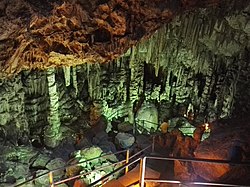
Psychro Cave (Greek: Σπήλαιο Ψυχρού) is an ancient Minoan sacred cave in Lasithi plateau in the Lasithi district of eastern Crete. Psychro is associated with the Dictaean or Diktaian Cave (Greek: Δικταῖον Ἄντρον; Diktaion Antron), one of the putative sites of the birth of Zeus. Other legends place Zeus' birthplace as Idaean Cave (Ἰδαῖον Ἄντρον) on Mount Ida. According to Hesiod, Theogony (477-484), Rhea gave birth to Zeus in Lyctus and hid him in a cave of Mount Aegaeon. Since the late nineteenth century the cave above the modern village of Psychro has been identified with Diktaean Cave, although there are other candidates, especially a cave above Palaikastro on Mount Petsofas.[1]

Key Information

Geography

[edit]

The cave is located in the prefecture of Lasithi. In Minoan times, the town of Malia was the closest metropolitan center.

Myth

[edit]
The thieves Laius, Celeus, Aegolius and Cerberus stung by bees in the Dictaean Cave.

The Dictaean Cave is famous in Greek mythology as the place where Amalthea, nurtured the infant Zeus with her goat's milk. The archaeology attests to the site's long use as a place of cult worship. The nurse of Zeus, who was charged by Rhea to raise the infant Zeus in secret here, to protect him from his father Cronus (Krónos) is also called the nymph Adrasteia in some contexts.[2] It is one of a number of caves believed to have been the birthplace or hiding place of Zeus.[3] The mountains, of which the cave are part, are known in Crete as Dikte.

Archaeology

[edit]

The cave was first excavated in 1886 by Joseph Hatzidakis, President of the Syllogos at Candia, and F. Halbherr.[4] In 1896, Sir Arthur Evans investigated the site.[5]

In 1898 Pierre Demargne conducted brief investigations,[6] followed by David George Hogarth of the British School at Athens in 1900 who carried out more extensive operations. Hogarth's reports published in 1900[7] give a picture of the destruction wrought by primitive archaeological methods: immense fallen blocks from the upper cave roof were blasted before removal; the rich black earth had been previously ransacked. The stuccoed altar in the upper cave was discovered in 1900, surrounded by strata of ashes, pottery and "other refuse", among which were votive objects in bronze, terracotta, iron and bone, with fragments of some thirty libation tables and countless conical ceramic cups for food offerings. Bones among the ash layer attest to sacrifice of bulls, sheep and goats, deer and a boar.[8]

The undisturbed lowest strata of the upper cave represented the transition between Late Minoan Kamares ware to earliest Mycenaean levels; finds represented the Geometric Style of the ninth century BCE, but few later than that. More recent excavation has revealed the use of the cave reached back to Early Minoan times, and votive objects attest to the cave's being the most frequented shrine by Middle Minoan times (MM IIIA).[9]

The water pool

The lower grotto falls steeply with traces of a rock-cut stair to a pool, out of which stalactites rise. "Much earth had been thrown down by diggers of the Upper Grotto," Hogarth reported, "and this was found full of small bronze objects." In the vertical chinks of the lowest stalactites, Hogarth's team found "toy double-axes, knife-blades, needles, and other objects in bronze, placed there by dedicators, as in niches. The mud at the edge of the subterranean pool was also rich in similar things and in statuettes of two types, male and female and engraved gems."

In 1961, the art historian and archaeologist John Boardman published the finds uncovered by these and other excavations.[citation needed]

While clay human figurines are normally found in peak sanctuaries, Psychro and the sanctuary on Mount Ida stand out as the only sacred caves that have yielded human figurines. Psychro is also a unique sacred cave for a bronze leg, also known as a votive body part, which is the only votive body part to be found in a sacred cave. More common sacred cave finds at Psychro include stone and ceramic lamps.

Psychro yielded an uncommon number of semi-precious stones, including carnelian, steatite, amethyst, jasper and hematite.

Psychro's artefacts are now on display at the Heraklion Museum, the Ashmolean Museum in Oxford, the Louvre and the British Museum.[10]

Idaean Cave

[edit]
Idaean Cave

Idaean Cave (Greek: Ιδαίο άντρο) is a system of caves located on the slopes of Mount Ida on Crete (35°12′30″N 24°49′44″E / 35.2082°N 24.8290°E / 35.2082; 24.8290 (Idaean Cave)). The deep cave has a single entrance and features stalagmites and stalactites.

In antiquity it was a place of worship because it was believed to be the cave where the titan Rhea hid the infant Zeus, to protect him from his father Cronus, who intended to swallow him like others of his progeny. It is one of a number of caves believed to have been the birthplace or hiding place of Zeus.[3] According to a variant of this legend, the Kouretes, a band of mythical warriors, undertook to dance their wild, noisy war dances in front of the cave, so that the clamour would keep Cronus from hearing the infant's crying.

Excavations have revealed a large number of votive cult offerings on the site.

See also

[edit]

Notes

[edit]

References

[edit]
[edit]
Revisions and contributorsEdit on WikipediaRead on Wikipedia
from Grokipedia
Psychro Cave, also known as the Dikteon Cave or Diktaion Antron, is a prominent natural cavern and situated at an elevation of 1,025 meters above sea level on the southern edge of the in the Lasithi Mountains of eastern , . This multi-chambered cave, formed primarily through geological processes, features an antechamber measuring 42 by 19 meters with a 1-meter-high rectangular , a vast main hall of 84 by 38 meters with an inclined floor leading to a stalagmite niche known as the "liknon" (cradle) of , and deeper chambers including a 25 by 12-meter area with a small pool and a striking referred to as the "mantle of Zeus." In , Psychro Cave is identified as the Diktaian Cave, the legendary birthplace of , where the god was hidden from his father by his mother Rhea, nursed by the Amaltheia, and guarded by the Kouretes through rhythmic dances and shield-clashing to mask his cries. Archaeologically, it stands as one of the most important cult sites of Minoan , with evidence of continuous religious use from the Early Minoan period (ca. 2800–2300 BCE) through the Middle Minoan (ca. 2200–1550 BCE), Geometric (8th century BCE), Orientalizing-Archaic (7th–6th centuries BCE), and into the Roman era, reflecting evolving rituals from sacrifices to later Hellenistic and Roman veneration. The cave's sanctity is underscored by a Neopalatial-period (ca. 1700–1450 BCE) terrace and outside the entrance, capable of accommodating up to 250 worshippers for communal ceremonies. Excavations, initiated in 1886 by Joseph Hatzidakis and Federico Halbherr, continued in 1897 by , and in 1899 by , revealed a wealth of votive offerings, including figurines of humans, animals, and deities, decorative sheets, daggers, arrowheads, double axes, and pottery sherds, many of which are housed in the Herakleion Archaeological Museum and the in . These artifacts, including large quantities of animal bones from deer, oxen, and goats indicating sacrificial practices, highlight Psychro's role as the largest and most impressive known cave sanctuary on , linking Minoan elite patronage to broader Aegean religious traditions. As of November 2025, the cave is temporarily closed for renovation works to improve accessibility and preservation.

Geography and Location

Physical Setting

Psychro Cave is situated on the in eastern , , at coordinates 35.1629°N 25.4451°E and an of 1025 meters above sea level, near the village of Psychro and the ancient site of Malia. The cave forms part of the Mountains and overlooks the expansive Lasithi Plain, a fertile agricultural region dotted with traditional white-sailed windmills used historically for irrigation. It lies approximately 55 kilometers east of the prominent Minoan site of , placing it within Crete's rich archaeological landscape. Access to the cave requires a 20- to 30-minute uphill hike from a parking area near Psychro village, involving steep, rocky paths and constructed steps that gain about 100 in . The cave interior spans roughly 2,200 square across multiple chambers, with a tourist route of 250 featuring illuminated stairs descending up to 60 vertically into the main areas, surrounded by stalactites and stalagmites.

Geological Formation

Psychro Cave is a classic example of a , formed through the dissolution of soluble bedrock by acidic over thousands of years, a process driven by the region's tectonic activity during the period. This formation is characteristic of the broader Cretan , where the cave is situated within the Tripolis zone's to Eocene limestones and dolomites, overlying older phyllite-quartzite series typical of the island's geology. The cave's internal structure consists of multi-level chambers carved into the , featuring a main hall measuring 84 m by 38 m, with an entrance 18 m wide and 14 m high. Stalactites and stalagmites adorn the walls and floors, forming columns and pools, including a small lake in the western chamber, while underground streams contribute to ongoing . The cave descends approximately 84 m vertically from the entrance to the lowest chambers. Among its unique natural features is a prominent altar-like rock formation, interpreted as a resembling a cradle (liknon), alongside impressive structures such as one known as "Rhea's breast," which enhance the cave's dramatic subterranean architecture. These elements, combined with the cave's resonant chambers, create pronounced acoustic effects that amplify sounds within the space.

Mythological Significance

Zeus Birthplace Legend

In ancient Greek mythology, Psychro Cave is renowned as the Dikteon Antron, the legendary birthplace and hiding place of , where his mother Rhea concealed him from his father to prevent the infant god from being devoured. According to Hesiod's (c. 700 BCE), Rhea gave birth to near Lyctus on and, fearing 's wrath, handed the child to , who hid him in a remote cave beneath the secret recesses of Mount Aegeum; there, earth nymphs nurtured him in secrecy. This narrative establishes as the protective cradle of the young , emphasizing themes of divine succession and maternal cunning central to the . Subsequent Hellenistic sources elaborate on the cave's specific role, locating it in the Dictaean region and detailing the nurturing figures involved. In Callimachus's Hymn to (3rd century BCE), Rhea bears and transports him to a Cretan near Cnossus, where the nymphs and Ida care for him in a golden cradle; he is suckled by the goat Amalthea, whose horn becomes the of abundance, while the Curetes clash their shields to mask his cries from . The explicitly ties this sanctuary to the Dictaean , ash-tree nymphs, reinforcing Psychro's identification as the site of 's rearing amid the Lasithi Plateau's rugged terrain. Alternative traditions introduce ambiguity, with some accounts attributing Zeus's birth to the Idaean Cave on , fostering a rivalry between the two sites in Cretan lore. However, Psychro is distinctly associated with "Diktean Zeus" in classical texts, such as Strabo's (1st century BCE), which describes the sanctuary of Dictaean Zeus near the town of Prasus and the mountain of Dictê, approximately 1,000 stadia east of Ida, and notes Minos's periodic consultations with in a nearby cave for divine laws. Epinician odes, including those of (5th century BCE), invoke Diktean Zeus in celebratory contexts, underscoring the cave's panhellenic prestige as a symbol of Cretan sovereignty and divine origins. The legend evolved significantly during the Hellenistic and Roman periods, solidifying Psychro Cave as a major pilgrimage destination and . Renewed rituals by the 1st century BCE reflected Roman influences, blending local Minoan elements with practices, where devotees sought the regenerative power of Diktean tied to themes of and renewal. This enduring narrative, propagated through and , elevated the cave's status, drawing worshippers who honored Zeus's mythic infancy as a foundation of cosmic order.

Ancient Cult Practices

The Psychro Cave, also known as the Diktaion Antron, served as a significant cult site during the Minoan period, with evidence of religious activity dating back to the Early Minoan era (c. 2800–2200 BCE) and reaching its peak in the Middle Minoan II phase (c. 2000–1750 BCE). Archaeological finds from this time include a variety of votive offerings such as clay figurines of humans, deities, and animals, double axes, sheets, daggers, and arrowheads, deposited in the cave's chambers as dedications to chthonic deities. These artifacts suggest rituals involving libations and offerings, potentially directed toward proto-Zeus figures or earth-bound divinities, as indicated by tablets from (KN Fp 1) recording oil offerings at a shrine of Dictaean Zeus, linking the cave to early worship of this deity. The cave's role in cult practices continued into the Archaic Greek period (8th–6th centuries BCE). In the 7th century BCE, the Cretan sage reportedly slept in the cave, awakening with prophetic abilities associated with Diktaian . Animal sacrifices formed a key element of these rites, inferred from the abundance of faunal remains—including bones from , sheep, goats, and pigs—found in stratified deposits, pointing to commensal rituals and burnt offerings on altars or natural features within the cave. The cave's physical attributes, including its profound darkness and central stalagmite niche known as the "liknon" (cradle), imbued the site with profound symbolism as the womb of the earth, evoking themes of birth, renewal, and chthonic power. This symbolism aligned with fertility cults and initiation rites in mystery traditions, where the cave's enclosed spaces facilitated transformative rituals, such as those experienced by Epimenides, connecting participants to divine origins and underworld forces.

Archaeological History

Discovery and Early Excavations

The Psychro Cave, long associated with ancient myths including its identification as the birthplace of , attracted modern scholarly attention in the late following reports from local shepherds who discovered ancient items within the site. In 1886, these findings prompted the first organized exploration by Greek archaeologist Joseph Hatzidakis, president of the Syllogos at Candia, and Italian archaeologist Federico Halbherr, who conducted initial excavations at the cave's entrance. Their work recovered bronze artifacts among other materials, marking the beginning of systematic investigation into the site's archaeological potential. Building on this, British archaeologist undertook a targeted dig in 1896, focusing on the upper chambers of the cave. Evans's efforts uncovered evidence of Minoan layers, confirming the site's significance as a cult center with deposits spanning prehistoric periods. This expedition highlighted the cave's stratified nature but was limited by the era's rudimentary techniques, such as manual clearing without advanced stratigraphic controls. The most comprehensive early excavation occurred in 1899–1900 under of the British School at , who conducted a systematic campaign emphasizing the upper . Hogarth's team targeted areas beneath the north and south-western walls, revealing stratified deposits that ranged from Early Minoan to Hellenistic times, demonstrating continuous use over millennia. Early digs, including Hogarth's, concentrated on accessible upper chambers due to the cave's challenging layout, but faced significant obstacles from unstable terrain filled with boulders and embanked terraces, as well as the absence of modern tools like powered equipment. These conditions, compounded by prior unregulated digging by locals and earlier explorers, resulted in some artifact dispersal and loss before full documentation could occur.

Key Artifacts and Interpretations

Among the most prominent artifacts recovered from Psychro Cave are bronze double axes, known as labrys, dating to approximately 1700 BCE during the Middle Minoan period. These votive offerings, often miniature and non-utilitarian, are interpreted as symbols of Minoan religious and political power, possibly representing divine authority or ritual implements linked to chthonic deities. Terracotta idols depicting female figures, primarily from the Late Minoan period, further highlight the cave's role in cult practices. These figurines, typically stylized with elaborate attire and gestures suggesting adoration or invocation, are viewed by scholars as representations of a Minoan goddess or priestesses engaged in ritual supplication. Libation tables and rhyta crafted from semi-precious stones such as and were also deposited as offerings, underscoring the site's significance for liquid-based rituals like pouring . These stone vessels, inscribed in some cases with script, facilitated ceremonial acts and reflect the technological sophistication of Minoan craftsmanship. Archaeological deposits indicate continuous ritual use of the cave from the Early Minoan period (ca. 2800 BCE) through the Geometric period (9th century BCE), with the highest concentration of finds occurring in Late Minoan III (c. 1400 BCE). This timeline suggests sustained cult activity across Minoan phases, potentially tied to seismic events or visions of divine epiphanies, as the cave's natural formations may have evoked otherworldly encounters during earthquakes common to . Many of these artifacts are housed in the , while select pieces, including bronze items and inscribed stones, reside in the , the , and the . No significant new discoveries have been reported since 2000, with ongoing studies focusing on existing collections.

Idaean Cave

The Idaean Cave, located on the eastern slopes of (Psiloritis) in central at coordinates 35.2082°N 24.8290°E and an elevation of 1,530 meters, features a structure similar to other Cretan sacred caves, including a main chamber approximately 40 meters long and 50 meters wide, with rock-carved altars at the entrance and areas for votive deposits. This cave served as a major cult site from the Early Minoan period through Roman times, with evidence of continuous ritual use marked by offerings such as bronze items and pottery. In ancient traditions, the Idaean Cave rivaled Psychro Cave as the purported birthplace of , with Cretan locals in antiquity asserting it as the true site where Rhea concealed the infant god from , a claim echoed in texts like Hesiod's and supported by the cave's pan-Cretan sanctuary status. Excavations beginning in the late , led by Federico Halbherr in 1885, and continuing with Yannis Sakellarakis in the 1980s, uncovered significant artifacts including bronze shields, idols, and bowls dating primarily to the 8th–7th centuries BCE, highlighting its prominence during the Geometric and Archaic periods. Key distinctions from Psychro Cave include the Idaean site's strong association with the Idaean Dactyls—mythical nymphs and spirits born in the cave, credited with inventing and related arts—contrasting with Psychro's emphasis on chthonic elements tied to earth deities. Archaeologically, while both caves show early use, the Idaean Cave yields fewer Minoan layers but a greater concentration of Archaic Greek artifacts, such as diverse votives influenced by Near Eastern styles, underscoring its role in later Greek cult practices.

Other Cretan Sacred Caves

In addition to Psychro Cave, several other caves in served as significant cult sites during the Minoan period, reflecting a broader of sacred natural landscapes. The Cave near Amnisos, located on the northern coast, was a primary dedicated to the of and motherhood, with evidence of worship spanning from the Early Minoan period through the Mycenaean era, including references to Eileithyia in association with the site. Similarly, the Kamares Cave, situated on the slopes of in central , functioned as a peak where thousands of vessels and other offerings were deposited, dating back to around 2000 BCE during the Middle Minoan I phase, indicating ritual feasting and votive practices. The Archanes area, near the modern town of Archanes, features cave sites linked to water cults, where natural springs and damp environments facilitated rituals tied to fertility and purification, as evidenced by associated and hydrological features in Minoan religious practices. These caves illustrate common patterns in Minoan religion, where natural formations were revered for worship of nature deities, often involving offerings of pottery, figurines, and libations to goddesses embodying , birth, and the earth's bounty. Psychro Cave stands out due to its strong mythological linkage to as his birthplace in later Greek traditions, overlaid on Minoan layers, and the exceptional depth of its archaeological deposits—spanning multiple meters of stratified offerings from Middle Minoan to Late Minoan periods—suggesting prolonged, intensive use unlike the more localized depositions at other sites. The distribution of these caves across points to a regional network of interconnected rituals, possibly coordinated through palatial centers, where pilgrims accessed remote, elevated, or coastal locations for seasonal or initiatory ceremonies. Scholars view these Minoan caves as liminal spaces—thresholds between the earthly and divine realms—in pre-Greek religious systems, where the interplay of darkness, water, and natural formations evoked chthonic powers and facilitated ecstatic or prophetic experiences. Early 20th-century archaeologist , in his excavations and analyses of Cretan sites, emphasized caves' role as enduring sanctuaries predating palatial complexes, influencing his broader interpretation of Minoan as rooted in animistic reverence for natural phenomena.

Modern Relevance

Tourism and Visitor Access

Psychro Cave, also known as Dikteon Cave, is typically open to visitors from April to , with hours from 8:00 AM to 6:00 PM in summer and 8:00 AM to 3:00 PM in winter, though it is closed on major holidays such as and 25. As of November 2025, the site is temporarily closed for renovations and will remain so throughout the year. The entry fee is €15 for adults upon reopening, with 50% reductions for citizens over 65 from to , and free admission for children under 5, students, and other eligible groups. Parking at the base costs €2.50, after which visitors ascend a steep, approximately 1 km path involving a 20- to 30-minute uphill hike suitable for those with moderate fitness levels; the path features handrails for safety. Inside the cave, a 250-meter tourist route descends via around 200 metal steps with handrails, allowing exploration of chambers illuminated to highlight mythological significance, such as the reputed birthplace of and a central . Guided tours, often available through local operators, emphasize these legends while offering panoramic views of the during the ascent and descent. The site attracts over 200,000 visitors annually, with peak crowds in summer; practical tips include bringing water, wearing sturdy non-slip shoes, and dressing in layers due to the cool, damp interior. Off-season visits are not recommended owing to closures and reduced accessibility. The terrain presents challenges including steep inclines, slippery steps from humidity and moisture, and uneven flooring, making it family-friendly for older children but unsuitable for very young kids or those with mobility impairments without assistance; donkey rides are occasionally available for the approach during peak season for an additional fee.

Preservation and Recent Developments

Psychro Cave, recognized as a significant , has been protected under Greece's laws since the early , with management overseen by the and Sports to safeguard its Minoan-era features and natural formations. Conservation efforts emphasize structural integrity and accessibility, including a 2018 project utilizing terrestrial to create high-resolution 3D models for planning preservation measures and enabling virtual tours. Recent developments focus on major renovations initiated in April 2024, funded by a €16 million allocation from the European Union's Recovery and Resilience Facility, aimed at restoring the site's , enhancing seismic , upgrading systems, and improving pathways to protect stalactites and ensure visitor safety. The cave was closed to the public starting September 9, 2024, under a European program coordinated by the , with no major new excavations planned; as of November 2025, stabilization and renovation works continue, with the site closed through 2025 and reopening expected in 2026 or later, though no firm date has been set. Complementing these efforts, a 2023 initiative announced plans for a cable car system to the cave's entrance at 1,025 meters elevation, incorporating additional stabilization and path restorations to boost while minimizing environmental impact. Ongoing challenges include threats from in , which strains site capacity and contributes to wear on delicate cave structures, alongside climate change impacts such as increased and fluctuations that endanger ancient formations across Greek heritage sites. The collaborates on sustainable management through such funded projects, prioritizing digital enhancements like the existing 3D mapping to reduce physical visitation pressures and support long-term conservation.

References

Add your contribution
Related Hubs
User Avatar
No comments yet.