Hubbry Logo
Minoan potteryMinoan potteryMain
Open search
Minoan pottery
Community hub
Minoan pottery
logo
8 pages, 0 posts
0 subscribers
Be the first to start a discussion here.
Minoan pottery
Minoan pottery
from Wikipedia
"Marine Style" flask with octopus, c. 1500-1450 BC
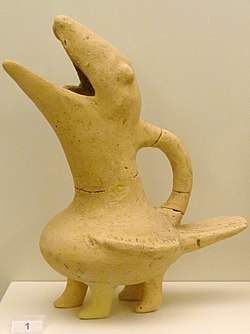
Figurine of female worshipper, Phaistos, 1700-1600 BC displayed in the Heraklion Archaeological Museum

The Minoan civilization produced a wide variety of richly decorated Minoan pottery. Its restless sequence of quirky maturing artistic styles reveals something of Minoan patrons' pleasure in novelty while they assist archaeologists in assigning relative dates to the strata of their sites. Pots that contained oils and ointments, exported from 18th century BC Crete, have been found at sites through the Aegean islands and mainland Greece, in Cyprus, along coastal Syria and in Egypt, showing the wide trading contacts of the Minoans.

The pottery includes vases, figurines, models of buildings, and burial urns called larnakes. Several pottery shapes, especially the rhyton cup, were also produced in soft stones such as steatite, but there was almost no overlap with metal vessels. The finest achievements came in the Middle Minoan period, with the palace pottery called Kamares ware, and the Late Minoan all-over patterned "Marine Style" and "Floral Style". These were widely exported around the Aegean civilizations and sometimes beyond, and are the high points of the Minoan pottery tradition.

The most comprehensive collection is in the Heraklion Archaeological Museum on Crete.

Traditional chronology

[edit]
Minoan chronology
3500–2900 BC[1] EMI Prepalatial
2900–2300 BC EMII
2300–2100 BC EMIII
2100–1900 BC MMIA
1900–1800 BC MMIB Protopalatial
(Old Palace Period)
1800–1750 BC MMIIA
1750-1700 BC MMIIB Neopalatial
(New Palace Period)
1700–1650 BC MMIIIA
1650–1600 BC MMIIIB
1600–1500 BC LMIA
1500–1450 BC LMIB Postpalatial
(at Knossos;
Final Palace Period)
1450–1400 BC LMII
1400–1350 BC LMIIIA
1350–1100 BC LMIIIB
Pottery from Lebena, Crete, 3000-2100 BC, AMH

The traditional chronology for dating Minoan civilization was developed by Sir Arthur Evans in the early years of the 20th century AD. His terminology and the one proposed by Nikolaos Platon are still generally in use and appear in this article. For more details, see the Minoan chronology.

Evans classified fine pottery by the changes in its forms and styles of decoration. Platon concentrated on the episodic history of the Palace of Knossos. A new method, fabric analysis, involves geologic analysis of coarse and mainly non-decorated sherds as though they were rocks. The resulting classifications are based on composition of the sherds.[2]

Production and techniques

[edit]

Little is known about the way the pottery was produced, but it was probably in small artisanal workshops, often clustered in settlements near good sources of clay for potting. For many, potting may well have been a seasonal activity, combined with farming, although the volume and sophistication of later wares suggests full-time specialists, and two classes of workshop, one catering to the palaces.[3] There is some evidence that women were also potters. Archaeologists seeking to understand the conditions of production have drawn tentative comparisons with aspects of both modern Cretan rural artisans and the better-documented Egyptian and Mesopotamian Bronze Age industries.[4] In Linear B the word for potter is "ke-ra-me-u".[5]

Technically, slips were widely used, with a variety of effects well understood. The potter's wheel appears to have been available from the MM IB, but other "handmade" methods of forming the body remained in use, and were needed for objects with sculptural shapes.[6] Ceramic glazes were not used, and none of the wares were fired to very high temperatures, remaining earthenware or terracotta. All of these characteristics remain true of later Greek pottery throughout its great period. The finest wares often have very thin-walled bodies. The excavation of an abandoned LM kiln at Kommos (the port of Phaistos), complete with its "wasters" (malformed pots), is developing understanding of the details of production.[7] The styles of pottery show considerable regional variation within Crete in many periods.[8]

Early Minoan

[edit]

Early Minoan pottery is broadly characterized by a large number of local wares with frequent Cycladic parallels or imports, suggesting a population of checkerboard ethnicity deriving from various locations in the eastern Aegean and beyond.[citation needed]

FN, EM I

[edit]

Early Minoan pottery, to some extent, continued, and possibly evolved from, the local Final Neolithic[9] (FN) without a severe break. Many[who?] suggest that Minoan civilization evolved in-situ and was not imported from the East. Its other main feature is its variety from site to site, which is suggestive of localism of Early Minoan social traditions.[citation needed]

Studies of the relationship between EM I and FN have been conducted mainly in East Crete.[10] There the Final Neolithic has affinities to the Cyclades, while both FN and EM I settlements are contemporaneous, with EM I gradually replacing FN. Of the three possibilities, no immigration, total replacement of natives by immigrants, immigrants settling among natives, Hutchinson[11] takes a compromise view:

"The Neolithic Period in Crete did not end in a catastrophe; its culture developed into that of the Bronze Age under pressure from infiltration of relatively small bands of immigrants from the south and east, where copper and bronze had long been in use."

Pyrgos Ware

[edit]
Early Minoan pottery from Pyrgos, 3000-2600 BC, Archaeological Museum of Heraklion (AMH)

EM I types include Pyrgos Ware,[12] also called "Burnished Ware". The major form was the "chalice", or Arkalochori Chalice, in which a cup combined with a funnel-shaped stand could be set on a hard surface without spilling. As the Pyrgos site was a rock shelter used as an ossuary, some hypothesize ceremonial usage]. This type of pottery was black, grey or brown, and burnished, with some sort of incised linear pattern. It may have imitated wood.

Tripod Cooking Pots

[edit]

The EM II era in the Minoan civilization saw the start of tripod cooking pots at places like Knossos, with that came a brief adoption of horned stands in cooking pot production, primarily used during the EM II period. These features have not been identified elsewhere beyond Knossos and surrounding regions. Cups had reduced in size for it to be used by one person.[13] The vast majority of these Minoan tripod cooking pots had deep featured bodies, usually being supported with three legs with either horizontal handles or vertical handles with a small opening on the top. They appear to be the most common way to cook.[14] These cooking tripods were made from red firing clay with rock fragments to create the coarse touch that these pots had. The usage of animal goods can be identified in the tripod cooking pots, and the usage of plant byproducts can also be identified.[15] The mixture of both can be found in the tripod cooking pots, but with plant byproducts being more evident than animal byproducts in some instances. There appears to be also found residue of beeswax in the tripod cooking pots. Most of these discoveries were found at Sissi. What that beeswax was used for is uncertain. This appears to potentially lead to the possibility of subtypes of these cooking pots.[16] There is evidence that these pots started to show up during the EMI in the Hagia Photia; its appearance in the Hagia Photia during the second EMII period is questionable.[17]  Most of these discoveries were located in the Northern and Northeastern sections of the island.

Incised Ware

[edit]

Another EM I type, Incised Ware, also called Scored Ware, were hand-shaped, round-bottomed, dark-burnished jugs (Example) and bulbous cups and jars ("pyxes"). Favored decor was incised line patterns, vertical, horizontal or herring-bone. These pots are from the north and northeast of Crete and appear to be modeled after the Kampos Phase of the Grotta-Pelos early Cycladic I culture. Some have suggested imports or immigrations. See also Hagia Photia.

Agyios Onouphrios, Lebena

[edit]
Agios Onouphrios ware with painted parallel-line decoration, 2600-1900 BC, AMH

The painted parallel-line decoration of Ayios Onouphrios I Ware was drawn with an iron-red clay slip that would fire red under oxidizing conditions in a clean kiln but under the reducing conditions of a smoky fire turn darker, without much control over color, which could range from red to brown. A dark-on-light painted pattern was then applied.[18] From this beginning, Minoan potters already concentrated on the linear forms of designs, perfecting coherent designs and voids that would ideally suit the shape of the ware. Shapes were jugs, two-handled cups and bowls. The ware came from north and south central Crete, as did Lebena Ware of the same general types but decorated by painting white patterns over a solid red painted background (Example). The latter came from EM I tombs.

Koumasa and Fine Gray Ware

[edit]

In EM IIA, the geometric slip-painted designs of Koumasa Ware seem to have developed from the wares of Aghios Onouphrios. The designs are in red or black on a light background. Forms are cups, bowls, jugs and teapots (Example: "Goddess of Myrtos"). Also from EM IIA are the cylindrical and spherical pyxides called Fine Gray Ware or just Gray Ware, featuring a polished surface with incised diagonals, dots, rings and semicircles.

Vasiliki Ware

[edit]

The EM IIA and IIB Vasiliki Ware, named for the Minoan site in eastern Crete,[19] has mottled glaze effects, early experiments with controlling color, but the elongated spouts drawn from the body and ending in semicircular spouts show the beginnings of the tradition of Minoan elegance (Examples 1, Examples 2). The mottling was produced by uneven firing of the slip-covered pot, with the hottest areas turning dark. Considering that the mottling was controlled into a pattern, touching with hot coals was probably used to produce it. The effect was paralleled in cups made of mottled stone.

EM III Pottery

[edit]

In the latest brief transition (EM III), wares in eastern Crete begin to be covered in dark slip with light slip-painted decor of lines and spirals; the first checkered motifs appear; the first petallike loops and leafy bands appear, at Gournia (Walberg 1986). Rosettes appear and spiral links sometimes joined into bands. These motifs are similar to those found on seals. In north central Crete, where Knossos was to emerge, there is little similarity: dark on light linear banding prevails; footed goblets make their appearance (Example).

Middle Minoan

[edit]
Clay house model from Archanes, 1700 BC, AMH

The rise of the Minoan palaces at Knossos and Phaistos and their new type of urbanized, centralized society with redistribution centers required more storage vessels and ones more specifically suited to a range of functions. In palace workshops, standardization suggests more supervised operations and the rise of elite wares, emphasizing refinements and novelty, so that palace and provincial pottery become differentiated.[citation needed]

The forms of the best wares were designed for table and service. In the palace workshops, the introduction from the Levant of the potter's wheel in MM IB enabled perfectly symmetrical bodies to be thrown from swiftly revolving clay.[20] The well-controlled iron-red slip that was added to the color repertory during MM I could be achieved only in insulated closed kilns that were free of oxygen or smoke.[citation needed]

Pithoi

[edit]
"Medallion Pithoi", or storage jars, at the Knossos palace. Named from the raised disks, they date to MM III/LM IA.

Any population center requires facilities in support of human needs and that is true of the palaces as well. Knossos had extensive sanitation, water supply and drainage systems,[21] which is evidence that it was not a ceremonial labyrinth or large tomb. Liquid and granular necessities were stored in pithoi located in magazines, or storage rooms, and elsewhere. Pithoi make their earliest appearance just before MMI begins and continue into Late Minoan, becoming very rare by LMIII (Examples 1, Examples 2). About 400 pithoi were found at the palace of Knossos. An average pithos held about 1100 pounds of fluid. Perhaps because of the weight, pithoi were not stored on the upper floors.[citation needed]

New styles

[edit]

New styles emerge at this time: an Incised Style (see above), and the tactile Barbotine ware, featuring the relief decoration studded with knobs and cones of applied clay in bands, waves and ridges. Such decorations are sometimes reminiscent of the marine-derived features such as the sand dollar tests, and barnacle growths (Example).

Early Minoan jug in barbotine style; surface treatment: barnacle work; dark painting on yellowish slip - Middle Minoan IB-IIA, earlier Protopalatial period - height: 19.2 cm; Kassel, Germany, Schloss Wilhelmshöhe Antiquities Collection

Barbotine ware features three-dimensional decorations, as well as the use of the ceramic slip. Ridges and protuberances of various types are seen on the surface of vessels.[22]

The earliest stages of Kamares ware also appear at this time. Scholars place Barbotine ware a bit earlier than the Kamares ware,

"Barbotine Ware appears, in its earliest stages, a bit before MM IA, in EM III. The style gradually becomes more popular and picks up significantly in MM IA, along with the conservative incised style, dark on light style, and White on Dark Ware."[23]

Gisela Walberg places Barbotine Ware, with its thin walls and dynamic motifs, in the Early Kamares Ware phase.[24]

Spirals and whorls motifs appear in Minoan pottery from EM I onwards (Walberg), but they become especially popular during EM III.[25] A new shape is the straight-sided cylindrical cup.[26]

MMIA wares and local pottery imitating them are found at coastal sites in the eastern Peloponnese, though not more widely in the Aegean until MMIB; their influence on local pottery in the nearby Cyclades has been studied by Angelia G. Papagiannopoulou (1991). Shards of MM IIA pottery have been recovered in Egypt and at Ugarit.[27]

Kamares Ware

[edit]
Kamares ware jug
A Kamare style vase, 2100-1700 BCE

Kamares Ware was named after finds in the cave sanctuary at Kamares on Mt. Ida in 1890. It is the first of the virtuoso polychrome wares of Minoan civilization, though the first expressions of recognizably proto-Kamares decor predate the introduction of the potter's wheel.

Finer clay, thrown on the wheel, permitted more precisely fashioned forms, which were covered with a dark-firing slip and exuberantly painted with slips in white, reds and browns in fluent floral designs, of rosettes or conjoined coiling and uncoiling spirals. Designs are repetitive or sometimes free-floating, but always symmetrically composed. Themes from nature begin here with octopuses, shellfish, lilies, crocuses and palm-trees, all highly stylized. The entire surface of the pot is densely covered, but sometimes the space is partitioned by bands. One variety features extravagantly thin bodies and is called Eggshell Ware (Example 1, Example 2).

Four stages of Kamares ware were identified by Gisela Walberg (1976), with a "Classic Kamares" palace style sited in MM II, especially in the palace complex of Phaistos. New shapes were introduced, with whirling and radiating motifs.(Examples 1, Examples 2, Examples 3, Examples 4, Examples 5, Examples 6, Examples 7, Examples 8, Examples 9, Examples 10)

Age of Efflorescence

[edit]

In MMIIB, the increasing use of motifs drawn from nature heralded the decline and end of the Kamares style. The Kamares featured whole-field floral designs with all elements linked together (Matz). In MMIII patterned vegetative designs, the Patterned Style, began to appear. This phase was replaced by individual vegetative scenes, which marks the start of the Floral Style. Matz refers to the "Age of Efflorescence", which reached an apogee in LM IA. (Some would include Kamares Ware under the Floral Style.)[citation needed]

The floral style depicts palms and papyrus, with various kinds of lilies and elaborate leaves. It appears in both pottery and frescoes. One tradition of art criticism calls this the "natural style" or "naturalism" but another points out that the stylized forms and colors are far from natural. Green, the natural color of vegetation, appears rarely. Depth is represented by position around the main scene.[citation needed]

Late Minoan

[edit]

LMI marks the highwater of Minoan influence throughout the southern Aegean (Peloponnese, Cyclades, Dodecanese, southwestern Anatolia). Late Minoan pottery was widely exported; it has turned up in Cyprus, the Cyclades, Egypt and Mycenae.

Floral style

[edit]

Fluent movemented designs drawn from flower and leaf forms, painted in reds and black on white grounds predominate, in steady development from Middle Minoan. In LMIB there is a typical all-over leafy decoration, for which first workshop painters begin to be identifiable through their characteristic motifs; as with all Minoan art, no name ever appears.

Marine style

[edit]

In LMIB, the Marine Style also emerges; in this style, perhaps inspired by frescoes, the entire surface of a pot was covered with sea creatures, octopus, fish and dolphins, against a background of rocks, seaweed and sponges (Examples 1, Examples 2, Examples 3, Examples 4). The Marine Style is more free flowing with no distinct zones, because it shows sea creatures as floating, as they would in the ocean.[28] The Marine style was the last purely Minoan style; towards the end of LMIB, all the palaces except Knossos were violently destroyed, as were many of the villas and towns.[29]

Rhyta

[edit]
Steatite rhyta in foreground, clay on shelf behind.

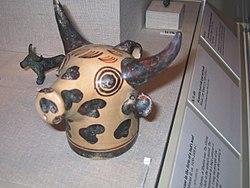
Dated to LM IA and following also are conical rhyta, or drinking cups, in steatite and also imitated in ceramic. (Example) Some of the rhyta are ornate libation vessels, such as the noted "Bull's-head Rhyton" found at Knossos. The Bull's Head Rhyton, however, was a specific type of which many instances have been found. The bull's head is found in ceramic as well. Other noted stone vases of LM IA and II are the "Harvester Vase" View 1, View 3, View 4, from Hagia Triada, which depicts a harvest procession, "the Chieftain Cup", depicting a coming-of-age rite, the Boxer Rhyton (Hagia Triada), showing boxing scenes, the Sanctuary Rhyton, depicting a peak sanctuary to the "mistress of animals" and featuring birds and leaping goats, and others.

Minoan-Mycenaean

[edit]
Restored frieze at Knossos showing Minoan ware. Although the rhyton (conical vase) is probably steatite, the other ware is most likely ceramic.

Around 1450 BCE, the beginning of LM II, the Mycenaean Greeks must have moved into the palace of Knossos. They were well-established by 1400, if the Linear B tablets can be dated to then. The resulting LM II culture is not a break with the Minoan past. Minoan traditions continue under a new administration. However, the vase forms and designs became more and more Mycenaean in character with a large variety of decoration. Style names have multiplied and depend to some degree on the author. The names below are only a few of the most common. Some authors just use the name "Mycenaean Koine"; that is, the Late Minoan pottery of Crete was to some degree just a variety of widespread Mycenaean forms. The designs are found also on seals and ceilings, in frescoes and on other artifacts. Often Late Minoan pottery is not easily placed in sub-periods. In addition are imports from the neighboring coasts of the Mediterranean. Ceramic is not the only material used: breccia, calcite, chlorite, schist, dolomite and other colored and patterned stone were carved into pottery forms. Bronze ware appears imitating the ceramic ware.

Palace style

[edit]
Late Minoan III Floral style, 1400-1100 BC

During LMII, Mycenean influence became apparent. The vase forms at Knossos are similar to those on the mainland. The Palace Style[30] showcased by them adapts elements of the previous styles but also adds features, such as the practice of confining decor in reserves and bands, emphasizing the base and shoulder of the pot and the movement towards abstraction (Examples 1, Examples 2, Examples 3). This style started in LM II and went on into LM III. The palace style was mostly confined to Knossos. In the late manifestation of the palace style, fluent and spontaneous earlier motifs stiffened and became more geometrical and abstracted. Egyptian motifs such as papyrus and lotus are prominent.

Plain and Close Styles

[edit]

The Plain Style and Close Style developed in LM IIIA, B from the Palace Style. In the Close Style the Marine and Floral Styles themes continue, but the artist manifests the horror vacui or "dread of emptiness". The whole field of decoration is filled densely. (Examples). The Stirrup Jar is especially frequent.


Subminoan

[edit]

Finally, in the Subminoan period, the geometric designs of the Dorians become more apparent. (Example)

Discovery and recognition

[edit]

Minoan wares were already familiar from finds on the Greek mainland, and export markets like Egypt, before it was realized that they came from Crete. In most 19th-century literature they are described as "Mycenaean", and the recognition and analysis of styles and periods had gone some way on this assumption. Only in the 1890s were the first finds on Crete recognised and published, from a cave at Kamares. These were found by a local archaeologist who allowed the young John Myres to publish them; Myres had realized that they were the same ware as finds in Egypt published by Flinders Petrie. For several decades analysis of Minoan pottery was essentially stylistic and typological, but in recent decades there has been a turn towards technical and socio-economic analysis.[31]

Written records of pots and pans

[edit]

The Linear B tablets contain records of vessels made of various materials. The vessel ideograms are not so clear as to make correlation with discovered artifacts easy. Using a drawing of the "Contents of the Tomb of the Tripod Hearth" at Zafer Papoura from Evans' Palace of Minos,[32] which depicts LM II bronze vessels, many in the forms of ceramic ones, Ventris and Chadwick[33] were able to make a few new correlations.

Ideogram[34] Linear B[35] Mycenaean Greek Classical Greek Etymology Examples
LM II Vessels[36]
202 GOBLET? di-pa *dipas (sing) depas (sing), cup, archaic large vessel. C.Luvian tappas and H. Luvian (CAELUM)ti-pa-sº 'sky (perceived by Anatolians as a cup covering the flat Earth)' (Yakubovich 2010: 146) 1
207 TRIPOD AMPHORA ku-ru-su-pa3 Possibly *khrysyphaia[37] or possibly containing Semitic suppu "vase".[38] ? Possibly "gold and grey" if Greek or "golden vase" if Semitic 1 (Early Cypriote)
209 AMPHORA a-pi-po-re-we *amphiphorewes (pl) amphiphoreus (sing), an amphora "port-about" (Hoffman) 1
210 STIRRUP JAR ka-ra-re-we *khlarewes (pl) khlaron (sing), archaic oil jar "yellow stuff" (Hoffman) 1, 2, 3, 4
211 WATER BOWL? po-ti-[]-we ? ? ?
212 WATER JAR? u-do-ro *hudroi (pl) hydros (sing), a water-snake "water (jars)" 1
213 COOKING BOWL i-po-no *ipnoi (pl)[39] ipnos (sing), a baking dish "Dutch oven"[40]

See also

[edit]

Notes

[edit]

References

[edit]

Further reading

[edit]
[edit]
Revisions and contributorsEdit on WikipediaRead on Wikipedia
from Grokipedia
Minoan pottery refers to the diverse array of ceramic vessels produced by the on the island of during the Aegean , approximately from 3000 BCE to 1100 BCE. This pottery is distinguished by its technical sophistication, innovative forms such as jugs, cups, amphoras, and rhyta, and decorative motifs that evolved from simple geometric patterns to elaborate naturalistic representations of flora, fauna, and especially , including octopuses, fish, and . Crafted primarily from local clays and fired in specialized kilns, these artifacts served utilitarian, ritual, and prestige functions, reflecting the Minoans' advanced craftsmanship and extensive Mediterranean trade networks. The development of Minoan pottery is divided into three main chronological phases: Early Minoan (c. 3000–2000 BCE), Middle Minoan (c. 2000–1700 BCE), and Late Minoan (c. 1700–1100 BCE), each marked by distinct stylistic shifts that aid in archaeological dating; this relative chronology is based on pottery styles, though absolute dates remain debated between "high" (transition c. 1700 BCE) and "low" (c. 1550 BCE) frameworks, with recent radiocarbon evidence favoring the high chronology. In the Early Minoan period, pottery was largely handmade with incised decorations, as seen in Incised Ware featuring parallel lines, Aghios Onouphrios Ware with dark diagonal lines on a light ground, and Vasilike Ware mimicking mottled stone surfaces through reddish paint. The Middle Minoan phase introduced the fast , enabling thinner vessels like the delicate Ware, and the iconic Kamares style, characterized by light-on-dark designs with abstract, vegetal, and animal motifs on prestige items produced in palace workshops at sites like and . By the Late Minoan period, styles transitioned to dark-on-light painting, encompassing the Floral Style with repeating plant motifs, the Pattern Style with geometric elements, the Marine Style depicting dynamic sea creatures in a naturalistic yet stylized manner, and the Style featuring symmetrical, large-scale compositions on jars, though Mycenaean influences introduced greater abstraction toward the end. Minoan pottery's significance extends beyond aesthetics, as it reveals insights into , economic exchanges, and , with fine wares like Kamares and Marine Style vessels exported to regions including , the , and the , underscoring Crete's . Production techniques advanced from hand-building and incising in early phases to wheel-throwing, , and controlled firing for glossy finishes in later periods, often centered in urban palaces that acted as craft hubs. Archaeologically, the pottery's stylistic chronology provides fixed points for of sites and destruction layers, such as the volcanic eruption on Thera around 1600 BCE, while modern analyses like highlight regional variations in materials and workshops.

Overview and Chronology

Definition and Significance

Minoan pottery encompasses the ceramic vessels and artifacts produced by the Minoan civilization on the island of Crete during the Bronze Age, spanning approximately 3000 to 1100 BC. These earthenware items are distinguished by their evolving construction techniques, from handmade in early phases to wheel-thrown in later periods, which allowed for more symmetrical forms, and elaborate painted decorations featuring motifs inspired by nature, such as marine life, plants, and abstract patterns. This pottery represents a pinnacle of early Aegean craftsmanship, evolving from simple handmade wares in the Early Minoan period to sophisticated, mass-produced pieces that highlight the Minoans' mastery of clay manipulation and firing techniques. The significance of Minoan pottery extends beyond utility, serving as a vital indicator of the society's technological progress, artistic innovation, and socioeconomic structure. Vessels were essential for everyday activities like storage of , wine, and grains, cooking, and ceremonial rituals, with large pithoi used in palatial complexes to manage surplus resources central to the Minoan economy. Major archaeological collections, such as those at the , preserve around 400 such pithoi from the palace at , each capable of holding up to 1100 pounds of materials, demonstrating the scale of Minoan administrative capabilities. Stylistic developments in also provide key evidence for cultural evolution, divided traditionally into Early, Middle, and Late Minoan phases. Economically, Minoan pottery facilitated extensive trade networks, with fine wares exported to and by the 18th century BC, often containing like oils and ointments that underscored Crete's role as a maritime hub. These exports not only spread Minoan aesthetic influences but also generated wealth through exchange for raw materials like metals, reinforcing the civilization's interconnectedness with the world. The enduring legacy of this pottery lies in its reflection of a vibrant, prosperous society where art and function intertwined to support palatial systems and international .

Traditional Chronology

The traditional chronology of Minoan pottery was established by British archaeologist Sir through his excavations at the palace of , beginning in 1900, where he developed a system based primarily on changes in pottery styles and forms observed in stratified deposits. Evans divided the sequence into three main eras—Early Minoan (EM I–III), Middle Minoan (MM I–III), and Late Minoan (LM I–III)—each subdivided into three phases, reflecting progressive developments in ceramic production and decoration that served as markers for broader cultural evolution. This tripartite framework incorporated a precursor phase known as Final Neolithic (FN), bridging the end of the period with the onset of EM I, and was grounded in the principle that pottery typology evolved linearly, allowing for the ordering of archaeological layers without reliance on external calendars. Evans' system emphasized stratigraphic evidence from , where vertical excavation layers revealed superimposed pottery assemblages, enabling the reconstruction of temporal sequences through the superposition of distinct styles, such as the shift from incised patterns in EM I to more elaborate painted motifs in later phases. Stylistic seriation complemented this by comparing vessel shapes, fabrics, and decorative techniques across sites, confirming correlations between and other key locations like and Malia, where similar palace complexes yielded comparable ceramic deposits. As Evans noted, this "does not rest merely on theoretical deductions as to the evolution and succession of types" but on "a mass of stratigraphical evidence," underscoring the empirical foundation of his approach in physical excavation records. Greek archaeologist Nikolaos Platon later refined Evans' pottery-based chronology in the mid-20th century, integrating it with architectural phases observed at to create a complementary system of four broad periods: Prepalatial (encompassing FN and EM–early MM), Protopalatial (MM I–II), Neopalatial (MM III–LM II), and Postpalatial (LM III). Platon's contributions, drawn from his excavations at sites including , emphasized destruction horizons and rebuilding episodes as synchronizing events that aligned pottery sequences across , enhancing the reliability of by linking ceramic changes to major structural alterations at palaces like , , and Malia. This palace-oriented refinement preserved Evans' core divisions while addressing limitations in purely stylistic analysis, such as regional variations, and has remained integral to the study of Minoan .

Recent Dating Methods and Revisions

Recent scientific methods have significantly refined the dating of Minoan pottery through absolute techniques such as applied to organic residues absorbed in vessels and (TL) dating of the ceramics themselves. targets charred food remains or residues within , providing direct dates for vessel use, as demonstrated in a seminal method using compound-specific to achieve precision within decades. This approach has been applied to Minoan contexts, allowing calibration against traditional stylistic chronologies. measures the accumulated radiation in grains within clay since the last firing, offering absolute ages for production independent of organic material; early applications to Minoan kilns from confirmed ages aligning with Middle Minoan phases around 2000–1700 BC. A 2023 study in the Journal of Archaeological Science: Reports integrated lipid residue analysis with stratigraphic and ceramic sequencing from cooking vessels at Sissi and Malia, refining Late Minoan (LM) IA dates by identifying sub-phases in massive fill deposits and extending the Neopalatial sequence through Postpalatial transitions. These methods complement , which uses tree-ring sequences from Aegean sites to anchor radiocarbon results, and Bayesian modeling, which statistically integrates multiple dates to model chronological transitions with reduced uncertainty. For instance, Bayesian analysis of radiocarbon data from olive wood buried by the Thera eruption has supported a late 17th to early BCE date (high chronology, c. 1627–1600 BC), prompting revisions to the EM-MM transition around 2000 BC and correlations with Egyptian chronologies. A September 2025 study in , using radiocarbon dating on Egyptian 17th–18th Dynasty museum objects, confirms the Thera eruption predated Pharaoh Ahmose (c. 1550 BC), supporting the high chronology and prompting further alignment of Minoan sequences with Egyptian timelines. Potential adjustments to the LM III end date, traditionally c. 1070 BC in low chronologies, arise from new Thera correlations, though high chronology advocates place it earlier at c. 1200 BC based on synchronized Aegean-Egyptian radiocarbon sequences. Despite these advances, gaps persist in integrating post-2023 archaeological finds and new coastal sites on like those near , such as the February 2025 excavations at Kastelli Hill revealing extensive Minoan remains, which require more for inter-site consistency. Limited application of combined TL and residue dating to these contexts hinders full revision of transitional phases, emphasizing the need for standardized Bayesian frameworks across Minoan settlements.

Production Techniques and Materials

Materials and Firing Processes

Minoan potters primarily utilized local alluvial clays sourced from red clay deposits across central and eastern , which provided the foundational material for their production. These clays displayed notable geochemical and mineralogical variability, influenced by the island's diverse geological formations, with samples from sites like Thrapsano in central featuring high content and low (CaO) levels that contributed to distinct fabric properties suitable for . Regional fabric analyses further highlight differences in clay composition, such as finer, more homogeneous clays in central compared to coarser variants in eastern areas like the Mirabello Bay region, reflecting localized sourcing and processing practices that affected texture and strength; advanced techniques like have confirmed the use of marls in central for fine wares, aiding workshop localization. To enhance durability and mitigate issues like cracking during drying and firing, potters frequently incorporated non-plastic tempers into the clay paste, including quartz sand or occasionally shell fragments, which helped control shrinkage and improve stability. This tempering approach varied by region, with coarser sand inclusions more common in south-central Cretan fabrics, underscoring adaptations to available local materials while maintaining the porous, low-fired nature of the final bodies. Firing processes in the Early Minoan period relied on open-air techniques, where pottery was arranged in bonfire-like setups and heated through direct contact with fuel, as indicated by production debris and waster heaps at manufacturing sites such as Myrtos Fournou Korifi. This method produced uneven results but sufficed for the period's simpler wares, with temperatures likely not exceeding 800°C and resulting in distinctly porous vessels. By the Middle Minoan era, technological progress introduced updraft kilns—often pear-shaped or channel-type structures—that achieved higher, more controlled temperatures of 900–1000°C, enabling the vitrification of finer fabrics and the distinctive glossy surfaces of styles like Kamares ware. Evidence from kiln remains and associated waster deposits at various Cretan sites confirms this shift, highlighting improved efficiency in heat distribution and fuel use that supported larger-scale production. Overall, these low-fired earthenware bodies remained porous and non-impervious, a hallmark of Minoan ceramics that influenced their functional and aesthetic qualities.

Manufacturing Tools and Workshop Practices

In the Early Minoan period, Minoan pottery production relied predominantly on hand-building techniques, such as and pinching, carried out in small-scale household or family-based workshops that produced limited quantities for local use. Archaeological evidence from sites like Myrtos Fournou Korifi indicates these units operated within domestic spaces, reflecting self-sufficient community practices rather than large-scale specialization. The transition to more advanced methods began in the Middle Minoan IB phase with the introduction of the fast , likely influenced by Near Eastern contacts, enabling faster and more uniform shaping of vessels. This innovation coincided with construction at sites like , where ceramic evidence from rubbish layers shows the gradual replacement of hand-building with wheel-throwing for smaller forms, while larger vessels continued to use coil methods aided by slow turntables. Essential tools included the itself, hands for manipulation, sponges for smoothing and applying water (particularly at rims), and rib tools—flat or curved implements of wood, bone, or shell—for scraping, compressing, and refining surfaces during forming and trimming. Workshop organization evolved significantly from the Early to Middle and Late Minoan periods, shifting from decentralized family units to larger, specialized ateliers often attached to palatial centers, which facilitated and export of standardized wares across and beyond. At Protopalatial sites like Quartier Mu in Malia and Myrtos Pyrgos, evidence of concentrated wasters and uniform fabrics points to organized production hubs integrated into emerging political structures, with output supporting demands and trade networks. In the Neopalatial era, palace-linked workshops at and further emphasized this specialization, where division of labor likely involved apprentices learning alongside experienced potters, as inferred from consistent technical traces across vessel assemblages. Fingerprint analysis on Early Minoan pottery from a pilot study of sherds from the Ayia Kyraki tholos and Myrtos Fournou Korifi revealed fingerprints primarily on interiors of closed shapes like jugs, suggesting hands-on manipulation during hand-building; while sample sizes were small, ridge patterns allowed identification of distinct makers.

Decoration Methods and Pigments

Minoan potters employed slips as a foundational technique for surface preparation and coloration, applying fine clay suspensions to smooth the vessel body and create a base for further decoration. These slips, often iron-rich, were used from the Early Minoan period onward to achieve red, brown, or black hues upon firing, with calcareous varieties common in early examples from sites like , where they were fired at temperatures between 950–1050°C. Slips could be applied uniformly or non-uniformly to produce artistic contrasts, as seen in burnished wares where differential application enhanced visual effects before reduction firing. In the Early Minoan phase, decoration frequently involved incising and impressing motifs directly into the leather-hard clay surface prior to slipping or firing, creating geometric patterns through parallel lines or scored designs on dark-burnished wares. This technique, evident in Incised Ware from around 3000–2000 BC, allowed for precise, tactile embellishments without added pigments. By the Middle and Late Minoan periods, with brushes became predominant, enabling more complex applications of slips and paints over the vessel surface to develop from geometric to naturalistic motifs. Burnishing followed these applications, using tools like pebbles to polish the surface and impart a lustrous sheen, particularly on slipped and painted pieces fired in controlled atmospheres. Pigments derived primarily from local minerals included iron-rich ochres, which oxidized to reds () or reduced to blacks () during firing, forming the basis for bichrome and effects. Manganese-based compounds produced or dark brown tones, often mixed into slips for added depth, while white pigments consisted of calcium silicates, aluminosilicates, or applied over dark grounds in wares like Kamares. Organic binders, such as plant-derived resins, were occasionally used to fix pigments post-firing, as detected in analyses of Late Minoan examples. Evidence from PIXE and SEM studies indicates trade influences on mineral pigments from contacts.

Early Minoan Period (c. 3000–2000 BC)

EM I: FN and Initial Developments

The transition from the Final Neolithic (FN) to Early Minoan I (EM I) in Crete, dated approximately to ca. 3000–2650 BC, represents a period of gradual evolution in pottery production, bridging Neolithic traditions with the onset of the Bronze Age. Coarse handmade vessels dominate this phase, constructed primarily through slab-building techniques using local raw materials such as terra rossa soils and calcareous clays, reflecting continuity in fabrication methods from earlier Neolithic practices. These pots feature thick walls and are fired at relatively low temperatures of 600–800°C, often in open or simple kiln environments, without evidence of wheel-throwing, which underscores the persistence of manual shaping traditions. Key ceramic forms during EM I include practical household items such as jugs for liquid storage and transport, open (including deep varieties like skoutelia), and large storage for foodstuffs, with some innovation toward specialized shapes like chalices and pedestalled vessels emerging in later EM IA–IB subphases. These forms show direct inheritance from FN assemblages, adapting bowl and morphologies to slightly more refined proportions while maintaining functional simplicity. At sites like , EM I deposits reveal jugs and bowls in coarse fabrics, often tempered with sand or for durability, linking to broader settlement patterns in central . Decorative techniques remain rudimentary, emphasizing simple incised or motifs such as , jabbed impressions, corrugations, and applied , frequently combined with burnishing to achieve a lustrous surface. A notable development in EM IA is the initial appearance of dark-on-light (DOL) , where iron-rich slips or pigments are applied in linear or geometric patterns on smoothed or slipped backgrounds, marking an early shift toward painted wares that foreshadow later Minoan styles. This emerges alongside coarse dark burnished classes, using iron-rich slips that oxidize to dark red tones. Archaeological evidence from key sites illustrates this transitional character: at , FN III–EM I layers yield coarse handmade jugs and bowls with incised decorations, evidencing local production tied to emerging agricultural communities. In the Lebena tombs of southern , FN III–IV and EM I pottery includes storage jars and bowls with plastic and incised motifs, deposited in contexts that highlight ritual continuity from mortuary practices. Similarly, in central-southern provides a stratified sequence showing the progression from FN coarse wares to EM I DOL-painted jugs, demonstrating regional standardization in fabrics like and types. Culturally, EM I pottery embodies strong ties to heritage, with shared tempering agents (e.g., and inclusions) and decorative syntax indicating endogenous development rather than external influences, though minor Cycladic-style imports appear sporadically. The absence of wheel and reliance on handmade methods align with a pre-palatial society focused on subsistence, setting the foundation for technological refinements in subsequent periods.

EM II: Regional Wares and Innovations

The Early Minoan II (EM II) period, roughly spanning 2650–2200 BCE, marked a phase of increasing regional diversity in Minoan pottery production across Crete, with distinct wares emerging that reflected local resources, craftsmanship traditions, and emerging social complexities. Unlike the more uniform hand-built forms of EM I, EM II pottery exhibited greater variation in fabrics, shapes, and decoration, often tied to specific geographic zones such as the south coast, central regions, and eastern areas. This diversification is evident in tomb assemblages and settlement deposits, where fine tablewares coexisted with utilitarian vessels, signaling advances in specialized production. Pyrgos Ware, named after a cave site on Crete's north coast near Nirou Khani, represents a key fine ware of EM IIA, characterized by dark gray to black burnished surfaces with incised or pattern-burnished geometric motifs, such as horizontal, vertical, and diagonal lines on chalices and pyxides. Produced primarily in north-central Crete, this ware's polished finish and handmade or coil-built elements with possible manual rotation for finishing indicate early experimentation with rotational forming techniques for smoother profiles. In contrast, south-central Crete favored wares like Aghios Onouphrios style, featuring reddish slip-painted linear clusters on open vessels from central and southern sites, often associated with tomb ceramics that emphasized ritual use. On the south coast, particularly around Lebena, pottery styles continued EM I traditions with white-painted patterns over solid red slips on bowls and jugs, adapted for tholos tomb contexts and highlighting localized burial practices. Koumasa Ware, developing in south-central regions during EM IIA, introduced geometric slip-painted designs in multiple colors on finer vessels, evolving from Aghios Onouphrios motifs and appearing in modest polychrome grays that added visual complexity to pyxides and cups. Fine Gray Ware, widespread but in limited quantities across Crete, featured polished gray fabrics with incised diagonals, semicircles, and dots on spherical or cylindrical pyxides, serving as a versatile fine ware that bridged regional styles. Incised Ware, with its geometric incisions often infilled with white paste on burnished black or red grounds, appeared island-wide on closed forms like jars, mimicking basketry patterns and demonstrating shared decorative influences despite local fabrication. Functional innovations included the introduction of tripod cooking pots at sites like , with three-legged bases for stability over hearths, marking a shift toward more efficient household wares made from coarse clays. These tripods, often undecorated and wheel-coiled, proliferated in central and indicate practical adaptations in daily life. The standout technological advance of EM II was Vasiliki Ware, concentrated in eastern around sites like Vasiliki and Mochlos, where potters achieved distinctive feathered, mottled surfaces through deliberate uneven firing—exposing vessels to reducing atmospheres that created lustrous red-to-black variegations on jugs, goblets, and teapots. This ware's experimental glazing and applied details, such as pellet "eyes" near spouts, rarely extended to north-central or western , underscoring east coast specialization. These regional wares not only highlight Crete's internal —east versus south coast contrasts in decoration and form—but also point to emerging trade networks, as evidenced by Vasiliki-style jugs appearing in Cycladic contexts, suggesting as an export good that facilitated inter-island exchanges. Overall, EM II innovations in firing control and vessel morphology laid groundwork for later Minoan efflorescence, emphasizing technological prowess over uniformity.

EM III: Transitional Styles

The Early Minoan III (EM III) period represents a brief transitional phase in Minoan pottery production, characterized by a marked simplification in decorative schemes compared to the diverse regional styles of EM II. Potters increasingly favored plain wares, often left undecorated or minimally treated with smoothed or burnished surfaces, alongside vessels featuring simple linear motifs such as horizontal bands, oblique lines, and parallel dashes executed in dark-on-light or light-on-dark techniques. This reduction in elaboration, with fewer complex patterns and a shift away from the incised or elements of prior phases, reflects a broader trend toward functional and standardized forms, including handleless conical cups, shallow bowls, and early pouring vessels like side-spouted jars. These stylistic changes in EM III pottery serve as a direct bridge to Middle Minoan I (MM I) developments, particularly in the emergence of coarser storage forms that foreshadow the large-scale pithoi of the palace period. While EM III vessels maintain handmade construction and semi-fine to coarse fabrics, the simplification of decoration and shapes—such as squat, thick-walled cups evolving into more refined conical profiles—indicates an adaptive continuity in production that accommodates growing communal needs. Painted elements in dark-on-light or white-on-dark styles begin to appear sporadically in fine wares, though overall motifs remain geometric and restrained. Deposits from key sites like and provide the primary evidence for EM III pottery, revealing a move toward greater standardization across central . At , excavations in early palace precursors uncovered assemblages of plain and simply decorated cups and bowls, suggesting centralized workshop practices that reduced variability in vessel forms and fabrics. Similarly, yields stratified layers (Phases VIII-IX) with comparable wares, including semi-fine plain conical cups and linear-motif jugs, indicating synchronized production techniques and shared typologies between these hubs, possibly linked to emerging trade networks. The significance of EM III pottery lies in its role as the conclusion to Early Minoan regionalism, where the diversity of EM II wares gives way to more uniform styles that anticipate the integrated of the Middle Minoan period. This transition underscores a societal shift toward centralized organization, with standardized pottery facilitating storage and distribution in proto-palatial contexts at sites like and , setting the stage for the economic complexity of MM I.

Middle Minoan Period (c. 2000–1700 BC)

MM I: Pithoi and Early Forms

The Middle Minoan I (MM I) period (c. 2000–1900 BC) witnessed the initial development of large-scale pottery production tied to the socio-economic changes accompanying the rise of proto-palaces in central . At sites such as Malia, where construction began in late MM Ia, and in MM Ib, storage facilities emerged to manage surpluses of agricultural goods like grain and , marking a shift toward centralized administration. Pithoi, the massive storage jars central to this era, were coarse-ware vessels designed for bulk containment, reflecting the period's emphasis on practical utility over fine artistry. These pithoi featured distinctive decorations, including rope patterns—such as coiled or impressed rope motifs—and elements like raised bands, knobs, and medallions, often combined with incised designs of herringbone or zigzag lines. At , approximately 400 such jars were documented in the west magazines, underscoring the scale of early palatial storage. Capacities reached substantial volumes, with larger examples holding up to several hundred liters (up to around 500 kg or 1100 pounds when filled with denser commodities like , or less for ). In addition to pithoi, MM I pottery encompassed early forms that served as precursors to later innovations, characterized by simple painted bands in on light grounds, often on jugs, bowls, and cups. These unadorned linear motifs built upon EM III transitional styles of incised and basic wares, signaling the gradual refinement in wheel-thrown techniques and firing processes that would lead into MM II developments. Such vessels highlight the onset of specialized production in proto-palatial workshops, prioritizing functionality for domestic and administrative use.

MM II: Kamares Ware and New Styles

The Middle Minoan II period (c. 1900–1750 BC) represents a peak in Minoan ceramic artistry, with Kamares ware emerging as the defining fine ware of this phase, showcasing advanced technical skill and decorative sophistication produced primarily at palatial centers like and . This style, named after the Kamares cave sanctuary on where early examples were discovered, transitioned from the coarser utilitarian forms of MM I, emphasizing elegant, export-oriented vessels that reflected elite consumption and cultural prestige. Kamares ware is distinguished by its thin-walled, lustrous construction—often termed "" ware for walls as fine as 1–2 mm thick—achieved through wheel-throwing on a fast-spinning , which allowed for symmetrical, graceful shapes like conical cups, jugs, and bowls. The vessels feature a dark ground, typically a glossy black slip, overlaid with light-on-dark decoration in white, red, and orange paints, creating high-contrast, vibrant effects. Common motifs include abstract geometric patterns such as double spirals, dotted lines, and interlocking curves, alongside floral elements like stylized petals and leaves, with occasional naturalistic touches evoking marine forms through undulating lines and tendrils. These designs, applied with precision, highlight the potters' mastery of controlled firing to achieve metallic luster and color stability. Alongside the core Kamares aesthetic, MM II introduced experimental variations that broadened the color range to include and slips, enabling more intricate compositions with stamped spirals, motifs, and clay appliqués for added texture. This period also saw the appearance of the first rhyta prototypes—specialized vessels in piriform or globular forms—decorated in the full Kamares idiom to serve or ceremonial purposes in palatial settings. The prestige of Kamares ware extended beyond through extensive trade, with exports reaching the and , where MM II cups and jugs were deposited in elite tombs and settlements as luxury imports. Notable examples come from the Middle Kingdom site of Kahun (modern al-Lahun), including wheel-made vessels with abstracts that were admired for their exotic craftsmanship and sometimes locally imitated. These finds underscore the ware's role in fostering Minoan diplomatic and economic ties during the protopalatial era.

MM III: Age of Efflorescence

The Middle Minoan III (MM III) period, spanning approximately 1750–1700 BC, represents a phase of renewed vitality in Minoan pottery following the seismic destructions that ended MM II, with palaces at key sites like Knossos, Phaistos, and Malia rebuilt on a grander scale, ushering in the Neopalatial era. This rebuilding fostered an environment of heightened ceramic activity, characterized by abundant output and technical refinement, though artistic complexity somewhat moderated from the polychrome exuberance of earlier Kamares ware. Pottery from this time exhibits greater regional diversity, particularly in south-central Crete, where local workshops adapted motifs and forms to palatial demands, signaling the period's role as a bridge to the more naturalistic expressions of the Late Minoan phase. MM III pottery displays varied motifs that blend abstract geometric elements with emerging representational features, reflecting both continuity and . In the MM IIIA subphase, light-on-dark decoration predominates, featuring thin spirals, spiky foliate bands, and polychrome vegetal patterns such as lilies and crocuses, often accented by the "White-Spotted Style" with white dots on dark grounds. By MM IIIB, motifs simplify and diversify regionally, incorporating thick retorted spirals, "lyrical floral" designs, tortoise-shell ripples, and basic bands or dots, with reduced polychromy and occasional impressed elements on ; mould-made figured attachments, like human or animal forms, appear in specialized workshops, adding a sculptural to vessels. Vessel forms expand in variety and scale, including handleless cups (six types in IIIA, with two smaller variants added in IIIB), straight-sided cups with grooves or bulges, elongated bridge-spouted jars, and pedestal-based jars that suggest increased capacity for storage and use. This stylistic breadth, with greater local variations in IIIB—such as unique pedestal vases at —underscores the period's artistic range, moving beyond uniform abstraction toward subtle figural hints. Production reached a peak of abundance and specialization during MM III, centered in palace-affiliated workshops that indicate organized craft networks and elite oversight. At sites like Mallia's Quartier Mu, potters employed moulds for attachments and wheel-thrown techniques for fine tableware, evidencing division of labor and technical proficiency tailored to palatial consumption; similar specialized output is noted at and , where unpainted or monochrome vessels supplemented rarer polychrome pieces for daily and ceremonial needs. Regional networks facilitated the distribution of these wares, with south-central showing pronounced local adaptations, though overall volume suggests a surge in output post-rebuilds, supporting the era's expansive socioeconomic structures before the LM I shifts. Evidence from deposits, such as those at , reveals substantial assemblages from earthquake-related destructions in late MM IIIB, highlighting the scale of production sustained until these events. The MM III period foreshadows Late Minoan naturalism through transitional motifs and contextual changes tied to seismic activity, setting the stage for LM I's floral and marine styles. The tortoise-shell ripple pattern, prominent in MM IIIB, evolves directly into LM IA's flowing foliate bands and rosettes, introducing more organic, naturalistic curves amid the ongoing abstract traditions. Post-earthquake rebuilds after the major seismic events around 1700 BC— which damaged or destroyed protopalatial structures—prompted architectural and innovations in MM III, with palaces reconstructed to accommodate expanded workshops and larger vessel forms, blending stability with subtle representational advances that bloom fully in the subsequent LM phase. These developments, evident in destruction layers across , mark MM III as a pivotal of resilience and creativity.

Late Minoan Period (c. 1700–1100 BC)

LM I: Floral and Marine Styles

The Late Minoan I (LM I) period in Minoan pottery, spanning approximately 1700–1450 BC, is characterized by a shift toward more naturalistic and dynamic decorative motifs, reflecting a cultural peak amid regional rebuilding and expanded trade networks following the Thera () volcanic eruption around 1600 BC. This era divides into LM IA and LM IB phases, each marked by distinct styles that emphasize floral and marine themes, often rendered in dark-on-light schemes on fine wares. These decorations built on the naturalism hinted at in Middle Minoan III pottery but achieved greater freedom and elaboration, appearing on vessels like jugs, ewers, cups, and bridge-spouted jars used in elite and ceremonial contexts. In LM IA, the Floral Style emerged as a prominent decorative mode, featuring stylized plant motifs such as running spirals, foliate bands, reeds, grasses, rosettes, sprays, and lilies arranged in friezes or as isolated elements on vessel bodies. These designs transitioned from light-on-dark to dark-on-light , with added white details for depth, and often filled vessel surfaces in a balanced, symmetrical manner on forms like straight-sided cups, semiglobular cups, jugs, and ewers. Examples include lily-decorated jars from and crocus friezes on cups from Palaikastro, showcasing a freer yet increasingly stylized approach derived from earlier Middle Minoan naturalism but adapted for palatial production. This style symbolized renewal and abundance, aligning with post-eruption reconstruction efforts on . The LM IB phase introduced the iconic Marine Style, known for its lively, densely packed representations of sea life including octopuses, fish, dolphins, murex shells, nautiluses, and seaweed in fluid, tentacular compositions that wrap around vessel forms to evoke marine depth and movement. Rendered in meticulous dark-on-light technique with white highlights, these motifs covered large areas of conical or piriform rhyta, bridge-spouted jugs, and stirrup jars, often attributed to specialized workshops possibly influenced by Cycladic artists fleeing the Thera eruption. A renowned example is the bridge-spouted jar from Palaikastro, depicting an octopus amid rocks and seaweed, which highlights the style's technical virtuosity and thematic focus on the Aegean marine environment. This period coincided with Minoan trade at its zenith, as evidenced by Marine Style exports to sites like Kastri on Kythera and Ayia Irini on Keos, facilitating cultural exchanges across the southern Aegean.

LM II: Rhyta and Specialized Vessels

The Late Minoan II period (c. 1450–1425 BC) marked a transitional phase in Minoan pottery production, characterized by the persistence of LM I naturalism in decorative motifs alongside the emergence of specialized vessel forms adapted for and trade purposes, particularly under the dominant influence of the palace following its rebuilding after the LM IB destructions. This era reflects increasing contacts with the Mycenaean mainland, evident in hybrid ceramic styles and vessel functionalities that bridged Minoan traditions with emerging Aegean-wide practices. Rhyta, conical or animal-head shaped vessels, exemplify the ritual specialization of LM II , often featuring incised or scenes depicting ceremonial activities. Conical rhyta, such as the renowned Boxer Rhyton from Hagia Triada, were crafted in fine clay or stone with spouts for pouring , adorned with low- carvings of combat sports or processions that evoked sacred performances. Bull-head rhyta, modeled after the sacred animal central to Minoan , appeared in and tomb contexts at , with naturalistic features like gilded horns and eyes enhancing their ceremonial prestige; examples from the Little at demonstrate this form's role in elite . At Archanes, chamber tombs yielded rhyta fragments, including those with applied decorative elements, underscoring their use in funerary across central . Specialized vessels like jars further highlight LM II's focus on practical luxury forms for storage and export, originating from Minoan innovations in the Middle Minoan period but refined amid Mycenaean interactions. These jars, with their distinctive false spout and handles, were ideal for transporting olive oil, a key Minoan commodity, and examples from feature painted octopus or floral motifs echoing LM I marine styles while incorporating mainland-inspired proportions. Early Mycenaean influences are apparent in the jars' squat forms and banded decorations, facilitating oil exports to the via -controlled networks. The palace's administrative dominance, evidenced by records of resource allocation, supported the production and distribution of these vessels, integrating rhyta with economic jars in a centralized system.

LM III: Palace and E-Mycenaean Influences

The Late Minoan III period (c. 1450–1100 BC) marks a phase of Minoan pottery production under increasing Mycenaean influence following the destruction of major palaces around 1450 BC, when mainland Greek forces assumed control over central , particularly at . This shift is evident in the standardization of forms and the adoption of script on vessels, reflecting administrative changes and cultural integration. Pottery from this era, especially LM IIIA, continues some LM II specializations in specialized vessels but adapts them to broader, more uniform production suited to Mycenaean preferences. The Palace Style, originating in LM II, persists into LM III as a distinctive pictorial mode characterized by large-scale amphorae and jars featuring elaborate narrative scenes. These vessels often depict processions of figures or activities, emphasizing and grandeur suitable for elite contexts. scenes, such as warriors pursuing deer or bulls with spears and s, are prominent motifs, appearing on stirrup jars and amphorae from sites like and Armenoi, symbolizing themes of power and the natural world. For instance, an LM IIIA2 from Armenoi illustrates a hunter with a dog chasing a deer, framed by marine elements like argonaut shells, blending local Minoan naturalism with emerging Mycenaean vigor. In parallel, the E-Mycenaean style emerges in LM IIIA–B, incorporating mainland Greek elements into Cretan traditions, such as more rigid forms and reduced naturalism. A key feature is the motif rendered on a dark ground, part of the Close Style's dense, patterned decoration that fills vessel surfaces with interlocking marine and floral elements, contrasting earlier light-on-dark techniques. This style appears on stirrup jars and kraters, where the 's tentacles curl symmetrically against a solid black background, evoking continuity with LM I marine themes but adapted to Mycenaean tastes. Concurrently, plain wares proliferate, consisting of undecorated or minimally slipped vessels like cups and bowls, indicating a shift toward utilitarian production amid broader economic changes. LM III pottery is widely attested at western sites like (Kastelli), where deposits reveal regional continuity and Mycenaean hybridization, including E-Mycenaean stirrup jars with inscriptions. By LM IIIB (c. 1300–1200 BC), production shows signs of decline, with coarser fabrics, simpler motifs, and fewer elaborate pieces, signaling the waning of palatial systems and increased provincial variation across .

Post-Minoan and Legacy

Subminoan and Mycenaean Overlap

The Subminoan period represents the immediate post-palatial phase in Cretan ceramics, marking a transitional stage from the Late Minoan III sequence to the Early , dated approximately to 1070–1020 BC. This era is characterized by a notable decline in the quality and sophistication of production, with a shift toward coarse handmade wares that reflect economic and cultural disruptions following the collapse of Minoan palatial systems. At key refuge sites like Karphi, a fortified settlement in central , these wares dominate assemblages, including large pithoi for storage, pithoid jars, tripods, and simple dishes, often produced with minimal refinement and uneven firing. Decoration becomes sparse and simplified, departing from the intricate motifs of LM III, with abstract patterns or faint echoes of earlier fringed styles appearing on a reduced scale, underscoring a broader cultural retreat. A significant aspect of Subminoan pottery is its overlap with Mycenaean traditions, evident in the continued production and use of stirrup jars, a shape originally popularized through Mycenaean influences during LM III but persisting as a hallmark of inter-island exchanges. These vessels, often found in Subminoan contexts at sites such as and Kavousi, feature simplified decorative panels with looping motifs, blending Cretan continuity with mainland Greek elements like reduced figural complexity akin to Submycenaean wares from and the Argolid. This fusion highlights ongoing Crete-Greece interactions, including in bulk liquids, as stirrup jars served practical roles in despite the era's overall coarseness. Common tablewares, such as deep bowls and skyphoi, further illustrate this hybridity, evolving from LM IIIC forms while incorporating Mycenaean-inspired restraint in ornamentation. The Subminoan phase signifies the effective end of the Minoan ceramic sequence, serving as a prelude to the Protogeometric and Geometric periods of the Early . At Karphi, the prevalence of undecorated or minimally adorned coarse vessels points to a survival strategy in isolated highland communities, where prioritized utility over artistry amid societal upheaval. This transitional style, with its Mycenaean overlaps, underscores Crete's integration into wider Aegean networks during a time of decline, laying the groundwork for renewed innovations in subsequent eras.

Plain and Close Styles

Plain pottery emerged prominently in the Late Minoan IIIC period (c. 1200–1070 BC), characterized by undecorated or minimally slipped wares primarily intended for everyday domestic use, such as storage jars, cooking pots, and simple cups. These vessels often featured coarse fabrics and basic forms like conical cups and kylikes, reflecting a shift toward utilitarian production amid broader societal changes on . Dominance of this style in LM IIIC assemblages underscores a departure from earlier elaborate decorations, with plain comprising a significant portion of excavated domestic deposits at sites like and . In contrast, the Close Style represents a more refined subset of LM IIIC decoration, applied to fine wares such as deep and kraters, featuring intricate linear motifs including concentric arcs, loops, dots, and dense filler ornaments that fill nearly every available space on the vessel surface. Exemplified by fragments from the Vronda settlement at Kavousi, these designs often appear on open shapes like carinated kylikes, where multiple borders constrain abstract patterns, evoking a constrained yet detailed aesthetic. This style persisted into the early Subminoan phase, with examples showing subtle evolution in motif density, though overall production remained localized and limited. These styles developed in the context of Crete's adaptation to reduced interregional trade and heightened instability following disruptions around 1200 BC, associated with the broader and possible external pressures like migrations or invasions. The prevalence of plain pottery signals economic contraction, with communities prioritizing functional, low-effort ceramics over imported or luxury goods, while Close Style pieces suggest selective continuity in decorative traditions among smaller-scale workshops. This minimalism aligns with the coarseness observed in Subminoan pottery, marking a transitional phase toward the Early .

Enduring Influences and Trade

Minoan pottery played a pivotal role in ancient Mediterranean trade networks, with exports extending across the , the , and , facilitating cultural and economic exchanges. Archaeological evidence indicates that distinctive styles like Kamares ware were transported to these regions, serving as markers of Minoan commercial reach. For instance, fragments of Kamares pottery have been recovered at (modern ) in the , suggesting direct or indirect trade links during the Middle , where these vessels likely contained luxury goods such as oils or perfumes. Similarly, Minoan ceramics appear in Levantine sites like and , often in elite contexts, underscoring their value in long-distance commerce. In 2024, excavations at Tel Shimron in northern uncovered sherds from a Minoan jug, marking only the third known Minoan ceramic find in the country and further evidencing Minoan trade connections to the . In addition to exports, Minoan potters incorporated imported motifs from , reflecting reciprocal influences through trade. Syrian-style decorative elements, such as geometric patterns and stylized vegetal designs, appear on Minoan vessels from the Middle Minoan period onward, likely introduced via imported pottery or artifacts from coastal Syrian ports. These adaptations enriched Minoan artistic repertoires, blending local naturalism with Near Eastern abstraction. The enduring influences of Minoan pottery are evident in its profound impact on subsequent cultures, particularly Mycenaean and Cypriot ceramics. Mycenaean potters on the Greek mainland adopted Minoan techniques, forms, and motifs, evolving them into a more rigid, narrative style while retaining elements like the octopus and floral patterns from LM I Marine Style exports. This influence extended to vessel shapes, such as the stirrup jar, which originated in Minoan workshops and became a staple in Mycenaean production for transporting liquids like olive oil. On Cyprus, Minoan imports inspired local imitations, contributing to the island's hybrid ceramic traditions during the Late Bronze Age. The legacy persisted into later Greek periods, notably through the stirrup jar form, which influenced Geometric pottery on the mainland by providing a template for functional yet decorative containers. This continuity highlights Minoan contributions to the evolution of Greek ceramic traditions. Scholarly discussions of Minoan pottery trade reveal gaps, particularly in exchanges with and , where evidence remains sparse compared to Aegean or Levantine connections. While Minoan-style pottery at sites like in suggests limited colonial or trading outposts, comprehensive studies are fewer, and Sicilian finds are mostly attributable to later Mycenaean activity rather than direct Minoan involvement. Recent advancements, such as 2023 lipid residue analyses on cooking vessels from Sissi and Malia, have begun addressing these gaps by identifying traces of traded commodities like animal fats and plant oils, offering insights into the economic contents of exported pottery.

Historical Context and Discovery

Archaeological Discovery and Key Sites

The earliest systematic explorations of Minoan pottery occurred in the late 19th century at , where local archaeologist Minos Kalokairinos conducted trial digs in 1878, uncovering large storage jars (pithoi) in the west wing of what would later be identified as the palace complex. These finds hinted at a sophisticated prehistoric culture but were limited due to Ottoman restrictions on further excavation. Major breakthroughs came in 1900 with ' excavations at , which revealed vast deposits of fine Kamares ware—a distinctive Middle Minoan pottery characterized by thin-walled vessels with red, white, and black abstract designs—produced in palace workshops and signaling advanced technology. Concurrently, Italian archaeologist Federico Halbherr initiated digs at , exposing palace-style pottery including pithoi and decorated vessels that paralleled Knossian finds, establishing the site as a key center for Minoan ceramic production. At Malia, Joseph Hatzidakis identified the palace in 1915 through trial trenches, with systematic French excavations from 1922 uncovering Middle Minoan workshops yielding specialized pottery forms and tools, illuminating local manufacturing practices. Further insights emerged from ' excavations at Akrotiri on Thera starting in 1967, which unearthed abundant imported Minoan pottery alongside local imitations, highlighting Crete's role as an export hub for ceramics across the Aegean. Post-2023 studies, including radiocarbon analyses of associated organic remains, have refined the chronology of these exports, linking them to Late Minoan I phases around mid-16th century BCE (c. 1610–1510 BC). Evans' comprehensive publications, particularly The Palace of Minos (1921–1936), solidified the recognition of a distinct "Minoan" civilization by the 1920s, shifting scholarly views from attributing Cretan artifacts to a broader "Mycenaean" mainland influence toward acknowledging Crete's unique cultural trajectory, as evidenced by its idiosyncratic pottery styles.

Trade Networks and Cultural Exchanges

The Minoan civilization maintained extensive maritime trade networks that facilitated the exchange of pottery across the eastern Mediterranean, connecting Crete to regions such as Egypt, the Cyclades, and the Levant during various periods of the Bronze Age. In the Late Minoan IA phase (c. 1700–1600 BC), direct imports of Minoan pottery to Egypt are evidenced by finds at sites like Avaris, where vessels such as jugs and bowls indicate active sea routes along the northern Egyptian coast, likely involving Cretan merchants transporting goods southward via the Nile Delta. Earlier, during Early Minoan II (c. 2800–2400 BC), trade links with the Cyclades are apparent through the distribution of Minoan-style pottery to islands like Kea and Melos, suggesting reciprocal maritime voyages that exchanged ceramic wares for raw materials such as obsidian. By Middle Minoan II (c. 1900–1700 BC), connections extended to the Levant, where motifs inspired by Levantine art, including stylized floral and geometric patterns, appeared on Minoan pottery, pointing to indirect or direct exchanges via coastal routes from Crete to Syrian ports like Ugarit. In 2024, excavations at Tel Kabri in Israel uncovered Minoan pottery sherds, the third such discovery in the region, further evidencing Minoan-Levantine trade connections. Cultural exchanges through these networks influenced Minoan pottery production and techniques, incorporating elements from foreign traditions while adapting them to local styles. The adoption of glazing methods, involving the application of copper-based colorants to achieve vibrant blue hues, is evident in Middle Minoan artifacts from , where potters blended siliceous bodies with alkaline fluxes similar to those used in Egyptian workshops, enhancing the aesthetic appeal of ceremonial vessels. In the Early Minoan period, Cycladic influences manifested in the adoption of incised shapes and simple geometric forms on Cretan pottery, such as collared jars, reflecting migrations or contacts that introduced minimalist designs from the islands. Links with remained limited, with sparse evidence of pottery motifs or shapes crossing the Aegean, possibly due to geographical barriers and preferential southern routes, though occasional gray ware imports suggest minor interactions in Middle Minoan times. Archaeological evidence underscores the role of pottery in these exchanges, including shipwrecks and analytical studies that reveal transport and contents. The Late Minoan III Point Iria shipwreck off the Argolid coast (c. 1200 BC) contained Cretan stirrup jars alongside Cypriot and mainland vessels, indicating a mixed cargo transported via interconnected routes that distributed as or containers. Recent lipid residue analysis on Middle Minoan cooking vessels from sites like Sissi and Malia has identified traces of imported resins and oils, such as pine and olive derivatives, suggesting that pottery served as carriers for exotic commodities in trade networks with the and . For instance, Kamares Ware, with its distinctive light-on-dark polychrome decoration, appears in Levantine contexts during MM II, highlighting pottery's function in .

Written and Iconographic Records

The primary written records pertaining to Minoan pottery derive from the script, employed at during the Late Minoan II-III periods under Mycenaean administration, where administrative tablets inventory various vessel types for palatial use. These clay tablets, numbering over 4,000 from , frequently list storage containers such as pithoi—large, coarseware jars used for holding , wine, and grain—with ideograms like *71 denoting pithoi and associated quantities or locations. Other vessel terms include *122 for kylikes (shallow drinking cups) and *229 for amphorae, reflecting organized distribution within the palace economy, though these records emphasize quantities and allocations rather than production details. In contrast, earlier Minoan records in , the undeciphered script of the Middle and early Late Minoan periods, appear on itself, including incised inscriptions on pithoi from sites like and , but their meanings remain ambiguous due to the script's unsolved syllabary and non-Indo-European language. tablets and tables mention goods potentially including ceramics in or contexts, yet without a full decipherment, interpretations of terms related to vessels rely on contextual parallels with , introducing uncertainties about pre-Mycenaean administration. These ambiguities highlight the script's primary administrative function, focused on commodities like textiles and foodstuffs, with references inferred rather than explicit. Iconographic evidence complements these texts, as Minoan frescoes depict pottery in ritual settings, such as the Procession Fresco from , where figures carry rhyta—ceremonial pouring vessels—suggesting libation or offering ceremonies linked to elite or religious activities. The Taureador Frescoes, also from , illustrate scenes that evoke broader sacrificial rituals where rhyta, often bull-headed in form, would channel liquids like blood or wine, underscoring pottery's role in performative . Seals and sealings provide further glimpses, with impressions on vessel handles or clay nodules from depicting motifs of human figures possibly engaged in craft activities, including interpretations of potters shaping or marking ceramics, indicating potter ownership or workshop identification in non-palatial contexts. Despite these sources, significant limitations persist in the written and iconographic corpus: no direct recipes or technical descriptions of pottery fabrication appear, as both Linear A and B prioritize inventories over manufacturing processes, leaving production techniques inferred from archaeological remains. Gaps in non-palatial records are evident, with most evidence concentrated in elite palace archives, potentially overlooking domestic or rural pottery use and variation. This scarcity of narrative or descriptive content underscores the scripts' bureaucratic nature, restricting insights into cultural or symbolic aspects of Minoan ceramics beyond functional listings.

References

Add your contribution
Related Hubs
User Avatar
No comments yet.