Hubbry Logo
RadiometryRadiometryMain
Open search
Radiometry
Community hub
Radiometry
logo
8 pages, 0 posts
0 subscribers
Be the first to start a discussion here.
Radiometry
Radiometry
from Wikipedia
Comparison of photometric and radiometric quantities

Radiometry is a set of techniques for measuring electromagnetic radiation, including visible light. Radiometric techniques in optics characterize the distribution of the radiation's power in space, as opposed to photometric techniques, which characterize the light's interaction with the human eye. The fundamental difference between radiometry and photometry is that radiometry gives the entire optical radiation spectrum, while photometry is limited to the visible spectrum. Radiometry is distinct from quantum techniques such as photon counting.

The use of radiometers to determine the temperature of objects and gasses by measuring radiation flux is called pyrometry. Handheld pyrometer devices are often marketed as infrared thermometers.

Radiometry is important in astronomy, especially radio astronomy, and plays a significant role in Earth remote sensing. The measurement techniques categorized as radiometry in optics are called photometry in some astronomical applications, contrary to the optics usage of the term.

Spectroradiometry is the measurement of absolute radiometric quantities in narrow bands of wavelength.[1]

Radiometric quantities

[edit]

Quantity Unit Dimension Notes
Name Symbol[nb 1] Name Symbol
Radiant energy Qe[nb 2] joule J ML2T−2 Energy of electromagnetic radiation.
Radiant energy density we joule per cubic metre J/m3 ML−1T−2 Radiant energy per unit volume.
Radiant flux Φe[nb 2] watt W = J/s ML2T−3 Radiant energy emitted, reflected, transmitted or received, per unit time. This is sometimes also called "radiant power", and called luminosity in astronomy.
Spectral flux Φe,ν[nb 3] watt per hertz W/Hz ML2T −2 Radiant flux per unit frequency or wavelength. The latter is commonly measured in W⋅nm−1.
Φe,λ[nb 4] watt per metre W/m MLT−3
Radiant intensity Ie,Ω[nb 5] watt per steradian W/sr ML2T−3 Radiant flux emitted, reflected, transmitted or received, per unit solid angle. This is a directional quantity.
Spectral intensity Ie,Ω,ν[nb 3] watt per steradian per hertz W⋅sr−1⋅Hz−1 ML2T−2 Radiant intensity per unit frequency or wavelength. The latter is commonly measured in W⋅sr−1⋅nm−1. This is a directional quantity.
Ie,Ω,λ[nb 4] watt per steradian per metre W⋅sr−1⋅m−1 MLT−3
Radiance Le,Ω[nb 5] watt per steradian per square metre W⋅sr−1⋅m−2 MT−3 Radiant flux emitted, reflected, transmitted or received by a surface, per unit solid angle per unit projected area. This is a directional quantity. This is sometimes also confusingly called "intensity".
Spectral radiance
Specific intensity
Le,Ω,ν[nb 3] watt per steradian per square metre per hertz W⋅sr−1⋅m−2⋅Hz−1 MT−2 Radiance of a surface per unit frequency or wavelength. The latter is commonly measured in W⋅sr−1⋅m−2⋅nm−1. This is a directional quantity. This is sometimes also confusingly called "spectral intensity".
Le,Ω,λ[nb 4] watt per steradian per square metre, per metre W⋅sr−1⋅m−3 ML−1T−3
Irradiance
Flux density
Ee[nb 2] watt per square metre W/m2 MT−3 Radiant flux received by a surface per unit area. This is sometimes also confusingly called "intensity".
Spectral irradiance
Spectral flux density
Ee,ν[nb 3] watt per square metre per hertz W⋅m−2⋅Hz−1 MT−2 Irradiance of a surface per unit frequency or wavelength. This is sometimes also confusingly called "spectral intensity". Non-SI units of spectral flux density include jansky (1 Jy = 10−26 W⋅m−2⋅Hz−1) and solar flux unit (1 sfu = 10−22 W⋅m−2⋅Hz−1 = 104 Jy).
Ee,λ[nb 4] watt per square metre, per metre W/m3 ML−1T−3
Radiosity Je[nb 2] watt per square metre W/m2 MT−3 Radiant flux leaving (emitted, reflected and transmitted by) a surface per unit area. This is sometimes also confusingly called "intensity".
Spectral radiosity Je,ν[nb 3] watt per square metre per hertz W⋅m−2⋅Hz−1 MT−2 Radiosity of a surface per unit frequency or wavelength. The latter is commonly measured in W⋅m−2⋅nm−1. This is sometimes also confusingly called "spectral intensity".
Je,λ[nb 4] watt per square metre, per metre W/m3 ML−1T−3
Radiant exitance Me[nb 2] watt per square metre W/m2 MT−3 Radiant flux emitted by a surface per unit area. This is the emitted component of radiosity. "Radiant emittance" is an old term for this quantity. This is sometimes also confusingly called "intensity".
Spectral exitance Me,ν[nb 3] watt per square metre per hertz W⋅m−2⋅Hz−1 MT−2 Radiant exitance of a surface per unit frequency or wavelength. The latter is commonly measured in W⋅m−2⋅nm−1. "Spectral emittance" is an old term for this quantity. This is sometimes also confusingly called "spectral intensity".
Me,λ[nb 4] watt per square metre, per metre W/m3 ML−1T−3
Radiant exposure He joule per square metre J/m2 MT−2 Radiant energy received by a surface per unit area, or equivalently irradiance of a surface integrated over time of irradiation. This is sometimes also called "radiant fluence".
Spectral exposure He,ν[nb 3] joule per square metre per hertz J⋅m−2⋅Hz−1 MT−1 Radiant exposure of a surface per unit frequency or wavelength. The latter is commonly measured in J⋅m−2⋅nm−1. This is sometimes also called "spectral fluence".
He,λ[nb 4] joule per square metre, per metre J/m3 ML−1T−2
See also:
  1. ^ Standards organizations recommend that radiometric quantities should be denoted with suffix "e" (for "energetic") to avoid confusion with photometric or photon quantities.
  2. ^ a b c d e Alternative symbols sometimes seen: W or E for radiant energy, P or F for radiant flux, I for irradiance, W for radiant exitance.
  3. ^ a b c d e f g Spectral quantities given per unit frequency are denoted with suffix "ν" (Greek letter nu, not to be confused with a letter "v", indicating a photometric quantity.)
  4. ^ a b c d e f g Spectral quantities given per unit wavelength are denoted with suffix "λ".
  5. ^ a b Directional quantities are denoted with suffix "Ω".
Quantity SI units Notes
Name Sym.
Hemispherical emissivity ε Radiant exitance of a surface, divided by that of a black body at the same temperature as that surface.
Spectral hemispherical emissivity εν
ελ
Spectral exitance of a surface, divided by that of a black body at the same temperature as that surface.
Directional emissivity εΩ Radiance emitted by a surface, divided by that emitted by a black body at the same temperature as that surface.
Spectral directional emissivity εΩ,ν
εΩ,λ
Spectral radiance emitted by a surface, divided by that of a black body at the same temperature as that surface.
Hemispherical absorptance A Radiant flux absorbed by a surface, divided by that received by that surface. This should not be confused with "absorbance".
Spectral hemispherical absorptance Aν
Aλ
Spectral flux absorbed by a surface, divided by that received by that surface. This should not be confused with "spectral absorbance".
Directional absorptance AΩ Radiance absorbed by a surface, divided by the radiance incident onto that surface. This should not be confused with "absorbance".
Spectral directional absorptance AΩ,ν
AΩ,λ
Spectral radiance absorbed by a surface, divided by the spectral radiance incident onto that surface. This should not be confused with "spectral absorbance".
Hemispherical reflectance R Radiant flux reflected by a surface, divided by that received by that surface.
Spectral hemispherical reflectance Rν
Rλ
Spectral flux reflected by a surface, divided by that received by that surface.
Directional reflectance RΩ Radiance reflected by a surface, divided by that received by that surface.
Spectral directional reflectance RΩ,ν
RΩ,λ
Spectral radiance reflected by a surface, divided by that received by that surface.
Hemispherical transmittance T Radiant flux transmitted by a surface, divided by that received by that surface.
Spectral hemispherical transmittance Tν
Tλ
Spectral flux transmitted by a surface, divided by that received by that surface.
Directional transmittance TΩ Radiance transmitted by a surface, divided by that received by that surface.
Spectral directional transmittance TΩ,ν
TΩ,λ
Spectral radiance transmitted by a surface, divided by that received by that surface.
Hemispherical attenuation coefficient μ m−1 Radiant flux absorbed and scattered by a volume per unit length, divided by that received by that volume.
Spectral hemispherical attenuation coefficient μν
μλ
m−1 Spectral radiant flux absorbed and scattered by a volume per unit length, divided by that received by that volume.
Directional attenuation coefficient μΩ m−1 Radiance absorbed and scattered by a volume per unit length, divided by that received by that volume.
Spectral directional attenuation coefficient μΩ,ν
μΩ,λ
m−1 Spectral radiance absorbed and scattered by a volume per unit length, divided by that received by that volume.

Integral and spectral radiometric quantities

[edit]

Integral quantities (like radiant flux) describe the total effect of radiation of all wavelengths or frequencies, while spectral quantities (like spectral power) describe the effect of radiation of a single wavelength λ or frequency ν. To each integral quantity there are corresponding spectral quantities, defined as the quotient of the integrated quantity by the range of frequency or wavelength considered.[2] For example, the radiant flux Φe corresponds to the spectral power Φe,λ and Φe,ν.

Getting an integral quantity's spectral counterpart requires a limit transition. This comes from the idea that the precisely requested wavelength photon existence probability is zero. Let us show the relation between them using the radiant flux as an example:

Integral flux, whose unit is W: Spectral flux by wavelength, whose unit is W/m: where is the radiant flux of the radiation in a small wavelength interval . The area under a plot with wavelength horizontal axis equals to the total radiant flux.

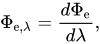
Spectral flux by frequency, whose unit is W/Hz: where is the radiant flux of the radiation in a small frequency interval . The area under a plot with frequency horizontal axis equals to the total radiant flux.

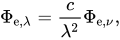
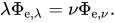
The spectral quantities by wavelength λ and frequency ν are related to each other, since the product of the two variables is the speed of light ():

or or

The integral quantity can be obtained by the spectral quantity's integration:

See also

[edit]

References

[edit]
[edit]
Revisions and contributorsEdit on WikipediaRead on Wikipedia
from Grokipedia
Radiometry is the science of measuring , specifically optical radiation spanning the , visible, and portions of the , corresponding to wavelengths from approximately 0.01 to 1000 µm or frequencies between 3×10¹¹ and 3×10¹⁶ Hz. This field quantifies the energy transfer of such between sources and receivers, forming the basis for precise of light propagation, sources, and materials. Central to radiometry are key quantities that describe in geometric terms, including radiant flux (Φ), the total power emitted in watts (); irradiance (E), the power per unit area in /m²; radiant intensity (I), the power per unit in /sr; and radiance (L), the power per unit area per unit in /m²·sr. These measures adhere to the (SI) and account for factors such as , the , and cosine dependencies in propagation. Radiometry differs from photometry, which restricts analysis to the (approximately 360–830 nm) and weights measurements by human visual sensitivity, using units like lumens and . Historically, radiometry advanced through efforts at the National Bureau of Standards (now NIST), beginning in the 1920s with verifications of and irradiance standards achieving few percent accuracy by the 1950s, then evolving to sub-percent precision in the 1960s–1970s via electrically calibrated detectors and spectroradiometry spurred by space and energy needs. Today, it underpins diverse applications, including astronomical observations, for weather and environmental monitoring, assessment, lighting efficiency optimization (which accounted for about 14% of U.S. electricity consumption in 2020), phototherapy, ultraviolet hazard regulation, and defense systems.

Introduction

Definition and Scope

Radiometry is the science of detecting and measuring radiant electromagnetic energy in the optical portion of the , spanning , visible, and wavelengths, corresponding to wavelengths from approximately 100 nm to 1 mm or frequencies between 3×10¹¹ and 3×10¹⁶ Hz. This field quantifies the energy carried by electromagnetic waves in terms of objective physical quantities, distinguishing it from photometry, which weights measurements according to human visual sensitivity. The scope of radiometry encompasses non-ionizing portions of the spectrum, such as (UV), visible light, and (IR), where measurements are crucial for assessing energy transfer in various environments. It includes both scalar measurements, which capture total without directional information (e.g., in watts per square meter), and vector measurements that account for directionality (e.g., radiance in watts per square meter per ). These approaches are essential for scientific and engineering applications, enabling precise quantification of to support fields like and materials testing. Key applications include determining the temperature of sources and evaluating levels, such as the standard 1000 /m² for terrestrial solar simulations. Radiometric measurements employ SI units, with power expressed in watts () and energy in joules (J), providing a standardized basis for comparing across diverse wavelengths and contexts.

Historical Development

The discovery of infrared radiation in 1800 by British William marked an early milestone in understanding beyond the visible spectrum. observed that a placed beyond the red end of the solar spectrum, dispersed by a prism, registered higher temperatures, indicating the presence of invisible "heating rays." This finding laid foundational groundwork for radiometry by expanding the conceptual scope of to include non-visible wavelengths. In the mid-19th century, German physicist Gustav Kirchhoff advanced the theoretical framework of thermal radiation through his 1859 law, which established that for a body in thermal equilibrium, the emissivity equals the absorptivity at each wavelength, enabling the concept of ideal blackbody radiators. Building on this, Austrian physicist Josef Stefan empirically derived in 1879 the relationship showing that the total energy radiated by a blackbody is proportional to the fourth power of its absolute temperature, later theoretically confirmed by Ludwig Boltzmann in 1884. These blackbody radiation laws provided essential principles for quantitative radiometric measurements, influencing subsequent detector developments. The late 19th and early 20th centuries saw practical advancements in instrumentation, notably American astrophysicist Samuel Langley's invention of the in 1880, a highly sensitive thermal detector capable of measuring minute temperature changes from radiant heat, which was a thousand times more precise than prior devices. The emergence of photoelectric detectors in the early 1900s further enabled direct electrical responses to radiation, facilitating more accurate spectral measurements. In 1948, the General Conference on Weights and Measures (CGPM) formalized key radiometric-related units, including the for based on a blackbody radiator at the platinum freezing point, setting the stage for the (SI) adopted in 1960. Post-World War II progress accelerated with space-based applications, as the Nimbus satellite series in the 1960s introduced advanced radiometers for , including high-resolution infrared instruments that measured global patterns from orbit. The National Institute of Standards and Technology (NIST), formerly the National Bureau of Standards, evolved its radiometry standards through cryogenic radiometers and trap detectors, achieving traceability for optical measurements with uncertainties below 0.1% by the 1980s and incorporating sources for UV and calibrations in the 1990s; as of May 2025, NIST's project provided lunar reflectance data for satellite radiometric calibration with 10 times greater accuracy than prior benchmarks. Key contributors included Langley for instrumentation and ongoing work by (CIE) Division 2 committees, which standardized physical measurements of and through global expert collaborations. Significant milestones included the adoption of absolute radiometry in the 1970s, exemplified by NIST's development of cavity-based absolute radiometers that substituted electrical for radiative power with high precision, enabling primary standards independent of secondary calibrations. Post-2010 advancements introduced quantum-based calibrations, such as using to achieve quantum efficiency measurements with 0.5% , enhancing radiometric accuracy in low-light regimes.

Core Concepts

Electromagnetic Radiation Fundamentals

Electromagnetic radiation, the foundation of radiometry, exhibits wave-particle duality, manifesting properties of both classical waves and discrete particles known as photons. As a wave, it consists of oscillating electric and magnetic fields perpendicular to each other and to the direction of propagation, traveling through vacuum at the constant speed of light, c=3×10⁸c = 3 \times 10^8 m/s. The fundamental relationship between its wavelength λ\lambda and frequency ν\nu is given by λν=c\lambda \nu = c, which determines the energy and behavior of the radiation across different regimes. The spans a continuous range of wavelengths, conventionally divided into distinct bands: radio waves (longest wavelengths, lowest frequencies), microwaves, (IR), visible light, (UV), s, and gamma rays (shortest wavelengths, highest frequencies). Each band corresponds to specific energies, quantified by E=hνE = h \nu, where hh is Planck's constant (h=6.626×1034h = 6.626 \times 10^{-34} J s), linking the particle-like nature of to its . This division is crucial for understanding how interacts with , as shorter wavelengths carry higher per and can ionize atoms in UV, , and gamma regions. Blackbody radiation represents the idealized emission from a perfect absorber, serving as a reference for in radiometry. A blackbody absorbs all incident and emits energy solely dependent on its TT, without regard to the material composition. The B(λ,T)B(\lambda, T), which describes the power per unit area, , and , follows : B(λ,T)=2hc2λ51ehc/λkT1B(\lambda, T) = \frac{2 h c^2}{\lambda^5} \frac{1}{e^{h c / \lambda k T} - 1} where kk is Boltzmann's constant (k=1.381×10²³k = 1.381 \times 10^{-23} J/K). This equation resolves the ultraviolet catastrophe of classical theory by incorporating quantum effects. , derived from , specifies the wavelength λmax\lambda_{\max} of peak spectral radiance via λmaxT=2898\lambda_{\max} T = 2898 μm·K, shifting the emission peak to shorter wavelengths as temperature increases—for instance, visible light peaks around 500 nm for solar temperatures near 5800 K. Polarization describes the orientation of the electric field vector in electromagnetic waves, which can be linear, circular, or elliptical, influencing , reflection, and absorption during measurements. Coherent maintains a fixed phase relationship across wavefronts, enabling interference effects essential for precise radiometric instrumentation, whereas incoherent sources like thermal emitters produce random phases that average out in detection. These properties must be accounted for in radiometric setups to avoid measurement biases, particularly in polarized or partially coherent sources such as lasers or atmospheric .

Distinction from Photometry

Photometry is the science of measuring visible light in a manner that accounts for the spectral sensitivity of the human eye, specifically weighting the radiation according to the photopic luminous efficiency function V(λ), which peaks at approximately 555 nm in the green region of the spectrum. This approach contrasts with radiometry by incorporating a psychophysical element, where photometric quantities such as luminous flux are expressed in lumens (lm) rather than the absolute energy unit of watts (W) used in radiometry. The V(λ) curve, standardized by the International Commission on Illumination (CIE), defines the eye's relative sensitivity across the visible range from about 360 nm to 830 nm, effectively filtering radiometric measurements to reflect perceived brightness. The primary distinction between radiometry and photometry lies in their measurement paradigms: radiometry provides objective, wavelength-independent quantification of optical radiation spanning the , , and portions of the , focusing solely on physical energy flux without regard to human perception. In contrast, photometry is inherently subjective and perceptual, applying the V(λ) weighting to restrict analysis to the and scale values relative to the eye's peak sensitivity at 555 nm, where the maximum reaches 683 lm/W for monochromatic radiation. This makes photometry unsuitable for non-visible wavelengths, such as or , where radiometry excels in applications like thermal imaging. Conversion between radiometric and photometric quantities is possible but limited; for monochromatic sources at 555 nm, the factor is precisely 683 lm/W, but broadband sources require integration over the spectrum using V(λ), yielding no universal equivalence due to varying spectral distributions. In practice, radiometric spectral data often serves as the foundation for computing photometric values in fields like , bridging the two through established CIE protocols that define both systems. This overlap ensures consistency, yet highlights radiometry's broader applicability for objective assessments beyond human vision.

Radiometric Quantities

Primary Quantities

, denoted QeQ_e, is the total amount of energy emitted, transferred, or received in the form of , irrespective of its wavelength distribution, and is measured in joules (J). This quantity serves as the foundational measure in radiometry for the absolute energy content involved in radiative processes. Radiant flux, symbolized as Φe\Phi_e, represents the rate of flow of radiant energy with respect to time, defined as Φe=dQedt\Phi_e = \frac{d Q_e}{d t}, and has units of watts (W). It quantifies the power radiated by a source or passing through a surface, providing a direct measure of energy transfer dynamics in radiometric systems. For instance, the total power output of an incandescent lamp or the of a star is characterized by its radiant flux Φe\Phi_e. Radiant intensity, denoted IeI_e, is the radiant flux per unit solid angle in a specified direction, given by Ie=dΦedΩI_e = \frac{d \Phi_e}{d \Omega}, with units of watts per steradian (W/sr). This quantity is essential for describing the directional distribution of power from sources, particularly point-like emitters. A key relation among these primaries is that the total radiant flux equals the integral of radiant intensity over the solid angle of the emitting hemisphere: Φe=2πIedΩ.\Phi_e = \int_{2\pi} I_e \, d\Omega. This integration holds for the total, wavelength-integrated case without spectral decomposition. These quantities form the basis for and can be extended to spectral variants for wavelength-dependent analyses.

Derived Quantities

Derived quantities in radiometry extend the primary concept of radiant flux by incorporating spatial and angular dependencies, enabling the description of radiation fields from extended sources and surfaces. These quantities are essential for analyzing how interacts with areas and directions in , particularly for non-point sources where uniformity cannot be assumed. Radiance, denoted LeL_e, quantifies the per unit projected area perpendicular to the direction of propagation and per unit . It is defined as Le=d2ΦedAcosθdΩL_e = \frac{d^2 \Phi_e}{dA \cos \theta \, d\Omega} with units of watts per square meter per (W/m²·sr). This measures the power density along a specific ray, and a key property is its invariance along a ray in lossless media, meaning the value remains constant as propagates through or homogeneous isotropic materials without absorption or . Irradiance, denoted EeE_e, represents the radiant flux incident on a surface per unit area, integrating contributions from all directions over the incident hemisphere. It is given by Ee=dΦedAE_e = \frac{d \Phi_e}{dA} in units of W/m². This quantity describes the total power density received at a point, independent of direction, and can be computed from radiance via hemispherical integration Ee=2πLecosθdΩE_e = \int_{2\pi} L_e \cos \theta \, d\Omega. Radiant exitance, denoted MeM_e, is the emitted by a surface per unit area into the outward hemisphere. Its definition mirrors that of but applies to outgoing emission: Me=dΦedAM_e = \frac{d \Phi_e}{dA} also in W/m². For a blackbody, this follows the Stefan-Boltzmann law, Me=σT4M_e = \sigma T^4, where σ=5.670×10⁸\sigma = 5.670 \times 10^{-8} W/m²·K⁴ is the Stefan-Boltzmann constant and TT is the absolute temperature. Radiosity, denoted JeJ_e, accounts for the total leaving a surface per unit area, comprising both emitted and reflected components: Je=Me+ρEeJ_e = M_e + \rho E_e, where ρ\rho is the . It is expressed in W/ and is particularly useful for diffuse surfaces in analyses, as it lumps all outgoing regardless of direction. Representative examples illustrate the scale of these quantities. The solar irradiance at Earth's surface under clear-sky conditions reaches approximately 1000 W/m² near noon at mid-latitudes, representing the power density from the Sun after atmospheric . For a blackbody at 300 K (), the is about 460 W/m², highlighting the role of thermal emission in everyday environments. Spectral versions of these derived quantities incorporate wavelength dependence, denoted with subscript λ\lambda or ν\nu, to describe distributions.

Spectral Radiometry

Spectral Quantity Definitions

In spectral radiometry, quantities describe the distribution of as a function of or frequency, enabling detailed analysis of across the optical spectrum. These spectral quantities are essential for applications such as and , where understanding the wavelength-dependent behavior of is critical. Unlike quantities that aggregate total , spectral forms provide the density of per unit spectral interval, allowing reconstruction of properties through integration. The , denoted Φe,λ\Phi_{e,\lambda} in watts per nanometer (W/nm) or Φe,ν\Phi_{e,\nu} in watts per hertz (W/Hz), quantifies the total power emitted, transmitted, or received by a source or system within an infinitesimal interval of Δλ\Delta\lambda or Δν\Delta\nu. This fundamental quantity serves as the basis for all other radiometric measures, representing the power density without regard to spatial or directional distribution. For instance, it is used to characterize the output of lamps or lasers across their emission spectra. Spectral radiance, Le,λL_{e,\lambda} in watts per square meter per steradian per nanometer (W/m²·sr·nm) or Le,νL_{e,\nu} in W/m²·sr·Hz, measures the per unit , per unit , and per unit spectral interval, capturing the directional intensity of from a surface or . It is invariant under in free and is pivotal for modeling transport in optical systems, such as in or illumination design. provides a complete description of how varies with direction and at a point. Spectral irradiance, Ee,λE_{e,\lambda} in W/m²·nm or Ee,νE_{e,\nu} in W/m²·Hz, represents the incident on a surface per unit area and per unit interval, integrating contributions from over the hemisphere. This is key for assessing exposure levels, such as in applications or performance, where the content of incoming radiation determines efficiency. Standard notation conventions employ subscripts λ\lambda to indicate per-unit-wavelength quantities and ν\nu for per-unit-frequency forms, with the distribution functions ensuring dimensional consistency across the . The corresponding total () quantity, such as total Φe\Phi_e, is obtained by integrating the quantity over all wavelengths or frequencies: Φe=0Φe,λdλ\Phi_e = \int_0^\infty \Phi_{e,\lambda} \, d\lambda or Φe=0Φe,νdν\Phi_e = \int_0^\infty \Phi_{e,\nu} \, d\nu. This integration links and radiometry, where broadband totals emerge as sums of components. A representative example is the solar spectral irradiance at Earth's surface, which exhibits a peak in the visible range around 500 nm, corresponding to light and delivering the majority of for biological and photovoltaic processes. This spectral profile underscores the concentration of in the 400–700 nm band, influencing applications from climate modeling to .

Spectral Distribution Equations

In spectral radiometry, radiometric quantities are often expressed as functions of either λ\lambda or ν\nu, requiring careful conversion to maintain the physical invariance of energy content within intervals. The fundamental relation ensures that the spectral radiant flux in wavelength form equals that in frequency form, such that Φe,λdλ=Φe,νdν\Phi_{e,\lambda} \, d\lambda = \Phi_{e,\nu} \, d\nu, accounting for the differential dν=(c/λ2)dλd\nu = -(c / \lambda^2) \, d\lambda where cc is the . Thus, the spectral density transforms as Φe,λ=(c/λ2)Φe,ν\Phi_{e,\lambda} = (c / \lambda^2) \Phi_{e,\nu}, with ν=c/λ\nu = c / \lambda. A cornerstone of spectral radiometry is the modeling of thermal emission from blackbodies using , which provides the Le,λ(λ,T)L_{e,\lambda}(\lambda, T) as a function of and TT: Le,λ(λ,T)=2hc2λ51ehc/λkT1,L_{e,\lambda}(\lambda, T) = \frac{2 h c^2}{\lambda^5} \frac{1}{e^{h c / \lambda k T} - 1}, where hh is Planck's constant and kk is Boltzmann's constant. This equation describes the maximum possible at equilibrium and serves as a reference for calibrating other sources. To obtain total radiometric quantities from their spectral counterparts, integration over the entire spectrum is required. The total radiant flux Φe\Phi_e is thus given by Φe=0Φe,λdλ=0Φe,νdν\Phi_e = \int_0^\infty \Phi_{e,\lambda} \, d\lambda = \int_0^\infty \Phi_{e,\nu} \, d\nu, where the equality holds due to the conversion relation ensuring conservation of total energy. For blackbody emission, this integral yields the Stefan-Boltzmann law, Φe=σT4\Phi_e = \sigma T^4 with σ=2π5k4/(15c2h3)\sigma = 2 \pi^5 k^4 / (15 c^2 h^3), but the spectral form emphasizes wavelength-dependent contributions. For band-limited spectra, such as those from lasers or filters, approximations simplify calculations by assuming the quantity is nearly constant over a small bandwidth Δλ\Delta\lambda or Δν\Delta\nu. The effective in the band is then Φe,bandΦe,λΔλ\Phi_{e,\text{band}} \approx \Phi_{e,\lambda} \Delta\lambda, enabling precise modeling of monochromatic-like sources. In detector applications, quantum efficiency η(λ)\eta(\lambda) modulates the response, with the detected proportional to Φe,λη(λ)dλ\int \Phi_{e,\lambda} \eta(\lambda) \, d\lambda over the band's narrow range, often approximating η(λ0)Φe,λ0Δλ\eta(\lambda_0) \Phi_{e,\lambda_0} \Delta\lambda at central λ0\lambda_0. An illustrative example is the spectral radiance from a blackbody source at 300 , approximating room-temperature emission. At the peak of approximately 9.66 μ\mum (per , λmaxT=2898μ\lambda_{\max} T = 2898 \, \mum \cdot), the radiance reaches about 9.92 m2^{-2} sr1^{-1} μ\mum1^{-1}, highlighting the dominance of mid- for such sources in applications like imaging.

Integral Radiometry

Integral Quantity Definitions

Integral radiometric quantities represent the total or power integrated over the entire , typically from through wavelengths, without resolving details. These quantities are essential for applications involving sources where the full energy content is relevant, such as solar radiation assessments or total thermal flux calculations. Unlike quantities, forms aggregate contributions across all wavelengths, simplifying analysis for non-dispersive measurements. One key integral quantity is the radiant exposure, denoted HeH_e, which measures the time-integrated irradiance on a surface. It is defined as He=EedtH_e = \int E_e \, dt, where EeE_e is the irradiance in watts per square meter (W/m²) and tt is time in seconds, yielding units of joules per square meter (J/m²). This quantity captures the cumulative energy deposited on a surface over a period, such as during an exposure test or environmental monitoring. For example, the annual solar radiant exposure on a horizontal surface in the United States averages approximately 5×1095 \times 10^9 to 7×1097 \times 10^9 J/m²/year, depending on location and atmospheric conditions. Integral radiosity, denoted JeJ_e, quantifies the total leaving a surface per unit area, encompassing both emitted and reflected components integrated over the hemisphere above the surface and the full . It has units of / and is particularly useful for describing the overall outgoing radiation from opaque or diffuse surfaces in or lighting scenarios. In practice, for sources like —which spans a broad from about 300 nm to 2500 nm—integral radiosity requires averaging over the source's emission profile, whereas near-monochromatic sources like LEDs (with bandwidths under 50 nm) allow approximations treating them as effectively single-wavelength emitters for integral calculations. All integral quantities ultimately relate to the primary radiant flux Φe\Phi_e, the total power in watts integrated over the complete ; for instance, integrating or exitance over area yields , and further spectral integration ensures the totals align with Φe\Phi_e for fully characterized sources. These integrals derive from spectral counterparts by summing over without weighting, assuming the full spectrum is considered.

Integration and Broadband Calculations

In radiometry, integral quantities such as total radiant flux Φe\Phi_e are obtained by numerically integrating distributions over , typically using methods like the or when data are provided at discrete intervals. The approximates the integral Φe,λdλ\int \Phi_{e,\lambda} \, d\lambda by summing trapezoidal areas under the curve, given by Iδλ(Φe,12+i=2n1Φe,i+Φe,n2)I \approx \delta\lambda \left( \frac{\Phi_{e,1}}{2} + \sum_{i=2}^{n-1} \Phi_{e,i} + \frac{\Phi_{e,n}}{2} \right) for evenly spaced points with interval δλ\delta\lambda, providing a first-order accurate method suitable for measured bands. enhances accuracy by fitting quadratic polynomials between points, exact for up to second-degree polynomials, and is preferred for spectra with curvature, such as those from thermal sources; it weights the middle point as 4×4 \times the endpoint contributions over even intervals. For broadband calculations, approximations simplify integration when full spectral data are unavailable, particularly for thermal emitters. The effective wavelength λeff\lambda_{\text{eff}} represents the single wavelength where monochromatic radiance equals the integrated broadband value, calculated as λeff=λLe,λS(λ)dλLe,λS(λ)dλ\lambda_{\text{eff}} = \frac{\int \lambda L_{e,\lambda} S(\lambda) \, d\lambda}{\int L_{e,\lambda} S(\lambda) \, d\lambda} with source radiance Le,λL_{e,\lambda} and detector responsivity S(λ)S(\lambda), useful for narrowband approximations in filter radiometers. For thermal sources, Planck averaging integrates the Planck function B(λ,T)B(\lambda, T) weighted by the instrument response, yielding an effective temperature via B(λ,T)S(λ)dλ=B(λeff,Teff)\int B(\lambda, T) S(\lambda) \, d\lambda = B(\lambda_{\text{eff}}, T_{\text{eff}}). In the full broadband limit for blackbodies, the Stefan-Boltzmann law provides total exitance as Me=σT4M_e = \sigma T^4, where σ=5.670×10⁸Wm2K4\sigma = 5.670 \times 10^{-8} \, \text{W} \cdot \text{m}^{-2} \cdot \text{K}^{-4}, derived from integrating Planck's law over all wavelengths. Uncertainty in these integrations arises primarily from spectral resolution limits and extrapolation beyond measured ranges. Finite resolution introduces bandwidth errors, correctable via series expansions like Ecorr=E0+A1E+A2E+E_{\text{corr}} = E_0 + A_1 E' + A_2 E'' + \cdots, where E0E_0 is the measured value and primes denote derivatives; coarser resolution increases random but can be reduced by averaging over more points, from ~4.5% at low resolution to ~0.8% at higher. at spectral edges, often using linear or fits, correlates errors across points and dominates for tails in non-thermal spectra, contributing up to several percent in UV-visible integrations without baseline corrections. Overall relative combines systematic (e.g., resolution offset) and random components via u(I)/I=(uRi/I)2+(uS/I)2u(I)/I = \sqrt{ \sum (u_{R_i}/I)^2 + (u_S/I)^2 }
Add your contribution
Related Hubs
User Avatar
No comments yet.