


Community hub
Recent from talks
Contribute something
Nothing was collected or created yet.
Kingdom of Albania (medieval)
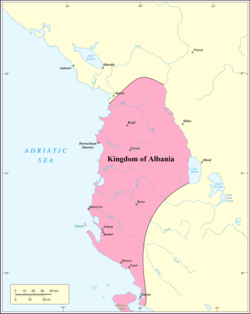
View on WikipediaThe Kingdom of Albania (Albanian: Mbretëria e Arbërisë, Latin: Regnum Albaniæ) was established by Charles of Anjou in the Albanian territories he conquered from the Byzantine Empire in 1271, with the help of the local Albanian nobility. The Kingdom of Albania was declared in late February 1272. The kingdom extended from the region of Durazzo (Dyrrhachium, modern Durrës) south along the coast to Butrint. A major attempt to advance further in direction of Constantinople failed at the Siege of Berat (1280–1281). A Byzantine counteroffensive soon ensued, which drove the Angevins out of the interior by 1281. The Sicilian Vespers further weakened the position of Charles, and the Kingdom was soon reduced by the Byzantines to a small area around Durazzo. The Angevins held out here, however, until 1368, when the city was captured by Karl Thopia. In 1392, Karl Thopia's son surrendered the city to the Republic of Venice.
Key Information


History
[edit]Background
[edit]
During the conflict between the Despotate of Epirus and the Empire of Nicaea in 1253, lord Golem of Kruja was initially allied with Epirus. Golem's troops had occupied the Kostur area trying to prevent the Nicaean forces of John Vatatzes from entering Devoll. Vatatzes managed to convince Golem to switch sides and a new treaty was signed between the parties where Vatatzes promised to guarantee Golem's autonomy. The same year Despot of Epirus Michael II signed a peace treaty with Nicaea acknowledging their authority over west Macedonia and Albania. The fortress of Krujë was surrendered to Nicaea, while the Nicean emperor acknowledged the old privileges and also granted new ones. The same privileges were confirmed later by his successor Theodore II Laskaris.[1]
The Nicaeans took control of Durrës from Michael II in 1256. During the winter of 1256–57, George Akropolites tried to reinstall Byzantine authority in the area of Arbanon. Autonomy was thus banished and a new administration was imposed. This was in contrast to what the Nicaeans had promised before. The local Albanian leaders revolted and on hearing the news, Michael II also denounced the peace treaty with the Nicaea. With the support of Albanian forces he attacked the cities of Dibra, Ohrid and Prilep. In the meantime Manfred of Sicily profited from the situation and launched an invasion into Albania. His forces, led by Philip Chinard, captured Durrës, Berat, Vlorë, Spinarizza and their surroundings and the southern coastline of Albania from Vlorë to Butrint.[2] Facing a war in two fronts, despot Michael II came to terms with Manfred and became his ally. He recognized Manfred's authority over the captured regions which were ceded as a dowry gift following the marriage of his daughter Helena to Manfred.[2][3]
Following the defeat of Michael II's and Manfred's forces in the Battle of Pelagonia, the new Nicaean forces continued their advance by capturing all of Manfred's domains in Albania, with the exception of Durrës. However, in September 1261, Manfred organized a new expedition and managed to capture all his dominions in Albania and he kept them until his death in 1266.[4] Manfred respected the old autonomy and privileges of the local nobility and their regions. He also integrated Albanian nobles into his administration, as was the case with Andrea Vrana who was the general captain and governor of Durrës and the neighboring region of Arbanon. Albanian troops were also used by Manfred in his campaigns in Italy. Manfred appointed Philippe Chinard as the general-governor of his dominions in Albania. Initially based in Corfu, Chinard moved his headquarters to Kanina, the dominant center of the Vlorë region. There he married a relative of Michael II.[5]
Creation
[edit]
After defeating Manfred's forces in the Battle of Benevento in 1266, the Treaty of Viterbo of 1267 was signed, with Charles of Anjou acquiring rights on Manfred's dominions in Albania,[6][7] together with rights he gained in the Latin dominions in the Despotate of Epirus and in the Morea.[8] Upon hearing the news of Manfred's death in the battle of Benevento, Michael II conspired and managed to kill Manfred's governor Philippe Chinard, with the help of Chinard's wife, but he could not capture Manfred's domains. Local noblemen and commanders refused to surrender Manfred's domains in Albania to Michael II. They gave the same negative response to Charles' envoy, Gazo Chinard in 1267, when following the articles of the Treaty of Viterbo, he asked for them to surrender Manfred's dominions in Albania.[9]
After the failure of the Eighth Crusade, Charles of Anjou returned his attention to Albania. He began contacting local Albanian leaders through local catholic clergy. Two local Catholic priests, namely Gjon from Durrës and Nicola from Arbanon, acted as negotiators between Charles of Anjou and the local noblemen. During 1271 they made several trips between Albania and Italy eventually succeeding in their mission.[10] On 21 February 1272,[6] a delegation of Albanian noblemen and citizens from Durrës made their way to Charles' court. Charles signed a treaty with them and was proclaimed King of Albania "by common consent of the bishops, counts, barons, soldiers and citizens" promising to protect them and to honor the privileges they had from Byzantine Empire.[11] The treaty declared the union between the Kingdom of Albania (Latin: Regnum Albanie) with the Kingdom of Sicily under King Charles of Anjou (Carolus I, dei gratia rex Siciliae et Albaniae).[10] He appointed Gazo Chinard as his Vicar-General and hoped to take up his expedition against Constantinople again. Throughout 1272 and 1273 he sent huge provisions to the towns of Durrës and Vlorë. This alarmed the Byzantine Emperor, Michael VIII Palaiologos, who began sending letters to local Albanian nobles, trying to convince them to stop their support for Charles of Anjou and to switch sides. The Albanian nobles sent the letters to Charles who praised them for their loyalty. Then, Michael VIII's hopes of stopping the advance of Charles were laid on the influence of Pope Gregory X. Gregory had high hopes of reconciling Europe, unifying the Greek and Latin churches, and launching a new crusade: to that end, he announced the Council of Lyon, to be held in 1274, and worked to arrange the election of an Emperor, so he ordered Charles to stop his operations.[12]
Charles of Anjou imposed a military rule on Kingdom of Albania. The autonomy and privileges promised in the treaty were "de facto" abolished and new taxes were imposed. Lands were confiscated in favor of Anjou nobles and Albanian nobles were excluded from their governmental tasks. In an attempt to enforce his rule and local loyalty, Charles I, took as hostages the sons of local noblemen. This created a general discontent in the country and several Albanian noblemen began contacting Byzantine Emperor Michael VIII who promised them, to acknowledge their old privileges.[13]
Byzantine offensive
[edit]As Charles I's intentions for a new offensive were stopped by the Pope and there was a general discontent within Albania, Michael VIII caught the occasion and began a campaign in Albania in late 1274. Byzantine forces helped by local Albanian noblemen captured the important city of Berat and later on Butrint. On November 1274, the local governor reported to Charles I that the Albanian and Byzantine forces had besieged Durrës. The Byzantine offensive continued and captured the port-city of Spinarizza. Thus Durrës alongside the Krujë and Vlora regions became the only domains in mainland Albania which were still under Charles I's control, but they were landlocked and isolated from each other. They could communicate with each other only by sea but the Byzantine fleet based in Spinarizza and Butrint kept them under constant pressure. Charles also managed to keep the island of Corfu.[14][15]
Michael VIII also scored another important diplomatic victory on Charles I by agreeing to unite the two churches in the Second Council of Lyon in 1274. Enthusiastic from the results of the council, Pope Gregory X, forbade any attempt by Charles on Michael VIII's forces. Under these circumstances Charles of Anjou was forced to sign a truce with Michael VIII in 1276.[14]
Angevin counteroffensive
[edit]
The Byzantine presence in Butrint alarmed Nikephoros I Komnenos Doukas the Despot of Epirus. He contacted Charles of Anjou and his vassal William II of Villehardouin who was at that time the prince of Achaea. Nikephoros I promised to make an oath of homage to Charles of Anjou in return for some land property in Achaia. In 1278 Nikephoros I's troops captured the city of Butrint. In March 1279 Nikephoros I declared himself a vassal of Charles of Anjou and surrendered to him the castles of Sopot and Butrint. As a pledge, Nikephoros I delivered his own son to the Angevin castellan of Vlorë to be held as hostage. Ambassadors were exchanged in this occasion, but Charles did not wait for the formalities to end; instead he ordered his captain and vicar-general at Corfu to capture not only Butrint, but everything that once belonged to Manfred and now were under the Despotate of Epirus.[16]
At the same time Charles began creating a network of alliances in the area in the brick of the new offensive, which would have pointed first to Thessaloníki and later to Constantinople. He entered in alliance with the kings of Serbia and Bulgaria.[17] He also tried to get the support of the local Albanian nobles. After continuous requests from other Albanian nobles, he liberated from Neapolitan prisons a number of Albanian nobles who were arrested before being accused of collaborating with Byzantine forces. Among them were Gjin Muzaka, Dhimitër Zogu and Guljem Blinishti. Gjin Muzaka especially was important to Charles' plans because the Muzaka family territories were around city of Berat. They were liberated, but were ordered to send their sons as hostages in Naples.[18]

On August 1279, Charles of Anjou appointed Hugo de Sully as Captain and Vicar-General of Albania, Durrës, Vlorë, Sopot, Butrint and Corfu. In the following months a great Angevin counteroffensive was prepared.[17] A lot of materials and men including Saracen archers and siege engineers were sent to de Sully, who had captured Spinarizza from Byzantine forces making it his headquarters.[19] The first goal of the expedition was the recapture of the city of Berat, which had been under Byzantine control since 1274. However, Charles' preparations were restrained by Pope Nicholas III who had forbidden Charles from attacking the Byzantine Empire. However, Pope Nicholas III died on August 1280 and for more than six months the Pope's seat was vacant. This gave Charles an opportunity to move on. During Autumn 1280 he gave the order to Hugo de Sully to move on.[20] In December 1280 Angevin forces captured the surroundings of Berat and besieged its castle.[19]
Byzantine counteroffensive
[edit]The Byzantine Emperor was hoping for the Pope to stop his Latin adversaries. In fact after the death in 1276 of Pope Gregory X, the main supporter of the union of the churches, his successors maintained the same course and this restricted Charles' movements. However, in February 1281 Charles of Anjou achieved a diplomatic victory by imposing a French Pope, as the head of the Catholic Church. The Byzantine Emperor Michael VIII was excommunicated by the new Pope and Charles' expedition against him blessed as a new crusade.[17]
.JPG)
The situation was very complicated for Michael VIII; however, he sent help to the besieged garrison. The Byzantine army which also included Turkish mercenaries arrived near Berat in March 1281. They were under orders to avoid pitched battle and to focus on ambushes and raids.[21] They managed to defeat Angevin forces by capturing first their commander Hugo de Sully in an ambush. This spread panic throughout his army, routing them from the battlefield. The Angevin army lost the major part of its forces and only a small part found refuge in the Kaninë castle, which was in Angevin hands.[22] The Byzantine army continued its advance further into the territory. They besieged the Angevin bases of Vlorë, Kaninë, and Durrës but could not capture them. The Albanian nobles in the region of Krujë allied themselves with the Byzantine Emperor and he granted them a charter of privileges for their city and bishopric.[23]
Charles' preparations and Sicilian Vespers
[edit]Treaty of Orvieto
[edit]The failure of Hugo de Sully's expedition convinced Charles of Anjou that an invasion of the Byzantine Empire by land was not feasible,[21] and he thus considered a naval expedition against Byzantium. He found an ally in Venice and in July 1281, the Treaty of Orvieto formalized this collaboration. Its stated purpose was the dethronement of Michael VIII in favor of the titular Latin emperor Philip of Courtenay and the forcible establishment of the Union of the Churches, bringing the Greek Orthodox Church under the authority of the Pope. Its principal motivation, however, was to re-establish the Latin Empire, under Angevin domination, and to restore Venetian commercial privileges in Constantinople.[24]

Under the terms of the treaty, Philip and Charles were to supply 8,000 troops and cavalry, and sufficient ships to transport them to Constantinople. Philip, the Doge of Venice Giovanni Dandolo, and Charles himself or Charles' son, Charles, Prince of Salerno, were to personally accompany the expedition. In practice, Charles would have supplied almost all of the troops, Philip having little or no resources of his own. The Venetians would supply forty galleys as escorts for the invasion fleet, which was to sail from Brindisi no later than April 1283. Upon Philip's restoration to the throne, he was to confirm the concessions of the Treaty of Viterbo and the privileges granted to Venice at the founding of the Latin Empire, including recognition of the Doge as dominator of "one-fourth and one-eighth of the Latin Empire."[25]
A second document was also drawn up to organize a vanguard to precede the main expedition of 1283. Charles and Philip were to supply fifteen ships and ten transports with about 300 men and horses. The Venetians were to provide fifteen warships for seven months of the year. These forces would make war against Michael VIII and "other occupiers" of the Latin Empire (presumably the Genoese), and would meet in Corfu by 1 May 1282, paving the way for the next year's invasion.[25]
The two treaties were signed by Charles and Philip on 3 July 1281, and were ratified by the Doge of Venice on 2 August 1281.[25]
Sicilian Vespers
[edit]
On Easter Monday 30 March 1282, in Sicily the local people began attacking French forces in an uprising which would become known as the Sicilian Vespers. The massacre went on for weeks throughout the island and they also destroyed the Angevin fleet gathered in the harbor of Messina which Charles had intended to use in the new expedition against Byzantium. Charles tried to suppress the uprising, but on 30 of August 1282, Peter III of Aragon landed in Sicily, it was clear that Charles had no more chances of attacking Byzantium.[26] In September 1282, the Angevin house forever lost Sicily. His son Charles II of Naples was captured by the Aragonese army in the Battle of the Gulf of Naples and was still a prisoner when his father, Charles of Anjou, died on 7 January 1285. Upon his death Charles left all of his domains to his son, who at the time was held by the Catalans. He was kept as prisoner up to 1289, when he was finally released.[27]
Restoration
[edit]Loss of Durrës
[edit]The Angevin resistance continued for some years in Kaninë, Durrës and Vlorë. However Durrës fell in Byzantine hands in 1288 and in the same year Byzantine Emperor Andronikos II Palaiologos renewed the privileges that his predecessor had granted to the Albanians in the Krujë region.[23] Kaninë castle was the last to fall to the Byzantines probably in 1294, while Corfu and Butrint remained in Angevin hands at least up to 1292.[28] In 1296 Serbian king Stephen Milutin took possession of Durrës. In 1299 Andronikos II Palaiologos married his daughter Simonis to Milutin and the lands he had conquered were considered as a dowry gift.[29]
Recapture of Durrës
[edit]
Although the Albanian territories were lost, the notion and rights of the Kingdom of Albania continued for the Angevins for a long time after Charles of Anjou's death. The Kingdom was inherited by Charles II after the death of his father in 1285. In August 1294, Charles II passed his rights on Albania to his son Philip I, Prince of Taranto. In November 1294, Philip I was married to the daughter of the Epirote Despot Nikephoros I, renewing the old alliance between the two states.[30] His plans of recovering old Angevin domains were paused for a while when in 1299 Philip of Taranto became a prisoner of Frederick III of Sicily in the Battle of Falconaria. However, after his release in 1302, he claimed his rights on the Albanian kingdom and began preparations to recover it. He gained the support of local Albanian Catholics who preferred a Catholic Italian power as their protector instead of the Orthodox Serbs and Greeks, as well as the support of Pope Benedict XI. In the summer of 1304, Serbs were expelled from the city of Durrës by its citizens and local nobles, who in September submitted themselves to Angevin rule. Philip and his father Charles II renewed the old privileges that Charles of Anjou had promised to the citizens and nobility of Durrës. In 1305, further extensive exemptions from dues and taxes were granted to the citizens of Durrës and the local nobles from Charles II.[31]
The territory of the Kingdom of Albania under Philip of Taranto was restricted to roughly the modern Durrës District. In an attempt to resolve the tensions between the house of Anjou and the Aragonese, the Kingdom of Albania and the lands in Achaea under Angevin dominion were offered in exchange for the Kingdom of Trinacria ruled by Frederick II. These negotiations lasted some years but were abandoned in 1316.[32]
Duchy of Durazzo
[edit]Upon the death of Philip of Taranto in 1332, there were various claims on his domains within the Angevin family. The rights of the Duchy of Durazzo (Durrës) and the Kingdom of Albania together were given to John of Gravina with a sum of 5,000 pounds of gold.[33] After his death in 1336, his dominions in Albania passed to his son Charles, Duke of Durazzo.
During this period there were different Albanian noble families who began consolidating their power and domains. One of them was the Thopia family whose domains were in central Albania. The Serbs were pressing hard in their direction and the Albanian nobles found a natural ally in the Angevins.[34] Alliance with Albanian leaders was also crucial to the safety of the Kingdom of Albania, especially during the 1320s and 1330s. Most prominent among these leaders were the Thopias, ruling in an area between the rivers Mat and Shkumbin,[35] and the Muzaka family in the territory between the rivers Shkumbin and Vlorë.[36] They saw the Angevins as protectors of their domains and made alliances. During 1336–1337 Charles had various successes against Serb forces in central Albania.[37]
Last decades
[edit]
The pressure of the Serbian Kingdom on the Kingdom of Albania grew especially under the leadership of Stefan Dušan. Although the fate of city of Durrës, the capital of the Kingdom, is unknown, by 1346 all Albania was reported to be under the rule of Dušan.[34] In 1348, Charles, Duke of Durazzo, was decapitated by his cousin Philip II, Prince of Taranto, who also inherited his rights on the Kingdom of Albania. Meanwhile, in Albania, after the death of Dušan, his empire began to disintegrate and, in central Albania, the Thopia family under Karl Topia, claimed rights to the Kingdom of Albania. In fact Stefan Uroš I was married to Helen of Anjou and Karl Topia was recognized as Count of Albania.[38] Karl Thopia took Durrës from the Angevins in 1368 with the consensus of its citizens. In 1376 Louis of Évreux, Duke of Durazzo who had gained the rights on the Albanian Kingdom from his second wife, attacked and conquered the city during the Durrës Expedition, but in 1383, Thopia took once again control of the city.[39][40]
In 1385 the city of Durrës was captured by Balša II. Topia called for Ottoman help and Balša's forces were defeated in the Battle of Savra. Topia recaptured the city of Durrës the same year and held it until his death in 1388. Afterwards, the city of Durrës was inherited by his son Gjergj, Lord of Durrës. In 1392 Gjergj surrendered the city of Durrës and his domains to the Republic of Venice.[41]
Government
[edit]The kingdom of Albania was a distinct entity from the Kingdom of Naples. The kingdom had the nature of a military oriented political structure. It had its own structure and organs of government which was located in Durrës.[42] At the head of this governmental body was the captain-general who had the status of a viceroy. These persons usually had the title of capitaneus et vicarius generalis and were the head of the army also, while the local forces were commanded by persons who held the title marescallus in partibus Albaniae.[42]
The royal resources, especially income from salt production and trade, were paid to the thesaurius of Albania. The port of Durrës and sea trade were essential to the kingdom. The port was under the command of prothontius and the Albanian fleet had its own captain. Other offices were created and functioned under the authority of the viceroy.[42]
With the attrition of the territory of the kingdom, the persons appointed as captain-generals began losing their powers, becoming more like governors of Durrës, than representatives of the king.[42]
The role of local Albanian lords became more and more important to the fate of the kingdom and the Angevins integrated them into their military structure especially in the second phase of the kingdom. When Philip of Taranto returned in 1304, one Albanian noble, Gulielm Blinishti, was appointed head of Angevin army in the Kingdom of Albania with the title marascallum regnie Albaniae.[43] He was succeeded in 1318 by Andrea I Muzaka.[44] From 1304 on, other western titles of nobility were bestowed by the Angevins upon the local Albanian lords.[45][46]
Although the Angevins tried to install a centralized state apparatus, they left great autonomy to the Albanians cities. In fact, in 1272 it was Charles of Anjou himself who recognized the old privileges of Durrës' community.
Religion
[edit]Historically the territory where the Kingdom of Albania lay was subject to different metropolitan powers such as Antivari, Durrës, Ohrid and Nicopolis, where Catholicism, Greek, Serbian and Bulgarian Churches applied their power interchangeably or sometimes even together. The presence of the kingdom reinforced the influence of Catholicism and the conversion to its rite, not only in the region of Durrës but also in other parts of the country.[47]
The Archbishopric of Durrës was one of the primary bishoprics in Albania and before the Great Schism (1054), it had 15 episcopal sees under its authority. After the split it remained under the authority of Eastern Church while there were continuous, but fruitless efforts from the Roman church to convert it to the Latin rite. However, things changed after the fall of Byzantine Empire in 1204. In 1208, a Catholic archdeacon was elected for the archbishopric of Durrës. After the reconquest of Durrës by the Despotate of Epirus in 1214, the Latin Archbishop of Durrës was replaced by an Orthodox archbishop. After his death in 1225, various nearby metropolitan powers fought over the vacant seat. At last a Nicean archbishop was appointed in 1256 but he could not effectively run its office since, in 1258, the city was captured by Manfred.[48]
After the creation of Kingdom of Albania in 1272, a Catholic political structure was a good basis for the papal plans of spreading Catholicism in the Balkans. This plan found also the support of Helen of Anjou, a spouse of King Stefan Uroš I and cousin of Charles of Anjou, as Queen consort of the Serbian Kingdom, who was at that time ruling territories in North Albania. Around 30 Catholic churches and monasteries were built during her rule in North Albania and in Serbia.[49] New bishoprics were created especially in North Albania, with the help of Helen of Anjou.[50]
Durrës became again a Catholic archbishopric in 1272. Other territories of the Kingdom of Albania became Catholic centers as well. Butrint in the south, although dependent on Corfu, became Catholic and remained as such during 14th century. The same happened to Vlorë and Krujë as soon as the Kingdom of Albania was created.[51]
A new wave of Catholic dioceses, churches and monasteries were founded, a number of different religious orders began spreading into the country, and papal missionaries also reached the territories of the Kingdom of Albania. Those who were not Catholic in Central and North Albania converted and a great number of Albanian clerics and monks were present in the Dalmatian Catholic institutions.[52]
However, in Durrës the Byzantine rite continued to exist for a while after Angevin conquest. This double-line of authority created some confusion in the local population and a contemporary visitor of the country described Albanians as nor they are entirely Catholic or entirely schismatic. In order to fight this religious ambiguity, in 1304, Dominicans were ordered by Pope Benedict XI to enter the country and to instruct the locals in the Latin rite. Dominican priests were also ordered as bishops in Vlorë and Butrint.[53]
Among the Catholic orders operating during that period in Albania, one could mention the Franciscan order, Carmelites, Cistercians and Premonstratensians. Also from time to time, the local bishops were appointed from different orders as different popes had their favorites among them.[54]
Krujë became an important center for the spread of Catholicism. Its bishopric had been Catholic since 1167. It was under direct dependence from the pope and it was the pope himself who consecrated the bishop.[55] Local Albanian nobles maintained good relations with the Papacy. Its influence became so great, that it began to nominate local bishops.
The Catholic cause had a drawback while Stephan Dushan ruled in Albania. The Catholic rite was called Latin heresy and Dushan's code contained harsh measures against them. However, the persecutions of local catholic Albanians did not begin in 1349 when the Code was promulgated, but much earlier, at least since the beginning of 14th century. Under these circumstances the relations between local Catholic Albanians and the papal curia became very close.[56]
Between 1350 and 1370, the spread of Catholicism in Albania reached its peak. At that period there were around seventeen Catholic bishoprics in the country, which acted not only as centers for Catholic reform within Albania, but also as centers for missionary activity in the neighboring areas, with the permission of the pope.[52]
Society
[edit]While the Byzantine Pronoia was the dominant form in the country, the Angevins introduced the Western type of feudalism. In the 13th and 14th centuries, pronoiars earned a great number of privileges and attributes, taking power away from the central authority. The benefit earned by the pronoiars from their land increased. Pronoiars began to collect land taxes for themselves which was an attribute of the state. They also began to exercise administrative authorities which replaced the state's, such as the ability to gather workers, guards, soldiers, and sometimes their own judges. In the 13th century, it was common for pronoiars to arrogate their own right to trial, initially for petty issues and then for serious crimes, taking away central authority from the main prerogatives to the practice of sovereignty.[57]
By the 14th century, the pronoia had reached the status of feudal possession. It could now be passed on to succession, split, and sold. The pronoia increasingly rarely fulfilled the military needs of the state.[57] Alongside the pronoiars were landowners who owned large tracts of land worked by farmers. The landownership also included pronoiars from Durrës, Shkodër, and Drisht. Citizens of Durrës owned property and grazing land in the nearby mountain of Temali. The splitting, inheritance, and selling of the property was a common occurrence.[58]
The feudal possessions in Albania, as in the West and the Byzantine Empire, were made up of two parts: the land of the peasants and the land which was directly owned by the lords of the land. The peasant's land was not centralized, but was split into many small plots, often far from each other. The lord's land was continually expanded along the same lines that the aristocracy strengthened.[58]
Land was also centralized under religious institutions, including monasteries and bishoprics. Unlike the 12th century, where the area under control was donated by the central authority, after the 12th century, most donors of land to the monasteries and bishoprics were small and large landowners.[58] By the beginning of the 14th century, monasteries and bishoprics had been able to collect large sums of land funds.[59] The income of the monasteries came mainly from agricultural products, but a small part also came from craftwork and other activities. A central source of income to the church were from taxes gathered in kind and in cash. A good of portion went to Rome or Constantinople. The delivery of bonds was one of the causes of friction between the local clergy and the Pope in Rome or the Patriarch in Constantinople.[60]
In an effort to find additional means of finance, especially in times of war, the central authority imposed high taxes on the population. The pyramid of society depended upon the work of the farmers. Besides the main category of farmers, categories of farmers included "free" farmer and "foreign" farmers. They were deprived of land and any form of possession and were therefore not registered, placing them in a feud for the quality of wages. Eventually, they received a piece of land for which they paid their duties, and were fused with the main category of farmers.[60]
The feudal duties of the peasant were not the same for all the Albanian areas but differed according to the terrain. The systems of payment in kind or in cash also changed accordingly, but the strengthening of the nobility against the central authority in the 13th century caused the payments in cash to increase compared to payments in kind. From the 12th to the 14th century, the vertical shift of power to the nobles was deepened. Not only were the plains brought under the control of the nobles, but also mountainous areas. The feudal possessions also began to include communal areas such as forests, pastures, and fisheries. This evolution took place during the period of Byzantine decline and saw the conversion of the pronoia into an estate very similar to the feudal one.[61]
The overwhelming majority of the population under the lords' rule was made up of agricultural workers. Contemporary sources reveal that in large parts of Albania, the village population had fallen to the status of serfdom. An anonymous traveler in 1308 revealed that farmers in the regions of Këlcyrë, Tomorricë, Stefaniakë, Kunavë, and Pultë of Dibra worked the lands and vineyards of their respective lords, turned over their products, and performed household work for them. The Byzantine historian Kantakouzenos, testifies that the power of the lords of these areas depended mostly on livestock which were present in large numbers.[62]
Cities
[edit]During the 13th century, many cities in Albania made the move from being primarily military strongholds to becoming urban centers. Unable to contain the development inside the city walls, many cities expanded outside them. Quarters outside the walls began to form, called proastion and suburbium and became important economic centers. In these quarters, trade took place and shops along with workshops were centered here. Eventually, many of these quarters too were surrounded by walls to protect them. In order to secure a supply of water, cisterns in open, safe spaces were used to gather water. In some unique cases, water was also gathered from nearby rivers.[63]
In the first half of the 14th century, the population of the cities grew greatly. Durrës is estimated to have had 25,000 inhabitants. The city became a center which attracted inhabitants from the rural areas.[63] Durrës is known to have had a large number of inhabitants who came from the surrounding villages. Those farmers who migrated to the city were often forced to pay a fixed payment or to make up for this payment by working in a commune. Along with the farmers came noblemen from the surrounding areas, who either migrated permanently or spent a large amount of time in the cities to look after their economic interests. Many had possessions, stores, and houses in the city. The movement of noblemen to urban areas became normal and they were eventually integrated into the city become citizens and often taking government positions.[64]
Architecture
[edit]The spread of Catholicism affected the architecture of religious buildings, with a new Gothic style, mainly in the Center and North Albania. These areas were attached to the Catholic church and thus had greater Western connections. Both the Catholic and Orthodox churches operated in Durrës and the surrounding areas, and therefore both Western and Byzantine architectural styles were followed.[65] Western architecture could also be found in areas where Western rulers had possessions. Churches built in this form were built in Upper and Central Albania and were characterized by an emphasis on an East-West longitudinal axis with circular or rectangular apses. Among the most notable architectural monuments of this period include the Church of Shirgj Monastery near the village of Shirgj near Shkodër, the Church of Saint Mary in Vau i Dejës, and the Church of Rubik.[66] The former two churches were built in the 13th century AD while the latter in the 12th century AD. Most of the churches built in this period were decorated with murals.[66]
In modern historiography
[edit]The Regnum Albaniae was used by the historiography of Fascist Italy to support the Italian claims on Albania. Also, modern Albanian historiography mythicized this kingdom as a medieval Albanian nation-state. In fact, Charles I d' Anjou never claimed that he was "Rex Albaniae", and the term "Regnum Albaniae" disappears from the Angevin archives after 1277. The borders of this kingdom were poorly defined.[67]
List of rulers
[edit]
Kings of Albania
[edit]- Charles I 1272–1285
- Charles II 1285–1294
Charles surrendered his rights to Albania to his son Philip in 1294. Philip reigned as Lord of the Kingdom of Albania.
Lords of the Kingdom of Albania
[edit]Philip died on 26 December 1331, and was succeeded by his son Robert. Robert's uncle, John, did not wish to do him homage for the Principality of Achaea, so Robert received Achaea from John in exchange for 5,000 ounces of gold and the rights to the diminished Kingdom of Albania. John took the style of Duke of Durazzo.
Dukes and Duchesses of Durazzo
[edit]- John 1332–1336
- Charles 1336–1348
- Joanna 1348–1368 & 1376–1383
- Louis 1365–1368 and 1376, in right of his wife
- Robert IV of Artois, Count of Eu 1376–1383, in right of his wife[68]
In 1368 and 1383, Durazzo fell to Karl Topia, who was recognized by Venice as Prince of Albania.
| History of Albania |
|---|
 |
| Timeline |
Captains and Vicars-General of the Kingdom of Albania
[edit]These officers were styled Capitaneus et vicaris generalis in regno Albaniae.[42]
- Gazo Chinard (1272)
- Anselme de Cayeux (May 1273)[69]
- Narjot de Toucy (1274)
- Guillaume Bernard (23 September 1275)
- Jean Vaubecourt (15 September 1277)
- Jean Scotto (May 1279)
- Hugues de Sully le Rousseau (1281)
- Guillaume Bernard (1283)
- Guy of Charpigny (1294)
- Ponzard de Tournay (1294)
- Simon de Mercey (1296)
- Guillaume de Grosseteste (1298)
- Geoffroy de Port (1299)
- Rinieri da Montefuscolo (1301)
Marshals of the Kingdom of Albania
[edit]These officers were styled Marescallus in regni Albaniae.[42][70]
- Guillaume Bernard
- Philip d'Artulla (Ervilla)
- Geoffroy de Polisy
- Jacques de Campagnol
- Andrea I Muzaka (1279)
- Gulielm Blinishti (1304)
References
[edit]- ^ Anamali & Prifti (2002), p. 202.
- ^ a b Setton (1976), p. 81.
- ^ Ducellier (1999), pp. 791–792.
- ^ Anamali & Prifti (2002), p. 205.
- ^ Anamali & Prifti (2002), pp. 205–206.
- ^ a b Ducellier (1999), p. 793.
- ^ Nicol (2010), p. 12.
- ^ Jacobi (1999), p. 533.
- ^ Anamali & Prifti (2002), p. 206.
- ^ a b Anamali & Prifti (2002), p. 207.
- ^ Nicol (2010), p. 15.
- ^ Nicol (2010), pp. 15–17.
- ^ Anamali & Prifti (2002), pp. 208–210.
- ^ a b Anamali & Prifti (2002), p. 201.
- ^ Nicol (2010), p. 18.
- ^ Nicol (2010), pp. 18–23.
- ^ a b c Nicol (2010), p. 25.
- ^ Anamali & Prifti (2002), p. 211.
- ^ a b Setton (1976), p. 136.
- ^ Nicol (2010), p. 206.
- ^ a b Bartusis (1997), p. 63.
- ^ Setton (1976), p. 137.
- ^ a b Nicol (2010), p. 27.
- ^ Nicol (2010), pp. 208–209.
- ^ a b c Nicol (1988), p. 208.
- ^ Setton (1976), p. 140.
- ^ Nicol (2010), p. 33.
- ^ Nicol (2010), p. 28.
- ^ Nicol (2010), pp. 67–68.
- ^ Nicol (2010), pp. 44–47.
- ^ Nicol (2010), p. 68.
- ^ Abulafia (1996), Intercultural contacts in the medieval Mediterranean, pp.1-13
- ^ Nicol (2010), p. 99.
- ^ a b Nicol (2010), p. 128.
- ^ Norris (1993), p. 36.
- ^ Fine (1994), p. 290.
- ^ Abulafia (1996), The New Cambridge Medieval History, Volume VI: c. 1300-c. 1415, p. 495
- ^ Nicolle (1988), p. 37.
- ^ Fine (1994), p. 384.
- ^ John V. A. Fine (jr.), John Van Antwerp Fine (1994). The Late Medieval Balkans A Critical Survey from the Late Twelfth Century to the Ottoman Conquest. University of Michigan Press. p. 384. ISBN 978-0-4720-8260-5.
...The Angevins retained Durazzo for a time, for in 1379 Joanna's new husband, Robert of Artois, is found issuing to Dubrovnik a charter pertaining to Durazzo. Karlo Thopia, who held the territory both north and south of the city, soon, probably in 1383, regained possession of Durazzo...
- ^ O'Connell (2009), p. 23.
- ^ a b c d e f Lala (2008), p. 21.
- ^ Lala (2008), p. 138.
- ^ Lala (2008), p. 136.
- ^ Pollo (1974), p. 54.
- ^ Castellan (2002), p. 25.
- ^ Lala (2008), p. 52.
- ^ Lala (2008), pp. 54–55.
- ^ Lala (2008), pp. 91–95.
- ^ Lala (2008), p. 155.
- ^ Lala (2008), pp. 147–148.
- ^ a b Lala (2008), p. 146.
- ^ Lala (2008), pp. 149–153.
- ^ Lala (2008), p. 154.
- ^ Lala (2008), p. 157.
- ^ Lala (2008), pp. 118–119.
- ^ a b Anamali & Prifti (2002), p. 220.
- ^ a b c Anamali & Prifti (2002), p. 221.
- ^ Anamali & Prifti (2002), pp. 221–222.
- ^ a b Anamali & Prifti (2002), p. 222.
- ^ Anamali & Prifti (2002), p. 223.
- ^ Anamali & Prifti (2002), p. 224.
- ^ a b Anamali & Prifti (2002), p. 225.
- ^ Anamali & Prifti (2002), p. 226.
- ^ Anamali & Prifti (2002), p. 314.
- ^ a b Anamali & Prifti (2002), p. 315.
- ^ "A. Kiesewetter, L'acquisto e l'occupazione del litorale meridionale dell'Albania da parte di re Carlo I d'Angiò (1279–1283). Palaver, Università del Salento, 4 n.s. (2015), n. 1, 255-298 , pp. 12-14". Archived from the original on 2023-03-15. Retrieved 2023-03-15.
- ^ John V. A. Fine (jr.), John Van Antwerp Fine (1994). The Late Medieval Balkans A Critical Survey from the Late Twelfth Century to the Ottoman Conquest. University of Michigan Press. p. 384. ISBN 978-0-4720-8260-5.
...The Angevins retained Durazzo for a time, for in 1379 Joanna's new husband, Robert of Artois, is found issuing to Dubrovnik a charter pertaining to Durazzo. Karlo Thopia, who held the territory both north and south of the city, soon, probably in 1383, regained possession of Durazzo...
- ^ Porčić 2021, p. 186.
- ^ Lala (2008), pp. 136, 138.
Sources
[edit]- Abulafia, David (1996), Arbel, Benjamin (ed.), Intercultural contacts in the medieval Mediterranean, Psychology Press, pp. 1–13, ISBN 978-0-7146-4714-2
- Abulafia, David (2000). "The Italian South". In Jones, Michael (ed.). The New Cambridge Medieval History, Volume 6, c.1300–c.1415. Cambridge: Cambridge University Press. pp. 488–514. ISBN 978-1-13905574-1.
- Anamali, Skënder; Prifti, Kristaq (2002). Historia e popullit shqiptar në katër vëllime (in Albanian). Botimet Toena. ISBN 978-99927-1-622-9.
- Bartusis, Mark C. (1997), The Late Byzantine Army: Arms and Society 1204–1453, University of Pennsylvania Press, ISBN 978-0-8122-1620-2
- Castellan, Georges (2002), Histoire de l'Albanie et des albanais, Editions ARMELINE, ISBN 978-2-910878-20-7
- Ducellier, Alain (1999). "Albania, Serbia and Bulgaria". In Abulafia, David (ed.). The New Cambridge Medieval History, Volume 5, c.1198–c.1300. Cambridge: Cambridge University Press. pp. 779–795. ISBN 978-1-13905573-4.
- Fine, John V. A. Jr. (1994) [1987]. The Late Medieval Balkans: A Critical Survey from the Late Twelfth Century to the Ottoman Conquest. Ann Arbor, Michigan: University of Michigan Press. ISBN 978-0-472-10079-8. OCLC 749133662.
- Frachery, Thomas (2005), Le règne de la Maison d'Anjou en Albanie (1272–1350), Rev. Akademos, pp. 7–26
- Jacobi, David (1999). "The Latin empire of Constantinople and the Frankish states in Greece". In Abulafia, David (ed.). The New Cambridge Medieval History, Volume 5, c.1198–c.1300. Cambridge: Cambridge University Press. pp. 525–542. ISBN 978-1-13905573-4.
- Lala, Etleva (2008), Regnum Albaniae, the Papal Curia, and the Western Visions of a Borderline Nobility (PDF), Central European University, Department of Medieval Studies, archived (PDF) from the original on 2022-10-09, retrieved 2011-05-29
- Nicol, Donald M. (1988). Byzantium and Venice: A Study in Diplomatic and Cultural Relations. Cambridge: Cambridge University Press. ISBN 0-521-34157-4.
- Nicol, Donald MacGillivray (2010), The Despotate of Epiros 1267–1479: A Contribution to the History of Greece in the Middle Ages, Cambridge University Press, ISBN 978-0-521-13089-9
- Nicolle, David (1988), Hungary and the fall of Eastern Europe 1000-1568, Osprey Publishing, ISBN 978-0-85045-833-6
- Norris, H. T. (1993), Islam in the Balkans: religion and society between Europe and the Arab world, University of South Carolina Press, ISBN 978-0-87249-977-5
- O'Connell, Monique (2009), Men of empire: power and negotiation in Venice's maritime state, Johns Hopkins University Press, ISBN 978-0-8018-9145-8
- Porčić, Nebojša (2021). "Documents of Mary of Cayeux concerning grants to the Abbey of Dommartin and an agreement with the king of England". Initial: A Review of Medieval Studies. 9: 181–208.
- Pollo, Stefanaq (1974), Histoire de l'Albanie, des origines à nos jours Volume 5 of Histoire des nations Collection Histoire des nations européennes Histoire des nations européennes, Horvath, ISBN 978-2-7171-0025-9
- Setton, Kenneth M. (1976). The Papacy and the Levant (1204–1571), Volume I: The Thirteenth and Fourteenth Centuries. Philadelphia: The American Philosophical Society. ISBN 0-87169-114-0.
- Thallóczy, Ludovicus; Jireček, Constantinus; Sufflay, Emilianus, eds. (1913). Acta et diplomata res Albaniae mediae aetatis illustrantia. Vol. 1. Vindobonae: Typis Adolphi Holzhausen.
- Thallóczy, Ludovicus; Jireček, Constantinus; Sufflay, Emilianus, eds. (1918). Acta et diplomata res Albaniae mediae aetatis illustrantia. Vol. 2. Vindobonae: Typis Adolphi Holzhausen.


Kingdom of Albania (medieval)
View on GrokipediaOrigins and Establishment
Historical Background
The territory of medieval Albania was integrated into the Byzantine Empire as part of the Theme of Dyrrhachium, a military-civilian province formed in the early 9th century to secure the Adriatic coast against Slavic and Arab threats, with its capital at Dyrrhachium (modern Durrës).[6] Byzantine control over the interior highlands solidified after the empire's victory over the First Bulgarian Empire in 1018, incorporating regions inhabited by proto-Albanian populations documented in sources from the 11th century onward as Arbanitai, often as semi-nomadic herders and irregular fighters.[7] This administrative framework emphasized fortified coastal defenses and thematic armies, but imperial overextension invited external incursions, notably the Norman expedition under Robert Guiscard, who captured Dyrrhachium following the Battle of Dyrrhachium on October 18, 1081, and held parts of the region until Byzantine counteroffensives under Alexios I Komnenos expelled them by 1085.[8] Byzantine authority waned further in the late 12th century amid dynastic instability and crusading disruptions, enabling local Albanian archons to assert autonomy. Progon, a native lord of the Progoni clan, founded the Principality of Arbanon around 1190, establishing its core around the Krujë fortress and extending between the Shkumbin and Drin river valleys from the Adriatic to the Black Drin.[9] Ruled successively by Progon (1190–c. 1198), his son Gjin Progoni (c. 1198–1208), and Dhimitër Progoni (c. 1208–1216), the principality operated as a semi-independent entity under nominal Byzantine overlordship, relying on fortified strongholds and tribal levies for defense while engaging in trade and diplomacy with neighboring powers.[9] After Dhimitër's death, control passed briefly to Gregorios Kamonas (c. 1216) and later Golem (until 1252), who navigated vassalage to the Despotate of Epirus and, temporarily, the Second Bulgarian Empire (1230–1241), before a revolt led to Nicaean imposition of Constantine Chabaron (1252–1257) and eventual absorption into the Empire of Nicaea by 1257.[9] The Fourth Crusade's sack of Constantinople in 1204 fragmented Byzantine holdings, birthing the Despotate of Epirus as a Greek-led successor state under Michael I Komnenos Doukas (r. 1205–1215), whose realm swiftly incorporated Arbanon and coastal Albanian territories northward to Dyrrhachium.[10] Michael I's nephew Theodore Komnenos Doukas (r. 1215–1230) aggressively expanded, seizing Thessalonica in 1224 and proclaiming himself emperor in 1227, but defeat at the Battle of Klokotnitsa in 1230 against Bulgarian tsar Ivan Asen II reduced Epirus to vassal status and fragmented its Albanian peripheries.[10] Michael II Komnenos (r. c. 1230–1268), an illegitimate son of Michael I, regained independence but faced chronic instability, including the loss of Thessalonica to Nicaea in 1246 and a decisive defeat at the Battle of Pelagonia in 1259, which ceded northern territories and exposed the despotate's vulnerabilities to Latin ambitions from the west.[10] These dynamics of imperial rivalry and local fragmentation set the stage for Angevin incursions into the power vacuum.Angevin Conquest and Proclamation
In 1271, following the consolidation of Angevin power in southern Italy, Charles I of Anjou directed military efforts toward the western Balkans to weaken the Byzantine Empire and secure strategic Adriatic outposts. Angevin forces, supported by local Albanian chieftains disillusioned with Byzantine rule under Michael VIII Palaiologos, captured the key port of Durrës (ancient Dyrrhachium) from the Despotate of Epirus, which held nominal Byzantine allegiance.[11] This conquest extended Angevin control southward along the coast, encompassing territories vital for naval operations and as a staging ground for further eastern campaigns.[5] Local elites, including Albanian archons, played a crucial role by submitting oaths of fealty to Charles, providing troops and intelligence in exchange for privileges and protection against Byzantine reconquest. These alliances reflected pragmatic shifts among regional powers amid the power vacuum left by Epirote instability and Byzantine recovery efforts post-1261 reconquest of Constantinople. By late 1271, Angevin viceroys administered captured strongholds, imposing feudal obligations while promising autonomy to cooperative nobles.[12] On 21 February 1272, Charles I formally proclaimed the establishment of the Regnum Albaniae, assuming the title rex Albaniae and defining the kingdom's boundaries from the Accroceraunian Mountains near Vlorë northward to the Drin River mouth. This self-proclamation was announced to assembled counts, barons, and knights, framing the new entity as a Latin Christian bulwark against Orthodox Byzantium.[13] The Holy See promptly recognized the kingdom as a Catholic realm, aligning with papal interests in countering Byzantine influence and supporting Angevin ambitions for a grand crusade.[14] Primary Angevin charters and papal correspondence from the period document these acts, emphasizing the kingdom's role in legitimizing territorial claims through feudal investiture and ecclesiastical endorsement. The proclamation served strategic purposes beyond mere title: it mobilized resources for defense against Byzantine counteroffensives and integrated Albanian lands into the Angevin fiscal and military system, with Durrës as the administrative center. However, effective control remained limited to coastal enclaves, reliant on the loyalty of allied chieftains whose support waned amid ongoing regional rivalries.[15]Territorial Extent and Administration
Geographical Boundaries
The Kingdom of Albania, established by Charles I of Anjou in February 1272, initially comprised territories conquered from the Despotate of Epirus and Byzantine forces, centered on the Adriatic coast. Its core area extended from Durrës (ancient Dyrrhachium) in the north southward along the coastline to Vlorë, with southern reaches occasionally claimed as far as Butrint. Inland control was limited but included strategic fortresses such as Berat and Kaninë, reflecting a focus on coastal strongholds and immediate hinterlands rather than deep penetration into the mountainous interior.[1][16] Northern boundaries approximated the Drin River vicinity, excluding Shkodër which remained outside Angevin direct control, while the western limit was the Adriatic Sea. Eastern frontiers were irregular and contested, bounded by the rugged Albanian highlands and resistance from local Albanian lords allied with Epirote or Byzantine interests, preventing stable expansion beyond the coastal plains. At its zenith in 1272–1274, prior to the failed Siege of Berat (1280–1281), the kingdom's extent covered central Albania's littoral and select inland valleys, totaling an estimated area of several thousand square kilometers though precise measurements are unavailable due to fluid control. Subsequent losses, including Durrës to Byzantine forces in 1288, progressively contracted these boundaries.[1][17]Governance Structure
The governance of the Kingdom of Albania under Angevin rule was characterized by a centralized monarchical authority exercised remotely from Naples, with military administration imposed on the conquered territories. Charles I of Anjou, who proclaimed himself King of Albania in February 1272, retained titular sovereignty while delegating executive power through appointed vicars-general and captains tasked with defense, taxation, and local order. These officials, often French or Italian nobles, operated from Durrës, the administrative capital, where key organs of government were established to oversee the realm's military-oriented structure.[13][18] Vicars-general held broad authority as the king's direct representatives, combining civil, military, and judicial functions. Early appointees included Gazo Chinard in 1272, followed by Anselme de Chaus in May 1273 and Narjot de Toucy in 1274, reflecting the Angevins' strategy of rotating loyal knights to maintain control amid Byzantine threats. By 1279, Hugh of Sully was dispatched as captain and vicar-general to Durazzo, Vlorë, Butrint, and Corfu, with mandates to fortify positions and suppress unrest through garrisons and feudal levies. This system prioritized strategic coastal enclaves over inland integration, leading to de facto military rule that curtailed promised local autonomies and imposed new taxes, straining relations with Albanian chieftains.[19][18] Local administration incorporated Albanian lords into the Angevin framework, particularly for military service, but effective power resided with foreign castellans overseeing fortified towns and ports. Counties or castellanies, such as those around Durrës and Vlorë, were governed by counts or justiciars under the vicar's oversight, enforcing Angevin feudal customs adapted to the region's Byzantine and tribal legacies. Judicial appeals ascended to the king, though practical enforcement waned after the Sicilian Vespers of 1282, fostering fragmentation as viceregal appointments became intermittent and reliant on alliances with opportunistic local elites.[5]Military Conflicts and Dynamics
Wars with Byzantium and Initial Defense
The Angevin conquest of Albanian territories from Byzantine control began in late 1271, when forces under Charles I of Anjou, supported by local Albanian chieftains disillusioned with Byzantine rule, captured key coastal strongholds including Durrës (Dyrrhachium) and Vlorë.[14] These chieftains provided auxiliary troops and intelligence, enabling rapid advances against garrisons loyal to Emperor Michael VIII Palaiologos, who had only tenuous hold over the region following the Despotate of Epirus's fragmentation.[20] By February 21, 1272, Charles proclaimed himself King of Albania (Regnum Albaniae), formalizing Angevin dominion over the area from Durrës southward along the Adriatic coast to Avlona (Vlorë), with papal recognition from the Holy See affirming the realm's Catholic orientation against Orthodox Byzantium.[14] This establishment relied on a mix of Frankish knights, Italian mercenaries, and Albanian levies, totaling several thousand combatants, though exact figures remain unrecorded in surviving chronicles.[21] Initial Byzantine countermeasures proved limited due to Michael's preoccupation with consolidating power after recapturing Constantinople in 1261 and negotiating the controversial Union of Lyon (1274) with the papacy.[22] However, in spring 1274, exploiting Charles's distractions in Italian affairs, Michael VIII dispatched forces to reclaim inland territories, capturing Berat and Butrint (Buthrotum) and confining Angevins to fortified coastal enclaves like Kaninë, Durrës, and Vlorë.[20] Angevin defenses held firm under local commanders such as William Blamund and Gjin Muzaka, repelling Byzantine sieges through superior artillery—early bombards and trebuchets—and alliances with Albanian nobles who resisted Orthodox reimposition.[20] These strongholds served as bases for naval raids, disrupting Byzantine supply lines across the Adriatic, while Charles reinforced garrisons with Neapolitan troops numbering around 1,000-2,000.[21] A pivotal Angevin offensive to reverse these losses culminated in the Siege of Berat (December 1280–April 1281), where General Hugh of Sully advanced with approximately 2,000 knights and 6,000 infantry, first storming Kaninë before encircling Berat's Byzantine garrison under John Mesazon.[20] Michael VIII responded by sending a relief army of 8,000-10,000 under Michael Tarchaneiotes, which arrived in early 1281 and employed ambushes in the hilly terrain, exploiting Angevin overextension and supply shortages.[23] On April 3, 1281, Tarchaneiotes routed Sully's forces in a surprise attack, capturing the general and inflicting heavy casualties—estimated at over 2,000 Angevins killed or captured—effectively halting further expansion and solidifying Byzantine interior control.[21] Angevin remnants retreated to coastal bastions, where they maintained defensive postures through 1288, relying on fortifications and intermittent reinforcements amid Charles's broader anti-Byzantine ambitions, including planned crusades against Constantinople.[20] This phase underscored the kingdom's vulnerability to guerrilla-style Byzantine warfare, which leveraged local terrain knowledge and Albanian defections over Angevin numerical superiority.[24]Impact of Sicilian Vespers and Internal Disruptions
The Sicilian Vespers revolt, commencing on 30 March 1282 with the massacre of Angevin officials in Palermo, triggered a chain of events that eroded the Kingdom of Albania's viability. Charles I of Anjou, facing the loss of Sicily to Aragonese forces, redirected substantial military contingents and fiscal revenues toward the protracted War of the Sicilian Vespers, which demanded sustained naval and land campaigns across the Mediterranean. This reallocation left Albanian garrisons under-resourced, as troop reinforcements from Italy dwindled and supply lines strained under competing priorities.[25] Byzantine forces, under Michael VIII Palaiologos and his successors, capitalized on this vulnerability, launching opportunistic incursions that reclaimed inland territories previously contested during the Angevin-Byzantine wars of the 1270s. The kingdom's effective control contracted sharply to coastal enclaves, including Durrës (Dyrrhachium), Vlorë, and associated ports, by the mid-1280s, as interior strongholds like Berat—site of a failed Angevin siege in 1280–1281—slipped away amid diminished defensive capabilities.[13][26] Internal disruptions compounded these external pressures, stemming from Angevin policies of heavy taxation to fund Mediterranean expeditions and the supplantation of local administrators with Provençal and Italian loyalists, which alienated Albanian nobles who had initially pledged fealty for anti-Byzantine campaigns. Charles I's death on 7 January 1285, followed by Charles II's capture by Aragonese forces in 1284 and subsequent captivity until 1288, created a regency vacuum under Queen Maria of Hungary, during which viceroys struggled to maintain cohesion. Local lords, facing unfulfilled promises of autonomy and economic burdens, engaged in sporadic defections and power grabs, fostering a pattern of de facto fragmentation that presaged the kingdom's later subdivision into semi-independent principalities.[25][27] These intertwined shocks—resource diversion from the Vespers war and governance breakdowns—causally accelerated the kingdom's peripheralization within Angevin strategy, shifting focus from Balkan consolidation to Italian recovery until nominal claims persisted under later rulers like Philip of Taranto. By 1294, Charles II had devolved Albanian titles to his son Philip, signaling a retreat to titular sovereignty over eroded domains.[13][26]Later Rebellions and Fragmentation
The Sicilian Vespers uprising on 30 March 1282 severely undermined Angevin authority across their Mediterranean holdings, including Albania, by diverting resources and exposing vulnerabilities to local dissent and external pressures.[13] Heavy taxation and failure to honor privileges granted to Albanian nobles fostered widespread discontent, prompting revolts against Angevin governors who often imprisoned or marginalized local elites.[13] Byzantine forces capitalized on this weakness, occupying the Adriatic coast up to Vlorë between 1284 and 1286, while earlier offensives in 1273 had already seized interior strongholds like Berat, Krujë, and Kaninë.[13] By the early 14th century, Angevin control had contracted to coastal enclaves such as Durrës, Vlorë, and Butrint, with Serbian incursions further eroding central authority; King Stefan Uroš II Milutin occupied Durrës in 1296, holding it until 1304 when it submitted to Philip of Taranto amid ongoing threats.[13] Local Albanian lords, initially allied against Byzantine and Serbian expansion, increasingly asserted autonomy, exemplified by the Thopia family's shift from nominal Angevin vassalage—recognized with territories from Mat to Shkumbin around 1338—to outright rebellion.[13] Karl Thopia, ruling from 1359 to 1388, captured Krujë in 1363 and Durrës in 1368 with citizen support and backing from Venice and Ragusa, effectively dismantling the remnants of Angevin rule and claiming the title to the kingdom.[13] [28] This culmination of rebellions accelerated fragmentation, as other clans like the Muzaka expanded amid the power vacuum, transitioning the region from a nominal Angevin monarchy to independent principalities by the late 14th century.[13] Serbian, Venetian, and emerging Ottoman influences compounded the dissolution, with Durrës briefly recaptured by Louis of Évreux in 1376 before reverting to local control, marking the end of unified Angevin governance.[28] Papal efforts to reform the realm, including legates dispatched in 1351, failed to stem the tide of decentralization driven by feudal rivalries and external aggressions.[13]Socioeconomic and Cultural Aspects
Economic Foundations and Taxation
The economy of the medieval Kingdom of Albania, proclaimed by Charles I of Anjou on February 21, 1272, was predominantly agrarian and pastoral, centered on livestock herding, grain cultivation in river valleys, and limited commodity production such as salt, which was managed by a designated thesaurius as a key revenue source.[13] Its strategic Adriatic coastline and position astride the Via Egnatia trade route supported commerce in ports like Durrës, a fortified hub for military logistics and exchange of goods including grain, minerals from the Balkan interior, and salt, though external powers such as Venice dominated Adriatic shipping lanes, constraining local autonomy in trade.[13] Feudal land grants formed the backbone of resource extraction, with inheritable fiefs distributed initially to Albanian nobles to foster loyalty, as exemplified by a 1274 grant to the castellan of Vlora, though subsequent dominance by French and Italian feudatories shifted benefits toward absentee landlords, exacerbating local exploitation.[13] [29] Taxation under Angevin rule began with concessions to build alliances, including promises of reduced levies to citizens and Albanian elites upon the kingdom's establishment, aimed at countering Byzantine influence in territories spanning from Vlorë to Lezhë.[29] These were short-lived; Charles I swiftly imposed stricter military governance, abolishing de facto autonomies and introducing new direct and indirect taxes on land, hearths, and trade to fund expeditions against Constantinople, which strained the sparse agrarian base and fueled resentment among subjected populations.[29] [13] By the early 14th century, efforts to stabilize revenues included targeted exemptions, such as those granted by Charles II to Durrës inhabitants in 1305, recognizing the port's commercial value amid territorial contractions post-Sicilian Vespers (1282).[13] Heavy fiscal demands, however, persisted as a causal factor in revolts, with revenues increasingly diverted to sustain garrisons and papal-aligned ecclesiastical institutions, including bishoprics that collected tithes in kind and coin, portions of which flowed to Rome.[13] The fiscal system's unsustainability reflected the kingdom's role as an outpost for broader Angevin ambitions rather than a self-sufficient entity; post-1282, after Byzantine advances reduced holdings to enclaves like Butrint by 1295, taxation yielded diminishing returns amid fragmented control and competition from Ragusan merchants in salt and silver trades.[13] Local nobles retained feudal dues from vassals, but Angevin oversight prioritized military extraction over infrastructural investment, limiting broader economic development beyond subsistence and tribute flows to Naples.[13] This structure, while enabling initial conquests, undermined long-term viability, as evidenced by the progressive cession of fiscal privileges to retain allegiance in shrinking domains until the 1360s.[13]Social Composition and Local Elites
The population of the Angevin Kingdom of Albania consisted primarily of ethnic Albanians, who formed a distinct community in the Balkan Peninsula by the 14th century, inhabiting mountainous and coastal regions with a rural economy based on agriculture, herding, and limited trade.[30] Social structure retained tribal clan organization, with virilocal residence patterns and exogamous marriages arranged by household heads, overlaid by emerging feudal elements such as cash payments to nobles that spread from plains to highlands during the 13th century.[31] Minorities included Vlach pastoralists in upland areas and Greek settlers in southern districts near Epirus, while Latin immigrants were confined to small garrisons and officials in ports like Durrës, numbering perhaps a few hundred at most.[32] Local elites comprised Albanian chieftains and nascent noble families who facilitated the Angevin conquest of 1271–1272 by providing auxiliary forces against Byzantine forces, securing their status through vassalage and land grants under Charles I.[33] These lords, often Orthodox and rooted in regional strongholds, integrated into the military hierarchy by supplying contingents for campaigns, such as defenses against Epirote incursions, while retaining de facto autonomy in interior territories amid weak central oversight.[13] By the late 13th century, following the Sicilian Vespers revolt of 1282, their influence grew, transitioning from Angevin dependents to semi-independent rulers as royal authority fragmented, exemplified by clans holding fiefs in central Albania.[34] This reliance on indigenous aristocracy underscored the kingdom's character as a Latin superstructure on pre-existing Albanian social frameworks, with limited Catholic proselytization among elites until papal incentives in the 1270s.[13]Religious Policies and Cultural Shifts
The Angevin Kingdom of Albania, established in 1272 following Charles I's conquest of key coastal territories from the Byzantine Empire, pursued policies to entrench Roman Catholicism as a means of consolidating Western loyalty amid a largely Eastern Orthodox population. Supported by the Papal Curia, which viewed the realm as a bulwark against Byzantine Orthodoxy, rulers like Charles I and his successors appointed Latin-rite bishops and reorganized dioceses, transforming Durrës into a Catholic archbishopric by 1272 and establishing suffragan sees in areas such as Bar, Ulcinj, and Shkodër.[13] Franciscan and Dominican missionaries arrived from 1288, founding monasteries and churches under royal patronage, with Queen Helen of Anjou (r. 1282–1306) dedicating territories to Saint Peter in 1291 and promoting conversions through land grants to Catholic institutions.[13] By the mid-14th century, under Popes like Clement VI (1342–1352), up to 17 new bishoprics emerged in regions including Kruja and Vlorë, reflecting intensified Latinization efforts tied to Angevin feudal incentives rather than widespread coercion.[13] Treatment of the Orthodox majority emphasized political realignment over mass suppression, though tensions arose from papal crusades against schismatics and Byzantine-Serb incursions. Local Orthodox communities coexisted in rural interiors, but coastal elites faced pressure to adopt the Latin rite for administrative roles and alliances; noble families like the Thopia converted around 1338, building Latin-rite churches to secure ties with Naples.[13] Serbian Emperor Stefan Dušan's Zakonik of 1349 explicitly banned Catholic practices, labeling them "Latin heresy" and imposing penalties, which prompted papal countermeasures including a 1319 crusade led by Andreas Croensis against Orthodox-aligned rulers.[13] Conversions among nobility, such as George II Balsha's shift to Catholicism in 1369 backed by Hungary, were pragmatic responses to Angevin-Venetian influence, yet broader Orthodox adherence persisted, limiting the kingdom's religious uniformity and contributing to fragmentation after the Sicilian Vespers of 1282 eroded central control.[13] Cultural shifts under Angevin rule introduced Western European elements, manifesting in linguistic borrowings from Old French—such as napë (from nappe, denoting tablecloth or altar cloth), parriz (from parvis, church porch), and pëllas (from pelle, shovel, linked to ecclesiastical tools)—reflecting elite exposure to Angevin administrators and clergy during the 13th–14th centuries.[4] Architectural influences included Gothic-style Catholic edifices in urban centers like Durrës and Shkodër, contrasting Byzantine Orthodox traditions, while feudal land tenure and courtly customs fostered a hybrid identity among Latinized lords.[13] These changes, however, remained confined to coastal elites and declined with the rise of local principalities post-1368, as Orthodox Serbian and later Ottoman pressures reversed some gains, preserving Albania's religious pluralism into the late medieval period.[13]Decline and Aftermath
Rise of the Duchy of Durazzo
The Duchy of Durazzo originated as a reconfiguration of Angevin holdings in Albania following the weakening of central authority after the Sicilian Vespers of 1282, which diverted resources from Balkan campaigns. By the early 14th century, the Kingdom of Albania had fragmented, with local lords such as the Thopias and Muzakas asserting greater autonomy, yet the port city of Durrës remained a key Angevin outpost. In 1304, Philip I of Taranto, son of King Charles II of Naples, restored Angevin dominance in Durrës after expelling forces aligned with the Despotate of Epirus, thereby reasserting control over the strategic Adriatic harbor.[27] Philip governed as titular King of Albania and Lord of Durazzo, maintaining nominal overlordship amid ongoing Byzantine and Serbian pressures. Upon Philip's death on 10 or 23 December 1332, succession disputes arose within the Angevin dynasty over his extensive domains, including Achaea, Albania, and Durazzo. His nephew Robert, Prince of Taranto, initially claimed the Albanian titles but on 17 December 1332 exchanged his rights to the Kingdom of Albania and Duchy of Durazzo with his uncle John, Count of Gravina, in return for John's claims to Achaea and a payment equivalent to 5,000 ounces of gold. This transaction formalized John as Duke of Durazzo, establishing the duchy as a semi-autonomous Angevin appanage focused on Durrës and its environs, separate from the broader Neapolitan realm. John's elevation reflected the dynasty's strategy to secure Balkan footholds through collateral branches, leveraging the city's fortifications and trade revenues despite limited direct control over inland territories. John ruled the duchy until his death on 5 April 1336 without surviving legitimate sons, leading to further claims via his daughter Margaret, who married William II, Count of Athens. The title thus passed into contention among Angevin cadets, sustaining the duchy's nominal existence even as effective Angevin influence waned. Local Albanian elites, including the Thopia family, increasingly dominated the hinterland, but the ducal title symbolized persistent dynastic pretensions, bolstered by papal recognition and intermittent military reinforcements from Naples. This structure allowed the duchy to endure as the last Angevin bastion in Albania until Karl Thopia's capture of Durrës in 1368.Conflicts with Emerging Powers
The expansion of the Serbian state under Stefan Dušan (r. 1331–1355) posed the primary external threat to the remnants of Angevin Albania in the mid-14th century, as Serbian forces capitalized on the kingdom's internal fragmentation and the distractions of Angevin rulers in Naples following the Sicilian Vespers of 1282. Dušan's campaigns, launched amid the Byzantine civil war of 1341–1347, targeted weakly held Angevin vassal territories, with Serbian armies overrunning much of central and southern Albania by the mid-1340s, including areas around Elbasan and Krujë.[35] Local Angevin-aligned lords, such as those in the Duchy of Durazzo, mounted sporadic resistance but lacked unified support from Naples, leading Charles, Duke of Durazzo, to formally acknowledge Dušan's overlordship in 1348 over disputed inland regions.[35] Dušan's imperial coronation in Skopje on 16 April 1346 formalized Serbian dominance in the Balkans, with his title explicitly claiming authority over "Serbs, Greeks, Bulgarians, and Albanians," reflecting de facto control over Albanian principalities that had previously paid nominal fealty to the Angevins.[36] Conflicts manifested as raids and sieges rather than large-scale pitched battles; for instance, Serbian garrisons imposed direct rule in captured districts, provoking revolts from Albanian Catholic nobles who viewed Angevin suzerainty as a bulwark against Orthodox Serbian expansionism. The papacy, wary of Dušan's Orthodox ambitions and alliances with Turkish mercenaries, viewed these incursions as a threat to Latin interests in the region, though papal diplomacy failed to rally effective Angevin countermeasures. Dušan's death on 20 December 1355 precipitated the rapid disintegration of centralized Serbian authority, enabling local Albanian lords to expel garrisons and reclaim territories through guerrilla warfare and alliances. The Muzaka family, retaining Angevin ties in Berat and Myzeqë, decisively defeated residual Serbian forces around 1359–1360, exploiting the succession crisis under Dušan's ineffectual son, Stefan Uroš V.[35] These victories underscored the fragility of Serbian gains in Albania, where terrain favored defensive insurgencies by lightly armed local militias over heavy cavalry-dependent invaders. By the 1360s, renewed Angevin expeditions under Louis of Durazzo briefly reasserted claims in coastal enclaves like Durrës, but Serbian influence lingered in inland Orthodox communities, foreshadowing further Balkan fragmentation amid the rising Ottoman presence.[12]Final Dissolution
By the mid-14th century, Angevin authority in Albania had contracted to the coastal stronghold of Durrës, the historic seat of their regional power. Local Albanian lords, emboldened by the weakening of central control from Naples amid internal Italian conflicts, increasingly challenged remaining Angevin garrisons. In 1368, Karl Thopia, a prominent Albanian noble from the Thopia family, seized Durrës with support from the local population, effectively expelling Angevin administrators and marking a significant erosion of direct royal oversight.[1] 短暂 Angevin resurgence occurred under the Duchy of Durazzo branch of the dynasty. Following the 1368 loss, Louis of Évreux, Duke of Durazzo and claimant to Albanian titles through marriage, launched an expedition in 1376, temporarily recapturing the city from Thopia's forces. Upon Louis's death later that year, control passed to his widow Joanna and her consort Robert IV of Artois, who maintained a tenuous hold amid ongoing regional instability. However, this revival proved short-lived as Karl Thopia mounted a renewed offensive, besieging and capturing Durrës definitively in 1383. This event eliminated the last vestige of Angevin military presence, dissolving effective monarchical rule over Albanian territories.[1] The 1383 fall of Durrës accelerated the kingdom's fragmentation into autonomous principalities under families like the Thopias, Muzakas, and Dukagjinis, who asserted de facto independence while nominally acknowledging distant overlords. Angevin rulers in Naples retained titular claims to the "Kingdom of Albania" in diplomatic correspondence and coinage into the early 15th century, but these held no practical authority. By 1392, even Thopia domains around Durrës were ceded to the Republic of Venice by Karl's son Gjergj, further underscoring the collapse of any unified Albanian polity under foreign crowns and paving the way for contests among emerging Balkan powers, including the Ottomans.[1]Rulers and Key Figures
Angevin Monarchs
Charles I of Anjou established the Kingdom of Albania on 21 February 1272 through a proclamation announcing its formation and assuming the title rex Albaniae, following conquests of territories from the Despotate of Epirus and Byzantine holdings around Durrës.[37] The kingdom served as a strategic base for his broader campaigns against the Byzantine Empire, with Charles appointing vicars-general such as Gazzo Chinardo to administer feudal obligations, including military service from local Albanian nobles who pledged homage.[38] By 1274, Angevin forces had expanded control southward to Vlorë and Berat, incorporating diverse ethnic groups under a Latin feudal system that emphasized Catholic allegiance amid Orthodox Byzantine influence.[27] Upon Charles I's death on 7 January 1285, his son Charles II inherited the Albanian crown alongside Naples, maintaining the title rex Albaniae until at least 1294, though effective dominion eroded due to the Sicilian Vespers revolt in 1282 and subsequent Byzantine-Serb incursions. [1] Imprisoned by Aragonese forces until 1289, Charles II focused on recovering Sicilian territories, leading to diminished direct oversight in Albania where local viceroys faced rebellions; by 1294, he transferred rights to the kingdom to his son Philip I of Taranto to consolidate Angevin claims.[1] Philip I of Taranto, ruling as King of Albania from circa 1304 until his death in 1331, briefly restored Angevin authority by recapturing Durrës in 1304 and appointing Albanian nobles like Gulielm Blinishti as military leaders, though persistent local resistance and Serbian expansion under Stefan Dušan limited territorial recovery to coastal enclaves.[27] The title persisted in the Angevin Taranto branch, with Philip's successors such as Philip II holding nominal sovereignty until the mid-14th century fragmentation, as Angevin resources prioritized Italian and Greek principalities like Achaea.Viceroys, Captains, and Local Lords
The Angevin monarchs governed the Kingdom of Albania through appointed viceroys and captains-general, who held the dual title of capitaneus et vicarius generalis regni Albaniae, functioning as both military commanders and administrative deputies responsible for defense, taxation, and local governance.[13] These officials oversaw key strongholds such as Durrës, Vlorë, and Berat, coordinating with marshals (marescallus in partibus Albaniae) who led regional forces.[13] In August 1279, Charles I of Anjou named Hugo de Sully as captain and vicar-general over Albania, Durrës, Vlorë, Sopot, Butrint, and Corfu, tasking him with consolidating conquests against Byzantine resurgence.[5] Philip I of Taranto, son of Charles II, exercised de facto viceregal authority after 1304, restoring Angevin control in Durrës and limiting the kingdom's territory to coastal enclaves amid Serbian expansions; he retained titular kingship until his death in 1332, after which his son Robert inherited these claims.[1] Albanian nobles like Gulielm Blinishti were elevated to command Angevin armies in the region during this restoration, exemplifying the integration of local elites to bolster loyalty and manpower.[5] Local lords, drawn from Albanian feudal families, played a critical role in sustaining Angevin rule by providing troops and intelligence against Byzantine and Serbian threats. The Muzaka family, for instance, received Angevin titles such as marshal of Albania, with Andrea II Muzaka affirming allegiance in 1336–1337 by dispatching his son as a hostage to Durrës.[39] The Thopia family similarly aligned with Angevin interests in northern territories, leveraging their regional influence to counter incursions while benefiting from feudal grants and military integration.[38] This reliance on indigenous nobility, however, bred tensions as lords balanced Angevin obligations with autonomous ambitions, contributing to fragmented control by the 1340s.Dukes of Durazzo
The title of Duke of Durazzo emerged as the Angevin Kingdom of Albania contracted to its coastal stronghold at Durrës (ancient Dyrrhachium) following the death of Philip I, Prince of Taranto, in 1332. John of Gravina, a son of King Charles II of Naples, purchased the rights to the duchy and the titular Kingdom of Albania from his nephew Robert, Prince of Taranto, for 5,000 pounds of gold.[5] John held the title from 1332 until his death on April 5, 1336, though effective control over Albanian territories remained tenuous amid local noble resistance and Serbian expansion under Stefan Dušan.[1] John's eldest son, Charles, Duke of Durazzo (born c. 1323), succeeded him in 1336 and inherited nominal sovereignty over Albania. Charles focused primarily on Neapolitan affairs but maintained Angevin claims in the Balkans, facing challenges from Albanian chieftains and Byzantine resurgence. He was captured and executed in Naples on January 23, 1348, during a plot against Queen Joanna I, after which his rights devolved to Philip II, Prince of Taranto, though Angevin authority in Albania eroded further.[1][38] By 1368, the Thopia family, a prominent Albanian noble clan controlling territories between the Mat and Shkumbin rivers, seized Durrës under Karl Thopia (c. 1320–1388), who proclaimed himself Duke of Durazzo. Karl, son of Andrea Thopia, expanded his domain to include Kruja by 1363 and dominated central Albania, allying variably with Venice against Serbian, Byzantine, and Ottoman threats. He briefly lost Durrës to Balša II of Zeta in 1385 but recaptured it the same year; Venetian records confirm his rule until his death in January 1388.[38] Karl's tenure marked the transition from Angevin titular rule to indigenous Albanian lordship, with his son Gjergj succeeding amid ongoing fragmentation.[38] Angevin claimants persisted nominally; Louis of Évreux (1341–1376), through marriage to Joanna, Duchess of Durazzo (a granddaughter of John of Gravina), briefly recovered Durrës in 1376 with Venetian aid but died soon after, ceding effective control back to the Thopias.[38] The duchy thus encapsulated the interplay of distant feudal titles and local power dynamics in late medieval Albania.| Duke | Reign | Notes |
|---|---|---|
| John of Gravina | 1332–1336 | Angevin prince; purchased rights to Albania. |
| Charles of Durazzo | 1336–1348 | Son of John; executed in Naples. |
| Karl Thopia | 1368–1388 | Albanian lord; de facto ruler of Durrës. |