


Community hub
Recent from talks
Contribute something
Nothing was collected or created yet.
Amicable numbers
View on Wikipedia
In mathematics, the amicable numbers are two different natural numbers related in such a way that the sum of the proper divisors of each is equal to the other number. That is, s(a)=b and s(b)=a, where s(n)=σ(n) − n is equal to the sum of positive divisors of n except n itself (see also divisor function).
The smallest pair of amicable numbers is (220, 284). They are amicable because the proper divisors of 220 are 1, 2, 4, 5, 10, 11, 20, 22, 44, 55 and 110, of which the sum is 284; and the proper divisors of 284 are 1, 2, 4, 71 and 142, of which the sum is 220.
The first ten amicable pairs are: (220, 284), (1184, 1210), (2620, 2924), (5020, 5564), (6232, 6368), (10744, 10856), (12285, 14595), (17296, 18416), (63020, 76084), and (66928, 66992) (sequence A259180 in the OEIS). It is unknown if there are infinitely many pairs of amicable numbers.
A pair of amicable numbers constitutes an aliquot sequence of period 2. A related concept is that of a perfect number, which is a number that equals the sum of its own proper divisors, in other words a number which forms an aliquot sequence of period 1. Numbers that are members of an aliquot sequence with period greater than 2 are known as sociable numbers.
History
[edit]Amicable numbers were known to the Pythagoreans, who credited them with many mystical properties. A general formula by which some of these numbers could be derived was invented circa 850 by the Iraqi mathematician Thābit ibn Qurra (826–901). Other Arab mathematicians who studied amicable numbers are al-Majriti (died 1007), al-Baghdadi (980–1037), and al-Fārisī (1260–1320). The Iranian mathematician Muhammad Baqir Yazdi (16th century) discovered the pair (9363584, 9437056), though this has often been attributed to Descartes.[1] Much of the work of Eastern mathematicians in this area has been forgotten.
Thābit ibn Qurra's formula was rediscovered by Fermat (1601–1665) and Descartes (1596–1650), to whom it is sometimes ascribed, and extended by Euler (1707–1783). It was extended further by Borho in 1972. Fermat and Descartes also rediscovered pairs of amicable numbers known to Arab mathematicians. Euler also discovered dozens of new pairs.[2] The second smallest pair, (1184, 1210), was discovered in 1867 by 16-year-old B. Nicolò I. Paganini (not to be confused with the composer and violinist), having been overlooked by earlier mathematicians.[3][4]
| # | m | n |
|---|---|---|
| 1 | 220 | 284 |
| 2 | 1,184 | 1,210 |
| 3 | 2,620 | 2,924 |
| 4 | 5,020 | 5,564 |
| 5 | 6,232 | 6,368 |
| 6 | 10,744 | 10,856 |
| 7 | 12,285 | 14,595 |
| 8 | 17,296 | 18,416 |
| 9 | 63,020 | 76,084 |
| 10 | 66,928 | 66,992 |
There are over 1 billion known amicable pairs.[5]
Rules for generation
[edit]While these rules do generate some pairs of amicable numbers, many other pairs are known, so these rules are by no means comprehensive.
In particular, the two rules below produce only even amicable pairs, so they are of no interest for the open problem of finding amicable pairs coprime to 210 = 2·3·5·7, while over 1000 pairs coprime to 30 = 2·3·5 are known [García, Pedersen & te Riele (2003), Sándor & Crstici (2004)].
Thābit ibn Qurrah theorem
[edit]The Thābit ibn Qurrah theorem is a method for discovering amicable numbers invented in the 9th century by the Arab mathematician Thābit ibn Qurrah.[6]
It states that if
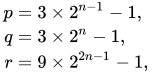
where n > 1 is an integer and p, q, r are prime numbers, then 2n × p × q and 2n × r are a pair of amicable numbers. This formula gives the pairs (220, 284) for n = 2, (17296, 18416) for n = 4, and (9363584, 9437056) for n = 7, but no other such pairs are known. Numbers of the form 3 × 2n − 1 are known as Thabit numbers. In order for Ibn Qurrah's formula to produce an amicable pair, two consecutive Thabit numbers must be prime; this severely restricts the possible values of n.
To establish the theorem, Thâbit ibn Qurra proved nine lemmas divided into two groups. The first three lemmas deal with the determination of the aliquot parts of a natural integer. The second group of lemmas deals more specifically with the formation of perfect, abundant and deficient numbers.[6]
Euler's rule
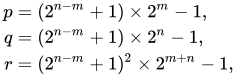
[edit]Euler's rule is a generalization of the Thâbit ibn Qurra theorem. It states that if where n > m > 0 are integers and p, q, r are prime numbers, then 2n × p × q and 2n × r are a pair of amicable numbers.
Note that thus


Thābit ibn Qurra's theorem corresponds to the case m = n − 1. Euler's rule creates additional amicable pairs for (m,n) = (1,8), (29,40) with no others being known. Euler (1747 & 1750) overall found 58 new pairs increasing the number of pairs that were then known to 61.[2][7]
Regular pairs
[edit]Let (m, n) be a pair of amicable numbers with m < n, and write m = gM and n = gN where g is the greatest common divisor of m and n. If M and N are both coprime to g and square free then the pair (m, n) is said to be regular (sequence A215491 in the OEIS); otherwise, it is called irregular or exotic. If (m, n) is regular and M and N have i and j prime factors respectively, then (m, n) is said to be of type (i, j).
For example, with (m, n) = (220, 284), the greatest common divisor is 4 and so M = 55 and N = 71. Therefore, (220, 284) is regular of type (2, 1).
Twin amicable pairs
[edit]An amicable pair (m, n) is twin if there are no integers between m and n belonging to any other amicable pair (sequence A273259 in the OEIS).
Other results
[edit]In every known case, the numbers of a pair are either both even or both odd. It is not known whether an even-odd pair of amicable numbers exists, but if it does, the even number must either be a square number or twice one, and the odd number must be a square number. However, amicable numbers where the two members have different smallest prime factors do exist: there are seven such pairs known.[8] Also, every known pair shares at least one common prime factor. It is not known whether a pair of coprime amicable numbers exists, though if any does, the product of the two must be greater than 1065.[9][10] Also, a pair of co-prime amicable numbers cannot be generated by Thabit's formula (above), nor by any similar formula.
In 1955 Paul Erdős showed that the density of amicable numbers, relative to the positive integers, was 0.[11]
In 1968 Martin Gardner noted that most even amicable pairs have sums divisible by 9,[12] and that a rule for characterizing the exceptions (sequence A291550 in the OEIS) was obtained.[13]
According to the sum of amicable pairs conjecture, as the number of the amicable numbers approaches infinity, the percentage of the sums of the amicable pairs divisible by ten approaches 100% (sequence A291422 in the OEIS).
Although all amicable pairs up to 10,000 are even pairs, the proportion of odd amicable pairs increases steadily towards higher numbers, and presumably there are more of them than of the even amicable pairs (sequence A360054 in OEIS).
There are amicable pairs where the sum of one number from the first pair and one number from the second pair equals the sum of the remaining two numbers, e.g. 67212 = 220 + 66992 = 284 + 66928 where (220, 284) and (66928, 66992) are two amicable pairs (sequence A359334 in OEIS).
Gaussian integer amicable pairs exist,[14][15] e.g. s(8008 + 3960i) = 4232 − 8280i and s(4232 − 8280i) = 8008 + 3960i.[16]
Generalizations
[edit]Amicable tuples
[edit]Amicable numbers satisfy and which can be written together as . This can be generalized to larger tuples, say , where we require


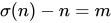



For example, (1980, 2016, 2556) is an amicable triple (sequence A125490 in the OEIS), and (3270960, 3361680, 3461040, 3834000) is an amicable quadruple (sequence A036471 in the OEIS).
Amicable multisets are defined analogously and generalizes this a bit further (sequence A259307 in the OEIS).
Sociable numbers
[edit]Sociable numbers are the numbers in cyclic lists of numbers (with a length greater than 2) where each number is the sum of the proper divisors of the preceding number. For example, are sociable numbers of order 4.

Searching for sociable numbers
[edit]The aliquot sequence can be represented as a directed graph, , for a given integer , where denotes the sum of the proper divisors of .[17] Cycles in represent sociable numbers within the interval . Two special cases are loops that represent perfect numbers and cycles of length two that represent amicable pairs.


![{\displaystyle [1,n]}](https://wikimedia.org/api/rest_v1/media/math/render/svg/7c79af450e22e8fd23f28e6be4cb23a47b24c1ba)
References in popular culture
[edit]- Amicable numbers are featured in the novel The Housekeeper and the Professor by Yōko Ogawa, and in the Japanese film based on it.
- Paul Auster's collection of short stories entitled True Tales of American Life contains a story ('Mathematical Aphrodisiac' by Alex Galt) in which amicable numbers play an important role.
- Amicable numbers are featured briefly in the novel The Stranger House by Reginald Hill.
- Amicable numbers are mentioned in the French novel The Parrot's Theorem by Denis Guedj.
- Amicable numbers are mentioned in the JRPG Persona 4 Golden.
- Amicable numbers are featured in the visual novel Rewrite.
- Amicable numbers (220, 284) are referenced in episode 13 of the 2017 Korean drama Andante.
- Amicable numbers are featured in the Greek movie The Other Me (2016 film).
- Amicable numbers are discussed in the book Are Numbers Real? by Brian Clegg.
- Amicable numbers are mentioned in the 2020 novel Apeirogon by Colum McCann.
- Amicable numbers are featured in the 2022 visual novel Heaven Burns Red by Key.
See also
[edit]- Betrothed numbers (quasi-amicable numbers)
- Amicable triple - Three-number variation of Amicable numbers.
Notes
[edit]- ^ Costello, Patrick (1 May 2002). "New Amicable Pairs Of Type (2; 2) And Type (3; 2)" (PDF). Mathematics of Computation. 72 (241): 489–497. doi:10.1090/S0025-5718-02-01414-X. Archived (PDF) from the original on 2008-02-29. Retrieved 19 April 2007.
- ^ a b Sandifer, C. Edward (2007). How Euler Did It. Mathematical Association of America. pp. 49–55. ISBN 978-0-88385-563-8.
- ^ Sprugnoli, Renzo (27 September 2005). "Introduzione alla matematica: La matematica della scuola media" (PDF) (in Italian). Universita degli Studi di Firenze: Dipartimento di Sistemi e Informatica. p. 59. Archived from the original (PDF) on 13 September 2012. Retrieved 21 August 2012.
- ^ Martin Gardner (2020) [Originally published in 1977]. Mathematical Magic Show. American Mathematical Society. p. 168. ISBN 9781470463588. Archived from the original on 2023-09-12. Retrieved 2023-03-18.
- ^ Chernykh, Sergei. "Amicable pairs list". Retrieved 2024-05-28.
- ^ a b Rashed, Roshdi (1994). The development of Arabic mathematics: between arithmetic and algebra. Vol. 156. Dordrecht, Boston, London: Kluwer Academic Publishers. p. 278,279. ISBN 978-0-7923-2565-9.
- ^ See William Dunham in a video: An Evening with Leonhard Euler – YouTube Archived 2016-05-16 at the Wayback Machine
- ^ "Amicable pairs news". Archived from the original on 2021-07-18. Retrieved 2016-01-31.
- ^ Hagis, Peter, Jr. (1969). "On relatively prime odd amicable numbers". Mathematics of Computation. 23 (107): 539–543. doi:10.2307/2004381. JSTOR 2004381. MR 0246816.
{{cite journal}}: CS1 maint: multiple names: authors list (link) - ^ Hagis, Peter, Jr. (1970). "Lower bounds for relatively prime amicable numbers of opposite parity". Mathematics of Computation. 24 (112): 963–968. doi:10.2307/2004629. JSTOR 2004629. MR 0276167.
{{cite journal}}: CS1 maint: multiple names: authors list (link) - ^ Erdős, Paul (2022). "On amicable numbers" (PDF). Publicationes Mathematicae Debrecen. 4 (1–2): 108–111. doi:10.5486/PMD.1955.4.1-2.16. S2CID 253787916. Archived (PDF) from the original on 2022-10-09.
- ^ Gardner, Martin (1968). "Mathematical Games". Scientific American. 218 (3): 121–127. Bibcode:1968SciAm.218c.121G. doi:10.1038/scientificamerican0368-121. ISSN 0036-8733. JSTOR 24926005. Archived from the original on 2022-09-25. Retrieved 2020-09-07.
- ^ Lee, Elvin (1969). "On Divisibility by Nine of the Sums of Even Amicable Pairs". Mathematics of Computation. 23 (107): 545–548. doi:10.2307/2004382. ISSN 0025-5718. JSTOR 2004382.
- ^ Patrick Costello, Ranthony A. C. Edmonds. "Gaussian Amicable Pairs." Missouri Journal of Mathematical Sciences, 30(2) 107-116 November 2018.
- ^ Clark, Ranthony (January 1, 2013). "Gaussian Amicable Pairs". Online Theses and Dissertations.
- ^ Weisstein, Eric W. "Amicable Pair". mathworld.wolfram.com.
- ^ Rocha, Rodrigo Caetano; Thatte, Bhalchandra (2015), Distributed cycle detection in large-scale sparse graphs, Simpósio Brasileiro de Pesquisa Operacional (SBPO), doi:10.13140/RG.2.1.1233.8640
References
[edit]
- This article incorporates text from a publication now in the public domain: Chisholm, Hugh, ed. (1911). "Amicable Numbers". Encyclopædia Britannica (11th ed.). Cambridge University Press.
- Sándor, Jozsef; Crstici, Borislav (2004). Handbook of number theory II. Dordrecht: Kluwer Academic. pp. 32–36. ISBN 978-1-4020-2546-4. Zbl 1079.11001.
- Wells, D. (1987). The Penguin Dictionary of Curious and Interesting Numbers. London: Penguin Group. pp. 145–147.
- Weisstein, Eric W. "Amicable Pair". MathWorld.
- Weisstein, Eric W. "Thâbit ibn Kurrah Rule". MathWorld.
- Weisstein, Eric W. "Euler's Rule". MathWorld.

External links
[edit]- M. García; J.M. Pedersen; H.J.J. te Riele (2003-07-31). "Amicable pairs, a survey" (PDF). Report MAS-R0307.
- Grime, James. "220 and 284 (Amicable Numbers)". Numberphile. Brady Haran. Archived from the original on 2017-07-16. Retrieved 2013-04-02.
- Grime, James. "MegaFavNumbers - The Even Amicable Numbers Conjecture". YouTube. Archived from the original on 2021-11-23. Retrieved 2020-06-09.
- Koutsoukou-Argyraki, Angeliki (4 August 2020). "Amicable Numbers (Formal proof development in Isabelle/HOL, Archive of Formal Proofs)".
- Chernykh, Sergei. "Amicable pairs list". Retrieved 2023-09-10. (database of all known amicable numbers)
Divisibility-based sets of integers | ||
|---|---|---|
| Overview |  | |
| Factorization forms | ||
| Constrained divisor sums | ||
| With many divisors | ||
| Aliquot sequence-related | ||
| Base-dependent | ||
| Other sets | ||
Classes of natural numbers | |||||||||||||||||||||||||
|---|---|---|---|---|---|---|---|---|---|---|---|---|---|---|---|---|---|---|---|---|---|---|---|---|---|
| |||||||||||||||||||||||||
| |||||||||||||||||||||||||
| |||||||||||||||||||||||||
| |||||||||||||||||||||||||
| |||||||||||||||||||||||||
| |||||||||||||||||||||||||
| |||||||||||||||||||||||||
| |||||||||||||||||||||||||
| |||||||||||||||||||||||||
| |||||||||||||||||||||||||

Amicable numbers
View on GrokipediaDefinition and Properties
Definition
Amicable numbers are two distinct positive integers and , with , such that the sum of the proper divisors of equals and the sum of the proper divisors of equals .[5] Proper divisors of a number are all its positive divisors excluding the number itself.[5] In standard mathematical notation, the sum-of-divisors function gives the sum of all positive divisors of , so the proper divisor sum is ; thus, and form an amicable pair if , , and .[5] The smallest known amicable pair is (220, 284).[6] The proper divisors of 220 are 1, 2, 4, 5, 10, 11, 20, 22, 44, 55, and 110, which sum to 284.[7] The proper divisors of 284 are 1, 2, 4, 71, and 142, which sum to 220.[7] Unlike perfect numbers, where , amicable numbers involve a mutual exchange between two distinct numbers, with each being either abundant () or deficient () relative to itself but balancing the pair.[5] In antiquity, such pairs were believed to possess mystical properties and were associated with Pythagorean traditions.[8]Fundamental Properties
Amicable pairs with satisfy , where denotes the sum of all positive divisors of .[9] This equality follows directly from the definition using the proper divisor sum function , since implies and implies . Adding these relations yields . To see this, start with and , so and . Adding the equations gives , which rearranges to .[9] Neither member of an amicable pair can be prime. If is prime, then , but , so no prime can pair with another number to form an amicable pair.[6] In an amicable pair with , is abundant since , while is deficient since . For the smallest pair , confirms 220's abundance, and confirms 284's deficiency.[1] Amicable pairs exhibit consistent parity: all known pairs have both members even or both odd, with the first odd pair discovered by Leonhard Euler in the 18th century. No mixed-parity pairs are known, and it remains open whether they exist.[1][10]Historical Development
Ancient and Early Discoveries
The concept of amicable numbers, pairs of distinct positive integers where each equals the sum of the proper divisors of the other, traces its origins to the Pythagorean school around 500 BCE. The Pythagoreans, who viewed numbers as embodying mystical and cosmic principles, are credited with early recognition of such pairs for their symbolic representation of harmony and reciprocity, though no specific examples survive from their writings.[11] This attribution stems from later accounts, highlighting the Pythagoreans' broader fascination with numerical relationships as manifestations of divine order.[12] The earliest documented pair, 220 and 284, was recorded by the Neoplatonist philosopher Iamblichus (c. 245–325 CE) in his commentary on Nicomachus of Gerasa's Introduction to Arithmetic. Iamblichus, drawing on Pythagorean traditions, described these numbers as "friendly" due to their mutual affection: the proper divisors of 220 (1, 2, 4, 5, 10, 11, 20, 22, 44, 55, and 110) sum to 284, while those of 284 (1, 2, 4, 71, and 142) sum to 220.[13] This presentation framed amicable numbers within a philosophical context of numerical friendship, preserving and elaborating on earlier oral or lost Pythagorean lore.[14] In the broader ancient Greek intellectual landscape, amicable numbers aligned with numerological explorations of harmony, as seen in Theon of Smyrna's Mathematics Useful for Reading Plato (c. 100 CE), which delved into Pythagorean classifications of numbers and their proportional relationships to illustrate cosmic balance.[15] No verified amicable pairs predate Iamblichus' account.Medieval and Early Modern Contributions
During the Islamic Golden Age, the mathematician Thābit ibn Qurra (c. 836–901 CE) made significant advancements in the study of amicable numbers by developing a systematic rule for generating such pairs, building on earlier Greek interest. He is credited with discovering the amicable pair (17,296, 18,416), which was the first new pair identified since antiquity, demonstrating a deeper understanding of divisor sums and their properties.[7][16] This contribution, preserved in Arabic mathematical texts, highlighted the potential for constructing amicable numbers through specific prime factorizations, though the full details of his method were rediscovered centuries later. In the early modern period, European mathematicians independently revived and extended this work amid renewed interest in number theory. Pierre de Fermat (1607–1665) rediscovered Thābit's rule around 1636 and applied it to find the same pair (17,296, 18,416), communicating his results through correspondence facilitated by Marin Mersenne, which spurred further exploration. Similarly, René Descartes (1596–1650) in 1638 used an analogous approach to identify the much larger pair (9,363,584, 9,437,056), showcasing the rule's capacity to produce increasingly complex examples without prior knowledge of Thābit's original formulation.[16][17] These discoveries, exchanged among scholars like Mersenne, marked a transition from isolated findings to collaborative inquiry in Europe. Leonhard Euler (1707–1783) brought a more rigorous and comprehensive approach in the 18th century, systematizing the study of amicable numbers through the divisor sum function (σ(n)). In works such as E100 (1747) and E152 (1750), he cataloged 59 new pairs, including examples like (2,620, 2,924), by systematically computing σ values and identifying reciprocal relationships. Euler also generalized Thābit's rule, expanding its scope and establishing foundational techniques that influenced subsequent generations, though he built directly on the pairs from Fermat and Descartes.[16][17]Methods of Generation
Thābit ibn Qurrah's Theorem
Thābit ibn Qurrah formulated a criterion in the 9th century for generating certain amicable pairs using a specific construction involving powers of 2 and presumed primes.[18] The theorem states that for an integer , if the numbers , , and are all prime, then and form an amicable pair, meaning the sum of the proper divisors of equals and vice versa.[18][19] This construction yields known amicable pairs only for . For , , , (all prime), giving the pair . For , , , (all prime), producing . For , , , (all prime), resulting in the pair .[18][19] No other values of up to very large limits satisfy the primality conditions for , , and simultaneously, though extensive computational searches have confirmed the absence of additional pairs from this rule for very large .[18] The proof relies on the multiplicativity of the divisor sum function , which for coprime factors multiplies accordingly. Consider , where and are distinct odd primes. Then, Substituting the forms, and , yields For with prime, Since , it follows that . To confirm amicability, verify , which holds because and algebraic expansion using the definitions of , , and equates this to . Thus, the sum of proper divisors of each is the other number.[18][19] The theorem's limitations stem from the rarity of simultaneous primality for , , and as increases; for example, at , is composite, and at , is composite. This scarcity means the rule generates only three known pairs, inspiring later generalizations like Euler's but producing few instances itself.[18]Euler's Rule and Extensions
Leonhard Euler significantly advanced the constructive generation of amicable pairs in the 18th century by generalizing earlier methods and systematically applying properties of the divisor sum function . His approach focused on pairs of the form and , where , , and are distinct odd primes, and . For such numbers to be amicable, the primes must satisfy and , which simplifies using the multiplicativity of : specifically, for odd . This leads to the conditions (all prime) and .[20][17] Euler further parameterized this rule using integers , defining: If , , and are all prime, then and form an amicable pair. This formulation encompasses previous results as a special case when , recovering Thābit ibn Qurrah's theorem, but allows broader exploration by varying and . A representative example occurs for , : , , (all prime), yielding the pair . Using this and related techniques, Euler discovered 59 new amicable pairs, expanding the known list from three to over 60 by 1750.[21][20] Extensions of Euler's rule accommodate greater structural variety in the odd parts of the numbers, such as products of more than two primes or higher powers of primes, by solving analogous equations from and for odd and possibly unequal exponents . Euler himself outlined paths to such generalizations, noting that amicable pairs could arise from forms like and (with a common factor and additional primality conditions on or similar), or by incorporating prime powers beyond the first degree in the factorization. These refinements enabled the discovery of dozens more pairs in the 18th and 19th centuries, including cases with squared factors like the pair , found in 1866 despite fitting an extended framework akin to Euler's methods. Modern variants continue this by systematically testing higher powers and additional prime factors computationally, producing many known pairs while emphasizing the rule's role in establishing inverse relations between the odd parts' divisor sums.[22][17][21]Specific Classes of Pairs
Smallest Known Pairs
The smallest known amicable pair, ordered by the smaller number, consists of 220 and 284. The proper divisors of 220 are 1, 2, 4, 5, 10, 11, 20, 22, 44, 55, and 110, which sum to 284. The proper divisors of 284 are 1, 2, 4, 71, and 142, which sum to 220.[1] The next smallest pair is 1184 and 1210. The proper divisors of 1184 are 1, 2, 4, 8, 16, 32, 37, 74, 148, 296, and 592, summing to 1210. The proper divisors of 1210 are 1, 2, 5, 10, 11, 22, 55, 110, 121, 242, and 605, summing to 1184.[23][24][25] The third smallest pair is 2620 and 2924. The sum of the proper divisors of 2620 is 2924, and the sum of the proper divisors of 2924 is 2620.[23][26][27] The fourth and fifth smallest pairs are 5020 and 5564, and 6232 and 6368, respectively, each satisfying the amicable condition where the proper divisor sum of the first equals the second and vice versa.[23] Among the earliest known amicable pairs, the pattern is mixed: the first six pairs consist of two even numbers each, the seventh pair consists of two odd numbers, and the eighth pair consists of two even numbers.[23] For completeness, the first ten smallest amicable pairs, ordered by the smaller member, are listed below:| Index | Smaller Number | Larger Number |
|---|---|---|
| 1 | 220 | 284 |
| 2 | 1184 | 1210 |
| 3 | 2620 | 2924 |
| 4 | 5020 | 5564 |
| 5 | 6232 | 6368 |
| 6 | 10744 | 10856 |
| 7 | 12285 | 14595 |
| 8 | 17296 | 18416 |
| 9 | 63020 | 76084 |
| 10 | 66928 | 66992 |
Regular and Twin Amicable Pairs
Regular amicable pairs form a subclass of amicable pairs characterized by a specific structural form that facilitates their generation through algebraic rules. An amicable pair with is regular if, letting , both and are square-free positive integers coprime to . This condition ensures that the odd parts of and (after factoring out the common power of 2 in ) have no squared prime factors and share no primes with , often resulting in pairs composed of a power of 2 multiplied by a small number of distinct odd primes.[28] Such pairs are typically easier to construct using methods like Thābit ibn Qurrah's theorem or its extensions, as the square-free requirement aligns with the multiplicative properties exploited in these rules.[29] The smallest regular amicable pair is , where , (square-free and coprime to 4), and (prime, hence square-free and coprime to 4); this pair corresponds to type (2,1), indicating two odd primes in the smaller member's odd part and one in the larger.[28] Another early example is , attributed to Thābit ibn Qurrah, with , , and (prime); also type (2,1).[28] Regular pairs often exhibit one abundant member (the smaller) and one deficient member (the larger), mirroring general amicable properties but with constrained prime factorizations that limit their abundance.[29] Further examples of regular amicable pairs include those discovered by later mathematicians using similar constructive methods. For instance, is a type (2,1) pair identified by Descartes (though initially containing a composite factor mistaken for prime), with , the odd part of the smaller being (both Fermat primes), and the larger's odd part a single prime.[28] Other known regular pairs, such as those from Euler's parametrizations, yield more examples; extensions of these rules generate pairs of higher types, including type (4,3). The largest known regular pair has 5577 digits and was found by García in 1997 via Wiethaus's rule.[28][29] These examples highlight how regular pairs prioritize minimal prime sets, often involving Fermat primes or Mersenne-like forms, making them prominent in historical developments despite comprising only a subset of all known pairs.| Pair | Type | Discoverer/Notes | Source |
|---|---|---|---|
| (220, 284) | (2,1) | Ancient/Pythagoreans | [28] |
| (17296, 18416) | (2,1) | Thābit ibn Qurrah (c. 9th century) | [28] |
| (9363584, 9437056) | (2,1) | Descartes (17th century) | [28] |
| Examples from Euler extensions | (4,3) | Euler extensions | [29] |
| Large pair (5577 digits) | Varies | García (1997), via Wiethaus rule | [28] |
| Pair | Difference | Notes | Source |
|---|---|---|---|
| (220, 284) | 64 | Smallest overall, also regular | [30] |
| (1184, 1210) | 26 | Second pair | [30] |
| (2620, 2924) | 304 | Third pair | [30] |
| (5020, 5564) | 544 | Fourth pair | [30] |
| (6232, 6368) | 136 | Fifth pair | [30] |
| (10744, 10856) | 112 | Sixth pair | [30] |
| (12285, 14595) | 2310 | Seventh pair, smallest odd | [30] |
| (64112960650, 64128831350) | 15870700 | Largest among first 3,000 pairs | [30] |