Hubbry Logo
RocinhaRocinhaMain
Open search
Rocinha
Community hub
Rocinha
logo
8 pages, 0 posts
0 subscribers
Be the first to start a discussion here.
Rocinha
Rocinha
from Wikipedia

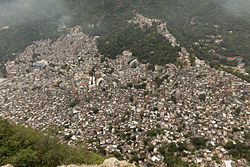
Rocinha (Portuguese pronunciation: [ʁɔˈsĩɲɐ], lit.'little farm') is a favela, located in Rio de Janeiro's South Zone between the districts of São Conrado and Gávea. Rocinha is built on a steep hillside overlooking Rio de Janeiro, and is located about one kilometre from a nearby beach. Most of the favela is on a very steep hill, with many trees surrounding it. Around 72,000 people live in Rocinha, making it the most populous favela in Rio de Janeiro.[2]

Key Information

Although Rocinha is officially categorized as a neighbourhood, many still refer to it as a favela. It developed from a shanty town into an urbanized slum. Today, almost all the houses in Rocinha are made from concrete and brick. Some buildings are three and four storeys tall and almost all houses have basic plumbing and electricity. Compared to simple shanty towns or slums, Rocinha has a better developed infrastructure and hundreds of businesses such as banks, medicine stores, bus routes, cable television, including locally based channel TV ROC TV Rocinha, and, at one time, a McDonald's franchise.[3] These factors help classify Rocinha as a favela bairro, or favela neighborhood.

History

[edit]

In the mid-20th century, Rio de Janeiro's industrial growth attracted many migrants from Brazil's drought-stricken northeast, leading to the formation of informal settlements like Rocinha. Due to a lack of affordable housing, residents built homes themselves, often without proper infrastructure. Rocinha grew rapidly and was recognized as a favela by the 1960s. From the 1970s to 1990s, Rocinha expanded vertically in a crowded and unplanned manner. The government largely neglected the area, leading to the rise of drug cartels and gangs that took control of parts of the community. But with the strong sense of community, the local people established community groups that locally improved town infrastructure and educational facilities and healthcare services.[4]

Community

[edit]
View of Rocinha as viewed from within
View of Rocinha during night

There are a number of community organizations at work in Rocinha, including neighbourhood associations and numerous NGOs and non-profit educational and cultural institutions.[5][6] Rocinha is home to most of the service workers in Zona Sul (the South Zone of Rio).[citation needed]

In recent years, due to its relative safety in comparison to other favelas, Rocinha has developed tourism-oriented activities such as hostels, nightclubs and guided tours. In September 2017, between 150 and 601 tourists were estimated to visit the slum per day, despite foreign governments' and the Rio police's safety warnings recommending against it. In October 2017, a Spanish tourist died after being shot by the police while visiting Rocinha during a turf war.[7]

During the years of 2014 to 2017, Rocinha was controlled by Amigos dos Amigos,[8] and is often caught in violent disputes among (and within) different criminal organizations.[9][7]

Police and military operations

[edit]

In November 2011, a security operation was undertaken where hundreds of police and military patrolled the streets of Rocinha to crack down on rampant drug dealers and bring government control to the neighbourhood.[10]

In December 2017, drug kingpin Rogério da Silva, known as Rogério 157, was arrested in Rocinha, in an operation involving 3,000 members of the Brazilian military and police forces. Rogério was wanted on charges of homicide, extortion, and drug trafficking.[11][12]

Rocinha is one of the most developed favelas.[13] Rocinha's population was estimated at between 150,000 and 300,000 inhabitants during the 2000s;[14] but the IBGE Census of 2010 counted only 69,161 people.[15] In 2017, The Economist reported a population of 100,000 in an area of 1 km2 (250 acres).[8]

In literature, film and music

[edit]

Robert Neuwirth discusses Rocinha in his book entitled Shadow Cities.[16] Rio de Janeiro was made the setting for the animation film Rio, where many scenes take place in Rocinha.

Also, Rocinha is the setting of the book Nemesis: One Man and the Battle for Rio by Misha Glenny in which he describes the rise and fall of Antônio Francisco Bonfim Lopes.

In 1998, Philip Glass wrote an orchestral piece titled "Days and Nights in Rocinha". It was meant as a reference to Ravel's Boléro, written for Dennis Russell Davies, to thank him for putting Glass' works on stage. He was inspired by dance music that he heard during the carnival, resulting in a samba-like rhythmical structure with a lot of time signature changes and varieties, such as 14/8, 15/8 and 9/8+4/4.

The 2008 film The Incredible Hulk featured aerial footage of Rocinha, showing the large number of intermodal containers repurposed as housing, and included an extensive chase scene filmed in the favela on the ground and across rooftops.[17][better source needed] It was also featured in the 2011 film Fast Five.

[edit]
Aerial view of Rocinha

Many celebrities have visited Rocinha, including Mikhail Gorbachev (during the Earth Summit of 1992) and actor Christopher Lambert. Some episodes of the Brazilian television series Cidade dos Homens (City of Men) were filmed there.

Video games

[edit]

See also

[edit]

References

[edit]
[edit]
Revisions and contributorsEdit on WikipediaRead on Wikipedia
from Grokipedia
Rocinha is a in the South Zone of Rio de Janeiro, , officially recognized as the most populous in the country with 72,154 residents according to the . Spanning approximately 1.49 square kilometers on a steep hillside between the districts of São Conrado and Gávea, near the Pedra dos Dois Irmãos rock formation, it features densely packed, self-constructed housing with limited formal infrastructure. The settlement emerged in the early from initial huts built by immigrants and rural migrants on former plantation land, expanding rapidly due to from 's Northeast region amid pressures. Rocinha's economy relies heavily on informal labor, small-scale commerce, and , though drug trafficking dominates, with control historically contested between factions such as and , leading to periodic outbreaks of armed violence that disrupt daily life and claim numerous lives. Efforts like the 2011 police pacification unit (UPP) aimed to reclaim territory from traffickers and improve services, but territorial disputes resumed after 2017, underscoring the challenges of state intervention in gang-dominated areas. Despite these issues, the community sustains resident associations, , and health initiatives, reflecting adaptive in the absence of consistent public provision. The favela's proximity to wealthy enclaves highlights stark socioeconomic disparities, with residents facing elevated risks from landslides, inadequate , and , while official human development metrics rank it low among Rio's neighborhoods. These conditions stem from historical neglect, rapid without , and the economic incentives of illicit markets in under-policed urban margins.

Geography and Location

Physical Characteristics

Rocinha occupies a steep hillside in Rio de Janeiro's South Zone, wedged between the affluent districts of São Conrado to the east and Gávea to the west, with views extending over these areas and the Atlantic Ocean beyond. This elevated position on the slopes of the Tijuca Massif's foothills places it on geologically unstable terrain prone to erosion and slippage. The rugged , featuring inclines often exceeding 30 degrees, complicates formal engineering and contributes to recurrent hazards, exacerbated by heavy seasonal rains that saturate the and trigger debris flows. Informal settlement patterns have resulted in multistory brick-and-concrete edifices stacked vertically along narrow alleys, or becos, adapting to the limited flat land while amplifying to structural instability and seismic-like shifts during storms. These physical attributes inherently limit expansive horizontal development, fostering a compact that strains rudimentary like drainage and access paths, as steep gradients hinder mechanized and . Proximity to upscale enclaves below accentuates topographic contrasts, with Rocinha's elevations reaching up to 200 meters above , isolating it from level coastal plains while exposing it to microclimatic variations in and .

Boundaries and Urban Integration

Rocinha occupies a steep hillside in Rio de Janeiro's South Zone, delimited by the affluent neighborhoods of Gávea to the north and São Conrado to the south. The favela's southern boundary is marked by the Lagoa-Barra Expressway, a major infrastructure corridor that physically separates it from São Conrado's upscale residential areas. Natural , including rugged hills and valleys, further defines its irregular perimeter, with informal footpaths serving as primary access points to adjacent zones rather than formalized roads. Despite its adjacency to wealthy districts—positioned between the beaches of and São Conrado, and near the Gávea Tunnel linking to central Rio—Rocinha experiences persistent spatial isolation. This proximity underscores socioeconomic contrasts, as the encroaches on lands coveted for formal development, leading to disputes over lines and buffer zones with upscale neighbors. Residents perceive stark boundaries enforced by both and , limiting seamless integration despite shared municipal jurisdiction. Efforts at urban upgrading, such as those under Rio's Favela-Bairro program initiated in the , have aimed to extend basic like and paving into Rocinha to foster ties with the formal city grid. However, comprehensive planning remains fragmented, perpetuating functional disconnection; for instance, while close to institutions like PUC-Rio university in Gávea, reliable transport links and public services do not fully bridge the divide. These gaps highlight how geographic constraints and ad-hoc growth hinder Rocinha's incorporation into broader urban frameworks, maintaining it as a semi-autonomous enclave amid Rio's stratified landscape.

History

Origins as Informal Settlement

Rocinha emerged in the late as clusters of rudimentary shanties erected by rural migrants on steep, underutilized hillsides between the neighborhoods of Gávea and São Conrado in Rio de Janeiro. These early inhabitants, largely drawn from Brazil's impoverished northeast regions, sought work in the expanding urban economy of the , where industrial growth and boomed during the and early . Facing acute shortages exacerbated by high formal market prices and bureaucratic restrictions on access, migrants resorted to self-building on peripheral, often state-owned or abandoned plots previously used for small-scale farming, or roças. The settlement's name, Rocinha—a of roça—reflects this agrarian origin, with initial parcelling of such plots documented around 1930. The first homes consisted of basic wooden or scrap-material structures, devoid of piped water, sewage systems, or , as residents lacked resources and legal recognition to connect to urban infrastructure. This informal occupation stemmed from systemic exclusion: low wages in informal labor sectors prevented participation in regulated markets dominated by elite interests and laws that reserved prime areas for formal development. Without initial state or regulation, the organic aggregation of shacks allowed rapid, albeit precarious, community formation, prioritizing survival over compliance with building codes. By the late , Rocinha had transitioned from isolated farmstead encroachments to a recognizable informal enclave, with noticeable population clusters signaling its entrenchment amid unchecked rural-urban migration flows. Authorities' early approach—focusing resources on central city beautification under leaders like Mayor Pedro Ernesto—permitted this growth but sowed enduring vulnerabilities, as the absence of public investment left foundational service gaps unaddressed for decades.

Expansion Amid Rapid Urbanization

During the 1950s and 1960s, Rocinha experienced its most rapid expansion as part of Rio de Janeiro's broader growth, driven by from Brazil's drought-affected northeast, where and agricultural decline pushed hundreds of thousands toward urban centers seeking industrial employment. This influx was amplified by chain-like migration patterns, where initial settlers attracted family and community networks, swelling Rocinha's population amid the destruction and relocation from nearby favelas cleared under efforts. Citywide, Rio's favela residents surged from approximately 170,000 in 1950—about 7% of the city's population—to over 600,000 by 1980, reflecting a 12.3% share of inhabitants despite aggressive removal policies that displaced around 140,000 people in the 1960s and 1970s but failed to stem overall informal settlement proliferation. From the through the , Rocinha's development proceeded informally on steep hillsides without effective enforcement or municipal oversight, as migrants constructed rudimentary dwellings using available materials like and , leading to dense, haphazard sprawl that strained the local environment through and risks. Government initiatives, such as favela eradication drives under authoritarian regimes, prioritized central area clearances for infrastructure like highways but overlooked root causes like shortages, resulting in peripheral expansions like Rocinha absorbing displaced populations without integrated . The economic magnetism of Rio's port activities, service sectors, and early industrialization under policies like those of in the 1940s onward drew low-skilled laborers, yet state housing programs proved woefully inadequate, providing minimal alternatives to self-built settlements and thereby fueling unchecked densification. By the late , despite sporadic upgrades in utilities, the absence of scalable exacerbated overcrowding in areas like Rocinha, where terrain limitations compounded infrastructural vulnerabilities without addressing migrant absorption at scale.

Rise of Organized Crime in the Late 20th Century

In the 1980s, the escalation of Brazil's role as a cocaine transit hub—facilitated by its proximity to Andean producers and demand in and North America—propelled local gangs in favelas like Rocinha from petty crime to structured drug trafficking enterprises. These groups aligned with emerging prison-born factions such as (CV), originally formed in the 1970s at Rio's penitentiary for inmate self-protection but expanding into territorial control amid the cocaine surge. Profits from sales, often in partnership with Colombian cartels, funded armament and recruitment, enabling dominance over drug points (bocas de fumo) and basic in state-neglected areas. Drug factions in Rocinha filled voids left by absent or corrupt state institutions, imposing pacto de não-agressão (non-aggression pacts) that regulated internal disputes, provided against external threats, and even mediated community conflicts—services supplanting unreliable police presence. However, this parallel authority relied on coercive , including executions for rule violations like from traffickers or informing, fostering a monopoly on that prioritized trade protection over resident welfare. By the , Rocinha had become Rio's largest cocaine distribution hub, with factions enforcing territorial exclusivity through armed patrols and checkpoints. Empirical trends underscore the causal link between drug profits and violence escalation, rather than chronic poverty alone: Rio's overall homicide rate climbed from approximately 40 per 100,000 inhabitants in the early to over 80 by the mid-1990s, coinciding precisely with market expansion and factional armament, while favelas without major trade routes saw comparatively stable levels. Institutional weaknesses, including underfunded policing and prohibition-driven black-market incentives, amplified these dynamics, allowing factions to extract rents via while deterring state incursion through retaliatory firepower. Internal CV fractures by the late 1990s birthed rivals like (ADA), formed by expelled members and poised to challenge Rocinha's control, signaling the maturation of factional competition.

Demographics

Population Size and Density

Rocinha recorded a population of 72,021 residents in the 2022 conducted by the Brazilian Institute of Geography and Statistics (IBGE), positioning it as Brazil's most populous according to official data. This figure reflects an undercount likely stemming from the settlement's irregular status, where informal dwellings, undocumented migrants, and transient occupants complicate enumeration efforts; prior IBGE counts, such as 69,161 in , similarly diverged from contemporaneous estimates ranging from 150,000 to 300,000. Independent assessments continue to cite 100,000 to 200,000 inhabitants, attributing discrepancies to unregistered growth and census evasion in high-crime areas. Spanning roughly 1.49 square kilometers, Rocinha's official density stands at approximately 48,400 persons per square kilometer, though elevated population projections suggest figures over 70,000 per square kilometer in core zones. This compression rivals densities in global slums like in or in , intensifying strains on , , and pathways amid steep terrain. Demographically, the community features a pronounced youth bulge, with favela-wide median ages around 30 years—younger than Brazil's national 35—fueled by rural-to-urban migration of families with children and high fertility rates, where over 70% of women bear their first child before age 20, elevating dependency ratios and reliance on kinship-based support systems.

Socioeconomic Composition and Migration Patterns

Rocinha's residents predominantly consist of low-income families, with a significant portion originating from Brazil's Northeast region via , which continues to supply low-skilled labor to the favela's economy. This pattern stems from economic disparities in the Northeast, where and limited opportunities drive ongoing rural-to-urban flows, even as diversification introduces some international migrants. Multigenerational residency is typical, as initial migrant families establish roots, passing down informal survival strategies amid persistent structural barriers. Educational attainment remains markedly low, averaging 5.1 years of formal schooling—below the city's 8-year mean—resulting in secondary completion rates under 50%, which constrains access to skilled and perpetuates reliance on informal work. Informal sector participation dominates, reflecting the mismatch between residents' qualifications and formal job demands, with migrants from low-education backgrounds reinforcing this cycle. Demographically, the population skews toward working-age adults, with roughly 71% between 15 and 59 years old and a balanced gender ratio (49% male, 51% female), heightening vulnerability among young males to non-formal economic alternatives due to scarce legitimate opportunities tied to skill deficits. This composition links migration inflows to sustained low-skill pools, limiting upward mobility despite some class shifts observed in broader favela trends.

Territorial Control and Governance

Dominance of Drug Trafficking Factions

The (ADA), formed in the late 1990s by dissident members of the prison gang, established dominance in Rocinha through armed displacement of rival factions, securing the as its primary stronghold by the early . This control relied on systematic enforcement via paramilitary-style operations, where ADA traffickers patrolled access points and neutralized threats to maintain exclusive territorial authority. The faction's grip, peaking in the first decade of the , framed Rocinha as a benchmark for ADA's operational success across Rio's favelas. ADA's internal structure follows a rigid typical of Rio's quadrilhas, with the "dono" (boss or owner) at the apex directing strategy, below whom operate gerentes (managers) overseeing sales at bocas de fumo (sales points), supported by gerentes de gerentes, soldados (armed enforcers), and olheiros (lookouts). The dono, exemplified by figures like Antônio Francisco Bonfim Lopes (), dictated operational rules, including profit distribution and conflict resolution, ensuring loyalty through a mix of incentives and coercion. This chain of command centralized decision-making, enabling rapid mobilization against incursions while insulating upper levels from direct exposure. Revenue streams centered on trafficking, with Rocinha serving as a consolidation and transit hub for shipments to the and , leveraging Brazil's role as a corridor for Andean-sourced product. Prohibition-driven price markups— fetching premiums in destination markets—provided the economic incentive for armed monopolization, funding acquisitions of assault rifles, grenades, and anti-aircraft weapons that paralleled police armaments in firepower. Supplementary income from taxing local vendors (e.g., fixed monthly fees on ) and extorting residents for "" further bolstered coffers, often expanding to untapped sectors during fluctuations. This model causally stifled legitimate enterprise, as ADA prohibitions on unlicensed vending or external suppliers—enforced to safeguard transit exclusivity—channeled economic activity into the faction's system, reducing incentives for formal and perpetuating reliance on illicit .

Emergence and Role of Militias

Milícias, hybrid criminal groups comprising off-duty and retired police officers, firefighters, and prison guards, began forming in Rio de Janeiro's West Zone during the mid-1980s as vigilante responses to escalating trafficking in peripheral favelas and bairros. These entities initially positioned themselves as self-defense units against armed factions like the , but by the early 1990s, they shifted toward systematic , demanding payments from residents for "security" that ostensibly protected communities from trafficker incursions while simultaneously infiltrating informal markets. The 2000s marked rapid militia expansion, fueled by alliances with local politicians and selective state tolerance, as groups like the Liga da Justiça consolidated control over swathes of territory beyond traditional favelas, including unregulated urban fringes. In exchange for nominal protection fees—often R$20–50 monthly per household—milícias assumed monopolies on , reselling pirated utilities such as (via clandestine wiring from legal grids) and at markups of 200–300%, alongside regulating informal vans and cable TV distribution. This rent-extraction model, rooted in the state's chronic under-provision of , generated annual revenues estimated in the hundreds of millions for dominant groups, but it reinforced dependency rather than fostering autonomy, with non-compliance met by arbitrary evictions or summary executions. Far from serving as stabilizing alternatives to traffickers, milícias exacerbated predation on vulnerable populations amid institutional voids, frequently igniting through turf disputes or internal purges; for example, the 2008 murder of journalists investigating militia rackets in exposed their coercive underbelly, prompting a parliamentary inquiry that documented over 100 schemes. Empirical analyses reveal militia-governed areas sustain rates akin to or intermittently surpassing those under single drug factions, with no statistically significant violence reduction—neighborhoods under exclusive militia rule averaging 15–27% elevated lethality when rivalries emerge, comparable to trafficker domains lacking competition. In Rocinha specifically, militia influence remained marginal due to the favela's entrenched dominance and geographic centrality, precluding the territorial footholds achieved elsewhere, yet the phenomenon underscores how state incapacity breeds layered criminal overlays rather than orderly substitutes.

State Withdrawal and Vacuum of Authority

Following Brazil's redemocratization and the 1988 Constitution's decentralization of fiscal responsibilities to states and municipalities, Rio de Janeiro's favelas, including Rocinha, received disproportionately low public investments in infrastructure and services, exacerbating resource misallocation and chronic underfunding. This shift prioritized formal urban areas, leaving informal settlements like Rocinha with minimal state oversight, as local governments lacked both capacity and incentives to extend governance effectively. Institutional corruption compounded this, with police officers frequently engaging in extortion, arms trafficking to gangs, and direct alliances with drug factions, thereby entrenching criminal control rather than challenging it. The absence of formalized property rights in Rocinha perpetuated a system where relied on informal possession or criminal enforcement, discouraging legal investment and enabling armed groups to impose rule through coercion. Efforts like the "Rocinha Mais Legal" program, initiated in 2004, aimed to regularize holdings but progressed slowly, leaving thousands without titles until partial advancements in 2012 benefited around 13,000 families across Rocinha and adjacent Vidigal. Without state-backed , residents deferred to factions for and protection, as the strongest armed entity effectively governed territory unchecked by formal authority. Pre-UPP data underscores the state's negligible footprint: Rocinha, despite housing over 100,000 residents by the early 2000s, had virtually no permanent police presence, with officers conducting sporadic, often corrupt incursions rather than sustained patrols. Public services were similarly sparse, including fewer than a handful of state-operated schools serving a dense , forcing reliance on faction-provided alternatives like informal and basic . This vacuum fostered dependency on criminal , where drug traffickers filled roles in order maintenance and resource distribution that the state neglected, creating parallel power structures sustained by and institutional inertia.

Crime and Violence

Scale and Nature of Criminal Activities

Rocinha serves as a primary distribution hub for in Rio de Janeiro's South Zone, facilitating the flow of drugs from production areas in neighboring countries to local markets and export routes via the city's ports. Since the , the has been a key for , with factions like (ADA) leveraging its strategic location near affluent neighborhoods to supply a significant portion of the urban market. Under ADA leader Antônio Francisco Bonfim Lopes ("Nem"), operations reportedly accounted for over 60% of the consumed in Rio de Janeiro, supported by an armed force of approximately 120 enforcers. The drug trade is intertwined with ancillary criminal activities that generate additional revenue streams. Factions impose rackets, often termed "security taxes," on local businesses, utilities, and construction projects within the , compensating for fluctuations in drug profits. supplies weapons for territorial defense and enforcement, while petty crimes including robberies and thefts provide supplementary income and fund logistics. These activities collectively sustain faction economies capable of maintaining extensive networks, with historical estimates placing the personal wealth derived from Rocinha's operations at around R$100 million for key figures like , indicative of broader illicit flows. In the context of Rio's favelas, drug traffickers exerted control over 37% of communities as of 2013, highlighting the entrenched scale of such dominance and its role in enabling high-volume trafficking. Rocinha's position as one of the largest and most strategically vital exemplifies this, where criminal enterprises prioritize alongside marijuana and other substances, though exact annual transit volumes remain opaque due to underreporting and enforcement gaps. data from broader Brazilian operations, such as over 128 tons of intercepted nationwide in 2023, underscores the magnitude of flows potentially routed through hubs like Rocinha, though favela-specific intercepts are limited by territorial challenges.

Homicide Rates and Territorial Wars

Rocinha's homicide rates have frequently surpassed 50 per 100,000 inhabitants during factional turf wars, far exceeding Rio de Janeiro's citywide average, with spikes directly tied to rivalries over drug trafficking routes and territorial dominance rather than socioeconomic factors alone. These conflicts involve heavily armed gunmen from dominant factions like (CV) and (ADA), who engage in retaliatory shootings that escalate rapidly, often resulting in civilian casualties amid crossfire. The 2017–2018 war between CV and ADA exemplifies this pattern, triggered by a leadership shift in Rocinha when local bosses aligned with CV against ADA remnants, leading to intense clashes that killed dozens within days and quadrupled murders in under a year. From September 2017 onward, invasions and ambushes claimed at least 20 lives in the initial weeks, with ongoing skirmishes through 2018 displacing residents and disrupting access to the favela's main artery, Rua Quatro. Such wars stem from factions' zero-sum competition for monopoly control, where losing ground means forfeiting multimillion-dollar cocaine distribution profits funneled through Rocinha's strategic position bordering upscale neighborhoods. Escalations in 2022–2023 involved targeted executions of traffickers amid renewed CV infighting and disputes with emerging splinter groups, perpetuating high lethality despite intermittent state interventions. The influx of smuggled firearms, predominantly pistols and originating from Paraguay's lax markets via routes, has causally intensified these battles by equipping combatants with superior firepower for prolonged engagements. This arms flow, often involving Brazilian-manufactured weapons resold illegally, sustains factional violence by lowering the threshold for lethal confrontations over micro-territories within the .

Direct Impacts on Daily Life and Economy

Frequent shootouts between drug factions in Rocinha force temporary halts to , , and mobility, confining residents indoors for hours or days during escalations. In September 2017, intensified violence between the and Red Command gangs led to thousands of children remaining home from , with businesses shuttering amid . Residents track these incidents via mobile apps to navigate safe paths, while a 2023 study found 26.5% in high-violence favelas like Rocinha postponing medical care due to clashes, compared to 5.9% in lower-risk areas. Community surveys reveal greater resident fear of police than criminals, with 61% in Rocinha citing higher apprehension toward due to victimization rates exceeding those from gangs. This stems from documented police abuses during incursions, eroding trust and amplifying daily anxiety over state interventions versus faction rule. Violence drives sporadic displacement, as families flee hotspots during turf disputes, exacerbating housing instability and family separations. Drug gangs perpetuate poverty traps by recruiting children as young as 10 for roles like lookouts or couriers, with Rio favelas employing an estimated 5,000 youths in such capacities, diverting them from schooling and formal opportunities. This cycle locks generations into illicit dependence, as early involvement correlates with lifelong exclusion from legal economies. Criminal taxation undermines the , with dominant factions like the Red Command imposing monthly fees averaging R$107 on businesses, plus service levies for (R$97) and internet, totaling millions in revenue exceeding drug sales. These fixed costs, often 20-30% of slim margins for small vendors, deter legitimate investment and prompt closures, as owners face threats or monopolized utilities under gang control. The resulting economic drag confines Rocinha to shadow markets, stifling growth and reinforcing resident reliance on faction-provided "order."

Security and Law Enforcement Interventions

Pre-UPP Police Operations

Prior to the Unidades de Polícia Pacificadora (UPP) program, police operations in Rocinha during the 1990s and early 2000s consisted primarily of sporadic, high-intensity raids aimed at seizing drugs, weapons, and arresting traffickers, but these efforts yielded only temporary disruptions as factions rapidly reestablished control through and the lack of follow-up occupation. Following a sharp decline in routine police presence starting in the late 1980s under Governor Leonel Brizola's administration, incursions became reactive and infrequent, enabling and other groups to solidify territorial dominance with minimal state interference. Payoffs to officers and infiltration of police ranks allowed arrested leaders to be released or operations to be tipped off, perpetuating a cycle where seizures of —such as and stocks—failed to weaken organizational structures. These interventions frequently involved overwhelming firepower and entered communities with a confrontational posture, resulting in significant civilian casualties from stray bullets, summary executions, or crossfire, which further alienated residents and undermined legitimacy without eradicating criminal networks. For example, reported cases in Rocinha where suspected dealers were killed during raids, exemplifying a broader pattern of excessive lethal force in favelas that prioritized short-term confrontations over . In 2004, amid escalating violence from a Vidigal-based incursion into Rocinha, authorities deployed 1,200 officers to quell the conflict, yet the operation achieved negligible lasting impact as traffickers regrouped, highlighting systemic inefficiencies rooted in corruption and inadequate intelligence. Empirical patterns from pre-UPP policing in Rio's favelas, including Rocinha, showed correlations between raids and brief declines in overt criminal visibility or homicides, followed by surges as groups retaliated against rivals or asserted dominance in the resulting . This , driven by unchecked faction resilience and police withdrawal post-operation, eroded public trust and perpetuated high violence levels, as communities bore the brunt of reprisals without sustained security gains. Such outcomes underscored the limitations of episodic enforcement in the absence of permanent presence, paving the rationale for more comprehensive state reclamation strategies.

Unidades de Polícia Pacificadora (UPP) Program

The Unidades de Polícia Pacificadora (UPP) program was implemented in Rocinha on November 13, 2011, through a coordinated military and police operation led by the (BOPE) to dislodge the drug trafficking faction and establish permanent police outposts within the . This rollout formed part of broader preparations for the 2016 Olympics, aiming to reclaim state authority in favelas by combining sustained policing with proximity-based community engagement, rather than episodic raids. Initial outcomes included a marked decline in visible criminal activity, with only 13 homicides recorded in Rocinha in the first year post-installation, compared to higher pre-UPP levels driven by factional disputes. The UPP approach bundled with social initiatives, such as improved garbage collection, basic outreach, and cultural activities coordinated through UPP Social units, intended to foster resident trust and deter criminal resurgence by addressing immediate quality-of-life deficits alongside . Empirical assessments confirmed short-term reductions in occupied areas, including drops of up to 78% in select UPP favelas during the early phase, attributed to the deterrent effect of fixed police presence that disrupted traffickers' operational freedom. However, rigorous evaluations, including difference-in-differences analyses of Rio's Institute of data, revealed that while UPP installations correlated with fewer police-involved killings (a 2.4 per 100,000 monthly reduction), overall rates did not sustain declines across treated favelas, as underlying criminal incentives persisted without deeper institutional reforms. Structural limitations emerged rapidly due to chronic underfunding, exacerbated by Brazil's 2014-2016 economic recession, which strained state budgets and prompted gradual troop withdrawals starting around 2015, reducing UPP personnel from peak levels of approximately 9,000 officers city-wide. In Rocinha, this led to diminished outpost viability and incomplete social program execution, as federal and state allocations failed to match operational demands, resulting in reliance on ad-hoc private financing that proved unsustainable. The absence of mechanisms to cultivate alternative governance—such as resident-led or economic disincentives to trafficking—allowed factional actors to regroup, culminating in resurgence by 2017, with shootouts and territorial contests reverting to pre-UPP patterns once police density waned. This outcome underscores a causal gap: temporary territorial control suppressed symptoms of disorder but did not eradicate root drivers like illicit economies, as evidenced by post-withdrawal spikes in de-pacified zones.

Post-UPP Failures and Recent Operations (2019–2025)

The abandonment of the Unidades de Polícia Pacificadora (UPP) in Rocinha, effectively completed by early 2019 following closures announced in 2018 and legislative moves to extinguish the program, correlated with a sharp resurgence of factional conflicts between the (CV) and (ADA). This vacuum enabled drug traffickers to reconsolidate territorial dominance, with frequent shootouts disrupting community life and crossfire risks persisting as a daily threat. Empirical data from the period indicate no sustained reduction in armed confrontations, as criminal groups exploited the state's retreat to rebuild operational capacity. Police operations intensified from 2023 to 2025, targeting criminal infrastructure in Rocinha and adjacent areas, including the of luxury properties used as trafficker hideouts in June 2025 and broader efforts to raze illegal constructions valued at over $300 million across Rio favelas by August 2025. These actions resulted in arrests and temporary disruptions, such as the dismantling of barricades and fortified positions, but failed to achieve enduring control, as evidenced by reports of Rocinha's swelling to approximately 1,500 rifles—up to seven times the firepower of a standard —by mid-2025. Operations in nearby complexes like Maré complemented these efforts but highlighted systemic limitations, yielding short-term gains without addressing recruitment or logistics networks. Critics, including community advocates and observers, contend that such interventions often prioritize spectacle over strategy, terrorizing residents—particularly vulnerable groups like children with autism—through indiscriminate raids while ignoring entrenched that enables criminal infiltration. In the wider Rio context, the weakening of trafficker strongholds has facilitated militia encroachments in peripheral zones, though Rocinha has largely retained CV hegemony amid internal power shifts rather than full territorial loss. levels in Rio favelas, driven predominantly by armed clashes (accounting for 78% of fatalities from 2018–2022 and persisting thereafter), underscore the operations' mixed outcomes, with no verifiable decline in Rocinha-specific violence metrics through 2025 to validate pacification narratives.

Socioeconomic Realities

Informal Economy and Employment Challenges

In Rocinha, employment is overwhelmingly concentrated in the informal sector, where residents primarily engage in low-skill service roles such as , street vending, manual labor in , and informal or transportation. Over 70% of workers commute daily to positions outside the , mainly in Rio de Janeiro's wealthier urban districts, reflecting a dependence on servicing affluent areas while lacking access to higher-skill opportunities within the itself. These jobs offer irregular income, often below formal minimum wages, with no benefits or job security, exacerbating economic vulnerability. Unemployment in Rocinha and similar Rio favelas surpasses 20%, with rates even higher among , fostering widespread idleness that drives into faction-controlled activities as an alternative to scarce legitimate work. trafficking organizations provide higher-wage roles compared to available formal or informal options, creating labor market competition that depresses wages across low-skill sectors and discourages employer investment due to risks and territorial instability. Faction-imposed informal taxes on commercial activities further stifle formal business entry, perpetuating reliance on transient, unregulated vending and service work tied to external demand rather than local development. This dynamic limits upward mobility, as criminal economies absorb labor that might otherwise seek formalization, while minimal outward migration—due to entrenched local networks—curbs potential remittances or skill acquisition from abroad.

Poverty Metrics and Dependency Cycles

In Rocinha, the largest in Rio de Janeiro with an estimated population of 100,000 to 200,000 residents, manifests through persistently low incomes relative to national benchmarks. Data on Brazilian favelas indicate an average monthly of R$734 as of 2020, often hovering near or below the World Bank-aligned of approximately R$665 per month in recent years, reflecting concentrated deprivation amid informal economic structures dominated by low-wage labor and subsistence activities. This income level, equivalent to about $130–140 at prevailing exchange rates, underscores household vulnerabilities, with many families relying on multiple low-productivity earners or none at all due to barriers in formal job markets. These metrics contribute to entrenched dependency cycles, where intergenerational is amplified by familial involvement in local criminal economies. Youth in Rocinha often enter drug trafficking networks—controlled by factions like the —as early as adolescence, drawn by immediate cash incentives amid scarce legitimate opportunities; this involvement yields short-term gains but imposes long-term barriers, including criminal records, , and heightened mortality risks that preclude upward mobility or stable employment outside the . Such patterns perpetuate deprivation, as family units prioritize survival through illicit means over investment in skills or , reinforcing a causal loop where absent state governance allows crime to supplant formal institutions and block pathways to self-sufficiency. Social welfare interventions like , which disbursed conditional cash transfers to millions of low-income families nationwide (averaging R$600–700 per household monthly by 2023), reach a substantial portion of Rocinha residents but exhibit limitations in disrupting these cycles. While intended to alleviate immediate hardship through requirements like school attendance, enforcement is inconsistent in gang-dominated areas lacking reliable state oversight, leading some recipients to treat benefits as a substitute for workforce participation rather than a bridge to independence. Critics argue this structure entrenches reliance by not addressing root voids in security and governance, where territorial criminal control stifles and formal hiring, thus failing to incentivize the behavioral shifts needed for sustained economic . In practice, program expansions under successive administrations have correlated with stabilized but not transformative poverty rates in favelas, highlighting the insufficiency of transfers alone without parallel reforms in and institutional presence.

Failures of Social Welfare Programs

Social welfare programs targeting Rocinha, including expansions of Brazil's conditional cash transfers since the mid-2000s, have faced systemic barriers from criminal faction control, which diverts or conditions aid distribution to maintain resident dependency and loyalty. In territories dominated by groups like , traffickers have intercepted resources meant for families, using them to bolster influence rather than alleviate , as evidenced by community reports of coerced enrollment in government registries under oversight. This interference stems from the absence of state authority, rendering programs ineffective at scale; national outlays exceeded R$30 billion annually by 2010, yet penetration remained uneven due to such territorial monopolies. UPP-linked social initiatives, launched alongside police pacification in Rocinha from 2011, promised integrated services like and health outposts but faltered on inadequate participation and follow-through, with dialogues failing to yield structural changes. By 2017, nearly 70% of residents surveyed reported UPP shortcomings, including unfulfilled service promises, and the program's 2018 retraction in Rocinha withdrew these aids without transitioning to viable alternatives, leaving cycles of short-term relief unaddressed. further eroded efficacy, as seen in delayed projects tied to welfare expansions, where residents pursued legal action against contractors for , highlighting siphoned funds amid unchecked factional veto power. Empirical outcomes underscore these disincentives: evaluations reveal reduced labor participation in recipient households and negligible long-term gains in nutrition or schooling where supply-side state failures persist, a dynamic amplified in Rocinha by ongoing disrupting program delivery. metrics, such as elevated rates in Rio's favelas despite national declines, reflect untreated institutional rot—programs treat symptoms like immediate hunger but ignore causal deficits in , fostering dependency without eradicating traps. Rather than curing underlying voids, these interventions often subsidize parallel economies, perpetuating stagnation as funds bypass root enablers of exclusion.

Infrastructure and Basic Services

Housing Conditions and Urban Hazards

Housing in Rocinha consists primarily of self-constructed, multi-story structures made from , blocks, and other basic materials, erected incrementally by residents without adherence to formal building codes or standards. These informal constructions, often built on steep hillsides with unconsolidated , are highly susceptible to structural collapses, exacerbated by overloading from and poor . The absence of regulatory oversight from municipal authorities has permitted unchecked vertical expansion, straining inadequate support systems and increasing failure risks during seismic activity or heavy loading. Landslides pose a perennial threat due to Rocinha's precarious and unregulated development on erosion-prone slopes. A 2025 vulnerability assessment identified 10,500 homes—42% of the favela's stock—as facing high risk, with 1,400 at very high risk, reflecting the concentration of informal settlements in geologically unstable areas. Heavy rainfall events, such as those in 2010, have triggered slides in Rio's favelas including zones adjacent to Rocinha, resulting in fatalities and displacement, with over 40 deaths reported across affected communities from such disasters. State failure to enforce laws or relocate vulnerable populations has allowed settlement expansion into high-hazard zones, directly causal to these recurrent perils. Overcrowding intensifies these hazards, with Rocinha's estimated of 100,000 to 200,000 residents crammed into a compact area, leading to households averaging multiple families per unit and excessive structural loads. Fire risks are amplified by improvised , including illegal "gato" connections to the grid, which cause frequent short circuits, outages, and blazes due to overloaded and uninsulated lines tangled across narrow alleys. incidents are common from exposed wires and flooding, while the dense layout hinders access. The lack of formal titles, stemming from informal occupation, bars residents from securing bank loans or for reinforcements, perpetuating cycles of substandard builds and to hazards. Without legal , of standards remains minimal, as municipal interventions are sporadic and often prioritize over regularization, leaving structural deficiencies unaddressed. This institutional neglect underscores how non- of and building regulations directly fosters the unsafe .

Access to Water, Sanitation, and Electricity

Access to piped in Rocinha remains intermittent and insufficient, with the community's reservoirs supplying approximately 18 liters per person per day for its estimated 122,000 residents, well below the standard of 50-100 liters daily. Supply inconsistencies force reliance on rooftop tanks that often deplete after two days without replenishment, exacerbating shortages amid state infrastructure failures, including unexecuted plans for additional reservoirs despite allocated funds exceeding R$1 billion. tests conducted by PUC-Rio in 2022 detected contamination in multiple taps, rendering much of the supply unfit for consumption and highlighting persistent gaps in treatment and distribution. Sanitation infrastructure suffers from inadequate sewage collection, with only partial formal connections and over 20 documented open sewage sites in areas like Vila Verde, leading to frequent overflows that contaminate local streams and . Approximately 30% of Rio de Janeiro's population, including many in favelas like Rocinha, lacks integration into formal systems, resulting in untreated discharge that pollutes waterways and perpetuates environmental hazards. State neglect in expanding networks has left residents protesting unfulfilled promises, such as full channeling by 2011, fostering conditions where flows openly through channels and alleys. Electricity access is undermined by pervasive , known locally as "gato," with rates reported as high as 83.74% in Rocinha, causing overloaded transformers and recurrent blackouts that disrupt daily life. These informal connections, often unmanaged and precarious, heighten risks of fires and service failures, particularly during factional conflicts when infrastructure or targeted disruptions occur, compounding intermittency beyond routine . In the void of reliable state provision, criminal factions exploit these gaps by overseeing gato networks and reselling access at markups, imposing parasitic costs on residents already burdened by infrastructural deficiencies. Poor sanitation and contaminated water contribute to elevated health risks, including gastrointestinal illnesses, , and vector-borne diseases like , which thrive in rat-infested, flood-prone environments with open . Annually, inadequate systems lead to widespread from work due to sanitation-linked infections, with national data indicating 217,000 cases of gastrointestinal issues causing an average of 17 hours lost per worker, patterns mirrored in Rocinha's dense, underserved setting. These outcomes stem directly from unaddressed overflows and , underscoring how service gaps amplify disease transmission in the absence of basic containment measures.

Transportation and Connectivity Issues

Rocinha's transportation infrastructure is constrained by its , featuring steep hillsides and a dense web of narrow alleys that preclude access for standard automobiles and larger vehicles. Internal mobility thus depends heavily on mototaxis, which maneuver through these confined paths where cars cannot. Only two primary roads accommodate buses or heavier transport, restricting formal public transit to the favela's periphery despite its adjacency to the Gávea Tunnel and proximity to extensive bus routes linking Zona Sul neighborhoods. Residents traverse these roads via informal kombi vans to connect with external services like the São Conrado metro station, underscoring persistent gaps in seamless integration with Rio de Janeiro's broader network. These limitations compound isolation, as physical and barriers—such as limited crossing points to affluent adjacent areas like Gávea and São Conrado—impede efficient outward movement, even as the favela abuts major arterials. Informal transport options, including mototaxis and vans, face operational risks from route competitions, further heightening mobility vulnerabilities for residents.

Cultural and Representational Aspects

Local Social Structures and Resilience

Community organizations in Rocinha, such as the Amigos da Vida association, provide essential services like and healthcare for children, operating as non-partisan entities to address gaps in public provision amid limited state penetration. Similarly, NGOs like Rocinha Mundo da Arte offer after-school programs focused on arts and play, creating safe havens for youth on weekdays to mitigate risks from and idleness. These initiatives form adaptive networks that foster basic social cohesion, yet their scope remains constrained by pervasive gang dominance and sporadic turf wars, which disrupt operations and intimidate participants. High levels of criminal and police violence further limit mobilizational efforts, as armed actors restrict space and prioritize territorial control over communal welfare. Extended family and kinship networks serve as foundational informal welfare structures, pooling resources for essentials like food sharing and childcare in an environment where formal safety nets falter due to corruption and underfunding. These ties enable pragmatic survival by distributing risks across households, though they often intersect with clan loyalties tied to factional allegiances, complicating neutral community building. Empirical observations from favela studies highlight how such relational bonds underpin daily resilience, countering the anarchy of unchecked armed groups without relying on idealized solidarity. Entrepreneurial endeavors exemplify resident resilience, with small-scale ventures—ranging from street vending to service provision—sustaining households despite infrastructural deficits and threats. A qualitative of 12 entrepreneurs in Rocinha revealed profiles driven by necessity rather than formal prescriptions, leveraging personal networks for capital and to achieve economic footholds. These activities contribute to high informal rates, enabling survival amid elevated mortality risks from , as operators adapt to and instability through flexible, low-overhead models. However, such underscores , as business viability hinges on navigating gang "taxes" and police incursions rather than scalable growth.

Depictions in Literature, Film, and Music

Rocinha's portrayal in frequently emphasizes the favela's violence and socioeconomic struggles, often through narratives that blend with glimpses of , though these works rarely delve into the individual agency driving criminal perpetuation. filmmaking initiatives, such as Rocywood, have emerged within Rio's favelas, including Rocinha, producing low-budget features inspired by Hollywood tropes to depict local daily life, from neighborhood bonds to turf conflicts, as alternatives to mainstream outsider perspectives. Broader Brazilian cinema on favelas, like chanchadas—musical comedies from the 1930s to 1960s—initially romanticized slum origins of culture before shifting to highlight failures amid , influencing later depictions of Rocinha as a site of both cultural vibrancy and peril. In , resident-authored works offer insider accounts of Rocinha's social fabric, countering external by focusing on personal histories amid dictatorship-era hardships. The 1983 collection Varal de Lembranças: Histórias da Rocinha, compiled by local students between 1978 and 1983 during Brazil's military regime, captures oral narratives of migration, labor, and formation, emphasizing endurance over criminal glorification. Non-resident analyses, such as Misha Glenny's 2015 biography , chronicle the ascent of Antônio Francisco Bonfim Lopes (), who controlled Rocinha's trade networks from 2004 until his 2011 arrest, detailing factional power struggles and state complicity without fully attributing outcomes to traffickers' strategic choices. Author Geovani Martins, raised in Rocinha, explores similar themes of police incursions and survival in his works spanning the UPP era, advocating confrontation of Brazil's unacknowledged violent past through favela-specific lenses. Musical depictions from Rocinha artists, particularly in and trap subgenres, oscillate between critiquing systemic exclusion and valorizing the drug economy as empowerment, often humanizing participants while sidestepping causal accountability for escalation. Baile pioneer MC Leonardo, a Rocinha native active since the , reflects on favela parties and territorial disputes in tracks that nostalgically evoke pre-pacification eras, when such events drew thousands despite risks. Emerging trap collective Trap de , featuring Rocinha rappers like MbNaVoz and PBSant, gained traction in 2020–2021 with lyrics and videos showcasing armed "crias" (youth enforcers) as anti-heroes resisting authority, prompting police probes for alleged gang promotion. Similarly, MC Neném's "Rap da Rocinha" highlights community pride and trade allure, perpetuating a of as self-sustaining hubs where illicit gains fund social ties, though empirical critiques note this glosses over dependency cycles fueled by voluntary recruitment.

Media Biases and Stereotypes in Portrayal

coverage of Rocinha has long prioritized narratives of , drug trafficking, and criminal gangs, perpetuating stereotypes that depict the favela as a monolithic zone of peril and marginalization. A 2015 media analysis revealed that over 70% of articles referencing Rio's favelas centered on negative themes such as armed conflicts and , often sidelining residents' agency, cultural production, or informal economies, which fosters a victimhood framing detached from internal dynamics like factional . Brazilian outlets like , despite shifting post-2009 pacification to include cultural highlights amid UPP deployments, maintained a conservative lens aligned with state narratives, underrepresenting resident perspectives on ongoing turf disputes while emphasizing official interventions. International reporting during the 2016 Rio Olympics exemplified sanitization biases, with portrayals in ceremonies and select coverage de-emphasizing violence to project a "pacified" vibrancy, such as through symbolic integrations that masked pre-event police lethality spikes— documented over 1,000 favela-related killings in preparations, yet media often framed these as security necessities rather than systemic escalations. Post-Games, violence reemerged, but initial optimism lingered in some accounts, contrasting empirical reversals like the 2016 resurgence of shootings in formerly stabilized areas. Community media, including Rocinha's Voz da Comunidade, counters the "dangerous trope" by amplifying local resilience and disputing stigmatization as a barrier to , yet this humanizing focus risks romanticization—portraying the as a "vibrant hub" of —while downplaying verifiable factional , such as ADA and CV alliances fueling post-2022 territorial wars that displaced thousands without equivalent scrutiny of internal power structures. These outlets, while filling gaps in resident-centered , exhibit biases toward external attributions like "stigma" or state neglect, prioritizing correction over causal analysis of gang-driven instability, as evidenced by selective emphasis on police incursions amid underreported inter-traficker clashes. Such dualities underscore how both mainstream and alternative idealization distort toward over data, with O Globo's government-aligned restraint and advocacy's alike sidelining comprehensive metrics from sources like Rio's Instituto de Segurança Pública.

Recent Developments and Future Prospects

Escalations in Factional Violence (2022–2025)

In the period from 2022 to 2025, factional violence in Rocinha intensified due to internal divisions within the (CV), primarily over control of lucrative drug trafficking profits and routes, rather than incursions by rival groups like or external factors. These splits, exacerbated by leadership rivalries and shifts in distribution dynamics, fueled sporadic but deadly clashes among sub-factions vying for dominance in the favela's hierarchy. Ongoing shootings and turf skirmishes persisted despite intermittent police interventions, with residents reporting heightened insecurity and temporary displacements during peak confrontations in 2023 and 2024. By mid-2025, CV operatives had amassed an arsenal of approximately 1,500 rifles—up to seven times the firepower of a standard operational police battalion—transforming Rocinha into the organization's most fortified stronghold in Rio de Janeiro state after nearly a decade of intermittent warfare. This escalation underscored the failure of prior territorial consolidations, as profit-driven betrayals and retaliatory hits maintained a , evidenced by continued police seizures of heavy weaponry and reports of localized homicides tied to factional purges. Operations like the June 2025 of CV-funded buildings highlighted the entrenched criminal enabling such instability, yet did little to dismantle the underlying economic incentives propelling the conflicts.

Government Responses and Policy Shifts

Following escalations in factional violence, Rio de Janeiro state and city authorities intensified targeted operations in Rocinha during the early 2020s, emphasizing disruption of criminal assets over broad community policing models like the Unidade de Polícia Pacificadora (UPP), which had collapsed in the favela by 2018 amid resident complaints of officer corruption and escalating clashes. The UPP's withdrawal left a vacuum, with no formal revival attempted due to its prior failures in sustaining control against resurgent gangs, prompting a pivot to narrower tactics such as selective raids informed by localized intelligence. City-led demolitions emerged as a core response, with the Public Order Secretariat (SEOP) executing 5,568 removals of irregular structures across Rio since 2021, 70% concentrated in organized crime-dominated zones including Rocinha, aimed at eroding traffickers' operational bases like hidden armories and luxury outposts. In Rocinha specifically, a January 30, 2025, operation razed a three-story building valued at R$2 million, suspected of use, while a June 26, 2025, dismantled three illegal edifices—including one featuring a penthouse with , gourmet kitchen, and sea-view access via secret passages—erected by factions for command purposes. A November 27, 2024, SEOP action further cleared 14 constructions in environmentally protected areas under gang influence, signaling ongoing commitment to physical reclamation. These measures, however, have proven largely symbolic, yielding temporary visibility gains without curbing violence resurgence or institutional weaknesses, as evidenced by persistent territorial disputes and the absence of broader reforms in . Efforts to incorporate intelligence-led elements, such as the Rocinha-based Integrated Information Circle pilot for fusing civil police data, stalled amid integration hurdles between agencies, limiting proactive threat mapping. Federal support remained episodic, with prior interventions like the 2018 Rio security decree failing to deliver sustained results and instead highlighting abuses, while state-level corruption— including officers' documented ties to militias and trafficking—eroded aid efficacy through diverted funds and eroded trust. Body-worn cameras trialed in Rocinha reduced stop-and-search incidents by 39% in monitored units, suggesting potential for data-driven restraint, but deployment remains uneven and unlinked to systemic overhaul.

Prospects for Sustainable Improvement

Sustainable improvement in Rocinha requires addressing structural barriers rooted in weak property rights and the distortions of -era , which perpetuate and deter investment. Endemic in public infrastructure projects, such as those in Rio's favelas, diverts funds and undermines trust in state-led initiatives, as evidenced by scandals in urban upgrading efforts where mismanagement and have stalled progress. Similarly, the of drugs sustains a parallel economy dominated by traffickers, costing favela businesses millions in lost revenue due to and , while fueling territorial conflicts that claim hundreds of lives annually. From first principles, formalizing property rights emerges as a foundational , enabling residents to leverage assets for credit and improvements rather than facing risks. Initiatives like community land trusts in Rio's favelas have granted titles to thousands, fostering self-financed upgrades and reducing informal vulnerabilities, as seen in projects regularizing ownership since 2018. elements, such as public-private partnerships for energy efficiency, have delivered reliable electricity to underserved areas via solar installations and tailored strategies, bypassing corrupt public monopolies and improving service delivery without relying solely on welfare expansions. Contrarian proposals include drug decriminalization to erode traffickers' monopoly, with 's 2024 ruling on possession potentially reducing incarceration and violence if extended, though empirical models from regulated markets suggest mixed outcomes without complementary enforcement. Analogies from market-oriented upgrades, such as property titling in other developing contexts, demonstrate sustained gains in housing quality and when combined with involvement, contrasting with state-alone approaches prone to capture. Yet, without establishing rule-of-law primacy to curb and factional power, these reforms risk entrenching cycles of instability, as historical upgrading programs in have faltered amid institutional frailties.

References

Add your contribution
Related Hubs
User Avatar
No comments yet.