Hubbry Logo
search
logo
1716735

Roman Carthage

logo
Community Hub0 Subscribers
Read side by side
from Wikipedia

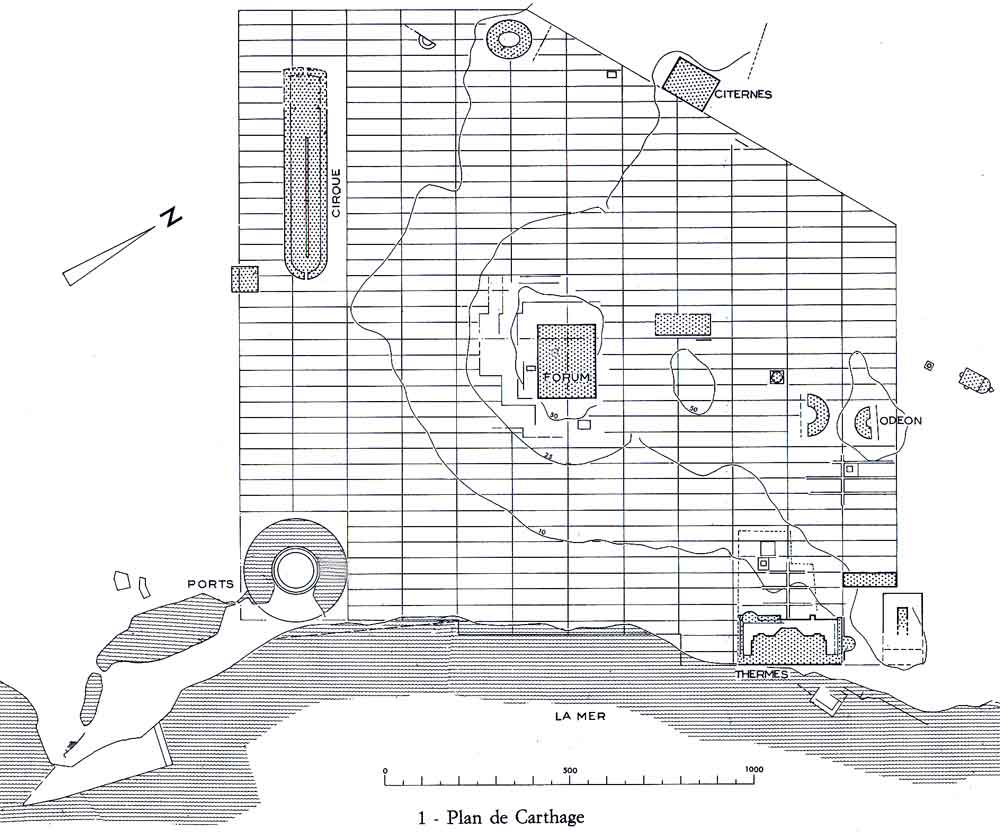
Plan of Roman Carthage
Map of Roman remains within the modern Carthage municipality.

Roman Carthage was an important city in ancient Rome, located in modern-day Tunisia. Approximately 100 years after the destruction of Punic Carthage in 146 BC, a new city of the same name (Latin Carthāgō) was built on the same land by the Romans in the period from 49 to 44 BC. By the 3rd century, Carthage had developed into one of the largest cities of the Roman Empire, with a population of several hundred thousand.[1] It was the center of the Roman province of Africa, which was a major breadbasket of the empire. Carthage briefly became the capital of a usurper, Domitius Alexander, in 308–311. Conquered by the Vandals in 439,[2] Carthage served as the capital of the Vandal Kingdom for a century. Re-conquered by the Eastern Roman Empire in 533–534, it continued to serve as an Eastern Roman regional center, as the seat of the praetorian prefecture of Africa (after 590 the Exarchate of Africa).

The city was sacked and destroyed by Umayyad Arab forces after the Battle of Carthage in 698 to prevent it from being reconquered by the Byzantine Empire.[3] A fortress on the site was garrisoned by Muslim forces[4] until the Hafsid period, when it was captured by Crusaders during the Eighth Crusade. After the withdrawal of the Crusaders, the Hafsids decided to destroy the fortress to prevent any future use by a hostile power.[5] Roman Carthage was used as a source of building materials for Kairouan and Tunis in the 8th century.[6]

History

[edit]
Map of the hill of the theatre of Carthage

Foundation

[edit]
Close up view of a Punic statue depicting the god Baal Hammon, from the era of Roman Carthage, 1st century BC, Bardo National Museum of Tunis

After the Roman conquest of Carthage, its nearby rival Utica, a Roman ally, was made capital of the region and for a while replaced Carthage as the leading centre of Punic trade and leadership. It had the advantageous position of being situated on the outlet of the Medjerda River, Tunisia's only river that flowed all year long. However, grain cultivation in the Tunisian mountains caused large amounts of silt to erode into the river. This silt accumulated in the harbour until it became useless, and so Rome looked for a new harbour town.

By 122 BC, Gaius Gracchus had founded a short-lived Roman colony, called Colonia Junonia. The purpose was to obtain arable lands for impoverished farmers. The Senate abolished the colony some time later, to undermine Gracchus' power.

After this failed effort, Carthage was rebuilt by Julius Caesar in the period from 49 to 44 BC, with the official name Colonia Iulia Concordia Carthago.[7] By the first century, it had grown to be the second-largest city in the western half of the Roman Empire. The geographer Strabo wrote that when the third Punic War began in 149 BC, the Carthaginians ruled 300 cities in Libya and 700,000 people lived in Carthage. Dexter Hoyos writes that it was physically impossible in any period of its history for that many people to live within its walls.[8] According to Hoyos, the population of Roman Carthage and its surrounding territory would have been around 575,000 in AD 149.[9] It was the centre of the Roman province of Africa, which was a major breadbasket of the empire. Among its major monuments was an amphitheatre. The temple of Juno Caelestis, dedicated to the City Protector Goddess Juno Caelestis, was one of the biggest building monuments of Carthage, and became a holy site for pilgrims from all Northern Africa and Spain.[10]

Early Christianity

[edit]

Carthage became a centre of early Christianity. In the first of a string of rather poorly reported councils at Carthage a few years later, 70 bishops attended. Tertullian later broke with the mainstream that was increasingly represented in the West by the primacy of the Bishop of Rome, but a more serious rift among Christians was the Donatist controversy, against which Augustine of Hippo spent much time and parchment arguing. At the Council of Carthage (397), the biblical canon for the western Church was confirmed. The Christians at Carthage conducted persecutions against the pagans, during which the pagan temples, including the Temple of Juno Caelesti, were destroyed.[11]

The great fire of the second century, which swept through the capital of the governor of the province, made it possible to develop a hilly area of the city as part of an important urban planning project. A vast district of luxurious dwellings, including the "Villa de la volière", was built on this occasion. A circular monument, which was excavated during the UNESCO campaign, called "rotonde sur podium carré",[12] is sometimes dated to the Christian period and identified by some researchers as a mausoleum.[13] A huge inscription to Aesculapius was found nearby, which suggests that the Punic temple of Eshmun was located on this site. Texts indicate that the Romans built the temple to the corresponding deity of their pantheon on the same site.[12] The last fundamental element of the building program is a large leisure area, with a theatre dating from the second century and an odeon built in the third century. According to Victor de Vita, the whole area was destroyed by the Vandals. However, a remaining population lived there and a settlement persisted in the ruins.

Vandal period

[edit]
The Vandal Kingdom in 500, centered on Carthage

The Vandals under Gaiseric landed at the Roman province of Africa in 429,[14] either at the request of Bonifacius, a Roman general and the governor of the Diocese of Africa,[15] or as migrants in search of safety. They subsequently fought against the Roman forces there and by 435[citation needed] had defeated the Roman forces in Africa and established the Vandal Kingdom.[12] As an Arian, Gaiseric was considered a heretic by the Catholic Christians, but a promise of religious toleration might have caused the city's population to accept him.

The 5th-century Roman bishop Victor Vitensis mentions in Historia Persecutionis Africanae Provincia that the Vandals destroyed parts of Carthage, including various buildings and churches.[16] Once in power, the ecclesiastical authorities were persecuted, the locals were aggressively taxed, and naval raids were routinely launched on Romans in the Mediterranean.[17]

Byzantine period

[edit]

After two failed attempts by Majorian and Basiliscus to recapture the city in the 5th century, the Byzantine or Eastern Roman Empire, using the deposition of Gaiseric's grandson Hilderic by his cousin Gelimer as a "casus belli", finally subdued the Vandals in the Vandalic War of 533–534, the Roman general Belisarius, accompanied by his wife Antonina, made his formal entry into Carthage in October 533. Thereafter, for the next 165 years, the city was the capital of Byzantine North Africa, first organised as the praetorian prefecture of Africa, which later became the Exarchate of Africa during the emperor Maurice's reign. Along with the Exarchate of Ravenna, these two regions were the western bulwarks of the Byzantine Empire, all that remained of its power in the West. In the early seventh century Heraclius the Elder, the Exarch of Africa, rebelled against the Byzantine emperor Phocas, whereupon his son Heraclius succeeded to the imperial throne.

Islamic conquest

[edit]

The Exarchate of Africa first faced Muslim expansion from Egypt in 647, but without lasting effect. A more protracted campaign lasted from 670 to 683 but ended in a Muslim defeat in the battle of Vescera. Captured by the Muslims in 695, it was recaptured by the Byzantines in 697, but was finally conquered in 698 by the Umayyad forces of Hassan ibn al-Nu'man. Fearing that the Eastern Roman Empire might reconquer it, the Umayyads decided to destroy Roman Carthage in a scorched earth policy and establish their centre of government further inland at Tunis. The city walls were torn down, the water supply cut off, the agricultural land ravaged and its harbours made unusable.[3] The destruction of the Roman Carthage and the Exarchate of Africa marked a permanent end to Roman rule in the region, which had largely been in place since the 2nd century BC.

It is visible from archaeological evidence that the town of Carthage continued to be occupied, particularly the neighbourhood of Bjordi Djedid. The Baths of Antoninus continued to function in the Arab period and the historian Al-Bakri stated that they were still in good condition. They also had production centres nearby. It is difficult to determine whether the continued habitation of some other buildings belonged to Late Byzantine or Early Arab period. The Bir Ftouha church might have continued to remain in use though it is not clear when it became uninhabited.[4] Constantine the African was born in Carthage.[18]

The fortress of Carthage continued to be used by the Muslims until the Hafsid era and was captured in 1270 by Christian forces during the Eighth Crusade. After the withdrawal of the Crusaders, Muhammad I al-Mustansir decided to completely destroy it to prevent a repetition.[5]

Rediscovery

[edit]

The ruins of Carthage were rediscovered at the end of the 19th century.[19] The Odeon was excavated in 1900–1901,[20] and the amphitheatre was excavated in 1904.

Amphitheatre

[edit]

Odeon Hill

[edit]

Odeon Hill, located to the north-east of the archaeological site of Carthage, is the site of numerous Roman ruins, including the theatre, the odeon, and the park of the Roman villas. The park includes the villa of the aviary, the best preserved Roman villa of the site of Carthage.

The House of the Horses contains a mosaic of more than fifty circus horses, bordered by hunting scenes.[21]

View of the elements of the Odeon Hill and the archaeological park of the Roman villas, no. 10 to 12.

The Odeon Hill has its name due to a misidentification of the building which was thought to be the Odeon, known to exist from Tertullian, but what tuned out to be a theatre.[20] Odeon hill and the park of the Roman villas are located to the east of the Roman colony of Carthage, and to the north of the park of the Baths of Antoninus. On its outskirts is now located the area of the presidential palace in the south, while in the north the Mâlik ibn Anas mosque has been built.

Theatre

[edit]
View of the current theatre seating area

Tertullian mentions in his introduction to the Florides[22] the richness of the decoration, the splendour of the marbles of the cavea, the parquet floor of the proscenium and the haughty beauty of the pillars.[23] There was a colonnade of marble and porphyry on the frons scænae, numerous statues and quality epigraphic ornaments. The theatre extends over an area equivalent of about four blocks and dates probably to the times of Augustus. By size it is the second largest Roman theatre in Africa, only the one in Utica is larger.[20]

Fragments of inscriptions found in the theatre refer to repairs made in the fourth century.[24]

The theatre is a mixture of Greek and Roman theatre: the tiers are supported by a system of vaults, but take advantage of the slope of the hill.[25] The cavea consisted of sections with tiers separated by stairs. The orchestra, with its more comfortable movable seats, was intended for VIP spectators. The pulpitum was a wall separating the orchestra from the stage, while the frons scænae formed the backdrop to the building. The odeon was entirely built, as it did not take advantage of the topography.

There are very few Roman remains of the stands in the present building. The theatre was renovated and since 1964 it is the site of the International Festival of Carthage.[26] The semicircular walls also date from the early 20th century when it was used for costume production.

Odeon

[edit]
Substructure of the Odeon in 2001

Only traces of substructures of the Odeon remain, barely cleared at the beginning of the 20th century. It was rediscovered by Paul Gauckler [fr] who lead the excavations between 1900 and 1901.[20] The Odeon was mentioned by the Christian theologist Tertullian and is where the Roman Emperor of African origin Septimus Severus shall have awarded the prize for the winner of the literary competition.[27] The Odeon, which is considered to be the largest Roman Odeon, lies adjacent to the southern theatre and occupies three city blocks. It had a seating capacity of about 20,000 spectators and it was not assumed to be an Odeon were it not for the inscription ODEVM discovered in a cistern under the stage. In comparison, the second largest Roman Odeon in Athens had a seating capacity of 5,000.[20]

Excavations took place again between 1994-2000 by researchers from the School of Architecture of the University of Waterloo in Ontario and the Trinity University in Texas.[20] Although the site is located in a non aedificandi zone, it is now situated in the immediate vicinity of the Mâlik ibn Anas Mosque. The building, which stood against the theater and was built entirely above ground level, had semi-circular corridors for the circulation of visitors. Tertullian mentions the discovery of burial sites during the construction of the building. Timothy Barnes assumed it to have been built around 200 BC.[20]

Roman villas

[edit]
Villa with cryptoportico on the left and in the background the villa of the aviary

The relics of the villas are in a mediocre state, except for those of the villa of the aviary. The main interest of the district consists in the vision of a neighbourhood of the Colonia Iulia Carthago, organised in insulae or small islands of 35 meters by 141 meters.

The second-century district has orthogonal streets, "successive tiers crammed into the sides of the hill";[28] the upper tier is located in the ground, the lower tier opens onto the street above the lower tier. The flats were located on the upper floor, with the shops occupying the ground floor at street level.

The villa is the main feature of the park, due to the quality of the restoration carried out in the 1960s.[29] The name of the villa comes from the mosaic of the aviary, marked by the presence of birds among the foliage,[28] which occupies the garden, in the centre of the viridarium, the heart of a square courtyard framed by a portico decorated with pink marble pillars.

To the southwest is a terrace that opens onto the street. To the west, a vaulted gallery also serves as a relief from the pressure of the ground, while the building's atrium is located to the east. To the north are all the prestige rooms, the ceremonial flats, the laraire and the vestibule.

Upstairs were the baths and shops. On the upper floor were the private flats of the owners, with shops under the terraced portico. Below the cryptoporticus was a weatherproof promenade.

Baths of Antoninus

[edit]
Ruins of the Baths of Antoninus

The Baths of Antoninus or Baths of Carthage are the largest set of Roman thermae built on the African continent and one of three largest built in the Roman Empire. They are the largest outside mainland Italy.[30] The baths are also the only remaining Thermae of Carthage that dates back to the Roman Empire's era. The baths were built during the reign of Roman Emperor Antoninus Pius.[31] The baths continued to function in the Arab period: the historian Al-Bakri stated that they were still in good condition.[citation needed]

The baths are at the South-East of the archaeological site, near the presidential Carthage Palace. The archaeological excavations started during the Second World War and concluded by the creation of an archaeological park for the monument. It is also one of the most important landmarks of Tunisia.[citation needed]

Circus

[edit]
A mosaic of the Circus of Carthage

The Circus of Carthage was modelled on the Circus Maximus in Rome. Measuring more than 470 m in length and 30 m in width,[32] it could house up to 45,000 spectators, roughly one third of the Circus Maximus, and was used for chariot racing.

The building appears to have been constructed sometime around 238 AD, and was used for several years before its official dedication.

Remains from the Circus Maximus, specifically the marble "spina" (a dividing barrier) were used in the Circus of Carthage, as well as the Circus of Maxentius and the city of Vienne located in France.[33]

See also

[edit]

References

[edit]

Further reading

[edit]
Revisions and contributorsEdit on WikipediaRead on Wikipedia
from Grokipedia
Roman Carthage refers to the ancient city of Carthage, located in modern-day Tunisia, after its reconstruction as a Roman colony following its destruction in the Third Punic War in 146 BCE.[1] Originally a Phoenician settlement and Rome's chief rival, the city was systematically razed by Roman forces under Scipio Aemilianus, with its population enslaved or dispersed and a curse laid upon the site to prevent rebuilding.[1] An initial attempt to establish a colony there in 122 BCE by Gaius Sempronius Gracchus failed due to political opposition and lingering Roman animosity toward the Punic legacy.[2] The successful refounding occurred in 44 BCE under Julius Caesar, who designated it Colonia Iulia Concordia Carthago, sending veterans and settlers to repopulate the area as part of his efforts to consolidate Roman control in North Africa.[2] Under Augustus, the city was further developed, receiving imperial privileges and becoming the capital of the province of Africa Proconsularis within five years, serving as the administrative and economic hub for Roman North Africa.[1] By the 1st century CE, Roman Carthage had grown into the second-largest city in the western Roman Empire, with an estimated population of around 500,000 inhabitants, reflecting its rapid urbanization and integration into the imperial network.[3] Economically, Roman Carthage thrived as a vital commercial center, leveraging its strategic position on the Mediterranean coast with dual harbors—a circular naval basin and a rectangular commercial port—that facilitated trade in goods such as olive oil, grain, wine, pottery, purple dye, tin, silver, and gold.[3] It played a crucial role in supplying Rome's grain annona, earning the region the moniker of the empire's "breadbasket," and its markets connected African produce with European and Eastern imports, underscoring its importance in the Roman economy.[1] Architecturally, the city featured a grid-plan layout centered on the Byrsa Hill, monumental public structures like the massive Antonine Baths (completed in the 2nd century CE), theaters, amphitheaters, and aqueducts, blending Roman engineering with lingering Punic and local elements.[1] Culturally, Roman Carthage was a diverse ethnic melting pot, as evidenced by over 1,200 inscriptions revealing a mix of Roman, Punic, Greek, and Eastern names, indicating a cosmopolitan society that preserved aspects of its pre-Roman heritage while adopting imperial norms.[4] By the 2nd century CE, it had emerged as an intellectual powerhouse, and in the 3rd and 4th centuries, it became a leading center of early Christianity, home to influential figures such as Tertullian (c. 155–240 CE), Cyprian of Carthage (d. 258 CE), and later Augustine of Hippo (354–430 CE), who studied there in his youth.[2] The city's prominence endured until its capture by the Vandals in 439 CE, marking the end of direct Roman rule, though it was briefly reconquered by Byzantine forces in 533 CE before the Arab conquest in 698 CE.[1]

History

Foundation and Early Development

Carthage, the ancient Punic capital, was utterly destroyed by Roman legions in 146 BC at the conclusion of the Third Punic War, with its walls razed, buildings burned, and surviving inhabitants enslaved or scattered. The site lay largely abandoned, serving as a cursed no-man's-land under Roman law prohibiting rebuilding, though some squatters and farmers occupied the ruins. In 122 BCE, Gaius Sempronius Gracchus attempted to establish a Roman colony named Colonia Junonia there to settle impoverished Italians, but the effort failed due to political opposition and religious omens, leading to its disbandment shortly after.[2] During the Roman civil wars, Julius Caesar conceived a plan to refound Carthage as a veteran colony named Colonia Iulia Concordia Carthago, aiming to settle Italian poor and discharged soldiers on the fertile lands of the former province of Africa to alleviate urban pressures in Rome. Preparations began around 49–44 BC, including surveys for land division, but Caesar's assassination halted progress before significant settlement occurred. The colony's official establishment came under Augustus in 29 BC, shortly after his victory at Actium, when approximately 3,000 Roman colonists—primarily veterans and civilians from Italy—were dispatched to the site, supplemented by local recruits from nearby areas. Land was allocated systematically, with each colonist receiving substantial plots in the surrounding ager, fostering agricultural recovery and integrating the new settlement into the province of Africa Proconsularis.[5] Early development focused on essential infrastructure to secure and sustain the colony: a central forum was laid out on Byrsa Hill as the administrative heart.[6] These foundational efforts, completed within the first decades of the 1st century AD, transformed the desolate ruins into a viable Roman outpost, setting the stage for gradual urban expansion.[7]

Imperial Growth and Administration

During the height of the Roman Empire in the 1st and 2nd centuries AD, Carthage experienced significant imperial growth, evolving from a refounded colony into a major urban center that served as the economic and administrative hub of North Africa. By the 2nd century AD, the city's population had boomed to an estimated 300,000–500,000 inhabitants, making it the second-largest city in the western Roman Empire after Rome itself. This expansion was driven by immigration from Italy and other provinces, as well as natural growth fueled by prosperous agriculture and trade networks that integrated Carthage into the broader imperial economy. The city's strategic location facilitated its role as a key port, channeling grain and olive oil from the African hinterland to supply Rome and other imperial centers. As the capital of the province of Africa Proconsularis, established after the defeat of Carthage in 146 BC and formalized under Augustus in 27 BC, the city was governed by a proconsul appointed by the Roman Senate for a one-year term.[8] This senatorial province fell under the oversight of the Senate in Rome, which selected governors from former consuls to ensure loyalty and prevent corruption, though the emperor retained indirect influence through appointments and appeals. The proconsul, residing in Carthage, managed judicial affairs, oversaw public order, and directed tax collection, which primarily consisted of a tithe on agricultural produce (annona) and customs duties on imports and exports; these revenues were crucial for funding the imperial grain supply (cura annonae) and provincial infrastructure.[9] Local administration was supported by a legate for military matters and quaestors for financial duties, with Carthaginian elites increasingly integrated into the provincial council (concilium provinciae) to handle routine governance. Key developments under the emperors Trajan (r. 98–117 AD) and Hadrian (r. 117–138 AD) marked periods of construction booms in Carthage, reflecting imperial investment in provincial capitals to solidify loyalty and enhance urban prestige. Trajan initiated projects to expand public facilities and improve harbor infrastructure, capitalizing on the city's role in the annona system. Hadrian, during his tour of Africa in 128 AD, further promoted building activities, including restorations and new civic structures, to promote cultural assimilation and economic stability.[10] In 203 AD, Emperor Septimius Severus, a native of nearby Leptis Magna, elevated Carthage's status during his visit by granting it enhanced colonial privileges (colonia Iulia Concordia Carthago) and initiating major urban enhancements, reinforcing its preeminence as the provincial capital.[2] Carthage also played a vital military role in securing the province against internal threats, particularly Berber revolts in the hinterlands. The Legio III Augusta, the only legion stationed in Africa Proconsularis, was based at Lambaesis from the time of Trajan onward and was responsible for patrolling the frontiers and suppressing uprisings, such as the prolonged revolt led by the Berber leader Tacfarinas from 17 to 24 AD.[11] The proconsul held imperium over this legion, enabling coordinated defenses that protected Carthage's agricultural estates and trade routes from nomadic incursions, though the city's own fortifications were modest compared to frontier forts. These efforts ensured the province's stability, allowing Carthage to flourish as a Roman stronghold until the 3rd century.[12]

Vandal and Byzantine Periods

The Vandal Kingdom was established in North Africa following the invasion led by King Geiseric, who crossed into Roman territory in 429 CE and captured Carthage in 439 CE, transforming the city into the capital of his realm.[13] This conquest disrupted Roman administration, as Geiseric systematically persecuted the local Roman elite, enslaving prominent citizens, confiscating their estates for distribution to his sons Huneric and Genzo, and imposing severe taxes that often led to exile or execution on fabricated charges of concealing wealth.[13] To prevent uprisings, he ordered the demolition of city walls across Libya except in Carthage itself, though the Vandals otherwise maintained much of the urban infrastructure while favoring their Arian Christian faith over the Nicene orthodoxy of the Roman population.[13][14] The Byzantine reconquest began in 533 CE under Emperor Justinian I, who dispatched General Belisarius with a fleet of approximately 500 ships carrying 16,000 troops to reclaim Africa from Vandal King Gelimer.[15] Belisarius landed at Caput Vada, advanced rapidly, and defeated the Vandals at the Battle of Ad Decimum on September 13, 533 CE, before entering Carthage unopposed two days later, as the city's inhabitants opened the gates and illuminated the streets in celebration while fleeing Vandal forces sought sanctuary in churches.[16] The campaign concluded with victory at the Battle of Tricamarum in December 533 CE and Gelimer's surrender in March 534 CE, restoring Roman control and reinstating Carthage as the administrative center of the Prefecture of Africa.[16] Belisarius promptly fortified the city and its key ports, such as Hadrumetum, to secure the province against potential Vandal remnants or local unrest.[16] Under Justinian, administrative reforms shifted Africa toward a more militarized structure, initially as a praetorian prefecture under officials like Solomon, who oversaw tax collection and legal restoration, but evolving into the Exarchate of Carthage by the late sixth century under Emperor Maurice to address persistent Berber (Mauri) threats through centralized military command.[17] Economic recovery was prioritized, with efforts to revive grain exports to Constantinople—disrupted under Vandal rule—and rebuild infrastructure, including city walls razed by Geiseric, which Justinian ordered reconstructed across at least 28 urban centers to bolster defense and trade. Church rebuilding accompanied this, as the emperor supported the Catholic hierarchy persecuted by the Arian Vandals, funding restorations and convening councils to reintegrate the African church into imperial orthodoxy.[18] By the seventh century, however, instability mounted due to ongoing Vandal War aftermaths, including Berber revolts led by figures like Garmul in the 570s CE, which drained resources and weakened Byzantine garrisons.[19] Arab threats emerged with the Umayyad raid of 647 CE under Abd Allah ibn Sa'd, which sacked Sufetula and forced tribute payments, exacerbating economic strain and internal divisions until the full conquest in 698 CE.[20] These pressures, combined with plagues and fiscal burdens from Justinian's reconquests, marked the gradual erosion of Byzantine authority in Carthage.[19]

Islamic Conquest and Decline

The Umayyad Caliphate's campaign against Byzantine North Africa culminated in the siege of Carthage, initiated in 697 AD by the Arab general Ḥassān ibn al-Nuʿmān, who sought to eliminate the city's role as a key Byzantine naval and administrative base.[21] After an initial Arab advance, Byzantine forces briefly recaptured the city with naval support in late 697, prompting Ḥassān to withdraw temporarily before returning with reinforcements in 698.[22] Short-lived resistance ensued, including naval clashes in Carthage's ports where Byzantine ships attempted to supply the defenders, but Ḥassān's forces overwhelmed them, leading to the city's fall in the spring of 698 AD.[23] Following the conquest, Ḥassān ordered the systematic destruction of Carthage to prevent its reuse as a Byzantine stronghold, with the walls demolished, the harbors filled in, and the water supply severed.[22] Archaeological evidence confirms widespread urban collapse and destruction layers from this period, though some areas show continuity in smaller-scale occupation.[22] Stones and materials from Roman-era structures were repurposed for constructing the nearby Islamic cities of Kairouan and Tunis, accelerating the abandonment of Carthage as a major center.[24] The conquest marked the end of Byzantine control in North Africa, with the surviving population—primarily Greco-Roman and Berber inhabitants—dispersing by sea or to adjacent settlements, reducing Carthage to scattered agricultural villages around the Byrsa hill.[22] This transition facilitated the consolidation of Islamic rule in Ifriqiyyah under the Umayyads, with Kairouan established as the regional capital since 670 AD and Tunis emerging as a fortified trade hub around 705 AD, shifting economic and administrative focus away from the ruins.[21]

Geography and Urban Layout

Location and Topography

Roman Carthage was situated on a prominent peninsula projecting into the Gulf of Tunis, approximately 15 km east of modern Tunis, Tunisia. The site occupied a strategic coastal position, with the ancient city centered around the elevated Byrsa Hill, which served as the acropolis and focal point of settlement. This location, originally chosen by Phoenician founders in the 9th century BCE and refortified under Roman rule after 146 BCE, benefited from the peninsula's natural extension eastward from coastal lagoons, providing a defensible land bridge to the mainland at its narrowest point of about 5 km.[25][26] The topography featured two primary harbors that underscored Carthage's maritime dominance: the circular Cothon, a military harbor with a central islet for admiralty and slipways for warships, and an adjacent rectangular commercial harbor for trade vessels. These artificial basins, protected by seawalls and chains, were integrated into the urban layout near Byrsa Hill, facilitating naval operations and commerce. Surrounding the peninsula were fertile plains ideal for agriculture, particularly grain and olive production, while the site's proximity to major Mediterranean trade routes enhanced its role as a hub for exchanging goods like cereals, olive oil, and metals across North Africa, Europe, and the Levant.[25][27] Topographically, Byrsa Hill's elevation, rising about 55 meters above sea level, offered commanding views and natural defensive advantages, allowing Roman engineers to fortify the acropolis with walls that leveraged the steep slopes. The coastal access supported a robust navy, essential for Rome's provincial control in Africa Proconsularis, while the enclosing lagoons to the west and south provided additional barriers against landward threats and sheltered smaller craft. This combination of hilltop prominence and sheltered waterways made the site militarily impregnable and economically vital.[25][26][28] Environmental factors significantly influenced settlement patterns, with the region's low annual rainfall—typically under 400 mm—necessitating reliance on rainwater harvesting from cisterns and limited aquifers for water supply, later augmented by Roman aqueducts from distant sources like Zaghouan. Seismic activity, common in the tectonically active Tunisian coastal zone due to the African-Eurasian plate boundary, posed risks to structures, as evidenced by occasional earthquake damage recorded in the broader Mediterranean context, though the stable limestone bedrock of the peninsula mitigated some vulnerabilities. These conditions shaped urban development, emphasizing resilient building on elevated terrain to avoid flooding from seasonal storms and lagoon overflows.[25][29]

City Planning and Infrastructure

The Roman city of Carthage was laid out on a grid plan typical of colonial foundations, featuring principal north-south cardo maximus and east-west decumanus maximus streets that intersected at the forum, dividing the urban area into rectangular insulae blocks measuring approximately 35 meters by 140 meters.[30][6] This orthogonal system accommodated the local topography, with streets oriented to facilitate drainage and access to key public spaces, though deviations occurred near the harbors to integrate with existing Punic features.[31] Key infrastructure included the Zaghouan Aqueduct, constructed under Hadrian in the early 2nd century CE, which spanned 132 kilometers from springs at Djebel Zaghouan to supply the city with an estimated 25,000 cubic meters of water per day, supporting public fountains, baths, and private homes through a network of pipes and cisterns.[32][33] Complementary systems featured covered sewers along major streets, channeling wastewater and stormwater to outlets in the harbors, enhancing sanitation in the densely populated urban core.[34] Port infrastructure was expanded during the imperial period, with the Rectangular Harbor modified by the addition of protective moles and warehousing along a 1.6-kilometer seafront to handle increased maritime traffic.[7] Public spaces centered on the forum atop Byrsa Hill, flanked by basilicas for judicial and administrative functions, while the urban area, encompassing forums, temples, and residential quarters, was later encircled by defensive walls approximately 3-3.5 meters thick, enclosing roughly 13 square kilometers by the late Roman period.[6][7] The initial Augustan-era plans under Augustus (late 1st century BCE to early 1st century CE) focused on refounding the colony with a basic grid and harbor adaptations, establishing the core layout amid the ruins of Punic Carthage.[7] By the Severan dynasty in the early 3rd century CE, under Septimius Severus—a native of Leptis Magna—additions included monumental enhancements to the harbors, such as colonnaded piazzas and extended moles, reflecting Carthage's growing status as a provincial capital.[7]

Society and Economy

Social Structure and Daily Life

Roman Carthage exhibited a stratified social hierarchy influenced by its status as a Roman colony, blending elite Roman settlers with local Punic and Berber populations, alongside a substantial underclass of slaves and freedmen. Inscriptions reveal that Roman nomenclature dominated among the upper classes, reflecting the influence of colonial administrators and wealthy landowners who held political and economic power, while Punic and Greek names were more prevalent among lower strata, indicating persistent local and immigrant communities. Local Punic and Berber groups, often integrated as farmers or artisans, formed the middle layers, maintaining cultural elements amid Romanization. Freedmen, many of whom were former slaves who gained manumission, played key roles as merchants and small-scale entrepreneurs, contributing to social mobility in this diverse urban environment.[4] Slavery was integral to Carthaginian society, with slaves comprising a significant portion of the urban population—estimated at up to 30% in major Roman cities like Carthage—drawn from war captives, trade, and local births. Archaeological evidence from burial grounds near the amphitheater, dating to the late 1st to early 3rd centuries CE, shows that slaves, particularly those in imperial service, made up about two-thirds of interred individuals in certain communities, performing diverse roles from household labor to administrative tasks. Slavery practices emphasized utility over harshness in urban settings, with manumission offering paths to freed status, though slaves endured limited rights and high mortality rates, averaging around 23 years for men and 27 for women in documented cases. Freedmen often retained ties to former owners through patronage networks, enhancing their integration into trade and civic life.[35][36] Daily life in Roman Carthage varied by class, with housing reflecting social divisions: elite families resided in spacious peristyle villas adorned with mosaics, such as the Maison du Cryptoportique, symbolizing wealth and public prestige, while the majority lived in multi-story insulae apartments, like those at the Theodosian Wall site, offering modest communal spaces for artisans and laborers. Family structures centered on the paterfamilias, with extended households including slaves and dependents, though late antique evidence suggests adaptations toward smaller units amid economic shifts. Education, primarily for elite males, began with elementary literacy under ludi magistri and progressed to grammatici for literary studies around age 12, fostering rhetorical skills essential for advancement; exceptional women, like the literate Perpetua in the early 3rd century, occasionally received similar training. Markets, or macella, bustled as daily hubs for provisioning, where residents purchased staples amid social interactions.[37][38] Gender roles adhered to Roman norms, with men dominating public and political spheres while women managed households and, in elite cases, influenced social networks; lower-class women contributed to markets and crafts, though legal subordination persisted. Festivals like Saturnalia provided rare social inversions, allowing temporary equality between masters and slaves through feasting and gift-giving, adapted to local customs in African provinces for communal celebration. Health and sanitation integrated into routines via public thermae, where bathing promoted hygiene and socializing across classes, and communal latrines flushed by aqueducts minimized disease in dense urban areas, though challenges like high infant mortality persisted.[39][40]

Economic Role and Trade

Roman Carthage served as a vital economic hub within the Roman Empire, particularly as the administrative center of the province of Africa Proconsularis, which functioned as one of the empire's primary agricultural breadbaskets. The region's fertile plains and Mediterranean climate enabled large-scale production of grain, olives, and wine, much of which was channeled through the annona system to supply Rome and other imperial centers. By the second century AD, African exports provided sufficient grain to meet Rome's needs for approximately eight months of the year, underscoring Carthage's central role in sustaining the capital's population and military. Olive oil production was equally significant, with early levies under Julius Caesar amounting to 3 million pounds annually, a figure that expanded under imperial administration to support both civilian consumption and state distributions. Wine from the hinterlands complemented these exports, transported via the province's extensive road and port networks to fulfill imperial quotas.[41] Carthage's commercial port facilitated robust Mediterranean trade, positioning the city as a nexus for imports and exports that bolstered the empire's economy. Key imports included marble from Greece and Italy for construction, while exports featured high-value goods such as textiles from regional workshops and pottery, notably African Red Slip Ware (ARS). ARS, produced in workshops around Carthage and in central Byzacena from the late first century AD, became a hallmark of Roman tableware, mass-manufactured with a glossy red slip and distributed across the Mediterranean to sites in Italy, Gaul, and the eastern provinces, often as return cargo on grain ships. This pottery trade not only generated revenue but also reflected Carthage's integration into imperial supply chains, with production peaking in the third to sixth centuries on rural estates tied to agricultural operations.[42][43] Local industries further amplified Carthage's economic contributions, including numerous olive oil presses that processed the province's abundant harvests for export in amphorae, fisheries exploiting coastal waters for salted fish and garum sauce integrated into broader Mediterranean networks, and craft workshops producing ceramics and textiles for both domestic use and imperial demands. These sectors were embedded in the annona framework, ensuring steady flows to Rome and military garrisons, with evidence of specialized facilities like fish-salting vats and fulling operations supporting the city's role in food and commodity production. Economic prosperity reached its zenith during the Antonine dynasty in the second century AD, driven by stable administration, agricultural expansion, and enhanced trade routes that maximized Africa's output. However, the third-century crisis, marked by invasions, civil wars, and monetary instability, led to disruptions in production and commerce, though Carthage maintained relative continuity compared to other provinces until later Vandal incursions.[44][45][46]

Culture and Religion

Pagan Traditions and Temples

In Roman Carthage, pagan religious practices reflected a profound syncretism between imported Roman cults and enduring Punic traditions, fostering a blended pantheon that honored both imperial and local deities. The chief Punic god Baal Hammon, central to Carthaginian worship, was interpretatio Romana as Saturn, with his attributes of fertility and protection integrated into Roman rituals; evidence from mid-2nd century CE busts and stelae at the Salammbo Tophet underscores this equivalence. Similarly, the Punic goddess Tanit, revered as Carthage's celestial protector, merged with Juno Caelestis, depicted on coinage from 64 BCE onward and promoted by figures like Septimius Severus in the early 3rd century CE. This fusion allowed Punic devotion to persist under Roman imperial auspices, as seen in evocatio rituals during the Third Punic War, where Scipio Aemilianus invoked Baal Hammon and Tanit to transfer their favor to Rome.[47][48] Key sacred sites embodied this syncretism, with the Capitolium on Byrsa Hill serving as the focal point of Roman religious authority. Constructed during the early imperial period following Augustus's refounding of the colony around 29 BCE, the Capitolium was dedicated to the Capitoline triad—Jupiter Optimus Maximus, Juno Regina, and Minerva—symbolizing Rome's dominion over the province of Africa Proconsularis; its platform leveled the Punic summit for a grand forum-adjacent complex. The Tophet sanctuary, originally a Punic open-air precinct for child and animal dedications to Tanit and Baal Hammon spanning the 8th–2nd centuries BCE, was repurposed in the Roman era, buried under terraces and rebuilt by the late 2nd century CE as a monumental complex with temples to Saturn (equated with Baal), Venus, and Caelestis. This transformation preserved Punic stelae and urns beneath Roman architecture, illustrating cultural continuity amid imperial overlay.[49][50][48] Rituals at these sites emphasized sacrifices and communal festivals, overseen by priesthoods that blended Roman collegial structures with Punic hierarchies. Animal offerings, including bulls and lambs, were standard at altars within temple courtyards, symbolizing reciprocity with the gods; inscriptions from the Tophet area confirm ongoing dedications to Saturn-Baal into the 2nd century CE. Priesthoods, such as the flamines for imperial cults and local suffetes adapted from Punic models, managed these rites, with elite Carthaginians holding positions that reinforced social status. Public festivals, akin to Rome's ludi, featured processions, theatrical performances, and games in honor of Caelestis and Saturn, fostering civic unity; the Sanctuary of Caelestis near the harbor hosted elaborate ceremonies with dove symbols evoking Tanit. These practices maintained vitality through the 3rd century CE, supported by provincial coinage and dedications.[47][48][51] Pagan traditions waned in the 4th century CE amid intensifying Christianization, culminating in temple closures and conversions under imperial edicts. The Theodosian decrees of 391–392 CE banned sacrifices and shuttered temples across the empire, targeting sites like Carthage's Capitolium and Caelestis sanctuary; enforcement by local bishops accelerated the shift. Bishop Aurelius of Carthage symbolically repurposed the Temple of Caelestis in 421 CE during an Easter procession, installing his cathedra in place of the idol within the temenos, though physical alterations were minimal and opposition from pagan elites persisted. By the early 5th century, structures like the Temple of Ceres were adapted into churches, with archaeological traces of razed shrines and overlaid Christian basilicas evidencing the transition; the Vandal invasion after 429 CE further dismantled remaining pagan infrastructure, such as the Via Caelestis.[52][53]

Christian Development and Figures

Christianity arrived in Carthage during the 2nd century AD, likely through trade routes and migrations from the eastern Mediterranean, establishing a vibrant community that produced influential Latin theological writings known as the works of the African Fathers.[54] This early development was marked by intellectual rigor and apologetics against paganism and heresy, with Carthage emerging as a center of Latin Christianity distinct from Greek traditions in the East.[55] Quintus Septimius Florens Tertullianus (c. 155–240 AD), commonly known as Tertullian, was the earliest major Christian author to write extensively in Latin and hailed from Carthage, where he defended the faith in works like Apologeticus.[56] Later in life, around 207 AD, Tertullian joined the Montanist movement, a prophetic sect emphasizing spiritual gifts and asceticism, which influenced North African Christianity but led to schisms.[55] His theological innovations, including concepts of the Trinity and church discipline, laid foundational ideas for Western doctrine.[57] Thascius Caecilius Cyprianus (c. 200–258 AD), bishop of Carthage from 248 AD, became a pivotal figure amid the Decian persecution of 250 AD, when Emperor Decius demanded libelli certificates of sacrifice to Roman gods, leading to widespread martyrdoms among Carthaginian Christians.[58] Cyprian fled initially but returned to organize the lapsi (those who lapsed under pressure), advocating for reconciliation while upholding church authority in treatises like De Lapsis.[59] He was martyred in 258 AD under Valerian, exemplifying the resilience of the Carthaginian church during imperial crackdowns.[58] By the late 4th century, Christianity had shifted to the dominant faith in Carthage following the Edict of Milan in 313 AD and Theodosius I's decrees against paganism, with numerous basilicas constructed to accommodate growing congregations.[60] The Basilica of Damous el-Karita, one of the largest early Christian churches at 65 by 45 meters with multiple aisles, was built in the 4th–5th centuries, symbolizing the faith's institutionalization and serving as a martyrium.[60] Ecclesiastical councils further solidified Carthage's role in Christian orthodoxy. The Council of Carthage in 397 AD, presided over by Bishop Aurelius, confirmed the 27-book New Testament canon, aligning African practice with emerging universal standards.[61] In 411 AD, the Conference of Carthage addressed the Donatist schism—a rigorist movement originating from disputes over clergy purity post-Diocletian persecution—bringing together 286 Catholic and 279 Donatist bishops under imperial auspices.[62] Aurelius Augustinus (354–430 AD), bishop of Hippo Regius but deeply engaged in Carthaginian affairs, played a central role in combating Donatism through writings like Contra Epistulam Parmeniani and De Baptismo, arguing for the church's universality over sectarian purity.[57] His involvement in the 411 conference helped secure imperial support for Catholic dominance, marking a turning point in resolving North African divisions.[63]

Arts, Literature, and Entertainment

Roman Carthage served as a vibrant hub for literary production in the Latin language during the imperial period, particularly through its renowned rhetorical schools that trained orators and writers. These institutions emphasized persuasive speech and composition, drawing students from across North Africa and fostering a sophisticated intellectual environment. Apuleius, a North African native educated in Carthage during the 2nd century AD, exemplifies this tradition; his novel The Metamorphoses, commonly known as The Golden Ass, is the only complete Latin novel to survive from antiquity and incorporates elements of local folklore and philosophy, reflecting the city's cosmopolitan influences.[64] Latin poetry also flourished, with Carthaginian elites patronizing works that blended classical forms with regional themes, contributing to the broader revival of Latin literature in Roman Africa.[65] The visual arts in Roman Carthage showcased a distinctive fusion of Roman techniques and lingering Punic motifs, evident in mosaics, sculptures, and frescoes that adorned villas and public spaces. Mosaics, the most prominent medium, often featured intricate depictions of birds, such as peacocks and doves, symbolizing abundance and the natural world; the Villa of the Aviary, for instance, displayed expansive pavements with avian scenes that highlighted the mosaicists' skill in opus vermiculatum using colored tesserae.[66] Sculptures in marble, including statues of deities and mythological figures, drew on classical Roman models but incorporated Punic stylistic elements like stylized proportions and symbolic iconography from earlier local traditions.[67] Frescoes, though less preserved, complemented these in domestic settings with vibrant wall paintings of landscapes and figures, blending Hellenistic realism with indigenous decorative patterns to create a hybrid aesthetic unique to the region.[68][47] Entertainment in Roman Carthage revolved around spectacles that mirrored imperial Roman practices, providing leisure and social cohesion for diverse populations. Gladiatorial games, featuring combats between trained fighters and wild beasts, were major events that underscored Roman dominance and drew large crowds, while chariot races in dedicated venues offered high-stakes excitement with factional rivalries.[69] Theater performances, including comedies and tragedies staged during public festivals, entertained audiences with Greek-inspired plays adapted to local tastes.[70] Festivals such as the Megalesia, honoring the goddess Cybele with processions, sacrifices, and ludi scaenici (theatrical games), were observed annually, integrating Roman religious pomp with provincial customs.[71] Intellectual life thrived through libraries and schools that preserved and disseminated knowledge, positioning Carthage as a key center in the Roman educational network. Rhetorical academies not only produced literati like Apuleius but also housed collections of texts essential for study.[65] Public and private libraries, evidenced by ancient accounts of translated Punic works like Mago's agricultural treatises, stocked Greek, Latin, and local manuscripts, supporting scholarly pursuits until late antiquity.[72][73]

Monuments and Archaeology

Amphitheatre and Circus

The amphitheatre of Roman Carthage, one of the largest in the western provinces, was constructed in the late first or early second century AD, with evidence from inscriptions dating its initial phase before AD 133–139.[74] It underwent major reconstruction after AD 165, likely under the Antonine dynasty, expanding its scale and incorporating advanced vaulted substructures for support.[75] With a seating capacity estimated at 30,000 to 35,000 spectators, the elliptical arena measured approximately 156 by 128 meters, allowing for grand spectacles that drew diverse crowds from across North Africa.[76] Primarily used for venationes—staged hunts featuring wild animals imported from the African interior—and public executions, the amphitheatre served as a venue for imperial entertainment and punishment until the Vandal capture of Carthage in AD 439.[77] Notable events included the martyrdom of early Christians such as Perpetua and Felicity in AD 203, where condemned individuals faced beasts in the arena as part of Roman judicial spectacles. These performances reinforced social hierarchies, with seating arrangements segregating classes and emphasizing the emperor's distant authority through lavish displays funded by provincial elites. The circus of Carthage, built starting in the late first century AD with significant expansions by the early third century, extended over 496 meters in length and accommodated up to 60,000–70,000 spectators in its U-shaped track, which was about 30 meters wide.[78] Constructed atop earlier Punic foundations using opus caementicium concrete and ashlar blocks, it featured a central spina—a low barrier adorned with monuments, obelisks, and water basins—that divided the track and marked turning points for races.[78] Chariot races, the circus's hallmark event, involved teams from the dominant Blues and Greens factions, whose rivalries mirrored those in Rome and fostered intense public loyalties, as depicted in local mosaics showing charioteers in faction colors.[79] Active through the fourth century and into the Vandal period until at least the early sixth century, the circus hosted regular ludi circenses that promoted imperial propaganda, celebrating victories and divine favor while integrating local African elements like exotic animal processions.[78] Structures suffered partial damage during the Vandal seizure of Carthage in AD 439 and subsequent conflicts, including the Byzantine reconquest in AD 533, leading to quarrying of materials for reuse, though the core layout endured as a symbol of Roman urban grandeur.[78] Both venues underscored Carthage's role as a provincial capital, where mass entertainment bolstered Roman identity and social cohesion amid a diverse population of citizens, veterans, and traders.

Theatres, Odeon, and Baths

The Roman Theatre of Carthage, situated at the foot of Odeon Hill, was constructed in the second century AD as a major venue for dramatic performances, poetry readings, and philosophical debates.[70] This open-air structure, built into the natural slope of the hill, featured a semi-circular cavea with tiered seating and a stage area protected by an elaborate system of vaults and arches designed to withstand seismic activity.[70] With a capacity exceeding 5,000 spectators, it served as a central hub for cultural gatherings in the provincial capital, reflecting Rome's emphasis on integrating Greek-inspired theatrical traditions into North African urban life.[80] The theatre remained in use until its partial destruction during the Vandal invasions of the fifth century AD, after which it fell into ruin until modern restorations in the late nineteenth and twentieth centuries revived it for contemporary events.[70] Adjacent to the main theatre on Odeon Hill stood the Odeon, a smaller concert hall erected in the second century AD specifically for musical recitations, choral performances, and rhetorical contests.[80] With an estimated seating capacity of approximately 20,000 spectators in its tiered seating arranged in a horseshoe-shaped auditorium, its architectural design prioritized acoustics and audience engagement.[81] The structure, now unrestored and visible primarily as ruins, underscores the Roman commitment to diverse entertainment venues in Carthage, complementing the broader arts scene without overlapping into arena-based events.[80] The Baths of Antoninus, also known as the Antonine Baths, represent the pinnacle of Roman hydraulic engineering in North Africa, constructed between 138 and 161 AD under Emperor Antoninus Pius and spanning approximately 215 by 160 meters.[82] As the largest bath complex on the African continent and third largest in the empire after those in Rome, it included a sequence of temperature-zoned rooms: a vast frigidarium with cold pools, tepidaria for transitional warming, and caldaria heated via an underfloor hypocaust system that circulated hot air through suspended floors and wall cavities.[82][83] Luxuriously appointed with marble cladding on walls and columns—some sourced from distant quarries and weighing up to four tons each—the baths also featured intricate floor mosaics depicting marine motifs and geometric patterns, alongside multiple communal pools and exercise areas open to the seafront.[82] Beyond hygiene, these facilities functioned as vital social nexus points where citizens of all classes mingled, conducted business, and engaged in leisurely discourse, remaining operational into the seventh century AD despite partial damage from Vandal incursions in the fifth century.[83] Water was supplied via the expansive Zaghouan Aqueduct, highlighting the integration of Carthage's infrastructure with its public amenities.[83]

Villas and Private Residences

The Roman villas district in Carthage, situated on Odeon Hill, featured an orthogonal urban layout organized according to the Augustan cadastral system, with standardized blocks measuring approximately 141 meters by 35 meters, superimposed over an earlier Punic necropolis from the 3rd–2nd centuries BCE.[84] This grid-based arrangement accommodated elite residences that evolved from modest 1st-century CE dwellings and workshops—such as those involved in garum production—into luxurious aristocratic villas by the 2nd century CE during the Antonine-Severan period.[84] These homes exemplified Graeco-Roman architectural principles, typically centered around peristyle courtyards with colonnaded porticos and open atriums that facilitated natural light and airflow, serving as the social and functional heart of the household.[85] Notable among these residences is the Villa of the Aviary, a 4th-century CE suburban estate renowned for its intricate mosaics depicting birds in flight and serene fountains, which were restored in the 1960s to preserve their original splendor.[84] In the Damous el-Karita area, urban elite residences displayed similar opulence, with refurbishments continuing into the 7th century CE and incorporating elements like private chapels tied to early Christian communities, such as the monastery of Bigua established in 483 CE.[84][85] Common features across these properties included private baths for personal hygiene and social gatherings, lush gardens for leisure and cultivation, and floors paved with imported marbles in opus sectile patterns, all of which underscored the wealth accumulated by Carthage's merchant elite through Mediterranean trade networks.[85][84] Beyond the urban core, suburban estates extended Carthage's elite housing into the surrounding territory, blending agricultural production with recreational pursuits from the 4th to 7th centuries CE.[85] Sites like Sidi Ghrib, located about 40 kilometers southwest of the city, housed expansive villas with grand private bath complexes, mosaic-decorated halls, and facilities for crop storage and processing, reflecting a lifestyle that integrated estate management—focused on commercial agriculture such as olive and grain cultivation—with otium activities like hunting and banquets.[86][85] These rural properties not only supported the city's economy but also provided retreats for the affluent, highlighting the continuity of Roman domestic traditions amid shifting political landscapes.[85]

Excavations and Preservation

The rediscovery of Roman Carthage's ruins in the 19th century was spearheaded by French archaeologists amid colonial interests in Tunisia. Initial surveys occurred as early as 1830, but systematic excavations began with Charles Ernest Beulé's work on Byrsa Hill in 1861, uncovering Roman remains and establishing the site's significance as a Roman colonial capital.[87] Subsequent efforts by Alfred Louis Delattre, starting in the 1870s under the White Fathers, expanded digs across multiple hills, including Byrsa, Junon, and Sainte-Monique, yielding artifacts that highlighted the site's layered history.[88] By the early 20th century, targeted excavations included Paul Gauckler's uncovering of the Odeon in 1900–1901 and the amphitheatre in 1904, which revealed architectural features of Roman entertainment venues and prompted the creation of an archaeological park. The mid-20th century saw intensified international collaboration through UNESCO's "Save Carthage" campaign, launched in 1972 and running until 1992, which coordinated 18 teams from various nations to conduct systematic surveys, excavations, and stabilization efforts.[89] These campaigns focused on key Roman features, such as the ports, city walls, and residential areas, unearthing artifacts including Latin inscriptions, coins, and pottery that illuminated trade networks and urban planning under Roman rule.[89] The work not only documented the site's Roman phase but also preserved vulnerable structures against further deterioration, marking a shift from colonial-era digs to global heritage protection. Designated a UNESCO World Heritage Site in 1979, Carthage's archaeological remains continue to face significant preservation challenges, including coastal erosion exacerbated by climate change and uncontrolled urban encroachment from modern development in the surrounding Tunisian suburbs.[25] Illegal constructions and land pressures have prompted ongoing demolitions, such as partial removals of structures like the Police Academy, with continued efforts in 2023 including vigilance on sites like the Boukhris field and circus of Carthage.[90][91] Despite these threats, the site's status has facilitated legal frameworks, including a 2022 boundary delineation, and UNESCO requested an updated state of conservation report by 1 December 2024.[90] As of 2025, environmental damage from climate change, including sea-level rise and erosion, has become increasingly visible, particularly affecting coastal monuments like the Antonine Baths.[92] Archaeological findings from these efforts have illuminated critical transitions, such as the Punic-Roman shift, where Punic sacred sites like the Tophet were repurposed in the late 2nd century CE into Roman temples dedicated to deities like Caelestis—a syncretic figure blending Punic Tanit with Roman Venus—evidenced by over 3,500 stelae and mosaic floors.[48] Vandal-period layers, identified in stratigraphy from the 5th to 6th centuries CE, reveal destruction followed by reuse of Roman structures, including villas and walls, indicating continuity amid political upheaval until the Byzantine reconquest in 533 CE.[93] Ongoing Tunisian-led projects, managed by the National Heritage Institute, emphasize conservation and research, including major rehabilitations of the Carthage Museum, Roman Theatre, Antonine Baths, and the "Magon" district, alongside preventive archaeology and enhanced site presentation.[90] These initiatives, supported by international partnerships, also involve excavations at the Tophet sanctuary to further explore late antique layers, ensuring the site's Roman legacy remains accessible for future study.[94]

References

User Avatar
No comments yet.