Hubbry Logo
Rookwood CemeteryRookwood CemeteryMain
Open search
Rookwood Cemetery
Community hub
Rookwood Cemetery
logo
8 pages, 0 posts
0 subscribers
Be the first to start a discussion here.
Rookwood Cemetery
Rookwood Cemetery
from Wikipedia

Celtic cross, Rookwood

Key Information

Rookwood Cemetery (officially named Rookwood Necropolis) is a heritage-listed cemetery in Rookwood, Sydney, Australia. It is the largest necropolis in the Southern Hemisphere[1] and is the world's largest remaining operating cemetery from the Victorian era.[2] It is close to Lidcombe railway station about 17 kilometres (11 mi) west of the Sydney central business district. It was added to the New South Wales State Heritage Register on 2 April 1999.[3]

Description

[edit]

Rookwood Cemetery is divided into denominational and operational areas with individual offices, staff, and equipment to run different parts of the entire area. The cemetery is now managed by three trusts. Rookwood Necropolis Land Manager are the custodians of Rookwood on behalf of the NSW Government. The two denominational trusts are responsible for the care and maintenance of a number of burial sections catering to various ethnic and cultural groups within the community. Those trusts are: Rookwood General Cemeteries Reserve Land Manager (Rookwood General Cemetery) and the Catholic Cemeteries and Crematoria. The NSW Cremation Company, which founded and operates The Rookwood Memorial Gardens Crematorium, is the oldest operating crematorium in Australia. The NSW Cremation Company is the only private company operating a 'cemetery' section within the Necropolis grounds. Today the company is part of the InvoCare company.

Rookwood also contains a number of memorial shrines including those dedicated to victims of The Holocaust and to members of the merchant marines killed in wartime. The Sydney War Cemetery is located in the eastern section of the Necropolis. The Circle of Love is a shrine dedicated to stillborn children or those who died in young infancy.

There are 915,000 people (figures as at 31 December 2014) that have been buried and cremated at Rookwood, which covers an area of 314 hectares (780 acres).[4] The "Friends of Rookwood Inc" is a voluntary organisation dedicated to preserving the site. As the largest Victorian era cemetery still in operation in the world, Rookwood is of significant national and historical importance.

Some older sections of Rookwood are overgrown with a riot of plants, early horticultural plants, some now large trees or groves, as well as an interesting array of remnant indigenous flora. This results in quite an eclectic mix of flora to be found within the necropolis, including endangered native species such as Downy wattle and small leaved Dillwynia (Dillwynia parvifolia).[5]

The Serpentine Canal within the Rookwood General Cemeteries Reserve Land Manager was restored in recent years, repairing and replacing ornamentation, landscaping and vegetation over 31 hectares (77 acres) of the cemetery.

History

[edit]

In 1819, Governor Lachlan Macquarie established Sydney's main burial ground near the town's brickworks. By the 1840s, the Devonshire Street Cemetery was close to being full so another larger site was needed. A location on the Sydney Common was chosen in 1845, but abandoned in 1859 without ever being used due to complaints from local residents and churches.[6] In Australia, as in Europe, there was an increasing trend to move burial sites outside of the cities for practical, hygienic and other more aesthetic purposes. With a railway line having been completed to Parramatta in 1856, it was decided to locate the new cemetery at a point on the line. Several sites were surveyed and found to be inappropriate. However, in 1862 the Cowper government purchased 80 hectares of land at Haslem's Creek from the estate of Edward Cohen. Cohen's land had previously formed part of a larger parcel known as "Hyde Park" that had been given to the magistrate and parliamentarian Henry Grattan Douglass in 1833 and subsequently leased out. The site was approved due to its relative isolation and proximity to the railway line.

The cemetery was then divided into sections for the various denominations according to their numbers in the 1861 census. The Church of England section was 21 hectares, the Catholic Church was allocated 14 hectares and a non-denominational area of 23 hectares was also established. Other denominations allocated land in the original 200 acres (80 hectares) were Jews, Independents (Congregationalists), Presbyterians and Wesleyans. The Necropolis Act of 1867 came into force on 1 January 1868 formally dedicating the cemetery and establishing cemetery trusts.[7] The first burial in the cemetery, reported by the Sydney Morning Herald, was a pauper, 18-year-old John Whalan, buried on 5 January 1867. This burial was not recorded in the burial register. The first official burial was recorded in the Roman Catholic area: a 14-month-old toddler, Catherine McMullen, on 7 January 1867.[8]

By 1879, more land was needed and the remaining 233 hectares of the former "Hyde Park" were then purchased. By the 1890s the cemetery was home to several buildings including the St Michael the Archangel Chapel and various cottages for section managers and sextons.

Originally known simply as the Necropolis (Koine Greek meaning "city of the dead"), local residents lobbied officials to have the name of their village changed from Haslem's Creek due to its association with the cemetery. In 1879, the villagers got their wish and the area's name was changed to Rookwood; however, before long, the Necropolis was also being referred to by that name. The settlement of Rookwood changed its name in 1913 to Lidcombe, as a blend of two mayors' names, Lidbury and Larcombe (Larcombe was also a monumental stonemason whose business, 'Larcombe Memorials' exists to this day). The cemetery retained the name Rookwood.

The name Rookwood is most likely an accidental or deliberate corruption of the name Brookwood Cemetery and its associated railway station. At the time of Rookwood's opening, Brookwood Cemetery, located in Brookwood, Surrey, England, was one of the largest cemeteries in the world. It is less likely that, as claimed by some sources, Rookwood was named after William Harrison Ainsworth's novel Rookwood, written in 1834.[9]

Railway line

[edit]
Haslem's Creek Cemetery station c.1865

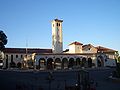
Rookwood was served by a rail spur from the main line from 1867 until 1948. Mortuary stations served each of the three sections of the necropolis, with a fourth at the main junction and a fifth on Regent Street adjacent to Central station. The railway line construction began in November 1864 and from 1 January 1865, trains began their run into the cemetery. It stopped at prearranged stations on the journey from central Sydney to pick up mourners and coffins. Trains ran at 9.30 am and 3 pm. The trains that carried the mourners were known as 'unimproved Redferns'[10] There were two types of Hearse carriages used for the procession. One consisted of a four-wheeled van that carried up to 10 coffins on its upper and lower shelves. Each of these shelves was designed so it could open onto the platform. There were also eight-wheeled vans that could hold 30 coffins. Both of these vehicles were attached the back of the train for transporting to the cemetery. At the terminus inside the cemetery the coffins were unloaded using 'wheeled hand-propelled litters'[11] The rail line was used to convey funeral parties to Rookwood until 1948 when the expanded use of processions by road made it obsolete. The stations were offered to the Joint Committee of Necropolis Trustees for the price of £1 but due to maintenance costs the offer was rejected and the platforms within the cemetery were demolished. Cemetery Station No. 1[9] at the head of the rail spur was sold to Reverend Buckle for £100 in 1951 and was moved to Canberra in 1957 to become the All Saints Church, Canberra.[12]

Cultural references

[edit]

Notable interments

[edit]

Rookwood Cemetery has or had several notable interments, including three recipients of the Victoria Cross.

War graves

[edit]

As at June 2025, Rookwood Necropolis contains the graves of a total 711 Commonwealth service personnel that are registered by the Commonwealth War Graves Commission, 435 from World War I and 274 from World War II, besides three Dutch war graves.[16] The commission also erected a memorial to 132 Commonwealth service personnel of World War II who were cremated at Rookwood Crematorium and whose ashes remain here.[17]

Four Japanese Imperial Navy crewmen of midget submarines M-14 and M-21 who died in the World War II Attack on Sydney Harbour during 31 May–8 June 1942 were cremated with naval honours at Rookwood Cemetery.[18] The ashes were returned to Japan later that year.[19]

Sydney War Cemetery

[edit]

Within the grounds of Rookwood Cemetery is enclosed the CWGC's Sydney War Cemetery, whose entrance is on the west side on the necropolis railway. It was established in 1942 during World War II for service personnel and there are now 732 buried or commemorated by name here. Most of those buried here died at the Concord Military Hospital in Sydney. The British war graves within the cemetery are of servicemen who died as prisoners of war in Japanese hands and had been cremated; after the war, their ashes were brought to Sydney and buried here. Here is also buried a civilian employee of the Admiralty and there is one French war grave.[20]

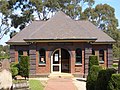
Within the entrance building is the New South Wales Cremation Memorial, which commemorates 199 service personnel of World War II who were cremated within the state of New South Wales and whose ashes were subsequently scattered or buried at places where commemoration by a CWGC memorial was not possible.[20]

Within the cemetery stands the Sydney Memorial to almost 750 personnel of the Australian Army, Royal Australian Air Force and Australian Merchant Navy who died in World War II in the eastern and southern regions of Australia and waters south of 20 degrees Latitude who have no known grave.[20]

Chapels

[edit]

Monuments and memorials

[edit]

Graves and mausoleums

[edit]

Buildings

[edit]

References

[edit]
[edit]
Revisions and contributorsEdit on WikipediaRead on Wikipedia
from Grokipedia
Rookwood Cemetery, officially the Rookwood , is Australia's largest cemetery and the largest in the , located in the Sydney suburb of , . Spanning approximately 314 hectares, it holds over 1 million interments (burials and ashes) as of 2023, accommodating around 80 religious denominations and serving as a chronicle of 's multicultural history. Established in response to the overcrowding of inner-city burial grounds in the 19th century, the site was selected in 1862 when 80 hectares of land at Haslem's Creek were purchased from the estate of Edward Cohen. The Necropolis Act of 1867 formalized its creation, and it officially opened on 1 January 1868, divided into sections for the Church of England, Roman Catholics, and non-denominational burials based on the 1861 census. By 1879, the cemetery had expanded to 313 hectares with additional land acquisitions, and its name was changed from Necropolis to Rookwood, possibly inspired by England's Brookwood Cemetery. A dedicated railway spur, operational from 1864 to 1948, facilitated funeral processions, with special mortuary stations and hearse carriages transporting coffins and mourners directly into the grounds. As of 2023, Rookwood is managed by Metropolitan Memorial Parks, a government-owned that amalgamated operations in July 2023 to ensure sustainable and services across the region. The site features iconic structures like the All Souls Chapel and the Chapel of Eternal Rest, alongside modern facilities for ceremonies, reflecting its evolution from a Victorian-era garden cemetery to a contemporary memorial park. It includes war graves sections, such as the Sydney War Cemetery established in 1942, commemorating from and beyond. As a heritage-listed , Rookwood preserves elaborate monuments, diverse cultural memorials, and natural , underscoring its role in Australian social and architectural .

Description and Location

Site Overview

Rookwood Cemetery, located in Sydney's , is an active Victorian-era spanning 286 hectares, making it the largest cemetery in the . Established to serve the growing population of , it functions as a multicultural burial ground that continues to accommodate interments today, blending historic Victorian landscapes with modern memorial practices. The site features diverse flora, including 368 indigenous plant species and areas of endangered vegetation such as the Cooks River Castlereagh Ironbark Forest, contributing to its ecological significance alongside its cultural role. Since its opening, Rookwood has recorded over 1 million interments, including burials and ash placements, encapsulating Australia's diverse religious and cultural history through graves representing various communities and faiths. The cemetery is divided into sections allocated to different denominations, reflecting the demographic composition of 19th-century . Rookwood holds heritage status, having been listed on the State Heritage Register on 2 April 1999 for its historical, cultural, and environmental value. It is managed by Metropolitan Memorial Parks, a government-owned established in July 2023, under the Crown Land Management Act 2016, ensuring ongoing preservation and operation as a public dedicated land. As of 2025, the cemetery is approaching full capacity in some sections, with projections indicating exhaustion by 2027, prompting discussions on sustainable practices.

Layout and Denominations

Rookwood Cemetery is organized into distinct denominational areas to accommodate the diverse religious and cultural needs of Sydney's multicultural population, with over 18 dedicated religious sections including Anglican, Catholic, Jewish, and Muslim zones, alongside areas for general burials. These sections are subdivided into more than 100 specific areas, each tailored to particular faiths or community groups, such as Assyrian Christian, Estonian, Latvian, Lutheran, Methodist, and Presbyterian, reflecting the cemetery's role as a resting place for representatives of over 90 different religious and cultural groups. The cemetery's management is divided between Metropolitan Memorial Parks (MMP), which oversees non-Catholic sections and land stewardship through the Metropolitan Memorial Parks Land Manager (MMPLM), and the Catholic Metropolitan Cemeteries Trust (CMCT) for Catholic areas. This structure follows the 2023 formation of MMP from previous trusts, including the Rookwood General Cemeteries Reserve Trust (RGCRT). As of 2025, the site is further divided into geographical management units to facilitate coordinated planning for burial allocations, conservation, and public access. The layout features a systematic grid of numbered avenues and paths, such as Hawthorne Avenue and William Drive, that provide structured navigation across the expansive grounds, interspersed with themed gardens like the Rookwood Memorial Gardens. Multicultural elements are integrated through dedicated shrines, including the Circle of Love, a circular space honoring universal themes of affection and loss, and the Jewish Memorial (also known as the Martyrs Memorial), which commemorates victims of the Nazi with inscribed names of extermination camps. Accessibility is prioritized through an extensive network of paths designed for and vehicular use, complemented by comprehensive signage that directs visitors to specific sections, chapels, and facilities. Provisions extend to all 89 religions and beliefs represented in Sydney's community, allowing for customized burial practices within designated zones while adhering to health and safety standards.

History

Establishment and Early Development

In 1862, the New South Wales government purchased approximately 80 hectares (200 acres) of land at Haslem's Creek, now part of Rookwood, from the estate of Edward Cohen to establish a new cemetery, driven by the overcrowding of inner-city burial grounds in amid rapid urban expansion. This initiative addressed acute burial space shortages, reflecting broader 19th-century reforms that promoted extramural cemeteries to mitigate risks from urban graveyards filled beyond capacity. Designed as a , the site embodied Victorian ideals of planned, garden-like burial spaces separated from the city, facilitating hygienic practices and accommodating 's growing population. The first burial occurred on 5 January 1867, when the remains of John Whalan, an 18-year-old Irish pauper who had recently arrived in the , were interred, predating the official opening. The Act took effect on 1 January 1868, marking the cemetery's formal opening and initial operations under government oversight. Early infrastructure focused on dividing the land into dedicated sections: 21 hectares for the (Anglican), 14 hectares for Catholics, and 23 hectares for non-denominational (general) burials, prioritizing equitable allocation based on the 1861 demographics. These arrangements underscored the cemetery's role in supporting diverse religious communities while advancing sanitary standards through organized, peripheral interments. During the , initial expansions responded to increasing demand, with additional land acquisitions beginning to extend the site's capacity beyond the original boundaries. By , a further 233 hectares were purchased, solidifying Rookwood's foundational growth and its adaptation to Sydney's urban pressures. This early development phase highlighted the cemetery's evolution from a provisional solution to a comprehensive necropolis, integral to 19th-century efforts in public health and metropolitan planning.

Expansions and Name Changes

Following its initial establishment, Rookwood Cemetery underwent significant expansion in 1879 when an additional 233 hectares were acquired from the former Hyde Park estate, bringing the total site to approximately 313 hectares to meet the increasing demands of Sydney's growing . This enlargement reflected the cemetery's role as a major , with ongoing internal developments in the early allowing it to accommodate surges in interments driven by urban booms. The cemetery's name evolved alongside local administrative changes. Originally designated as the at Haslem's Creek, it was renamed Rookwood Cemetery in , aligning with the nearby suburb's adoption of the Rookwood name in 1878 to distance itself from associations with death. In 1913, the suburb was renamed —a portmanteau of the mayors' surnames Lidbury and Larcombe, combined with references to former localities like Lidfield—though the cemetery retained its Rookwood designation. In the , Rookwood adapted to shifting burial practices and historical events. In 1926, four acres were allocated within the site for a crematorium operated by the Cremation Company, marking the integration of facilities as an alternative to traditional burial amid rising demand. The cemetery also responded to the impacts of the two world wars by dedicating sections for war graves, facilitating the interment of hundreds of service personnel. The 2014 Plan of Management guided Rookwood's operations toward long-term sustainability and preservation, dividing the site into 24 management units to balance needs with heritage conservation, promoting renewable interment and to extend capacity beyond projected limits, and emphasizing ecological protection of native vegetation and significant trees while funding perpetual maintenance through structured pricing. Subsequent developments include the July 2023 amalgamation of management under Metropolitan Memorial Parks and the return of operations to its control in July 2025. Ongoing expansions as of 2025, such as new sites in the Chinese and Muslim sections, continue to address capacity needs.

Transportation History

Mortuary Railway Line

The Mortuary Railway Line, also known as the Rookwood Necropolis railway line, was constructed as a branch from the to main line to facilitate the transport of remains and mourners to the newly established Rookwood Cemetery. The route for the was surveyed in December 1865. Although the first recorded operated in April 1864 using preliminary arrangements, the line officially opened in April 1867, with dedicated services commencing following the cemetery's consecration. Construction of the dedicated mortuary stations occurred between 1867 and 1869, with the Regent Street Mortuary Station in (designed by government architect James Barnet in Gothic Revival style using Pyrmont sandstone) completed in March 1869 and officially opened on 29 June 1869; a twin station at Rookwood followed in August 1869. The line operated exclusively for funeral purposes from 1867 to 1948, providing a dignified and efficient means of conveyance during an era when horse-drawn s were common but insufficient for Sydney's growing population. Regular s ran twice daily on weekdays and Sundays, departing from Mortuary Station at times such as 9:15 a.m. and 3:30 p.m., while special trains could be hired for larger processions; these consisted of locomotives pulling hearse carriages capable of holding 10 to 30 coffins, along with passenger cars for mourners. Infrastructure at the stations included dedicated hearse docks for loading coffins directly from road vehicles, sidings for train assembly, and ornate receiving houses to accommodate funeral parties, reflecting Victorian . The 4.8-kilometer branch connected to the broader rail network at (formerly Haslem's Creek), enabling seamless integration with Sydney's suburban services. The railway's decline began in the interwar period due to the increasing popularity of motor vehicles and improved road infrastructure, which allowed hearses and mourners to travel directly by or bus. By 1938, full operations from the Regent Street Mortuary Station had ceased, with services limited to weekends and rerouted through ; the line was fully withdrawn on 3 April 1948, after which the infrastructure was sold in 1952 and largely dismantled. This shift marked the end of rail-based funerals in , though the line's pioneering role in dedicated cemetery transport influenced Australian practices and highlighted the integration of railways in urban burial logistics during the 19th and early 20th centuries.

Modern Access and Infrastructure

Rookwood Cemetery is primarily accessed through its main entrance on Hawthorne Avenue in Rookwood, , with additional entry points including Sheehy Avenue and the East Street entrance, which provides direct access to the Catholic section's administrative facilities. Parking is available near the administration building, function centre, and , supporting both vehicular visitors and processions. Internal roads, such as Necropolis Drive and Centenary Drive, are paved and maintained for safe navigation across the site's approximately 286 hectares. Following the closure of the historic mortuary railway line in 1948, infrastructure has been modernized to emphasize road-based access integrated with Sydney's network. Visitors can travel by train to Lidcombe Station, approximately 2 kilometers away, and connect via bus route 920, which operates every 15-30 minutes and delivers passengers directly to the cemetery gates in about 27 minutes. Post-1948 developments include extensive paving of internal roadways, expanded parking areas, and improved signage to aid orientation among the cemetery's denominational zones, with ongoing upgrades to drainage and pathways enhancing operational efficiency and visitor safety. The cemetery's operational support includes on-site administrative offices open from 8 a.m. to 4 p.m. on weekdays and limited hours on weekends, handling inquiries, bookings, and records via phone or in-person consultations. facilities enable routine upkeep of grounds, monuments, and infrastructure, including recent projects for road resurfacing and safety barriers. services feature downloadable site maps for self-navigation and organized guided tours, such as monthly walking and driving excursions led by the Friends of Rookwood, providing historical context without requiring prior booking. As a state heritage-listed site since 1997, Rookwood Cemetery serves a growing role, offering designated walking trails through its multicultural burial grounds and heritage areas for educational exploration of Sydney's . These trails, combined with self-guided historic walks in sections like the Catholic Mortuary 1, attract visitors interested in architecture, notable interments, and cultural narratives, with free and paid tours emphasizing the site's evolution as a multicultural necropolis.

Facilities and Structures

Chapels

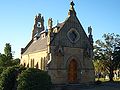
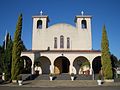
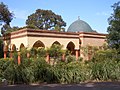
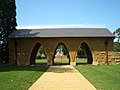
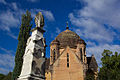
Rookwood Cemetery features several chapels serving as venues for services, ceremonies, and viewings across its denominational sections. These structures accommodate diverse religious rites, with capacities varying to suit intimate gatherings or larger processions, reflecting the cemetery's multi-faith since its establishment. The Chapel of St. Michael the Archangel, located in the Catholic section, stands as one of the cemetery's earliest and most prominent religious buildings. Designed in the mid-1880s by architects Sheerin and and constructed from Pyrmont sandstone around 1886–1890, it exemplifies with ornate details including pointed arches, ribbed vaults, and a originally topped by a statue of the archangel. The chapel's interior features windows depicting biblical scenes, an elaborately carved altar, and historical plaques commemorating early burials, creating a solemn space for Catholic rites. As part of the cemetery's heritage-listed core, it has undergone preservation efforts to maintain its Victorian-era integrity, including repairs to sandstone facades and roof elements under the State Heritage Register. In the Anglican section, the All Souls Chapel, built in 1954, provides a contrasting mid-20th-century venue with styling. Characterized by streamlined geometric forms, a copper-clad dome, and modern interiors equipped for contemporary services, it supports both religious and secular funerals with audiovisual capabilities for . Renovated in recent years to blend historical charm with updated facilities like and accessible entryways, the chapel accommodates up to 150 mourners and highlights the evolution from traditional horse-drawn processions in the to electric hearses and digital memorials today. The Sacred Heart Chapel, also in the Catholic section and dating to circa 1928, serves as an additional space with simpler Gothic influences, including arched windows and a modest for ongoing masses. Complementing these, a Jewish chapel was constructed by in the Jewish section to facilitate traditional , though specific architectural details remain less documented in . Overall, these s underscore Rookwood's role in preserving denominational practices while adapting to modern funeral needs, protected under the cemetery's broader heritage status.

Other Buildings and Crematorium

The Rookwood Necropolis features several key non-chapel structures essential to its operations, including gatehouses and administrative facilities. The Manager’s Lodge, constructed in the mid-1860s and designed by Colonial Architect James Barnet, serves as both a and residence for cemetery management, exemplifying early Victorian-era with its functional yet ornate design. By the 1890s, additional gatehouses and cottages had been added to support expanding operations, including an entrance lodge on Sutton Road in Victorian Gothic style, characterized by a prominent that has occasionally been mistaken for a . Administrative offices, such as the Jewish Trust opened in 2011 within the Jewish section and the Muslim in the Muslim section, handle denomination-specific records and services, while a former Anglican office from the 1940s era supported war administration. Maintenance sheds, including the Rookwood General Reserve Trust (RGCRT) Monuments and Maintenance Staff Shed in the Anglican Unit 5, provide storage and workspaces for and monument care. The Rookwood Memorial Gardens Crematorium, integrated within the broader grounds, represents a pivotal development in Australian funerary practices. Opened in as the first crematorium in and the oldest continuously operating one in , it was designed by architect Frank Bloomfield in a Mediterranean style, featuring lush gardens, a central , concentric paths, and shady trees to create a serene environment. The facility was established on land leased to the New South Wales Cremation Company Limited starting in 1926, with four acres initially set aside for its operations, marking it as the second crematorium in the country at the time of full implementation. In July 2025, operations returned to full management under Metropolitan Memorial Parks. Its walls and niche s, such as those in the Harmony Rose Garden with elegant white roses and the Memorial —a and wood structure with attached plaques in a memorial garden—offer above-ground options for cremated remains, accommodating both individual and communal interments across various denominational sections. The crematorium's design facilitates seamless integration with the surrounding burial grounds, allowing for memorial services that transition from to garden scattering or niche placement within the 286-hectare site. Many of its Victorian-era structures, including gatehouses and early administrative buildings, are protected under a Permanent Conservation Order covering 81 hectares, as well as listing on the State Heritage Register (Item 00718) under the Heritage Act 1977 (NSW), ensuring the preservation of original fabric, landscapes, and historical elements like serpentine drains and sandstone receiving houses from the 1860s and 1870s. These protections emphasize the site's role as Australia's largest remaining operating Victorian cemetery, prioritizing maintenance of its architectural and cultural integrity.

Monuments and Memorials

General Monuments

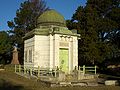
Rookwood Cemetery features a diverse array of general monuments, including Victorian-era obelisks, sculptures, and family vaults primarily located in the Anglican and Jewish sections. These structures, constructed from materials such as and , reflect the cemetery's role as a repository of 19th-century and practices, with many originating from early colonial periods. Among the notable examples are grand mausoleums built for early settlers, such as the Frazer Mausoleum, erected in 1894 for Irish-born politician and businessman John Frazer. Standing over 10 meters tall with a domed roof, bronze doors, stained-glass windows, and Pyrmont construction, it serves as a prominent housing seven family members. Floral tributes and garden memorials are also prevalent, incorporating symbolic plantings in Victorian gardenesque layouts to honor the deceased. Artistically, these monuments embody 19th- and 20th-century styles, including High Victorian Byzantine Gothic in structures like the Frazer Mausoleum and classical influences drawn from botanic garden designs with circular parterres and native plantings. Edwardian elements appear in later headstones and vaults, showcasing evolving societal tastes in memorialization. Maintenance of these monuments is overseen by Metropolitan Memorial Parks through a comprehensive Conservation Management Plan, which prioritizes protection against and via regular audits, material repairs, and heritage inventory updates under the NSW Heritage Act 1977. Recent efforts include the 2024-2025 restoration of the Frazer Mausoleum, which was highly commended at the 2025 National Trust (NSW) Heritage Awards for its preservation techniques.

Specialized Memorials

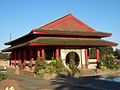
Rookwood Cemetery features several specialized memorials dedicated to specific ethnic, community, or tragic groups, reflecting the diverse heritage of Sydney's population. These structures serve as focal points for communal remembrance, often incorporating symbolic elements tied to cultural traditions. The Jewish Memorial, also known as the Martyrs Memorial, commemorates the victims of the Nazi during , with the names of twenty infamous extermination camps engraved on its surface. Located in the Jewish section, this monument was established to honor the six million murdered by the Nazis and hosts annual ceremonies where prayers are recited and survivors' stories are shared. The Circle of Love is a garden dedicated to stillborn infants and children who died in early infancy, honoring over 20,000 such interments in unmarked graves at Rookwood from the mid-1920s to the mid-1970s. Situated in a serene landscaped area, it allows families to place stars or plaques, providing a space for private reflection and public acknowledgment of infant loss. The Memorial and pays tribute to sailors and merchant seafarers lost at sea, featuring a roofed brick and wood structure within a memorial garden, complete with an attached plaque detailing naval losses. This site in the Independent section underscores the sacrifices of non-combat maritime personnel and includes niches for ashes. Ethnic community shrines include the Quong Sing Tong Shrine, erected in 1877 for the Chinese community, which stands as one of the earliest such dedications in the cemetery and symbolizes ancestral reverence through its pavilion design. In the Armenian section, the Armenian Genocide Memorial, a khachkar-inspired structure, commemorates the 1.5 million victims of the 1915 , blessed in recent years to serve present and future generations. Disaster memorials, such as the large communal grave site for the 1936 Disaster victims—where 12 lives were lost in a launch —provide collective burial and remembrance for those perished in accidents. These specialized memorials are clustered within Rookwood's denominational zones, such as Jewish, Independent, Chinese, and Armenian areas, facilitating targeted access and maintenance. Annual commemorations, including services and blessings, draw community members for rituals that preserve cultural narratives. As sites for reflection, these memorials educate visitors on Australia's , highlighting themes of loss, resilience, and diversity through guided tours and public events.

Burials and Graves

Types of Graves and Mausoleums

Rookwood encompasses a diverse array of types, reflecting its evolution as a multicultural ground since its establishment in 1867. Traditional monumental graves, featuring upright headstones and elaborate structures, dominate the 19th-century sections, while cemeteries with simpler, uniform markers emerged in the to promote ordered landscapes. Underground vaults and crypts provide additional options for s, particularly in designated family plots. Columbaria for the interment of cremated remains are prevalent, offering niches in landscaped settings for ashes. Mausoleums at Rookwood include multi-level family tombs designed for multiple interments, such as the Catholic Mausoleum of the , constructed in a modern style, and the nearby Holy Innocents Crypts dedicated to children's remains. Other examples encompass the Independent Trust Mausoleum from 1999 and historic structures like the Frazer Mausoleum, built from Pyrmont sandstone in the late 19th century. Over 600,000 graves and 200,000 cremation niches exist across the site, with numerous preserved mausoleums contributing to its heritage value. The cemetery's burial practices have shifted from the elaborate, gardenesque designs of the —characterized by large, ornate monuments—to more restrained modern plots emphasizing simplicity and accessibility. This transition aligns with broader 20th-century trends toward rationalist cemetery layouts, including "slab and desk" graves from the that facilitate maintenance. Multicultural adaptations are integral to Rookwood's structure, with dedicated sections accommodating diverse rites, such as Islamic lawn graves and niches in the Muslim areas, Chinese monumental plots featuring headstones with photographs, and facilities supporting Hindu cremation practices within the broader memorial gardens. Jewish sections include adaptations like the Beit Tephilla chapel for traditional funerals, underscoring the necropolis's role in serving Sydney's evolving demographic.

War Graves and Sydney War Cemetery

Rookwood Necropolis contains numerous Commonwealth war graves scattered across its various denominational sections, reflecting the cemetery's role in honoring military personnel from multiple conflicts. There are 393 burials from the First World War and 253 from the Second World War, primarily of Australian service members but also including individuals from other Commonwealth nations. Among these Second World War burials are the cremated remains of 11 unidentified Allied prisoners of war repatriated from Japanese camps in after the conflict. These graves are maintained by the (CWGC), ensuring uniformity in headstone design and ongoing preservation efforts, including regular cleaning and repair of memorials to withstand environmental wear. Within the necropolis, the Sydney War Cemetery was established in 1942 when the Australian government acquired land specifically for interring military personnel who died during the Second World War. The site was formally transferred to the CWGC in December 1946 and now holds 732 burials and commemorations from that war, predominantly Australians, alongside smaller numbers from (11), the (10), (8), (4), (3), (2), and single burials from , , the , and . In addition, it includes 12 post-war burials: 11 from the and one from the . The CWGC continues to oversee the cemetery's maintenance, with headstones featuring standardized inscriptions that record rank, name, unit, date of death, and age, preserving the identities and sacrifices of those interred. The Sydney War Cemetery features prominent memorials that symbolize collective remembrance. At its center stands the Cross of Sacrifice, a CWGC-designed monument erected to honor all who died in military service, particularly those without individual graves. Adjacent to it is the Stone of Remembrance, a unique feature in Australian war cemeteries, intended originally for transport to overseas sites but retained here as a symbol of egalitarian commemoration for all fallen soldiers regardless of rank. These structures, constructed from durable stone, undergo periodic conservation to prevent deterioration, ensuring their longevity into the 21st century. Annual commemorative services, including dawn ceremonies, are held at the Sydney War Cemetery, drawing veterans' groups, families, and community members to pay tribute through wreath-laying and moments of silence. The site was added to Australia's Register of the National Estate in 1986, underscoring its cultural and historical significance, with ongoing CWGC efforts focused on headstone preservation rather than new interments, as the cemetery remains largely complete following its post-war designations.

Notable Interments and Cultural Impact

Prominent Burials

Rookwood Cemetery serves as the final resting place for numerous influential figures from Australian history, spanning politics, arts, military service, and business. Among its prominent burials are political leaders who shaped governance, entertainers who defined Australian cultural identity, military heroes honored with the , and pioneers representing diverse communities. These interments highlight the cemetery's role as a repository of national significance since its establishment in (official opening 1868).

Political Figures

Joseph Cahill, from 1952 to 1959, was buried in the Catholic section of Rookwood Cemetery following his death on 22 October 1959 from a . As the only NSW to die in office, his drew thousands, reflecting his legacy in infrastructure development like the planning and initiatives. Louisa Lawson, a pioneering and newspaper proprietor who founded The Dawn in 1895 to advocate for , was interred in the Anglican section in 1920 after her death on 12 August aged 72. Mother of writer , she played a key role in the Australian movement and was a vocal campaigner for social reforms.

Entertainment and Arts

Peter Dawson, renowned and recording artist who sold millions of records in the early 20th century, including renditions of "," was buried in the Presbyterian section (5F, Row 23, Grave 2196) after dying of on 27 September 1961 at age 79. Born in , he performed globally and composed music that captured Australian spirit, making him a household name through gramophone recordings. Roy Rene, iconic comedian known as "Mo McCackie" in and radio, was laid to rest in the Jewish section following his death from atherosclerotic heart disease on 22 November 1954 at age 62. His irreverent humor entertained generations, with a of over 60 cars underscoring his popularity as a pioneer of Australian entertainment.

Military Honors

Rookwood Cemetery holds the graves of three recipients, symbolizing its connection to Australia's history. Sergeant John Paton, awarded the VC for gallantry during the Indian Mutiny at on 16 November 1857 while serving with the 93rd Regiment, died on 1 April 1914 in and was buried with full honors in the cemetery's west section. Sergeant John Woods Whittle, who earned the VC for rescuing wounded comrades under heavy fire at Boursies, , on 9 April 1917 with the 12th Battalion AIF during , passed away from a cerebral hemorrhage on 2 March 1946 at age 63 and was interred in Rookwood. A Tasmanian native, he also received the and continued military service post-war. Captain Richard Been Stannard, recipient of the VC for leadership in evacuating personnel from Namsos Wharf, , between 28 April and 2 May 1940 while in the Royal Naval Reserve during , died on 22 July 1977 in and was cremated and interred at Rookwood Crematorium. His actions saved lives amid intense enemy fire, earning him recognition as a naval .

Other Notables

The cemetery's first recorded burial was that of John Whalan, an 18-year-old pauper, on 7 January 1867 in what became the Anglican section, marking the site's inaugural interment as Haslem's Creek Cemetery before its renaming. Sir , influential businessman and co-founder of Ansett Airlines who to prominence in and after emigrating from in 1949, was buried in the Jewish section (23E) after dying of cancer on 25 June 1999 at age 75. His contributions to Australian industry included expanding and freight services, though his career involved controversies over business practices. Mei Quong Tart, a prominent Chinese-Australian merchant, philanthropist, and tea house owner who bridged cultures in late 19th-century , was interred in following his death at age 53 from injuries sustained in an attack at his office. As a leader in the Chinese community, he advocated for immigrant rights and hosted events that promoted cultural exchange.

Cultural References and Heritage Significance

The Australian colloquialism "as crook as Rookwood," meaning extremely ill or in poor condition, originated in the 19th century and draws from the cemetery's remote location and association with death, evoking the idea of being at death's door. This phrase, documented in early slang, reflects perceptions of Rookwood as a distant and foreboding place during its formative years. It has persisted in popular usage, highlighting the cemetery's embedding in local linguistic culture. Rookwood Cemetery serves as a prominent site for tourism and educational programs, attracting visitors through guided tours led by volunteers on the first Sunday of each month from to , which explore its architectural and historical features. Ghost tours capitalize on its Victorian-era ambiance and reported hauntings, offering nighttime walks that blend with factual narratives of its past. The site's multicultural composition, representing over 90 nationalities, supports studies in immigration and social diversity, making it a resource for understanding Australia's demographic evolution. In 2017, to mark its 150th anniversary, Rookwood hosted extensive events including historic walking tours, talks, grave-digging demonstrations, and the "HIDDEN" outdoor sculpture exhibition featuring 40 installations amid the graves, drawing thousands to engage with its legacy. In 2024, Rookwood Crematorium returned to management by Metropolitan Memorial Parks. As of 2025, the cemetery faces a space crisis, with full capacity expected by 2027 and some sections (e.g., Greek Orthodox, Muslim) depleting faster. As Australia's oldest continuously operating Victorian-era cemetery, established in , Rookwood holds profound heritage significance, recognized for its scale as one of the world's largest 19th-century burial grounds and its role in preserving through diverse interments that chronicle waves of and cultural shifts. Its status as a place of outstanding cultural and environmental heritage underscores its value in documenting colonial and modern Australian narratives, from early to global migrant communities. Rookwood remains actively operational, with ongoing burials and cremations reflecting its continued relevance; in the 2014-15 financial year, the West Central region including Rookwood accounted for approximately 4,770 burials and 5,679 cremations, comprising over 40% of metropolitan Sydney's services. Recent expansions, such as new burial lawns in 2023, have provided temporary relief, but as of 2025, the cemetery is projected to reach capacity by 2027 amid a broader burial space crisis in Sydney. The cemetery has appeared in media, including interruptions during filming of the 2022 series Last King of the Cross due to a funeral procession, and in literature such as Chris Nyst's 2005 novel Crook As Rookwood, which uses the site as a symbolic backdrop for crime narratives.

References

Add your contribution
Related Hubs
User Avatar
No comments yet.