Recent from talks
Nothing was collected or created yet.
Rose window
View on Wikipedia


Rose window is often used as a generic term applied to a circular window, but is especially used for those found in Gothic cathedrals and churches. The windows are divided into segments by stone mullions and tracery. The term rose window was not used before the 17th century and comes from the English flower name rose.[1]
The name "wheel window" is often applied to a window divided by simple spokes radiating from a central boss or opening, while the term "rose window" is reserved for those windows, sometimes of a highly complex design, which can be seen to bear similarity to a multi-petalled rose. Rose windows are also called "Catherine windows" after Saint Catherine of Alexandria, who was sentenced to be executed on a spiked breaking wheel. A circular window without tracery such as are found in many Italian churches, is referred to as an ocular window or oculus.
Rose windows are particularly characteristic of Gothic architecture and may be seen in all the major Gothic cathedrals of Northern France. Their origins are much earlier than Gothic architecture, however, and rose windows may be seen in various forms throughout the Medieval period. Their popularity was revived, with other medieval features, during the Gothic revival of the 19th century, so that they are seen in Christian churches all over the world.[2]
Style
[edit]- Oculi: These could be open or blind, could be glazed or filled with thin alabaster. During the late Gothic period very large ocular windows were common in Italy, being used in preference to traceried windows and being filled with elaborate pictures in stained glass designed by the most accomplished Late Medieval and Early Renaissance designers including Duccio, Donatello, Uccello and Ghiberti.[3][4]
- Wheel Windows: These windows had a simple tracery of spokes radiating either from a central boss or from a central roundel. Popular during the Romanesque period and Gothic Italy, they are found across Europe but particularly Germany and Italy.[5] They also occur in Romanesque Revival buildings of the 19th and 20th centuries.
- Plate Tracery: Rose windows with pierced openings rather than tracery occur in the transition between Romanesque and Gothic, particularly in France and most notably at Chartres. The most notable example in England is the north transept window, known as the "Dean's Eye" in Lincoln Cathedral. These windows are occasionally found in 19th-century Revival buildings.[6]
- Early Gothic: Rose windows with tracery comprising overlapping arcs like flower petals, circular and square shapes. This form occurs in Northern France, notably at Laon Cathedral, Italy and England. This style of window is popular in Gothic Revival architecture for the similarity that it has to a flower and is also utilised with specific reference to Our Lady of the Rosary.
- Rayonnant Gothic: The rose windows are divided by mullions radiating from a central roundel, overlapping in a complex design, each light terminating in a pointed arch and often interspersed with quatrefoils and other such shapes. Many of the largest rose windows in France are of this type, notably those at Paris and in the transepts of St Denis. An example in England is that in the north transept of Westminster Abbey. This style occurs widely in Gothic churches and is also widely imitated in Gothic Revival buildings.[7]
- Flamboyant Gothic: The style is marked by S-curves in the tracery causing each light to take on a flamelike or "flamboyant" shape. Many windows are composed of fairly regularly shaped lights the richness of design dependent on the multiplicity of parts. Good examples are at Beauvais Cathedral and Sainte-Chapelle, Paris. Some Late Gothic rose windows are of immense complexity of design, often using elements of the Gothic style in unexpected ways. A magnificent example is that of the façade of Amiens Cathedral. Although the design usually radiates from a central point, it may not be symmetrical about each axis. This may be seen in the Flamboyant Decorated Gothic window called the "Bishop's Eye" at Lincoln Cathedral in which the design takes the form of two ears of wheat.
- Renaissance: The Renaissance made a break with the Gothic style, and a return to the Classical. Plain untraceried oculi were sometimes employed, either in Classical pediments[8] or around domes as at the Pazzi Chapel, Florence.[9]
- Baroque: The Baroque style saw much greater use of ocular windows, which were not always circular, but frequently oval or of a more complex shape. They were untraceried or crossed by mullions of very simple form but were often surrounded by ornate carving. The purpose of such windows was the subtle illumination of interior spaces, without resorting to large windows offering external visibility. They rarely form a dominant visual element to either the façade or the interior as do the great Gothic windows.[10] However, there are some notable exceptions, in particular the glorious burst of light which pours through the oval alabaster window depicting the Holy Spirit in the Reredos behind the High Altar of St. Peter's Basilica, Rome.[11][clarification needed]
- Modern: Modern circular windows, which are most frequently of a simple ocular type, have an eclectic range of influences which includes abstract art, ship's portholes and the unglazed circular openings of Oriental architecture.
History
[edit]Origin
[edit]The origin of the rose window may be found in the Roman oculus. These large circular openings let in both light and air, the best known being that at the top of the dome of the Pantheon. Geometrical patterns similar to those in rose windows occur in Roman mosaics.
The German art historian Otto von Simson (1912-1993) considered that the origin of the rose window lay in a window with the six-lobed rosettes and octagon which adorned the external wall of the Umayyad palace Khirbat al-Mafjar near Jericho, built between 740 and 750 CE. This theory suggests that crusaders brought the design of this attractive window to Europe, introducing it to churches. But the decorative pattern for rose and, independently, the tracery, are very present in vestiges of the early Christian architecture, Byzantine architecture, and especially in Merovingian art, and Visigothic architecture before the Muslim conquest of Spain. Half roses are also known, as with the church of San Juan Bautista in Baños de Cerrato. The scarcity and the brittleness of the vestiges of this time does not make it possible to say that the complete rose window in tracery did not exist in the early Middle Ages.
-
The oculus of the Pantheon, Rome
-
Roman mosaic. Rome
-
Common Visigothic decoration. Crypt in Valencia Cathedral, 6th–7th century
-
Visigothic design of roses, pre-Islamic, from basilica of Saint Vincent of Lérins of Cordoba, 6–7th century
-
Merovingian illumination in Missale Gothicum, towards 700. The two large roses are six-lobed
-
Visigothic window with stone tracery, Church of San Juan Bautista, Baños de Cerrato, 7th century
In Early Christian and Byzantine architecture, there are examples of the use of circular oculi. They usually occur either around the drum of a dome, as at the Church of the Holy Sepulchre, Jerusalem, or high in the end of a gable of low-pitched Classical pediment form, as at Sant'Agnese fuori le mura, Rome, and Torcello Cathedral.[12][page needed]
-
Oculus of Santa Maria Maggiore, Rome, 5th century (decoration is later)
-
Baptistery of St. John of Poitiers, France, 6-7th century
-
Oculi of Sant'Agnese fuori le mura
-
Torcello Cathedral, Venice
-
Aquileia Basilica, Italy, 11th century
A window of the 8th century, now in Venice, and carved from a single slab, has alternating tracery-like components of two tiers of four lancets separated by three oculi. Many semicircular windows with pierced tracery exist from the 6th to the 8th century, and later in Greece.[13][page needed]
Small circular windows such as that at S. Agnese and Torcello as well as unglazed decorative circular recesses continued to be used in churches in Italy, gaining increasing popularity in the later Romanesque period.
The windows of Oviedo
[edit]In the vicinity of Oviedo in Spain are several churches of the late 9th and early 10th century which display a remarkable array of windows containing the earliest examples of roses windows outside the Byzantine Empire. The designs closely resemble the motifs found on the Byzantine relief carvings of marble sarcophagi, pulpits and well heads and pierced decorations of screens and windows of Ravenna and Constantinople. The church of San Pedro de Nora has at its apsidal end a trio of rectangular windows with pierced decoration of two overlapping circles, the upper containing a Greek cross, the window being divided by the circles and the arms of the cross into numerous sections like tracery "lights".
In another of these churches, San Miguel de Lillo, is the earliest known example of an axially placed oculus with tracery. Several such windows of different sizes exist, and decoration of both Greek Cross and scalloped petal-like form occur, prefiguring both wheel and rose windows.
-
San Miguel de Lillo, Oviedo, Spain. Towards 850
-
San Miguel de Lillo, detail
-
San Miguel de Lillo, detail
-
Rear of San Pedro at Nora, showing windows with double circle and Greek cross.
Romanesque Circular windows
[edit]Circular windows and decorative circular recesses are a feature of many Romanesque churches and cathedrals, particularly in Germany and Italy where the style existed for a prolonged period, overlapping the development of Gothic in France and its arrival with French architects in England.
In Germany, Worms Cathedral, has wheel windows in the pedimental ends of its nave and gables, very similar to the Early Christian Basilica of S. Agnese in Rome. The apsidal western end has a central wheel window with smaller oculi in each face. The Church of the Apostles, Cologne has an array of both ocular and lobed windows forming decorative features in the gables and beneath the Rhenish helm spire. The octagonal dome has a ring of oculi with two in each of the curved faces.[13]

In Třebíč, Czech Republic, is the 12th- and 13th-century Romanesque style Basilica of St Procopius with apsidal windows similar to those at Worms, but in this case the openings are filled with tracery of a Gothic form, clearly marking the transition to a new style.
In Italy, the use of circular motifs in various media was a feature of church facades, occurring on Early Christian, Romanesque, Gothic, Renaissance and Baroque churches, a well-known example being those great circles in polychrome marble which complement the central circular window on Alberti's Early Renaissance façade at Santa Maria Novella in Florence.[14] Oculi were also typically used in the drums supporting domes and as upper lights in octagonal baptisteries such as that at Cremona.
Romanesque facades with oculi include San Miniato al Monte, Florence, 11th century, San Michele, Pavia, c. 1117, and Pistoia Cathedral, 1150. As the windows increased in size in the later Romanesque period, wheel windows became a standard feature of which there are fine examples at San Zeno Maggiore, Verona and Monza Cathedral.[13]
On the Romanesque façade of Spoleto Cathedral there is a profusion of recessed and traceried oculi surrounding the central features of a rose window set within a square beneath a large mosaic of 1207.
In England there exist five Romanesque wheel windows, notably those at Barfreston and Castle Hedingham parish churches.
St Denis, Chartres, Mantes, Laon and Paris
[edit]

The transition from the Romanesque style to the Gothic was not clear cut, even at the Abbey of St Denis, to the north of Paris, where the Abbot Suger, between 1130 and 1144, gathered the various newly emerging features of Gothic into a single building, thereby “creating” the Gothic style.[15]
Suger's original rose window in the prototype Gothic façade of St Denis probably pre-dates many of the remaining circular windows in Romanesque buildings such as those in England, at Trebic and Spoleto and that in the façade at Speyer.
Suger's window was not distinctively Gothic in its appearance. It no longer has its original form, but a mid-19th-century drawing by the restorer Viollet-le-Duc indicates that it had a very large ocular space at the centre, the glass supported by an iron hoop, and surrounded by simple semicircular cusped lobes cut out of flat stone in a technique known as "plate tracery". The window now has Gothic tracery in it, possibly added by Viollet-le-Duc who was very concerned about the lack of stability of the whole façade, and having restored the towers, was impelled to demolish the northern one when it suddenly subsided.
Along with the simple wheel windows of the late Norman period in England, Germany and Italy, a large late 12th-century window still exists at Chartres Cathedral. This remarkable window combines a large roundel at the centre with the radiating spokes of a wheel window, surrounded by a ring of smaller “plate tracery” lights with scalloped borders. The window, depicting the Last Judgement, contains its original scheme of glazing and retains much of the original glass of 1215, despite suffering damage during World War II.[16]
Following the west window of Chartres, more daring Gothic windows were created at the Collegiate Church of Notre-Dame in Mantes and in the dynamically sculptural facade of Laon Cathedral (which also, unusually, has a rose window in its eastern end as well as in it transept ends). These windows have large lights contained in tracery of a semicircular form, like overlapping petals.

The window that is central to the well-known Gothic façade of Notre Dame, Paris, is of more distinctly Gothic appearance, with mullions in two bands radiating from a central roundel, each terminating in pointed arches. It was this window, completed about 1255, that set the pattern for many other rose window including those of the transepts at St Denis and the gigantic and complex window in the south transept at Notre Dame.[17]
At Chartres, the transepts roses follow the style of the original 12th-century rose, elaborating on the theme of contrasting forms. The south rose combines the wheel with circles and semicircles, while the north rose introduces square lights which, rotating around the centre, are all set at different angles, creating a kaleidoscopic effect of great energy.[18]
Further development
[edit]From the building of Chartres the dimensions of the rose window began to increase with the development of more elaborate window styles associated with Gothic architecture. By the middle of the 13th century, the rose had attained the greatest possible size – the entire width of the nave or transept, as seen in the transept roses at St Denis and Paris.
In the facades of St Denis, Chartres, Mantes, Laon and Paris, the rose was put under a circular arch. The next important development in its use for the Gothic style was to put it under a pointed arch, as was done in the Notre-Dame de Reims (after 1241), in the transepts as well as in the later roses of the facade. This form probably stemmed from the now destroyed St Nicaise, also in Reims.
The rose window was often placed above a row of vertical lights as the apex of the composition, the small corner "spandrels" between the rose and lower tier being filled by smaller lights of rose form, as in the transepts of St Denis and Notre Dame.
The last step in evolution of the Gothic style was to set the rose into a tier of vertical lights, of staggered height and surmount it by a tapering pointed light so that it became the centre of a vast window composition, covering the whole end of the transepts, as in Rouen or Beauvais Cathedrals. This sort of elaborate composition can also be seen at the east end of Milan Cathedral.
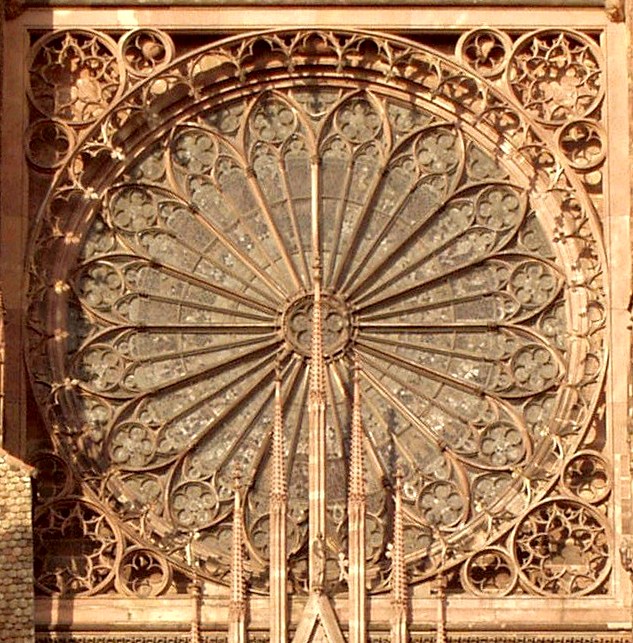
Rose windows were also set into square windows, the spandrels being pierced and filled with smaller lights as at Paris, 1257, or unpierced with sculpture, the form more common in Italy as at Spoleto and also seen in the north transept of Westminster Abbey and at Strasbourg Cathedral, (see pictured above).
Regional examples
[edit]Australia
[edit]A number of Australia's cathedrals have Gothic Revival rose windows including three by William Wardell at St Mary's Cathedral, Sydney and another at St Patrick's Cathedral, Melbourne which form the upper part of a very large seven-light window in the west end.
Ecuador
[edit]Two examples of rose windows are found in the National Basilica, built in 1893 and in the Santa Teresa Church, built in 1934. The cathedral in Cuenca, in the southern Andes, has a notable rose window.

England
[edit]In England, the use of the rose window was commonly confined to the transepts although roses of great span were constructed in the west front of Byland Abbey and in the east front of Old St. Paul's Cathedral in London.
The cathedrals of York, Lincoln, Canterbury, Durham and Oxford feature medieval rose windows.
Medieval Beverley Minster has an example of an Early Gothic wheel window with ten spokes, each light terminating in a cusped trefoils and surrounded by decorative plate tracery.
Later windows are to be seen at the nondenominational Abney Park Chapel in London designed in 1838–40 by William Hosking FSA; Holy Trinity Church, Barnes, London; St Nicholas, Richmond; and St Albans Cathedral by George Gilbert Scott.
At Christ Church Appleton-le-Moors, Yorkshire, the 19th-century architect J.L.Pearson appears to have taken as his inspiration the regional floral symbol of the white rose. This unusual plate-tracery window dating from the 1860s has been designed with five double sections like the two-part petals of a simple rose.
The largest rose window in England is believed to be that installed in the chapel of Lancing College in 1978, with a diameter of 32 feet.[citation needed]
France
[edit]France has a great number of medieval rose windows, many containing ancient glass. In northern France, a rose window is usually the central feature of the facade. The transept facades commonly contain rose windows as well. Examples can be seen at Notre Dame, Paris (see left), the Basilica of Saint Denis (see left), Chartres Cathedral (see above), Reims Cathedral, Amiens Cathedral and Strasbourg Cathedral (see introductory pictures.)
Italy
[edit]In Italy, the rose window was particularly used by the Lombard architects, as in San Zeno in Verona, and in the Cathedral of Modena, and in the Tuscan Gothic churches like the Cathedrals of Siena and Orvieto. An outstanding example of a rose window is the thirteen-spoked centrepiece of the Minor Basilica in Larino, Molise (1312). Others are the Basilica of St Francis of Assisi and Santa Maria di Collemaggio (1289) in L'Aquila.
United States
[edit]The Great Rose Window over the entrance to the Cathedral Basilica of the Sacred Heart in Newark, New Jersey is the largest of any Catholic church in the Western Hemisphere.
First United Methodist Church in Lubbock, Texas, houses one of the largest rose windows at 26+1⁄2 feet (8.1 m) in diameter.[19] A Baroque oculus without tracery or stained glass can be seen at San Jose Mission in San Antonio, Texas, which was founded by the Franciscan Fathers and dates from 1718 to 1731.
The largest rose window in the United States is The Great Rose Window above the main doors of the Cathedral of St. John the Divine in New York City. It is designed in the Gothic Revival style and made from more than 10,000 pieces of stained glass.
Washington National Cathedral has three large rose windows which represent the Creation, Last Judgement, and Glory of God.
In 1954, the French artist Henri Matisse created the Abby Aldrich Rockefeller Memorial Rose Window on the east wall of the Union Church of Pocantico Hills, New York.
Symbolism
[edit]

In Gothic cathedrals and churches, where a rose is often found above the western portal, the most common subject of the stained glass that it contains is the Last Judgement, which by a long tradition is depicted either in mural or glass on the western wall of the building.[20] In such windows Christ is shown seated in the centre "light" and within the lights around him are the symbols of the four Gospel writers, Apostles, Prophets, Saints and Angels. Some windows show God's dominion over Heaven and Earth by including Zodiacal signs and Labours of the Months.[21]
When rose windows are used in the transept ends, then one of those windows is frequently dedicated to Mary as the Mother of Jesus. In modern Catholic thought, the rose window is often associated with the Virgin Mary because one of her titles, referred to by St Bernard of Clairvaux, is the "Mystical Rose". However, the specific association of Mary with the rose window is unlikely during the Medieval period, because the term "rose window" was not coined until the 17th century, a time when few such windows were being constructed. However, with the revival of the Gothic style in the 19th and 20th centuries, much stained glass that was installed in rose windows, both in new churches and as restoration in old churches, was dedicated to the Virgin Mary.[22]
Timeline
[edit]This section may need to be rewritten to comply with Wikipedia's quality standards. (December 2017) |
Note: The styles below refer to the architectural advancements that occurred in the evolution of the Rose window.
- Origin of the overall concept is thought to have come from Roman oculus
- Example(s):
- Pantheon, Rome (Built 113–125 AD)
- Roman mosaic were common for rose patterns.
- Example(s):
Early Christian (260–525 AD)
[edit]- Oculi style
- Often used in France and Italy at this time.
- Roughly only 6 feet in diameter.
- Some were elaborately decorated with carved ornament and symbols of the Evangelist. Also it was common for them to be decorated with images of lions, bulls, eagles, and angels. With that being said, most had little-to-no decoration.
- The most important identifying thing about the oculi style was that a technically, in the traditional sense, wasn't a window. This was due to the fact that, there was no glass separating the inside of the building from the outside. Sometimes they would have metal grate bars in them.
- The belief of the purpose and use, was to have natural light within the structures.
- Example(s):
- Chapel of Burj Heidar (298 AD)
- Church of the Holy Sepulchre (335 AD)
Byzantine (330–1453 AD)
[edit]- Oculi style
- Example(s):
- Saint-Généroux (950 AD)
- Created later in the Byzantine period, it was heavily influenced by the Romanesque period that was just about to flourish.
- Saint-Généroux (950 AD)
- Example(s):
- Other speculation of its origins, is that it comes from the six-lobed rosettes and octagon, that decorate Hisham's Palace (Built 740–750 AD)
- In 848, the earliest known example of an axially placed oculus with tracery became San Miguel de Lillo.
- During the 6th–8th century, semicircular windows were thought to have existed.
- In Spain, the Oviedo vicinity, has some of the earliest examples of rose windows outside of the Byzantine Empire. (9th – early 10th century)
Romanesque (1000–1150 AD)
[edit]- Oculi style
- Example(s):
- Cefalù Cathedral (12th century AD)
- Example(s):
- Small circular windows were common, and very popular of this period.
- The reason for this, was the poor architectural advancements at the time. At this point, the heavy stone material that was favored could only support small windows.
- Many speculate that the rose window came from the Wheel a Fortune from the northern facade of a, Saint-Étienne, Beauvais in 1072.
- Wheel window style
- The wheel window style refers to when architects started to putting glass within the oculi structure creating an actual window. This was due to when architects tried increasing the diameter of the oculi to let in more light, the problem of wind and rain became very apparent.
- They became the standard for the rose window, becoming the base of which other styles that would be created.
- Example(s):
- Worms Cathedral (1110 AD)
- Saint-Etienna, Beauvais (1150 AD)
- Castle Hedingham churches
- Plate tracery style
- “Tracery” refers to the pattern within the window itself. Over the course of time tracery will evolve and change into three different distinct patterns: geometric, flower, and flame.
- “Plate” refers to a technique that came about in the 5th and 6th century in Syria, where when carving designs, an artist would take a single flat slab or piece of stone and carve one complete design with it.
- Example(s):
- Strasbourg Cathedral (1015–1439 AD)
- Consider to be the first Gothic church, the Abbey Church of Saint-Denis, was completed in 1144 AD, as the Gothic period was beginning. It also is the first known church to have stained glass rose windows around 1200 AD
- The first rose windows that used dividing pieces and adornments first appeared basically at the same time in Italy at San Zeno at Verona, in Tuscany and in France at Saint-Denis and Saint-Etienne at Beauvais. At this time it was just as much of a useful structure tailored for interior drama as it was for exterior decoration.
- Rose windows gained major popularity in the middle of the 12th century.
Early Gothic (around 1150–1250 AD)
[edit]- The Gothic period is considered to be the birthplace of the “true” traditional rose window.
- Plate tracery style
- Example(s):
- Notre-Dame de Paris (1163–1345 AD)
- Notre-Dame was considered a great architectural accomplishment in many ways including the rose window. The west rose window is nearly 33 ft in diameter with a spider web like frame for great support. It also has one of the highest ratio of glass and stone of any other rose window.
- In 1225 Notre-Dame began modifications on its fourth story, instead of a triforium there were rose-shaped oculi which projected light onto the roof.
- The Collegiate Church of Mantes which was similar in design but smaller in scale also used oculi windows for lighting.
- Lincoln Cathedral (1185–1311 AD)
- Notre-Dame de Paris (1163–1345 AD)
- Example(s):
- Around the Gothic period the style of window, took a turn from the “wheel” like shape to a more complex flowering shape.
- Although, it cannot be known for sure when the rose window got its name, the naming of the window is thought to have occurred around the early 13th century.
- It is believed that the increase in popularity of the Virgin Mary is linked to the rose windows getting their name and gaining favor as well.
- A product already have been invented in the Middle Ages, stained glass only had appeared in the rose window at the Abbey Church of Saint-Denis. However, it started to become more popular around the earlier part of the 1200s, often the money for the glass, being donated by the wealthy.
- The glass had a tenancy to be dark and rich with color.
- The most common color combination was blue and red color patterns.
- Bar tracery style
- Bar tracery allowed for more glass to be used in the windows, creating a more visually stunning piece of artwork.
- In 1211, Reims Cathedral became known for being the first Gothic cathedral to use bar tracery with rose windows.
- Besides, showing up later in Rhenish art around 1200, the circular window was almost never used in Romanesque architecture and never considered to be important for lighting.
- Early Gothic style
- Example(s):
- Laon Cathedral (12th–13th centuries AD)
- 1180–90 marked the date for the two transept large rose windows which were made up of several juxtaposed multi-foils. These stood out in particular for their importance in interior lighting.
- Around 1205 the Laon Cathedral's choir was upgraded to also house a large rose window which was subdivided by mullions (slender dividing bars). Along with some other tall windows this was considered one of the greatest examples of Gothic art from the early 13th century.
- Laon Cathedral (12th–13th centuries AD)
- Example(s):
- From the 12th until the early 13th century, The Last Judgement became a popular theme in rose windows.
- Rayonnant Gothic style
- This began the revolution of rose windows, in the sense that no Gothic church or cathedral, was complete without one. Rose Windows became a standard part of Gothic architecture. With the overwhelming desire to have rose windows everywhere, came the mixed reviews of craftsmanship and design, compared to the ones of previous eras.
- The style is probably most known for its emphasis on more glass being shown in the rose windows.
- Curvilinear style
- Origin are from England.
- Compared to previous styles, the Curvilinear style is considered to be one of the more abstract, unconventional, design interpretations of the rose window.
- Example(s):
- Boyton in Wiltshire (13th century AD)
- Flamboyant Gothic style
- The name refers to the flame like form and design within the patterned tracery.
- Example(s):
- Sainte-Chapelle (1242–1248 AD)
- Sens Cathedral (1490)
- One of the most exquisite examples of flamboyant style mastered by Martin Chambige.
- Beauvais Cathedral (1500)
- Also created by Chambiege and while it is visually spectacular it is not executed as well.
High Gothic (around 1250–1375 AD)
[edit]- First started in France and around 1260, spread across Europe. The Gothic period was considered to be a "golden age" of architecture.
- There are many things that cause the rose window to spread so rapidly across Europe, such as...
- The increase in the authority of religion.
- The growth of the economy at the time.
- The designing of the intricate framework of the rose windows had two basic principles of design during this period:
- Ad Quadratum
- "Right Measure" or "Two to One"
- The use of voids in the geometrical designing a rose windows is a defining difference between Rayonnant and Famboyant styles.
- Practically every rose window contains at least one star. The star can be literal or it can be implied in the design work.
- The tree of Jesus was a popular theme in rose windows through the 12th–13th centuries.
- Curvilinear style
- Plate tracery style
- Bar tracery style
- Rayonnant Gothic style
- Example(s):
- Notre-Dame de Paris (1163–1345 AD)
- Example(s):
- Flamboyant Gothic style
- Example(s):
- Lincoln Cathedral (1185–1311 AD)
- Beauvais Cathedral (1272 AD)
- Amiens Cathedral (13th century AD)
- Example(s):
International Gothic (around 1375–1450 AD)
[edit]- Stained glass at this point in time was beginning to be much more painterly.
- To create a lighter and area feel, colors such as yellows and greens were often used.
- Plate tracery style
- Bar tracery style
- Rayonnant Gothic style
- Flamboyant Gothic style
Early and High Renaissance (around 1400–1550 AD)
[edit]- This period is marked by the increase in longitude storytelling with narrative images.
- Although, later many were removed in the 19th century, the zodiac symbol also became a recurring design element in rose windows at this time.
- Oculi style
- Example(s):
- Pazzi Chapel (1429–1443 AD)
- Example(s):
- Renaissance style
- This began the break of the Gothic style and instead started the renewal of the Classical art style.
- A defining characteristic about the Renaissance style is the use of ferramenta instead of stone tracery.
- Creating abstract figures within rose windows was particularly prevalent at this time.
- Example(s):
- Seville Cathedral (1536 AD)
- Plate tracery style
- Bar tracery style
- Rayonnant Gothic style
Baroque (1600–1725 AD)
[edit]- Baroque style
- Common with this style, was the use of circular, oval, and organic complex shapes; not just circular shapes.
Neoclassical (1760–1830 AD)
[edit]- Oculi style
The Revival (mid-19th–20th centuries AD)
[edit]- This was a time of restoring, recreating, and creating cathedrals, inspired by older designs.
- This phenomenon spread across Europe being particularly prevalent in Britain, France, and Germany.
- Plate Tracery style
- Bar Tracery style
- Wheel Window style
- Flamboyant Gothic style
- Renaissance style
- Rayonnant Gothic style
- Rose pattern tracery was very popular.
Modern (1860–1970s AD)
[edit]- It is speculated that the Modern period of rose windows is a continuation of the Revival period previous.
- Modern style
- The rose design itself would often be interpreted very abstractly with stained glass as well as new types of glass such as dalle de verre.
Galleries
[edit]Gallery showing stone mullions and tracery
[edit]-
Italy, Troia, Cathedral of Santa Maria Assunta (1093–1125)
-
Italy, Basilica of San Francesco d'Assisi (1228–1253)
-
France, Notre-Dame de Paris (1250–1260)
-
Italy, Monterosso al Mare, Church of St. John the Baptist (1282–1307)
-
Italy, L'Aquila, Basilica of Santa Maria di Collemaggio (1287)
-
Basilica Cathedral of Lodi, Italy
Gallery showing stained glass
[edit]-
France, Chartres Cathedral, ancient transept window
-
France, Sens Cathedral, transept, showing Flamboyant window incorporated into a large composition
-
Notre-Dame de Paris, France, north transept
-
France, Sainte-Chapelle, Paris, the Apocalypse in Flamboyant tracery
-
England Lincoln Cathedral, the Bishop's Eye. Fragments of ancient glass in a Flowing Gothic window
-
Germany, Memorial Church (Gedaechtniskirche), Speyer
-
Sweden, Oscar Frediks Church
-
Peru, the Presidential Palace
-
England, St Matthias, Richmond. architect G. Scott, glass William Wailes
-
Germany, the chancel window of Himmelfahrtskirche, Dresden
-
Spain, Mallorca, Palma, with a pattern which existed already in the ancient Roman and wisigothic roses
-
Australia, the Waratah window, St Bede's, Drummoyne, Sydney, by Alfred Handel
-
United States, window over the altar in Boston University's Marsh Chapel
See also
[edit]References
[edit]- Henry Adams, Mont-Saint-Michel and Chartres, Paul Hamlyn, ISBN 0600341828
- Sarah Brown, Stained Glass- an Illustrated History, Bracken Books, ISBN 1-85891-157-5
- Painton Cowen, The Rose Window, London and New York, 2005 (offers the most complete overview of the evolution and meaning of the form, accompanied by hundreds of colour illustrations.)
- Eberhard, Robert. "Church Stained Glass Windows".[permanent dead link]
- Giovanni Fanelli, Brunelleschi, 1980, Becocci editore Firenze. ISBN unknown
- Sir Banister Fletcher, A History of Architecture on the Comparative Method, first published 1896, current edition 2001, Elsevier Science & Technology ISBN 0-7506-2267-9[page needed]
- Helen Gardner, Art through the Ages, 5th edition, Harcourt, Brace and World, ISBN 978-0-15-503752-6
- John Harvey, English Cathedrals, 1963, Batsford, ISBN
- Lawrence Lee, George Seddon, Francis Stephens, Stained Glass, Spring Books, ISBN 0-600-56281-6
- Elizabeth Morris, Stained and Decorative Glass, Doubleday, ISBN 0-86824-324-8
- Anne Mueller von der Haegen, Ruth Strasser, Art and Architecture of Tuscany, 2000, Konemann, ISBN 3-8290-2652-8
- Nikolaus Pevsner, An Outline of European Architecture; 7th ed., Penguin Books, 1964, ISBN unknown
- Joseph Rykwert, "Leonis Baptiste Alberti", Architectural Design, Vol. 49 No. 5–6, Holland St, London
- Otto von Simson (1956), The Gothic Cathedral, Origins of Gothic Architecture and the Medieval Concept of Order, 3rd ed. 1988, Princeton University Press, Princeton.
- John Summerson, Architecture in Britain 1530–1830, 1977 ed., Pelican, ISBN 0-14-056003-3
- Wim Swaan, The Gothic Cathedral, Omega, ISBN 0-907853-48-X
- Camille, Michael. Gothic Art: Glorious Visions. New York City: Harry N. Abrams, 1996.
- Cowen, Painton. Rose Windows. Edited by Jill Purce. London, UK: Thames and Hudson, 1974.
- ———The Rose Window: Splendor and Symbol. New York, NY: Thames & Hudson, 2005.
- Grodecki, Louis. Gothic Architecture. Milano: Electa Editrice, 1978
- Shaver-Crandell, Anne. Cambridge Introduction to the History of Art: The Middle Ages. New York City: University of Cambridge Press, 1982.
- Stokstad, Marilyn, and Michael W. Cothren. Art History. 5th ed. Vol. 1. N.p.: Pearson, 2014.
- Swaan, Wim. The Late Middle Ages, Great Britain: Paul Elek Ltd, 1977
- Toman, Rolf, ed. The Art of Gothic: Architecture, Sculpture, Painting. N.p.: Konemann, 1998.
Footnotes
[edit]- ^ Oxford English Dictionary, s.v. "rose-window" ([f. ROSE n. + WINDOW n.]).
- ^ Dow, Helen J. (December 1957). "The Rose-Window". Journal of the Warburg and Courtauld Institutes. 20 (3/4): 248–297. doi:10.2307/750783. JSTOR 750783. S2CID 195029297. Retrieved 25 September 2020.
- ^ Florence Cathedral, Siena Cathedral
- ^ Wim Swaan, The Gothic Cathedral, Banister Flether
- ^ Speyer Cathedral, Orvieto Cathedral, Peterborough Cathedral
- ^ "The Dean's Eye, Lincoln Cathedral". Archived from the original on 2006-10-29. Retrieved 2007-01-02.
- ^ St Mary's Cathedral, Sydney has three fine Gothic Revival examples.
- ^ See Madonna di S. Biagio, Montepulciano
- ^ Giovanni Fanelli, Brunelleschi.
- ^ Examples are at the Karlskirche, Vienna; Brevnov monastery, Prague; St Bride, Fleet Street, London
- ^ Bannister Fletcher; James Lees-Milne, St Peter's.
- ^ Banister Fletcher
- ^ a b c Banister Fletcher
- ^ Joseph Rykwert, Leonis Baptiste Alberti, Architectural Design, Vol 49 No 5–6, Holland St, London
- ^ Nikolaus Pevsner, An Outline of European Architecture
- ^ Lawrence Lee, George Seddon, Francis Stephens, Stained Glass
- ^ Wim Swaan
- ^ Henry Adams, Mont-Saint-Michel and Chartres
- ^ Media, Sarah Self-Walbrick A.-J. "Lubbock church's design inspired by Notre Dame". Lubbock Avalanche-Journal. Retrieved 2021-09-13.
- ^ The early 13th-century stained glass in the western rose of Chartres Cathedral is an outstanding extant example
- ^ An example is at the Abbey of St Denis
- ^ A fine example of a 19th-century Marian rose window exists at St Mary's Cathedral, Sydney.
External links
[edit]- Digital photographs of stained glass windows (Medieval and later) from French cathedrals, taken by Painton Cowen et al. from York Digital Library (YODL) collection Archived 2021-12-11 at the Wayback Machine
- therosewindow.com Painton Cowen's website, with many good images of rose windows
- Tips & Tricks to Gothic Geometry Archived 2023-03-20 at the Wayback Machine – How to design a rose window
- Chartres Rose Window Geometry
- Wagon Wheel Rose Windows of the Medieval Norman Cathedrals of Puglia – Photos
- Herbermann, Charles, ed. (1913). . Catholic Encyclopedia. New York: Robert Appleton Company.
Rose window
View on GrokipediaDefinition and Characteristics
Architectural Description
A rose window is a circular, decorative window typically found in the upper facades or transepts of churches and cathedrals, designed to fill large openings with intricate, symmetrical patterns.[6] These windows are distinguished from other circular openings, such as simple oculi, by their emphasis on radial symmetry and elaborate tracery that radiates outward in a petal-like formation, creating a visually dynamic focal point.[7][6] Common locations for rose windows include the west front of a church or cathedral, where they often crown the main portal, as well as the ends of the north and south transepts to balance the structure's design.[1] In terms of scale and proportions, rose windows generally span circular openings ranging from 10 to 15 meters in diameter, allowing them to dominate the architectural composition without overwhelming the surrounding elements.[8] This size enables the windows to serve both decorative and functional purposes, admitting light into the interior spaces of large ecclesiastical buildings.[1]Key Components and Design Elements
A rose window's core structure consists of a circular stone frame, often set within an embrasure in the wall, enclosing a central oculus surrounded by radiating mullions that form spokes extending to the perimeter.[9] These mullions, typically slender stone bars, provide structural support while dividing the window into segments, creating a wheel-like pattern that mimics the petals of a rose.[10] The central oculus serves as the focal point, often filled with stained glass or left as an open circle in simpler designs, allowing light to penetrate and illuminate the interior space.[11] The design's intricacy is primarily achieved through tracery, the ornamental stonework that fills the circular frame. Early forms feature plate tracery, where solid stone slabs are pierced with simple geometric openings, such as circles or lobes, to create a robust yet decorative pattern, as seen in the 12th-century rose window at Notre-Dame-en-Vaux in Châlons-en-Champagne.[9] In contrast, bar tracery, developed during the High Gothic period, employs thin, curving stone bars that intersect to form more complex motifs, enabling larger windows with greater light transmission; this evolved from plate tracery into dynamic networks supporting expansive glazed areas.[10] A specialized variant, wheel tracery, emphasizes radial spokes converging at the center, resembling a spoked wheel, with examples like the Early Gothic window at Beverley Minster featuring ten spokes terminating in cusped trefoils.[9] Stained glass serves as the infill within the tracery compartments, transforming the window into a luminous artwork where colored panels capture and filter sunlight to produce vibrant interior effects.[11] The interplay between the rigid tracery framework and the translucent glass enhances depth and movement, with light passing through the segments to create shifting patterns that emphasize the window's radial symmetry.[9] Design variations often revolve around the number of radiating spokes, typically ranging from 6 to 24, which determines the window's complexity and scale; smaller roses may have 6 to 8 spokes, while grand examples like the north transept rose at Chartres Cathedral employ 12 for balanced proportions.[9] These spokes are grounded in geometric forms derived from compass-and-straightedge constructions, incorporating motifs such as trefoils (three-lobed), quatrefoils (four-lobed), or sexfoils (six-lobed) at their terminals to evoke natural and symbolic harmony.[9] Such elements ensure both aesthetic unity and structural integrity, with the geometric bases allowing for scalable patterns across different window sizes.[10]Historical Development
Origins in Early Christianity and Romanesque Periods
The earliest precedents for rose windows can be traced to the circular oculi found in Early Christian basilicas of 4th-5th century Rome, which served as simple openings to admit light into otherwise solid stone structures.[12] These oculi, often placed in walls or at the base of domes, echoed Roman architectural traditions while adapting to Christian liturgical needs for illumination symbolizing divine presence.[13] Byzantine influences further contributed through the prominent use of circular motifs in 5th-6th century architecture and decoration in Ravenna, where round forms appeared in mosaics, relief carvings, and structural elements, emphasizing cosmic and eternal themes. During the Romanesque period, roughly 1000-1150 AD, these circular openings evolved into true windows in monastic churches across Europe, marking the emergence of what would become rose windows.[13] Architects began filling oculi with glass, creating wheel-like designs with radiating spokes that balanced the era's emphasis on massive, fortress-like forms with symbolic light.[14] This development aligned with Romanesque priorities of solidity and theological depth, where the circle represented divine perfection and unity.[7] A notable early example is the oculus with basic tracery in the church of San Miguel de Lillo near Oviedo, Spain, dating to 848 AD and considered the earliest known axially placed circular window of its kind.[15] In this Pre-Romanesque structure, the window's latticework of stone bars introduced rudimentary tracery, transitioning from solid stone infill to patterned openings that allowed controlled light penetration. Similarly, the 11th-century abbey church at Cluny, France, incorporated simple circular windows in its monastic design, exemplifying how such features proliferated in Benedictine institutions to enhance spiritual ambiance without compromising structural mass.[16] These innovations reflected the Romanesque drive toward symbolic expression, where light filtering through basic tracery evoked heavenly radiance amid robust architecture.[13]Evolution in Gothic Architecture
The rose window reached its zenith during the Gothic period, evolving from modest circular openings into expansive, intricate features that symbolized divine light and structural ingenuity. In the Early Gothic phase (c. 1150–1250), the introduction of bar tracery marked a pivotal advancement, allowing for more delicate stone frameworks that supported larger areas of stained glass while maintaining structural integrity. This innovation first appeared at the Basilica of Saint-Denis in the 1140s under Abbot Suger, where the ambulatory rose windows exemplified the era's emphasis on luminosity and height, facilitated by the concurrent development of flying buttresses that transferred loads to external supports, enabling thinner walls and bigger openings.[17][18] Similarly, Chartres Cathedral's western rose window, constructed in the early 13th century, featured a 12-meter diameter design depicting the Final Judgment with radiating spokes of tracery, showcasing refined geometric symmetry and the use of vibrant blue glass to enhance visual impact.[17][19] By the High Gothic period (c. 1250–1375), rose windows scaled up dramatically in size and complexity, with geometries becoming more precise through the application of proportional systems like the Golden Section and quadrature ratios in tracery design. Notre-Dame de Paris, begun in 1163 and featuring its south transept rose window completed in the 13th century, measured 13 meters across with 84 glass panes illustrating Old Testament themes, demonstrating how flying buttresses permitted vast glazed surfaces that flooded interiors with colored light.[17] Laon Cathedral's rose windows, also from the 13th century, exemplified this era's refined radial patterns, where bar tracery evolved into denser networks that balanced aesthetic elegance with engineering demands.[20] These developments prioritized conceptual harmony, using symmetry to evoke celestial order while adapting to the period's taller vaults and expansive naves. The Rayonnant and Flamboyant sub-styles further pushed boundaries, introducing curvilinear tracery that maximized glass area and minimized stone, creating an illusion of weightlessness. In the Rayonnant style, the chapel's vast stained glass walls covered over 600 square meters, with the later-added rose window (1485–1498) featuring flowing linear patterns that radiated light like a jeweled crown, directly enabled by advanced flying buttress systems.[17] Flamboyant designs, emerging later in the 14th century, featured even more undulating, flame-like motifs in tracery, as seen in later Gothic facades, enhancing the dynamic interplay of light and form while building on High Gothic geometries.[20] Overall, these evolutions transformed rose windows into integral expressions of Gothic aspiration, where architectural innovation and artistic vision converged to illuminate sacred spaces.Post-Gothic Developments and Revivals
Following the decline of Gothic architecture in the late Middle Ages, rose windows underwent adaptations during the Renaissance, where they were integrated into more classical and humanistic facades with reduced emphasis on intricate tracery, favoring balanced proportions and symbolic clarity. A prominent example is the rose window of Florence Cathedral (Santa Maria del Fiore), designed by the Renaissance artist Lorenzo Ghiberti around 1445 as part of the cathedral's upper facade plans; its circular form, featuring a gilded bronze frame with the Assumption of the Virgin, exemplifies the period's shift toward harmonious geometry over the dense stonework of Gothic designs.[21] This window, though rooted in Gothic circular motifs, reflects Renaissance ideals by prioritizing sculptural elegance and perspective, influencing later Italian ecclesiastical architecture.[22] In the Baroque period of the 17th and 18th centuries, rose windows evolved into more ornamental elements, often employed in both religious and secular buildings to enhance dramatic lighting and theatrical effects, with elaborate frames that complemented curved forms and gilded details. At St. Peter's Basilica in Vatican City, the large circular window above the nave, featuring Gian Lorenzo Bernini's 1660 design of the Dove of the Holy Spirit amid radiant rays and clouds, serves as a Baroque adaptation, using stained glass to symbolize divine illumination in a manner that prioritizes emotional impact over structural tracery.[23] A further example appears in colonial Baroque contexts, such as the Rose Window at Mission San José in San Antonio, Texas, sculpted in 1775; this intricately carved stone oculus, one of the finest surviving Baroque examples in North America, frames a simple glazed circle with floral and shell motifs, emphasizing decorative exuberance in mission architecture.[24] The 19th-century Gothic Revival movement revitalized rose windows as central features in new church constructions and restorations, drawing on medieval precedents to evoke spiritual authenticity amid industrialization, with architects like Augustus Welby Northmore Pugin and Eugène Viollet-le-Duc championing their symbolic and structural revival. Pugin, in his influential writings and designs, advocated for Gothic elements including rose windows to restore moral and aesthetic purity.[25] Viollet-le-Duc, during his restorations of Notre-Dame de Paris from 1845 to 1864, meticulously rebuilt the south transept rose window, preserving 13th-century glass while adding medallions to complete the wheel-like design, thereby influencing global Gothic Revival practices through his detailed documentation.[1] In the United States, this trend manifested in the Washington National Cathedral, initiated in 1907 under Gothic Revival principles; its west rose window, titled "Creation" and installed in 1976 by artist Rowan LeCompte, comprises thousands of pieces of stained glass depicting the creation theme, embodying the era's blend of historical fidelity and innovative symbolism.[26] Twentieth-century interpretations of rose windows embraced abstraction and modernism, departing from tracery to explore light, color, and form in organic curves and later geometric minimalism, often in post-war reconstructions symbolizing renewal. Such designs, influenced by earlier Gothic foundations, prioritized experiential illumination in contemporary spaces.[27]Styles and Regional Variations
European Styles
In France, rose windows reached a pinnacle of refinement during the Rayonnant phase of Gothic architecture in the mid-13th century, prioritizing the interplay of light through geometric tracery that created radiant, wheel-like patterns to symbolize divine illumination.[28] This style emphasized intricate, linear stonework that extended beyond the glass, allowing vast expanses of stained glass to flood interiors with colored light while maintaining structural elegance. A prime example is the south transept rose window at Strasbourg Cathedral, completed in the 13th century (c. 1225–1230), where symmetrical radial spokes and circular motifs exemplify the style's focus on luminous geometry and balanced proportions.[29] English rose windows evolved distinctly in the Perpendicular Gothic period from the late 14th to 16th centuries, characterized by bold vertical lines and fan-like tracery that emphasized height and uniformity over the curvilinear forms of earlier styles. This approach integrated rose designs into larger window ensembles, with tracery resembling flattened arches or radiating fans that maximized glazing area for light diffusion. At York Minster, the 15th-century south transept rose window illustrates this with its grid-like, perpendicular mullions forming a delicate yet robust circular frame, blending with the cathedral's overall Perpendicular aesthetics of verticality and repetitive motifs.[30] In Italy, rose windows often fused lingering Gothic traditions with emerging Renaissance humanism, incorporating classical symmetry and figural narratives that highlighted human proportion and perspective during the 14th to 16th centuries.[31] This blend resulted in more restrained tracery compared to northern Europe, with an emphasis on harmonious integration into facades and symbolic iconography drawn from antiquity. The Duomo of Milan provides a notable instance, where the apse rose windows, installed progressively from the 14th to 19th centuries, combine Gothic circular forms with Renaissance detailing in their marble frames and balanced radial designs.[31] German rose windows in the late Gothic era, particularly from the 14th to 16th centuries, featured complex tracery with flowing lines that conveyed dynamic energy and ornate complexity.[32] This variation reflected regional masons' adaptations of French influences, amplifying decorative flourishes to create intricate patterns that enhanced the dramatic interplay of light and shadow. Cologne Cathedral's transept rose windows, part of the original 13th–14th century High Gothic design with later glazing, showcase this through their expansive stonework and glazing within a Gothic framework. Spanish interpretations, especially in the Isabelline style of the late 15th and early 16th centuries, infused rose windows with plateresque ornamentation and Mudejar-inspired motifs, merging Gothic circularity with intricate, shell-like detailing and Islamic geometric echoes. This ornamental exuberance prioritized surface decoration over pure structure, often adorning the windows with heraldic and floral elements. At Toledo Cathedral, the 16th-century rose window above the main portal exemplifies Isabelline traits, featuring elaborate tracery with twisted columns and decorative profusion that bridges Gothic legacy with proto-Renaissance flair.Non-European and Colonial Examples
Rose windows, a hallmark of European Gothic architecture, were introduced to non-European regions primarily through colonial missionary activities, where they adapted to local materials, climates, and cultural contexts, often blending with indigenous motifs or Baroque elaborations. In Spanish colonial Latin America, these windows appeared in mission churches as symbols of evangelization, constructed using local stone and adapted to seismic conditions. A notable 16th-century example is the rose window at the Ex-Convento de San Pablo in Yecapixtla, Morelos, Mexico, which features intricate Plateresque detailing and floats above the porch in a design that integrates Renaissance influences with regional craftsmanship.[33] This window, part of a Franciscan monastery built between 1535 and 1550, exemplifies early colonial fusion, where European forms met Mesoamerican stoneworking techniques. Similarly, the Baroque rose window at Mission San José y San Miguel de Aguayo in San Antonio, Texas—part of New Spain's northern frontier—sculpted around 1775, showcases floral tracery and shell motifs, considered one of the finest examples of Spanish colonial ornamentation in North America.[24] English colonial expansion carried rose windows to Australia in the 19th century, within Gothic Revival structures that evoked imperial ties to Britain. St. Mary's Cathedral in Sydney, designed by William Wardell and constructed from 1868 to 2000, features three large rose windows by Hardman & Co., installed starting in 1881, depicting biblical scenes such as Adam and the prophets in the west transept.[34] These windows, made in Birmingham and shipped to the colony, adapted European stained glass to the harsh Australian light, serving as focal points in a sandstone edifice that symbolized Catholic presence in a British dominion.[35] In the United States, 19th- and 20th-century Gothic Revival churches incorporated rose windows as part of broader architectural revivals influenced by colonial legacies and European immigration. Grace Cathedral in San Francisco, begun in 1927 and dedicated in 1964, includes a prominent south transept rose window titled "Canticle of the Sun," crafted in faceted glass by Gabriel Loire in 1964, drawing on medieval traditions while using modern techniques for seismic resilience.[36] This Episcopal cathedral's design, inspired by French Gothic models like Chartres, reflects American adaptations where local granite and innovative engineering met imported artistry. Adaptations in Asia and Africa remained rare, limited to missionary architecture under European powers, where rose windows often simplified due to material scarcity and tropical climates. In the Spanish-colonized Philippines, the 17th-century San Agustin Church in Manila, completed in 1608, features a distinctive circular oculus rose window above the entrance, integrated into a Baroque facade that withstands earthquakes through coral stone and molave wood framing.[37] This Augustinian structure, a UNESCO site, blends Iberian design with Asian seismic adaptations, using the window to illuminate neoclassical interiors. In Africa, colonial missionary efforts introduced rose windows in British-influenced churches; All Saints Cathedral in Nairobi, Kenya, built in the early 20th century, includes a glittering rose window with Afrikan floral motifs, resembling English wheels while incorporating local decorative elements to engage indigenous congregations.[38] Unique fusions emerged in colonial Mexico, where Baroque influences transformed rose windows into ornate spectacles. These designs, often gilded and integrated with talavera tiles, highlighted the hybridity of colonial art, where Spanish friars collaborated with indigenous artisans to create windows that served both liturgical and propagandistic roles in evangelization.Symbolism and Cultural Significance
Religious and Theological Meanings
The circular form of the rose window has long symbolized eternity and divine perfection in Christian theology, representing God's infinite nature without beginning or end.[39] This shape evokes the all-encompassing eye of God, or oculus Dei, serving as a visual metaphor for divine omniscience and watchfulness over creation.[40] Rose windows also carry strong Marian associations, with the "rose" itself emblematic of the Virgin Mary as the Mystical Rose and queen of heaven, particularly in Gothic cathedrals dedicated to her such as Notre-Dame de Paris and Chartres.[41] In these settings, the window's floral-like tracery reinforces Mary's role as a mediatrix of grace, linking earthly devotion to celestial purity.[42] Theologically, rose windows play a crucial role in illuminating the nave, symbolizing the descent of divine light into the human realm and evoking the radiant glory described in the Book of Revelation, where heavenly visions are bathed in uncreated light.[18] This luminous effect underscores the Incarnation, transforming the church interior into a space where worshippers experience God's presence as both transcendent and immanent.[43] Liturgically, the placement of rose windows enhances their doctrinal significance: those on the west facade often depict the Last Judgment or Christ's Second Coming, reminding entrants of eschatological hope and accountability.[42] In contrast, transept roses typically honor saints, apostles, or the 24 elders from Revelation, framing the cross arms of the church to emphasize communal sanctity and apostolic witness.[44]Artistic and Symbolic Interpretations
In Renaissance art, the rose window's circular form and radiant tracery inspired interpretations of beauty and cosmic order, reflecting humanism's emphasis on harmonious proportions akin to the universe's structure.[45] This secular lens extended the motif's appeal, portraying the rose as an emblem of universal beauty rather than solely divine light. In modern art, rose windows continued to embody themes of love and cosmic harmony through abstracted stained glass designs, as seen in works by Louis Comfort Tiffany, where floral and radiant patterns suggested emotional connection and natural splendor. These interpretations shifted toward personal and universal symbolism, with the window's form representing love's encompassing nature and the cosmos's intricate order, free from strict religious narratives.[46] Literary works further amplified these motifs, with Dante Alighieri's Divine Comedy employing the celestial rose in Paradiso as a symbol of transcendence, its tiered petals illustrating beauty's ascent and love's unifying force across the eternal realm. Similarly, Marcel Proust's In Search of Lost Time evokes the rose window of the Combray church as a quivering portal to memory and fleeting transcendence, where light through the glass captures the essence of lost time and human longing.[47][48] During the Gothic Revival in 19th-century Britain, rose windows symbolized national identity, as architects like Augustus Welby Northmore Pugin incorporated them into Gothic Revival churches to evoke a distinctly British medieval heritage, blending cultural pride with aesthetic revival. This adaptation positioned the rose as a emblem of enduring national beauty and order amid industrialization.[49] In 20th-century architecture, rose windows adopted abstract symbolism akin to mandalas, promoting interfaith harmony through their circular geometry, as in designs evoking wholeness and cosmic unity in ecumenical spaces. These modern iterations, such as those in contemporary chapels, interpret the form as a meditative tool for personal transcendence, bridging diverse spiritual traditions.[50][45]Construction and Preservation
Materials and Building Techniques
Rose windows were primarily constructed using durable stone for the structural tracery, with limestone and sandstone being the most common materials due to their workability and availability in medieval Europe.[51] These stones allowed masons to carve intricate geometric patterns while providing sufficient strength to support the window's circular form. The infill consisted of pot-metal glass, where metallic oxides were mixed into the molten glass batch to achieve vibrant, translucent colors throughout the material, often in jewel tones like deep blues, reds, and greens.[52] Lead cames—H-shaped strips of malleable lead—were used to hold the cut glass pieces together, forming a flexible framework that accommodated the tracery's curves and ensured weatherproofing when sealed with putty.[52] The construction process began with the erection of temporary wooden centering, or scaffolds, to support the radial stone tracery during assembly, similar to techniques used for vaulting in Gothic cathedrals.[53] Masons cut the tracery stones on-site using templates derived from full-scale drawings on tracing floors, ensuring precise geometric alignment for the circular design.[54] Once the stone framework was in place and the centering removed, glaziers fitted the stained glass panels into the openings, soldering the lead cames at joints and applying linseed oil putty to secure and waterproof the assembly.[52] Engineering challenges centered on managing the radial loads exerted by the window's weight and wind pressures on the expansive circular span, which were balanced through integration with surrounding piers, arches, and buttresses to distribute forces evenly across the wall.[55] Early plate tracery, consisting of solid stone slabs pierced with openings, provided initial stability but limited glass area; it evolved into bar tracery by the mid-13th century, where slender stone mullions formed self-supporting networks, enhancing structural efficiency and allowing larger glazed surfaces without compromising integrity.[19] Medieval masons employed basic yet precise tools, including chisels for carving stone details, compasses for laying out geometric patterns based on circular and polygonal proportions, and straightedges for alignment.[56] Mason's marks—unique chisel-incised symbols—were carved on tracery stones to identify individual workers, track piece placement during assembly, and facilitate quality control within guild systems.[57] These techniques, refined over centuries, enabled the creation of rose windows that combined aesthetic complexity with enduring stability.Modern Restoration Practices
In the 19th century, restoration practices for rose windows emphasized stylistic fidelity to medieval originals, often involving the recreation of tracery and glass elements in period-appropriate designs. Architect Eugène Viollet-le-Duc led extensive work at Notre-Dame de Paris from the 1840s to the 1860s, directing the repair of the cathedral's rose windows by glazier Alfred Gérente, who preserved surviving medieval medallions while recreating missing ones to match the Gothic aesthetic. This approach included replacing deteriorated stonework to restore structural integrity without introducing modern materials.[58][59] Restorers face significant challenges from environmental degradation, including weathering that causes glass corrosion through exposure to rain, wind, and temperature fluctuations, leading to leaching of metal oxides and surface pitting. Pollution exacerbates these issues by depositing acidic particles that etch stained glass.[60] War-related damage, such as the blast-induced cracks in Bristol Cathedral's 1877 rose window during World War II bombings, has also necessitated targeted repairs to bowed glass and rusted supports.[61] Twentieth- and twenty-first-century techniques have advanced beyond stylistic recreation to incorporate non-invasive technologies for precise conservation. Laser cleaning, developed through projects like LASERGLASS, uses controlled infrared or ultraviolet beams to remove surface contaminants from stained glass without abrading the substrate, applied successfully to cathedral windows to mitigate pollution buildup. UV-protective glazing, such as vented exterior panels with low-iron glass, shields rose windows from ultraviolet radiation and moisture while allowing ventilation, as implemented at York Minster to prevent fading and condensation damage.[62][63] Three-dimensional scanning enables accurate documentation and replication of tracery for repairs, notably in post-2019 Notre-Dame efforts where it facilitated the assessment and cleaning of the intact rose windows, which were decontaminated, gently washed, and reinstalled after smoke exposure. The cathedral reopened on December 8, 2024, with the rose windows fully restored.[64][65][66] International organizations provide standardized frameworks to guide these practices, ensuring ethical and reversible interventions. The Corpus Vitrearum, through its Conservation Committee, outlines principles for stained glass preservation, advocating coordinated research, minimal intervention, and documentation via tools like digital scanning to maintain historical authenticity across global sites. For World Heritage contexts, UNESCO's general conventions on cultural heritage influence rose window restorations by promoting protective measures against environmental threats, as applied in monitoring efforts at sites like Notre-Dame.[67]Notable Examples and Galleries
Iconic European Rose Windows
One of the most celebrated rose windows in Gothic architecture is the north transept rose at Notre-Dame de Paris, constructed around 1250-1260 during the cathedral's expansion under Louis IX. This 13-meter-diameter window features a central medallion depicting the Virgin Mary enthroned with the Christ Child, encircled by 80 panels illustrating Old Testament figures including prophets, kings, and judges who prefigure the Virgin's role in salvation history. The design employs radiant bar tracery forming a wheel-like pattern that diffuses light through nearly all-original 13th-century stained glass, emphasizing blues and reds to symbolize divine grace and the harmony between Old and New Testaments. The north rose window's original glass was cleaned and preserved during the post-fire restoration, contributing to the cathedral's reopening in December 2024.[65][1][68] Its significance lies in exemplifying High Gothic advancements in glazing techniques, where the window serves as a luminous theological narrative, integrating seamlessly with the cathedral's axial symmetry. At Chartres Cathedral, the west facade rose window, dating to circa 1215, stands as a pinnacle of early 13th-century French Gothic artistry, measuring approximately 12 meters in diameter and dominating the Royal Portal's upper register. Centered on Christ as the Judge of the Apocalypse, it radiates outward through concentric circles portraying angels sounding trumpets, the 24 Elders from Revelation, resurrected souls, and demonic figures, all rendered in vibrant cobalt blues and ruby reds across 176 panels. The wheel-form tracery, with 12 main spokes evoking the apostles, harmonizes with the lancet windows below to create a unified facade composition that conveys eschatological themes of divine justice and redemption. This window's preservation of original medieval glass underscores its role as a visual sermon, illuminating the nave with apocalyptic prophecy central to medieval devotion.[42][69][70] Lincoln Cathedral's rose windows, emblematic of 14th-century English Decorated Gothic, include the Dean's Eye in the north transept (circa 1320-1330) and the Bishop's Eye in the south (circa 1336), both showcasing intricate curvilinear tracery that flows like organic vines to frame biblical narratives. The Dean's Eye, with its geometric wheel divided into 36 segments, originally depicted the Last Judgment featuring Christ enthroned amid angels bearing instruments of the Passion, resurrected figures, and Old Testament prophets, though later restorations incorporated Victorian glass; angelic motifs recur in the tracery spandrels, echoing the nearby Angel Choir's sculpted seraphim. Measuring about 9 meters across, these windows exemplify the Decorated style's emphasis on light filtration through flamboyant stonework, enhancing the cathedral's ethereal interior while symbolizing heavenly hierarchy and judgment. Their rarity in English cathedrals highlights regional adaptations of continental Gothic forms.[71][72] The west facade rose window at Reims Cathedral, installed in the late 13th century around 1280, integrates harmoniously with the portal sculptures, including the renowned Smiling Angel (L'Ange au Sourire) positioned on the north transept portal's jamb, creating a cohesive narrative facade. This 12.5-meter-diameter oculus, framed by bar tracery forming a six-lobed rose, centers on the Assumption of the Virgin Mary amid adoring angels, apostles, prophets, and kings, with grisaille borders enhancing light play across 84 panels of predominantly original glass in deep azures and amethysts. The window's design aligns vertically with the central tympanum's Last Judgment, amplifying themes of Marian intercession and royal consecration befitting Reims' role as France's coronation site. Its structural innovation in load-bearing tracery allowed for expansive glazing, influencing subsequent High Gothic facades across Europe.[73][74][75][76] The rose window of Strasbourg Cathedral, a masterpiece of late 13th- to 14th-century Gothic architecture attributed to Erwin von Steinbach, measures 15 meters in diameter and forms a central element of the cathedral's façade, constructed from the late 12th century and completed in 1439. Unlike traditional rose windows featuring saints, this one incorporates unique ears of wheat in its tracery design, symbolizing Strasbourg's medieval commercial power and prosperity, while its round form evokes cosmic imagery of the Earth, Sun, and God overseeing creation. The stained glass, primarily from the 12th to 14th centuries and preserved with influences from French Gothic (reds and blues) and Germanic styles (greens), illustrates theological narratives akin to a "poor man's Bible," diffusing light to illuminate the interior with themes of divine order and local identity. This window exemplifies the fusion of French Gothic innovations with regional Alsatian elements, highlighting Strasbourg's historical role as a free imperial city and contributing to the cathedral's status as one of Europe's most ornate Gothic structures.[77]Global and Modern Instances
The Washington National Cathedral in Washington, D.C., represents a prominent 20th-century example of rose windows in a non-European context, blending Gothic Revival architecture with modern American innovation. Constructed between 1907 and 1990, the cathedral features three major rose windows: the North Rose depicting the Last Judgment (completed 1951), the South Rose illustrating the Church Triumphant (completed 1963), and the West Rose known as the Creation Rose (completed 1978). The Creation Rose, measuring 26 feet in diameter and comprising over 10,500 pieces of stained glass, portrays the biblical creation narrative through radiant, jewel-toned panels that emphasize themes of light and divine order, crafted by artist Rowan LeCompte. While the cathedral's rose windows adhere to traditional radial symmetry, the adjacent Space Window (installed 1974) introduces a space-themed motif with a fragment of lunar rock from the Apollo 11 mission embedded in its glass, symbolizing humanity's exploration as a modern extension of sacred art.[78] In Spain, the Sagrada Família basilica exemplifies an ongoing modern adaptation of rose windows within a European project that transcends traditional Gothic forms. Initiated in 1882 under Antoni Gaudí's direction, the Passion Façade's Rose Window of the Resurrection—completed in 2015—features organic tracery inspired by Gaudí's nature-derived designs, such as bone-like structures and flowing lines that evoke skeletal and vegetal motifs. Crafted by stained-glass artist Joan Vila-Grau, this approximately 8-meter-diameter window uses cool blue tones to represent dawn and resurrection, integrated with the facade's angular, austere aesthetic by sculptor Josep Maria Subirachs, and employed advanced computational modeling for its intricate geometric patterns.[79][80] Contemporary art installations have extended rose window concepts into abstract, non-ecclesiastical settings. Marc Chagall's Peace Window at the United Nations headquarters in New York, unveiled in 1964, serves as a modern stained glass work inspired by radial rose window designs through its vibrant, symbolic composition of peace emblems—including a dove, child, and intertwined figures—arranged in a luminous, radial harmony across a 15-by-12-foot panel. Commissioned as a memorial to UN Secretary-General Dag Hammarskjöld, this work by the artist and UN staff fuses biblical and universal motifs in bold blues, yellows, and reds, marking a mid-20th-century evolution of the form toward global humanism.[81]Visual Galleries of Tracery and Stained Glass
The visual galleries below compile high-resolution photographs of intact and restored rose windows, selected to illustrate key aspects of tracery and stained glass without interpretive commentary. These images, drawn from architectural heritage sites and scholarly resources, emphasize design variety for comparative viewing. Captions denote the era and location for each example. Gallery 1: Stone Tracery Examples from Romanesque to GothicThis selection traces the progression of stone tracery patterns in rose windows, starting with the robust, plate-based divisions of Romanesque designs and advancing to the slender, filigree-like bar tracery of Gothic periods. Examples include:
- A 12th-century wheel window at Autun Cathedral, Burgundy, France (Romanesque era), showing simple plate tracery with thick stone segments forming a solid, segmented circle that minimally pierces the wall.[82]
- The north transept rose window at Laon Cathedral, Picardy, France (c. 1170s, Early Gothic), featuring emerging bar tracery with geometric piercings that begin to lighten the overall structure beyond plate forms.[83]
- The west facade rose window at Chartres Cathedral, Eure-et-Loir, France (c. 1215, High Gothic), displaying radiating wheel tracery with cusped arches and interconnected circles that introduce filigree delicacy.[83]
- The north transept rose window at Reims Cathedral, Marne, France (c. 1270s, High Gothic), exemplifying advanced bar tracery with intricate, interlaced filigree motifs that create a lace-like framework.
These images highlight stained glass arrangements within rose windows, focusing on radial figural scenes, dominant color palettes of reds and blues, and the transmission of light through layered glass panels. Examples include:
- The north transept rose window at Chartres Cathedral, Eure-et-Loir, France (c. 1235, High Gothic), composed of a central Madonna and Child figure ringed by doves, angels, and Old Testament kings in vivid red and blue tones, with light passing through to produce glowing interior effects.[83][84]
- The west rose window at Chartres Cathedral, Eure-et-Loir, France (c. 1215, High Gothic), arranged with Christ in Majesty as Judge of the Apocalypse surrounded by angels, the 24 Elders, resurrected souls, and demons in red and blue schemes, allowing diffused light to accentuate the radial composition.[84]
- The south transept rose window at Notre-Dame Cathedral, Paris, France (c. 1260, High Gothic), depicting Last Judgment scenes in a circular layout using deep crimson reds and sapphire blues, where sunlight filters through to cast colored beams.[83][85]
