


Community hub
Recent from talks
Contribute something
Nothing was collected or created yet.
List of Sega arcade system boards
View on Wikipedia

Sega is a video game developer, publisher, and hardware development company headquartered in Tokyo, Japan, with multiple offices around the world. The company's involvement in the arcade game industry began as a Japan-based distributor of coin-operated machines, including pinball games and jukeboxes.[1][2][3] Sega imported second-hand machines that required frequent maintenance. This necessitated the construction of replacement guns, flippers, and other parts for the machines. According to former Sega director Akira Nagai, this is what led to the company into developing their own games.[4]
Sega released Pong-Tron, its first video-based game, in 1973.[5] The company prospered from the arcade game boom of the late 1970s, with revenues climbing to over US$100 million by 1979.[6] Nagai has stated that Hang-On and Out Run helped to pull the arcade game market out of the 1983 downturn and created new genres of video games.[4]
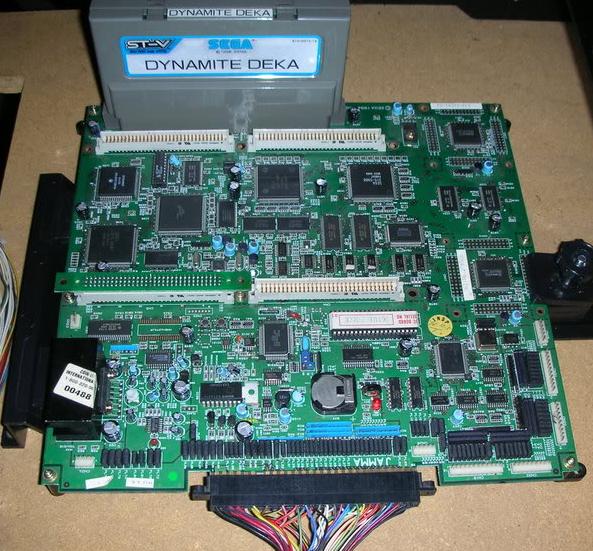
In terms of arcades, Sega is the world's most prolific arcade game producer, having developed more than 500 games, 70 franchises, and 20 arcade system boards since 1981. It has been recognized by Guinness World Records for this achievement.[7] The following list comprises the various arcade system boards developed and used by Sega in their arcade games.
Arcade system boards
[edit]| Arcade board | Notes | Notable games and release years |
|---|---|---|
| Dual[8][9] |
|
|
| G80[11][12] |
|
|
| VCO Object | ||
| LaserActive |
|
|
| System 1 System 2 |
|
|
| Super Scaler |
| |
| System E |
|
|
| System 16 System 18 |
|
|
| OutRun |
| |
| X Board |
|
|
| System 24 |
|
|
| Y Board |
| |
| Mega-Tech Mega Play |
|
|
| System C | ||
| System 32 |
| |
| Model 1 |
|
|
| Model 2 |
|
|
| Sega Titan‑Video (ST‑V) |
|
|
| Model 3 |
|
|
| NAOMI |
|
|
| Hikaru |
|
|
| NAOMI 2 |
|
|
| Triforce |
|
|
| Chihiro |
| |
| SystemSP |
|
|
| Lindbergh |
| |
| Europa-R |
| |
| RingEdge RingWide RingEdge 2 |
|
|
| Nu Nu 1.1 Nu 2 |
Nu and Nu 1.1:
Nu 2:
|
|
| ALLS |
|
|
Additional arcade hardware
[edit]Sega has developed and released additional arcade games that use technology other than their dedicated arcade system boards. The first arcade game manufactured by Sega was Periscope, an electromechanical game. This was followed by Missile in 1969.[190] Subsequent video-based games such as Pong-Tron (1973), Fonz (1976), and Monaco GP (1979) used discrete logic boards without a CPU microprocessor.[191] Frogger (1981) used a system powered by two Z80 CPU microprocessors.[192] Some titles, such as Zaxxon (1982) were developed externally from Sega, a practice that was not uncommon at the time.[193]
See also
[edit]References
[edit]- ^ Horowitz, Ken (2018). The Sega Arcade Revolution, A History in 62 Games. McFarland & Company. pp. 3–6. ISBN 9781476631967.
- ^ "Sega and Utamatic Purchase Assets of Service Games". Billboard. 5 September 1960. p. 71. ISSN 0006-2510.
- ^ "Service Games Inc. Bought By Sega and Uta Matic". Cashbox. Vol. 21, no. 51. 3 September 1960. p. 52. ISSN 0008-7289.
- ^ a b Famitsu DC (15 February 2002). Interview: Akira Nagai — SEGA REPRESENTATIVE. Famitsu Books (in Japanese). Enterbrain. pp. 20–23. ISBN 9784757707900.
{{cite book}}:|work=ignored (help) (Translation by Shmuplations. Archived 2020-08-07 at the Wayback Machine). - ^ Horowitz 2018, pp. 14-16
- ^ Horowitz 2018, pp. 21-23
- ^ "Most prolific producer of arcade machines". Guinness World Records. Jim Pattison Group. Archived from the original on 25 December 2014.
- ^ "The Arcade Flyer Archive - Video Game Flyers: Dual, Gremlin-Sega". flyers.arcade-museum.com.
- ^ "ヘッドオン". Sega Interactive. Archived from the original on 5 January 2020.
- ^ a b c d Horowitz 2018, p. 24-26
- ^ "The Arcade Flyer Archive - Video Game Flyers: Battle Star, Sega-Gremlin". flyers.arcade-museum.com.
- ^ "スペースオデッセイ". Sega Interactive. Archived from the original on 24 December 2019.
- ^ a b c d "Sega/Gremlin Introduces 'Convert-A-Game' At Annual Distributor Meeting In La Costa". Cashbox. 4 July 1981. pp. 41–42.
- ^ a b Horowitz 2018, pp. 31-35
- ^ Adlum, Eddie (November 1985). "The Replay Years: Reflections from Eddie Adlum". RePlay. Vol. 11, no. 2. pp. 134-175 (160-3).
- ^ "The Replay Years: Video Systems". RePlay. Vol. 11, no. 2. November 1985. pp. 128, 130.
- ^ a b c d Horowitz 2018, pp. 43-46
- ^ Horowitz 2018, pp. 65-69
- ^ a b Horowitz 2018, pp. 56-58
- ^ Horowitz 2018, pp. 52-54
- ^ a b "Overseas Readers Column: Sega's Astron Belt Will Be Shipped Soon" (PDF). Game Machine. No. 211. Amusement Press, Inc. 1 May 1983. p. 30.
- ^ Horowitz 2018, pp. 71-74
- ^ a b Adlum, Eddie (November 1985). "The Replay Years: Reflections from Eddie Adlum". RePlay. Vol. 11, no. 2. pp. 134-175 (168-70).
- ^ a b c d e Horowitz 2018, pp. 120, 131
- ^ ""Somber" JAMMA Show Hosts Five Laser Disc Games" (PDF). Cash Box. 15 October 1983. pp. 32, 34.
- ^ "Best Hit Games 25" (PDF). Game Machine (in Japanese). No. 251. Amusement Press, Inc. 1 January 1985. p. 37.
- ^ "wadai masin" (PDF). Game Machine (in Japanese). No. 251. Amusement Press, Inc. 3 March 1984. p. 25.
- ^ Horowitz 2018, pp. 184-187
- ^ "Overseas Readers Column: Sega Develops Movie Simulator "AS-1"" (PDF). Game Machine (in Japanese). No. 419. Amusement Press, Inc. 1 February 1992. p. 26.
- ^ a b "Sega's Wild Ride". Wired. April 1993. Retrieved 4 September 2021.
- ^ Horowitz, Ken (21 October 2016). Playing at the Next Level: A History of American Sega Games. McFarland & Company. p. 122. ISBN 978-0-7864-9994-6.
- ^ Williams, Leah J. (2 June 2021). "New Reports Have Everyone Fired Up For A Sega World Return". Kotaku Australia. Archived from the original on 2 June 2021. Retrieved 4 September 2021.
- ^ "SC-3000". sega.jp (in Japanese). Sega. Retrieved 14 January 2020.
- ^ a b Horowitz 2018, pp. 81-84
- ^ Sato, Hideki; Famitsu DC (15 February 2002). Interview: The Witness of History. Famitsu Books (in Japanese). Enterbrain. pp. 22–25. ISBN 978-4-75770789-4.
{{cite book}}:|work=ignored (help) (Translation by Shmuplations. Archived 2020-08-14 at the Wayback Machine). - ^ a b Horowitz 2018, p. 77, 91
- ^ Horowitz 2018, pp. 108-109
- ^ a b Horowitz 2018, pp. 106-108
- ^ Horowitz 2018, pp.124-125
- ^ a b c d e f Horowitz 2018, pp. 92-97
- ^ a b Horowitz 2018, pp. 100-102
- ^ a b c d e Horowitz 2018, pp. 102-106
- ^ Fahs, Travis (21 April 2009). "IGN Presents the History of SEGA - IGN - Page 3". IGN. Retrieved 8 August 2016.
- ^ a b Sato (18 September 2013). "Sega's Original Hardware Developer Talks About The Company's Past Consoles". Siliconera. Curse LLC. Archived from the original on 2 December 2013. Retrieved 23 November 2013.
- ^ Sczepaniak, John (August 2006). "Retroinspection: Mega Drive". Retro Gamer. No. 27. Imagine Publishing. pp. 42–47. Archived from the original on 24 September 2015 – via Sega-16.
- ^ Horowitz 2018, p. 114
- ^ Horowitz 2018, pp. 126-127
- ^ a b c d e f Horowitz 2018, pp. 132-134
- ^ a b Horowitz 2018, p. 148
- ^ Horowitz 2018, pp. 174-177
- ^ "Video Game Flyers: Shadow Dancer, Sega (Japan)". The Arcade Flyer Archive. Retrieved 19 September 2021.
- ^ "Leadership: Sega USA does it again with 'Line of Fire' and some hot kits". RePlay. Vol. 15, no. 4. January 1990. pp. 23–6.
- ^ Horowitz 2018, p. 171
- ^ The One. No. 36. emap Images. September 1991. p. 96.
- ^ a b Grazza, Brian (October 5, 2017). "OutRun". Hardcore Gaming 101. Kurt Kalata. Archived from the original on October 14, 2017.
- ^ a b Horowitz 2018, pp. 112-114
- ^ Mielke, James (2012). "The Disappearance of Yu Suzuki, Part 1". 1Up.com. Ziff Davis. Archived from the original on 13 November 2013. Retrieved 22 January 2019.
- ^ Horowitz 2018, pp. 118-119
- ^ "Sega-16.com: History of The OutRun series". Archived from the original on 14 January 2010. Retrieved 24 April 2009.
- ^ "Turbo Out Run". The Arcade Flyer Archive.
- ^ a b c d Horowitz 2018, pp. 144-145
- ^ a b c d Horowitz 2018, pp. 141-144
- ^ Horowitz 2018, p. 173
- ^ Horowitz 2018, pp. 137-140
- ^ a b c d e Horowitz 2018, pp. 151-152
- ^ a b c d "ACME: New Product Review". RePlay. Vol. 15, no. 7. April 1990. pp. 50–60.
- ^ a b c Horowitz 2018, pp. 165-168
- ^ "ACME: New Product Review". RePlay. Vol. 15, no. 7. April 1990. pp. 50–80.
- ^ a b c Horowitz 2018, p. 182
- ^ a b c d Horowitz 2018, pp. 187-190
- ^ "Overseas Readers Column: Sega's R & D Shows "System 32" Board" (PDF). Game Machine (in Japanese). No. 388. Amusement Press, Inc. 15 September 1990. p. 22.
- ^ "Rad Mobile (Registration Number PA0000606075)". United States Copyright Office. Retrieved 5 July 2021.
- ^ "F1 Exhaust Note - Videogame by Sega". Killer List of Videogames. Retrieved 10 September 2021.
- ^ "Golden Axe: The Revenge of Death Adder". Killer List of Video Games. The International Arcade Museum. Retrieved 18 December 2013.
- ^ Horowitz 2018, pp. 190-193
- ^ Sega Arcade History (in Japanese). Enterbrain. p. 123.
- ^ a b c d Horowitz 2018, pp. 193-197
- ^ a b c Horowitz 2018, pp.229-233
- ^ a b c "Sega Enterprises Ltd". Real3D. Lockheed Martin. 1996. Archived from the original on 2 January 1997. Retrieved 19 April 2021.
- ^ a b "Second Hand Smoke - One up, two down". Tom's Hardware Guide. Tom's Hardware. 22 October 1999. Retrieved 19 April 2021.
- ^ a b "Sega's Riding High: big sales for 'Virtua Racing' signal new era for Sega & the biz; Tom Petit & Ken Anderson explain how hi-tech is remaking coin-op". RePlay. Vol. 18, no. 4. January 1993. pp. 75–83.
- ^ a b c d Horowitz 2018, pp. 198-204
- ^ "Pedal To The Metal: Sega Set To Speed, Swing, Sidekick Into The 1990s With New Fall Line". Vending Times. Vol. 29, no. 10. August 1989. pp. 52–5.
- ^ "Star Wars Aracde". The Arcade Flyer Archive. Retrieved 21 May 2021.
- ^ Horowitz 2018, p. 180
- ^ "US defense corp. holds key to Sega's plans". Next Generation. November 1995. pp. 12–14. Retrieved 14 November 2020.
- ^ "Overseas Readers Column: Sega, GE Tie-Up On CG Technology" (PDF). Game Machine (in Japanese). No. 438. Amusement Press, Inc. 1–15 November 1992. p. 30.
- ^ "News Digest: Future Sega Simulators to Use Super Hi-Tech From GE". RePlay. Vol. 18, no. 3. December 1992. p. 30.
- ^ Fahs, Travis (21 April 2009). "IGN Presents the History of SEGA - IGN - Page 8". IGN. Retrieved 8 August 2016.
- ^ Alvarado, Omar; Fellers, Thomas J.; Davidson, Michael W. (17 September 2002). "Intel i960". Molecular Expressions. Florida State University. Retrieved 22 October 2025.
- ^ Horowitz 2018, pp. 203-206
- ^ a b c d Horowitz 2018, pp. 206-210
- ^ a b Webb, Marcus (June 1996). "Sega Model 2 Technology Licensed to Data East, Jaleco, and Tecmo". Next Generation. No. 18. Imagine Media. p. 26.
- ^ Horowitz 2018, pp. 204-206
- ^ Horowitz 2018, p. 212
- ^ Horowitz 2018, p. 215
- ^ a b Horowitz 2018, pp. 217-220
- ^ Horowitz 2018, p. 220
- ^ "セガ、PS3/Xbox 360「MODEL2 COLLECTION」". Game Watch (in Japanese). November 16, 2012. Archived from the original on August 9, 2017. Retrieved March 7, 2019.
- ^ "AOU". Electronic Gaming Monthly. No. 93. Ziff Davis. April 1997. p. 79.
- ^ a b c d Horowitz 2018, pp. 222-226
- ^ "Overseas Reader Column: Sega Introduces "Titan" Coin-Op System Board" (PDF). Game Machine. No. 471. Amusement Press, Inc. 1 May 1994. p. 26.
- ^ "Virtua Fighter Remix". Next Generation. No. 12. Imagine Media. December 1995. p. 209.
- ^ "US defense corp. holds key to Sega's plans". Next Generation. No. 11. November 1995. pp. 12–14.
- ^ "Model 3: Sega Affirms Arcade Supremacy". Next Generation. No. 17. Imagine Media. May 1996. pp. 12–18.
- ^ "US defense corp holds key to Sega's plans". Next Generation. Vol. 1, no. 11. November 1995. p. 14.
- ^ "News: Virtua Fighter 3". Computer and Video Games (174): 10–1. May 1996.
- ^ a b Horowitz 2018, pp. 233-237
- ^ Lenoir, Tim (2000). "All but War Is Simulation: The Military-Entertainment Complex" (PDF). Configurations. 8 (3): 289–335 (317). doi:10.1353/con.2000.0022.
- ^ "NG Alphas: Virtua Fighter 3". Next Generation. No. 22. Imagine Media. October 1996. p. 108.
- ^ a b "Sega Model 3 Pinout Class". Killer List of Videogames. Retrieved 19 April 2021.
- ^ Horowitz 2018, pp. 237-240
- ^ "Star Wars Trilogy Aracde". The Arcade Flyer Archive. Retrieved 21 May 2021.
- ^ a b Ohbuchi, Yutaka (September 17, 1998). "How Naomi Got Its Groove On". GameSpot. Archived from the original on December 24, 2017. Retrieved December 9, 2014.
- ^ Fahs, Travis (9 September 2010). "IGN Presents the History of Dreamcast". IGN. Archived from the original on 28 September 2014. Retrieved 31 October 2014.
- ^ Hagiwara, Shiro; Oliver, Ian (November–December 1999). "Sega Dreamcast: Creating a Unified Entertainment World". IEEE Micro. 19 (6): 29–35. doi:10.1109/40.809375.
- ^ "NAOMI: New Arcade Board System" (PDF). Sega. 1998. Retrieved 15 October 2021.
- ^ "NEC and VideoLogic Power Up". Edge. January 1999. p. 11.
- ^ Sega Naomi service manual. SEGA ENTERPRISES, LTD. MANUAL NO. 420-6455-01, p. 7
- ^ Sega Naomi GD-ROM system service manual. SEGA ENTERPRISES, INC. USA. MANUAL NO. 420-6620-02, p. 12, 16, 22 Naomi in this configuration has no ROM board to run a game from
- ^ Sega Strike Fighter DX (9/1 ver) DGM-0095 schematic. Sega enterprises ltd. (Mentions Naomi slave, Naomi master and game boards)
- ^ Sega Strike Fighter DX type Owner's manual, SEGA ENTERPRISES, INC. USA. MANUAL NO. 420-6589-01 mentions Naomi boards, Naomi multi master and Naomi multi slave, and a game BD on p. 128, and a photo with a 3 board design (each with two white edge connectors on the same side, not including a ROM board on top, nor a midplane) on p. 89.
- ^ Airline Pilots DX Type Owner's manual. SEGA ENTERPRISES, LTD. MANUAL NO. 420-6471-01 uses the same 3 board design on p. 72. Mentions a Naomi board on p.10.
- ^ Sega F355 challenge Owner's manual. SEGA ENTERPRISES, INC. USA. MANUAL NO. 4201-6507-01 shows 4 boards on p. 72, each with two white edge connectors and "Naomi board" on p. 10 and "NAOMI MULTI MASTER" and "NAOMI MULTI SLAVE" on p.137. "F355 Challenge". The Arcade Flyer Archive. mentions 4 Naomi systems.
- ^ McFerran, Damien (16 April 2015). "Hardware Classics: Sega Dreamcast". Nintendo Life. Retrieved 11 July 2011.
- ^ Horowitz, Ken (22 June 2018). The Sega Arcade Revolution: A History in 62 Games. McFarland & Company. p. 210. ISBN 978-1-4766-7225-0.
- ^ "House Of The Dead 2". Killer List of Videogames. Retrieved 19 April 2021.
- ^ Horowitz 2018, pp. 240-242
- ^ a b c "Sega Naomi Original Pinout Class". Killer List of Videogames. Retrieved 19 April 2021.
- ^ "DERBY OWNERS CLUB(ダービーオーナーズクラブ) – 株式会社セガ". セガ・アーケードゲームヒストリー|株式会社セガ (in Japanese). Retrieved 28 December 2023.
- ^ "F355 Challenge". The Arcade Flyer Archive.
- ^ Souppouris, Aaron (23 August 2019). "Sega is becoming its weird and wonderful self again". Engadget. Retrieved 16 January 2019.
- ^ "甲虫王者ムシキング – 株式会社セガ". セガ・アーケードゲームヒストリー|株式会社セガ (in Japanese). Retrieved 28 December 2023.
- ^ "セガ四人打ち麻雀MJ – 株式会社セガ". セガ・アーケードゲームヒストリー|株式会社セガ (in Japanese). Retrieved 28 December 2023.
- ^ a b c d e Horowitz 2018, pp. 242-244
- ^ a b c d "NASCAR Arcade". Edge. No. 90. November 2000. p. 67.
- ^ "AIR TRIX(エアトリックス) – 株式会社セガ". セガ・アーケードゲームヒストリー|株式会社セガ (in Japanese). Retrieved 28 December 2023.
- ^ NASCAR Arcade Deluxe Edition Owner's Manual. Sega. 2000. p. 33.
- ^ a b c "NAOMI 2: Sega reveals its next gen arcade hardware". DC-UK. No. 16. December 2000. p. 41.
- ^ a b "Sega Announces NAOMI2 Next Generation Arcade Systems Using Imagination Technologies' PowerVR Graphics Architecture". PowerVR. 11 January 2001. Retrieved 19 April 2021.
- ^ "ワイルドライダーズ – 株式会社セガ". セガ・アーケードゲームヒストリー|株式会社セガ (in Japanese). Retrieved 28 December 2023.
- ^ Chau, Anthony (3 July 2001). "Virtua Fighter 4 - First Impressions Part 1 (Arcade)". IGN. Retrieved 11 March 2016.
- ^ "Initial D - Arcade Stage". The Arcade Flyer Archive. Retrieved 21 May 2021.
- ^ "ソウルサーファー – 株式会社セガ". セガ・アーケードゲームヒストリー|株式会社セガ (in Japanese). Retrieved 28 December 2023.
- ^ a b "GameCube Arcade Hardware Revealed". IGN. 18 February 2002. Retrieved 5 March 2013.
- ^ Mirabella III, Fran (16 July 2003). "Inside F-Zero AX". IGN. Retrieved 14 June 2013.
- ^ IGN Staff (28 February 2002). "Nintendo Roundtable". IGN. Retrieved 7 July 2021.
- ^ "アヴァロンの鍵 – 株式会社セガ". セガ・アーケードゲームヒストリー|株式会社セガ (in Japanese). Retrieved 28 December 2023.
- ^ Satterfield, Shane (28 March 2002). "Sega and Nintendo form developmental partnership". GameSpot. Archived from the original on 13 February 2009. Retrieved 20 June 2007.
- ^ "Mario Kart Arcade GP". The Arcade Flyer Database. Archived from the original on 25 March 2019. Retrieved 6 May 2021.
- ^ "バーチャストライカー4 – 株式会社セガ". セガ・アーケードゲームヒストリー|株式会社セガ (in Japanese). Retrieved 28 December 2023.
- ^ a b c d e f Jenkins, David (20 July 2005). "Sega Arcade Hardware Confirmed As PowerVR-Based". Gamasutra. Archived from the original on 13 May 2012. Retrieved 15 January 2020.
- ^ Torres, Ricardo (19 September 2002). "JAMMA 2002: House of the Dead 3". Gamespot. Archived from the original on 22 May 2016. Retrieved 10 December 2021.
- ^ "Museum of the Game: Ghost Squad". Killer List of Videogames. Retrieved 29 October 2020.
- ^ "Quest of D (クエスト オブ ディー) – 株式会社セガ". セガ・アーケードゲームヒストリー|株式会社セガ (in Japanese). Retrieved 28 December 2023.
- ^ "セガ ゴルフクラブ ネットワークプロツアー – 株式会社セガ". セガ・アーケードゲームヒストリー|株式会社セガ (in Japanese). Retrieved 28 December 2023.
- ^ Namco. (n.d.). Maximum Tune Operators Manual. Namco UK. Retrieved March 15, 2024, from https://www.progettosnaps.net/manuals/pdf/wangmid.pdf. Page 101 clearly shows the Main Sega Chihiro unit.
- ^ "セガネットワーク対戦麻雀MJ3 – 株式会社セガ". セガ・アーケードゲームヒストリー|株式会社セガ (in Japanese). Retrieved 28 December 2023.
- ^ "三国志大戦 – 株式会社セガ". セガ・アーケードゲームヒストリー|株式会社セガ (in Japanese). Retrieved 28 December 2023.
- ^ Namco UK. (n.d.). Wangan Midnight Maximum Tune 2 Operators Manual. Namco UK. Retrieved March 15, 2024, from https://www.progettosnaps.net/manuals/pdf/wangmid2j.pdf. Page 105 clearly shows the Chihiro system, as well as referring to it as "Chihiro Game PC Board Assy"
- ^ a b "Dinosaur King" owner's manual. Sega. p. 36.
- ^ "オシャレ魔女 ラブ and ベリー – 株式会社セガ". セガ・アーケードゲームヒストリー|株式会社セガ (in Japanese). Retrieved 28 December 2023.
- ^ "ぶろっくぴーぽー – 株式会社セガ". セガ・アーケードゲームヒストリー|株式会社セガ (in Japanese). Retrieved 28 December 2023.
- ^ a b c d e Maragos, Nick; Sheffield, Brandon (31 August 2005). "Round-Up: New Sega Arcade Board, EA's Grammy Pro Sessions, PSP European, Oceania Launch". Gamasutra. Archived from the original on 15 November 2013. Retrieved 15 January 2020.
- ^ "Initial D4". PrimeTime Amusements. Retrieved 21 May 2021.
- ^ "Let's Go JUNGLE!(レッツ ゴー ジャングル!) – 株式会社セガ". セガ・アーケードゲームヒストリー|株式会社セガ (in Japanese). Retrieved 28 December 2023.
- ^ "ネットワーク対戦クイズ Answer×Answer – 株式会社セガ". セガ・アーケードゲームヒストリー|株式会社セガ (in Japanese). Retrieved 28 December 2023.
- ^ "SEGA NETWORK CASINO CLUB(SNC) – 株式会社セガ". セガ・アーケードゲームヒストリー|株式会社セガ (in Japanese). Retrieved 28 December 2023.
- ^ "2SPICY – 株式会社セガ". セガ・アーケードゲームヒストリー|株式会社セガ (in Japanese). Retrieved 28 December 2023.
- ^ "セガネットワーク対戦麻雀MJ4 – 株式会社セガ". セガ・アーケードゲームヒストリー|株式会社セガ (in Japanese). Retrieved 28 December 2023.
- ^ "SEGA-RaceTV – 株式会社セガ". セガ・アーケードゲームヒストリー|株式会社セガ (in Japanese). Retrieved 28 December 2023.
- ^ a b c Plunkett, Luke (27 May 2008). "Take A Look At Sega Rally 3". Kotaku. Retrieved 15 January 2020.
- ^ a b c "Sega Supported Hardware". segaarcade.com. Sega Amusements International Ltd. Retrieved 15 January 2020.
- ^ a b "Initial D Arcade Stage 7 AA X Races To Arcades This Thursday". Siliconera. 28 November 2012. Retrieved 15 January 2020.
- ^ "シャイニング・フォース クロス – 株式会社セガ". セガ・アーケードゲームヒストリー|株式会社セガ (in Japanese). Retrieved 28 December 2023.
- ^ "Let's GO ISLAND 3D(レッツ ゴー アイランド 3D) – 株式会社セガ". セガ・アーケードゲームヒストリー|株式会社セガ (in Japanese). Retrieved 28 December 2023.
- ^ "Chaos Code coming to North America on PSN". Polygon. 14 August 2013. Retrieved 15 January 2020.
- ^ "OPERATION G.H.O.S.T. – 株式会社セガ". セガ・アーケードゲームヒストリー|株式会社セガ (in Japanese). Retrieved 28 December 2023.
- ^ "maimai – 株式会社セガ". セガ・アーケードゲームヒストリー|株式会社セガ (in Japanese). Retrieved 28 December 2023.
- ^ McFerran, Damien (21 July 2015). "Weirdness: Sega's Repackaged Transformers Arcade Game Is An Unexpected Nod To Its Glorious Past". Nintendo Life. Retrieved 15 January 2020.
- ^ "コード・オブ・ジョーカー(CODE OF JOKER) – 株式会社セガ". セガ・アーケードゲームヒストリー|株式会社セガ (in Japanese). Retrieved 28 December 2023.
- ^ a b c d e "Sega announces next-generation arcade game board "Nu". The first adoption title is "Hatsune Miku Project DIVA Arcade Future Tone"". 4gamer.net (in Japanese). 4 September 2013. Retrieved 16 January 2020.
- ^ "え~でる すなば ふしぎなすなあそび – 株式会社セガ". セガ・アーケードゲームヒストリー|株式会社セガ (in Japanese). Retrieved 28 December 2023.
- ^ "Wonderland Wars – 株式会社セガ". セガ・アーケードゲームヒストリー|株式会社セガ (in Japanese). Retrieved 28 December 2023.
- ^ "CHUNITHM – 株式会社セガ". セガ・アーケードゲームヒストリー|株式会社セガ (in Japanese). Retrieved 28 December 2023.
- ^ "新甲虫王者ムシキング – 株式会社セガ". セガ・アーケードゲームヒストリー|株式会社セガ (in Japanese). Retrieved 28 December 2023.
- ^ "頭文字D ARCADE STAGE Zero – 株式会社セガ". セガ・アーケードゲームヒストリー|株式会社セガ (in Japanese). Retrieved 28 December 2023.
- ^ a b Nojima, Ryo (10 October 2018). "Arcade popular series latest work "HOUSE OF THE DEAD -SCARLET DAWN-"". CGWorld.jp (in Japanese). Born Digital, Inc. Retrieved 16 January 2020.
- ^ "Dead or Alive 6's Arcade Version Announced". DualShockers.com. Retrieved 11 October 2024.
- ^ Horowitz 2018, pp. 8-13
- ^ Horowitz 2018, pp. 16, 28, 56
- ^ Horowitz 2018, pp. 36-39
- ^ Horowitz 2018, pp. 48-50
| Arcade systems |  | |
|---|---|---|
| Video game consoles | ||
| Portable devices | ||
| Dual systems | ||
| Licensed consoles | ||
| Online gaming services | ||
| Accessories | ||
| Amusement venues | ||
| Related | ||

List of Sega arcade system boards
View on GrokipediaEarly Discrete and Z80-based Systems
Blockade and VIC Dual Boards
Sega's earliest ventures into video arcade hardware emerged in the mid-1970s, coinciding with the post-Pong boom in digital gaming and representing a pivotal shift from the company's prior electromechanical systems like Periscope and Missile.[1] The Blockade and VIC Dual boards, developed through Sega's association with Gremlin Industries, introduced microprocessor-based architectures to Sega's arcade lineup, enabling more complex gameplay than discrete logic circuits alone could support.[12] These systems laid foundational groundwork for Sega's expansion in the arcade market, blending custom circuitry with emerging CPU technology to produce affordable, cabinet-shared hardware.[13] The Blockade hardware, originally created by Gremlin Industries in 1976 for the titular game Blockade—a two-player maze navigation title where players maneuver blocks to trap opponents—utilized an Intel 8080 microprocessor running at 2 MHz as its core processing unit.[14] This 8-bit CPU handled game logic, supported by 1.25 KB of RAM (including 256 bytes for main operations and 1 KB for video buffering) and custom TTL-based chips for graphics generation and sound.[14] The system featured a monochrome raster display capable of rendering simple vector-like lines for the block trails, emphasizing efficient, low-cost design suitable for upright cabinets weighing around 290 pounds.[15] Additional titles like Comotion and Hustle ran on variants of this board, showcasing its versatility for early puzzle and action games before Sega's full acquisition of Gremlin in 1978 integrated it into their portfolio.[13] Introduced in 1977, the VIC Dual board marked Sega's adoption of the Zilog Z80 microprocessor, operating at approximately 3-4 MHz, in a dual-processor configuration designed for shared cabinets that housed two independent games to maximize operator value.[16] Each game utilized a dedicated Z80 CPU paired with custom discrete logic for sound generation—unique per title—and a monochrome raster display at 256 x 224 resolution, supporting pong-style mechanics with enhanced collision detection and scoring.[17] Key components included TTL chips for video output and input handling via joysticks or trackballs, with the "dual" aspect allowing linked play or separate experiences in a single enclosure, as seen in crates containing multiple interchangeable boards.[16] This setup facilitated Sega's entry into diverse genres beyond basic block games, bridging the gap to more standardized Z80-based systems in the late 1970s.[17] Notable games on the VIC Dual included Head-On (1979), a pioneering maze-racing title where players dodged oncoming cars, and Carnival (1980), a shooting gallery with light-gun elements, both exemplifying the board's capability for fast-paced, score-driven action in the competitive post-Pong landscape.[16] These boards collectively represented Sega's strategic evolution from electromechanical periscopes and missile simulators to fully digital video arcades, prioritizing modular hardware for rapid game iteration and market penetration.[12]Z80 and G80 Vector Boards
Sega's Z80 arcade system board, released around 1980, represented an important step in the company's arcade hardware evolution, transitioning to a microprocessor-driven raster graphics platform. Powered by a Zilog Z80 CPU operating at 4 MHz, the board featured 2 KB of RAM and supported monochrome displays, enabling ROM-based game storage that allowed for more programmable and replayable experiences compared to earlier discrete logic systems. This hardware facilitated the development of titles like Space Firebird, a fixed shooter with multi-stage alien invasions, and Moon Cresta, a licensed vertical shooter emphasizing power-ups and enemy formations.[18][19][20] The Sega G80 board, introduced in 1981, extended this Z80 architecture to vector graphics, marking Sega's entry into high-contrast, line-drawn visuals suited for space-themed arcade games. Equipped with a Z80A CPU clocked at 3.072 MHz, support for vector monitors, and 4 KB of ROM capacity, the G80 emphasized scalable graphics generated by direct deflection of the CRT beam, providing smooth and detailed depictions without pixelation. Notable games on the vector variant included Space Odyssey, a space combat simulator with multi-directional movement, and Space Fury, a defensive shooter against asteroid fields and enemies. The board's design prioritized ROM programmability for complex trajectories and enemy behaviors in zero-gravity environments.[21][22][23][24] Variants such as the G80 Mark II refined the original architecture with improved vector resolution and sound capabilities, using discrete DACs for basic tone generation, while maintaining compatibility with the core Z80 ecosystem. These boards collectively introduced ROM-based development workflows and vector technology to Sega's portfolio, focusing on immersive space simulations that influenced later raster systems like System 1 in the early 1980s.[21][25]16-bit System Era
System 16 Family
The Sega System 16, launched in 1985, marked Sega's transition to 16-bit arcade hardware, building on the success of earlier pseudo-3D titles like Space Harrier and Out Run. This platform featured a Motorola 68000 main CPU clocked at 10 MHz for game logic, paired with a Zilog Z80 sound CPU at 4 MHz and a Yamaha YM2151 FM synthesis chip for audio, enabling richer soundscapes compared to prior 8-bit systems. Video output supported a resolution of 320x224 pixels in vertical orientation, with a 4096-color palette allowing up to 64 colors on screen simultaneously, facilitated by dedicated ASIC chips for sprite and tilemap rendering.[26][6] The System 16 family evolved through several variants to address production costs, performance needs, and piracy concerns. The System 16A, introduced in 1986, refined the base design with minor board revisions for titles like Fantasy Zone, maintaining the core 68000 at 10 MHz but optimizing ROM integration for faster game swaps. The System 16B, released in 1987, upgraded the sound CPU to 5 MHz and incorporated the NEC uPD7759 ADPCM chip for enhanced speech and effects, powering games such as Shinobi and Alien Syndrome. Later variants of the System 16B, starting around 1988, integrated encryption via the FD1094 custom 68000 processor to deter bootlegs, as seen in Altered Beast, while retaining the YM2151 for audio continuity.[26][6][27] Hardware advancements in the family included custom ASICs like the 315-5158 for efficient sprite handling—supporting up to 128 sprites with scaling and rotation—and modular ROM boards that allowed operators to update games without full hardware replacement, extending the platform's lifespan until around 1990. This design influenced genres like shoot 'em ups, with Fantasy Zone's colorful multidirectional scrolling, and beat 'em ups, exemplified by Golden Axe's cooperative side-scrolling combat on the 16B and later boards. The System 16's flexible architecture laid groundwork for enhanced encryption in later platforms like System 18.[5][6]System 18 and System 24 Boards
The Sega System 18, introduced in 1989 as an evolution of the System 16 architecture, featured a Motorola 68000 main CPU clocked at 10 MHz, paired with a Zilog Z80 sound CPU running at 8 MHz.[28] Its audio subsystem included dual Yamaha YM3438 FM synthesis chips at 8 MHz each and a Ricoh RF5C68 PCM decoder operating at 10 MHz, relabeled as a Sega custom 315-series IC for 8-channel sample playback.[28] Video capabilities supported a 320x224 resolution with a 4096-color palette, enabling up to 128 on-screen sprites, four tilemap layers, one text layer, hardware sprite zooming, and translucent shadow effects, which facilitated pseudo-3D visuals through sprite scaling and rotation.[28] To combat piracy, System 18 employed encrypted program ROMs decrypted via specialized Hitachi FD1094 or similar masked 68000 CPUs, a refinement of System 16's security that included a "suicide battery" mechanism to disable boards upon tampering or battery failure.[29] This board's JAMMA-compliant design improved scalability over System 16, though System 16 and 18 use different pinouts (Sega vs. JAMMA), limiting direct compatibility and requiring modifications for conversions between them.[30] Notable System 18 titles leveraged these enhancements for dynamic action gameplay, such as Shadow Dancer: The Secret of Shinobi (1989), which used sprite zooming for fluid ninja combat illusions, and Michael Jackson's Moonwalker (1990), featuring dance sequences with layered backgrounds and shadow effects.[28] Alien Storm (1990) demonstrated the system's sprite handling in side-scrolling shoot-'em-ups, while Laser Ghost (1990) employed pseudo-3D road projection for horror-themed vehicular action.[28] These games highlighted System 18's focus on enhanced 2D visuals approaching 3D-like depth without full polygonal rendering, bridging arcade aesthetics toward the 32-bit System 32 era. In parallel, the Sega System 24, debuted in 1988, utilized dual Motorola 68000 CPUs at 10 MHz—one for booting and I/O, the other for gameplay—to manage its tilemap-heavy rendering.[31] Sound was handled directly by the main CPUs driving a Yamaha YM2151 FM chip at 4 MHz alongside a DAC for sampled audio, eschewing a dedicated Z80 for streamlined processing.[31] Optimized for medium-resolution displays (496×384), it supported advanced multi-layer tilemaps with 32,768 colors (15-bit RGB) and shadow/highlight support, ideal for top-down perspectives in racing and strategy games.[31][32] Storage flexibility was a key innovation, using 3.5-inch floppy disks for program loading (with optional ROM or CD-ROM boards for later titles), enabling easier updates and higher effective data capacity compared to fixed-ROM predecessors like System 16.[31] While sharing encryption elements with System 16 via per-game CPU modules, System 24 emphasized scalability through modular storage, reducing hardware costs for operators and supporting larger asset sets without proportional board complexity.[33] System 24 excelled in overhead-view simulations, as seen in Hot Rod (1988), a multi-player drag racer utilizing precise tile-based tracks and vehicle scaling, and Rough Racer (1990), which expanded on isometric driving with dynamic weather and collision detection via layered maps.[31] Other representatives included Gain Ground (1988), a tactical shooter with intricate level geometry, and Crack Down (1989), employing tilemaps for top-down infiltration missions.[31] Quiz Syukudai: wo Wasuremashita (1990) showcased the system's versatility in non-action genres through animated quiz interfaces. These boards collectively advanced Sega's 16-bit arcade lineup by prioritizing visual depth and anti-piracy measures, setting foundational techniques for the transition to 32-bit processing in System 32.[28][31]| Feature | System 18 | System 24 |
|---|---|---|
| Main CPU | 68000 @ 10 MHz | Dual 68000 @ 10 MHz |
| Sound CPU | Z80 @ 8 MHz | None (main CPU-driven) |
| Video Layers | 4 tiles + 1 text + sprites (zooming) | Multi-layer tiles (medium res, scrolling) |
| Storage | ROM board | Floppy/ROM/CD-ROM |
| Key Security | Encrypted FD1094 CPU, suicide battery | Per-game CPU encryption |
| Example Games | Shadow Dancer, Moonwalker | Hot Rod, Rough Racer |