Hubbry Logo
Intersection (set theory)Intersection (set theory)Main
Open search
Intersection (set theory)
Community hub
Intersection (set theory)
logo
8 pages, 0 posts
0 subscribers
Be the first to start a discussion here.
Intersection (set theory)
from Wikipedia

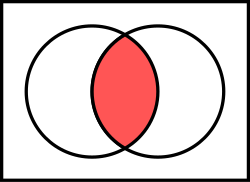
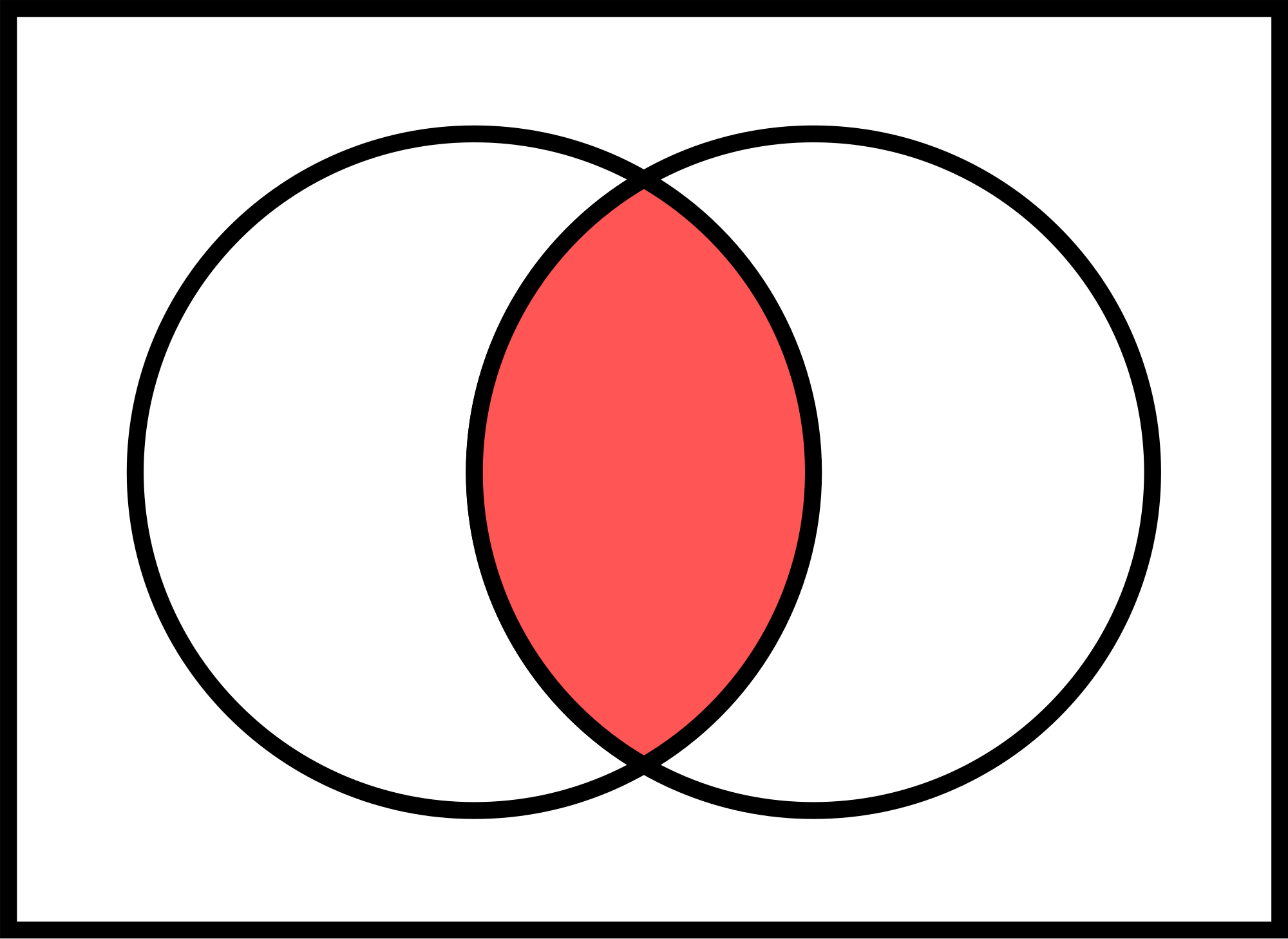
In set theory, the intersection of two sets and denoted by [1] is the set containing all elements of that also belong to or equivalently, all elements of that also belong to [2] The notion of intersection as a set operation has been generalized from geometry, where it is encountered in the case of geometric sets of points, such as individual points, lines (infinite uncountable sets of points), planes, etc.

Key Information

Notation and terminology

[edit]

Intersection is written using the symbol "" between the terms; that is, in infix notation. For example: The intersection of more than two sets (generalized intersection) can be written as: which is similar to capital-sigma notation.


For an explanation of the symbols used in this article, refer to the table of mathematical symbols.

Definition

[edit]
Intersection of three sets:
Intersections of the unaccented modern Greek, Latin, and Cyrillic scripts, considering only the shapes of the letters and ignoring their pronunciation
Example of an intersection with sets

The intersection of two sets and denoted by ,[3] is the set of all objects that are members of both the sets and In symbols:


That is, is an element of the intersection if and only if is both an element of and an element of [3]

For example:

  • The intersection of the sets {1, 2, 3} and {2, 3, 4} is {2, 3}.
  • The number 9 is not in the intersection of the set of prime numbers {2, 3, 5, 7, 11, ...} and the set of odd numbers {1, 3, 5, 7, 9, 11, ...}, because 9 is not prime.

Intersecting and disjoint sets

[edit]

We say that intersects (meets) if there exists some that is an element of both and in which case we also say that intersects (meets) at . Equivalently, intersects if their intersection is an inhabited set, meaning that there exists some such that

We say that and are disjoint if does not intersect In plain language, they have no elements in common. and are disjoint if their intersection is empty, denoted

For example, the sets and are disjoint, while the set of even numbers intersects the set of multiples of 3 at the multiples of 6.

Algebraic properties

[edit]

Binary intersection is an associative operation; that is, for any sets and one has

Thus the parentheses may be omitted without ambiguity: either of the above can be written as . Intersection is also commutative. That is, for any and one has The intersection of any set with the empty set results in the empty set; that is, that for any set , Also, the intersection operation is idempotent; that is, any set satisfies that . All these properties follow from analogous facts about logical conjunction.

Intersection distributes over union and union distributes over intersection. That is, for any sets and one has Inside a universe one may define the complement of to be the set of all elements of not in Furthermore, the intersection of and may be written as the complement of the union of their complements, derived easily from De Morgan's laws:

Arbitrary intersections

[edit]

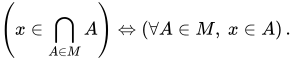
The most general notion is the intersection of an arbitrary nonempty collection of sets. If is a nonempty set whose elements are themselves sets, then is an element of the intersection of if and only if for every element of is an element of In symbols:

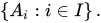
The notation for this last concept can vary considerably. Set theorists will sometimes write "", while others will instead write "". The latter notation can be generalized to "", which refers to the intersection of the collection Here is a nonempty set, and is a set for every

In the case that the index set is the set of natural numbers, notation analogous to that of an infinite product may be seen:

When formatting is difficult, this can also be written "". This last example, an intersection of countably many sets, is actually very common; for an example, see the article on σ-algebras.

Nullary intersection

[edit]
Conjunctions of the arguments in parentheses

The conjunction of no argument is the tautology (compare: empty product); accordingly the intersection of no set is the universe.

In the previous section, we excluded the case where was the empty set (). The reason is as follows: The intersection of the collection is defined as the set (see set-builder notation) If is empty, there are no sets in so the question becomes "which 's satisfy the stated condition?" The answer seems to be every possible . When is empty, the condition given above is an example of a vacuous truth. So the intersection of the empty family should be the universal set (the identity element for the operation of intersection),[4] but in standard (ZF) set theory, the universal set does not exist.


However, when restricted to the context of subsets of a given fixed set , the notion of the intersection of an empty collection of subsets of is well-defined. In that case, if is empty, its intersection is . Since all vacuously satisfy the required condition, the intersection of the empty collection of subsets of is all of In formulas, This matches the intuition that as collections of subsets become smaller, their respective intersections become larger; in the extreme case, the empty collection has an intersection equal to the whole underlying set.


Also, in type theory is of a prescribed type so the intersection is understood to be of type (the type of sets whose elements are in ), and we can define to be the universal set of (the set whose elements are exactly all terms of type ).

See also

[edit]

References

[edit]

Further reading

[edit]
[edit]
Revisions and contributorsEdit on WikipediaRead on Wikipedia
from Grokipedia
In set theory, the intersection of two or more sets is the set consisting of all elements that are common to every set in the collection, formally defined as the collection of objects belonging to both (or all) sets involved. For two sets AA and BB, this is denoted AB={xxAxB}A \cap B = \{ x \mid x \in A \land x \in B \}, where \cap symbolizes the operation. The intersection operation exhibits several key algebraic that underpin its utility in . It is commutative, so AB=BAA \cap B = B \cap A, and associative, meaning (AB)C=A(BC)(A \cap B) \cap C = A \cap (B \cap C). Additionally, intersection distributes over union: A(BC)=(AB)(AC)A \cap (B \cup C) = (A \cap B) \cup (A \cap C), and it is idempotent, with AA=AA \cap A = A. The intersection of any set with the is empty, A=\emptyset \cap A = \emptyset, reflecting that no elements are common to the empty set. These properties make intersection a foundational in , essential for constructing more complex structures in fields such as logic, probability, and , where it models shared attributes or conditions. For finite or infinite families of sets {AiiI}\{A_i \mid i \in I\}, the intersection iIAi\bigcap_{i \in I} A_i generalizes this to the elements present in all AiA_i.

Basics

Notation and Terminology

The standard notation for the intersection of two sets AA and BB in is the infix symbol ABA \cap B, where \cap represents the sign. This symbol was introduced by in his 1888 work Calcolo geometrico secondo l'Ausdehnungslehre di H. Grassmann. The symbol \cap is commonly pronounced "cap," as in "A cap B." In spoken mathematical discourse, the full expression is often read as "A intersection B" or simply "the intersection of A and B." Historically, alternative notations have appeared in the development of and related fields. For instance, used , such as xyxy, to denote the (or "logical ") of classes in his 1854 treatise An Investigation of the Laws of Thought. In some contexts, such as certain treatments of or lattice theory, the dot product ABA \cdot B has been employed to signify , reflecting an to in arithmetic. The intersection of exactly two sets is termed the binary intersection, emphasizing its operation on a pair of collections. This operation identifies the common elements present in both sets, which intuitively represent the overlap between them. The terminology "intersection" itself derives from , where it originally described the points or regions shared by figures, such as the crossing of lines; adopts this concept to denote shared membership among abstract collections.

Definition

In set theory, the intersection of two sets AA and BB, denoted ABA \cap B, is formally defined as the set of all elements that belong to both AA and BB. Using , this is expressed as AB={xxAxB},A \cap B = \{ x \mid x \in A \land x \in B \}, where \land represents , ensuring that membership in the intersection requires satisfaction of both conditions simultaneously./01:_Set_Theory/1.02:_Basic_Set_Operations) This operation can be visualized using a , where the overlapping region of the circles representing AA and BB corresponds precisely to ABA \cap B, capturing the shared elements while excluding those unique to either set. For a concrete example, consider A={1,2,3}A = \{1, 2, 3\} and B={2,3,4}B = \{2, 3, 4\}; then AB={2,3}A \cap B = \{2, 3\}, as these are the only elements common to both./01:_Set_Theory/1.02:_Basic_Set_Operations) The intersection is well-defined within the framework of , relying on the (or comprehension) to construct subsets based on membership properties, ensuring no paradoxes arise from the . To verify that ABAA \cap B \subseteq A (and similarly for BB), suppose xABx \in A \cap B; by , xAxBx \in A \land x \in B, so xAx \in A holds directly, confirming the subset relation./04:_Sets/4.03:_Set_Operations)

Binary Intersection

Intersecting and Disjoint Sets

In set theory, two sets AA and BB are said to be intersecting if their is non-empty, that is, if ABA \cap B \neq \varnothing, meaning there exists at least one element common to both sets. This condition highlights the overlap between the sets, where the shared elements form the non-empty . Conversely, two sets AA and BB are disjoint if their is the , AB=A \cap B = \varnothing, indicating that the sets have no elements in common. In this case, the result of the intersection operation is the \varnothing, representing complete separation between the sets. For example, consider the set of even positive integers E={2,4,6,8,}E = \{2, 4, 6, 8, \dots\} and the set of multiples of 3 M={3,6,9,12,}M = \{3, 6, 9, 12, \dots\}; these are intersecting sets because EM={6,12,18,}E \cap M = \{6, 12, 18, \dots\} \neq \varnothing. In contrast, the set of even positive integers EE and the set of odd positive integers O={1,3,5,7,}O = \{1, 3, 5, 7, \dots\} are disjoint, as EO=E \cap O = \varnothing. The concept extends to families of sets: a collection of sets {Ai}iI\{A_i\}_{i \in I} is mutually disjoint if every pair AiA_i and AjA_j (for iji \neq j) is disjoint, meaning AiAj=A_i \cap A_j = \varnothing for all distinct indices. This property is fundamental in partitioning a into non-overlapping subsets.

Algebraic Properties

The binary intersection operation on the power set of a forms a fundamental part of , where it serves as the meet operation (∧), and in lattice theory, it acts as the greatest lower bound for any two sets. These structures endow the collection of all subsets with algebraic properties that mirror those of and facilitate rigorous proofs in set-theoretic reasoning. Commutativity states that for any sets AA and BB, AB=BAA \cap B = B \cap A. To justify this using set definitions, suppose xABx \in A \cap B; then xAx \in A and xBx \in B, which implies xBx \in B and xAx \in A, so xBAx \in B \cap A. Conversely, if xBAx \in B \cap A, then xABx \in A \cap B. Thus, the sets are equal. Associativity holds: for sets AA, BB, and CC, (AB)C=A(BC)(A \cap B) \cap C = A \cap (B \cap C). Let x(AB)Cx \in (A \cap B) \cap C; then xCx \in C and xABx \in A \cap B, so xAx \in A, xBx \in B, and xCx \in C, implying xA(BC)x \in A \cap (B \cap C). The reverse inclusion follows similarly by symmetry in the definitions. Idempotence is given by AA=AA \cap A = A for any set AA. If xAAx \in A \cap A, then xAx \in A and xAx \in A, so xAx \in A. Conversely, if xAx \in A, then xAx \in A and xAx \in A, so xAAx \in A \cap A. The absorption law asserts A(AB)=AA \cap (A \cup B) = A. Let xA(AB)x \in A \cap (A \cup B); then xAx \in A and xABx \in A \cup B. Since xAx \in A, it follows that xAx \in A. For the reverse, if xAx \in A, then xAx \in A and xABx \in A \cup B (as AABA \subseteq A \cup B), so xA(AB)x \in A \cap (A \cup B). Distributivity over union is A(BC)=(AB)(AC)A \cap (B \cup C) = (A \cap B) \cup (A \cap C). To show the left-to-right inclusion, let xA(BC)x \in A \cap (B \cup C); then xAx \in A and xBCx \in B \cup C, so either xBx \in B or xCx \in C. If xBx \in B, then xAB(AB)(AC)x \in A \cap B \subseteq (A \cap B) \cup (A \cap C); similarly if xCx \in C. For the reverse, if x(AB)(AC)x \in (A \cap B) \cup (A \cap C), say xABx \in A \cap B, then xAx \in A and xBBCx \in B \subseteq B \cup C, so xA(BC)x \in A \cap (B \cup C); the other case is analogous. The dual distributivity law is A(BC)=(AB)(AC)A \cup (B \cap C) = (A \cup B) \cap (A \cup C), justified by similar element membership arguments. The ** for intersection is the universal set UU, satisfying AU=AA \cap U = A. If xAUx \in A \cap U, then xAx \in A and xUx \in U, so xAx \in A. Conversely, since AUA \subseteq U, if xAx \in A, then xAx \in A and xUx \in U, so xAUx \in A \cap U. Boundedness properties include the inclusions ABA\emptyset \subseteq A \cap B \subseteq A and ABB\emptyset \subseteq A \cap B \subseteq B. The lower bound holds vacuously as the is a of every set. For the upper bounds, if xABx \in A \cap B, then xAx \in A and xBx \in B by , so ABAA \cap B \subseteq A and ABBA \cap B \subseteq B. A related domination law is A=A \cap \emptyset = \emptyset, since no element can belong to both AA and \emptyset.

General Intersections

Arbitrary Intersections

In , the arbitrary intersection of a {AiiI}\{A_i \mid i \in I\}, where II is a nonempty , is the set consisting of all elements that belong to every set in the family. Formally, iIAi={xiI,xAi}.\bigcap_{i \in I} A_i = \{ x \mid \forall i \in I, \, x \in A_i \}. This definition extends the binary intersection to collections of any , provided the index set II is nonempty. The notation for arbitrary intersections typically employs the large cap symbol iIAi\bigcap_{i \in I} A_i, though it may also be written as {AiiI}\cap \{A_i \mid i \in I\} to emphasize the collection without explicit indexing. When the index set is countable, such as the natural numbers N\mathbb{N}, the notation simplifies to n=1An\bigcap_{n=1}^\infty A_n. These variations ensure clarity in expressing intersections over finite, countably infinite, or uncountable families. Arbitrary intersections exhibit several key properties that generalize those of finite cases. Monotonicity holds in the sense that if JIJ \subseteq I, then iIAijJAj\bigcap_{i \in I} A_i \subseteq \bigcap_{j \in J} A_j, since any element in the larger intersection must belong to all sets indexed by II, hence also to those indexed by the subset JJ. Associativity over indices follows directly from the definition, as the intersection does not depend on the order or grouping of the family; for any partition of II into subindices, the overall intersection remains unchanged. Additionally, intersections distribute over unions: for a family {AiiI}\{A_i \mid i \in I\} and a fixed set BB, iI(AiB)=(iIAi)B.\bigcap_{i \in I} (A_i \cup B) = \left( \bigcap_{i \in I} A_i \right) \cup B. The general binary distributivity iIjJCijfiICi,f(i)\bigcap_{i \in I} \bigcup_{j \in J} C_{ij} \supseteq \bigcup_{f} \bigcap_{i \in I} C_{i, f(i)} holds via choice functions f:IJf: I \to J in more advanced contexts, though the reverse inclusion requires additional structure. These properties are derived from the elemental definition and hold without invoking the axiom of choice for the basic cases. A concrete example illustrates the behavior of countable arbitrary intersections in the real numbers R\mathbb{R}. Consider the family of closed intervals {[0,1/n]nN}\{[0, 1/n] \mid n \in \mathbb{N}\}. The intersection is {0}\{0\}, since 0 belongs to every interval, while any positive x>0x > 0 fails to be in [0,1/n][0, 1/n] for sufficiently large nn where 1/n<x1/n < x. This demonstrates how infinite intersections can shrink to a singleton despite each finite subintersection being an interval of positive length. In more advanced , arbitrary intersections play a foundational role in concepts like filters and ultrafilters, where a filter on a set is a nonempty collection closed under finite intersections and upward closed under supersets, with the arbitrary intersection over the filter relating to its fixed points or kernels in topological or algebraic structures.

Nullary Intersection

The nullary intersection refers to the intersection of a indexed by the \emptyset. In this case, the intersection is defined to be the universal set UU, the ambient set containing all elements under consideration. This is expressed as iAi=U.\bigcap_{i \in \emptyset} A_i = U. This definition arises from the logical principle of : for any element xUx \in U, the statement i (xAi)\forall i \in \emptyset\ (x \in A_i) holds true because there are no indices ii to falsify it, as the universal quantifier over an empty domain is always satisfied. The adoption of this convention maintains consistency in algebraic structures, such as complete lattices, where the empty infimum (meet) is the top element, ensuring that operations over empty collections align with the lattice's bounds. For example, with universe U={1}U = \{1\}, the empty intersection yields {1}\{1\}, as every element in UU belongs to "all" (none) of the sets in the empty family.
Add your contribution
Related Hubs
User Avatar
No comments yet.