


Community hub
Recent from talks
Contribute something
Nothing was collected or created yet.
Shepetivka
View on Wikipedia | This article needs additional citations for verification. (November 2019) |
Shepetivka (Ukrainian: Шепетівка, IPA: [ʃepeˈt⁽ʲ⁾iu̯kɐ] ⓘ; Polish: Szepetówka) is a city located on the Huska River in Khmelnytskyi Oblast (province) in western Ukraine. Shepetivka is the administrative center of Shepetivka Raion (district). It hosts the administration of Shepetivka urban hromada, one of the hromadas of Ukraine.[1] Population: 40,299 (2022 estimate).[2]
Key Information


Shepetivka is an important railway junction with five intersecting transit routes. It is located 100 km away from Khmelnytskyi, the oblast's capital.
The city is located near historic city of Iziaslav, the center of Ruthenian Zasławski princely estate.
History
[edit]
Poland-Lithuania 1594–1793
Russian Empire 1793–1917
Ukrainian People's Republic 1917–1918
Republic of Poland 1919–1920
Soviet Ukraine 1920–1922
Soviet Union 1922–1941
Nazi Germany 1941–1944
Soviet Union 1944–1991
Ukraine 1991–present


A settlement called Shepetovka, belonging to the prince Ivan Zaslavsky, was first mentioned in a written document in 1594. In the 16th century Shepetivka didn't differ from other settlements of Volhynia. The settlement had a community and a windmill. It was given Magdeburg Rights at the end of the 16th century. This contributed the settlement's expansion and growing population. At the turn of the 16th and 17th centuries, the peasantry was intensively enslaved. Population of Shepetivka also suffered from frequent attacks of the Crimean Tatars. Peasants and craftsmen responded to the feudal oppression with the revolt in 1591-1593, led by Krzysztof Kosiński, and the revolt in 1594-1596, led by Severyn Nalyvaiko. When during the Ukrainian war of liberation from Poland in July 1648, peasant-Cossack regiments of Maxym Kryvonis had conquered Polonne, the inhabitants of Shepetivka joined the troops.
At the end of the 17th century, Shepetivka became property of Lubomirski family, and in 1703, of the Sanguszko family. In 1795, it became part of Iziaslav County, Volhynian Governorate. In 1866, Shepetivka became the capital of the county.
The first railway station was built in 1873.
In 1923, it got the status of a town, becoming the capital of Shepetovka district. In 1932 it became the capital of Shepetivka Raion, Vinnytsia Oblast. In 1937 Shepetivka Raion became part of Kamianets-Podilskyi (since 1954 Khmelnytskyi) Oblast. In 1991, Ukraine became an independent state, and Shepetovka became part of the state (and the town name took on the Ukrainian variant of "Shepetivka").
Shepetovka was a town with extensive settlement by Jews, similar to the surrounding region.[3] There were 20,000 Jews counted in a census in the late 1670s, and 52,000 in the 1760s.[4] Several important rabbis were active in the region in the 1700s, including Rabbi Pinchas Shapira, who is buried in Shepetovka.[4] Significant emigration from Shepetovka occurred between 1880 and 1925.
During World War II, the Jewish population of Shepetovka was decimated. Hundreds of people were executed over the summer of 1941, and thousands more in the summer of 1942. Some Jews were evacuated to Uzbekistan and survived the war.[4]
Until 18 July 2020, Shepetivka was incorporated as a city of oblast significance and served as the administrative center of Shepetivka Raion though it did not belong to the raion. In July 2020, as part of the administrative reform of Ukraine, which reduced the number of raions of Khmelnytskyi Oblast to three, the city of Shepetivka was merged into Shepetivka Raion.[5][6]
Geography
[edit]Climate
[edit]| Climate data for Shepetivka (1981–2010) | |||||||||||||
|---|---|---|---|---|---|---|---|---|---|---|---|---|---|
| Month | Jan | Feb | Mar | Apr | May | Jun | Jul | Aug | Sep | Oct | Nov | Dec | Year |
| Mean daily maximum °C (°F) | −1.3 (29.7) |
−0.2 (31.6) |
5.0 (41.0) |
13.6 (56.5) |
20.1 (68.2) |
22.4 (72.3) |
24.3 (75.7) |
23.8 (74.8) |
18.4 (65.1) |
12.2 (54.0) |
4.6 (40.3) |
−0.3 (31.5) |
11.9 (53.4) |
| Daily mean °C (°F) | −3.8 (25.2) |
−3.2 (26.2) |
1.1 (34.0) |
8.2 (46.8) |
14.3 (57.7) |
16.9 (62.4) |
18.8 (65.8) |
18.1 (64.6) |
13.1 (55.6) |
7.7 (45.9) |
2.0 (35.6) |
−2.5 (27.5) |
7.6 (45.7) |
| Mean daily minimum °C (°F) | −6.4 (20.5) |
−6.1 (21.0) |
−2.3 (27.9) |
3.5 (38.3) |
8.9 (48.0) |
11.9 (53.4) |
13.7 (56.7) |
12.9 (55.2) |
8.8 (47.8) |
4.3 (39.7) |
−0.8 (30.6) |
−5.0 (23.0) |
3.6 (38.5) |
| Average precipitation mm (inches) | 36.1 (1.42) |
38.4 (1.51) |
35.9 (1.41) |
46.1 (1.81) |
64.0 (2.52) |
98.2 (3.87) |
101.9 (4.01) |
72.3 (2.85) |
63.5 (2.50) |
43.5 (1.71) |
41.9 (1.65) |
41.6 (1.64) |
683.4 (26.91) |
| Average precipitation days (≥ 1.0 mm) | 9.2 | 9.5 | 8.8 | 8.1 | 9.2 | 11.0 | 10.4 | 8.4 | 8.2 | 7.6 | 8.3 | 10.4 | 109.1 |
| Average relative humidity (%) | 86.6 | 84.8 | 80.3 | 71.1 | 69.0 | 74.3 | 75.8 | 75.2 | 79.3 | 81.9 | 87.2 | 88.3 | 79.5 |
| Mean monthly sunshine hours | 42.8 | 66.7 | 121.7 | 182.9 | 264.1 | 239.3 | 254.3 | 250.8 | 168.2 | 120.6 | 51.9 | 25.3 | 1,788.6 |
| Source: World Meteorological Organization[7] | |||||||||||||
Local media
[edit] |
There are several media types represented in Shepetivka:
- newspapers
- Shepetivskyi Visnyk is a city district publication (founders - Shepetivka city and district councils, RSA, the editorial staff of the newspaper); circulation is up to 7800 copies per week; comes out twice a week
- Den za dnem is a regional information-analytical weekly; weekly circulation — 7600 copies
- TV
- TV and Radio Company LLC Like TV (former Chance)
- radio
- editorial office of the city district radio broadcasting
Notable people
[edit]- Oleksii Mes, Ukrainian Air Force pilot, who died while intercepting Russian cruise missiles, was born in Shepetivka
- Valentina Matviyenko, Chairwoman of the Federation Council of Russia, former governor of Saint Petersburg, was born in Shepetivka
- Ignacy Jan Paderewski, pianist, composer, and Polish prime minister, lived near Shepetivka as a child
- Nikolai Ostrovsky, Soviet writer, the author How the Steel Was Tempered,[8] lived here during his childhood and adolescent years
- Rabbis Pinchas of Korets lived about 30 miles from Shepetivka, but died and is buried in Shepetivka.
- Rabbi Simcha Sheps, Rosh Yeshiva of Yeshiva Torah Vodaas grew up in Shepetivka (according to the Torah Vodaas Haggadah)
- Serhiy Klimovych, Hero of Soviet Union,[9] was born and died in Shepetivka
- Valentin Kotyk, the youngest-ever Hero of Soviet Union.[10]
- Aizik Vaiman, notable orientalist.[11]
Gallery
[edit]-
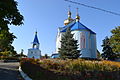 Church of Nativity
 -
 Museum
 -
 Palace of Justice
 -
 Great Synagogue
 -
 Railway Station
 -
 Heroiv Nebesnoi Sotni Street
 -
 Saint Michael's Church
 -
 City Hall
 -
 Museum of Propaganda


References
[edit]- ^ "Шепетовская городская громада" (in Russian). Портал об'єднаних громад України.
- ^ Чисельність наявного населення України на 1 січня 2022 [Number of Present Population of Ukraine, as of January 1, 2022] (PDF) (in Ukrainian and English). Kyiv: State Statistics Service of Ukraine. Archived (PDF) from the original on 4 July 2022.
- ^ "Shepetovka Descendants".
- ^ a b c "Shepetovka Descendants - History".
- ^ "Про утворення та ліквідацію районів. Постанова Верховної Ради України № 807-ІХ". Голос України (in Ukrainian). 2020-07-18. Retrieved 2020-10-03.
- ^ "Нові райони: карти + склад" (in Ukrainian). Міністерство розвитку громад та територій України.
- ^ "World Meteorological Organization Climate Normals for 1981–2010". World Meteorological Organization. Archived from the original on 17 July 2021. Retrieved 17 July 2021.
- ^ "Музей Миколи Островського в Шепетівці за сприяння Інституту перепрофілювали у Музей пропаганди". Ukrainian Institute of National Memory (in Ukrainian). 31 March 2020. Retrieved 2021-03-24.
- ^ Знані постаті Шепетівщини
- ^ Володимир Федотов: Так як загинув Валя Котик? maidan.org.ua
- ^ Історія та культура євреїв Шепетівщини. shepetivka.com.ua
External links
[edit]
Shepetivka
View on GrokipediaShepetivka is a city in western Ukraine's Khmelnytskyi Oblast, situated on the Huska River and functioning as the administrative center of Shepetivka Raion and its urban hromada, with a population of about 42,000.[1][2] First documented in historical records in 1594 and granted Magdeburg Rights by the late 16th century, the settlement developed into a key commercial outpost before emerging as a vital railway junction in the modern era, featuring five intersecting transit lines that link it to all major regions of Ukraine and international routes.[1][3] Its economy centers on transportation infrastructure, light industry such as food processing and furniture manufacturing, and agriculture, underscoring its role as a logistical node in the Podolian uplands rather than a prominent cultural or industrial powerhouse.[2][4]
History
Early settlement and founding
Archaeological evidence indicates human habitation in the vicinity of Shepetivka during the Neolithic period (approximately 10,000–5,000 BCE), with stone tools uncovered in the surrounding area, suggesting early agricultural or foraging activities in the fertile Volhynian landscape.[5] A nearby burial mound dating to the Bronze Age (circa 3,000–1,200 BCE) further attests to continuous prehistoric presence, likely drawn by the region's chernozem soils suitable for rudimentary farming.[5] The first documented reference to Shepetivka as a settlement appears in 1594, recording it as a village owned by Prince Ivan Zaslavsky, a magnate within the Polish-Lithuanian Commonwealth.[1] Situated along the Huska River, the site's development was causally linked to its advantageous position for agriculture, leveraging the river for irrigation and transport amid the expansive, arable plains of Volhynia.[6] This noble ownership facilitated initial growth as a rural estate focused on grain production, with the Commonwealth's feudal structure providing stability for such agrarian outposts. By the late 16th century, Shepetivka transitioned toward urban status, receiving Magdeburg rights that granted self-governance and market privileges, reflecting its economic viability as a trade and farming hub under princely patronage.[1] These privileges, common in Commonwealth borderlands, encouraged settlement by incentivizing crafts and commerce alongside agriculture, though the core remained tied to the land's productivity rather than industry.[1]Imperial Russian and revolutionary eras
Shepetivka was incorporated into the Russian Empire following the Second Partition of Poland in 1793, becoming part of Volhynia Governorate in the Zaslavl uyezd.[7][8] Administratively, it functioned as a volost center within Iziaslav County until reforms in the mid-19th century elevated its status, with the town serving as a hub for local agriculture and small-scale trade under imperial oversight.[1] The late 19th century marked significant economic expansion, driven by railway development that positioned Shepetivka as a key junction with five intersecting lines connecting it to major cities and industrial centers.[5] Construction of these lines, beginning in the 1870s as part of the Southwestern Railways network, facilitated grain transport and commerce, boosting the local economy beyond subsistence farming. The Jewish community played a central role in this growth, with their numbers rising from 1,042 in the 1847 revision to 3,880 by the 1897 census—nearly 48 percent of the total population—primarily engaging in trade, artisanship, and railway-related services.[1] World War I disrupted the region due to Shepetivka's strategic rail infrastructure, which drew Russian military defenses and later retreats amid German advances in Volhynia by 1915.[5] The 1917 February and October Revolutions precipitated a collapse of imperial authority, leading to brief control by the Ukrainian People's Republic as local councils formed amid widespread unrest.[9] In the subsequent Ukrainian-Soviet War and Polish-Soviet War (1919–1921), the town experienced repeated shifts in occupation: Bolshevik forces captured it during offensives in Podilia and Volhynia, only for Polish armies to contest the area as part of broader advances into eastern Galicia and Volhynia, with Ukrainian irregulars mounting local resistance against both sides.[9] These conflicts inflicted economic damage and population displacements, though Shepetivka's rail role amplified its tactical importance in the chaos.[5]Soviet period and collectivization
Following the consolidation of Bolshevik control in the region amid the Russian Civil War, Shepetivka was integrated into the Ukrainian Soviet Socialist Republic by the early 1920s, with administrative status as a city formalized in 1923.[5] This incorporation subjected the locality to centralized Soviet governance, prioritizing agricultural extraction to fund broader industrialization under the first Five-Year Plan initiated in 1928.[10] Collectivization campaigns from 1928 onward forcibly amalgamated private peasant holdings into kolkhozy, targeting "kulaks" deemed economic saboteurs through expropriation, deportation, and execution. In Shepetivka district, significant peasant resistance manifested in 1929 via large-scale underground networks led by former Ukrainian People's Republic army officers, organizing against Soviet authority and land seizures; such opposition prompted GPU surveillance and suppression, reflecting broader rural insurgencies across Ukraine.[11] Dekulakization in the area involved violent enforcement, including instances where Soviet troops killed or wounded dozens of protesters, leaving at least 15 dead in one documented clash.[12] These measures, driven by quotas that ignored local productivity realities, eroded traditional farming structures and provoked slaughter of livestock—Ukraine-wide, cattle herds declined by over 40% between 1928 and 1933—causally exacerbating food shortages through disrupted incentives and coerced compliance.[13] The ensuing Holodomor famine of 1932–1933, enforced via inflated grain procurements and blacklisting of non-compliant villages, inflicted severe demographic losses in Shepetivka district, as noted in contemporary reports from western Ukraine highlighting starvation amid withheld aid.[14] Regional policies, including mobility restrictions and seed confiscations, amplified mortality by preventing self-relief, with Ukraine overall registering excess deaths estimated at 3.5–5 million, disproportionately among rural ethnic Ukrainians resistant to Russification. Empirical records underscore the famine's engineered nature: procurements continued despite evident collapse, prioritizing urban and export needs over peasant survival, thus revealing coercion's role in demographic engineering rather than mere mismanagement.[15] Parallel industrialization efforts leveraged Shepetivka's railway junction for logistics, expanding the pre-existing sugar refinery and establishing ancillary processing facilities to process regional beets, aligning with Stalin's emphasis on heavy industry over agrarian self-sufficiency.[16] Stalinist purges from 1937 extended repression to local cadres and intelligentsia, purging perceived nationalists while imposing Russian as the administrative lingua franca, which systematically marginalized Ukrainian cultural expression; resistance data indicate these policies sustained latent rural discontent, as evidenced by ongoing underground activities despite deportations totaling over 130,000 Ukrainian peasants nationwide in the 1930s.[13] Such coercion, rooted in ideological class warfare, yielded short-term output gains but at the cost of entrenched societal alienation.World War II and the Holocaust
German forces occupied Shepetivka on July 5, 1941, following the rapid advance of Army Group South during Operation Barbarossa.[16] In the immediate aftermath, through July and August 1941, Nazi units and local collaborators conducted mass shootings that killed approximately 4,000 Jews from Shepetivka and surrounding areas, targeting the town's pre-war Jewish population of 4,844, which constituted about 20 percent of residents.[16][17] These executions occurred in nearby forests, with victims driven from their homes and shot in groups, reflecting the broader pattern of Einsatzgruppen-led killings in Ukraine during the initial occupation phase.[5] A ghetto was subsequently established in Shepetivka to confine surviving Jews, primarily women, children, elderly, and those spared initially for forced labor.[1] On June 25, 1942, German Security Police, assisted by Ukrainian auxiliary forces, liquidated the ghetto by marching most inmates to the Tsvetukha ravine outside town, where they were machine-gunned en masse, resulting in the near-total annihilation of the local Jewish community; only a handful survived through hiding or escape.[1][18] Survivor testimonies and post-war investigations confirm the systematic nature of these actions, with local police from Shepetivka participating in similar pogroms in adjacent towns like Polonnoye, underscoring collaboration by some Ukrainian elements under Nazi direction.[18] By war's end, fewer than 400 Jews returned to Shepetivka, verifying the Holocaust's devastation there.[17] Amid occupation, Ukrainian nationalist partisans of the Polissian Sich, led by Taras Bulba-Borovets, conducted the Shepetivka Operation on August 19, 1942, a raid targeting German military logistics at the town's key railway junction. The action succeeded in capturing four railway coaches loaded with armaments and supplies, disrupting Nazi transport lines temporarily and demonstrating the vulnerability of rail infrastructure to guerrilla tactics in the region.[19] This operation, independent of Soviet partisans, highlighted Polissian Sich efforts against both Nazi occupiers and rival groups, though it did not alter the overall course of local extermination policies.[20] The Red Army liberated Shepetivka on February 13, 1944, during the Proskuriv–Chernivtsi Offensive of the 1st Ukrainian Front, after a two-week battle that inflicted heavy losses on defending German forces, with thousands reported killed or captured.[21][16] Civilian casualties during the fighting and subsequent Soviet reprisals against suspected collaborators added to wartime tolls, though precise figures remain undocumented; the liberation ended Nazi control but transitioned to renewed Soviet authority, marked by mutual atrocities on all sides rather than unalloyed heroism.[16]Postwar reconstruction and late Soviet years
Following the liberation of Shepetivka by Soviet forces in February 1944, postwar reconstruction prioritized restoring war-damaged infrastructure, with the railway junction receiving immediate attention due to its strategic role in logistics and military transport. The full reconstruction of the Shepetivka railway node was completed in the postwar years, incorporating new technologies for train formation to enhance efficiency and capacity. Between 1950 and 1952, additional facilities were built to support expanded operations, aligning with broader Soviet efforts to rehabilitate Ukraine's rail network, which had suffered extensive destruction during the war, including up to 75% of bridges on key lines.[22][23] This development solidified Shepetivka's position as a vital depot, facilitating the movement of goods and troops amid the Soviet Union's rapid industrialization push under the fourth and subsequent five-year plans. Industrial growth focused on military-related enterprises, including the modernization of the Shepetivka Repair Plant, which evolved into a key facility for artillery maintenance and production, reflecting centralized directives to bolster the Soviet arsenal in western Ukraine. The plant's expansion supported the upkeep of heavy weaponry, contributing to the region's transformation into a strategic rear for the Red Army during the Cold War buildup. Population influxes, driven by state-directed migrations and incentives for workers in defense industries, led to urban expansion, though official Soviet censuses masked underlying coercive elements such as forced resettlements from other republics, resulting in gradual ethnic Russification—evident in oblast-level data showing rising Russian shares from 3-5% in the 1950s to over 10% by the 1970s amid suppressed Ukrainian cultural agency.[24][25] In the late Soviet period, from the 1970s onward, Shepetivka experienced the broader effects of economic stagnation, characterized by decelerating industrial output and inefficiencies in centralized planning, such as resource misallocation and technological lag, which hampered sustained growth despite initial postwar gains. Heavy industry, including machinery and repair sectors, contributed to localized environmental degradation through unchecked emissions and waste, though state reporting minimized these issues, prioritizing production quotas over mitigation—a pattern consistent with systemic Soviet prioritization of quantity over sustainability. By the 1980s, these factors underscored the limits of state-driven development, with per capita industrial productivity in Ukraine trailing earlier peaks, setting the stage for underlying tensions in the region's economy.[26][27]Independence and post-Soviet developments
Following Ukraine's declaration of independence on 24 August 1991—ratified by a nationwide referendum on 1 December with 90.32% approval—Shepetivka transitioned into the administrative structure of the newly sovereign state as the center of Shepetivka Raion in Khmelnytskyi Oblast.[28] The city's Soviet-era infrastructure, including its status as a key railway junction connecting western Ukraine to broader networks, endured amid national economic upheaval, while local governance shifted toward decentralized models under the 1996 constitution, though implementation faced delays due to fiscal constraints and corruption in resource allocation.[29] The 1990s brought acute deindustrialization, with Ukraine's GDP contracting by approximately 60% between 1990 and 1999 amid hyperinflation peaking at 10,155% in 1993 and the collapse of centralized supply chains; Shepetivka shared in this regional pattern, as non-essential Soviet industries declined, prompting a pivot to agriculture-dominated output like grain cultivation and sugar beet processing in the fertile Podillia lands.[30] Privatization efforts yielded mixed outcomes, with small-scale assets like the Hannopil distillery in Shepetivka Raion auctioned off to private buyers by the early 2020s, though strategic assets such as the state-owned Shepetivka Arsenal—focused on ammunition storage and repair—and railway operations under Ukrzaliznytsia remained under government control, preserving some employment stability but limiting efficiency gains.[31][29] Political events resonated locally within broader national currents: during the 2004 Orange Revolution protests against alleged electoral fraud, Khmelnytskyi Oblast voters backed pro-reform candidate Viktor Yushchenko in the 26 December rerun, underscoring western Ukraine's divergence from eastern pro-government support and highlighting persistent critiques of oligarchic influence in vote manipulation.[32] Echoes of the 2013–2014 Euromaidan movement appeared in regional demonstrations against corruption and Yanukovych-era policies, though Shepetivka's response remained subdued compared to urban centers, aligning with the oblast's empirical tilt toward European integration over Eurasian ties.[33] By the early 2020s, Shepetivka's economy hinged on agriculture and light industry, with limited diversification exacerbating vulnerabilities; population fell from roughly 47,000 in the late Soviet era to an estimated 40,000–43,000 amid emigration-driven outflows, low fertility rates below replacement levels, and economic stagnation that funneled labor to Poland and other EU states.[34][35] This depopulation intensified regional disparities, as remittances provided short-term relief but underscored failures in retaining skilled workers through inadequate infrastructure investment and governance reforms.[36]Involvement in the Russo-Ukrainian War
Shepetivka's strategic significance in the Russo-Ukrainian War stems from its position in western Ukraine, approximately 200 kilometers from the Polish border, facilitating logistics for Ukrainian military supplies received from NATO allies. The city hosts the 47th Arsenal of Ukraine's Main Missile and Artillery Directorate, a Soviet-era facility storing ammunition and munitions, which has drawn repeated Russian targeting as a high-value military asset.[37] This entrenchment of military infrastructure, inherited from the Soviet period, underscores causal vulnerabilities in post-Soviet border regions, where depots like Shepetivka's enable rapid redistribution of Western-supplied weaponry eastward but expose nearby civilian areas to retaliatory strikes. On April 2, 2022, Russian missiles struck an industrial facility near Shepetivka in Khmelnytskyi Oblast, with Ukrainian regional authorities reporting no injuries among the 15 personnel present, though the site sustained damage consistent with targeting dual-use infrastructure supporting logistics.[38] Subsequent attacks focused on the arsenal; on October 25, 2023, Russian kamikaze drones hit the Shepetivka raion, likely aiming at the 47th Arsenal to disrupt munitions stockpiles amid Ukraine's counteroffensive efforts.[37] Russian sources claimed similar strikes extended to Shepetivka-area targets as late as April 23, 2025, as part of broader campaigns against Ukrainian rear-area logistics, though independent verification remains limited.[39] Civilian impacts have included collateral damage from blast waves and debris, with reports of shattered windows in residential areas and schools near strike sites, but no confirmed fatalities directly attributed to Shepetivka-specific attacks in available data up to 2025. The arsenal's fortified yet proximate location to urban zones—within the raion—has prompted localized evacuations and power disruptions, exacerbating displacement trends in Khmelnytskyi Oblast, where over 10% of pre-war residents relocated due to repeated aerial threats. Local authorities have emphasized community resilience through volunteer networks for repairs and aid distribution, though sustained strikes highlight dependencies on external military aid that perpetuate targeting risks rooted in the facility's Cold War origins. Official Ukrainian reports and OSINT analyses attribute minimal direct civilian targeting, framing strikes as precision efforts against military nodes, while critiquing narratives that downplay the arsenal's role in escalating local hazards.[40]Geography
Location and terrain
Shepetivka is situated in the northern part of Khmelnytskyi Oblast in western Ukraine, at coordinates approximately 50°10′ N latitude and 27°04′ E longitude.[41][42] The city lies on the banks of the Huska River, a tributary within the broader hydrological network of the region that has historically facilitated local drainage and settlement patterns.[41] This positioning places Shepetivka roughly 200-300 kilometers east of the Polish border, contributing to its role in cross-regional connectivity while exposing it to influences from the Volhynian-Podilian transitional zone.[43] The terrain around Shepetivka features a predominantly flat to gently undulating landscape characteristic of the Shepetivka Plain, part of the Volhynian Upland, with elevations averaging about 253 meters above sea level.[42][44] The area encompasses sod-podzolic and grey forest soils, which are moderately fertile and support grain cultivation due to their drainage properties and nutrient retention in the forest-steppe environment.[45] Surrounding the urban core are expanses of arable plains interspersed with patches of deciduous forests, shaping a mosaic that influences water flow from the Huska River and limits extreme topographic barriers.[46] The urban area of Shepetivka covers approximately 40 square kilometers, while the broader Shepetivka urban hromada extends over a larger administrative territory incorporating adjacent rural lands.[6] This spatial configuration, with its level terrain and riverine access, has favored compact settlement and agricultural extension without significant natural defenses from elevation changes.[44]Climate and environmental features
Shepetivka lies within the humid continental climate zone (Köppen Dfb), featuring cold, snowy winters and warm, humid summers without pronounced dry periods. Average January temperatures range from highs of -1°C to lows of -5°C, while July averages include highs around 24°C and lows near 14°C, supporting agricultural cycles reliant on frost-free growing seasons.[47] [48] Annual precipitation averages 650–720 mm, concentrated in summer thunderstorms and spring melt, which enhances soil moisture for crops like wheat and potatoes but occasionally leads to waterlogging in low-lying areas.[49] This regime contributes to the region's habitability, with moderate humidity levels (typically 70–80% year-round) mitigating extreme aridity risks.[47] The Huskva River, a tributary of the Horyn, influences local hydrology, with spring flooding from snowmelt posing periodic risks to nearby floodplains and infrastructure, though historical records show no major catastrophic events in recent decades. Environmental concerns include legacy pollution from Soviet-era rail and light industry, affecting soil quality through heavy metal residues and reducing arable land fertility in affected zones.[49] Air quality remains generally fair outside winter inversions, but particulate levels rise from regional biomass burning and transport emissions.[50] Recent meteorological trends, drawn from station data, reveal warming winters— with average January lows rising by 1–2°C since the 1990s—aligned with broader Ukrainian patterns of anthropogenic-driven climate shifts, rather than isolated local factors like deforestation.[51] [52] Forest cover losses in surrounding Polissia areas, exacerbated by wildfires, have indirectly strained ecological buffers against erosion and altered microclimates, though precipitation variability shows no clear intensification yet.[53] These changes underscore vulnerabilities for agriculture, prompting calls for resilient practices amid projected increases in extreme precipitation events.[54]Demographics
Population dynamics
The population of Shepetivka reached its post-World War II peak during the late Soviet era, recording 50,880 residents in the 1989 census, reflecting modest growth from 43,480 in 1979 driven by industrial employment and internal Soviet migration.[55] [34] This expansion aligned with broader Ukrainian urban trends under centralized planning, though constrained by regional agricultural limits and limited natural increase. Post-independence, the population declined to 48,212 by the 2001 Ukrainian census, a net loss of approximately 2,668 persons over 12 years, primarily attributable to economic contraction following the Soviet collapse, which prompted emigration of working-age individuals seeking opportunities abroad or in larger Ukrainian cities, compounded by fertility rates falling below replacement levels (national total fertility rate dropping to 1.1-1.2 children per woman in the 1990s). Further erosion to an estimated 40,299 by January 2022 stemmed from sustained low birth rates (national figures hovering around 1.2-1.3 since 2000) and chronic net out-migration, with Ukraine losing over 10 million residents overall since 1991 due to these factors rather than acute crises alone. [56] The Russian invasion of Ukraine in February 2022 accelerated demographic pressures nationwide, with an estimated 6-8 million citizens displaced internally or as refugees by mid-2023, contributing to a 10-15% effective population drop in non-frontline regions like Shepetivka through temporary evacuations and hesitancy to return amid infrastructure risks and economic uncertainty.[57] [58] While Shepetivka's rail hub status facilitated some outflows, its relative distance from active combat zones limited permanent abandonment compared to eastern oblasts, though aging demographics—evident in rising median age and rural-to-urban shifts within the surrounding hromada—exacerbated vulnerability, with youth emigration predating the war and now intensified by conflict-related fears.[59]| Year | Population | Source Type |
|---|---|---|
| 1989 | 50,880 | Soviet Census[55] |
| 2001 | 48,212 | Ukrainian Census |
| 2022 (est.) | 40,299 | Official Estimate |
Ethnic, linguistic, and religious composition
The ethnic composition of Shepetivka has historically been dominated by Ukrainians, with the 2001 census recording over 94% Ukrainians across Khmelnytskyi Oblast, including the Shepetivka area, and a small Russian minority comprising around 3%.[60] Other groups, such as Poles and Belarusians, constituted less than 1% combined in the region, reflecting limited Soviet-era Russification in western Ukraine compared to eastern areas. Pre-World War II data indicate a more diverse profile, with Jews forming 15-20% of the local population in the interwar period, but this community was nearly eradicated during the Holocaust through ghettoization and mass executions in 1941-1942, leaving negligible Jewish presence today.[1] Linguistically, Ukrainian has been the native language for the vast majority, aligning with oblast-level 2001 census figures showing approximately 88% Ukrainian speakers in Khmelnytskyi, versus 10% Russian.[61] Surzhyk, a hybrid Ukrainian-Russian dialect arising from Soviet-era linguistic mixing, persists in some rural and transitional speech patterns around Shepetivka but remains subordinate to standard Ukrainian in urban settings. Post-2014 decommunization efforts and the 2019 language law have accelerated a shift toward exclusive Ukrainian use in public life, contributing to a measurable decline in everyday Russian and bilingualism, as regional surveys indicate reduced Russian proficiency among younger cohorts amid national reassertion of Ukrainian identity.[62] Religiously, Eastern Orthodoxy prevails, with most adherents affiliated with the Orthodox Church of Ukraine (OCU), established in 2018 to sever ties with the Russian Orthodox Church, reflecting local resistance to Moscow's influence post-2014.[63] Historical Jewish religious life, centered around synagogues like the Great Synagogue built in the 19th century, was obliterated by the Holocaust, with no significant organized Jewish community remaining.[1] Minor Protestant denominations exist but represent under 5% regionally, underscoring Orthodoxy's causal dominance shaped by centuries of church-state entanglement and post-Soviet revival.[64]Economy
Industrial base and key sectors
Shepetivka's industrial sector comprises 14 enterprises, with processing industries accounting for 88% of output and food production for 11.1%.[2] These facilities largely trace origins to Soviet-era establishments, which underwent significant contraction following Ukraine's 1991 independence due to market disruptions and reduced demand for heavy machinery.[2] A cornerstone of the industrial base is military-related manufacturing and repair, centered on the Shepetivka Repair Plant under Ukroboronprom. This facility produces multiple launch rocket systems such as the Bureviy (Hurricane) and repairs self-propelled artillery units including 2S1 Gvozdika and 2S3 Akatsiya.[65][66] Complementing this is the 47th Arsenal of the Main Missile and Artillery Directorate, a key logistics hub for ammunition storage, maintenance, and distribution in Khmelnytskyi Oblast.[67] Food processing represents another vital sector, exemplified by the Shepetivka Sugar Plant, which processes sugar beets into refined products as part of the Aspik Group's operations.[68] The city's railway junction status further bolsters industrial viability by facilitating logistics for these plants, though specialized railway engineering production remains limited. Overall, industry employs a substantial portion of the workforce, sustaining urban employment amid post-Soviet economic shifts, albeit with persistent challenges in modernization and efficiency reflected in subdued output relative to pre-1990s peaks.[2]Agriculture, trade, and recent economic challenges
The fertile chernozem soils surrounding Shepetivka in Khmelnytskyi Oblast support grain production, including wheat and corn, alongside potatoes and livestock such as dairy cattle and poultry, forming the backbone of the local rural economy.[69] These activities align with the oblast's specialization in grains and horticulture, contributing to Ukraine's overall agricultural output where crops like wheat, maize, and potatoes dominate, with annual potato production estimated at 9-11 million tonnes nationwide prior to wartime disruptions.[70] Livestock rearing complements crop farming through integrated systems, though yields remain vulnerable to weather and input costs. Trade in agricultural goods from the Shepetivka area channels through regional markets and export routes, leveraging Ukraine's position as a major grain supplier, with pre-war agricultural exports accounting for about 41% of total exports.[71] Local commerce focuses on domestic sales of potatoes, grains, and dairy products, while surplus grains tie into national export chains, historically directed toward Europe and Asia.[72] Russia's full-scale invasion beginning February 24, 2022, imposed severe strains, including missile strikes on energy and transport infrastructure that disrupted supply chains and elevated input costs, leading to nationwide agricultural damages estimated at $80 billion by late 2023.[72] Inflation surged, with food prices rising amid fertilizer and fuel shortages, while export volumes for key crops declined due to port blockades and logistical barriers until the establishment of a partial Black Sea corridor in mid-2022. Labor shortages intensified from mass emigration—over 6 million Ukrainians fled abroad—and mobilization, reducing the workforce by more than 25% and affecting 60% of businesses by late 2024, hindering planting and harvesting in rural areas like those around Shepetivka.[73] [74] These factors contributed to a 30% contraction in Ukraine's GDP in 2022, with agriculture's share holding at around 10% but facing lagged recovery in per capita output compared to pre-war levels.[75] [76]Infrastructure and Transportation
Railway and road networks
Shepetivka functions as a key railway junction within Ukraine's Southwestern Railways directorate, featuring five intersecting lines that connect to major cities including Kyiv to the east, Lviv via Khmelnytskyi to the west, Ternopil to the southwest, and Podillia region routes, enabling onward links toward Warsaw.[4][2] The station, operational since 1873, initially spurred local economic development by integrating the town into broader imperial rail networks.[5] Approximately 31 passenger trains traverse the junction daily, supporting civilian mobility across Ukraine and limited international services.[77] Soviet-era postwar reconstructions and expansions from the 1940s to 1950s prioritized freight handling, with additional tracks and facilities to accommodate industrial shipments from Podillia quarries and agriculture.[23] Following Ukraine's independence in 1991, maintenance of the rail infrastructure has encountered persistent issues, including underfunding, track degradation, and delays in electrification upgrades, contributing to average service disruptions reported across the national network.[78] Complementing rail access, Shepetivka lies at the crossroads of national highways H-03 (Ternopil–Khmelnytskyi–Shepetivka) and H-25 (Polonne–Shepetivka), which link the city to regional centers and facilitate automotive freight and passenger road travel.[2] These routes, part of Ukraine's upgraded post-Soviet road system, handle increased truck traffic for local grain and industrial goods transport, though periodic repairs address wear from heavy usage.[79]Military and logistical significance
The 47th Arsenal, part of Ukraine's Central Missile and Artillery Directorate and located in the nearby village of Tsvetokha, functions as a primary storage depot for artillery ammunition and rockets, a role inherited from Soviet-era infrastructure developed to support Warsaw Pact logistics in western Ukraine.[67] This facility's concentration of munitions has positioned Shepetivka as a strategic military target amid the Russian invasion, with Russian forces conducting multiple strikes to degrade Ukrainian artillery capabilities; notable attacks include drone strikes on October 25, 2023, which damaged storage sites in the Shepetivka raion.[37] Such targeting underscores the arsenal's causal role in enabling sustained Ukrainian firepower, as disruptions could limit shell availability for frontline howitzers and multiple-launch rocket systems. Shepetivka's railway infrastructure, integrated into Ukraine's broader western network, has amplified its logistical significance since February 2022 by serving as a transit node for Western-supplied munitions and equipment entering via Polish borders, with trains routing aid eastward while avoiding frontline vulnerabilities in central and eastern regions.[80] This positioning, combined with the arsenal's storage capacity, facilitates rapid redistribution to operational units, though it has invited precision strikes to interdict supply flows, as evidenced by repeated Russian aerial campaigns on Khmelnytskyi Oblast depots.[81] Historically, the area's terrain—featuring dense forests and rail lines—supported partisan warfare during World War II, where Soviet-affiliated groups exploited Shepetivka's connectivity for sabotage against German occupation forces, including operations that disrupted Axis supply lines in 1942.[82] These guerrilla tactics, leveraging local geography for ambushes and rail demolitions, prefigured the site's enduring military value in asymmetric and conventional conflicts alike.Government and Administration
Local governance structure
Shepetivka functions as the administrative center of the Shepetivka urban territorial hromada, formed as part of Ukraine's 2020 administrative-territorial reform that consolidated smaller units into unified communities for enhanced local self-governance. The hromada includes the city of Shepetivka and the villages of Zhylyntsi, Plesna, and Plishchyn, covering a population of approximately 47,000 as of recent estimates. This setup replaced prior raion-level structures, granting the hromada direct control over local services, infrastructure, and economic development without intermediate district administrations.[83] Governance operates through a dual structure: the Shepetivka City Council (rada), a legislative body of elected deputies responsible for approving the annual budget, enacting local regulations, managing communal property, and overseeing strategic planning; and the executive committee, led by the mayor, which handles operational administration via specialized departments for finance, communal services, education, social protection, and urban development. The council's deputies, numbering around 26 based on hromada size under electoral law, convene sessions to deliberate policies, while the executive implements decisions and reports to the council. This division ensures checks and balances, with the mayor also chairing the executive committee to coordinate daily functions like public utilities and emergency response.[84][85] The framework derives from Ukraine's decentralization process, launched via the 2014 Law on Cooperation of Territorial Communities, which enabled voluntary amalgamation and fiscal devolution, culminating in the 2020 reform under the Law on Administrative-Territorial Structure. These measures transferred powers including land allocation, local taxation, and primary education from oblast and former raion levels, boosting hromada autonomy—evidenced by retained revenues from property taxes (up to 100% locally), land fees, and 60% of personal income tax generated within the territory. Pre-war budgets, such as the 2021 plan totaling 360 million UAH in revenues, primarily funded infrastructure maintenance, social services, and communal enterprises, underscoring fiscal independence amid national equalization transfers.[86]Political alignments and elections
In the 1991 Ukrainian independence referendum held on December 1, voters across Ukraine approved the Act of Declaration of Independence with 92.3% support nationally, reflecting broad regional consensus including in Khmelnytskyi Oblast where turnout exceeded 90% and affirmative votes aligned with or surpassed national figures due to the area's historical ties to Ukrainian national identity.[87] This outcome underscored early pro-sovereignty alignments in central-western regions like Shepetivka's, contrasting with more divided eastern areas and establishing a baseline of empirical preference for separation from Soviet structures over continued union.[88] Subsequent elections revealed patterns of centrist and pro-European Union orientations, tempered by regional conservatism evident in voting data. In the 2014 presidential election following Euromaidan, Petro Poroshenko, advocating EU integration and anti-Russian policies, secured victories in western and central oblasts including Khmelnytskyi, where support for pro-Maidan candidates outpaced national averages amid lower protest mobilization in smaller cities like Shepetivka compared to Lviv or Kyiv.[89] The 2019 presidential contest saw Volodymyr Zelenskyy, a centrist outsider emphasizing anti-corruption and peace negotiations, prevail with over 70% nationally and majorities in Khmelnytskyi Oblast, though with relatively subdued margins in the west reflecting persistent preferences for established pro-Ukrainian figures over populist shifts.[90] Local elections in 2015 and 2020 further highlighted pragmatic alignments, with incumbents and centrist blocs dominating Shepetivka's mayoral and council races, prioritizing infrastructure over ideological extremes.[91] Amid the 2022 Russian invasion, overt political divisions yielded to wartime unity, with polling showing near-universal rejection of Russian influence in Khmelnytskyi Oblast despite underlying east-west cultural gradients, such as lingering Russian-language use in informal settings (though Ukrainian predominates officially and daily).[92] This cohesion masks empirical conservatism in the region, where voting has historically favored stability-oriented candidates over radical reforms, diverging from national media portrayals of uniform pro-Western zeal and highlighting causal factors like rural demographics and Soviet-era linguistic habits rather than ideological fragmentation.[93]Culture and Society
Education and institutions
The Shepetivka community operates 11 secondary education institutions focused on general schooling, supplemented by a comprehensive children's and youth sports school for physical development and extracurricular activities.[3] These facilities address foundational education for the local population, which numbered approximately 40,000 in the city proper as of recent estimates, though precise enrollment figures for Shepetivka remain limited in public data. Vocational training is available through the Shepetivka Vocational Lyceum, which delivers professional-technical programs for youth alongside adult retraining and upskilling to support career advancement.[94] The affiliated Shepetivka Vocational College provides post-secondary technical education, emphasizing practical skills aligned with regional economic needs such as infrastructure maintenance. Higher education pursuits often require relocation to regional centers like Khmelnytskyi or Kyiv, with limited local options beyond vocational levels. Ukraine's adult literacy rate reached 100% by 2021, indicative of robust post-Soviet schooling outcomes extending to areas like Shepetivka through universal access and compulsory education policies.[95] Despite this, youth emigration for advanced studies abroad or in urban hubs has accelerated brain drain, with surveys showing high intentions among Ukrainian students to migrate for better prospects, correlating with enrollment pressures and demographic outflows in smaller communities.[96][97] This trend underscores opportunity gaps, as local institutions struggle to retain talent amid economic constraints and post-2014 migration patterns.[98]Media and cultural life
The primary local media outlet in Shepetivka is the Shepetivskyi Visnyk newspaper, a Ukrainian-language publication founded as a city and district periodical that covers public-political news, cultural events, advertisements, and local announcements, with ongoing print and online editions as of 2025.[99] Another key broadcaster is Like TV, a regional television and radio company operating since at least the early 2010s, providing coverage of Shepetivka and surrounding areas within a 40-kilometer analog signal radius, emphasizing local news and community programming in Ukrainian.[100] Following Ukraine's 2014 Euromaidan Revolution and decommunization laws enacted in 2015, local media shifted toward a stronger Ukrainian-language and national-identity focus, reducing residual Soviet-era influences amid broader print media circulation declines due to digital migration and economic pressures.[101] Cultural activities center on the Shepetivka City House of Culture, which hosts amateur ensembles including the folk amateur theater-studio "Bravo," a preparatory studio, the "Retro" ensemble, Dixieland band, and dance theater, supporting performances and community events.[102] Annual festivals include the "Rizdvyana Zirka" (Christmas Star) carol and shchedrivka contest, reaching its 14th edition on December 26, 2023, with 23 collectives participating, and City Day celebrations on June 13 marking the 434th anniversary in 2021 through concerts, fairs, and folk performances tied to regional Podolian traditions. [103] The city has hosted national events like the All-Ukrainian choreographic arts festival "Zolote Kolo" (Golden Circle) in May 2018, promoting dance rooted in Ukrainian folk heritage.[104] Museums reflect efforts to address Soviet legacies; the former Mykola Ostrovsky Regional Literary Memorial Museum, established in the 1970s to honor the Soviet writer Nikolai Ostrovsky (born nearby in 1904), exemplified state-promoted Russification through heroic narratives of Bolshevik revolution and World War II, but was repurposed post-2015 decommunization into the Museum of Propaganda to critique such ideological indoctrination.[101] [105] This transformation underscores local cultural reevaluation, prioritizing Ukrainian historical realism over imposed Soviet monuments and figures that marginalized indigenous identity.[101]Religious history and current practices
Orthodox Christianity predominated in Shepetivka prior to the 1930s, with churches like the Saint Michael Archangel Orthodox Cathedral anchoring community worship under the Russian Orthodox tradition.[106] A notable Jewish community emerged after repopulation in the late 17th century following destruction during the Khmelnytsky Uprising of 1648–1649, evolving into a Hasidic center under Rabbi Pinhas of Koretz and numbering 1,042 individuals by 1847, centered around synagogues including the Great Synagogue.[1][16] Catholic influence, stemming from Polish-Lithuanian Commonwealth control, manifested in a minority presence, exemplified by the Church of the Exaltation of the Holy Cross built in 1859.[107] Soviet rule from 1922 imposed state atheism, closing religious sites, persecuting clergy, and eradicating open practice across Orthodox, Jewish, and Catholic faiths, with many structures repurposed or demolished. The Holocaust under Nazi occupation from 1941 annihilated Shepetivka's Jewish population and razed synagogues, leaving no viable community for religious continuity.[108] After Ukrainian independence in 1991, religious revival occurred, including reconstructions like the 1989 rebuilding of the Catholic Church of the Exaltation amid perestroika liberalization. Orthodox practice revived under the Ukrainian Orthodox Church of the Moscow Patriarchate (UOC-MP), part of the Shepetivka and Slavuta Eparchy, but faced schism with the 2018 formation of the Orthodox Church of Ukraine (OCU). In Shepetivka, this tension led to raids and seizure attempts on UOC-MP sites, such as St. Michael's Cathedral, culminating in the community holding outdoor services on April 9, 2023, after eviction pressures in 2022.[109][110] Catholic services persist modestly at the Exaltation church, while Jewish religious life remains negligible post-emigration waves in the late 1980s and 1990s.[5]Notable Residents
Historical figures
Moses Goldshtein (1868–1932), born in Shepetivka, emerged as a prominent lawyer in the Russian Empire during the late 19th and early 20th centuries, specializing in criminal and civil cases amid the era's turbulent legal landscape. His career highlighted the challenges faced by Jewish professionals under tsarist restrictions, including quotas and discriminatory policies, before he emigrated to Paris in 1918 amid the Russian Civil War and Bolshevik consolidation of power.[1]Contemporary individuals
Oleksii Mes (October 20, 1993 – August 26, 2024) was a Ukrainian Air Force lieutenant colonel and fighter pilot born in Shepetivka, known by the callsign "Moonfish." He graduated with honors from the Ivan Kozhedub Kharkiv National Air Force University and commanded a MiG-29 squadron as of June 2022, actively advocating for the delivery of F-16 fighter jets to Ukraine amid the Russian invasion. Mes perished during a combat mission flying one of Ukraine's initial F-16s, marking the first such aircraft loss in the conflict while intercepting Russian missiles; he was posthumously awarded the Hero of Ukraine title on March 17, 2025.[111][112] Mark Drobit, born August 27, 1986, in Shepetivka, is a Ukrainian theater and film actor recognized as an Honored Artist of Ukraine since 2019. Raised in Shepetivka where he participated in local performances during his youth, Drobit trained at the Kyiv National University of Theater, Film and Television, gaining prominence for roles in series such as Krepostnaya and stage productions at the Kyiv Academic Young Theater. His career exemplifies the migration of regional talent to urban centers like Kyiv for professional opportunities post-independence.[113][114] Anna Salivanchuk, born in Shepetivka, is a Ukrainian actress who began her career locally, winning the "Miss Shepetivka" contest before pursuing studies in psychology and acting in Kyiv. Active in theater and film, she has appeared in various productions and returned to her hometown in October 2025 for a performance, highlighting enduring ties to Shepetivka despite a decade away; her path reflects broader patterns of artistic emigration from smaller Ukrainian cities since 1991.[115][116]References
- https://www.wikidata.org/wiki/Q4522966