


Community hub
Recent from talks
Contribute something
Nothing was collected or created yet.
Silhouette
View on Wikipedia
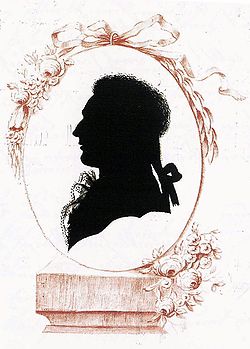
A silhouette (English: /ˌsɪluˈɛt/,[1] French: [silwɛt]) is the image of a person, animal, object or scene represented as a solid shape of a single colour, usually black, with its edges matching the outline of the subject. The interior of a silhouette is featureless, and the silhouette is usually presented on a light background, usually white, or none at all. The silhouette differs from an outline, which depicts the edge of an object in a linear form, while a silhouette appears as a solid shape. Silhouette images may be created in any visual artistic medium,[2] but were first used to describe pieces of cut paper, which were then stuck to a backing in a contrasting colour, and often framed.
Cutting portraits, generally in profile, from black card became popular in the mid-18th century, though the term silhouette was seldom used until the early decades of the 19th century, and the tradition has continued under this name into the 21st century. They represented a cheap but effective alternative to the portrait miniature, and skilled specialist artists could cut a high-quality bust portrait, by far the most common style, in a matter of minutes, working purely by eye. Other artists, especially from about 1790, drew an outline on paper, then painted it in, which could be equally quick.
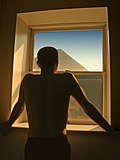
From its original graphic meaning, the term silhouette has been extended to describe the sight or representation of a person, object or scene that is backlit and appears dark against a lighter background. Anything that appears this way, for example, a figure standing backlit in a doorway, may be described as "in silhouette". Because a silhouette emphasises the outline, the word has also been used in fields such as fashion, fitness, and concept art to describe the shape of a person's body or the shape created by wearing clothing of a particular style or period.
Etymology and origins
[edit]
The word silhouette is derived from the name of Étienne de Silhouette, a French finance minister who, in 1759, was forced by France's credit crisis during the Seven Years' War to impose severe economic demands upon the French people, particularly the wealthy.[3] Because of de Silhouette's austere economies, his name became synonymous with anything done or made cheaply and so with these outline portraits.[4][5] Prior to the advent of photography, silhouette profiles cut from black card were the cheapest way of recording a person's appearance.[6][7]
The term silhouette, although existing from the 18th century, was not applied to the art of portrait-making until the 19th century. In the 18th and early 19th century, "profiles" or "shades" as they were called were made by one of three methods:
- painted on ivory, plaster, paper, card, or in reverse on glass;
- "Hollow cut" where the negative image was traced and then cut away from light coloured paper which was then laid on a dark background; and
- "cut and paste" where the figure was cut out of dark paper (usually free hand) and then pasted onto a light background.[2]
History
[edit]Greek origins
[edit]

Pliny the Elder recounts the history of painting in books 34 and 35 of his Natural History (c. 77 CE). In book 35, chapter 5, he writes of silhouette as a starting point in the development of painting:
- "We have no certain knowledge as to the commencement of the art of painting, nor does this enquiry fall under our consideration. The Egyptians assert that it was invented among themselves, six thousand years before it passed into Greece; a vain boast, it is very evident. As to the Greeks, some say that it was invented at Sicyon, others at Corinth; but they all agree that it originated in tracing lines round the human shadow [omnes umbra hominis lineis circumducta]."
In chapter 15, he tells the story of Butades of Corinth as an originator of this modeling technique:
- "Butades, a potter of Sicyon, was the first who invented, at Corinth, the art of modelling portraits in the earth which he used in his trade. It was through his daughter that he made the discovery, who, being deeply in love with a young man about to depart on a long journey, traced the profile of his face, as thrown upon the wall by the light of the lamp [umbram ex facie eius ad lucernam in pariete lineis circumscripsit]. Upon seeing this, her father filled in the outline, by compressing clay upon the surface, and so made a face in relief, which he then hardened by fire along with other articles of pottery."
Greek black-figure pottery painting,[8] also known as the black-figure style or black-figure ceramic (Greek, μελανόμορφα, melanomorpha), common between the 7th and 5th centuries BCE, employs the silhouette and characteristic profile views of figures and objects on pottery forms. The pots themselves exhibit strong forms in outline that are indicators of their purpose, as well as being decorative.[9]
Profile portraits
[edit]

For the depiction of portraits, the profile image has marked advantage over a full-face image in many circumstances, because it depends strongly upon the proportions and relationship of the bony structures of the face (the forehead, nose and chin) making the image is clear and simple. Research at Stanford University indicated that where previous studies of face recognition have been based on frontal views, studies with silhouettes show humans are able to extract accurate information about gender and age from the silhouette alone.[10] This is an important concept for artists who design characters for visual media, because the silhouette is the most immediately recognisable and identifiable shape of the character.[11]
For this reason, profile portraits have been employed on coinage since antiquity,[12][13] with the earliest human profile portrait appearing on coins from Lycia around 500 BC.[13][14][15] The practice of portraying rulers in profile on the currency they issued became firmly established by Alexander the Great and his successors.[13]
The early Renaissance period saw a fashion for painted profile portraits and people such as Federico da Montefeltro and Ludovico Sforza were depicted in profile portraits.
Profile portrait techniques
[edit]

A silhouette portrait can be painted or drawn. However, the traditional method of creating silhouette portraits is to cut them from lightweight black cardboard and mount them on a pale (usually white) background. This was the work of specialist artists, often working out of booths at fairs or markets, whose trade competed with that of the more expensive miniaturists patronised by the wealthy.
A traditional silhouette portrait artist would cut the likeness of a person, freehand, within a few minutes.[16] Some modern silhouette artists also make silhouette portraits from photographs of people taken in profile.[6] These profile images are often head and shoulder length (bust) but can also be full length.[17]
Nineteenth-century popularity and development
[edit]

The work of the physiognomist Johann Caspar Lavater, who used silhouettes to analyse facial types, is thought to have promoted the art.[18] The 18th century silhouette artist August Edouart cut thousands of portraits in duplicate. His subjects included French and British nobility and US presidents. Much of his personal collection was lost in a shipwreck.[19] In England, the best known silhouette artist, a painter not a cutter, was John Miers, who travelled and worked in different cities, but had a studio on the Strand in London.[20] He advertised "three minute sittings",[21] and the cost might be as low as half a crown around 1800. Miers' superior products could be in grisaille, with delicate highlights added in gold or yellow, and some examples might be painted on various backings, including gesso, glass or ivory.[22] The size was normally small, with many designed to fit into a locket, but otherwise a bust some 3 to 5 inches high was typical, with half- or full-length portraits proportionately larger.
In America, silhouettes were highly popular from about 1790 to 1840.
The physionotrace apparatus invented by Frenchman Gilles-Louis Chrétien in 1783-84 facilitated the production of silhouette portraits by deploying the mechanics of the pantograph to transmit the tracing (via an eyepiece) of the subject's profile silhouette to a needle moving on an engraving plate, from which multiple portrait copies could be printed.[23][24] The invention of photography signaled the end of the silhouette as a widespread form of portraiture.[6]
Maintaining the tradition
[edit]

The skill was not lost, and travelling silhouette artists continued to work at state fairs into the 20th century. E. J. Perry and Dai Vernon were artists active in Coney Island at this time as well. The popularity of the silhouette portrait is being reborn in a new generation of people who appreciate the silhouette as a nostalgic way of capturing a significant occasion.
In the United States and the UK silhouette artists have websites advertising their services at weddings and other such functions.[6][25][26] In England there is an active group of silhouette artists.[27][16][28] In Australia, S. John Ross plied his scissors at agricultural shows for 60 years until his death in 2008.[29] Other artists such as Douglas Carpenter produce silhouette images using pen and ink.[30]
In art, media and illustrations
[edit]
Since the late 18th century, silhouette artists have also made small scenes cut from card and mounted on a contrasting background like the portraits. These pictures, known as "paper cuts", were often, but not necessarily, silhouette images. European paper cuts traditionally have differed from Asian paper cuts, which are often made of several layers of brightly coloured and patterned paper, with many formal decorative elements such as flower petals.
Among 19th century artists to work with papercutting was the author Hans Christian Andersen.[31] The modern artist Robert Ryan creates intricate images by this technique, sometimes using them to produce silk-screen prints.[32]

_(14776099784).jpg)
In the late 19th and early 20th century several illustrators employed designs of similar appearance for making book illustrations. Silhouette pictures could easily be printed by blocks that were cheaper to produce and longer lasting than detailed black and white illustrations.
Silhouette pictures sometimes appear in books of the early 20th century in conjunction with colour plates. (The colour plates were expensive to produce and each one was glued into the book by hand.) Illustrators who produced silhouette pictures at this time include Arthur Rackham and William Heath Robinson. In breaking with literal realism, artists of the Vorticist, Futurist and Cubist[33][34] movements employed the silhouette. Illustrators of the late 20th century to work in silhouette include Jan Pienkowski and Jan Ormerod. In the early 1970s, French artist Philippe Derome uses the black cut silhouette in his portraits of black people. In the 21st century, American artist Kara Walker develops this use of silhouette to present racial issues in confronting images.[35]
Shadow theatre
[edit]Originating in Asia with traditions such as the shadow theatres (wayang) of Indonesia, the shadow play became a popular entertainment in Paris during the 18th and 19th centuries. In late 19th-century Paris, shadow theatre was particularly associated with the cabaret Le Chat Noir, where Henri Rivière was the designer.[36]


Movies
[edit]
Since their pioneering use by Lotte Reiniger in silent films, silhouettes have been used for a variety of iconic, graphic, emotional, or conversely for distancing, effects in many movies. These include many of the opening credit sequences of the James Bond films. The opening sequence of the television series Alfred Hitchcock Presents features a silhouetted profile of Alfred Hitchcock stepping into a caricatured outline of himself, and in his movie Psycho, the killer in the shower scene manifests as a terrifying silhouette. A scene from E.T. showing the central characters on a flying bicycle silhouetted against the full moon became a well-known movie poster. Harry Potter and the Deathly Hallows – Part 1 contains an animated sequence in silhouette illustrating a short story The Tale of the Three Brothers that is embedded in the film. The sequence was produced by Ben Hibon for Framestore, with artwork by Alexis Lidell.
Silhouettes have also been used by recording artists in music videos. One example is the video for "Buttons" by The Pussycat Dolls, in which Nicole Scherzinger is seen in silhouette. Michael Jackson used his own distinctive silhouette both on stage and in videos such as "You Rock My World". Early iPod commercials portrayed silhouetted dancers wearing an iPod and earbuds.
The cult television program, Mystery Science Theater 3000 features the three main characters of the series watching a movie as silhouettes at the bottom of the screen.
Architecture
[edit]
The discipline of architecture that studies the shadows cast by or upon buildings is called sciography.
The play of shadows upon buildings was very much in vogue a thousand years ago as evidenced by the surviving examples of muqarnas decoration, where the shadows of three-dimensional ornamentation with stone masonry around the entrance of mosques form pictures. As outright pictures were avoided in Islam, tessellations and calligraphic pictures were allowed, "accidental" silhouettes are a creative alternative.[37][38]
Photography
[edit]
Many photographers use the technique of photographing people, objects or landscape elements against the light, to achieve an image in silhouette. The background light might be natural, such as a cloudy or open sky, mist or fog, sunset or an open doorway (a technique known as contre-jour), or it might be contrived in a studio; see low-key lighting. Silhouetting requires that the exposure be adjusted so that there is no detail (underexposure) within the desired silhouette element, and overexposure for the background to render it bright; so, a lighting ratio of 16:1 or greater is the ideal. The Zone System[39] was an aid to film photographers in achieving the required exposure ratios. High contrast film, adjustment of film development,[40] and/or high contrast photographic paper may be used in chemical-based photography to enhance the effect in the darkroom.[41] With digital processing the contrast may be enhanced through the manipulation of the contrast curve for the image.[42]
Photographic silhouettes
[edit]-
 Rumination
 -
 Below Bethesda Terrace, Central Park
 -

-
 Barack Obama and Michelle Obama watching fireworks
 -

-

-

-



.jpg)

.jpg)
Graphic design
[edit]In media the term "to silhouette" is used for the process of separating or masking a portion of an image (such as the background) so that it does not show. Traditionally silhouettes have often been used in advertising, particularly in poster design, because they can be cheaply and effectively printed.

.jpg)


Other uses
[edit]
Fashion and fitness
[edit]The word "silhouette", because it implies the outline of a form, has been used in both fashion and fitness to describe the outline shape of the body from a particular angle, as altered by clothing in fashion usage, and clothed or unclothed where fitness is concerned, (e.g. a usage applied here by the Powerhouse Museum). Advertising for both these fields urges people, women in particular, to achieve a particular appearance, either by corsetry, diet or exercise. The term was in use in advertising by the early 20th century. Many gyms and fitness studios use the word "silhouette" either in their name or in their advertising.[43]
Historians of costume also use the term when describing the effect achieved by the clothes of different periods, so that they might describe and compare the silhouette of the 1860s with that of the other decades of the 19th century. A desirable silhouette could be influenced by many factors. The invention of crinoline steel influenced the silhouette of women in the 1850s and 60s. The posture of the Princess Alexandra influenced the silhouette of English women in the Edwardian period.
Icons
[edit]Because silhouettes give a very clear image, they are often used in any field where the speedy identification of an object is necessary. Silhouettes have many practical applications. They are used for traffic signs. They are used to identify towns or countries with silhouettes of monuments or maps. They are used to identify natural objects such as trees, insects and dinosaurs. They are used in forensic science.[44]
-
 Traffic sign in Japan warning that the road crosses a railway
 -
 Mudflap girl, a common image on car mudflaps
 -
 Silhouettes representing human evolution
 -
 Flag of Cyprus with the map of the country as a silhouette
 -

-


Journalism
[edit]For interviews, some individuals choose to be videotaped in silhouette to mask their facial features and protect their anonymity, typically accompanied by a dubbed voice. This is done when the individuals may be endangered if it is known they were interviewed.

Computer modelling
[edit]Computer vision researchers have been able to build computational models for perception that are capable of generating and reconstructing 3D shapes from single or multi-view depth maps or silhouettes (see visual hull).[45]


Business documents
[edit]Silhouettes have also been used to create images that serve as business documents.[46][47] Slave owners have had silhouettes made of the people they enslaved in order to document them as property and in order to accompany other business documents such as a bill of sale.[48][49]
Military and firearms
[edit]Silhouettes of ships, planes, tanks, and other military vehicles are used by soldiers and sailors for learning to identify different craft.
-
 Silhouette of an aircraft
 -
 Human silhouette for firearms training
 -
 Metallic silhouette for target shooting


Notable examples
[edit]See also
[edit]References
[edit]- ^ Wells, John (3 April 2008). Longman Pronunciation Dictionary (3rd ed.). Pearson Longman. ISBN 978-1-4058-8118-0.
- ^ a b McClard, Peggy. "History of Silhouette". www.PeggyMcClard.com. Archived from the original on December 5, 2007. Retrieved September 12, 2011.
- ^ McLynn pp. 64–65
- ^ Teall, Gardner (Aug 1916). "Silhouettes Old and New". House & Garden. 30: 20.
- ^ There is no mention of de Silhouette making silhouettes in his earliest record in 1834 edition Biographie universelle ou dictionnaire historique contenant la nécrologie des hommes célèbres Volume 5. Furne, 1834. P. 2850
- ^ a b c d Custom Silhouette Pictures by Karl Johnson Archived 2009-01-16 at the Wayback Machine, accessed November 2, 2008.
- ^ The family name Silhouette is a French form of a Basque surname, Ziloeta; Arnaud de Silhouette, Étienne's father, was from Biarritz in the French Basque Country; this surname, whose Standard Basque or Batua form is Zuloeta, contains the suffix -eta "abundance of" and zilo, Batua zulo, "hole".
- ^ R. M. Cook (1976). Review of John Boardman, Athenian Black Figure Vases: A Handbook. Classical Review (New Series), 26, pp 253-253. doi:10.1017/S0009840X00248610.
- ^ Trendall, A. D. (Arthur Dale Trendall) & National Gallery of Victoria (1966). Greek vases in the Felton Collection. Oxford University Press, Melbourne ; New York
- ^ Science Daily, accessed November 2, 2008.
- ^ Good design lies in the foundation Archived 2009-01-01 at the Wayback Machine, accessed August 18, 2009.
- ^ Carradice, Ian (1978). Ancient Greek Portrait Coins. British Museum Publications. p. 2. ISBN 9780714108490.
- ^ a b c West, Shearer; Birmingham, Shearer (2004). Portraiture. OUP Oxford. p. 68. ISBN 9780192842589.
- ^ Root, Margaret Cool (1989). "The Persian archer at Persepolis : aspects of chronology, style and symbolism". Revue des Études Anciennes. 91: 43–50. doi:10.3406/rea.1989.4361.
- ^ "Half-figure of the King: unravelling the mysteries of the earliest Sigloi of Darius I" (PDF). The Celator. 26 (2): 20. February 2012. Archived (PDF) from the original on 2018-11-21.
- ^ a b Roving Artists Classic portraits Archived 2015-11-14 at the Wayback Machine
- ^ "Silhouette Sarah". Archived from the original on 2015-05-16. Retrieved 2017-02-02.
- ^ Lavater, accessed November 2, 2008.
- ^ August Edward, accessed November 2, 2008.
- ^ John Miers, accessed November 2, 2008, V&A biography Archived 2012-10-06 at the Wayback Machine
- ^ brereton.org.uk, Printed advertisement on back of a miniature
- ^ museum "Silhouettes" Archived 2016-04-22 at the Wayback Machine
- ^ Freund, Gisèle (1974), Photographie et société, Éditions du Seuil, p. 8-18, retrieved 18 April 2016
- ^ Cromer 'Le secret du physoniotrace Bulletin de la société archéologique, historique et artistique, ´Le Vieux Papier,' 26th year, October 1925
- ^ "Silhouette Sarah | Silhouette Artist, Cutter and Entertainer". www.silhouettecutting.co.uk. Retrieved 2017-01-05.
- ^ "Mark Conlin | Silhouette Artist". www.theshadowcutter.co.uk. Retrieved 2019-09-20.
- ^ Tyneside silhouettist inspired family-success Archived 2013-04-26 at the Wayback Machine accessed February 4, 2012]
- ^ Artist brings talent to The Woodlands shop, Houston Chronicle
- ^ The Silhouette Man, accessed November 2, 2008.
- ^ Silhouette artist, accessed November 2, 2008.
- ^ Hans Christian Andersen's Paper Cuts in the Royal Library, accessed November 2, 2008.
- ^ Mister Rob Ryan, accessed November 2, 2008.
- ^ Robbin, T. (2008). Shadows of reality: the fourth dimension in relativity, cubism, and modern thought. The Mathematical Intelligencer, 30(1), 74-75.
- ^ "Collection Online | Man Ray. Silhouette. 1916 - Guggenheim Museum". guggenheim.org. Retrieved March 21, 2016.
- ^ Knipe, P. (2002). Paper profiles: American portrait silhouettes. Journal of the American Institute for Conservation, 41(3), 203-223.
- ^ Le Cabaret du Chat Noir (1881–1897) Archived 2017-02-15 at the Wayback Machine, Musée d'Orsay, Paris, 1992
- ^ google.no, Niğde Alaaddin Mosque where a Chiaroscuro drawing of a woman's face with crown and long hair appears at a specific time of the year.
- ^ fotogaleri.haberler.com Archived 2015-12-22 at the Wayback Machine, Divriği Great Mosque and Hospital with the silhouette of a praying man that appears over the entrance door of the mosque part and changes pose as the sun moves.
- ^ Adams, Ansel & Baker, Robert (1995). The camera (1st pbk. ed). Little, Brown, Boston
- ^ Adams, Ansel & Baker, Robert (1981). The negative (1st ed). New York Graphic Society, Boston
- ^ Adams, Ansel & Baker, Robert (2003). The print. Little, Brown and Company, Boston
- ^ Evening, Martin (2015). Adobe Photoshop CC for photographers : a professional image editor's guide to the creative use of Photoshop for the Macintosh and PC (2nd edition). Burlington, MA, USA Focal Press
- ^ There are over 1,800,000 mentions of the word "silhouette" in conjunction with "fitness" online. There are many "Silhouette Fitness" studios and gymnasiums, e.g. in Halifax, in Bendigo Archived 2011-10-05 at the Wayback Machine, in Switzerland Archived 2008-10-26 at the Wayback Machine etc
- ^ Forensic entomology Archived 2008-05-10 at the Wayback Machine, accessed November 3, 2008.
- ^ "Soltani, A. A., Huang, H., Wu, J., Kulkarni, T. D., & Tenenbaum, J. B. Synthesizing 3D Shapes via Modeling Multi-View Depth Maps and Silhouettes With Deep Generative Networks. In Proceedings of the IEEE Conference on Computer Vision and Pattern Recognition (pp. 1511-1519)". GitHub. 5 January 2022.
- ^ Purtill, Corinne (21 November 2018). "An enslaved woman's shadow is the most compelling image in the National Portrait Gallery". Quartz. Archived from the original on April 22, 2020. Retrieved 2021-11-24.
- ^ Catlin, Roger. "Rarely Seen 19th-Century Silhouette of a Same-Sex Couple Living Together Goes On View". Smithsonian Magazine. Retrieved 2021-11-24.
- ^ "Africans in America/Part 2/Flora". www.pbs.org. Archived from the original on November 24, 2021. Retrieved 2021-11-24.
- ^ "'Black Out: Silhouettes Then and Now': Rare art form on display in Mississippi more than just shadows of the past". Mississippi Today. 2019-06-14. Archived from the original on September 28, 2020. Retrieved 2021-11-24.
Bibliography
[edit]- Coke, Desmond (1913). The Art of Silhouette. London: Martin Secker.
- Jackson, Emily (1911). The History of Silhouettes. London: The Connoisseur.
- Knipe, Penley (2002). "Paper Profiles: American Portrait Silhouettes". Journal of the American Institute for Conservation. 44 (3): 203–223. doi:10.1179/019713602806082575. S2CID 192205617.
- McKechnie, Sue (1978). British Silhouette Artists and their Work, 1760–1860. London: Sotheby Parke Bernet. ISBN 0856670367.
- McLynn, Frank (2005) [2004]. 1759:The Year Britain Became Master of the World. London: Pimlico. ISBN 9780712694186.
- Orr, Inge C. (1974). "Puppet Theater in Asia". Asian Folklore Studies. 33 (1): 69–84. doi:10.2307/1177504. JSTOR 1177504.
- Roe, F. Gordon (1970). Women in Profile: A Study in Silhouette. London: John Baker. ISBN 978-0-212-98364-3.
- Rutherford, Emma (2009). Silhouette: The Art of the Shadow. New York: Rizzoli. ISBN 978-0-8478-3077-0.
- Stoichitǎ, Victor (1997). A Short History of the Shadow. Essays in Art & Culture. London: Reaktion. ISBN 978-1-86189-000-9.
- Sedda, Julia (2014). "Silhouettes: the fashionable paper portrait miniature around 1800". In Pappe, Bernd; Schmieglitz-Otten, Juliane; Walczak, Gerrit (eds.). European Portrait Miniatures: artists, functions and collections. Petersberg: Michael Imhof Verlag. pp. 179–185. ISBN 978-3-86568-969-6.
- Sedda, Julia (2009). "Reading circles, crafts, and flower arranging: everyday items in the silhouettes of Luise Duttenhofer (1776–1829)". In Goggin, Maureen Daly; Tobin, Beth Fowkes (eds.). Women and Things, 1750–1950: gendered material strategies. Farnham: Ashgate. ISBN 978-0-7546-6550-2.
- Vigarello, Georges (2016) [2012]. The Silhouette: from the 18th century to the present day. Translated by Dörr, Augusta. London: Bloomsbury Visual Arts. ISBN 9781474244657.
Film
[edit]- Reiniger, Lotte: Homage to the Inventor of the Silhouette Film. Dir. Katja Raganelli. DVD. Milestone Film, 1999.
External links
[edit] Media related to Silhouettes at Wikimedia Commons
- GAP Guild of American Papercutters
- "Silhouettes". Paintings & Drawings. Victoria and Albert Museum. Archived from the original on July 12, 2007. Retrieved August 21, 2007.
- Profile Likenesses of the Executive and Legislature of Georgia (Silhouette Book), by William H. Brown, 1855[permanent dead link] from the collection of the Georgia Archives Archived 2013-06-28 at the Wayback Machine.
- Kara Walker's A Horrible Beautiful Beast
- Kara Walker's 2007 Whitney Exhibit
- Andersen, Jens (2002). "Scissor Writing". Det Kongelige Bibliotek. Retrieved 22 November 2016.
- Ingersoll, Julia (2003). "Wayang Kulit: the Ancient Shadow Plays of Bali". Gamelan Tunas Mekar. Archived from the original on 12 December 2018. Retrieved 22 November 2016.
| International | |
|---|---|
| National | |
| Other | |

Silhouette
View on GrokipediaFundamentals
Definition and Optical Principles
A silhouette is the image of an object, person, animal, or scene rendered as a solid, uniform shape—typically black—wherein only the outer edges align with the contour as viewed from a particular direction, omitting all internal details.[7] This representation captures the object's apparent boundary without tonal gradations, emphasizing shape through stark contrast rather than texture or form.[8] Optically, a silhouette forms through the occlusion of light by an opaque or semi-opaque object positioned between a bright illuminant and the observer, creating a high-contrast boundary where the object's dark interior merges indistinguishably against the light source.[9] The phenomenon relies on the rectilinear propagation of light rays, which are blocked entirely within the object's projection, rendering fine structures invisible due to insufficient scattered or reflected light reaching the eye or detector.[8] In pristine conditions, the silhouette edge corresponds to the envelope of tangent rays grazing the object's extremities, defining the visible perimeter as the transition from occluded to unoccluded light paths.[7] This process differs from a cast shadow, which projects the object's outline onto an intervening surface via divergent or parallel rays from a light source; a silhouette, by contrast, is the direct perceptual outline of the occluding body itself when backlit, without requiring a projection screen.[8] Factors such as the light source's distance and angular size influence edge sharpness: a distant point source yields crisp boundaries akin to orthographic projection, while nearby extended sources introduce penumbral blurring at the margins.[10] In imaging systems, pristine silhouettes may degrade due to diffraction, atmospheric scattering, or detector noise, but the core principle remains the geometric interception of radiance.[7]Etymology and Early Conceptualization
The term silhouette derives from the surname of Étienne de Silhouette (1709–1767), a French diplomat and finance minister who briefly served as Controller-General of Finances under Louis XV from March to November 1759.[3] Appointed during France's fiscal crisis amid the Seven Years' War (1756–1763), de Silhouette implemented aggressive austerity measures, including new taxes and reductions in court expenditures, which provoked widespread ridicule and contributed to his rapid dismissal after eight months.[1] In this context, the inexpensive technique of producing profile portraits—typically by tracing a shadow outline, cutting black paper, or painting a solid dark form against a light background—gained popularity as an accessible alternative to costly painted miniatures, leading contemporaries to derisively label such works à la Silhouette in mockery of his perceived stinginess.[11] Contemporary accounts suggest de Silhouette may have personally engaged in cutting paper profiles as a hobby, further linking his name to the practice, though the primary association stems from satirical commentary on economic frugality rather than his direct invention.[12] The word first appeared in French print around 1760, initially denoting these economical shadow portraits before broadening to describe any outline representation devoid of interior detail.[3] English adoption followed shortly after, with early uses in the 1760s reflecting the same pejorative origins tied to fiscal restraint.[1] The underlying conceptualization of a silhouette as a stark outline emerged from fundamental optical principles observable since antiquity, where a subject's form is rendered by blocking light against a contrasting backdrop, reducing complex three-dimensionality to a two-dimensional contour.[13] This idea, rooted in shadow casting and profile delineation, was formalized in artistic practice by the 18th century as a democratized form of portraiture, prioritizing silhouette's efficiency in capturing essential shape over nuanced shading or color, thus enabling rapid production for the emerging middle class without requiring skilled engraving or painting.[14] Prior to the term's coinage, similar outline techniques appeared in European shadow theaters and informal sketches, conceptualizing the form as a mnemonic or theatrical device rather than a standalone portrait medium.[15]Historical Development
Ancient and Pre-Modern Origins
Silhouette-like representations appeared in ancient China through shadow puppetry, a performative art using translucent screens and articulated leather or paper figures illuminated from behind to cast shadows. This tradition originated during the Han Dynasty (206 BCE–220 CE), with practitioners manipulating rods to animate figures accompanied by music and narration.[16] [17] Legends attribute its invention to a court magician who created horse shadows to console Emperor Wu (r. 141–87 BCE) after the death of his concubine, though the first documentary evidence dates to the Song Dynasty (960–1279 CE).[18] The technique relied on precise cutting of hides treated with oil for translucency and coloration, enabling complex narratives from folklore and history.[19] In ancient Greece, the black-figure pottery technique produced durable silhouette images by applying black slip to clay vessels, firing them to create glossy black figures against the natural red body, with internal details revealed through incision. Developed in Corinth around 700–650 BCE, this method silhouetted human and mythical forms, emphasizing outline and profile views for narrative scenes on vases and amphorae.[20] [21] The approach transitioned to Attic workshops by circa 600 BCE, dominating until the red-figure style's rise around 530 BCE, demonstrating early mastery of contrast for visual storytelling on everyday and ceremonial objects.[22] Roman naturalist Pliny the Elder (23–79 CE), in his Naturalis Historia, described the origins of painting and modeling as stemming from shadow tracing: the daughter of Sicyonian potter Butades outlined her departing lover's shadow on a wall using a lamp, which her father filled with clay to form the first relief portrait before firing it with roof tiles.[23] [24] This anecdote, echoed in later sources, highlights prehistoric experimentation with shadow projection for capturing human profiles, predating formal portraiture and influencing Renaissance revivals of outline art.[25] Similar shadow play traditions emerged independently in India, with leather puppets (thalubomalata) documented in southern regions before the 10th century CE, spreading to Southeast Asia via trade routes and adapting local myths.[26] These pre-modern methods prioritized silhouette for accessibility, requiring minimal materials yet enabling dynamic performances in communal settings across Asia.[27]18th-Century European Emergence
Silhouette portraits emerged in early 18th-century Europe as a cost-effective alternative to expensive painted miniatures, with artists using light sources like candles to project and trace subjects' profiles onto paper or translucent screens for cutting or painting in black.[28] This technique, often termed "shades" during the period, spread rapidly through itinerant practitioners who produced quick likenesses in minutes for a fraction of traditional portrait costs, appealing to the burgeoning middle class.[29] By the mid-1700s, the practice had become fashionable across France, England, and other regions, with profiles typically full-face or in strict profile to capture outlines without shading or detail.[12] The nomenclature "silhouette" arose in 1759, linked to Étienne de Silhouette (1709–1767), France's Controller-General of Finances under Louis XV, whose stringent fiscal policies during the Seven Years' War prompted satirical association of his name with rudimentary, low-cost shadow portraits executed "à la silhouette" to deride their austerity.[11] Despite the term's origins in mockery, it standardized reference to these works, which were mounted on cardstock, sometimes gilded or backed with contrasting paper for visual effect.[30] Advancements in the late 18th century enhanced efficiency and accuracy. In 1784, French inventor and engraver Gilles-Louis Chrétien (1758–1819) developed the physiognotrace, a pantograph-based apparatus that mechanically traced a subject's profile onto paper via a sighting tube and articulated arm, allowing precise outlines for subsequent cutting, painting, or engraving.[31] This device enabled operators to produce hundreds of copies daily from a single tracing, facilitating dissemination through printed multiples and broadening access beyond elite circles.[32] The physiognotrace's adoption in Paris ateliers marked a shift toward semi-industrial production, influencing silhouette dissemination in England by the 1790s and underscoring the form's role in democratizing visual representation amid Enlightenment-era emphasis on empirical observation.[33]19th-Century Peak and Techniques
The early decades of the 19th century witnessed the height of silhouette portraiture's popularity in Europe and the United States, driven by its accessibility as a swift and economical alternative to traditional painted portraits. Itinerant artists catered to a broad clientele, producing profiles in mere minutes for prices affordable to the middle class, often advertising their speed and fidelity to likeness.[2] This era saw silhouettists like the French-born Auguste Edouart, active from the 1820s through the 1840s in Britain and America, generate tens of thousands of works, including intricate full-length compositions cut freehand with scissors in two to three minutes.[34][35] Dominant techniques shifted toward paper cutting over painting, with hollow-cuts—profiles excised from light paper and backed by dark material for contrast—prevalent in American practice, reflecting a preference for efficient production suited to traveling studios.[36] Freehand scissor work on black-coated wove or thin cardstock allowed skilled practitioners to render detailed outlines without aids, using fine embroidery scissors or knives for precision.[36] Mechanical devices augmented accuracy; the physiognotrace, employing a pantograph to trace and reduce profiles onto paper for subsequent cutting or inking, enabled high-volume output, as demonstrated by Charles Willson Peale's Philadelphia museum operation from 1802, where silhouettist Moses Williams created over 8,500 pieces in the inaugural year.[2] Optical instruments further refined methods during the Regency and early Victorian periods, with camera obscura and camera lucida projecting shadows onto surfaces for direct tracing, bridging manual shadowgraphy and mechanical replication.[4] Cut-and-pasted silhouettes, formed by affixing black paper profiles to white or gilded grounds, often incorporated decorative elements like gold leaf or lithographed backdrops, enhancing their appeal as keepsakes.[36] These innovations peaked around the 1830s, sustaining the form's vogue until photographic daguerreotypes, introduced in 1839, offered superior detail and supplanted it by the 1850s.[4]Decline with Photography and 20th-Century Revival
The advent of photography in 1839, particularly the daguerreotype process announced by Louis Daguerre, marked the beginning of the decline in silhouette portraiture as a primary medium for capturing likenesses.[37] Photography provided greater detail and realism compared to the stylized profiles of silhouettes, which relied on shadow outlines and paper cutting, while becoming increasingly affordable by the 1840s for portrait sessions.[15] By 1880, as photographic technology advanced and costs dropped further, demand for professional silhouettes waned significantly in urban areas, though the practice lingered in rural settings and as amateur craft.[15] Silhouettes were gradually supplanted because they could not compete with photography's fidelity to facial features, textures, and expressions, reducing them from a staple of 18th- and early 19th-century portraiture to occasional novelties or folk art by the late 19th century.[38] A minor resurgence occurred around the U.S. Centennial in 1876, driven by nostalgia for pre-photographic traditions, but this did not restore widespread popularity.[37] In the 1920s, silhouette portraiture experienced a notable revival, coinciding with interests in handicrafts and streamlined aesthetics amid the Arts and Crafts Movement's influence and the era's fascination with simplified forms.[15] Artists like Eveline Maydell produced hand-cut paper silhouettes for elite clientele, including prominent society figures, emphasizing the medium's tactile, immediate appeal over mechanical reproduction.[39] This period reframed silhouettes not as obsolete relics but as artistic expressions suited to modernist tastes, though they remained niche compared to their pre-photographic prominence.[40]Production Techniques
Manual Cutting and Shadow Tracing
![A man tracing a silhouette of a seated woman]float-right Manual cutting of silhouettes involved artists using scissors to freehand cut profiles from black paper while observing the sitter directly, often completing a portrait in under a minute.[30] This technique gained prominence in the late 18th and early 19th centuries as an affordable alternative to painted portraits, with practitioners like French artist Auguste Edouart producing over 100,000 works between 1825 and 1840 by conversing with subjects to capture characteristic poses before cutting.[6] In America, cutters such as Moses Williams, active around 1803 in Philadelphia, specialized in hollow-cut silhouettes pierced through white paper to create shaded effects, while Raphaelle Peale employed similar methods.[30] Materials typically included lightweight black wove or laid paper mounted on white cardstock, with edges sometimes gilded or painted for enhancement.[36] Shadow tracing complemented cutting by projecting a sitter's profile via a light source onto paper for outlining before excision or inking.[41] This method, popular from the mid-18th century, utilized lamps or sunlight to cast shadows against translucent screens, allowing artists to trace outlines manually or with mechanical aids like the physionotrace invented in 1784 by Frenchman Gilles-Louis Chrétien, which scaled down profiles for miniature portraits.[42] British artists such as John Miers and Isabella Robinson Beetham produced traced and cut works in the 1790s, often embellishing them with gold leaf or watercolor backgrounds.[36] The process emphasized profile accuracy, with sitters positioned sideways to a light, though it required steady hands to avoid distortions from movement or uneven illumination.[43] Both techniques peaked in popularity before photography's rise in the 1840s, which offered more detailed likenesses at comparable speeds, leading to their decline as professional practices by mid-century.[14] Nonetheless, manual methods persisted among amateurs and itinerant artists, valued for their simplicity and evocative reduction to essential form.[44] Modern revivals, such as those by contemporary cutters using only scissors and paper without aids, echo these traditions for events and custom commissions.[45]Photographic and Printing Methods
Printed silhouette portraits emerged in the late 18th and early 19th centuries as a means to reproduce traced profiles in multiples, often derived from mechanical devices like the physionotrace invented by Gilles-Louis Chrétien in 1786. This device used a pantograph system to trace a subject's shadow profile against a lighted background, generating a scaled outline suitable for engraving onto copper or steel plates via etching techniques. The engraved plates allowed ink to be applied and pressed onto paper, producing identical black-line silhouettes that could be hand-colored or mounted, facilitating affordable dissemination of portraits of royalty, celebrities, or common sitters.[36][46] Lithography, developed around 1796 and widely adopted by the 1820s, further enabled mass production of silhouette images by drawing outlines directly on lithographic stones with greasy ink, which repelled water during printing and attracted ink to reproduce the profile in black on paper. Printers such as E.B. and E.C. Kellogg in Hartford, Connecticut, utilized lithography from 1846 onward to create decorative backgrounds—often featuring architectural motifs or landscapes—onto which hand-cut paper silhouettes were affixed, combining printed elements with manual artistry for composite portraits. Wood engraving, another 19th-century technique, involved carving the silhouette profile in relief on wooden blocks for letterpress printing, commonly used for book illustrations or ephemera featuring generic or notable figures.[36][46][47] Photographic methods for silhouettes arose with the invention of practical photography in 1839, including Louis Daguerre's daguerreotype and William Henry Fox Talbot's calotype processes, which could capture outline effects by exposing the subject against an intense backlight, such as sunlight, to silhouette the foreground figure as a dark form against a brightened background. This backlighting technique exploited the processes' sensitivity to light ratios, underexposing the subject while overexposing the light source, though early practitioners prioritized detailed tonal portraits over pure outlines, contributing to the decline of traditional silhouette production by the mid-19th century. Hollow-cut or painted silhouettes occasionally incorporated photographic prints as bases, but the direct photographic silhouette persisted as an artistic device rather than a commercial portrait alternative.[48][49]Digital and Computational Generation
Digital silhouettes are generated through algorithmic processing of images, videos, or 3D models, enabling precise extraction of outlines without manual intervention. In computer vision, common methods include background subtraction, where static or dynamic backgrounds are differenced from foreground objects to isolate binary silhouettes, and semantic segmentation using machine learning models to delineate object boundaries based on pixel classification.[50] These techniques, often applied in visual hull reconstruction, achieve high accuracy with multi-view inputs but require controlled environments to minimize noise from lighting variations or motion blur.[51] For 3D polygonal models in computer graphics, object-space algorithms compute silhouettes by identifying edges shared between front-facing and back-facing polygons relative to the viewpoint, facilitating efficient rendering in non-photorealistic styles.[52] Perspective-accurate variants employ point-plane duality to track silhouette changes dynamically, reducing computational overhead for applications like model simplification or animation.[53] Image-space approaches, conversely, rasterize scenes and detect discontinuities in depth or normals to extract edges, supporting hardware acceleration via shaders for real-time stylized outlines.[54] Shape-from-silhouette (SFS) methods reconstruct 3D volumes from multiple 2D silhouettes by intersecting visual cones, with extensions handling dynamic objects across time via temporal consistency constraints.[55] Vector-based extraction algorithms further refine raster silhouettes into scalable paths, useful for blueprint generation or cultural heritage digitization, by tracing contours and optimizing Bezier curves.[56] These computational pipelines underpin tools in visual effects and design software, where silhouettes serve as primitives for edge detection, matting, or procedural modeling, though accuracy depends on input quality and viewpoint calibration.[57]Artistic and Performative Applications
Shadow Theater and Live Performance
Shadow theater, also known as shadow puppetry, utilizes silhouettes formed by light passing through cut-out figures held between a light source and a translucent screen to enact narratives in live performances. This technique collapses three-dimensional forms into two-dimensional outlines, emphasizing contour and gesture for dramatic effect. Puppets are typically crafted from translucent materials like leather or paper, articulated with joints for movement, and manipulated by performers behind the screen.[58] The practice originated in China during the Han dynasty (206 BCE–220 CE), where it evolved from funerary rituals involving shadow figures to entertain emperors and later the public. By the Tang dynasty (618–907 CE), it gained popularity, reaching artistic maturity in the Song dynasty (960–1279 CE) with refined puppet designs and musical accompaniment. Performances feature a puppeteer operating dozens of figures while narrating stories from history, folklore, or mythology, often synchronized with gongs, strings, and vocals. Chinese shadow puppetry was inscribed on UNESCO's Intangible Cultural Heritage list in 2009 for its cultural significance.[16][58] In Southeast Asia, Javanese wayang kulit represents a prominent adaptation, with performances documented since the 9th century CE in temple reliefs at Prambanan. Using water buffalo hide puppets pierced and painted for detail, a single dalang (puppeteer) controls up to 100 figures to retell Hindu epics like the Mahabharata, projecting shadows onto a cotton screen illuminated by oil lamps. The form symbolizes philosophical dualities, such as light versus shadow representing good and evil, and remains a communal ritual in Java and Bali, recognized by UNESCO in 2003. Similar traditions include Turkish Karagöz, originating in the Ottoman Empire around the 14th–16th centuries, featuring humorous leather puppets satirizing society, and Indian Tholu Bommalata from Andhra Pradesh, using large hide figures for mythological tales.[59][60] Modern shadow theater extends these roots into innovative live spectacles, incorporating electric lights, projections, and human performers for layered silhouettes. Groups like ShadowLight Productions in the United States employ "live animation," blending puppet shadows with actor silhouettes and cutout scenery to create depth through multiple light sources, as seen in productions adapting classic tales or original stories since the 1980s. Contemporary ensembles, such as Chicago's Manual Cinema founded in 2010, fuse shadow puppetry with overhead projectors and sound design for multimedia narratives, preserving the silhouette's evocative power while appealing to diverse audiences. These evolutions maintain the form's emphasis on suggestion over literal representation, allowing performers to evoke emotion through outline and motion alone.[61]Visual Arts and Portraiture
Silhouette portraiture emerged as a distinct visual art form in the 18th century, serving as an economical alternative to painted portraits by capturing a subject's profile through cut paper or ink outlines. This technique emphasized the essential contours of the face and figure, reducing complex features to stark black shapes against a light background, which allowed for rapid production—often completed in minutes—and affordability for the middle class. In the United States, silhouettes gained popularity from the late 18th century onward due to their accuracy, low cost, and ease of mailing, with artists producing them at public venues or museums.[2][62] The practice traces mythological origins to Dibutades, a Corinthian potter's daughter around 600 BC, who reportedly traced her lover's shadow on a wall before his departure for war, marking an early instance of profile delineation in art. By the Regency period in Europe, silhouette artists incorporated optical devices like the camera obscura and camera lucida to enhance precision, transitioning from simple shadow tracing to refined cut-paper profiles backed with contrasting materials. In America, the Peale Museum in Philadelphia became a hub for silhouette production in the late 18th and early 19th centuries, where enslaved artist Moses Williams (1777–1825) cut profiles using physiognotrace machines, contributing to thousands of preserved examples from the Revolutionary era.[63][4][64] Prominent silhouettists included French artist Auguste Edouart (1789–1861), who created over 100,000 full-length and profile portraits during travels in Britain and America, employing a distinctive convex cutting method on cardstock for lifelike results. American wax sculptor Patience Wright (1725–1786) pioneered three-dimensional silhouette busts in wax, gaining fame in London for her profile likenesses of notables like George III. These works highlighted silhouette's artistic merit in distilling identity to silhouette lines, influencing later illustrators and designers while prioritizing form over color and texture. In the 19th century, the form persisted in folk art traditions, with itinerant cutters producing oval-framed profiles that adorned homes as mementos.[6][15] Beyond strict portraiture, silhouettes appeared in broader visual arts as symbolic elements in drawings and paintings, evoking anonymity or dramatic effect through negative space. Contemporary artists like Kara Walker have revived the medium in large-scale cut-paper installations exploring historical narratives, such as African American experiences, layering silhouettes to convey complex social dynamics without facial details. This evolution underscores silhouette's enduring appeal in visual arts for its minimalist abstraction, which forces viewers to infer character from outline alone, a principle rooted in perceptual psychology where profiles suffice for recognition.[65]Film, Animation, and Media Representations
Silhouette animation emerged as a distinct technique in early cinema, with German filmmaker Lotte Reiniger pioneering its use through intricate cut-out figures animated against illuminated backgrounds. Her 1926 feature-length film The Adventures of Prince Achmed, clocking in at 65 minutes, remains the oldest surviving animated feature film and employed articulated paper silhouettes manipulated frame-by-frame to depict Arabian Nights tales, achieving fluid motion via multiplane camera setups she co-developed with her husband Carl Koch.[66] [67] Reiniger produced over 40 such films between the 1910s and 1970s, often adapting fairy tales like those of Hans Christian Andersen, using durable materials such as lead sheeting for character joints to enable precise, shadow-like movements that emphasized outline and gesture over internal detail.[68] [69] Later animators built on this foundation, integrating silhouettes with hybrid methods for stylistic depth. French director Michel Ocelot's 1989 series Princes et Princesses combined silhouette cut-outs with live-action footage and clay elements, creating episodic fairy tale narratives that leveraged the technique's minimalist abstraction to evoke universality and dreamlike quality across 52 minutes of runtime.[67] In broader animation practice, silhouettes aid character design by ensuring poses remain distinguishable in motion, as seen in sequences prioritizing readable outlines for dynamic action, though full films rarely rely solely on the method post-Reiniger due to its labor-intensive nature requiring thousands of hand-cut frames.[70] In live-action film, silhouettes function as a cinematographic device to convey mood, anonymity, or dramatic tension through backlighting that renders subjects as dark outlines against brighter environs, a staple in film noir of the 1940s and 1950s. Films like The Big Combo (1955) employed stark silhouette shots to heighten suspense in its crime narrative, exposing characters' forms without facial cues to underscore moral ambiguity and isolation.[71] [72] Cinematographer Roger Deakins has notably advanced this in modern works, such as the opening sequence of Jarhead (2005), where silhouetted Marines against a desert sunset symbolize dehumanization and silhouette readability builds narrative gravity without dialogue.[73] Directors like Steven Spielberg integrated silhouettes for iconic effect, including the bicycle-moon silhouette in E.T. the Extra-Terrestrial (1982) and raptor shadows in Jurassic Park (1993), exploiting the technique's ability to distill emotion into simple, memorable shapes.[74]Design and Symbolic Uses
Graphic Design, Icons, and Branding
Silhouettes in graphic design emphasize essential contours and forms through high contrast, typically rendering subjects as solid black shapes against a light background or vice versa, which simplifies visual information and enhances scalability for reproduction in print, digital, and signage media. This approach draws from principles of visual perception where the brain quickly processes figure-ground relationships, allowing designers to convey identity or function with minimal elements. In practice, silhouettes reduce complexity to core silhouettes, making them ideal for logos and icons that must remain legible at small sizes or in low-resolution contexts, as evidenced by their prevalence in vector-based design tools since the adoption of scalable formats like SVG in the 1990s.[75][76] Icons utilizing silhouettes dominate user interfaces and app design due to their versatility across color schemes and their ability to symbolize abstract concepts—such as a generic human figure for "user" or a bird for "flight"—without requiring intricate details that could obscure meaning on devices with varying screen resolutions. Designers favor them for evoking universality and timelessness, as the absence of facial features or textures avoids cultural specificity while promoting rapid recognition; for instance, silhouette icons in software like Adobe Illustrator have been standard since the 1980s for tool palettes, prioritizing form over realism to minimize rendering demands. Empirical advantages include improved memorability, with studies showing silhouette-based icons outperforming detailed illustrations in quick-scan tasks by up to 20% in user testing scenarios.[77][78] In branding, silhouettes forge strong identities by leveraging simplicity for instant recall, often passing the "silhouette test" where the shape alone evokes the brand without text or color. Notable examples include the National Basketball Association's logo, a dribbling player silhouette introduced in 1969, which captures the sport's motion and has endured redesign debates due to its emblematic power; Major League Baseball's red batter outline, also from 1969, symbolizing athletic poise; and the James Bond franchise's gun-barrel view, originating in the 1962 film Dr. No and refined as a black circular silhouette with a white figure. These designs succeed because silhouettes adapt seamlessly to monochrome applications, such as packaging or embroidery, and evoke intrigue through implied narrative, as seen in the Schwarzkopf brand's head profile reinforcing haircare focus since the early 20th century. Research indicates silhouettes in branding boost persuasion by directing focus to archetypal forms, outperforming detailed imagery in evoking emotional responses like aspiration or mystery.[79][80][81]Fashion, Fitness, and Silhouetting
In fashion design, the silhouette denotes the overall outline or contour formed by a garment's structure, which dictates its visual impact and how it interacts with the wearer's body.[82] This element has historically served as a primary means of stylistic expression, with changes reflecting societal norms, technological advances in textiles, and undergarment innovations; for instance, the rigid corseted hourglass silhouette dominated Western women's fashion from the mid-19th to early 20th centuries before yielding to looser forms post-World War I.[83] By the 1960s, the fashionable silhouette increasingly emphasized the natural body line, coinciding with the miniskirt's introduction and a decline in structured underpinnings, allowing greater mobility and a focus on individual proportions.[83] Common garment silhouettes include the A-line, characterized by a fitted bodice flaring out from the waist to form a triangular shape that skims the hips; the sheath, a slim, straight-cut form hugging the body without excess volume; and the hourglass, which accentuates a narrow waist against fuller bust and hips through cinching or padding.[84] Designers select silhouettes based on fabric drape, body type compatibility, and era-specific trends, such as the tent silhouette's loose, trapezoidal drop popularized in the 1950s for casual wear.[85]| Silhouette Type | Description | Historical Peak |
|---|---|---|
| A-line | Fitted at top, widening downward like the letter A | 1950s–1960s, designed by Christian Dior[84] |
| Hourglass | Curved with defined waist, balanced bust and hips | 19th–early 20th centuries, via corsets[83] |
| Sheath | Form-fitting tube, minimal seams for sleek line | Mid-20th century onward, for professional attire[84] |
| Empire | High waistline under bust, flowing skirt | Early 19th century, inspired by neoclassical gowns[85] |
Military, Firearms, and Target Practice
In military marksmanship training, silhouette targets replicate human forms to simulate combat scenarios and enhance rapid target acquisition. The U.S. Army has employed pop-up silhouette targets since the Vietnam War era, presenting them irregularly at unknown distances to condition soldiers for surprise engagements.[90] These targets, often in olive drab for realism, expose briefly to mimic fleeting threats, improving instinctive response over static bull's-eye alternatives.[91] Human silhouette designs outperform traditional targets in fostering combat-effective shooting by bridging the psychological gap between practice and lethal force application.[92] Silhouette targets have long served in technique-of-fire drills, with the U.S. Army using them for squad-level training and pistol qualification since at least the mid-20th century.[93] Standard variants like the B-27, a full-torso human outline, have been staples for decades in military, law enforcement, and FBI defensive firearms courses, emphasizing center-mass hits for stopping power.[94] Modern iterations include reactive and photorealistic silhouettes for tactical simulations, prioritizing accuracy, threat discrimination, and multi-range proficiency in high-stress conditions.[95] In civilian and competitive firearms practice, metallic silhouette shooting emerged as a distinct discipline, tracing origins to Mexican border conflicts around 1910–1919 and formalized with steel targets by 1948.[96][97] Shooters engage animal-shaped steel silhouettes—such as chickens at 40 meters, pigs at 100 meters, turkeys at 150 meters, and rams at 200 meters for rifles—using scoped firearms in categories like high-power rifle or handgun silhouette.[98] Governed by bodies like the International Metallic Silhouette Shooting Union (IMSSU) and North American Silhouette Shooting Association (NASSA), the sport tests precision and equipment reliability, with knock-down hits required to score, evolving from live animal hunts to standardized metal targets for safety and consistency.[97][99] Beyond ground forces, military aviation employs silhouette recognition for rapid aircraft identification, a skill developed since World War I to distinguish friend from foe via outline profiles viewed from multiple angles.[100] During World War II, scale recognition models and silhouette charts trained personnel on distinctive shapes, such as wing configurations and fuselage silhouettes, reducing misidentification risks in dynamic combat environments.[100] Contemporary systems extend this to multi-spectrum targets simulating vehicle radar, infrared, and visual signatures for integrated combat identification.[101]Technological and Modern Extensions
Software Tools for VFX and Editing
Silhouette by Boris FX serves as the premier standalone application for rotoscoping and paint tasks in visual effects (VFX) pipelines, enabling precise outline tracing to produce alpha mattes that isolate subjects as silhouettes against backgrounds.[102] This node-based tool supports over 400 VFX operations, including keyframeable splines for complex motion, warping, and morphing, which facilitate seamless integration of digital elements in feature films.[102] Acquired by Boris FX in 2019 following its Academy Award recognition for roto and paint advancements, the software operates on 64-bit systems across Windows, macOS, and Linux, demanding substantial RAM for handling high-resolution footage.[103] Recent iterations, such as version 2025.5 released in September 2025, incorporate AI-driven features like automated object detection, facial segmentation, and optical flow for accelerating matte creation on intricate shots.[104] Adobe After Effects integrates rotoscoping capabilities through its Roto Brush tool, which uses AI-assisted edge detection to generate propagating silhouettes for masking in compositing and motion graphics workflows.[105] This feature, refined in updates through 2025, allows editors to refine outlines frame-by-frame or propagate across sequences, supporting VFX tasks like element isolation in live-action footage.[106] For broader compositing, The Foundry's Nuke employs node graphs where silhouette mattes serve as inputs for layering, keying, and 3D integration, handling production-scale resolutions up to 8K and beyond.[107] Specialized plugins like Boris FX's Mocha Pro enhance tracking for silhouette-based rotoscoping by providing planar surfaces that stabilize outlines amid camera movement, integrable with hosts such as After Effects or Nuke.[108] Open-source alternatives, including Blender's Grease Pencil and masking tools, offer free rotoscoping for independent VFX artists, though they lack the optimized performance of professional suites for high-end film editing.[105] These tools collectively underpin causal pipelines in VFX, where silhouette accuracy directly impacts compositing fidelity, as evidenced by their deployment in Hollywood productions for matte generation since the early 2010s.[109]AI-Driven Silhouette Creation and Analysis
AI-driven silhouette creation leverages machine learning algorithms to automatically extract or generate two-dimensional outlines from photographic or synthetic inputs, simplifying processes traditionally reliant on manual tracing. Tools such as Phot.AI employ convolutional neural networks to segment foreground subjects and render them as binary silhouettes, preserving essential contours while discarding internal details.[110] Similarly, platforms like kaze.ai and Fluxai.art utilize diffusion models or edge-detection variants to transform user-uploaded images into minimalist silhouettes in seconds, enabling applications in digital art and branding without specialized skills.[111][112] As of 2026, several free online AI tools excel at converting photos to high-contrast black-and-white silhouettes suitable for paper cut styles, laser cutting, crafts, vinyl cutting, and stencils. These tools provide one-click processing with no editing skills required and output high-resolution PNGs suitable for silhouette art and paper crafts. Notable examples include:- Media.io AI Silhouette Maker: Offers one-click conversion with advanced edge detection for clean, high-contrast black-and-white silhouettes, ideal for laser cutting, minimalist art, and paper crafts.[113]
- Phot.AI AI Silhouette Maker: Enables instant photo-to-silhouette conversion with customizable styles, colors, and opacity for artistic high-contrast results.[110]
- Pixelbin AI Silhouette Maker: Produces sharp, solid-fill black-and-white silhouettes optimized for crafts, vinyl cutting, and stencils.[114]
- Kaze.ai Silhouette Maker: Provides fast, precise conversion to clean, sharp silhouettes perfect for high-contrast paper cut effects.[111]