Hubbry Logo
Sampler (musical instrument)Sampler (musical instrument)Main
Open search
Sampler (musical instrument)
Community hub
Sampler (musical instrument)
logo
8 pages, 0 posts
0 subscribers
Be the first to start a discussion here.
Contribute something
Sampler (musical instrument)
from Wikipedia

Lichttonorgel (1936),
an earlier sampling organ utilizing analog optical disc
An Akai MPC2000 sampling sequencer (1997)

A sampler is an electronic musical instrument that records and plays back samples (portions of sound recordings). Samples may comprise elements such as rhythm, melody, speech, sound effects or longer portions of music.

The mid-20th century saw the introduction of keyboard instruments that played sounds recorded on tape, such as the Mellotron. As technology improved, cheaper standalone samplers with more memory emerged, such as the E-mu Emulator, Akai S950 and Akai MPC.

Samples may be loaded or recorded by the user or by a manufacturer. The samples can be played back by means of the sampler program itself, a MIDI keyboard, sequencer or another triggering device (e.g., electronic drums). Because these samples are usually stored in digital memory, the information can be quickly accessed. A single sample may be pitch-shifted to different pitches to produce musical scales and chords.

Often samplers offer filters, effects units, modulation via low frequency oscillation and other synthesizer-like processes that allow the original sound to be modified in many different ways. Most samplers have Multitimbrality capabilities – they can play back different sounds simultaneously. Many are also polyphonic – they are able to play more than one note at the same time.

History

[edit]
Mellotron (Introduced 1963)
EMS MUSYS-3 (1970) (based on Nunzio 2014)

Prior to computer memory-based samplers, musicians used tape replay keyboards, which store recordings on analog tape. When a key is pressed the tape head contacts the moving tape and plays a sound. The Mellotron was the most notable model, used by a number of groups in the late 1960s and the 1970s, but such systems were expensive and heavy due to the multiple tape mechanisms involved, and the range of the instrument was limited to three octaves at the most. To change sounds a new set of tapes had to be installed in the instrument. The emergence of the digital sampler made sampling far more practical.

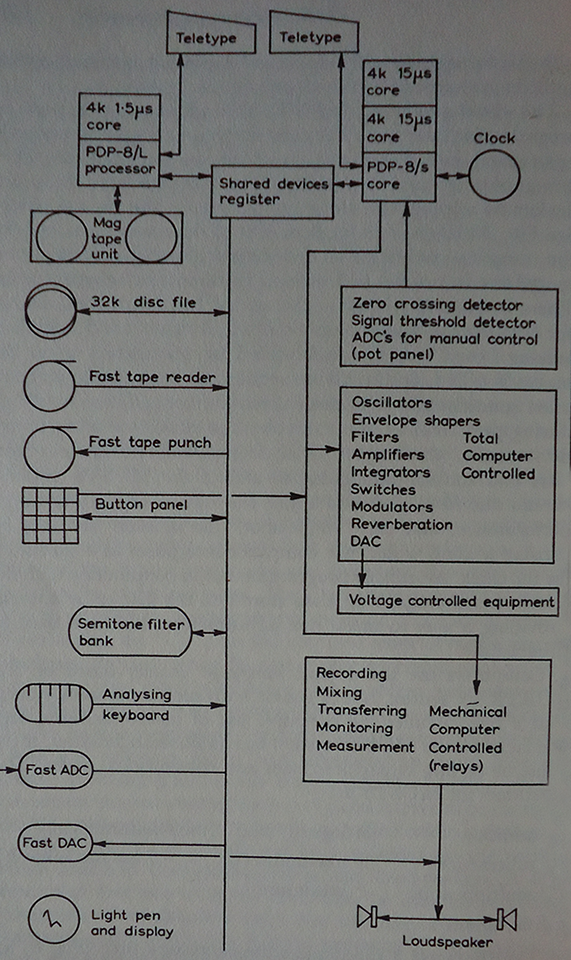
The earliest digital sampling was done on the EMS Musys system, developed by Peter Grogono (software), David Cockerell (hardware and interfacing) and Peter Zinovieff (system design and operation) at their London (Putney) Studio c. 1969. The system ran on two mini-computers, Digital Equipment PDP-8's. These had a pair of fast D/A and A/D converters,[1][2] 12,000 (12k) bytes of core memory (RAM), backed up by a hard drive of 32k and by tape storage (DecTape).[3][4][5] EMS equipment was used to control the world's first digital studio (EMS London (Putney) Studio), and their earliest digital sampling was done on that system during 1971–1972 for Harrison Birtwistle's "Chronometer" released in 1975.[1][6][7]

Fairlight CMI (1979)

The first commercially available sampling synthesizer was the Computer Music Melodian by Harry Mendell (1976), while the first polyphonic digital sampling synthesizer was the Australian-produced Fairlight CMI, first available in 1979. These early sampling synthesizers used wavetable sample-based synthesis.[8] The Fairlight CMI played and recorded low quality samples at 8-bit audio depth and 8–24 kHz sampling rate.[9]

In 1981, Toshiba introduced the LMD-649 in Japan. It was an early digital sampler that played and recorded high quality pulse-code modulation (PCM) samples at 12-bit audio depth and 50 kHz sampling rate, stored in 128 KB of dynamic RAM.[10] It was created by engineer Kenji Murata for Japanese electronic music band Yellow Magic Orchestra, who used it for extensive sampling and looping in their 1981 album Technodelic.[11] The LMD-649 was also used by other Japanese synthpop artists in the early 1980s, including Chiemi Manabe[12] and Logic System.[13]

Sampling keyboards were notable for their high price which was out of reach for the majority of working musicians – with the early Fairlight starting at $30,000. The E-mu Emulator brought the price down to under $10,000 but it was not until the mid-1980s that genuinely affordable keyboard samplers began to hit the market with the Ensoniq Mirage in 1985 and the E-mu Emax the following year, which had a sub-$2000 price point. The Korg DSS-1 and Roland's S-Series followed shortly afterwards.

During the 1980s, hybrid synthesizers began to utilize short samples (such as the attack phase of an instrument) along with digital synthesis to create more realistic imitations of instruments than had previously been possible. Examples are the Korg M1, Roland U-110, Yamaha's SY series, and the Kawai K series of instruments. Limiting factors at the time were the cost of physical memory (RAM) and the limitations of external data storage devices, and this approach made best use of the tiny amount of memory available to the design engineers.

E-mu SP-12 (1986)
Akai MPC60 (1988)

The E-mu SP-1200 percussion sampler, upon its release in August 1987, popularized the use of digital samplers within hip hop music in the late 1980s. Akai pioneered many processing techniques, such as crossfade looping and "time stretch" to shorten or lengthen samples without affecting pitch and vice versa. The Akai MPC60, released in 1988, went on to become the most influential sampler in hip hop music.[14] That same year, the Ensoniq EPS – the successor to the Mirage – was launched and was the first sampling keyboard which was designed specifically for live performance rather being a purely studio based tool as most samplers had been hitherto.

The 2010s-era music workstation usually uses sampling, whether simple playback or complex editing that matches all but the most advanced dedicated samplers, and also includes features such as a sequencer. Samplers, together with traditional Foley artists, are the mainstay of modern sound effects production. Using digital techniques various effects can be pitch-shifted and otherwise altered in ways that would have required many hours when done with tape.

Elements

[edit]

Interface

[edit]
Fig. 1: An example of how multiple samples can be arranged across a keyboard range. In this example, four different recordings of a violin are distributed across 12 notes. Each sample will play back at three different pitch values

Usually a sampler is controlled by an attached music keyboard or other external MIDI controller or source. Each note-message received by the sampler accesses a particular sample. Often multiple samples are arranged across the keyboard, each assigned to a note or group of notes. Keyboard tracking allows samples to be shifted in pitch by an appropriate amount, typically in semitones and tones. Each group of notes to which a single sample has been assigned is often called a "keyzone", and the resultant set of zones is called a keymap.

For example, in Fig 1, a keymap has been created with four different samples. Each sample, if pitched, should be associated with a particular center pitch. The first sample (Violin G#2) is distributed across three different notes, G2, G#2, and A2. If the note G#2 is received the sampler will play back the Violin G#2 sample at its original pitch. If the note received is G2 the sampler will shift the sample down a semitone while the note A2 will play it back a semitone tone higher. If the next note (Bb2) is input the sampler will select the Violin B2 sample, playing it a semitone lower than its center pitch of B2.

In general, samplers can play back any kind of recorded audio. Most samplers offer editing tools that allow the user to modify and process the audio and apply a wide range of effects. This makes the sampler a powerful and versatile musical tool.

Hierarchy

[edit]

A sampler is organized into a hierarchy of progressively more complicated data structures. At the bottom lie samples, individual recordings of any sound, recorded at a particular sample rate and resolution. While a common sound to sample is a musical instrument being played (e.g., a pianist playing a piano note or an organist playing a pipe organ), a sample could be any sound, including "non-musical" sounds such as a typewriter clacking or a dog barking. A reference center pitch indicates the actual frequency of the recorded note. Samples may also be "looped" by defining points at which a repeated section of the sample starts and ends, allowing a relatively short sample to play endlessly. In some cases, a "loop crossfade" is indicated, allowing less obvious transitions at the loop point by fading the end of the loop out while fading its beginning in.

Keymaps are arranged into instruments. At this level parameters may be added to define how the keymaps are played. Filters can be applied to change the sound-color while low frequency oscillators and envelope generators can shape the amplitude, pitch, filter or other parameters of the sound. Instruments may have multiple layers of keymaps to play more than one sample at the same time and each keymap may have a different set of parameters so that the incoming note-events affect each layer differently. For example, two layers may have a different sensitivity to the velocity of the incoming note, altering the resulting timbre according to how hard the note is played.

At this level, there are two basic approaches to sampler organization. In a bank approach, each instrument is assigned to a different MIDI channel and multiple banks can be stored to reconfigure the sampler. A different and more powerful approach is to associate each instrument with a patch number or ID so that each MIDI channel can be configured separately by sending controller information on the individual channel.

Types

[edit]
Joaquín Lana using a Yamaha SU10 Sampler

Many samplers work as described above: the keymapping system "spread out" a sample over a certain range of keys. This has side-effects that may be desirable in some contexts, such as speeding up or slowing down drum loops. However, the higher and lower-pitched parts of such a keymap may sound unnatural. For example, if a harpsichord is sampled in its lower register and then the samples are moved up to very high pitches, the high notes may not sound natural and authentic. When arranging a pitched instrument over several keymaps, the transition from one to another may be too noticeable for realistic imitation of the instrument – the art is to make transitions as smooth as possible.

Some phrase samplers are more optimised for triggering single "one-shot" sounds such as drum hits. Each keymap spans only a single key, requiring a large number of zones (61 on a five-octave keyboard), each with its own settings. "Phrase sampling" aims to simplify this, particularly on interfaces such as the 16 pads on the Akai MPC series: the fact that each pad is actually a note is hidden from the user. The sampling engine does not re-pitch samples, it only plays them back. The user interface is simplified. Phrase samplers often have a groovebox format, which makes them lightweight, easy to operate and light to carry.

Specifications

[edit]

Samplers can be classified by several specifications;

  • Polyphony: How many voices (or notes) can play simultaneously, to create chords
  • Sample Space: How much memory is available to load samples
  • Channels: How many different MIDI channels are available for different instruments
  • Bit depth: How much sample resolution can be supported
  • Outputs: How many discrete audio outputs are available

Manufacturers and models

[edit]

Computer Music Melodian

[edit]
DEC PDP-8/A (a minicomputer).
Computer Music Melodian (1976) was developed based on it[15][16]

Computer Music Inc. was started in New Jersey United States in 1972 by Harry Mendell and Dan Coren. The company was established to develop and market musical instruments based on computer software. The Melodian, developed in 1976,[15][16] was based on Digital Equipment Corporation's PDP-8 computer. It included hand-wired digital-to-analog and analog-to-digital conversion functions, as well as tracking anti-aliasing filters. The Melodian was first used by Stevie Wonder on his album Stevie Wonder's Journey Through "The Secret Life of Plants" (1979).

The Melodian was a monophonic synthesizer with 12-bit analog-to-digital sampling at rates up to 22 kHz. It was designed to be compatible with analog synthesizers and had a feature allowing it to synchronize to the pitch of an analog synthesizer, such as an ARP 2600. This meant that the Melodian captured all frequency modulation effects, including those produced through the ARP's touch ribbon control. It also could trigger off the ARPs keyboard, thus functioning somewhat as a hybrid of sampler and analog synthesizer and making the most of the technology available at the time.

Synclavier

[edit]
Synclavier PSMT rack (1984)
Synclavier PSMT & VPK (1984)[17]

The Synclavier System was an early digital synthesizer and sampler, manufactured by New England Digital. First released in 1977, it proved to be highly influential among both music producers and electronic musicians, due to its versatility, its cutting-edge technology and distinctive sound. Synclavier Systems were expensive – the highest price ever paid for one was about $500,000, although average systems were closer to about $200,000 – $300,000. Although this made it inaccessible for most musicians, it found widespread use among producers and professional recording studios, and it competed in this market with other high-end production systems, such as the Fairlight CMI. Though scarce, the Synclavier remains in use in many studios to this day.

Fairlight Instruments

[edit]
Fairlight CMI Series III (1985)

Fairlight Instruments was started in Sydney, in 1975 by Peter Vogel and Kim Ryrie. The company was originally established as a manufacturer and retailer of video special effects equipment.

The Fairlight CMI or Computer Music Instrument, released in 1979, started life as the Qasar M8. The M8 was handwired and legend has it that it took two hours to boot up. The CMI was the first commercially available polyphonic digital sampling instrument. The original Fairlight CMI sampled using a resolution of 8 bits per sample,[18] at a rate of 24 kHz, and used two 8-bit Motorola 6800 processors (later upgraded to the more powerful 16/32-bit Motorola 68000).[19] It was equipped with two six-octave keyboards, an alphanumeric keyboard, and an interactive video display unit (VDU) where soundwaves could be edited or even drawn from scratch using a light pen. Software allowed for editing, looping, and mixing of sounds which could then be played back via the keyboard or the software-based sequencer. It retailed for around US$25,000.

Fairlight later released the Series IIx, which increased the sampling rate to 32 kHz[19] and was the first to feature basic MIDI functionality. In 1985, the Series III was released with two significant upgrades: bit rate and sampling rate were increased to CD quality (16 bit/44.1 kHz) and SMPTE time code was now supported. Notable users of the Fairlight CMI include Peter Gabriel, Herbie Hancock, Trevor Horn, Art of Noise, Yello, Pet Shop Boys, Jean Michel Jarre, Duran Duran and Kate Bush. Horn, considered the "Man who invented the eighties", first used his well-known sampling techniques on the album Adventures in Modern Recording, the second studio album released under the name of his project The Buggles. Saying that he was "quite fascinated by Fairlight brass and all of those kind of things that Geoffrey and I had started messing around with before he went off to join Asia", the sampling techniques on Adventures would later be used for records Horn produced like Slave to the Rhythm by Grace Jones, Art of Noise's The Seduction of Claude Debussy and Frankie Goes To Hollywood's Welcome to the Pleasuredome.[20]

E-mu Systems

[edit]

E-mu Emulator (1981) was E-mu Systems' initial foray into sampling, and saved the company from financial disaster after the complete failure of the Audity due to a price tag of $70,000. The name 'Emulator' came as the result of leafing through a thesaurus and matched the name of the company perfectly. The Emulator came in 2-, 4-, and 8-note polyphonic versions, the 2-note being dropped due to limited interest, and featured a maximum sampling rate of 27.7 kHz, a four-octave keyboard and 128 kB of memory.

E-mu Emulator II (1984) was designed to bridge the gap between the Fairlight CMI and Synclavier and the Ensoniq Mirage. It featured 8 notes polyphony, 8-bit sampling, 512kb of RAM (1mb in the EII+ though only accessible as two independent 512kb banks), an 8-track sequencer, and analog filtering. With the addition of the hard disk option, the Emulator II was comparable to samplers released 5 years later.

E-mu SP-12 (1986) was a forerunner of E-mu SP-1200.

E-mu Emulator III (1987) was a 16-bit stereo digital sampler with 16-note polyphony, 44.1 kHz maximum sample rate and had up to 8 MB of memory. It featured a 16 channel sequencer, SMPTE and a 40 MB hard disk.

E-mu SP-1200 (1987) was, and still is, one of the most highly regarded samplers for use in hip-hop related production. Its 12-bit sampling engine gave a desirable warmth to instruments and a gritty punch to drums. It featured 10 seconds of sample time spread across four 2.5-second sections.

E-mu Emax, sold between 1985 & 1995, and aimed at the lower end of the market.

E-mu ESI-32 (1994) was a stripped down, far cheaper, and simplified EIIIx, and could use the same samples. The unit could accommodate up to 32 MB RAM, 32 note polyphony and sounds could be routed internally to one of four polyphonic outputs. Via optional SCSI interface, the ESI-32 could access external CD-ROM, Zip-100, and hard drives.

Akai

[edit]
Linn LM-1 (1980)
Akai S612 (1985)
Akai S900 (1986)
Akai MPC60 (1988)
Akai S1000 (1988)

Akai entered the electronic musical instrument world in 1984 when Roger Linn, the creator of the Linn LM-1, the Linn 9000, and the LinnDrum, partnered with the Japanese/Singaporean Akai Corporation to create samplers similar to the ones created at Linn's own company, Linn Electronics. With this came the first in a series of affordable samplers, the S612, a 12 bit digital sampler module. The S612 was superseded in 1986 by the S900.

The Akai S900 (1986) was the first truly affordable digital sampler. It was 8-note polyphonic and featured 12-bit sampling with a frequency range up to 40 kHz and up to 750 kB of memory that allowed for just under 12 seconds at the best sampling rate. It could store a maximum of 32 samples in memory. The operating system was software based and allowed for upgrades that had to be booted each time the sampler was switched on.

The Akai MPC60 Digital Sampler/Drum Machine and MIDI Sequencer (1988) was the first non-rack mounted model released. It is also the first time a sampler with touch sensitive trigger pads was produced by AKAI, giving birth to the popular MPC series of sampler sequencers.

The Akai S950 (1988) was an improved version of the S900, with a maximum sample frequency of 48 kHz and some of the editing features of the contemporary S1000.

The Akai S1000 (1988) was possibly the most popular 16-bit 44.1 kHz stereo sampler of its time. It featured 16-voices, up to 32 MB of memory, and 24-bit internal processing, including a digital filter (18 dB/octave), an LFO, and two ADSR envelope generators (for amplitude and filtering). The S1000 also offered up to 8 different loop points. Additional functions included Autolooping, Crossfade Looping, Loop in Release (which cycles through the loop as the sound decays), Loop Until Release (which cycles through the loop until the note begins its decay), Reverse and Time Stretch (version 1.3 and higher).

Other samplers released by AKAI include the S01, S20, S700, S2000, S2800, S3000, S3000XL, S3200, S5000, S6000, MPC500, MPC1000, MPC2000, MPC2000XL, MPC2500, MPC3000, MPC3000XL, MPC3000LE, MPC4000, MPC5000, Z4 and Z8.

Roland

[edit]

Roland Corporation manufactured the S series. These were true samplers that provide all of the features described above, including sampling, sample editing, pitch transposition, and keyzone mapping:

More recently, Roland introduced the Groove Sampler concept. These devices are renowned for their ease of use, but a few lack the pitch transposition and keyzone mapping capabilities that most samplers have. Some have limits to rendering loops or sound effects samples that are played back at the same pitch they were recorded. Although these machines are equipped with a wide range of built-in effects, a few lack pitch transposition and keyzone mapping that diminishes their utility significantly. The Roland Groove Sampler line includes the following:

Boss

[edit]
Boss Dr. Sample SP-303 (2001)

Being a division of the Roland Corporation, Boss also contributed to the Groove Sampler/Groove Box concept with several samplers.

Sample storage

[edit]

Most older samplers use SCSI as the protocol for getting sample data in and out of the machine. SCSI interfaces were either standard on the sampler or offered as an option. SCSI provides the ability to move large quantities of data in and out of a sampler in reasonable times. Hard drives, CD-ROM drives, Zip drives and removable cartridge drives such as Syquest and Iomega Jaz drives are the most popular SCSI devices used with samplers. Each has its own strengths and weaknesses, with hard drives being the fastest devices. Modern (after 2000) samplers use solid-state memory cards (such as compact Flash or SmartMedia) for sample storage and transfer.

Software samplers

[edit]
Fantasia, a user interface for LinuxSampler. LinuxSampler is a clone of GigaSampler by NemeSys, which was one of the first disk-streaming software samplers on PC.

In the 1990s and 2000s, the increases in computer power and memory capacity have made it possible to develop software applications that provide the same capabilities as hardware-based units. These are typically produced as virtual instrument plug-ins – for example, using the VST system. Some such samplers provide relatively simple sample playback facilities, requiring the user to turn to other software for such tasks as sample editing, sample recording, and DSP effects, while others provide features beyond those offered by rack-mounted units.

Trackers

[edit]
Renoise, a graphical Tracker sequencer with integrated sampler

In the 1980s, users on Home computers invented Trackers. Sequencers are software samplers as the real-time resampling is a required capability for the Tracker concept.[21] Since the 1980s, Trackers were able to perform 4-channel resampling in realtime under usage of the Paula Chip on the Amiga. Since the early 1990s Trackers performed on PCs multi-track resampling in realtime as pure software solution. This was possible under the usage of highly optimized assembly code, an early example is the InertiaPlayer released in 1993.[22] A recent PC Tracker with good sampler capabilities is for instance the Renoise Tracker.[21][23]

See also

[edit]

References

[edit]
[edit]
Revisions and contributorsEdit on WikipediaRead on Wikipedia
from Grokipedia
A sampler is an that captures, stores, and reproduces audio samples—short recordings of sounds from instruments, voices, environments, or other sources—allowing musicians to manipulate these samples through techniques such as pitch-shifting, time-stretching, looping, layering, and reversing to create new musical compositions. Unlike traditional synthesizers that generate sounds via oscillators and waveforms, samplers rely on pre-recorded audio as their core material, enabling the emulation of acoustic instruments or the invention of entirely novel timbres. The technology traces its roots to mid-20th-century innovations in sound recording and playback, with early precursors like the , patented by American inventor Harry Chamberlin in the late 1940s, which used magnetic tape loops triggered by keys to replay pre-recorded sounds. This concept evolved into the in 1963, developed by the British Bradley brothers (Leslie, Norman, and Frank) based on Chamberlin's design; it featured 35 individual tape loops, one per key, providing polyphonic playback of orchestral and vocal samples, and gained prominence in through artists like on tracks such as "." The advent of digital sampling marked a pivotal shift, with the Fairlight CMI—created in 1979 by Australian inventors Peter Vogel and Kim Ryrie of Fairlight Instruments—becoming the first commercially available polyphonic digital sampler, capable of 8-bit sampling at 10 kHz and priced at around $25,000, which revolutionized studio production for artists like and . Subsequent developments, such as ' Emulator in 1981 and the SP-1200 in 1987, democratized access with more affordable hardware (the SP-1200 at around $3,000) and higher fidelity (12-bit resolution), profoundly influencing hip-hop production by enabling DJs and producers like Marley Marl and to chop and sequence vinyl breaks into beats. Modern samplers encompass both hardware (e.g., series) and software plugins integrated into digital audio workstations (DAWs) like , supporting high-resolution sampling rates up to 192 kHz and 24-bit depth, which has expanded their role in genres from to film scoring. By facilitating the reuse and transformation of existing sounds, samplers have not only blurred the lines between composition and but also raised ongoing debates about and originality in music creation.

History

Tape-Based Precursors

The concept of replaying pre-recorded sounds for musical performance originated with optical soundtracks in early 20th-century cinema, where audio waveforms were encoded as variable-density or variable-area patterns on 35mm film strips, allowing synchronized playback of and effects during projection. This technology, developed in the 1920s, marked an early form of sound storage and retrieval that influenced later mechanical instruments by demonstrating the feasibility of capturing and reproducing acoustic events. A direct precursor emerged in 1934 with the Singing Keyboard, invented by Frederick Minturn Sammis and James Nuthall, which used strips of 35mm film with electro-optical recordings of audio waves to trigger sounds via a keyboard, primarily for previews of effects and . The transition to in the mid-20th century improved reliability and accessibility, paving the way for keyboard-controlled replay systems that formed the foundation of analog sampling. In 1946, American inventor Harry Chamberlin conceived the , an electro-mechanical that utilized continuous loops to replay pre-recorded sounds of real instruments, such as those from the Orchestra, assigned to specific keys. Each key activated a dedicated , typically lasting about eight seconds, which played forward upon depression and rewound via a spring mechanism when released, enabling polyphonic playback of orchestral timbres like strings, , and . First models were produced in the early , with the instrument resembling a large console and incorporating multiple tapes for and rhythm sections, though production was limited to around 50 units due to its custom-built nature. Building on Chamberlin's design, the Mellotron was developed in 1963 by brothers Leslie, Norman, and Frank Bradley of Streetly Electronics in Birmingham, , as a more manufacturable alternative using individual tape strips rather than loops. The Mark II model featured two 35-note keyboards with 1,260 separate recordings on 3/8-inch tapes, each strip mounted on a capstan that pressed against a fixed playback head when a key was struck, delivering eight-second samples of instruments like flutes, violins, and choirs. This setup allowed for three selectable sounds per octave via movable heads, making it suitable for home and professional use, with over 1,000 units produced by the 1970s. The Mellotron gained prominence in , notably through The Beatles' use of its flute and trumpet sounds on "Strawberry Fields Forever" in 1967, and King Crimson's extensive integration of its string and brass patches on their 1969 debut album In the Court of the Crimson King, defining its signature orchestral texture in . Despite their innovations, tape-based instruments like the Chamberlin and Mellotron faced significant technical limitations, including fixed pitches tied to the original recording speed, which prevented easy transposition without altering playback rate and thus affecting timbre across the keyboard. Mechanical wear on the tapes from repeated contact with heads led to degradation and required frequent replacement, while the eight-second sample duration imposed constraints on sustained notes, often resulting in abrupt cutoffs. Additionally, the lack of pitch or time manipulation capabilities limited expressive control, and reliability issues, such as tape slippage and head alignment, contributed to a high maintenance burden. These analog systems laid essential groundwork for digital sampling, which overcame such constraints through electronic storage and processing.

Emergence of Digital Samplers

The emergence of digital samplers marked a pivotal shift from analog tape replay systems to electronic waveform capture and manipulation in the late 1970s, enabling musicians to record, store, and alter sounds with unprecedented flexibility. In 1976, Harry Mendel invented the Computer Music Melodian, recognized as the first monophonic digital sampler, which used 8-bit sampling at low rates to capture and play back sounds via a keyboard interface. This device laid the groundwork for digital sampling by converting analog audio into digital data for storage and playback, though its limited polyphony and resolution restricted it to basic applications. The following year, in 1977, New England Digital Corporation introduced the , initially as a that later incorporated sampling add-ons, transforming it into a versatile . Priced over $200,000 for fully equipped systems, the was a high-end tool adopted by pioneering artists such as , who utilized it for complex compositions and performances. By 1979, the emerged as the first polyphonic digital sampling synthesizer, developed by Peter Vogel and Kim Ryrie in . Featuring 8-bit sampling at rates up to 24 kHz, an innovative interface for waveform editing on a monitor, and 8-voice polyphony, it cost approximately $25,000, making it accessible only to well-funded professionals. notably employed the on his albums, including Peter Gabriel III (1980), where its sampling capabilities contributed to distinctive textures like the iconic "gamel" sound. Central to these innovations was the advent of analog-to-digital conversion (ADC) technology, which allowed real-time capture of audio waveforms as for storage in RAM, facilitating pitch-shifting, looping, and editing without . This breakthrough overcame the mechanical limitations of tape-based precursors like the , ushering in an era of programmable .

Expansion in the 1980s and 1990s

The , released in 1981, marked a significant step toward more accessible digital sampling with its 8-bit resolution and 27 kHz sampling rate, allowing up to 2 seconds of mono sample time in its initial 128 KB memory configuration. This sampler gained prominence in professional studios, notably used by artists like on her 1985 album for custom sound manipulation and orchestral textures. Building on this foundation, the II arrived in 1984, enhancing fidelity through techniques that effectively expanded beyond 8-bit while maintaining the same 27.7 kHz rate and increasing sample time to about 17 seconds with expandable memory up to 1 MB. These developments, inspired by high-end predecessors like the , helped transition sampling from elite workstations to broader studio tools. The 1986 introduction of the further democratized sampling by offering an affordable rackmount unit priced around $2,500, featuring 12-bit resolution and variable sampling rates from 7.5 to 40 kHz for up to 63 seconds of total mono sample time in 750 KB RAM. Its 8-voice and compatibility made it a staple in emerging genres, particularly hip-hop and electronic music, where producers like those behind early tracks exploited its gritty, immediate sound for chopped loops and drum hits. Parallel to these advances, rackmount and keyboard samplers proliferated, exemplified by the 1984 , an 8-bit keyboard sampler with 128 KB waveform storage and variable sample rates from 10 to 33 kHz, enabling up to 6.5 seconds total at the lowest rate and about 2 seconds per keyboard half at the highest rate, with built-in sequencing for live performance. Roland's S-series, starting with the 1986 S-50 keyboard (12-bit, 16 voices) and evolving to the 1987 S-550 rackmount (16-bit linear, 1.5 MB memory), provided versatile editing and free sample libraries that encouraged experimentation in pop and production. A key industry shift in the and stemmed from plummeting RAM costs, which allowed samplers to accommodate longer samples—often exceeding 30 seconds by the early —and boosted from typical 8 voices in early models like the S900 to 32 or more in later designs such as Akai's S3000 series. This scalability fueled a sampling boom, notably in hip-hop, where the 1987 drum sampler's 12-bit, 26 kHz gritty tone and 10 seconds of sample time powered Public Enemy's dense, layered productions on albums like It Takes a Nation of Millions to Hold Us Back.

Modern Developments

In the late 1990s, hardware samplers like the Z-series and E-mu E5000 introduced hard disk sampling, allowing for much longer recordings without RAM limitations, paving the way for software dominance. In the 2000s, the music production landscape shifted significantly toward software samplers, exemplified by ' Kontakt, released in 2002, which leveraged computer RAM and later SSD storage to handle virtually unlimited sample libraries without the hardware constraints of earlier devices. This transition democratized access to high-fidelity sampling, allowing producers to load expansive multisample instruments and manipulate them in real-time within digital audio workstations (DAWs). Hardware samplers experienced a revival during this period, with the , introduced in 2005, offering portable, battery-powered sampling for live performance and beatmaking, building on the portability ethos of designs but with enhanced effects and sequencing. The line continued evolving, culminating in the 2021 SP-404MKII, which incorporated analog modeling circuits for vintage tape and vinyl emulations alongside modern digital processing. Similarly, the , launched in 2011, emerged as a compact all-in-one portable integrating sampling, synthesis, and sequencing in a handheld form factor ideal for on-the-go creation. From the 2010s into the 2020s, cloud-based sampling platforms like Splice revolutionized sample access, providing subscription-based libraries of royalty-free sounds downloadable directly into DAWs, enabling seamless integration and collaboration across devices. AI-assisted tools further advanced sample generation, with platforms such as Splice's Create feature using to produce custom loops and one-shots from user prompts, expanding creative possibilities beyond traditional recording. Mobile applications complemented these developments; for instance, Apple's Sampler on allows users to record or import audio via or files, then play it chromatically on a with editing options like and envelope adjustment. Technical advancements in samplers included widespread adoption of 24-bit/96 kHz resolution for capturing and processing audio with minimal noise and , as seen in codecs like ' AD1871, which supports these specs in hardware. Real-time processing was enhanced by dedicated DSP chips, such as those in the Audiotec Fischer HELIX DSP.3S, enabling low-latency effects like reverb and compression during playback in hardware units. Open-source platforms like facilitated custom sampler development, allowing users to build polyphonic instruments with features such as granular playback and control through visual patching. As of 2025, samplers are increasingly embedded within synthesizers for hybrid workflows, as in Modal Electronics' Carbon8 series, which combines digital synthesis with sample-based via onboard memory and effects. Emerging VR/AR interfaces are also influencing sampling, with applications enabling users to manipulate audio samples in immersive 3D environments, such as dragging beats in virtual DAWs for intuitive spatial arrangement.

Design and Operation

Core Principles of Sampling

The core principles of sampling in musical instruments revolve around the of analog audio signals to enable storage, manipulation, and playback of recorded sounds. The sampling process begins with analog-to-digital conversion (ADC), where a continuous audio —typically captured via a or line input—is measured at discrete time intervals to create a digital representation. This captures the 's values as a series of numerical samples, allowing the original sound to be approximated and reconstructed during playback. A fundamental constraint in this process is the Nyquist-Shannon sampling theorem, which states that to accurately reconstruct a continuous signal without , the sampling rate must be at least twice the highest frequency component in the signal. In audio applications, where human hearing typically extends to 20 kHz, a sampling rate of 44.1 kHz (as in CD-quality audio) suffices to capture the full audible spectrum. The theorem is expressed as: fs2fmaxf_s \geq 2 f_{\max} where fsf_s is the sampling frequency and fmaxf_{\max} is the maximum frequency of interest. Sampling below this rate introduces , where high frequencies masquerade as lower ones, degrading sound quality; thus, anti-aliasing filters are applied before ADC to remove frequencies above half the sampling rate. Following sampling, quantization converts the continuous amplitude values of each sample into discrete digital levels, determined by the bit depth of the system. For instance, a 16-bit depth provides 65,536 possible levels (2^{16}), enabling fine-grained representation of amplitude variations. This process inherently introduces quantization noise—the difference between the original analog value and its digital approximation—which manifests as a noise floor limiting the signal-to-noise ratio (SNR). In 16-bit audio, the theoretical SNR is approximately 96 dB, sufficient for most musical applications but improvable with higher bit depths like 24-bit for professional recording. Once digitized, samples are stored and triggered for playback, typically via notes that map keyboard pitches to specific sample regions. A note-on message initiates playback from the sample's start point, with influencing or other parameters. To sustain sounds beyond their natural decay, looping repeats a designated portion of the sample—often the sustain phase—seamlessly forward or bidirectionally to minimize audible seams. Envelope shaping, commonly using an ADSR (Attack, Decay, Sustain, Release) generator, modulates the sample's over time: attack ramps up volume quickly, decay reduces it to a sustain level held during the note, and release fades out after note-off. Basic pitch transposition adjusts playback speed relative to the triggering note's frequency, raising pitch by accelerating the sample (shortening duration) or lowering it by deceleration, which can introduce time-stretching artifacts like shifts or phasing if not compensated.

User Interfaces

User interfaces for samplers have evolved to provide intuitive control over sample triggering, , and manipulation, enabling musicians to interact with in real-time. These interfaces typically combine physical and virtual elements designed for expressiveness and efficiency, allowing users to select, modify, and playback samples while integrating with broader music production workflows. Keyboard and pad-based interfaces are fundamental for triggering samples with dynamic expression, particularly in hardware samplers. Velocity-sensitive keys, as found in many keyboard-equipped samplers, respond to the force of key presses to vary sample volume and timbre, facilitating nuanced performances similar to acoustic instruments. The Akai MPC series exemplifies pad-based designs, featuring velocity-sensitive pads arranged in a grid that allow drummers and producers to program rhythms intuitively, with the pads transmitting velocity values from 0 to 127 for precise control over sample dynamics. Graphical interfaces have transitioned from early hardware innovations to sophisticated software environments, enhancing visual feedback for sample manipulation. The , introduced in 1979, pioneered a interface that allowed users to interact directly with displays on a monitor, selecting menu options and editing audio traces by drawing on the screen. In modern software samplers like Ableton Sampler, graphical user interfaces (GUIs) provide drag-and-drop functionality for loading samples, visualization for precise editing, and compatibility, making complex operations accessible through familiar visual metaphors. Editing controls on samplers typically include dedicated knobs, sliders, and buttons for adjusting sample parameters without deep menu navigation. These controls enable users to set sample start and end points to trim audio clips, define loop boundaries for seamless repetition, and fine-tune pitch or tuning for integration. For instance, in hardware like the , knobs adjust loop start and end positions directly, while crossfade sliders smooth transitions to avoid audible clicks. Effects application, such as reverb or filtering, is often mapped to real-time sliders for on-the-fly adjustments during performance or composition. MIDI integration standardizes communication between samplers and external controllers, ensuring compatibility across devices. The protocol handles note-on and note-off messages to trigger samples, data for dynamic response, and continuous controllers for parameters like volume or modulation, allowing a single keyboard to control multiple samplers in a setup. This interoperability, established since the , enables samplers to receive input from sequencers or DAWs, expanding creative possibilities in live and studio environments. The evolution of sampler user interfaces reflects broader technological advances, shifting from command-line programming in 1970s systems like early digital audio workstations to intuitive drag-and-drop interactions in 2020s applications. Initial interfaces required text-based commands for sample loading and editing, limiting accessibility to skilled programmers, whereas contemporary designs prioritize tactile feedback and visual immediacy, as seen in the progression from the Fairlight's pen-based system to touchscreen GUIs in software samplers. This development has democratized sampling, making it viable for non-experts while retaining depth for professionals.

Sample Management and Hierarchy

In samplers, the fundamental building block is the sample, a raw recording typically stored in uncompressed formats such as or AIFF. Each sample includes essential metadata to facilitate musical playback, including the root note—the original pitch at which the sound was captured—to determine transposition behavior, as well as loop points that define sections for repeated playback to sustain notes without abrupt endings. This metadata ensures the sample integrates seamlessly into melodic contexts, allowing the sampler engine to adjust pitch and duration appropriately during performance. Building upon individual samples, an instrument or patch represents a higher-level where multiple samples are mapped across keyboard zones to create a playable entity. This multi-sample mapping assigns specific samples to defined key ranges, enabling realistic emulation of acoustic instruments by selecting pitch-appropriate recordings rather than relying on extreme transposition of a single sample, which could degrade audio quality through artifacts like formant shifting. For added expressiveness, patches incorporate layers, where samples vary by dynamic intensity—e.g., a patch might use softer-recorded strikes for low velocities and brighter, louder ones for high velocities—to mirror the nuanced response of real instruments. Round-robin variations further refine this by alternating among several takes of the same note and velocity, reducing the "machine-gun effect" of identical repetitions in rapid sequences. At the ensemble level, multi-timbral setups extend the through programs or banks, which group multiple instruments for concurrent playback on separate channels or layers. This structure allows a sampler to function as a virtual , with each program loading a distinct patch—such as on one channel and strings on another—while banks organize collections of programs for quick selection and switching during live or studio use. Such organization supports polyphonic complexity without requiring multiple devices, as the sampler allocates voices across the to handle simultaneous timbres efficiently. Key operational features enhance the flexibility of this hierarchy, including crossfading between adjacent samples in key or velocity zones for smooth, artifact-free transitions as parameters change. Key and switching provides more discrete control, instantly selecting a new sample based on thresholds without blending, ideal for abrupt articulations like notes. Time-stretching algorithms, such as the , enable pitch adjustments without altering playback speed by decomposing the audio into frequency and phase components via short-time , then resynthesizing with modified parameters to preserve temporal integrity—a technique widely adopted in samplers for realistic transposition of loops and phrases.

Key Specifications

Samplers operate by capturing and reproducing audio signals through digital means, with key performance metrics defining their audio fidelity and operational limits. The sampling rate determines the frequency range that can be accurately represented, typically adhering to standards like 44.1 kHz for CD-quality audio, which captures frequencies up to 22.05 kHz per the Nyquist theorem, while professional applications often employ higher rates such as 48 kHz or 96 kHz to reduce aliasing and improve high-frequency detail. Bit depth governs dynamic range and noise floor; 16-bit resolution provides a 96 dB signal-to-noise ratio suitable for most music production, whereas 24-bit offers 144 dB for studio-grade recordings with greater headroom. Polyphony refers to the maximum number of simultaneous or notes a sampler can produce, commonly ranging from 16 to 128 in hardware units and limited by available CPU and RAM in software implementations, enabling complex arrangements without voice stealing. Memory capacity has evolved significantly, starting from 128 KB in early digital samplers like the E-mu Emulator I, sufficient for just a few seconds of low-fidelity mono audio, to gigabytes in modern software samplers that support extensive libraries of multisampled instruments. Expansion options, such as memory cards in vintage hardware or host system RAM in software, allow scaling to accommodate larger sample sets. Processing power encompasses the sampler's ability to apply real-time effects like reverb, filtering, and modulation, often via dedicated DSP chips in hardware or host CPU in software, with low-latency performance critical for live playback—ideally under 5 ms to remain imperceptible to performers. (I/O) configurations facilitate integration; audio inputs enable direct recording, while or USB interfaces handle note triggering and control, and storage options have progressed from SCSI ports for hard drives in legacy systems to USB/SSD connectivity in contemporary designs. These specifications underpin sample management hierarchies by quantifying the resources available for organizing and layering sounds across voices and memory allocations.

Types of Samplers

Hardware Samplers

Hardware samplers are standalone electronic musical instruments that capture, store, and playback samples using dedicated physical hardware, typically categorized by their form factor and intended primary use in performance or studio environments. These devices emerged as self-contained units in the late and evolved through the decades, offering musicians direct control without reliance on external computers. Keyboard samplers integrate a built-in keyboard for real-time and sound manipulation, allowing users to trigger samples across multiple octaves with velocity-sensitive keys. A prominent example is the Korg Triton Extreme, a 76-key released in 2004, featuring 160 MB of waveform ROM, expandable sample RAM up to 96 MB, and tube-driven analog modeling for warm tonal characteristics, making it suitable for live and studio applications. This design facilitates immediate playability, blending sampling with synthesis in a portable rig. Rackmount modules represent a compact form factor optimized for studio integration within 19-inch equipment racks, emphasizing expandability and multi-channel output for complex setups. The E-mu E6400 Ultra, introduced in the late , exemplifies this category with its 16 MB standard sample RAM expandable to 128 MB via modules, supporting 64-voice , expandable to 128 voices, and 16-part multitimbrality for layered . These units often include interfaces for external storage, enabling seamless incorporation into professional recording environments without occupying desk space. Drum samplers and pad controllers are specialized hardware focused on percussion programming, featuring velocity- and pressure-sensitive pads for intuitive beat creation and sequencing. The Akai MPC series, starting with the MPC60 in 1988 and continuing through modern iterations like the MPC X, provides 16 pads, 64-track sequencing, and integrated sampling capabilities, allowing users to record, chop, and arrange drum samples in real time. This form factor excels in groove-oriented production, combining tactile input with onboard effects for rapid workflow in hip-hop and electronic music. Portability trends in hardware samplers gained momentum in the with battery-powered grooveboxes designed for mobile creation. The Boss SP-202 Dr. Sample, launched in , offers a lightweight, handheld unit with 4 minutes 20 seconds of internal mono sampling time, a built-in condenser microphone, and AA battery operation for up to 8 hours, ideal for and on-the-go looping. Such devices prioritize accessibility, enabling spontaneous sampling without power outlets. Hardware samplers provide advantages like tactile, low-latency control for live and direct analog-to-digital conversion without computer dependency, fostering a focused creative process. However, they often suffer from limited expandability compared to software alternatives, with fixed memory constraints and aging components like floppy drives posing maintenance challenges in modern setups.

Software Samplers

Software samplers are virtual instruments that operate as software applications or plugins within digital audio workstations (DAWs), enabling the playback and manipulation of audio samples on general-purpose computers without requiring dedicated hardware. Unlike fixed hardware units, they offer infinite limited only by the host system's power and storage, allowing for extensive sample libraries and complex layering. This architecture emerged prominently in the with dedicated apps like Propellerhead's , released in 1997, which emulated basslines via synthesis modeling and used samples for TR-808/TR-909 drum machines, marking an early shift toward software-based production tools. By the early , integration with DAWs became standard, transforming samplers into essential components of modern music production workflows. A key aspect of software samplers is their compatibility with plugin formats that facilitate seamless integration into DAWs. The most common include VST (Virtual Studio Technology, developed by for cross-platform use), AU (Audio Units, Apple's format optimized for macOS), and AAX (Avid Audio eXtension, designed for with native and DSP variants). These formats allow samplers to function as insert effects or instruments, with examples like Steinberg's HALion providing advanced scripting capabilities via to create custom behaviors, such as automated sample triggering, parameter modulation, and dynamic layering based on input or performance data. HALion's scripting extends basic sampling to programmable instruments, enabling developers to tailor responses for specific musical needs, from orchestral articulations to experimental . Sample management in software samplers relies on pre-built libraries of multisampled recordings, often organized as collections for instruments like orchestras or vintage synths, which are loaded on-demand to optimize resource usage. ' Kontakt, a leading example, employs disk streaming to preload only necessary portions of samples into RAM while fetching others from storage in real time, preventing overload even with gigabyte-scale libraries. This approach supports hierarchical sample , where layers, round-robins, and articulations are mapped across keyboard zones, allowing realistic emulation of acoustic instruments through techniques like key-switching for seamless transitions. Advanced real-time features distinguish modern software samplers, extending traditional playback with and emerging AI enhancements. divides samples into short "grains" (typically 1-100 ms) for real-time recombination, enabling effects like time-stretching without pitch alteration or cloud-like textures, as implemented in plugins like those from or independent developers. Additionally, AI-driven upscaling addresses low-resolution legacy samples (e.g., low sample rates or bit depths from early digital recordings) by predicting and generating higher-fidelity versions, improving clarity and reducing artifacts during playback; tools like AI audio super-resolution models integrated into production software facilitate this process. Open-source alternatives provide accessible, customizable options for users across platforms. LinuxSampler, initiated in 2002, offers a free, GPL-licensed engine with professional features like multi-timbral operation, support for SFZ and GIG formats, and low-latency streaming, making it suitable for Linux, Windows, and macOS environments in both standalone and plugin modes. By 2025, software samplers have evolved into ubiquitous, feature-rich tools within production suites, with standout plugins like LANDR Sampler emphasizing intuitive interfaces for beatmaking and creative manipulation, while others such as Arturia CMI V revive historical samplers through emulation and modern extensions. This progression underscores their role in democratizing high-end sampling, contrasting hardware's constraints by leveraging computational advances for endless sonic possibilities.

Hybrid and Specialized Samplers

Hybrid samplers integrate hardware controllers with software engines to provide tactile interfaces for sample manipulation while leveraging computational power for processing. ' , introduced in 2009, exemplifies this approach by pairing a pad-based hardware controller with the Maschine software, which integrates seamlessly with the Kontakt sampler for loading and editing samples in real-time. This design enables users to trigger one-shot samples or loops via velocity-sensitive pads while the software handles effects, slicing, and pattern sequencing, bridging physical performance with digital workflow efficiency. Specialized samplers often target niche applications, such as pattern-based trackers that emphasize modular composition over traditional waveform editing. Impulse Tracker, released in 1995 as freeware by developer Jeffrey Lim, introduced advanced features like 16-bit sample support and instrument envelopes within a tracker interface, allowing composers to arrange samples into patterns saved as .it modules for chiptune and lo-fi productions. Modern iterations, like Renoise, extend this tracker paradigm into a full digital audio workstation with sampling capabilities, supporting multi-track editing, native DSP effects such as reverb and filters, and export to production-quality audio formats. Field recorders with integrated sampling functions cater to on-location audio capture for later manipulation. The Zoom H5, a handheld device, records up to four tracks simultaneously in format at sample rates from 44.1 kHz to 96 kHz, using interchangeable mic capsules to capture environmental sounds directly as raw samples for import into samplers. Similarly, samplers embedded in grooveboxes like the Elektron Digitakt II facilitate live performance, offering 16 stereo tracks for sample playback, real-time recording, and sequencing with parameter locks for dynamic looping during sets. These devices emphasize low-latency analog-to-digital conversion, enabling seamless integration of external inputs like microphones or instruments into digital sample chains without perceptible delay.

Manufacturers and Models

Pioneering Systems

The pioneering systems of the late and early laid the foundation for modern sampling technology, introducing capture and playback to musical instruments despite their prohibitive costs and technical limitations. These early devices, often hybrids of synthesis and sampling, were developed amid rapid advancements in and audio , enabling musicians to record, manipulate, and replay real-world sounds in ways previously impossible with analog synthesizers. Their emergence marked a shift from waveform generation to sample-based , influencing professional music production profoundly. The Computer Music Melodian, released in 1976 by American inventor Harry Mendell, stands as the earliest commercially available digital sampler, serving as a direct precursor to later polyphonic systems. This monophonic device featured basic 8-bit mono sampling capabilities, allowing users to capture and playback short audio snippets through a simple interface, though it lacked the polyphony and storage that would define subsequent innovations. Despite its groundbreaking role in demonstrating the viability of digital sampling for music, the Melodian achieved limited commercial success due to its rudimentary design and high price relative to the era's synthesizers, remaining more of a technological curiosity than a widespread tool. The Synclavier II, introduced by New England Digital in 1978 and refined through 1984, represented an early hybrid approach by combining (FM) synthesis with emerging sampling features. It utilized a "partial timbre" method, where up to four voices per note could be layered with 24 adjustable harmonics, enabling complex FM-generated sounds alongside elements. Sampling was added in 1982 via the Sample-to-Disk system, supporting up to 50 seconds of monophonic audio at 16-bit resolution, with ranging from 8 to 32 voices and memory expandable from 32K to 56K 16-bit words. Storage relied on 5¼-inch floppy disks and optional hard drives, while a 16-track digital memory recorder provided tape-like backup for sequences up to 10,000 notes. Priced from £14,500 for the basic 8-voice model to £35,900 for fully equipped versions, the Synclavier II was adopted by elite studios, including , for its precision in and sequencing, appealing to composers seeking integrated workstations. The (Computer Musical Instrument) series, developed by Australian engineers Peter Vogel and Kim Ryrie, debuted with the Series I in 1979 and evolved through the Series III by 1985, establishing sampling as a core musical paradigm. The Series I offered 8-voice with 8-bit sampling at up to 32 kHz, supported by 1 MB of total memory across voice cards (16K waveform RAM each), and introduced the concept of a via lightpen for waveform editing. The Series II (1982) enhanced this with the iconic Page R sequencer—a pattern-based tool allowing up to 255 monophonic patterns across 8 parts—while the Series IIx added and SMPTE compatibility; the Series III shifted to 16-bit processing for improved fidelity. Systems included a 6-octave keyboard, QWERTY input, and 8-inch disk drives, but their complexity and prices—starting at £18,000 for Series I, rising to £27,000 for Series II, and £60,000 for Series III—confined them to professional environments. Notably, the Fairlight powered innovative film scores and pop productions, such as elements in Vangelis's work and tracks by artists like and , where its ability to digitize and sequence acoustic samples transformed orchestral emulation. The , launched in 1981 by , democratized sampling somewhat by prioritizing affordability and simplicity over the workstation ambitions of rivals. This 8-voice polyphonic sampler captured audio at 28 kHz 12-bit resolution, with sounds stored on 8-inch floppy disks holding up to 512 KB, allowing users to load and manipulate samples via a basic keyboard interface. Lacking built-in sequencing or advanced editing, it focused on playback with velocity sensitivity and basic envelopes, priced at around £5,000—far below competitors—making it accessible to session musicians and producers. The Emulator I gained prominence in and pop, where its gritty, warm tone featured in recordings by bands like Yes and artists such as , enabling realistic instrument replication that bridged studio experimentation and commercial hits. These pioneering systems, while revolutionary, were hampered by exorbitant costs—often exceeding £10,000—and technical constraints like low-resolution audio and limited storage, restricting adoption to well-funded professionals in major studios and high-end productions. Their high nonetheless catalyzed broader innovation in audio , inspiring refinements in sample fidelity, , and user interfaces that propelled sampling from niche experimentation to a cornerstone of by the mid-1980s.

Major Hardware Brands

Akai emerged as a dominant force in hardware sampling during the late and , with its S series rackmount samplers becoming staples in professional studios for their affordability and expandability compared to earlier high-end systems. The S900, released in 1986, was a groundbreaking 12-bit sampler offering 8 voices of and sample rates from 7.5 kHz to 40 kHz, enabling producers to capture and manipulate sounds with unprecedented accessibility. Building on this, the MPC60 arrived in 1988 as an integrated sequencer-sampler, featuring 16 velocity-sensitive and 8 tracks of sequencing, which revolutionized beat-making by combining sampling with pattern-based composition in a portable format. Akai's lineup evolved with the S5000 in 1998, a 16-bit model supporting up to 64 MB of RAM expansion, multi-effects processing, and 64-voice (expandable to 128 voices), making it a versatile tool for complex sound design in genres like hip-hop and electronic music. E-mu Systems contributed significantly to drum sampling with the SP-1200, introduced in 1987 as a dedicated drum machine-sampler optimized for percussive sounds, boasting 12-bit resolution at 26 kHz sampling rate and 10 seconds of total sample memory across 8 voices. Its gritty, compressed tone—due to the analog filtering and low bit depth—became iconic in hip-hop production, influencing artists who valued its punchy output for vinyl-based sampling workflows. While E-mu's later Emulator X in 2004 primarily targeted software emulation, hardware variants like the IV from the late maintained the brand's legacy in rackmount sampling with enhanced 16-bit capabilities. Roland offered budget-friendly and multifunctional hardware samplers that broadened access during the expansion era. The S-10, launched in 1986, was an entry-level 12-bit keyboard sampler with 8-voice , 4-sample capability at 15/30 kHz rates, and a compact design using 2.8-inch Quick Disks for storage, appealing to live performers and home studios. The W-30 followed in 1989 as a waveform-based sampler-workstation, integrating 12-bit sampling with ROM synthesis, 16-voice , and built-in sequencing for hybrid sound creation. By 1997, the SP-808 combined sampling, 8-track recording, and effects in a portable unit with 44.1 kHz/16-bit resolution and storage, streamlining loop-based production for electronic and groove-oriented music. Other notable brands included Ensoniq with the ASR-10 in 1990, a 16-bit/44.1 kHz sampler-keyboard offering 32-voice , extensive editing, and sequencer integration, prized for its high-fidelity sampling and creative effects like wave sequencing. Korg's DSS-1 from 1986 blended sampling and synthesis in a hybrid instrument, using 12-bit/48 kHz sampling with 256 KB RAM and analog-style modeling filters for distinctive tonal versatility. Akai's influence persisted despite the company's in 2005, as its hardware models like the MPC series and S samplers continued to shape vinyl sampling culture in hip-hop and beyond, with second-hand units remaining sought-after for their unique sonic character.

Software and Contemporary Developers

Software samplers have become integral to modern music production, offering flexible, computer-based alternatives to hardware. released Kontakt in as a versatile software sampler plugin, supporting extensive scripting for custom instruments and integrating with workstations (DAWs). Kontakt's expansions, such as the Komplete bundles introduced in , provide comprehensive libraries of sampled instruments and effects, enabling producers to access orchestral, electronic, and acoustic sounds within a unified ecosystem. Steinberg's HALion, first launched in 2001, pioneered software sampling with VST integration and evolved to include advanced modes in later versions like HALion 6 (2017), allowing manipulation of audio grains for texture creation and . MOTU introduced MachFive in 2003 as a multi-format sampler supporting , EXS, and libraries, emphasizing cross-platform compatibility and a scripting engine for dynamic performances. These tools shifted sampling from dedicated hardware to plugin-based workflows, democratizing access for home studios. Contemporary hardware developers have innovated with compact, portable designs post-2000. Teenage Engineering's OP-Z, released in 2019, combines pocket-sized synthesis and sampling with a built-in and sequencer for on-the-go beatmaking. Roland's SP-404MKII, launched in 2021, offers battery-powered portability with 16-bit sampling, extensive effects processing, and Lo-Fi modes tailored for live performance and effects-heavy production. Elektron's Octatrack, introduced in , excels as a dynamic performance sampler with real-time slicing, parameter locks, and crossfader control for evolving loops during live sets. Indie developers like Sonicware have gained traction in the 2020s with the Liven series, such as the Lofi-12 (2022), which focuses on chiptune-inspired sampling with a 12/16-bit engine and retro sequencing for lo-fi and game audio aesthetics. Integration firms, including , embed samplers into software like rekordbox (updated through 2024), featuring 16-sample slots, sequencing, and hardware controller compatibility for DJ workflows. Emerging trends include subscription-based sample libraries, exemplified by Splice's model launched in 2013, which provides royalty-free access to millions of sounds via monthly credits, fostering collaborative production. Open hardware like Modal Electronics' Argon8 (2019) blends with sample import capabilities, allowing users to create wavetables from audio for hybrid . As of 2025, developers emphasize sustainable and modular designs in response to lingering chip shortages, prioritizing recyclable components and upgradable architectures to enhance longevity in music gear, with recent releases like the Akai MPC One+ (2024) continuing to advance standalone sampling capabilities.

Cultural and Technical Impact

Applications in Music Production

Samplers facilitate on-the-fly recording and editing of acoustic instruments, voices, and environmental sounds in music production studios, enabling producers to capture raw audio and immediately manipulate it into layered hybrid textures. Techniques include trimming waveforms, adjusting amplitude envelopes for attack and decay, and applying basic effects like reverb or distortion to blend elements seamlessly. For instance, multiple solo performances—such as guitar or saxophone takes—can be recorded to disk and edited via MIDI volume cross-fading on separate channels, preserving creative options without the limitations of analog tape splicing. Layering enhances sonic depth by stacking samples with subtle pitch variations or reversed playback to simulate natural chorusing, creating thicker, more complex timbres from simple recordings. Hardware samplers provide tactile control for these processes, allowing real-time adjustments during production. Many samplers incorporate built-in step sequencers, particularly in MPC-style units, which streamline beat-making by arranging chopped samples into rhythmic patterns and automating parameters like pitch or filtering. This integration supports quick iteration, where producers sequence drum hits, melodic loops, and one-shot effects in a single device for efficient track construction. In live settings, samplers enable performers to trigger pre-loaded loops and samples via velocity-sensitive , facilitating dynamic in DJ sets and electronic concerts. Devices like the SPD-SX allow nine for instant playback, syncing samples to backing tracks through or audio cues for cohesive onstage performances. Production workflows often involve vinyl ripping in hip-hop, where turntables play records through a sampler to capture melodic sections, followed by chopping and re-pitching the audio for rearrangement into new beats. In film scoring, multi-samples—recordings of instruments across multiple pitches and velocities—enable orchestral mockups by mapping layers in DAWs to emulate full ensembles realistically. Samplers synergize with effects processors and digital audio workstations (DAWs) for non-destructive editing, where software plugins like Kontakt allow importing samples, applying real-time processing, and exporting without altering originals. Hardware units connect via for triggering, while DAW routing handles audio sends to external effects, ensuring flexible experimentation in mixes.

Influence on Genres and Innovation

Samplers profoundly shaped hip-hop by enabling producers to loop and manipulate drum breaks, with the becoming a cornerstone during the genre's golden age in the 1980s and 1990s. This device facilitated the widespread use of iconic samples like the from ' 1969 track "Amen, Brother," which was chopped and sped up to form the rhythmic backbone of countless hip-hop tracks, influencing subgenres from old-school to . In electronic music, Akai's MPC series revolutionized and production starting in the late 1980s, allowing artists to sequence sampled loops with precision and integrate them into live performances, as seen in early and tracks that layered urban sounds with synthesized beats. For pop and rock, samplers enabled orchestral emulation through sample libraries, permitting artists like Portishead and Björk in the 1990s to blend trip-hop rhythms with simulated strings and brass, creating lush, cinematic textures without live ensembles. The advent of affordable samplers fostered innovative collage techniques, where disparate audio fragments were reassembled into new compositions, paving the way for mashups and the genre of . Coined by composer John Oswald in his 1985 essay "Plunderphonics, or Audio Piracy as a Compositional Prerogative," the term described the transformative reuse of recorded sounds as a creative act, exemplified by Oswald's own works that layered pop vocals over experimental backings to critique cultural consumption. This approach democratized sound manipulation, inspiring experimental musicians to treat recordings as raw material for abstraction, as in Pierre Schaeffer's precursors that evolved into digital sampling by the 1980s. Legal challenges emerged as samplers blurred lines between inspiration and infringement, with the 1991 case Grand Upright Music, Ltd. v. Warner Bros. Records Inc. ruling that unauthorized sampling of Gilbert O'Sullivan's "Alone Again" in Biz Markie's track constituted copyright violation, mandating clearance for even brief excerpts and reshaping hip-hop production practices. In the 2020s, debates over fair use intensified with AI-driven sampling, where tools trained on vast datasets raise questions about transformative use; the U.S. Copyright Office's 2025 report on generative AI training emphasized that ingesting copyrighted works without permission may not qualify as fair use, prompting calls for ethical guidelines. By 2025, trends favor AI models trained on public domain samples to avoid litigation, balancing innovation with respect for creators' rights. Culturally, samplers lowered barriers to entry, empowering bedroom producers since the 1980s by providing compact, cost-effective tools for full-track creation without professional studios, fueling independent scenes in hip-hop and electronic music. This democratization extended to broader fields, influencing in video games and where sampled elements create immersive environments, such as procedural audio layers in titles like Control or atmospheric effects in horror scores. Overall, samplers spurred by encouraging sonic deconstruction, from John Cage's chance-based assemblages in the mid-20th century to modern , fostering genres that prioritize texture over .

References

Add your contribution
Related Hubs
Contribute something
User Avatar
No comments yet.