Hubbry Logo
OphiocordycepsOphiocordycepsMain
Open search
Ophiocordyceps
Community hub
Ophiocordyceps
logo
8 pages, 0 posts
0 subscribers
Be the first to start a discussion here.
Ophiocordyceps
Ophiocordyceps
from Wikipedia

Ophiocordyceps
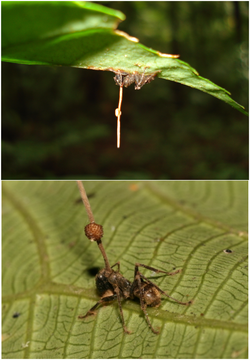
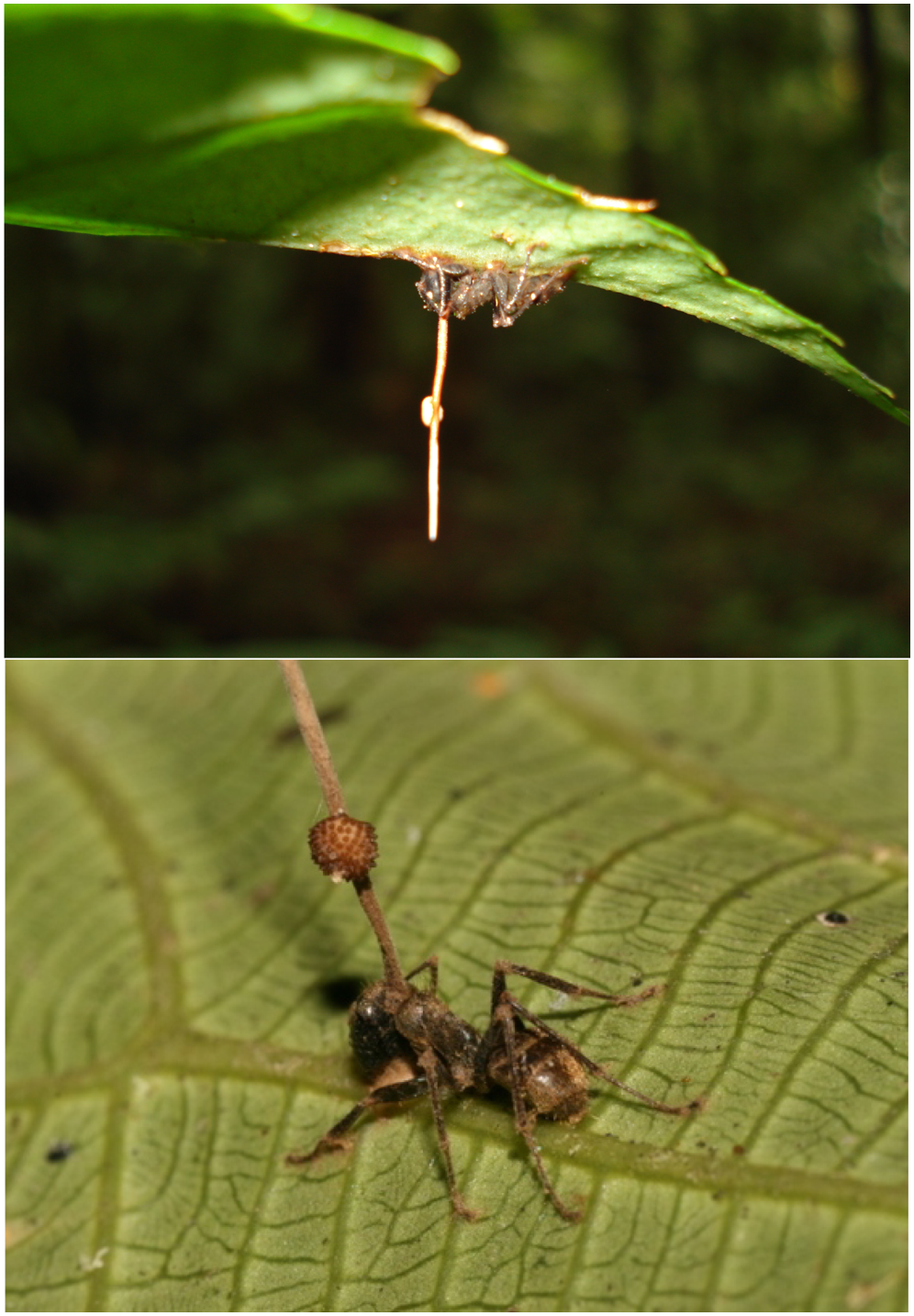
Dead ants infected with Ophiocordyceps unilateralis
Scientific classification Edit this classification
Kingdom: Fungi
Division: Ascomycota
Class: Sordariomycetes
Order: Hypocreales
Family: Ophiocordycipitaceae
Genus: Ophiocordyceps
Petch (1931)
Type species
Ophiocordyceps blattae
(Petch) Petch (1931)
Synonyms[1]
List
  • Cordycepioideus Stifler (1941)
  • Desmidiospora Thaxt. (1891)
  • Papiliomyces Luangsa-ard, Samson & Thanakitp. (2020)
  • Podonectrioides Kobayasi & Shimizu (1983)
  • Syngliocladium Petch (1932)

Ophiocordyceps is a genus of fungi within the family Ophiocordycipitaceae.[2] The widespread genus, first described scientifically by British mycologist Tom Petch in 1931,[3] contains about 140 species that grow on insects.[4] Anamorphic genera that correspond with Ophiocordyceps species are Hirsutella, Hymenostilbe, Isaria, Paraisaria, and Syngliocladium.[5]

One species complex, Ophiocordyceps unilateralis, is known for its parasitism on ants, in which it alters the behavior of the ants in such a way as to propagate itself more effectively, killing the ant and then growing its fruiting bodies from the ant's head and releasing its spores.[6][7][8][9] To accomplish this, infected ants are stripped of their instinctive fear of heights, and leaving the relative safety of their nests, climb up the nearest plant—a syndrome known as "summit disease".[10] The ant clamps its jaws around the plant in a "death grip" and following, mycelia grow from the ant's feet and stitch them to the surface of the plant.[10] The spores released from the ant carcass fall to the ground and infect other ants that come in contact with the spores so that this cycle continues.[11] Areas with high densities of ants that have this fungus growing out of them are known as graveyards.[11]

A 48-million-year-old fossil of an ant in the death-grip of Ophiocordyceps unilateralis was discovered in Germany.[12]

Sources and uses

[edit]
Moth larvae infested by Ophiocordyceps sinensis sold as herbal medicine

Ophiocordyceps sinensis is a species that infects the larvae of Tibetan ghost moths, and is used extensively in traditional Chinese medicine.[13][14][15] There is currently no scientific evidence that use of this species has any clinically detectable effect on human diseases.[14]

Ophiocordyceps robertsii is used by the Māori people of New Zealand as food and a source of ink for tattoos. The charred insect-fungus complex was mixed with tree sap to make an almost black ink.[16]

Ophiocordyceps nutans in its anamorphic form Hymenostilbe nutans is used as a biological control for stinkbugs.[17]

Non-insect hosts

[edit]

One not-yet-named fungus that falls into Ophiocordyceps infects juvenile edible crabs. Infection is fatal once the fungus becomes established in the hemocoel.[18]

Species

[edit]

Reference:[19]

Phylogeny

[edit]

A relatively broad phylogeny of the genus was published in 2024 as part of the effort to distinguish more species from inside the O. sinensis complex.[21]

[edit]

Simply referred to as "cordyceps", an unspecified species in this genus is the cause of a worldwide pandemic and the zombie-like "infected" in the 2013 video game The Last of Us, its 2020 sequel, and the 2023 television adaptation.

In the 2014 novel The Girl with All the Gifts and its 2016 film adaptation, a mutation of Ophiocordyceps unilateralis is responsible for an infection that causes the collapse of civilization.

In the 2022 comic-book series Poison Ivy written by G. Willow Wilson, the titular character makes use of a fictitious species belonging to this genus.

The Pokémon Paras and Parasect are based on insects parasitized by Ophiocordyceps.

See also

[edit]

References

[edit]
[edit]
Revisions and contributorsEdit on WikipediaRead on Wikipedia
from Grokipedia
Ophiocordyceps is a of ascomycete fungi in the family and order , comprising over 300 entomopathogenic species that primarily parasitize such as , , beetles, and lepidopteran larvae. Established by British mycologist Tom Petch in 1931, the genus was later emended and distinguished from the related genus in 2007 based on phylogenetic analyses and morphological traits, including darkly pigmented, pliant to wiry stromata that emerge from the host's body. These fungi are characterized by cylindrical asci containing filiform, multiseptate ascospores that often disarticulate into part-, with perithecia that may be superficial or immersed in the stroma. Ecologically, Ophiocordyceps species play key roles in tropical and subtropical ecosystems by regulating insect populations, with many exhibiting host manipulation behaviors—such as inducing to climb before death to optimize dispersal. The genus exhibits high , with over 340 accepted as of 2025; new continue to be described, particularly from . Morphologically, stromata are fibrous and tough in texture, often with a fertile portion bearing perithecia; pigmentation ranges from dark brown to black, aiding in distinguishing Ophiocordyceps from the more brightly colored . Notable include O. unilateralis, a keystone parasite of formicine that alters host locomotion via bioactive compounds, leading to death in elevated positions for enhanced transmission. Other significant taxa, such as O. sinensis (a medicinal infecting larvae) and termite-pathogenic like O. brunneirubra, highlight the genus's broad host range across insect orders including , Isoptera, and Coleoptera. While primarily known for insect parasitism, Ophiocordyceps has no documented pathogenicity in vertebrates, though its manipulation mechanisms inspire research in fungal and .

Description

Morphology

Ophiocordyceps species produce distinctive stromata, which are the fruiting bodies emerging from infected host cadavers, typically elongated and club-shaped, ranging from wiry and flexible to tough and leathery in texture. These stromata are often stipitate, solitary or in clusters, and vary in color from pale yellowish to dark brown, with lengths commonly spanning several millimeters to centimeters depending on the and host. In O. unilateralis, for instance, the stroma is characteristically single and darkly colored, arising unilaterally from the host's head or region. By contrast, O. sinensis features a more robust stroma that emerges from the within the mummified , often appearing black in wild specimens and serving as the primary above-ground structure. Microscopically, Ophiocordyceps is defined by perithecia, which are flask-shaped, ostiolate structures embedded superficially, pseudo-immersed, or fully immersed within the stroma, housing the asci. The asci are cylindrical to filiform, typically pedicellate with long stalks, and contain multiseptate ascospores that are and filiform, fragmenting post-ejection into smaller part-spores for enhanced dispersal. This fragmentation into numerous part-spores (varying from 4 to over 32 depending on the species) is a key diagnostic trait across the , facilitating wind or insect-mediated spread. Morphological variations are pronounced among species, reflecting adaptations to different hosts; for example, O. unilateralis produces a compact, ant-attaching stroma optimized for elevation above the forest floor, while O. sinensis develops an internal —a hardened, nutrient-rich mass of densely interwoven hyphae—prior to stroma formation, which integrates with the host's remains. Developmentally, Ophiocordyceps progresses from a conidial anamorph stage, often represented by Hirsutella-like structures producing mucilaginous conidia on phialides, to the teleomorph stage. Inside the host, hyphal growth initially occurs as invasive, yeast-like blastospores in the hemocoel, transitioning to interwoven mycelial networks that form sclerotia or directly develop into stromata upon host death. This biphasic life cycle underscores the genus's entomopathogenic strategy, with hyphal patterns shifting from proliferative to structural as the colonizes and ultimately fructifies.

Life cycle

The life cycle of Ophiocordyceps initiates with the of ascospores, which are multiseptate structures measuring 80–200 µm, upon contact with the of a susceptible host. These ascospores produce germ tubes that penetrate the host's through mechanical pressure combined with the secretion of hydrolytic enzymes, including chitinases, lipases, and proteases. This penetration process allows the fungus to breach the multi-layered and enter the host's hemocoel. Inside the host, the fungus proliferates as yeast-like blastospores or mycelium, colonizing tissues and absorbing nutrients via enzymatic degradation, typically over 4–10 days. This internal growth phase exhausts the host's resources, leading to death around 4–10 days post-infection, depending on species and conditions, at which point the fungus shifts to vegetative hyphal expansion to secure the cadaver with rhizoids. Post-mortem, a stroma—a club-shaped fruiting body—emerges from the host's head or intersegmental regions, often within 3–7 days under suitable conditions, marking the transition to reproductive stages. Sexual reproduction predominates, with perithecia forming on the stroma to produce and forcibly discharge ascospores for dispersal, completing the cycle. Certain species also incorporate asexual phases, generating conidia through anamorphic structures like hymenostilboid or hirsutelloid synanamorphs. Stroma development and sporulation are environmentally cued, requiring high humidity and specific temperatures—such as those in tropical forests—to optimize fruiting body maturation and spore release, often peaking seasonally with rainfall lags.

Taxonomy and classification

Etymology and history

The genus name Ophiocordyceps combines the Greek prefix "ophio-" (from ophis, meaning snake), alluding to the often twisted or serpentine appearance of the stroma, with "cordyceps," derived from the Greek kordylē (club) and Latin caput (head), referring to the club-shaped fruiting bodies. The broader genus Cordyceps, which initially included species later classified under Ophiocordyceps, was established in 1818 by Swedish mycologist Elias Magnus Fries as part of the Pyrenomycetes, based on morphological characteristics of entomopathogenic fungi. In the mid-19th century, British mycologist Miles Joseph Berkeley contributed significantly to the early taxonomy by describing several Cordyceps species parasitic on , including C. sinensis (now Ophiocordyceps sinensis) in 1843 from specimens collected in . The genus Ophiocordyceps was first established by British mycologist Tom Petch in 1931 to accommodate species of Cordyceps with clavate, thick-walled asci and ascospores that break into part-spores. Key discoveries of Ophiocordyceps species date back centuries, with O. sinensis first documented around the 15th century in Tibetan medical texts as "yartsa gunbu" (meaning "summer grass, winter worm") by the physician Zurkhar Namnyi Dorje, who noted its use as a tonic in traditional Tibetan and Chinese medicine. Similarly, O. unilateralis was first observed in 1859 by British naturalist Alfred Russel Wallace during his Amazon expeditions, where he described the fungus's peculiar growth on infected ants. A major taxonomic milestone occurred in 2007 when Sung et al. conducted multi-gene phylogenetic analyses (using loci such as nrSSU, nrLSU, tef1, rpb1, rpb2, and others), revealing that Cordyceps was polyphyletic and proposing the elevation of subgenus Ophiocordyceps to full status within the newly defined family ; this reclassification transferred approximately 150 species, including O. sinensis and O. unilateralis, based on shared morphological traits like darkly pigmented, pliant stromata and molecular evidence of .

Phylogeny

Ophiocordyceps belongs to the phylum , order , and family , a classification supported by extensive molecular phylogenetic analyses. These studies delineate the genus as a monophyletic group distinct from sensu stricto, primarily through the use of nuclear ribosomal markers such as small subunit (SSU rDNA) and protein-coding genes including RNA polymerase II largest subunit (RPB1) and second largest subunit (RPB2). The separation highlights Ophiocordyceps as an independent lineage adapted to entomopathogenic lifestyles, resolving earlier taxonomic ambiguities in the Clavicipitaceae s.l. Phylogenetic reconstructions reveal major within the broader hypocrealean entomopathogens, including Clavicipitaceae-like pathogens that form basal groups, with Ophiocordyceps emerging as a derived characterized by specialized morphological and ecological traits. Multi-gene datasets combining SSU rDNA, RPB1, and RPB2 consistently position Ophiocordyceps within the , emphasizing its evolutionary divergence from plant-associated relatives toward exclusive parasitism. This derived status underscores a history of host-specific adaptations, as evidenced by robust Bayesian and maximum likelihood trees that resolve intergeneric relationships with high support. Evolutionary adaptations in Ophiocordyceps for include genomic expansions in related to biosynthesis, which facilitate host immobilization and nutrient acquisition. For instance, clusters encoding synthetases produce beauvericin, a cyclodepsipeptide that disrupts muscle function and aids in overcoming host defenses. further reveals an expanded secretome—comprising up to twofold more than in non-pathogenic relatives—enabling efficient penetration and manipulation of hosts, a key innovation in the transition to entomopathogenicity within .

Ecology

Hosts and distribution

Ophiocordyceps species predominantly infect as primary hosts, including , moths, beetles, and representatives from at least 10 insect orders such as Coleoptera, , and . For instance, specifically targets carpenter (Camponotus spp.), particularly C. rufipes, C. balzani, and C. atriceps, demonstrating high host specificity. Secondary hosts encompass other , including spiders and social wood-feeding , as seen in O. salganeicola parasitizing cockroach species in Neotropical rainforests. Rare cases involve non- hosts, such as O. ophioglossoides on truffle-like fungi (Elaphomyces spp.) or wood-inhabiting substrates, though parasitism remains the genus's ecological focus. The exhibits a range of host specificities, with many being monophagous—restricted to a single host —while others display polyphagous tendencies, infecting multiple related hosts within an order. This variation supports diverse ecological roles, particularly in regulating populations in forest understories. Over 200 described underscore the breadth of exploitation, though undescribed diversity likely extends this further. Geographically, Ophiocordyceps is concentrated in tropical and subtropical forests, with highest diversity in regions like the , Southeast Asian rainforests (e.g., Province, ), and Central American woodlands, where humidity and host abundance favor spore dispersal. Diversity decreases with increasing latitude, reflecting a core distribution that occasionally extends into warm-temperate zones. An exception is O. sinensis, endemic to high-altitude alpine meadows on the and Himalayan ranges in (, , , , ), , , and , occurring between 3,000 and 5,000 meters where cold winters and specific conditions prevail. This elevational niche contrasts with lowland tropical preferences, highlighting the genus's adaptability to varied climatic niches.

Infection and behavioral manipulation

Ophiocordyceps species initiate infection when encounter fungal spores in the environment, which adhere to the host's . The spores germinate and penetrate the ant's through a combination of mechanical force generated by in specialized structures like appressoria and the secretion of hydrolytic enzymes, including proteases and lipases, that degrade the chitin-protein matrix. This enzymatic and physical breach allows hyphae to invade the hemocoel, marking the onset of systemic colonization. Once inside, the proliferates as mycelial networks or yeast-like blastospores, rapidly depleting the host's nutrients and producing metabolites such as guanidinobutyric acid to disrupt physiological functions. This leads to host death typically within 3-9 days post-infection, with mycelia filling tissues like the head and causing through mechanisms including mitochondrial damage. Prior to death, the fungus manipulates ant behavior, inducing "summit disease" where infected individuals exhibit convulsions and erratic movement before climbing vegetation to bite into leaves or twigs at heights around 25 cm above the , synchronized near solar noon in microhabitats with 90-95% relative optimal for subsequent sporulation. These alterations arise from neural interference, likely mediated by fungal alkaloids such as aflatrem-like compounds that target the , overriding normal patterns to position the host for enhanced dispersal. Following host death, which occurs shortly after the biting grip—often within 6 hours—the emerges from the intersegmental regions of the , particularly the head, to form a stroma or fruiting body. This elevated structure ensures spores are released from an optimal height, propelled by wind or to infect nearby in dense "graveyards." The stroma's growth, beginning 2-3 days post-mortem, secures the ant's lock-jaw to the substrate, preventing dislodgement and maximizing transmission efficiency.

Diversity and species

Overall diversity

The genus Ophiocordyceps comprises more than 360 described , primarily known for their role as specialized pathogens of arthropods, with potentially hundreds more undescribed, especially within the understudied tropical ecosystems where cryptic diversity is prevalent due to host-specific adaptations. This estimation reflects ongoing discoveries driven by morphological and molecular analyses, highlighting the genus's richness in entomopathogenic forms that exploit a wide array of orders, including Coleoptera, , and . Diversity within Ophiocordyceps is characterized by species primarily infecting , with some associated with other arthropods such as spiders; these species often cluster phylogenetically into clades defined by host type, such as the O. unilateralis complex targeting formicine or groups parasitizing lepidopteran larvae. This host-driven clustering underscores the genus's evolutionary specialization, where closely related species exhibit similar infection strategies tailored to specific insect taxa across at least 13 insect orders, as well as spiders and other arthropods. The rate of species discovery has accelerated since the genus's formal establishment in 2007 through the taxonomic split from , facilitated by multi-locus molecular surveys that reveal hidden lineages; for instance, recent molecular phylogenetic studies have described new taxa like O. zhenxingensis in 2025, infecting larvae in . This surge includes clusters of novel species from regions like western and the Brazilian Amazon, emphasizing the role of genomic and phylogenetic tools in uncovering previously overlooked variation. Global hotspots for Ophiocordyceps center on tropical rainforests, where the highest occurs due to abundant hosts and humid conditions favoring fungal proliferation; notable is observed in biodiverse areas such as the and Andean foothills, alongside Southeast Asian tropics, reflecting regional host specificity and limited dispersal. These patterns align with broader phylogenetic clades that support host-based diversification, though detailed evolutionary relationships are explored elsewhere.

Notable species

Ophiocordyceps unilateralis is renowned for its infection of carpenter ants (Camponotus spp.) in understories, where it manipulates host behavior to induce a fatal bite on leaf veins at a precise height, optimizing dispersal. This species produces a single, wiry stroma emerging from the ant's dorsal pronotum, typically 1.8–2 cm long and dark brown, facilitating the release of ascospores. Ecologically, it acts as a keystone parasite, regulating populations and influencing forest microhabitats through localized epizootics. In contrast, , known as the caterpillar fungus or yarsagumba, parasitizes larvae of ghost moths (Thitarodes spp.) in high-altitude meadows of the Himalayan region, forming a sclerotized complex where the stroma emerges from the mummified host. The stroma is elongated, often exceeding 5 cm and up to 10 cm, with a club-shaped fertile portion densely packed with perithecia for ascospore production. This holds significant ecological value in alpine ecosystems, supporting nutrient cycling, and is economically vital, contributing substantially to rural livelihoods through sustainable harvesting. Ophiocordyceps sphecocephala demonstrates high host specificity by infecting wasps, particularly vespid , with the stroma protruding from the host's head to maximize exposure. Less extensively studied than ant or lepidopteran parasites, it exhibits morphological adaptations like a compact, head-emergent fruiting body, underscoring the genus's versatility in hymenopteran manipulation. Its ecological role involves targeted predation on solitary or social wasps, potentially curbing and pest dynamics in forested habitats. A recently described species, Ophiocordyceps salganeicola, was identified in 2021 as a parasite of social wood-feeding (Salganea esakii and S. taiwanensis) in Japanese subtropical forests, expanding the known host range beyond and moths to . The stroma is clavate to cylindrical, 1–7 cm long and cream to dark brown, arising from the host's body within rotting logs, where it may alter host positioning to enhance release near the surface. This discovery highlights evolutionary shifts in Ophiocordyceps toward diverse hosts, aiding in wood-decay niches. Morphological variations among these species reflect host adaptations; for instance, the compact 1.8–2 cm stroma of O. unilateralis suits arboreal ant placement, while the larger 5–10 cm structure of O. sinensis supports spore dissemination in open alpine environments, with O. salganeicola's intermediate size (1–7 cm) fitting subterranean wood habitats.

Human interactions

Traditional and medicinal uses

Ophiocordyceps sinensis, commonly known as "winter worm, summer grass" (dongchong xiacao in Chinese and yartsa gunbu in Tibetan), has been utilized in traditional Chinese medicine (TCM) and Tibetan medicine for over 700 years as a tonic to enhance vitality, support kidney function, and act as an aphrodisiac. In these traditions, it is harvested from high-altitude regions of the Qinghai-Tibetan Plateau, where the fungus parasitizes the larvae of ghost moths, emerging as a fruiting body in summer. Folk healers in areas like Sikkim, near the Nepal-Tibet border, employ it to boost stamina, energy, and libido, often administering it with milk, hot water, or local alcohol for conditions including fatigue and respiratory issues. Within Tibetan Buddhist practices, it serves as a longevity elixir, incorporated into vitalizing preparations known as bcud len to promote overall health and endurance. The high demand for wild O. sinensis has driven its market value to between $15,000 and $110,000 per kilogram or more internationally as of 2024-2025, varying by quality and region, with premium specimens fetching higher prices in markets like and . This economic incentive has spurred intensive harvesting in and since at least the , when its medicinal properties were first documented in Tibetan texts. Traditionally, it is prepared as a or powder to address renal dysfunction, hyposexuality, and immune-related ailments in TCM. A related species, Ophiocordyceps militaris, distinct from O. sinensis but sharing the genus, is cultivated for use in supplements that claim to provide immune-boosting and for enhancing reproductive function and overall vitality. Unlike the wild-harvested O. sinensis, O. militaris is grown on substrates like grains, making it more accessible for commercial production. In contemporary practices, both species appear in modern products such as capsules, teas, and tonics, continuing their role in TCM formulations for stamina and maintenance among practitioners and consumers in . As of 2025, efforts to cultivate O. sinensis strains have expanded to address supply shortages driven by overharvesting.

Research and applications

Research on Ophiocordyceps has focused on its bioactive compounds, particularly , a analog isolated from O. militaris in the 1950s. exhibits antiviral effects by inhibiting through interference with synthesis and has demonstrated antitumor activity via multiple pathways, including induction of , inhibition of , and suppression of tumor in various cancer models. These properties have been attributed to cordycepin's structural similarity to , allowing it to disrupt in pathogens and cancer cells. Further studies have confirmed its broad-spectrum potential against , viruses, and , positioning it as a for pharmaceutical development. Entomopathogenic species within Ophiocordyceps, such as O. unilateralis, have been evaluated for biocontrol applications due to their natural insecticidal efficacy and low environmental impact. These fungi infect and manipulate host insects like and beetles, leading to host and dispersal, which has prompted testing against agricultural pests including bark beetles and soil-dwelling larvae. Research highlights their role as eco-friendly alternatives to chemical insecticides, with strains demonstrating high in field trials and endophytic formulations to enhance . Ongoing studies emphasize optimizing formulation and delivery to target specific pests while minimizing non-target effects. Medical research on O. sinensis extracts has included clinical trials assessing efficacy for and respiratory conditions. A pilot study showed that supplementation with O. sinensis (Cs-4 strain) improved exercise performance and reduced subjective in healthy elderly subjects, suggesting benefits for physical endurance. For respiratory issues, a of 15 randomized controlled trials (RCTs) involving 1,238 patients demonstrated that O. sinensis preparations may improve lung function, exercise endurance, and in stable (GOLD stages 2-3), though methodological quality was low and no serious adverse events were reported. In the , investigations into beta-glucans from O. sinensis have revealed their immunomodulatory effects, including enhancement of maturation, T-cell activation, and production, which support immune responses against infections and tumors. These activate pattern recognition receptors, promoting and adaptive immunity in preclinical and early clinical models. Genetic engineering efforts using / have targeted O. militaris to enhance production for pharmaceutical applications. The system has enabled precise disruption of genes in the pathway, increasing yields by reprogramming metabolic fluxes and upregulating key enzymes like those in the salvage pathway. Studies have also applied to eliminate toxin-producing gene clusters, ensuring safer strains for scaled production of bioactive compounds like . These advancements facilitate higher-efficiency processes, supporting the development of fungal-derived therapeutics.

Cultural significance

Ophiocordyceps has captured the public imagination through its portrayal in video games and , most notably in the 2013 video game and its 2023 HBO adaptation, where a fictional mutated strain of the fungus causes a zombie-like in humans by infecting the and manipulating , drawing direct inspiration from the real-life effects of O. unilateralis on ants. The game's creators at based the concept on the fungus's ability to hijack insect hosts, transforming it into a metaphor for and . Documentaries have further popularized the genus by showcasing its eerie life cycle. The 2006 BBC series Planet Earth featured groundbreaking footage of Ophiocordyceps infecting , illustrating the fungus's manipulation of host in a segment titled "Attack of the Killer Fungi," which highlighted the rapid growth and spore release from dead . has produced specials and videos, such as the 2019 clip "'Zombie' Parasite Cordyceps Fungus Takes Over Through Mind Control," emphasizing the mind-altering effects of Ophiocordyceps on and other arthropods to educate viewers on parasitic fungi. The research of entomologist David P. Hughes, who studies Ophiocordyceps manipulation of ant behavior at , has been widely popularized in and media, contributing to its use as a for mind control in science fiction narratives beyond The Last of Us, such as in discussions of parasitic dominance in . This has extended to broader cultural depictions, including sci-fi explorations of fungal influence on cognition. The release of in 2013 spurred increased public interest in and fungal , leading to a surge in educational content and artistic representations of "zombie ants" controlled by Ophiocordyceps. This phenomenon has manifested in online discussions, illustrations, and memes portraying the fungus's effects, fostering greater awareness of entomopathogenic fungi among non-specialists.

Conservation concerns

Ophiocordyceps sinensis, a high-value species in the genus, faces severe threats from overharvesting across the Himalayan region, driven by its commercial demand in . Surveys of over 800 collectors in , , , and indicate that production has declined significantly over the past decade, with the majority reporting reduced yields attributed primarily to overharvesting. In , per capita harvests dropped from approximately 261 pieces per person in 2006 to 126 in 2010, while 95% of harvesters noted decreasing availability in pastures. This intensive collection, often occurring before maturation, disrupts fungal reproduction and indirectly impacts host populations (Thitarodes spp.) by altering dynamics in alpine meadows. Habitat degradation exacerbates these pressures, particularly through in tropical regions affecting ant-parasitizing Ophiocordyceps species like O. unilateralis. Loss of forest cover reduces populations of formicine hosts and alters the humid microclimates essential for fungal growth and dispersal, leading to localized declines in fungal diversity. In the , compounds habitat loss for O. sinensis by shifting suitable elevations upward; projections indicate potential habitat expansion of up to 4.87% by 2070 under low-emission scenarios, but with losses in lower-altitude eastern regions of due to warming temperatures (3.0–6.3°C rise by 2090s). These changes threaten the fungus's narrow alpine niche (3,200–4,900 m), further stressing host caterpillars sensitive to altered snow patterns and winter temperatures. Conservation efforts for O. sinensis include national protections in , where it is classified as endangered under the second class of state protection since 1999 and listed as vulnerable on the due to . Although proposals for inclusion in Appendix II have been discussed to regulate , the species remains unlisted as of 2025. To mitigate wild harvest pressures, has invested in artificial cultivation, though full life-cycle remains challenging; mycelial and substratum methods contribute to limited production, with total annual yields from the Qinghai-Tibetan Plateau estimated at 80–175 tons, predominantly wild-sourced. Beyond O. sinensis, broader risks loom for undescribed Ophiocordyceps , many of which play keystone roles in regulating populations in tropical forests. like O. unilateralis control formicine densities through specialized , maintaining balance, but habitat from endangers hundreds of potentially undescribed lineages, potentially leading to undetected extinctions and disrupted dynamics. Ecosystem disruptions could thus cascade, undermining the genus's contributions to across diverse habitats.

References

Add your contribution
Related Hubs
User Avatar
No comments yet.