Hubbry Logo
Appalachian OhioAppalachian OhioMain
Open search
Appalachian Ohio
Community hub
Appalachian Ohio
logo
8 pages, 0 posts
0 subscribers
Be the first to start a discussion here.
Appalachian Ohio
Appalachian Ohio
from Wikipedia
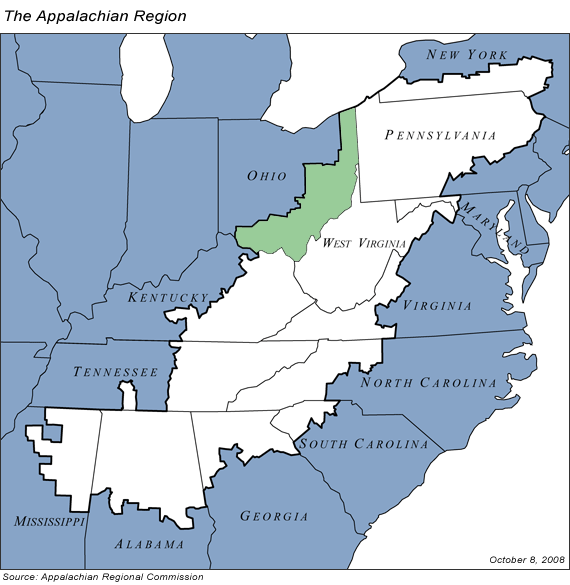
Appalachian Ohio, shaded in green, shown within Appalachia.

Appalachian Ohio is a bioregion and political unit in the southeastern part of the U.S. state of Ohio, characterized by the western foothills of the Appalachian Mountains and the Appalachian Plateau. The Appalachian Regional Commission defines the region as consisting of thirty-two counties.[1] This region roughly overlaps with the Appalachian mixed-mesophytic forests, which begin in southeast Ohio and southwest Pennsylvania and continue south to Georgia and Alabama. The mixed-mesophytic forest is found only in Central and Southern Appalachia and eastern/central China. It is one of the most biodiverse temperate forests in the world.

Geologically, Appalachian Ohio corresponds closely to the terminal moraine of an ancient glacier that runs southwest to northeast through the state. Areas south and east of the moraine are characterized by rough, irregular hills and hollows, characteristic of the Allegheny Plateau and Cumberland Plateaus of the western Appalachian Plateau System. Unlike eastern Appalachia, this region does not have long fin-like ridges like those of the Ridge-and-Valley Appalachians subranges, but a network of rocky hollows and hills going in all directions.

The region is considered part of "central Appalachia", a political, cultural, and bioregional classification that includes southeastern Ohio, Eastern Kentucky, most of West Virginia and Southwestern Virginia. The region has a total population of roughly 1.982 million.

Counties and county seats

[edit]
Counties of Appalachian Ohio, with East Central region in yellow, South East region in red, and Southern region in blue
1. Adams County
2. Ashtabula County
3. Athens County
4. Belmont County
5. Brown County
6. Carroll County
7. Clermont County
8. Columbiana County
9. Coshocton County
10. Gallia County
11. Guernsey County
12. Harrison County
13. Highland County
14. Hocking County
15. Holmes County
16. Jackson County
17. Jefferson County
18. Lawrence County
19. Mahoning County
20. Meigs County
21. Monroe County
22. Morgan County
23. Muskingum County
24. Noble County
25. Perry County
26. Pike County
27. Ross County
28. Scioto County
29. Trumbull County
30. Tuscarawas County
31. Vinton County
32. Washington County

The Governor's Office of Appalachia subdivides the 32 counties of Appalachian Ohio into three smaller regions: East Central Ohio, South East Ohio, and Southern Ohio.[1][2] The following lists include each county in the region and its county seat.

East Central Ohio South East Ohio Southern Ohio

Cities

[edit]

Appalachian Ohio has several cities within its borders, which as of the 2010 census included the following localities:

Politics

[edit]
2006 U.S. Senate election in Ohio.
2024 U.S. Senate election in Ohio.

With the exception of progressive college cities like Athens, Ohio, Appalachian Ohio has been a Republican stronghold since Donald Trump became the party's nominee in 2016. Historically, the region was a Democratic stronghold or evenly split.

Neighboring parts of Appalachia in other states have also shifted towards the Republicans during the same time period, including West Virginia and the Eastern Kentucky Coalfield.[3]

Democrat Sherrod Brown's Ohio U.S. Senate elections show the region's long-term trend towards Republicans. In 2024, Brown only won Athens county. But in 2006, Brown had won almost every single county in the region.

Appalachian Ohio Presidential election results[4]
Year Democratic Republican Third parties
2024 30.8% 288,055 68.4% 638,561 0.6% 7,196
2020 32.7% 313,027' 66.0% 632,243 1.4% 12,982
2016 33.3% 298,738 62.6% 562,102 4.1% 37,224
2012 48.7% 433,276 51.3% 456,776 0% 0

Transportation

[edit]

John Glenn Columbus International Airport, in Columbus, is the largest airport and serves most of the residents in southeast Ohio. John Glenn offers primarily domestic flights. Cincinnati/Northern Kentucky International Airport to the southwest serves most of the residents of Cincinnati and its metropolitan area, and Cleveland Hopkins International Airport to the north is also a major hub airport.

Appalachian Regional Commission

[edit]
Map showing 2012 ARC economic designations for Appalachian Ohio.

The Appalachian Regional Commission was formed in 1965 to aid economic development in the Appalachian region, which was lagging far behind the rest of the nation on most economic indicators. The Appalachian region currently defined by the commission includes 420 counties in 13 states, including 32 counties in Ohio. The commission gives each county one of five possible economic designations— distressed, at-risk, transitional, competitive, or attainment— with "distressed" counties being the most economically endangered and "attainment" counties being the most economically prosperous. These designations are based primarily on three indicators— three-year average unemployment rate, market income per capita, and poverty rate.[5] In 2009, Appalachian Ohio had a three-year average unemployment rate of 8.4%, compared with 7.5% statewide and 6.6% nationwide. In 2008, Appalachian Ohio had a per capita market income of $22,294, compared with $29,344 statewide and $34,004 nationwide. In 2009, Appalachian Ohio had a poverty rate of 16%, compared to 13.6% statewide and 13.5% nationwide.[6] Seven Ohio counties—Adams, Athens, Meigs, Morgan, Noble, Pike and Vinton—were designated "distressed", while nine—Ashtabula, Gallia, Guernsey, Harrison, Jackson, Lawrence, Monroe, Perry and Scioto—were designated "at-risk". The remaining half of Appalachian Ohio counties were designated "transitional", meaning they lagged behind the national average on one of the three key indicators. No counties in Ohio were given the "attainment" or "competitive" designations.

Athens County had Appalachian Ohio's highest poverty rating, with 32.8% of its residents living below the poverty line. Clermont had Appalachian Ohio's highest per capita income ($30,515) and Holmes had the lowest unemployment rate (5.5%).[5] Washington County has the highest high school graduation rate (84.5%), while Adams County has the lowest (68.6%). Although Holmes County has a significantly lower high school graduation rate than Adams County at 51.5%, its graduation rates are somewhat skewed compared to the rest of the region, due to the county's high population of Amish, whose children do not attend school past the eighth grade.[7]

Notable people

[edit]

Notable Americans from Appalachian Ohio include:

See also

[edit]

References

[edit]

Further reading

[edit]
[edit]
Revisions and contributorsEdit on WikipediaRead on Wikipedia
from Grokipedia
Appalachian Ohio encompasses the 32 counties in the eastern and southeastern portions of the U.S. state of designated by the (ARC) as part of the broader n region, spanning from the valley northward through hilly terrain. This area covers 16,011.5 square miles and had an estimated of 1,972,196 in 2024, representing a decline from prior decades amid broader trends of outmigration and economic shifts. Defined by the unglaciated Plateau's rugged , the region historically depended on extractive industries such as and timber harvesting, which fueled growth but later contributed to structural economic distress following industry contractions. Empirical indicators reveal persistent challenges, including employment growth lagging the national average by a factor of eight from 2001 to 2021 and elevated poverty rates compared to non-n Ohio counties, though recent ARC investments aim to diversify toward advanced manufacturing and . Despite these hurdles, the area's resource base and community resilience have supported niche sectors like and extraction, underscoring causal links between terrain-driven isolation and slower adaptation to post-industrial economies.

Geography and Definition

Counties and Boundaries

Appalachian Ohio comprises 32 counties designated by the (ARC), a federal agency created by the Appalachian Regional Development Act of 1965 to address economic challenges in the region. The ARC defines its service area based on a combination of geographic contiguity to the and indicators of economic distress, such as market income and poverty rates below national averages. In , this designation covers counties primarily in the southeastern and eastern parts of the state, selected for their alignment with these criteria as of the program's inception and subsequent reviews. The designated counties, listed alphabetically, are: Adams, Ashtabula, , Belmont, , Carroll, Clermont, Columbiana, Coshocton, Gallia, , Harrison, Highland, Hocking, Holmes, Jackson, Jefferson, Lawrence, Mahoning, Meigs, Monroe, Morgan, Muskingum, Noble, , Pike, Ross, Scioto, Trumbull, Tuscarawas, Vinton, and Washington. These counties form the boundaries of Appalachian Ohio, which trace the outlines of the included county lines, creating an elongated area stretching approximately 250 miles from Clermont County near in the southwest to Ashtabula County near in the northeast. The southern boundary generally follows the , separating Ohio from and , while the eastern edge abuts , and the northern extent reaches counties. This administrative delineation, rather than a strict physiographic one, reflects the ARC's focus on economic policy implementation over natural features alone, though it largely coincides with the unglaciated in southeastern .

Physical Landscape and Climate

Appalachian Ohio encompasses the unglaciated portion of the in the state's southeastern counties, presenting a rugged, dissected of steep hills, narrow valleys, and elevated uplands resulting from prolonged of nearly horizontal layers deposited during the Pennsylvanian Period. These layers consist predominantly of interbedded sandstones, shales, siltstones, and seams, which outcrop in prominent ridges and contribute to the region's scenic gorges, cliffs, and natural arches. The absence of Pleistocene glaciation—unlike in northwestern —has preserved sharper relief, thinner soils derived from weathered bedrock, and frequent rock , fostering a suited to but less amenable to large-scale compared to glaciated lowlands. Elevations vary from roughly 550 feet (168 m) above along the Ohio River valley in the south to over 1,300 feet (396 m) across interior hilltops, with the area's highest prominence at Galloway Knob in Belmont County reaching 1,397 feet (426 m). Drainage is dominated by the along the southern boundary and its southeastern tributaries, such as the Muskingum, Hocking, and Shade rivers, which have carved deep incisions into the plateau, creating V-shaped valleys, waterfalls, and floodplains that historically facilitated transportation and resource extraction. The region's climate falls within the humid continental classification (Köppen Dfa), marked by significant seasonal temperature swings, ample humidity, and no prolonged dry periods. In Athens County, a central representative locale, annual average high temperatures reach 64°F (18°C) and lows 38°F (3°C), with July highs typically 84°F (29°C) and January lows 23°F (-5°C); snowfall accumulates to about 25-30 inches annually, while summers feature frequent thunderstorms. Annual precipitation averages 39-41 inches (991-1,041 mm), concentrated slightly more in spring and summer due to frontal systems and orographic enhancement from the hilly topography intercepting moist air masses from the and . These patterns support deciduous forest cover but also contribute to periodic flooding in river valleys.

History

Pre-Settlement and Early European Settlement

The Appalachian Ohio region, encompassing the southeastern portion of the state within the , was occupied by Native American peoples for over 10,000 years prior to European contact. Archaeological evidence from Paleo-Indian sites, dating to approximately 13,000–10,000 BCE, reveals fluted projectile points and big-game hunting tools, indicating small nomadic bands adapted to post-glacial environments. These were succeeded by Archaic period (c. 8000–1000 BCE) foragers who exploited diverse riverine and forested resources, with seasonal camps yielding ground stone tools and early evidence of nut processing. The Woodland period introduced mound-building cultures, beginning with the Adena (c. 1000 BCE–200 CE), who constructed conical burial mounds and enclosures for ceremonial purposes, often aligned with solstices; notable sites include those near the and in Washington County, such as the Conus Mound in Marietta, containing artifacts like ornaments and sheets suggestive of regional . The subsequent Hopewell culture (c. 200 BCE–500 CE) expanded this tradition, erecting geometric earthworks and effigy mounds for ritual and exchange networks spanning from the to the Gulf Coast, with exotic materials like and grizzly bear teeth recovered from Ohio Valley sites; Hopewell influence extended into eastern Ohio's hilly terrain, though central river valleys hosted the densest complexes. Late Prehistoric peoples (c. 1000–1650 CE) shifted toward semi-permanent villages with palisades along tributaries of the , relying on maize-bean-squash supplemented by deer and ; their and triangular points distinguish them from earlier groups, with population estimates reaching several thousand in southern clusters before European-introduced diseases and intertribal conflicts reduced densities. By the protohistoric era (post-1500 CE), Iroquoian-speaking groups like the Erie occupied the littoral extending into eastern , while Algonquian maintained seasonal camps in the Scioto and drainages; the (c. 1600–1700) displaced many, allowing () and (western ) migrations into the Muskingum and Tuscarawas valleys by the early , where they hunted, trapped beaver, and contested British and French traders. French explorers, including La Salle in 1669, traversed the watershed for by the late , establishing temporary posts, but permanent European-American settlement awaited resolution of Native title and British claims post-Revolutionary War. The of 1787 organized the , prohibiting slavery and enabling orderly surveys; on April 7, 1788, the of Associates, comprising veterans and investors, founded Marietta at the Muskingum-Ohio confluence with 48 pioneers under , erecting blockhouses and fort amid 1.5 million acres purchased from the federal government for $1 million in depreciated certificates. This marked the first organized, non-Native settlement north of the and west of the Appalachians, driven by land speculation and Revolutionary War bounties. Early settlers focused on surveying, farming corn and livestock, and salt production from licks, but faced raids from and Wyandot alliances resisting encroachment, as in the 1791 killing 14 near modern . U.S. military campaigns, culminating in General Anthony Wayne's victory at Fallen Timbers on August 20, 1794, forced the (1795), ceding two-thirds of to the U.S. and enabling influxes from and ; by 1800, Washington County's population exceeded 4,000, with log cabins dotting ridges and hollows, though from river bottoms and Native reprisals delayed upland penetration until the 1810s.

Industrial Development and Boom (19th-20th Centuries)

The exploitation of Appalachian Ohio's natural resources began with timber harvesting in the early , as the region's dense forests supplied for , furniture, and to support nascent settlements and downstream industries. By the , logging operations had expanded significantly, driven by demand from growing Midwestern cities and the need for railway ties, with companies clear-cutting vast tracts in counties like Hocking and to feed steamboat and economies. This activity laid groundwork for further extraction but depleted forests rapidly, shifting focus to subsurface resources by mid-century. Coal mining emerged as the dominant industry following transportation infrastructure developments, with small-scale operations noted as early as 1800 in southeastern Ohio's outcrops along streams in counties such as and Muskingum. The completion of the & in 1832 initially enabled limited shipments, but the true boom ignited after railroads penetrated the region starting in 1851, connecting mines to markets in , , and beyond for iron, , and coke production. In the Hocking Valley coalfield, production surged from the 1870s onward, attracting thousands of immigrant laborers from Europe and creating company towns like Nelsonville and Buchtel, where operators such as the Columbus & Hocking Coal & Iron Company dominated output. The late 19th and early 20th centuries marked the peak of industrial expansion, fueled by national demand for during and booms; Ohio's total output reached approximately 28 million short tons annually by , with southeastern fields contributing substantially through underground mines employing pillar-and-room methods. Labor unrest, including the 1884 mine wars in areas like New Straitsville where striking miners torched facilities, underscored the era's tensions amid rapid growth, yet production continued to climb, peaking statewide at over 50 million tons in 1913 before and competition began eroding gains. Auxiliary industries, such as clay extraction for bricks and in Zanesville and iron smelting in Hanging Rock, intertwined with , employing additional workers and processing local ores until imported alternatives undercut them post-1900. This resource-driven surge transformed Appalachian Ohio from agrarian isolation into an industrial appendage of urban centers, with railroads hauling to fuel America's expansion.

Post-Industrial Decline and Recovery Efforts (Mid-20th Century Onward)

Following , the industry in Appalachian Ohio, which had driven economic growth through much of the , entered a period of sharp decline due to that reduced labor needs, from cheaper Western enabled by railroad in the 1970s, and a shift in energy markets toward . employment across Appalachia fell as productivity rose, with the region's share of national jobs dropping from 85% in 1954 to 57% by 2018; in , underground jobs plummeted from over 20,000 in the 1950s to fewer than 2,000 by 2010. Environmental regulations, including the Clean Air Act amendments of 1970 and subsequent provisions in 1990, further pressured high-sulfur Ohio by mandating or fuel switches, contributing to mine closures and output reductions of over 60% in Central Appalachian fields between 2005 and 2015. This industrial contraction triggered widespread socioeconomic fallout, including outmigration and persistent . Seven Appalachian counties have lost residents every decade since 1950, with overall regional shrinking in line with job losses; for instance, counties like and Meigs saw net declines of 10-20% from 1970 to 2020. Poverty rates in Appalachian Ohio counties frequently exceeded 20% through the late , remaining higher than the state average at 15.9% versus 12.8% statewide as of 2017-2021, exacerbated by limited diversification beyond extractive industries. and timber sectors, once supplementary, also waned amid and , leaving communities with elevated —often double the national rate in the 1980s—and reliance on federal transfers. Recovery initiatives gained traction with the establishment of the (ARC) in 1965, which channeled federal funds into infrastructure, highways, and workforce development to mitigate isolation and spur non-coal growth. ARC investments in , totaling hundreds of millions by the 2020s, supported sewage systems, broadband expansion, and education programs, facilitating over $133 million in local projects through development districts in 2024 alone. The 2011 Utica Shale boom provided a temporary economic lift via hydraulic fracturing, generating an estimated $86 billion in investment and 86,000 jobs statewide by supporting industries like pipelines and services, though direct employment gains in core Appalachian counties were modest and offset by ongoing population losses and unemployment rates exceeding state averages in places like Belmont and Monroe. Despite these efforts, challenges persist, including the that ARC-linked programs have targeted through recovery-to-work grants exceeding $2 million in by 2023, addressing barriers like and employment for those in treatment. Diversification into , renewables, and light manufacturing has yielded uneven results, with and labor force participation lagging due to skill mismatches and geographic constraints; and gas volatility underscores the need for sustained, market-driven adaptation over subsidy-dependent models.

Demographics

The population of Appalachian Ohio, comprising 32 counties designated by the , stood at 1,985,283 in 2020, reflecting a decline of approximately 2.8 percent from 2,042,040 residents recorded in 2010. This downward trajectory accelerated in the early , with a 0.76 percent drop between 2020 and 2022—outpacing the statewide decline of 0.35 percent over the same period—driven by persistent negative natural increase (deaths exceeding births) and net domestic out-migration. Projections indicate further contraction, with the regional population forecasted to fall to 1,786,488 by 2040, a loss of over 10 percent from 2020 levels, underscoring structural demographic challenges in this rural expanse. Historically, population growth in Appalachian Ohio surged during the late 19th and early 20th centuries, fueled by , timber harvesting, and related , which attracted laborers and supported modest expansion—such as an 11 percent increase from 1910 to 1950, far below national rates. However, following the mid-20th-century industry peak led to sustained out-migration, with northern Appalachian subregions like experiencing net losses of young adults and families as jobs evaporated amid , environmental regulations, and competition from cheaper energy sources. Post-World War II, this pattern intensified, contributing to a regional where residents relocated to urban centers in (e.g., Akron, ) or beyond state lines for and service-sector . Contemporary migration patterns reveal a pronounced exodus of working-age individuals, particularly those aged 18-25, seeking higher education, better-paying jobs, and urban amenities unavailable locally, resulting in net out-migration rates that exacerbate aging demographics and hollow out labor forces. In-migration remains minimal, often limited to retirees or retirees drawn by lower living costs, failing to offset outflows; for instance, northern Appalachia's domestic migration balances have stayed negative, with losses over 13 times those in southern subregions as of recent analyses. This selective out-migration of youth correlates directly with in extractive industries, low diversification, and geographic isolation, perpetuating a cycle of stagnation distinct from Ohio's metro-area gains around Columbus. Empirical data from flows confirm that rural Appalachian counties continue to hemorrhage residents to metropolitan hubs, with limited reversal despite policy interventions.

Ethnic and Cultural Composition

The ethnic composition of Appalachian Ohio is predominantly non-Hispanic white, reflecting historical settlement patterns from the 18th and 19th centuries by migrants of origin, particularly Scots-Irish (Ulster Scots) who moved westward from and . According to data from the Ohio Department of Development, the region's of approximately 1.98 million includes a total minority of 208,926, or about 10.6%, with non-Hispanic forming the largest minority group in most counties. This contrasts with the broader state of , where minority and populations comprise around 25%, underscoring Appalachian Ohio's lower diversity; twelve of Ohio's fourteen counties with minority populations below 6% lie within the region. Smaller groups include those of German, English, and limited Native American ancestry, though the latter is often overstated in popular narratives relative to genetic and historical records. Culturally, the population maintains a distinct Appalachian identity shaped by rural isolation, kinship networks, and self-reliance, with social structures emphasizing extended family ties over individualism prevalent in urban America. Evangelical Protestantism dominates religious life, influencing community values centered on personal responsibility, hospitality, and mutual aid, as evidenced by high church attendance and volunteerism rates in rural counties. Traditions such as bluegrass music, storytelling, quilting, and seasonal festivals persist, often tied to agrarian roots and coal-era migrations, fostering resilience amid economic shifts but also contributing to insularity that limits external integration. These traits, rooted in empirical patterns of settlement and adaptation rather than media stereotypes, correlate with lower rates of certain urban-associated social pathologies but higher vulnerability to regional issues like substance abuse.

Economy

Historical Industries: Coal, Timber, and Manufacturing

in Appalachian Ohio began around 1800, with early operations extracting from seams in counties such as , Belmont, and Muskingum to supply local forges and riverboats. Production expanded rapidly after the Civil War, driven by railroad construction and industrial demand; by the , some underground mines in the region yielded over 250 tons daily, primarily for fuel. Ohio's Appalachian coalfields contributed to the state's total output exceeding 3 billion tons historically, with peak employment and production in the early supporting steelworks and power generation, though and environmental regulations later curbed growth. The timber industry flourished in Appalachian Ohio's oak-hickory forests during the late 19th and early 20th centuries, providing for , railroad ties, and mine supports amid a broader Appalachian boom from the to . accelerated as steam-powered sawmills processed vast stands for export via the , reducing the state's forest cover to about 10% by the early 1900s; in southeastern counties, wood props were essential for underground , with Ohio's sector consuming significant volumes around 1900 when production peaked. efforts, including state forests established from 1916, followed widespread clear-cutting, marking a shift from exploitation to managed resources. Manufacturing in the region leveraged abundant clay, , and sand for , , and related goods, with East Liverpool emerging as a hub by the late 19th century, producing nearly half of U.S. domestic through factories utilizing transport. In Zanesville, firms like Samuel Weller's achieved national prominence by 1905 as the country's largest producer, capitalizing on local clays for decorative wares amid a boom from 1860 to 1945. -fired kilns and timber for crates intertwined these sectors with extractive industries, though competition from imports and fuel shifts contributed to declines post-World War II.

Modern Economic Structure and Diversification

The modern of Appalachian remains predominantly service-oriented, with private-sector totaling approximately 530,000 jobs as of 2021, reflecting a 3.6% decline from 2016 amid broader regional challenges in retaining workforce participation. Leading industries include food services and drinking places, which accounted for 10.9% of private in 2021, followed by ambulatory services at 7.0%, hospitals at 5.1%, and /residential care facilities at 4.9%; these and accommodation sectors have shown relative stability or modest growth in social assistance subcomponents (+16% from 2016-2021), contrasting with sharper declines in traditional like transportation equipment (-32.2%). Per capita personal income in the region averaged $28,842 for 2017-2021, significantly trailing non-Appalachian portions of the state, while median household income stood at $46,023 in 2018 versus $52,407 statewide, underscoring persistent gaps in wage levels driven by limited high-value job creation. Energy extraction, once dominated by , has partially shifted to production in formations like the Marcellus and Utica shales, with Appalachian Ohio hosting industry clusters that employ a notable share of workers, though counties have underperformed regionally in jobs, population, and income metrics compared to non-gas Appalachian areas. Despite a boom in the , has not yielded sustained economic diversification, as production trends indicate peaking output and failure to offset 's structural decline, leaving extraction vulnerable to commodity cycles without broader spillover benefits. Diversification initiatives, primarily through the Appalachian Regional Commission's (ARC) Partnerships for Opportunity and Workforce and Economic Revitalization (POWER) program targeting coal-impacted areas, have channeled federal funds into emerging sectors since 2015, with Ohio receiving multiple grants in 2023 totaling over $10 million for projects like broadband expansion in Morgan and Ashtabula counties (serving thousands of households and businesses), tourism enhancements such as Portsmouth riverfront development ($1.5 million) and Steubenville theater restoration ($1.5 million), and workforce training via manufacturing coalitions (e.g., GROW Appalachia, $1.4 million for 125 jobs) and CDL centers ($1.3 million for 200 trainees). In FY2023, ARC invested $24.1 million statewide in , leveraging $76.3 million in matches for priorities including $3.9 million in workforce ecosystems, $3.2 million in , and $3 million in regional and culture, yielding 440 jobs created or retained and training for 8,560 individuals. State-level efforts complement this, with 2024 grants emphasizing advanced manufacturing, healthcare, and IT to build on local assets like food production clusters and proximity to logistics hubs. Tourism has emerged as a tangible diversification vector, generating $6.9 billion in business sales across the Appalachian region in 2023 through attractions like ($270 million impact, up 65% since 2013) and , with visitor spending exceeding $1 billion and supporting 10-15% of jobs in counties like and Hocking; these gains stem from , historic sites, and , though they remain seasonal and insufficient to fully counter outmigration or income disparities. Overall, while infrastructure like (serving 16,030 households/businesses in FY2023) enables and , the region's employment growth has lagged Ohio's by factors of 2-3 times in recent years, with diversification yielding incremental rather than transformative results amid structural barriers like skill mismatches and geographic isolation.

Persistent Challenges: Poverty, Unemployment, and Policy Impacts

Appalachian Ohio exhibits rates exceeding state averages, with 15.9% of residents living below the poverty line as of the latest available data, compared to 12.8% in non-Appalachian portions of the state. This disparity reflects structural economic vulnerabilities, including limited job opportunities outside declining extractive industries and lower median household incomes of $53,499 versus approximately $62,000 in the rest of . Child poverty and working-age adult poverty remain elevated, contributing to intergenerational transmission of economic disadvantage amid outmigration of younger populations seeking elsewhere. Unemployment in the region averages 4.8%, higher than the 4.3% statewide figure, with many counties experiencing rates up to 6.8% in . These elevated levels trace to the post-industrial contraction, particularly the sector's sharp employment decline—Ohio lost 46.7% of jobs and 28.6% in related power generation roles between the early 2000s and mid-2010s—exacerbated by , cheaper competition, and reduced demand for high-sulfur . The ripple effects include multiplier losses in ancillary industries like transportation and retail, with -dependent counties seeing sustained labor force exit rather than reabsorption into new sectors. Federal and state policies have shaped these outcomes, with environmental regulations under the Clean Air Act and subsequent rules accelerating coal-fired power plant retirements, as evidenced by closures like those of Dayton Power & Light facilities in Adams County, which inflicted direct job losses and fiscal strain on local governments through diminished bases. While market forces predominated, regulatory compliance costs contributed to uneconomic operations for aging plants, hastening the transition without commensurate support for displaced workers. The (ARC), created by in , has invested in infrastructure and workforce programs, aiding a poverty rate drop from near 30% in the to current levels, yet the region's remains 23% below the national median, underscoring limited success in achieving self-sustaining diversification. Recent state initiatives, such as the $500 million Appalachian Community Grant Program launched in 2022, target water systems and to address infrastructural deficits, but persistent gaps in healthcare access and skills training highlight ongoing policy shortfalls in reversing entrenched distress.

Culture and Society

Appalachian Traditions, Values, and Community Resilience

Appalachian Ohio communities emphasize values of and , shaped by historical isolation in rugged terrain that necessitated local resourcefulness for survival. These traits manifest in a preference for handling challenges through personal effort rather than external aid, with families often relying on networks for support during hardships like job loss in declining industries. Strong serve as a foundational value, prioritizing multigenerational households and mutual assistance, which fosters pride in regional identity and skepticism toward distant authorities. Cultural traditions in Appalachian Ohio revolve around communal and spiritual practices that reinforce these values, including regular and family-centered gatherings such as home-cooked meals and sessions passed down orally. Evangelical predominates, with providing a framework for moral guidance and emotional coping, as evidenced by studies linking to improved wellness outcomes among older residents. Folk crafts like and , often tied to seasonal fairs or church events, preserve heritage while promoting practical skills, though commercialization has diluted some authentic forms since the mid-20th century. toward neighbors remains a hallmark, rooted in economies that endured beyond the era. Community resilience is demonstrated through adaptive social structures that buffered economic shocks, particularly the coal industry's contraction from peak production of over 50 million tons annually in during the to under 10 million by 2020. Kinship and church networks facilitated informal aid, such as shared labor during floods or , enabling higher retention of compared to non-Appalachian distressed areas; for instance, post-2008 data show Appalachian counties with robust family systems experiencing 15-20% lower out-migration rates than predicted by economic models alone. This resilience counters narratives of passivity, as empirical analyses reveal proactive initiatives, like volunteer fire departments and local co-ops, sustaining viability amid policy failures in federal retraining programs that achieved only 30% employment placement rates for displaced miners by 2015.

Education, Health, and Social Fabric

Educational attainment in Appalachian Ohio trails national and state benchmarks, especially in postsecondary completion, reflecting barriers such as limited access to higher education institutions and economic pressures discouraging prolonged schooling. Data from indicate that, from 2017 to 2021, only 19.2% of adults aged 25 and older in the region's 32 Appalachian counties held a bachelor's degree or higher, compared to 33.7% nationwide. High school graduation rates align more closely with broader averages, at approximately 89%, akin to the U.S. figure of 89.4%, though persistent underfunding and rural isolation contribute to lower overall academic performance and college enrollment. Health outcomes in Appalachian Ohio are markedly poorer than national norms, driven by chronic diseases, limited healthcare access, and the opioid epidemic's toll on mortality. The prevalence of diabetes stands at 12.7%, exceeding the national rate of 9.8% and Ohio's 11.0%, per Appalachian Regional Commission analysis. Opioid-related overdoses have intensified these disparities, with rural Appalachian counties experiencing sharp rises in drug poisoning deaths from 2009 to 2013, contributing to excess mortality and a regional life expectancy decline; in Ohio overall, opioid overdoses reduced average life expectancy by 1.1 years in peak crisis years. Primary care physician availability lags, at 66.8 per 100,000 population versus the U.S. average of 75.6, exacerbating untreated conditions like obesity and heart disease. The social fabric of Appalachian Ohio exhibits resilience through tight-knit kinship networks and community mutual aid, yet it is strained by entrenched poverty, family instability, and outmigration of younger residents, fostering an aging population vulnerable to isolation. Poverty affects 14.3% of the broader Appalachian population as of 2018-2022, higher than national trends, with socioeconomic factors like low educational attainment and job loss correlating to elevated "diseases of despair" including suicides and substance abuse. Family structures show higher rates of single-parent households tied to economic hardship, with Ohio's family poverty at 9.7% overall but amplified in Appalachian counties, undermining long-term social cohesion despite cultural emphases on self-reliance and local solidarity.

Debunking Stereotypes: Media Portrayals vs. Empirical Realities

Media portrayals of Appalachian Ohio frequently perpetuate the "" archetype, depicting residents as uniformly impoverished, uneducated, and culturally backward, often attributing socioeconomic challenges to inherent laziness or moral failings rather than structural factors like the decline of due to federal regulations and global market shifts. These narratives, amplified in works like J.D. Vance's and echoed in mainstream outlets, overlook regional diversity and resilience, framing the area as a monolith of despair while downplaying empirical progress in diversification toward sectors like advanced manufacturing, healthcare, and . In reality, while Appalachian Ohio's poverty rate stood at 14% in 2019—higher than the state average of 12%—this masks significant variation across its 32 counties and ongoing declines, with the broader Appalachian region's poverty rate dropping 1.5 percentage points from 2014 to 2018, reaching 14.3% by recent ARC metrics, driven by workforce training programs and development. household income in the region lags at about 82% of the national figure ($64,588 versus $78,772), yet thrives, with residents exhibiting high rates of small business ownership in trades and services, countering laziness tropes through pragmatic adaptation to economic shocks. Education stereotypes of widespread ignorance ignore institutions like Ohio University in Athens, which serves over 20,000 students annually and boosts local attainment, with Appalachian Ohio's high school graduation rates approaching state averages (around 88% in 2022) and growing associate's degree programs in vocational fields like welding and nursing fostering skilled labor. Cultural portrayals as violent or insular feudists disregard empirical evidence of strong community cohesion, where family networks and mutual aid—rooted in values of self-reliance and perseverance—yield lower crime rates in many rural counties compared to urban Ohio counterparts, such as Hocking County's violent crime rate of 1.2 per 1,000 residents versus Cleveland's 15+. Health and social narratives often fixate on the opioid crisis, which peaked with over 1,000 overdose deaths in Ohio's Appalachian counties in but has since declined 20% by 2023 amid local recovery initiatives, yet media rarely highlights resilience factors like faith-based support systems and informal caregiving that correlate with higher scores in surveys of Appalachian adults. These distortions, prevalent in outlets with documented ideological slants, serve to exoticize rather than analyze causal drivers like policy-induced job losses, sidelining residents' agency in rebuilding through local governance and innovation.

Politics and Governance

Historical Political Alignment

Appalachian Ohio's political history reflects a longstanding Democratic alignment, forged in the economic hardships of the early and reinforced by labor unions representing miners and industrial workers in counties such as Belmont, Jefferson, Mahoning, Scioto, and Trumbull. The (UMWA), headquartered in areas with significant membership, exerted substantial influence through strikes and endorsements, aligning the region's workforce with Democratic platforms emphasizing , safety regulations, and relief from industrial exploitation. This union dominance translated into voter mobilization, particularly after the UMWA's collaboration with federal initiatives under the , which funded infrastructure like roads and parks in economically distressed southeastern counties via programs such as the and . From the 1932 presidential election onward, Democratic candidates consistently outperformed Republicans in Appalachian Ohio counties, with securing victories in most eastern industrial areas amid the Great Depression's coal sector collapse. This pattern endured through the postwar era, as evidenced by Lyndon B. Johnson's 1964 landslide in Ohio, where he captured over 60% in union strongholds like Mahoning (68%) and Trumbull (65%), driven by commitments to labor protections and antipoverty measures. similarly prevailed in 1976, garnering approximately 54% in Appalachian counties amid regional economic malaise from , underscoring the area's identification with the Democratic Party's economic interventionism. Local and state politics mirrored this federal trend, producing Democratic figures attuned to Appalachian concerns, such as governors and legislators from coal districts who prioritized unemployment aid and industry subsidies. maintained this support in 1992 and 1996, winning key counties like Lawrence and Scioto with margins exceeding 10 points, though underlying —rooted in rural and skepticism of urban elites—occasionally yielded Republican breakthroughs, as in Nixon's 1972 sweep. Overall, through the , the region's alignment prioritized material interests over ideological shifts, with tied to union turnout operations exceeding state averages in Democratic primaries.

Recent Shifts: Economic Discontent and Conservative Turn

Appalachian Ohio's , marked by the sharp decline of , has underpinned growing voter dissatisfaction with establishment policies. Coal employment across fell by approximately 150,000 jobs—or 85%—between 1980 and 2017, with Ohio's southeastern counties bearing disproportionate impacts from mechanization, regulatory pressures, and market shifts toward and renewables. rates in these mining-dependent areas remain elevated, exceeding 20% in many counties as of 2020, compared to the national average of 11.4%, while has hovered above state norms amid limited diversification. This distress, compounded by outmigration and opioid-related social decay, eroded traditional loyalty to Democratic platforms emphasizing environmental protections and global trade, which locals increasingly viewed as exacerbating job losses without viable alternatives. The resultant discontent propelled a pronounced conservative pivot in electoral behavior, evident from the 2016 presidential cycle onward. Historically Democratic strongholds in Appalachian Ohio, buoyed by union heritage, flipped decisively toward Republican candidates promising economic nationalism and deregulation. Donald Trump captured Ohio with 51.7% in 2016, securing majorities in counties like Belmont and Jefferson that had favored Barack Obama four years prior, signaling rejection of globalization policies like NAFTA. This realignment intensified: Trump garnered 53.3% statewide in 2020, with Appalachian counties delivering margins often exceeding 20 points, driven by appeals to cultural identity and opposition to federal overreach. By 2024, the conservative turn solidified, as Trump expanded his Ohio vote share to approximately 55%, widening leads in nearly every county, including rural southeastern precincts where economic grievances amplified support for protectionist stances. Concurrently, down-ballot races reflected this shift, with Republican gains in state legislative seats and contests underscoring a broader embrace of and skepticism toward expansive welfare programs perceived as insufficiently addressing root causes like failures. Local analyses attribute the durability of this trend to tangible frustrations over unfulfilled promises of retraining and transitions, fostering enduring alignment with platforms prioritizing domestic industry revival.

Role of Federal Programs like the Appalachian Regional Commission

The (ARC), established by the Appalachian Regional Development Act of 1965, coordinates federal, state, and local efforts to stimulate economic growth and improve quality of life in the 423-county region, including 32 counties in southeastern designated as economically distressed due to factors like terrain, sparse population, and historical reliance on extractive industries. In , ARC partners with the Governor's Office of Appalachia to fund , workforce development, and entrepreneurship initiatives, allocating $23.3 million across 56 projects in fiscal year 2024, with emphasis on broadband expansion, water and wastewater systems, and advanced manufacturing to support coal-impacted communities. Local development districts in Appalachian leveraged ARC grants to secure over $133 million in total investments for 60 projects in 2023, demonstrating a multiplier effect where each ARC dollar attracted additional private and public funds. ARC's POWER (Partnerships for Opportunity and Workforce and Economic Revitalization) Initiative, launched in , has directed specific aid to Ohio's coal-dependent areas; in 2024, it awarded over $5 million to three advanced projects aimed at retraining workers and fostering diversification. Empirical assessments indicate measurable progress: a 2010 econometric analysis found that ARC programs reduced rates in Appalachian counties by 4.2 percentage points relative to comparable non-Appalachian border counties between 1960 and 2000, attributing gains to investments like highways and facilities that enhanced connectivity and access to markets. Region-wide, Appalachia's rate halved from 31% in 1960 to 15.2% in 2015-2019, outpacing the national decline in relative terms, alongside improvements in unemployment and labor force participation as of 2025 ARC data. Despite these advances, ARC's effectiveness faces scrutiny for insufficiently addressing root causes of stagnation, with 13% of Appalachian counties— including several in —still classified as "distressed" in 2024 based on three-year averages of , per capita income, and metrics exceeding national norms by specified thresholds. Critics, including fiscal conservatives, argue that after nearly six decades and billions in federal outlays, the program's persistence reflects bureaucratic inertia rather than transformative impact, as evidenced by proposed 93% budget cuts in the 2026 federal proposal, which highlighted redundant spending without proportional poverty eradication. Some analyses contend ARC investments have disproportionately benefited local elites and infrastructure over human capital development, perpetuating dependency amid lagging and income convergence with the U.S. average. Other federal programs, such as grants, complement ARC but similarly grapple with evaluating long-term causal impacts amid confounding factors like and . Overall, while ARC has facilitated targeted gains in Appalachian Ohio, its role underscores tensions between short-term palliatives and structural reforms needed for sustained prosperity.

Infrastructure and Connectivity

Transportation Networks

Appalachian Ohio's transportation infrastructure centers on a network of interstate highways, state routes designated under the (ADHS), and supporting local roads, which facilitate freight movement and regional connectivity despite the area's rural and hilly terrain. traverses the northern tier of the region, connecting counties like Belmont and to urban centers in Columbus and , while provides north-south linkage through Washington and Noble counties, linking to Marietta and points northward. These interstates handle significant freight traffic, including and goods, as outlined in 's State Freight Plan, which identifies southeastern Ohio corridors as critical for industrial logistics. The ADHS, authorized by in 1965, includes key corridors in such as State Route 32 (the James A. Appalachian Highway), an east-west route spanning southern counties like Pike and Scioto, designed to boost economic access by reducing travel times to markets. Additional routes, including and State Route 7 along the , form part of this system, with ARC funding completing segments that have generated measurable economic gains, such as $2.6 billion in regional value-added from improved . The Department of Transportation's Local Road Access Program allocates funds specifically for the 32 Appalachian counties to upgrade connectors linking rural communities to these highways, addressing isolation caused by inadequate secondary roads. Rail freight lines, operated by carriers like Norfolk Southern and CSX, traverse the region primarily for extraction and export from counties such as Belmont and Jefferson, though declining mining volumes have strained maintenance, prompting preservation efforts to sustain connectivity. The supports barge traffic via ports in Marietta and Gallipolis, handling bulk commodities that complement highway limitations in the hilly interior. Air travel relies on airports, such as those in and Zanesville, with no major commercial hubs within the region; residents typically access facilities in Columbus or for passenger service. Overall, while federal and state investments via ARC and ODOT have mitigated some access deficits, the network's sparsity contributes to higher logistics costs compared to Ohio's urban areas.

Energy Resources and Development

Appalachian Ohio's energy resources have historically centered on extraction, with significant deposits in counties such as Belmont, Jefferson, and Monroe, contributing to the region's economy through underground and surface operations. production in peaked in the mid-20th century but has since plummeted due to competition from cheaper , stricter environmental regulations, and shifts in national energy markets; statewide output fell from over 30 million short tons annually in the to less than 8 million short tons by 2023, with Appalachian counties bearing much of the decline. Employment in 's sector dropped by 46.7% between 2000 and 2020, exacerbating local economic challenges in mining-dependent communities. The advent of hydraulic fracturing in the Utica Shale formation, underlying much of Appalachian Ohio, catalyzed a boom starting around 2011, transforming the region's landscape. By 2023, Ohio's production reached 2.3 trillion cubic feet, nearly 14 times the 2013 level, with comprising 97% of gross withdrawals, primarily from Appalachian counties like , Noble, and Carroll. As of 2024, approximately 3,427 horizontal wells in the Utica had yielded around 19 trillion cubic feet of gas and 180 million barrels of condensate, though production dipped 10% in the first nine months of 2024 amid market fluctuations and operational constraints. This shift supported thousands of jobs in drilling, processing, and construction, with Appalachian Basin output accounting for 29% of U.S. in 2022. Infrastructure development, including pipelines like the and systems, has facilitated gas transport from Appalachian Ohio to markets in the Midwest and Northeast, bolstering export potential via LNG facilities. Coal-fired power plants, once dominant, continue to retire—projected to drive 0.9 to 1.8 billion cubic feet per day of additional gas demand in Appalachia by 2028—while gas-fired generation rises to meet industrial and needs. Renewable energy remains marginal, with wind and solar projects facing local opposition and regulatory hurdles; for instance, counties like Richland have enacted bans, though potential manufacturing jobs in components could emerge in the coming decades. Overall, fossil fuels, particularly , sustain the sector's economic viability amid coal's structural decline.

Notable Individuals and Contributions

John Glenn, born on July 18, 1921, in Cambridge, the county seat of Guernsey County, became a pioneering astronaut and politician whose achievements elevated Ohio's profile in American space exploration. As a Marine Corps pilot during World War II and the Korean War, he logged over 900 hours in combat, earning the Distinguished Flying Cross six times. On February 20, 1962, Glenn piloted the Friendship 7 spacecraft, becoming the first American to orbit Earth, completing three orbits in a mission lasting 4 hours and 55 minutes that demonstrated U.S. capabilities amid the Cold War space race. Later, he served four terms as a U.S. Senator from Ohio (1974–1999), focusing on arms control, environmental protection, and veterans' affairs, and at age 77, flew on the Space Shuttle Discovery in 1998 to study aging effects in space. Dean Martin, born Dino Paul Crocetti on June 7, 1917, in Steubenville, Jefferson County, emerged as a defining figure in mid-20th-century American entertainment through his multifaceted career in music, film, and television. Rising from work and in his Appalachian roots, he gained fame in the 1940s as a with hits like "" (1953) and "Memories" (1966), selling millions of records and earning a place in the . As part of the with and , Martin starred in films such as (1960) and hosted (1965–1974), which drew 30 million weekly viewers at its peak, blending charisma with a laid-back persona reflective of working-class resilience. His contributions spanned over 100 film appearances and a lasting influence on and comedy. Dave Grohl, born January 14, 1969, in Warren, Trumbull County, exemplifies the region's export of raw musical talent to global rock stardom, shaping and genres. Growing up in a area marked by industrial decline, Grohl began drumming in punk bands before joining Nirvana in 1990, contributing to their breakthrough album (1991), which sold over 30 million copies and defined 1990s . After Nirvana's 1994 dissolution, he founded , releasing multi-platinum albums like (1997) and earning three for Best Rock Album, while producing and performing across genres, including a 2023 collaboration with traditional American folk elements. Grohl's work highlights entrepreneurial drive from Appalachian Ohio's economic challenges, with grossing hundreds of millions in tours. Eddie Levert, born June 16, 1942, in Canton, Stark County, led as lead singer, delivering and R&B hits that captured the emotional depth of working-class life amid the region's social upheavals. Formed in 1958, the group achieved commercial success with albums like Back Stabbers (1972), featuring the title track that topped R&B charts and earned a No. 1 position, alongside social commentary in "For the Love of Money" (1973), which critiqued materialism. Over five decades, Levert's tenor voice propelled 10 million records sold, three Grammy nominations, and induction into the Rock and Roll Hall of Fame (2005), contributing to Philadelphia soul's legacy while rooting performances in Ohio's cultural fabric.

References

Add your contribution
Related Hubs
User Avatar
No comments yet.