Hubbry Logo
Spotting scopeSpotting scopeMain
Open search
Spotting scope
Community hub
Spotting scope
logo
8 pages, 0 posts
0 subscribers
Be the first to start a discussion here.
Spotting scope
Spotting scope
from Wikipedia
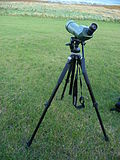
A 100mm spotting scope with a paraxial 30mm finderscope
A compact spotting scope with 8-24x magnification, (corresponds to 400-1200 mm on a camera lens). The front lens is 40 mm in diameter and when fully extended, it has a length of 18 cm.

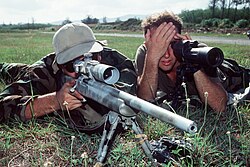
A spotting scope is a compact lightweight portable telescope optimized for detailed observation of distant objects.[1] They are used as tripod mounted optical enhancement devices for various outdoor activities such as birdwatching, skygazing and other naturalist activities, for hunting and target shooting to verify a marksman's shot placements, for tactical ranging and surveillance, and for any other application that requires higher magnification than ordinary binoculars (typically 20× to 60×).

The light-gathering power and resolution of a spotting scope is determined by the diameter of the objective lens, typically between 50 and 80 mm (2.0 and 3.1 in). The larger the objective, the more massive and expensive the telescope.

The optical assembly has a small refracting objective lens, an internal image-erecting system, and an eyepiece that is usually removable. The image-erecting system may use relay lenses, prisms such as Porro or roof prisms, or a catadioptric system of the Schmidt or Maksutov design. Spotting scopes may have a ruggedized design, a mounting interface for attaching to a tripod, and an ergonomically designed and located control knob for focus adjustment. Some spotting scopes also have in-built reticles for stadiametric rangefinding.

Spotting scope eyepieces are usually interchangeable to adapt for different magnifications, or may have variable zoom to give a range of magnifications. Magnifications less than 20× are unusual, as are magnifications more than 60× since the latter can lead to poorer image brightness, a narrow field of view and too much image shaking, even on a tripod. The eyepiece mount layout can be "straight-through" (the eyepiece is on the same axis as the scope body), or "angled" (the eyepiece is at an angle to the scope body—usually 45 degrees).

The high magnification of spotting scopes makes them prone to image disturbance from vibrations, so they are often stabilized with tripods or (less commonly) monopods, which provide a stationary and steady platform. Tripod heads can be used to control any required movements of the scope.

[edit]

See also

[edit]

References

[edit]
[edit]
Revisions and contributorsEdit on WikipediaRead on Wikipedia
from Grokipedia
A spotting scope is a compact, portable resembling a small , optimized for daytime observation of distant terrestrial objects by providing upright, magnified images with greater detail than but less power than astronomical telescopes. It typically features a design with an objective lens diameter ranging from 50 to 100 millimeters, allowing for effective light gathering in various conditions, and variable commonly between 15x and 60x to balance detail and . Unlike inverted-image astronomical telescopes, spotting scopes incorporate prisms—such as Porro or roof prisms—to erect the image for intuitive viewing, and they are often built to be rugged, waterproof, and tripod-mountable for stability during extended use. Spotting scopes vary in configuration, with straight eyepieces suited for quick in activities like or , and angled eyepieces preferred for comfortable, prolonged observation in or viewing by aligning better with the user's natural posture. High-quality models employ advanced glass like extra-low dispersion (ED) elements to minimize , fully multi-coated lenses for enhanced light transmission and contrast, and eye relief of at least 14 millimeters to accommodate eyeglass wearers. In contrast, cheaper spotting scopes exaggerate dimming when zooming due to poorer glass quality, fewer or less effective multi-coatings, and greater internal light loss from scatter and reflections, while higher-quality models with fully multi-coated lenses and ED glass (which reduces chromatic aberration while improving brightness/clarity) maintain better light transmission and less severe brightness loss overall. Objective lens size directly influences performance: smaller 50-65 mm lenses offer portability for , while larger 80-85 mm versions provide brighter, sharper images at extreme distances, though at the cost of added weight. These instruments are widely employed in outdoor pursuits such as birding, where their close-focus capabilities (often under 20 feet) enable detailed study of nearby subjects, and in for spotting across vast landscapes, even in . Additional applications include via digiscoping adapters that attach cameras to the , , and competitive shooting for precise target evaluation, making spotting scopes a versatile tool for enthusiasts seeking enhanced without the bulk of full-sized telescopes.

Definition and Overview

Purpose and Characteristics

A spotting scope is a compact, portable optimized for detailed terrestrial observation of distant objects, distinguishing it from astronomical telescopes by its focus on upright, non-inverted images suitable for everyday field use. It typically provides variable magnification ranging from 20x to 60x, allowing users to zoom in on subjects like or landscapes without the bulk of larger optics. Key characteristics include a construction, often under 2 kg for models with 80 mm objectives, enabling easy transport during outdoor activities. The design emphasizes ruggedness for field conditions, featuring objective lens diameters of 50-85 mm to gather sufficient light for clear views in varying conditions, and a requirement for mounting to stabilize against hand-held vibrations at higher magnifications. Portability is further enhanced by shorter tube lengths of 20-50 cm in collapsed form, compared to full-sized telescopes, along with water-resistant or fully waterproof housings in contemporary designs to withstand environmental exposure. The term "spotting scope" originates from its early military applications in scouting and target identification, where it facilitated precise observation of remote positions. This naming reflects its practical role in "spotting" details over distances, evolving from wartime tools to versatile instruments for civilian pursuits.

Basic Optical Principles

Spotting scopes operate on the principle of refraction, utilizing a convex objective lens to collect and converge parallel light rays emanating from distant objects. This lens, positioned at the front of the instrument, bends the incoming light through refraction, forming a real, inverted image at its focal plane within the optical tube. The diameter of the objective lens, typically ranging from 50 to 85 mm, determines the scope's light-gathering capacity, with larger apertures enabling brighter images particularly in low-light conditions. To correct the inverted image produced by the objective lens and render it upright for terrestrial observation, spotting scopes incorporate image-erecting mechanisms, primarily prisms such as Porro or roof types, though some designs employ relay lenses. Porro prisms, consisting of two right-angled prisms arranged in a Z-shaped configuration, achieve on all surfaces without light loss, providing high optical efficiency and a wider but resulting in a bulkier instrument. In contrast, roof prisms feature a roof-like edge that allows for a straight, compact light path, making them suitable for portable angled spotting scopes; however, they require or phase-correction coatings to minimize light scatter and prevent double imaging. These prism systems not only erect the image but also fold the , shortening the physical length of the scope while maintaining the effective . The angular (FOV) in spotting scopes is inversely related to , narrowing as higher powers are applied to prioritize detail over breadth. At moderate magnifications like 20x, the FOV typically spans 1 to 3 degrees, allowing observation of an area approximately 52 to 157 feet wide at 1,000 yards, which facilitates before zooming in. This trade-off ensures usability for scanning landscapes while enabling precise examination of distant subjects. Light transmission efficiency is crucial for maintaining and contrast, influenced by factors such as the number of optical surfaces and their coatings. Multi-layer anti-reflective coatings, applied to all air-to-glass interfaces, suppress unwanted reflections and , achieving overall transmission rates of 80-95% in fully multi-coated systems; premium designs can exceed 90% by using broadband coatings that minimize losses across the . These coatings, often magnesium fluoride-based, interfere destructively with reflected light waves, directing more photons to the observer's eye and enhancing performance in varied lighting.

History

Early Development

The spotting scope originated in the mid-19th century as a compact iteration of the , tailored for portable use in military scouting by European opticians seeking to enhance field capabilities. These early devices addressed the need for lightweight that could be easily carried by spotters and surveyors, building on the basic refracting designs established since the early but miniaturized for practical deployment. European manufacturers like Dollond and Ross in Britain produced portable terrestrial telescopes in the early , which evolved into dedicated spotting scopes for land-based observation. A significant optical innovation was the invention of erecting prisms by Ignazio Porro in 1854, which corrected the inverted image of refractors and allowed for more compact designs suitable for terrestrial use. However, these prisms were not yet incorporated into American military optics during the Civil War (1861-1865), where simple draw-tube refracting telescopes were employed by the U.S. for spotting enemy positions and coordinating signals over distances of 8 to 15 miles. By the 1890s, commercial production advanced with firms like introducing refined models featuring 15x to 30x magnification, optimized for and land surveying with improved achromatic lenses to minimize . Zeiss, established in , leveraged its expertise in precision optics to produce these early spotting scopes, which marked a shift toward standardized, high-quality instruments for civilian and professional use beyond purely military contexts. The transition to dedicated spotting scopes accelerated during (1914-1918), evolving from naval into specialized tools for observation, where they allowed soldiers to monitor enemy lines without exposing themselves to fire. British military examples, such as all-brass spotting telescopes produced by , were commonly used by officers for this purpose, representing a refinement in portability and erect-image over earlier binocular adaptations.

Modern Advancements

Following , spotting scopes underwent significant technological improvements, beginning in the with advancements in optical design and the introduction of models by companies like Kowa, whose TS-1 and TS-2 scopes (1952) catered to growing interest in and . Variable zoom eyepieces, providing magnification ranges like 20-60x, emerged in the and , offering greater flexibility for observation without needing multiple fixed eyepieces. In the 1980s and , optical performance advanced further through the adoption of crystal and extra-low dispersion (ED) glass lenses, which dramatically reduced and delivered apochromatic-level clarity with enhanced color fidelity and contrast. Kowa introduced pure elements in its TSN-3 and TSN-4 spotting scopes in 1986, marking a milestone in aberration correction for field use. Similarly, Nikon's ED glass, developed in as a durable alternative to , became standard in spotting scopes by the 1980s and , enabling sharper edge-to-edge images in premium models from brands like Vortex and . Concurrently, evolved to rigorous standards, with many scopes achieving —protection against immersion in water up to 1 meter for 30 minutes—through purging and seals, a feature that gained prominence in the to ensure reliability in adverse weather. The digital era from the 2010s to 2025 integrated electronics for enhanced functionality, including universal adapters for digiscoping, which align mobile cameras with the for high-resolution and video capture directly through the scope. These adapters, popularized by products like PhoneSkope models around 2010, transformed spotting scopes into hybrid imaging tools for wildlife documentation. Built-in rangefinders, offering accuracy up to 1,500 or more on reflective targets, appeared in tactical models such as the Newcon Optik Spotter LRF Pro, combining with precise distance measurement for applications in and . Stabilization technologies also emerged, with gyroscopic systems in scopes like the OSCAR6 HDX Pro (introduced in 2025) counteracting hand tremors to deliver steady views at magnifications up to 32x without a . As of 2025, has influenced design, with manufacturers incorporating eco-friendly materials such as recycled plastics in housings and packaging to reduce environmental impact, as seen in initiatives by brands like that emphasize waste diversion and resource efficiency. These trends align with broader industry efforts to minimize production footprints while preserving optical performance.

Optical Design

Components

The objective lens assembly forms the front end of a spotting scope, consisting of a multi-element lens group typically comprising 3 to 5 glass elements designed to gather and focus incoming light. These elements, often including extra-low dispersion (ED) or fluoride glass, are arranged in an achromatic or apochromatic configuration to minimize . Objective lens diameters commonly range from 50 mm to 100 mm, with larger apertures providing enhanced light collection for low-light conditions. Many modern assemblies feature hydrophobic coatings on external surfaces, such as Leica's AquaDura, which repel water and reduce dirt adhesion for clearer viewing in adverse weather. Following the objective lens, the light path includes a prism assembly that erects the inverted image for upright terrestrial viewing, distinguishing spotting scopes from astronomical telescopes. Spotting scopes typically use either Porro prisms, which provide a wider and better light transmission but result in a bulkier design, or roof prisms, which enable more compact and straight configurations at the cost of slightly reduced optical performance. These prisms fold the optical path to shorten the overall length of the instrument while maintaining high . The body and housing encase the internal and , typically constructed from lightweight aluminum tubes or molded composite materials for and portability. These structures are often overmolded with rubber armoring to enhance grip, absorb shocks from impacts, and provide resistance. A prominent feature is the focus wheel, usually located along the main tube, which allows precise adjustment by moving internal lens groups along the to achieve sharp focus from near to distant subjects. The eyepiece mount connects the viewing lens system to the body, employing either a threaded interface or a bayonet-style locking mechanism for secure attachment of interchangeable eyepieces. This facilitates customization of magnification levels and compatibility with accessories. An integrated diopter adjustment ring on the eyepiece or mount enables users to compensate for individual eyesight variations, ensuring the reticle or image appears sharp without . Additional hardware enhances usability and protection, including a built-in sunshade that extends from the objective end to block and reduce glare during bright conditions. A rotatable tripod collar, featuring standard threads such as 1/4-20 UNC or 3/8-16, is integrated into the body for stable mounting on or other supports. Some models incorporate optional patterns, etched directly into the glass of the or an internal focal plane, for applications requiring measurement or ranging.

Magnification and Resolution

Magnification in spotting scopes refers to the factor by which an observed object appears enlarged compared to the , determined by the ratio of the objective lens to the eyepiece . The for magnification mm is given by m=fofem = \frac{f_o}{f_e}, where fof_o is the of the objective lens and fef_e is the of the eyepiece. Spotting scopes typically offer fixed magnification levels, such as 20x or 30x, or variable zoom ranges from 15-45x to 20-60x, allowing users to adjust for different viewing distances and conditions while balancing detail and . The resolving power of a spotting scope, or its ability to distinguish fine details, is fundamentally limited by according to the Rayleigh criterion, which defines the minimum θ\theta as approximately θ1.22λD\theta \approx 1.22 \frac{\lambda}{D}, where λ\lambda is the of (typically around 550 nm for visible ) and DD is the diameter of the objective aperture. For a common 60 mm spotting scope, this yields a theoretical resolution of about 2.32 arcseconds using the Rayleigh limit or 1.93 arcseconds via the Dawes limit, enabling the separation of point sources like distant stars or fine terrestrial features under ideal conditions. However, practical resolution is often capped by atmospheric seeing, which introduces and blurs images to 2-3 arcseconds in typical conditions, thereby limiting useful to approximately 30-60x for most spotting scopes, depending on aperture size and environmental factors. Higher magnification in spotting scopes comes with trade-offs in image brightness and usability, primarily through the reduction in size, calculated as the objective diameter divided by the (exit pupil=Dm\text{exit pupil} = \frac{D}{m}). For instance, a 60 mm objective at 20x produces a 3 mm , which narrows further at higher powers, diminishing light transmission to the eye and degrading performance in low-light scenarios like dawn or observations. This brightness loss is more pronounced in cheaper spotting scopes due to poorer glass quality, fewer or incomplete anti-reflective coatings, and increased internal light loss from scatter and reflections, often resulting in transmission rates below 80%. In contrast, higher-quality models with fully multi-coated lenses and extra-low dispersion (ED) glass achieve superior light transmission (up to 90-99% per surface), reducing the severity of dimming during zooming and improving clarity by minimizing chromatic aberration. The must align with the human eye's pupil for optimal light gathering, ideally matching 3-5 mm in moderate to low light to maximize brightness without wasting illumination, as the eye's dilation typically reaches 5-7 mm in darkness but constricts to 2-4 mm in daylight. Additionally, eye relief—the distance from the to the eye at which the full is visible—should be 15-20 mm for comfortable use by eyeglass wearers, preventing and fatigue during prolonged sessions.

Configurations and Types

Eyepiece Orientation

Spotting scopes are available in two primary eyepiece orientations: straight-through and angled designs, each tailored to enhance user ergonomics based on viewing position and activity. The straight-through configuration aligns the eyepiece directly with the objective lens axis, creating a linear optical path that promotes a natural eye-line alignment for users in prone or low-position setups. This design is particularly favored in hunting and tactical applications, where quick target acquisition and seamless transitions from binoculars are essential, as it allows observers to maintain a consistent field of view without significant head adjustments. For instance, when glassing downhill or seated in a vehicle, the straight orientation provides intuitive usability, especially for beginners or those prioritizing speed over prolonged sessions. In contrast, the angled eyepiece design offsets the at 45° or 90° from the objective axis, incorporating additional prisms to redirect the light path for more comfortable viewing from standing or seated positions. This configuration is widely preferred for and nature observation, as it reduces neck strain during extended viewing periods and facilitates easier access to elevated targets, such as birds in treetops. By enabling a lower height for stability, angled scopes also support shared use among observers of varying heights without repositioning the equipment. The offset design enhances overall comfort in dynamic environments, like forested areas or when scanning horizons from a seated posture. While both orientations offer distinct advantages, trade-offs arise in field of view, accessibility, and portability. Straight-through scopes excel at low-angle observations with potentially broader apparent fields due to the direct path, but they can be challenging for targeting high-elevation subjects, requiring users to bend or elevate awkwardly. Angled models, however, introduce extra prisms that may slightly increase overall length or weight compared to equivalent straight versions, though many modern designs minimize this difference to maintain packability. For example, high-end models like the series exhibit negligible weight variations between configurations, with the primary distinction being ergonomic adaptability rather than bulk.

Specialized Variants

Catadioptric spotting scopes, particularly those employing the Maksutov-Cassegrain design, utilize a folded to achieve ultra-compact dimensions, often measuring less than 30 cm in length, making them ideal for marine environments and travel applications. These variants combine mirrors and lenses to reduce overall size while maintaining high-quality images suitable for both terrestrial and astronomical observation, with introducing models like the C70 Mini Mak in the early 2000s that weigh around 1 kg and offer 25-75x magnification. Their sealed, waterproof construction enhances durability in harsh conditions such as or . Digital and electronic spotting scopes integrate sensors with built-in LCD displays, enabling digital zoom capabilities ranging from 30x to 100x and (IR) modes for in select models, which have gained popularity since 2015 for and low-light monitoring. These devices capture video and photos directly, often with resolutions up to , and feature adjustable IR illuminators for detection ranges exceeding 200 meters in darkness. By 2025, many digital models include app connectivity for real-time sharing and basic AI for . The technology provides real-time digital enhancement, reducing the need for traditional eyepieces and allowing connectivity to smartphones or computers for shared viewing. High-end apochromatic spotting scopes incorporate extra-low dispersion (ED) glass elements to minimize . Models such as the ATS series employ HD lenses for superior color fidelity and contrast, with the ATS 65 offering 20-60x in a lightweight body weighing approximately 1.4 kg. This design excels in resolving fine details like planetary features or distant , with field tests confirming minimal color fringing even at high magnifications. Portable ultra-light spotting scopes, typically featuring 50mm objective lenses and weighing under 500g, cater to backpacking enthusiasts seeking minimal bulk without sacrificing performance. The Kowa TSN-500 series exemplifies this category, with the TSN-501 model at just 400g and 20-40x , constructed from lightweight and optimized for close-focus viewing in rugged terrain. These scopes prioritize quick setup and portability, often including protective cases for multi-day expeditions.

Applications

Nature and Wildlife

Spotting scopes are widely used in to identify at distances of 100 to 500 meters, where magnifications of 20 to 60x provide sufficient detail for distinguishing , shapes, and behaviors without approaching the birds. Angled designs are particularly favored for group , as they allow multiple observers of varying heights to share the view comfortably by minimizing the need for adjustments and enabling ergonomic positioning during extended sessions. In , spotting scopes facilitate the tracking of mammals such as deer or and insects like in natural reserves, where a wide exceeding 2 degrees (approximately 35 meters at 1,000 meters) helps locate and follow moving subjects across expansive habitats. Weatherproofing features, including waterproof sealing and fogproof purging, ensure reliable performance during all-day field use in , , or fluctuations. Digiscoping, the practice of attaching cameras to spotting scopes for , emerged in the late with early adapters linking digital cameras to eyepieces, enabling non-intrusive imaging of distant subjects. Modern adapters secure smartphones or DSLRs to scopes, allowing capture of images and videos at up to 60x while keeping observers at a safe distance to avoid disturbing like nesting birds or animals. In eco-tourism, spotting scopes equipped with adapters enable integration with apps like eBird, where users log species observations and upload digiscoped photos to contribute to global conservation data. This connectivity supports real-time species identification and mapping, enhancing educational experiences in hotspots worldwide.

Military and Tactical

In contexts, spotting scopes have been integral to observation since , with the employing models like the M33 for target spotting and fire direction in combat operations. These early instruments provided essential long-range visibility for adjusting barrages, marking the foundational role of spotting optics in coordinated ground engagements. Contemporary and rely on high- spotting scopes equipped with mil-dot to enable precise and ranging, particularly in dynamic environments such as . The U.S. Army's M151 Spotting Scope, offering 12-40x and a MIL-Grid , facilitates long-distance target recognition and identification for teams, supporting and tasks with its weatherproof, fogproof construction. Similarly, devices like the Bushnell Legend Tactical T-Series provide 15-45x zoom with a first-focal-plane mil-hash , optimizing tactical collaboration and range estimation in field operations. Spotting scopes also bolster sniping by integrating s for accurate distance measurement up to several kilometers, enhancing precision in post-2000 conflicts like those in and . The Newcon Optik Spotter LRF PRO exemplifies this, combining 15-60x magnification with a built-in eye-safe capable of measurements to 3,000 meters, allowing snipers to acquire and engage targets rapidly while sharing real-time data with team systems. Its MIL-STD-810G ruggedness ensures reliability in harsh conditions, streamlining the spotter-shooter workflow. For low-light and nocturnal operations, thermal variants equipped with FLIR technology detect heat signatures at ranges exceeding 1 kilometer. The FLIR Scout Pro III monocular, used as a compact spotting device, identifies human-sized targets up to 1,500 meters in complete darkness or adverse weather, providing dismounted soldiers with critical for and pursuit. These systems leverage uncooled sensors for passive detection, minimizing exposure during night patrols or ambushes.

Accessories

Mounting Systems

Spotting scopes require stable mounting systems to counteract the magnification-induced shake that can render high-power views unusable, particularly at magnifications exceeding 40x. Tripods, the most common support, typically feature three adjustable legs made from aluminum or carbon fiber, providing heights between 1 and 1.5 meters and load capacities of 5 to 10 kg to accommodate scopes weighing up to several kilograms. Carbon fiber models, such as the Vortex Ridgeview Carbon (weighing 1.45 kg), offer superior compared to aluminum due to their and rigidity, while aluminum options like the Manfrotto Befree Advanced Twist provide affordability at similar specs. Many incorporate ball heads for quick repositioning or fluid pan-tilt mechanisms, enabling smooth 360° panning and precise tracking of moving subjects like . For scenarios demanding portability or rapid deployment, such as vehicle-based observation or uneven terrain, window mounts serve as lighter alternatives, often weighing under 300 g, while monopods are typically 500-800 g. Monopods, like compact carbon fiber variants, extend to about 1.5 m with load capacities of 8-10 kg or more, sacrificing some stability for a weight reduction of 40-60% compared to tripods, making them suitable for brief setups in dynamic environments. Window mounts clamp directly to frames or rails via adjustable jaws, typically supporting 2-5 kg and featuring pan-tilt heads for 360° rotation without leaving the vehicle; examples include the Hawke Window Mount, which uses protective rubber pads to prevent slippage and damage during quick attachments. These systems excel in reducing setup time to seconds, ideal for hunters or birders scanning from roadsides. Gimbal and alt-azimuth heads enhance specialized uses, particularly for smooth motion or astronomical applications. heads, mounted on tripods or monopods, balance heavy scopes for fluid 360° rotation and locking clamps, minimizing user fatigue during extended panning—useful for tracking fast-moving targets or digiscoping. Alt-azimuth heads, common in cross-use with telescopes, allow independent altitude and adjustments via slow-motion controls, supporting 360° rotation and elevations up to 90°, as seen in Celestron's heavy-duty models for stable terrestrial or celestial viewing. Vibration reduction is critical in windy or high-magnification scenarios, where even minor tremors blur images at 60x. Carbon fiber tripods inherently dampen oscillations better than metal due to their composite , while designs incorporating spiked stakes on leg feet secure the mount into soft ground for added steadiness in gusty conditions. Open-windowed or minimalist configurations, such as those in the 3 Legged Thing Winston 2.0, minimize wind resistance and weight, further improving image clarity by reducing buffeting effects. Anti-vibration pads or clamps, like the Celticbird suppression sets, can be added to further isolate the scope from environmental shakes.

Eyepieces and Adapters

Eyepieces for spotting scopes are typically interchangeable optical components that determine the and viewing comfort, available in fixed or zoom configurations to suit various observational needs. Fixed eyepieces, such as the Vortex Razor HD model offering 22x , provide consistent resolution and are often preferred for precise applications like target identification due to their lack of mechanical complexity compared to zooms. Zoom eyepieces, like the 25-60x, allow variable in a single unit, enabling users to adjust from wide-area scanning to detailed close-ups without swapping parts. Many modern eyepieces incorporate twist-up eyecups for comfortable viewing with or without eyeglasses, along with eye relief ranging from 18-31 mm to accommodate different users. Apparent fields of view in these eyepieces generally span 50-80°, balancing immersion with edge-to-edge clarity. Prices for eyepieces vary widely, from budget options around $50 for basic zooms to high-end models exceeding $500 for premium optics with advanced coatings. Digiscoping adapters enhance spotting scopes by enabling and through attachment of cameras or , transforming the scope into a telephoto system. T-mount adapters, such as those from Hawke Optics, secure DSLR cameras directly to the via a standardized T2 thread, allowing full-frame sensors to capture images at the scope's maximum zoom without errors. Universal clamps, like the Phone Skope system, accommodate with adjustable fittings for widths of 2.3-3.3 inches, facilitating quick setup for on-the-go shooting. These adapters support high-resolution imaging, with smartphone setups routinely producing 10-megapixel photos even at full zoom on compatible scopes, though image quality depends on the scope's and conditions. Reticle inserts in spotting scope eyepieces provide etched grids for precise ranging and measurement, commonly in mil (milliradian) or (minute of angle) scales to aid tactical or competitive uses. The Nightforce MIL-XT , optimized for spotting scopes, features hashmarks at standard mil increments for quick distance estimation and holdover calculations. Similarly, the Vortex Razor HD eyepiece offers a fixed 22x ranging with secondary references for and adjustments, compatible with tactical spotting scopes like the Razor HD 27-60x85mm. These are integrated into dedicated fixed-magnification eyepieces, enhancing accuracy in low-contrast environments without obstructing the primary view. While illumination is rare in spotting scope due to daytime applications, non-illuminated designs like the Burris SCR- ensure visibility across varying light levels. Teleconverter or extender tubes boost the effective of spotting scopes for extended reach in and , though they reduce the field of view proportionally. The Swarovski ME 1.7x magnification extender, for instance, attaches via to ATX/STX modular systems, increasing zoom ranges such as 30-70x to 51-120x while maintaining optical clarity. Rated at 1.5-2x factors in similar products, these boosters narrow the field—e.g., from 104-57 ft/1000 yds to tighter views—to prioritize detail over breadth, making them valuable for digiscoping distant subjects like .

Maintenance and Care

Cleaning

Proper cleaning of a spotting scope is essential to maintain optical clarity and prevent damage to delicate components such as lenses and seals. Begin with the lenses, which are the most sensitive parts. To clean and lenses, first use a blower or to gently remove loose and without touching the surface. For remaining smudges or fingerprints, employ a lens pen with a soft and retractable tip, or a cloth lightly dampened with an optics-grade cleaning solution; always wipe in a gentle circular or spiral motion from the center outward to avoid scratching. Avoid household wipes, tissues, or abrasive materials, as they can strip protective coatings or cause micro-abrasions. For exterior care, focus on the rubber armor and body to preserve waterproofing and grip. Wipe the exterior with a soft, damp cloth using mild and to remove dirt or residue, then dry thoroughly with a cloth. Steer clear of abrasives, solvents, or harsh chemicals, which can degrade the rubber or anodized finishes. To maintain fog-proofing, avoid exposing the scope to extreme temperature swings during cleaning or use, as rapid changes can compromise internal purging. Preventing internal fog in waterproof models involves proactive measures. Place silica gel packets in the storage case to absorb excess moisture and inhibit condensation buildup. For models with seals, inspect them annually for cracks, wear, or debris by visually checking the joints and gently cleaning with a soft cloth if needed; replace if damaged to ensure ongoing water resistance. Cleaning frequency depends on usage intensity. In field conditions, such as frequent outdoor exposure, clean the exterior weekly to prevent grime accumulation, while should be addressed monthly or as needed when visibility is impaired. For high-end spotting scopes, schedule professional servicing every 1-2 years to inspect internal components, realign , and perform deep cleaning beyond user capabilities.

Storage

Proper storage of spotting scopes is essential for preserving optical clarity, mechanical integrity, and overall functionality over extended periods of non-use. Hard-shell padded cases, typically constructed from impact-resistant materials like reinforced or aluminum, provide robust protection during transport and long-term storage by shielding the device from physical shocks and environmental contaminants. Soft sleeves, often featuring thick padding and stay-on designs, are ideal for daily carry and quick access, offering lightweight cushioning against minor bumps while allowing the scope to remain partially assembled. To mitigate humidity-related issues such as fungal growth or internal corrosion, many users incorporate desiccants like packets within airtight cases, particularly in high-moisture environments. Environmental controls play a critical role in preventing degradation. Spotting scopes should be stored at temperatures between 13°C and 22°C to avoid that could stress seals or coatings, with maintained below 60%—ideally around 40%—using dehumidifiers or sealed containers if necessary. Direct must be avoided to prevent damage to lens coatings from UV rays and heat. Store the scope in a position within its protective case to minimize stress on the focusing mechanism and tube assembly. Seasonal preparations enhance longevity, especially for electronic variants. In winter storage, remove batteries from illuminated or digital spotting scopes to prevent leakage and corrosion of internal contacts during cold-induced discharge. Conduct annual inspections to check for loose screws on mounts, eyepieces, and body components, tightening them as needed to maintain alignment and structural stability. Adhering to these practices can extend the usable lifespan of a spotting scope to 10-20 years or more, depending on build quality and initial care. As of , trends in storage solutions emphasize modular cases that integrate compartments for accessories like eyepieces and tripods, facilitating organized protection without disassembly.

Comparison to Other Optics

Versus Binoculars

Spotting scopes and serve overlapping yet distinct roles in observation , with key trade-offs in , stability, , weight, cost, and application suitability. Spotting scopes typically provide higher ranges of 20-60x, enabling detailed views of distant subjects, while are generally limited to 8-12x for practical handheld use. This higher power in spotting scopes demands a stable mount, such as a , to counteract image shake and , whereas can be used handheld without additional support, offering greater flexibility in dynamic settings. In terms of (FOV), excel with wider angles, often 5-8 degrees, facilitating rapid scanning and target acquisition across broad areas, which is ideal for initial surveys in or . Spotting scopes, by contrast, deliver narrower FOVs of 1-3 degrees at higher magnifications, prioritizing in-depth study of specific targets over expansive coverage. This design makes spotting scopes less suited for quick panning but superior for prolonged examination, such as identifying fine details in or configurations from afar. Weight and portability further highlight the divergence: spotting scopes weigh 1-2 kg and are bulkier due to their objective lenses and zoom mechanisms, often requiring a carrying case and setup time that limits mobility. Binoculars, at 0.5-1 kg, are more compact and easier to transport, suiting extended hikes or active pursuits without encumbrance. Cost reflects these differences, with quality ranging from $100 to $1,000 and spotting scopes from $200 to $2,000, influenced by optical coatings, build materials, and included accessories like eyepieces. Overall, spotting scopes support extended, single-target viewing in stationary scenarios, while favor versatile, on-the-move observation. For use cases, binoculars are preferred in mobile activities like , in varied terrain, or scanning crowds at events, where their wide FOV and handholdability enable swift adjustments to changing scenes. Spotting scopes shine in stationary setups, such as overlooking open fields for or sports events, where high reveals nuances invisible to the or lower-power . Many observers carry both to leverage binoculars for broad searches and scopes for confirmatory details.

Versus Telescopes

Spotting scopes and telescopes both utilize refractive to magnify distant objects, but they differ fundamentally in design and purpose, with spotting scopes optimized for terrestrial observation and telescopes primarily for celestial viewing. Spotting scopes incorporate prisms to produce an upright, non-inverted image suitable for activities like or , whereas telescopes typically yield an inverted image that requires an additional erecting prism for terrestrial use, making them less intuitive for ground-based applications. This design distinction stems from the spotting scope's emphasis on user-friendly viewing of upright subjects in natural environments, while telescopes prioritize light-gathering for faint astronomical objects. In terms of optical performance, spotting scopes generally offer magnification ranges of 20x to 60x, often with variable zoom capabilities, providing a balance between detail and usability for mid-range distances. Telescopes, by contrast, support higher magnifications exceeding 100x—commonly up to 500x with interchangeable eyepieces—enabling finer resolution of , , and deep-sky objects, though this comes at the expense of a narrower . Spotting scopes maintain a wider , typically around 2-3 degrees at moderate powers, which facilitates tracking moving subjects like , whereas telescopes' fields are often under 1 degree at high powers, better suited for static celestial targets. Aperture sizes in spotting scopes rarely exceed 85mm, limiting their light-gathering for low-light astronomy, while telescopes frequently feature larger apertures, such as 100mm or more, to capture more photons from distant . Portability and durability further highlight their divergent applications: spotting scopes are compact, lightweight (often under 2 kg), and built with rubber armoring, , and fog-proofing to withstand field conditions like or rough handling during outdoor pursuits. Telescopes, especially refractor or reflector models, tend to be bulkier and heavier, with optical tubes that may require tripods or mounts for stability, rendering them less practical for mobile terrestrial use but ideal for stationary setups in astronomy. For instance, a typical spotting scope like the Vortex Razor HD measures around 13-16 inches in length when collapsed, compared to a beginner like the Orion StarBlast, which has a 114 mm but demands more setup space. While spotting scopes can serve as entry-level astronomical tools for viewing the or bright , their limited and options make them suboptimal for deep-sky observation compared to , which excel in resolving faint nebulae or galaxies through superior light collection. Conversely, using a for everyday terrestrial tasks requires additional accessories like erecting diagonals, increasing complexity and cost, whereas spotting scopes' straight or angled configurations promote ergonomic, shared viewing without such modifications. Ultimately, the choice depends on the observer's focus—terrestrial versatility favors spotting scopes, while astronomical depth prioritizes .

References

Add your contribution
Related Hubs
User Avatar
No comments yet.