

Square of opposition
View on Wikipedia | This article needs additional citations for verification. (February 2015) |


In term logic (a branch of philosophical logic), the square of opposition is a diagram representing the relations between the four basic categorical propositions. The origin of the square can be traced back to Aristotle's tractate On Interpretation and its distinction between two oppositions: contradiction and contrariety. However, Aristotle did not draw any diagram; this was done several centuries later.
Summary
[edit]In traditional logic, a proposition (Latin: propositio) is a spoken assertion (oratio enunciativa), not the meaning of an assertion, as in modern philosophy of language and logic. A categorical proposition is a simple proposition containing two terms, subject (S) and predicate (P), in which the predicate is either asserted or denied of the subject.
Every categorical proposition can be reduced to one of four logical forms, named A, E, I, and O based on the Latin affirmo (I affirm), for the affirmative propositions A and I, and nego (I deny), for the negative propositions E and O. These are:
- The A proposition, the universal affirmative (universalis affirmativa), whose form in Latin is 'omne S est P', usually translated as 'every S is a P'.
- The E proposition, the universal negative (universalis negativa), Latin form 'nullum S est P', usually translated as 'no S are P'.
- The I proposition, the particular affirmative (particularis affirmativa), Latin 'quoddam S est P', usually translated as 'some S are P'.
- The O proposition, the particular negative (particularis negativa), Latin 'quoddam S nōn est P', usually translated as 'some S are not P'.
In tabular form:
| Name | Symbol | Latin | English* | Mnemonic | Modern form[1] |
|---|---|---|---|---|---|
| Universal affirmative | A | Omne S est P. | Every S is P. (S is always P.) |
affirmo (I affirm) |
|
| Universal negative | E | Nullum S est P. | No S is P. (S is never P.) |
nego (I deny) |
|
| Particular affirmative | I | Quoddam S est P. | Some S is P. (S is sometimes P.) |
affirmo (I affirm) |
|
| Particular negative | O | Quoddam S nōn est P. | Some S is not P. (S is not always P.) |
nego (I deny) |
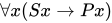

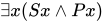

*Proposition A may be stated as "All S is P." However, Proposition E when stated correspondingly as "All S is not P." is ambiguous[2] because it can be either an E or O proposition, thus requiring a context to determine the form; the standard form "No S is P" is unambiguous, so it is preferred. Proposition O also takes the forms "Some S is not P." and "A certain S is not P." (Latin 'Quoddam S nōn est P.')
** in the modern forms means that a statement applies on an object . It may be simply interpreted as " is " in many cases. can be also written as .


Aristotle states (in chapters six and seven of the Peri Hermēneias (Περὶ Ἑρμηνείας, Latin De Interpretatione, English 'On Interpretation')), that there are certain logical relationships between these four kinds of proposition. He says that to every affirmation there corresponds exactly one negation, and that every affirmation and its negation are 'opposed' such that always one of them must be true, and the other false. A pair of an affirmative statement and its negation is, he calls, a 'contradiction' (in medieval Latin, contradictio). Examples of contradictories are 'every man is white' and 'not every man is white' (also read as 'some men are not white'), 'no man is white' and 'some man is white'.
The below relations, contrary, subcontrary, subalternation, and superalternation, do hold based on the traditional logic assumption that things stated as S (or things satisfying a statement S in modern logic) exist. If this assumption is taken out, then these relations do not hold.
'Contrary' (medieval: contrariae) statements, are such that both statements cannot be true at the same time. Examples of these are the universal affirmative 'every man is white', and the universal negative 'no man is white'. These cannot be true at the same time. However, these are not contradictories because both of them may be false. For example, it is false that every man is white, since some men are not white. Yet it is also false that no man is white, since there are some white men.
Since every statement has the contradictory opposite (its negation), and since a contradicting statement is true when its opposite is false, it follows that the opposites of contraries (which the medievals called subcontraries, subcontrariae) can both be true, but they cannot both be false. Since subcontraries are negations of universal statements, they were called 'particular' statements by the medieval logicians.
Another logical relation implied by this, though not mentioned explicitly by Aristotle, is 'alternation' (alternatio), consisting of 'subalternation' and 'superalternation'. Subalternation is a relation between the particular statement and the universal statement of the same quality (affirmative or negative) such that the particular is implied by the universal, while superalternation is a relation between them such that the falsity of the universal (equivalently the negation of the universal) is implied by the falsity of the particular (equivalently the negation of the particular).[3] (The superalternation is the contrapositive of the subalternation.) In these relations, the particular is the subaltern of the universal, which is the particular's superaltern. For example, if 'every man is white' is true, its contrary 'no man is white' is false. Therefore, the contradictory 'some man is white' is true. Similarly the universal 'no man is white' implies the particular 'not every man is white'.[4][5]
In summary:
- Universal statements are contraries: 'every man is just' and 'no man is just' cannot be true together, although one may be true and the other false, and also both may be false (if at least one man is just, and at least one man is not just).
- Particular statements are subcontraries. 'Some man is just' and 'some man is not just' cannot be false together.
- The particular statement of one quality is the subaltern of the universal statement of that same quality, which is the superaltern of the particular statement because in Aristotelian semantics 'every A is B' implies 'some A is B' and 'no A is B' implies 'some A is not B'. Note that modern formal interpretations of English sentences interpret 'every A is B' as 'for any x, a statement that x is A implies a statement that x is B', which does not imply 'some x is A'. This is a matter of semantic interpretation, however, and does not mean, as is sometimes claimed, that Aristotelian logic is 'wrong'.
- The universal affirmative (A) and the particular negative (O) are contradictories. If some A is not B, then not every A is B. Conversely, though this is not the case in modern semantics, it was thought that if every A is not B, some A is not B. This interpretation has caused difficulties (see below). While Aristotle's Greek does not represent the particular negative as 'some A is not B, but as 'not every A is B', someone in his commentary on the Peri Hermaneias, renders the particular negative as 'quoddam A nōn est B', literally 'a certain A is not a B', and in all medieval writing on logic it is customary to represent the particular proposition in this way.
These relationships became the basis of a diagram drawn by Boethius and used by medieval logicians to classify the logical relationships. The propositions are placed in the four corners of a square, and the relations represented as lines drawn between them, whence the name 'Square of Opposition'. Therefore, the following cases can be made:[6]
- If A is true, then E is false, I is true, O is false;
- If E is true, then A is false, I is false, O is true;
- If I is true, then E is false, A and O are indeterminate;
- If O is true, then A is false, E and I are indeterminate;
- If A is false, then O is true, E and I are indeterminate;
- If E is false, then I is true, A and O are indeterminate;
- If I is false, then A is false, E is true, O is true;
- If O is false, then A is true, E is false, I is true.
To memorise them, the medievals invented the following Latin rhyme:[7]
- A adfirmat, negat E, sed universaliter ambae;
I firmat, negat O, sed particulariter ambae.
It affirms that A and E are not neither both true nor both false in each of the above cases. The same applies to I and O. While the first two are universal statements, the couple I / O refers to particular ones.
The Square of Oppositions was used for the categorical inferences described by medieval logicians: conversion and obversion and contraposition. Each of those three types of categorical inference was applied to the four logical forms: A, E, I, and O.
The problem of existential import
[edit]Subcontraries (I and O), which medieval logicians represented in the form 'quoddam A est B' (some particular A is B) and 'quoddam A non est B' (some particular A is not B) cannot both be false, since their universal contradictory statements (no A is B / every A is B) cannot both be true. This leads to a difficulty firstly identified by Peter Abelard (12 February 1079 – 21 April 1142). 'Some A is B' seems to imply 'something is A', in other words, there exists something that is A. For example, 'Some man is white' seems to imply that at least one thing that exists is a man, namely the man who has to be white, if 'some man is white' is true. But, 'some man is not white' also implies that something as a man exists, namely the man who is not white, if the statement 'some man is not white' is true. But Aristotelian logic requires that, necessarily, one of these statements (more generally 'some particular A is B' and 'some particular A is not B') is true, i.e., they cannot both be false. Therefore, since both statements imply the presence of at least one thing that is a man, the presence of a man or men is followed. But, as Abelard points out in the Dialectica, surely men might not exist?[8]
- For with absolutely no man existing, neither the proposition 'every man is a man' is true nor 'some man is not a man'.[9]
Abelard also points out that subcontraries containing subject terms denoting nothing, such as 'a man who is a stone', are both false.
- If 'every stone-man is a stone' is true, also its conversion per accidens is true ('some stones are stone-men'). But no stone is a stone-man, because neither this man nor that man etc. is a stone. But also this 'a certain stone-man is not a stone' is false by necessity, since it is impossible to suppose it is true.[10]
Terence Parsons (1939 – 2022) argues that ancient philosophers did not experience the problem of existential import as only the A (universal affirmative) and I (particular affirmative) forms had existential import. (If a statement includes a term such that the statement is false if the term has no instances, i.e., no thing associated with the term exists, then the statement is said to have existential import with respect to that term.)
- Affirmatives have existential import, and negatives do not. The ancients thus did not see the incoherence of the square as formulated by Aristotle because there was no incoherence to see.[11]
He goes on to cite a medieval philosopher William of Ockham (c. 1287 – 9/10 April 1347 ),
- In affirmative propositions a term is always asserted to supposit for something. Thus, if it supposits for nothing the proposition is false. However, in negative propositions the assertion is either that the term does not supposit for something or that it supposits for something of which the predicate is truly denied. Thus a negative proposition has two causes of truth.[12]
And points to Boethius' commentaryof Aristotle's work as giving rise to the mistaken notion that the O form has existential import.
- But when Boethius (c. 480 – 524) comments on this text he illustrates Aristotle's doctrine with the now-famous diagram, and he uses the wording 'Some man is not just'. So this must have seemed to him to be a natural equivalent in Latin. It looks odd to us in English, but he wasn't bothered by it.[13]
Modern squares of opposition
[edit]
The conträr below is an erratum:
It should read subconträr.
In the 19th century, George Boole (November 1815 – 8 December 1864) argued for requiring existential import on both terms in particular claims (I and O), but allowing all terms of universal claims (A and E) to lack existential import. This decision made Venn diagrams particularly easy to use for term logic. The square of opposition, under this Boolean set of assumptions, is often called the modern square of opposition. In the modern square of opposition, A and O claims are contradictories, as are E and I, but all other forms of opposition cease to hold; there are no contraries, subcontraries, subalternations, and superalternations. Thus, from a modern point of view, it often makes sense to talk about 'the' opposition of a claim, rather than insisting, as older logicians did, that a claim has several different opposites, which are in different kinds of opposition with the claim.
Gottlob Frege (8 November 1848 – 26 July 1925)'s Begriffsschrift also presents a square of oppositions, organised in an almost identical manner to the classical square, showing the contradictories, subalternates and contraries between four formulae constructed from universal quantification, negation and implication.
Algirdas Julien Greimas (9 March 1917 – 27 February 1992)' semiotic square was derived from Aristotle's work.
The traditional square of opposition is now often compared with squares based on inner- and outer-negation.[14]
Logical hexagons and other bi-simplexes
[edit]The square of opposition has been extended to a logical hexagon which includes the relationships of six statements. It was discovered independently by both Augustin Sesmat (April 7, 1885 – December 12, 1957) and Robert Blanché (1898–1975).[15] It has been proven that both the square and the hexagon, followed by a "logical cube", belong to a regular series of n-dimensional objects called "logical bi-simplexes of dimension n". The pattern also goes even beyond this.[16]
Square of opposition (or logical square) and modal logic
[edit]The logical square, also called square of opposition or square of Apuleius, has its origin in the four marked sentences to be employed in syllogistic reasoning: "Every man is bad," the universal affirmative – The negation of the universal affirmative "Not every man is bad" (or "Some men are not bad") – "Some men are bad," the particular affirmative – and finally, the negation of the particular affirmative "No man is bad". Robert Blanché published with Vrin his Structures intellectuelles in 1966 and since then many scholars think that the logical square or square of opposition representing four values should be replaced by the logical hexagon which by representing six values is a more potent figure because it has the power to explain more things about logic and natural language.
Set-theoretical interpretation of categorical statements
[edit]In modern mathematical logic, statements containing words "all", "some" and "no", can be stated in terms of set theory if we assume a set-like domain of discourse. If the set of all A's is labeled as and the set of all B's as , then:


- "All A is B" (AaB) is equivalent to " is a subset of ", or .
- "No A is B" (AeB) is equivalent to "The intersection of and is empty", or .
- "Some A is B" (AiB) is equivalent to "The intersection of and is not empty", or .
- "Some A is not B" (AoB) is equivalent to " is not a subset of ", or .




By definition, the empty set is a subset of all sets. From this fact it follows that, according to this mathematical convention, if there are no A's, then the statements "All A is B" and "No A is B" are always true whereas the statements "Some A is B" and "Some A is not B" are always false. This also implies that AaB does not entail AiB, and some of the syllogisms mentioned above are not valid when there are no A's ().


See also
[edit]References
[edit]- ^ Per The Traditional Square of Opposition: 1.1 The Modern Revision of the Square in the Stanford Encyclopedia of Philosophy
- ^ Kelley, David (2014). The Art of Reasoning: An Introduction to Logic and Critical Thinking (4 ed.). New York, NY: W. W. Norton & Company, Inc. p. 150. ISBN 978-0-393-93078-8.
- ^ "Introduction to Logic - 7.2.1 Finishing the Square and Immediate Inferences". 2021-08-10.
- ^ Parry & Hacker, Aristotelian Logic (SUNY Press, 1990), p. 158.
- ^ Cohen & Nagel, Introduction to Logic Second Edition (Hackett Publishing, 1993), p. 55.
- ^ Reale, Giovanni; Antiseri, Dario (1983). Il pensiero occidentale dalle origini a oggi. Vol. 1. Brescia: Editrice La Scuola. p. 356. ISBN 88-350-7271-9. OCLC 971192154.
- ^ Massaro, Domenico (2005). Questioni di verità: logica di base per capire e farsi capire. Script (in Italian). Vol. 2. Maples: Liguori Editore Srl. p. 58. ISBN 9788820738921. LCCN 2006350806. OCLC 263451944.
- ^ In his Dialectica, and in his commentary on the De Interpretatione.
- ^ Re enim hominis prorsus non existente neque ea vera est quae ait: omnis homo est homo, nec ea quae proponit: quidam homo non est homo.
- ^ Si enim vera est: Omnis homo qui lapis est, est lapis, et eius conversa per accidens vera est: Quidam lapis est homo qui est lapis. Sed nullus lapis est homo qui est lapis, quia neque hic neque ille etc. Sed et illam: Quidam homo qui est lapis, non est lapis, falsam esse necesse est, cum impossibile ponat.
- ^ Parsons, Terence (2021), Zalta, Edward N. (ed.), "The Traditional Square of Opposition", The Stanford Encyclopedia of Philosophy (Fall 2021 ed.), Metaphysics Research Lab, Stanford University, retrieved 2025-02-27.
- ^ "The Traditional Square of Opposition > Notes (Stanford Encyclopedia of Philosophy)". plato.stanford.edu. Retrieved 2025-02-27.
- ^ Parsons, Terence (2021), Zalta, Edward N. (ed.), "The Traditional Square of Opposition", The Stanford Encyclopedia of Philosophy (Fall 2021 ed.), Metaphysics Research Lab, Stanford University, retrieved 2025-02-27.
- ^ Westerståhl, 'Classical vs. modern squares of opposition, and beyond', in Beziau and Payette (eds.), The Square of Opposition: A General Framework for Cognition, Peter Lang, Bern, 195-229.
- ^ N-Opposition Theory Logical hexagon
- ^ Moretti, Pellissier
External links
[edit]
- Parsons, Terence. "The Traditional Square of Opposition". In Zalta, Edward N. (ed.). Stanford Encyclopedia of Philosophy.
- International Congress on the Square of Opposition
- Special Issue of Logica Universalis Vol. 2 N. 1 (2008) on the Square of Opposition
- Catlogic: An open source computer script written in Ruby to construct, investigate, and compute categorical propositions and syllogisms
- Periermenias Aristotelis with links to video and digitised manuscript LJS 101 of Boethius' Latin translation of Aristotle's De Interpretatione, which contains 9th/11th century copies (some with color) of Aristotle's square of opposition on leaves 36r and 36v.
| General | |||||||||
|---|---|---|---|---|---|---|---|---|---|
| Theorems (list) and paradoxes | |||||||||
| Logics |
| ||||||||
| Set theory |
| ||||||||
| Formal systems (list), language and syntax |
| ||||||||
| Proof theory | |||||||||
| Model theory | |||||||||
| Computability theory | |||||||||
| Related | |||||||||


Square of opposition
View on GrokipediaHistorical Development
Aristotelian Origins
The square of opposition traces its origins to Aristotle's syllogistic logic, developed in his Prior Analytics around 350 BCE, where the foundational relations among categorical propositions are systematically outlined to support deductive reasoning. In Book I, Chapter 1, Aristotle defines the basic components of syllogisms, including premisses that affirm or deny predicates of subjects, categorized into universal and particular forms, affirmative and negative types.[3] This framework establishes the logical structure for valid inferences without explicitly drawing a diagrammatic square, though the oppositional relationships it describes form the basis for later visualizations.[4] Within the historical context of Aristotle's Organon, a collection of treatises on logic, the square emerges as part of the fourfold classification of propositions integral to categorical syllogisms—arguments composed of two premisses leading to a conclusion about subject-predicate relations. These propositions represent assertions about classes, such as belonging to all, none, some, or not some members, enabling the evaluation of syllogistic moods across three figures. Aristotle's approach prioritizes the principle of contradiction, ensuring that every affirmation has a corresponding negation, which underpins the oppositional dynamics observed in the square.[3][1] The initial purpose of this formulation was to visualize and test the opposition between universal and particular propositions, facilitating the determination of syllogistic validity by revealing necessary implications and incompatibilities among statement types. By analyzing conversions—such as the full convertibility of universal negatives and partial convertibility of universals affirmatives—Aristotle provided tools for constructing sound arguments in dialectical and demonstrative contexts.[4][3] Although Aristotle did not depict a literal square diagram, the placement of the four proposition types at its vertices—A (universal affirmative: "All S are P"), E (universal negative: "No S are P"), I (particular affirmative: "Some S are P"), and O (particular negative: "Some S are not P")—directly reflects his categorical scheme, as later formalized by medieval logicians. This arrangement highlights the vertical subalternation between universals and particulars, alongside horizontal contraries and subcontraries, serving as a mnemonic for the oppositional logic he pioneered.[1][4]Medieval and Post-Medieval Evolution
The square of opposition underwent significant refinement during the medieval period, beginning with the earliest known diagrammatic representation originating with Apuleius in the 2nd century CE and later incorporated by Boethius in the early 6th century CE. In his Latin commentary on Aristotle's On Interpretation, composed around 510 CE, Boethius standardized the relationships among categorical propositions through a visual quadrilateral that illustrated contraries, subcontraries, contradictories, and subalterns. This diagrammatic innovation, rooted in Boethius's translations of Aristotle's Prior Analytics and Categories, preserved and transmitted Aristotelian logic to the Latin West, ensuring the square's central role in scholastic education despite assuming non-empty terms (the U-restriction) for practical reasoning. The enduring mnemonic labels—A and I derived from the vowels of affirmo (I affirm) and E and O from nego (I deny)—became standard in later medieval logic texts.[1][5][6] By the 13th century, the square had become an integral pedagogical device in medieval scholasticism, particularly through Peter of Spain's Summulae Logicales, a widely adopted textbook on logic. Authored around 1230–1240, this tractatus employed the square to elucidate the opposition relations essential for constructing and validating syllogisms, allowing students to systematically test the compatibility of premises and conclusions in deductive arguments. Peter integrated the diagram into discussions of categorical propositions, using it to demonstrate how contradictories (e.g., universal and particular negatives) negate each other, while contraries (e.g., universal affirmative and negative) cannot both be true. This approach made the square a foundational tool for teaching syllogistic inference in university curricula, influencing generations of logicians and reinforcing its status as a visual aid for grasping the interdependencies among proposition types in term logic.[7] Renaissance developments further adapted the square for broader educational accessibility, with Petrus Ramus (1515–1572) advocating simplifications to streamline Aristotelian logic amid humanist critiques of scholastic complexity. In works like his Dialecticae institutiones (1543), Ramus retained the square's core oppositions but minimized elaborate diagrammatic flourishes, prioritizing linear, topic-based methods over intricate figures to facilitate quicker mastery of syllogisms in teaching settings. This pedagogical reform emphasized practical utility, reducing the square's role to a basic mnemonic for opposition laws while integrating it into a reformed dialectic that favored invention and disposition over traditional judgment.[4] The square's evolution bridged into early modern formalizations through Gottfried Wilhelm Leibniz (1646–1716), who drew on its relational structure in developing precursors to symbolic logic. In his 1679 manuscript De formis syllogismorum, Leibniz formalized syllogistic moods using opposition principles, deriving valid inferences from the square's contradictories and subalternations alongside the axiom dictum de omni et nullo. This work marked a transition toward algebraic representations, where propositional relations were expressed symbolically (e.g., via containment and negation), laying groundwork for his envisioned characteristica universalis—a universal language for mechanical reasoning that abstracted the square's geometric insights into computable forms.Core Concepts
Categorical Propositions
Categorical propositions form the foundational building blocks of Aristotelian logic, expressing relationships between two categories or classes of things, typically denoted as subject (S) and predicate (P). These propositions are structured using a quantifier, the subject term, a copula (linking verb), and the predicate term, allowing for assertions about inclusion or exclusion between classes. In the square of opposition, four standard forms—A, E, I, and O—capture the essential types, distinguished by their quantity and quality.[8] Quantity refers to the scope of the subject term: universal propositions (A and E) apply to every member of the subject class, while particular propositions (I and O) apply to at least one member. Quality pertains to the nature of the assertion: affirmative propositions (A and I) assert that the predicate applies to the subject, whereas negative propositions (E and O) deny that application. These distinctions enable precise logical analysis, as quantity affects distribution (whether the term refers to all or some instances), and quality determines the affirmative or negative relation between terms.[9] The A proposition, or universal affirmative, states "All S are P," asserting that every member of the subject class is included in the predicate class. For example, "All humans are mortal" claims that mortality applies to every human. The E proposition, or universal negative, states "No S are P," asserting complete exclusion, as in "No humans are immortal," denying any overlap between the classes. The I proposition, or particular affirmative, states "Some S are P," indicating partial inclusion, such as "Some humans are philosophers." Finally, the O proposition, or particular negative, states "Some S are not P," indicating partial exclusion, for instance, "Some humans are not philosophers." These forms provide the basic units for evaluating logical relations.[8][9] In Aristotelian syllogisms, as outlined in the Prior Analytics, categorical propositions function as premises to deduce conclusions through a middle term connecting the major and minor premises. For example, a valid syllogism might use an A proposition as the major premise ("All mammals are warm-blooded") and an A as the minor ("All dogs are mammals") to conclude an A proposition ("All dogs are warm-blooded"). This deductive role underscores their utility in demonstrating necessary inferences from given premises, forming the core of traditional term logic.[8]Traditional Relations
The traditional square of opposition delineates four key logical relations among the four categorical propositions: universal affirmative (A: "All S are P"), universal negative (E: "No S are P"), particular affirmative (I: "Some S are P"), and particular negative (O: "Some S are not P"). These relations—contradiction, contrariety, subcontrariety, and subalternation—govern the inferential possibilities between the propositions under classical Aristotelian assumptions.[5][10] Contradiction connects A with O, and E with I, such that the propositions cannot both be true and cannot both be false; the truth of one necessarily implies the falsity of the other. For example, "All humans are mortal" (A) contradicts "Some humans are not mortal" (O), as they always differ in truth value. This relation, rooted in Aristotle's distinction between universal and particular negations, ensures exhaustive opposition.[5][10][11] Contrariety links the two universals, A and E, where they cannot both be true but can both be false. Thus, if "All birds can fly" (A) is true, then "No birds can fly" (E) must be false, though both could be false if birds neither all fly nor none fly. Aristotle identified this as opposition between universal affirmation and universal negation.[5][10][11] Subcontrariety unites the two particulars, I and O, such that they cannot both be false but can both be true. For instance, if "Some fruits are apples" (I) is false, then "Some fruits are not apples" (O) must be true, yet both can hold in a diverse category like fruits. This relation complements contrariety by applying to non-universal statements.[5][10][11] Subalternation establishes a downward inferential chain: A implies I, and E implies O, meaning the truth of the universal entails the truth of the corresponding particular, while the falsity of the particular entails the falsity of the universal. For example, from "No metals are gases" (E), it follows that "Some metals are not gases" (O); conversely, if "Some metals are not gases" (O) is false, then "No metals are gases" (E) is false. This relation reflects the classical commitment to existential import in universals.[5][10][11] Diagrammatically, the square positions A at the top left, E at the top right, I at the bottom left, and O at the bottom right. Vertical lines represent subalternation (A to I, E to O), the top horizontal line denotes contrariety (A to E), the bottom horizontal line indicates subcontrariety (I to O), and diagonals signify contradiction (A to O, E to I). This arrangement visually encodes the inferential rules, facilitating quick deduction of truth-value dependencies.[5][10]Key Philosophical Challenges
Existential Import
Existential import refers to the classical assumption in Aristotelian logic that universal propositions, specifically the A ("Every S is P") and E ("No S is P") forms, presuppose the existence of at least one member of the subject class S.[5] This presupposition means that for such universals to be true, the subject term must denote a non-empty class, ensuring that the proposition is not vacuously true in cases where S does not exist.[12] This assumption plays a crucial role in the traditional square of opposition by enabling the subalternation relation, where a universal affirmative (A) implies its corresponding particular affirmative (I, "Some S is P"), and a universal negative (E) implies its corresponding particular negative (O, "Some S is not P").[5] However, it introduces inconsistencies when applied to empty classes, as the truth of A or E would require existence that is absent, rendering the universals false while potentially allowing contradictory particulars to hold true in modern interpretations.[13] Without existential import, subalternation fails, undermining key inferences in the square.[5] Historically, Aristotle's commitment to existential import is implicit rather than explicit, as evidenced in his discussions in the Prior Analytics and De Interpretatione, where syllogistic validity assumes non-empty terms for universals.[13] Scholars debate this commitment: some, like Jan Łukasiewicz, argue that Aristotle restricted his logic to existing subjects, excluding empty terms like "goat-stag" from full syllogistic application, while others, including Mario Mignucci and Wolfgang Kneale, contend that Aristotle allowed for empty terms but treated universals as false in such cases to preserve the square's relations.[13] Later medieval logicians, such as Paul of Venice, clarified these tensions by emphasizing that negative particulars (O) lack existential import, allowing them to be vacuously true for empty subjects.[5] A classic example illustrates the implications: the proposition "All unicorns are magical" (A form) classically carries existential import, implying that some unicorns exist; if unicorns do not exist, the statement is false, which affects its contrariety with the E form "No unicorns are magical," as both cannot be true under the assumption but leads to paradoxes in empty cases.[13] This example highlights how existential import maintains the square's logical structure in traditional contexts but invites critique when confronting non-referring terms.[5]Empty Terms and Universals
The problem of empty terms arises in the square of opposition when the subject class of a categorical proposition has no members, such as in the statement "All golden mountains are golden." In the modern interpretation, this universal affirmative (A) is vacuously true because there are no instances of golden mountains that fail to be golden, yet the corresponding particular affirmative (I), "Some golden mountains are golden," is false due to the absence of any such entities. This vacuous truth disrupts the traditional subalternation relation, where A should entail I, thereby challenging the coherence of the square's structure.[5] Universal propositions A ("All S are P") and E ("No S are P") distribute fully over their subjects, asserting something about every member of the subject class, which presupposes a non-empty class in the traditional view; when the subject is empty, this distribution leads to vacuous truth in modern logic but falsity for affirmatives in classical interpretations. For empty subjects, A becomes false under the traditional account because it fails to predicate truly of any existing things, while E remains true, preserving contrariety between A and E without requiring existence for negatives. This handling of distribution underscores how empty terms test the square's reliance on non-vacuous quantification for universals.[10] Medieval logicians addressed these issues through supposition theory, which governs how terms refer in propositions. William of Ockham (c. 1287–1347), for instance, held that affirmative universal propositions require the subject term to supposit personally for existing individuals; if the term is empty and supposits for nothing, the proposition is false, thereby attributing existential import to universals and avoiding vacuous truth. This approach, rooted in Ockham's nominalist semantics, ensured that empty terms did not undermine the square's relations by making A false in such cases, consistent with the demands of subalternation and contradiction.[14] These considerations have profound implications for the square of opposition, particularly subalternation from universals to particulars: if particulars like I require existence (as traditionally interpreted) while O does not, empty subjects render I false and O true, upholding the downward implications only when universals are true (which they are not for empty affirmatives). This preserves the square's integrity under the classical framework, though it contrasts with broader debates on existential import as a presupposition across proposition types.[5]Modern Adaptations
Boolean and Set-Theoretical Interpretations
In the 19th century, advancements in algebraic logic provided a formal reinterpretation of the square of opposition, aligning it with Boolean principles that eliminate existential import for universal propositions. This approach treats categorical propositions as operations on sets or classes without presupposing the existence of elements in the subject term, allowing for vacuous truths in cases of empty classes. George Boole's An Investigation of the Laws of Thought (1854) laid foundational work by developing an algebra of logic where terms are represented as variables that can take zero values, enabling the analysis of syllogisms without assuming non-empty subjects. Similarly, Augustus De Morgan's Formal Logic (1847) contributed by extending syllogistic reasoning to include relational properties and emphasizing the treatment of empty classes as permissible, which influenced the Boolean framework for categorical logic. Under this Boolean interpretation, the four categorical propositions are reformulated as follows:- Universal affirmative (A: "All S are P") as , equivalent to , meaning no S falls outside P.
- Universal negative (E: "No S are P") as , equivalent to , meaning the intersection of S and P is empty.
- Particular affirmative (I: "Some S are P") as , asserting at least one element in the overlap.
- Particular negative (O: "Some S are not P") as , asserting at least one element in S outside P.[5]