


Community hub
Recent from talks
Contribute something
Nothing was collected or created yet.
Research and development
View on Wikipedia | This article has multiple issues. Please help improve it or discuss these issues on the talk page. (Learn how and when to remove these messages)
|


Research and development (R&D or R+D),[1] known in some countries as experiment and design, is the set of innovative activities undertaken by corporations or governments in developing new services or products.[2][3][4] R&D constitutes the first stage of development of a potential new service or the production process.
Although R&D activities may differ across businesses, the primary goal of an R&D department is to develop new products and services.[2][4] R&D differs from the vast majority of corporate activities in that it is not intended to yield immediate profit, and generally carries greater risk and an uncertain return on investment.[2][5] R&D is crucial for acquiring larger shares of the market through new products.[4] R&D&I represents R&D with innovation.[6][7][8]
Background
[edit]New product design and development is often a crucial factor in the survival of a company. In a global industrial landscape that is changing fast, firms must continually revise their design and range of products. This is necessary as well due to the fierce competition and the evolving preferences of consumers. Without an R&D program, a firm must rely on strategic alliances, acquisitions, and networks to tap into the innovations of others.
A system driven by marketing is one that puts the customer needs first, and produces goods that are known to sell.[9] Market research is carried out, which establishes the needs of consumers and the potential niche market of a new product. If the development is technology driven, R&D is directed toward developing products to meet the unmet needs.[citation needed]
In general, research and development activities are conducted by specialised units or centres belonging to a company, or can be out-sourced to a contract research organisation, universities, or state agencies.[citation needed] In the context of commerce, "research and development" normally refers to future-oriented, longer-term activities in science or technology, using similar techniques to scientific research but directed toward desired outcomes and with broad forecasts of commercial yield.[10]
Statistics on organizations devoted to "R&D" may express the state of an industry, the degree of competition or the lure of progress.[11] Some common measures include: budgets, numbers of patents or on rates of peer-reviewed publications. Bank ratios are one of the best measures, because they are continuously maintained, public and reflect risk.
In the United States, a typical ratio of research and development for an industrial company is about 3.5% of revenues; this measure is called "R&D intensity".[12] A high technology company, such as a computer manufacturer, might spend 7% or a pharmaceutical companies such as Merck & Co. 14.1% or Novartis 15.1%. Anything over 15% is remarkable, and usually gains a reputation for being a high technology company such as engineering company Ericsson 24.9%, or biotech company Allergan, which tops the spending table with 43.4% investment.[13] Such companies are often seen as credit risks because their spending ratios are so unusual.[citation needed]
Generally such firms prosper only in markets whose customers have extreme high technology needs, like certain prescription drugs or special chemicals, scientific instruments, and safety-critical systems in medicine, aeronautics or military weapons. [citation needed]The extreme needs justify the high risk of failure and consequently high gross margins from 60% to 90% of revenues.[citation needed] That is, gross profits will be as much as 90% of the sales cost, with manufacturing costing only 10% of the product price, because so many individual projects yield no exploitable product. Most industrial companies get 40% revenues only.[citation needed]
On a technical level, high tech organizations explore ways to re-purpose and repackage advanced technologies as a way of amortizing the high overhead.[citation needed] They often reuse advanced manufacturing processes, expensive safety certifications, specialized embedded software, computer-aided design software, electronic designs and mechanical subsystems.[citation needed]
Research from 2000 has shown that firms with a persistent R&D strategy outperform those with an irregular or no R&D investment program.[14]
Business R&D
[edit].jpg)
Research and development are very difficult to manage, since the defining feature of research is that the researchers do not know in advance exactly how to accomplish the desired result. As a result, "higher R&D spending does not guarantee more creativity, higher profit or a greater market share".[15] Research is the most risky financing area because both the development of an invention and its successful realization carries uncertainty including the profitability of the invention. One way entrepreneurs can reduce these uncertainties is to buy the licence for a franchise, so that the know-how is already incorporated in the licence.[16]
Benefit by sector
[edit]In general, it has been found that there is a positive correlation between the research and development and firm productivity across all sectors, but that this positive correlation is much stronger in high-tech firms than in low-tech firms.[17][18] In research done by Francesco Crespi and Cristiano Antonelli, high-tech firms were found to have "virtuous" Matthew effects while low-tech firms experienced "vicious" Matthew effects, meaning that high-tech firms were awarded subsidies on merit while low-tech firms most often were given subsidies based on name recognition, even if not put to good use.[19] While the strength of the correlation between R&D spending and productivity in low-tech industries is less than in high-tech industries, studies have been done showing non-trivial carryover effects to other parts of the marketplace by low-tech R&D.[20]
Risks
[edit]Business R&D is risky for at least two reasons. The first source of risks comes from R&D nature, where R&D project could fail without residual values. The second source of risks comes from takeover risks, which means R&D is appealing to bidders because they could gain technologies from acquisition targets.[21] Therefore, firms may gain R&D profit that co-moves with takeover waves, causing risks to the company which engages in R&D activity.[22]
Global
[edit]
Global R&D management is the discipline of designing and leading R&D processes globally, across cultural and lingual settings, and the transfer of knowledge across international corporate networks.[24]
Government expenditures
[edit]United States
[edit]Former President Barack Obama requested $147.696 billion for research and development in FY2012, 21% of which was destined to fund basic research.[25] According to National Science Foundation in U.S., in 2015, R&D expenditures performed by federal government and local governments are 54 and 0.6 billions of dollars.[26] The federal research and development budget for fiscal year 2020 was $156 billion, 41.4% of which was for the Department of Defense (DOD).[27] DOD's total research, development, test, and evaluation budget was roughly $108.5 billion.[28]
-
 The Jet Propulsion Laboratory, California
 -
 Learning Research and Development Center, Pittsburg
 -
 Mercedes Benz Research Development North America
 -
 National Museum of the U.S. Air Force-Research and Development Gallery
.jpg)

.jpg)

Israel
[edit]Israel is the world leader in spending on R&D as a percentage of GDP as of 2022, spending 6.02%.[29] According to CSIS, During the 1970s and 1980s Israel initially built up Israel's research infrastructure through various programs, often in the defence industry. In 1984, a law for Encouragement of Research and Development in Industry encouraged the commercial sector to invest in R&D in Israel as well as empowered the Office of Chief Scientist In the 1980s to 1992, the Chief scientist of Israel significantly expanded R&D subsidies in the Israeli industrial sector.[30] Israel invested in the creation of clusters of startups in the high-tech sector as well as venture capital investments. In 1993, Israel initiated the Yozma program, which led to the doubling of value of Israel's 10 new venture capital funds in 3 years.[30] In the late 1990s, Israel was second only to the US in private equity as a share of the general economy.[30] The high tech sector in Israel, known as Silicon Wadi, which earned Israel the nickname - Start-up Nation, was ranked the 4th leading startup ecosystem in the world by Startup genome with a value of $253billion in 2023.[31]
-
 Microsoft Israel R&D Center
 -
 General Motors R&D, Israel
 -
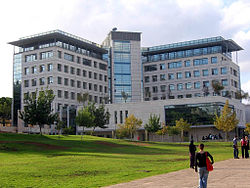 Technion, Computer Science faculty
 -
 Weizmann Institute, koffler accelerator
 -
 Israeli StemRad astronaut anti radiation suit, picture by NASA
.jpg)


European Union
[edit]Europe is lagging behind in R&D investments from the past two decades.[according to whom?] The target of 3% of gross domestic product (GDP) was meant to be reached by 2020, but the current amount is below this target. This also causes a digital divide among countries since only a few EU Member States have R&D spending.[32]
Research and innovation in Europe are financially supported by the programme Horizon 2020, which is open to participation worldwide.[33]
A notable example is the European environmental research and innovation policy, based on the Europe 2020 strategy which will run from 2014 to 2020,[34] a multidisciplinary effort to provide safe, economically feasible, environmentally sound and socially acceptable solutions along the entire value chain of human activities.[35]
Firms that have embraced advanced digital technology devote a greater proportion of their investment efforts to R&D. Firms who engaged in digitisation during the pandemic report spending a big portion of their expenditure in 2020 on software, data, IT infrastructure, and website operations.[36][37] A 2021/2022 survey found that one in every seven enterprises in the Central, Eastern and South Eastern regions (14%) may be classed as active innovators — that is, firms that spent heavily in research and development and developed a new product, process, or service — however this figure is lower than the EU average of 18%. In 2022, 67% of enterprises in the same region deployed at least one sophisticated digital technology, and 69% EU firms did the same.[38]
As of 2023, European enterprises account for 18% of the world's top 2 500 R&D corporations, but just 10% of new entrants, compared to 45% in the United States and 32% in China.[39]
As of 2024, the electronics sector leads in R&D investment, with 28% of its total investment dedicated to it. This is followed by textiles (19%), digital (18%), and aerospace (15%). Other sectors allocate less than 10% of their total investment to R&D.[40][37]
While 17% of the world’s top R&D investors are based in the European Union, they accounted for only 1% of acquisitions involving EU-based companies between 2013 and 2023.[41][42]
-
 Secop R&D Center in Gleisdorf Austria
 -
 IBM Germany Research & Development


Worldwide
[edit]In 2015, research and development constituted an average 2.2% of the global GDP according to the UNESCO Institute for Statistics.[43]
By 2018, research and development constituted an average 1.79% of the global GDP according to the UNESCO Institute for Statistics. Countries agreed in 2015 to monitor their progress in raising research intensity (SDG 9.5.1), as well as researcher density (SDG 9.5.2), as part of their commitment to reaching the Sustainable Development Goals by 2030. However, this undertaking has not spurred an increase in reporting of data. On the contrary, a total of 99 countries reported data on domestic investment in research in 2015 but only 69 countries in 2018. Similarly, 59 countries recorded the number of researchers (in full-time equivalents) in 2018, down from 90 countries in 2015.[44]
| Country | R&D as percentage of GDP |
|---|---|
| Israel | |
| Korea | |
| Sweden | |
| Belgium | |
| United States | |
| Japan | |
| Austria | |
| Switzerland | |
| Germany | |
| Denmark | |
| Finland | |
| Iceland | |
| China | |
| France | |
| Netherlands | |
| Norway | |
| Slovenia | |
| Czechia | |
| Singapore | |
| Australia |
See also
[edit]- Basic research
- Demonstration
- Industrial laboratory
- Innovation
- List of business and finance abbreviations
- List of companies by research and development spending
- List of countries by research and development spending
- Neglected tropical disease research and development
- Prototype
- Science of science policy
- Science policy
- Technological revolution
- Technology life cycle
References
[edit]- ^ "Policy for research and technological development | Fact Sheets on the European Union | European Parliament". 31 March 2023.
- ^ a b c "Research and Development in the Pharmaceutical Industry". US Congressional Budget Office. April 2021. Retrieved 29 August 2024.
- ^ Wragg, David W. (1973). A Dictionary of Aviation (first ed.). Osprey. p. 223. ISBN 9780850451634.
- ^ a b c Investopedia Staff (2003-11-25). "Research And Development – R&D". Investopedia. Retrieved 2017-12-12.
- ^ Yiu, L. M. Daphne; Lam, Hugo K. S.; Yeung, Andy C. L.; Cheng, T. C. E. (2020). "Enhancing the Financial Returns of R&D Investments through Operations Management". Production and Operations Management. 29 (7): 1658–1678. doi:10.1111/poms.13186. hdl:10397/89881. ISSN 1937-5956. S2CID 216529963.
- ^ EUROPEAN COMMISSION https://ec.europa.eu/competition/state_aid/cases/220403/220403_758165_5_1.pdf
- ^ Expenses for university R&D&I increase moderately in Spain https://www.eurekalert.org/pub_releases/2021-07/ucid-efu072221.php Archived 2021-07-26 at the Wayback Machine
- ^ Research, Development and Innovation (R&D&I), Fundação Para a Ciência e Tecnologia https://www.fct.pt/dsi/idi/index.phtml.en Archived 2022-09-07 at the Wayback Machine
- ^ Anderson, James C.; Narus, James A. (1998-11-01). "Business Marketing: Understand What Customers Value". Harvard Business Review. No. November–December 1998. ISSN 0017-8012. Retrieved 2019-02-06.
- ^ ChartsBin. "Research and Development Employees by Country". ChartsBin. Retrieved 2019-02-06.
- ^ Khan, Firdos Alam (2018-09-03). Biotechnology Fundamentals. CRC Press. ISBN 9781498723459.
- ^ "R&D expenditure - Statistics Explained - Eurostat". ec.europa.eu. Archived from the original on 2025-07-05. Retrieved 2025-07-28.
- ^ All figures UK R&D Scoreboard Archived 2005-10-27 at the Wayback Machine as of 2006[update].
- ^ Dingwall, Robert; McDonnell, Mary Byrne (2015-06-26). The SAGE Handbook of Research Management. SAGE. ISBN 9781473914452.
- ^ "Aerospace and Defense: Inventing and Selling the Next Generation" (PDF). Center for Strategic and International Studies. Center for Strategic and International Studies, International Security Program. December 5, 2009. p. 1. Archived from the original (PDF) on 28 July 2011. Retrieved 6 August 2017.
- ^ "Invention Finance". investor-partner.co.uk. Archived from the original on 8 September 2015.
- ^ Ortega-Argiles, Raquel; Potters, Lesley; Vivarelli, Marco (2011). "R&D and productivity: testing sectoral peculiarities using micro data". Empirical Economics. 41 (3): 817–839. doi:10.1007/s00181-010-0406-3. hdl:10419/35059. S2CID 59130979.
- ^ Ortega-Argiles, Raquel; Piva, Mariacristina; Vivarelli, Marco (2011). "Productivity Gains from R&D Investment: Are High-Tech Sectors Still Ahead?". IZA Discussion Papers (5975). IZA: 1–22.
- ^ Crespi, Francesco; Antonelli, Cristiano (2011). "Matthew Effects and R&D Subsidies: Knowledge Cumulability in High-Tech and Low-Tech Industries". Working Papers (140). Università degli Studi Roma Tre: 1–24.
- ^ Mendonca, Sandro (2009). "Brave Old World: Accounting for 'High-Tech' Knowledge in 'Low-Tech' Industries". Research Policy. 38 (3): 470–482. doi:10.1016/j.respol.2008.10.018.
- ^ Bena, Jan; Kai, Li (2014). "Corporate innovations and mergers and acquisitions". The Journal of Finance. 69 (5): 1923–1960. doi:10.1111/jofi.12059. hdl:10.1111/jofi.12059.
- ^ Lin, Ji-Chai; Wang, Yanzhi (Andrew) (2016). "The R&D Premium and Takeover Risk". The Accounting Review. 91 (3): 955–971. doi:10.2308/accr-51270. hdl:10397/65000.
- ^ Anderson, G.; Moris, F. (2023). "Federally Funded R&D Declines as a Share of GDP and Total R&D". National Science Foundation, National Center for Science and Engineering Statistics. Archived from the original on 3 October 2023.
NSF 23-339
- ^ Chiesa, V. (2001). R&D Strategy and Organisation, Imperial College Press
- ^ Sargent, John F Jr, ed. (2011). Federal Research and Development Funding: FY2011 (PDF). Library of Congress, Congressional Research Service. OCLC 1097445714.
- ^ "Research and Development: U.S. Trends and International Comparisons, National Science Foundation" (PDF).
- ^ "Federal Research and Development (R&D) Funding: FY2021". 17 December 2020. Retrieved 20 February 2021.
- ^ "RDT&E Programs (R-1)" (PDF). Office of the Undersecretary of Defense (Comptroller). February 2020. Retrieved 20 February 2021.
- ^ "R&D as a percentage of GDP by country 2022". Statista. Retrieved 2024-07-02.
- ^ a b c "Sustaining Israel's Innovation Economy | Perspectives on Innovation | CSIS". www.csis.org. Retrieved 2024-07-02.
- ^ Genome, Startup. "Startup Genome". Startup Genome. Retrieved 2024-07-02.
- ^ "Innovation overview 2023". European Investment Bank. 2023-02-28.
- ^ "European Commission – PRESS RELEASES – Press release – Horizon 2020 – the EU's new research and innovation programme". europa.eu.
- ^ "European Commission – PRESS RELEASES – Press release – Horizon 2020: Commission proposes €80 billion investment in research and innovation, to boost growth and jobs". europa.eu. Retrieved 2017-12-12.
- ^ "EUR-Lex – 02013R1291-20150704 – EN – EUR-Lex". eur-lex.europa.eu. Retrieved 2017-03-16.
- ^ Digitalisation in Europe 2021–2022: Evidence from the EIB Investment Survey. European Investment Bank. 2022-05-05. ISBN 978-92-861-5233-7.
- ^ a b "Press corner". European Commission – European Commission. Retrieved 2022-05-31.
- ^ EIB Investment Survey 2022 – CESEE overview. European Investment Bank. 2023-01-11. ISBN 978-92-861-5435-5.
- ^ EIB Investment Report 2023/2024: Transforming for competitiveness. European Investment Bank. 2024-02-07. ISBN 978-92-861-5648-9.
- ^ Post-COVID recovery and green transition: An ecosystem view. European Investment Bank. 2024-05-08. ISBN 978-92-861-5617-5.
- ^ "The 2023 EU Industrial R&D Investment Scoreboard". IRI. Retrieved 2024-08-29.
- ^ "The scale-up gap: Financial market constraints holding back innovative firms in the European Union". European Investment Bank. Retrieved 2024-07-30.
- ^ "Research and development expenditure (% of GDP) | Data". data.worldbank.org. Retrieved 2017-12-12.
- ^ Schneegans, S.; Straza, T.; Lewis, J., eds. (11 June 2021). UNESCO Science Report: the Race Against Time for Smarter Development. Paris: UNESCO. ISBN 978-92-3-100450-6.
- ^ "Science,technology and innovation". data.uis.unesco.org.
Sources
[edit] This article incorporates text from a free content work. Licensed under C-BY-SA 3.0 IGO. Text taken from UNESCO Science Report: the Race Against Time for Smarter Development., Schneegans, S., T. Straza and J. Lewis (eds), UNESCO.

External links
[edit] Media related to Research and development at Wikimedia Commons


| |||||||||||||||||||||||||||||||||
| |||||||||||||||||||||||||||||||||
| |||||||||||||||||||||||||||||||||

| International | |
|---|---|
| National | |
| Other | |

Research and development
View on GrokipediaDefinition and Fundamentals
Core Concepts and Distinctions
Research and development (R&D) encompasses creative and systematic work aimed at increasing the stock of knowledge—including knowledge of humanity, culture, and society—and applying that knowledge to develop new applications, such as materials, products, devices, processes, systems, or services.[11] This definition, established in the OECD's Frascati Manual, serves as the international standard for identifying and measuring R&D activities, emphasizing novelty, creativity, and uncertainty as inherent characteristics that distinguish R&D from routine engineering or market research.[12] R&D excludes activities lacking systematic planning or aimed solely at adapting existing products without significant innovation, ensuring focus on efforts that advance technological frontiers or resolve scientific unknowns.[2] The core components of R&D comprise three interrelated activities: basic research, applied research, and experimental development, each defined by their objectives and outputs.[11] Basic research involves experimental or theoretical endeavors primarily to acquire new knowledge about the fundamental principles underlying phenomena, without immediate practical applications in mind; for instance, studies on quantum mechanics in the early 20th century laid groundwork for later technologies despite initial lack of targeted use.[12] It prioritizes understanding observable facts and causal mechanisms through hypothesis testing and replication, often conducted in academic or public sector settings where long-term, exploratory outcomes prevail over short-term commercial viability.[2] Applied research, in contrast, directs original investigations toward acquiring new knowledge with a specific practical objective, such as addressing identified technical challenges or exploring potential uses for basic research findings.[11] It bridges fundamental insights and real-world problems, producing intermediate outputs like prototypes or feasibility assessments; an example is the development of early antibiotic testing protocols in the 1940s, which built on basic microbiological discoveries to target bacterial infections.[12] While sharing methodological rigor with basic research, applied efforts emphasize problem-solving utility, often funded by industry or government agencies seeking measurable progress toward implementation.[2] Experimental development represents the application of research-derived knowledge and practical experience to systematically create or substantially improve tangible outputs, including new products, processes, or systems.[11] This stage involves iterative prototyping, testing under operational conditions, and design refinement to achieve reliability and scalability, as seen in the evolution of semiconductor fabrication techniques from the 1960s onward, which integrated applied circuit knowledge into manufacturable chips.[12] Unlike research, it focuses on verifiable performance enhancements rather than novel knowledge generation, though it generates ancillary data that may feed back into research cycles.[2] These distinctions, while analytically useful for resource allocation and policy, reflect a continuum rather than rigid categories, with overlaps arising from integrated projects where basic inquiries inform applied goals and developmental trials yield unexpected theoretical insights.[11] In practice, the boundaries depend on contextual intent and outcomes; for example, a project's classification may shift if initial applied aims evolve into broader foundational exploration.[12] Such fluidity underscores R&D's iterative nature, where causal chains from curiosity-driven inquiry to market-ready innovation drive economic and technological progress, though empirical measurement challenges persist due to self-reported categorizations by performers.[2]Basic vs. Applied Research
Basic research, as defined by the OECD Frascati Manual, constitutes experimental or theoretical work primarily aimed at acquiring new knowledge regarding the fundamental underpinnings of phenomena and observable facts, without immediate or specific applications in view.[13] In contrast, applied research involves original investigations directed toward acquiring new knowledge but oriented explicitly toward a particular practical objective or problem-solving aim.[13] The U.S. National Science Foundation (NSF) aligns with this, characterizing basic research as efforts to augment scientific knowledge for its intrinsic value, emphasizing comprehension of underlying principles over utilitarian outcomes.[2] The core distinction lies in intent and orientation: basic research pursues generalizable insights into natural laws and mechanisms, often through exploratory inquiry unbound by predefined endpoints, whereas applied research leverages existing knowledge to address targeted challenges, such as improving processes or technologies.[2] Methodologically, basic research tends toward abstract modeling, hypothesis testing in controlled settings, and long-term horizons, yielding publications and theoretical advancements; applied research employs iterative experimentation, prototyping, and validation against real-world constraints, producing patents, prototypes, or incremental solutions.[1] Funding patterns reflect these divergences: in 2022, U.S. basic research received 40% of its support from federal sources and 37% from businesses, with the latter often more mission-oriented even in basic pursuits, while applied research draws disproportionately from industry for its nearer-term commercial viability.[14] Historically, the dichotomy gained prominence through Vannevar Bush's 1945 report Science, the Endless Frontier, which positioned basic research as the "pacemaker of technological progress," insulating it from short-term pressures to foster breakthroughs that later enable applied innovations.[15] Examples illustrate this: basic research into quantum electrodynamics in the mid-20th century elucidated subatomic behaviors without practical intent, foundational to later applied developments like transistors; applied research, conversely, might refine laser technology for medical diagnostics based on such fundamentals.[16] Despite overlaps—where basic inquiries anticipate utility or applied work uncovers novel principles—the framework persists in policy for allocating resources, though critics note its subjectivity, as researcher motivations can blur lines and private basic efforts increasingly align with strategic goals.[17] Empirically, basic research underpins sustained innovation, with studies showing that foundational discoveries correlate with downstream economic multipliers, albeit through nonlinear pathways rather than direct causation.[18]Development Processes
Development processes in research and development (R&D) encompass the systematic application of knowledge gained from basic or applied research to create or significantly improve products, processes, or services, often through iterative engineering and validation efforts.[2] These processes emphasize empirical testing, risk reduction, and scalability, distinguishing them from pure research by focusing on practical implementation and commercialization potential.[19] A widely adopted framework for managing these processes is the Stage-Gate model, developed by Robert G. Cooper in the late 1980s, which structures development into sequential stages punctuated by evaluation gates to assess feasibility, progress, and go/no-go decisions.[20] Typical stages include ideation and scoping for initial concept refinement; business case development involving market analysis and prototyping; detailed engineering and design; testing and validation through prototypes and pilots; and finally, launch preparation with full-scale production planning.[21] At each gate, multidisciplinary teams review data against predefined criteria such as technical achievability, cost estimates, and competitive positioning, enabling early termination of unviable projects to conserve resources.[19] Empirical analyses of Stage-Gate implementations indicate improved project outcomes, with firms reporting success rates for new products rising from under 10% in unstructured approaches to 30-50% when gates enforce rigorous criteria and cross-functional reviews.[22] However, the model's linear nature can introduce delays in dynamic fields like software, prompting adaptations such as hybrid Stage-Gate-Agile systems that incorporate iterative sprints within stages for faster feedback loops.[23] In sectors like pharmaceuticals, development processes align with regulatory milestones, progressing from preclinical testing to phased clinical trials (Phase 1 for safety in small groups, Phase 2 for efficacy in larger cohorts, and Phase 3 for confirmatory trials in thousands of participants) before market approval.[24] Agile methodologies, originating from software engineering in the early 2000s, have increasingly influenced R&D development by prioritizing incremental deliverables, continuous integration, and adaptive planning over rigid phases, particularly in tech-driven innovations where user feedback drives rapid pivots.[25] This approach reduces time-to-market—evidenced by studies showing 20-50% faster development cycles in adopting organizations—but requires strong team discipline to avoid scope creep.[23] Across industries, effective processes integrate tools like computer-aided design (CAD) for prototyping and simulation modeling for virtual testing, minimizing physical iterations while grounding decisions in causal data from failure analyses.[26] Success hinges on balancing structured oversight with flexibility, as overly bureaucratic gates can stifle creativity, whereas unchecked iteration risks inefficient resource allocation.[27]Historical Evolution
Pre-Industrial and Early Industrial Origins
In antiquity, precursors to modern research emerged through empirical observation and systematic inquiry in civilizations such as ancient Egypt, where knowledge of mechanics, medicine, and astronomy enabled feats like pyramid construction and the development of a solar calendar around 3000 BCE.[28] Similarly, ancient China during the Han dynasty (206 BCE–220 CE) produced inventions including gunpowder and paper through practical experimentation tied to state needs, while ancient Greece from the 6th century BCE advanced deductive reasoning in mathematics and astronomy, though often remaining theoretical rather than applied.[28] Roman engineering from the 1st century BCE emphasized practical applications in architecture and hydraulics, as documented in Pliny the Elder's Naturalis Historia, fostering infrastructure like aqueducts but relying on tacit, experience-based knowledge over codified methodologies.[28] These efforts, primarily elitist and patronage-driven, influenced economies through incremental productivity gains in agriculture and construction but lacked the institutional structures for scalable development.[28] The medieval period (11th–15th centuries) saw the establishment of universities in Europe, which preserved and expanded knowledge in fields like metallurgy and construction, transitioning tacit craftsmanship into more codified forms via scholastic methods.[28] The Renaissance and Scientific Revolution (15th–17th centuries) accelerated this with the printing press's invention around 1440 by Johannes Gutenberg, enabling widespread dissemination of texts, and empirical methodologies championed by figures like Francis Bacon, who in 1620 advocated inductive reasoning for practical utility in Novum Organum.[28] Institutions such as the Royal Society of London, founded in 1660, institutionalized collaborative experimentation, funding inquiries into natural phenomena that bridged scholarly pursuit and potential applications, though still divorced from commercial imperatives.[29] During the early Industrial Revolution (c. 1760–1840), invention shifted toward systematic problem-solving amid Britain's textile and energy demands, exemplified by Thomas Newcomen's atmospheric steam engine in 1712 and James Watt's improvements by 1769, which involved iterative testing and partnerships with manufacturers like Matthew Boulton to enhance efficiency for mining and factories.[30] These advances relied on empirical tinkering rather than pure theory, with over 2,000 patents granted in Britain between 1750 and 1800 for machinery like the spinning jenny (1764) by James Hargreaves, driving economic growth through mechanization but conducted largely by independent artisans or small firms without dedicated teams.[31] By the mid-19th century, organized efforts emerged, including Michael Faraday's systematic electromagnetic experiments at the Royal Institution from 1831, yielding generators and motors, and the first industrial chemical laboratories in France during the 1860s, followed by German firms in the 1870s that commercialized university-derived dyes through in-house teams.[32] In the United States, Thomas Edison's Menlo Park laboratory, established in 1876, marked a pivotal step toward structured development, employing over 30 technicians for systematic invention, resulting in the phonograph (1877) and incandescent bulb (1879) via methodical trial-and-error, with Edison securing 1,093 patents by emphasizing division of labor in research.[33] This model, blending basic inquiry with applied prototyping, influenced subsequent labs, such as those in the pharmaceutical sector where university collaborations, like the 1895 diphtheria antitoxin by H.K. Mulford Company with University of Pennsylvania input, demonstrated early spillovers from academic science to industry.[34] These origins highlighted causal links between resource constraints, market incentives, and incremental experimentation, setting precedents for formalized R&D amid expanding industrial scales.[34]20th Century Corporate and Government Expansion
The establishment of dedicated industrial research laboratories by major American corporations in the early 20th century represented a pivotal shift toward systematic, in-house R&D, driven by the demands of emerging technologies in electricity, chemicals, and machinery. General Electric created the first prominent corporate lab in 1900, led by consultant Charles Proteus Steinmetz, focusing on electrical innovations such as improved generators and lighting systems.[35] This model spread rapidly; by 1910, firms like Kodak and DuPont had followed, with DuPont opening its Experimental Station in 1903 to tackle synthetic materials and dyes amid competitive pressures from European chemical giants.[36] Between 1900 and 1940, nearly 350 independent industrial laboratories emerged, concentrating in the Middle Atlantic region and prioritizing applied problem-solving over pure science.[37] Corporate R&D expanded further in the interwar period, fueled by scientific opportunities in physics and chemistry that enabled breakthroughs in complex products like automobiles and appliances. Hundreds of companies, particularly in electrical and chemical sectors, internalized research functions to reduce dependence on external inventors and patents, with the number of scientists and engineers in industrial labs doubling between 1921 and 1927 despite the economic disruptions of the Great Depression.[38][39] This era saw R&D budgets grow as firms recognized returns from innovations like radio components and synthetic fibers, though outcomes varied by industry, with success tied to integration with manufacturing processes rather than isolated basic research. In contrast, government-sponsored R&D remained limited before World War II, comprising a small fraction of total activity and oriented toward practical, mission-specific needs rather than broad innovation. U.S. federal expenditures totaled under $70 million annually by 1940—equivalent to about 1% of inflation-adjusted modern levels—primarily supporting agriculture via the Department of Agriculture's experiment stations, natural resource surveys, and nascent defense projects.[40] Agencies such as the National Bureau of Standards, founded in 1901, focused on metrology and standards for industry, but lacked the scale or ambition of corporate efforts, reflecting a laissez-faire approach where public roles were confined to foundational infrastructure rather than competitive technological advancement.[41] World War I prompted modest increases, including the creation of the National Research Council in 1916 to coordinate wartime science, yet these did not sustain post-armistice expansion, leaving private enterprise as the dominant force in R&D growth.Post-WWII Boom and Cold War Era
Following World War II, the United States experienced a surge in research and development (R&D) activities, building on wartime innovations and transitioning to peacetime applications. In July 1945, Vannevar Bush, director of the Office of Scientific Research and Development, published "Science, the Endless Frontier," which argued that sustained federal investment in basic research was essential for national security, economic prosperity, and public health, proposing the creation of a National Research Foundation to coordinate non-military scientific efforts.[42] This vision influenced the establishment of the National Science Foundation (NSF) in 1950 under President Harry S. Truman, with an initial budget focused on supporting basic research at universities and fostering a larger cadre of scientists.[43] Federal R&D expenditures, which totaled under $70 million annually in 1940 (adjusted for inflation to about 1% of later levels), began modest growth in the late 1940s, laying the groundwork for expanded public-private partnerships.[40] The onset of the Cold War accelerated R&D investments, particularly in defense-related fields, as geopolitical tensions with the Soviet Union prioritized technological superiority. The Soviet launch of Sputnik in 1957 prompted the creation of the Advanced Research Projects Agency (ARPA, later DARPA) on February 7, 1958, by President Dwight D. Eisenhower to consolidate high-risk, high-reward military R&D projects, including early space and missile technologies.[44] By the early 1960s, U.S. total R&D spending accounted for nearly 70% of global efforts, dominated by government funding channeled through defense contracts that supported innovation hubs and increased patenting in affected regions by 40-50% compared to untreated areas by 1970.[45] [46] These investments, often performed by industry, contributed to roughly one-quarter of subsequent business sector productivity growth.[6] The Space Race epitomized Cold War R&D competition, driving massive U.S. commitments to aeronautics and related technologies. From 1960 to 1973, the Apollo program alone cost $25.8 billion (equivalent to about $318 billion in 2023 dollars), spurring advancements in computing, materials, and propulsion while employing thousands in R&D roles.[47] Soviet expenditures, estimated at $6-10 billion through 1964, focused on parallel achievements like Yuri Gagarin's 1961 orbital flight, but U.S. investments ultimately enabled the 1969 moon landing and broader spillovers to civilian sectors.[48] Defense R&D's emphasis on applied development sustained a growing population of researchers, with federal outlays peaking relative to private spending during this era before declining post-1990.[49]Globalization and Digital Age (1980s–Present)
The globalization of research and development accelerated in the 1980s as multinational corporations increasingly established overseas R&D facilities to access specialized talent, reduce costs, and align innovation with local markets.[50] This shift marked a departure from predominantly home-country-centric models, with transnational corporations (TNCs) performing strategic R&D in developing countries starting in the mid-1980s.[51] By the 1990s, internationalization concentrated in the Triad regions (North America, Europe, Japan), involving technology transfers, patent licensing, and adaptive research for regional needs.[52] Global R&D investments expanded dramatically, rising from $478.6 billion in 1980 to $1.61 trillion in 2013 (in 2009 purchasing power parity dollars).[53] The digital age, propelled by the IT revolution and widespread adoption of computing and internet technologies, further intensified R&D globalization by enabling distributed teams, real-time data sharing, and software-intensive innovation.[54] U.S. multinationals' foreign R&D expenditures grew sevenfold between 1989 and 2013, driven partly by the rising importance of software and information technology in firm operations.[54] Digital tools facilitated open innovation models, where firms linked foreign R&D affiliates to external partners, enhancing knowledge flows and reducing development timelines.[55] This era saw the proliferation of global R&D networks, including centers in emerging hubs like Israel and India, exemplified by facilities such as Microsoft's Israel R&D Center focusing on cybersecurity and AI.[56] By the 2020s, global R&D spending reached $3.1 trillion in 2022, with the United States accounting for 30% and China 27%, reflecting Asia's ascendance amid geopolitical shifts.[57] Digital technologies transformed R&D methodologies, incorporating big data analytics, machine learning simulations, and virtual prototyping to accelerate discovery and mitigate risks across sectors like pharmaceuticals and automotive engineering.[58] However, challenges emerged, including intellectual property vulnerabilities in offshore locations and dependencies on global supply chains, prompting strategies like nearshoring in response to tensions such as U.S.-China trade disputes.[59] Despite these, the period underscored R&D's role in fostering economic resilience, with business-funded activities comprising the majority of expenditures worldwide.[60]Economic Role in Business and Innovation
Incentives and Returns on Investment
Firms engage in research and development (R&D) primarily to secure competitive advantages through technological innovations that enhance product offerings, improve production efficiency, or create new markets, thereby generating supernormal profits protected by intellectual property rights or lead-time advantages.[61] These incentives are driven by the prospect of capturing economic rents, as successful R&D outcomes enable firms to charge premium prices, expand market share, and deter entrants, with empirical analyses confirming that innovation-intensive strategies correlate with sustained profitability in dynamic industries.[62] Private returns on R&D investment, measured as the internal rate of return or excess profitability from innovation outputs, typically range from 10% to 30% annually, exceeding those of conventional physical capital investments like machinery, which average around 7-10%.[61] [62] A meta-analysis of firm-level studies estimates an average private rate of return near 20%, implying that a $1 investment in R&D yields approximately $3-4 in additional profits over subsequent years, though variability arises from sector-specific factors such as information technology (higher returns) versus mature manufacturing (lower).[62] [63] These returns are derived from econometric models linking R&D expenditures to productivity gains and revenue growth, accounting for lags where benefits often materialize 2-5 years post-investment.[64] Government incentives, including tax credits and subsidies, supplement market-driven motivations by reducing the effective cost of R&D, with programs like the U.S. Research and Development Tax Credit providing dollar-for-dollar offsets that boost after-tax returns by 10-20% for qualifying expenditures.[65] However, such policies address underinvestment stemming from knowledge spillovers, where private firms capture only a fraction of total benefits—social returns to private R&D are estimated at 50-100%, reflecting externalities like industry-wide productivity spillovers that justify public intervention despite occasional inefficiencies in allocation.[64] [66] Uncertainty inherent in R&D, with success rates often below 50% for early-stage projects, tempers incentives but does not negate them, as portfolio approaches and staged funding mitigate risks while high marginal returns on breakthroughs—evident in cases like pharmaceutical blockbusters yielding ROIs over 50%—drive overall positive expected values.[61] Empirical evidence from U.S. business data indicates that firms increasing R&D intensity by 1% of sales see long-term productivity rises of 0.1-0.3%, underscoring the causal link between investment and economic performance despite measurement challenges like intangible asset valuation.[67]Sector-Specific Applications and Benefits
In the pharmaceutical sector, research and development (R&D) focuses on drug discovery, clinical trials, and biomanufacturing processes, yielding breakthroughs such as targeted therapies for cancer and vaccines that have averted millions of deaths. For instance, R&D investments enabled the rapid development of mRNA-based COVID-19 vaccines in 2020, which by 2022 had been administered over 13 billion doses globally, reducing severe illness rates by up to 90% in clinical settings.[68] Benefits include improved public health outcomes, with studies estimating that pharmaceutical R&D generates social returns of 10-20% annually through productivity gains from healthier workforces and reduced healthcare costs, though private returns vary due to high failure rates exceeding 90% for drug candidates.[69][70] The information technology sector leverages R&D for advancements in semiconductors, software algorithms, and artificial intelligence, exemplified by investments totaling $150 billion in U.S. computer and electronic products R&D in 2022, driving exponential increases in computational efficiency per Moore's Law extensions.[71] Applications include cloud computing infrastructures and machine learning models that automate data analysis, with benefits manifesting as enhanced productivity across economies; for example, AI-related R&D has contributed to a 1-2% annual boost in total factor productivity in tech-dependent industries through spillover effects to non-performers.[67][72] In the automotive industry, R&D targets electric vehicle batteries, autonomous driving systems, and lightweight materials, as seen in expenditures exceeding $100 billion globally in 2023 for electrification transitions.[60] Key applications involve simulation modeling for crash safety and powertrain optimization, delivering benefits like a 50% reduction in battery costs from 2010 to 2023, which has accelerated market adoption and lowered emissions by enabling vehicles with ranges over 300 miles on single charges.[73] These investments yield competitive edges, with firms recouping costs through premium pricing and regulatory compliance advantages in low-emission standards.[74] Energy sector R&D emphasizes renewables, grid storage, and fusion technologies, with U.S. business funding reaching $20 billion in 2022 for clean energy innovations.[57] Applications include perovskite solar cells and advanced turbines, resulting in solar photovoltaic costs dropping 89% from 2010 to 2022, facilitating a shift toward sustainable sources that now comprise 12% of global electricity generation.[73] Benefits encompass energy security and economic savings, as R&D-driven efficiency gains have reduced U.S. household energy expenditures by 15% in real terms over the past decade, while fostering job creation in high-skill manufacturing.[75] Agricultural R&D applies biotechnology and precision farming tools, such as CRISPR gene editing and drone-based crop monitoring, with global investments yielding hybrid seeds that increased maize yields by 20-30% in developing regions since 2000.[73] In the U.S., such efforts contributed to a 1.5% annual productivity growth rate from 2010-2020, enhancing food security and reducing pesticide use by up to 37% through targeted applications.[67] Overall benefits include mitigated famine risks and trade surpluses, though returns depend on intellectual property enforcement to capture spillovers from public-private collaborations.[68]Risks, Failures, and Management Strategies
Research and development (R&D) inherently involves high uncertainty, with technical, financial, market, and human factors contributing to elevated risks of failure. Technical risks arise from unpredictable scientific outcomes, such as incomplete knowledge of underlying mechanisms or unforeseen technical hurdles, which can render projects unfeasible despite initial promise.[76] In pharmaceuticals, for instance, approximately 90% of drug candidates fail during clinical development due to inefficacy, safety issues, or both, even after preclinical validation.[77] Financial risks stem from substantial capital outlays with no guaranteed returns; R&D costs can escalate due to scope creep or prolonged timelines, often leading to opportunity costs as funds are diverted from proven revenue streams. Market risks include misjudging demand or facing superior competitive alternatives, while human risks encompass talent attrition or errors from inadequate expertise. Strategic misalignment, where R&D pursuits do not align with organizational priorities, further amplifies these vulnerabilities.[78] Notable R&D failures underscore these risks' consequences. In the pharmaceutical sector, Pfizer's torcetrapib cholesterol drug, abandoned in 2006 after Phase III trials, incurred over $800 million in losses due to increased mortality risks observed in patients.[79] Similarly, Merck's Vioxx painkiller, withdrawn in 2004 amid cardiovascular safety concerns, resulted in a $4.85 billion settlement for user damages following its market approval.[80] Outside pharma, Ford's Edsel automobile project, launched in 1958 after extensive market research, failed commercially due to overestimation of consumer interest and design flaws, leading to $350 million in losses (equivalent to about $3.5 billion in 2023 dollars) and its discontinuation within three years.[81] Dyson's electric car initiative, developed over a decade with £500 million invested by 2019, was canceled that year owing to prohibitive production costs and unviable market pricing, highlighting financial and market miscalculations.[82] These cases illustrate how even well-resourced efforts can collapse under compounded risks, with industry-wide data showing an overall likelihood of approval from Phase I in drug development at just 9.6%.[83] Effective management strategies mitigate these risks through structured processes emphasizing identification, assessment, and mitigation. Risk identification involves early mapping of potential technical and market uncertainties, often via multidisciplinary teams, while quantitative evaluation uses probabilistic models to prioritize threats.[84] Stage-gate reviews, implemented sequentially to evaluate progress against milestones, enable timely termination of underperforming projects, preserving resources; empirical studies show this approach enhances productivity in high-risk endeavors when paired with tolerance for initial uncertainties.[85] Portfolio diversification across multiple projects balances high-risk, high-reward bets against safer increments, with evidence indicating that aligning R&D risk management with corporate strategy improves new product development outcomes.[86] Additionally, agile methodologies adapt to emerging data, reducing human and strategic errors, while external collaborations share risks and leverage specialized knowledge.[76] Despite these tools, complete risk elimination remains impossible, as innovation demands tolerance for failure to achieve breakthroughs.[87]Funding Mechanisms
Private Sector Funding Dynamics
Private sector entities, primarily business enterprises, perform and fund the majority of global research and development activities, accounting for approximately 78% of total U.S. R&D expenditures in 2022 at $697 billion out of $892 billion nationally.[71] Worldwide, business enterprise R&D constitutes the largest share in OECD countries, with expenditures reaching significant scales driven by profit-oriented investments in applied research and technological development.[69] This dominance reflects a causal emphasis on innovations with direct commercial applicability, where firms prioritize projects offering measurable returns over speculative basic research due to challenges in appropriating knowledge spillovers.[88] The primary source of private R&D funding derives from internal company resources, such as retained earnings and operational cash flows, comprising $608 billion or about 88% of U.S. business R&D spending in 2022, with the remainder from external sources including federal government contracts ($83 billion total external).[89] In OECD frameworks, business enterprises predominantly self-finance their R&D through industry own-funds, supplemented by inter-firm payments, foreign funding, and public grants, though the exact mix varies by sector and jurisdiction.[90] Large corporations like those in pharmaceuticals, information technology, and manufacturing allocate these funds strategically, often tying investments to competitive advantages in product pipelines and process improvements, as evidenced by sustained growth in business R&D performance exceeding 14% year-over-year in the U.S.[89] Venture capital plays a complementary role in funding high-risk, early-stage R&D within startups, particularly in emerging technologies, though it represents a smaller fraction of overall private expenditures compared to established firms' internal budgets. Global venture capital investments rose in early 2025, fueled by megadeals in artificial intelligence and biotechnology, yet remain selective amid economic uncertainties, with startups extending funding cycles to 18-24 months.[91] [92] This dynamic underscores venture capital's function in bridging gaps for innovations too uncertain for corporate balance sheets, enabling rapid scaling but with high failure rates inherent to speculative R&D pursuits.[93] Trends in private sector funding exhibit accelerated growth outpacing public investments, with U.S. business R&D nearing $700 billion by 2022 and global totals reflecting similar expansions despite geopolitical tensions, concentrated in high-tech industries.[89] [94] Funding dynamics are influenced by tax incentives, which in OECD countries account for nearly 55% of government support to business R&D, incentivizing higher expenditures without direct outlays.[95] However, reliance on internal funds ties R&D intensity to firm profitability, leading to cyclical fluctuations and potential underinvestment during downturns, as firms balance short-term shareholder pressures against long-term innovation needs.[88]Public Sector Funding and Policies
Public sector funding for research and development primarily supports basic research, national defense, public health, and infrastructure with long-term payoffs that private entities often underinvest in due to high risks and non-appropriable knowledge spillovers. Governments allocate resources via budget appropriations, grants to universities and national laboratories, and procurement contracts, with total global government R&D expenditures estimated at around 25-35% of overall R&D funding depending on the economy. In OECD countries, government budget appropriations or outlays for R&D (GBOARD) grew by 2% in real terms in 2022, following a post-pandemic rebound, but remained below business sector growth rates.[96] This funding mechanism addresses market failures in pure research while enabling strategic priorities, though empirical analyses indicate variable returns influenced by allocation efficiency and bureaucratic incentives.[97] In the United States, federal agencies such as the National Science Foundation (NSF), National Institutes of Health (NIH), and Department of Defense (DoD) disbursed approximately $190 billion in R&D obligations in fiscal year 2022, constituting about 18% of total national R&D performance, with a focus on competitive peer-reviewed grants to minimize political distortion.[57] Policies emphasize dual-use technologies and technology transfer via acts like the Bayh-Dole Act of 1980, which has facilitated over 15,000 startup formations from federally funded research by allowing universities to retain patent rights. In contrast, China's government sector R&D expenditure reached levels 1.6 times that of the US in recent years, driven by state-directed plans under the 14th Five-Year Plan (2021-2025), prioritizing self-reliance in semiconductors, biotechnology, and artificial intelligence through subsidies to state-owned enterprises and national labs.[98] [99] Such centralized approaches have accelerated catch-up in applied technologies but evidence suggests lower marginal productivity per dollar compared to decentralized systems, as state involvement can crowd out private initiative and foster rent-seeking.[100] The European Union exemplifies collaborative public policies through Horizon Europe (2021-2027), budgeting €95.5 billion for transnational grants emphasizing green and digital transitions, with member states contributing additional national funds to reach collective intensities of 3% GDP in total R&D.[101] Government policies increasingly target energy and defense amid geopolitical shifts; OECD data show sharp rises in these areas post-2022, with energy R&D budgets up 20% in real terms across member states due to net-zero commitments and supply security needs.[98] However, critiques from economic analyses highlight that public funding's efficacy hinges on rigorous evaluation metrics, as historical cases like Solyndra demonstrate risks of politically motivated selections over merit-based ones, underscoring the need for sunset clauses and independent oversight to align with causal evidence of innovation pathways.[102]| Country/Region | Government R&D Expenditure (2022/2023, USD PPP billions, approx.) | Share of National Total R&D (%) |
|---|---|---|
| China | ~500 | ~8 (performance share) |
| United States | ~300 | ~18 (funding share) |
| European Union | ~250 (aggregate) | ~20-25 |
| Japan | ~50 | ~15 |
Tax Credits, Subsidies, and Other Instruments
Tax credits for research and development (R&D) expenditures represent a primary fiscal incentive used by governments to stimulate private-sector innovation, typically calculated as a percentage of qualified R&D spending above a base amount. In the United States, the federal R&D tax credit under Section 41 of the Internal Revenue Code, enacted in 1981 and made permanent in 2015, provides a credit of up to 20% on incremental qualified research expenses (QREs), which include wages, supplies, and 65% of contract research costs meeting a four-part test for technological uncertainty and experimentation.[103] Empirical studies indicate these credits increase R&D investment, with one analysis finding eligible firms boosted research spending by an average of 17%, particularly among smaller companies lacking prior credits.[104] Firm-level evidence supports elasticities of 0.1 to 0.3, meaning a 10% reduction in the user cost of R&D via credits yields 1-3% higher spending, though aggregate effects can appear muted due to baseline adjustments and crowding out of other funds.[105][106] Globally, R&D tax incentives have proliferated, comprising about 55% of total government support for business R&D in OECD countries by 2020, up from 30% in 2000, with refundable credits especially beneficial for startups facing losses.[107] Countries like Canada and Australia offer among the most generous regimes for small and medium-sized enterprises (SMEs), with refundable rates exceeding 30-35% on eligible expenditures, enabling cash refunds that enhance liquidity for early-stage innovation.[108][109] In Europe, the implied subsidy rate (B-index) for R&D spending varies, with France and Portugal providing effective rates above 0.30 (meaning a 30% subsidy per dollar spent), while Germany's is lower at around 0.10 due to narrower definitions of qualifying activities.[110] Direct subsidies, including grants and appropriations, constitute another key instrument, often targeting basic or applied research where private returns are uncertain or spillovers are high. In the US, federal subsidies funded roughly 40% of basic research in 2022, with total R&D support reaching $201.9 billion proposed for FY2025, dominated by defense (DOD) and health (HHS) agencies.[14][111] These have yielded substantial long-term productivity gains, with government-funded R&D accounting for about 25% of US business-sector productivity growth since World War II and returns estimated at 140-210% on nondefense investments.[6][66] However, subsidies can distort allocation by favoring politically connected projects, and evidence suggests they are less efficient than tax credits for applied R&D, as governments struggle to select high-impact innovations compared to market signals.[112] Other instruments include government loan guarantees, accelerated depreciation, and patent boxes, which reduce effective tax rates on innovation-derived income. For instance, patent box regimes in countries like the UK and Netherlands tax qualifying IP income at rates as low as 10%, complementing upfront incentives by extending benefits to commercialization.[113] While these tools amplify R&D by alleviating financing constraints—particularly for SMEs facing high upfront costs—their net impact depends on design; refundable and broad-based incentives outperform targeted ones prone to abuse or narrow eligibility.[114] Overall, empirical consensus holds that such instruments elevate total R&D intensity when calibrated to avoid deadweight loss, though they complement rather than substitute private funding, with private-sector decisions driving most applied innovation.[115][116]Global Expenditures and Trends
National and Regional Breakdowns
In 2022, the United States recorded the world's highest gross domestic expenditure on R&D (GERD) at $923.2 billion in purchasing power parity (PPP) dollars, accounting for approximately 30% of the global total of $3.1 trillion.[57] China followed with $811.9 billion, representing a 16% increase from the prior year and reflecting sustained government-directed growth in strategic sectors like semiconductors and artificial intelligence.[57] Japan ranked third at $200.8 billion, driven primarily by corporate investments from electronics and automotive industries.[57] ![Spending on research and development as share of GDP, OWID.svg.png][float-right] Germany's GERD stood at $174.9 billion, with business enterprises funding over 60% amid a focus on manufacturing and engineering applications.[57] South Korea expended $139.0 billion, bolstered by chaebol-led efforts in displays, batteries, and telecommunications.[57] Other notable performers included the United Kingdom ($102.6 billion) and France ($85.2 billion), where public funding supported aerospace and health research.[57] These top performers collectively accounted for over 70% of global R&D outlays, highlighting concentration in advanced economies.[57] When measured as a percentage of GDP (R&D intensity), smaller high-tech economies lead: Israel at approximately 5.7% in 2022, emphasizing defense and cybersecurity innovations. South Korea followed at 4.9%, with total spending reaching 119.74 trillion South Korean won (about $90 billion USD) in 2023, ranking second globally in intensity.[117] Japan and Germany hovered around 3.3-3.4%, while the United States stood at 3.5% and China at 2.6% in 2023.[118] Emerging players like India increased to about 0.7% of GDP, focusing on information technology and pharmaceuticals, though absolute volumes remain modest at under $50 billion.[118] Regionally, North America—dominated by the U.S.—held about 32% of global R&D in 2022, with Canada contributing an additional $20-25 billion annually in resource and biotech areas.[57] The European Union aggregated €389 billion (roughly $420 billion USD nominal) in 2023, or 2.26% of collective GDP, led by Germany and France but varying widely, with Sweden at 3.4% and southern members like Italy below 1.5%.[119] East Asia, including China, Japan, and South Korea, surpassed 45% of worldwide totals, fueled by export-oriented manufacturing and state planning.[94]| Top Countries by GERD (2022, PPP billion USD) | Value |
|---|---|
| United States | 923.2[57] |
| China | 811.9[57] |
| Japan | 200.8[57] |
| Germany | 174.9[57] |
| South Korea | 139.0[57] |
| Leading Countries by R&D Intensity (2022-2023, % of GDP) | Value |
|---|---|
| Israel | 5.7% |
| South Korea | 4.9%[117] |
| United States | 3.5%[118] |
| Japan | 3.4%[118] |
| China | 2.6%[119] |
Worldwide Totals and Growth Patterns
Global gross domestic expenditures on research and development (GERD) reached approximately $3 trillion in 2023, nearly tripling from $725 billion in 2000 despite economic crises, a pandemic, and geopolitical tensions.[94] [57] This expansion reflects sustained investment in innovation, with business sector outlays comprising about 70% of the total, underscoring private enterprise as the primary driver of global R&D scale.[120] Growth patterns show concentration among leading economies: in 2022, the top eight regions accounted for 82% of worldwide R&D, led by the United States at 30% ($923 billion in adjusted GERD) and China at 27%.[57] Absolute spending has increased more than threefold from 2000 to 2019 alone, but recent real growth has decelerated, with corporate R&D rising 6.1% in 2023 compared to 7.5% in 2022, and overall global R&D projected at 2.9% for 2024 before easing to 2.3% in 2025.[121] [122] [123] R&D intensity, measured as GERD relative to GDP, reveals uneven global distribution, with roughly 66% of economies below 1% and half under 0.5%, highlighting disparities in commitment to research investment.[94] In contrast, the OECD maintained an average of 2.7% from 2020 onward, stable amid slowing growth, while non-OECD surges—particularly in China—have offset declines elsewhere.[98] These patterns indicate that while absolute totals continue upward, momentum is waning in mature economies, with emerging powers reshaping the trajectory through state-directed acceleration.[98]Recent Shifts (2020s Developments)
The COVID-19 pandemic catalyzed a sharp increase in R&D investments, particularly in biotechnology and public health, with U.S. federal obligations for R&D rising nearly 14% to $190.2 billion in fiscal year 2021, of which $35.6 billion stemmed from pandemic-related stimulus.[124] This influx supported accelerated vaccine and therapeutic development, yielding high economic returns estimated close to optimal levels for COVID-specific efforts.[125] Globally, governments directed substantial funds toward pandemic preparedness, including $13.7 billion in development assistance for health responses in 2020 alone.[126] Post-pandemic, overall global R&D growth decelerated markedly, expanding by 2.9% in 2024 and forecasted at 2.3% for 2025—the weakest pace since the 2008 financial crisis—amid cooling venture capital and broader economic pressures.[122] [127] Exceptions persisted in select regions and sectors; China's R&D expenditures grew by 8.7%, exceeding OECD averages, U.S. (1.7%), and EU (1.6%) rates, with basic research funding advancing 10.5% to 249.7 billion yuan in 2024, elevating its share of global gross domestic R&D spending.[98] [128] [129] This divergence underscores China's state-directed emphasis on strategic technologies, contrasting with moderated growth in Western economies.[130] Artificial intelligence has profoundly reshaped R&D methodologies, accelerating processes across 80% of large corporate spending sectors and poised to double innovation velocity while generating up to $500 billion in annual economic value through applications in simulation, prediction, and optimization.[131] [132] In biopharma, AI-driven efficiencies have enhanced clinical trial productivity and drug discovery, contributing to signs of higher overall R&D output despite persistent high costs averaging $2.23 billion per asset in 2024.[133] [134] Geopolitical frictions and supply chain disruptions prompted targeted public interventions, exemplified by the U.S. CHIPS and Science Act of 2022, which committed $280 billion to semiconductor R&D and manufacturing incentives, including $11 billion for research facilities and $52.7 billion in broader chip ecosystem support.[135] [136] Such measures, alongside rising government allocations to energy and defense R&D, reflect a pivot toward securing critical technologies amid U.S.-China competition and post-pandemic vulnerabilities.[98] In dealmaking, biopharma partnerships have shifted toward later-stage assets, prioritizing de-risked innovations over early exploratory ventures.[137]Measurement and Assessment
Inputs: Expenditures and Intensity Metrics
Gross domestic expenditure on research and development (GERD) measures the aggregate inputs to R&D, comprising all current and capital spending performed within a country's borders by business enterprises, higher education institutions, government, and private nonprofits, regardless of funding source.[75] This metric captures the scale of resource allocation to systematic investigation aimed at new knowledge or applications, excluding routine development absent innovative elements.[138] GERD data, harmonized under Frascati Manual guidelines, enable cross-national comparisons but vary in coverage due to differing national reporting standards and exclusions like military R&D in some tallies.[57] R&D intensity, typically expressed as GERD as a percentage of GDP, adjusts expenditures for economic size to gauge relative prioritization of innovation over output growth.[118] Higher intensity correlates with sustained competitiveness in knowledge-driven sectors, though causal links to productivity gains depend on institutional absorption capacity and spillover efficiency, not merely spending levels.[123] Global GERD totaled $3.1 trillion in PPP U.S. dollars in 2022, reflecting a tripling from $725 billion in 2000 amid accelerating demand for technological advancement.[57] [123] The United States led with $923 billion in GERD that year, followed by China at $812 billion, together accounting for over half of worldwide totals.[57]| Country/Region | GERD (2022, billion PPP USD) | Intensity (% of GDP, latest available) |
|---|---|---|
| United States | 923 | 3.5 (2021) |
| China | 812 | 2.6 (2023) |
| European Union | ~600 (est. 2023 EUR equiv.) | Varies; Sweden 3.64 (2023) |
| OECD Average | N/A | 2.7 (2023) |