


Community hub
Recent from talks
Contribute something
Nothing was collected or created yet.
Super FX
View on Wikipedia


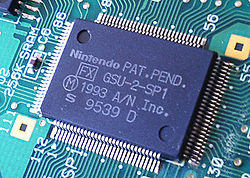
The Super FX is a coprocessor on the Graphics Support Unit (GSU) added to select Super Nintendo Entertainment System (SNES) video game cartridges, primarily to facilitate advanced 2D and 3D graphics. The Super FX chip was designed by Argonaut Games, who also co-developed the 3D space rail shooter video game Star Fox with Nintendo to demonstrate the additional polygon rendering capabilities that the chip had introduced to the SNES.[1]
History
[edit]The Super FX chip design team included engineers Ben Cheese, Rob Macaulay, and James Hakewill.[2] While in development, the Super FX chip was codenamed "Super Mario FX"[3] and "MARIO". "MARIO", a backronym for "Mathematical, Argonaut, Rotation, & Input/Output", is printed on the face of the final production chip.[4] The chip's name would lead to an urban legend that "Super Mario FX" was a video game in development for the SNES.[5]
Because of high manufacturing costs and increased development time, few Super FX based games were made compared to the rest of the SNES library. Due to these increased costs, Super FX games often retailed at a higher MSRP compared to other SNES games.[6]
According to Argonaut Games founder Jez San, Argonaut had initially intended to develop the Super FX chip for the Nintendo Entertainment System. The team programmed an NES version of the first-person combat flight simulator Starglider, which Argonaut had developed for the Atari ST and other home computers a few years earlier, and showed it to Nintendo in 1990. The prototype impressed the company, but they suggested that they develop games for the then-unreleased Super Famicom due to the NES's hardware becoming outdated in light of newer systems such as the Sega Genesis/Mega Drive and the TurboGrafx-16/PC Engine. Shortly after the 1990 Consumer Electronics Show held in Chicago, Illinois, Argonaut ported the NES version of Starglider to the Super Famicom, a process which took roughly one week according to San.[7]
Nintendo later considered integrating Argonaut's Super FX chip into certain Super Famicom and SNES hardware revisions and add-on plans. Jez San said the chip was completed too late for the Japanese Super Famicom launch but was discussed for inclusion in a subsequent SNES hardware revision for the North American market to lower the cost of producing 3D-capable games. He also recalled that during early talks between Nintendo and Sony about a planned SNES CD-ROM peripheral, the companies initially intended for the CD add-on to incorporate the Super FX chip to provide 3D acceleration.[8]
Function
[edit]The Super FX chip is used to render 3D polygons and to assist the SNES in rendering advanced 2D effects. This custom-made RISC processor is typically programmed to act like a graphics accelerator chip that draws polygons to a frame buffer in the RAM that sits adjacent to it. The data in this frame buffer is periodically transferred to the main video memory inside of the console using DMA in order to show up on the television display.
The first version of the chip, commonly referred to as simply "Super FX", is clocked with a 21.4 MHz signal, but an internal clock speed divider halves it to 10.7 MHz. Later on, the design was revised to become the Super FX GSU (Graphics Support Unit); this, unlike the first Super FX chip revision, is able to reach 21 MHz.
All versions of the Super FX chip are functionally compatible in terms of their instruction set. The differences arise in how they are packaged, their pinout, and their internal clock speed. As a result of changing the package from 100 to 112 pins when creating the GSU-2, more external pins were available and assigned for addressing. As a result, a larger amount of external ROM or RAM can be accessed.
Usage
[edit]Star Fox uses the chip for the rendering of hundreds of simultaneous 3D polygons. It uses scaled 2D bitmaps for lasers, asteroids, and other obstacles, but other objects such as ships are rendered with 3D polygons. Super Mario World 2: Yoshi's Island uses the chip for 2D graphics effects like sprite scaling and stretching.
Game cartridges that contain a Super FX chip have additional contacts at the bottom of the cartridge that connect to the extra slots in the cartridge port that are not otherwise typically used. Therefore, Super FX games cannot be plugged into cartridge adapters which predate the release of Super FX games. This includes cheat devices, such as the Game Genie.
List of games
[edit]| Title | Release date | SuperFX version | Frequency | ROM size | Work RAM size | Save RAM size |
|---|---|---|---|---|---|---|
| Star Fox (PAL: Starwing)[9] | February 1993 | Mario Chip[10] | 10.5 MHz (21 MHz / 2)[11] |
8 MBit | 256 KBit | None |
| Dirt Racer[12] | May 1995 | GSU-1 | 21 MHz[11] | 4 MBit | 256 KBit | None |
| Dirt Trax FX[13] | June 1995 | 4 MBit | 512 KBit | None | ||
| Stunt Race FX (JP: Wild Trax)[14] | May 1994 | 8 MBit | 512 KBit | 64 KBit | ||
| Vortex[15] | September 1994 | 4 MBit | 256 KBit | None | ||
| Doom[16] | September 1995 | GSU-2 | 16 MBit | 512 KBit | None | |
| Super Mario World 2: Yoshi's Island[17] | August 1995 | GSU-2-SP1 | 16 MBit | 256 KBit | 64 KBit | |
| Winter Gold[18] | November 1996 | GSU-2 | 16 MBit | 512 KBit | 64 KBit |
Unreleased games
[edit]- Comanche (gameplay looks the same to Super FX voxel demo, but there is no direct connection between both)[19]
- FX Fighter (originally titled Fighting Polygon)[19]
- Power Slide (developed at the same time as Dirt Racer)[20]
- Star Fox 2 (eventually released with the Super NES Classic Edition in 2017)[21]
- Transformers: Generation 2 (abandoned during development)[22]
- Yoshi Racing (prototype that later evolved into Croc: Legend of the Gobbos)[23]
Gallery
[edit]- Variants of the Super FX chip, sorted chronologically
-
 MARIO CHIP 1
 -
 MARIO CHIP 1 (COB)
 -
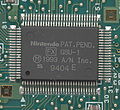 GSU-1
GSU-1 -
 GSU-2
GSU-2 -
 GSU-2-SP1


See also
[edit]- List of Super NES enhancement chips
- ARC (processor)
- Sega Genesis § Sega Virtua Processor
- Synopsys § ARC International - continued development Super FX technology
References
[edit]- ^ "Of argonauts, vectors, and flying foxes: The rise of 3D on Nintendo consoles". BlameTheControlPad.com. Archived from the original on June 13, 2008. Retrieved January 4, 2015.
- ^ Retrobates (April 3, 2014). "Blood". Retro Gamer.
We did most of the technology back in England with a relatively large engineering/tech team, which comprised of Carl Graham and Pete Warnes on the software-based 3D technology and Ben Cheese, Rob Macaulay and James Hakewill working on the hardware side of things
- ^ Cuthbert, Dylan [@dylancuthbert] (February 3, 2012). "@snescentral no, that was the internal code name for the FX chip" (Tweet). Archived from the original on May 25, 2014. Retrieved May 25, 2014 – via Twitter.
- ^ McFerran, Damien (July 4, 2013). "Born slippy: the making of Star Fox". Eurogamer. Gamer Network. Retrieved July 4, 2013.
- ^ Matthew Byrd (7 April 2023). "Super Mario's Biggest Urban Legends and Unsolved Mysteries". Den of Geek. Retrieved 7 February 2024.
- ^ "Cart Queries" (PDF). GamePro. No. 59. IDG. June 1994. p. 12.
- ^ Brookes, Jason; Bielby, Matt (May 1993). "Superplay interview: Jez San, Argonaut". Super Play. No. 7. United Kingdom: Future Publishing. p. 26.
- ^ McFerran, Damien (30 November 2019). "The SNES PlayStation Was Going To Have A Super FX Chip Built-In". Nintendo Life. Retrieved 10 October 2025.
- ^ Strauss, Bob (April 2, 1993). "Star Fox". Entertainment Weekly. Retrieved January 1, 2019.
- ^ "Super NES Programming/Super FX tutorial - Wikibooks, open books for an open world". en.wikibooks.org. Retrieved 2021-09-12.
- ^ a b "Super FX Chip (Concept)". Giant Bomb. Retrieved 2021-09-13.
- ^ "Dirt Racer". SNES Central. Retrieved July 20, 2014.
- ^ "Dirt Trax FX". SNES Central. Retrieved July 20, 2014.
- ^ "Stunt Race FX". SNES Central. Retrieved July 20, 2014.
- ^ "Vortex". SNES Central. Retrieved July 20, 2014.
- ^ "Doom". SNES Central. Retrieved July 20, 2014.
- ^ Harris, Craig (May 24, 2002). "E3 2002: Hands-on Impressions: Yoshi's Island". IGN. Ziff Davis. Archived from the original on August 20, 2016. Retrieved January 1, 2019.
- ^ F.J. McCloud. "A Super FX FAQ". anthrofox.org. Retrieved 13 September 2019.
- ^ a b "Super FX Series: Cancelled Super FX Games". ScrewAttack.com. 2013-07-04. Archived from the original on 2013-08-30. Retrieved 2015-04-13.
- ^ Lee (October 28, 2009). "Powerslide FX [SNES / 3DO - Unreleased] - Unseen64". Unseen64.
- ^ Sao, Akinori. "Developer Interview: Star Fox & Star Fox 2 - Super Nintendo Entertainment System: Super NES Classic Edition - Official Site". Nintendo of America. Retrieved January 18, 2018.
- ^ "The Making of: Vortex". Retro Gamer. No. 147. United Kingdom: Imagine Publishing. October 2015. pp. 38–41.
- ^ "Croc: Legend of the Gobbos". Retro Gamer. No. 154. United Kingdom: Imagine Publishing. April 2016. pp. 88–91.
External links
[edit]
- "Nintendo Land Tech Page". Archived from the original on April 11, 2009. Retrieved May 9, 2019.
Super FX
View on Grokipedia- Super FX (GSU-1): Star Fox (1993, North America; known as Starwing in Europe), Stunt Race FX (1994), Dirt Trax FX (1995), and Vortex (1994), which leveraged the chip for pseudo-3D racing and flight simulations.[2][3]
- Super FX-2 (GSU-2): Super Mario World 2: Yoshi's Island (1995), Doom (1995, by Williams Entertainment), and Star Fox 2 (unreleased prototype, later included in the 2017 SNES Classic Edition), showcasing applications in platforming with dynamic transformations and first-person shooters.[1][2][3]
Development
Origins
In the early 1990s, the Super Nintendo Entertainment System (SNES), launched in 1990 in Japan and 1991 in North America, was primarily designed for 2D sprite-based graphics, relying on tilemaps and layered backgrounds for scrolling effects, which severely limited its capacity for rendering 3D polygons without external assistance.[4] The system's Ricoh 5A22 CPU, a derivative of the 6502 processor clocked at around 3 MHz, lacked native support for multiplication and division operations essential for 3D transformations, making real-time polygon processing computationally prohibitive on the 16-bit hardware alone.[4] These constraints stemmed from the era's focus on cost-effective 2D gaming, leaving developers seeking advanced visuals inspired by arcade innovations to explore custom solutions.[5] Argonaut Software, founded by Jez San in 1982, emerged as a key innovator in this space through early experiments with 3D graphics on home consoles, drawing inspiration from arcade titles like Hard Drivin' and Atari's Star Wars vector graphics.[6] The company had previously demonstrated rudimentary 3D capabilities on the NES with prototypes like NesGlider, highlighting the potential to extend such techniques to more powerful systems.[5] In 1989, Argonaut further impressed Nintendo with a 3D demo on the Game Boy achieved by hacking the hardware to bypass limitations. San, driven by a passion for space combat and flight simulation games reminiscent of his earlier title Starglider (1986), envisioned bringing true 3D experiences to console audiences, prompting Argonaut to pursue hardware enhancements tailored for the SNES.[6] In July 1990, Jez San pitched a custom coprocessor concept directly to Nintendo executives during a meeting in Kyoto, proposing a chip to enable pseudo-3D effects by offloading intensive calculations from the main CPU.[5] This initiative was motivated by the need to overcome the SNES's inherent 2D architecture, with the conceptual goal of accelerating polygon rendering and coordinate transformations to render feasible 3D visuals on 16-bit hardware without implementing a complete 3D rendering pipeline.[6] Nintendo's approval of the pitch marked the genesis of what would become the Super FX chip, positioning Argonaut as a pivotal collaborator in expanding console graphical frontiers.[5]Design Process
The design process for the Super FX chip, also known as the Graphical Support Unit (GSU), originated from a collaboration between British developer Argonaut Software and Nintendo, formalized in 1991. Argonaut founder Jez San approached Nintendo with a proposal to create a custom coprocessor that could handle 3D polygon rendering on the Super Nintendo Entertainment System (SNES), building on earlier software-based 3D experiments attempted for the Nintendo Entertainment System (NES). Nintendo approved the project, recognizing the potential to enhance the SNES's graphical capabilities beyond its original design, and the small Argonaut team began specifying and implementing the chip as a cartridge-based ASIC rather than a console-integrated component due to development timelines.[7][8] Prototyping presented significant engineering challenges, including the creation of a custom 16-bit RISC instruction set optimized for polygon transformation and rendering, while balancing constraints on power consumption, thermal management, and manufacturing costs to fit within affordable game cartridges. The team addressed these by designing the chip to operate at 10.74 MHz (up to 21.48 MHz without clock division), ensuring compatibility with the SNES's 3.58 MHz bus without excessive heat generation that could affect cartridge reliability.[1] First silicon tape-outs occurred in late 1991, followed by iterative revisions to refine performance and integration, with early prototypes demonstrating basic 3D capabilities like wireframe rendering. These efforts were complicated by the need to interface seamlessly with the SNES's limited memory and I/O systems, requiring careful optimization to avoid bottlenecks in data transfer.[9][10] Key milestones marked steady progress toward commercialization, with the GSU-1 (Super FX) version finalized in 1992 after approximately two years of development. This culminated in rigorous testing using early prototypes of Star Fox, Nintendo's flagship title to showcase the chip's polygon rendering for real-time 3D environments. Cost negotiations between Argonaut, Nintendo, and manufacturers focused on keeping the chip's per-unit price low—estimated at around $10—to minimize impact on retail game prices, though this still positioned Super FX titles as premium products compared to standard SNES cartridges. Team contributions were pivotal, particularly from programmer Giles Goddard, who played a central role in designing the chip's hardware and optimizing its communication protocols with the SNES bus for efficient command and data exchange. Drawn from Argonaut's young talent pool, including Dylan Cuthbert, the group overcame resource limitations through innovative problem-solving, such as leveraging existing DSP techniques from games like Pilotwings for inspiration.[9][2][10]Technical Specifications
Core Architecture
The Super FX, also known as the Graphics Support Unit (GSU), features a 16-bit RISC-like processor core designed specifically for accelerating graphics and mathematical computations in Super Nintendo Entertainment System (SNES) cartridges.[11] This processor includes 16 general-purpose 16-bit registers (R0 through R15), with R14 serving as a ROM address pointer and R15 functioning as the program counter.[11] The custom instruction set is optimized for vector mathematics and graphics processing, incorporating operations such as multiply-accumulate (via MULT and LMULT instructions) to enable efficient transformations and rendering tasks.[11] Internally, the GSU-1 core integrates a 512-byte instruction cache for rapid execution, alongside access to external cartridge components including 32 or 64 KB of SRAM for data storage and Game Pak ROM for program code, including bootstrap routines.[11] A parallel 8-bit by 8-bit multiplier supports extended 16-bit by 16-bit operations, facilitating fast coordinate and matrix calculations essential for 3D graphics.[11] The core operates at a base clock speed of 10.74 MHz—derived from the SNES's 21.48 MHz master clock—up to 21.48 MHz by disabling the internal clock divider via the CLSR register bit, with pipelined execution enabling overlapping instruction fetch and execution.[11] Data flow within the architecture relies on independent buses for ROM and RAM access, enabling parallel operations with the SNES CPU while sharing the cartridge slot interface.[11] Transfers occur via DMA-like mechanisms, where the GSU coordinates data movement from its accessible RAM to the SNES Picture Processing Unit (PPU) for pixel plotting, using buffering to minimize latency.[11] All arithmetic is performed in fixed-point format using 16-bit operations (addition, subtraction, multiplication, and right-shift division), without a dedicated floating-point unit, to handle 3D coordinate manipulations efficiently on integer hardware.[11] The chip is housed in a 100-pin Quad Flat Package (QFP) for integration into cartridges.[2]Hardware Versions
The original version of the Super FX chip, designated GSU-1, was released in 1993 and could operate at clock speeds of 10.74 MHz (divided) or 21.48 MHz (full), configurable via the CLSR register bit, with up to 32 or 64 KB of RAM, facilitating the initial implementation of 3D polygon rendering in titles such as Star Fox.[12] Designed by Argonaut Software and produced by Nintendo, the GSU-1 served as a RISC-based coprocessor integrated into select SNES cartridges to handle intensive geometric calculations beyond the capabilities of the base console hardware, with ROM access limited to 1 MB (8 Mbit).[12][13][14] In 1995, the successor chip, known as Super FX-2 or GSU-2, was introduced with support for the full 21.48 MHz clock speed, 32 or 64 KB RAM capacity (commonly 64 KB in titles), and an expanded 112-pin package allowing ROM access up to 2 MB (16 Mbit).[12][14] This upgrade allowed for more complex graphical computations in later games while preserving backward compatibility with existing GSU-1 software, enabling developers to leverage the improved hardware without major code revisions.[15] Production of the GSU-2 benefited from cost optimizations in manufacturing, which broadened its adoption across additional titles compared to the initial version.[15] Both hardware versions shared key limitations, including the absence of dedicated hardware texture mapping and a dependence on the SNES main processor for final rasterization and display output, as the Super FX primarily managed transformation and pixel plotting tasks.[15] The chips reflected their focused role as specialized accelerators rather than full-system processors.[13]Functionality
Graphics Acceleration
The Super FX enhances visual effects on the Super Nintendo Entertainment System (SNES) by serving as a dedicated graphics coprocessor, primarily accelerating 3D rendering tasks that would otherwise overburden the main CPU. This RISC-based chip, operating at clock speeds up to 21.4 MHz, performs computationally intensive operations to generate pseudo-3D graphics, freeing the SNES processor for game logic and other functions.[11] Central to its graphics acceleration is polygon rendering, where it supports flat-shaded polygons at rates of 15,000 to 20,000 per second, as demonstrated in optimized scenarios like combat simulations.[16] The chip employs transformation matrices, such as 3x3 multiplications in 16-bit fixed-point arithmetic, to enable rotation, scaling, and positioning of vertices, using instructions like ROTATE and PROJECT for efficient coordinate manipulation.[11] Key effects facilitated include point-sampled texture mapping via affine transformations, which apply linear mappings to rasterize textured surfaces; sprite sorting to approximate depth ordering in layered scenes; and Mode 7 enhancements, extending the SNES's native affine background mode for smoother pseudo-3D terrain and environmental effects.[2] These capabilities rely on the chip's high-speed multiplication (e.g., 16x16-bit operations in 7-11 cycles depending on memory access) and division instructions to process visual data rapidly.[11] The rendering pipeline begins with vertex transformation in 3D space, followed by clipping against view volumes, perspective projection to 2D coordinates, and transfer of the resulting polygon data to the SNES PPU for final scanline rasterization and display. This offloads the CPU, enabling complex scenes without halting gameplay.[17] In benchmarks, the Super FX delivers 15-20 frames per second in flight simulator-style applications featuring low-polygon models, typically 100-200 polygons on-screen, balancing visual fidelity with real-time performance.[2] Its 16 general-purpose RISC registers streamline these math-heavy operations, contributing to the overall efficiency of graphics processing. Differences between GSU-1 and GSU-2 include expanded ROM addressing in the latter (up to 2 MB vs. 1 MB), enabling more complex programs.[1]Processing Capabilities
The Super FX, also known as the Graphics Support Unit (GSU), features a 16-bit RISC processor designed for efficient general-purpose computations, particularly those involving mathematical operations essential for real-time game processing. It includes dedicated hardware support for multiplication and division, enabling faster handling of integer arithmetic compared to the main SNES CPU. This allows the chip to perform vector operations for 3D transformations independently, offloading complex calculations from the host processor without requiring CPU intervention during execution.[4] Key to its processing efficiency is its support for high-speed integer multiplication, with instructions optimized for both 8-bit and 16-bit operands; for instance, 8-bit multiplications can complete in as few as 2-5 cycles depending on configuration, while 16-bit operations take 7-14 cycles. These capabilities make it suitable for tasks like matrix multiplications in 3D math pipelines. The processor operates at a base clock speed of 10.74 MHz or 21.48 MHz (selectable), with cache access enabling faster execution by avoiding wait states (effectively up to twice as fast as external memory access), achieving approximately 4-10 MIPS of performance in optimized game scenarios at full speed—sufficient for real-time simulations but limited by the need for data synchronization with the SNES system.[4][2][17] In terms of memory management, the Super FX includes up to 64 KB (with architectural support for 128 KB in GSU-2) of dedicated addressable RAM, primarily used for object data, program variables, and intermediate computation results, which can be shared with the SNES for output buffering; the size varies by cartridge (e.g., 32 KB in most GSU-1 games, 64 KB in some GSU-2 titles). It employs a 512-byte instruction cache to enable pipelined execution, allowing overlapping of fetch and execute phases for smoother operation when code is loaded into cache—effectively tripling access speed relative to external ROM or RAM. The chip can address up to 1 MB of ROM for game code and data in its initial version (GSU-1), with higher-capacity variants supporting more, facilitating self-contained programs for computational tasks.[4][17][1] Beyond core math, the Super FX's architecture supports other non-graphical computations, such as simulating particle systems through iterative position and velocity updates in its RAM, as seen in effects like explosions or debris in supported titles. It also enables procedural generation of terrain or objects via custom algorithmic loops executed on-chip, reducing reliance on precomputed assets. For limited AI tasks, such as basic pathfinding in 3D spaces, developers could implement simple search algorithms using the chip's registers and loops, though constrained by its overall throughput. However, its efficiency for real-time tasks is bottlenecked by the SNES main bus bandwidth of approximately 2.68 MHz for effective data transfers between the chip and system memory.[4][18]Implementation
Integration with SNES
The Super FX chip, also known as the Graphics Support Unit (GSU), is integrated into select SNES cartridges and interfaces directly with the console via the cartridge slot's 62-pin connector. This connection maps specific control signals to the SNES expansion port equivalents, including the /GSU_RST pin for resetting the GSU and the /GSU_RD pin for reading GSU registers and memory, which are tied to the cartridge's address bus lines (e.g., pins 23 and 54 for read/write controls).[19] The chip shares the 8-bit bidirectional data bus (cartridge pins 19-22 and 50-53) with the SNES CPU, enabling access to the shared RAM (32–128 KiB depending on the cartridge) and ROM for graphics data exchange.[20] Communication between the Super FX and SNES occurs over this shared data bus, with the CPU writing commands to GSU registers to initiate processing and polling or using interrupts for synchronization. The GSU can assert the /IRQ line (cartridge pin 18) to interrupt the SNES CPU, signaling task completion, often timed with V-blank periods to avoid display tearing during graphics updates.[14] For efficient data transfer, the SNES CPU employs DMA bursts to upload textures or rendered pixels from the shared RAM (32–128 KiB depending on the cartridge) directly to PPU VRAM, bypassing slower CPU cycles and supporting real-time rendering.[21] This protocol ensures seamless operation without halting the main CPU. For the GSU-2 variant, integration supports expanded RAM (up to 128 KiB) and ROM access, with a 112-pin package and full 21.48 MHz clock. The Super FX draws power from the SNES's 5V rail supplied through cartridge pins 27 and 58, with no dedicated 3.3V rail required for its operation.[22] Heat generated by the chip during intensive polygon rendering dissipates passively through the plastic cartridge casing, a design constraint of the enclosed SNES cartridge ecosystem. Nintendo licensed the Super FX technology from Argonaut Games and mandated certification for all implementations, verifying hardware compliance and integrating lockout mechanisms to deter piracy via unauthorized copies.[14] The integration maintains full compatibility across all SNES models, including NTSC and PAL variants, as the chip idles without address access and draws negligible power in inactive states, ensuring no interference with standard cartridges lacking the GSU.[23]Game Development Usage
Developers relied on specialized tools from Argonaut Games, including a software development kit (SDK) with an assembler tailored for the GSU's RISC instruction set, such as the ARGOS2.EXE program copyrighted in 1992. Nintendo complemented this with official development kits that featured flashable cartridges, enabling rapid prototyping and debugging through physical cartridge swaps to test code iterations on actual hardware. These tools were critical for managing the chip's unique architecture, though limited documentation often required reverse-engineering efforts. The typical workflow involved writing low-level assembly code directly for the GSU to maximize performance in graphics-intensive tasks, such as 3D polygon transformations and rasterization. A hybrid division of labor was standard, with the GSU dedicated to compute-heavy operations like rendering polygons, while the SNES's main 65816 CPU handled non-graphics elements including user interface, input processing, and audio. Optimization strategies, such as polygon culling to eliminate off-screen or hidden geometry, were essential to fit real-time 3D effects within the system's constraints and achieve playable frame rates. Key challenges included the GSU's RISC design, which imposed a steep learning curve compared to the more familiar CISC-based SNES CPU, necessitating specialized expertise in efficient instruction use. ROM budgeting proved restrictive, as GSU code and data shared the cartridge's total capacity—typically 1–2 MB for released titles, with theoretical support up to 2 MB for GSU-2—demanding careful allocation to avoid exceeding limits. Developers also navigated bus contention issues, where the GSU's faster clock speed clashed with slower ROM access, requiring synchronized memory management. Licensing added further hurdles, involving formal agreements and royalty payments to both Argonaut Games and Nintendo, which increased production costs. The need for custom printed circuit boards (PCBs) per title to integrate the Super FX chip exacerbated expenses, contributing to low adoption; only around 10 games ultimately utilized the technology due to these financial barriers.Games
Released Titles
The Super FX chip powered a select group of officially released Super Nintendo Entertainment System (SNES) games between 1993 and 1996, with eight titles documented across North America, Japan, and PAL regions.[24] These games harnessed the chip's polygon rendering and processing strengths to enable 3D elements and advanced effects, transitioning from the GSU-1 variant in initial releases for basic 3D acceleration to the upgraded GSU-2 in later titles for smoother performance and expanded capabilities like increased RAM. Star Fox, released in 1993 by Nintendo and co-developed by Argonaut Software, served as the debut showcase for the Super FX, employing the GSU-1 at 10.5 MHz to generate polygonal models for enemy ships, terrain, and the player's Arwing fighter in a pioneering 3D rail shooter format. The chip's real-time transformation and rotation functions created the illusion of full 3D space combat, setting a benchmark for console graphics enhancement.[25][26] Stunt Race FX, launched in 1994 by Nintendo and Argonaut Software, utilized the GSU-1 to render 3D stunt tracks and vehicles in a futuristic racing game, integrating the chip's polygon capabilities with the SNES's Mode 7 scaling for dynamic perspectives and jumps. This title demonstrated the Super FX's potential for non-shooter genres, allowing for scalable 3D environments that emphasized speed and spectacle.[27] Super Mario World 2: Yoshi's Island, released in 1995 by Nintendo, incorporated the more advanced GSU-2 to enhance 2.5D platforming levels with fluid sprite scaling, stretching, and special effects like the baby's transformation mechanics and crayon-like visuals. The chip offloaded complex rendering tasks from the main CPU, enabling richer animations and layered depth that defined the game's whimsical aesthetic.[28] Among other releases, Doom (1995, ported by Sculptured Software and published by Williams Entertainment) adapted the first-person shooter to SNES using the GSU-2 for 3D maze navigation, enemy rendering, and texture mapping, achieving playable frame rates despite hardware limits through custom optimizations. Titles like Vortex (1994, Argonaut Software, GSU-1 for mech-based 3D shooting), Dirt Trax FX (1995, Acclaim Entertainment, GSU-1 for motocross terrain), and PAL-region exclusives such as Dirt Racer (1995, GSU-1 for off-road racing) and Winter Gold (1996, Funcom, GSU-2 for winter sports simulations) rounded out the catalog, collectively illustrating the chip's versatility in genres from action to simulation.[29][30][31]Unreleased Projects
Star Fox 2, developed by Nintendo and Argonaut Software in 1995, represented an advanced sequel to the original Star Fox, featuring branching levels, on-rails shooting with free-roaming exploration segments, and enhanced 3D graphics powered by the Super FX2 chip.[32] The project was fully completed and passed quality assurance by 1996 but was canceled as Nintendo shifted focus to the Nintendo 64 amid competition from the PlayStation and Saturn.[33] Prototypes leaked online as early as 1999, allowing fan preservation through emulation until its official release on the SNES Classic Edition in 2017.[33] FX Fighter, a 3D fighting game prototyped by Argonaut Software in 1995, aimed to showcase real-time polygonal combat on the SNES using the Super FX chip, with features like over 40 moves per character and blocky, Virtua Fighter-inspired graphics.[34] A technical demo was displayed at the Winter 1995 Consumer Electronics Show alongside Star Fox 2, and screenshots appeared in the February 1995 issue of Joypad magazine.[34] The SNES version was ultimately shelved due to the transition to 32-bit consoles, though a downgraded PC port was released by GTE Entertainment later that year.[34] Other prototypes included PowerSlide, a realistic racing game developed by Elite Systems and MotiveTime around 1994, which utilized the Super FX chip for rigid-body dynamics and split-screen multiplayer but reached only about 70% completion before cancellation owing to high cartridge production costs.[35] Additional canceled projects, such as Comanche—a 3D helicopter simulator by Argonaut Software—further highlighted the chip's untapped potential.[3] Argonaut's internal tests during this period explored additional 3D concepts, but the rapid industry shift to the Nintendo 64 and escalating Super FX chip expenses halted further development on these SNES-bound projects.[33] ROM dumps of several unreleased Super FX prototypes, including Star Fox 2 and FX Fighter, surfaced in the 2010s, enabling playability via accurate emulators such as bsnes.[33]Legacy
Industry Impact
The Super FX chip represented a technological milestone as the first dedicated 3D graphics accelerator in a consumer video game console, enabling real-time rendering of polygons on the 16-bit Super Nintendo Entertainment System (SNES) through its custom RISC processor design.[36] Developed by Argonaut Software in collaboration with Nintendo, it delivered approximately 40 times faster 3D graphics performance compared to the base SNES hardware, allowing games to compute vector graphics, sprite transformations, and basic 3D math on cartridge-embedded hardware.[37] This innovation directly inspired competitors, notably Sega's Virtua Processor (SVP) chip, which was developed as a reaction to the Super FX and integrated into the Mega Drive/Genesis cartridge for Virtua Racing to achieve similar polygon-based 3D effects with even higher performance.[38] The SVP's approach mirrored the Super FX by offloading 3D processing from the main CPU; Sega later shifted focus to add-on hardware like the 32X after limited use of the SVP.[14] In market terms, the Super FX significantly boosted SNES longevity and sales during the mid-1990s 16-bit era, primarily through flagship titles like Star Fox, which sold over 4 million units worldwide according to developer Argonaut Games.[39] As Nintendo's first mainstream 3D game, Star Fox served as a killer application that demonstrated the console's potential for advanced visuals, sustaining interest against emerging 32-bit competitors and contributing to the SNES's overall shipment of over 49 million units.[37] The chip's viability for co-processors also paved the way for integrated 3D hardware in next-generation systems; it was slated for inclusion in the canceled SNES PlayStation prototype—a joint Sony-Nintendo venture—where it would have served as the core 3D engine.[36] The Super FX encouraged a shift toward hybrid 2D/3D game design, blending polygonal environments with traditional 2D sprites to overcome hardware limitations while creating immersive depth—Star Fox, for instance, used 3D polygons for terrain and ships alongside 2D bitmaps for projectiles and enemies.[37] This approach influenced the transition from sprite-based 2D titles to more dynamic experiences during the 16-bit to 32-bit era, with Argonaut's expertise from the Super FX leading to further Nintendo collaborations, including N64 development projects like Star Fox 64 that advanced 3D gameplay mechanics.[40] However, the chip faced criticisms for limited adoption, with only about eight games utilizing it due to high manufacturing costs that raised cartridge prices by $10–15 over standard SNES titles, making development and retail less economical for third parties.[14] This scarcity highlighted the need for built-in 3D processing in next-generation consoles, such as the Nintendo 64's Reality Coprocessor, which integrated graphics acceleration directly into the system to avoid per-game expenses.[36]Preservation and Emulation
Emulation of the Super FX chip, also known as the Graphics Support Unit (GSU), has been a key focus for SNES preservation efforts, with tools like bsnes and higan providing cycle-accurate simulation of its operations.[41] These emulators replicate the chip's 16-bit RISC architecture, including its instruction and pixel caches, through reverse-engineering techniques that ensure compatibility with games like Star Fox.[41] However, challenges arise in fully replicating the Super FX's fixed-point mathematics without access to original silicon, as the chip's custom 16-bit operations for 3D rendering require precise timing emulation to avoid desynchronization or visual artifacts.[18][42] Fan-driven projects have extended Super FX functionality through homebrew developments and ROM modifications. Homebrew efforts, such as demos utilizing the Super FX for 3D polygons and animations, demonstrate ongoing experimentation with the chip on modern hardware like flash carts including the EverDrive and FX PAK Pro, which support Super FX execution for custom titles.[43][44] ROM hacks, such as those overclocking the Super FX to 21 MHz mode or upgrading Star Fox to use Super FX 2 capabilities, enhance original games by improving framerates and adding features like enhanced audio via MSU-1 integration.[45][46] Official revivals of Super FX titles have relied on emulated implementations rather than hardware recreations. Nintendo Switch Online added Star Fox to its SNES library in 2019, using an emulated Super FX chip to faithfully reproduce the game's polygonal graphics, marking a significant step in accessible preservation.[47] In 2025, Limited Run Games released a definitive edition of Doom for SNES, featuring all four episodes and a custom "Super FX 3" chip for enhanced processing power, representing a modern hardware revival of Super FX technology.[48][49] No official hardware re-releases of original Super FX-equipped cartridges have occurred, limiting physical preservation to original silicon.[50] Legal aspects of Super FX preservation have evolved with the expiration of related patents around 2016, which some observers linked to increased re-releases, though the chip's design rights remained with Nintendo.[50] Community efforts, including ROM dumping by services like Hidden Palace, have preserved prototypes such as early Star Fox builds, aiding archival access to unreleased Super FX projects.[51][52]References
- https://en.wikibooks.org/wiki/Super_NES_Programming/Super_FX_tutorial