Hubbry Logo
SwagmanSwagmanMain
Open search
Swagman
Community hub
Swagman
logo
8 pages, 0 posts
0 subscribers
Be the first to start a discussion here.
Swagman
Swagman
from Wikipedia

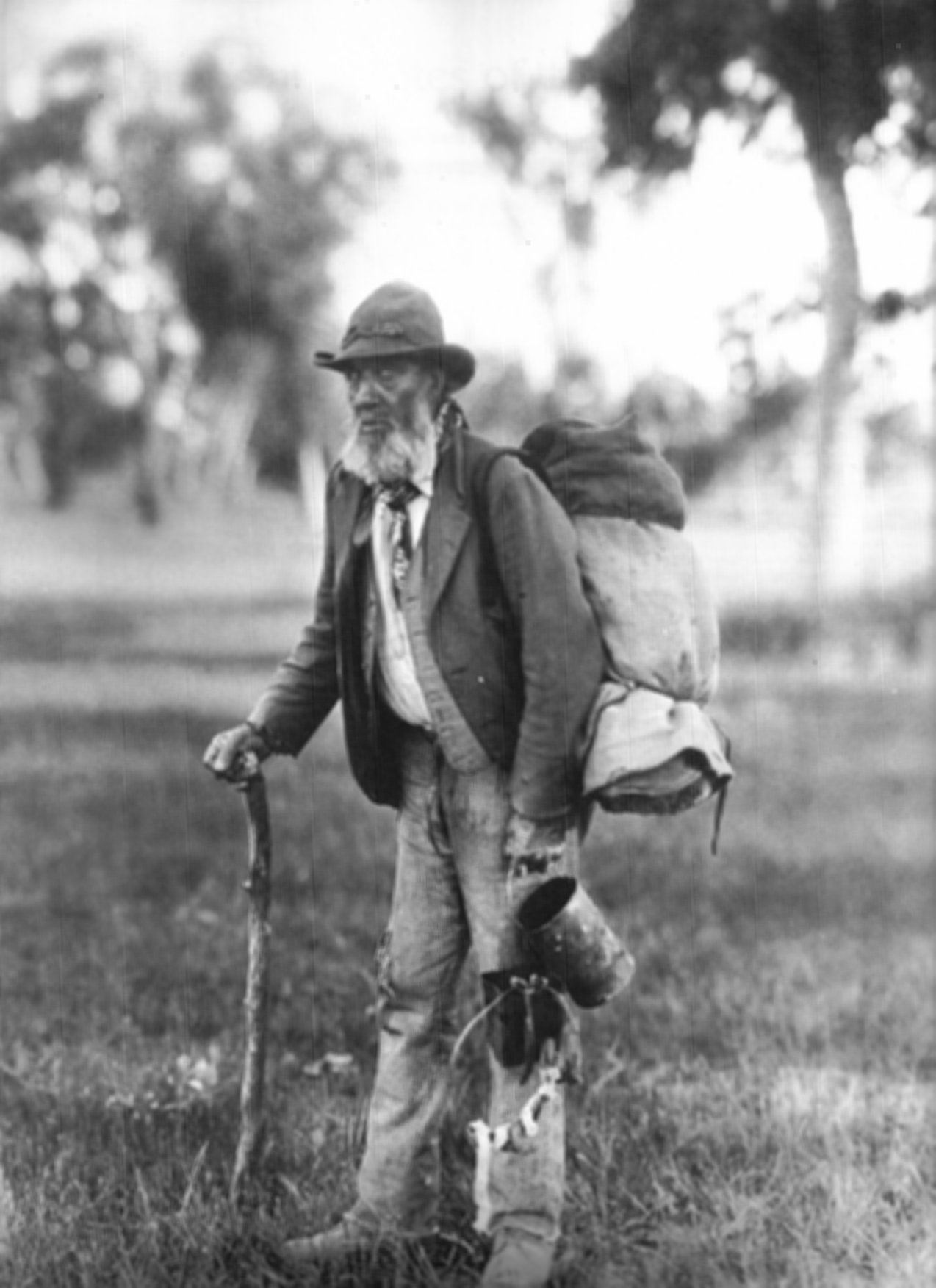
Photograph of a swagman, c. 1901

A swagman (also called a swaggie, sundowner or tussocker) was a transient labourer who travelled by foot from farm to farm carrying his belongings in a swag. The term originated in Australia in the 19th century and was later used in New Zealand.

Swagmen were particularly common in Australia during times of economic uncertainty, such as the 1890s and the Great Depression of the 1930s. Many unemployed men travelled the rural areas of Australia on foot, their few meagre possessions rolled up and carried in their swag. Their swag was frequently referred to as "Matilda", hence Waltzing Matilda refers to walking with their swag. Typically, they would seek work in farms and towns they travelled through, and in many cases the farmers, if no permanent work was available, would provide food and shelter in return for some menial task.

The figure of the "jolly swagman", represented most famously in Banjo Paterson's bush poem "Waltzing Matilda", became a folk hero in 19th-century Australia, and is still seen today as a symbol of anti-authoritarian values that Australians considered to be part of the national character.

Etymology

[edit]

In the early 1800s, the term swag was used by British thieves to describe any amount of stolen goods. One definition given in Francis Grose's 1811 Dictionary of the Vulgar Tongue is "any booty you have lately obtained,.... To carry the swag is to be the bearer of the stolen goods to a place of safety."[1] James Hardy Vaux, a convict in Australia, used the term for similar purposes in his memoirs written in 1812 and published in 1819.[2] By the 1830s, the term in Australia had transferred from meaning goods acquired by a thief to the possessions and daily necessaries carried by a bushman. The compound swagman and colloquial variation swaggie first appeared in the 1850s during the Australian gold rushes, alongside less common terms such as bundleman.[3] New Zealanders adopted the term in the 1880s, where swagmen were also known as swaggers.[4] Swagger also originated in Australia, but became obsolete there by the 1890s.[5]

Swagman, n.d.

History

[edit]
Down on His Luck, painted by Frederick McCubbin in 1889, depicts a melancholic swagman "on the Wallaby"

Before motor transport became common, the Australian wool industry was heavily dependent on itinerant shearers who carried their swags from farm to farm (called properties or "stations" in Australia), but would not in general have taken kindly to being called "swagmen". Outside of the shearing season their existence was frugal, and this possibly explains the tradition (of past years) of sheep stations in particular providing enough food to last until the next station even when no work was available. Some were especially noted for their hospitality, such as Canowie Station in South Australia which around 1903 provided over 2,000 sundowners each year with their customary two meals and a bed.[6]

A romanticised figure, the swagman is famously referred to in the song "Waltzing Matilda", by Banjo Paterson, which tells of a swagman who turns to stealing a sheep from the local squatter.

The economic depressions of the 1860s and 1890s saw an increase in these itinerant workers. During these periods it was seen as 'mobilising the workforce'. At one point it was rumoured that a "Matilda Waltzers' Union" had been formed to give representation to swagmen at the Federation of Australia in 1901.

During the early years of the 1900s, the introduction of the pension and the dole reduced the numbers of swagmen to those who preferred the free lifestyle. During World War I many were called up for duty and fought at Gallipoli as ANZACs. The song "And The Band Played Waltzing Matilda" tells the story of a swagman who fought at Gallipoli.

The numbers of swagmen have declined over the 20th century, but still rising in times of economic depression. Swagmen remain a romantic icon of Australian history and folklore.

Swags are still heavily used, particularly in Australia, by overlanders and campers. There are still a large number of manufacturers actively making both standard and custom-design swags.

Lifestyle

[edit]
A picture of an old man sitting alone on a straw chair with his head in his hands, evoking intense despair.
'The Shiner', a South Island swagman from the 1870s to the 1920s[7]
(Robifearnside), ref Henry Lawson 'Selected Stories' 'The Romance of the Swag p449' Pub by A&R Classics
George Lambert, Sheoak Sam, 1898. Most swagmen travelled alone or with a dog.

Swagmen were often victims of circumstance who had found themselves homeless. Others were rovers by choice, or else they were on the run from police (bushrangers). Many were European or Asian migrants seeking fortune on the goldfields. One such swagman was Welshman Joseph Jenkins, who travelled throughout Victoria between 1869 and 1894, documenting his experiences in daily diary entries and through poetry.[8] Swagmen ranged in age from teenagers to the elderly. Socialist leader John A. Lee's time as a swagman while a teenager informed his political writing,[9] and also featured directly in some of his other books. Novelist Donald Stuart also began his life as a swagman at age 14. Several of his novels follow the lives of swagmen and aborigines in the Kimberley and Pilbara regions of Western Australia. Many swagmen interacted with Aboriginals along their travels; bushwear designer R. M. Williams spent his latter teen years as a swagman travelling across the Nullarbor Plain, picking up bushcraft and survival skills from local Aboriginal tribes such as cutting mulga, tracking kangaroos and finding water.

At times they would have been seen in and around urban areas looking for work or a handout. Most eyewitness descriptions of swagmen were written during the period when the country was 'riding on the sheep's back'. At this time, rovers were offered rations at police stations as an early form of the dole payment. They roamed the countryside finding work as sheep shearers or as farm hands. Not all were hard workers. Some swagmen known as sundowners would arrive at homesteads or stations at sundown when it was too late to work, taking in a meal and disappearing before work started the next morning. The New Zealand equivalent of a sundowner was known as a tussocker.[5]

Most existed with few possessions as they were limited by what they could carry. Generally they had a swag (canvas bedroll), a tucker bag (bag for carrying food) and some cooking implements which may have included a billy can (tea pot or stewing pot). They carried flour for making damper and sometimes some meat for a stew.

In Henry Lawson's short story 'The Romance of the Swag', he describes in detail how to make a dinky-die Aussie swag. Lawson states, 'Travelling with the swag in Australia is variously and picturesquely described as "humping bluey", "walking Matilda", "humping Matilda", "humping your drum", "being on the wallaby", "jabbing trotters", and "tea and sugar burglaring".'[10]

Swagmen travelled with fellow 'swaggies' for periods, walking where they had to go, hitch hiking or stowing aboard cargo trains to get around. They slept on the ground next to a campfire, in hollowed out trees or under bridges.

[edit]
Swagman float at the 2008 Adelaide Christmas Pageant

In the 19th century, Australian bush poetry grew in popularity alongside an emerging sense of Australian nationalism. The swagman was venerated in poetry and literature as symbolic of Australian nationalistic and egalitarian ideals. Popular poems about swagmen include Henry Lawson's Out Back (1893) and Shaw Neilson's The Sundowner (1908). In 1902, Barbara Baynton published a collection of short stories titled Bush Studies. The final story, "The Chosen Vessel" (1896), gives an account of a woman alone in a bush dwelling, where she is preyed upon and eventually raped and murdered by a passing swagman. This was in stark contrast to traditional bush lore, where swagmen are depicted in distinctly romantic terms. Swagmen were also prominent in the works of those associated with the Jindyworobak Movement, including poet Roland Robinson, who was a swagman for much of his life before World War II.

Coinciding with trends in 19th-century Australian literature, swagmen were popular subjects of contemporary painters and illustrators. Drawings of swagmen, itinerant bush workers, rural nomads and other men "on the wallaby" were prevalent in newspapers and picturesque atlases. ST Gill and James Alfred Turner popularised the open-air life of the swagman. By the 1880s, swagmen featured in the works of Tom Roberts, Walter Withers, Arthur Streeton, Frederick McCubbin, and other artists associated with the Melbourne-based Heidelberg School, which is customarily held to be the first distinctly Australian movement in Western art and the "golden age of national idealism" in Australian painting.[11]

Swagmen and other characters of the bush were popular subjects of the silent film era of Australian cinema. Raymond Longford's 1914 The Swagman's Story starred Lottie Lyell. 1936's The Flying Doctor was directed by Miles Mander and starred Charles Farrell as a swagman travelling through the Blue Mountains towards Sydney. Swagmen have been the subject of numerous books including the 1955 novel The Shiralee by D'Arcy Niland, which was made into a 1957 film, starring Peter Finch (who himself lived as a swagman during early adulthood[12]), and a 1987 TV mini-series, starring Bryan Brown. Norman Kaye played the role of a swagman in the 1976 bushranger film Mad Dog Morgan.[13] Arthur Upfield wrote a number of novels about swagmen including Death of a Swagman (1942), The Bushman Who Came Back (1957) and Madman's Bend (1963). In the 1981 film adaptation of Ethel Pedley's 1899 children's book Dot and the Kangaroo, a magical swagman helps Dot find Mother Kangaroo's lost joey.[14] The Scottish singer-songwriter Alistair Hulett wrote a song about the 'swaggies' called "The Swaggies Have All Waltzed Matilda Away".

In the 1946 Sherlock Holmes film Dressed to Kill, a tune called "The Swagman", heard on an old music box, plays an important role in solving the mystery.

The Australian Batman villain Swagman derives his name from the term, but takes more conceptual inspiration from Australian bushranger Ned Kelly, who wore a suit of bulletproof armour during his final shootout with Australian law enforcement.

List of swagman bush ballads

[edit]
1887 studio portrait of a swagman by John William Lindt
  • "Australia's on the Wallaby"
  • "Four Little Johnny Cakes"
  • "Humping Old Bluey"
  • "My Old Black Billy"
  • "The Old Bark Hut"
  • "The Ramble-eer"
  • "The Reedy Lagoon"
  • "Snake Gully Swagger"
  • "Waltzing Matilda"
  • "With My Swag on My Shoulder"

References

[edit]

Further reading

[edit]
Revisions and contributorsEdit on WikipediaRead on Wikipedia
from Grokipedia
A swagman was an itinerant rural laborer in Australia, primarily during the 19th and early 20th centuries, who traveled on foot carrying a swag—a rolled blanket containing bedding, clothing, and minimal possessions—while seeking seasonal or casual work on sheep stations, cattle properties, and farms. These workers often navigated vast outback distances, relying on billabongs for water and occasional billets for shelter, embodying a transient lifestyle driven by economic necessity amid fluctuating rural employment opportunities. The term "swagman" emerged in the 1830s from "swag," for a thief's bundle repurposed in the Australian context to denote the laborer's pack, reflecting the harsh self-sufficiency required in remote areas where formal was absent. Swagmen played a vital role in the colonial economy, filling labor shortages in shearing, , and harvesting, though their existence was marked by precariousness, including exposure to extremes, isolation, and periodic during droughts or depressions. Diaries from figures like Joseph Jenkins, a Welsh immigrant who labored as a swagman in Victoria for over two decades, provide firsthand accounts of daily hardships and resilience, highlighting the occupation's cultural significance in Australian frontier history. By the early 1900s, the swagman's prominence waned with improved rail networks, , and , which reduced demand for foot-traveling itinerants, though the persists as a symbol of in .

Definition and Etymology

Definition


A swagman was a transient itinerant laborer who traveled on foot across rural and , primarily during the 19th and early 20th centuries, carrying personal belongings and basic provisions in a portable bundle known as a swag. This swag typically consisted of a rolled or groundsheet enclosing , cooking utensils, and sleeping gear, slung over the shoulder via a stick or strap for mobility over long distances in the .
Swagmen sought seasonal or casual work on sheep stations, runs, or farms, such as shearing, , or , often in exchange for , , and minimal wages, embodying a nomadic response to economic instability and sparse settlement in colonial . While romanticized in , their lifestyle reflected harsh realities of , isolation, and , distinguishing them from mere as many were skilled laborers displaced by depressions or .

Etymology and Terminology

The term swagman derives from swag, a denoting a bundle of personal possessions or rolled up for carrying, combined with the -man to indicate the carrier. The word swag itself entered English in the early , initially referring to stolen goods or a thief's haul, before evolving to describe a traveler's pack by the in Australian usage. The compound swagman first appears in print in 1851, initially in British contexts describing itinerant peddlers or vagrants, but by the mid-19th century it had become entrenched in to denote a transient traversing rural areas on foot with his swag in pursuit of seasonal work. In Australian terminology, swagman emphasized the figure's mobility and self-reliance amid sparse settlement, distinguishing it from urban vagrancy. Colloquial diminutives such as swaggie emerged as informal variants, reflecting everyday bush speech and persisting into the 20th century. Subtypes included the sundowner, a pejorative for swagmen who strategically arrived at homesteads at dusk to beg provisions without offering labor, exploiting rural hospitality norms; this term drew from nautical slang for evening drinks but adapted to critique idleness. Other synonyms like tussocker appeared regionally, often denoting rougher or less reputable wanderers, though swagman remained the standard designation in literature and folklore. Phrases like "on the wallaby track" further enriched the lexicon, idiomatically describing the swagman's wandering existence—evoking the elusive paths of wallabies through scrubland—and first recorded in bush ballads around 1890 to symbolize unemployment or nomadic hardship. These terms collectively underscored the swagman's role in Australia's pastoral economy, where transience was both necessity and cultural archetype, rather than mere destitution.

Historical Context and Origins

Socioeconomic Factors

The socioeconomic conditions of 19th-century , characterized by a reliance on pastoral and agricultural exports like , fostered the itinerant swagman lifestyle due to the inherently seasonal and intermittent demand for rural labor. , typically concentrated in spring, and crop harvesting required temporary workers who traveled between stations, as permanent employment was rare amid fluctuating wool prices and periodic droughts that reduced farm viability. This mobility was necessitated by the vast distances and poor infrastructure of the , where fixed settlements offered limited opportunities for unskilled men, many of whom were immigrants or former miners displaced after the gold rushes of the . Economic depressions intensified these pressures, particularly the severe downturn of the , when bank failures and a collapse in export revenues led to widespread exceeding 10% in urban areas and even higher in rural districts. Rural properties, burdened by debt and falling land values, cut permanent staff and relied on casual itinerants for tasks like mending or timber splitting, while failed smallholders joined the ranks of the jobless, tramping roads in search of sustenance work. was compounded by the absence of social welfare systems, forcing and exposing swagmen to chronic and vagrancy laws that penalized idleness. These factors reflected broader structural issues in Australia's colonial economy, including over-reliance on primary industries vulnerable to global market shifts and insufficient industrialization to absorb surplus labor. While some swagmen were skilled shearers earning modest wages during peak seasons—up to 30 shillings per week in the 1880s—the majority faced irregular income, with many subsisting on charity or odd jobs, highlighting the causal link between economic volatility and the proliferation of transient workers.

Emergence in the 19th Century

The swagman emerged in mid-19th century Australia as colonial expansion and economic volatility fostered a class of itinerant rural laborers. The gold rushes, initiated by discoveries of payable alluvial gold in Bathurst, New South Wales, in May 1851 and Ballarat, Victoria, shortly thereafter, drew over 500,000 immigrants by 1861, rapidly inflating the population and labor pool. As yields declined by the late 1850s, many former diggers, lacking skills or capital for settled pursuits, turned to transient work in the burgeoning pastoral industry, which spanned immense sheep runs requiring seasonal hands for shearing, droving, and boundary riding. This nomadic vocation suited Australia's sparse settlement and vast distances, where fixed employment was scarce outside urban centers or major stations. Swagmen carried essentials in a rolled swag—typically a or groundsheet bundling clothes, , and tucker—tramping dusty tracks from to , offering labor in exchange for , , and wages. The term "swagman," denoting one "on the wallaby track" or , crystallized during this era, reflecting both opportunity and desperation in a prone to booms and busts. Numbers swelled amid recurrent downturns, particularly the severe depression of the , triggered by falling prices, collapses, and , which idled thousands of workers. Contemporary accounts, such as the diaries of Welsh migrant Joseph Jenkins—who arrived in in 1869 and labored as a swagman across Victoria until 1894—depict a landscape teeming with vagrants seeking sporadic jobs like tree-felling or harvesting, often enduring rejection and privation. Jenkins himself gauged around 200,000 such itinerants by the late , roughly one in eight of Australia's estimated 1.7 million inhabitants, though this figure likely overstated the core nomadic cohort amid broader .

Lifestyle and Practices

Daily Routines and Work

Swagmen maintained a nomadic routine centered on itinerant labor in rural , primarily during the late , involving long-distance foot travel between pastoral stations and farms to secure short-term employment. A typical day began at dawn, with rising times often recorded between 5 and 6 a.m., followed by a frugal of boiled in a billy can and damper baked from carried supplies. They then packed their swag—a rolled bundle of blankets and possessions weighing up to 60 pounds—and tramped along country roads or bush tracks, covering distances of 20 to 30 miles daily while seeking homesteads. Upon arrival at a , usually by , swagmen approached owners to negotiate work for "tucker" (food) or minimal wages, such as 10 to 15 shillings per week plus keep. Labor tasks varied seasonally: during the shearing period from to , they contributed to wool sheds by catching, shearing, and classing sheep, working 10- to 12-hour shifts amid dust and flies. Off-season duties included with wire and posts, splitting timber rails, felling trees with axes, ploughing fields, carting hay, or planting and picking potatoes, often under harsh weather conditions that diaries noted as disruptive, such as unrelenting heat or floods. Evenings concluded with camping under trees, in haystacks, or near watercourses, where the swagman unrolled his bedding on the ground, boiled the billy for , and prepared a simple supper of preserved , , or foraged items if rations were low. Diaries of individuals like Joseph Jenkins, spanning 1869 to 1894 in Victoria, exemplify this pattern through consistent entries detailing rise times, chore lists (e.g., "dug potatoes" or "carted wood"), weather observations, and critiques of inefficient farm practices, underscoring the physical toll of repetitive manual toil and isolation. Some avoided full commitment as "sundowners," arriving at dusk for evening meals but departing before dawn labor demands.

Equipment and Survival Techniques

The core equipment of a swagman consisted of the swag itself, a compact bedroll formed by rolling woollen blankets around spare clothing, personal effects, and sometimes a waterproof "bluey" coat, secured with rope or twine and slung over the shoulder for mobility across vast distances. This arrangement allowed for carrying essentials weighing 20-30 kilograms while enabling daily treks of up to 30 kilometers in search of work or sustenance. Accompanying the swag was the billy can, a cylindrical metal pot essential for boiling water over open fires to prepare tea—a staple beverage—or simple meals, its design facilitating suspension from the swag or carrying in hand. Additional items included a for cutting food, preparing kindling, or minor repairs, along with basic utensils such as a tin plate and for eating, often stored in ditty bags rolled within the swag. Matches or flint strikers enabled fire-starting, critical for warmth and cooking in the variable climate, while a tucker bag held rations like , , and leaves procured from homesteads. These minimal possessions reflected the swagman's reliance on resourcefulness over abundance, with total gear prioritizing portability and multifunctionality to withstand Australia's arid and unpredictable conditions. Survival techniques emphasized to the outback's harsh environment through improvised shelters, such as utilizing hollow gum trees for against rain and or constructing lean-tos from branches and bark when trees were unavailable. followed established tracks, roads, or watercourses, supplemented by observation of , landmarks, or local knowledge to avoid disorientation in featureless . sourcing involved identifying billabongs or soaks, with in the billy can to mitigate risks, while depended on intermittent station handouts, opportunistic with the knife, or , underscoring a lifestyle sustained by physical endurance and opportunistic self-provisioning rather than stored supplies.

Diet and Self-Sufficiency

Swagmen's diet centered on portable staples that could withstand long travels and rough conditions, primarily for making damper—an cooked in campfire ashes—along with and for brewing in a billy tin. These items formed the core of their tucker bag or nose-bag, often packed alongside minimal meat or bread when available, enabling basic sustenance without reliance on fixed settlements. , typically 10-20 pounds per load, was mixed with and salt to produce damper, providing dense calories from wheat imports dominant in 19th-century Australian bush diets. Self-sufficiency demanded resourcefulness in provisioning, with swagmen carrying like leaves (up to 2 pounds) and (1-2 pounds) to brew strong billy , a boiled over open fires and sometimes swung to settle grounds, sustaining them through 20-30 mile daily treks. was sporadic, sourced from carried rations, opportunistic of rabbits or birds introduced in the 1850s-1880s, or in billabongs, though scarcity in arid interiors often forced reliance on station handouts or basic stews from preserved dripping. bush , such as native seeds or roots, supplemented diets in skilled hands, but historical accounts emphasize carried staples over wild harvesting due to the harsh, unpredictable environment limiting consistent yields. This minimalist approach underscored swagmen's independence, with total food loads kept under 10-15 pounds to avoid overburdening during "humping the bluey," prioritizing endurance over variety; nutritional deficiencies like were common without fresh produce, as evidenced in diaries of figures like Joseph Jenkins, who noted repetitive meals of , , and occasional mutton from farm work between 1869 and 1894. While romanticized as fully autonomous, many balanced self-provisioning with casual labor for rations, reflecting pragmatic adaptation rather than absolute isolation from pastoral economies.

Variations Among Swagmen

Productive Laborers

Many swagmen functioned as productive itinerant laborers, traveling on foot across rural to fill seasonal labor shortages on sheep stations, farms, and pastoral properties during the late 19th and early 20th centuries. These workers typically sought employment in demanding tasks such as wool shearing, fence mending, crop harvesting, and , which were essential to the colonial economy reliant on export-oriented agriculture. Historical records indicate that such laborers often earned wages or rations in exchange for their efforts, with shearers commanding rates of up to 1 per 100 sheep shorn in the 1880s, though piecework pay incentivized high productivity amid competition. A notable example is Joseph Jenkins, a Welsh immigrant who arrived in Victoria in 1869 and sustained himself as a swagman until , documenting over 4,000 pages of diaries detailing honest labor in agricultural and jobs across central districts. Jenkins rejected idleness, explicitly criticizing "loafers" and emphasizing through work, such as splitting posts and rails or hay carting, which provided him steady income despite economic downturns like the 1890s depression. His accounts counter romanticized views by highlighting the physical toll—blisters, hunger during job hunts, and isolation—yet affirm that diligent swagmen integrated into rural networks, often returning to favored employers seasonally. Contemporary observers, including pastoralists, valued these workers for bridging labor gaps in remote areas where permanent staff were scarce; for instance, during peak shearing seasons from to , swagmen comprised a significant portion of transient teams on large stations, processing millions of sheep annually. Economic pressures, including the land boom collapse and shearers' strikes, swelled their ranks but also underscored their role in maintaining output, as verified by station records showing reliance on mobile labor over urban recruits. This productivity distinguished them from non-contributors, fostering a pragmatic tolerance among landowners who provided "tucker" (food) to reliable arrivals.

Sundowners and Idlers

Sundowners represented a opportunistic subset of itinerant workers in rural , characterized by their practice of arriving at pastoral stations or shearing sheds at to claim and after the day's labor had ended, thereby evading work obligations. This tactic exploited the customary hospitality extended to travelers, as stations often provided "tucker" (rations) to potential laborers, but sundowners departed at dawn before tasks resumed. Literary depictions, such as in Henry Lawson's 1900 short story "Two Sundowners," portrayed these figures as "swagman loafers" or "bummers" who strategically timed their journeys, particularly in inclement weather, to secure unearned provisions. Idlers, overlapping with sundowners but distinguished by outright aversion to labor, consisted of transients who shirked opportunities altogether, subsisting on , charity, or minimal exertion rather than seasonal jobs like shearing or . Historical records from the late , including accounts during the , noted such individuals as burdens on rural communities, with station owners resenting the drain on resources without reciprocal effort. A 1902 report from described a sundowner exemplifying this type—a "big, bony " who sought handouts without work intent—highlighting that was not confined to men. Debates over their authenticity persisted; a 1889 article in The Bulletin contended that the sundowner archetype was largely mythical, asserting that genuine urban loafers lacked the mobility or endurance for travel, while mobile swagmen primarily sought legitimate work to build labor pools for squatters. This view aligned with the era's economics, where pre-shearing rations attracted workers rather than freeloaders, though from authors like Lawson suggested sundowners and idlers formed a real, if minority, amid widespread . Their presence fueled social criticisms, portraying them as parasites undermining the self-reliant ethos of life, yet economic hardships in periods like the and likely amplified such behaviors among desperate transients.

Decline and Modern Relevance

Factors in Obsolescence

The of the swagman accelerated in the early , with numbers significantly diminishing by the as itinerant labor became rare. This shift followed peaks during economic depressions, such as the and , when drove many men onto the roads. A primary factor was the expansion of social welfare programs, which provided alternatives to transient self-reliance and casual labor. The introduction of the Age Pension in 1908 and subsequent benefits like invalid pensions in 1910 offered financial support to the elderly and disabled, diminishing the need for older swagmen to beg or work sporadically for sustenance. By the 1940s, further stabilized livelihoods during downturns, reducing reliance on seasonal work or station handovers. These measures, combined with post-World War II , fostered stable urban and rural opportunities, drawing workers away from nomadic patterns. Agricultural played a crucial role in eroding demand for itinerant hands. From the onward, widespread adoption of , harvesters, and other machinery in , , and industries supplanted manual tasks like shearing assistance, , and labor that had sustained swagmen. This technological shift increased farm efficiency and scale, leading to a steady decline in rural labor needs and contributing to depopulation of areas, as fewer workers were required for seasonal peaks. Improvements in transportation further undermined the swagman's foot-bound mobility. Expanded rail networks in the late 19th and early 20th centuries allowed quicker access to jobs, but the proliferation of automobiles and bicycles from the enabled faster, less arduous travel, reducing the cultural and practical necessity of carrying a swag over long distances. By mid-century, rising road traffic and stricter regulations on roadside and open fires curtailed the feasibility of traditional billy-tea stops and camps. Urbanization and regulatory changes compounded these trends, as growing cities absorbed rural labor into fixed industries, while laws and land-use restrictions limited transient lifestyles. By the mid-20th century, the swagman had largely transitioned from a common economic adaptation to a folkloric relic.

Comparisons to Contemporary Nomads

Contemporary itinerant workers in Australia, particularly those on Working Holiday Maker (WHM) visas, exhibit parallels to swagmen in their pursuit of seasonal agricultural labor across rural regions. These modern workers, often young international visa holders aged 18-35, travel between farms for tasks like and harvesting, mirroring the swagmen's movement from property to property in search of shearing or jobs during the late 19th and early 20th centuries. However, unlike swagmen who traversed vast distances on foot with minimal possessions, WHM participants typically rely on vehicles, hostels, or shared accommodations, and their mobility is facilitated by visa requirements mandating 88 days of specified regional work for extensions, blending with leisure travel. Grey nomads, predominantly retirees over 55 who embark on extended road trips in or motorhomes, represent another form of contemporary nomadism that evokes the swagman's independent roaming spirit but diverges sharply in socioeconomic conditions. Estimated to number over 400,000 annually by the early 2020s, these travelers prioritize and self-sufficiency in the , much like swagmen's adaptation to life, yet they operate from positions of with modern amenities, contrasting the swagmen's frequent and reliance on casual labor or charity. This group sustains a cultural affinity for the Australian landscape's vastness, but their journeys emphasize over economic necessity, underscoring technological and welfare advancements that rendered the swagman's harsh peripatetic existence obsolete by the mid-20th century. Rare individual cases persist of self-identified modern swagmen, such as John Cadoret, who since 1977 has walked thousands of kilometers along Australian highways, carrying a swag and subsisting on found resources or donations, closely replicating historical practices amid contemporary infrastructure. These outliers highlight enduring appeals of extreme , though they remain marginal compared to institutionalized nomadism via visas or mobility, reflecting broader shifts from foot-powered to mechanized transience.

Cultural Representations

In Bush Ballads and Literature

The archetype permeates Australian bush ballads and of the late 19th and early 20th centuries, often embodying themes of , isolation, and the raw exigencies of itinerant labor in the . Authors depicted swagmen as transient figures navigating vast, unforgiving landscapes, their narratives grounded in observations of real hardships rather than unbridled , though occasional highlighted their resilience against and environmental adversity. Henry Lawson, a prose writer and poet who drew from personal experience tramping , portrayed swagmen with stark realism in works such as "The Romance of the Swag," where he recounts the physical toll of humping heavy loads over months, emphasizing and meanness as integral to survival rather than mere sentiment. In poems like "The Swagman and His Mate" (published circa 1900), Lawson evokes the desolation of toil, with companions sharing meager provisions amid relentless hardship, underscoring as a pragmatic bulwark against despair. His depictions prioritize empirical grit over idealization, reflecting the author's own spells of swag-carrying in and during the 1880s and 1890s. A.B. (Banjo) Paterson, contrasting Lawson's sobriety with verse infused by frontier yarns, featured swagmen in poems such as "The Swagman's Rest" (from The Man from Snowy River and Other Verses, 1895), narrating the death and burial of "Old Bob," a weathered bush wanderer known for camping by rivers and humping his swag across overland tracks. In "The Swagman" (also circa 1895), Paterson captures the itinerant's shift from shearing to vagrancy, lamenting failed prospects with a refrain of self-pitying autonomy: "I'm a swagman on the wallaby." These portrayals, while rhythmic and accessible, stem from Paterson's exposure to station life in New South Wales, blending factual bush customs with narrative economy to evoke transient labor's cyclical toil. C.J. Dennis contributed to the motif in "The Swagman" (from The Songs of a Sentimental Bloke, 1915), sketching an aged, grey-whiskered traveler who has journeyed far, his disheveled form symbolizing the toll of endless roads and sparse charity from settlers. Such literary recurrings, across balladry and short fiction, cemented the swagman as a cultural emblem of Australia's colonial , informed by eyewitness accounts amid economic depressions like the shearers' strikes, yet critiqued in some quarters for glossing over vagrancy's idleness.

Iconic Examples like Waltzing Matilda

"Waltzing Matilda," composed by poet Andrew Barton "Banjo" Paterson in 1895 during a visit to Dagworth Station in western Queensland, stands as the preeminent cultural depiction of the swagman in Australian folklore. The ballad narrates the tale of a transient laborer who encamps beside a waterhole, or billabong, to brew tea in his billycan; spotting a stray sheep, or jumbuck, he seizes it for food, concealing it in his tuckerbag when approached by the station owner on horseback and three mounted police. Cornered, the swagman declares defiance—"You'll never catch me alive, said he"—before drowning himself in the billabong, after which his spirit is said to wander the site, eternally "waltzing" with his swag, or matilda. The term "waltzing Matilda" derives from slang for tramping the outback with one's bedroll slung over the shoulder. Paterson drew inspiration from real incidents at the station, including the 1894 shearers' strike involving woolshed arsons and the apparent of a German , Heinrich "Hoffy" Hoffmeister, who reportedly leapt into a creek to escape amid labor unrest. First published in form in 1903 with a melody adapted by Christina Macpherson from an earlier tune, the song quickly gained traction as a symbol of independence and resistance to authority, nearly supplanting "" as the in public votes as late as 2019. Its enduring popularity—performed at events from celebrations to international tours—reflects the swagman's as both resourceful survivor and tragic , though Paterson himself later downplayed its radical undertones, viewing it as lighthearted entertainment. Other notable ballads evoke similar itinerant hardships. Paterson's "The Swagman's Rest" (1895) portrays an aged swagman's lonely death in the bush, buried hastily by mates under bloodwoods to deter his ghost, underscoring the isolation and finality of wandering. C. J. Dennis's poem "The Swagman" (1916) depicts a grizzled, grey-haired figure with tattered boots and , trudging endless tracks through diverse Australian landscapes, embodying weary persistence amid privation. These works, alongside , cemented the swagman in literary canon as a quintessence of resilience, often blending empirical toil with romantic .

Myths, Realities, and Debates

Romanticization vs. Empirical Evidence

The romanticized portrayal of the swagman in , such as in bush ballads, depicts him as a resilient, independent wanderer embodying , , and defiance against authority, often glossing over the socioeconomic desperation that drove itinerancy. This idealization, rooted in late-19th-century , emphasizes freedom on the "wallaby track" while minimizing chronic hardships like and exposure. Empirical accounts from the era, including police records and vagrancy prosecutions, reveal a grimmer reality: many swagmen were unskilled laborers or unemployed men displaced by economic downturns, such as the 1890s depression, leading to widespread itinerancy marked by begging, petty theft, and reliance on pastoral stations for subsistence. Vagrancy laws in Australian colonies targeted such transients, with arrests for idleness or drunkenness comprising a majority of minor criminal cases, indicating systemic poverty rather than voluntary adventure. Subsets like "sundowners"—itinerants arriving at stations at dusk for food but departing before dawn labor—exemplified avoidance of work, blurring lines between genuine job-seekers and professional vagrants, contrary to the unified heroic archetype. Henry Lawson's stories, while sometimes sentimental, provide firsthand glimpses of this disparity, portraying swagmen facing isolation, failed prospects, and moral compromises like "shooting the moon" ( under ), underscoring poverty's erosive toll over romantic self-reliance. Historical critiques, including contemporary Bulletin articles, debated the "mythical sundowner" but acknowledged persistent loafing among transients, with urbanizing Australia rendering rural increasingly maladaptive and burdensome to settled communities. Overall, while some swagmen contributed seasonal labor, evidence from legal and literary records prioritizes causal factors like and arid conditions over folklore's emphasis on innate ruggedness.

Social Perceptions and Criticisms

Social perceptions of swagmen in historical were marked by , blending customary toward itinerants with underlying suspicion of exploitation. Rural households often provided meals and as a cultural norm, yet many viewed swagmen warily, particularly those dubbed "sundowners" who strategically arrived at homesteads near dusk to secure provisions without offering labor, departing before work could be demanded. This practice fueled resentment among farmers, portraying such individuals as opportunistic idlers rather than genuine workers. Criticisms of swagmen as societal burdens sharpened during economic downturns, including the 1890s depression, when drove more men onto the roads, amplifying perceptions of them as non-productive straining community resources. Colonial vagrancy laws, inherited from English statutes and enforced from the mid-19th century, criminalized transients without "visible means of support," leading to thousands of charges documented in police gazettes, often for minor infractions like sleeping rough while seeking seasonal . Officials and media, such as an Hobarton Guardian editorial, decried —including swagmen—as "idle vagabonds" emblematic of and disorder, justifying arrests to maintain despite the laws' broad application risking overreach against the impoverished. While later romanticized their independence, empirical accounts underscore how these perceptions positioned swagmen as peripheral threats in a settler society prioritizing settled labor.

References

Add your contribution
Related Hubs
User Avatar
No comments yet.