
.svg/250px-Board_of_Control_for_Cricket_in_India_Logo_(2024).svg.png)


.svg/2000px-Board_of_Control_for_Cricket_in_India_Logo_(2024).svg.png)
Community hub
Recent from talks
Contribute something
Nothing was collected or created yet.
India national cricket team
View on Wikipedia
.svg) | |||||||||||||
| Nickname | Men in Blue[1][2] | ||||||||||||
|---|---|---|---|---|---|---|---|---|---|---|---|---|---|
| Association | Board of Control for Cricket in India | ||||||||||||
| Personnel | |||||||||||||
| Test captain | Shubman Gill | ||||||||||||
| One Day captain | Shubman Gill | ||||||||||||
| T20I captain | Suryakumar Yadav | ||||||||||||
| Coach | Gautam Gambhir | ||||||||||||
| History | |||||||||||||
| Test status acquired | 1932 | ||||||||||||
| International Cricket Council | |||||||||||||
| ICC status | Full Member (1926) | ||||||||||||
| ICC region | Asia | ||||||||||||
| |||||||||||||
| Tests | |||||||||||||
| First Test | v  England at Lord's, London; 25–28 June 1932 England at Lord's, London; 25–28 June 1932 | ||||||||||||
| Last Test | v  West Indies at Arun Jaitley Stadium, New Delhi; 10–14 October 2025 West Indies at Arun Jaitley Stadium, New Delhi; 10–14 October 2025 | ||||||||||||
| |||||||||||||
| World Test Championship appearances | 3 (first in 2021) | ||||||||||||
| Best result | Runners-up (2021, 2023) | ||||||||||||
| One Day Internationals | |||||||||||||
| First ODI | v England at Headingley, Leeds; 13 July 1974 | ||||||||||||
| Last ODI | v  Australia at Adelaide Oval, Adelaide; 23 October 2025 Australia at Adelaide Oval, Adelaide; 23 October 2025 | ||||||||||||
| |||||||||||||
| World Cup appearances | 13 (first in 1975) | ||||||||||||
| Best result | Champions (1983, 2011) | ||||||||||||
| T20 Internationals | |||||||||||||
| First T20I | v  South Africa at Wanderers Stadium, Johannesburg; 1 December 2006 South Africa at Wanderers Stadium, Johannesburg; 1 December 2006 | ||||||||||||
| Last T20I | v  Pakistan at Dubai International Cricket Stadium, Dubai; 28 September 2025 Pakistan at Dubai International Cricket Stadium, Dubai; 28 September 2025 | ||||||||||||
| |||||||||||||
| T20 World Cup appearances | 9 (first in 2007) | ||||||||||||
| Best result | Champions (2007, 2024) | ||||||||||||
| Official website | bcci | ||||||||||||
| |||||||||||||
| As of 23 October 2025 | |||||||||||||


| India national cricket teams | ||||
|---|---|---|---|---|
 Women's (1976–present) |
Men's (1926–present) |
Women's U19 (2022–present) |
Men's U19 (1979–present) |
Blind Men's (2012–present) |
The India men's national cricket team represents India in international cricket. It is governed by the Board of Control for Cricket in India (BCCI) and is a full member nation of the International Cricket Council with Test, One Day International and Twenty20 International status. India are the current holders of the Men's T20 World Cup, the ICC Champions Trophy and the Asia Cup.
The team has played 596 Test matches, winning 185, losing 186, with 224 draws and 1 tie. As of August 2025, India is ranked fourth in the ICC Men's Test Team Rankings with 107 rating points. India have played in two of the three World Test Championship finals, finishing runners-up in 2021 and 2023.
The team has played 1,068 ODI matches, winning 567, losing 447, tying 10 and with 44 ending in a no-result. As of September 2025, India is ranked first in the ICC Men's ODI Team Rankings with 124 rating points. India have appeared in the World Cup final four times and have won the title twice. India have also won the Champions Trophy three times.
The team has played 254 Twenty20 International matches, winning 170, losing 71, tying 7 and with 6 ending in a no-result. As of August 2025, India is ranked first in the ICC Men's T20I Team Rankings with 271 rating points. India have won the T20 World Cup twice.
History
[edit]Early history (1700s–1918)
[edit]The British first brought cricket to India in the early 1700s, with the first cricket match played in 1721.[13] It was played and adopted by Kolis of Gujarat who were sea pirates and outlaws who often looted the British ships. The East India Company tried to manage the Kolis through cricket and were successful,[14][15][16] In 1848, the Parsi community in Mumbai formed the Oriental Cricket Club, the first cricket club to be established by Indians. After slow beginnings, the Europeans eventually invited the Parsis to play a match in 1877.[17] By 1912, the Parsis, Hindus, Sikhs and Muslims of Bombay played a quadrangular tournament with the Europeans every year.[17] In the early 1900s, some Indians went on to play for the England cricket team. Some of these, such as Ranjitsinhji and Duleepsinhji were greatly appreciated by the British and their names went on to be used for the Ranji Trophy and Duleep Trophy – two major first-class tournaments in India. In 1911, an Indian men's cricket team, captained by Bhupinder Singh of Patiala, went on their first official tour of the British Isles, but only played English county teams and not the England cricket team.[18][19]
Test match status (1918–1970)
[edit]India was invited to the International Cricket Council in 1926, and made their debut as a Test playing nation in England in 1932, led by C. K. Nayudu, who was considered the best Indian batsman at the time.[20] The one-off Test match between the two sides was played at Lord's in London. The team was not strong in their batting[21] at this point and went on to lose by 158 runs.[22] India hosted its first men's Test cricket series in 1933 when England toured India. The visitors won the three-test series 2–0 with the matches held at Bombay (now Mumbai), Calcutta (now Kolkata) and Madras (now Chennai).[23] The Indian team continued to improve throughout the 1930s and 1940s but did not achieve an international victory during this period. In the early 1940s, India did not play any men's Test cricket due to World War II. The team's first series as an independent country was in late 1947 against Don Bradman's Australia.[24] It was also the first Test series India played which was not against England. Australia men's cricket team won the five-match series 4–0, with Bradman tormenting the Indian bowling in his final Australian summer.[25] India subsequently played their first Test series at home not against England, but against the West Indies in 1948. West Indies won the five Test series 1–0.[26] India recorded their first Test victory, in their 24th match, against England at Madras in 1952.[27] Later in the same year, they won their first Test series, which was against Pakistan.[28] They continued their improvement throughout the early 1950s with a series win against New Zealand in 1956. However, they did not win again in the remainder of the decade and lost badly to strong Australian and English sides. On 24 August 1959, India lost by an innings in the Test to complete the only 5–0 whitewash ever inflicted by England.[29] The next decade saw India's reputation develop as a team with a strong record at home. They won their first Test series against England at home in 1961–62 and also won a home series against New Zealand. They managed to draw home series against Pakistan and Australia and another series against England. In this same period, India also won its first series outside the subcontinent, against New Zealand in 1967–68.[30]
The key to India's bowling in the 1970s were the Indian spin quartet – Bishan Singh Bedi, E. A. S. Prasanna, B. S. Chandrasekhar and Srinivasaraghavan Venkataraghavan. This period also saw the emergence of two of India's best ever batsmen, Sunil Gavaskar and Gundappa Viswanath. Indian pitches have had the tendency to support spin and the spin quartet exploited this to create collapses in opposing batting line-ups.[31][32] These players were responsible for the back-to-back series wins in 1971 in the West Indies and in England, under the captaincy of Ajit Wadekar. Gavaskar scored 774 runs in the West Indian series while Dilip Sardesai's 112 played a big part in their one Test win.[33][34][35]
One-day cricket and ICC Cricket World Cup success (1970–1985)
[edit]The advent of men's One Day International (ODI) cricket in 1971 created a new dimension in the cricket world. However, India was not considered strong in ODIs at this point and batsmen such as the captain Gavaskar were known for their defensive approach to batting. India began as a weak team in ODIs and did not qualify for the knockout stage in the first two editions of the Cricket World Cup.[36] Gavaskar infamously blocked his way to 36 not out of 174 balls against England in the inaugural 1975 Cricket World Cup; India scored just 132 for 3 and lost by 202 runs.[37]
In contrast, India fielded a strong team in Test matches and was particularly strong at home, where their combination of stylish batsmen and beguiling spinners were at their best. India set a then Test record in the third Test against the West Indies at Port-of-Spain in 1976, when they chased 403 to win, thanks to 112 from Viswanath.[38] In November 1976, the team established another record by scoring 524 for 9 declared against New Zealand at Kanpur without any individual batsman scoring a century.[39] There were six fifties, the highest being 70 by Mohinder Amarnath.[40] This innings was only the eighth instance in Test cricket where all eleven batsmen reached double figures.[41] India performed worse in the 1979 Cricket World Cup, failing to win a single match.[42]
During the 1980s, India developed a more attack-minded batting line-up with stroke makers such as the wristy Mohammad Azharuddin, Krishnamachari Srikanth, Dilip Vengsarkar and all-rounders Kapil Dev and Ravi Shastri. On 25 June 1983, India won the 1983 Cricket World Cup, defeating the favourites and the two-time defending champions West Indies in the final at Lord's, owing to a strong bowling performance. Bowler Roger Binny was the leading wicket taker of the tournament with 18 scalps.[43][44] In spite of this, the team performed poorly in the Test arena, including 28 consecutive Test matches without a victory. In 1984, India won the inaugural edition of the Asia Cup and in 1985, won the World Championship of Cricket in Australia.[45]
Late 20th century (1985–1999)
[edit]Despite winning major tournaments in the first half of the 1980s, India remained a weak test team. India's Test series victory in 1986 against England remained the last Test series win by India outside the subcontinent for the next 19 years. The 1980s saw Gavaskar and Kapil Dev (India's best all-rounder to date) at the pinnacle of their careers. Gavaskar made a Test record 34 centuries as he became the first man to reach the 10,000 run mark. Kapil Dev later became the highest wicket-taker in Test cricket with 434 wickets.[46] The period was also marked by an unstable leadership, with Gavaskar and Kapil exchanging the captaincy several times.[47][48] India co-hosted the 1987 Cricket World Cup, the first instance when the tournament was hosted outside England. In the semi-finals, the India was defeated by England, after having defeated them on the same stage four years prior.[49]
The addition of Sachin Tendulkar and Anil Kumble to the national side in 1989 and 1990 further improved the team. The following year, Javagal Srinath, India's fastest bowler since Amar Singh made his debut. Under Azharuddin, India played in the 1992 Cricket World Cup, failing to make the knockout stage in the tournament for the first time since 1979. During the 1990s, India did not win any of its 33 Tests outside the subcontinent while it won 17 out of its 30 Tests at home.[50] Notably, India won a hat-trick of Asia Cups in 1988, 1991 and 1995.
India was eliminated by neighbours Sri Lanka on home soil at the disastrous 1996 Cricket World Cup semi-final, where rioters burnt section of the stadium at Kolkata after India were set to face a crushing defeat.[51] Tendulkar was the tournament's leading run scorer, with this the first time an Indian being one in the tournament; and Kumble leading the wicket-taking charts. Following the World Cup, the team underwent a year of change as Sourav Ganguly and Rahul Dravid, later to become captains of the team, made their debut in the same test at Lord's. Tendulkar replaced Azharuddin as captain in late 1996, but after a personal and team form slump, Tendulkar relinquished the captaincy and Azharuddin was reinstated at the beginning of 1998. India lost the final of the 1997 Asia Cup, losing the tournament for the first time in editions they had participated in.[52] In order to play a bilateral ODI series against Pakistan, India split its squad into two and sent a weak squad to feature in the cricket tournament of the 1998 Commonwealth Games. As a result, India failed to progress from the group stage. In the inaugural edition of the Champions Trophy in 1998, India were knocked out in the semi-finals by West Indies.
The team had yet another disastrous World Cup in 1999. Despite Dravid being the tournament's leading run scorer, India failed to reach the knockouts. Following this, Tendulkar was again made captain, and had another poor run, losing 3–0 on a tour of Australia and then 2–0 at home to South Africa. Tendulkar resigned, vowing never to captain the team again.[53]
Captaincy changes and dominance on global stage (2000–2013)
[edit]The team was further damaged in 2000 when former captain Azharuddin and fellow batsman Ajay Jadeja were implicated in a match-fixing scandal and given life and five-year bans respectively.[54][55] This period was described by the BBC as "the Indian cricket's worst hour".[56] However, the new core – Tendulkar, Dravid, Kumble and Ganguly – swore not to let this happen to them again, and led Indian cricket out of the dark times. The first three put aside personal ambitions to let Ganguly lead them into a new era.[57]
The Indian team underwent major improvements under the captaincy of Ganguly and the guidance of John Wright, India's first foreign coach.[58][59] Ganguly led India to the final of the 2000 Champions Trophy, India's first ICC final after the 1983 World Cup. Despite his century, India was defeated in the final by New Zealand. He was the leading run scorer in the tournament, and Venkatesh Prasad the leading wicket taker. In the Kolkata Test match, India became only the third team in the history of Test cricket to win a Test match after following on. Australian captain Steve Waugh labelled India as the "Final Frontier" because of his side's inability to win a Test series in India.[60] In 2002, India took part in the 2002 NatWest Series against England and Sri Lanka, where after topping the table they faced hosts England in the final. India ended up chasing 326 to win what is widely regarded as one of the greatest ODI matches of all time, winning the series. On 30 September 2002, India and Sri Lanka were crowned undefeated joint-winners of the 2002 Champions Trophy after the final was rained off following 2 days of play. This was India's first ICC title after the 1983 World Cup, and India and Sri Lanka became the only countries to have won both the tournaments. Virender Sehwag was the tournament's leading run scorer.
India then went to the 2003 Cricket World Cup in South Africa, where they reached the final, India's third consecutive ICC final, only to be beaten by Australia. Tendulkar, the player of the tournament, set the record for the most runs scored in a single world cup. A convincing ODI series win in Pakistan in early 2006, following a loss in the Test series, gave India the world record of 17 successive ODI victories while batting second.[61] India had poor performances at the Champions Trophies in 2004 and 2006, and most notably at the 2007 Cricket World Cup under Dravid's leadership which led to significant changes in the team's structure. India found a new core in players like MS Dhoni, Yuvraj Singh, Harbhajan Singh and Zaheer Khan.
In 2007, Dhoni was made captain in limited-overs. On 24 September 2007, India won the inaugural edition of the Men's T20 World Cup held in South Africa, beating Pakistan by five runs in the final.[62] This victory was a dominant factor in the introduction of the Indian Premier League. Despite this, India failed to reach the knockout stages of the 2009 Champions Trophy and the 2009 and 2010 editions of the T20 World Cup.
India won the 2010 Asia Cup, winning the tournament for the first time in fifteen years. Tendulkar became the first cricketer to score 200 in ODIs. On 2 April 2011, India won the 2011 Cricket World Cup by defeating Sri Lanka in the final, thus becoming the third team after West Indies and Australia to win the World Cup twice.[63] India also became the first team to win the World Cup on home soil. This was Tendulkar's last of six world cups, having equalled Javed Miandads record of having played in the most editions of the tournament.[64] Zaheer Khan was the joint-highest wicket taker of the tournament. Sehwag, Yuvraj and Harbhajan became the first set of players to win all three ICC white-ball tournaments. Later that year, Sehwag broke Tendulkar's record of having the highest individual score in ODIs. The following year, the team failed to reach the knockouts for the 2012 T20 World Cup, for the third time in a row.[65]
On 19 June 2013, India won the 2013 Champions Trophy undefeated after overcoming England in the rain-affected final and Dhoni became the first captain in history to win all three ICC trophies in white-ball cricket, namely the Cricket World Cup, T20 World Cup and Champions Trophy. Player of the tournament Shikhar Dhawan was the leading run scorer, and won the 'golden bat'. Ravindra Jadeja won the 'golden ball' for being the highest wicket-taker.[66][67] India now had a strong core with Rohit Sharma and Dhawan as ODI openers; along with Virat Kohli, bowlers Ravichandran Ashwin, Mohammed Shami, Bhuvneshwar Kumar and all rounder Jadeja.
ICC tournament drought (2014–2023)
[edit]In the 2014 T20 World Cup hosted in Bangladesh, India narrowly missed out on another ICC trophy by losing to Sri Lanka in the final. Player of the tournament Kohli was the leading run scorer, having set the record for most runs scored in a single edition of the tournament (319).[68] In late 2014, Dhoni stepped down as captain in tests to focus on white-ball cricket, paving way for Kohli, the vice-captain, to succeed him. In a match against Sri Lanka, Rohit overtook Sehwag to become the leading run-scorer in an inning in ODIs (264), being the first player to cross 250.
India was knocked out of the 2015 Cricket World Cup in the semi-final to eventual winners Australia.[69] With the inclusion of pacer Jasprit Bumrah and all-rounder Hardik Pandya in the squad, India began 2016 by winning the 2016 Asia Cup, remaining unbeaten throughout the tournament.[70] The team were favourites to win the 2016 T20 World Cup, which was being held at home, but lost in the semi-final to eventual champions West Indies. Kohli became the first player to be player of the tournament in back to back editions of a major cricket tournament.[71]
After Dhoni stepped down from white-ball captaincy, Kohli stepped in as full-time captain across formats. India lost to arch rivals Pakistan in the final of the 2017 Champions Trophy by 180 runs, the worst defeat in the final of an ICC ODI tournament. Dhawan again won the 'golden bat' after being the leading run scorer, becoming the first to win the award twice.[72][73]
In 2018, India won a test series in Australia for the first time in their history, under Kohli and coach Shastri.[74] After winning the 2018 Asia Cup and the 2018 Nidahas Trophy, the team's next major global tournament was the 2019 Cricket World Cup where they made the semi-finals but lost to New Zealand by 18 runs. After Dhoni's retirement, KL Rahul took over as wicket-keeper and became a team regular.[75][76] Vice-captain Rohit was the highest run-scorer of the tournament with 648 runs, and set the record for most centuries scored in a tournament (5). Following being dismissed for 36 in a test against Australia, India managed to turn-around and again win a series in Australia for the second time.[77]
India played the first ever final of the World Test Championship in 2021 against New Zealand in which they lost by eight wickets.[78] The team had a disappointing performance at the 2021 T20 World Cup, failing to reach the knockout stage of an ICC tournament for the first time since 2012; and also notably losing to rivals Pakistan by 10 wickets, their first defeat against the team in a World Cup match.[79] After this tournament, Kohli was sacked as captain, being succeeded by Rohit across formats; and Dravid replacing Shastri as coach.[80] They qualified for the semi-finals in the 2022 T20 World Cup, but lost to England by ten wickets. India played the final of the 2023 World Test Championship against Australia in which they lost by 209 runs.[81] Following these losses, Rohit notably mentioned to Dinesh Karthik that "something needed to change", and he changed to having a more aggressive batting style as well as directing a more targetting batting approach in the team.
India went on to win the 2023 Asia Cup by notably dismissing Sri Lanka for 50 runs in the final and winning by ten wickets.[82] India also secured the gold medal at the 2022 Asian games held in 2023 due to higher seeding after the final against Afghanistan was washed out.[83] They were deemed favourites to win the home 2023 Cricket World Cup. Rohit broke Tendulkar's record of the most World Cup centuries in the match against Afghanistan. Tendulkar conceded more records to Kohli, who overtook him to score the most centuries in ODI cricket; as well as for scoring the most runs in a single edition of the tournament (765). India was ultimately defeated in the final by Australia.[84] Shami was the leading wicket taker of the tournament.[85]
Resurgence (2024–present)
[edit]In January, India played the longest-ever T20i in a match against Afghanistan, which got extended to two rounds of super overs in an eventual Indian triumph.[86] On 29 June 2024, India won the 2024 T20 World Cup by defeating South Africa in the final.[87][88][89] They became the third team after England and West Indies to win the cup twice and also the first team to win the tournament undefeated. Arshdeep Singh was the joint-highest wicket taker at 17 wickets, while Bumrah became the player of the tournament. This was Rohit's last of nine T20 World Cups, having participated in every edition up until 2024 alongside Shakib al Hasan of Bangladesh.[90][91] On 9 March 2025, India won the 2025 Champions Trophy undefeated. The team defeated New Zealand in the final, defeating them for the first time at this stage in an ICC tournament.[92] This was India's third consecutive final of the tournament, as well as fourth consecutive ICC final. India became the first team to win the tournament thrice, with Rohit and Kohli being the only Indians to win four ICC tournaments.[93][94]
Despite this, India had a poor season of test cricket. Following the series win against England and Bangladesh, India lost 3–0 to New Zealand in a home series, followed by failing to win a hat-trick of a test series in Australia. Due to these losses, India missed out on qualifying for the 2025 World Test Championship final, although the team was in a comfortable position to qualify prior to the 2 series, thereby failing to reach the final for the first time.[95][96]
Gallery
[edit]-
 C. K. Nayudu, India's first Test cricket captain
 -
![Lala Amarnath batting during a match against Middlesex at Lord's, c. 1936[97]](//upload.wikimedia.org/wikipedia/commons/thumb/6/6a/Lala_Amarnath_at_Lord%27s_1936.jpg/250px-Lala_Amarnath_at_Lord%27s_1936.jpg)
-
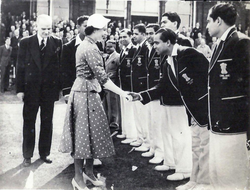 Elizabeth II with members of the Indian cricket team during their tour of England in 1952
 -
 Kapil Dev with then Indian President Zail Singh after the team's return to India post winning the 1983 World Cup. They are holding the Cricket World Cup Trophy
 -
 Graph showing India's Test match results against all Test match teams from 1932 to September 2006
 -
 Indian players celebrating after taking a wicket against New Zealand in 2010
 -
![With 619 wickets, Anil Kumble is the world's fourth highest wicket-taker in Tests and India's highest Test and ODI wicket-taker.[98]](//upload.wikimedia.org/wikipedia/commons/thumb/a/a3/Kumble_edited.jpg/250px-Kumble_edited.jpg) With 619 wickets, Anil Kumble is the world's fourth highest wicket-taker in Tests and India's highest Test and ODI wicket-taker.[98]
With 619 wickets, Anil Kumble is the world's fourth highest wicket-taker in Tests and India's highest Test and ODI wicket-taker.[98] -
 Historic moment during winning of 2011 Cricket World Cup
 -
 MS Dhoni batting against South Africa during the group stage match of 2013 ICC Champions Trophy
 -
 Roger Binny played for the national cricket team
 -
 The national cricket team of India with a cup
 -
 Rohit Sharma hoists the Indian flag at Kensington Oval, Barbados after winning 2024 Men's T20 World Cup final

![Lala Amarnath batting during a match against Middlesex at Lord's, c. 1936[97]](https://en.wikipedia.org/wiki/File:Lala_Amarnath_at_Lord%27s_1936.jpg)


.jpg)
![With 619 wickets, Anil Kumble is the world's fourth highest wicket-taker in Tests and India's highest Test and ODI wicket-taker.[98]](https://en.wikipedia.org/wiki/File:Kumble_edited.jpg)


Governing body
[edit]The Board of Control for Cricket in India (BCCI) is the governing body for the Indian cricket team and first-class cricket in India. The Board has been operating since 1929 and represents India at the International Cricket Council (ICC). Its headquarters is situated in the 'Cricket centre' at Churchgate in Mumbai, Maharashtra. Amongst the richest sporting organisations in the world, it sold media rights for India's matches from 2006 to 2010 for $612,000,000.[99] Roger Binny is present BCCI president and Devajit Saikia is secretary.
The International Cricket Council determines India's upcoming matches through its future tours program. However, the BCCI, with its influential financial position in the cricketing world, has often challenged the ICC's program and called for more series between India, Australia and England which are more likely to earn more revenue as opposed to tours with Bangladesh or Zimbabwe.[100] In the past, the BCCI has also come into conflict with the ICC regarding sponsorships.[101]
Selection committee
[edit]Selection for the Indian cricket team occurs through the BCCI's zonal selection policy, where each of the five zones is represented by one selector and one of the members nominated by BCCI as the chairman of the selection committee. This has sometimes led to controversy as to whether these selectors are biased towards their zones.[102]
Until 18 November 2022, Chetan Sharma was the chief selector and Debashish Mohanty, Harvinder Singh and Sunil Joshi were members. The entire panel was sacked after the unsuccessful performance of the team in 2022 ICC Men's T20 World Cup.[103] On 7 January 2023, Sharma was again appointed as the chief selector along with Shiv Sunder Das, Subroto Banerjee, Salil Ankola, and Sridharan Sharath.[104] On 17 February 2023, Sharma resigned from his post after a sting operation by a private news channel saw him make several loose comments on the Indian team with Shiv Sunder Das replacing him and acting as an interim chief selector.[105] On 4 July 2023, Ajit Agarkar was appointed as the new chief selector and replaced Sharma.[106] He joined Das, Banerjee, Ankola and Sharath on the selection committee.[107]
Team colours
[edit]India plays its Test cricket matches with the traditional cricket whites with navy blue caps and helmets. The uniforms worn in limited-overs matches have different shades of blue for ODIs and T20Is, with sometimes a splash of the colours that are present in the Indian flag.[108]
During the 1992 and 1999 Cricket World Cups, the Indian team's kit was sponsored by ISC and Asics respectively,[109][110] but had been without an official kit sponsor until 2001. With no official kit sponsor for the Indian team, Omtex manufactured the shirts and pants for the team, while some players chose to wear pants provided to them by their individual sponsors like Adidas and Reebok until December 2005. In December 2005, Nike outbid its competitors Adidas and Reebok, and acquired the contract for five years which started in January 2006 ahead of Indian team's tour to Pakistan.[111] Nike was a long time kit supplier to team India with two extensions for a period of five years each time; in 2011[112] and 2016[113] respectively.
After Nike ended its contract in September 2020,[114] MPL Sports Apparel & Accessories, a subsidiary of online gaming platform Mobile Premier League replaced Nike as the kit manufacturer in November 2020 ahead of Indian team's tour to Australia, which was supposed to run until December 2023.[115][116]
In November 2022, MPL Sports decided to exit the deal before the end of their contract and hand over their rights to Kewal Kiran Clothing Limited (KKCL).[117] In January 2023, MPL appointed Kewal Kiran Clothing Limited (KKCL) and Killer Jeans (a brand owned by KKCL) as interim sponsors until May 2023.[118][119] In February 2023, it was announced that Adidas will begin a five-year sponsorship deal in June 2023 ahead of ICC World Test Championship final, replacing KKCL.[120] In May 2023, BCCI officially announced Adidas as their kit sponsor for the next five years running until March 2028.[121][122][123]
| Period | Kit manufacturer | Shirt sponsor[124] |
|---|---|---|
| 1992 | ISC | – |
| 1999 | Asics | ITC Limited (Wills & ITC Hotels) |
| 1993–2001 | ||
| 2001–2005 | Omtex | Sahara |
| 2006–2013 | Nike | |
| 2014–2017 | Star India | |
| 2017–2019 | Oppo | |
| 2019–2020 | Byju's | |
| 2020–2022 | MPL Sports | |
| 2023 | Killer Jeans | |
| 2023–2025 | Adidas | Dream11 |
| 2025–present | Apollo Tyres |
Sponsorship
[edit]| Team sponsor | Apollo Tyres |
|---|---|
| Kit sponsor | Adidas |
| Title sponsor | IDFC FIRST Bank |
| Official partner(s) | SBI Life Campa Atomberg Technologies |
| Official broadcaster | JioStar |
Team sponsorship
[edit]Apollo Tyres is the new official sponsor of Indian cricket team from 16'th september 2025. Apollo Tyres first international mileage will be in the two-match home Test series against the West Indies, which begins on October 2. The new sponsor's logo will also be on display during India A's three-match ODI series in Kanpur against Australia A. Sponsorship period is set to run until 2027 [127]Dream11 (Sporta Technologies Pvt. Ltd.) was announced as the sponsor for the team on 1 July 2023.[128] Their sponsorship was supposed to run until 31 March 2026 for a period of three years,[129] but ended prematurely in August 2025, when Dream11 pulled out following the passage of the Online Gaming Act.[130] Previously, Byju's was the sponsor for the Indian team from 5 September 2019 until 31 March 2023, after Oppo handed over the rights to them.[131] Oppo's sponsorship was supposed to run from 2017 until 2022, but they handed over to Byju's. On 7 March 2022, Byju's extended its sponsorship for one year.[132][133] Previously, the Indian team has been sponsored by Byju's from September 2019 until March 2023, Oppo from May 2017 until August 2019, Star India from January 2014 until March 2017,[134] Sahara India Pariwar from June 2001 until December 2013[135][136] and ITC Limited (with Wills and ITC Hotels brands) from June 1993 until May 2001.[137][138]
Official partners
[edit]On 9 January 2024, BCCI announced Campa and Atomberg Technologies as official partners for its domestic & international season during 2024–26.[139] On 20 September 2023, BCCI announced SBI Life as the official partner for its domestic & international season during 2023–26.[140] In August 2023, IDFC First Bank replaced Mastercard as the current title sponsor for all international and domestic matches played in India for the 2023–26 season.[141] The title sponsorship was initially given to Paytm for all matches played between 2015 and 2023[142] but they handed over to Mastercard in 2022. On 30 August 2019, following the conclusion of the expression of interest process for official partners' rights, the BCCI announced that Sporta Technologies Pvt. Ltd. (Dream11), LafargeHolcim (ACC Cements, and Ambuja Cements) and Hyundai Motors India Ltd. have acquired the official partners' rights for the BCCI International and Domestic matches during 2019–2023.[143] Disney Star and Airtel have been title sponsors previously.[144][145]
Official broadcasters
[edit]JioHotstar is the official broadcaster until March 2028 for all the men's international and domestic matches played in India.[146][147] Star Sports telecasts the international and domestic matches on TV, while it is live streamed on JioHotstar as OTT (over the top) platform.[148]
Fixtures
[edit]International grounds
[edit]There are numerous world-renowned cricket stadiums located in India. Most grounds are under the administration of various state cricket boards as opposed to being under the control of the BCCI. The Bombay Gymkhana Ground was the first ground in India to host a full-scale cricket match featuring an Indian cricket team. This was between the Parsis and the Europeans in 1877.[149] The first stadium to host a Test match in India was also the Gymkhana Ground in Mumbai in 1933, the only Test it ever hosted. The second and third Tests in the 1933 series were hosted at the Eden Gardens in Kolkata and the Chepauk in Chennai. The Arun Jaitley Cricket Stadium in Delhi was the first stadium to host a Test match after independence, a draw against the West Indies in 1948, the first of a five-Test series. There are 21 stadiums in India that have hosted at least one official Test match. In recent years, there has been an increase in the number of world-class cricket stadiums in India.[150][151]
India currently has the world's largest cricket stadium (which is also the world's largest stadium),[152][153] The Narendra Modi Stadium, located in Ahmedabad, Gujarat, India. It is currently recognised as one of the world's premier cricket venues and has hosted several high-profile matches. Eden Gardens has hosted the most Tests, and also has the third-largest seating capacity of any cricket stadium in the world. Founded in 1864, it is one of the most historical stadiums in India, having hosted numerous historical matches.[154][155] Other major stadiums in India include the Arun Jaitley Cricket Stadium, which was established in 1883 and hosted memorable matches including Anil Kumble's ten wickets in an innings haul against Pakistan.[156]
The Bombay Gymkhana Ground hosted the first Test match in India which is the only Test it has hosted to date.[157] Wankhede Stadium, established in 1974, has a capacity to hold 33,100 spectators and is currently the most popular venue in the city. It has hosted 24 Test matches. It also hosted the 2011 World Cup final, in which India became the first team to win the World Cup at home soil. It was the unofficial successor of the Brabourne Stadium, which is also located in Mumbai. Mumbai is often considered the cricketing capital of India because of its fans and the talent it produces via the domestic Mumbai cricket team. Thus the stadium regularly hosts major Test matches.[158] The M. A. Chidambaram Stadium in Chennai is also considered to be an important historical Indian cricket ground, established in the early 1900s, it was the site of India's first Test victory.[159] The first ODI match in India was hosted by the Sardar Vallabhbhai Patel Stadium, Ahmedabad during the series against England on 25 November 1981. [160] India played the first T20I match in India at the Brabourne Stadium in Mumbai on 20 October 2007 against the visiting Australian team. [161]
Captains
[edit]A total of 35 men have captained the Indian men's cricket team in at least one Test match, although only six have led the team in more than 25 matches, and six have captained the team in men's ODIs but not Tests. India's first captain of the men's cricket team was C. K. Nayudu, who led the team in four matches against England: one in England in 1932 and a series of three matches at home in 1933–34. Lala Amarnath, India's fourth captain of the men's cricket team and the first Indian to score a century in Test cricket while playing for India, led the team in its first Test match after Indian independence. He also captained the side to its first Test victory and first series win, both in a three-match series at home against Pakistan in 1952–53. From 1952 until 1961–62, India men's cricket team had a number of captains such as Vijay Hazare, Polly Umrigar and Nari Contractor.[162][163]
The Nawab of Pataudi, Mansoor Ali Khan Pataudi, was the men's team's captain for 36 Test matches from 1961–62 to 1969–70, returning for another four matches against West Indies in 1974–75. In the early years of his captaincy tenure, the team was whitewashed in the West Indies, England and Australia. However, in 1967–68, Pataudi led India men's cricket team on its maiden New Zealand tour, which ended in India winning the Test series 3–1.[164] In 1970–71, Ajit Wadekar took over the captaincy from Pataudi. Under Wadekar's captaincy, India registered its first Test series win in the West Indies and England. India played its first men's ODI in 1974, also under his captaincy.[165] India won its first men's ODI under the captaincy of Srinivasaraghavan Venkataraghavan in the 1975 World Cup, against East Africa. Between 1975–76 and 1978–79, Bishan Singh Bedi captained the team in 22 men's Tests and four ODIs, winning six Tests and one ODI.[166][167]
Sunil Gavaskar took over as men's Test and ODI captain in 1978–79, leading India in 47 Test matches and 37 ODIs, winning nine Tests and 14 ODIs. He was succeeded by Kapil Dev in the 1980s, who captained for 34 Test matches, including four victories. Kapil Dev led India to victory in 39 of his 74 ODIs in charge, including the 1983 Cricket World Cup.[168] Kapil Dev also captained India's 2–0 Test series victory in England in 1986.[169] The captaincy shuffled between Dev and Gavaskar, with Gavaskar captaining India to triumph in the inaugural 1984 Asia Cup and 1985 World Championship of Cricket.
Between 1987–88 and 1989–90, India had three captains in Dilip Vengsarkar, Ravi Shastri and Krishnamachari Srikkanth. Vengsarkar took over the captaincy from Kapil Dev after the 1987 World Cup. Although he started with two centuries in his first series as captain, his captaincy period was turbulent and he lost the job following a disastrous tour of the West Indies in early 1989 and a stand-off with the Indian Cricket Board (BCCI).[170][171]
India has had six regular Test captains of the men's cricket team since Mohammad Azharuddin took charge in 1989. Azharuddin led the team in 47 Test matches from 1989–90 to 1998–99, winning 14, and in 174 ODIs, winning 90. He was followed by Sachin Tendulkar, who captained the men's cricket team in 25 Test matches and 73 ODIs in the late 1990s; Tendulkar was relatively unsuccessful[172][173] as a captain, winning only four Test matches and 23 ODIs.
Sourav Ganguly became the regular captain of the men's team in both Tests and ODIs in 2000.[174] He remained captain until 2005–06 and became the then most successful Indian captain, winning 21 of his 49 Test matches in charge and 76 of his 146 ODIs. Under his captaincy, India became the joint-winners of the 2002 ICC Champions Trophy with Sri Lanka, and through three consecutive ICC finals - the Champions Trophy finals of 2000 and 2002 along with the World Cup final of 2003. India lost only three Tests at home under Ganguly and managed to draw Test series in England and Australia.
Rahul Dravid took over as men's Test captain in 2005. In 2006, he led India to its first Test series victory in the West Indies in more than 30 years.[175]
In September 2007, MS Dhoni was named as the new captain of the men's ODI and T20I teams, after Dravid stepped down from the post. Soon after taking up the captaincy, Dhoni led the team to the inaugural T20 World Cup title. Anil Kumble was appointed Test captain in November 2007, but retired from international cricket in November 2008 after captaining in 14 Tests. Dhoni succeeded him as the men's Test captain, making him the captain in all formats. Under the captaincy of Dhoni, the Indian men's cricket team held the number one position in the ICC Men's Test Team Rankings for 21 months (from November 2009 to August 2011), and set a national record for most back-to-back ODI wins (nine straight wins).[176] Dhoni also led the team to victory in 2011 Cricket World Cup and 2013 ICC Champions Trophy. Thus, Dhoni became the first captain in history to win all three major ICC trophies. Dhoni also took the team to the final of the 2014 T20 World Cup.[177] However, the team performed poorly in away Tests from 2011 to 2014 and Dhoni retired from Test cricket in December 2014, with Virat Kohli being named as the new Test captain.[178] Dhoni resigned as captain of the ODI and T20I teams in January 2017 and Kohli succeeded him at the position.[179]
Under Kohli's captaincy, India was unbeaten in 19 Test matches, starting from a 3–0 series win over New Zealand and ending with a 2–1 series win over Australia. India also had an unbeaten streak of winning nine consecutive Test series, starting with a 3–0 series win over Sri Lanka in Sri Lanka and ending with a 1–0 series win over Sri Lanka at home. India also became only the third team after Australia and South Africa to have won their most recent Test series simultaneously against all the other Test-playing nations. As per winning percentage in Test matches, Kohli was India's second most successful Test captain, behind Ajinkya Rahane, having won more than 58% of Test matches (at least two games). He took India to the 2017 Champions Trophy and 2021 World Test Championship finals.[180]
In November 2021, Rohit Sharma was appointed as the new T20I captain of the Indian men's cricket team after Kohli resigned from the role.[181] Kohli led India one last time in T20Is at the T20 World Cup 2021. Under Rohit Sharma's first series as permanent captaincy, India whitewashed New Zealand at home in the T20I series 3–0.[182] In December 2021, Sharma was also appointed as the new ODI captain of the Indian men's cricket team, replacing Kohli ahead of their away series against South Africa.[183] Kohli later quit as Test captain as well, after their Test series loss to South Africa.[184] Sharma replaced Kohli as Test captain before the Test series against Sri Lanka[185] and is now the full-time captain of the Indian men's cricket team. Rohit took India to the finals of the 2023 World Test Championship and 2023 World Cup, and victories in the 2024 T20 World Cup and 2025 Champions Trophy.[186] Sharma was then succeeded as Test captain by Shubman Gill.[187]
Most matches as captain in all formats
[edit]| Rank | Matches | Player | Won | Lost | Tied | Draw | %Won | %Lost | Period |
|---|---|---|---|---|---|---|---|---|---|
| 1 | 332 | MS Dhoni | 178 | 120 | 6 | 15 | 53.61 | 36.14 | 2007-2018 |
| 2 | 221 | Mohammad Azharuddin | 104 | 90 | 2 | 19 | 47.05 | 40.72 | 1990-1999 |
| 3 | 213 | Virat Kohli | 135 | 60 | 3 | 11 | 63.38 | 28.16 | 2013-2022 |
| 4 | 195 | Sourav Ganguly | 97 | 78 | 0 | 15 | 49.74 | 40.00 | 1999-2005 |
| 5 | 141 | Rohit Sharma | 102 | 33 | 2 | 3 | 72.34 | 23.40 | 2017–2025 |
| Last updated: 4 March 2025[188] | |||||||||
Current squad
[edit]The BCCI released the list of their 2023–24 annual player contracts on 28 February 2024.[189] Players can still be upgraded to a Grade C annual player contract on a pro-rata basis by meeting the criteria of playing a minimum of three Tests or eight ODIs or ten T20Is in the specified period (1 October 2023 to 30 September 2024).
This is a list of every active player who is contracted to BCCI, has played for India since August 2024 or was named in the recent Test, ODI or T20I squads. Uncapped players are listed in italics.[190]
Last updated: 19 October 2025
- Key
| Symbol | Meaning |
|---|---|
| CG | Contract grade with BCCI |
| No. | Shirt number of the player in all formats |
| Format | Denotes the player recently played in which particular format, not his entire career |
| Name | Age | Batting style | Bowling style | Domestic team | IPL Team | CG | Forms | No. | Captaincy | Last Test | Last ODI | Last T20I |
|---|---|---|---|---|---|---|---|---|---|---|---|---|
| Batters | ||||||||||||
| Rohit Sharma | 38 | Right-handed | Right-arm off break | Mumbai | Mumbai Indians | A+ | ODI | 45 | 2024 |
2025 |
2024
| |
| Virat Kohli | 36 | Right-handed | Right-arm medium | Delhi | Royal Challengers Bengaluru | A+ | ODI | 18 | 2025 |
2025 |
2024
| |
| Shubman Gill | 26 | Right-handed | Right-arm off break | Punjab | Gujarat Titans | A | Test, ODI, T20I | 77 | Test(c) ODI(c) T20I (vc) | 2025 |
2025 |
2025
|
| Suryakumar Yadav | 35 | Right-handed | Right-arm off break | Mumbai | Mumbai Indians | B | T20I | 63 | T20I (c) | 2023 |
2023 |
2025
|
| Shreyas Iyer | 30 | Right-handed | Right-arm leg spin | Mumbai | Punjab Kings | B | ODI | 96 | ODI (vc) | 2024 |
2025 |
2023
|
| Yashasvi Jaiswal | 23 | Left-handed | Right-arm leg spin | Mumbai | Rajasthan Royals | B | Test, ODI | 64 | 2025 |
2025 |
 2024 2024
| |
| Rinku Singh | 28 | Left-handed | Right-arm off break | Uttar Pradesh | Kolkata Knight Riders | C | T20I | 35 | — | 2023 |
2025
| |
| Sai Sudharsan | 24 | Left-handed | Right-arm leg break | Tamil Nadu | Gujarat Titans | — | Test | 51 | 2025 |
2023 |
 2024 2024
| |
| Devdutt Padikkal | 25 | Left-handed | Right-arm off break | Karnataka | Royal Challengers Bengaluru | — | Test | 37 | 2024 |
— | 2021
| |
| All-rounders | ||||||||||||
| Ravindra Jadeja | 36 | Left-handed | Slow left-arm orthodox | Saurashtra | Chennai Super Kings | A+ | Test, ODI | 8 | 2025 |
 2025 2025 |
2024
| |
| Hardik Pandya | 32 | Right-handed | Right-arm medium-fast | Baroda | Mumbai Indians | A | ODI, T20I | 33 | 2018 |
2025 |
2025
| |
| Axar Patel | 31 | Left-handed | Slow left-arm orthodox | Gujarat | Delhi Capitals | B | ODI, T20I | 20 | 2024 |
2025 |
2025
| |
| Nitish Kumar Reddy | 22 | Right-handed | Right arm medium-fast | Andhra Pradesh | Sunrisers Hyderabad | C | Test, ODI, T20I | 88 | 2025 |
2025 |
2025
| |
| Washington Sundar | 26 | Left-handed | Right-arm off break | Tamil Nadu | Gujarat Titans | C | Test, ODI, T20I | 5 | 2025 |
2025 |
2025
| |
| Shivam Dube | 32 | Left-handed | Right-arm medium | Mumbai | Chennai Super Kings | C | T20I | 25 | — | 2024 |
2025
| |
| Tilak Varma | 22 | Left-handed | Right-arm off break | Hyderabad | Mumbai Indians | C | T20I | 72 | — | 2023 |
2025
| |
| Abhishek Sharma | 25 | Left-handed | Slow left-arm orthodox | Punjab | Sunrisers Hyderabad | C | T20I | 4 | — | — | 2025
| |
| Wicket-keeper-batters | ||||||||||||
| KL Rahul | 33 | Right-handed | — | Karnataka | Delhi Capitals | A | Test, ODI | 1 | 2025 |
2025 |
2022
| |
| Rishabh Pant | 28 | Left-handed | — | Delhi | Lucknow Super Giants | B | Test | 17 | Test (vc) | 2025 |
2024 |
2024
|
| Sanju Samson | 30 | Right-handed | — | Kerala | Rajasthan Royals | C | T20I | 9 | — | 2023 |
2025
| |
| Dhruv Jurel | 24 | Right-handed | — | Uttar Pradesh | Rajasthan Royals | C | Test, T20I | 21 | 2025 |
— | 2025
| |
| Jitesh Sharma | 32 | Right-handed | — | Vidarbha | Royal Challengers Bengaluru | — | T20I | 99 | — | — |  2024 2024
| |
| Pace bowlers | ||||||||||||
| Jasprit Bumrah | 31 | Right-handed | Right-arm fast | Gujarat | Mumbai Indians | A+ | Test, T20I | 93 | 2025 |
2023 |
2025
| |
| Mohammed Siraj | 31 | Right-handed | Right-arm fast | Hyderabad | Gujarat Titans | A | Test, ODI | 73 | 2025 |
2025 |
2024
| |
| Mohammed Shami | 35 | Right-handed | Right-arm fast | Bengal | Sunrisers Hyderabad | A | ODI | 11 | 2023 |
2025 |
2025
| |
| Akash Deep | 28 | Right-handed | Right-arm fast-medium | Bengal | Lucknow Super Giants | C | Test | 41 | 2025 |
— | — | |
| Anshul Kamboj | 24 | Right-handed | Right-arm medium-fast | Haryana | Chennai Super Kings | C | Test | 47 | 2025 |
— | — | |
| Arshdeep Singh | 26 | Left-handed | Left-armmedium-fast | Punjab | Punjab Kings | C | ODI, T20I | 2 | — | 2025 |
2025
| |
| Prasidh Krishna | 29 | Right-handed | Right arm fast | Karnataka | Gujarat Titans | C | Test | 24 | 2025 |
2023 |
2023
| |
| Harshit Rana | 23 | Right-handed | Right arm fast | Delhi | Kolkata Knight Riders | C | ODI, T20I | 22 | 2024 |
2025 |
2025
| |
| Spin bowlers | ||||||||||||
| Kuldeep Yadav | 30 | Left-handed | Left-arm wrist spin | Uttar Pradesh | Delhi Capitals | B | Test, ODI, T20I | 23 | 2025 |
2025 |
2025
| |
| Varun Chakravarthy | 34 | Right-handed | Right-arm leg break | Tamil Nadu | Kolkata Knight Riders | C | ODI, T20I | 29 | — | 2025 |
2025
| |
| Ravi Bishnoi | 25 | Right-handed | Right-arm leg spin | Gujarat | Lucknow Super Giants | C | T20I | 56 | — | 2022 |
2025
| |
Pay grade
[edit]BCCI awards central contracts to its players, their pay is graded according to the importance of the player. Players' salaries are as follows:[189]
- Grade A+ – ₹7 crore (US$828,000)
- Grade A – ₹5 crore (US$591,000)
- Grade B – ₹3 crore (US$355,000)
- Grade C – ₹1 crore (US$118,000)
- Grade F – Fast Bowling Contracts
- Match fees
Players also receive a match fee of ₹15 lakh (US$18,000) per Test match, ₹6 lakh (US$7,100) per ODI, and ₹3 lakh (US$3,500) per T20I.
Coaching staff
[edit]| Position | Name |
|---|---|
| Head coach[191] | Gautam Gambhir |
| Assistant coach[192][193] | Ryan ten Doeschate |
| Bowling coach[194] | Morné Morkel |
| Fielding coach[195] | T Dilip |
| Strength and Conditioning coach[196] | Adrian le Roux |
Tournament history
[edit]A red box around the year indicates tournaments played within India
| Champions | |
| Runners-up | |
| Semi-finals |
Cricket World Cup
[edit]| Year | Round | Position | P | W | L | T | NR | Squad | Ref |
|---|---|---|---|---|---|---|---|---|---|
| 1975 |
Group Stage | 6/8 | 3 | 1 | 2 | 0 | 0 | Squad | [197] |
| 1979 |
Group Stage | 7/8 | 3 | 0 | 3 | 0 | 0 | Squad | [198] |
 1983 1983 |
Champions | 1/8 | 8 | 6 | 2 | 0 | 0 | Squad | [199] |
 1987 1987 |
Semi Finals | 3/8 | 7 | 5 | 2 | 0 | 0 | Squad | [200] |
| 1992 |
Group Stage | 7/9 | 8 | 2 | 5 | 0 | 1 | Squad | [201] |
| 1996 |
Semi Finals | 3/12 | 7 | 4 | 3 | 0 | 0 | Squad | [202] |
   1999 1999 |
Super Six | 6/12 | 8 | 4 | 4 | 0 | 0 | Squad | [203] |
 2003 2003 |
Runners Up | 2/14 | 11 | 9 | 2 | 0 | 0 | Squad | [204] |
| 2007 |
Group Stage | 9/16 | 3 | 1 | 2 | 0 | 0 | Squad | [205] |
 2011 2011 |
Champions | 1/14 | 9 | 7 | 1 | 1 | 0 | Squad | [206] |
| 2015 |
Semi Finals | 3/14 | 8 | 7 | 1 | 0 | 0 | Squad | [207] |
| 2019 |
Semi Finals | 3/10 | 10 | 7 | 2 | 0 | 1 | Squad | [208] |
| 2023 |
Runners Up | 2/10 | 11 | 10 | 1 | 0 | 0 | Squad | [209] |
 2027 2027 |
To be determined | [210] | |||||||
| 2031 |
Qualified as co-hosts | [211] | |||||||
| Total | 2 Titles | 13/13 | 96 | 63 | 30 | 1 | 2 | ||
T20 World Cup
[edit]| Year | Round | Position | P | W | L | T | NR | Squad | Ref |
|---|---|---|---|---|---|---|---|---|---|
| 2007 |
Champions | 1/12 | 7 | 4 | 1 | 1 | 1 | Squad | [212] |
| 2009 |
Super 8s | 7/12 | 5 | 2 | 3 | 0 | 0 | Squad | [213] |
| 2010 |
Super 8s | 8/12 | 5 | 2 | 3 | 0 | 0 | Squad | [214] |
| 2012 |
Super 8s | 5/12 | 5 | 4 | 1 | 0 | 0 | Squad | [215] |
| 2014
|
Runners-up | 2/16 | 6 | 5 | 1 | 0 | 0 | Squad | [216] |
| 2016 |
Semi-finals | 4/16 | 5 | 3 | 2 | 0 | 0 | Squad | [217] |
  2021 2021 |
Super 12s | 6/16 | 5 | 3 | 2 | 0 | 0 | Squad | [218] |
| 2022 |
Semi-finals | 3/16 | 6 | 4 | 2 | 0 | 0 | Squad | [219] |
 2024 2024 |
Champions | 1/20 | 9 | 8 | 0 | 0 | 1 | Squad | [220] |
| 2026 |
Qualified as co-hosts | [221] | |||||||
| 2028 |
To be determined | [222] | |||||||
| 2030 |
[223] | ||||||||
| Total | 2 Titles | 9/9 | 53 | 35 | 15 | 1 | 2 | ||
World Test Championship
[edit]| Season | League stage | Final | ||||||||||||
|---|---|---|---|---|---|---|---|---|---|---|---|---|---|---|
| Standing | Matches | DED | PC | Points | PCT | Venue | Final | Position | Ref | |||||
| P | W | L | D | T | ||||||||||
| 2019–2021 | 1/9 | 17 | 12 | 4 | 1 | 0 | 0 | 720 | 520 | 72.2 | Rose Bowl, England
|
Lost to New Zealand by 8 wickets
|
Runners Up | [224] |
| 2021–2023 | 2/9 | 18 | 10 | 5 | 3 | 0 | 5 | 216 | 127 | 58.80 | The Oval, England
|
Lost to Australia by 209 runs
|
Runners Up | [225] |
| 2023–2025 | 3/9 | 19 | 9 | 8 | 2 | 0 | 2 | 228 | 114 | 50.00 | Lord's, England
|
Did Not Qualify | Third Place | [226] |
Champions Trophy
[edit]| Year | Round | Position | P | W | L | T | NR | Squad | Ref |
|---|---|---|---|---|---|---|---|---|---|
| 1998 |
Semi Finals | 3/9 | 2 | 1 | 1 | 0 | 0 | Squad | [227] |
| 2000 |
Runners Up | 2/11 | 4 | 3 | 1 | 0 | 0 | Squad | [228] |
| 2002 |
Champions | 1/12 | 5 | 3 | 0 | 0 | 2 | Squad | [229] |
| 2004 |
Group Stage | 7/12 | 2 | 1 | 1 | 0 | 0 | Squad | [230] |
| 2006 |
Group Stage | 5/10 | 3 | 1 | 2 | 0 | 0 | Squad | [231] |
| 2009 |
Group Stage | 5/8 | 3 | 1 | 1 | 0 | 1 | Squad | [232] |
| 2013 |
Champions | 1/8 | 5 | 5 | 0 | 0 | 0 | Squad | [233] |
| 2017
|
Runners Up | 2/8 | 5 | 3 | 2 | 0 | 0 | Squad | [234] |
| 2025
|
Champions | 1/8 | 5 | 5 | 0 | 0 | 0 | Squad | [235] |
| 2029
|
Qualified as hosts | [236] | |||||||
| Total | 3 Titles | 9/9 | 34 | 23 | 8 | 0 | 3 | ||
Asia Cup
[edit]| Year | Round | Position | P | W | L | T | NR | Ref |
|---|---|---|---|---|---|---|---|---|
| 1984
|
Champions | 1/3 | 2 | 2 | 0 | 0 | 0 | [237] |
| 1986 |
Boycotted the tournament | [238] | ||||||
| 1988 |
Champions | 1/4 | 4 | 3 | 1 | 0 | 0 | [239] |
| 1990–91 |
Champions | 1/3 | 3 | 2 | 1 | 0 | 0 | [240] |
| 1995 |
Champions | 1/4 | 4 | 3 | 1 | 0 | 0 | [241] |
| 1997 |
Runners Up | 2/4 | 4 | 1 | 2 | 0 | 1 | [242] |
| 2000 |
First Round | 3/4 | 3 | 1 | 2 | 0 | 0 | [243] |
| 2004 |
Runners Up | 2/6 | 6 | 3 | 3 | 0 | 0 | [244] |
| 2008 |
Runners Up | 2/6 | 6 | 4 | 2 | 0 | 0 | [245] |
| 2010 |
Champions | 1/4 | 4 | 3 | 1 | 0 | 0 | [246] |
| 2012 |
First Round | 3/4 | 3 | 2 | 1 | 0 | 0 | [247] |
| 2014 |
First Round | 3/5 | 4 | 2 | 2 | 0 | 0 | [248] |
| 2016 |
Champions | 1/5 | 5 | 5 | 0 | 0 | 0 | [249] |
| 2018
|
Champions | 1/6 | 6 | 5 | 0 | 1 | 0 | [250] |
| 2022
|
Super Fours | 3/6 | 5 | 3 | 2 | 0 | 0 | [251] |
| 2023
|
Champions | 1/6 | 6 | 4 | 1 | 0 | 1 | [252] |
| 2025
|
Champions | 1/8 | 7 | 7 | 0 | 0 | 0 | [253] |
| Total | 9 Titles | 16/17 | 72 | 50 | 19 | 1 | 2 | |
Asian Games
[edit]| Year | Round | Position | P | W | L | T | NR | Ref |
|---|---|---|---|---|---|---|---|---|
 2010 2010
|
Did not participate | |||||||
 2014 2014
| ||||||||
| 2022
|
Gold | 1/14 | 3 | 2 | 0 | 0 | 1 | [254] |
 2026 2026
|
To be determined | |||||||
| Total | 1 Title | 1/3 | 3 | 2 | 0 | 0 | 1 | |
Commonwealth Games
[edit]| Year | Round | Position | P | W | L | T | NR | Ref |
|---|---|---|---|---|---|---|---|---|
 1998 1998
|
Group Stage | 9/16 | 3 | 1 | 1 | 0 | 1 | [255] |
| Total | 0 Title | 1/1 | 3 | 1 | 1 | 0 | 1 |
Defunct tournaments
[edit]| Tournaments | |||||||
|---|---|---|---|---|---|---|---|
| Australian Tri-Series | Asian Test Championship | Austral-Asia Cup | NatWest Series | World Championship of Cricket | Nehru Cup | Hero Cup | Nidahas Trophy |
|
|
|
|
|
|||
Honours
[edit]ICC
[edit]Titles
Awards
- ICC Test Championship
- ICC ODI Championship
- Winners (1): 2013
ACC
[edit]- Asia Cup
- Asian Test Championship
- Third place (1): 1998–99
Multi-sport events
[edit]- Asian Games
- Gold medal (1): 2022
Statistics
[edit]Tests
[edit]Head-to-head record
| Opponent | Matches | Won | Lost | Tied | Draw | % Won | % Lost | % Drew | First | Last |
|---|---|---|---|---|---|---|---|---|---|---|
| Afghanistan
|
1 | 1 | 0 | 0 | 0 | 100.00 | 0.00 | 0.00 | 2018 | 2018 |
| Australia
|
112 | 33 | 48 | 1 | 30 | 29.46 | 42.85 | 26.78 | 1947 | 2025 |
| Bangladesh
|
15 | 13 | 0 | 0 | 2 | 86.66 | 0.00 | 13.33 | 2000 | 2024 |
| England
|
141 | 37 | 53 | 0 | 51 | 26.24 | 37.58 | 36.17 | 1932 | 2025 |
| New Zealand
|
65 | 22 | 16 | 0 | 27 | 33.84 | 24.61 | 41.53 | 1955 | 2024 |
| Pakistan
|
59 | 9 | 12 | 0 | 38 | 15.25 | 20.33 | 64.40 | 1952 | 2007 |
| South Africa
|
44 | 16 | 18 | 0 | 10 | 36.36 | 40.90 | 22.72 | 1992 | 2023 |
| Sri Lanka
|
46 | 22 | 7 | 0 | 17 | 47.82 | 15.21 | 36.95 | 1982 | 2022 |
| West Indies
|
101 | 24 | 30 | 0 | 47 | 23.76 | 29.70 | 46.53 | 1948 | 2025 |
| Zimbabwe
|
11 | 7 | 2 | 0 | 2 | 63.63 | 18.18 | 18.18 | 1992 | 2005 |
| Total | 595 | 184 | 186 | 1 | 224 | 30.92 | 31.26 | 37.64 | 1932 | 2025 |
| Statistics are correct as of India v West Indies at Narendra Modi Stadium, 1st Test, 2 October - 6 October 2025.[260][261]
| ||||||||||
|
Most Test runs for India[262]
Most Test wickets for India[264][265]
| |||||||||||||||||||||||||||||||||||||||||||||||||||||||||||||||||||||||||||||||||||||||||||||||||||||||||||||||||||
One-Day Internationals
[edit]Head-to-head record
| Opponent | Matches | Won | Lost | Tied | No Result | % Won | First | Last | |
|---|---|---|---|---|---|---|---|---|---|
| Full Members | |||||||||
| Afghanistan
|
4 | 3 | 0 | 1 | 0 | 75.00 | 2014 | 2023 | |
| Australia
|
152 | 58 | 84 | 0 | 10 | 38.14 | 1980 | 2025 | |
| Bangladesh
|
42 | 33 | 8 | 0 | 1 | 78.57 | 1988 | 2025 | |
| England
|
110 | 61 | 44 | 2 | 3 | 55.45 | 1974 | 2025 | |
 Ireland Ireland
|
3 | 3 | 0 | 0 | 0 | 100.00 | 2007 | 2015 | |
| New Zealand
|
120 | 62 | 50 | 1 | 7 | 51.66 | 1975 | 2025 | |
| Pakistan
|
136 | 58 | 73 | 0 | 5 | 42.64 | 1978 | 2025 | |
| South Africa
|
94 | 40 | 51 | 0 | 3 | 42.55 | 1991 | 2024 | |
| Sri Lanka
|
171 | 99 | 59 | 2 | 11 | 57.89 | 1979 | 2024 | |
| West Indies
|
142 | 72 | 64 | 2 | 4 | 50.70 | 1979 | 2023 | |
| Zimbabwe
|
66 | 54 | 10 | 2 | 0 | 81.81 | 1983 | 2022 | |
| Associate Members | |||||||||
 Bermuda Bermuda
|
1 | 1 | 0 | 0 | 0 | 100.00 | 2007 | 2007 | |
 East Africa East Africa
|
1 | 1 | 0 | 0 | 0 | 100.00 | 1975 | 1975 | |
 Hong Kong Hong Kong
|
2 | 2 | 0 | 0 | 0 | 100.00 | 2008 | 2018 | |
| Kenya
|
13 | 11 | 2 | 0 | 0 | 84.62 | 1996 | 2004 | |
| Namibia
|
1 | 1 | 0 | 0 | 0 | 100.00 | 2003 | 2003 | |
 Nepal Nepal
|
1 | 1 | 0 | 0 | 0 | 100.00 | 2023 | 2023 | |
| Netherlands
|
3 | 3 | 0 | 0 | 0 | 100.00 | 2003 | 2023 | |
| Scotland
|
1 | 1 | 0 | 0 | 0 | 100.00 | 2007 | 2007 | |
| United Arab Emirates
|
3 | 3 | 0 | 0 | 0 | 100.00 | 1994 | 2015 | |
| Total | 1066 | 567 | 445 | 10 | 44 | 53.18 | 1974 | 2025 | |
| Statistics are correct as of India v New Zealand at Dubai International Cricket Stadium, Dubai, 9 March 2025.[267][268]
| |||||||||
|
Most ODI runs for India[269]
Most ODI wickets for India
| |||||||||||||||||||||||||||||||||||||||||||||||||||||||||||||||||||||||||||||||||||||||||||||||||||||||||||||||||||||||||||||||||||||
Twenty20 Internationals
[edit]Head-to-head record
| Opponent | Matches | Won | Lost | Tied | Tie+Win | Tie+Loss | No Result | % Won | First | Last |
|---|---|---|---|---|---|---|---|---|---|---|
| ICC Full Members | ||||||||||
| Afghanistan
|
9 | 7 | 0 | 0 | 1 | 0 | 1 | 77.78 | 2010 | 2024 |
| Australia
|
32 | 20 | 11 | 0 | 0 | 0 | 1 | 62.50 | 2007 | 2024 |
| Bangladesh
|
18 | 17 | 1 | 0 | 0 | 0 | 0 | 94.44 | 2009 | 2025 |
| England
|
29 | 17 | 12 | 0 | 0 | 0 | 0 | 58.62 | 2007 | 2025 |
| Ireland
|
8 | 8 | 0 | 0 | 0 | 0 | 0 | 100.00 | 2009 | 2024 |
| New Zealand
|
25 | 12 | 10 | 1 | 2 | 0 | 0 | 48.00 | 2007 | 2023 |
| Pakistan
|
16 | 12 | 3 | 0 | 1 | 0 | 0 | 75.00 | 2007 | 2025 |
| South Africa
|
31 | 18 | 12 | 0 | 0 | 0 | 1 | 58.06 | 2006 | 2024 |
| Sri Lanka
|
33 | 21 | 9 | 0 | 2 | 0 | 1 | 63.63 | 2009 | 2025 |
| West Indies
|
30 | 19 | 10 | 0 | 0 | 0 | 1 | 63.33 | 2009 | 2023 |
| Zimbabwe
|
13 | 10 | 3 | 0 | 0 | 0 | 0 | 76.92 | 2010 | 2024 |
| ICC Associate members | ||||||||||
| Hong Kong
|
1 | 1 | 0 | 0 | 0 | 0 | 0 | 100.00 | 2022 | 2022 |
| Namibia
|
1 | 1 | 0 | 0 | 0 | 0 | 0 | 100.00 | 2021 | 2021 |
| Nepal
|
1 | 1 | 0 | 0 | 0 | 0 | 0 | 100.00 | 2023 | 2023 |
| Netherlands
|
1 | 1 | 0 | 0 | 0 | 0 | 0 | 100.00 | 2022 | 2022 |
| Oman
|
1 | 1 | 0 | 0 | 0 | 0 | 0 | 100.00 | 2025 | 2025 |
| Scotland
|
2 | 1 | 0 | 0 | 0 | 0 | 1 | 50.00 | 2007 | 2021 |
| United Arab Emirates
|
2 | 2 | 0 | 0 | 0 | 0 | 0 | 100.00 | 2016 | 2025 |
| United States
|
1 | 1 | 0 | 0 | 0 | 0 | 0 | 100.00 | 2024 | 2024 |
| Total | 254 | 170 | 71 | 1 | 6 | 0 | 6 | 66.92 | 2006 | 2025 |
| Statistics are correct as of India v Pakistan - Asia Cup at Dubai, 28 September 2025.[272][273]
| ||||||||||
|
Most T20I runs for India[269][274]
Most T20I wickets for India[276]
| |||||||||||||||||||||||||||||||||||||||||||||||||||||||||||||||||||||||||||||||||||||||||
Individual records
[edit]
Sachin Tendulkar, who began playing for India as a 16-year-old in 1989 and has since become the most prolific run-scorer in the history of both Test and ODI cricket, holds a large number of national batting records. He holds the record of most appearances in both Tests and ODIs, most runs in both Tests and ODIs and most centuries in Tests.[279] The highest score by an Indian is the 319 scored by Virender Sehwag in Chennai. It is the second triple century in Test cricket by an Indian, the first being a 309 also made by Sehwag although against Pakistan. The team's highest ever score was a 759/7 against England at MA Chidambaram Stadium, Chennai in 2016, while its lowest score was 36 against Australia in 2020.[280] In ODIs, the team's highest score is 418/5 against West Indies at Indore in 2011–12. India scored 413–5 in a match against Bermuda in 2007 World Cup which was the highest score ever in Cricket World Cup history at the time. In the same match, India set a world record of the highest winning margin in an ODI match of 257 runs.[281]
India has also had some very strong bowling figures, with spin bowler Anil Kumble being a member of the elite group of four bowlers who have taken 600 Test wickets.[282] In 1999, Kumble emulated Jim Laker to become the second bowler to take all ten wickets in a Test match innings when he took 10 wickets for 74 runs against Pakistan at the Feroz Shah Kotla in Delhi.[283][284]
Many of the Indian cricket team's records are also world records, for example Tendulkar's century tally (in Tests and ODIs) and run tally (also in both Tests and ODIs).[285] Dhoni's 183 not out against Sri Lanka in 2005 is the world record score by a wicketkeeper in ODIs.[286] The Indian cricket team also holds the record sequence of 17 successful run-chases in ODIs,[287] which ended in a dramatic match against the West Indies in May 2006, which India lost by just one run.[288]
Tendulkar was the first batsman to score 200 runs (he was unbeaten on 200 from 147 deliveries including 25 fours and 3 sixes) in a single ODI innings, on 24 February 2010 against South Africa in Gwalior.[289] On 8 December 2011, this achievement was eclipsed by compatriot Virender Sehwag, who scored 219 runs from 149 deliveries (25 fours and 7 sixes) versus the West Indies in Indore.[290] On 13 November 2014 the record was broken by another Indian opening batsmen, Rohit Sharma, who scored 264 runs from 173 deliveries (33 fours and 9 sixes) against Sri Lanka in Kolkata, West Bengal. In 2013, Dhoni became the first captain in history to win all three major ICC trophies- ICC Cricket World Cup in 2011, ICC World Twenty20 in 2007 and ICC Champions Trophy in 2013.[291][292][293][294]
In 2014, Kohli became the first cricketer to win back-to-back Man of the Series awards in the 2014 ICC World Twenty20 and 2016 ICC World Twenty20. Rohit is the most runs scorer in T20Is as of July 2024[update] and also hold joint most T20I centuries.[295] In 2017, Ravichandran Ashwin became the fastest cricketer in history to reach 250 wickets.[296]
| Inductee | Induction year | Tests | ODIs | ||
|---|---|---|---|---|---|
| Matches | Span | Matches | Span | ||
| Bishan Bedi | 2009 | 67 | 1966–1979 | 10 | 1974–1979 |
| Kapil Dev | 2009 | 131 | 1979–1994 | 225 | 1978–1994 |
| Sunil Gavaskar | 2009 | 125 | 1971–1987 | 108 | 1974–1987 |
| Anil Kumble | 2015 | 132 | 1990–2008 | 271 | 1990–2007 |
| Rahul Dravid | 2018 | 164 | 1996–2012 | 344 | 1996–2011 |
| Sachin Tendulkar | 2019 | 200 | 1989–2013 | 463 | 1989–2012 |
| Vinoo Mankad | 2021 | 44 | 1946–1959 | 0 | N/A |
| Virender Sehwag | 2023 | 104 | 2001–2013 | 251 | 1999–2013 |
| MS Dhoni | 2025 | 90 | 2005–2014 | 350 | 2004–2019 |
Fan following
[edit]
Owing to the massive Indian diaspora in nations like Australia, England and South Africa, a large Indian fan turnout is expected whenever India plays in each of these nations. There have been a number of official fan groups that have been formed over the years, including the Bharat Army,[297] the Indian equivalent of the Barmy Army, that were very active in their support when India toured Australia in 2003/2004. They are known to attribute a number of popular Indian songs to the cricket team.[298]
Fan rivalry and cross-border tension has created a strong rivalry between the Indian and the Pakistani cricket teams. In tours between these two nations, cricket visas are often employed to accommodate for the tens of thousands of fans wishing to cross the border to watch cricket. This intense fan dedication is one of the major causes of the BCCI's financial success.[299]

However, there are downsides to having such a cricket-loving population. Many Indians hold cricket very close to their hearts and losses are not received well by the Indian population. In some cases, particularly after losses to Pakistan or after a long string of weak performances, there have been reports of player effigies being burnt in the streets and vandalism of player homes.[302] In many cases, players have come under intense attention from the media for negative reasons, this has been considered one of the reasons for Ganguly being left out of the Indian team. At times, when a match is surrounded by controversy, it has resulted in a debacle. For example, when India slid to defeat against Australia at Brabourne Stadium in 1969, fans began throwing stones and bottles onto the field as well as setting fire to the stands, before laying siege to the Australian dressing rooms.[303] During the same tour, a stampede occurred at Eden Gardens when tickets were oversold and India fell to another loss; the Australian team bus was later stoned with bricks.[304] A similar event occurred during the 1996 Cricket World Cup, where India were losing the semi-final to Sri Lanka at Eden Gardens. In this case, the fan behaviour was directed at the Indian team in disappointment at their lacklustre performance. An armed guard had to be placed at the home of captain Mohammad Azharuddin to ensure his safety.[304] In 1999, a riot occurred in a Test against Pakistan at Eden Gardens after a collision with Pakistani paceman Shoaib Akhtar saw Sachin run out, forcing police to eject spectators and the game to be played in an empty stadium. In 2006, a string of low scores resulted in Tendulkar being booed by the Mumbai crowd when he got out against England.[305]
Often, fans engage in protests regarding players if they believe that regionalism has affected selection, or because of regional partisan support for local players. In 2005, when Ganguly was dropped from the team, Ganguly's home town Kolkata erupted in protests.[306] India later played a match against South Africa in Kolkata. The Indian team was booed by the crowd who supported South Africa instead of India in response to Ganguly's dropping.[307] Similar regional divisions in India regarding selection have also caused protests against the team, with political activists from the regional Kalinga Kamgar Sena party in Odisha disrupting the arrival of the team in Cuttack for an ODI over the lack of a local player in the team, with one activist manhandling coach Greg Chappell.[308] Similar treatment was handed to Sunil Gavaskar in the 1987 World Cup Semi Finals by crowds at Wankhede Stadium when he got bowled by Phillip DeFreitas.[305]
A successful string of results, especially victories against the arch-rival Pakistan or victories in major tournaments such as the World Cup are greeted with particular ecstasy from the Indian fans.[309][310][311] Test rivalries include the Border–Gavaskar Trophy with Australia, the Freedom Trophy with South Africa, and the Anderson-Tendulkar Trophy with England.
See also
[edit]


Notes
[edit]References
[edit]- ^ "India vs Zimbabwe: Men in Blue eye series win in 3rd ODI".
- ^ "Prez Murmu, Modi, others congratulate Rohit Sharma & Co. as Men in blue trounce NZ to lift ICC Champions Trophy".
- ^ "Finally, Team India is No.1 in Test cricket". The Times of India. 7 December 2009.
- ^ "India retain No.1 ODI ranking after annual ICC update".
- ^ "India topple Sri Lanka to become No. 1 team in ICC T20 rankings". News 18. 2 April 1974. Archived from the original on 9 January 2021. Retrieved 7 January 2021.
- ^ "ICC Rankings". International Cricket Council.
- ^ "Test matches - Team records". ESPNcricinfo.
- ^ "Test matches - 2025 Team records". ESPNcricinfo.
- ^ "ODI matches - Team records". ESPNcricinfo.
- ^ "ODI matches - 2025 Team records". ESPNcricinfo.
- ^ "T20I matches - Team records". ESPNcricinfo.
- ^ "T20I matches - 2025 Team records". ESPNcricinfo.
- ^ Downing, Clement (1737). William Foster (ed.). A History of the Indian Wars. London.
- ^ Downing, Clement (1978). A History of the Indian Wars. p. 189. OCLC 5905776.
- ^ Drew, John (6 December 2021). "The Christmas the Kolis took to cricket". The Daily Star. Retrieved 5 December 2021.
- ^ Drew, John (21 December 2021). "How East India traders brought cricket to Indian shores 300 years ago this fortnight". Scroll.in. Retrieved 1 November 2023.
- ^ a b "Cricket and Politics in Colonial India". Ramachandra Guha. 1998. JSTOR 651075.
- ^ "India in British Isles, 1911". CricketArchive. Archived from the original on 9 November 2012. Retrieved 21 September 2006.
- ^ Alderman, Elgan. "Hundreds and heatwaves: the story of the 1911 All India tour to England that helped shape the country's identity". The Times. ISSN 0140-0460. Archived from the original on 29 November 2021. Retrieved 29 November 2021.
- ^ "History of the Imperial Cricket Conference". ICC. Archived from the original on 21 March 2006. Retrieved 21 September 2006.
- ^ "On this day in 1932, India played its first-ever Test match". ANI News. Archived from the original on 20 March 2023. Retrieved 20 March 2023.
- ^ "India in England, 1932". ESPNcricinfo. Archived from the original on 25 December 2006. Retrieved 8 March 2022.
- ^ "England tour of India 1933/34".
- ^ "What Don Bradman thought of the first Indian team that toured Australia". 14 September 2024.
- ^ "India in Australia, 1948". ESPNcricinfo. Archived from the original on 9 May 2006. Retrieved 8 March 2022.
- ^ "West Indies tour of India". Archived from the original on 16 December 2015. Retrieved 10 March 2022.
- ^ "England in India, 1951–52". ESPNcricinfo. Archived from the original on 9 May 2006. Retrieved 8 March 2022.
- ^ "Beyond boundaries". Deccan Chronicle. 29 March 2011. Archived from the original on 1 April 2011. Retrieved 1 April 2011.
- ^ "India suffer 0–5 whitewash in England in 1959". 24 August 2013. Archived from the original on 5 October 2022. Retrieved 5 October 2022.
- ^ "India in New Zealand Test Series, India in New Zealand Test Series 1967/68 score, Match schedules, fixtures, points table, results, news". ESPNcricinfo. Archived from the original on 18 January 2022. Retrieved 16 January 2022.
- ^ Dinakar, S. (18 June 2020). "The legendary spin quartet through the eyes of V.V. Kumar". The Hindu. Archived from the original on 5 October 2022. Retrieved 5 October 2022.
- ^ "India's famed spin quartet – the gold standard for hunting in packs". 20 September 2016. Archived from the original on 5 October 2022. Retrieved 5 October 2022.
- ^ "How Sunil Gavaskar took on West Indies 50 yrs ago & became India's 1st sports superstar". ThePrint. 6 March 2021. Archived from the original on 5 October 2022. Retrieved 5 October 2022.
- ^ "Sunil Gavaskar scores a world record 774 runs in his debut series". 19 April 2013. Archived from the original on 5 October 2022. Retrieved 5 October 2022.
- ^ "Dilip Sardesai, Batsman with a key role in helping India to make breakthroughs". TheGuardian.com. 16 July 2007. Archived from the original on 29 March 2023. Retrieved 5 October 2022.
- ^ "Team India on the brink of ODI record at Vizag, remain torchbearers of 50-over format". Hindustan Times. 23 October 2018. Archived from the original on 24 October 2018. Retrieved 24 October 2018.
- ^ "Sunny's World Cup go-slow". ESPNcricinfo. Archived from the original on 6 January 2022. Retrieved 6 January 2022.
- ^ "When India successfully chased a 400-plus target against West Indies to change world cricket forever". 12 April 2013. Archived from the original on 16 April 2023. Retrieved 16 April 2023.
- ^ "Most run-outs, and the lowest score never made". Archived from the original on 14 January 2023. Retrieved 14 January 2023.
- ^ "Highest Test totals without a century and half-century". 30 June 2015. Archived from the original on 14 January 2023. Retrieved 14 January 2023.
- ^ "Records. Test matches. Team records. Most batters reaching double figures in an innings". ESPNcricinfo. Archived from the original on 6 January 2022. Retrieved 6 January 2022.
- ^ "World Cup diary: The intriguing story of India's 1979 World Cup campaign". 18 April 2020.
- ^ "The day that changed Indian cricket".
- ^ "The World Cup classic no one saw".
- ^ "Benson & Hedges World Championship of Cricket 1985". ESPNcricinfo. Retrieved 19 March 2020.
- ^ "30th January 1994: When Kapil Dev became the leading wicket-taker in the world". Hindustan Times. 30 January 2019. Archived from the original on 14 January 2023. Retrieved 14 January 2023.
- ^ "Sunil Gavaskar: Was replaced as captain despite India winning West Indies series". The Times of India. Indo-Asian News Service. 29 June 2020. Archived from the original on 6 January 2022. Retrieved 6 January 2022.
- ^ "Sunil Gavaskar on why Kapil Dev was dropped for 1984 Kolkata Test: 'Why would I drop my only match-winner'". 7 March 2021. Archived from the original on 14 January 2023. Retrieved 14 January 2023.
- ^ "India vs England, 2nd Semi-Final at Mumbai, Nov 05 1987 - Full Scorecard".
- ^ "Not the '90s again, please".
- ^ "Tears in vain as India crash out".
- ^ "'Sachin Tendulkar didn't have a strong team but he wasn't the most motivational captain either'". 5 September 2020. Archived from the original on 3 October 2022. Retrieved 3 October 2022.
- ^ "The reasons behind Tendulkar's decision to quit". Retrieved 14 June 2024.
- ^ "On this day in 2000: Mohammad Azharuddin, Ajay Jadeja played their last international match before being banned". Firstpost. 3 June 2022. Retrieved 12 September 2023.
- ^ Balachandran, Kanishkaa (6 April 2023). "Supriya Sobti Gupta on 'Caught Out': I wanted to bring out the human element in Indian cricket's match-fixing saga". The Hindu. ISSN 0971-751X. Retrieved 12 September 2023.
- ^ Ananthasubramanian, Vignesh (10 November 2017). "10 forgettable moments that no Indian cricket fan will want to relive". www.sportskeeda.com. Retrieved 12 September 2023.
- ^ "India cricket: Middle-order retirements are end of era". BBC News. 23 August 2012. Archived from the original on 18 October 2015. Retrieved 22 June 2018.
- ^ "External Affairs Minister S Jaishankar lauds India-NZ bilate ." The Times of India. 9 October 2022. Archived from the original on 6 March 2023. Retrieved 6 February 2023.
- ^ "July 5th 1956 – India's First Foreign Coach John Wright Is Born". Archived from the original on 6 March 2023. Retrieved 6 February 2023.
- ^ Steve Waugh. "I am proud that everybody gave 100%". From the Waugh Front. ESPNcricinfo. Archived from the original on 17 October 2007. Retrieved 21 September 2006.
- ^ "TWI gets production rights for India-Pakistan series". The Hindu – Sport. Archived from the original on 26 November 2007. Retrieved 14 October 2006.
- ^ "On this day in 2007, India clinched inaugural ICC T20 World Cup". The Times of India. 24 September 2022. Archived from the original on 27 April 2023. Retrieved 16 April 2023.
- ^ Dhoni and Gambhir lead India to World Cup glory Archived 12 December 2011 at the Wayback Machine ESPNcricinfo. Retrieved 12 December 2011
- ^ "Throwback to ICC Cricket World Cup 2011: India becomes first team to win final on home soil". WION. 16 May 2019. Archived from the original on 25 October 2020. Retrieved 8 April 2022.
- ^ "T20 World Cup fiasco: Dhoni blames IPL parties". 16 May 2012.
- ^ "ms dhoni retires only international captain to win 3 icc trophies". 15 August 2020. Archived from the original on 14 August 2022. Retrieved 3 October 2022.
- ^ "Dhoni retires: the only international captain to win 3 ICC trophies". 15 August 2020. Archived from the original on 1 December 2022. Retrieved 3 October 2022.
- ^ "On This Day in 2014: Sri Lanka Won the T20 World Cup Beating India in the Final". Archived from the original on 16 April 2023. Retrieved 16 April 2023.
- ^ "Team India's World Cup 2015 report card". The Times of India. 28 March 2015. Archived from the original on 3 July 2021. Retrieved 16 April 2023.
- ^ "India beat Bangladesh to win record sixth Asia Cup title". The Times of India. 7 March 2016. Archived from the original on 18 April 2023. Retrieved 16 April 2023.
- ^ "March 31, 2016: MS Dhoni-led India suffer T20 World Cup heartbreak vs West Indies". India Today. 31 March 2021. Archived from the original on 7 April 2022. Retrieved 7 April 2022.
- ^ Siddharth Monga (15 June 2017). "Dominant India march into yet another final". ESPNcricinfo. Archived from the original on 16 June 2017. Retrieved 16 June 2017.
- ^ Andrew Fidel Fernando (18 June 2017). "India hoodoo broken emphatically by Pakistan". ESPNcricinfo. Archived from the original on 8 December 2022. Retrieved 10 February 2023.
- ^ "Kohli's India script historic series win in Australia".
- ^ "World Cup 2019: India's road to semi-finals". 8 July 2019. Archived from the original on 16 April 2023. Retrieved 16 April 2023.
- ^ "2019 World cup semifinal IND vs NZL". Archived from the original on 3 October 2022. Retrieved 3 October 2022.
- ^ Lemon, Geoff (19 January 2021). "India's bloody-mindedness fired them to historic win in Australia". The Guardian.
- ^ "RESULT Final, Southampton, June 18 – 23, 2021, ICC World Test Championship". Archived from the original on 3 October 2022. Retrieved 3 October 2022.
- ^ Aldred, Tanya (24 October 2021). "Pakistan thrash India by 10 wickets at T20 World Cup – as it happened". TheGuardian.com.
- ^ "Virat Kohli to step down as India's T20I captain after T20 World Cup in UAE, Oman". Hindustan Times. 16 September 2021.
- ^ "AUS vs IND, ICC World Test Championship 2021–2023, Final at London, June 07 – 11, 2023 – Full Scorecard". ESPNcricinfo. Retrieved 23 September 2023.
- ^ "Asia Cup 2023 Statistics – Asia Cup". ESPNcricinfo. Retrieved 23 September 2023.
- ^ "India Asian games".
- ^ Martin, Ali (19 November 2023). "Australia earn Cricket World Cup glory as Travis Head ton spoils India's party". TheGuardian.com.
- ^ "Kohli describes occasion of his 50th ODI hundred as 'the perfect picture'". Retrieved 16 December 2023.
- ^ "India vs Afghanistan, 3rd T20I at Bengaluru, IND v AFG, Jan 17 2024 - Full Scorecard".
- ^ "Jasprit Bumrah's fine spell helps India beat South Africa in T20 World Cup final". The Irish Times.
- ^ "India seal T20 World Cup glory after epic duel against South Africa". International Cricket Council. 29 June 2024. Archived from the original on 29 June 2024. Retrieved 29 June 2024.
- ^ "India wins men's T20 World Cup, defeating South Africa in dramatic final". CNN. 29 June 2024.
- ^ Achal, Ashwin (29 June 2024). "IND vs SA, T20 World Cup 2024 final: India lifts second T20 WC title after 17 years". The Hindu. ISSN 0971-751X. Archived from the original on 1 July 2024. Retrieved 30 June 2024.
- ^ "India script history to become first-ever team to win T20 Cricket World Cup title undefeated". 29 June 2024.
- ^ Liew, Jonathan (9 March 2025). "India see off New Zealand to complete clinical Champions Trophy triumph". The Guardian.
- ^ "Sachin roars for 'champion' India, Ganguly can't stop raving over 'captain marvellous' Rohit after Champions Trophy win".
- ^ "Rohit, Kohli surpass MS Dhoni for most ICC titles by an Indian with Champions Trophy 2025 win". 10 March 2025.
- ^ "New Zealand beat India again to romp to historic 3-0 Test series win". The Guardian. 3 November 2024.
- ^ Lemon, Geoff; Smyth, Rob; Lemon (Earlier), Geoff; Smyth (Later), Rob (5 January 2025). "Australia win Border-Gavaskar series 3-1 against India – as it happened". the Guardian.
- ^ Lala Amarnath is the first Indian batsman to score a test century while playing for India
- ^ "Anil Kumble". ESPNCricInfo. Archived from the original on 11 February 2009. Retrieved 8 March 2022.
- ^ "Nimbus Bags Cricket Rights for $612 m". The Hindu. India. Archived from the original on 10 January 2007. Retrieved 11 January 2007.
- ^ "ICC faces threat from India". ESPNcricinfo. 3 January 2006. Archived from the original on 8 February 2007. Retrieved 8 March 2022.
- ^ "India challenge ICC". TVNZ. Archived from the original on 8 February 2007. Retrieved 11 January 2007.
- ^ "Selection Policy not Zonal: Pawar". The Tribune. India. Archived from the original on 8 February 2007. Retrieved 11 January 2007.
- ^ "T20 World Cup fallout: BCCI sacks entire selection panel, split captaincy in job mandate for new committee". The Times of India. 18 November 2022. Archived from the original on 19 November 2022. Retrieved 18 December 2022.
- ^ "BCCI announces All-India Senior Men Selection Committee appointments". www.bcci.tv. Retrieved 17 July 2023.
- ^ "Chetan Sharma resigns as BCCI chief selector". The Times of India. 17 February 2023. ISSN 0971-8257. Retrieved 17 July 2023.
- ^ "Ajit Agarkar named India men's chief selector". Cricbuzz. 4 July 2023. Retrieved 31 October 2023.
- ^ "BCCI names Ajit Agarkar India's new chairman of selectors". The Hindu. 5 July 2023. ISSN 0971-751X. Retrieved 17 July 2023.
- ^ "Iconic shades of blue: Evolution of Team India's jersey from 1985 to 2021". WION. 13 October 2021. Retrieved 19 July 2023.
- ^ "Colour scheme: The inside story of cricket's clothing revolution". cricket.com.au. Archived from the original on 9 May 2023. Retrieved 9 May 2023.
- ^ "Classic World Cup Kits – 1999". www.icc-cricket.com. Archived from the original on 30 April 2020. Retrieved 6 May 2023.
- ^ "Nike Wins Bid to Equip Indian Cricket Team". The New York Times. Agence France-Presse. 25 December 2005. ISSN 0362-4331. Archived from the original on 6 May 2023. Retrieved 6 May 2023.
- ^ "Nike to remain sponsor of Team India kit – Times of India". The Times of India. Archived from the original on 29 November 2018. Retrieved 29 November 2018.
- ^ "Players, BCCI unhappy with kit sponsor Nike". The Indian Express. 22 August 2017. Archived from the original on 29 November 2018. Retrieved 29 November 2018.
- ^ "BCCI to float fresh tender for apparel sponsorship after Nike decides against renewing its contract". The Financial Express. 19 July 2020. Archived from the original on 25 November 2020. Retrieved 6 November 2020.
- ^ "MPL Sports Apparel and Accessories becomes new kit sponsor of Indian cricket team". The Financial Express. 2 November 2020. Archived from the original on 2 November 2020. Retrieved 6 November 2020.
- ^ "BCCI announces MPL Sports as Official kit sponsor for Team India". The Board of Control for Cricket in India. Archived from the original on 17 November 2020. Retrieved 17 November 2020.
- ^ "Byju's, MPL want to exit sponsorship deal with BCCI". mint. 22 December 2022. Retrieved 26 July 2023.
- ^ "India's kit sponsor changes without official announcement, new jersey launched for Sri Lanka T20Is". Hindustan Times. 3 January 2023. Archived from the original on 4 January 2023. Retrieved 4 January 2023.
- ^ "KKCL's Killer replaces MPL Sports as official kit sponsor of Team India". The Economic Times. 6 January 2023. ISSN 0013-0389. Retrieved 26 July 2023.
- ^ Khosla, Varuni (21 February 2023). "Adidas to sponsor India cricket team kit in ₹350 cr deal". mint. Archived from the original on 9 March 2023. Retrieved 9 March 2023.
- ^ "BCCI and Adidas Announce Multi-Year Partnership As Official Kit Sponsor of the Indian Cricket Team". www.bcci.tv. Archived from the original on 26 May 2023. Retrieved 26 May 2023.
- ^ "Adidas named new India cricket team kit sponsor". Hindustan Times. 22 May 2023. Archived from the original on 26 May 2023. Retrieved 26 May 2023.
- ^ "Adidas to be India's kit sponsor till 2028". ESPNcricinfo. Archived from the original on 29 May 2023. Retrieved 29 May 2023.
- ^ "As Byju's Looks For Early Exit, Here's Every Brand That's Sponsored The Indian Jersey So Far". www.mensxp.com. 22 December 2022. Archived from the original on 6 May 2023. Retrieved 6 May 2023.
- ^ "'Inspired by Surf Excel' Team India's new kit for T20 World Cup 2024 disappoints fans". 7 May 2024.
- ^ "The Board of Control for Cricket in India". www.bcci.tv. Retrieved 16 September 2023.
- ^ https://www.indiatoday.in/sports/cricket/story/apollo-tyres-new-sponsor-indian-cricket-team-after-dream11-exit-2788181-2025-09-16
- ^ "BCCI announces Dream11 as the new Team India Lead Sponsor". www.bcci.tv. Retrieved 1 July 2023.
- ^ Farooqui, Javed (1 July 2023). "Dream11 bags team India jersey sponsor rights at base price of Rs 358 crore". The Economic Times. ISSN 0013-0389. Retrieved 1 July 2023.
- ^ "BCCI begins hunt for new sponsor after Dream11 walks out". The Hindu. 25 August 2025. Retrieved 25 August 2025.
- ^ "Star India asks BCCI for discount in current deal, exiting Byju's wants board to encash bank guarantee". The Hindu. 9 January 2023. Archived from the original on 16 April 2023. Retrieved 16 April 2023.
- ^ "BCCI extends jersey sponsorship with BYJU's by one year". Cricbuzz. Archived from the original on 7 March 2022. Retrieved 7 March 2022.
- ^ "OPPO wins Indian team sponsorship rights till 2022". EspnCricinfo. 7 March 2017. Archived from the original on 19 March 2018. Retrieved 18 March 2018.
- ^ "Star wins Indian team sponsorship rights". EspnCricinfo. 9 December 2013. Archived from the original on 11 January 2018. Retrieved 18 March 2018.
- ^ "Sahara India Pariwar:: Overview. World's Largest Family". www.sahara.in. Archived from the original on 28 March 2023. Retrieved 29 May 2023.
- ^ "Sahara signs biggest deal in cricket world". ESPNcricinfo. Archived from the original on 29 May 2023. Retrieved 29 May 2023.
- ^ "ITC Stubs Out Sponsorship". www.telegraphindia.com. Retrieved 1 July 2023.
- ^ "Sahara India ends ties with BCCI, withdraws sponsorship & pulls out of IPL". The Economic Times. 4 February 2012. Archived from the original on 16 April 2023. Retrieved 16 April 2023.
- ^ "BCCI announces Campa and Atomberg Technologies as official partners for India Home Cricket Season 2024–26". www.bcci.tv. Retrieved 9 January 2024.
- ^ "BCCI announces SBI Life as Official Partner for BCCI Domestic & International Season 2023–26". www.bcci.tv. Retrieved 21 September 2023.
- ^ "IDFC First Bank acquires title sponsorship rights for all BCCI international and domestic home matches". www.bcci.tv. Archived from the original on 5 September 2022. Retrieved 7 September 2022.
- ^ Sportstar, Team (21 August 2019). "BCCI awards title sponsorship rights to Paytm for five more years". sportstar.thehindu.com. Archived from the original on 27 December 2019. Retrieved 5 October 2022.
- ^ "Dream11, LafargeHolcim and Hyundai awarded official partners' rights for BCCI international and domestic seasons 2019–23". The Board of Control for Cricket in India. Archived from the original on 16 September 2021. Retrieved 17 November 2020.
- ^ "Star India not renewing jersey sponsorship for Indian cricket team". The New Indian Express. 28 February 2017. Archived from the original on 6 January 2022. Retrieved 6 January 2022.
- ^ "Airtel wins Team India home series sponsorship". India Today. Press Trust of India. 20 August 2010. Archived from the original on 6 January 2022. Retrieved 6 January 2022.
- ^ "It advantage JioStar as brands pad up to spend on cricket". Hindustan Times. 21 February 2025.
- ^ "BCCI searches for temporary broadcast partner for home series in June, Media Rights Tender to be released after IPL 2023". 27 March 2023. Archived from the original on 21 April 2023. Retrieved 21 April 2023.
- ^ Shuchi Bansal (21 February 2025). "It advantage JioStar as brands pad up to spend on cricket". Hindustan Times.
- ^ "Gymkhana Ground".
- ^ "Mohali's Mullanpur stadium named after Maharaja Yadavindra Singh". 29 March 2021. Archived from the original on 5 October 2022. Retrieved 5 October 2022.
- ^ "Cricketer Rohit Sharma lays stone for international cricket stadium in Hyderabad". 8 January 2020. Archived from the original on 5 October 2022. Retrieved 5 October 2022.
- ^ "England v India: Motera becomes the world's largest cricket stadium". BBC News. 24 February 2021. Archived from the original on 4 January 2023. Retrieved 4 January 2023.
- ^ "Largest cricket stadium in Motera, with seating capacity for over 1 lakh fans, renamed as Narendra Modi Stadium". India Today. 24 February 2021. Archived from the original on 4 October 2022. Retrieved 6 January 2022.
- ^ "Grounds: Eden Gardens". ESPNcricinfo. Archived from the original on 6 October 2006. Retrieved 8 March 2022.
- ^ "Top 10 cricket matches at Eden Gardens, Kolkata". 21 September 2016. Archived from the original on 5 October 2022. Retrieved 5 October 2022.
- ^ "Grounds: Feroz Shah Kotla". ESPNcricinfo. Archived from the original on 14 October 2006. Retrieved 8 March 2022.
- ^ "Inaugural home venues of the 10 Test playing nations". 15 February 2017. Archived from the original on 15 April 2023. Retrieved 15 April 2023.
- ^ "What Makes Mumbai Cricketers Special". Archived from the original on 16 April 2023. Retrieved 16 April 2023.
- ^ "Grounds: M.A. Chidambaram Stadium". ESPNcricinfo. Archived from the original on 4 November 2006. Retrieved 8 March 2022.
- ^ "Ahmedabad hosted India's first ODI". TimesofIndia. 26 October 2021. Retrieved 1 December 2023.
- ^ "India's first T20I at Brabourne Stadium in Mumbai". ESPNcricinfo. 20 October 2007. Retrieved 1 December 2023.
- ^ "List of Test captains". ESPNcricinfo. Archived from the original on 7 February 2022. Retrieved 9 January 2022.
- ^ "List of Captains of One Day Cricket Team of India". Archived from the original on 7 December 2021. Retrieved 7 December 2021.
- ^ "Tempting tastes dished up when India visits New Zealand". Archived from the original on 16 April 2023. Retrieved 16 April 2023.
- ^ "Ajit Wadekar, who led India to maiden wins in England & Windies dies at 77". 16 August 2018. Archived from the original on 16 April 2023. Retrieved 16 April 2023.
- ^ "Bishan Singh Bedi". Archived from the original on 4 October 2022. Retrieved 4 October 2022.
- ^ "Bishan Bedi". Archived from the original on 4 October 2022. Retrieved 4 October 2022.
- ^ "When Kapil was king".
- ^ "The Inspirational Tale Of 1986: How Kapil Dev Led India To Historic 2-0 Series Win In England".
- ^ "Dilip Vengsarkar Captaincy". Archived from the original on 6 December 2021. Retrieved 7 December 2021.
- ^ "Dilip Vengsarkar". Archived from the original on 7 December 2021. Retrieved 7 December 2021.
- ^ "Tendulkar on his captains: Ganguly was aggressive, Rahul methodical, Dhoni instinctive". Firstpost. 7 November 2014. Archived from the original on 15 July 2015. Retrieved 1 July 2015.
- ^ "Replacing Sachin with Azhar as captain in 1997: When selectors spun the ball". 6 November 2014. Archived from the original on 9 November 2014. Retrieved 8 July 2016.
- ^ "How Sourav Ganguly became the Indian captain in 2000 ahead of Anil Kumble and Ajay Jadeja". 23 July 2020. Archived from the original on 4 October 2022. Retrieved 4 October 2022.
- ^ Ugra, Sharda (17 July 2006). "Thanks to Dravid, Kumble, Team India tastes victory in West Indies after 35 years". India Today. Archived from the original on 17 March 2022. Retrieved 17 March 2022.
- ^ "The Canadian Press: Sri Lanka denies India 5–0 rout by winning final ..." 13 February 2009. Archived from the original on 13 February 2009.
- ^ "On this day, MS Dhoni became the first captain to win all three ICC titles by winning 2013 Champions Trophy". Times Now. 23 June 2020. Archived from the original on 11 January 2022. Retrieved 9 January 2022.
- ^ "Dhoni retires from Test cricket". ESPNcricinfo. 30 December 2014. Archived from the original on 17 March 2022. Retrieved 17 March 2022.
- ^ "MS Dhoni gives up India's ODI and T20 captaincy". ESPNcricinfo. 4 January 2017. Archived from the original on 17 March 2022. Retrieved 17 March 2022.
- ^ "India Cricket Team Records & Stats". ESPNcricinfo. Archived from the original on 29 March 2023. Retrieved 7 February 2022.
- ^ "Rohit Sharma named India T20I captain for New Zealand series". The Times of India. 10 November 2021. Archived from the original on 9 January 2022. Retrieved 9 January 2022.
- ^ Mundayur, Rohit (22 November 2021). "India whitewash New Zealand: The need to be realistic in a fresh start". India Today. Archived from the original on 18 January 2022. Retrieved 17 January 2022.
- ^ "Rohit Sharma replaces Virat Kohli as India's ODI captain, to take over from South Africa series starting next month". Hindustan Times. 8 December 2021. Archived from the original on 27 January 2022. Retrieved 8 December 2021.
- ^ "Virat Kohli quits India's test captaincy: Cricketers pay tribute to the former skipper with throwback pictures. Photogallery – ETimes". photogallery.indiatimes.com. Archived from the original on 17 January 2022. Retrieved 17 January 2022.
- ^ "Rohit Sharma appointed as India's full-time Test captain". www.icc-cricket.com. Archived from the original on 5 March 2022. Retrieved 28 February 2022.
- ^ "23/24: How Rohit Sharma and his Indian team have been dominating ICC tournaments". 11 March 2025.
- ^ "Shubman Gill unveiled as India's new Test captain, Pant his deputy".
- ^ "Most matches as captain for India in Tests+ODIs+T20Is". ESPNcricinfo. Retrieved 22 January 2022.
- ^ a b "BCCI announces annual player retainership 2023–24 – Team India (Senior Men)". BCCI. 28 February 2024. Retrieved 28 February 2024.
- ^ "India Men's Cricketers Grade. BCCI". www.bcci.tv. Retrieved 27 March 2023.
- ^ "Mr Gautam Gambhir appointed as Head Coach – Team India (Senior Men)".
- ^ "Abhishek Nayar, Ryan ten Doeschate set to become India's assistant coaches". ESPNcricinfo.
- ^ "BCCI terminates India assistant coach Abhishek Nayar's contract". ESPNcricinfo.
- ^ "Morne Morkel appointed India's bowling coach". ESPNcricinfo.
- ^ "T Dilip reappointed as India fielding coach for England tour". India Today.
- ^ "Adrian le Roux appointed India strength coach for England Test series 2025". India Today.
- ^ "Prudential World Cup 1975". Archived from the original on 6 December 2021. Retrieved 6 December 2021.
- ^ "Prudential World Cup 1979". Archived from the original on 6 December 2021. Retrieved 6 December 2021.
- ^ "Prudential World Cup 1983". Archived from the original on 6 December 2021. Retrieved 6 December 2021.
- ^ "Reliance World Cup 1987/88". Archived from the original on 15 August 2022. Retrieved 15 August 2022.
- ^ "Reliance World Cup 1987/88". Archived from the original on 15 August 2022. Retrieved 15 August 2022.
- ^ "Wills World Cup 1995/96". Archived from the original on 20 August 2022. Retrieved 20 August 2022.
- ^ "World Cup 1999". Archived from the original on 15 August 2022. Retrieved 15 August 2022.
- ^ "ICC World Cup 2002/03". Archived from the original on 4 October 2022. Retrieved 4 October 2022.
- ^ "World Cup 2007". Archived from the original on 30 September 2022. Retrieved 4 October 2022.
- ^ "ICC Cricket World Cup 2010/11". Archived from the original on 4 October 2022. Retrieved 4 October 2022.
- ^ "ICC Cricket World Cup 2014/15". Archived from the original on 4 October 2022. Retrieved 4 October 2022.
- ^ "ICC Cricket World Cup 2019". Archived from the original on 4 October 2022. Retrieved 4 October 2022.
- ^ "ICC Cricket world Cup 2023".
- ^ "USA to stage T20 World Cup: 2024–2031 ICC Men's tournament hosts confirmed". Archived from the original on 5 December 2021. Retrieved 6 December 2021.
- ^ "USA to stage T20 World Cup: 2024–2031 ICC Men's tournament hosts confirmed". Archived from the original on 5 December 2021. Retrieved 6 December 2021.
- ^ "ICC World Twenty20 2007/08". Archived from the original on 8 December 2021. Retrieved 6 December 2021.
- ^ "ICC World T20, 2009". Archived from the original on 6 December 2021. Retrieved 6 December 2021.
- ^ "ICC World T20, 2010". Archived from the original on 6 December 2021. Retrieved 6 December 2021.
- ^ "ICC World T20 2012". Archived from the original on 6 December 2021. Retrieved 6 December 2021.
- ^ "ICC World Twenty20 2014". Archived from the original on 6 December 2021. Retrieved 6 December 2021.
- ^ "ICC World T20, 2016". Archived from the original on 6 December 2021. Retrieved 6 December 2021.
- ^ "ICC Men's T20 World Cup 2021/22". Archived from the original on 3 December 2021. Retrieved 6 December 2021.
- ^ "USA to stage T20 World Cup: 2024–2031 ICC Men's tournament hosts confirmed". Archived from the original on 5 December 2021. Retrieved 6 December 2021.
- ^ "ICC Men's T20 world Cup 2024".
- ^ "USA to stage T20 World Cup: 2024–2031 ICC Men's tournament hosts confirmed". Archived from the original on 5 December 2021. Retrieved 6 December 2021.
- ^ "USA to stage T20 World Cup: 2024–2031 ICC Men's tournament hosts confirmed". Archived from the original on 5 December 2021. Retrieved 6 December 2021.
- ^ "USA to stage T20 World Cup: 2024–2031 ICC Men's tournament hosts confirmed". Archived from the original on 5 December 2021. Retrieved 6 December 2021.
- ^ "ICC World Test Championship 2019–2021 Table". ESPNcricinfo. Archived from the original on 12 August 2021. Retrieved 29 August 2021.
- ^ "ICC World Test Championship (2021–2023) Points Table". Archived from the original on 1 August 2019. Retrieved 6 December 2021.
- ^ "ICC World Test Championship 2023-25".
- ^ "Wills International Cup 1998/99". Archived from the original on 29 September 2022. Retrieved 15 August 2022.
- ^ "ICC KnockOut, 2000". Archived from the original on 15 August 2022. Retrieved 15 August 2022.
- ^ "ICC Champions Trophy 2002/03". Archived from the original on 16 August 2022. Retrieved 15 August 2022.
- ^ "2004 Champions Trophy". Archived from the original on 3 October 2022. Retrieved 3 October 2022.
- ^ "ICC Champions Trophy 2006/07". Archived from the original on 3 October 2022. Retrieved 3 October 2022.
- ^ "ICC Champions Trophy 2009/10". Archived from the original on 29 September 2022. Retrieved 15 August 2022.
- ^ "ICC Champions Trophy 2013". Archived from the original on 7 September 2022. Retrieved 15 August 2022.
- ^ "ICC Champions Trophy 2017". Archived from the original on 13 August 2022. Retrieved 15 August 2022.
- ^ "ICC Champions Trophy 2025".
- ^ "USA to stage T20 World Cup: 2024–2031 ICC Men's tournament hosts confirmed". Archived from the original on 5 December 2021. Retrieved 6 December 2021.
- ^ "India, Pakistan, Sri Lanka in the United Arab Emirates, 1984 ( Asia Cup )". Archived from the original on 6 December 2021. Retrieved 6 December 2021.
- ^ "Austral-Asia Cup 1985/86". Archived from the original on 15 August 2022. Retrieved 15 August 2022.
- ^ "Wills Asia Cup 1988/89". Archived from the original on 3 October 2022. Retrieved 3 October 2022.
- ^ "Asia Cup 1990/91". Retrieved 3 March 2025.
- ^ "Pepsi Asia Cup 1994/95". Archived from the original on 5 October 2022. Retrieved 5 October 2022.
- ^ "Pepsi Asia Cup 1997". Archived from the original on 5 October 2022. Retrieved 5 October 2022.
- ^ "2000 Asia Cup". Archived from the original on 5 October 2022. Retrieved 5 October 2022.
- ^ "2004 Asia Cup". Archived from the original on 5 October 2022. Retrieved 5 October 2022.
- ^ "2008 Asia Cup". Archived from the original on 5 October 2022. Retrieved 5 October 2022.
- ^ "2010 Asia Cup". Archived from the original on 5 October 2022. Retrieved 5 October 2022.
- ^ "Asia Cup 2011/12". Archived from the original on 5 October 2022. Retrieved 5 October 2022.
- ^ "2014 Asia Cup". Archived from the original on 4 October 2022. Retrieved 4 October 2022.
- ^ "Men's T20 Asia Cup 2015/16". Archived from the original on 4 October 2022. Retrieved 4 October 2022.
- ^ "2018 Asia Cup". Archived from the original on 3 October 2022. Retrieved 3 October 2022.
- ^ "2022 Asia Cup". Archived from the original on 3 October 2022. Retrieved 3 October 2022.
- ^ "Asia Cup 2023". Retrieved 17 September 2023.
- ^ "2027 Asia Cup". Retrieved 29 July 2024.
- ^ "Asian Games Men's Cricket Competition 2023". Retrieved 24 October 2023.
- ^ "Commonwealth Games 1998/99". Archived from the original on 15 August 2022. Retrieved 15 August 2022.
- ^ "Dhoni presented with ICC Test championship mace". The Hindu. 28 December 2009.
- ^ "India retains ICC Test Championship mace thanks to series win over Australia".
- ^ "Virat Kohli proud as India win ICC Test championship mace for 3rd successive year". April 2019.
- ^ "A retrospective: How the mace has changed hands". 25 February 2018.
- ^ "Records | Test matches | Team records | Results summary | ESPNcricinfo.com". Cricinfo. Retrieved 6 December 2021.
- ^ "India Cricket Team Records & Stats | ESPNcricinfo.com". Cricinfo. Retrieved 6 December 2021.
- ^ "Test records – Most career runs". ESPNcricinfo. Retrieved 20 June 2020.
- ^ "India Test records – Most career runs". ESPNcricinfo. Retrieved 20 June 2020.
- ^ "Test records – Most career wickets". ESPNcricinfo. Retrieved 4 December 2021.
- ^ "Test records – Most career wickets taken by a fast bowler". ESPNcricinfo. Retrieved 4 December 2021.
- ^ "India Test records – Most career wickets". ESPNcricinfo. Retrieved 4 December 2021.
- ^ "Records / India / One-Day Internationals / Result summary". ESPNcricinfo. Retrieved 1 August 2023.
- ^ "Records / One-Day Internationals / Team records / Results summary". ESPNcricinfo. Retrieved 1 August 2023.
- ^ a b "Law 18 – Scoring runs". Marylebone Cricket Club. Archived from the original on 29 December 2018. Retrieved 29 December 2018.
- ^ "India ODI Records – Most career runs". ESPNcricinfo. Retrieved 22 January 2022.
- ^ "India ODI Records – Most career wickets". ESPNcricinfo. Retrieved 1 July 2020.
- ^ "Records / India / Twenty20 Internationals / Result summary". ESPNcricinfo. Retrieved 21 November 2021.
- ^ "Records / Twenty20 Internationals / Team records / Results summary". ESPNcricinfo. Retrieved 21 November 2021.
- ^ "T20I Records – Most career runs". ESPNcricinfo. Retrieved 21 November 2021.
- ^ "India T20I Records – Most career runs". ESPNcricinfo. Retrieved 23 October 2022.
- ^ "T20I Records – Most career wickets". ESPNcricinfo. Retrieved 21 November 2021.
- ^ "India T20I Records – Most career wickets". ESPNcricinfo. Retrieved 21 November 2021.
- ^ "Sachin Tendulkar". ESPNCricInfo. Archived from the original on 15 September 2012. Retrieved 8 March 2022.
- ^ "Sachin Tendulkar:Cricbuzz.com". Archived from the original on 2 July 2022. Retrieved 12 August 2022.
- ^ "India all out for 36 – their lowest-ever Test score – as Australia romp to victory in series opener". skysports.com. Archived from the original on 2 February 2021. Retrieved 26 January 2021.
- ^ "Bermuda v India Match 12". Archived from the original on 12 August 2022. Retrieved 12 August 2022.
- ^ "Anil Kumble". Archived from the original on 3 May 2022. Retrieved 14 August 2022.
- ^ "On This Day in 1999, Anil Kumble Picks 10 Wickets in an Innings Against Pakistan". Archived from the original on 14 August 2022. Retrieved 14 August 2022.
- ^ "February 7, 1999: Anil Kumble emulates Jim Laker with historic 10-wicket haul vs Pakistan in Delhi". 7 February 2021. Archived from the original on 1 December 2022. Retrieved 14 August 2022.
- ^ Sports, Times of (6 April 2020). "Sachin Tendulkar's List of 100 Centuries with Full Details Across All Formats". Times of Sports. Archived from the original on 14 August 2022. Retrieved 14 August 2022.
- ^ "On This Day In 2005: MS Dhoni Registered His Highest ODI Score". Ndtvsports.com. Archived from the original on 5 May 2022. Retrieved 14 August 2022.
- ^ "Dravid rues faulty execution". ESPNcricinfo. 21 May 2006. Archived from the original on 9 March 2022. Retrieved 8 March 2022.
- ^ "2nd ODI, Kingston, May 20, 2006, India tour of West Indies". Archived from the original on 14 August 2022. Retrieved 14 August 2022.
- ^ "On this day in 2010: Tendulkar creates history by scoring first double century in Men's ODI cricket". 24 February 2022. Archived from the original on 14 August 2022. Retrieved 14 August 2022.
- ^ "On This Day In 2011: Virender Sehwag Became Second Indian Batter To Score ODI Double Century". 8 December 2021. Archived from the original on 14 August 2022. Retrieved 14 August 2022.
- ^ "MS Dhoni retires: Only international captain to win 3 ICC trophies". 15 August 2020. Archived from the original on 14 August 2022. Retrieved 14 August 2022.
- ^ "Dhoni retires: the only international captain to win 3 ICC trophies". 15 August 2020. Archived from the original on 1 December 2022. Retrieved 14 August 2022.
- ^ "4 Indian Players who have won all 3 ICC Titles". 20 December 2018. Archived from the original on 14 August 2022. Retrieved 14 August 2022.
- ^ "List of Double Centuries by Rohit Sharma in ODIs Cricket". 30 April 2020. Archived from the original on 1 December 2022. Retrieved 14 August 2022.
- ^ "Virat Kohli Vs Rohit Sharma: Who Retired With Most Runs, Centuries And Wins?". Times Now. 5 July 2024. Retrieved 9 July 2024.
- ^ "Ashwin – the fastest to 250 Test wickets". Archived from the original on 14 August 2022. Retrieved 14 August 2022.
- ^ "Bharat Army History". www.bharat-army.com. Archived from the original on 2 July 2015. Retrieved 1 July 2015.
- ^ "Swami Army Roars to Full Battle Cry". The Age Newspaper. Melbourne. 28 December 2003. Archived from the original on 17 October 2007. Retrieved 21 September 2006.
- ^ "10,000 Visas for Pak Cricket Fans". The Tribune, Chandigarh. Archived from the original on 3 September 2006. Retrieved 21 September 2006.
- ^ Binoy, George (4 June 2007). "A snake charmer and an investment guru". ESPNcricinfo. Archived from the original on 28 February 2010. Retrieved 15 February 2010.
- ^ "Sachin is this fan's match ticket". The Times of India. 31 January 2007. Archived from the original on 27 February 2010. Retrieved 18 February 2010.
- ^ "Ganguly's Debt of Gratitude". BBC News. 21 March 2003. Archived from the original on 13 January 2009. Retrieved 21 September 2006.
- ^ "India vs Austalia [sic]: Riots of 1969, tied Test and mother of all comebacks". The Economic Times. 5 February 2023. Retrieved 31 March 2024.
- ^ a b Andrew Miller; Martin Williamson (11 April 2006). "I predict a riot". Archived from the original on 8 February 2007. Retrieved 8 March 2022.
- ^ a b "Sachin Tendulkar booed by Wankhede Crowd". India Daily. Archived from the original on 11 October 2006. Retrieved 15 January 2006.
- ^ "Protests rock Kolkata over Ganguly's exclusion". Rediff. Archived from the original on 18 December 2005. Retrieved 14 October 2006.
- ^ "For The Love Of Dada – When Eden Gardens Turned Against India Because Ganguly Was Not Playing". 26 May 2020. Archived from the original on 7 December 2021. Retrieved 7 December 2021.
- ^ "Security concerns over Barabati Stadium's future". ESPNcricinfo. 24 January 2007. Archived from the original on 27 January 2007. Retrieved 8 March 2022.
- ^ "The Entire Nation Erupts with Joy". The Tribune, Chandigarh. Archived from the original on 10 September 2006. Retrieved 8 March 2022.
- ^ "India-Pakistan Cricket Rivalry: A War Without Shooting". 3 November 2022. Archived from the original on 20 April 2023. Retrieved 21 April 2023.
- ^ "India vs. Pakistan: A complex rivalry hitting new heights". Deutsche Welle. Archived from the original on 21 April 2023. Retrieved 21 April 2023.
Further reading
[edit]Bibliography
[edit]- Majumdar, Boria (2018). Eleven Gods and a Billion Indians: The On and Off the Field Story of Cricket in India and Beyond. New Delhi: Simon & Schuster India. ISBN 978-93-86797-18-6.
- Guha, Ramachandra (2020). The Commonwealth of Cricket. Fourth Estate. ISBN 978-93-90327-28-7.
- Guha, Ramachandra (2003). A Corner of a Foreign Field. Pan Macmillan. ISBN 978-0-330-49117-4.
- Sen, Ronojoy (2015). Nation at Play. Contemporary Asia in the World. ISBN 978-0-231-16490-0.
Cited sources
[edit]- "Chronology of Important Sports Events — West Bengal". wbsportsandyouth.gov.in. Kolkata: Government of West Bengal – Department of youth services and sports. 2017. Archived from the original on 13 October 2022. Retrieved 25 January 2023.
- "Board of Control for Cricket in India — History of cricket in India". icc-cricket.com. International Cricket Council. Archived from the original on 4 October 2022. Retrieved 17 February 2023.
External links
[edit]

Titles | |
|---|---|
| |||||||||
| Team | |||||||||
| Records | |||||||||
| Matches | |||||||||
| Grounds | |||||||||
| Culture | |||||||||
| Key personnel |
| ||||||||
| Major Titles |
| ||||||||
| Other Titles |
| ||||||||
| |||||||||||||||||||||||||||||||||||||||||||||||||||||||||||


India national cricket team
View on GrokipediaHistory
Early history (18th century–1918)
Cricket was introduced to India by British East India Company mariners in the early 18th century, with the earliest recorded instance occurring in 1721 near Cambay (modern-day Khambhat) in the Bombay Presidency, where sailors played informal games on the banks of the Dhadhar River.[13][14] The sport initially remained confined to British expatriates and military personnel in coastal trading hubs like Bombay (now Mumbai) and Calcutta (now Kolkata), serving as a recreational activity amid colonial expansion.[15] By the late 18th century, organized play began to emerge, as evidenced by the establishment of the Calcutta Cricket Club in 1792, one of the world's oldest surviving cricket clubs outside England, which hosted matches against teams from nearby military stations like Barrackpore and Dum Dum.[16][17] The formation of dedicated clubs accelerated cricket's growth in the 19th century, particularly in Bombay, where the Bombay Gymkhana was established in 1875 as an exclusive venue for European sports enthusiasts, incorporating cricket alongside polo and football.[18][19] Indian participation gained momentum through the Parsi community, who formed the Oriental Cricket Club in 1848—the first Indian cricket club—driven by their anglophile inclinations and commercial ties with the British.[20] The Parsees, inspired by observing British games, quickly adopted and refined the sport, organizing informal matches against Europeans by the 1870s; the first notable inter-community encounter occurred in 1877, when the Parsi Gymkhana defeated the Bombay Gymkhana (Europeans) by an innings and 38 runs, marking a pivotal moment in Indian involvement.[13][21] This Parsi initiative was instrumental in popularizing cricket beyond elite British circles, as they disseminated techniques through community networks and challenged colonial dominance on the field.[22] Princely states also played a supportive role in the sport's early dissemination during the 19th century, with rulers acting as patrons who funded grounds, imported equipment, and hosted exhibitions to foster local talent. For instance, Maharaja Rajinder Singh of Patiala established the Patiala Cricket Club and built dedicated pavilions, integrating cricket into royal leisure and diplomacy.[23][24] These efforts complemented urban developments, blending traditional patronage with emerging colonial influences to broaden cricket's appeal across diverse regions. By the early 20th century, competitive structures solidified with the launch of the Bombay Quadrangular Tournament in 1912, which expanded the annual Presidency Match format to include four teams: Europeans, Parsees, Hindus, and Muslims, representing Bombay's major communities.[13] Hosted at the Bombay Gymkhana, the tournament drew large crowds and heightened communal rivalries, laying groundwork for organized representative play while showcasing Indian proficiency against British sides.[25]Test cricket era and pre-independence (1918–1947)
The Board of Control for Cricket in India (BCCI) was established on December 1, 1928, in Madras (now Chennai), as the governing body for cricket in the country, succeeding earlier ad hoc committees and marking a formal step toward organized administration under colonial rule.[2] This formation followed India's admission as a full member of the Imperial Cricket Conference (now the ICC) in 1929, which paved the way for the country to be granted Test cricket status, becoming the sixth nation to achieve it. The BCCI's creation addressed longstanding issues of fragmented control by princely states and British officials, enabling coordinated efforts for international participation despite challenges from limited infrastructure and funding.[2] India's entry into Test cricket came with its inaugural series against England in 1932, a three-match tour of England captained by C. K. Nayudu, the first Indian to lead the national side.[26] The team, comprising mostly amateur players from princely states and British India clubs, played its debut Test at Lord's on June 25, 1932, where Nayudu's all-round contribution—including 40 runs and three wickets—highlighted emerging talent amid a 158-run defeat. The series ended 0-1 in England's favor, with the hosts winning the third Test by nine wickets, underscoring India's inexperience against seasoned opposition on seaming pitches and the logistical strains of overseas travel. Nayudu's leadership, marked by his powerful batting and tactical acumen, symbolized a shift toward Indian agency in the sport, though the tour exposed divisions within the squad influenced by regional and class differences.[27] The return series against England in 1933–34, hosted in India, introduced aggressive tactics reminiscent of bodyline bowling, with English captain Douglas Jardine employing short-pitched deliveries and packed leg-side fields to target Indian batsmen.[28] This approach, later infamous from the 1932–33 Ashes, physically intimidated players and tested resilience; Lala Amarnath, making his debut, responded with a defiant 118 in the first Test at Bombay (now Mumbai), becoming the first Indian to score a Test century and exposing vulnerabilities in the visitors' strategy. Despite India drawing the series 0-0, the tactics highlighted safety concerns for uncapped players without protective gear, fostering debates on fair play and contributing to subtle rule adjustments in subsequent years. Amarnath's performance established him as a pioneering figure, though internal politics limited his immediate influence.[29] The 1936 tour of England, led by the Maharaja of Vizianagaram (Vizzy), represented India's most ambitious pre-war overseas venture, with 38 first-class matches showcasing depth in batting from players like Vijay Merchant, who averaged 57.89. However, the tour was marred by leadership controversies, including Vizzy's decision to send Amarnath home mid-tour after a dressing-room altercation, which strained team unity and drew criticism from figures like Nayudu.[30] The three-Test series resulted in a 2-0 loss, with England dominating on home soil, but India's overall tour record of 10 wins in 36 games demonstrated growing competitiveness against county sides. This expedition, funded largely by princely patronage, underscored the sport's role in fostering national identity amid rising independence sentiments. World War II profoundly disrupted international cricket from 1939 to 1945, canceling all Test matches for India and halting overseas tours due to travel restrictions, resource shortages, and the subcontinent's strategic importance in the Allied effort. While domestic competitions like the Ranji Trophy continued intermittently to maintain player fitness and morale, the BCCI focused on grassroots development and wartime relief, with many cricketers enlisting or contributing to war funds.[2] Post-war resumption came with the 1946 tour of England, captained by Nawab of Pataudi senior, where India played 29 first-class matches but lost the three Tests by an innings each, reflecting rustiness after the seven-year hiatus. The tour, amid India's push for independence, symbolized resilience, with standout performances from Vinoo Mankad reinforcing the team's potential despite colonial-era constraints.[31]Post-independence consolidation (1947–1970)
Following India's independence in 1947, the national cricket team embarked on its first overseas tour to Australia in late 1947, marking a pivotal moment in rebuilding the side amid the nation's transition. The five-Test series resulted in a 4-0 defeat for India, with Australia dominating through heavy innings victories, including margins of 226 runs in the first Test at Brisbane and 177 runs in the fifth at Melbourne. Despite the losses, the tour highlighted emerging talent and resilience, as India secured non-Test wins against a strong Australian XI by 47 runs in Sydney and against Tasmania by an innings. This expedition, led by Lala Amarnath, underscored the challenges of competing against a formidable opponent shortly after partition, which had disrupted team preparations and logistics.[32] Vinoo Mankad emerged as a cornerstone all-rounder during this period, exemplifying the grit required for post-independence consolidation. On the 1947-48 tour, Mankad claimed 20 wickets across the Tests at an average of 34.45 and contributed 116 runs, while excelling in first-class matches with 583 runs at 44.84 and 49 wickets overall. His notable act of running out Australia's Bill Brown without warning during the second Test at Sydney—now termed "Mankading"—sparked debate but affirmed his tactical acumen, as the dismissal was deemed legal under cricket laws. Mankad's endurance and versatility, including tireless left-arm spin bowling, provided stability to a young side, earning him recognition as one of Wisden's Cricketers of the Year for his broader contributions in 1946-47, which carried into the independence era.[33] Domestically, the Ranji Trophy, established in 1934, served as a vital feeder system that expanded post-independence to integrate talent from newly formed states and regions. By 1947-48, the tournament featured around 18 teams, growing to over 20 by the mid-1950s as princely states merged into the Indian union, allowing broader representation and nurturing players like Vijay Hazare and Polly Umrigar. This structure under the Board of Control for Cricket in India (BCCI) facilitated a more unified national pool, with Bombay's dominance—winning five titles between 1948-49 and 1959-60—highlighting the competition's role in skill development amid limited international exposure. The Ranji's zonal format, refined post-1956, ensured competitive matches that prepared players for Test demands, contributing to gradual team cohesion.[34][35] India achieved its first-ever Test victory in the second match of the home series against England in February 1952 at Madras (now Chennai), ending a 20-year winless streak since gaining Test status in 1932. Batting first on a wearing pitch, India posted 266 and 245, with Vinoo Mankad taking 12 wickets in the match (8/55 and 4/73) to bowl out England for 82 and 242, securing an eight-wicket win. This triumph, under captain Vijay Hazare, boosted morale and validated domestic progress, though the series overall ended in a 1-0 loss for India after three draws. The 1952-53 tour to West Indies followed, yielding competitive draws in four of five Tests, including the first at Port of Spain where India scored 417, but no victories as West Indies won the second by 142 runs.[36] Persistent challenges hampered progress, including substandard pitches that favored draws over decisive results and inadequate infrastructure limiting training and travel. Indian wickets, often unprepared and variable, led to low-scoring games and frequent stalemates, as seen in the 1961-62 home series against England, where three of five Tests ended drawn despite India's 2-0 series win through victories in Calcutta and Madras. Limited facilities, such as poor outfields and basic accommodations, exacerbated fatigue on long tours, while financial constraints restricted professional coaching until the late 1960s. These issues fostered a defensive style reliant on spin bowling, with players like Bapu Nadkarni exemplifying economical spells to force results.[37][38] A breakthrough came in 1967-68 with India's first overseas series victory, a 3-1 triumph over New Zealand during a four-Test tour. Under Mansoor Ali Khan Pataudi's captaincy, India won the first Test at Dunedin by five wickets, thanks to spin duo Erapalli Prasanna (5/94) and Bishan Singh Bedi's control, followed by victories in Auckland and Christchurch; New Zealand replied in the second at Wellington. This success, on seaming pitches unfamiliar to the side, affirmed growing maturity, with Ajit Wadekar's 67 in the tense Dunedin chase symbolizing improved batting depth. The series marked a shift from mere survival to competitive assertion in Test cricket.[39]Emergence in limited-overs cricket (1971–1983)
The introduction of One Day Internationals (ODIs) marked a significant shift for the Indian cricket team, beginning with their participation in the format during the 1974 tour of England. India's inaugural ODI was played on July 13, 1974, at Headingley, Leeds, against England, where India posted 265 but fell short by four wickets in a 55-over match.[40] This encounter introduced Indian players to the aggressive, run-scoring demands of limited-overs cricket, contrasting with the defensive strategies honed in Test matches. India's first ODI victory came during the inaugural Prudential World Cup in 1975, hosted in England, where they defeated East Africa by ten wickets on June 11 at Headingley, chasing 121 in just 29.5 overs.[41] Under captain S. Venkataraghavan, the team struggled overall in the tournament, suffering heavy defeats against England by 202 runs on June 7 at Lord's—where Sunil Gavaskar's labored 36 not out off 174 balls symbolized early adaptation challenges—and against New Zealand by four wickets on June 14 at Manchester.[42] These results led to a group-stage exit with one win from three matches, highlighting the need for faster scoring rates and better fielding in the 60-over format.[43] The 1979 Prudential World Cup, also in England, saw Sunil Gavaskar take over as captain, but India again exited at the group stage without a victory.[44] They lost to West Indies by eight wickets on June 9 at Edgbaston, scoring 190 before collapsing; to New Zealand by 83 runs on June 13 at Leeds, managing only 100 in reply to 197; and to Sri Lanka by 47 runs on June 16 at Old Trafford, falling short at 191 chasing 239.[45][46] Despite the disappointments, these tournaments exposed the team to high-pressure limited-overs scenarios and prompted tactical evolution, including greater emphasis on all-rounders. Bilateral ODI series began to build India's confidence in the format during this era. Although early tours like the 1974 Prudential Trophy against England resulted in a 0-2 series loss, the team notched competitive showings. A milestone came in 1978 with Kapil Dev's ODI debut on October 1 against Pakistan in Quetta, where his all-round contributions helped secure a four-run victory, marking India's first ODI win abroad (though the series ended 1-2).[47] At home, India's first ODI series arrived in 1982 against Sri Lanka, resulting in a dominant 3-0 whitewash, showcasing improved batting depth and bowling variety.[48] These matches, including victories by 47 runs in the opener at Patiala and eight wickets in the finale at Nagpur, represented the team's first clean sweep on home soil and signaled growing prowess in limited-overs cricket. Domestically, the Duleep Trophy, contested among zonal teams since 1961-62, played a crucial role in nurturing talent during the 1970s by simulating multi-day matches that enhanced stamina and technique for emerging players.[49] Its competitive structure, with South Zone winning in 1970-71 and West Zone in 1972-73, helped identify all-rounders like Kapil Dev, who impressed in domestic circuits before his international breakthrough, contributing to the overall elevation of Indian cricket standards.[50] The culmination of this emergence was India's unexpected triumph in the 1983 Prudential World Cup under Kapil Dev's captaincy, defeating West Indies by 43 runs in the final at Lord's on June 25, where India defended 183 with disciplined bowling led by Mohinder Amarnath's 3/26.[51] This victory, the first major limited-overs title for India, validated the experimental phase and transformed the team's global standing.World Cup triumph and expansion (1983–1999)
The 1983 Prudential World Cup marked a pivotal moment for Indian cricket, as Kapil Dev's captaincy led the team to an unlikely victory in their first major international title. India stunned defending champions West Indies in the opening group match by 34 runs, posting 262/9 with Yashpal Sharma's unbeaten 89, while Roger Binny took 4/39 to bowl out West Indies for 228. A dramatic rescue came against Zimbabwe, where Kapil Dev scored an unbeaten 175 off 138 balls—featuring 16 fours and 6 sixes—to recover from 17/5 and secure a 31-run win after India reached 266/8. In the semi-final, India chased England's 237/7 with 6 wickets in hand, thanks to Mohinder Amarnath's 82. The final at Lord's saw India score 183 all out, then bowl out West Indies for 140, with Amarnath (2/12) and Binny (4/36) starring; Amarnath was named player of the match and tournament.[51] Building on this momentum, India won the 1985 Benson & Hedges World Championship of Cricket in Australia, another limited-overs tournament featuring Test nations. Under Kapil Dev, India topped the league stage with victories including a 6-wicket win over New Zealand and reached the final against Pakistan. Chasing 177, India won by 8 wickets in 47.1 overs, with Sunil Gavaskar (36*) and Mohammad Azharuddin (41*) anchoring the chase after early losses; Ravi Shastri was named player of the series for his all-round contributions. This triumph reinforced India's growing prowess in one-day internationals, where they played 18 ODIs in 1985 alone, up from fewer fixtures pre-1983.[52][53] India's World Cup performances in the late 1980s and 1990s showed consistency but also setbacks. In the 1987 Reliance World Cup, co-hosted by India and Pakistan, Kapil Dev's team won five of seven group matches, including a 9-wicket thrashing of New Zealand highlighted by Chetan Sharma's first World Cup hat-trick, before a 35-run semi-final loss to England at Wankhede Stadium (England 254/6, India 219). The 1992 Benson & Hedges World Cup in Australia and New Zealand was disappointing, with India securing only two victories—against Pakistan by 43 runs (India 216/7, Pakistan 173) and Zimbabwe—finishing seventh in the round-robin stage with two wins from eight matches. By the 1996 Wills World Cup, under Mohammad Azharuddin, India advanced to the semi-final but suffered a default loss to Sri Lanka at Eden Gardens after crowd riots interrupted play when Sri Lanka were 120/8 chasing 252; the match was awarded to Sri Lanka, amid national controversy over fan behavior.[54][55][56][57] In Test cricket, the period saw expansion through more international tours and key victories, signaling India's rising competitiveness. Kapil Dev's leadership delivered a historic 2-0 series win in England in 1986—the first overseas Test series victory against them since 1971—with wins at Lord's (5 wickets, Dilip Vengsarkar 61*) and Headingley (279 runs). At home, the 1992-93 series against England under Azharuddin resulted in a 3-0 whitewash, India's first clean sweep of a home series against them, featuring dominant performances like an innings and 22-run win in Bengaluru with Anil Kumble's 5/64. Sachin Tendulkar's debut in November 1989 against Pakistan in Karachi—scoring 59 and 27 in his first Test—heralded a new era, as the prodigy became a fixture amid increased bilateral tours, with India playing 42 Tests and 148 ODIs between 1983 and 1999, fostering deeper global engagement.[58]Global dominance and leadership changes (2000–2013)
Under Sourav Ganguly's captaincy, India reached the final of the 2003 ICC Cricket World Cup in South Africa but lost to Australia by 125 runs in Johannesburg, where Australia posted 359 for 2 and restricted India to 234 all out.[59] This runners-up finish marked a significant achievement, showcasing India's rising prowess in limited-overs cricket following their strong group-stage performance, including an unbeaten run until the semi-final. In the subsequent 2003–04 Border-Gavaskar Trophy in Australia, Ganguly led India to a drawn 1–1 series, highlighted by a historic victory in the second Test at Adelaide—their first win on Australian soil in 22 years—thanks to standout performances from Rahul Dravid and VVS Laxman. This tour represented a turning point, demonstrating India's ability to compete aggressively abroad against a dominant Australian side, fostering a more resilient team ethos.[60] Captaincy underwent notable transitions amid internal challenges, with Ganguly removed from the role in October 2005 following a public dispute with coach Greg Chappell, leading to Rahul Dravid's appointment as ODI and Test captain.[61] Dravid stabilized the side, guiding India to series wins in the West Indies and a strong showing in England, but stepped down in September 2007 after a disappointing 2007 ODI World Cup, paving the way for MS Dhoni's emergence as the new ODI and T20I captain.[62] Dhoni's appointment, endorsed by senior players including Sachin Tendulkar, signaled a shift toward younger, dynamic leadership.[63] Dhoni's early tenure yielded immediate success with India's victory in the inaugural 2007 ICC T20 World Cup in South Africa, defeating Pakistan by 5 runs in the final to claim the country's first T20I title.[64] This triumph, achieved without senior players like Tendulkar, Dravid, and Ganguly, highlighted Dhoni's calm tactical acumen and marked his rapid rise as a leader capable of blending aggression with composure.[65] The launch of the Indian Premier League (IPL) in 2008 by the BCCI revolutionized player development, providing a high-intensity T20 platform that exposed young Indian talents to international coaching, diverse playing styles, and pressure-packed scenarios, significantly enhancing skills in fielding, power-hitting, and pace bowling.[66] The league's structure, featuring global stars alongside domestic players, accelerated the growth of uncapped Indians, contributing to a deeper talent pool that bolstered the national team's performance across formats.[67] Under Dhoni, India asserted home dominance in Tests, exemplified by a comprehensive 4–0 whitewash of Australia in the 2013 Border-Gavaskar Trophy, where spinners Ravichandran Ashwin and Ravindra Jadeja dismantled the visitors across four matches.[68] This series underscored India's spin-heavy strategy on turning pitches, extending their unbeaten home streak and solidifying their status as a formidable force in red-ball cricket on familiar soil. The pinnacle of this era came with India's 2011 ICC Cricket World Cup triumph on home soil, defeating Sri Lanka by 6 wickets in the final at Wankhede Stadium, Mumbai, where Dhoni's unbeaten 91 sealed the chase of 275.[69] Yuvraj Singh's all-round contributions throughout the tournament, including 362 runs and 15 wickets, earned him Player of the Series honors and epitomized the team's balanced attack.[70] This victory, the second ODI World Cup for India after 1983, cemented Dhoni's legacy and elevated Indian cricket to global preeminence across limited-overs formats.[71]Tournament setbacks and revival (2014–present)
Following the highs of the early 2010s, the Indian cricket team encountered a challenging phase in major international tournaments starting from 2014. In the 2015 ICC Cricket World Cup, India reached the semi-finals but suffered a 95-run defeat against Australia in Sydney, where Australia posted 328 for 7, driven by centuries from Steve Smith (105) and fifties from Aaron Finch (81), while India's batting collapsed to 233 all out. This loss marked the beginning of a string of setbacks in knockout stages of ICC events.[72][73] The trend continued in the 2019 ICC Cricket World Cup, where India again exited in the semi-finals, losing by 18 runs to New Zealand in Manchester despite a competitive chase of 240; New Zealand scored 239 for 8, and India's innings ended at 221, with Matt Henry taking 3 for 37. In the 2021 ICC Men's T20 World Cup, India failed to advance beyond the Super 12 stage after early defeats to Pakistan (by 10 wickets) and New Zealand (by 8 wickets), leading to their elimination even before playing their final group matches.[74][75] The disappointments extended to the inaugural World Test Championship (WTC). In the 2021 final at Southampton, India were beaten by 8 wickets by New Zealand, who chased 139 after India scored 217 and 170, while New Zealand replied with 249 and 140 for 2, highlighted by Kane Williamson's unbeaten 52. The 2023 WTC final at The Oval saw an even heavier loss, with Australia winning by 209 runs; Australia declared at 469 for 7 and 270 for 8, while India managed 296 and 234, as Australia's bowlers, led by Pat Cummins (4 for 40 in the second innings), dominated. These reverses culminated in the 2023 ICC Cricket World Cup final at Ahmedabad, where hosts India fell short by 6 wickets chasing 241, bowled out for 240 earlier, with Travis Head's 137 proving decisive for Australia.[76][77][78][79][80] Signs of revival emerged in 2023 with India's dominant victory in the Asia Cup, defeating Sri Lanka by 10 wickets in the final at Colombo; Sri Lanka were bowled out for 50, with Mohammed Siraj claiming 6 for 21, allowing India to chase in just 6.1 overs. This momentum carried into the 2024 ICC Men's T20 World Cup, where under captain Rohit Sharma, India ended an 11-year ICC trophy drought by beating South Africa by 7 runs in the final at Bridgetown. India posted 176 for 7, powered by Rohit Sharma's 31-ball 47 and Virat Kohli's 76, before Jasprit Bumrah's 2 for 18 and Suryakumar Yadav's crucial catch to dismiss David Miller sealed the win as South Africa finished on 169 for 8.[81][82][83][84] The revival continued with India's victory in the 2025 ICC Champions Trophy, defeating England in the final as part of a dominant campaign.[85] In the Test arena, the 2024-25 Border-Gavaskar Trophy against Australia highlighted ongoing challenges, with Australia reclaiming the series 3-1 after India won the first Test by 295 runs in Perth but lost the second by 10 wickets in Adelaide, drew the third in Brisbane, lost the fourth by 184 runs in Melbourne, and lost the fifth by 6 wickets in Sydney. As of November 2025, these performances underscore India's efforts to rebuild across formats, blending resilience in white-ball cricket with the need for consistency in Tests.[86]Administration and Governance
Board of Control for Cricket in India (BCCI)
The Board of Control for Cricket in India (BCCI) was established in December 1928 as the national governing body for cricket in India, with its headquarters located at the Cricket Centre in Wankhede Stadium, Mumbai.[2] Initially formed by eight territorial associations to oversee the sport's administration and development, the BCCI has since grown into the world's richest cricket board, generating an annual revenue of approximately ₹9,742 crore (about $1.17 billion) in the financial year 2023-24, primarily driven by its dominant position in global cricket economics.[2][87] This financial prowess has enabled the BCCI to invest heavily in infrastructure, player welfare, and international competitions, solidifying India's status as a cricketing powerhouse.[88] The BCCI's organizational structure is led by key office-bearers, including the president, vice-president, secretary, joint secretary, and treasurer, who are elected by representatives from its 38 full member state cricket associations. As of September 2025, the office-bearers include President Mithun Manhas, Vice-President Rajeev Shukla, Secretary Devajit Saikia, Joint Secretary Prabhtej Bhatia, and Treasurer Ashish Shelar.[89][90] These associations, representing various regions and institutions across India, form the backbone of domestic cricket governance and elect the board's leadership during annual general meetings.[2] The structure emphasizes decentralized administration, with state bodies handling local tournaments while the central board coordinates national and international affairs, ensuring alignment with International Cricket Council (ICC) regulations.[91] Among the BCCI's key initiatives, the National Cricket Academy (NCA), founded in 2000 in Bengaluru under the vision of then-president Raj Singh Dungarpur, serves as the premier facility for talent development, injury rehabilitation, and coaching programs.[92] Following the high-profile match-fixing scandals of 2000 involving international players, the BCCI appointed an anti-corruption commissioner and collaborated with the ICC to establish robust monitoring protocols, including education workshops and investigative units to safeguard the game's integrity.[93] These measures evolved into the formal Anti-Corruption Unit (ACU) by 2015, focusing on prevention through player briefings and rapid response to suspicious activities.[94] The BCCI's financial model relies on diverse revenue streams, with the Indian Premier League (IPL) contributing 59% of its FY24 income at ₹5,761 crore through media rights, sponsorships, and ticket sales.[87] International broadcasting deals and endorsements from global brands further bolster earnings, accounting for about 8% and additional sponsorship revenues, respectively, allowing substantial allocations for state associations and infrastructure.[88] However, the board has faced significant controversies, particularly administrative opacity highlighted by the 2013 IPL spot-fixing scandal, which prompted the Supreme Court-appointed Lodha Committee in 2015 to recommend sweeping reforms. More recently, in November 2025, the BCCI engaged in discussions with the Pakistan Cricket Board (PCB) to resolve a dispute over the Asia Cup 2025 trophy, demonstrating ongoing efforts to address bilateral administrative issues.[91][95] Implemented mandatorily by 2016-17 following court orders, these reforms included term limits for office-bearers (nine years total across levels), age caps (70 years), and mandatory state association elections to enhance transparency and reduce conflicts of interest.[96] Despite initial resistance, the changes have streamlined governance, though ongoing debates persist over their full efficacy in curbing internal power dynamics.[97]Selection process and committee
The selection of players for the India national cricket team is managed by the Board of Control for Cricket in India (BCCI), which oversees the process to ensure alignment with national objectives and performance standards.[2] The senior men's selection committee, comprising five members as of 2025, is responsible for picking squads across formats, drawing from a pool of domestic and international performers. Headed by chief selector Ajit Agarkar, the current panel includes Shiv Sundar Das, Ajay Ratra, R. P. Singh, and Pragyan Ojha, all former international cricketers selected through a structured BCCI appointment process.[89][98] The selection process emphasizes recent form, fitness, and performances in domestic competitions such as the Ranji Trophy for red-ball cricket and the Indian Premier League (IPL) for white-ball formats, with the committee evaluating players' adaptability to specific match conditions and team balance needs.[99] While a single national committee handles selections for Tests, One Day Internationals (ODIs), and T20Is, decisions are tailored to each format's demands, often involving consultations with the captain and coach to incorporate tactical insights.[100] Fitness assessments and injury recovery are critical, as evidenced by mandatory participation in domestic tournaments for centrally contracted players when not on international duty. Historically, the selection mechanism evolved from an ad-hoc, regionally influenced system in the early 20th century to a more structured zonal-based panel by the mid-1900s, where each of India's five zones had a representative selector.[100] This zonal approach, intended to promote balanced representation, faced criticism for biases and inconsistencies, particularly after India's early exit from the 2007 Cricket World Cup, prompting the BCCI to abolish it in favor of a merit-based national panel selected via interviews starting in 2016.[100] Further professionalization followed the 2016 Lodha Committee reforms, which introduced term limits, cooling-off periods, and transparency measures to reduce administrative interference and enhance accountability.[101] Notable decisions by the committee include the inclusion of Hardik Pandya in the 2024 ICC Men's T20 World Cup squad, marking his return after an ankle injury and a controversial IPL captaincy stint; this choice, finalized after deliberations involving captain Rohit Sharma, coach Rahul Dravid, and Agarkar, positioned Pandya as vice-captain and all-rounder, contributing to India's eventual victory.[102][103] Parallel structures exist for women's and age-group teams, with the women's selection committee—chaired by Amita Sharma and including Sulakshana Naik, Jaya Sharma, Sravanthi Naidu, and Shyama Dey—following similar criteria focused on domestic leagues like the Women's Premier League.[89] Junior panels for Under-19 and Under-16 levels mirror this setup, prioritizing grassroots and age-group domestic performances to build a talent pipeline.[89]Coaching staff and support personnel
The coaching staff of the India national cricket team plays a pivotal role in tactical planning, skill enhancement, and player welfare, adapting strategies to diverse conditions such as the spin-friendly pitches prevalent in the subcontinent. As of November 2025, Gautam Gambhir serves as the head coach, having been appointed in July 2024 following Rahul Dravid's tenure, with a focus on fostering aggressive yet disciplined play across formats. Gambhir, a former India opener and two-time IPL-winning captain, has emphasized mental resilience and format-specific preparations, contributing to India's unbeaten T20I series record under his guidance and their victory in the 2025 Asia Cup.[104][105] Supporting Gambhir is a mix of Indian and international specialists. Sitanshu Kotak, appointed batting coach in January 2025, works on refining techniques for stability and temperament, particularly in building innings on turning tracks. Morne Morkel, the bowling coach since 2024, aids in developing pace variations and death-over strategies, drawing from his experience as a former South African fast bowler. T. Dilip continues as fielding coach, emphasizing athleticism and innovative drills to improve catching and ground fielding efficiency. Kamlesh Jain, the team physiotherapist, manages injury prevention and rehabilitation, ensuring player fitness through tailored recovery programs during high-intensity tours.[106][107][108][109] The support personnel's contributions extend to specialized areas like spin bowling, crucial for subcontinental dominance, with consultants such as Ramesh Powar providing expertise in variations and pitch reading to exploit home advantages. Under previous head coach Ravi Shastri from 2017 to 2021, the staff prioritized all-round development, leading to successes in Australia and the 2021 World Test Championship final. Historically, India shifted from foreign coaches—such as Greg Chappell (2005–2007), whose tenure introduced professional structures but faced internal conflicts, to a preference for Indian coaches post-2015—to leverage cultural understanding and long-term continuity.[110][111] In the 2024 T20 World Cup, under Dravid's staff, innovative death bowling tactics—featuring yorker precision from Jasprit Bumrah and Arshdeep Singh—restricted opponents effectively, contributing to India's title win by defending low totals through smart field placements and variations. Gambhir's current setup builds on this, integrating data-driven insights for tactical adaptability in white-ball cricket.[112][113]Team Identity
Colours, kit, and logo
The Indian national cricket team's visual identity is centered on white uniforms for Test matches, a tradition rooted in the format's origins dating back to the early 20th century when all international cricket was played in all-white attire. This classic kit, including trousers, shirt, and cap, emphasizes simplicity and continuity with the sport's heritage, often featuring the team's emblem on the chest.[114] In limited-overs formats such as One Day Internationals (ODIs) and Twenty20 Internationals (T20Is), the team adopted blue as its primary colour starting in the early 1990s, marking a shift from the all-white kits used in the inaugural ODIs of the 1970s and 1980s. The introduction of coloured clothing globally began with Kerry Packer's World Series Cricket in 1977, but India first wore a navy blue jersey in the 1992 ODI World Cup, inspired by the blue hue of the Ashoka Chakra in the national flag to symbolize vastness and national pride. Following the 1983 World Cup victory, subsequent kits incorporated tricolour accents in saffron, white, and green—reflecting the Indian flag—on collars, shoulders, or sleeves, evolving the design to blend patriotism with the dynamic needs of day-night matches.[115][116][117] The kit's evolution accelerated with the commercialization of limited-overs cricket, transitioning from basic cotton fabrics to performance-oriented materials like moisture-wicking polyester by the late 1990s. Kit suppliers have played a key role; Nike served as the official supplier from 2006 to 2020, introducing format-specific designs such as v-neck collars for ODIs and crew necks for T20Is, before Adidas took over in 2023 under a five-year agreement running until March 2028, focusing on sustainable recycled materials and advanced cooling technology like HEAT.RDY. These kits comply with International Cricket Council (ICC) regulations, which require distinct colours for each team to avoid clashes, prohibit advertising on the front of shirts beyond approved sponsor logos, and mandate player names and numbers (ranging from 1 to 100) on the back for identification in broadcasts. The Board of Control for Cricket in India (BCCI) assigns numbers to players, with notable retirements such as Mahendra Singh Dhoni's No. 7 in 2023 to honor his legacy.[118][119][120] The team's logo, displayed on the left chest of all kits, is the BCCI emblem—a five-pointed star originating from the 1928 colonial-era design inspired by the Order of the Star of India, encircled by "Board of Control for Cricket in India." This symbol has faced criticism for its British Raj associations, prompting calls since 2017 to replace it with a more indigenous element like the Ashoka Chakra, though it remains unchanged to preserve institutional continuity. Above the emblem on limited-overs jerseys, three golden stars denote India's World Cup wins in 1983, 2007, and 2011, adding a layer of achievement to the visual identity.[121][122][123] Special edition kits highlight cultural motifs, as seen in the 2023 ODI World Cup jersey, which featured a deep blue base with saffron, white, and green stripes on the shoulders—replacing Adidas's signature three white stripes—to evoke the national tricolour and indigenous heritage. This design incorporated subtle tiger motifs on the sleeves, symbolizing strength and agility, while maintaining ICC-compliant elements like breathable fabric for high-performance play. Such variations allow the team to celebrate milestones without altering core regulations.[124][125]Sponsorship deals and partners
The Board of Control for Cricket in India (BCCI) manages a robust portfolio of sponsorship deals that significantly bolster the financial ecosystem of the India national cricket team, with partnerships spanning jersey sponsorships, kit manufacturing, and title rights for home series. As of September 2025, Apollo Tyres serves as the official lead sponsor for the team's jersey, securing a landmark deal valued at ₹579 crore for the period from 2025 to 2028, marking a 62% increase over the previous agreement and providing prominent branding on the front of the playing shirts during international matches.[126] This partnership replaced Dream11, which held the jersey sponsorship from 2023 to August 2025 under a three-year contract worth ₹358 crore, including per-match fees of ₹5 crore for home internationals and ₹1.5 crore for ICC events.[127] Adidas has been the official kit sponsor since June 2023, under a multi-year agreement that supplies match, training, and travel apparel for the men's, women's, and youth teams, emphasizing performance fabrics and the iconic three-stripe design integrated into the team's blue kit.[119] Prior to Adidas, Nike held the kit sponsorship from 2006 to 2013, introducing modern designs but facing criticism for quality issues during high-profile tournaments.[128] Other key partners include IDFC First Bank, which acquired title sponsorship rights for all BCCI international and domestic home matches in a three-year deal worth ₹369.6 crore starting in 2023, covering 56 matches and enhancing visibility through series naming rights.[129] Dream11 maintains linkages through its ongoing involvement in IPL-related branding, contributing to broader ecosystem revenue despite the end of its direct team jersey deal.[130] Sponsorships play a pivotal role in BCCI's finances, forming a substantial portion of non-media income and supporting infrastructure, player development, and event hosting, with the board's total revenue reaching ₹9,741.7 crore in FY 2023-24, where commercial partnerships like these accounted for key growth drivers alongside IPL contributions.[131] Historically, the team's first major sponsorship began in 1993 with ITC Limited (via Wills and ITC Hotels), valued at ₹35 lakh per Test and ₹32 lakh per ODI, setting the stage for escalating commercial interest after the 1983 World Cup victory.[128] Subsequent deals, such as Sahara India's 12-year partnership from 2001 to 2013 worth over ₹1,000 crore, further professionalized branding but were not directly tied to LG, contrary to some early reports of electronics sector involvement in ancillary events during the 1990s.[132] The sponsorship landscape has not been without challenges, particularly in the 2010s when the IPL spot-fixing scandal in 2013 led to probes involving team officials and betting syndicates, raising ethical concerns over gambling-adjacent partners and prompting stricter BCCI oversight on sponsor vetting.[133] This era's controversies, including lifetime bans for figures like Rajasthan Royals co-owner Raj Kundra and Chennai Super Kings official Gurunath Meiyappan, underscored the risks of high-stakes commercial ties in a sport intertwined with betting culture, influencing subsequent deals to prioritize non-gaming entities.[134]Broadcasting rights and media coverage
The broadcasting of India national cricket team matches has evolved significantly since the early days of television in the country. Until the early 1990s, Doordarshan, the state-owned broadcaster, held a monopoly on telecasting cricket matches, including international fixtures, requiring the Board of Control for Cricket in India (BCCI) to pay substantial fees for production and airtime.[135] This changed with economic liberalization in 1991, opening the market to private broadcasters and leading to competitive bidding for rights. For bilateral international series and domestic tournaments from September 2023 to March 2028, Viacom18 Media Private Limited holds the global media rights, valued at ₹5,963 crore, with broadcasts on Sports18 channels for television and JioCinema for digital streaming.[136] In contrast, ICC events featuring the Indian team from 2024 to 2027 are covered under Disney Star's rights deal worth approximately $3.01 billion, aired on Star Sports networks and streamed on Disney+ Hotstar.[137] Internationally, matches reach audiences through region-specific deals; in the United States and Canada, Willow TV holds ICC broadcast and digital rights until 2027, providing comprehensive coverage of men's and women's events.[138] In the United Kingdom and Ireland, Sky Sports retains ICC rights through 2031, including live telecasts of all major tournaments and bilateral series involving India.[139] The shift to digital platforms has amplified global reach and viewership. During the 2024 ICC Men's T20 World Cup final, Disney+ Hotstar achieved a record 53 million concurrent viewers in India alone, highlighting the platform's role in engaging younger, mobile-first audiences.[140] Live coverage has profoundly boosted fan engagement, as evidenced by the 2011 ICC Cricket World Cup final, which drew 67.6 million television viewers in India, fostering nationwide unity and elevating cricket's cultural prominence.[141]Current Team and Leadership
Squad composition and pay structure
The Indian national cricket team's squad is drawn from the Board of Control for Cricket in India (BCCI) central contracts, which form the core pool of players eligible for selection across Test, One Day International (ODI), and Twenty20 International (T20I) formats as of the 2024-25 season.[142] This pool emphasizes a balance of experienced leaders and emerging talents, with selections tailored to format-specific demands: Tests prioritize endurance and spin bowling expertise, ODIs focus on versatile all-rounders and middle-order stability, and T20Is favor aggressive batsmen and death-over specialists. Key players include openers like Rohit Sharma and Yashasvi Jaiswal, top-order batsman Virat Kohli, wicketkeeper-batsman Rishabh Pant, all-rounder Ravindra Jadeja, and pace bowler Jasprit Bumrah, who anchor the team's strategies in multiple formats.[143] Post-2024 updates have seen inclusions like Pant's full return to all formats following his recovery, alongside emerging prospects such as Shubman Gill and Nitish Kumar Reddy, while exclusions reflect performance-based adjustments, such as limited roles for some white-ball specialists.[142] The squad's composition highlights format differentiation, with Test specialists like Jadeja and Bumrah providing spin-pace combinations suited for longer games, while T20I emphases include explosive all-rounders such as Hardik Pandya and Suryakumar Yadav for quick scoring. Reserves and emerging players, including Gill (a rising ODI and Test opener) and Jaiswal (a dynamic left-handed opener), bolster depth, often rotating into squads for series like the ongoing 2025-26 tours.[143] This structure ensures adaptability, with the BCCI selection committee drawing from approximately 34 contracted players to form match-day XIs.[142] The BCCI's pay structure operates through annual central contracts divided into four grades (A+, A, B, and C), awarded based on participation in international matches, domestic performances, and overall contribution across formats, with the 2024-25 contracts running from October 1, 2024, to September 30, 2025.[142] Grade A+ players, the highest tier, receive ₹7 crore annually and include Rohit Sharma, Virat Kohli, Jasprit Bumrah, and Ravindra Jadeja, recognizing their consistent leadership and match-winning impact.[144] Grade A (₹5 crore) features six players like KL Rahul, Shubman Gill, Mohammed Shami, Mohammed Siraj, Hardik Pandya, and Rishabh Pant, who play pivotal roles in at least two formats.[144] Lower tiers include Grade B (₹3 crore) with Suryakumar Yadav, Kuldeep Yadav, Axar Patel, Yashasvi Jaiswal, and Shreyas Iyer, focusing on format-specific strengths like Yadav's T20I prowess, and Grade C (₹1 crore) encompassing 19 players such as Arshdeep Singh, Sanju Samson, and emerging talents like Dhruv Jurel and Abhishek Sharma, who gain contracts through promising debuts or domestic success.[142][144] Match fees supplement retainers—₹15 lakh for Tests, ₹6 lakh for ODIs, and ₹3 lakh for T20Is—ensuring rewards for active participation, with post-2024 revisions promoting younger players into higher grades based on series performances like the 2024 T20 World Cup.[145]Current captains across formats
Shubman Gill serves as the captain of the Indian cricket team in both Test and One Day International (ODI) formats. He was appointed Test captain in May 2025 following the retirements of Rohit Sharma and Virat Kohli from the format, with his tenure beginning ahead of the five-match series against England. Gill's ODI captaincy commenced on October 4, 2025, succeeding Rohit Sharma for the three-match series against Australia.[146] His leadership style emphasizes assertiveness and inclusivity, often described as composed under pressure while leading by example through bold decision-making on the field.[147] Gill frequently consults with head coach Gautam Gambhir, who has advised him to remain authentic in his approach amid high-stakes transitions.[148] Suryakumar Yadav has been the captain of the team in Twenty20 International (T20I) cricket since July 2024, taking over from Rohit Sharma ahead of the series against Sri Lanka.[149] Yadav's style is characterized by unpredictability and a team-first mentality, focusing on innovative tactics that leverage middle-order strengths and foster fearlessness among players.[150] He maintains close collaboration with Gambhir, emphasizing a shared commitment to eliminating the fear of failure in T20 cricket.[151] This approach builds on the momentum from Rohit Sharma's successful leadership, particularly his guidance of India to victory in the 2024 ICC Men's T20 World Cup, ending an 11-year ICC trophy drought.[152] In Tests, Rishabh Pant acts as vice-captain, supporting Gill in the longer format as announced for the November 2025 series against South Africa.[153] For white-ball cricket, Shreyas Iyer serves as vice-captain in ODIs, while Gill holds the role in T20Is.[154][146]Records for captaincy tenure
MS Dhoni holds the record for the most international matches captained by an Indian player, leading the team in 332 games across all formats from 2007 to 2018.[155] His tenure is marked by significant achievements, including India's first Test series win in Australia in 2011 and the 2011 ODI World Cup triumph, alongside consistent performance in limited-overs cricket. Dhoni's leadership emphasized tactical acumen and player development, contributing to India reaching the top of the ICC Test rankings for 18 months starting in 2009.[156] Under Dhoni, India recorded 27 Test wins from 60 matches (45% win rate), 110 ODI wins from 200 matches (55% win rate, excluding no-results), and 41 T20I wins from 72 matches (57% win rate).[157][158] These figures highlight his balanced success, particularly in white-ball formats where India became a dominant force.[159] Kapil Dev's captaincy from 1982 to 1987 is iconic for guiding India to their maiden ICC ODI World Cup title in 1983, defeating the West Indies in the final and ending a 28-year drought for major international silverware. In 34 Tests, he oversaw 4 wins, 7 losses, and 23 draws (12% win rate), while in 74 ODIs, India secured 39 victories against 33 defeats (53% win rate).[160][159] His all-round contributions and inspirational leadership laid the foundation for India's rise as a global cricket power. Sourav Ganguly, captaining from 1999 to 2005, revolutionized India's approach, especially overseas, with 11 Test victories in 28 away games—a 39% success rate abroad that included historic series wins in Australia (2003-04, though drawn 1-1) and Pakistan (2004).[161] Overall, in 49 Tests, he achieved 21 wins, 13 losses, and 15 draws (43% win rate); in 146 ODIs, 76 wins and 62 losses (52% win rate).[162] Ganguly's aggressive style fostered a winning mindset, fostering talents like Virender Sehwag and Harbhajan Singh. As of November 2025, Rohit Sharma's captaincy tenure (2017-2025) spans 142 international matches with 103 wins overall (73% win rate across formats), including key ICC triumphs like the 2024 T20 World Cup and 2025 Champions Trophy.[163] In Tests, he led in 24 matches, securing 12 wins, 9 losses, and 3 draws (50% win rate).[160] In ODIs, 56 matches yielded 42 wins and 12 losses (75% win rate), the highest for any Indian ODI captain with substantial games.[164] His T20I record includes 62 matches with 50 wins (81% win rate).[165] The following tables summarize key captains' records by format for comparison, focusing on players with at least 20 matches led.Test Cricket Captaincy Records
| Captain | Span | Matches | Wins | Losses | Draws | Win % |
|---|---|---|---|---|---|---|
| MS Dhoni | 2008-2014 | 60 | 27 | 18 | 15 | 45.0 |
| Virat Kohli | 2014-2022 | 68 | 40 | 17 | 11 | 58.8 |
| Sourav Ganguly | 2000-2005 | 49 | 21 | 13 | 15 | 42.9 |
| Kapil Dev | 1983-1987 | 34 | 4 | 7 | 23 | 11.8 |
| Rohit Sharma | 2022-2024 | 24 | 12 | 9 | 3 | 50.0 |
ODI Cricket Captaincy Records
| Captain | Span | Matches | Wins | Losses | Ties/NR | Win % |
|---|---|---|---|---|---|---|
| MS Dhoni | 2007-2018 | 200 | 110 | 74 | 16 | 55.0 |
| Sourav Ganguly | 1999-2005 | 146 | 76 | 62 | 8 | 52.1 |
| Mohammed Azharuddin | 1990-1999 | 174 | 90 | 76 | 8 | 51.7 |
| Kapil Dev | 1982-1987 | 74 | 39 | 33 | 2 | 52.7 |
| Rohit Sharma | 2017-2025 | 56 | 42 | 12 | 2 | 75.0 |
T20I Cricket Captaincy Records
| Captain | Span | Matches | Wins | Losses | Ties/NR | Win % |
|---|---|---|---|---|---|---|
| MS Dhoni | 2007-2016 | 72 | 41 | 28 | 3 | 56.9 |
| Rohit Sharma | 2017-2024 | 62 | 50 | 10 | 2 | 80.6 |
| Virat Kohli | 2017-2021 | 50 | 30 | 16 | 4 | 60.0 |
| Suryakumar Yadav | 2023-2025 | 33 | 27 | 5 | 1 | 81.8 |
Venues and Schedule
Primary international grounds
The India national cricket team plays its home matches at several iconic venues across the country, with the Board of Control for Cricket in India (BCCI) rotating these grounds to host international series and ensure equitable distribution of fixtures.[166] This rotation policy promotes cricket development in various regions and complies with International Cricket Council (ICC) guidelines for venue selection. Key grounds are selected based on their infrastructure, historical significance, and pitch conditions, which often influence match strategies. Eden Gardens in Kolkata stands as one of the most historic venues, established in 1864 and hosting India's first Test match in 1934 against England. With a capacity of 68,000 spectators, it is renowned for its spin-friendly pitches that assist turners as matches progress, particularly in longer formats.[166] The ground has witnessed landmark events, including the 1987 Cricket World Cup final where Australia defeated England. Wankhede Stadium in Mumbai, with a seating capacity of 33,100, offers a balanced yet batting-oriented pitch that favors stroke-makers due to its even bounce and lively outfield.[166] Opened in 1974, it became synonymous with Indian cricket triumphs after hosting the 2011 ICC Cricket World Cup final, where India chased down 275 to win by six wickets against Sri Lanka.[167] M. Chinnaswamy Stadium in Bengaluru accommodates around 40,000 fans and is celebrated as a high-scoring venue, thanks to its short boundaries (64-73 meters) and flat pitches that encourage aggressive batting in limited-overs cricket. It hosted its inaugural Test in 1974 and remains a favored spot for thrilling encounters, often producing totals exceeding 300 in ODIs.[166] Among other prominent grounds, Narendra Modi Stadium in Ahmedabad boasts the world's largest cricket capacity at 132,000, featuring 11 practice pitches including six with red soil to support pace bowling.[166] Its pitches are generally balanced but tend to favor batsmen in white-ball games, evolving from the former Sardar Patel Stadium's layout. Additional venues like M. A. Chidambaram Stadium in Chennai (capacity 38,200), known for turner-friendly surfaces that aid spinners, Arun Jaitley Stadium in Delhi (capacity 55,000), which provides varied conditions for both batsmen and bowlers, and Barsapara Cricket Stadium in Guwahati (capacity 40,000), a modern venue opened in 2017 known for balanced pitches regularly hosting Tests and limited-overs games, are also regularly utilized in home schedules.[166][168]Recent and upcoming fixtures
In 2024, India clinched the ICC Men's T20 World Cup title by defeating South Africa by 7 runs in the final at Bridgetown, Barbados, ending an 11-year ICC trophy drought with standout performances from Virat Kohli (76) and Jasprit Bumrah (2/18).[83] Earlier that year, in the 2023 ICC Cricket World Cup final at Ahmedabad, India fell short against Australia, losing by 6 wickets while chasing 241 after posting 240, despite a strong semi-final win over New Zealand.[80] The 2024–25 Border-Gavaskar Trophy saw Australia win the series 3–1 over five Tests, with India winning the first Test at Perth by 295 runs, Australia winning the second at Adelaide by 10 wickets, the third at Brisbane drawn, the fourth at Melbourne by 184 runs, and the fifth at Sydney by 6 wickets, impacting their World Test Championship standings.[86] In early 2025, India triumphed in the ICC Champions Trophy, co-hosted by Pakistan and the UAE, defeating New Zealand by 4 wickets in the Dubai final after topping Group B with wins over Pakistan (by 6 wickets) and Bangladesh.[169] Later that year, the five-match Test series in England ended in a 2–2 draw, highlighted by Shubman Gill's double century (269) in the second Test at Edgbaston and a thrilling 6-run victory in the fifth Test at The Oval, bolstering India's WTC points tally.[170] Upcoming fixtures include the South Africa tour of India, commencing with a two-Test series integral to the 2025–27 World Test Championship cycle, where victories could propel India toward the top of the points table currently led by Australia.[171] This is followed by three ODIs, providing preparation for limited-overs commitments.| Date | Match | Venue | Format |
|---|---|---|---|
| November 14–18, 2025 | India vs South Africa, 1st Test | Eden Gardens, Kolkata | Test |
| November 22–26, 2025 | India vs South Africa, 2nd Test | Assam Cricket Association Stadium, Guwahati | Test |
| November 30, 2025 | India vs South Africa, 1st ODI | JSCA International Stadium Complex, Ranchi | ODI |
| December 3, 2025 | India vs South Africa, 2nd ODI | Shaheed Veer Narayan Singh International Stadium, Raipur | ODI |
| December 7, 2025 | India vs South Africa, 3rd ODI | Wankhede Stadium, Mumbai | ODI |
Tournament Achievements
ICC events (World Cup, T20 World Cup, Champions Trophy, World Test Championship)
The India national cricket team has a distinguished record in ICC events, securing seven limited-overs titles across the ODI World Cup, T20 World Cup, and Champions Trophy, while establishing itself as a consistent performer in semifinals and finals.[172] Since their debut in 1975, India has reached the ODI World Cup knockout stages in every edition they qualified for, accumulating the most semifinal appearances (seven) among all teams in major ICC tournaments.[173] In the World Test Championship, India has been a top contender but yet to claim the title, reaching the finals in the inaugural two cycles.[174]ODI World Cup
India has participated in every edition of the ODI World Cup since its inception in 1975, initially as an associate member before full Test status.[175] Their breakthrough came in 1983, defeating West Indies by 43 runs in the final at Lord's, marking the first World Cup win for a non-host nation and igniting cricket's popularity in India. Under MS Dhoni's captaincy, India hosted and won the 2011 tournament, beating Sri Lanka by six wickets in the final at Wankhede Stadium, Mumbai, in a chase of 275.[69] India finished as runners-up in 2003, losing to Australia by 125 runs in Johannesburg, and again in 2023, falling short by six wickets to Australia in Ahmedabad despite a dominant league stage. The team has reached the semifinals in seven editions (1983, 1985, 1996, 2003, 2011, 2015, 2023), the highest by any nation.[176]| Edition | Host | Matches Played | Result | Key Performance |
|---|---|---|---|---|
| 1975 | England | 3 | Group Stage | Lost all matches |
| 1979 | England | 3 | Group Stage | 1 win, 2 losses |
| 1983 | England | 8 | Winners | Beat West Indies in final |
| 1987 | India/Pakistan | 7 | Semifinals | Lost to England |
| 1992 | Australia/New Zealand | 8 | Group Stage | 2 wins, 5 losses, 1 NR |
| 1996 | India/Pakistan/Sri Lanka | 6 | Semifinals | Lost to Sri Lanka |
| 1999 | England | 8 | Super Sixes | 4 wins, 4 losses |
| 2003 | South Africa | 11 | Runners-up | Lost to Australia in final |
| 2007 | West Indies | 9 | Group Stage | 5 wins, 4 losses |
| 2011 | India/Bangladesh/Sri Lanka | 9 | Winners | Beat Sri Lanka in final |
| 2015 | Australia/New Zealand | 8 | Semifinals | Lost to Australia |
| 2019 | England/Wales | 9 | Semifinals | Lost to New Zealand |
| 2023 | India | 11 | Runners-up | Lost to Australia in final |
T20 World Cup
India won the inaugural ICC Men's T20 World Cup in 2007, defeating Pakistan by five runs in the final at Johannesburg under MS Dhoni's leadership, with key contributions from Yuvraj Singh and RP Singh. They claimed their second title in 2024, overcoming South Africa by seven runs in the final at Bridgetown, Barbados, ending an 11-year ICC trophy drought and showcasing a balanced attack led by Jasprit Bumrah.[83] India reached the semifinals in 2009, 2010, and 2016, advancing to Super 8s in the first two and the main draw in the latter, but exited after losses to Australia (2009), Australia (2010), and West Indies (2016).[177] The team has qualified for every edition since 2007, with a strong record in group stages but occasional knockout inconsistencies.[178]| Edition | Host | Matches Played | Result | Key Performance |
|---|---|---|---|---|
| 2007 | South Africa | 6 | Winners | Beat Pakistan in final |
| 2009 | England | 7 | Semifinals | Lost to Australia |
| 2010 | West Indies | 6 | Semifinals | Lost to Australia |
| 2012 | Sri Lanka | 4 | Super 8s | 2 wins, 2 losses |
| 2014 | Bangladesh | 6 | Semifinals | Lost to South Africa |
| 2016 | India | 6 | Semifinals | Lost to West Indies |
| 2021 | UAE/Oman | 5 | Group Stage (Super 12) | 3 wins, 2 losses |
| 2022 | Australia | 6 | Semifinals | Lost to England |
| 2024 | West Indies/USA | 8 | Winners | Beat South Africa in final |
Champions Trophy
India secured their first ICC Champions Trophy in 2002, defeating West Indies by 20 runs in the final at Colombo (then called the ICC KnockOut Tournament).[179] They won their second in 2013, beating England by five runs in a rain-affected final at Birmingham, with Ravindra Jadeja earning Player of the Tournament honors. India finished as runners-up in 2017, losing to Pakistan by 180 runs in the final at The Oval, despite a strong group stage. In the 2025 edition, India clinched their third title, defeating New Zealand by four wickets in the final at Dubai International Stadium on March 9, chasing 252 in a dominant campaign under Rohit Sharma.[180] The team has reached the semifinals in four of the seven editions played.[181]| Edition | Host | Matches Played | Result | Key Performance |
|---|---|---|---|---|
| 1998 | Bangladesh | 4 | Semifinals | Lost to Zimbabwe |
| 2000 | Kenya/UAE | 4 | Group Stage | 2 wins, 2 losses |
| 2002 | Sri Lanka | 4 | Winners | Beat West Indies in final |
| 2004 | England | 3 | Group Stage | 2 wins, 1 loss |
| 2006 | India | 3 | Group Stage | 2 wins, 1 loss |
| 2009 | South Africa | 4 | Group Stage | 2 wins, 2 losses |
| 2013 | England/Wales | 5 | Winners | Beat England in final |
| 2017 | England/Wales | 5 | Runners-up | Lost to Pakistan in final |
| 2025 | Pakistan/UAE | 6 | Winners | Beat New Zealand in final |
World Test Championship
India reached the inaugural World Test Championship final in 2021, losing to New Zealand by eight wickets at Southampton after topping the league table with 12 wins in 17 matches. They qualified again for the 2023 final, finishing second in the points table, but were defeated by Australia by 209 runs at The Oval. In the 2023-25 cycle, India started strongly, winning series against England (4-1) and Bangladesh (2-0), but a 1-3 home series loss to Australia in late 2024 cost them a top-two finish, placing third with 9 wins from 19 Tests and 52.08% points percentage.[182] The final, held June 11-15, 2025, at Lord's, saw South Africa defeat Australia by 5 wickets.[174] India's consistent contention underscores their Test prowess, with the highest win percentage (55.88%) across the three cycles.[183]| Cycle | Matches Played | Wins-Losses-Draws/Ties | Points % | Result |
|---|---|---|---|---|
| 2019-21 | 17 | 12-4-1-0 | 69.44 | Runners-up (lost to New Zealand) |
| 2021-23 | 18 | 10-2-6-0 | 64.50 | Runners-up (lost to Australia) |
| 2023-25 | 19 | 9-6-4-0 | 52.08 | 3rd place (did not qualify for final) |
ACC and regional tournaments (Asia Cup)
The Asia Cup, inaugurated in 1984 by the Asian Cricket Council (ACC) in Sharjah, United Arab Emirates, was established to foster cricket among Asian nations, initially in the One Day International (ODI) format. Held biennially since 1986, the tournament alternates between ODI and Twenty20 International (T20I) formats, with the 2016 edition marking the first T20I version to align with the growing popularity of shorter formats. India has been the dominant force, securing a record nine titles, more than any other team, which underscores their regional supremacy and consistent performance against Asian rivals.[184][185] India's victories span both formats, beginning with the inaugural 1984 ODI edition under Sunil Gavaskar's captaincy, where they defeated Pakistan in the final. They achieved three consecutive titles in 1988, 1990–91, and 1995 (all ODI), followed by another win in 1995, also in ODI. The team added ODI triumphs in 2010 and 2018, the latter featuring a strong showing in the UAE. Transitioning to T20I, India clinched the 2016 edition in Bangladesh and the 2023 ODI version under a hybrid hosting model in Sri Lanka and Pakistan, defeating Sri Lanka by 10 wickets in the final—a record margin. Most recently, in the 2025 T20I edition hosted primarily in Dubai, India won by five wickets against Pakistan in the final on September 28, completing their ninth title and extending their lead in the tournament's history.[186][187][185] The India-Pakistan rivalry defines much of the Asia Cup's intensity, with the two teams contesting 22 matches across formats, where India holds a 13-8 edge, including key wins like the 2023 group-stage thriller and the 2025 final. These encounters often draw massive viewership and highlight tactical battles, such as India's chase in the 2023 hybrid format final against Sri Lanka, which avoided full travel to Pakistan due to geopolitical tensions.[185] In tournament statistics, India boasts the most titles at nine, with Sachin Tendulkar as their highest run-scorer overall (971 runs in 21 innings across ODI editions). In T20I Asia Cups, Virat Kohli leads Indians with 429 runs in 10 matches, while Abhishek Sharma topped the 2025 edition with 314 runs at a strike rate of 200, exemplifying emerging talent's impact.[188][189][190] Beyond the senior Asia Cup, India has excelled in other ACC events, particularly those nurturing future stars. In the ACC Emerging Teams Asia Cup (formerly Emerging Teams Cup), India A won the inaugural 2013 edition and has remained competitive; in the 2024 T20 version in Oman, they topped Group A with wins over UAE and Hong Kong but lost the semi-final to Afghanistan A, with the tournament ultimately claimed by Afghanistan A. This platform has honed players like Tilak Varma, who captained India A in 2024 and contributed significantly to senior squads.[191][192][193] The ACC U19 Asia Cup, started in 1989, has been a vital pipeline for India's senior team, with India securing eight titles (1989, 2003, 2012, 2013–14, 2016, 2018, 2020, 2022). Notable transitions include Virat Kohli and Ravindra Jadeja from the 2008 U19 squad (which overlapped with Asia Cup success), Rohit Sharma from earlier editions, and recent stars like Shubman Gill and Yashasvi Jaiswal, who debuted for the seniors after strong U19 performances. In the 2024 edition, India reached the final but lost to Bangladesh by 59 runs, yet players like Vaibhav Suryavanshi (67 off 36 in semis) signaled future potential. These tournaments have directly contributed to India's depth, with over a dozen U19 Asia Cup standouts becoming senior regulars.[194][195][196]Multi-sport events (Asian Games, Commonwealth Games)
Cricket made its debut as a medal sport at the Asian Games in 2010, following earlier considerations for inclusion as a demonstration event, though it was not featured in that capacity prior to the Guangzhou edition.[197] In the 2023 Asian Games held in Hangzhou, China, the Indian men's team secured gold in the T20 format after their final against Afghanistan was abandoned due to rain, with India awarded the medal based on superior T20I rankings following Afghanistan's 112/5.[198] The women's team also clinched gold, defeating Sri Lanka by 19 runs in the final, where India posted 173/2 before restricting the opponents to 154/8, highlighted by Smriti Mandhana's explosive 43 off 23 balls. At the Commonwealth Games, cricket was limited to the women's T20 event in 2022 in Birmingham, marking its first inclusion since the men's list-A tournament in 1998, where no Indian team participated.[199] India reached the final but earned silver after a narrow nine-run defeat to Australia, who chased down 166/8 with Alyssa Healy's unbeaten 59 sealing the victory despite Renuka Singh's 4/20 for India.[200] Men's cricket was absent from the 2022 program due to scheduling constraints and focus on gender equity in emerging sports.[201] Participation in these multi-sport events presented challenges for the Indian teams, including limited preparation time as squads were often assembled from domestic performers rather than the full international roster, and the matches, while accorded T20I status by the ICC, carried less prestige than bilateral series. For the men's Asian Games side, players like Yashasvi Jaiswal and Tilak Varma gained valuable exposure, contributing to a dominant run that included a 23-run quarter-final win over Nepal.[202] Looking ahead, cricket has been confirmed for both men's and women's T20 events at the 2026 Asian Games in Aichi-Nagoya, Japan, with up to 10 men's and eight women's teams expected, building on the 2023 success to further integrate the sport into Asian multi-sport frameworks.[203] However, the sport was excluded from the scaled-down 2026 Commonwealth Games in Glasgow due to budget and venue limitations, eliminating opportunities for medals in that event.[204] These appearances have provided a significant boost to India's T20 capabilities, offering high-pressure match practice in diverse conditions and fostering team cohesion, as evidenced by the 2023 Asian Games campaign where the men's final washout still underscored tactical adaptability against regional rivals like Afghanistan.[205] Overall, medal tallies include two golds from the 2023 Asian Games and one silver from the 2022 Commonwealth Games, enhancing cricket's profile within India's broader Olympic and multi-sport achievements.[206]Statistical Overview
Test cricket records
As of November 2025, the India national cricket team has contested 597 Test matches since their debut in 1932, securing 185 victories, suffering 187 defeats, with 224 draws and 1 tie, yielding a win percentage of approximately 31%.[207] This near-parity in wins and losses reflects India's evolution from early struggles to a competitive force, particularly in the modern era under captains like Virat Kohli and Rohit Sharma.[207] India's performance starkly contrasts between home and away conditions. At home, they have amassed 122 wins from 284 matches, establishing an unbeaten run of 18 consecutive series victories from 2013 to 2024 before rare losses to New Zealand in 2024/25 and South Africa in 2025/26.[208][209] Overseas, success has been harder-earned with 63 wins across 313 matches, highlighted by challenges in traditional strongholds; for instance, India has only 11 Test victories in Australia despite 58 attempts.[210] Notable batting landmarks include India's highest team total of 759/7 declared against England in Chennai in December 2016, powered by centuries from Karun Nair, Cheteshwar Pujara, and Murali Vijay.[211] Other high scores underscore their batting depth, such as 675/5 declared versus Australia in Delhi in 2023. On the bowling front, the 2-1 series triumph in Australia during the 2018-19 Border-Gavaskar Trophy remains a pinnacle, with Jasprit Bumrah and Mohammed Shami leading a pace attack that dismantled the hosts in Melbourne and Sydney. Key milestones define India's Test journey. Their 100th victory came in November 2009, an innings and 144-run thrashing of Sri Lanka in Kanpur.[212] The team also achieved a record-extending unbeaten streak of 19 Tests from October 2016 to January 2019, encompassing series wins in the West Indies, Sri Lanka, and home triumphs over Australia and England.[213]Overall Test Record Summary
| Category | Matches | Wins | Losses | Draws | Ties | Win % |
|---|---|---|---|---|---|---|
| Overall | 597 | 185 | 187 | 224 | 1 | 31.0 |
| Home | 284 | 122 | 51 | 110 | 1 | 43.0 |
| Away/Neutral | 313 | 63 | 136 | 114 | 0 | 20.1 |
Highest Innings Totals
| Score | Overs | Opponent | Venue | Year |
|---|---|---|---|---|
| 759/7d | 190.4 | England | Chennai | 2016 |
| 675/5d | 161.5 | Australia | Delhi | 2023 |
| 664 | 170.0 | England | Nottingham | 2018 |
| 657/7d | 178.0 | South Africa | Centurion | 2010 |
| 649/9d | 149.5 | England | Leeds | 2002 |
Recent Series Results (2020–2025)
| Series | Host | Matches | Result | Margin |
|---|---|---|---|---|
| Australia in India, 2022/23 | India | 4 | India won | 2-1 |
| India in England, 2025 | England | 5 | Drawn | 2-2 |
| West Indies in India, 2025/26 | India | 2 | India won | 2-0 |
| India in Australia, 2024/25 | Australia | 5 | Australia won | 3-1 |
| New Zealand in India, 2024/25 | India | 3 | New Zealand won | 1-0 |
| England in India, 2023/24 | India | 5 | India won | 4-1 |
| South Africa in India, 2025/26 | India | 1 | South Africa won | 1-0 |
One Day International records
The India national cricket team has contested 1,069 One Day International (ODI) matches since their debut in 1974, securing 568 wins, 447 losses, 10 ties, and 44 no-results, resulting in a win percentage of 53.13%.[216] This robust overall record underscores their evolution from early struggles to consistent dominance, particularly in bilateral series against associate and lower-ranked full-member nations. India's batting prowess is exemplified by their highest team total of 418/5, achieved against West Indies in Indore on December 8, 2011, powered by centuries from Virender Sehwag, Sachin Tendulkar, and Gautam Gambhir.[217] In chasing scenarios, their record stands at 362/1 against Australia in Jaipur on October 16, 2013, led by an unbeaten 209 from Rohit Sharma and 100 not out from Virat Kohli.[218] Kohli, in particular, has mastered run chases, contributing unbeaten centuries in three successful pursuits exceeding 350 runs, including 117* against Australia in 2016 and 160* against South Africa in 2018. On the bowling front, India's best individual figures are 7/57 by Mohammed Shami against New Zealand in Mumbai on November 15, 2023, during the ICC Cricket World Cup semi-final.[219] An early highlight was Irfan Pathan's 5/27 against Pakistan in Karachi on February 2, 2006, during the inaugural match of the 2006 ICC Champions Trophy. The team's overall bowling economy rate in ODIs is 4.78 runs per over, reflecting disciplined performances in restricting opponents.[216] In series play, India boasts dominant records against weaker opponents, including 78 wins in 92 ODIs against Zimbabwe. They also hold the all-time record for the longest winning streak with nine consecutive ODI victories, from January 21, 2008, to September 14, 2008, spanning series against Hong Kong, Pakistan, Bangladesh, and England.[220]| Category | Matches | Wins | Win % | Key Note |
|---|---|---|---|---|
| Overall | 1,069 | 568 | 53.13 | Includes ties and no-results.[216] |
| Home | 552 | 340 | 61.59 | Strongest at venues like Eden Gardens (52 wins in 95 matches). |
| Away | 357 | 164 | 45.94 | Notable series wins in Australia (2018-19, 2020-21). |
| Neutral | 160 | 64 | 40.00 | Includes major ICC tournaments.[216] |
Twenty20 International records
India's T20I journey began on December 1, 2006, with a historic 6-wicket victory over South Africa in Johannesburg, chasing down 127 in 19.5 overs to mark their entry into the shortest international format.[221] By November 2025, India had contested 258 T20I matches, securing over 160 wins and establishing a win percentage above 60%, reflecting their evolution into a powerhouse of aggressive, high-scoring cricket.[222] The team's batting prowess is evident in record-breaking totals that emphasize explosive innovation, such as the highest-ever T20I score of 297/6 against Bangladesh at Hyderabad on October 12, 2024, which narrowly missed the 300-run mark and showcased boundary-hitting dominance with 25 sixes.[223] This performance underscored India's shift toward ultra-aggressive strategies in the powerplay and middle overs, contrasting earlier conservative approaches. In the 2024 ICC Men's T20 World Cup, India capped a dominant campaign by winning the title, defeating South Africa by 7 runs in the final at Bridgetown after posting 176/7, with key contributions from Virat Kohli's 76 and Hardik Pandya's all-round impact.[83] Batsmen like Rohit Sharma exemplify strike-rate leadership, boasting a T20I career rate of 139.07 across 159 matches, enabling rapid accumulations that have powered numerous chases and totals exceeding 200. On the bowling front, death-over specialist Jasprit Bumrah has been instrumental, conceding runs at an economy of 6.36 in 79 T20Is while taking 99 wickets, often restricting opponents below 150 in high-pressure phases.[224] India's six-hitting records highlight this aggressive ethos, with Rohit Sharma leading all Indians with 205 maximums in T20Is, followed by Suryakumar Yadav's 150, contributing to team efforts that frequently surpass 20 sixes in innings.[225]Highest Team Totals in T20Is
| Score | Opponent | Venue | Date |
|---|---|---|---|
| 297/6 | Bangladesh | Hyderabad | 12 Oct 2024 |
| 283/1 | West Indies | Lauderhill | 7 Aug 2023 |
| 260/5 | Sri Lanka | Pallekele | 28 Jul 2024 |
| 244/4 | Afghanistan | Mohali | 14 Jan 2024 |
| 240/3 | New Zealand | Wellington | 20 Jan 2020 |
Summary of Match Results by Major Opponents (as of November 2025)
| Opponent | Matches | India Wins | Opponent Wins | Ties/No Result |
|---|---|---|---|---|
| Australia | 32 | 15 | 16 | 1 |
| England | 24 | 12 | 11 | 1 |
| Pakistan | 10 | 8 | 2 | 0 |
| South Africa | 28 | 15 | 12 | 1 |
| Sri Lanka | 19 | 13 | 5 | 1 |
Individual and Team Records
Leading performers in each format
In Test cricket, Sachin Tendulkar holds the record as India's leading run-scorer with 15,921 runs across 200 matches at an average of 53.78, including 51 centuries.[228] Rahul Dravid follows with 13,288 runs in 164 Tests, renowned for his defensive solidity and 36 hundreds.[229] For wickets, Anil Kumble leads with 619 dismissals in 132 Tests at an average of 29.65, highlighted by his unique 10-wicket haul in an innings against Pakistan in 1999.[230] Ravichandran Ashwin ranks second with 527 wickets in 106 Tests as of his retirement in 2024, excelling in spin-friendly conditions.[231]| Category | Player | Runs/Wickets | Span | Key Stat |
|---|---|---|---|---|
| Runs | Sachin Tendulkar | 15,921 runs | 1989-2013 | 51 centuries |
| Runs | Rahul Dravid | 13,288 runs | 1996-2012 | Avg. 52.31 |
| Wickets | Anil Kumble | 619 wickets | 1990-2008 | Best: 10/74 |
| Wickets | Ravichandran Ashwin | 527 wickets | 2011-2024 | 37 five-wicket hauls |
| Category | Player | Runs/Wickets | Span | Key Stat |
|---|---|---|---|---|
| Runs | Sachin Tendulkar | 18,426 runs | 1989-2012 | 49 centuries |
| Runs | Virat Kohli | 14,255 runs | 2008-2025 | Avg. 58.11 |
| Wickets | Anil Kumble | 337 wickets | 1990-2007 | Econ. 4.30 |
| Wickets | Javagal Srinath | 315 wickets | 1989-2003 | Best: 5/23 |
| Category | Player | Runs/Wickets | Span | Key Stat |
|---|---|---|---|---|
| Runs | Rohit Sharma | 4,231 runs | 2007-2024 | 5 centuries |
| Runs | Virat Kohli | 4,188 runs | 2010-2024 | Avg. 48.69 |
| Wickets | Arshdeep Singh | 100 wickets | 2022-2025 | Reached 100 in 64 matches |
| Wickets | Yuzvendra Chahal | 91 wickets | 2016-2023 | Best: 6/25 |