Hubbry Logo
SilvanerSilvanerMain
Open search
Silvaner
Community hub
Silvaner
logo
8 pages, 0 posts
0 subscribers
Be the first to start a discussion here.
Silvaner
Silvaner
from Wikipedia
Silvaner
Grape (Vitis)
Silvaner in Viala & Vermorel
Color of berry skinBlanc
SpeciesVitis vinifera
Also calledSylvaner, Gros-Rhin, Grüner Silvaner, Johannisberger, Sylvaner verde (more)
OriginCentral Europe, possibly Austria
Notable regionsAlsace, Austria, Franconia, other regions of Germany
VIVC number11805
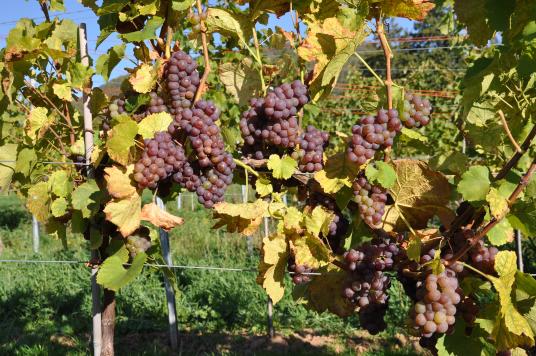
Silvaner growing in Franconia

Silvaner or Sylvaner (German: [zɪlˈvaːnɐ] ) is a variety of white wine grape grown primarily in Alsace and Germany, where its official name is Grüner Silvaner. While the Alsatian versions have primarily been considered simpler wines, it was included among the varieties that can be used to produce Alsace Grand Cru wine in 2006, together with the four 'noble grapes' of Alsace, although only in one vineyard, Zotzenberg.

This dichotomy is explained by the vigour of the Sylvaner vine and the grape's neutral flavour, which can lead to blandness unless yields are controlled. On the other hand, it gives a blank canvas for the expression of terroir, and on good sites with skilled winemaking, Sylvaner can produce elegant wines. It has high acidity but naturally reaches high must weights, so is often blended with other varieties such as Riesling or Elbling, and is sometimes made into a dessert wine.

History

[edit]

Sylvaner is an ancient variety that has long been grown in Central Europe. In Germany it is best known as a component of Liebfraumilch. It has long enjoyed a better reputation in Franconia than in other German wine regions. DNA fingerprinting has revealed it to be a cross between Traminer and the "hunnic" variety Österreichisch-Weiß (meaning "Austrian White").[1] As a result, it is now thought to have originated in Austrian Empire.

It is thought that the grape came to Germany after the Thirty Years' War as there is a record of Sylvaner from Austria being planted at County of Castell in Franconia on 5 April 1659.[2] So Germany celebrated the 350th anniversary of Silvaner in 2009. Its name has been taken to be associated with either Latin silva (meaning woods) or saevum (meaning wild), and before modern ampelography it was sometimes assumed that this variety had a close relationship with wild vines.[3] Before DNA typing, some assumed an origin in Transylvania based on its name.

A lot of Sylvaner was planted in Germany and Alsace after the Second World War, reaching 30% and 25% respectively of total vineyard area in the 1960s - 1970s. It was Germany's most grown variety until it was overtaken by Müller-Thurgau around 1970. Much of the German crop was blended into Liebfraumilch, but overproduction of this type of wine ruined its reputation, and changing tastes led to many vines being grubbed up. Liebfraumilch became popular again with new wine drinkers and again changing tastes.[4] However, in Franconia, where Liebfraumilch may not be produced and which primarily stuck to dry white wines in the decades when most other German regions produced semi-sweet wines, Silvaner has kept its popularity. Single-variety semi-sweet Silvaner, which used to be common, has all but disappeared from the German wine production. More recently there has been a revival in Alsace based on low yields from good vineyard sites, with formal recognition in 2006 as Zotzenburg Sylvaner became the first to be designated an Alsace Grand Cru.[5]

Sylvaner is the wine chosen by the protagonist of Julio Cortázar's novel 62 Modelo para armar on the firsts pages, when entering the Parisian restaurant Polidor “Why did I ask for a bottle of Sylvaner?”.

Distribution and wines

[edit]

Australia

[edit]

In the 1970s Brown Brothers experimented with "Syilvaner" in northeastern Victoria, but nothing seems to have come of it.[6]

Austria

[edit]

There are just 34 hectares (84 acres) of Sylvaner in its land of origin, due to the trend in Austrian wine towards drier styles.[7]

A bottle of Green silvaner from Međimurje County

Croatia

[edit]

Sylvaner (silvanac zeleni in Croatian) is grown in Eastern Croatia, in the regions of Slavonija and Srijem, as well as in other regions. In recent years high-quality semi-dry Silvanac zeleni from Orahovica has become one of Croatia's more popular whites.

France

[edit]

Sylvaner has a controversial place in Alsace wine. Since 2006, it may be used in Alsace Grand Cru, which was previously reserved for the four "noble grapes" Gewürztraminer, Muscat, Pinot gris and Riesling, but only in the Zotzenberg vineyard, which together with Altenberg de Bergheim and Kaefferkopf were allowed to produce mixed variety wines as Alsace Grand Cru.[8] Zotzenberg Grand Cru wines may consist of Gewürztraminer, Pinot gris, Riesling and Sylvaner in any combination. It is therefore possible to produce a varietally pure "Sylvaner Grand Cru" from this vineyard, but it may not be labelled so, only "Zotzenberg". Even after this, Jean Trimbach's view was that "This Sylvaner grand cru is only possible in Zotzenberg, it is a recognition of the terroir, but we should stop there." As in Germany, Sylvaner has been falling in popularity since the 1970s, declining from 25% of Alsace vineyards to 10% in that time.[5]

Germany

[edit]
A Silvaner wine from Franconia in the typical Bocksbeutel.

First recorded at Castell in 1659, Silvaner (with an 'i') reached a peak in the 1960s-1970s, with 30% of German vineyards. However overproduction during the Liebfraumilch years ruined its reputation, and it has since retreated to its stronghold in Franconia (Frankenland) (1,425 ha), where on the best chalky Muschelkalk terroir it can produce wines that can compete with the best German white wines which usually are made out of the Riesling grape. These powerful wines are considered food-friendly and are often described as having an "earthy" palate. Under VDP Erste Lage/Grosses Gewächs rules, Silvaner may be used for Grosses Gewächs wines (top-end dry wines), but only in Franconia and Saale-Unstrut and not in any of the other 11 German wine regions.[9] Silvaner is also grown in Rheinhessen (2,486 ha) and Palatinate, and is sometimes also made into dessert wine.[10] Currently there are 5,000 hectares (12,000 acres) in Germany, just 5% of the total area under vine.[11]

The official name of the variety in Germany is Grüner Silvaner, spelled with an "i" in difference from Alsace and its homeland of Austria.[3]

The Silvaner is not usually matured in barrique (oak) barrels to avoid the fine and fruity body of the Silvaner being overwhelmed by the oak taste.

Romania

[edit]

In Transylvania, presumed to be the homeland of Silvaner, two varieties of this grape are grown: the Sylvaner roz (rosé) and the Sylvaner Verde B (Grüner Silvaner, Silvaner) in wineyards as Jidvei (Tarnava) and Nachbil (Dealurile Sătmarului - Satu Mare)

Slovakia

[edit]

Silvaner is traditionally grown in the Limbach village in Slovakia, that is famous for its varietal Silvaner wines, and in its surroundings.

Switzerland

[edit]

Some is grown in Switzerland, where it is known as Johannisberger or Sylvaner with an "y".

United States

[edit]

In 1858, Emil Dresel brought the first Sylvaner cuttings to America and planted them on what is now the Scribe Estate in Sonoma County. In his honor, Scribe Winery planted one acre in 2007. It has been grown for many years at Rancho Sisquoc Winery in the Santa Maria Valley of California. Otherwise, Sylvaner has more or less disappeared from California, where it was known as Sylvaner Riesling, Franken Riesling, Monterey Riesling, and Sonoma Riesling. Oregon does have some Sylvaner at David Hill Vineyards in Forest Grove.

Red and Blue Silvaner

[edit]
Blue Silvaner

Varieties of Red Silvaner [12] and Blue Silvaner grapes are mutated varieties and are produced in small quantities

The wine areas of Baden-Württemberg are best known for producing red wines, most of which are locally consumed and not well known outside Germany.[13][14] Adjacent wine region Franken in Bayern (Franconia) has a similar continental type warm dry summer and is often planted with white silvaner grapes with small plantings of red silvaner grapes.[15][16]

Red silvaner mutates easily, with more than 200 varieties researched. Quality producers put much interest into new clone varieties for eventual replacement of traditional varieties.[17][18]

Blue silvaner is thought to be a natural cross between red and green silvaner, while red silvaner is thought to originate from natural mutation of green silvaner.[19]

A German red sylvaner wine from 2017 has been rated among the top 6% of wines in the country.[20]

Vine and viticulture

[edit]
A Silvaner from Franconia.

The vine is vigorous and productive, with three-lobed leaves. The bunches are small and cylindrical, with medium green berries that ripen quickly.

In 1940, Silvaner was crossed with Chasselas to produce the white grape variety Nobling.[21]

Synonyms

[edit]

Silvaner is also known under the following synonyms: Arvine, Arvine Grande, Augustiner Weiss, Beregi Szilvani, Boetzinger, Clozier, Cynifadl Zeleny, Cynifal, Fliegentraube, Frankenriesling, Frankentraube, Fueszeres Szilvani, Gamay blanc, GentilvVert, Gros Rhin, Gros-rhin, Gruen Silvaner, Gruenedel, Gruenfraenkisch, Grün Silvaner, Haeusler Schwarz, Johannisberger, Mishka, Momavaka, Monterey Riesling, Moravka, Movavka, Muschka, Mushza, Musza, Nemetskii Rizling, Oesterreicher, Oestreicher, Pepltraube, Picardon blanc, Picardou blanc, Plant Du Rhin, Rhin, Rundblatt, Salfin, Salfine Bely, Salvaner, Salviner, Scharvaner, Scherwaner, Schoenfeilner, Schwaebler, Schwuebler, Sedmogradka, Sedmogradska Zelena, Selenzhiz, Selivan, Silvánské zelené, Sylván zelený, Sonoma Riesling, Sylvaner, Sylvaner verde, Szilvani Feher, Tschafahnler, Yesil Silvaner, Zelencic, Zeleny, Zirifandel Zierifandel, Zinifal, Zoeld Szilvani, Zoeldsilvani,[22] Syilvaner, Siylvaner, Sylvaner vert, Grüner Sylvaner, Grünfraenkisch, Franken Riesling[6] and Grüner Silvaner.

See also

[edit]

References

[edit]

Further reading

[edit]
[edit]
Revisions and contributorsEdit on WikipediaRead on Wikipedia
from Grokipedia
Silvaner, also known as Sylvaner, is an ancient grape variety originating from , particularly associated with and , where it produces medium-bodied wines characterized by subtle fruity aromas of green apple, pear, and citrus, often underscored by earthy mineral notes and medium acidity. One of Europe's oldest cultivated vines, Silvaner is believed to be a natural cross between Traminer and Österreichisch Weiss, with roots tracing back to the regions of the former , including modern-day , , and . It spread to in the mid-17th century, where it was first documented in (Franken) in 1659, and became the country's most widely planted grape for nearly 300 years, thriving during challenging periods like the and post-Thirty Years' War recovery due to its resilience in cooler climates. Today, plantings have declined since the 1960s owing to high yields, susceptibility to frost and diseases, and competition from varieties like and , but it remains significant in with 4,228 hectares (about 4.1% of total vineyard area) as of 2024, primarily in Rheinhessen and Franken. In , it covers just 23 hectares as of 2023–2024, mainly in Niederösterreich and Steiermark, while smaller plantings exist in (France), (as Johannisberger), and northern Italy's Alto Adige. Viticulturally, Silvaner is an early-ripening variety with small, dense clusters of greenish-yellow berries, thriving in chalky, cooler soils but prone to in high-lime conditions and requiring careful management against diseases. The resulting wines are versatile, typically dry with 11.5–13.5% ABV, no , and medium acidity, ranging from light and fresh everyday styles to complex, terroir-driven expressions aged in or , often featuring herbaceous hints like or fresh grass alongside peach and passion fruit notes. In Franken, it is iconically bottled in the flat, round , and high-end examples, such as VDP Grosses Gewächs, highlight its potential for aging and pairing with dishes like , , or roast pork.

History and Origins

Early Cultivation

The name Silvaner (also spelled Sylvaner in some contexts) has long been associated with in modern-day , where it was traditionally believed to have originated, based on etymological associations, introduced by German settlers during waves of migration to the region. This etymological link reflects early assumptions about its eastern European roots, though subsequent research has clarified its Austrian origins as a cross between Traminer and Österreichisch Weiß, with cultivation documented in the Valley since medieval times. The variety's verifiable early cultivation in German-speaking regions began in the mid- to late , coinciding with post-Thirty Years' War recovery efforts in . The first documented planting occurred on April 5, 1659, when an estate administrator in , Franken (Franconia), acquired 25 Silvaner vines for the Reitsteig at a cost of 8 shillings and 3½ each. Shortly thereafter, in 1665, Cistercian monks at Ebrach Abbey in Franken recorded the grape by name in their documents, crediting Abbot Alberich Degen with importing vines from to bolster local wine production. These monastic initiatives underscored Silvaner's initial role as a reliable, suited to the challenging clay-limestone soils of Franken. By the late 17th century, Silvaner had spread from Franken to adjacent regions, including the Pfalz and Rheinhessen, where it was embraced for its adaptability and capacity to produce substantial yields on diverse sites. In the broader , encompassing and , the grape saw early adoption as an integral part of imperial viticulture. This expansion highlighted Silvaner's foundational importance in sustaining regional wine economies, particularly through its robust vigor that supported consistent production amid varying climatic conditions. During the devastating phylloxera outbreaks that ravaged European vineyards in the late , Silvaner's inherent vigor proved advantageous in recovery efforts, enabling faster replanting and helping maintain wine output in affected areas like Franken and Rheinhessen where pre-phylloxera vines had persisted in isolated, sandy soils.

Genetic Background and Evolution

Silvaner is a natural hybrid variety resulting from the cross between Savagnin Blanc (also known as Traminer or ancestor) and Österreichisch Weiß, an obscure ancient white grape once common in . This parentage was confirmed through using molecular markers, establishing Silvaner as an autochthonous variety of central Europe, likely originating in or adjacent regions such as during the 14th or 15th century. Prior to these genetic analyses, etymological theories suggested possible Transylvanian roots via medieval trade routes from the region, but modern studies refute this in favor of a local Alpine genesis. The variety's evolutionary history reflects adaptations to cool continental climates, where it developed moderate tolerance to low temperatures through in pre-modern vineyards. While not exceptionally frost-hardy—exhibiting sensitivity to severe winter freezes below -18°C—Silvaner's early budburst and vigorous growth suit marginal sites with short growing seasons, contributing to its spread across by the . The phylloxera epidemic of the 1880s devastated European plantings, including Silvaner, prompting widespread onto resistant American rootstocks like Riparia or Rupestris hybrids; this practice revolutionized propagation, enabling replanting on a large scale while preserving the scion's characteristics but introducing subtle influences on vigor and yield. Early 20th-century breeding efforts focused on to enhance uniformity, with the 1922 Froelich clone—derived from high-quality Franken vines—becoming the first officially registered Silvaner selection in , marking a shift toward standardized . DNA analyses have revealed Silvaner's relatively low due to historical bottlenecks and reliance on few clones in systems, heightening vulnerability to diseases like and climate stressors. In recent years, as of , Silvaner has gained attention for its adaptability to warming climates, potentially aiding future resilience.

Vine Characteristics and Viticulture

Morphological Traits

The Silvaner displays medium to high vigor, characterized by upright shoots and medium wood maturity, enabling fertile and consistent yields in suitable conditions. Its leaves are pentagonal in shape, typically five-lobed with lightly sinuated and undulate margins, orbicular or cordate form, and a slightly bullate texture featuring wide, pointy teeth and low to medium on both surfaces. The berries are small to medium in size, spherical or roundish, with a green-yellow hue often marked by brown specks or small dots; they possess relatively thick skins that contribute to the variety's signature high acidity and moderate sugar accumulation at maturity. Clusters form compact, cylindrical or conical-cylindrical bunches with conspicuous shoulders and dense berry packing, rendering them susceptible to botrytis bunch rot under humid conditions. As a , Silvaner requires onto phylloxera-resistant rootstocks such as 5BB, SO4, or Börner for effective cultivation, demonstrating strong compatibility with these selections.

Cultivation Requirements and Practices

Silvaner vines are best suited to cool continental climates, where they develop their characteristic high acidity and subtle fruit flavors without excessive heat stress. The variety ripens mid-season, typically about two weeks earlier than , and benefits from regions with moderate sunshine exposure and protection from frosts, to which it shows notable sensitivity. While tolerant of winters, Silvaner performs optimally in areas with balanced moisture, as it requires consistent water availability during growth to avoid stress. The adapts well to fertile, well-drained soils of medium to heavy texture, particularly those rich in , , and , such as the Muschelkalk prevalent in Germany's Franken region. These types provide the necessary nutrient supply to support Silvaner's vigorous growth while contributing to the wine's mineral expression. However, it is prone to in overly or nutrient-poor sites, and neutral to slightly alkaline pH levels are ideal for maintaining acidity and overall health. Viticultural practices for Silvaner emphasize controlling its inherent vigor through systems like pruning or high cordon , which allow for balanced shoot growth and exposure. Meticulous winter limits bud numbers to achieve yields typically ranging from 50 to 80 hl/ha in quality-oriented vineyards, though higher outputs up to 120 hl/ha are possible in fertile sites with careful management. Canopy management, including leaf removal and positioning, is crucial to enhance , reduce humidity around clusters, and mitigate fungal risks while promoting even ripening. Key challenges in Silvaner cultivation include high susceptibility to powdery mildew, , and botrytis bunch rot, necessitating vigilant monitoring and protective measures like sulfur-based treatments. The variety also exhibits poor , relying on soils with reliable water retention or in drier conditions. In the , German growers have increasingly turned to sustainable and organic practices to address these issues, with many estates adopting to bolster vine resilience, improve , and produce more expressive wines.

Variants

Red Silvaner

Red Silvaner represents a rare color of the Silvaner variety, featuring red berry skins due to pigmentation while retaining white pulp, distinguishing it from teinturier grapes that color the juice. This arises naturally from the green-skinned Grüner Silvaner and is genetically identical to the parent variety, resulting in no significant differences in morphology or composition beyond color. Cultivation of Red Silvaner remains extremely limited, comprising less than 1% of total Silvaner plantings worldwide, primarily in experimental contexts within and . It is occasionally propagated for producing or light red wines, with yields comparable to standard Silvaner and necessitating similar viticultural practices. The variant shares the robust, high-yielding nature of Silvaner, thriving in and soils but requiring careful management to maintain berry integrity. Today, it is largely conserved in such as the Julius Kühn-Institut's facility at Geilweilerhof in to preserve within the Silvaner lineage. Commercial production of Red Silvaner is negligible, with extremely limited plantings concentrated in research-oriented vineyards exploring its potential for amid rising temperatures and shifting growing conditions. Small-scale examples persist in regions like , where producers experiment with its potential for distinctive light reds.

Blue Silvaner

Blue Silvaner, also known as Blauer Silvaner, is a rare color of the variety characterized by blue-black skins, distinguishing it from the more common green-berried Grüner Silvaner. This variant produces wines with enhanced tannic structure due to the pigmented skins, offering a robust profile suitable for meal accompaniment and aging. The imparts higher levels of bitter and herbal notes compared to standard Silvaner, while retaining a similar aromatic base of apple and earthiness. The blue mutation was first documented in 1964 when a single vine appeared in a 1.3-hectare plot of Green Silvaner in , , prompting tests for genetic stability among its descendants. It was officially registered in the German variety catalog in 1984, marking its recognition as a distinct clone. Historical records suggest blue-berried Silvaner existed in mixed plantings alongside yellow and red variants as early as the in , but selective propagation of the green type led to its near by the mid-20th century. Like Red Silvaner, it represents a pigmented sport of the parent variety, though Blue Silvaner emphasizes deeper skin coloration for subtle red hues in vinification. Cultivation of Blue Silvaner remains niche, with approximately 29 hectares planted across as of 2018 (less than 1% of total Silvaner acreage, which stood at 4,419 hectares in 2022), primarily in regions such as , Rheinhessen, and Saale-Unstrut. The variety thrives in diverse soils but shows promise in and terrains, yielding medium-sized, dense clusters of round berries that ripen to dark violet-blue shades. Its content allows for limited color extraction during fermentation, resulting in copper-golden to salmon-pink wines rather than deep reds. In , where Silvaner traces possible origins, blue mutations have been noted in old vineyards, though commercial plantings remain experimental and focused on preserving . Breeding programs at the Julius Kühn-Institut (JKI) in Geilweilerhof maintain Blue Silvaner in their collection, supporting efforts to develop disease-resistant hybrids through crosses with resilient varieties. These hybrids aim to combine Blue Silvaner's potential with improved vigor for sustainable organic production. Emerging applications highlight Blue Silvaner's versatility for low-intervention wines, including lightly tinted rosés and orange-style whites with elevated structure and aging potential. However, its adoption is constrained by modest yields and sensitivity to overcropping, which can dilute the intense, spicy flavors of apple peel, hay, and citrus zest. Producers value it for boutique, terroir-driven expressions, particularly in cooler climates where its early ripening aids adaptation to variable conditions.

Wine Characteristics

General Profile and Styles

Silvaner wines are characterized by a base profile featuring high acidity levels typically ranging from 6 to 8 g/L, which contributes to their refreshing and structured nature, alongside low to medium alcohol content of 11-13% ABV. These wines generally present a neutral to subtly fruity character, often exhibiting notes of green apple and undertones that highlight the grape's restrained aromatic intensity. The primary styles of Silvaner encompass dry table wines classified under predicates such as Kabinett and , with rare instances of sweeter Auslese productions reserved for exceptional vintages or late-harvest conditions. Fermentation is commonly conducted in tanks at controlled temperatures of 16-18°C to preserve the wine's inherent freshness and delicate fruit expression, while optional aging is employed in certain Franken region styles to impart subtle complexity and texture without overpowering the varietal's purity. Winemaking techniques emphasize early harvesting in October to maintain the grape's natural acidity, with frequently blocked to retain the crisp, tart profile essential to the style. In blended wines like , Silvaner is commonly used, contributing body and acidity alongside varieties such as and Müller-Thurgau; regulations require at least 70% from approved white grapes including Silvaner. Since the early , Silvaner production has evolved from large-scale, mass-produced volumes toward a greater emphasis on terroir-driven expressions, with increasing focus on single-vineyard sites that showcase site-specific minerality and nuance, reflecting a broader revival supported by initiatives like the Silvaner Forum founded in 1998.

Aroma, Flavor, and Pairing Notes

Silvaner wines are characterized by a subtle aroma profile that contributes to their neutral, restrained varietal character. Prominent notes often include , lime, and wet stone , with herbal undertones influenced by compounds. With aging, these wines can develop enhanced mineral complexity, maintaining vibrancy for up to 10 years in optimal conditions. On the palate, Silvaner typically presents a crisp acidity balanced by subtle flavors of peach and herbal elements, leading to a dry finish. The medium-light body emphasizes freshness without overt fruitiness. Variants like Red Silvaner introduce light for added structure, while Blue Silvaner offers a more intense expression with heightened bitter phenols and potential rosé-like hues in skin-contact styles. Ideal food pairings for Silvaner highlight its acidity and minerality, complementing such as or , white meats like , and Alsatian dishes including . It contrasts well against lighter fare but is less suited to heavy pairings. Serve at 8-10°C to preserve its refreshing qualities. Critics have noted rising appreciation for Silvaner as an underrated value, with recent vintages earning scores averaging around 88-93 points for their terroir-driven expression and elegance.

Regional Production

Silvaner occupies a significant position in German viticulture, with approximately 4,330 hectares under cultivation as of 2023, reflecting a decline from over 5,000 hectares in 2010 due to shifts toward more internationally popular varieties like and Pinot varieties. The grape is primarily concentrated in three regions: Rheinhessen, the largest single area with around 1,875 hectares and expansive limestone-influenced sites; Franken, accounting for about 36% of national plantings (around 1,563 hectares) and using the iconic flat, bottle as its signature vessel; and Pfalz, where it contributes to the region's diverse portfolio. In , Silvaner typically yields dry wines characterized by pronounced mineral notes arising from the soils common in producing areas like Franken and Rheinhessen, often complemented by subtle green apple and herbal undertones. Annual production is estimated at around 250,000–300,000 hectoliters based on average yields, with only about 5% destined for export, mainly to markets seeking mineral-driven whites. Recent trends highlight a resurgence in Silvaner's reputation, propelled by innovative producers such as those at Weingut Müller in Franken, who have elevated its profile through site-specific expressions and a marked shift toward practices amid growing demands. The 2021 late-spring frost notably disrupted production, reducing yields significantly in vulnerable regions like Franken due to bud damage in cooler, inland sites. In 2024, overall production declined by 9.7% to 7.8 million hectoliters due to challenges, potentially impacting Silvaner yields similarly. Economically, Silvaner accounts for about 4.2% of Germany's total area and around 3% of volume, serving as a for Qualitätswein designations, particularly in dry styles that underscore the country's emphasis on terroir-driven quality wines from protected origins.

Austria

In , Sylvaner—officially known as Grüner Sylvaner—is one of the country's oldest autochthonous grape varieties, originating from a natural cross between Traminer and Österreichisch Weiß, and historically referred to as "Österreicher." This variety, among Europe's earliest cultivated vines, spread from to Germany in the , where it gained prominence, but remains of minor significance in its homeland today. plantings total just 23.06 hectares as of the 2023-2024 growing season, with the largest concentrations in Niederösterreich (15 hectares, or 64.18% of the total), followed by Steiermark (6 hectares, 28.01%), (1.3 hectares, 5.84%), Wien (0.4 hectares, 1.91%), and negligible amounts in Bergland. Austrian Sylvaner wines are typically neutral to fruity in style, with aromas of emerging in more mature expressions, reflecting the grape's early ripening and adaptation to specific site conditions. Production volumes are modest due to the variety's limited cultivation, emphasizing its role as a supporting player rather than a standalone varietal wine. While not a focal point in prominent appellations like the DAC—where and dominate—Sylvaner contributes to regional specialties through blending. The variety faces significant cultivation challenges, including low frost resistance, high susceptibility to , oidium, and botrytis, as well as proneness to in lime-rich soils and weak vigor that limits its suitability for modern high-training systems like Lenz Moser's. Plantings have declined steadily from 1999 to 2020, overshadowed by the more robust and market-favored , though Sylvaner retains value in field blends such as Wiener Gemischter Satz, where it adds complexity alongside grapes like , , and Neuburger in Vienna's historic vineyards.

France

In , Silvaner, known locally as Sylvaner, is cultivated almost exclusively in the region, where it represents a modest but historic component of the white wine portfolio. Plantings total approximately 672 hectares as of 2024, reflecting a continued but stable presence in the vineyard landscape. This variety is one of the permitted grapes for sparkling wines, contributing to the base blends alongside , , and others. Sylvaner has been one of the seven authorized varietals for AOC wines since the appellation's recognition in 1962, with formal inclusion in varietal labeling and blends established by 1971 under INAO regulations. It plays a supporting role in assemblages like Edelzwicker and Gentil d', where it adds freshness and structure, though it is less prominent in Grand Cru designations except for the Zotzenberg site. Plantings have declined significantly from around 1,000 hectares in the 1980s, driven by grower preferences for higher-value varieties such as , which now dominate premium segments; this shift reduced Sylvaner's share from over 20% of vineyards to under 5% today. Alsace Sylvaner wines are characteristically full-bodied yet refreshing, often slightly off-dry with aromas and flavors of ripe , white , and subtle minerality derived from the region's and alluvial soils. Annual production hovers around 20,000 hectoliters, primarily as accessible entry-level AOC Alsace bottlings that emphasize everyday drinkability rather than complexity. These wines pair well with light , aspics, or Alsatian , showcasing the grape's versatility in regional cuisine. Notable concentrations of Sylvaner occur around in the department, where granite-influenced slopes enhance the wine's textural depth, and Ribeauvillé, home to historic producers like the Cave de Ribeauvillé that specialize in old-vine expressions. In select sites, late-harvest Vendanges Tardives versions elevate the style, yielding sweeter, more concentrated wines with botrytis-inflected pear and honey notes, though such bottlings remain rare.

Other Producing Countries

In , Silvaner is cultivated on approximately 250 hectares, primarily in the region among the German-speaking cantons, where it contributes to the production of around 25,000 to 30,000 hectoliters annually of white wines noted for their mineral-driven profiles influenced by the alpine . The features small experimental plantings of Silvaner totaling under 200 hectares, concentrated in cooler areas such as New York's and parts of , with initial introductions dating to the 1970s alongside other vinifera varieties; current production remains modest at roughly 5,000 cases per year, often explored in hybrids and blends. Australia and Croatia maintain limited Silvaner vineyards, each under 100 hectares, where the variety is typically incorporated into cool-climate white blends; in Croatia, known locally as Silvanac zeleni, these plantings trace back to the Austro-Hungarian era and persist in eastern regions like . Romania preserves historical remnants of Silvaner cultivation totaling about 234 hectares, primarily yielding table wines, while Slovakia has around 233 hectares centered around Limbach and showing signs of revival in niches as of 2025. Globally, Silvaner plantings outside , , and amount to fewer than 1,000 hectares, reflecting a 10% increase in areas since 2020 driven by the variety's adaptability to changing climates.

Synonyms and Nomenclature

Regional Names

In , the Silvaner is officially designated as Grüner Silvaner under national wine regulations, distinguishing it from historical variants. In the Franken region, where it dominates plantings, it is commonly tagged as Franken Silvaner to emphasize local and tradition. In , particularly within the Niederösterreich district and its associated Districtus Austriae Controllatus (DAC) appellations such as Kremstal and Kamptal, the variety is known as Sylvaner. In , under the (AOC) regulations, the grape is officially named Sylvaner and permitted for use in varietal wines from the region. In , the variety is primarily cultivated in the region, where it is known as Johannisberg; Silvaner is the standard name in German-speaking areas, while Sylvaner appears in French-speaking areas. At the level, the grape is registered as Silvaner in the official variety catalogue, with harmonization of names across member states completed by 2010 to standardize trade and labeling.

Linguistic and Historical Synonyms

The name Silvaner derives from the Latin silvanus, meaning "of the forest" or "forester," a reference that likely stems from an early myth associating the grape with wild woodland vines growing in forested areas of . This etymological link reflects 17th- and 18th-century beliefs about its origins, though genetic analysis has since traced it to a crossing of Traminer (related to ) and Österreichisch Weiss, an ancient Austrian variety. Prior to 1918, the spelling "Sylvaner" was commonly used in German-speaking regions, a convention altered after to "Silvaner" in line with orthographic reforms. Historical synonyms for Silvaner abound, testifying to its ancient cultivation across since at least the , with over 165 documented in the VIVC database as of 2025. In 18th-century , it was known as Zierfandler or Grüner Zierfandler, names evoking its ornamental clusters and green berries, though these terms have largely fallen out of use to distinguish it from the unrelated Spätrot variety. Similarly, Ruländer served as an early misnomer in German regions, confusing it with due to superficial similarities in berry skin and wine structure. Other archaic terms include Augustiner Weiss (referring to monastic plantings) and Weisser Zierfandler, many of which highlight its role in blending and table wines before phylloxera devastation in the late . Cross-culturally, Silvaner's nomenclature ties into its genetic heritage, with —a pink-berried mutation of the parent—providing a direct lineage in French Jura traditions, where related terms like Arvine Grande persist in historical . These connections underscore its evolution from a rustic, forest-foraged vine to a structured , with genetic studies confirming ties to synonyms like Österreicher in . In modern contexts, deprecated terms such as "White Burgundy" appeared in early 20th-century U.S. catalogs to market Silvaner imports, exploiting its subtle, mineral-driven profile akin to unoaked , but standardization efforts by organizations like the VIVC have phased them out to prevent confusion with true Burgundian varieties like (Weissburgunder).

References

Add your contribution
Related Hubs
User Avatar
No comments yet.