Hubbry Logo
TelegraphistTelegraphistMain
Open search
Telegraphist
Community hub
Telegraphist
logo
8 pages, 0 posts
0 subscribers
Be the first to start a discussion here.
Telegraphist
Telegraphist
from Wikipedia

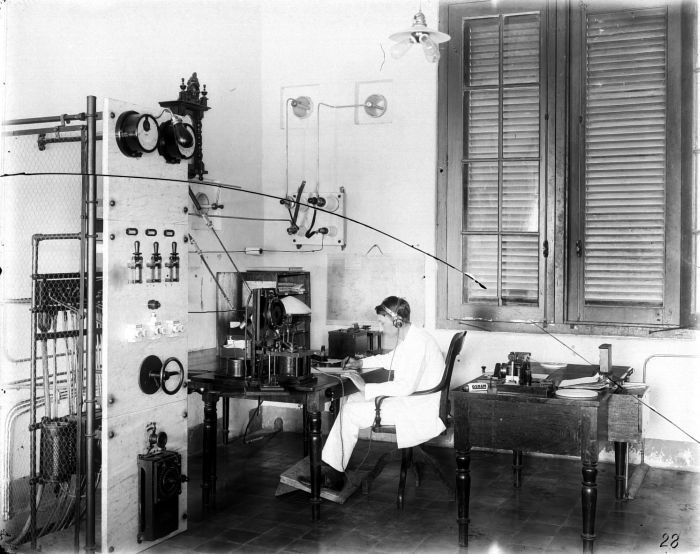
Telegrapher, dated before 1927 from the Tropenmuseum collection

A telegraphist (British English), telegrapher (American English), or telegraph operator is a person who uses a telegraph key to send and receive Morse code messages in a telegraphy system. These messages, also called telegrams, can be transmitted electronically by land lines, or wirelessly by radio.

History

[edit]
Telgraphists of the Queen Mary's Army Auxiliary Corps, 1919

During the First World War, the Royal Navy enlisted many volunteers as radio telegraphists. Telegraphists were indispensable at sea in the early days of wireless telegraphy, and many young men were called to sea as professional radiotelegraph operators who were always accorded high-paying officer status at sea. Subsequent to the Titanic disaster and the Radio Act of 1912, the International Safety of Life at Sea (SOLAS) conventions established the 500kHz maritime distress frequency monitoring and mandated that all passenger-carrying ships carry licensed radio telegraph operators.[1]

Notable telegraphists

[edit]

See also

[edit]

References

[edit]
Revisions and contributorsEdit on WikipediaRead on Wikipedia
from Grokipedia
A telegraphist, also known as a telegrapher or telegraph operator, is a skilled professional who operates telegraph equipment to transmit and receive messages, primarily using through electrical wires or signals. The role emerged in the mid-19th century after the development of the electric telegraph, revolutionizing long-distance communication by enabling near-instantaneous message delivery across continents. Telegraphists were indispensable in key sectors, including postal services where they handled public telegrams after national monopolies like Britain's acquisition of the telegraph network; railroads, where they coordinated train movements to avert collisions and supported western expansion in the United States; military operations, such as during the for intelligence and command coordination; and maritime shipping for ship-to-shore and inter-ship signaling. Notably, the profession opened opportunities for women, who comprised a significant portion of operators—such as the over 800 female telegraphists employed at London's Central Telegraph Office by the 1890s—and formed fraternal organizations to advocate for better wages and conditions. The telegraphist's expertise in rapid code transmission, often at speeds exceeding 30 , facilitated pivotal historical advancements in , dissemination, and global connectivity until the early 20th century. However, the rise of the , automated teletype systems, and led to the profession's decline after the 1920s, rendering it largely obsolete by the mid-20th century as telegraph use dwindled post-Great Depression.

Definition and Role

Definition

A telegraphist is a specialist who operates telegraph equipment to transmit and receive messages, primarily using via manual keys. This role emerged in the context of the electric telegraph's in the , enabling rapid long-distance communication. The term "telegraphist" is the preferred designation, while "telegrapher" is the equivalent, both rooted in 19th-century terminology derived from "telegraph" combined with suffixes indicating a practitioner. The word "telegraphist" emerged in the , aligning with the adoption of electric telegraph systems. Telegraphists are distinguished from telegraph engineers, who focus on designing, installing, and maintaining the underlying systems and , whereas telegraphists execute the operational transmission tasks. Their core function centers on converting textual or verbal content into coded electrical or radio signals for wired or long-distance relay, with variants including American Morse for landlines and International Morse for global use.

Primary Responsibilities

Telegraphists, also known as telegraph operators, were responsible for encoding messages into using a , carefully adjusting the transmission speed and signal clarity to ensure reliable delivery over long distances. This process required precise manipulation of the key to produce distinct dots and dashes, with operators typically aiming for speeds of around 30-40 during routine operations to balance efficiency and accuracy. Upon receiving incoming signals, telegraphists decoded the impulses—converted from electrical pulses into audible clicks or paper tape impressions—transcribing them onto paper or typewriters while verifying the message's integrity through word counts and checksums. They acknowledged receipt by sending an "" signal along with their personal identifier and office call, then double-checked for completeness before finalizing the transcript. Message routing involved determining the optimal path for transmission, often coordinating with switchboard operators to direct telegrams to their destinations, with priority given to urgent dispatches such as bulletins or orders to minimize delays in critical communications. Operators ensured by treating all messages as private and delivering them promptly only to authorized recipients, sometimes forwarding night messages to the nearest open office before closing. In cases of transmission errors caused by interference, static, or line faults, telegraphists followed standardized protocols, such as indicating a mistake and requesting retransmission of the affected words or entire sections, while logging discrepancies for reporting to supervisors. They repeated back portions of the message for confirmation, marking corrections as "Repeated back OK" to maintain accuracy, and adjusted instruments or reported failures to restore service quickly. To support continuous operations, telegraphists managed in 24/7 stations, relieving colleagues at designated times and briefing successors on pending messages, train positions, or unfinished business to avoid disruptions. During high-volume periods, such as closes, operators handled overwhelming backlogs— for instance, processing 16 million shares on , 1929, often extending shifts until late evening to clear queues and update price information.

Work Environments

Telegraphists operated in diverse settings that reflected the telegraph's role in connecting land, sea, and operations across various eras and regions. offices, such as those in depots, served as key hubs for coordinating transportation and commercial traffic; for instance, and railroad operators worked in small station buildings equipped with telegraph sounders, straight keys, and later typewriters, often handling dual circuits amid constant message flow. Maritime environments centered on rooms aboard ships, which were compact cabins designed for limited deck space, featuring operating tables, storage for spare parts like fuses and crystals, and waterproofed enclosures to shield equipment from saltwater exposure. field units, particularly during conflicts like the , utilized temporary setups in tents, crude shelters, or bombproofs near front lines, where operators managed portable wire lines under combat conditions. Physical setups typically included enclosed booths or dedicated rooms fitted with essential tools: sounder devices for audible signal reception, manual keys for transmission, and paper tape perforators for recording messages, often in environments filled with the rhythmic clicking of multiple instruments. These spaces were frequently noisy due to overlapping transmissions and dimly lit to enhance focus on auditory cues, though maritime cabins prioritized compactness and orderliness to prevent equipment failure. In specialized offices, such as those of , telegraphists managed high-volume international dispatches in urban central locations, integrating and early systems for rapid news relay. Employment contexts spanned commercial enterprises like offices, where operators handled public and business messages; governmental post offices, including the Central Telegraph Office in with its networks linking branches; and signals for strategic communications. Working conditions were demanding, with shifts commonly extending 10 to 12 hours or more, sometimes without breaks, as seen in isolated railway outposts or busy urban hubs. Operators faced exposure to , such as static from ungrounded lines or atmospheric disturbances in setups, which could disrupt signals and require constant adjustments. Gender dynamics varied, with women increasingly employed in telegraph roles from the late , particularly in post offices and commercial firms, though often at lower pay, under similar long-hour pressures. Safety and health concerns arose from the equipment's demands and hazards. High-voltage lines posed risks, exemplified by incidents like strikes through ungrounded apparatus, leading to fatalities among operators. Repetitive strain injuries, known historically as "telegrapher's " or "glass arm," resulted from prolonged keying motions, causing wrist and arm afflictions that forced some to retire early. In fields, operators endured additional perils, including targeting and , with casualty rates exceeding 8% in the U.S. Civil War Signal Corps due to combat exposure. Poor ventilation in some offices heightened respiratory risks, while maritime roles involved navigating shipboard instability and potential leaks threatening gear integrity.

Historical Development

Origins in Early Telegraphy

The profession of telegraphist originated in the mid-19th century with the invention of the , which necessitated skilled individuals to manually transmit and receive messages over electrical wires. Parallel developments occurred in the United States and ; in 1837, Samuel F. B. Morse developed a practical and filed a caveat for its patent, featuring an automatic sender that used a plate with metal bars representing dots and dashes for alphabetic and numeric signals, along with a receiver employing an to mark paper tape. In Britain, William Fothergill Cooke and patented a needle the same year, which used electrical impulses to move needles on a dial to spell out messages and required operators to interpret and signals. This innovation addressed the limitations of earlier optical telegraphs by enabling instantaneous long-distance communication, but it required operators proficient in interpreting and sending coded electrical impulses. The system's debut underscored the demand for dedicated operators when, on May 24, 1844, Morse transmitted the first official message—"What hath God wrought?"—from the U.S. Capitol in , to his associate in , , over a 40-mile line. This biblical quotation, suggested by Annie Ellsworth, traveled via copper wire strung on poles, marking the telegraph's public demonstration and proving its reliability for commercial use. The event highlighted the essential role of operators, who had to key in signals precisely and decode responses in real time, as initial receivers produced inked traces on tape that operators read aloud or transcribed. Among the earliest operators were apprentices like , whose mechanical expertise transformed Morse's prototype into a workable device. Recruited in after impressing Morse at his father's , Vail refined the telegraph key into a simple lever mechanism for manual on-off signaling and contributed to streamlining the by assigning shorter sequences to frequent letters, enhancing transmission speed. His hands-on involvement, including constructing instruments and securing patents, exemplified the apprenticeship model that trained initial telegraphists through direct collaboration with inventors. Training in the 1840s remained informal, relying on apprenticeships under experienced technicians in both the and , where operators learned to handle equipment through trial and practice rather than structured programs. The launch of the first commercial line in 1846, connecting New York to Washington by the Magnetic Telegraph Company, intensified this need, as operators manually operated keys and relays along the route to relay messages for businesses and government. Technologically, these systems depended on battery-powered circuits to generate electrical pulses and electromagnetic relays—pioneered by —to amplify weak signals over distances, allowing basic on-off modulation for code transmission without continuous power draw. Socioeconomically, the telegraphist role arose amid rapid railroad expansion in the , as lines proliferated across the U.S. to transport goods and passengers. Operators were integral to safe operations, using telegraph stations at rail depots to implement block signaling: they communicated positions to dispatchers, indicating occupied track sections to avert collisions and coordinate schedules dynamically, a flexibility impossible with timetables alone. This integration, beginning with lines paralleling railroads like the Baltimore and , positioned telegraphists as vital to industrial growth, blending communication expertise with transportation logistics.

Expansion and Peak Usage

The successful laying of the in marked a pivotal expansion in global , dramatically reducing communication times across the Atlantic from weeks to minutes and spurring demand for skilled international operators to manage the surge in cross-oceanic traffic. This breakthrough tied distant markets together, enabling rapid exchange of commercial information such as prices between and America, which necessitated a growing cadre of telegraphists proficient in handling high-volume, time-sensitive transmissions. By the early , the completion of the Pacific cable in 1902 further globalized the network, connecting to via and and encircling the world in telegraph lines for the first time, thereby intensifying the need for operators versed in long-distance, multilingual operations. In the United States, the profession reached its zenith around 1900, with —a dominant player—handling over 63 million messages annually, reflecting the explosive growth in telegraph usage that supported the nation's expanding economy. This volume underscored the essential role of telegraphists, whose numbers swelled to meet the demands of an interconnected , employing tens of thousands across the to process domestic and international dispatches efficiently. Technological innovations like the duplex system, which allowed simultaneous two-way transmission over a single wire, and Edison's quadruplex system of 1874, enabling four messages at once (two in each direction), revolutionized capacity but required operators with advanced skills in signal adjustment and error correction to maintain reliability. Amid this boom, telegraphists organized to address grueling conditions, culminating in the formation of the Commercial Telegraphers' Union of America on March 15, 1903, which quickly amassed over 8,000 members advocating for equitable wages, defined hours, and improved working environments in the face of long shifts and low pay. Economically, these professionals were indispensable, powering real-time stock trades through dedicated tickers that disseminated nationwide, coordinating transatlantic flows by relaying passenger manifests and arrangements, and fueling news services like the , whose wire networks delivered breaking reports to newspapers almost instantaneously.

Role in Conflicts and Major Events

During the (1861–1865), telegraphists in the U.S. Military Telegraph Corps played a pivotal role in facilitating real-time battlefield coordination and command decisions, operating portable equipment such as wagon-mounted wire systems to lay temporary lines under combat conditions. These field operators, often civilians attached to the Quartermaster Department, constructed over 15,000 miles of telegraph lines and transmitted approximately 6.5 million messages, enabling Union generals to direct troop movements and artillery fire swiftly. President frequently visited the War Department telegraph office, where operators like those in the U.S. Military Telegraph Service used Stager's Telegraphic Cipher Book to secure dispatches, allowing him to monitor frontline developments and issue direct orders to commanders. In the , telegraphists were essential for restoring communication amid widespread infrastructure collapse, with operators rapidly repairing severed lines and coordinating relief efforts through surviving networks to connect the isolated city with the outside world. The quake initially cut all telegraph service for three hours, but and personnel, including figures like H.J. Jeffs who climbed damaged poles to reconnect wires, reestablished key circuits by midday, enabling the transmission of urgent damage reports and supply requests that facilitated federal aid. Their efforts, often conducted amid aftershocks and fires, ensured that news of the disaster reached national authorities, preventing further chaos in relief coordination. The sinking of the RMS Titanic in 1912 highlighted the life-saving potential of wireless telegraphists, as operators Jack Phillips and , employed by the , continuously broadcast distress signals from the ship's radio room despite the vessel's imminent collapse. Phillips, the senior operator, initiated calls at 12:15 a.m. on April 15, specifying the ship's position (41.44°N, 50.24°W), while assisted until the power failed at 2:17 a.m., moments before the ship sank at 2:20 a.m. Their persistent transmissions alerted the , which arrived to rescue over 700 survivors, though Phillips perished and barely escaped; this event spurred international reforms like the 1914 mandating 24-hour watches. In (1914–1918), wireless telegraphists revolutionized naval and land operations, with shipboard operators sending signals that coordinated fleet maneuvers and rescues, while trench-based networks supported artillery timing and supply logistics. By 1918, wireless had become widespread on British ships, building on the 435 sets installed by 1913 and enabling admirals to direct battles like in real time via transmissions up to 100 miles. On the Western Front, telegraphists laid buried cable networks in trenches—often under fire—to link forward observers with gun batteries, reducing response times for barrages from hours to minutes and minimizing incidents. These operators also intercepted enemy signals for intelligence, contributing to breakthroughs like the decoding of German naval codes. During (1939–1945), telegraphists integrated into units intercepted and decrypted enemy wireless transmissions, including those encrypted with the , providing Allied commanders with critical tactical advantages. In the European theater, British and American intercept operators at stations like monitored and Morse signals, breaking Enigma variants to reveal convoy attack plans and saving thousands of lives through rerouted shipping. In the Pacific, U.S. radiomen operated ship-to-shore links and direction-finding equipment to intercept Japanese fleet codes, enabling victories like Midway by predicting carrier positions from decrypted messages. These efforts, supported by over 10,000 trained signals personnel, underscored ’s role in fusing communication with code-breaking for strategic dominance.

Decline with Emerging Technologies

The rise of the in the post-1920s era significantly eroded the demand for manual telegraph operations, as automated switching systems and direct-dial capabilities diminished the need for human intermediaries in point-to-point messaging. By , teletypewriters—electromechanical devices that automated the transmission of typed messages over telegraph lines—further supplanted skilled operators, allowing typists to send and receive communications without specialized coding expertise. This shift accelerated during the , when telegraph traffic volumes plummeted and never fully recovered, marking the beginning of widespread obsolescence for traditional telegraphist roles. In the and , the advent of voice radio and phototelegraphy technologies redirected communication flows away from wire-based telegraph services, particularly for dissemination and long-distance reporting. Radio telegraphy, already competing with wire systems since the early 1900s, became dominant for maritime and international traffic by the , leading to the closure of numerous wire services as broadcasters and agencies prioritized faster, voice-enabled alternatives. Phototelegraphy, or systems, enabled the rapid transmission of images over telegraph and radio lines starting in the early , transforming by delivering photographs in minutes rather than days, which further marginalized text-only in press agencies and wire services. By the , these innovations had consolidated the decline, with many telegraph offices converting to or abandoning operations in favor of integrated radio-fax networks. The displacement of telegraphists peaked in the 1940s amid these technological transitions, with approximately 18,376 jobs lost as and competing media reduced needs. Retraining initiatives during this period, often supported by and industry programs, sought to transition operators toward emerging roles in and early electromechanical systems, though many faced prolonged without successful reemployment in communication sectors. Key milestones underscored the telegraph's fade into history, including Western Union's discontinuation of public telegram services on , , after which only about 20,000 messages had been sent annually at a cost of around $10 each. Military applications persisted longer, with the U.S. ceasing Morse code monitoring in 1995 and broader armed forces phasing out routine by the late 1990s in favor of and digital systems. Despite these closures, and telegraph techniques endured among enthusiasts and in remote regions into the , valued for their reliability in emergencies where modern fails. Ham radio operators continue to employ Morse for long-distance contacts, particularly in low-bandwidth scenarios, while isolated communities in areas like the or developing nations occasionally rely on it for basic connectivity. This niche persistence highlights Morse's adaptability, even as global adoption waned.

Skills and Training

Technical Proficiency

Telegraphists demonstrated technical proficiency through precise manipulation of transmission keys, which were essential for generating accurate signals. Straight keys required operators to manually depress and release a to produce short dots and longer dashes, with standard dot duration set at approximately one and dashes at three units, separated by one-unit spaces within characters and three-unit spaces between elements. Semi-automatic keys, such as bug keys introduced later, allowed for mechanical dits while manual input controlled dahs, enabling consistent timing at entry-level speeds of 5-10 for routine operations. Equipment maintenance formed a core duty, involving regular adjustments to relays, batteries, and insulators to ensure reliable performance. Relays, which functioned as electromagnetic switches to repeat weak signals, were fine-tuned via screws on armatures and coils to optimize sensitivity and prevent sticking, particularly in response to varying line conditions or lightning-induced damage. Batteries, typically Grove or Daniell cells providing 80-250 volts, demanded weekly cleaning of zinc plates, acid replenishment, and quarterly replacements to maintain consistent current output and avoid polarization. Insulators, made of glass, porcelain, or gutta-percha, were inspected for cracks or moisture ingress, with repairs involving cement sealing or additional coatings to minimize leakage. Troubleshooting line faults required systematic diagnostics, focusing on common issues like breaks or grounds that disrupted circuits. Operators used test boxes placed at intervals along lines to isolate faults by checking continuity with electrometers or reduced battery cells, identifying breaks through complete signal loss and grounds via partial current leakage often caused by or foreign conductors. Repairs involved splicing wires with tools or grounding plates to restore integrity, with daily journaling of issues to coordinate linemen for pole climbs or wire replacements. Signal optimization for long-distance wired systems relied on serving as early amplifiers to boost fading pulses, allowing transmission over hundreds of miles without excessive , while basic filters—such as inductive coils or condensers—helped suppress noise from in urban or stormy conditions. In practice, operators adjusted springs and local circuits to enhance clarity, ensuring signals remained distinguishable up to 300 miles on lines. For wireless telegraphy in Marconi-style sets, particularly on ships, operators tuned antennas and oscillators to match frequencies for reliable ship-to-shore communication amid static and interference. This involved adjusting variable inductors or "jiggers" to resonate with transmitted wavelengths, optimizing spark-gap oscillators for sharp signals, and aligning receiver coherers or magnetic detectors to filter , enabling ranges of several hundred miles in maritime environments. Elite telegraphists achieved speeds exceeding 40 words per minute by recognizing an operator's unique "fist"—the distinctive rhythm and spacing in their sending style—allowing rapid, intuitive copying without visual aids. Such proficiency, honed through ear training, supported high-volume traffic in busy offices or during emergencies.

Morse Code and Coding Techniques

The International Morse Code, standardized in 1851 through a conference involving European telegraph administrations, forms the core coding system for telegraphists worldwide. This code represents letters, numerals, and punctuation using sequences of short signals (dots) and long signals (dashes), with precise timing and spacing to ensure clarity over noisy lines. According to ITU Recommendation M.1677, a dot lasts one unit of time, a dash three units, the pause between elements within a character one unit, between letters three units, and between words seven units. For example, the letter A is encoded as .- (dot-dash), while the international distress signal SOS is ...---... (three dots, three dashes, three dots), chosen for its simplicity and rhythmic distinctiveness. In the United States, telegraphists initially employed the variant, developed by and in the 1840s and optimized for English-language frequency with shorter average durations and irregular dash lengths (often two units instead of three). This code featured distinct representations, such as C as .--.. (dot dash dot dot), which features a structure optimized for English frequencies compared to International's -.-. (dash dot dash dot), and remained in domestic use, particularly by railroads, into the mid-20th century, while International Morse was adopted for global communications to facilitate . To enhance efficiency, telegraphists adopted abbreviation practices including Q-codes and prosigns, which condensed common phrases and procedural instructions into short sequences. Q-codes, originating from early 20th-century radiotelegraph conventions, include QSL (-.-.--.-.) to confirm message receipt and understanding. Prosigns, procedural signals without letter spacing, encompass AR (.-.-.) to signify the end of a transmission and BT (-...-) for a brief pause between message sections, allowing seamless operator handoffs. Adaptations of extended its utility to non-Latin scripts, with variants assigning unique dot-dash patterns to characters in other alphabets. The Cyrillic , for instance, maps Russian letters like Я to -.--, while Asian adaptations include the Japanese Wabun code for syllables and Chinese systems using phonetic encodings or four-digit telegraphic codes converted to Morse equivalents. Error correction in relied on built-in redundancies and operator protocols, particularly repeated transmissions to counter signal degradation from atmospheric interference or line faults. Critical messages were routinely sent in duplicate or triplicate, with receiving telegraphists requesting repeats via prosigns like RPT if ambiguities arose, ensuring high fidelity in high-stakes environments.

Education and Professional Development

In the nineteenth century, entry into the telegraphist profession primarily occurred through informal on-the-job apprenticeships, often lasting 2 to 5 years, where novices began by observing experienced operators and practicing basic skills such as copying incoming messages to develop proficiency in decoding signals. By the late nineteenth century, formal training programs emerged through dedicated telegraph institutes in the United States, which offered structured courses typically spanning 6 to 12 months and emphasizing practical instruction in telegraph equipment and operations. For instance, the Telegraph College, established in , connected student classrooms directly to active railroad telegraph lines to simulate real-world conditions and prepare graduates for immediate employment. Certification processes became more formalized with the passage of the , which mandated government-issued licenses for wireless telegraph operators to ensure competency in radio communication; these licenses required passing examinations that included Morse code speed tests, a standard requirement for securing employment in the field. Professional advancement for telegraphists generally followed a hierarchical path from junior operator roles, involving routine message handling, to senior positions such as chief operator or supervisor, overseeing multiple stations; labor unions like the Order of Railroad Telegraphers, founded in 1886, played a key role in negotiating better wages, working conditions, and promotion opportunities to support career progression. During , labor shortages due to military enlistment prompted the rapid expansion of women's training programs for , with companies and government agencies establishing short-term courses to qualify female recruits as operators; this initiative not only filled immediate gaps but also led to the retention of many women in permanent roles post-war, diversifying the profession.

Notable Telegraphists

Pioneers and Innovators

(1791–1872), an American inventor and artist, played a foundational role in establishing the telegraph profession by developing the electromagnetic telegraph and its operational framework in the 1830s and 1840s. His system featured an automatic sender using metal bars to represent code elements, connected to a battery and wire, which set early standards for transmission efficiency. Morse trained the initial operators, including and J.H. Rogers, for the first public demonstration line between Washington, D.C., and in 1844, emphasizing real-time interpretation of code signals via distinct sounds from the receiver. This training established protocols for transcribing messages aurally, laying the groundwork for professional operator skills and the widespread adoption of as a transmission standard. Alfred Vail (1807–1859), a machinist and collaborator with Morse, advanced the telegraph's practicality through key inventions and refinements that directly influenced early operator practices. Vail developed the lever-style in , an improvement on Morse's original transmitter, which allowed manual control of electrical pulses for sending dots and dashes, reducing mechanical complexity and enabling faster operation on early lines. He also refined the code itself, proposing the dot-dash system based on frequency of letter usage to shorten transmissions, and operated the receiver at the inaugural Washington-Baltimore telegraph line in , demonstrating its reliability over 40 miles. Vail's innovations, including a portable electromagnetic patented in 1837, facilitated military applications by allowing compact field deployment for signaling. In Britain, William Fothergill Cooke (1806–1879) pioneered electric with a focus on practical integration into infrastructure, particularly railways, where he trained operators to ensure safe and efficient use. Partnering with , Cooke patented the five-needle telegraph in 1837, the first commercial system, and installed it on the Great Western Railway in , training staff to interpret needle deflections for train coordination. His single-needle apparatus, introduced in 1841, simplified operations and reduced wiring, while the "alarum" feature integrated an alarm bell with clockwork detents for automated signaling alerts, enhancing railway safety protocols. Cooke's emphasis on operator training for these systems established standards for telegraph use in transportation, influencing the Electric Telegraph Company's expansion across British railways by 1846. Early contributions from these innovators extended the profession's reach, with Vail's portable designs proving adaptable for military signaling in field operations and Cooke's railway integrations demonstrating telegraphy's role in real-time coordination. Sarah G. Bagley (1806–1889) emerged as a trailblazing figure in the 1840s, becoming the first known female telegraph operator in the United States when she was hired in Lowell, Massachusetts, in 1846. Over two years, she managed telegraph offices in Lowell and Springfield, mastering code transmission amid a male-dominated field. As a labor advocate, Bagley founded the Lowell Female Labor Reform Association in 1844 and served as its president, leading petitions with thousands of signatures for a 10-hour workday and testifying before the Massachusetts legislature in 1845 and 1846. Her work as an operator amplified her activism, as she edited the Voice of Industry in 1845 to expose workplace abuses and organized women's labor chapters across New England, advancing rights for female workers in emerging technical roles.

Famous Operators and Their Contributions

One of the most renowned telegraph operators of the early was Jack Phillips, the senior operator aboard the RMS Titanic in 1912. As the primary communicator, Phillips managed the ship's Marconi wireless room, busy clearing a backlog of passenger messages to on the evening of April 14 before the iceberg collision overwhelmed the system. Following the impact at 11:40 p.m., he initiated distress signals using the code, sending dozens of urgent transmissions to nearby vessels despite failing equipment and rising water, continuing even after Captain Edward Smith ordered him to abandon the room around 2:00 a.m. His efforts alerted the , which arrived to rescue survivors. Assisting Phillips was junior operator Harold Bride, who took over relaying messages to the bridge and helped maintain the during the chaos. Bride contributed to the distress calls that reached multiple ships, including the Carpathia, enabling the rescue of approximately 705 people from the lifeboats—an outcome directly credited to the operators' persistence amid the sinking. Bride survived the disaster by clinging to an overturned collapsible lifeboat, suffering and injuries, and later aided the Carpathia's operator in transmitting survivor lists to shore. His subsequent before the U.S. inquiry detailed the operations and equipment limitations, influencing key maritime reforms such as mandatory 24-hour radio watches on ships and the standardization of the distress signal over . In a related incident highlighting the risks of ignored warnings, Cyril Evans, the wireless operator on the , attempted to alert the Titanic to heavy ice fields at 11:07 p.m. on , transmitting: "We are stopped and surrounded by ice." Phillips, overwhelmed by relay traffic, brusquely replied "Shut up!" and the message was not escalated to Titanic's bridge, contributing to the navigational oversight. Evans shut down his set shortly after, leaving the Californian unresponsive to later distress calls. David Sarnoff, a young Marconi wireless operator stationed at the Wanamaker Department Store in New York, monitored the Titanic's signals throughout the night of 14-15, 1912, confirming the ship's sinking and coordinating early news relays to newspapers. His extended monitoring and relaying of survivor information demonstrated wireless telegraphy's potential for , propelling his career from operator to executive roles at the newly formed Radio Corporation of America (RCA), where he later pioneered . Earlier in the telegraph era, served as a "moonlight" (night-shift) operator in the , starting at age 16 in offices across , , and the Midwest, where grueling schedules—often 12-hour nights—honed his understanding of inefficiencies. During these shifts, Edison reportedly dozed while copying messages by propping his head to feel the key's vibrations, a makeshift adaptation that underscored the need for automated systems. This hands-on experience directly informed his later innovations, including the 1874 quadruplex telegraph, which allowed four simultaneous messages over one wire, greatly increasing capacity and addressing the speed bottlenecks he encountered as an operator.

Legacy

Impact on Modern Communication

The practices of telegraphists, particularly the manual keying of , served as a direct precursor to modern and teletyping systems by transitioning from single-switch operations to multi-key keyboard interfaces for . Early telegraph keys required operators to manually electrical circuits to transmit dots and dashes, a labor-intensive process that limited speed and accuracy. By the early , this evolved into teletypewriters, first developed around as automated extensions of telegraph machines, which incorporated full keyboards to generate standardized electrical signals for text transmission. These devices, such as the ASR-33 model introduced in , used mechanical keyboards with tape for input and output, enabling efficient, repeatable that influenced subsequent computer terminals and keyboards. Telegraphists' proficiency in Morse code provided a foundational skill set for radio operators, particularly in aviation and amateur (ham) radio, where the code's on-off signaling was adapted for wireless transmission. During World War I, aviation radio operators relied on Morse code tapped via sending keys to relay critical reconnaissance data, such as enemy positions, from aircraft to ground stations, drawing directly on telegraphy training for precise encoding and decoding under noisy conditions. In ham radio, enthusiasts inherited telegraphy practices, using Morse for its reliability and efficiency, including Q signals and abbreviations originally developed by telegraph operators to convey location and signal strength over airwaves. This transfer persisted into the mid-20th century, with Morse code required for higher-class ham radio licenses in the US until 2007 (though dropped for entry-level licenses in 1991), underscoring its enduring role in fostering technical communication skills. As of 2025, Morse code continues to be used voluntarily in amateur radio for its efficiency in weak signal conditions and is still a required skill in some international emergency and aviation contexts, perpetuating telegraphy-derived expertise. Early security measures in telegraphy, including codebooks designed to protect message confidentiality, laid roots for modern cybersecurity concepts, notably inspiring the one-time pad encryption system. In 1882, banker published Telegraphic Code to Insure Privacy and Secrecy in the Transmission of Telegrams, which employed random numerical shifts applied to codewords—each used only once and then discarded—to render intercepted messages indecipherable without the shared key. This approach, predating its formal recognition by 35 years, demonstrated perfect secrecy when keys were truly random and single-use, influencing later cryptographic standards like those used in Soviet communications during the . Telegraph ciphers thus established principles of key uniqueness and non-reusability that underpin contemporary protocols. The binary on-off signaling central to telegraphy—where electrical pulses represented presence (1) or absence (0)—formed the conceptual basis for modern bits in computing and internet protocols, enabling the encoding of all digital information. Telegraph systems like Morse code used timed pulses to transmit data over wires, a discrete-state method that directly parallels binary digital transmission in networks. This foundation evolved into packet-switched networks, such as Ethernet, which employ on-off keying (e.g., Manchester encoding) to send binary sequences representing IP packets, optimizing data flow across global infrastructures. By reducing complex messages to simple pulse patterns, telegraphy anticipated the efficiency of binary protocols that power today's internet routing and data exchange. Finally, the archival legacy of telegram formats, characterized by enforced brevity to minimize transmission costs, profoundly shaped the concise style of and . Telegraphers developed "telegraphese," a clipped omitting articles, pronouns, and redundant words—charged per word, this ensured messages were as short as possible, much like the 160-character limit imposed on early to align with cellular signaling efficiencies. This practice influenced digital texting norms, where abbreviations and (e.g., "u" for "you") echo telegraphic economy, promoting rapid, essential communication in platforms like and .

Cultural and Social Significance

The profession of telegraphist offered significant for both immigrants and women in the late 19th and early 20th centuries , providing access to skilled clerical roles that were relatively well-paid compared to traditional labor options. Immigrants from often entered as a pathway to stable employment, leveraging the industry's expansion to secure positions as operators alongside printers and clerks amid waves of migration between and 1900. For women, represented an early entry into technological and office work, broadening their economic independence and disposable income for consumer activities, though it remained competitive with male-dominated fields. By the , women comprised a substantial portion of telegraph office staff in the U.S., reflecting the profession's shift toward female labor in communication roles, though exact figures varied by region and company. Telegraphists played a key role in labor movements, advocating for better conditions through organized strikes that highlighted the demanding nature of their work. The 1907 strike by the Commercial Telegraphers Union of America against demanded an eight-hour workday, wage increases, and equal pay for women, beginning in major cities like New York and before spreading nationwide. This action, involving thousands of operators, underscored the union's push against long shifts and unequal treatment, ultimately pressuring employers toward concessions despite partial failures. Earlier efforts, such as the 1873 walkout by female employees, similarly focused on equal pay, marking as a site of early gender-based labor activism. In media portrayals, telegraphists often symbolized isolation, ingenuity, or quiet heroism amid remote or monotonous duties. The 1993 Norwegian film The Telegraphist, directed by Erik Gustavson, depicts a rural operator's romantic and inventive pursuits in early 20th-century , adapted from Hamsun's Dreamers (Sværmere, 1927), where the protagonist embodies dreamy detachment in a harsh coastal setting. Hamsun's work uses the telegraphist as a lens for exploring personal ambition and societal constraints, portraying the role as both connective and alienating in small communities. Such representations in literature and cinema highlighted the operator's pivotal yet solitary position in linking distant lives. Gender dynamics in telegraphy revealed "telegraph girls" as pioneers breaking clerical barriers, entering a field initially reserved for men through demonstrated skill in and rapid transmission. Women operators gained relative autonomy but faced persistent pay disparities, earning less than male counterparts for similar work until wartime demands in the 1940s prompted gradual equalization efforts. These women navigated competitive environments, often starting in low-wage entry roles, yet their presence challenged traditional norms in . Globally, telegraph operators in colonial contexts, such as British , functioned as extensions of imperial authority, facilitating administrative and military control over vast territories. Established in the 1850s by the British East India Company, the Indian telegraph network enabled rapid communication for governance and suppression of uprisings, positioning operators—often British or trained locals—as key agents in maintaining empire-wide coordination. By the 1870s, lines connecting to reinforced colonial hierarchies, with operators relaying orders that centralized power and marginalized indigenous systems. This role underscored telegraphy's dual function as a tool of connectivity and domination in imperial settings.

References

Add your contribution
Related Hubs
User Avatar
No comments yet.