Hubbry Logo
Ordinance (Latter Day Saints)Ordinance (Latter Day Saints)Main
Open search
Ordinance (Latter Day Saints)
Community hub
Ordinance (Latter Day Saints)
logo
8 pages, 0 posts
0 subscribers
Be the first to start a discussion here.
Ordinance (Latter Day Saints)
from Wikipedia

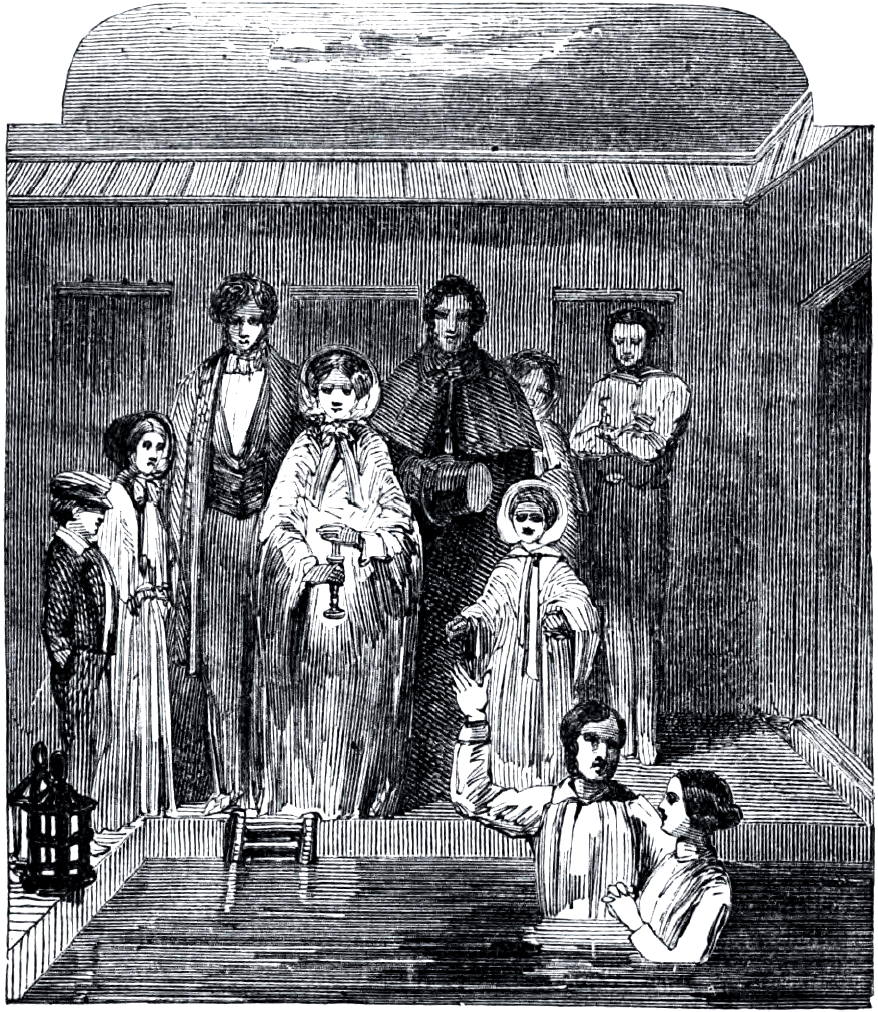
Artist's depiction of a Latter Day Saint baptism including the all-white clothing, c. 1850.

In the Latter Day Saint movement, an ordinance is a sacred rite or ceremony that has spiritual and symbolic meanings and act as a means of conveying divine grace. Ordinances are physical acts which signify or symbolize an underlying spiritual act; for some ordinances, the spiritual act is the finalization of a covenant between the ordinance recipient and God.

Ordinances are usually performed by the authority of the priesthood and in the name of Jesus Christ. The use of the term "ordinance" by adherents is distinct from the use of the term in other branches of Christian tradition, where "ordinance (Christian)" is often used to imply that the act is merely symbolic and does not convey grace. Latter Day Saint use of the term "ordinance" carries the same meaning as the term "sacrament" as used by other Christian denominations.[1] Community of Christ-derived denominations of the Latter Day Saint movement also tend to refer to "sacraments" rather than "ordinances".

Some ordinances—such as baptism, confirmation and the sacrament of the Lord's Supper—are similar to those practiced by other Christian denominations. Other Latter Day Saint ordinances—including the endowment and sealings—are unique and usually performed within a Latter Day Saint temple.

Saving ordinances

[edit]

Saving ordinances are those ordinances that are a requirement for exaltation.[2][3] Most Latter Day Saints denominations see saving ordinances as necessary, but not sufficient, requirements for exaltation.

The following are examples of saving ordinances in most sects of the Latter Day Saint movement:

A Latter Day Saint confirmation c. 1852.
  1. Baptism: Performed by immersion at age eight or older. Baptism is seen as symbolic both of Jesus' death, burial and resurrection[4] and is also symbolic of the baptized individual putting off of the natural or sinful man and becoming spiritually reborn as a disciple of Jesus.
  2. Confirmation and reception of the Gift of the Holy Ghost: Performed by laying hands on the head of a newly baptized member. Through confirmation, the initiate becomes an official member of the church and receives the "gift of the Holy Ghost".[5]
  3. Ordination to the Priesthood: In the Latter Day Saint movement, the priesthood is the power and authority of God given to man, including the authority to perform ordinances and to act as a leader in the church. Latter Day Saint theology has recognized at least three orders of priesthood: (1) the Aaronic priesthood, (2) the Melchizedek priesthood; and (3) the Patriarchal priesthood. Although these are different orders, they are all subsumed under the priesthood held by Jesus Christ, or the Melchizedek priesthood. For most of the history of the Latter Day Saint movement, only men have been ordained to specific offices in the priesthood, and most Latter Day Saint denominations still restrict their priesthood to men. However, some exceptions to this policy do exist, such as within the Church of Jesus Christ of Latter Day Saints (Strangite),[6] a church founded by James J. Strang, and the Community of Christ, which began ordaining women to all of its priesthood offices in 1984.

Saving temple ordinances

[edit]
Robes of the Nauvoo endowment, c. 1870s

In some Latter Day Saint churches, additional saving ordinances are performed in temples. These include the endowment, the washing and anointing, and sealings. Currently, only the Church of Jesus Christ of Latter-day Saints (LDS Church)-derived and Cutlerite-derived[7] denominations within the Latter Day Saints movement practice all three. Other Latter Day Saint denominations, such as Community of Christ-derived[8] and Hedrickite-derived[9] denominations do not perform any of them. Still other denominations, such Strangite-derived[10] denominations, practice sealings but reject the washing and anointing and the endowment.

  1. Endowment: Referred to as a gift of "power from on high" by Joseph Smith, founder of the Latter Day Saint movement, although the purpose and meaning of the endowment varied during his lifetime. After 1842, the endowment usually consists of two phases: (1) an initiation, and (2) an instructional and testing phase. The initiation consisted of the washing and anointing, culminating in the clothing of the patron in a "Garment of the Holy Priesthood". The instructional and testing phase of the endowment consisted of a scripted reenactment of Adam and Eve's experience in the Garden of Eden.[11] The instruction is punctuated with personal covenants, gestures, and a prayer circle around an altar. At the end of instruction, the initiate's knowledge of symbolic gestures and keywords is tested at a "veil", a symbolic final frontier for the initiate to face the judgment of Jesus, before entering the presence of God in the Celestial Kingdom.[12]
  2. Marriage and sealing: An ordinance where individuals are married and sealed as husband and wife as an eternal family. Any children the couple may already have are sealed to the family and any children born into this marriage after sealing are also sealed into that family which will live together forever, if obedient to God's commandments. Children that are brought into the family later, though not born into the family such as via adoption, can be sealed to the family later in a sealing ceremony without the need for the marriage portion. This ordinance is particularly performed by the LDS Church[13]: 57  and branches of Mormon fundamentalism.
  3. Sealing to parents: For children born before a marriage and sealing is performed or who have been adopted into a family, this ordinance seals them into that family as if they had been born into a sealed family.

Saving ordinances on behalf of the dead

[edit]
Baptismal font in the Salt Lake Temple, c. 1912, where baptisms for the dead are performed by the LDS Church

According to Latter Day Saint theology, ordinances can be performed vicariously (i.e., post-mortem) on behalf of any person who would desire to accept the ordinance but did not receive it. While some sects, such as the Hedrickite denominations, have rejected some or all vicariously performed ordinances, other denominations, such as the LDS Church, still perform the saving ordinances on behalf of their deceased ancestors. These are performed vicariously or by "proxy" on behalf of the dead, and church members believe that it is up to the deceased to accept or reject the offered ordinance in the spirit world. Since deceased persons no longer have an earthly existence, they are unable to directly participate in these "saving" ordinances themselves. The physical performance of these ordinances by proxy is seen as fulfillment of the requirement. As with living ordinances, ordinances for the dead are considered necessary but insufficient. It is believed that the spirits in the spirit world are offered the teachings of the full gospel of Jesus Christ and have the opportunity to accept or decline vicarious ordinances done on their behalf. Some LDS Church members refer to Paul in 1 Corinthians 15:29 regarding baptism for the dead as evidence that this was a religious practice of ancient tradition that has now been restored by the LDS Church.[14]

Non-saving ordinances

[edit]

Ordinances which are not a requirement for exaltation are referred to as non-saving ordinances. A non-saving ordinance may be performed on behalf of an individual many times; in practice, however, some non-saving ordinances are only performed once per individual. While not every denomination performs each of these ordinances, they can be found throughout Latter Day Saint theology.

  1. Animal sacrifice: The ordinance of animal sacrifice was instituted in the Strangite denominations,[15] primarily as a part of Strangite celebration rituals. Although the chapter on "Sacrifices" in Strang's Book of the Law of the Lord speaks of them as being offered for sins, the prohibition on such sacrifices contained in 3 Nephi 9:19–20,[16] meant that Strang focused instead on sacrifice as an element of religious festivities,[17][18] especially the commemoration of the coronation a king.[19] The head of every house, from the king to his lowest subject, was to offer "a heifer, or a lamb, or a dove. Every man a clean beast, or a clean fowl, according to his household."[20]
  2. Anointing of the Sick/Administration to the Sick and Consecrating oil: A person who is physically ill, emotionally strained, or sick in any other way may request administration of this blessing or ordinance. The purposes to provide assurance of God's care and concern and also of the church's interest in that person. Often this included the anointing of the head of the person with consecrated oil, necessitating the ordinance of "Consecrating oil".
  3. Calling: This ordinance requires that a person having responsibility over a unit or an auxiliary of the church prayerfully seek revelation to determine which individual is to fill particular responsibilities within that organization. If the individual agrees—and many persons wait to receive spiritual confirmation before agreeing—then the individual is "called" to the position.
  4. Dedication of a church building or a temple: This ordinance is performed after the building is completed or purchased; if a building undergoes extensive remodeling, this ordinance may be performed again.
  5. Dedication of a grave: This ordinance is performed immediately before the body is placed in the grave; it is usually performed only once.
  6. Dedication of a land or country for the preaching of the gospel: This ordinance is usually performed before or soon after missionaries begin to preach in a particular country; it is usually performed only once (but may be performed again if missionaries have not been in a particular country for an extended period of time); it is typically performed by an apostle.
    Rigdonite/Bickertonite Foot washing in the Philippines
  7. Foot washing: The ordinance of foot washing was instituted in the Rigdonite/Bickertonite denominations as a demonstration of personal humility. Members follow the ordinance of as described in John 13:5 four times a year, when members greet each other with a "holy kiss", preferably on the cheek, to signify that they are greeting each other in the love of God, in accordance with the description given in the King James Version of the New Testament.[21][22] The Rigdonite/Bickertonite denominations believes that this is a very important ordinance, citing Jesus' statement to Peter: "If I wash thee not, thou hast no part with me."[22]
  8. Hosanna Shout: An organized ritual of a congregation of shouting hosanna, as a recitation of praise to God, while waving a white handkerchief, and is usually performed as a ritual in the dedication of a Temple. It was first used as part in the dedication the Kirtland temple and was part of the Kirtland endowment ceremony.
  9. Naming and blessing a child: Typically this ordinance is performed shortly only once after a child's birth in fulfillment of the commandment in the Doctrine and Covenants: "Every member of the church of Christ having children is to bring them unto the elders before the church, who are to lay their hands upon them in the name of Jesus Christ, and bless them in his name."[23] The purpose of the practice is twofold: to give a baby an official name and to provide an opportunity to give a blessing for the child's spiritual and physical welfare.
  10. Patriarchal blessing/Evangelist's blessing: A blessing or ordinance given normally once by a patriarch to a church member. Patriarchal blessings are modeled after the blessing given by Jacob to each of his sons prior to his death and are considered a gift of knowledge and strength of one's coming challenges and blessings.
  11. Prayer circle: An antiphonic prayer around an altar, performed as part of the endowment and on other occasions, such among the Apostolic United Brethren and the True and Living Church of Jesus Christ of Saints of the Last Days, where prayer circles within temples, endowment houses, and homes are still common.
  12. Priesthood blessing (including father's blessings): A prayer for healing, comfort or counsel given by a Melchizedek Priesthood holder, who lays his hands on the head of the person receiving the blessing.
  13. Rebaptism of faithful members: In late 1839, many who were already baptized members of the church, were rebaptised either to show a renewal of their commitment to the movement or as part of a healing ordinance. Some denominations, such as the Community of Christ, never performed this ordinance. While others, like the LDS church historically performed this ordinance, such as during the Mormon Reformation, but no longer do.
  14. Sacrament/Lord's Supper: An ordinance in which participants eat bread and drink wine, water, or unfermented grape juice[24] in remembrance of the body and blood of Jesus Christ. It is similar to the Eucharist in the Catholic Church, or communion in Protestant denominations. Normally, the sacrament is provided either every Sunday, on the first Sunday of each month, as part of the regular meeting, or other additional special occasions. Strictly speaking, this is a non-saving ordinance because a person could be exalted without ever having participated in the sacrament. However, individuals who have been baptized are expected to regularly participate in the sacrament.
  15. Setting apart: An ordinance where a person is formally chosen and blessed to carry out a specific calling or responsibility in the church. Once a person has accepted the responsibility of holding a calling and has been "Sustained" by the members of the church for that position, one or more priesthood holders "set apart" the person to serve in that calling, usually accomplish by giving the person a priesthood blessing by the laying on of hands.
  16. Shaking the dust from the feet: A cursing ordinance in which a priesthood holder leaves a curse instead of a blessing, by casting off the dust of their feet "against them as a testimony, and cleansing your feet by the wayside." It was most often used against those who rejected the teachings of the church, or who failed to provide missionaries, with food, money, or shelter. Since the early-20th century, the practice has been rare.
  17. Ritual of the law of adoption: An ordinance practiced mainly between 1846 and 1894 in which priesthood men were sealed in a father–son relationship to other men who were not part of nor even distantly related to their immediate nuclear family. There is no surviving evidence that the "law of adoption" sealing practice was taught by Joseph Smith or his contemporaries prior to Smith's death in 1844. However, adoptions appeared on the records of the Nauvoo Temple in 1846, and scholars generally assume that the practice was instituted by Brigham Young.[25] Following an address on 8 April 1894 by Wilford Woodruff, the practice of the law of adoption ceased in the LDS Church.[26] However, some denominations, such as the Restoration Church of Jesus Christ.[27] (commonly referred to as the "Gay Mormon Church"), continue to perform the ritual of the law of adoption.
  18. Second anointing: An ordinance performed for a sealed couple, sealing them up to eternal life, and anointing them as kings and queens, priests, and priestesses. In the LDS Church it is also called the fulness of the priesthood, and is a rare, but currently practiced ordinance for live participants,[28][29][30] and (less commonly) vicariously for deceased individuals,[31] though, it is usually only given in absolute secrecy to a small number of members after a lifetime of service.[32] The ordinance is also still performed by many Mormon fundamentalist groups.

See also

[edit]

Notes

[edit]

References

[edit]
Revisions and contributorsEdit on WikipediaRead on Wikipedia
from Grokipedia
In The Church of Jesus Christ of Latter-day Saints, an ordinance is a sacred, formal act or ceremony performed by the authority of the priesthood, consisting of rites with spiritual significance that are prerequisite to and exaltation. These ordinances represent covenants between participants and , invoking divine power and establishing binding commitments essential for eternal progression. The core saving ordinances include by immersion for the remission of sins, typically administered to individuals at age eight or older, and the subsequent by , which confers membership in the Church and the gift of the Holy Ghost. Temple ordinances, performed exclusively within dedicated temples, encompass the endowment—a ceremonial instruction and covenant-making process—and , or sealing, which unites families eternally. Priesthood enables men to perform these rites, while non-saving ordinances such as the (renewing baptismal covenants weekly) and blessings for the sick provide ongoing spiritual guidance and healing. A defining characteristic is the performance of vicarious ordinances for the deceased, allowing proxy baptisms, confirmations, endowments, and sealings in temples, predicated on the in posthumous agency and the universal offer of . This practice, rooted in scriptural interpretations of redemption for the dead, underscores the emphasis on genealogical research and family history work to identify ancestors for these rites. Controversies have arisen over the of temple ceremonies, which are not publicly disclosed to preserve their sanctity, and historical shifts in ordinance details, reflecting ongoing according to Church doctrine.

Theological Foundations

Scriptural and Revelatory Basis

In Latter-day Saint theology, ordinances constitute sacred rites and ceremonies essential to , restored through divine to after the , a period in which priesthood authority, doctrinal purity, and the "true order" of these practices were lost from the earth. This restoration, claimed to fulfill biblical prophecies of a latter-day gathering and renewal (such as Amos 9:11 and Acts 3:19–21), positions ordinances not as symbolic rituals but as causal mechanisms conferring priesthood power and enabling progression toward exaltation, with authority derived directly from heavenly messengers. The , comprising modern revelations, repeatedly emphasizes that valid ordinances require proper priesthood keys and must be performed in precise forms to bind on earth and in heaven. Central to this basis is 84, a received September 22–23, 1832, which articulates the and covenant of the priesthood, declaring that "in the ordinances thereof, the power of godliness is manifest" and linking such rites to inheritance of divine promises. Similarly, section 128, dictated September 6, 1842, establishes as a vicarious ordinance generations, stating that "we without them cannot be made perfect; neither can they without us be made perfect." Section 132, recorded July 12, 1843, reveals the sealing ordinance of eternal marriage as part of the "new and everlasting covenant," without which participants "cannot be saved in the eternal world" or attain exaltation. These texts portray ordinances as gates to the kingdoms of glory outlined in section 76 (received February 16, 1832), where celestial inheritance demands , , and temple sealings performed by authorized servants. The and Pearl of Great Price further anchor ordinances in ancient precedent, countering claims of novelty by depicting them as perennial elements of God's plan. In 3 Nephi 11, the resurrected Christ commands the to baptize by immersion after , specifying the words and manner to avoid disputations, thus modeling the restored form. 6, from Smith's inspired translation of Genesis, records ordinances in Adam's era, including , , and covenanting unto sanctification, through which "their garments were white even as death," signifying purity and access to the . Complementing these, 121:36–37, part of a from 1839 amid , asserts that priesthood rights—inextricably tied to ordinances—"are inseparably connected with the powers of " but operate only "upon the principles of ," underscoring that unrighteous administration yields no divine efficacy. allusions, such as and (Acts 8:14–17; Hebrews 6:1–2), are interpreted as fragmentary remnants preserved amid , fully clarified through latter-day .

Role in Salvation, Exaltation, and Eternal Progression

In Latter-day Saint , ordinances serve as divinely appointed acts that enable individuals to enter into covenants with , which are prerequisites for receiving the full measure of His grace and progressing toward eternal life. Unlike Protestant doctrines emphasizing —faith alone as sufficient for —Latter-day Saints teach that , defined as and of sins, requires initial ordinances such as and to access the Holy Ghost and basic celestial inheritance, while exaltation in the highest degree of the celestial kingdom demands additional temple covenants, including eternal , to achieve godhood and eternal increase. This framework posits ordinances not as mere symbols but as causal mechanisms through which obedience activates divine power, allowing participants to overcome natural tendencies toward and align with God's eternal laws, as outlined in 131:1–4 and 132:19–20, where celestial marriage is explicitly required for inheriting "thrones, kingdoms, principalities, and powers." The necessity of ordinances underscores a theology of active participation over passive reliance on grace, critiquing mainstream Christian underemphasis on verifiable obedience as evidenced by temple recommend interviews, which assess adherence to commandments like tithing and chastity before authorizing higher ordinances. Church leaders assert that these covenants bind individuals to Christ, facilitating progression through empirical patterns of repentance and endurance, though critics argue this resembles ritualistic formalism rather than transformative faith. Doctrinally, failure to receive and honor these ordinances limits one's glory to terrestrial or telestial kingdoms, per visions in Doctrine and Covenants 76, emphasizing causal accountability: ordinances provide the framework for eternal families and creative powers, absent which exaltation remains unattainable even for the valiant. Member experiences often link ordinance participation to heightened spiritual outcomes, with surveys and testimonies reporting increased commitment and perceived divine guidance post-endowment, aligning with the view of covenants as empowering progression. However, aggregate retention data reveals challenges, with studies indicating that only about % of those raised in the remain affiliated into adulthood, suggesting that while ordinances foster individual testimonies, broader cultural and doctrinal factors influence long-term adherence beyond ritual compliance. This empirical gap highlights ongoing debates about whether ordinances causally drive retention or merely correlate with self-selection among the committed, prompting church efforts to strengthen preparatory teachings for deeper covenant understanding.

Historical Development

Origins Under Joseph Smith (1830s–1844)

The initial ordinances of the Latter Day Saint movement centered on baptism, confirmation, and priesthood ordinations, as directed by revelations to Joseph Smith in the late 1820s and early 1830s. Smith and Oliver Cowdery received the Aaronic Priesthood through a purported visitation by John the Baptist on May 15, 1829, near Harmony, Pennsylvania, authorizing them to baptize; they baptized each other that same day in the Susquehanna River. The Church of Christ was formally organized on April 6, 1830, in Fayette, New York, with baptisms commencing that day, including for Smith's father, Joseph Smith Sr., performed by Smith himself. Confirmation by laying on of hands to confer the Holy Ghost followed baptisms, as specified in a revelation dated circa April 1830 (Doctrine and Covenants 20), which also outlined procedures for ordaining elders, priests, teachers, and deacons to perform these rites. The Melchizedek Priesthood, enabling further ordinances, was reportedly conferred by Peter, James, and John around May or June 1829, though contemporary documentation of this event is limited to later reminiscences. By 1840, amid relocation to , Smith expanded ordinances to include proxy baptisms for the dead. He first publicly taught the doctrine on August 15, 1840, during the funeral sermon for Seymour Brunson, asserting it as a means for the deceased to accept the gospel. The earliest recorded proxy baptisms occurred in the near Nauvoo, starting as early as September 12, 1840, performed by individuals acting on behalf of ancestors without standardized records or temple facilities at the time. These practices drew from Smith's interpretations of passages, such as 1 Corinthians 15:29, but lacked prior institutional precedent in the movement. In Nauvoo, temple-related ordinances emerged as Smith pursued construction of a temple. Preliminary washings and anointings had been administered in the following its 1836 dedication, serving as a foundational experience for select leaders. The full endowment ceremony—incorporating covenants, symbolic instruction on creation and exaltation, and ritual clothing—was introduced by Smith on May 4–5, 1842, to nine men in the upper room of his Red Brick Store, repurposed for the purpose after Nauvoo meetings. This timing followed Smith's own initiation as a Master Mason on March 15, 1842, with historical records noting parallels in gestures, tokens, and penalties between the endowment and contemporary Masonic rituals, though Smith presented the endowment as restored ancient practice. Sealing ordinances for eternal marriage, including provisions for plural unions, were formalized in a revelation dictated July 12, 1843 ( 132), amid Smith's private practice of such sealings since at least 1841. These developments occurred without completed temple infrastructure, relying on ad hoc spaces and emphasizing priesthood authority derived from Smith's revelations.

Expansion and Institutionalization in the 19th Century

Following the martyrdom of on June 27, 1844, , as president of the Apostles, asserted leadership over the Church of Jesus Christ of Latter-day Saints, claiming that Smith had conferred priesthood keys upon the Quorum in March 1844, enabling continuity in administering ordinances. Under Young's direction, the Saints migrated westward to the , arriving in July 1847, where temple construction became central to institutionalizing ordinances amid ongoing persecution and isolation, serving as focal points for communal resilience and doctrinal practice. Young prioritized temple edifices to formalize endowments and sealings, which had been performed in Nauvoo; on February 14, 1853, he conducted the groundbreaking for the , envisioning it as a hub for eternal family linkages through plural sealings aimed at establishing multi-generational posterity. This emphasis on sealings reflected a doctrinal view of ordinances as mechanisms for dynastic expansion, with Young himself entering into over 50 plural marriages, many sealed for eternity to build covenant lineages despite external pressures. By the 1850s, plural sealings proliferated in settlements, reinforcing social structures in pioneer communities where ordinances provided ritual continuity and motivation for collective labor, such as and settlement expansion. The completion of the St. George Temple in 1877 marked a pivotal institutionalization, as it was the first facility to host comprehensive proxy ordinances beyond baptisms; on January 11, 1877, endowments and sealings for the dead commenced under Young's authorization, with Wilford Woodruff overseeing initial sessions that extended living rites to deceased ancestors, formalizing genealogical research as a prerequisite. This development, dedicated by Young, Brigham Young Jr., and Woodruff on April 6, 1877, amid southern Utah's frontier conditions, linked ordinances to salvation for prior generations, with records indicating rapid adoption as members submitted names for proxy work to fulfill redemptive promises. Even as federal anti-polygamy legislation intensified— including the Morrill Act of 1862 and the of 1882, which criminalized plural marriage and unseated LDS territorial influence—temple sealings persisted as core to institutional identity, with thousands performed annually in temples until the curtailed new plural unions, though proxy sealings for the dead continued unabated to sustain doctrinal commitments. These practices, documented in temple ledgers, underscored ordinances' role in fostering cohesion during demographic shifts and legal sieges, as sealings bound families across migrations and hardships, prioritizing eternal over temporal alliances.

Standardizations and Adjustments in the 20th Century

In the early decades of the , Church leaders addressed variations in temple ordinance presentation by standardizing wording and procedures. Under President , a revised the endowment for uniformity across temples, eliminating elements like the of vengeance and reducing instructional content to enhance clarity and efficiency while preserving core revelatory elements. These adjustments reflected leadership direction to align practices with increasing membership demands rather than external pressures. The 1920s saw further refinements, including the discontinuation of healing blessings and baptisms for health within temples, as resources shifted toward endowments, sealings, and proxy work amid growing attendance. Practices such as the second anointing, previously more frequent, were restricted in publicity and administration under Grant's administration, limiting them to select faithful couples nominated by stake presidents to maintain sanctity and focus on essential ordinances. Post-World War II Church expansion, with membership surpassing 1 million by 1950, prompted procedural efficiencies like filmed endowments introduced in 1953 and single-room presentations in new temples during the early 1950s under President . approved minor script clarifications in the mid-20th century to streamline delivery without altering doctrinal substance, supporting a temple-building surge that added facilities like the Temple in 1955. Parallel advancements in family , including microfilming of records starting in 1938, facilitated a boom in proxy ordinances by preserving genealogical data for temple submission.

Recent Revelatory Changes (2019–2024)

In January 2019, the First Presidency of The Church of Jesus Christ of Latter-day Saints announced adjustments to several temple ordinances, including the initiatory , the endowment presentation, and associated covenants, with implementation beginning that month across temples. These revisions removed phrasing in women's covenants that had implied obedience to husbands, redirecting promises of covenant-keeping to directly; altered veil practices during the endowment to eliminate certain physical coverings for women; and simplified elements of the initiatory ordinance, such as reducing ritual nudity exposure and associated gestures. The church described these as inspired clarifications to enhance reverence and focus on eternal principles, though they followed years of member reports citing discomfort with gendered language and physical aspects, particularly amid broader cultural shifts like #MeToo influences on perceptions of bodily autonomy. A related policy shift in May 2019 eliminated the longstanding one-year waiting period required after civil marriages before couples could receive temple sealings, allowing immediate temple ordinances for those married civilly if worthy. This change, affecting eligibility for the sealing ordinance, was framed as facilitating family unity without doctrinal alteration, yet it addressed practical barriers that had contributed to non-temple weddings among members facing worthiness or logistical issues. In February 2023, further endowment revisions were introduced, adding pre-covenant instructional explanations, incorporating more Christ-centered visual aids and verbal references to Jesus Christ, and reducing physical gestures during token exchanges—often described as "less touching" to minimize direct contact between participants and temple workers. Proxy sealing ordinances for the dead were also simplified in associated updates, streamlining procedural requirements for vicarious work. The First Presidency stated these maintained the covenants' substance while improving clarity and devotion, but empirical patterns suggest responsiveness to exit surveys and feedback highlighting ritual discomfort, contrasting with historical assertions by church leaders like that core endowment elements remain unchangeable as divine restoration. By August 2024, the endowment ceremony underwent additional streamlining, reducing its duration by approximately 20 percent through elimination of redundant phrasing and procedural efficiencies, shortening sessions to about one hour. These modifications, again attributed to under President , align with ongoing efforts to address declining temple attendance and member surveys indicating unease with ritual length and elements, though they underscore causal tensions between adaptive practices and doctrinal claims of ordinance fixity originating from . Such iterative changes from 2019 to 2024 reflect a pattern of empirical adjustment to sustain participation amid retention challenges, rather than isolated prophetic tweaks.

Classification of Ordinances

Saving Ordinances Required for Exaltation

Saving ordinances required for exaltation in The Church of Jesus Christ of Latter-day Saints consist of , , and—for male members— to the Priesthood, which must precede temple ordinances essential for full exaltation. These rites are performed sequentially for living individuals who demonstrate , , and worthiness, establishing initial covenants with under priesthood . They differ from preparatory or proxy ordinances by directly enabling personal progression toward celestial glory, as outlined in Latter-day Saint . Baptism, the foundational saving ordinance, involves full immersion in water by a holder of the Aaronic or Priesthood, symbolizing death to sin and rebirth in Christ. It is administered to accountable individuals, defined as those reaching the age of eight years, when they are capable of and covenant-making. The ordinance remits sins through in Jesus Christ and obedience to gospel principles, serving as the gate to membership in the Church and prerequisite for subsequent rites. Confirmation follows , typically on the same day, and entails the by a Priesthood holder to confirm the recipient as a member of the Church and bestow the gift of the Holy Ghost. This ordinance invokes the Holy Ghost as a constant companion to guide, reveal truths, and sanctify the individual, contingent upon continued righteousness. It completes the initial entry into the covenant path, enabling spiritual discernment essential for exaltation. For male members, priesthood ordination constitutes a saving ordinance, beginning with the Aaronic Priesthood conferred and offices assigned— at age 11 or 12, at 14, and priest at 16—providing preparatory authority for service. Advancement to the Priesthood, typically at age 18 or older for worthy elders, grants higher authority necessary for exaltation, including the power to perform saving ordinances and enter temple covenants. This , by , emphasizes male-only eligibility as per revealed , distinguishing roles in priesthood administration while requiring all to honor covenants for eternal families.

Temple Ordinances Exclusive to Endowed Members

The temple endowment is an ordinance administered exclusively in temples to worthy adult members of The Church of Jesus Christ of Latter-day Saints who have received baptism and confirmation. It provides instruction on God's plan of salvation through dramatic presentations, symbolic elements including washings, anointings, and the donning of ceremonial garments, and requires covenants of obedience to God, sacrifice, living the gospel, chastity, and consecration of person and possessions. These elements aim to endow participants with divine knowledge, power, and blessings for mortality and eternity, conditional on covenant fidelity. Eligibility for the endowment requires individuals to be at least 18 years old, have completed or its equivalent, and hold a current temple recommend verifying worthiness through interviews on , , and adherence to church standards. Prior to 1990, the ceremony included symbolic gestures depicting penalties for covenant violation, such as throat-slitting and disembowelment motions, which were removed to streamline the rite and reduce discomfort while preserving core covenants. The sealing ordinance unites a man and woman in celestial marriage for time and eternity, extending to children born after the sealing or adopted through it, forming eternal family units prerequisite for exaltation in the celestial kingdom's highest degree. Revelation states that "in order to obtain the highest, a man must enter into this order of the priesthood [meaning the new and everlasting covenant of marriage]" (Doctrine and Covenants 131:1–2). Performed by endowed sealers holding priesthood keys, it requires participants to first receive their endowments and occurs in dedicated temple sealing rooms, with proxy sealings available for the deceased. Unendowed youth aged 8 to 20 may receive limited temple recommends to witness parental sealings or be sealed to parents but cannot participate in endowments or spousal sealings until adulthood. In the , sealings often involved plural wives under doctrinal mandates later suspended, emphasizing lineage continuation and exaltation, though monogamous sealings predominate today. These ordinances, accessible only to endowed members, underscore the church's theology of eternal progression through covenant-bound family exaltation.

Ordinances Performed by Proxy for the Dead

Proxy ordinances for the deceased, also known as vicarious temple work, involve living members of The Church of Jesus Christ of Latter-day Saints performing , confirmations, initiatory ordinances, , and sealings on behalf of individuals who have died. These rituals, conducted exclusively in dedicated temples, are predicated on the doctrine that the deceased retain agency in the spirit world to accept or reject the offered . The practice embodies a form of , extending salvific opportunities beyond mortality, yet its outcomes—such as posthumous acceptance by spirits—cannot be empirically verified, relying instead on revelatory claims and . The origins trace to , where introduced on August 15, 1840, during a funeral sermon, drawing from 1 Corinthians 15:29 and subsequent revelations recorded in sections 127–128. Initial baptisms occurred in the as early as September 12, 1840, before shifting to temple fonts, with the Nauvoo Temple's baptismal font dedicated on November 8, 1841. Proxy extensions to endowments and sealings developed concurrently in the Nauvoo period, institutionalizing the linkage between living proxies and deceased recipients. Genealogical identification of the deceased is required, prioritizing direct ancestors verified through records on FamilySearch.org to ensure ordinance eligibility. Logistically, names are reserved via the church's Ordinance Preparation System or tools like "Ordinances Ready" on , which checks for incomplete proxy work among ancestors; these "cleared" or prepared names are then submitted for temple sessions. Proxies, who must be worthy endowed members, perform the ordinances in sequenced temple queues, with baptisms and confirmations occurring in fonts supported by twelve oxen statues symbolizing the tribes of . The 1918 vision of , canonized as 138, provides revelatory justification, depicting Christ's organization of missionary labor in the spirit world and affirming that proxy acts enable the dead to receive the gospel post-mortem. Annually, millions of proxy ordinances are performed across the church's 136 temples, though exact figures are not publicly disclosed; pre-2020 estimates suggest proxy baptisms alone approached millions yearly, contributing to billions historically. Policies restrict indiscriminate use: ordinances require at least 30 days post-death (or one year for non-relatives without close ties), and in 1995, following controversy, the church agreed with Jewish leaders to halt proxy work for Holocaust victims unless they are direct ancestors, removing approximately 380,000 such names from to respect consent proxies. This underscores causal tensions between doctrinal imperatives and external sensitivities, with efficacy hinging on unobservable spirit-world dynamics rather than measurable outcomes.

Non-Saving or Auxiliary Ordinances

Non-saving or auxiliary ordinances in The Church of Jesus Christ of Latter-day Saints consist of priesthood-administered rites that provide spiritual guidance, affirm family ties, and authorize temporary service roles, but are not prerequisites for , exaltation, or entry into the celestial kingdom. These practices foster individual identity within the faith community and reinforce covenant-keeping without bearing the eternal weight of saving covenants like or temple endowments. They are performed under priesthood authority and emphasize personal , paternal responsibility, and ecclesiastical organization, drawing from scriptural precedents such as patriarchal blessings in the and . Patriarchal blessings represent a key auxiliary ordinance, wherein an ordained stake patriarch—called and set apart by general or stake authorities—lays hands on a worthy adult member and pronounces a recorded declaration of their lineage within one of the tribes of , often Ephraim or Manasseh, alongside personalized counsel attributed to . First formalized under in the 1830s and expanded in the , these blessings serve as lifelong "personal scripture" for the recipient, offering direction on life purpose, spiritual gifts, and conditional promises tied to faithfulness, though they are kept confidential and not publicly shared. Recipients typically request them after age 12 or , with the Church maintaining an archive of millions since the practice's inception, enabling digital access for members since 2016. Unlike ordinances, patriarchal blessings do not confer priesthood or remission of sins but aid in self-understanding and covenant motivation within the community. The naming and of infants, performed by a Priesthood holder—ideally the father—publicly declares the child's name, invokes a father's for health and spiritual growth, and symbolizes paternal without effecting or recording the child as a church member. Authorized by the local or president and typically conducted during services until the child reaches age 8, this rite echoes 20:70, which instructs elders to "lay their hands upon them... and bless them," but explicitly excludes baptismal immersion or of the Holy Ghost. It reinforces family unity and communal recognition, with no salvific requirement; unbaptized children who die young are assured celestial inheritance per church doctrine, rendering the blessing advisory rather than covenantal. In cases of critically ill newborns, expedited blessings may occur in hospitals, underscoring their supportive rather than redemptive nature. Setting apart individuals for church callings constitutes another auxiliary ordinance, wherein a priesthood leader with appropriate keys—such as a stake president for ward positions—lays hands on the appointee to confer temporary authority, pronounce a for inspiration, and outline duties specific to roles like missionaries, presidents, or leaders. This practice, rooted in biblical examples like Numbers 27:18-23 where set apart , ensures divine enablement for service without permanent priesthood and requires worthiness interviews beforehand. Performed after a calling is extended and accepted, the ordinance includes promises of guidance contingent on obedience, enhancing organizational cohesion and member commitment to voluntary roles that sustain ward functions. Releases from callings similarly involve brief , maintaining the transient, supportive character of these rites in building communal identity and efficacy.

Administration and Practice

Priesthood Authority and Performers

In The Church of Jesus Christ of Latter-day Saints, all ordinances require performance by members ordained to the appropriate priesthood office, as this constitutes the causal mechanism for their validity according to restored , independent of contemporary egalitarian interpretations. The priesthood operates in a hierarchical structure: the Aaronic Priesthood comprises the offices of , , and , with priests authorized to baptize; the Priesthood includes elders and high priests, who perform confirmations, blessings, and temple ordinances. This male-exclusive ordination ensures ordinances invoke divine power, as emphasized in 84, which delineates priesthood duties and oaths primarily to male descendants in the line of authority. Women participate in supportive capacities, such as assisting in instruction or preparation, but do not officiate ordinances, per 25, which assigns roles like expounding scriptures and managing household affairs without conferring priesthood office. Priesthood validity hinges on a traceable chain from the individual back to via apostolic keys restored in 1829 and 1830, with church records maintaining empirical verification to preclude unauthorized performances. Globally, as of 2023 with over 17 million members across 100,000+ congregations, stake presidents—ordained high priests holding from the First Presidency—authorize local leaders to perform ordinances, ensuring consistent application under centralized apostolic oversight. Absent this keyed , performances lack efficacy, underscoring the doctrinal necessity of male priesthood lineage over participatory inclusivity.

Eligibility, Worthiness, and Temple Recommends

Eligibility for temple ordinances in The Church of Jesus Christ of Latter-day Saints requires members to obtain a temple recommend through interviews that verify personal worthiness and covenant-keeping commitment. These recommends are issued for specific purposes, such as limited-use permits for baptisms for the dead or full recommends for endowments and sealings, and they must be renewed annually for endowed adults to maintain access. The process involves sequential interviews: an initial one by a or branch president, followed by confirmation from a stake president or mission president, ensuring layered assessment of adherence to doctrinal standards. The temple recommend interview questions probe core areas of obedience, including faith in , Jesus Christ, and the Holy Ghost; testimony of the current and sustaining church leaders; compliance with the law of chastity (sexual relations reserved for marriage between man and woman); strict observance of (full payment of income); adherence to the Word of Wisdom (abstinence from tobacco, alcohol, coffee, tea, and harmful substances); honesty in temporal dealings; and commitment to temple covenants upon endowment. Members must also affirm they are not disfellowshipped or excommunicated and do not affiliate with groups or individuals opposing church teachings. Failure to affirm these—due to unrepentant serious sin, such as , pornography use without , or deliberate covenant violation—results in denial or revocation of the recommend until resolution through and discipline. , defined as willful rebellion against church authority or propagation of false , similarly bars participation. Youth eligibility is restricted: children ages 11 and older may receive limited-use recommends for and for the dead after demonstrating basic worthiness, but endowment and sealing ordinances are reserved for those at least 18 years old, mature enough for full covenants, or married regardless of age. This tiered access enforces progressive spiritual preparation, limiting youth to proxy work until they can bear the higher responsibilities of personal ordinances. Converts follow a similar path, requiring , , and a probationary period of demonstrated faithfulness before recommend eligibility. Temple recommends empirically filter for covenant adherence, as possession correlates with elevated church activity rates; while the church does not release official statistics on recommend holders, self-reported surveys indicate that only a minority of total members—estimated at 20-40% of adults—maintain current recommends, reflecting the behavioral demands as a causal mechanism for identifying committed participants amid broader nominal membership. This standard acts as a verifiable barrier, excluding those whose actions contradict professed faith and thereby preserving the ordinances' sanctity for those empirically demonstrating obedience.

Procedural Elements and Symbolic Aspects

Temple garments, received following the endowment ordinance, consist of underclothing worn daily by endowed adult members as a personal reminder of covenants made with . These garments incorporate specific markings at the and , symbolizing commitments to and consecration, respectively, and are intended to invoke a sense of divine protection when worn. The design has evolved since the , with adjustments in the under First Presidency direction shortening sleeves and legs while retaining core symbolic elements, reflecting practical adaptations without altering fundamental purposes. Procedural elements include handclasps and exchanged during ordinances, serving as symbolic affirmations of fidelity to covenants rather than literal mechanisms for celestial access. These gestures, introduced in Nauvoo-era temple practices, represent personal endorsements akin to signing commitments, emphasizing unity and accountability among participants. Similarly, circles conducted in temples involve participants joining hands in a ring to collectively invoke blessings, symbolizing communal wholeness and exclusion of worldly distractions for focused supplication. This form, restored through , draws on purported ancient precedents of encircled for enhanced spiritual potency. Latter-day Saints maintain that these symbols trace to biblical temple practices, such as priestly garments in Exodus 28, positioning them as restorations of authentic ancient rites rather than innovations. Details of procedures remain undisclosed outside temples to preserve sacredness, as instructed in revelations cautioning against casual revelation of holy matters, framing the approach as reverence for divine things over clandestine exclusivity. This discretion aligns with scriptural emphasis on protecting covenantal knowledge from profanation, prioritizing internal spiritual efficacy over public exposition.

Controversies and Criticisms

Influences from Freemasonry and Novelty Claims

Joseph Smith was initiated into Freemasonry on March 15, 1842, and raised to the degree of Master Mason the following day in Nauvoo, Illinois. Less than two months later, on May 4, 1842, he introduced the temple endowment ceremony to a small group of church leaders in the Red Brick Store, incorporating ritual elements such as symbolic gestures, oaths, and clothing that closely paralleled Masonic practices. These included handshakes or "tokens," signs of recognition, and penalties for disclosure, which mirrored those taught in the first three degrees of Freemasonry available to Smith at the time. Historical records, including contemporary accounts from participants like Heber C. Kimball, confirm the rapid sequence, suggesting a causal influence from Smith's recent Masonic exposure on the development of the endowment's form. While the LDS endowment expanded Masonic-like elements with unique covenants of obedience, chastity, and consecration, oriented toward posthumous progression and exaltation rather than Freemasonry's moral allegories, critics argue these additions represent adaptation rather than independent revelation, pointing to verbatim phrasing in oaths and the absence of such rituals in Smith's earlier teachings or the Book of Mormon. LDS apologists counter that Freemasonry preserved corrupted fragments of ancient temple rites, which Smith restored through divine inspiration, using familiar 19th-century forms to convey eternal truths; they cite Joseph's encouragement for Saints to join Masonry as preparatory, not derivative. However, empirical analysis of ritual texts shows over 50% overlap in dramatic narrative and gestures between early endowments and contemporaneous Masonic exposures, undermining claims of mere coincidence and supporting the view that the ordinances' structure was a novel synthesis rather than pristine restoration. Former church members and external critics, drawing on declassified Masonic monitors and eyewitness testimonies, characterize the endowment as a fabrication blending with Smith's theological innovations, lacking precedents in biblical or pre-1842 practice and thus evidencing human invention over ancient continuity. This perspective aligns with causal historical sequencing, where the ordinances' introduction post-initiation implies borrowing, though LDS sources maintain the parallels served pedagogical purposes without compromising revelatory origin.

Implications of Frequent Modifications

The assertion in 1:38 that "what I the Lord have spoken... shall not pass away" has been interpreted by some Latter-day Saints as implying the permanence of revealed ordinances, yet empirical records document numerous alterations to temple rites since their initial institution in the . For instance, the endowment ceremony, introduced in 1842, underwent substantive revisions by the 1920s, including the elimination of specific oaths and adjustments to instructional content, as directed by church leadership to standardize practices across temples. These modifications, while not altering core covenants in official narratives, involve over a dozen documented shifts in wording, procedure, and emphasis by mid-century, raising questions about the static nature of divine revelation when causal analysis points to pragmatic adaptations rather than immutable mandates. Such alterations often correlate with socio-political pressures, as seen in the issued by , which curtailed plural marriage practices and necessitated corresponding changes to temple sealing ordinances to align with U.S. legal realities and avert institutional dissolution. Prior to this, sealings routinely incorporated plural unions as doctrinally essential; post-Manifesto, emphasis shifted to monogamous eternal pairings, reflecting a concession to external enforcement rather than a purportedly eternal principle unaffected by temporal contingencies. This pattern suggests ordinances function as adaptive mechanisms, where cultural and legal exigencies drive revisions, challenging first-principles claims of unchanging divine intent. Mormon fundamentalist groups, emerging from dissent against the , reject post-1880s modifications—including temple ordinances—as deviations from Smith's original revelations, viewing them as symptomatic of broader in the mainstream church. They maintain fidelity to pre-Manifesto practices, such as unrestricted plural sealings, arguing that true ordinances cannot evolve without contradicting scriptural immutability. In contrast, leaders of The Church of Jesus Christ of Latter-day Saints frame these adjustments as "living" prophetic guidance, accommodating ongoing revelation to contemporary contexts without nullifying foundational truths. This divergence underscores a core tension: empirical mutability undermines assertions of unalterable rites, prompting scrutiny of whether such changes stem from divine consistency or human responsiveness to societal forces.

Gender Roles, Patriarchy, and Modern Adjustments

Latter-day Saint temple ordinances incorporate a structure rooted in 132, which outlines the "new and everlasting covenant" of marriage as part of the patriarchal order, wherein eternal family units are organized under male priesthood authority to facilitate exaltation. In this framework, sealings bind husbands, wives, and children eternally, with the husband positioned as the family head, reflecting divine roles differentiated by sex rather than cultural imposition. Historically, the endowment ceremony included elements such as women being veiled during portions of the ritual, symbolizing sacred separation and reverence, a practice discontinued in temple revisions announced on January 2, 2019. Prior to these changes, the law of obedience covenant required women to hearken to their husbands as part of hearkening to God, a phrasing paralleled for men in obedience to the Lord but interpreted by critics as reinforcing subjugation. The 2019 adjustments aligned the covenants symmetrically for both sexes to obey God directly, eliminating gender-specific language, which church leaders described as enhancing clarity without altering doctrine, though some observers attribute the shifts to external pressures from egalitarian movements. The exclusion of women from priesthood , affirmed in revelations to , limits female roles to receiving rather than conferring ordinances like baptisms or sealings, prompting criticisms of systemic despite women's in temple settings such as initiatory ordinances. Proponents argue this differentiation aligns with scriptural precedents of male headship, as in the patriarchal order, enabling complementary roles where women exercise priesthood power through male proxies while focusing on maternal and nurturing capacities essential to eternal increase. Empirical data indicate that temple sealings correlate with marital stability, with studies showing divorce rates among endowed Latter-day Saints at 1-2% in early years compared to 8-12% for non-endowed members, and lifetime estimates around 25-30%, lower than the U.S. national average of approximately 40-50%. This suggests the doctrinal emphasis on eternal covenants fosters resilience against dissolution, countering narratives that patriarchal elements inherently undermine cohesion.

Perspectives from Other Christian Traditions and Ex-Members

Evangelical Protestants criticize Latter-day Saint ordinances as embodying a form of works-righteousness that undermines the doctrine of sola fide, or salvation by grace through faith alone apart from works, as articulated in Ephesians 2:8–9. They contend that mandatory temple rituals, endowments, and proxy baptisms add salvific requirements beyond personal faith in Christ, effectively turning ordinances into prerequisites for exaltation rather than symbolic affirmations. Proxy work for the dead, in particular, is frequently denounced as unbiblical and akin to forbidden communication with spirits, evoking biblical prohibitions against necromancy in passages like Deuteronomy 18:10–12, with no New Testament precedent for posthumous salvific interventions. Catholics regard LDS baptism as invalid, a determination formalized by the Vatican's Congregation for the Doctrine of the Faith in , owing to the LDS rejection of the traditional and understanding of as three separate beings rather than one essence in three persons. While acknowledging the ordinance's intent toward , the Church views advanced temple rites—such as endowments, sealings, and celestial marriages—as extra-scriptural accretions lacking continuity with or patristic , often likening the claimed restoration from to unsubstantiated innovation rather than recovery of primitive Christianity. These practices are seen as diverging from sacramental theology, where efficacy derives from Christ's institution and ecclesial authority, not posthumous proxies or progressive revelations. Ex-members of the LDS Church frequently cite temple endowment sessions as turning points toward disillusionment, describing the ceremonial oaths, symbolic gestures, and ritualistic elements—such as donning temple garments and enacting covenants under penalty—as unexpectedly arcane, manipulative, or reminiscent of Masonic secrecy rather than . Personal testimonies often portray these experiences as inducing or spiritual trauma, with participants feeling coerced into commitments amid withheld details during prior instruction, prompting immediate doubts about doctrinal authenticity. Empirical data from disaffiliation studies reinforce this, with doctrinal —including reactions to temple —identified as a leading factor; a survey of over 3,000 former members found 74% attributing their exit primarily to disbelief in LDS teachings, while qualitative accounts highlight temple exposure accelerating faith crises among those previously committed. Such narratives underscore empirical patterns of retention challenges post-endowment, particularly among younger adherents encountering unpreviewed ritual intensity.

References

Add your contribution
Related Hubs
User Avatar
No comments yet.