Hubbry Logo
The Explorers ClubThe Explorers ClubMain
Open search
The Explorers Club
Community hub
The Explorers Club
logo
8 pages, 0 posts
0 subscribers
Be the first to start a discussion here.
The Explorers Club
The Explorers Club
from Wikipedia

The Explorers Club is an American-based international multidisciplinary professional society with the goal of promoting scientific exploration and field study. The club was founded in New York City in 1904 and has served as a meeting point for explorers and scientists worldwide.

Key Information

The Explorers Club hosts an annual dinner to honor accomplishments in exploration, which is known for its adventurous, exotic cuisine.[1][2]

History

[edit]

In 1904, a group of men active in exploration met at the request of noted journalist, historian and explorer Henry Collins Walsh to form an organization to unite explorers in the bonds of good fellowship and to promote the work of exploration by every means in its power.[3] Joining Walsh were Adolphus Greely, Donaldson Smith, Carl Lumholtz, Marshall Saville, Frederick Dellenbaugh and David Brainard. After several further informal meetings, the Explorers Club was incorporated on October 25, 1905. Women were first admitted in 1981, with a class including Sylvia Earle and Kathryn Sullivan.[4] Famous honorary members have included Theodore Roosevelt, John Glenn, Jim Fowler, Walter Cronkite, Prince Philip, Duke of Edinburgh, Sir Edmund Hillary, Buzz Aldrin and Albert I, Prince of Monaco.[5]

The Explorers Club has 34 chapters in the United States and around the world,[6] which serve as local contact points for explorers, scientists and students. Many chapters hold monthly dinners, lectures and seminars, award field-research grants to students, publish newsletters and organize expeditions, field trips and educational events.[7]

Charter members

[edit]

Fellows and Members

[edit]

The Explorers Club has approximately 3,500 members worldwide, with members from every continent and in more than 60 countries. The club differentiates exploration for field science from exploratory travel for tourism. Individuals eligible for membership are those who engage in or support field science expeditions aimed at exploring unfamiliar or poorly understood locations or phenomena, with the goal of acquiring knowledge for the benefit of humanity. The focus is on individuals who have gained practical experience by actively participating in fieldwork as participants in one or more documented scientific expeditions.[9] The club has made it a priority to expand its membership to include qualified explorers from across a range of diversities, including race, culture, gender, age, sexual orientation, geography and socio-economic level, as well as explorers with disabilities.

Membership of the club is divided into two categories. Fellows have made documented contributions to scientific knowledge through field expeditions. Members have evidenced a sustained interest and participation in some aspect of field exploration and have contributed in broad terms to the cause of exploration and the furthering of scientific knowledge.[9]

Famous firsts

[edit]

The Explorers Club is renowned for various "Famous Firsts" accomplished by its members, including:[10][11]

  • First to the North Pole (1909) – Robert E. Peary (honorary membership in 1912) & Matthew Henson Robert Peary's claim to have been the first to the North Pole has been disputed and current consensus does not support his claim. However, in 1968 Ralph Plaisted became the first undisputed person to reach the North Pole over land.[12][13][14][15]

Headquarters

[edit]
First floor fireplace

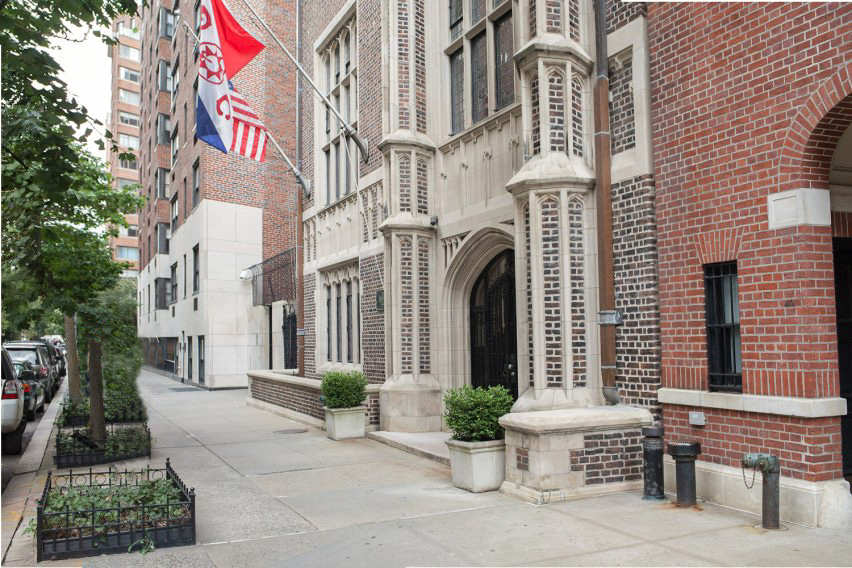
The Explorers Club held its first regular meeting at its original headquarters in the Studio Building at 23 West 67th Street in New York City.[3] The club finished construction on its next headquarters at 544 Cathedral Parkway in 1928 and there the club continued to expand its extensive collection of artifacts, trophies and books on exploration. In 1965, spurred by Lowell Thomas,[3] the club purchased its current headquarters on the Upper East Side, a six-story Jacobean revival mansion on East 70th Street, where it houses the James B. Ford Exploration Library, the Sir Edmund Hillary Map Room and a collection of artifacts from more than a century of exploration. The building was previously the home of Stephen C. Clark. Certain designated rooms of the club are open to the general public.

Lectures and publications

[edit]

In the 1920s, the club began to invite both explorers returning from the field and visiting scientists to relate their experiences and findings. By the 1930s these informal gatherings developed into academic lectures and illustrated talks. The club continues to provide weekly lectures and programs, which are often open to the public at its headquarters.[16] In November 1921, the Explorers Club published the first edition of The Explorers Journal to share news from the field, remarks from headquarters, recent acquisitions, obituaries and book reviews. The Explorers Journal is still published quarterly,[17] with articles and photography from Explorers Club members in the field.

Television series

In 2022, the Explorers Club and Discovery Channel formed a partnership to produce a series called Tales from the Explorers Club, which is hosted by Explorers Club member Josh Gates. The series covered stories about other famous Explorers Club members such as Ernest Shackleton, Sir Edmund Hillary, Gertrude Bell, Jim Lovell and Jeff Bezos.[18]

The Explorers Club flag

[edit]
The Explorers Club flag

The Explorers Club flag has been carried on hundreds of expeditions by club members since 1918. To obtain permission to carry the flag, a club member must show that the expedition holds the promise of scientific results. The flag must be exhibited at every suitable opportunity on the expedition, and must be returned to the club along with a written record of the expedition, called the Flag Report. The club's Research Collections is the repository for these unique reports, including the original "Flag Book" — a bound journal of hand-written reports, vintage prints, clippings and assorted records submitted by the explorers who first carried the Explorers Club flag on expeditions.[19]

There are currently 242 numbered flags.[20] Many of the older flags have been retired. The Explorers Club flag has been carried on such expeditions as:

NASA missions Apollo 8, Apollo 11, Apollo 13 and Apollo 15 each carried miniature club flags on board.

Honors and grants

[edit]

Honors

[edit]

The Explorers Club Medal, the highest honor that can be bestowed by the Club, is awarded for "extraordinary contributions directly in the field of exploration, scientific research, or to the welfare of humanity". Past recipients include:[32]

The Legendary Explorer Medal is given "to recognize a feat of such courage and incredible accomplishment that has transcended the ordinary bounds of history". Past recipients include:[49]

Beyond The Explorers Club Medal and The Legendary Explorer Medal, the club also presents, among others, The Edward C. Sweeney[50] Medal, The Citation of Merit, The Lowell Thomas Award, The Finn Ronne Memorial Award, The Buzz Aldrin Space Exploration Award, The Tenzing Norgay Award, The William Beebe Award, The President’s Award and The New Explorer Award.[51]

Grants

[edit]

The club also awards a range of grants for field science and exploration, including the Youth Activity Fund Grant, the Exploration Fund Grant[52] and the President's Award for Exploration and Technology. One club award, the Scott Pearlman Field Award for Science and Exploration,[53] is named for one of the youngest club members (inducted at age 22) who was a photographer and participant in three flag expeditions. Scott A. Pearlman contracted hepatitis C and died at the age of 38. Pearlman was a son of Explorers Club member and officer Robert E. Pearlman.

Presidents

[edit]

Presidents of the Explorers Club are elected by a vote of the Board of Directors after the Annual Meeting. Men and women may offer their name for consideration.

# From To President[54]
1 1905 1906 Adolphus Greely
2 1907 1908 Frederick Cook
3 1909 1911 Robert Peary
4 1912 1913 David Legge Brainard
5 1913 1916 Robert Peary
6 1917 1918 Carl Akeley
7 1919 1922 Vilhjalmur Stefansson
8 1922 1925 George Gustav Heye
9 1926 1927 James Ford
10 1928 1930 George Gustav Heye
11 1931 1934 Roy Chapman Andrews
12 1935 1937 Walter W. Granger
13 1937 1939 Vilhjalmur Stefansson
14 1940 1943 Herbert Spinden
15 1944 1946 Alexander Wetmore
16 1947 1948 Clyde Fisher
17 1949 1950 James Chapin
18 1951 1952 John Tee-Van
19 1953 1954 Edward Weyer Jr.
20 1955 1958 Serge A. Korff
21 1959 1961 Charles Hitchcock
22 1961 1963 John Pallister
23 1963 1965 Serge A. Korff
24 1965 1967 Edward C. Sweeney[55]
25 1967 1971 Walter Wood
26 1971 1973 Hobart Van Dressen
27 1973 1975 Russell Gurnee
28 1975 1976 E. Lovell Becker
29 1976 1978 Virgil Kauffman
30 1978 1981 Charles Brush
31 1981 1985 George V.B. Cochran
32 1985 1987 John Levinson
33 1987 1989 John Bruno
34 1989 1991 Nicholas Sullivan
35 1991 1993 David Swanson
36 1993 1996 John Loret
37 1996 2000 Alfred S. McLaren
38 2000 2002 Faanya Rose
39 2002 2006 Richard Wiese
40 2006 2009 Daniel Bennett
41 2009 2012 Lorie Karnath[56]
42 2012 2015 Alan Nichols
43 2015 2018 Ted Janulis[57]
44 2018 2021 Richard Wiese[58]
45 2021 2025 Richard Garriott[59]
46 2025 Richard Wiese[60]

References

[edit]
[edit]
Revisions and contributorsEdit on WikipediaRead on Wikipedia
from Grokipedia
The Explorers Club is an international, multidisciplinary professional society headquartered in , dedicated to the advancement of , scientific , and resource conservation. Founded in by historian and journalist Henry Collins Walsh, the organization began as a gathering of explorers and scientists, before incorporating in 1905 and expanding its scope to all realms of . Since its inception, the Club has supported expeditions across land, sea, air, and , granting funds and resources to members pursuing groundbreaking research. Notable achievements by its members include Robert Peary's 1909 expedition, Roald Amundsen's 1911 attainment, Edmund Hillary and Tenzing Norgay's 1953 summit, Neil Armstrong's 1969 , and Robert Ballard's 1985 discovery of the RMS Titanic. The Club's membership, which includes luminaries such as , , , and , spans over 3,500 fellows, associates, and student members from more than 60 countries, fostering a global network through chapters, annual dinners, and the Explorers Journal. In addition to exploration, the organization emphasizes conservation and education, offering grants like the Explorers Club Discovery Expeditions and hosting events to highlight underrepresented explorers through initiatives such as the Society of Forgotten Explorers.

History

Founding and Charter Members

The Explorers Club was first conceived in April 1904, with its formal organization occurring in May of that year in New York City, initiated by a group of seven charter members led by Henry Collins Walsh. These founders, drawn from diverse fields of exploration and science, sought to create a society that would foster collaboration among adventurers and researchers amid the intensifying global exploration efforts of the early 20th century, including major polar expeditions and archaeological ventures. The club's early activities reflected the era's boom in discovery, with informal connections to predecessor organizations like the Arctic Club of America, whose members would later integrate into the Explorers Club in 1913. The club was officially incorporated as a nonprofit in New York on October 25, 1905, establishing its legal foundation to support scientific inquiry and field work. From its inception, the primary objectives centered on promoting in , , , and allied sciences, while providing a forum for sharing knowledge and artifacts from expeditions. Initial meetings were held in modest venues in New York, allowing the group to coalesce around these goals during a time when feats like traverses and South American surveys were capturing public imagination. Among the charter members, Henry Collins Walsh (1864–1931), a engineer, , and editor of The Engineering and Mining Journal, played a pivotal role as the club's driving force, leveraging his networks to assemble the founding group and articulate its mission for advancing field sciences. David L. Brainard (1856–1946), a U.S. Army and seasoned explorer who had served on the (1881–1884), brought expertise in polar survival and logistics, contributing to the club's emphasis on rigorous fieldwork. Marshall Saville (1867–1935), an archaeologist specializing in Mesoamerican cultures, added depth to the club's archaeological focus through his excavations in and . Frank Chapman (1864–1945), a pioneering ornithologist and at the , championed studies, influencing the club's commitment to documentation. Frederick A. Cook (1865–1940), a physician and explorer known for his controversial claims of reaching the in 1908 and ascending Mount McKinley in 1906, exemplified the bold spirit the founders aimed to honor, though his contributions sparked debates within scientific circles. Herschel C. Parker (1855–1931), a and mining consultant with expeditions to and , provided technical insights into resource exploration and terrain analysis. Caspar Whitney (1862–1929), a war correspondent, sportsman, and big-game hunter who documented African and North American adventures, helped shape the club's ethos of narrative-driven exploration. Key early leaders, such as Brigadier General Adolphus W. Greely (1844–1935), an Arctic explorer who commanded the ill-fated and later served as the club's first president from 1905 to 1908, further solidified its direction toward honoring polar achievements and scientific rigor. These charter members and their immediate successors laid the groundwork for an institution that would become a cornerstone of global exploration, emphasizing interdisciplinary collaboration over the coming decades.

Membership Evolution and Categories

Following its incorporation in , The Explorers Club experienced early growth through strategic absorptions and expansions, notably integrating all members of the Arctic Club of America in , which bolstered its roster of polar experts and established a stronger foundation for multidisciplinary . By the , the club's membership had grown to approximately 100 individuals, reflecting increasing interest in global field research amid the era's adventuring spirit. Membership categories have evolved to accommodate a range of contributors, with eligibility determined by the Membership Committee based on demonstrated engagement in and . Fellows represent professional explorers who have made significant contributions to scientific knowledge through field work, requiring at least five years of active involvement, documented achievements, and endorsements from two current Fellows or Members. Members include supporters and emerging explorers with notable interest and participation in expeditions, needing three years of relevant experience and similar endorsements. Additional categories encompass Associates for those with specialized contributions but limited field time; Student Members for undergraduates and graduates actively pursuing exploration-related studies; for retired Fellows and Members over 70; and Friends for non-explorers who advance the club's mission through patronage or advocacy, without field requirements. Life, Honorary, Corresponding, and Medalist statuses honor exceptional long-term or distinguished service. Historically exclusive as an all-male organization since its founding, The Explorers Club admitted its first women members in 1981, prompted by advocacy including a letter from astronomer Carl Sagan, marking a pivotal shift toward inclusivity. Today, the club maintains around 3,500 members across more than 60 countries. To address ongoing exclusivity, the club launched its Diversity and Inclusion Program in early 2020, aiming to broaden representation by acknowledging historical barriers and leveraging diverse perspectives to enrich exploration. Complementing this, the EC50 program—conceived in July 2020 and debuting in 2021—annually honors 50 underrecognized explorers from underrepresented groups in race, gender, LGBTQ+ communities, and global origins, fostering new alliances and amplifying inclusive science communication. International expansion has further diversified the membership, with chapters serving as regional hubs; notable examples include the chapter established in 1937 to connect government-affiliated explorers, and European chapters formed in the to engage continental scientists under global criteria emphasizing field experience and endorsements. The club now operates 34 chapters worldwide, enabling localized networking while upholding uniform eligibility standards.

Key Milestones and Famous Firsts

One of the earliest milestones for The Explorers Club occurred in 1909 when its third president, Robert E. Peary, along with and four companions, claimed to have reached the on April 6, becoming the first explorers to do so. Peary, who served as club president from 1909 to 1911, had organized the expedition under the auspices of the Peary Arctic Club, highlighting the organization's early focus on . In 1913, the club merged with the Arctic Club of America, absorbing all its members and expanding its influence in studies. In the mid-20th century, club members achieved several landmark "firsts" that pushed the boundaries of human endurance and scientific discovery. On December 14, 1911, and his team became the first to reach the , with Amundsen later receiving honorary membership in the club in 1912. , a club member, and summited on May 29, 1953, marking the first confirmed ascent of the world's highest peak and advancing mountaineering techniques for high-altitude research. In oceanography, , a club member, and made the first manned dive to the in the on January 23, 1960, reaching a depth of approximately 35,800 feet and confirming the presence of life in the deepest ocean environment. The mission in 1969 saw club members , , and Michael Collins become the first humans to land on the on July 20, with Armstrong and Aldrin conducting the first lunar walk; the crew carried an Explorers Club flag to the surface, symbolizing the organization's role in space exploration. Other notable firsts by club members include the first traversals of , such as the 1957–1958 led by and , which completed the first overland crossing of the continent from the to the , providing critical data on and ice structures. In the post-2000 era, the club has supported private through ties to , including the participation of members like on the company's first all-civilian orbital mission, , in 2021, which advanced accessible space travel and scientific data collection from . The organization has also backed climate-focused polar expeditions in the , such as research voyages to the and to study melting ice sheets and shifts, exemplified by expeditions like the 2020 Narwhal project, which examined the impacts of restrictions on polar fieldwork while gathering environmental data. These milestones have profoundly impacted scientific fields: polar expeditions by Peary, Amundsen, and Fuchs refined geographic mapping and climate modeling for Earth's extreme environments; Walsh's dive revolutionized by demonstrating the viability of deep-sea habitats and spurring technology; and the achievement expanded knowledge of lunar , paving the way for ongoing space research and resource conservation efforts.

Headquarters and Facilities

The Explorers Club conducted its early meetings at various venues across from 1904 through the 1920s, reflecting the organization's nascent stage before establishing a permanent base. The first regular meeting occurred in 1905 at the original in the Studio Building at 23 West 67th Street. By , the club operated from temporary at 10 West 72nd Street, accommodating growing membership and activities. In 1964, the club purchased the Jacobean Revival mansion at 46 East 70th Street, previously the residence of Stephen C. Clark, grandson of co-founder Edward Clark, and relocated its international headquarters there in 1965. Constructed in 1912 by architect Harry Allan Jacobs, the five-story spans numbers 42-46 East 70th Street and exemplifies early 20th-century opulence with Tudor-inspired elements, including stone facade, leaded windows, and ornate interiors. The headquarters features numerous rooms adorned with expedition artifacts, such as rugs from explorations and tsantsa shrunken heads from Ecuador's people, serving as tangible links to the club's history of fieldwork. The research library contains approximately 14,000 volumes, including rare books on , alongside archives documenting expeditions and member contributions. The bar area, decorated with mounted trophies and navigational instruments, facilitates informal gatherings tied to the club's tradition of sharing expedition tales over drinks. Restorations in the addressed structural wear, while early efforts focused on preventing further deterioration of the historic structure, including facade repairs and interior preservation to maintain its role as a functional clubhouse. Today, the facility hosts lectures, dinners, and member events, while safeguarding collections that support ongoing research and conservation initiatives.

Programs and Activities

Lectures, Publications, and Education

The Explorers Club maintains an active public lecture program to foster interest in scientific exploration and , with the flagship Monday Night Lectures series held at its New York headquarters. These events typically feature presentations by club members on recent expeditions and discoveries, beginning with a reception at 6 p.m., followed by a one-hour talk starting at 7 p.m., and concluding with up to 30 minutes of audience questions, often wrapping up by 8:30 p.m.. The series draws topics from ongoing fieldwork, including polar adventures and deep-sea explorations, and is live-streamed via the club's and channels to broaden accessibility. Additional talks occur through chapter events and specialized series like the Next Generation Speaker Series, which highlights emerging explorers discussing topics such as cave mapping and marine wildlife tracking. The club's publications serve as key vehicles for disseminating firsthand accounts of , starting with The Explorers Journal, a quarterly launched in 1921 to share field reports, updates, and member insights. Spanning themes from oceanic depths to frontiers, the journal features articles by renowned explorers accompanied by high-quality , emphasizing interdisciplinary scientific narratives over exhaustive data. Complementing this is The Explorers Log, the club's official quarterly newsletter, which provides member news, event recaps, and brief expedition summaries to keep the community informed. Both publications underscore the club's commitment to documenting human achievement in without delving into financial or award-related details. Educational outreach has expanded significantly in the digital era, with initiatives targeting youth and aspiring scientists to promote STEM learning through . The Youth Explorers Program, established for individuals aged 12 to 16, cultivates curiosity via interactive sessions on fieldwork basics and environmental conservation. Post-2020, the club introduced webinars like the ACCESS series, offering career guidance for high school and students on paths in , alongside the Explorers Club 50 speaker series on , which includes episodes on youth empowerment and interdisciplinary storytelling supported by partners like . A notable collaboration with produced the 2022 series Tales from the Explorers Club, hosted by member , which recounts historic expeditions to inspire broader audiences with tales of polar treks and yeti's searches. Video archives and live streams from lectures further enhance this digital presence, reaching global viewers since the early and emphasizing . These efforts collectively advance the club's mission of interdisciplinary education, drawing briefly from post-expedition insights to illustrate real-world applications in STEM fields.

Flag Expeditions and Field Work

The Explorers Club , a symbol of scientific , was first introduced in and carried on its inaugural expedition to by archaeologist Theodore de Booy. Designed by founding member Frederick S. Dellenbaugh, the features a white diagonal stripe—representing the path of —flanked by a red field symbolizing courage and a blue field denoting fidelity, with the club's initials "E" and "C" separated by a emblem at the center. Since its debut, the has been loaned sequentially for over 1,000 expeditions, each numbered to track its journey and contributions to field science. The protocol for using the flag emphasizes its role in advancing non-commercial, scientific endeavors, requiring applicants to demonstrate how the expedition will contribute new knowledge through . Grantees must physically carry the to the expedition site, document its presence with photographs , and submit a detailed report upon return, including scientific findings, logistical summaries, and any artifacts or data collected. This reporting ensures the flag's legacy as a verifiable record of exploration, with loaned flags returned to the club's headquarters in for archiving or reuse. Among the most renowned flag expeditions are those that marked historic firsts, such as the 1953 ascent of by and , the 1960 dive to the in the bathyscaphe Trieste by and , and the 1969 mission to the Moon by , , and Michael Collins. These voyages highlight the flag's presence at humanity's frontiers, from extreme altitudes to oceanic abysses and extraterrestrial surfaces. More recent examples include the 2025 Sceye expedition exploring stratospheric research using Flag #210 and the 2017 Korseai project in the using Flag #211. The application process is managed by the club's Flag and Honors Committee, which evaluates proposals based on criteria including scientific merit, expedition safety protocols, environmental impact, and the applicant's active involvement as a club member in good standing. Eligible members—Fellows, Members, or Associate Members—submit detailed forms outlining objectives, team composition, and expected outcomes, with approvals requiring subsequent board review; the program maintains selectivity to uphold its standards. Ethics guidelines prioritize conservation and prohibit activities like trophy hunting, with post-2020 reforms strengthening requirements for sustainable practices and cultural sensitivity in field work. In contemporary field work, the flag system integrates modern technologies such as GPS tracking to monitor expedition progress in real-time and facilitate with global conservation networks. This evolution supports collaborative efforts, including surveys and climate research, while global chapters—such as those in , , and —conduct parallel flag activities tailored to regional priorities, enhancing the club's worldwide impact on .

Grants and Research Support

The Explorers Club provides financial support for exploration and scientific research through several dedicated grant programs, aimed at fostering fieldwork that advances knowledge in various disciplines. The Rising Explorer Grant targets high school and undergraduate students conducting field-based science projects, offering average awards of $2,000 to cover expenses such as travel and equipment. The Pathfinder Grant, formerly known as the Exploration Fund Grant, supports graduate and post-graduate students as well as early-career scientists with field research initiatives, providing grants ranging from $2,500 to $5,000. Launched in early 2024, the Explorers Club Impact Grants award $10,000 to $25,000 for larger-scale field expeditions emphasizing scientific discovery and conservation outcomes. Additionally, the Kensington Conservation Grant represents a $1,000,000 commitment to fund on-the-ground conservation efforts worldwide. Eligibility for these grants is broadly accessible, prioritizing applicants worldwide without requiring Explorers Club membership, though some programs like the Pathfinder Grant focus on students and early-career professionals in any relevant discipline. Applications are submitted online, typically six months in advance of the planned fieldwork, and include project proposals, budgets, resumes, recommendation letters, and evidence of necessary permits; reviews occur in spring and fall cycles through a peer evaluation process assessing scientific merit and feasibility. The club encourages applications from diverse backgrounds and emphasizes collaboration with local experts to enhance project inclusivity and impact. These programs concentrate on field-based research in areas such as biological sciences, , archaeology, anthropology, paleontology, earth sciences, and conservation, with projects addressing challenges like and . While exact annual totals vary, the Impact Grants supported multiple global initiatives in their inaugural year, and the program allocates funds across several conservation projects annually. Funded projects have contributed to notable scientific advancements, including the description of new species by grantees and conservation efforts such as shark population studies in and , glacier monitoring in , and jaguar rewilding in . These initiatives often lead to peer-reviewed publications and recommendations, amplifying the club's role in promoting with tangible environmental benefits.

Awards and Honors

Major Awards and Medals

The Explorers Club bestows a range of prestigious awards and medals to recognize excellence in field exploration, scientific research, and contributions to humanity's understanding of the world. These honors, often presented at the club's annual Explorers Club Annual Dinner (ECAD), emphasize innovation, risk-taking, and global impact in disciplines ranging from and to and . The Explorers Medal, the club's highest honor, has been awarded annually since 1914 to individuals for extraordinary contributions directly in the field of , scientific research, or service to humanity. Recipients are selected for lifetime achievements that advance knowledge and inspire future explorers. Other key medals include the Edward C. Sweeney Medal, first struck in 1968 and awarded annually to a club member for distinguished service to the organization's welfare and advancement. The Citation of Merit, given annually since 1962, honors individuals or teams for outstanding feats of or significant contributions to the club. Specialized awards highlight specific domains of exploration. The Finn Ronne Memorial Award, presented quadrennially since its establishment to honor Antarctic explorer Finn Ronne, recognizes accomplishments in polar field research that exemplify the club's ideals of perseverance and discovery. The Buzz Aldrin Space Exploration Award, also quadrennial, celebrates pioneering work in outer space exploration, reflecting the club's expansion into aerospace achievements. The Tenzing Norgay Award acknowledges exceptional mountaineering in the spirit of the famed Sherpa who summited , focusing on high-altitude endeavors that push human limits. Additionally, the Lowell Thomas Award, named for the broadcaster and explorer, is given annually on a thematic basis to groups of outstanding explorers excelling in particular fields, such as conservation or . The New Explorer Award, introduced in the 2010s to nurture emerging talent, is granted annually to young innovators in physical, biological, natural sciences, engineering, or social sciences, aligning with the club's goals of diversity and inclusion in exploration. These awards are typically conferred during the ECAD gala, a black-tie event in that draws global attention to honorees' work. Nominations for major awards are submitted by club fellows and reviewed by dedicated committees, which prioritize criteria like , scientific rigor, and benefits to global society or the club's mission. The process ensures selections highlight endeavors that advance and conservation, often involving multidisciplinary impact. Historically, the club's awards evolved from an early emphasis on polar and geographic expeditions in the early , reflecting the founding members' Arctic interests, to broader scopes post-1960s that incorporated ocean depths, , and after pivotal achievements like the . This expansion mirrors the club's growing international membership and focus on contemporary challenges, with recent awards like the and New Explorer recognizing underrepresented fields and diverse explorers. Over the decades, these honors have collectively recognized hundreds of trailblazers, fostering a legacy of inspiration in scientific .

Notable Recipients and Impact

A notable recipient of the Explorers Club's highest honor, the Explorers Medal, was Sir Edmund Hillary, awarded in 1986 for his groundbreaking ascent of alongside , which not only achieved a long-sought human milestone but also advanced mountaineering techniques and high-altitude physiology research. This recognition solidified Hillary's status as a global icon of exploration, enabling him to lead subsequent Antarctic expeditions, such as the 1957-1958 Trans-Antarctic Expedition, and establish the Himalayan Trust in 1966 to support Sherpa communities through education and healthcare initiatives. In the realm of oceanography, Sylvia A. Earle received the Explorers Medal in 1997 for her pioneering deep-sea dives and advocacy for , including leading the first team of women in the 1970 II project and conducting over 7,000 hours underwater. As the first woman to receive this medal, Earle's honor amplified her efforts to protect ocean ecosystems, contributing to the establishment of marine protected areas and influencing U.S. policy through her role as the first woman chief scientist of the (NOAA) from 1990 to 1992. Similarly, filmmaker and explorer was awarded the Explorers Medal in 2013 for his solo dive to the in the , the deepest point on Earth, using the submersible, which collected unprecedented biological and geological samples. This achievement, supported by the Club's recognition, spurred further private funding for technologies and raised public awareness of deep-sea threats. The Club's awards have increasingly highlighted diversity, beginning with the admission of women in 1981 following advocacy efforts, and the 1980 Lowell Thomas Award to Sylvia Earle as an early milestone for female explorers. More recently, the program, launched in 2021 to honor 50 emerging explorers annually through 2025, has emphasized underrepresented voices, including indigenous leaders and women; for instance, the 2024 class featured Peruvian indigenous biologist Rosa Vásquez Espinoza, who collaborates with Amazonian communities on research, and the 2025 class includes a young indigenous leader focused on rainforest regeneration and . These honors have profoundly impacted recipients' careers by elevating their visibility and attracting additional funding; for example, post-medal expeditions by honorees like Earle have secured millions in grants for conservation projects, while the Club's network has facilitated collaborations leading to changes, such as strengthened U.S. marine protection laws influenced by awardees' advocacy. The awards' prestige has also spurred broader initiatives, including the Club's Conservation Grant, which in 2025 funded two projects protecting ecosystems: one on Asian elephants in and by Kim Frank, and another researching Tulum's underwater caves in by Octavio Del Río Lara. Reflecting the Club's global reach, recipients hail from more than 50 countries, fostering cross-cultural collaborations; the EC50 classes alone represent explorers from over 55 nations working on shared challenges like . Recent awards underscore emerging frontiers, such as the 2025 Finn Ronne Memorial Award to astrobiologist Dale Andersen for his research in Antarctic oases informing , and the 2025 EC50 inclusion of innovators using AI for mapping remote terrains and analyzing satellite data in polar and contexts.

Leadership and Governance

List of Presidents

The presidents of The Explorers Club are elected by the club's fellows, typically serving one- to two-year terms, though some early leaders held longer tenures during periods of rapid growth, such as in the when the organization expanded its membership and activities. The president's role includes shaping club policy, overseeing the influential Flag and Honors Committee that approves expeditions and awards, and steering governance to support scientific exploration and resource conservation. Term lengths have remained short to ensure fresh perspectives, with elections held annually at the club's Annual Dinner. Recent presidents from 2020 to 2025 have prioritized diversity initiatives to include more women and underrepresented groups in membership, alongside efforts like virtual lectures and online archives to broaden global access to the club's resources.
FromToPresidentKey Actions
19051906Adolphus W. GreelyEstablished initial governance and incorporated members from the Club to build the foundation for multidisciplinary exploration.
19061909Frederick A. CookPromoted polar research and international collaboration during the club's formative years.
19091911Robert E. PearyGuided policy on expedition validation and honors, including recognition of major achievements.
19121913David L. BrainardStrengthened administrative policies and oversight of field activities post-founding.
19131916Robert E. PearyOversaw expansion of membership and program development during era challenges.
19671971Walter W. WoodDirected national and international chapter growth to enhance global outreach.
20122015Alan NicholsAdvanced legal and logistical support for international expeditions.
20152018Ted JanulisImplemented financial strategies to fund grants and programs.
20182021Navigated digital shifts during the , expanding online education and events.
20212024 de CayeuxEmphasized inclusivity, ties, and partnerships for diverse membership.
2025PresentFocuses on in field research and modernizing club facilities for future governance.

Notable Fellows and Members

The Explorers Club has long attracted a diverse array of distinguished individuals dedicated to advancing scientific exploration across , , and . Among its notable fellows and members are polar explorers whose expeditions expanded human knowledge of extreme environments. Rear Admiral , a pioneering aviator and explorer, joined the club in the early and carried Explorers Club Flag #98 on his 1939-1941 expedition, contributing foundational research on and . Similarly, and , who reached the in 1909 with support, were early members whose work highlighted collaborative polar achievements. Astronauts represent another key category, embodying the club's commitment to . , the astronaut who walked on the in 1969, has been a longtime fellow, actively participating in club events and inspiring future generations through his advocacy for space travel. , the first human to step on the lunar surface, was also a member, lending his historic perspective to the club's discussions on extraterrestrial frontiers. , the first American to orbit Earth in 1962, contributed to the club's aerospace initiatives during his fellowship. Modern scientists and conservationists further enrich the club's roster, focusing on ecological and biological discoveries. , the renowned primatologist whose decades-long study of chimpanzees in revolutionized understanding of primate behavior, served as an honorary member and fellow, receiving the club's medal in 1993 for her conservation efforts before her passing in 2025. , elected a fellow in 1947, led across the Pacific on a balsa raft, demonstrating ancient migration theories and using club resources like a planning globe preserved in the club's collections. , who summited in 1953 with , was a fellow whose Himalayan explorations advanced science and philanthropy. The club's membership also includes influential figures in oceanography and filmmaking. Sylvia Earle, a marine biologist and the first woman elected to full membership in 1981, has led submersible dives to study coral reefs and ocean depths, advocating for marine protected areas through her club involvement. , the first American woman to walk in space in 1984, joined as one of the inaugural female fellows and has contributed to programs. , filmmaker and deep-sea explorer, became a member in 2003 and conducted record-breaking dives to the , sharing technological insights with the club. , founder of , joined in the 2010s and supports space innovation, aligning with the club's multidisciplinary ethos. Diversity has grown significantly since the club admitted women in 1981, with pioneering figures like closely associated with the club through friendships and events in the 1930s despite the men-only policy at the time, influencing early discussions on aviation exploration. Post-2020, the club has welcomed indigenous leaders such as Arley Payaguaje, a Secoya indigenous advocate from focused on Amazonian rights and , and Sieko Paai, a Secoya leader promoting in conservation. Global figures include African conservationists like Beverly and Dereck Joubert, fellows who document wildlife in through the club's supported films and research. The legacy of these notables extends through endowments and named programs; for instance, the club partners with on the Explorers Club Discovery Expeditions, funding projects inspired by fellows like Goodall. With approximately 3,500 members worldwide, around 100 living notables continue to shape . In the , the club has added members advancing tech-driven , such as John Mack, a fellow exploring AI's role in discovery and ethics in . Others, like , a using drone and for Mars mapping, highlight emerging intersections of and fieldwork.

References

Add your contribution
Related Hubs
User Avatar
No comments yet.