Hubbry Logo
Railroad switchRailroad switchMain
Open search
Railroad switch
Community hub
Railroad switch
logo
8 pages, 0 posts
0 subscribers
Be the first to start a discussion here.
Railroad switch
Railroad switch
from Wikipedia

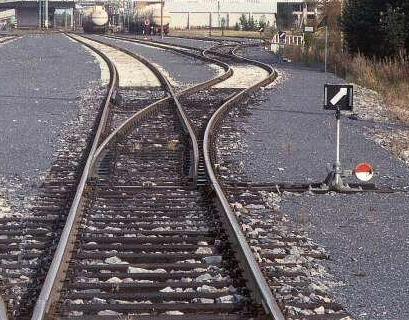
A right-hand railroad switch with point indicator pointing to right
Animated diagram of a right-hand railroad switch. The green line represents direction of travel only, the black lines represent fixed portions of track, and the red lines depict the moving components. Track A divides into two: the straight track (B), named the normal, and the diverging track (C), named the reverse.
Large stations may have hundreds of switches (Frankfurt Central Station, Germany).
Switch blades in motion (Hong Kong Mass Transit Railway light rail)
Abt switch used in the 1895-built Dresden Funicular Railway (photo of 1985)

A railroad switch (AE), turnout, or (set of) points (CE) is a mechanical installation enabling railway trains to be guided from one track to another, such as at a railway junction or where a spur or siding branches off.

Design

[edit]

The parts of a turnout are known by different names in different jurisdictions. The main terms in US and UK usage are shown in the selectable diagrams. In this article, the US term is listed first and UK second, in parentheses.

The most common type of switch consists of a pair of linked tapering rails, known as points (switch rails or point blades), lying between the diverging outer rails (the stock rails). These points can be moved laterally into one of two positions to direct a train coming from the point blades toward the straight path or the diverging path. A train moving from the narrow end toward the point blades (i.e. it will be directed to one of the two paths, depending on the position of the points) is said to be executing a facing-point movement.

For many types of switch, a train coming from either of the converging directions will pass through the switch regardless of the position of the points, as the vehicle's wheels will force the points to move. Passage through a switch in this direction is known as a trailing-point movement and switches that allow this type of movement without damage to the mechanism are called trailable switches.[1][page needed] In turn, these can either be non-resettable or resettable, meaning they either require on-site intervention to return the switch to operation after a trailing point movement or can continue operating with no in-person actions.[2]

A switch generally has a straight "through" track, such as the mainline, and a diverging route – respectively termed "normal" and "reverse" routes. The handedness of the installation is described by the side that the diverging track leaves. Right-hand switches have a diverging path to the right of the straight track, when coming from the point blades (switch blades), and a left-handed switch has the diverging track leaving to the opposite side. In many cases, such as rail yards, many switches can be found in a short section of track, sometimes with switches going both to the right and left (although it is better to keep these separated as much as feasible). Sometimes a switch merely divides one track into two; at others, it serves as a connection between two or more parallel tracks, allowing a train to switch between them. In many cases, where a switch is supplied to leave a track, a second is supplied to allow the train to reenter the track some distance down the line; this allows the track to serve as a siding, allowing a train to get off the track to allow traffic to pass (this siding can either be a dedicated short length of track, or formed from a section of a second, continuous, parallel line), and also allows trains coming from either direction to switch between lines; otherwise, the only way for a train coming from the opposite direction to use a switch would be to stop, and reverse through the switch onto the other line, and then continue forwards (or stop, if it is being used as a siding).

A straight track is not always present; for example, both tracks may curve, one to the left and one to the right (such as for a wye switch), or both tracks may curve, with differing radii, while still in the same direction. Switches consume a relatively high proportion of a railway maintenance budget.[3]

History

[edit]
A railway worker operating a manual switch at a rail yard in Britain during World War I
Control stand of a defunct railroad switch on the way from Pyin Oo Lwin to Goteik viaduct (Myanmar)

Simple single-bladed switches were used on early wooden railways to move wagons between tracks. As iron-railed plateways became more common in the eighteenth century, cast iron components were made to build switches with check rails.[4][page needed] In 1797, John Curr described the system that he developed which used a single iron blade, hinged on a vertical pin that was tapered to lie against the plateway.[5][page needed] By 1808, Curr's basic design was in common use.[6][page needed]

The use of a sprung rail, giving a smooth transition, was patented by Charles Fox in 1838.[7]

Prior to the widespread availability of electricity, switches at heavily traveled junctions were operated from a signal box constructed near the tracks through an elaborate system of rods and levers. The levers were also used to control railway signals to control the movement of trains over the points. Eventually, mechanical systems known as interlockings were introduced to make sure that a signal could only be set to allow a train to proceed over points when it was safe to do so. Purely mechanical interlockings were eventually developed into integrated systems with electric control. On some low-traffic branch lines, in self-contained marshalling yards, or on heritage railways, switches may still have the earlier type of interlocking.

Operation

[edit]
The operation of a railroad switch. In this animation, the red track is the one traveled during a facing-point movement. The switch mechanism, shown in black, may be operated remotely using an electric motor or hand-operated lever or from a nearby ground frame.

A railroad car's wheels normally take up a position over the center of the rails by virtue of the wheel treads' coning;[8] the flanges on the inside edges of the wheels. When the wheels reach the switch, the wheels are guided along the route determined by which of the two points is connected to the track facing the switch. In the illustration, if the left point is connected, the left wheel will be guided along the rail of that point, and the train will diverge to the right. If the right point is connected, the right wheel will be guided along the rail of that point, and the train will continue along the straight track. Only one of the points may be connected to the facing track at any time; the two points are mechanically locked together to ensure that this is always the case.

A mechanism is provided to move the points from one position to the other ("changing the switch-blades" or "changing the points"). Historically, this would require a lever to be moved by a human operator, and some switches are still controlled this way. However, most are now operated by a remotely controlled actuator called a switch machine or point machine, which may contain an electric motor or a pneumatic or hydraulic actuator. This both allows remote control and monitoring, and the use of stiffer, strong switches that would be too difficult to move by hand.

In a trailing-point movement (running through the switch in the wrong direction while they are set to turn off the track), the flanges on the wheels will force the points to the proper position. This is sometimes known as running through the switch. Some switches are designed to be forced to the proper position without damage. Examples include variable switches, spring switches, and weighted switches.

If the points are rigidly connected to the switch control mechanism, the control mechanism's linkages may be bent, requiring repair before the switch is again usable. For this reason, switches are normally set to the proper position before performing a trailing-point movement.[9]

High-speed operation

[edit]

Generally, switches are designed to be safely traversed at low speed. However, it is possible to modify the simpler types of switch to allow trains to pass at high speed. More complicated switch systems, such as double slips, are restricted to low-speed operation. On European high-speed lines, it is not uncommon to find switches where a speed of 200 km/h (124 mph) or more is allowed on the diverging branch. Switches were passed over at a speed of 560 km/h (348 mph) (straight) during the French world speed run of April 2007.[10]

The US Federal Railroad Administration has published the speed limits for higher-speed turnouts with No. 26.5 turnout that has speed limit of 60 mph (97 km/h) and No. 32.7 with speed limit of 80 mph (129 km/h).[11]

Operation in cold conditions

[edit]
Gas heating keeps a switch free from snow and ice.
Similarly, an electric forced-air heater can keep a switch free from snow and ice.

Under cold weather conditions, snow and ice can prevent the proper movement of switch or frog point rails, essentially inhibiting the proper operation of railroad switches. Historically, railway companies have employees keep their railroad switches clear of snow and ice by sweeping the snow away using switch brooms (Basically wire brooms with a chisel attached onto the opposite end of the broom – quite similar to ice scrapers used today), or gas torches for melting ice and snow. Such operation are still used in some countries, especially for branch routes with only limited traffic (e.g. seasonal lines). Modern switches for heavily trafficked lines are typically equipped with switch heaters installed in the vicinity of their point rails so that the point rails will not be frozen onto the stock rail and can no longer move. These heaters may take the form of electric heating elements or gas burners mounted on the rail, a lineside burner blowing hot air through ducts, or other innovative methods (e.g. geothermal heat sink, etc.) to keep the point & stock rails above freezing temperatures. Where gas or electric heaters cannot be used due to logistic or economic constraints, anti-icing chemicals can sometimes be applied to create a barrier between the metal surfaces to prevent ice from forming between them (i.e. having frozen together by ice). Such approaches however, may not always be effective for extreme climates since these chemicals will be washed away over time, especially for heavily thrown switches that experience hundreds of throws daily.[citation needed]

Heating alone may not always be enough to keep switches functioning under snowy conditions. Wet snow conditions, which generate particularly sticky snow and whiteout conditions, may occur at temperatures just below freezing, causing chunks of ice to accumulate on trains. When trains traverse over some switches, the shock, vibration, possibly in combination with slight heating caused by braking or a city microclimate, may cause the chunks of ice to fall off, jamming the switches. The heaters need time to melt the ice, so if service frequency is extremely high, there may not be enough time for the ice to melt before the next train arrives, which will then result in service disruptions. Possible solutions include installing higher capacity heaters, reducing the frequency of trains, or applying anti-icing chemicals such as ethylene glycol to the trains.[12]

Classification

[edit]
A low-speed #6 right-hand switch between a main line and a rail yard

The divergence and length of a switch is determined by the angle of the frog (the point in the switch where two rails cross, see below) and the angle or curvature of the switch blades. The length and placement of the other components are determined from this using established formulas and standards. This divergence is measured as the number of units of length for a single unit of separation.

In North America this is generally referred to as a switch's "number". For example, on a "number 12" switch, the rails are one unit apart at a distance of twelve units from the center of the frog.

In the United Kingdom points and crossings using chaired bullhead rail would be referred to using a letter and number combination. The letter would define the length (and hence the radius) of the switch blades and the number would define the angle of the crossing (frog). Thus an A7 turnout would be very short and likely only to be found in tight places like dockyards whereas an E12 would be found as a fairly high speed turnout on a mainline.

On the London, Midland and Scottish Railway, switch curvatures were specified from A (sharpest) to F (shallowest), with the following corresponding radii:[13]

  • B – 613 feet (186.84 m) – simple crossover with a 1 in 8 crossing angle
  • C – 980 feet (298.70 m) – scissors or simple crossover with a 1 in 10 crossing angle
  • D – 1,379 feet (420.32 m) – double track junction switch with a 1 in 12 crossing angle

Safety

[edit]

Switches are necessary for the operation of a railway, but they do pose a number of risks:

  • Reversing the points under a moving train will almost always derail the train.
  • Points might move due to the extreme forces exerted by a passing train. In an especially noteworthy and extreme case, a switch's setting was forcibly changed as a result of a disintegrated duo-block wheel getting caught in a switch. This caused one of the world's worst rail disasters, the Eschede train disaster.
  • A train might stand so close to the frog of a switch that a passing train would collide with its side (the first train is then said to have been fouling the switch).
  • The necessary maintenance of the complex mechanical device might be neglected.
  • Tampering with a manually operable switch or operation errors in an interlocking may result in two trains being on the same track, potentially causing a collision.

Accidents

[edit]

Switch-related accidents caused by one or more of these risks have occurred, including:

  • The 1980 Buttevant Rail Disaster at Buttevant, County Cork, in Ireland, when the DublinCork express was derailed at high speed after being inadvertently switched into a siding via ground frame operated points, resulting in 18 deaths.
  • Wrecks caused by switches being thrown open in front of the trains by saboteurs, as in the non-fatal derailments near Newport News, on 12 August 1992, and in Stewiacke, on 12 April 2001. To prevent these incidents, most unused switches are locked.
  • The Eschede train disaster in 1998 in Germany was one of the world's deadliest high-speed train accidents, resulting in 101 deaths. It occurred when a wheel rim of an ICE train failed at 200 kilometres per hour (120 mph), partially derailing the car. The wheel rim went through the floor of the carriage and was dragging on the ground. While passing through the station at Eschede it threw a switch, causing the rear wheels of the car to switch onto a track diverging from the track taken by the front wheels. The car was thereby thrown into and destroyed the piers supporting a 300-tonne roadway overpass.
  • The May 2002 Potters Bar rail crash at Potters Bar, Hertfordshire, in the United Kingdom, occurred when a switch sprang to a different position as a coach crossed it, a type of mishap called splitting the switch. The front wheels of a coach progressed along the straight track as intended, but the rear wheels slewed along the diverging track. This caused the whole coach to detach from the train and slew sideways across the platform ahead. The movement of the switch occurred beneath the final coach, so that the preceding coaches remained on the track. Poor maintenance of the points was found to be the primary cause of the crash.
  • The interim report into the Grayrigg derailment of 23 February 2007 blamed an incorrectly maintained set of points.[14]
    • On 31 July 1991, several cars derailed, killing seven passengers, due to a missing locking pin on the switch mechanism.[15]
    • Twenty-seven years later, on 4 August 2018, the Silver Star crashed into a parked freight train on a siding due to a misaligned switch, killing two crewmen.[16]

Components

[edit]

Switch rails (points or point blades)

[edit]
A pair of tapered moveable rails known as switch rails (points or point blades)

Switch rails (points or point blades) are the movable rails that guide the wheels towards either the straight or the diverging track. They are tapered, except on stub switches occasionally found in industrial sidings, which have square ends.

In popular parlance in the UK and most other Commonwealth countries, the term points refers to the entire mechanism. In professional parlance, the term refers only to the movable rails and the entire mechanism is named turnout or points and crossings. Turnout and switch are terms used in North America in all contexts.

In some cases, the switch blades can be heat treated for improvement of their service life. There are different kinds of heat treatment processes such as edge hardening or complete hardening.

The cross-section of the switch blades also influences performance. New tangential blades perform better than old-style blades.

Crossing (frog)

[edit]
A one-piece cast crossing. The shiny line crosses the rusty line. This North American "self-guarding cast manganese" component without guard rails has raised flanges on the crossing, which may bear on the face of the wheel as it passes through.
Left, the crossing or frog with its adjacent wing rails; right, the guard rail or check rail

The crossing or frog is the component that enables passage of wheels on either route through the turnout. It can be assembled out of several appropriately cut and bent pieces of rail or can be a single casting of manganese steel. On lines with heavy use, the casting may be treated with explosive shock hardening to increase service life.[17]

Guard rail (check rail)

[edit]

A guard rail is a short piece of rail placed alongside the main (stock) rail opposite the crossing. These ensure that the wheels follow the appropriate flangeway through the frog and that the train does not derail.[18][failed verification]

Check rails are often used on very sharp curves, even where there are no switches.[19]

Switch motor

[edit]
The switch motor (in this case an electric motor) and associated mechanism used to operate this switch can be seen to the right in the picture.

A switch motor or switch machine (point motor or point machine) is an electric, hydraulic or pneumatic mechanism that aligns the points with one of the possible routes. The motor is usually controlled remotely by the dispatcher (signaller in the UK). The switch motor also includes electrical contacts to detect that the switch has completely set and locked. If the switch fails to do this, the governing signal is kept at red (stop). There is also usually some kind of manual handle for operating the switch in emergencies, such as power failures, or for maintenance purposes.

A patent by W. B. Purvis dates from 1897.

Switch stand (points lever)

[edit]
An example of a mechanism used at a switch. The two points are linked together with a throw bar (also known as a stretcher bar). The throw bar extends to the lever on the near side of the track, which is used to throw the switch. This is an example of a low switch stand, used at locations where there is not sufficient clearance for a tall switch stand. This particular stand is designed to be trailed through by rolling stock, which will cause the points to become lined for the route that the wheels have passed through. It has a reflectorized target.

A switch stand (points lever or ground throw) is a lever and accompanying linkages to align the points of a switch by hand. The lever and its accompanying hardware is usually mounted to a pair of long ties (sleepers) that extend from the switch at the points. They are often used in a place of a switch motor on less frequently used switches. In some places, the lever may be some distance from the points, as part of a lever frame or ground frame. To prevent the tampering of switches by outside means, these switches are locked when not in use.

Facing point lock

[edit]
A set of points on the Strathspey Railway in Scotland. The facing point lock in the middle will need to be withdrawn using the blue lever (behind) on the left before the points themselves can be moved using the black lever (front). Once the points have been moved the lock will be pushed in again with the blue lever to lock the points in position.

A facing point lock (FPL), or point lock, is a device which, as the name implies, locks a set of points in position, as well as mechanically proving that they are in the correct position. The facing point part of the name refers to the fact that they prevent movement of the points during facing moves, where a train could potentially split the points (end up going down both tracks) if the points were to move underneath the train. During trailing moves, the wheels of a train will force the points into the correct position if they attempt to move, although this may cause considerable damage. This act is known as a "run through".

In the United Kingdom, FPLs were common from an early date, due to laws being passed which forced the provision of FPLs for any routes traveled by passenger trains – it was, and still is, illegal for a passenger train to make a facing move over points without them being locked, either by a point lock, or temporarily clamped in one position or another.[20]

Joints

[edit]

Joints are used where the moving points meet the fixed rails of the switch. They allow the points to hinge easily between their positions. Originally the movable switch blades were connected to the fixed closure rails with loose joints, but since steel is somewhat flexible it is possible to obviate this looseness by thinning a short section of the rail's bottom itself.

Straight and curved switches

[edit]

Turnouts were originally built with straight switch blades, which ended at the pointed end with a sharp angle. These switches cause a bump when the train traverses in the turnout direction. The switch blades could be made with a curved point which meets the stockrail at a tangent, causing less of a bump, but the disadvantage is that the metal at the point is thin and necessarily weak. A solution to these conflicting requirements was found in the 1920s on the German Reichsbahn. The first step was to have different rail profile for the stock rails and switch rails, with the switch rails being about 25 mm (0.98 in) less high, and stockier in the middle.

Types

[edit]

Apart from the standard right-hand and left-hand switches, switches commonly come in various combinations of configurations.

Slip

[edit]

Double slip

[edit]
A double switch, or double slip—the points are set to connect the upper left and lower right tracks.

A double slip switch (double slip) is a narrow-angled diagonal flat crossing of two lines combined with four pairs of points in such a way as to allow vehicles to change from one straight track to the other, alternatively to going straight across. A train approaching the arrangement may leave by either of the two tracks on the opposite side of the crossing. To reach the third possible exit, the train must change tracks on the slip and then reverse.

The arrangement gives the possibility of setting four routes, but because only one route can be traversed at a time, the four blades at each end of the crossing are often connected to move in unison, so the crossing can be worked by just two levers or point motors. This gives the same functionality of two points placed end to end. These compact (albeit complex) switches usually are found only in locations where space is limited, such as station throats (i.e. approaches) where a few main lines spread out to reach any of numerous platform tracks.

In North American English, the arrangement may also be called a double switch, or more colloquially, a puzzle switch. The Great Western Railway in the United Kingdom used the term double compound points, and the switch is also known as a double compound in Victoria (Australia). In Italian, the term for a double switch is deviatoio inglese, which means English switch. Likewise, it is called Engels(e) Wissel in Dutch and, occasionally, Engländer ("english one", literally "Englishman") in German.

Single slip

[edit]

A single slip switch works on the same principle as a double slip, but provides for only one switching possibility. Trains approaching on one of the two crossing tracks can either continue over the crossing, or switch tracks to the other line. However, trains from the other track can only continue over the crossing, and cannot switch tracks. This is normally used to allow access to sidings and improve safety by avoiding having switch blades facing the usual direction of traffic. To reach the sidings from what would be a facing direction, trains must continue over the crossing, then reverse along the curved route (usually onto the other line of a double track) and can then move forward over the crossing into the siding.

Outside slip

[edit]
A double, outside slip in Heidelberg main station

An outside slip switch is similar to the double or single slip switches described above, except that the switch blades are outside of the diamond instead of inside. An advantage over an inside slip switch is that trains can pass the slips with higher speeds. A disadvantage over an inside slip switch is that they are longer and need more space.

An outside slip switch can be so long that its slips do not overlap at all, as in the example pictured. In such a case a single, outside slip switch is the same as two regular switches and a regular crossing. Double outside slip switches are only used in rare, specific cases.

Crossover

[edit]
A universal crossover at Richthof between Kirchheim and Langenschwarz stations on the Hanover–Würzburg high-speed railway
A scissors crossover: two pairs of switches linking two tracks to each other in both directions

A crossover is a pair of switches that connects two parallel rail tracks, allowing a train on one track to cross over to the other. Like the switches themselves, crossovers can be described as either facing or trailing.

When two crossovers are present in opposite directions, one after the other, the four-switch configuration is called a universal crossover.[21][22] If the crossovers overlap to form an × in the center, it is called a double crossover, a scissors crossover, or just scissors;[23] due to requiring a diamond crossing in the center, it is also sometimes known as a diamond crossover. This makes for a very compact track layout, but requires more maintenance and is more expensive to produce.[21]

In a setup where each of the two tracks normally carries trains of only one direction, a crossover can be used either to detour "wrong-rail" around an obstruction or to reverse direction. A crossover can also join two tracks of the same direction, possibly a pair of local and express tracks, and allow trains to switch from one to the other.

On a crowded system, routine use of crossovers (or switches in general) will reduce throughput, as use of the switch blocks multiple tracks. For this reason, on some high-capacity rapid transit systems, crossovers between local and express tracks are not used during normal rush hour service, and service patterns are planned around use of the usually flying junctions at each end of the local-express line.

Stub

[edit]
Closeup of a stub switch in Pennsylvania
A narrow-gauge stub switch—this switch has an additional piece of movable rail instead of a frog.

A stub switch lacks the tapered points (point blades) of a typical switch. Instead, both the movable rails and the ends of the rails of the diverging routes have their ends cut off square. The switch mechanism aligns the movable rails with the rails of one of the diverging routes. In 19th century US railroad use, the stub switch was typically used in conjunction with a harp switch stand.

The rails leading up to a stub switch are not secured to the sleepers for several feet, and rail alignment across the gap is not positively enforced. Stub switches also require some flexibility in the rails (meaning lighter rails), or an extra joint at which they hinge. Therefore, these switches cannot be traversed at high speed or by heavy traffic and so are not suitable for main line use. A further disadvantage is that a stub switch being approached from the diverging route that is not connected by the points would result in a derailment. Yet another disadvantage is that in very hot weather, expansion of the steel in the rails can cause the movable rails to stick to the stock rails, making switching impossible until the rails have cooled and contracted.

One advantage to stub switches is that they work better in the snow. The sideways action of the point rails pushes snow to the side, instead of packing the snow between the points and the rail in a more modern design.

Stub switches were more common in the very early days of railways and their tramway predecessors. Now, because of their disadvantages, stub switches are used primarily on narrow-gauge and branch lines.

Three way

[edit]
A three-way stub switch at Sheepscot station on the Wiscasset, Waterville and Farmington Railway

A three-way switch is used to split a railroad track into three divergent paths rather than the more usual two. There are two types of three-way switches. In a symmetrical three-way switch, the left and right branches diverge at the same place. In an asymmetrical three-way switch, the branches diverge in a staggered way using two interlaced turnouts. Both types of three-way switches require three frogs.

The complexity of symmetrical switches usually results in speed restrictions, therefore three-way switches are most often used in stations or depots where space is restricted and low speeds are normal. Symmetrical switches were used quite often on Swiss narrow-gauge railways. Asymmetrical three-way switches are more common, because they do not have speed restrictions compared to standard switches. However, because of their higher maintenance cost due to special parts as well as asymmetric wear, both types of three-way switches are replaced with two standard switches wherever possible.

In areas with very low speeds, like depots, and on railroads that had to be built very cheaply, like logging railroads, three-way switches were sometimes built as stub switches.

Plate

[edit]
A narrow-gauge plate switch

A plate switch incorporates the tapered points of a typical switch into a self-contained plate. Each point blade is moved separately by hand. Plate switches are only used for double-flanged wheels, with wheels running through the plates on their flanges, guided by the edges of the plate and the movable blade.

Off-railer

[edit]

The off-railer is a system of installing a turnout over and above some plain track, without having to cut or replace that track. It is useful for installing temporary branches on agricultural railways, and sidings for track machines on mainline rails. Special ramps lift the wheels off the normal track, and then the off-railer curves away as required. Decauville has such a system. [24] It is similar to a drawbridge crossing.

Interlaced turnout

[edit]
A tight intersection of tracks, with two parallel tracks going in each of four directions
Interlaced turnouts on the elevated Chicago "L" northbound and southbound Purple and Brown lines intersecting with eastbound and westbound Pink and Green lines and the looping Orange line above the Wells and Lake street intersection in The Loop

An interlaced turnout is a method of splitting a track into three or more divergent paths. It is an arrangement of two standard turnouts, usually one left- and one right-handed, in an "interlaced" fashion. The points of the second turnout are positioned between the points and the frog of the first turnout. In common with other forms of three way turnouts an additional frog is required.[citation needed]

Wye

[edit]
A wye switch on the mainline, leading to a single-track bridge, near Ravenstein, Netherlands

A wye switch (Y points) has trailing ends which diverge symmetrically and in opposite directions. The name originates from the similarity of their shape to that of the letter Y. Wye switches are usually used where space is at a premium. In North America this is also called an "equilateral switch" or "equilateral turnout". Common switches are more often associated with mainline speeds, whereas wye switches are generally low-speed yard switches.

One advantage of wye switches is that they can have a coarser frog angle using the same radius of curvature than a common switch. This means that they give rise to a less severe speed restriction than the diverging branch of a common switch, without having to resort to more expensive switches with a moving frog. For this reason they are sometimes used on a main line where it splits into two equally important branches or at the ends of a single track section in an otherwise double track line.

Run off

[edit]
Trap points at the exit from a yard

Run-off points are used to protect main lines from stray or runaway cars, or from trains passing signals set at danger. In these cases, vehicles would otherwise roll onto and foul (obstruct) the main line and cause a collision. Depending on the situation in which they are used, run-off points are referred to either as trap points or catch points. Derailers are another device used for the same purpose.

Catch points are installed on the running line itself, where the railway climbs at a steep gradient. They are used to prevent runaway vehicles colliding with another train further down the slope. In some cases, catch points lead into a sand drag to safely stop the runaway vehicle, which may be traveling at speed. Catch points are usually held in the 'derail' position by a spring. They can be set to allow a train to pass safely in the downhill direction using a lever or other mechanism to override the spring for a short time.

Catch points originate from the days of the 'unfitted' goods (freight) train. As these trains tended to consist of either completely unbraked wagons (relying entirely on the locomotive's own brakes), or ones with unlinked, manually applied brakes (necessitating a stop at the top of steep downgrades for the guard to walk along the train and set the brakes on each wagon in turn), they also lacked any mechanism to automatically brake runaway cars. Catch points were therefore required to stop the rear portion of a poorly coupled train that might break away while climbing a steep grade – although they would also stop vehicles that ran away for any other reason. Now that trains are all 'fitted' (and broken couplings are far less common), catch points are mostly obsolete.

Similar to catch points, trap points are provided at the exit from a siding or where a goods line joins a line that may be used by passenger trains. Unless they have been specifically set to allow traffic to pass onto the main line, the trap points will direct any approaching vehicle away from the main line. This may simply result in the vehicle being derailed, but in some cases a sand drag is used, especially where the vehicle is likely to be a runaway traveling at speed due to a slope.

Derailers

[edit]

A derailer works by derailing any vehicle passing over it. There are different types of derailers, but in some cases they consist of a single switch point installed in a track. The point can be pulled into a position to derail any equipment that is not supposed to pass through.

Dual gauge

[edit]
A dual-gauge switch in Japan

Dual gauge switches are used in dual gauge systems. There are various possible scenarios involving the routes that trains on each gauge may take, including the two gauges separating or one gauge being able to choose between diverging paths and the other not. Because of the extra track involved, dual gauge switches have more points and frogs than their single gauge counterparts. This limits speeds even more than usual.

A related formation is the 'swish' or rail exchange, where (usually) the common rail changes sides. These have no moving parts, the narrower gauge wheels being guided by guard rails as they transition from one rail to another. The wider gauge only encounters continuous rail so is unaffected by the exchange. At dual gauge turntables, a similar arrangement is used to move the narrow-gauge track from one side to a central position.

Rack railway

[edit]
Railroad switch of the Schynige Platte Railway (at Schynige Platte, Switzerland)

Rack-railway switches are as varied as rack-railway technologies. Where use of the rack is optional, as on the Zentralbahn in Switzerland or the West Coast Wilderness Railway in Tasmania, it is common to place turnouts only in relatively flat areas where the rack is not needed. On systems where only the pinion is driven and the conventional rail wheels are idlers, such as the Dolderbahn in Zürich, Štrbské Pleso in Slovakia and the Schynige Platte rack railway, the rack must be continuous through the switch. The Dolderbahn switch works by bending all three rails, an operation that is performed every trip as the two trains pass in the middle. The Štrbské Pleso and Schynige Platte Strub rack system instead relies on a complex set of moving points which assemble the rack in the traversed direction and simultaneously clear the crossed direction conventional rails. In some rack systems, such as the Morgan system, where locomotives always have multiple driving pinions, it is possible to simplify turnouts by interrupting the rack rail, so long as the interruption is shorter than the spacing between the drive pinions on the locomotives.[25]

Rotary

[edit]
A Pilatus Railway turnout consisting of a bridge that rotates about its lengthwise axle

Rotary switches are sometimes used on rack railways to maintain alignment of the pinion (cog) with two different tracks. They are used on the Pilatus Cog Railway to allow up-bound and down-bound trains to pass each other on a grade while sharing the remainder of the single track.

A rotary switch rotates about its long axis to present a track connection to a chosen set of tracks. Physically, it flips over (rotates about its long axis 180 degrees) to connect to the chosen set of tracks. Once the rotary switch is secured the train can proceed. Pinion alignment is maintained in both positions.

Diamond

[edit]
A switch diamond at a junction in the UK

Although not strictly speaking a turnout, a switch diamond is an active trackwork assembly used where the crossing angle between two tracks is too shallow for totally passive trackwork: the unguided sections of each rail would overlap. These vaguely resemble two standard points assembled very closely toe-to-toe. These would also often utilize swingnose crossings at the outer ends to ensure complete wheel support in the same way as provided on shallow angle turnouts. In North America these are known as movable-point diamonds. In the UK, where the angle of divergence is shallower than 1 in 8 (center-line measure) a switched diamond will be found rather than a passive or fixed diamond.

Such switches are usually implemented on the basis of increasing the safe crossing speed. Open blades impose a speed restriction, due to the potential of the crossing impact fracturing the rail as both wheels on each axle hit the crossing gaps almost simultaneously. Switched blades, as shown in the photograph, allow a much higher speed across the gap by providing an essentially continuous piece of rail across the gap on both sides.

The frog end of the switched crossing, despite still having a gap in one rail, is less problematic in this regard. The outer rail is still continuous, the wing rail (the part that turns out, after the frog gap) provides a gradual transition, and the check rail avoids the possibility of points splitting. This can be seen in how, under examination, the wing rail has a wider polished section, showing how the wheel load is transferred across the gap.

Single point

[edit]
A single-point switch on the Toronto streetcar system

Single point switches, known as Tongue and Plain Mate switches, are sometimes used on freight railways in slow speed operation in paved areas such as in ports. In the United States, they are regulated by provision 213.135(i) of the Federal Railroad Administration Track Safety Standards.

On streetcar (tram) systems using grooved rails, if the wheels on both sides of the car are connected by a rigid solid axle, only one switchpoint is needed to steer it onto one or the other track. The switchpoint will be on inside rail of the switch's curve route. When a streetcar enters the curve route of the switch, the wheel on the inside of the curve (the right side of the car on a right turn) is pulled into the turn, and through the axle, directs the wheel on the outside to also follow the curve.[26] The outside wheel is supported for a short distance by its flange running in the groove.

Some low-floor streetcar designs use split axles (a separate half-axle for the wheel on each side of the car). Such streetcars are unsuitable for use with single-point switches as there is be no mechanism to transfer the force from the inner to the outer wheels at switches.[26]

A single-point switch is cheaper to build, especially in street trackage, as there is no need to link to a second switchpoint.[26]

Temporary

[edit]
Temporary or 'Californian' points installed on tramline 81 at the junction of Avenue Louise and Rue Bailli (in French), a.k.a. Louisalaan and Baljuwstraat (in Dutch), Brussels

When a tram track is interrupted during repairs, a set of temporary points may be placed on top of existing track to allow trams to cross to the parallel track. These are known as Kletterweichen [de] or Auflegeweichen in German, aiguillages californiens in French, and oplegwissels [nl], klimwissels or Californische wissels in Dutch. They may be welded into place and allow trams to pass at walking pace.

Speeds over turnouts

[edit]

Train speeds over turnouts are governed by a number of factors. As a general rule, the smaller the crossing angle of a turnout, the higher the turnout speed. Turnouts are usually rated numerically, which represents the ratio of divergence per length as measured at the frog.[citation needed]

Higher-speed turnouts in the United States include:[11]

  • no. 26.5: 60 mph (97 km/h)
  • no. 32.7: 80 mph (130 km/h)

Such specifications, however, are by no means universal: 1:16 is specified for 62 mph (100 km/h) standard-gauge track in Uganda.[27]

Turnouts on high-speed rail lines have much larger crossing numbers than the above, combined with swing noses.

Assembly and transport

[edit]
Transport of switches by rail creates problems as they are so long and wide.

Turnouts are large pieces of rail infrastructure which may be too big, wide, or heavy to transport in one piece. Special wagons can carry the pieces at approximately 45° from vertical, so that they fit within the structure gauge. Once all the pieces have arrived, the turnout is assembled sleeper by sleeper on site. A set of turnouts may be trial assembled beforehand off site, to check that everything fits.

See also

[edit]

References

[edit]

Further reading

[edit]
[edit]
Revisions and contributorsEdit on WikipediaRead on Wikipedia
from Grokipedia
A railroad switch, also known as a turnout or set of points, is a mechanical installation that enables trains to be guided from one track to another at intersecting or diverging points. These devices are essential components of , allowing for the efficient routing of trains on mainlines, sidings, and yards by aligning movable rails to direct wheel flanges onto the desired path. In yards, switches facilitate the low-speed assembly, disassembly, and sorting of trains, often operated manually or with simple mechanisms, while on mainlines they support higher-speed operations for passing, diverging routes, or maintenance access, typically controlled remotely via signals and power systems. Misaligned or improperly operated switches pose significant risks, including derailments or damage, underscoring the need for precise engineering, regular maintenance, and adherence to operating rules. The core structure of a railroad switch consists of several key components designed to ensure smooth transitions and durability under heavy loads. Stock rails form the fixed outer boundaries of the tracks, while movable switch points—tapered rails connected by a throw bar—pivot to guide the train's wheels toward the straight or diverging route. Closure rails bridge the gap between the points and the frog, where the rails of the two tracks cross at an angle; the frog itself is a critical V-shaped casting that allows wheels to pass over the intersection without derailing, often made of manganese steel for high-traffic areas. Guard rails, positioned parallel to the stock rails near the frog, prevent wheels from dropping into the crossing, enhancing stability. Additional elements include heel blocks at the switch base for secure attachment to ties, and switch ties—specialized timber or concrete supports—that anchor the assembly. Railroad switches are classified by type and design to suit varying operational demands, with the "number" of a turnout indicating its divergence angle (e.g., a No. 7 turnout has a 1:7 ratio, allowing gentler curves for higher speeds). Common frog types include spring-rail for flexible guidance in yards, rail-bound for durable mainline use, and self-guarded variants for lower-speed applications up to 30 mph. Operationally, switches can be facing (encountered points-first for diverging) or trailing (frog-first for merging), with modern installations often featuring power-operated mechanisms—electric, pneumatic, or hydraulic—for remote control, replacing early manual levers. Historically, railroad switches originated in the late with rudimentary designs for mine tramways, used manually on early 19th-century steam railroads with simple stub switches, evolving to split-point systems by the late 1800s to handle heavier traffic and improve . began in the early with electric and compressed-air machines, followed by remote controls in and computerized systems in the , significantly improving and across global rail networks. Today, switches remain governed by standards from organizations like the American and Maintenance-of-Way Association (AREMA), ensuring compatibility with modern high-speed and freight operations.

Overview

Definition and Purpose

A railroad switch, also known as a turnout or points, is a mechanical device that enables trains to change tracks by guiding the wheels from one rail to another, thereby directing rail traffic onto divergent paths. This installation is fundamental to rail infrastructure, allowing for the seamless diversion of locomotives and cars between routes without requiring full stops or reversals. The primary purposes of railroad switches include facilitating the branching, joining, or crossing of tracks, particularly in rail yards, sidings, and mainlines where multiple routes converge. In yards, they support essential operations such as storing equipment, conducting inspections and maintenance, and assembling or disassembling trains, thereby optimizing the flow of both passenger and freight traffic. By providing operational flexibility, switches enhance the overall capacity and safety of rail networks, preventing unauthorized or misdirected movements that could lead to collisions or derailments. At its core, the basic mechanics of a railroad switch involve movable rails, referred to as points, which are tapered and hinged to align precisely with fixed stock rails, creating the necessary gap—typically around 5 inches—to guide wheel flanges onto the desired path. Key components such as these switch rails and the V-shaped at the divergence point ensure smooth transitions. Historically, switches have evolved from simple manual devices operated by switchmen using levers to complex automated systems controlled electrically or pneumatically, reducing human error and increasing operational speed. Railroad switches are crucial for rail efficiency, as they enable complex routing configurations that allow trains to maintain momentum while navigating interconnected networks, thereby minimizing delays and maximizing throughput in high-traffic areas.

Terminology

In railroad , terminology for switches and related components varies by and , ensuring precise communication among professionals. In North American usage, a "turnout" refers to the complete assembly that diverts from one track to another, encompassing the switch, , closure rails, and guard rails. By contrast, commonly employs "points" for the entire mechanism or specifically the movable rails, while "switch" is more prevalent in for the movable elements. The term "blade" is often used interchangeably with "point" to describe the tapered, movable rail sections in British . Related concepts distinguish directional and geometric configurations. "Facing points" describe a switch approached head-on by an oncoming , allowing route selection, whereas "trailing points" are those passed from the end, permitting passage over only one route. An "equilateral turnout" features symmetric divergence to both sides in a Y-shape, unlike the more common "unequal turnout" where one route remains straight and the other diverges at an angle. Key acronyms include FPL for "facing point lock," a mechanism that secures points in position during facing movements to prevent unintended shifts. AREMA, the American Railway Engineering and Maintenance-of-Way Association, establishes industry standards for switch design and terminology, influencing North American practices.

Essential Terminology Glossary

  • Turnout: The full track assembly including switch points, frog, and rails that enables train diversion; derived from "turning out" to a secondary path.
  • Switch: The movable rail components that guide wheels to select a route; in , often synonymous with the entire turnout mechanism.
  • Points (or Point Blades): The tapered, hinged rails that lie between stock rails to direct train movement; "points" emphasizes their pointed shape in British usage.
  • Frog: The V-shaped intersection where rails cross, allowing wheel flanges to pass; etymologically linked to the V-shaped "frog" on a horse's .
  • Guard Rail (or Check Rail): A rigid rail parallel to the running rail near the frog, guiding wheel flanges to prevent .
  • Stock Rail: The fixed outer rail against which points close to form a .
  • Closure Rail: The section of rail connecting the switch points to the frog in a turnout assembly.
  • Facing Point Lock (FPL): A locking device ensuring points remain secure when trains approach facing the switch.
  • Equilateral Turnout: A symmetric Y-configured turnout diverging equally to left and right routes.
  • Unequal Turnout: A standard asymmetric turnout with one straight main route and one diverging .

Historical Development

Early Inventions

The origins of railroad switches trace back to the rudimentary wooden wagonways of the in , primarily developed for transporting in mining regions. These early systems relied on simple mechanisms such as turnplates or sliding wooden rails to divert horse-drawn wagons between tracks, allowing operators to manually reposition vehicles at junctions. Such prototypes were essential for efficient underground and surface but were limited by their fragility and imprecision. In the 1780s, the shift to iron plateways marked a significant advancement, introducing more durable switches manually operated via levers. English mining engineer John Curr is credited with one of the earliest documented inventions in this area, describing a hinged blade switch in for use in Sheffield collieries. Curr's design facilitated smoother transitions for coal carts on L-shaped iron rails, where the rail flange guided the plain wheels, and it became widely adopted in European mining by the early 1800s, enhancing transport efficiency while still requiring hand operation. His subsequent patents in the further refined iron plateway components, including switching elements, to withstand heavier loads. The advent of steam railroads in the early prompted adaptations for flanged wheels, which became standard by the 1830s. Unlike earlier plateways, edge rail systems used wheels with inner flanges to maintain alignment, necessitating switches that could reliably guide these flanges through diverging paths. British engineer William Jessop had pioneered flanged wheels in 1789 for better stability on iron rails, but their integration into public steam lines, such as the in 1825, accelerated switch redesigns to prevent misalignments at speeds beyond horse traction. A pivotal came from Charles Fox, who patented an improved point mechanism in 1832. Fox's design employed hinged movable points instead of sliding rails, allowing for precise and secure track divergence while reducing the physical effort needed for operation. This addressed key limitations of prior systems and set a precedent for safer routing on emerging rail networks. Early switches, however, posed substantial challenges, including frequent derailments from wooden components warping under weather or load, brittle early iron failing under stress, and manual levers prone to operator error or . These risks were particularly acute in coal tramways and nascent steam lines, where imprecise alignment could lead to catastrophic accidents, underscoring the era's reliance on basic materials and human intervention.

19th and 20th Century Advancements

During the mid-to-late 19th century, railroad switches saw significant material and design improvements as rail networks expanded rapidly in the United States and . Cast iron frogs, which provided greater durability over earlier wooden or versions, became widely adopted starting in the , enabling more reliable wheel transitions at diverging tracks. Spring switches, featuring resilient points that returned to a default position after train passage, were also introduced and proliferated during this era, particularly in the 1870s and 1880s, to enhance safety and reduce maintenance on high-traffic lines. These advancements addressed the limitations of manual stub switches, supporting the industrialization of rail infrastructure amid booming freight and passenger demands. By the 1890s, mechanization accelerated with the introduction of pneumatic and electric actuators, marking a shift from purely manual operations. George Westinghouse's Company, founded in 1881, patented early electro-pneumatic systems that used controlled by electrical signals to move switch points, improving precision and speed on busy junctions. These innovations, including the first electro-pneumatic in 1891, allowed for safer, more automated control, reducing in complex track layouts. In the early 1900s, safety features like facing point locks were standardized to prevent switches from being thrown under moving trains, a response to frequent derailments on facing routes. Concurrently, the predecessor of the American Railway Engineering and Maintenance-of-Way Association (AREMA), established in 1899, began developing uniform standards for switch components, including and materials, to facilitate across North American railroads. These efforts promoted consistency in design and installation, aiding the efficient expansion of national rail systems. The World Wars profoundly influenced switch development, as military logistics demands necessitated robust, high-capacity rail networks capable of sustaining massive troop and supply movements. During , Allied forces relied on railways for under heavy loads. highlighted the critical role of switches in diverting supply trains, though infrastructure including switches often required rapid repairs after damage. Key milestones in the mid-20th century included the widespread implementation of switches in , allowing operators to manage points from centralized towers and boosting efficiency on double-track mainlines. By the , electro-pneumatic systems evolved into more integrated setups, combining electrical controls with air-powered actuators for faster, more reliable operation on electrified lines, as seen in post-war reconstructions that prioritized for growing freight volumes.

Modern Innovations

In the late 20th century, railroad switches transitioned from manual and electro-pneumatic systems to computerized electric machines, enhancing reliability and remote operation. The IRM-23 model, developed by Intertech Rail, exemplifies this shift with its dual-control electric design using worm gear actuators for precise point movement, allowing integration with centralized control systems and reducing human intervention. These advancements, building on earlier electro-pneumatic designs, enabled faster switching times and better fault detection through basic electronic monitoring. The 2010s introduced smart technologies for proactive switch management, including sensors and for . Systems like those implemented by use (IoT) sensors to monitor switch health in real-time, detecting anomalies in or alignment via AI algorithms to prevent failures before they occur. Concurrently, low-friction composite materials, such as Railko NF21 from Tenmat, were adopted for slide plates and bearers, reducing wear and energy loss by providing controlled coefficients without traditional metal-on-metal contact. The (UIC) highlights these AI-driven approaches as key to extending switch lifespan and minimizing downtime across global networks. By the 2020s, switch innovations focused on seamless integration with advanced signaling, particularly the (ETCS) within the (ERTMS), where switch positions are digitally verified and locked to ensure safe route authorization. Electro-hydraulic actuators emerged for high-speed applications, with the Repoint project at the demonstrating a novel design using hydraulic cylinders for smoother, faster switching up to 320 km/h while reducing dynamic forces on tracks. Sustainability efforts gained prominence, incorporating eco-friendly lubricants and recyclable components to lessen environmental impact. Biodegradable synthetic lubricants like Glidex MC from Midwest Industrial Supply provide long-lasting protection for switch plates without petroleum-based , resisting wash-off in harsh weather. Recyclable composites in bearers and rollers, such as those from Nortrak, further support principles by enabling easier end-of-life processing. As of 2024, wireless remote controls and vibration-dampening designs represent cutting-edge progress, enabling operator-independent switching via radio signals integrated with systems for enhanced safety and efficiency. The Repoint initiative also incorporates features, using compliant materials to dampen oscillations during high-speed transitions, thereby lowering noise and structural stress.

Design and Components

Geometry and Layout

The geometry of a railroad switch, commonly referred to as a turnout, is governed by the turnout number system, which quantifies the rate of between the main and diverging tracks. The turnout number represents the ratio of longitudinal distance to lateral spread; for instance, a No. 8 turnout features a 1:8 ratio, where the tracks separate by 1 unit of gauge for every 8 units along the track centerline, resulting in a frog angle of approximately 7.125 degrees. This system ensures predictable alignment for safe train passage, with higher numbers indicating gentler divergences suitable for higher speeds. Straight switches, with linear switch points, contrast with curved switches, where the points follow a curved profile to blend into the diverging route. Straight switches are typically employed in mainline applications to minimize abrupt changes and support speeds up to 19 mph on the diverging route for a No. 8 turnout, while curved switches, with shorter point lengths (e.g., 13 feet for No. 8), facilitate tighter radii in yard settings for low-speed maneuvering. Radius calculations for the diverging closure rail depend on the turnout number and gauge; for mainline use, larger numbers like No. 12 yield radii exceeding 1,000 feet to maintain stability at 40-50 mph, whereas yard turnouts (e.g., No. 6) use radii around 300-400 feet for operational efficiency at 10-15 mph. The lead length, defined as the distance from the point of switch to the point of , is determined by turnout geometry standards. For a No. 8 , the lead is 68 feet. Closure rails connect the switch points to the , with spacing gradually increasing to accommodate the diverging path, while guard rails maintain clearance of 1.5 to 2 inches in flangeways to prevent . This spacing, typically starting at 1.75 inches near the and widening to match the frog entry, guides flanges through the without binding. Equilateral turnouts feature a symmetric V-shaped layout, allowing bidirectional divergence at equal angles from a central straight track, ideal for wyes or crossovers where either route can serve as mainline. For a No. 8 equilateral, the design supports up to 27 mph on both branches, with mirrored enhancing versatility in complex layouts.

Core Structural Components

The core structural components of a railroad switch, also known as a turnout, consist of the fixed and movable elements that enable trains to diverge from or converge onto tracks while maintaining stability and alignment. These include the switch rails, , guard rails, and supporting joints and tie plates, all designed to withstand heavy loads and dynamic forces. Switch rails, commonly referred to as points or blades, are the tapered movable rails that guide the flanges into the desired route by aligning against the rails. They are typically machined from high-carbon or to resist and , with lengths ranging from 15 to 20 feet depending on the turnout and rail section. These rails are pre-bent if required and pivot at the , ensuring a precise fit with a point thickness of about 15-20 millimeters to support loads. The crossing, or , is a V-shaped component that facilitates the transfer of wheels from one rail to another at the intersection point. Constructed from cast or for against impact and abrasion, it features a point that corresponds directly to the turnout number—for instance, a No. 8 frog has an angle of approximately 7 degrees 9 minutes, where the number represents the of run to rise. The flangeway within the is typically 1.75 inches wide to accommodate wheel flanges. Guard rails, also called check rails, are fixed supplemental rails installed parallel to the stock rails to prevent wheel climb and , particularly near frogs and switches. Made of standard , they are positioned with a clearance of 1.75 inches from the stock rail's gauge face, creating a narrow flangeway that guides the while allowing smooth passage. Joints and tie plates provide essential connections and support within the switch assembly. Insulated rail joints, often using non-conductive bushings and end posts, isolate sections for signaling and integrity, preventing electrical continuity between rails. Expansion joints accommodate thermal movement, with standard gaps of about 1/8 inch per 100 feet of rail to mitigate from temperature changes of up to 100 degrees . Tie plates, typically , secure rails to ties and distribute loads, with specialized designs at switch heels using blocks for flexibility in continuous welded rail applications. Straight switches feature linear switch points against straight stock rails, resulting in an abrupt directional change that requires robust support from closely spaced ties. In contrast, curved switches incorporate pre-bent rails and closure sections with gradual , often supported by additional tie plates and longer ties to ensure smoother transitions and reduced stress on wheels, integrating seamlessly with the overall turnout geometry.

Actuation and Control Mechanisms

Railroad switches are actuated and controlled through a combination of mechanical, electrical, and hydraulic systems designed to precisely position and secure the switch points against the stock rails. Electro-mechanical motors, typically consisting of a coupled with a gearbox and lead-screw mechanism, or hydraulic systems provide the force required to throw the switch, overcoming , , or on the points. These actuators generate sufficient —often in the range of 100-200 ft-lbs depending on the model and track conditions—to ensure reliable operation under varying loads. In remote or low-traffic yards, manual switch stands, also known as points levers, serve as the primary actuation method, allowing operators to physically throw the switch via a lever connected to the points by rods. These stands incorporate target indicators, such as colored plates (e.g., red for diverging and green for mainline), to visually confirm the switch position from a distance, enhancing safety during manual operations. Safety is further ensured by the facing point lock (FPL), a mechanical interlock that secures the switch points in position and prevents actuation when a train occupies the approach track, thereby avoiding unintended movements during facing-point operations. FPL systems must comply with Federal Railroad Administration (FRA) standards, including requirements for switch-and-lock movements on mechanically operated switches as specified in 49 CFR § 236.306. Position verification is handled by detection systems, such as circuit controllers or point detectors, which monitor the alignment of the switch points relative to the stock rails and provide electrical feedback to signaling systems. These devices are calibrated to detect proper closure within a tolerance where contacts change state if the point opens one-fourth inch or more, preventing false indications that could lead to unsafe routing. Contemporary advancements include pneumatic cylinders and solenoid-based actuators, which offer faster response times for high-density operations, achieving throw durations of 0.6 to 1.2 seconds while maintaining compatibility with existing detection and locking features. These systems often incorporate closed-loop controls for precise positioning and fault detection, improving reliability in adverse weather.

Operation

Basic Switching Process

The basic switching process begins with signal activation in controlled territories, where a or authorizes the movement based on status confirming the block is clear. This triggers the actuation mechanism, such as an in a power switch machine, to initiate point movement by driving the switch rods connected to the movable points. Once the points align with the desired route—typically creating a precise gap of about 5 inches between the point and stock rail—the circuit controller verifies the position, engaging the lock to secure the switch against unintended movement. The then approaches under a cleared signal aspect, such as "proceed at restricted speed," ensuring safe entry into the switch. During the train's passage, wheel-rail interaction relies on the wheel contacting the aligned switch point to guide the train into the divergent path, preventing the wheels from continuing straight on the stock rail. This flange guidance occurs at typical entry speeds of 5-15 mph in yard or low-speed operations, allowing the flange to gently engage the point without excessive impact. The core structural components, including the hinged switch points and connecting rods, facilitate this precise alignment to direct the wheelset onto the intended track. The process differs between facing and trailing operations: in facing moves, where the train approaches the points head-on, the locked switch must withstand potential misalignment forces, requiring robust locking to avoid ; trailing moves, where the train enters from the diverging side, are easier as the flanges can force the points into alignment if slightly mispositioned, reducing the risk and force needed for secure operation. For powered switches, the throw time—the duration for the motor to move the points from one position to the other—typically ranges from 2-3 seconds, depending on voltage and load, enabling quick yet controlled changes. After the train passes, the switch resets to its normal position (usually the main track) via another actuation command, with continuous monitoring by circuit controllers or detectors to confirm alignment and detect faults like broken rods.

High-Speed Operation

High-speed railroad switches, or turnouts, must accommodate speeds exceeding 100 mph (160 km/h) while maintaining stability and , necessitating specialized designs that minimize dynamic forces and ensure smooth transitions. For lines operating above 200 km/h, turnouts typically feature a number 18 or higher configuration, providing a divergence that allows for a minimum radius of at least 250 meters in the diverging route to reduce lateral accelerations. These designs incorporate resilient wheels on locomotives and , which use elastomeric materials to dampen vibrations and noise generated during high-velocity passage, and elastomeric pads beneath the rails to enhance track elasticity and distribute loads more evenly, thereby preventing excessive wear on switch components. Operational speeds through high-speed turnouts in commonly reach 200 km/h (124 mph), enabling efficient routing without significant deceleration on dedicated lines. Experimental tests have demonstrated even higher capabilities on straight track, such as the French achieving 574.8 km/h in 2007 on upgraded infrastructure, though such speeds remain non-operational and are not achieved through turnouts. To mitigate vibrations at these rates, hydraulic dampers are integrated into the switch actuation mechanisms to absorb shocks during rail transitions, while wider guard rails—often with intervals up to 1365 mm—guide wheels securely and prevent flange climb, reducing the risk of lateral instability. Integration of advanced signaling systems like (CBTC) is essential for high-speed operations, providing real-time positioning data to synchronize switch alignments with train movements and ensure precise timing to avoid conflicts at velocities over 200 km/h. However, limitations persist due to centrifugal forces, which intensify with speed and curve radius; for instance, on a number 12 turnout with a tighter radius, speeds above 80 mph (129 km/h) significantly elevate risks by increasing wheel-rail contact forces beyond safe thresholds, often necessitating speed restrictions to 40-60 mph in conventional applications.

Adverse Condition Adaptations

Railroad switches operating in cold conditions require adaptations to prevent formation and freezing of , which can lead to operational failures. Switch heaters, typically powered by gas or at 10-20 kW, are installed to melt and maintain functionality by directing or direct onto the switch points and rods. These systems activate automatically based on sensors, ensuring the switch blades remain free to move. Additionally, anti-icing chemicals such as glycol-based fluids are applied to switch points and slide plates to lower the freezing point of moisture and prevent buildup. Thermal expansion and contraction of components, governed by a coefficient of approximately 11.5 × 10^{-6} per °C, can cause binding in cold weather as materials contract and create excessive tension in connecting rods and joints. To mitigate this, dedicated heating elements are integrated into switch rods and joints to maintain optimal lengths and prevent mechanical binding, allowing reliable actuation even in sub-zero temperatures. In snow-prone areas, such as those in , switches are adapted with enclosed points using covers to shield mechanisms from accumulation and facilitate easier clearing. Blade deflectors, positioned along the switch rails, redirect falling away from critical areas to reduce packing between the point and stock rail. For other environmental challenges, dust covers made of durable materials enclose switch mechanisms in arid regions to protect against windblown ingress, which can abrade components and impair movement. In coastal areas exposed to salt-laden air, switches incorporate corrosion-resistant coatings, such as galvanized or treatments, to extend service life and prevent rust-induced failures. Maintenance protocols for adverse conditions include pre-winter application of low-viscosity oils to switch rods and plates, ensuring remains effective at low temperatures without thickening or freezing. These oils, often moly-fortified synthetics, reduce friction and prevent seizing during cold starts.

Types and Configurations

Standard Turnouts

Standard turnouts, also known as simple or basic turnouts, are fundamental components of railroad track systems that enable to diverge from or converge onto a main track via a single alternative path. These configurations typically consist of switch points, stock rails, closure rails, and a , allowing for straightforward routing in yards, sidings, and lines. The design prioritizes simplicity and cost-effectiveness for low- to moderate-speed operations, with the turnout's geometry defined by its number, which represents the of longitudinal distance to lateral spread— for instance, a No. 6 turnout features a 1:6 , corresponding to a frog angle of approximately 9°31'38", making it suitable for yard maneuvers where speeds are limited to around 10-15 mph. In a simple turnout, the switch points—movable tapered rails—align with the stock rails to guide the train wheels either straight along the main track or onto the diverging route, where the frog provides the intersection point for the rails. This setup is commonly deployed in tangent (straight) track alignments to facilitate standardized manufacturing and installation, reducing maintenance needs compared to more complex geometries. For example, No. 6 turnouts are widely used in classification yards for sorting cars, as their sharper divergence supports tight spacing without excessive land requirements, though they impose lateral forces on equipment that limit speeds on the diverging leg. Wye switches represent a specialized standard turnout forming a Y-shaped configuration, where a single entry track splits into two diverging branches, each typically equipped with its own switch for independent control. This arrangement is primarily employed in terminal areas or junctions to reverse direction without a full loop, allowing locomotives to turn around efficiently by traversing the two arms of the Y. The design enhances operational flexibility in space-constrained environments, such as urban rail yards, but requires careful alignment to manage the acute angles at the switches, often limiting speeds to 10-20 mph. Stub switches, an older variant of standard , feature short, movable rail stubs that pivot at a fixed point rather than using extended tapered points, relying on manual or mechanical bending to align with the stock rails. Historically used for low-speed access to sidings or industrial spurs, these switches were economical for light-duty applications but prone to misalignment and under repeated use. Their application has been largely discontinued on main lines due to concerns and the superiority of modern split-switch designs, though remnants persist in secondary or heritage lines for speeds under 10 mph. Three-way turnouts provide a compact standard configuration for routing trains from one entry track to three possible paths—straight, left diverge, or right diverge—using a single set of overlapping switch points and multiple frogs. This rare design, which integrates two switch mechanisms into one assembly, is employed in dense yard ladders or terminal throats to minimize space and hardware, but its complexity increases demands and risk of misalignment, restricting use to low-speed operations below 15 mph. The arrangement demands precise engineering to ensure wheel guidance across the intertwined rails, making it uncommon outside specialized freight classification facilities. Diamond crossings serve as fixed crossing configurations for the at-grade of two straight tracks, forming a diamond-shaped layout where rails cross without switches, typically at angles of 1:6 or gentler to minimize impact forces. These fixed configurations rely on rigid wing rails and guard rails to prevent flanges from climbing the crossing point, ensuring safe passage for bidirectional traffic on both tracks. Commonly installed in secondary lines or yards, diamond crossings accommodate speeds of 10 mph for freight and 15 mph for passenger service when equipped with proper guards, per U.S. standards, but sharper angles increase wear and require frequent inspections.

Slip and Crossover Variants

Slip and crossover variants of railroad switches are specialized configurations designed to facilitate multiple track transitions or crossings at junctions, enabling efficient routing in constrained environments such as yards or urban areas without requiring trains to come to a complete stop. These variants integrate elements like movable points and frogs to allow bidirectional or diagonal movements between intersecting tracks, optimizing space and operational flexibility compared to standard single-path turnouts. A double slip switch combines two crossovers into a single compact unit, permitting diagonal swaps between tracks at a crossing. It superimposes two sets of switch points and curved closure rails over an elongated diamond crossing, allowing a train approaching from any of the four tracks to route to any of the other three. This design is particularly useful in terminal yards and passenger stations where space is limited, as it supports versatile train movements to multiple platforms. Double slips are fabricated with high-grade, wear-resistant materials to withstand frequent use and ensure ride quality. In contrast, a single slip switch provides one-way crossing capability with a movable , integrating a switch and curved rails on one side of a track crossing. The movable frog point, often powered separately, aligns with the switch to eliminate gaps and guide wheels smoothly during . This configuration routes traffic along only one diagonal path at the crossing, making it suitable for sites where full bidirectional flexibility is unnecessary but space-saving is critical. Single slips are less complex than double slips but still require precise actuation to maintain safety and prevent derailments. A crossover consists of paired turnouts positioned on two parallel tracks to enable direct transfer from one track to the other. Each turnout includes a switch at one end and a converging element at the other, operated in correspondence to align for straight or crossover paths. This setup allows trains to switch tracks efficiently, supporting operational needs like overtaking or siding access without intersecting other routes. Crossovers can be single (two turnouts) or double (four turnouts with an intermediate diamond), with the paired design ensuring synchronized movement to avoid conflicts. An outside slip switch positions the movable points external to the crossing , differing from internal configurations by allowing higher-speed passages through the straight routes. This variant is adapted for industrial settings where tracks intersect at acute angles, providing crossover functionality while minimizing interference with primary traffic flows. The external points reduce wear on the and enable quicker alignments for diverging moves. Interlaced turnouts overlap components from adjacent tracks to conserve space in tight urban rail environments. Tracks run parallel on a shared with interlaced rails, ensuring only one occupies the section at a time to prevent collisions. This configuration, akin to gauntlet track, facilitates compact junctions where standard spacing is impractical, such as in city centers or bridges.

Specialized and Temporary Types

Dual gauge switches, also known as three-rail turnouts, are designed to accommodate multiple track gauges within a single assembly, typically by incorporating a alongside additional rails for the secondary gauge. These switches enable seamless transitions between standard gauge (1435 mm) and broader or narrower gauges, such as broad gauge (1600 mm) or narrow gauge (1067 mm), facilitating in mixed-gauge networks. In , where broad gauge (1676 mm) and meter gauge (1000 mm) systems coexist, manufacturers like Rahee Track Technologies supply turnouts tailored to specifications, supporting high-speed and heavy-haul operations with low maintenance requirements. Similarly, in , configurations address the transition between the Iberian broad gauge (1668 mm) and standard gauge lines, often requiring specialized switching devices to manage gauge breaks without disrupting traffic flow. Rack railway switches incorporate geared mechanisms to handle steep inclines where alone is insufficient, typically exceeding 10% gradients. These systems feature a central toothed rack rail between the running rails, engaged by cogwheels or pinions on the locomotives, with switches designed to align both the running rails and the rack for precise meshing. The points in rack switches often include rotating or adjustable elements to ensure the cog engages correctly on diverging paths, preventing slippage on gradients up to 45 degrees or more. Such configurations are essential for mountain railways, where the geared setup provides form-fitting traction to support train movement without reliance on wheel-rail . Off-railer and plate switches serve as portable solutions for temporary rerouting during or on or portable rail lines. An off-railer consists of forged iron pieces, approximately 4 feet long and matching rail height, tapering to form a miniature that sits atop the fixed track; it allows wagons to be pushed onto a diverging portable line, aided by a curved guide for directional control. These devices, historically used in systems like portable railways, enable quick establishment of sidings without permanent infrastructure. Plate switches, meanwhile, integrate tapered points directly into flat plates for easy placement and removal, providing a low-profile, bolted assembly suitable for short-term track diversions in scenarios. Temporary switches are bolted, portable units deployed for construction or repair work, offering a non-permanent means to create turnouts or crossovers. These systems typically involve modular frames with rails clamped or bolted to the mainline, requiring minimal track cutting and allowing installation in hours by small crews. Rated for low speeds under 10 mph to ensure , they guide equipment onto auxiliary tracks while maintaining mainline integrity, with removal equally straightforward to restore full operations. Manufacturers like Aldon provide components such as portable derails integrated into these setups, limiting speeds to 5-10 mph based on rail weight and type for controlled rerouting. Run-off switches, often implemented as intentional derailers, are positioned to safely halt runaway rail equipment by forcing it off the track in a controlled manner. These devices feature a raised or on the rail that lifts the , derailing the vehicle onto a prepared runoff area to dissipate without endangering mainline or personnel. In industrial and contexts, derailers must be placed close to standing equipment and far enough from structures to avoid hazards, with blue flags or signs indicating their presence. Government safety codes, such as those from the , mandate derailers at track ends to prevent runaways from reaching main lines, ensuring effective control in potential collision scenarios.

Performance and Standards

Speed Limits and Capacity

The design of a railroad switch fundamentally determines the maximum safe operating speeds on both the mainline and diverging routes, balancing factors such as curvature radius, superelevation, and lateral forces to prevent . For a No. 20 turnout, typical speed limits are 60 mph on the mainline route and 40 mph on the diverging route, depending on specific design and conditions. These limits ensure that centrifugal forces remain within acceptable bounds for standard freight and passenger equipment. The maximum permissible speed through a turnout is closely tied to its closure curve radius and superelevation principles, often limited by a 3-inch unbalance on flat curves. For higher-speed applications exceeding 100 mph, turnouts numbered 40 or greater, or specialized high-speed designs, are typically required, often incorporating sprung points to dynamically adjust under load and maintain precise alignment during high-velocity passage. Switch capacity, or the number of trains that can safely traverse a junction per hour, is constrained by the mechanical throw time—typically 2 to 5 seconds for powered actuators—and subsequent reset cycles, which must synchronize with signaling intervals to avoid conflicts. Powered switches generally enable a throughput of 20 to 30 trains per hour in controlled environments, though this varies with traffic density and automation level. To validate these performance metrics, dynamic load simulations are employed as a core testing standard, modeling wheel-rail interactions to predict wear patterns and component fatigue over extended service life. These simulations incorporate vehicle-track coupling dynamics to forecast degradation under repeated loading. A primary bottleneck in switch performance arises at the frog, where wheel impacts generate vertical forces up to 50 kips at 60 mph, potentially accelerating wear and requiring reinforced materials or elastic elements for mitigation.

Classification Systems

Railroad switches, also known as turnouts, are categorized through various standardized systems that facilitate , , and operational consistency across networks. These classifications primarily focus on geometric parameters, operational functionality, and historical , enabling engineers to select appropriate configurations based on speed, traffic type, and requirements. , the American Railway Engineering and Maintenance-of-Way Association (AREMA) provides a primary geometric , while European systems under the (UIC) emphasize radius and speed capabilities. Functional distinctions further refine usage based on actuation and directional orientation. The AREMA classification system designates switches primarily by frog number, which represents the of the along the center line to the spread at the point, effectively indicating the divergence . A frog number of #10, for instance, corresponds to a 1:10 and an of approximately 5.7 degrees, suitable for moderate-speed diverging routes with calculated speeds based on 3 inches of . Higher numbers, such as #15 or #20, denote gentler s (e.g., #15 at about 3.8 degrees) for higher-speed applications, promoting smoother transitions and reduced wheel-rail impact. This system also incorporates dual designations, distinguishing between rigid s—typically cast for durability in low- to medium-speed settings—and flexible frogs, which feature assembled, movable components to accommodate dynamic loads in high-speed turnouts like a No. 15 flexible variant. In contrast, the UIC framework classifies turnouts by the of the diverging and associated speed class, prioritizing high-speed compatibility on European networks. Turnouts are denoted by ratios such as 1:12, which features a relatively tight suitable for speeds up to 100 km/h on the diverging track, with designs incorporating up to 100 mm of for passenger comfort. More advanced classes, like those in UIC Leaflet 711, support speeds of 160 km/h or higher through larger (e.g., equivalent to No. 46 in French systems), ensuring lateral acceleration limits are met for operations. This radius-based approach allows for tangential alignments and optimized geometry, differing from AREMA's frog-centric method while aligning with broader goals. Functional classifications address operational mechanics and directional use. Power switches employ electric, pneumatic, or hydraulic actuators for and precise alignment, commonly integrated with signaling systems for mainline applications. Spring switches, conversely, use internal springs to restore the points to a default position after a train passes, enabling self-alignment in trailing movements without external power, though they require signal protection for . Directionally, facing switches position points toward oncoming traffic, allowing active route selection, whereas trailing switches orient points away from the approach, permitting only convergent passage to prevent . These categories ensure adaptability to diverse yard and mainline scenarios. Prior to the late 19th century, switch classification relied on empirical sizing derived from practical experience rather than standardized metrics, often varying by railroad and leading to inconsistent performance. The formation of the American Railway Engineering Association in 1899 marked the shift toward formalized systems like frog numbering, replacing methods with quantifiable geometric standards to enhance safety and efficiency. Such obsolete approaches, prevalent before 1900, lacked the precision of modern classifications, contributing to higher maintenance demands and accident risks.

Global Standards and Variations

In the United States, railroad switches adhere to standards set by the (FRA) and the American Railway Engineering and Maintenance-of-Way Association (AREMA), emphasizing heavy-duty construction for freight-intensive operations on a standard gauge of 4 feet 8.5 inches (1,435 mm). AREMA specifications prominently feature rail-bound and solid frogs, designed for durability under high-impact loads from heavy rail sections (up to 112 lb/yd or heavier), with detailed plans for radiographic testing and point dimensions to ensure structural integrity. European standards, governed by the (UIC) and the Technical Specifications for (TSI), prioritize lighter, aerodynamic designs optimized for high-speed passenger networks on a metric standard gauge of 1,435 mm. UIC guidelines, such as Leaflet 719, incorporate movable crossing noses that enable train deviations at speeds up to 220 km/h, with track flexibility requirements limiting vertical rail displacement to 1-2 mm under 20-ton axle loads to minimize dynamic stresses. These designs support mixed-traffic lines with gradients up to 15‰ while ensuring interoperability across borders. In , standards reflect seismic vulnerabilities and historical gauge diversity; Japan's Ministry of Land, , and (MLIT) mandates earthquake-resistant designs for switches and structures, incorporating load factors (e.g., 1.15 for self-weight under seismic conditions) and deflection limits (e.g., 1/800 of span for bridges over 50 m) to maintain stability during tremors. Legacy networks often use dual-gauge configurations, such as 1,067 mm (cape gauge) alongside 1,435 mm standard for lines, with flexible points engineered for resilience; in , high-speed switches follow 1,435 mm gauge with emerging gauge-changing technologies for integrating legacy meter-gauge lines. Australian switches conform to Australian Standards (AS) such as AS 1085.21 for turnouts and crossings, primarily on 1,435 mm standard gauge for interstate lines, though regional networks in and retain the broader 5 ft 3 in (1,600 mm) Irish gauge, necessitating adapted switch geometries like minimum throat openings of 50-65 mm. Harsh environmental adaptations include dust-resistant enclosures for switch mechanisms in arid zones, aligning with IP65-rated protections for electrical components to prevent ingress in dusty conditions. As of 2025, global efforts, led by UIC's International Railway Solutions (IRS) framework, promote interoperability through unified leaflets on track equipment and signaling, with Europe's Rail Joint Undertaking advancing standards like EN 16494 for integrated systems to bridge regional variations.

Safety and Maintenance

Integrated Safety Features

Railroad switches incorporate several integrated safety features designed to prevent operational failures, particularly in high-risk environments like mainline tracks. Facing point locks (FPLs) are mechanical devices that secure the switch points in position, ensuring they cannot be moved while a train is approaching from the facing direction. These locks are mandatory for mechanically operated switches, movable-point frogs, and split-point on signaled mainlines, as required by federal regulations. They engage only when the switch points are properly aligned, typically detecting and preventing operation if there is a misalignment of 0.25 inches (one-fourth inch) or more between the switch point and stock rail. , often paired with FPLs, provide an additional safeguard by forcing a train off the track if it attempts to pass through a misaligned switch, thereby mitigating risks on mainline routes. Switch indicators offer visual or audio confirmation of the switch's position to verify proper alignment before train movements. These devices, such as LED-based position indicators or audible alarms, ensure that operators and crews can confirm that the points are lined for the intended route and fit tightly against the stock rails. In non-signaled territory, switch position indicator lights serve as a critical visual to prevent errors in manual operations. Anti-creep devices, typically in the form of clamps or braces fitted between the switch blade and stock rail near the heel, counteract gradual longitudinal displacement caused by , braking forces, or rail creep. These mechanisms minimize unintended movement of the switch components, enhancing stability and preventing subtle shifts that could lead to misalignment over time. Signaling interlocks integrate electrical controls to enforce safe operations by preventing signal clearance until the switch position is verified. Circuit controllers, operated by the switch points or locking mechanisms, select control circuits for signals only when the switch is fully in the correct position, thereby prohibiting conflicting routes. This interlocking ensures that no proceed indication is given unless the switch-and-lock movement confirms proper alignment. In modern systems, sensor-based anomaly detection has emerged as an advanced safety layer, particularly in the 2020s, with technologies like ultrasonic monitoring enabling real-time identification of defects or irregularities in switch components. Ultrasonic sensors, often deployed in wayside systems, detect cracks, wear, or misalignments through guided wave propagation, allowing for proactive intervention without halting operations. These innovations, combined with machine learning algorithms for data analysis, improve detection accuracy under operational conditions.

Accident Causes and Prevention

Railroad switches are implicated in a significant portion of derailments, particularly in yard and siding tracks where switching operations are frequent. According to an analysis of U.S. Class I railroad data from 2001 to 2010, switch-related defects and improper use accounted for approximately 24.6% of derailments on yard tracks and 15.5% on siding tracks, though only 5.1% on main tracks. More recent FRA data through 2024 shows about 793 Class I derailments annually, with roughly 74% occurring in yards, and overall derailment rates declining 40% since 2005; switch-specific involvement remains prominent in non-mainline areas. Common failure modes include point malfunctions, where the movable switch points fail to align properly, leading to climb or contact issues; impacts, which occur when wheels strike the intersecting point at the and cause (representing about 0.3% of main-line cases); and , such as tampering with switch mechanisms, which can misalign points and precipitate accidents. Historical accidents underscore the severity of switch failures. In the 1998 Eschede derailment in , a fractured rim from metal caught on a switch , derailing the high-speed train and causing it to collide with a bridge; this resulted in 101 fatalities and 88 serious injuries. Similarly, the 2002 Potters Bar in the UK stemmed from a points failure where loose nuts and degraded insulating bushes allowed the switch rails to misalign under , derailing a and killing seven people (six passengers and one pedestrian). Mitigation strategies have evolved to address these vulnerabilities, emphasizing redundant systems and regulatory standards. In the U.S., (FRA) regulations under 49 CFR Part 236 mandate switch circuit controllers that detect point misalignment (e.g., openings of 1/4 inch or more) and de-energize track circuits to prevent signal clearance for unsafe routes, incorporating redundancy to avoid single-point failures. Post-accident reforms, including enhanced locking mechanisms like electric and route locking to secure switches during train passage, were influenced by incidents such as and are codified in these standards to reduce misalignment risks. Emerging technologies focus on proactive risk reduction through data-driven approaches. AI-based are being trialed for monitoring switch conditions via sensor , enabling early detection of in points and frogs to forecast failures and schedule targeted , as demonstrated in recent railway applications that have reduced switch-related disruptions.

Inspection, Assembly, and Transport

Railroad switches are typically prefabricated in factories to precise specifications, with complete assemblies weighing between 10 and 25 tons depending on the turnout length and design complexity. These prefabricated units, including points, frogs, and guard rails, are constructed using standardized components such as switch ties and heel blocks to ensure alignment and durability. On-site assembly involves positioning the prefabricated switch over prepared ties and securing it through bolting, often using 5-hole or 6-hole angle bars at the to fasten the switch rails firmly while maintaining a throw of approximately 4.75 inches for hand-operated models. This process requires coordination with tie installation in multiple passes to avoid track instability, with adjustable brace plates spiked to the ties for support. Inspection of railroad switches encompasses both visual and advanced methods to detect wear, misalignment, or defects in key components such as points, , frogs, and stock rails. Routine visual checks, conducted monthly via foot inspections, examine switch stands, , point fit, guard rails, heel blocks, and frogs for issues like excessive or loose connections, with findings documented on standardized forms and submitted for review. , using high-frequency pulses around 2.25 MHz, supplements these by identifying internal flaws in rails and frogs, typically performed at intervals aligned with track class requirements under federal regulations like 49 CFR Part 213. tests on connecting and bolts ensure secure fastening, targeting 50 to 100 foot-pounds to prevent loosening under load, with quarterly joint inspections involving signal departments to verify overall functionality. Transport of railroad switches relies on specialized rail cars for mainline units, which carry prefabricated assemblies to the site while minimizing track disruption. Heavy components, particularly frogs weighing several tons, require cranes for unloading and precise placement, often using hy-rail equipped to navigate the tracks safely. During transit, spring rail frogs must be secured with blocks and clamping bars to prevent shifting, adhering to general rail handling protocols that prohibit storage near active switches to avoid hazards. Maintenance practices for railroad switches emphasize regular and timely replacement to extend and ensure operational reliability. cycles occur monthly, applying approved switch plate oil to point tips, horns, hold-downs, and slide plates to reduce and friction, with adjustments to rail flange lubricators preventing excess application that could compromise . Switches and their components have service lives of several decades with proper , but parts like points must be inspected and replaced when or damage exceeds regulatory limits (e.g., 5/8 inch for frog points), which may impose speed restrictions such as 10 mph until repaired. In 2025, drone-assisted inspections have become standard for remote or hard-to-reach switches, enabling efficient visual and thermal scans of track conditions including and ties, as adopted by major carriers like BNSF to enhance and reduce manual exposure.

References

Add your contribution
Related Hubs
User Avatar
No comments yet.