Hubbry Logo
Turkish crescentTurkish crescentMain
Open search
Turkish crescent
Community hub
Turkish crescent
logo
8 pages, 0 posts
0 subscribers
Be the first to start a discussion here.
Turkish crescent
Turkish crescent
from Wikipedia
Turkish crescent
Turkish crescent in a German museum.
Hornbostel–Sachs classification111.242.222

A Turkish crescent, also called Turkish jingle or a Jingling Johnny,[1] (a smaller version is called a Çevgen;[2] Turkish: Çağana;[3][4][1] German: Schellenbaum;[5] French: Chapeau chinois[6] or Pavillon chinois), is a percussion instrument traditionally used by military bands internationally. In some contexts it also serves as a battle trophy or object of veneration.

Description

[edit]

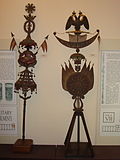
The instrument, usually 2 to 2.5 m (6 ft 7 in to 8 ft 2 in) long, consists of an upright wooden pole topped with a conical brass ornament and having crescent shaped crosspieces, also of brass. Numerous bells are attached to the crosspieces and elsewhere on the instrument. Often two horsetail plumes of different colors are suspended from one of the crescents; occasionally they are red-tipped, symbolic of the battlefield. There is no standard configuration for the instrument, and of the many preserved in museums, hardly two are alike.[7]

The instrument is held vertically and when played is either shaken up and down or twisted.[8] Sometimes there is a geared crank mechanism for rotating it.[9]

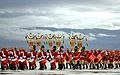
Today the instrument is prominent in the marching bands of the German Bundeswehr, the French Foreign Legion, the Russian Armed Forces, the Armed Forces of Chile, the Armed Forces of Bolivia, the Swedish Armed Forces and in Ottoman military bands. Some folk music features similar instruments based on a wooden staff with jingling attachments. A notable folk example is the Australian "lagerphone", made by nailing crown-seal bottle-caps, from beer bottles, onto a wooden broomstick handle, and used to provide a percussive beat for a folk song or bush dance.[citation needed]

During its existence, the Soviet Union produced variant forms of the instrument for military bands, with red artificial plumes and the red star finial.


Non-musical aspects

[edit]
The Turkish crescent captured by the 88th Regiment of Foot

Turkish crescents had symbolic value for the military units that used them. The 88th Regiment of Foot (Connaught Rangers) famously captured one at the Battle of Salamanca in 1812. It became an object of pride and veneration at the regiment's ceremonial parades.[10]

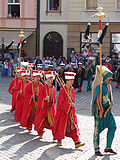
In the early 20th century, Turkish crescents were used in processions honoring important dignitaries. They were skillfully twirled by dignified performers, much as a mace or baton might be today, by drum majors.[11] This aspect survives today in the use of Turkish crescents as mostly symbolic objects in military marching bands. This can be clearly seen in the videos in the External links section at the end of this article.

History

[edit]
Replica of the Turkish crescent presented to King David Kalākaua on the occasion of his visit to Berlin

The instrument possibly has antecedents in Central Asian tengrist staffs. Similar instruments occur in ancient Chinese music, perhaps diffused from the same Central Asian (Turkic) sources.[12]

Europeans knew of it in the 16th century. In the 18th century, it was part of the Turkish Janissary bands that were the source of much interest in Europe, and in the 19th century, it was widely used in European military bands. It was abandoned by the British in the mid-19th century but survives today, in an altered form, in Germany[8] and in the Netherlands, plus in two military bands in France (the French Foreign Legion and the 1st Spahi Regiment). It is also found in the military bands of the Russian Federation, Ukraine, Belarus, Azerbaijan, Kazakhstan, Chile, Peru, Bolivia and Brazil (examples are in the Brazilian Marine Pipes, Drum and Bugle Corps and the Band of the 1st Guard Cavalry Regiment "Independence Dragoons"). Its presence in the bands of Chile, Brazil and Bolivia is due to the Prussian military influences which arrived in these countries during the late 19th to early 20th centuries.

Its heyday in Europe was from the mid-18th to mid-19th century, when it was commonly played by elaborately dressed black Africans, who made all manner of contortions while playing. Some of these gestures survive today, in the stick twirling by bass and tenor drummers. An aspect of the elaborate costumes survives in the leopard skin apron worn by bass drummers in British military bands;[13] however the use of the "Jingling Johnny" was discontinued in the British Army in 1837.[14]

Gentorag, a bell tree from Bali

In 1881, the German Emperor William I presented a Turkish crescent to King David Kalākaua on the occasion of the King's visit to Berlin during his trip around the world[15] bearing the inscription "no ka hoomanao ana ia Berlin" (to commemorate Berlin),[16] which was then used by the Royal Hawaiian Band.

In the mid-19th century this instrument was replaced in most bands by the glockenspiel, which was carried similarly but could be played musically.[7]

Argentina

[edit]

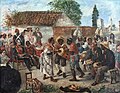
Known as the "Chinesco", the instrument was used by Afro-Argentinians in the 19th century. Descriptions of the instrument describe the masacalla, an ethnic instrument. A painting by Martin Boneo and a news clipping from 1899 show an instrument held on a long pole, with horsetails, and either a pointed top like a Chinese hat, or a crescent.

Java and Bali

[edit]

The instrument has also been known in Java under the names genta (Hindu-Javanese), klinting, byong or Kembang delima (pomegranate blossom), and in Bali as gentorag. The Javanese instruments lack the crescent or hat, but have "a central wooden spindle" with the bells suspended at different levels on crosses of wood or metal. Bells can also be suspended on wheels stacked above each other, largest on the bottom to tallest on the top. The wheel is mounted to that its rim is not up and down like a car rim, but horizontal to the ground.[17]

Use in specific musical works

[edit]

See also

[edit]

Sources

[edit]
  1. ^ a b Yarmanurl, Ozan. "ZİLLİ VE DERİ GERGİLİ ÇALGILAR" (PDF). Çağana Acem diyarında ... pehlivan ...Batı Anadoluda benimsendiği ... Avrupa bandolarına ... geçmiş olup, "Jingling Johnnie" (Çıngırdayan Coni) veya "Turkish Crescent" (Türk Hilâli) ... ve Çin Şapkası adı da verilen ... adlarıyla anılan ve Çin Şapkası ... çıngırak başlı ve süslü uzunca bir tahta ãsã olmaktadır. (translation:Çağana Instrument...from the land of Persia...adopted in Western Anatolia...passed to European bands...known as "Jingling Johnnie" (Çıngırdayan Coni) or "Turkish Crescent" (Türk Hilâli), also known as the Chinese Hat...long wooden wooden with rattle head and ornate.
  2. ^ "Mehter çalgıları" (in Turkish). Retrieved 8 December 2019.
  3. ^ "çağana". Kubbealtı Lugatı (in Turkish). Kubbealtı Lugatı Akademisi. Retrieved 8 December 2019. Türk mûsikîsinde kullanılan eski bir çalgı, çegāne (translation: An old instrument used in Turkish music, çegāne".)
  4. ^ "Chaghana". Dolmetsch Music Dictionary dolmetsch.com. Chaghana also called 'Turkish crescent', chapeau chinois or 'jingling johnnie', a ceremonial staff of ancient Central Asian origin which was adopted by the Turks ...surmounted by a crescent and a metal ornament shaped like a Chinese hat...valued by Europeans as a war trophy during periods of conflict with Turkey...
  5. ^ "Turkse schelleboom van A. Maas". Retrieved 7 December 2020.
  6. ^ "Chapeau chinois". Musical Instrument Museums Online, mimo-international.com.
  7. ^ a b Chenley, Brian (September 1961). "Jingling Johnny: a Note on the Pavillon Chinois". Berlioz Society Bulletin (36): 29–30.
  8. ^ a b c Blades, James. "Turkish crescent". Grove Music Online. Oxford University Press. Retrieved 2014-06-01. (subscription required)
  9. ^ Blades, James (1980). "Turkish crescent". In Stanley Sadie (ed.). The New Grove Dictionary of Music and Musicians. London: MacMillan.
  10. ^ McBride, Charlie (1994-10-20). "The Fighting 88th". Galway Advertiser: 32. Retrieved 2010-12-04.
  11. ^ a b Mellers, Wilfrid (13 Aug 1987). Music in a New Found Land: Themes and Developments in the History of American Music. Oxford University Press, USA. p. 260. ISBN 0-19-520526-X. Retrieved 2011-12-29. ...a special part is written for Turkish Crescent, an arrangement of bells supported on a mace which was carried processionally, to accompany Very Important Persons. The mace had to be twirled by a highly skilled, as well as dignified, performer. Sousa saw a possible connection between this Oriental tradition and the drum-major's twirled baton. Characteristically, the Americans democratized the ritual instrument; they christened it "Jingling Johnnie"!
  12. ^ "jingling Johnny". Encyclopædia Britannica Online. 2010. Retrieved 2010-12-05.
  13. ^ Blades, James (2005). Percussion Instruments and Their History. Westport, Connecticut: The Bold Strummer, Ltd. pp. 265–266, 281. ISBN 0-933224-61-3.
  14. ^ Turner, Gordon; Turner, Alwyn W (June 2012). "The Band of The Coldstream Guards". military-bands.co.uk. Droit History. Archived from the original on 7 June 2008. Retrieved 16 February 2015.
  15. ^ "Influence of Prussia", Honolulu Star-Bulletin, January 23, 2005 Archived June 20, 2006, at the Wayback Machine
  16. ^ Mary Kawena Pukui; Samuel Hoyt Elbert (2003). "lookup of manaʻo". in Hawaiian Dictionary. Ulukau, the Hawaiian Electronic Library, University of Hawaiʻi Press., Mary Kawena Pukui; Samuel Hoyt Elbert (2003). "lookup of hoʻomanaʻo". in Hawaiian Dictionary. Ulukau, the Hawaiian Electronic Library, University of Hawaiʻi Press.
  17. ^ Jaap Kunst. Music in Java, Its history, its theory and its technique, 3rd edition. Vol. 1. The Hague: Martinus Nijhoff. p. 184.
  18. ^ "TV review: QI Jingle Bells Christmas edition" by Sam Wollaston, The Guardian, 22 December 2012
  19. ^ Axworthy, Michael (2006). The Sword of Persia: Nader Shah, from Tribal Warrior to Conquering Tyrant. I.B. Tauris. p. 96. ISBN 9781850437062.
  20. ^ Berlioz, Hector (1858). Tr. Mary Cowden Clarke (ed.). A Treatise Upon Modern Instrumentation and Orchestration. London: Novello, Ewer & Co. pp. 233. Retrieved 2010-12-03.
  • Chappell, Mike. Wellington's Peninsula Regiments. Osprey Publishing, 2003.
[edit]
Revisions and contributorsEdit on WikipediaRead on Wikipedia
from Grokipedia
The Turkish crescent, also known as the jingling johnny or chapeau chinois, is a consisting of a tall wooden staff, typically 4 to 6 feet (1.2 to 1.8 meters) in height, topped with a conical ornament and featuring -shaped metal crosspieces or tiers fitted with numerous small bells and jingles that produce a characteristic rattling or jingling sound when the instrument is shaken or twisted. Originating from the Ottoman Empire's military bands in the 17th and 18th centuries, the instrument was designed as an to add rhythmic flair and exotic tone color to percussion ensembles, often played by shaking it up and down or thumping the base on the ground in time with marching music. It gained prominence in during the late 18th century amid a fascination with "Turkish" music, following diplomatic exchanges such as the gift of a full band from the Ottoman to King II of around 1720, which influenced the adoption of similar instruments in Western military traditions. By the Napoleonic era, the Turkish crescent had spread widely across European armies, including British, French, German, Russian, and even Chilean and Brazilian forces, where it was carried in parades by the tallest soldiers for visual and auditory impact, as seen in its use by the British Coldstream Guards at the Battle of Waterloo in 1815. Composers like Joseph Haydn, Wolfgang Amadeus Mozart, and Ludwig van Beethoven incorporated it into orchestral works during this period to evoke Oriental atmospheres, often grouping it with bass drums, cymbals, and triangles for collective "alla turca" effects. In the , the instrument's design evolved for more independent use, with figures like integrating it into symphonic textures for harmonic and rhythmic purposes, though its popularity waned by the mid-1800s in favor of simpler percussion. Today, the Turkish crescent survives primarily in ceremonial military bands, such as those of the , and occasionally in historical reenactments or modern marching ensembles, preserving its role as a symbol of exotic .

Physical characteristics

Design and components

The Turkish crescent, also known as the jingling johnny or Schellenbaum, features a central upright pole or staff that serves as the primary structural support, typically around 1.5 to 2 meters in height to allow for visibility and handling in settings. This pole is surmounted by a -shaped top piece, often formed as a half-moon symbolizing Ottoman influences, positioned with its points upward. Adorning the and extending downward along the pole are multiple tiers of bells and jingles, arranged in a hierarchical structure to produce varied sounds when agitated. The number of bells varies by instrument; for example, one configuration includes 16 small bells hung in a single row along the upper tier or canopy, while lower sections may incorporate additional rows such as two tiers of 14 bells each on a double or inverted form. These components may also feature dangling chains or small pellet bells (crotals) attached to spherical or conical intermediaries below the main , enhancing the instrument's ornamental profile. Optional decorative elements integrate into the design for ceremonial emphasis, including horsehair plumes or tassels suspended from the lower bells, as well as occasional flags, military insignia, or metallic stars affixed to the upper canopy. The overall width of the assembled structure reaches about 30 to 77 centimeters, depending on the extension of the tiers, creating a visually striking, tiered silhouette that distinguishes it from simpler percussion instruments.

Materials and variations

The Turkish crescent is primarily constructed from for the crescent-shaped top and the attached bells, providing and , while the central pole is typically made of iron or another metal, often with a wooden for grip. In some examples, nickel-silver is incorporated into the hammered components for added corrosion resistance and tonal quality. The wooden elements, such as the pole or , are sometimes stained or reinforced to withstand prolonged use in processions. The bells, which form a key part of the instrument's sound-producing mechanism, are untuned and consist of multiple small metal pieces—often cast or suspended in sets of four to twelve—arranged along the and intermediate structures to create a layered, shimmering effect when the instrument is shaken. These bells typically feature internal clappers or loose jingles made from the same or similar alloys, ensuring a consistent cascade of percussive tones without precise pitch control. Instruments vary significantly in size, with full-sized military versions reaching up to 2.5 meters in height to project presence in large formations, while smaller or ornamental models measure around 1 to 1.8 meters for easier handling in ceremonial contexts. The larger variants emphasize height for visual impact, often topped with symbolic finials like eagles, whereas compact versions prioritize portability without sacrificing the core jingling array. European adaptations, known as the Schellenbaum, introduce additional elements such as spheres, stars, and pendants suspended from the structure, enhancing ornamental detail while maintaining the bell framework. These modifications, seen in 19th-century German examples, include multi-tiered designs with perforated cones and hemispherical bases adorned with pellet bells, reflecting localized aesthetic preferences in military bands. Modern replicas generally retain traditional and metal construction but may incorporate lightweight alloys in the pole for improved portability in contemporary marching ensembles.

Historical development

Origins in Ottoman military music

The Turkish crescent, known in Ottoman Turkish as çevgan, emerged as a key within the mehter ensembles of the corps during the 17th and 18th centuries, integral to the Ottoman Empire's musical traditions. These mehter bands, which accompanied the elite infantry units, incorporated the crescent-shaped staff topped with bells and sometimes adorned with horsetail plumes to produce a distinctive jingling alongside and wind instruments. By the mid-17th century, traveler documented the presence of multiple musician guilds in , highlighting the organized role of such instruments in fostering a powerful auditory presence for the army. The instrument's design, evoking a —a symbol resonant with Islamic iconography—allowed it to function both as a musical tool and a visual emblem carried at the forefront of formations. The primary purpose of the Turkish crescent in these Ottoman military contexts was to generate loud, clashing sounds that intimidated adversaries on the battlefield while visually impressing allies and spectators through its elaborate, towering structure. In mehter performances, which occurred during marches, sieges, and ceremonial processions, the crescent's bells were shaken to create a continuous metallic clamor, complementing the thunderous beats of bass drums and cymbals to evoke fear and boost troop morale. European observer , during his travels in 1672–1673, described the overwhelming impact of mehter processions in , with their din of kettledrums mounted on camels shaking the ground and stirring visceral responses among onlookers. Similarly, accounts from around 1717, such as those by , noted the vibrant musical elements in Ottoman public processions that reinforced imperial authority. Sultan (r. 1789–1807), an accomplished composer and player himself, played a pivotal role in promoting wind and percussion ensembles within Ottoman musical traditions during his late-18th-century reforms, lending royal instruments like the kös kettledrum to sufı lodges and encouraging the refinement of mehter-style performances. His patronage helped elevate the status of percussion-heavy military music, aligning it with broader cultural expressions amid efforts to modernize the empire's institutions. However, the instrument's prominence waned following the of 1826, when Sultan Mahmud II decisively suppressed the Janissary corps in a violent purge, disbanding the mehter bands and leading to the dispersal of their instruments, many of which were subsequently acquired and adapted by European military ensembles. This event marked the end of the Turkish crescent's traditional Ottoman military application, shifting its legacy beyond imperial borders.

European adoption and janissary influence

The fascination with Ottoman culture, known as the "Turkish craze" or Turcomania, swept across in the , fueled by encounters with bands during conflicts like the Austro-Turkish Wars and a broader enthusiasm for exotic Eastern elements in art and music. European military musicians, intrigued by the percussive intensity of these Ottoman ensembles, began incorporating the Turkish crescent—a jingling originating from traditions—into their own formations to evoke similar dramatic effects. This adoption marked a key phase in the instrument's transmission from the Ottoman military context to Western ceremonial and band music. By the late , the Turkish crescent had become a staple in European military bands, particularly in Austrian and Prussian regiments, where it enhanced the martial pomp of parades and battles. French Revolutionary armies further embraced it after the , integrating the instrument into their reformed bands as part of broader military innovations inspired by exotic influences. Composers of the era drew on this Janissary-inspired percussion for orchestral works, with featuring "Turkish" elements like cymbals, triangle, and in his Symphony No. 100 ("," 1794) to capture the rousing quality of Ottoman bands, while 's "Turkish March" from No. 11 (K. 331, c. 1783) indirectly echoed the rhythmic vitality of such instruments through its alla turca style. As the instrument spread, Europeans adapted and renamed it for local use, dubbing it the "jingling johnny" in British bands and "Schellenbaum" in German ones, often modifying its design with additional bells or streamlined features to suit orchestral integration while retaining its core jingling mechanism. Its popularity peaked in the among British regimental bands, where it symbolized imperial grandeur during parades and colonial campaigns, remaining a fixture until its gradual decline around amid shifting musical tastes and modernization of military ensembles.

Global dissemination and regional adaptations

The Turkish crescent, known variously as the jingling johnny or Schellenbaum, spread globally through European colonial military traditions in the , particularly via British and German imperial forces. British military bands, which incorporated the instrument as part of their until the , extended this practice to colonial outposts including , where German musicians from regions like served in the and contributed to band formations. In , German colonial administrations adopted the Schellenbaum for military ensembles; for instance, in from 1903 to 1909, composer Willy Höhne trained indigenous musicians to play it, with the band performing across regions such as and . These transmissions around the mid-19th century adapted the instrument to local contexts, often retaining its role in enhancing rhythmic drive during marches and ceremonies. In , the instrument arrived through European influences, notably German military musicians who shaped band traditions during visits and residencies. In , figures like Max Kühne introduced Western percussion elements, including jingle-based instruments akin to the Turkish crescent, to indigenous Andean ensembles around 1910, evolving its use in festive and military settings that later influenced music. Similarly, Spanish and colonial legacies facilitated its integration into regional bands, where it transformed into lighter, portable variants for processions and celebrations. Asian adaptations emerged post-colonial encounters, particularly in Indonesia during the Dutch era, where the instrument influenced gamelan percussion. Referred to as a gentorag or bell tree—a rod with small bronze bells in concentric circles—it appears in archaic Javanese gamelan kodhok ngorek and Balinese pelegongan ensembles, providing rhythmic accents that blend with metallophones and gongs. This localization post-Dutch colonial period (late 19th to early 20th century) reflects a fusion of European military imports with indigenous traditions. In the , revivals sustained the Turkish crescent in diverse settings, including Scandinavian folk bands and American circus parades. While specific Scandinavian uses remain niche, its jangling suited revived folk processions emphasizing rhythmic vitality. In the United States, it featured prominently in circus bands and parades, as evoked in John Philip Sousa's "Nobles of the Mystic Shrine" (1923), where the instrument's bells simulate a marching pole hung with jingles alongside tambourines and triangles. Today, the Turkish crescent is preserved in museum collections worldwide, such as the Hartenberger World Musical Instrument Collection at and the Musical Instrument Museums Online network, with occasional appearances in percussion festivals and historical reenactments.

Musical applications

Playing techniques

The Turkish crescent is primarily played by holding the staff vertically in one hand at its base and shaking or twisting it vigorously to cause the attached bells and jingles to clash and produce a shimmering, metallic sound. This motion activates the instrument's tiers of bells, creating layered tones that vary in intensity based on the vigor of the shake. The grip is typically one-handed, allowing for a range of motions from quick wrist twists to broader arm swings, which control the rhythmic emphasis and volume of the jingles. Players often position themselves at the front of marching formations to maximize the instrument's visual and auditory impact, as it was traditionally carried ahead of bands. Prolonged performance demands physical stamina due to the sustained shaking required during extended marches.

Role in ensembles and bands

The Turkish crescent, also known as the jingling johnny or Schellenbaum, has historically served as a key in bands, providing rhythmic drive through its jingling bells while contributing visual spectacle as an ornate staff carried by the band leader alongside drums and brass sections. Originating in Ottoman ensembles, it was adopted into European bands by the early , where its shaking motion synchronized with bass drums and cymbals to maintain marching and enhance the warlike character of processional music. In modern contexts, particularly in German bands such as the Heeresmusikkorps Hannover, it continues to be used in parades for its ceremonial presence and rhythmic punctuation. In concert orchestras and ensembles, the Turkish crescent adds exotic timbral color during the late 18th and 19th centuries, often integrated into the to evoke Oriental or military effects in symphonic works. Composers incorporated it or its emulations to heighten dramatic accents, positioning it separately from core percussion like kettledrums to preserve ensemble balance against and strings. Contemporary bands occasionally revive it for period-authentic , where it functions as part of a homogeneous Turkish percussion group including and , ensuring it supports rather than dominates the overall texture. Within folk and settings, the instrument enhances processional in marching formations, delivering a sustained shimmer from its cascading bells to accompany traditional dances and communal events. Its role here emphasizes rhythmic fills and visual flair in outdoor ensembles, typically played by rotating the staff in coordination with other percussion to avoid overpowering and woodwinds. The Turkish crescent's primary timbral contribution is a bright, metallic jingling sound produced by its bells and plates, ideal for accents and textural fills rather than melodic lines, which integrates seamlessly into larger ensembles without requiring amplification even in expansive venues. This shimmering quality, achieved through basic shaking techniques, complements and cymbals while maintaining dynamic equilibrium in group settings.

Notable compositions and performances

The Turkish crescent has appeared in several seminal classical works, often to evoke the exotic timbres of Janissary bands within European orchestral and band settings. The Turkish crescent has been used in performances of Joseph Haydn's Symphony No. 100 in G major ("Military"), composed in 1794, to enhance the alla turca percussion effects in the second movement's allegretto and the finale, contributing to the symphony's martial character. Hector Berlioz prominently featured the instrument in his Grande symphonie funèbre et triomphale (1840), a large-scale work for wind band composed for a Parisian civic procession, using it alongside cymbals and bass drum to underscore the triumphant march sections. In the early , American composer integrated the Turkish crescent into his march "Nobles of the Mystic Shrine" (1923), drawing on its jingling quality to amplify the piece's pseudo-Oriental motifs and celebrate his affiliation with the fraternal order. The Sousa Band's Victor recording of the march from March 29, 1923, one of the earliest preserved examples on shellac disc, highlights the instrument's role in live band performances of the era, capturing its distinctive rattle amid brass and percussion. Contemporary ensembles have revived the Turkish crescent in performances of these and similar works, particularly within bands. The United States Marine Band, known as "The President's Own," routinely incorporates it in Sousa marches like "Nobles of the Mystic Shrine" during events such as their Sousa Season Opener concerts, maintaining its place in ceremonial band traditions.

Cultural and ceremonial roles

Non-musical symbolism

In the Ottoman military context, the Turkish crescent, known as çevgan in Turkish, embodied the Islamic moon emblem, symbolizing divine authority and imperial power. This shape, drawn from the hilal or new moon, represented and the sultan's role as caliph, integrating the instrument into mehter ensembles as a marker of the empire's martial and spiritual dominance. Upon its adoption in during the 18th and 19th centuries, the Turkish crescent became a potent of and , evoking romanticized visions of the "mysterious East" in Western cultural imagination. It aligned with broader Orientalist tropes in depictions of Ottoman culture. Heraldically, the instrument served as a battle standard in Ottoman and later European military traditions, carried in processions to denote martial heritage. British and French regiments, influenced by bands, used it as a sign of disciplined valor tied to Eastern military pageantry. The Turkish crescent's elevated design and dynamic motion were engineered for psychological effect, instilling awe and fear in adversaries much like ancient standards, with its jingling bells and towering presence amplifying the mehter band's intimidating aura on the . In and travelogues of the 17th and 19th centuries, the instrument appeared as an icon of Eastern splendor, depicting Ottoman processions as embodiments of opulent imperial .

Modern ceremonial and decorative uses

In contemporary settings, the Turkish continues to appear in military parades and historical reenactments, serving as a ceremonial of rather than a functional instrument. For instance, the Music Corps (Heeresmusikkorps) incorporates the Schellenbaum—a European variant of the Turkish —into modern ceremonial marches, as seen in a 2023 parade in Hannover where it was carried as a jingling standard to evoke historical military pomp. Similarly, Ottoman-style Mehter bands, which feature the Turkish , perform at public festivals and reenactments worldwide, including a 2015 Turkish-American parade in that recreated imperial processions. In and regions influenced by Ottoman heritage, Mehter ensembles hold ceremonial significance in non-military events such as weddings, circumcisions, and state processions, symbolizing cultural continuity and national pride. These performances often occur at official openings and public celebrations, blending historical reverence with modern festivity. Replicas of the Turkish crescent are produced and sold primarily for decorative and collectible purposes, appearing in antique markets and as non-functional ornaments in private collections or heritage sites. High-quality brass reproductions, such as those modeled after imperial German designs, are available through specialized militaria vendors and command premium prices due to their intricate craftsmanship and historical allure. Restorations of original pieces are common for cultural preservation, with examples featured in auctions and exhibitions that highlight their ornamental value beyond musical utility. Educational institutions and museums utilize the Turkish crescent in static displays to illustrate and Ottoman influences, often without active playing to focus on its visual and symbolic elements. The Smithsonian National Museum of American History houses a 19th-century example as part of its collection on music traditions, providing context on its adoption in Western armies. Likewise, the in exhibits a Turkish crescent within a broader array of 16th- to 19th-century instruments, aiding public understanding of European musical exoticism. Such displays are integrated into school outreach programs and museum tours to demonstrate the instrument's role in historical pageantry.

References

Add your contribution
Related Hubs
User Avatar
No comments yet.