



Community hub
Recent from talks
Contribute something
Nothing was collected or created yet.
Low-power electronics
View on Wikipedia
Low-power electronics are electronics designed to consume less electrical power than usual, often at some expense. For example, notebook processors usually consume less power than their desktop counterparts, at the expense of computer performance.[1]
History
[edit]Watches
[edit]The earliest attempts to reduce the amount of power required by an electronic device were related to the development of the wristwatch. Electronic watches require electricity as a power source, and some mechanical movements and hybrid electromechanical movements also require electricity. Usually, the electricity is provided by a replaceable battery. The first use of electrical power in watches was as a substitute for the mainspring, to remove the need for winding. The first electrically powered watch, the Hamilton Electric 500, was released in 1957 by the Hamilton Watch Company of Lancaster, Pennsylvania.
The first quartz wristwatches were manufactured in 1967, using analog hands to display the time.[2]
Watch batteries (strictly speaking cells, as a battery is composed of multiple cells) are specially designed for their purpose. They are very small and provide tiny amounts of power continuously for very long periods (several years or more). In some cases, replacing the battery requires a trip to a watch repair shop or watch dealer. Rechargeable batteries are used in some solar-powered watches.
The first digital electronic watch was a Pulsar LED prototype produced in 1970.[3] Digital LED watches were very expensive and out of reach to the common consumer until 1975, when Texas Instruments started to mass-produce LED watches inside a plastic case.
Most watches with LED displays required that the user press a button to see the time displayed for a few seconds because LEDs used so much power that they could not be kept operating continuously. Watches with LED displays were popular for a few years, but soon the LED displays were superseded by liquid crystal displays (LCDs), which used less battery power and were much more convenient in use, with the display always visible and no need to push a button before seeing the time. Only in darkness, you had to press a button to light the display with a tiny light bulb, later illuminating LEDs.[4]
Most electronic watches today use 32.768 KHz quartz oscillators.[2]
As of 2013, processors specifically designed for wristwatches are the lowest-power processors manufactured today—often 4-bit, 32.768 kHz processors.
Mobile computing
[edit]When personal computers were first developed, power consumption was not an issue. With the development of portable computers however, the requirement to run a computer off a battery pack necessitated the search for a compromise between computing power and power consumption. Originally most processors ran both the core and I/O circuits at 5 volts, as in the Intel 8088 used by the first Compaq Portable. It was later reduced to 3.5, 3.3, and 2.5 volts to lower power consumption. For example, the Pentium P5 core voltage decreased from 5V in 1993, to 2.5V in 1997.
With lower voltage comes lower overall power consumption, making a system less expensive to run on any existing battery technology and able to function for longer. This is crucially important for portable or mobile systems. The emphasis on battery operation has driven many of the advances in lowering processor voltage because this has a significant effect on battery life. The second major benefit is that with less voltage and therefore less power consumption, there will be less heat produced. Processors that run cooler can be packed into systems more tightly and will last longer. The third major benefit is that a processor running cooler on less power can be made to run faster. Lowering the voltage has been one of the key factors in allowing the clock rate of processors to go higher and higher. [5]
Electronics
[edit]Computing elements
[edit]The density and speed of integrated-circuit computing elements has increased exponentially for several decades, following a trend described by Moore's Law. While it is generally accepted that this exponential improvement trend will end, it is unclear exactly how dense and fast integrated circuits will get by the time this point is reached. Working devices have been demonstrated which were fabricated with a MOSFET transistor channel length of 6.3 nanometres using conventional semiconductor materials, and devices have been built that use carbon nanotubes as MOSFET gates, giving a channel length of approximately one nanometre. The density and computing power of integrated circuits are limited primarily by power-dissipation concerns.
The overall power consumption of a new personal computer has been increasing at about 22% growth per year.[6] This increase in consumption comes even though the energy consumed by a single CMOS logic gate in order to change its state has fallen exponentially in accordance with Moore's law, by virtue of shrinkage.[6]
An integrated-circuit chip contains many capacitive loads, formed both intentionally (as with gate-to-channel capacitance) and unintentionally (between conductors which are near each other but not electrically connected). Changing the state of the circuit causes a change in the voltage across these parasitic capacitances, which involves a change in the amount of stored energy. As the capacitive loads are charged and discharged through resistive devices, an amount of energy comparable to that stored in the capacitor is dissipated as heat:
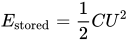
The effect of heat dissipation on state change is to limit the amount of computation that may be performed within a given power budget. While device shrinkage can reduce some parasitic capacitances, the number of devices on an integrated circuit chip has increased more than enough to compensate for reduced capacitance in each individual device. Some circuits – dynamic logic, for example – require a minimum clock rate in order to function properly, wasting "dynamic power" even when they do not perform useful computations. Other circuits – most prominently, the RCA 1802, but also several later chips such as the WDC 65C02, the Intel 80C85, the Freescale 68HC11 and some other CMOS chips – use "fully static logic" that has no minimum clock rate, but can "stop the clock" and hold their state indefinitely. When the clock is stopped, such circuits use no dynamic power but they still have a small, static power consumption caused by leakage current.
As circuit dimensions shrink, subthreshold leakage current becomes more prominent. This leakage current results in power consumption, even when no switching is taking place (static power consumption). In modern chips, this current generally accounts for half the power consumed by the IC.
Reducing power loss
[edit]Loss from subthreshold leakage can be reduced by raising the threshold voltage and lowering the supply voltage. Both these changes slow down the circuit significantly. To address this issue, some modern low-power circuits use dual supply voltages to improve speed on critical paths of the circuit and lower power consumption on non-critical paths. Some circuits even use different transistors (with different threshold voltages) in different parts of the circuit, in an attempt to further reduce power consumption without significant performance loss.
Another method that is used to reduce power consumption is power gating:[7] the use of sleep transistors to disable entire blocks when not in use. Systems that are dormant for long periods of time and "wake up" to perform a periodic activity are often in an isolated location monitoring an activity. These systems are generally battery- or solar-powered and hence, reducing power consumption is a key design issue for these systems. By shutting down a functional but leaky block until it is used, leakage current can be reduced significantly. For some embedded systems that only function for short periods at a time, this can dramatically reduce power consumption.
Two other approaches also exist to lower the power overhead of state changes. One is to reduce the operating voltage of the circuit, as in a dual-voltage CPU, or to reduce the voltage change involved in a state change (making a state change only, changing node voltage by a fraction of the supply voltage—low voltage differential signaling, for example). This approach is limited by thermal noise within the circuit. There is a characteristic voltage (proportional to the device temperature and to the Boltzmann constant), which the state switching voltage must exceed in order for the circuit to be resistant to noise. This is typically on the order of 50–100 mV, for devices rated to 100 degrees Celsius external temperature (about 4 kT, where T is the device's internal temperature in Kelvins and k is the Boltzmann constant).
The second approach is to attempt to provide charge to the capacitive loads through paths that are not primarily resistive. This is the principle behind adiabatic circuits. The charge is supplied either from a variable-voltage inductive power supply or by other elements in a reversible-logic circuit. In both cases, the charge transfer must be primarily regulated by the non-resistive load. As a practical rule of thumb, this means the change rate of a signal must be slower than that dictated by the RC time constant of the circuit being driven. In other words, the price of reduced power consumption per unit computation is a reduced absolute speed of computation. In practice, although adiabatic circuits have been built, it has been difficult for them to reduce computation power substantially in practical circuits.
Finally, there are several techniques for reducing the number of state changes associated with a given computation. For clocked-logic circuits, the clock gating technique is used, to avoid changing the state of functional blocks that are not required for a given operation. As a more extreme alternative, the asynchronous logic approach implements circuits in such a way that a specific externally supplied clock is not required. While both of these techniques are used to different extents in integrated circuit design, the limit of practical applicability for each appears to have been reached.[citation needed]
Wireless communication elements
[edit]There are a variety of techniques for reducing the amount of battery power required for a desired wireless communication goodput.[8] Some wireless mesh networks use "smart" low power broadcasting techniques that reduce the battery power required to transmit. This can be achieved by using power aware protocols and joint power control systems.
Costs
[edit]In 2007, about 10% of the average IT budget was spent on energy, and energy costs for IT were expected to rise to 50% by 2010.[9]
The weight and cost of power supply and cooling systems generally depends on the maximum possible power that could be used at any one time. There are two ways to prevent a system from being permanently damaged by excessive heat. Most desktop computers design power and cooling systems around the worst-case CPU power dissipation at the maximum frequency, maximum workload, and worst-case environment. To reduce weight and cost, many laptop computers choose to use a much lighter, lower-cost cooling system designed around a much lower Thermal Design Power, that is somewhat above expected maximum frequency, typical workload, and typical environment. Typically such systems reduce (throttle) the clock rate when the CPU die temperature gets too hot, reducing the power dissipated to a level that the cooling system can handle.
Examples
[edit]See also
[edit]References
[edit]- ^ "Intel Processor Letter Meanings [Simple Guide]". 2020-04-20.
- ^ a b Eric A. Vittoz. "The Electronic Watch and Low-Power Circuits". 2008.
- ^ "All in Good Time: HILCO EC director donates prototype of world's first working digital watch to Smithsonian". Texas Co-op Power. Feb 2012. Retrieved 2012-07-21.
- ^ U.S. patent 4,096,550: W. Boller, M. Donati, J. Fingerle, P. Wild, Illuminating Arrangement for a Field-Effect Liquid-Crystal Display as well as Fabrication and Application of the Illuminating Arrangement, filed 15 October 1976.
- ^ Microprocessor Types and Specifications, by Scott Mueller and Mark Edward Soper, 2001
- ^ a b Paul DeMone. "The Incredible Shrinking CPU: Peril of Proliferating Power". 2004. [1]
- ^ K. Roy, et al., "Leakage current mechanisms and leakage reduction techniques in deep-submicrometer CMOS circuits", Proceedings of the IEEE, 2003. [2]
- ^ "How to use optional wireless power-save protocols to dramatically reduce power consumption" by Bill McFarland 2008.
- ^
King, Rachael (2007-05-14). "Averting the IT Energy Crunch". Businessweek. Archived from the original on 2013-01-05.
Energy costs, now about 10% of the average IT budget, could rise to 50% ... by 2010.
Further reading
[edit]- Gaudet, Vincent C. (2014-04-01) [2013-09-25]. "Chapter 4.1. Low-Power Design Techniques for State-of-the-Art CMOS Technologies". In Steinbach, Bernd [in German] (ed.). Recent Progress in the Boolean Domain (1 ed.). Newcastle upon Tyne, UK: Cambridge Scholars Publishing. pp. 187–212. ISBN 978-1-4438-5638-6. Retrieved 2019-08-04. [3] (455 pages)
External links
[edit]- "High-level design synthesis of a low power, VLIW processor for the IS-54 VSELP Speech Encoder" by Russell Henning and Chaitali Chakrabarti (NB. Implies that, in general, if the algorithm to run is known, hardware designed to specifically run that algorithm will use less power than general-purpose hardware running that algorithm at the same speed.)
- CRISP: A Scalable VLIW Processor for Low Power Multimedia Systems by Francisco Barat 2005
- A Loop Accelerator for Low Power Embedded VLIW Processors by Binu Mathew and Al Davis
- Ultra-Low Power Design by Jack Ganssle
- K. Roy and S. Prasad, Low-Power CMOS VLSI Circuit Design, John Wiley & Sons, Inc., ISBN 0-471-11488-X, 2000, 359 pages.
- K-S. Yeo and K. Roy, Low-Voltage Low-Power VLSI Subsystems, McGraw-Hill 2004, ISBN 0-07-143786-X, 294 pages.
Low-power electronics
View on GrokipediaIntroduction
Definition and Scope
Low-power electronics encompasses the engineering of circuits and systems to achieve significantly reduced electrical power consumption relative to traditional designs, with a primary focus on enabling prolonged operation in battery-limited or energy-harvesting environments. This field emphasizes optimization at the component, circuit, and system levels to balance performance, area, and reliability while minimizing energy use, often through architectural choices that prioritize efficiency over raw speed or capacity.[1] The scope of low-power electronics includes digital circuits such as CMOS-based logic and memory, analog components like amplifiers and sensors, and mixed-signal systems that integrate both for applications in portable devices, IoT nodes, and wearable technology. It deliberately excludes high-power domains, such as power conversion and distribution systems (e.g., inverters and converters in power electronics), which prioritize energy handling over minimization. Key performance metrics within this scope include power density, measured in watts per square centimeter (W/cm²) to assess efficiency in compact layouts, and energy per operation, typically quantified in picojoules per operation (pJ/op) to evaluate computational efficiency.[7][1][7] Key early developments include the introduction of CMOS technology in 1963, enabling low-power digital circuits. The field gained prominence in the 1970s with the proliferation of battery-powered consumer devices, such as CMOS-based calculators that reduced power needs through low-voltage operation and standby modes. It has been advanced through IEEE standards, notably IEEE Std 1801 (Unified Power Format, approved in 2009 and updated to 1801-2024 as of 2024), which provides a framework for specifying and verifying low-power intent in VLSI designs, and the inaugural International Symposium on Low Power Electronics and Design (ISLPED) in 1994.[8][3][9] Power targets in low-power electronics generally range from microwatts to milliwatts, supporting applications where average consumption must remain below 1 mW to enable multi-year battery life or harvesting from ambient sources.Importance and Motivations
Low-power electronics address critical motivations in modern device design, primarily by prolonging battery life in mobile devices such as smartphones and tablets, enabling extended usage without frequent recharging and supporting the growing demand for portable computing.[10] This approach also reduces the need for complex thermal management systems, as lower power dissipation generates less heat, simplifying cooling requirements and enhancing overall device reliability in constrained environments.[11] In large-scale deployments like data centers and sensor networks, these techniques lower operational costs by minimizing electricity consumption, which constitutes a significant portion of expenses in high-density computing infrastructures.[12] Additionally, low-power strategies support broader environmental objectives by curbing the carbon footprint of energy-intensive operations, with efficiency gains in data centers helping to offset a projected doubling of global electricity demand from this sector by 2026 (as reported by IEA in 2024).[13] The benefits of low-power electronics extend to enabling always-on sensors in Internet of Things (IoT) applications, where minimal energy use allows continuous environmental or asset monitoring without battery replacement, fostering scalable smart systems.[14] In wireless networks, these designs optimize power allocation to extend communication range, as seen in protocols like Wi-Fi HaLow that leverage lower frequencies for propagation over several kilometers while maintaining low consumption.[15] They further facilitate compact wearable health monitors, supporting uninterrupted tracking of vital signs like heart rate and activity levels in devices that prioritize user comfort and long-term wearability.[16] Quantitatively, such innovations hold potential for substantial energy savings, with the average appliance expected to consume 25% less energy by 2030 relative to 2020 levels through improved efficiency standards (in the IEA Net Zero Scenario).[17] On a societal level, low-power electronics align with the United Nations Sustainable Development Goal 7, which targets universal access to affordable, reliable, and sustainable energy by 2030, including doubling the global rate of energy efficiency improvements from 1990-2010 baselines to mitigate climate impacts.[18] Economically, they provide incentives for edge computing deployments, where reduced data transmission to central clouds lowers electricity bills by up to 80% in AI-driven scenarios compared to traditional cloud processing.[19]Historical Development
Early Innovations
The invention of the transistor in 1947 at Bell Laboratories marked a pivotal advancement in low-power electronics, replacing power-hungry vacuum tubes with compact semiconductor devices capable of amplification and switching at significantly reduced energy levels.[20] Developed by John Bardeen, Walter Brattain, and William Shockley, the point-contact transistor demonstrated reliable signal amplification using far less power than vacuum tubes, which consumed watts of electricity and generated substantial heat due to filament requirements.[21] This breakthrough enabled the miniaturization of electronic circuits and laid the foundation for battery-powered applications, as transistors drew minimal quiescent current—often in the milliwatt range—while maintaining functionality. In the 1960s, the shift from bipolar junction transistors to metal-oxide-semiconductor (MOS) technologies further reduced static power dissipation, as MOS devices exhibited no continuous current flow in the off state, unlike bipolar transistors that required base current for operation.[22] Complementary MOS (CMOS), invented in 1963 by Frank Wanlass at Fairchild Semiconductor, amplified this advantage by pairing n-type and p-type transistors to minimize power during logic transitions, consuming power primarily during switching events.[23] These innovations enabled the development of integrated circuits with microwatt-level operation, critical for portable devices constrained by battery life. A landmark application emerged in the late 1960s with quartz wristwatches, which demanded ultra-low power for continuous operation from small batteries. Seiko's 1969 Astron 35SQ, the world's first commercial quartz wristwatch, utilized a hybrid integrated circuit with discrete components optimized for low power, extending battery life beyond one year.[24] This design, incorporating a quartz crystal oscillator and stepping motor, demonstrated how early MOS-inspired techniques could support precise timing in wearable electronics without frequent recharging. The early 1970s saw the advent of low-power integrated circuits that integrated these principles into programmable devices. Intel's 4004, released in 1971 as the first single-chip microprocessor, operated on a PMOS process with a power consumption of about 500 milliwatts at 15 volts, a substantial reduction compared to discrete bipolar equivalents and a stepping stone for further scaling in density and efficiency.[25] Built for the Busicom calculator, the 4004's 2,300 transistors handled 4-bit arithmetic at 740 kHz, paving the way for MOS-based systems that prioritized power efficiency over speed for handheld applications.[26] Handheld calculators exemplified these advancements, leveraging 4-bit processors to deliver computational power under 100 milliwatts total draw. Texas Instruments' 1972 Datamath (TI-2500), powered by the TMS0100 custom MOS chip, ran on a 6-volt NiCd battery pack and featured low standby power, enabling hours of use per charge while performing basic arithmetic with an LED display.[27] This device's integration of logic, memory, and display drivers in a single package highlighted the practical impact of MOS scaling on consumer portability. Government funding accelerated these developments, particularly through the Defense Advanced Research Projects Agency (DARPA). In the late 1970s, DARPA's VLSI program invested in high-density chip design methodologies, supporting research that enhanced low-power architectures for military communications, including compact radios for field use.[28] These efforts, emphasizing automated design tools and process improvements, directly contributed to VLSI chips suitable for battery-constrained portable systems in defense applications.[29]Evolution in Computing and Communication
The push for low-power electronics in computing gained momentum in the 1980s as battery-powered portable laptops emerged, constrained by limited energy density in nickel-cadmium batteries. These devices, such as early models from IBM, highlighted the need for efficient power management to achieve practical runtime, influencing subsequent innovations in voltage and frequency control. The 1992 launch of the IBM ThinkPad 700 series introduced sophisticated power-saving features, including automatic sleep modes and processor throttling, which extended battery life to approximately 4 hours under typical loads, setting a benchmark for mobile computing efficiency. This era's constraints directly spurred the development of dynamic voltage scaling (DVS), a technique that dynamically reduces supply voltage and clock frequency during low-demand periods to minimize dynamic power dissipation, first commercialized in systems like Intel's SpeedStep technology in the late 1990s.[30][31] In the 1990s, low-power design extended to mobile communication with the adoption of ARM-based processors in cell phones, optimized for sub-1W operation to support extended voice calls on rudimentary batteries. The Nokia 6110, released in 1997, marked a milestone as the first GSM phone to integrate an ARM processor—the Texas Instruments ARM7TDMI—running at 13 MHz with power consumption below 1W, enabling up to 3 hours of talk time while incorporating features like SMS and games.[32][33] ARM's reduced instruction set computing (RISC) architecture prioritized energy efficiency over raw speed, becoming ubiquitous in handsets and influencing the shift from power-hungry x86 alternatives. By the 2000s, smartphones advanced this integration through sub-1V CMOS processes, as seen in the original iPhone's 2007 Samsung S5L8900 SoC at 90 nm, which achieved average system power around 500 mW during mixed use, supporting 8 hours of talk time on a 5.18 Wh battery.[34] Parallel advances in wireless communication emphasized low-power RF transceivers to complement computing efficiency. The Bluetooth 1.0 specification, finalized in 1999, defined short-range RF protocols with transmit power levels of 1 mW (Class 3), 2.5 mW (Class 2), and up to 100 mW (Class 1), allowing battery-operated devices to maintain connections without excessive drain—typically under 10 mW average for data transfer. Wi-Fi standards evolved similarly, with IEEE 802.11 power-save modes introduced in the early 2000s reducing transceiver duty cycles and idle consumption to below 100 mW through techniques like beacon listening and traffic indication maps. In the 2010s, 5G networks incorporated massive multiple-input multiple-output (MIMO) systems, where base stations with dozens of antennas serve multiple users concurrently, improving energy efficiency by up to 10 times per bit compared to 4G, as beamforming concentrates power toward devices rather than broadcasting broadly.[35][36] Industry-wide shifts adapted Moore's Law to prioritize power amid the 2006 breakdown of Dennard scaling, where transistor miniaturization no longer proportionally reduced voltage, causing power density to rise and stalling single-core clock speeds. This prompted a focus on multi-core low-power architectures to parallelize workloads while capping thermal limits, exemplified by Apple's A-series chips. The A5, introduced in 2011 for the iPhone 4S, was the first dual-core implementation in the lineup, combining ARM Cortex-A9 cores at 800 MHz with sub-1W envelope to deliver 2x graphics performance over its predecessor at similar battery draw, influencing heterogeneous big.LITTLE designs in mobile SoCs.[37][38]Fundamental Principles
Power Consumption Models
In low-power electronics, power consumption is primarily modeled through dynamic and static components, which together determine the overall energy efficiency of CMOS-based circuits. Dynamic power arises from the charging and discharging of capacitances during logic transitions, representing the energy expended when transistors switch states. This is the dominant form of power dissipation in traditional CMOS designs operating at higher frequencies.[39] The dynamic power dissipation in a CMOS circuit is given by the formula where is the activity factor (the fraction of cycles in which a node switches), is the load capacitance, is the supply voltage, and is the clock frequency. This equation captures the switching losses, as energy is drawn from the supply to charge the capacitive load to during a low-to-high transition, with half of that energy stored in the capacitor and the other half dissipated as heat during discharge. In CMOS inverters and gates, these losses occur primarily during the brief periods when both NMOS and PMOS transistors conduct, but the quadratic dependence on voltage makes supply scaling a key lever for reduction.[40] Static power, in contrast, represents the unavoidable dissipation even when the circuit is idle, stemming from leakage currents through off-state transistors. The static power is modeled as where is the total leakage current and is the supply voltage. In modern scaled CMOS technologies, subthreshold leakage dominates, occurring when the gate-source voltage is below the threshold but a weak inversion channel still allows current to flow from drain to source due to thermal energy. This component increases exponentially with decreasing threshold voltage, a trade-off necessitated by performance demands.[41] The temperature dependence of static power is significant, with subthreshold leakage current approximately doubling for every 10°C rise in operating temperature, driven by the increased thermal voltage and reduced threshold voltage at higher temperatures. This effect can lead to thermal runaway in densely packed chips if not managed. Gate oxide leakage, another static contributor from quantum tunneling through thin insulators, exhibits weaker temperature sensitivity but becomes prominent below 100 nm nodes.[42] The total power consumption is the sum of these components: For energy analysis in bursty workloads common to low-power devices, such as intermittent IoT sensing, the relevant metric is energy , integrating power over time to account for varying activity and idle periods. Typical static power values in 65 nm CMOS nodes range from 10-100 µW per logic block, depending on transistor width and threshold flavor, with subthreshold leakage contributing around 100 nA/µm at a 0.3 V threshold and 1 V supply. These models guide architects in balancing performance and efficiency across process generations.[43]Key Design Techniques
One of the primary strategies for minimizing dynamic power consumption in CMOS circuits involves voltage and frequency scaling, particularly through dynamic voltage-frequency scaling (DVFS). DVFS dynamically adjusts the supply voltage (V) and clock frequency (f) based on workload demands, exploiting the quadratic dependence of dynamic power (P_dynamic = α C V² f) on voltage, where α is the activity factor and C is capacitance. By halving the supply voltage while proportionally scaling frequency, DVFS can reduce dynamic power by approximately 87% due to the V² f dependence, enabling significant energy savings in processors without proportional performance loss. This technique was pioneered in early low-power microprocessor designs, demonstrating practical implementation in 0.5 μm CMOS processes with voltage ranges from 2 V to 0.9 V. Complementary to DVFS, clock gating selectively disables the clock signal to inactive circuit blocks, effectively lowering the switching activity factor α and preventing unnecessary dynamic power dissipation from clock distribution networks, which can account for 30-50% of total power in synchronous designs. Leakage power, which dominates in standby modes and scales exponentially with decreasing transistor sizes, is addressed through several circuit-level techniques. Power gating, also known as multi-threshold CMOS (MTCMOS), inserts high-threshold voltage (high-Vt) sleep transistors between the power supply and logic blocks to isolate and shut off unused sections, drastically reducing subthreshold leakage while maintaining data retention in active paths. This approach, introduced in high-speed low-Vt LSIs, achieves standby leakage reductions of over 99% with minimal active-mode overhead in 0.3 μm CMOS. Multi-threshold CMOS extends this by assigning high-Vt transistors to non-critical paths for low-leakage operation and low-Vt transistors to speed-critical paths, balancing performance and power without additional area penalties. Body biasing further mitigates leakage by applying forward or reverse bias to the transistor substrate: reverse body biasing increases the effective threshold voltage to suppress subthreshold leakage, while forward biasing reduces it for performance boosts, with adaptive schemes enabling up to 60% leakage reduction in 0.13 μm CMOS under varying temperatures. At the architectural level, asynchronous logic eliminates the global clock, avoiding clock distribution power (up to 40% of total in synchronous systems) and enabling fine-grained local timing based on data arrival, which reduces average switching activity and supports irregular workloads with lower energy per operation. Near-threshold computing operates supply voltages near the transistor threshold (around 0.4 V in modern nodes), minimizing energy per computation by balancing dynamic and leakage components, though it trades off performance; this paradigm has been shown to achieve 10x energy efficiency gains over super-threshold operation in 45 nm CMOS processors. Adiabatic switching principles recover charge from load capacitances using slowly ramped power-clock signals, approaching near-zero dynamic power loss in theory by avoiding resistive dissipation, with practical CMOS implementations in 2-phase adiabatic static logic demonstrating 70-90% energy savings compared to conventional CMOS for data-path circuits.Low-Power Components
Digital Computing Elements
Digital computing elements form the backbone of low-power electronics in processors, memories, and logic gates, where optimizations target reduced dynamic and static power while maintaining functionality for embedded and edge applications. In processors, low-power central processing units (CPUs) such as the ARM Cortex-M series achieve sub-1 mW/MHz operation through efficient architectures optimized for microcontrollers.[44] For instance, the Cortex-M0+ core delivers dynamic power consumption of approximately 9.4 µW/MHz in a minimum configuration at 1.2 V supply.[45] Similarly, RISC-V cores emphasize configurability for energy efficiency, with designs like the HAMSA-DI dual-issue core targeting embedded systems through in-order execution and small footprint, yielding up to 25% better energy efficiency in floating-point workloads compared to scalar baselines.[46] A key technique in heterogeneous processors is big.LITTLE architecture, which pairs high-performance "big" cores (e.g., Cortex-A series) with energy-efficient "LITTLE" cores (e.g., Cortex-A series variants), allowing task migration to minimize power; this can save up to 75% CPU energy in low-to-moderate workloads by utilizing LITTLE cores for idle or light tasks.[47] Dynamic voltage and frequency scaling (DVFS) can further enhance these savings by adjusting operating points based on load. Static random-access memory (SRAM) cells are critical for on-chip caches, where low-leakage designs reduce standby power in always-on systems. Conventional 6T SRAM cells suffer from subthreshold leakage in deep-submicron processes, but 8T variants decouple read and write paths using separate access transistors, cutting total leakage by up to 50% in hold mode at low temperatures while improving read stability.[48] Emerging spin-transfer torque magnetic random-access memory (STT-MRAM) offers non-volatility, eliminating refresh overhead and leakage in standby; write energies below 1 pJ/bit enable fast switching (1-5 ns) with endurance exceeding 10^12 cycles, making it suitable for last-level caches in power-constrained processors.[49] For dynamic random-access memory (DRAM), which dominates off-chip storage, refresh reduction techniques exploit row retention time variations; retention-aware intelligent DRAM refresh (RAIDR) profiles weak rows to skip unnecessary refreshes, achieving 74.6% refresh power savings in 32 GB systems without error correction overhead.[50] At the logic gate level, transistor scaling drives low-power digital circuits, with FinFETs replacing planar MOSFETs at 14 nm nodes to suppress leakage. FinFETs' tri-gate structure enhances channel control, significantly mitigating short-channel effects and reducing off-state currents compared to planar devices at equivalent performance.[51] More recent advancements include gate-all-around (GAA) field-effect transistors, which provide superior electrostatic control over the channel, further reducing leakage currents in sub-3 nm nodes for ultra-low-power applications as of 2025. This enables denser integration in application-specific integrated circuits (ASICs) for edge AI, where custom designs like neuromorphic processors operate under 10 mW total power.Analog and Wireless Elements
In low-power electronics, analog circuits play a critical role in signal conditioning and conversion, where switched-capacitor techniques enable efficient operation by discretizing continuous signals using charge transfer on capacitors, minimizing static power dissipation. These techniques are particularly suited for operational amplifiers (op-amps) and analog-to-digital converters (ADCs) in energy-constrained environments, such as wearable sensors. For instance, a switched-capacitor successive approximation register (SAR) ADC operating at 0.5 V achieves sub-1 µW power consumption while maintaining 8-bit resolution, leveraging capacitor arrays for sampling and comparison without continuous analog bias currents.[52] Similarly, low-power op-amps employing switched-capacitor integrators reduce quiescent current to below 1 µA, enabling rail-to-rail operation in sub-1 V supplies for precision amplification in battery-powered systems. Sigma-delta modulators represent another cornerstone of low-power analog design, offering high-resolution oversampled conversion for applications like audio processing. A fourth-order single-bit sigma-delta modulator fabricated in 0.13 µm CMOS achieves 92 dB dynamic range at 20 kHz bandwidth while consuming only 100 µW at 0.7 V supply, utilizing feedforward architecture and dynamic element matching to suppress quantization noise without excessive power.[53] This efficiency stems from noise shaping, where quantization errors are pushed to higher frequencies and filtered, allowing relaxed anti-aliasing requirements and integration with low-power decimation filters. Wireless elements in low-power systems focus on radio-frequency (RF) transceivers that balance data transmission with minimal energy use, essential for sensing and communication in IoT devices. Zigbee transceivers, compliant with IEEE 802.15.4, operate at a transmit power of 1 mW (0 dBm), enabling short-range connectivity with low duty cycles to extend battery life, typically achieving average power below 10 mW in active modes through direct-sequence spread spectrum modulation. Bluetooth Low Energy (BLE), an evolution for ultra-low-power wireless, incorporates duty cycling to activate the radio only during brief connection events, reducing average consumption to under 10 µA in sleep states while supporting 1 Mbps data rates over 10-100 m distances.[54] Power amplifier (PA) efficiency in these transceivers is enhanced by techniques like envelope tracking, which dynamically adjusts the supply voltage to match the RF signal envelope, preventing over-biasing and reducing dissipation. This method can improve PA efficiency by up to 50% at back-off power levels common in modulated signals, as demonstrated in GaN-based designs where average efficiency exceeds 50% for 3G/4G waveforms, compared to fixed-supply class-AB PAs at 20-30%.[55] Sensors, particularly microelectromechanical systems (MEMS) accelerometers, integrate seamlessly with low-power analog and wireless elements for motion detection in always-on applications. A silicon oscillating MEMS accelerometer consumes 27 µW at 1.8 V, achieving 4 µg bias instability and 10 µg/√Hz noise density through electrostatic drive and sense mechanisms that minimize mechanical damping losses.[56] To further optimize energy, these sensors pair with wake-up radios (WuRs), which remain in a sub-µW standby mode to detect external triggers, activating the main transceiver only on events like vibration thresholds; for example, an 802.11ba-compliant WuR integrates with MEMS for IoT nodes, enabling event-driven operation with overall system power under 1 µW average.[57] This integration avoids continuous polling, preserving battery life in remote sensing deployments.Applications
Consumer Electronics
Low-power electronics have revolutionized consumer devices by enabling extended battery life, portability, and seamless always-on functionality without compromising performance. In personal gadgets like smartphones, wearables, laptops, tablets, and audio accessories, innovations in system-on-chip (SoC) designs, display technologies, and wireless protocols prioritize energy efficiency to meet user demands for all-day usage. These advancements stem from the evolution of mobile computing, where power constraints have driven the adoption of specialized low-power domains and energy management techniques. In smartphones and wearables, SoC architectures such as Qualcomm's Snapdragon series incorporate always-on subsystems that handle sensor processing and context awareness with ultra-low power consumption to minimize idle drain. For instance, the Snapdragon 835's always-on domain achieves 80% lower power than its predecessor, enabling features like voice activation while preserving battery life.[58] Fitness trackers further leverage energy harvesting techniques, capturing ambient energy from body movements or solar sources to supplement batteries; triboelectric nanogenerators in wearables can generate microwatts to milliwatts during activities like walking, reducing recharge frequency.[59] These designs ensure devices remain operational for days on a single charge, enhancing user experience in health monitoring and notifications. Laptops and tablets benefit from advanced power modes in processors like Intel's Core Ultra series, which optimize core utilization and integrate AI-driven efficiency to achieve over 20 hours of battery life in productivity scenarios.[60] Display technologies play a crucial role, with organic light-emitting diode (OLED) panels offering lower drive power than liquid crystal displays (LCDs) by emitting light directly from pixels, especially for content with dark areas; OLEDs can save up to 20-40% energy compared to LCDs for typical mobile interfaces.[61] This combination extends runtime for tasks like web browsing and video playback, making ultrathin form factors viable. Audio devices, particularly true wireless earbuds, utilize Bluetooth Low Energy (BLE) connectivity with average power consumption in the range of 10-15 mW during transmission, enabling hours of playback on compact batteries. Active noise-cancellation integrated circuits (ICs), such as the ams AS3418, operate under 10 mW at 1.8 V, processing audio signals efficiently to block ambient noise without significant battery impact.[62] These low-power components support immersive listening experiences, with earbuds lasting 4-6 hours per charge including ancillary features like touch controls.Industrial and IoT Devices
In the realm of industrial and IoT devices, low-power electronics facilitate the deployment of connected, distributed systems essential for automation, monitoring, and real-time data collection in resource-limited settings. IoT sensors exemplify this through battery-free nodes that leverage RF energy harvesting to enable operation at ultra-low power levels, such as 100 nW, by capturing ambient radio frequency signals to power sensing and transmission tasks.[63] These nodes often integrate with communication protocols like LoRaWAN, which employs long-range, low-duty-cycle operation—typically 0.1% on-time—to minimize energy use while covering distances up to several kilometers in industrial environments.[64] Industrial control systems further demonstrate low-power design principles with programmable logic controllers (PLCs) that incorporate sub-1W microcontrollers optimized for harsh conditions, including extreme temperatures and vibrations, to ensure reliable automation without frequent maintenance or power interruptions.[65] In smart grids, low-power metering integrated circuits (ICs) play a critical role by providing precise energy measurement with minimal self-consumption to support distributed monitoring and efficient load balancing across vast networks.[66] Automotive applications highlight the scalability of these technologies, where advanced driver-assistance systems (ADAS) rely on radar chips operating under 5W in always-on modes to deliver continuous object detection and collision avoidance, balancing safety with vehicle energy efficiency.[67] Similarly, electric vehicle (EV) battery management systems achieve optimization with high-resolution tracking for current and power to enable fine-grained control of cell balancing and state-of-charge estimation to extend battery life and prevent degradation.[68]Challenges and Future Directions
Current Limitations
The end of Dennard scaling has imposed severe constraints on power-efficient chip design, as transistor density continues to increase while power density rises exponentially, leading to "dark silicon"—regions of the chip that must remain powered off to avoid exceeding thermal limits. This phenomenon, first quantified in multicore processors, results in over 21% of transistors being dark at the 22 nm node and more than 50% at 8 nm, severely limiting parallelization and overall performance scaling under fixed power budgets.[69] Below 5 nm process nodes, quantum tunneling exacerbates leakage currents, allowing electrons to pass through insulating barriers and significantly increasing static power dissipation, which can dominate total consumption and undermine efforts to scale voltage further.[70] Inherent trade-offs between performance and power consumption further hinder advancements, where achieving higher speeds often requires disproportionate power increases; for instance, in power-constrained systems, doubling computational frequency may demand up to an order of magnitude more energy due to voltage-frequency dependencies.[71] In analog circuits, operating at sub-threshold voltages to minimize power amplifies thermal noise, which arises from random charge carrier motion and scales inversely with signal amplitude, degrading signal-to-noise ratios and limiting precision in sensors and amplifiers.[72] Practical barriers include manufacturing variability in FinFET structures, where inconsistencies in fin height, width, and doping lead to threshold voltage fluctuations that necessitate conservative design margins, imposing power overheads of 10-20% to ensure reliable operation across process corners.[73] Additionally, supply chain vulnerabilities for rare materials like gallium, essential for high-efficiency compound semiconductors in low-power RF and power electronics, create risks of shortages and price volatility, as over 90% of global refined gallium production is concentrated in a single country, disrupting consistent access for device fabrication. In 2023 and 2025, China introduced export controls on gallium, leading to supply shortages and price volatility; a 2025 ban to the US was suspended until November 2026.[74][75]Emerging Technologies and Trends
Emerging technologies in low-power electronics are shifting beyond traditional CMOS scaling limits by exploring novel materials and architectures that promise orders-of-magnitude improvements in energy efficiency. Two-dimensional (2D) materials, such as molybdenum disulfide (MoS₂), enable transistors with subthreshold swings near the Boltzmann limit of 65 mV/decade and on/off ratios exceeding 10⁸ at scaled channel lengths down to 1 nm, facilitating operation at supply voltages below 0.5 V and reducing dynamic power compared to silicon counterparts.[76] These devices leverage the atomic-scale thickness and tunable bandgap (1.6–2 eV) of MoS₂ to minimize leakage while maintaining mobilities of 20–60 cm²/V·s, positioning them as candidates for ultra-low-power logic and memory in IoT applications.[76] Spintronics further advances non-volatile logic by exploiting electron spin for data storage and processing, eliminating standby power in conventional volatile circuits. Domain wall magnetic tunnel junction (DW-MTJ) devices achieve switching energies as low as 0.5 fJ per bit for adders, with densities up to 2.5 × 10¹⁰ devices/cm² at 15 nm features, using spin-transfer torque or spin-orbit torque to propagate domain walls efficiently.[76] Magnetoelectric field-effect transistors (MEFETs), integrating 2D materials with high spin-orbit coupling, demonstrate full-adder operations below 20 aJ at speeds under 20 ps and temperatures up to 400 K, offering non-volatility without magnetic fields.[76] These spintronic approaches enable instant-on computing, reducing overall system energy by retaining state without refresh. Neuromorphic computing paradigms, inspired by biological neural efficiency, are gaining traction through spiking neural networks (SNNs) that process information via discrete spikes rather than continuous values, achieving synaptic operations at 1–3 pJ per event compared to 100 pJ or more in von Neumann architectures for equivalent tasks.[77] SNNs implemented with memristive synapses, such as those based on niobium oxide or phase-change materials, support spike-timing-dependent plasticity and leaky integrate-and-fire models with energies below 100 fJ per synapse update, enabling edge AI with minimal data movement.[76] Quantum dot-based sensors complement this by providing ultra-low-power detection; for instance, polyzwitterion-gated transistors using quantum dots exhibit optoelectronic synaptic responses at ~250 aJ per spike, ideal for always-on sensing in wearable and environmental monitoring devices.[78] Key trends integrate these technologies with energy harvesting to enable perpetual operation in batteryless systems. Solar and thermal harvesters capture ambient fluxes as low as 10–100 µW/cm² indoors, powering IoT nodes through efficient DC-DC converters and storage capacitors, with demonstrated outputs sufficient for sub-mW microcontrollers.[79] Wireless standards like IEEE 802.15.4z enhance ultra-wideband communication for precise ranging while targeting average power below 5 mW in duty-cycled modes, supporting secure, low-energy networks for asset tracking.[80] Roadmaps project beyond-CMOS systems reaching 1 fJ per logic operation by 2030 through hybrid integrations of 2D materials, spintronics, and photonics, potentially reducing global computing energy demands by 100× while scaling to exascale AI.[7]References
- https://lpcwiki.miraheze.org/wiki/Nokia_6110