


Community hub
Recent from talks
Contribute something
Nothing was collected or created yet.
University of Chicago Law School
View on Wikipedia
The University of Chicago Law School is the law school of the University of Chicago, a private research university in Chicago, Illinois. It employs more than 180 full-time and part-time faculty and hosts more than 600 students in its Juris Doctor program, while also offering the degree programs in Master of Laws, Master of Studies in Law, and Doctor of Juridical Science.[1]
Key Information


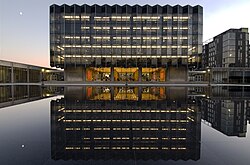
The law school was originally housed in Stuart Hall, a Gothic-style limestone building on the campus's main quadrangles. Since 1959, it has been housed in an Eero Saarinen-designed building across the Midway Plaisance from the main campus of the University of Chicago. The building was expanded in 1987 and again in 1998. It was renovated in 2008, preserving most of Saarinen's original structure.
Members of the faculty have included Cass Sunstein, Richard Posner, and Richard Epstein, three of the most-cited legal scholars of the 20th and early 21st centuries. Other notable former faculty members include U.S. president Barack Obama and U.S. Supreme Court justices Antonin Scalia, John Paul Stevens, and Elena Kagan.
History
[edit]Establishment of a new law school in Chicago
[edit]
When the University of Chicago was founded in 1892, its president William Rainey Harper expressed a desire to establish a law school for the university that would improve democratic government.[4] At the time, Harper observed that, "[t]hus far democracy seems to have found no way of making sure that the strongest men should be placed in control of the country's business."[5] Harper took advice from a number of his contemporaries. One such adviser, a professor at the University of Cambridge, suggested that the object of the new law school should be to train students to become "leaders of the bar and ornaments of the bench, inspiring teachers, scientific writers and wise reformers" and emphasising public law and comparative law.[6] Another adviser, a member of the Chicago bar, suggested that Harvard Law School, led by Christopher Columbus Langdell and influenced by the casebook method at the time, had "lost touch with great leaders among jurists and lawyers" and that the new law school in Chicago should focus on "social economics" or "principles of statesmanship" for lawyers.[6] Noted legal scholar Ernst Freund suggested that the law school promote an interdisciplinary approach to legal education, offering elective courses in subjects such as history and political science.[7] Ultimately, Harper settled with the view that the study of law should not occur in a vacuum, and that it should take into account "the whole field of man as a social being".[6]
In 1901, Harper announced that the new law school would be established the following year. He requested assistance from the faculty of Harvard Law School, whose dean at the time, James Barr Ames, granted professor Joseph Henry Beale a two-year leave of absence to serve as the first dean of the law school in Chicago. He did so on the condition that Chicago "have ideals and methods similar to [those of] the Harvard Law School".[6] However, Ames objected to the proposed curriculum, which contemplated close affiliation with social science departments in the university and subjects that were not found in a traditional first-year law curriculum. He insisted that the faculty comprise "solely of persons who teach law in the strict sense of the word" and using the casebook method.[6] Harper agreed to these terms, and together with Beale assembled the faculty and designed the curriculum. Harper departed from the understanding he had reached with Ames and hired Freund to teach property law, and the law school's curriculum was influenced by Freund's interdisciplinary approach. The founding faculty members were Blewett Harrison Lee and Julian Mack, who had both taught at the law school of Northwestern University; James Parker Hall, who had taught at Stanford Law School and turned down an offer to teach at Harvard Law School; Clarke Butler Whittier, who had also taught at Stanford; Harry A. Bigelow, a notable scholar at Boston University who recognized limitations in the casebook method;[8] and Freund.[4]
Founding and early period
[edit]On October 1, 1902, the law school opened for classes in the University Press Building (currently the Bookstore Building). John D. Rockefeller paid the $250,000 construction cost, and President Theodore Roosevelt laid its cornerstone.[9] At the time of its opening, the law school consisted of 78 students (76 men and two women). It offered courses in contract law, torts, criminal law, property law, agency, and pleading, with electives in administrative law, corporations law, federal jurisdiction, Roman law, international law, and legal ethics.[6] The law school invented the J.D. degree,[4] and was just one of five law schools in the U.S. that required a college degree from its applicants as a prerequisite to admission.[10] Its library, which was established in short order, housed some 18,000 volumes of law reports. In 1903, a year after the law school opened, enrollment at the law school grew rapidly as its student body increased to 126. Floyd R. Mechem, a professor at the University of Michigan Law School and pioneer in empirical legal studies at the time, joined the faculty and remained at the law school for 25 years until his death in 1928.[11][6]

The law school prospered in its early years and fostered relationships with scholars in other fields, including economics, political science, psychology, and history.[6] It also developed ties with members of the Chicago bar, who served as part-time faculty members and taught legal procedure and other practical courses. The law school's academic standards were recognized as at least equal to those of Harvard.[4] In 1904, the law school moved to Stuart Hall on the main university campus. In the same year, Sophonisba Breckinridge became the first woman to graduate from the law school––a feat that had not yet been achieved at Yale Law School, Columbia Law School or Harvard. In her autobiography, Breckinridge noted that "the fact that the law school, like the rest of the University ... accepted men and women students on equal terms was publicly settled".[13] The law school also established its first alumni association in this period.[14]
The law school faced considerable change in the years leading up to World War I and shortly thereafter. Beale returned to Harvard after his two-year leave of absence. In 1909, the eminent jurist Roscoe Pound taught at the law school for a year.[4] The law school established a chapter of the Order of the Coif in 1911 and the Edward W. Hinton Moot Court program in 1914. During World War I, enrollment declined: in Spring 1917, 241 students were enrolled; this number dropped to 46 by Fall 1918. In 1920, Earl B. Dickerson became the first African-American to graduate from the law school. The law school's Black Law Students Association is named in his honor.[15] Following the war, in 1926, enrollment reached 500 students for the first time. In 1927, the law school began to offer its first seminars. Its longest-serving dean, James Parker Hall, who played a significant role in recruiting numerous distinguished faculty members to the law school, died in office in 1928.[16]
Growth in interdisciplinary approach and the leadership of Edward Levi
[edit].jpg)
In the 1930s, new dean Harry A. Bigelow built on the interdisciplinary foundations laid by Freund and introduced classes in accounting, economics, and psychology. The law school's curriculum was shaped by the emerging influence of the law and economics movement. Aaron Director and Henry Simons began offering economics courses in 1933.[17] Faculty member Edward Levi also introduced economics in the antitrust course, permitting Director to teach one of every five classroom sessions.[18] The first volume of the University of Chicago Law Review was also published in 1933.[19] The law school established a legal writing program in 1938 and the Law and Economics Program in 1939. The LL.M. program was established in 1942, while Harry A. Bigelow Teaching Fellowships were established in 1947. As was the case during World War I, enrollment at the law school, like at many of the other top law schools in the country, declined and its academic calendar was adjusted to meet military needs.[20]

In the 1950s and 1960s, the law school experienced a period of profound growth and expansion under the leadership of Edward Levi, who was appointed Dean in 1950. In 1951, Karl Llewellyn and Soia Mentschikoff joined the law school, the latter being the first woman on the faculty. Other notable scholars, widely regarded as institutional figures and leading thinkers in their respective areas,[21] were Walter J. Blum and Bernard D. Meltzer, who studied and taught at the law school for their entire academic careers. Between 1953 and 1955, Supreme Court justice John Paul Stevens taught antitrust at the law school. In 1958, Director founded the Journal of Law and Economics. In 1959, the law school moved to its current building on 60th Street, designed by Eero Saarinen. In 1960, constitutional law scholar Philip Kurland founded the Supreme Court Review. Levi later served as the provost (1962–1968) and the president (1968–1975) of the University of Chicago, before becoming the United States Attorney General under president Gerald Ford. During his time at the law school, Levi also supported the Committee on Social Thought graduate program.[22]
Late 20th century
[edit]By the 1970s and 1980s, the law and economics movement had attracted a series of scholars with strong connections to the social sciences, such as Nobel laureates Ronald Coase and Gary Becker and scholars Richard A. Posner and William M. Landes. In 1972, Posner founded the Journal of Legal Studies. The law school also established joint degree programs with the Committee on Public Policy Studies and the Department of Economics, complementing Max Rheinstein's Foreign Law Program, which was established in the 1950s with a bequest from the Ford Foundation. The Legal History Program was established in 1981.[23] In 1982, the Federalist Society was established by a group of students at the law school, together with students from Harvard Law School and Yale Law School. In 1989, the D'Angelo Law Library exceeded 500,000 volumes.[14]

In the same period, many scholars who would later become leaders in their field joined the law school faculty at an early stage in their careers. Richard A. Epstein, identified in a Legal Affairs poll as one of the most influential legal thinkers of modern times,[24] joined the faculty in 1973 and continues to serve as emeritus professor and senior lecturer. Geoffrey R. Stone, a leading First Amendment scholar and alumnus and former dean of the law school, joined the faculty in the same year. Douglas G. Baird, a luminary in bankruptcy law, has been on the faculty since 1980 and served as dean between 1994 and 1999. Cass Sunstein, regarded as "the most cited legal scholar in the United States and probably the world",[25] began his teaching career at the law school in 1981 and served as a faculty member for 27 years. Former U.S. Supreme Court justice Antonin Scalia served as a professor between 1977 and 1982.[26] His future colleague on the Supreme Court, Elena Kagan, began her career at the law school too, as did noted legal scholars Lawrence Lessig and Adrian Vermeule. The 44th President of the U.S. Barack Obama taught at the law school between 1992 and 2004 in the areas of constitutional law, racism and the law, and voting rights before he was elected to the U.S. Senate.[27]
Academics
[edit]The law school currently employs more than 200 full-time and part-time faculty members and enrolls approximately 600 students in its Juris Doctor (J.D.) program.[28] It also offers advanced legal degrees such as the Master of Laws (LL.M.) (or alternatively the M.C.L.), the Master of Legal Studies (M.L.S.) and the Doctor of Jurisprudence (J.S.D.).[29] The J.D. degree may be combined with a Master of Business Administration (M.B.A.) or Doctor of Philosophy (Ph.D.) with the University of Chicago Booth School of Business, a Master of Arts (A.M.) in international relations, a Master of Public Policy (M.P.P.) with the University of Chicago Harris School of Public Policy, or a Master of Divinity (M.Div.) with the University of Chicago Divinity School.[30]
The law school's professors use the Socratic Method to facilitate learning in lectures and seminars. This method includes calling on students without prior notice, presenting hypotheticals, and continuously questioning them to test their knowledge and application of the material and to flesh out underlying assumptions in their responses.[31] It is one of the few law schools in the United States that employs this mode of teaching, which is assisted by its low student-to-professor ratio.[32]
Clinics[edit]The law school offers seven legal clinics, in which students earn course credit while practicing law under the direction of the clinic's independent faculty:[33]
|
Academic centers[edit]The law school has six research centers and projects. Each center hosts events, activities, and guest speakers throughout the academic year. They are as follows:[34]
|
Policy initiatives[edit]The law school has five current and past policy initiatives:[40]
|
Court Reform in the Juvenile Justice System International Best Standards for Guest Worker Programs (2015-2017) Bilateral Labor Agreements Dataset Animal Law Policy Initiative (Concluded) Foster Care to Adulthood (2005-2008) Kanter Project on Mass Incarceration (2013) Programs[edit]
|
D'Angelo Law Library
[edit]
The D'Angelo Law Library is part of the University of Chicago Library system. Renovated in 2006, it features a second-story reading room. The Law Library is open 90 hours per week and employs 11 full-time librarians and 11 additional managers and staff members. It has study space for approximately 500 people, a wireless network and 26 networked computers. It contains over 700,000 volumes of books, with approximately 6,000 added each year, including materials in over 25 languages, and primary law from foreign countries and international organizations.[45]
Admissions and costs
[edit]In 2021, the law school enrolled 175 students from an applicant pool of 6,514. Overall, the acceptance rate was 11.91% [1] For the entering class of 2024, the 25th and 75th LSAT percentiles were 169 and 175, respectively, with a median of 172. The 25th and 75th undergraduate GPA percentiles were 3.82 and 3.98, respectively, with a median of 3.91.[1]
In 2020, the law school reported that it had received approximately 1,000 applications for 80 positions.[46]
The total cost of attendance (indicating the cost of tuition, fees and living expenses) at the law school for the 2017–18 academic year was $93,414.[47]
Grading
[edit]The law school employs a grading system that places students on a scale of 155–186. The scale was 55–86 prior to 2003, but since then the law school has used a prefix of "1" to eliminate confusion with the traditional 100 point grading scale. For classes of more than 10 students, professors are required to set the median grade at 177, with the number of grades above 180 approximately equaling the number of grades below a 173.[48]
In an article published in The New York Times in 2010, business writer Catherine Rampell criticized other schools' problems with grade inflation, but commended Chicago's system, saying that Chicago "has managed to maintain the integrity of its grades."[49]
Students graduate "with honors" by attaining a final average of 179, "with high honors" upon attaining a final average of 180.5, and "with highest honors" upon attaining a final average of 182. The last of these achievements is rare; typically only one student every few years will attain the requisite 182 average. Additionally, the law school awards two honors at graduation that are based on class rank. Of the students who earned at the law school at least 79 of the 105 credits required to graduate, the top 10% are elected to the Order of the Coif.[50] Students finishing their first or second years in the top 5% of their class, or graduating in the top 10%, are honored as "Kirkland and Ellis Scholars."[50]
Publications
[edit]The law school produces seven professional journals.
Four of those journals are student-run:
- the University of Chicago Law Review (among the top five most cited law reviews in the world)[51]
- the Chicago Journal of International Law,
- the University of Chicago Legal Forum, and
- the University of Chicago Business Law Review.[52][53]
The other three are overseen by faculty:
- the Supreme Court Review,
- the Journal of Law and Economics, and
- the Journal of Legal Studies.[54]
The law school produces several series of academic papers, including the Kreisman Working Papers Series in Housing Law and Policy, the Coase-Sandor Working Paper Series in Law and Economics, the Fulton Lectures, and the Public Law and Legal Theory Working Papers, in addition to a series of occasional papers.[55]
Student groups
[edit]There are approximately 60 student-run groups at the law school which fall under the umbrella of the Law Students Association.[56] It is home to one of the three founding chapters of the Federalist Society. As a professor, former Supreme Court justice Antonin Scalia helped to organize the Chicago chapter of the society.[26] Chicago is also home to a large chapter of the progressive American Constitution Society for Law and Policy.[57]
Reception
[edit]Outcomes and career prospects
[edit]In 2018, the law school was ranked first in the U.S. for overall employment outcomes by the National Law Journal[58] and second in the U.S. for best career prospects by Forbes.[59] According to the law school's official 2020 ABA-required disclosures, 98.5% of the Class of 2019 obtained full-time, long-term, JD-required employment within ten months of graduation.[47] The median salary for its graduates in the Class of 2019 was $190,000, and 75% of graduates earned starting salaries of $190,000 or greater upon graduation.[47] For the same cohort, 50.2% of graduates secured positions at law firms with more than 500 lawyers.[47] The law school is ranked first in the U.S. by the National Law Journal for placing the highest percentage of recent graduates in law firms of 100 or more lawyers.[60] It also had the highest first-time Bar pass rate (98.9%) of all law schools in the United States.[47]
Judicial clerkships
[edit]In 2023, University of Chicago Law School alumni comprised the third-highest percentage of recent graduates clerking for federal judges, after Stanford Law School and Yale Law School.[61] Data compiled from the previous 12 years by Brad Hillis in 2017 indicates that the law school has the third-highest gross and third-highest per capita placement of alumni in Supreme Court of the United States clerkships among all law schools since 1882.[62] Between 1992 and 2017, it placed 88 alumni in Supreme Court of the United States clerkships. During the 2021-2022 Term alone, nine different Chicago alumni clerked for nine different justices on the Supreme Court of the United States.[63] In the Class of 2019, 27.6% of its graduates secured clerkships (with 87.3% of those graduates in federal clerkships).[47]
Rankings
[edit]The law school is included in the T14, a classification of consistently high ranking U.S. law schools. Recent rankings include:
- Third of all law schools in the world (third in the U.S.) by the Academic Ranking of World Universities in 2020[64]
- Fourth in the world (second in the U.S.) by the Times Higher Education World University Rankings in 2021[65]
- First in the U.S. by Above the Law in 2021[66] and second by Business Insider[67]
- Third in the U.S. by U.S. News & World Report in 2022[68] and 2023[69]
- Second in the U.S. in terms of scholarly impact in a 2021 study by Gregory Sisk et al. in 2021[70]
- Second in the U.S. for best career prospects by Forbes in 2017[59]
- Third in the U.S. for highest-earning graduates by Forbes in 2021[71]
- First in the U.S. for best professors and best for federal clerkships by the Princeton Review in 2023[72]
- Third in the U.S. for best classroom experience by the Princeton Review in 2023[72]
Campus
[edit]
The law school was originally housed in Stuart Hall, a Gothic-style limestone building on the campus's main quadrangles. Needing more library and student space, the law school moved across the Midway Plaisance to its current, Eero Saarinen-designed building (next to what was then the headquarters of the American Bar Association) in October 1959. The building contains classrooms, the D'Angelo Law Library, faculty offices, and an auditorium and courtroom, arranged in a quadrangle around a fountain (mimicking the college Gothic architecture of the campus's main quadrangles). The year saw a number of celebrations of the law school's new home, including a filming of The Today Show and appearances by Chief Justice Earl Warren, Governor (and later Vice President) Nelson Rockefeller and Secretary-General of the United Nations Dag Hammarskjöld.[73]
In 1987, and over the objections of the Saarinen family, the building was expanded to add office and library space (and the library renamed in honor of alumnus Dino D'Angelo). In 1998, a dedicated space for the law school's clinics, the Arthur Kane Center for Clinical Legal Education, as well as numerous additional classrooms, were constructed.[73] Renovation of the library, classrooms, offices, and fountain was completed in 2008, notable for the preservation of most of Saarinen's structure at a time when many modernist buildings faced demolition.[74][75]
People
[edit]Deans
[edit]- Joseph Henry Beale (1902–1904)
- James Parker Hall (1904–1928)
- Harry A. Bigelow (1929–1939)
- Wilber G. Katz (1939–1950)
- Edward H. Levi (1950–1962)
- Phil C. Neal (1963–1975)
- Norval Morris (1975–1979)
- Gerhard Casper (1979–1987)
- Geoffrey R. Stone (1987–1993)
- Douglas Baird (1994–1999)
- Daniel Fischel (1999–2001)
- Saul Levmore (2001–2009)
- Michael H. Schill (2010–2015)
- Thomas J. Miles (2015–2025)
- Adam Chilton (2025–present)
Notable faculty
[edit]The law school's faculty has included the 44th U.S. President Barack Obama, Supreme Court justices Antonin Scalia, John Paul Stevens and Elena Kagan, leaders of the legal realism movement Karl Llewellyn and Herman Oliphant, tax law doyen Walter J. Blum, leading constitutional law scholars Harry Kalven and Michael W. McConnell, founder of the law and literature movement James Boyd White, and one of the most widely-cited legal scholars in the world, Cass Sunstein. Its current faculty includes Kyoto Prize winner Martha Nussbaum, distinguished legal philosopher Brian Leiter, First Amendment scholar Geoffrey R. Stone, federal appellate judges Frank H. Easterbrook and Diane P. Wood, bankruptcy expert Douglas Baird, prominent legal historian Richard H. Helmholz, and among the most widely-cited legal scholars of the 20th and 21st centuries Richard A. Posner, Richard A. Epstein and Eric Posner.[76][77][78]
Current
[edit]- Daniel Abebe: constitutional law and international law scholar
- Albert Alschuler: scholar on criminal law and criminal procedure
- Douglas Baird: scholar on bankruptcy law and contracts
- William Baude: scholar on constitutional law and interpretation
- Omri Ben-Shahar: contracts and consumer protection scholar
- Lisa Bernstein: contracts and commercial law scholar
- Curtis Bradley: international law and foreign relations scholar
- Emily Buss: scholar on children and parents' rights
- Anthony J. Casey (alumnus): scholar on business law, finance, and bankruptcy
- Dhammika Dharmapala: economist and tax scholar
- Frank H. Easterbrook (alumnus): United States circuit judge of the United States Court of Appeals for the Seventh Circuit and leading antitrust scholar
- Richard A. Epstein (emeritus): scholar on classical liberalism, libertarianism, torts, Roman Law, contract and law and economics
- Daniel Fischel (emeritus, alumnus): law and economics scholar, and chairman and president of Compass Lexecon
- Tom Ginsburg: scholar on international and comparative law
- Richard H. Helmholz: legal historian and expert on European legal history
- M. Todd Henderson (alumnus): scholar on corporations law and securities regulation
- William H. J. Hubbard (alumnus): civil procedure and law and economics scholar
- Aziz Huq: scholar on constitutional law, federal courts, and criminal procedure
- Dennis J. Hutchinson (alumnus): constitutional law scholar and former editor of the Supreme Court Review
- Alison LaCroix: legal historian and constitutional law scholar
- William Landes: economist and law and economics scholar
- Brian Leiter: legal philosopher and scholar on Nietzsche
- Saul Levmore: former Dean of the law school and scholar on commercial law and public choice
- Jonathan Masur: behavioral law and economics, patent law, and administrative law scholar
- Thomas J. Miles: law and economics scholar
- Jennifer Nou: scholar on administrative law and regulatory policy
- Martha Nussbaum: influential philosopher and expert on ancient Greek and Roman philosophy, political philosophy, feminism, and ethics
- Randal C. Picker (alumnus): scholar on antitrust and intellectual property law
- Eric Posner: scholar on international law and contract law, and one of the most cited law professors in the U.S.
- Richard A. Posner: former federal appellate judge and the most cited legal scholar of the 20th century.[79]
- John Rappaport: criminal procedure and criminal law scholar
- Gerald N. Rosenberg: leading scholar on political science and law, and author of The Hollow Hope (1991)
- Andrew M. Rosenfield (alumnus): economist, CEO and managing partner of TGG Group, and managing partner of Guggenheim Partners
- Geoffrey R. Stone (alumnus): leading scholar on constitutional law and the First Amendment
- Lior Strahilevitz: property law and privacy law scholar
- David A. Strauss: constitutional law scholar
- Diane P. Wood: Chief United States circuit judge of the United States Court of Appeals for the Seventh Circuit
Former
[edit]- Mortimer J. Adler
- Amabel Anderson Arnold
- Paul M. Bator
- Harry A. Bigelow
- Walter J. Blum (alumnus)
- Lea Brilmayer
- Gerhard Casper
- Ronald Coase: winner of the Nobel Memorial Prize in Economic Sciences
- William Crosskey
- Brainerd Currie
- David P. Currie
- Kenneth W. Dam
- Kenneth Culp Davis
- Aaron Director
- Justin Driver
- Ulrich Drobnig
- Owen M. Fiss
- Ernst Freund
- Elizabeth Garrett
- Grant Gilmore
- Douglas Ginsburg (alumnus)
- Jack Goldsmith
- Philip Hamburger
- Bernard Harcourt
- Geoffrey C. Hazard Jr.
- Edward W. Hinton (after whom the Hinton Moot Court Competition is named)[80]
- James F. Holderman
- Elena Kagan: Justice of the Supreme Court of the United States
- Dan Kahan
- Harry Kalven (alumnus)
- Stanley Nider Katz
- Nicholas Katzenbach: former Attorney General of the United States
- Friedrich Kessler
- Spencer L. Kimball
- Larry Kramer (alumnus)
- Anthony Kronman
- Philip Kurland
- John H. Langbein
- Douglas Laycock (alumnus)
- Lawrence Lessig
- Karl Llewellyn
- Edward Levi: former Attorney General of the United States (alumnus)
- Jonathan R. Macey
- Julian Mack
- Michael W. McConnell (alumnus)
- Tracey Meares (alumna)
- Bernard D. Meltzer (alumnus)
- Soia Mentschikoff
- Abner Mikva (alumnus)
- William R. Ming (alumnus)
- Norval Morris
- Edward R. Morrison (alumnus)
- Dallin H. Oaks (alumnus)
- Barack Obama (1992–2004): former President of the United States
- Herman Oliphant (alumnus)
- Douglas H. Parker
- Eduardo Peñalver
- Roscoe Pound
- John Mark Ramseyer
- Max Rheinstein
- Antonin Scalia: former Justice of the Supreme Court of the United States
- Michael H. Schill
- Stephen Schulhofer
- Richard Scott, Baron Scott of Foscote: former Lord of Appeal
- Henry Simons
- A. W. B. Simpson
- Anne-Marie Slaughter
- John Paul Stevens: former Justice of the Supreme Court of the United States
- Cass Sunstein
- Jacobus tenBroek
- Adrian Vermeule
- James Boyd White
- Hans Zeisel
Notable alumni
[edit]The law school has produced many distinguished alumni in the judiciary, government and politics, academia, business, and other fields. Its alumni include heads of state and politicians around the world, the Lord Chief Justice of England and Wales, the President of the Supreme Court of Israel, judges of United States Courts of Appeals, several U.S. Attorneys General and Solicitors General, members of Congress and cabinet officials, Privy Counsellors, university presidents and faculty deans, founders of the law firms Kirkland & Ellis, Baker McKenzie, and Jenner & Block, CEOs and chairpersons of multinational corporations, and contributors to literature, journalism, and the arts. The law school counts among its alumni recipients of the Presidential Medal of Freedom, Fulbright Scholars, Rhodes Scholars, Marshall Scholars, Commonwealth Fellows, National Humanities Medallists, and Pulitzer Prize winners.
In the judiciary, notable alumni include Lord Thomas, who served as Lord Chief Justice of England and Wales from 2013 to 2017, and former President of the Supreme Court of Israel, Shimon Agranat. Federal appellate judges who graduated from the law school include Douglas H. Ginsburg, David S. Tatel, Michael W. McConnell and Robert Bork, who was unsuccessfully nominated to the U.S. Supreme Court. Other federal appellate judges include Abner Mikva, who later served as White House Counsel in the Clinton administration; Frank H. Easterbrook, who currently teaches at the law school; and Jerome Frank, who served as Chairman of the Securities and Exchange Commission and, together with fellow alumnus Herman Oliphant, played a leading role in the legal realism movement in the U.S. More recently confirmed alumni federal appellate judges include Anthony Johnstone, Eric E. Murphy, Neomi Rao, Beth Robinson, Eric D. Miller, and Allison H. Eid.
Notable alumni in government and politics include Attorneys General John Ashcroft, Ramsey Clark and Edward H. Levi, who was Dean of the law school from 1950 to 1962. The last Solicitor General of the United States, Noel Francisco, graduated from the law school in 1996. Other graduates include the former Prime Minister of New Zealand, Geoffrey Palmer; prosecutor at the Nuremberg trials and drafter of the U.N. Charter, Bernard D. Meltzer; former FBI director, James Comey; former United States Secretary of the Interior and key figure in the implementation of the New Deal, Harold L. Ickes; former Secretary of Health, Education, and Welfare, Abraham Ribicoff; the first director of the Consumer Financial Protection Bureau, Richard Cordray; current White House Counsel Ed Siskel; current CDC official Nirav D. Shah; current U.S. senator Amy Klobuchar, and U.S. Representative and United States House Select Committee on the January 6 Attack Vice-Chair Liz Cheney, among other members of Congress.
Alumni who are leaders in higher education include the current president of Princeton University, Christopher L. Eisgruber; the current Dean of the University of Texas School of Law, Ward Farnsworth; the former Dean of Stanford Law School and President of the London School of Economics, Larry Kramer; the co-chair of the COVID-19 Advisory Board, head of Operation Warp Speed, and former Dean of the Yale School of Medicine, David A. Kessler; the former Dean of Cornell Law School, Roger C. Cramton; and the former Dean of Vanderbilt University Law School, Tulane University Law School and Cornell Law School, William Ray Forrester. Scholars who graduated from the law school include Harvard Law School professor Mary Ann Glendon, who is a former U.S. ambassador to the Holy See; First Amendment scholar Geoffrey R. Stone; tax law doyen Walter J. Blum; and one of the pre-eminent constitutional law scholars of the 20th century, Harry Kalven.[79]
In business, notable alumni include the billionaire and founder of the Carlyle Group, David Rubenstein; the former CEO and president of Bloomberg L.P. and the current CEO of Sidewalk Labs, Daniel L. Doctoroff; the executive chairman of Hyatt Hotels Corporation, Thomas Pritzker; the chairman and president of Compass Lexecon and an emeritus professor at the law school, Daniel Fischel; former president of Weyerhaeuser and of Boy Scouts of America, Norton Clapp; the current commissioner of the NBA, Adam Silver; the founder of Yammer, David O. Sacks; and Katherine L. Adams, the general counsel of Apple Inc.. In the field of non-governmental organizations, alumni include the founder and CEO of the International Justice Mission, Gary Haugen; and co-founder of Amnesty International, Luis Kutner.
The law school also counts among its alumni four recipients of the Presidential Medal of Freedom; two Pulitzer Prize winners; the first female African-American U.S. senator, Carol Moseley Braun; the first African-American to serve as a United States federal judge, James Benton Parsons; civil rights attorney and chairman of the Fair Employment Practices Committee, Earl B. Dickerson; the first female president of the American Law Institute and of the American Bar Association, Roberta Cooper Ramo; Pulitzer Prize-winner Studs Terkel; civil rights activist and the first woman to graduate from the law school, Sophonisba Breckinridge; and the founder of the intelligent design movement, Phillip E. Johnson.
References
[edit]- ^ a b c d e "Chicago, University of - 2021 Standard 509 Information Report" (PDF). December 14, 2021. Archived from the original (PDF) on February 27, 2022. Retrieved February 27, 2022.
- ^ "University of Chicago". U.S. News & World Report – Best Law Schools. Retrieved April 8, 2025.
- ^ "University of Chicago - 2021 Consumer Bar Passage Report" (PDF).[permanent dead link]
- ^ a b c d e Paul D. Carrington, "The Missionary Diocese of Chicago", 44 Journal of Legal Education 467 (1994)
- ^ William Rainey Harper, The Trend in Higher Education 31 (Chicago, 1905)
- ^ a b c d e f g h Frank L. Ellsworth, Law on the Midway: The Founding of the University of Chicago Law School 33 (Chicago, 1977)
- ^ Boyer, John W. R. (2015). The University of Chicago: A History. University of Chicago Press. p. 439. ISBN 9780226242651.
- ^ Tefft, Sheldon. "Harry A. Bigelow". Law School Record. University of Chicago.
- ^ Boyer, John W. R. (2015). The University of Chicago: A History. University of Chicago Press. p. 438. ISBN 9780226242651.
- ^ "What is the difference between the LL.B. degree and the J.D.degree? - Ask a Librarian!". asklib.law.harvard.edu. Retrieved January 19, 2020.
- ^ Edward W. Hinton, "Floyd Russell Mechem", 23 Illinois Law Review 591 (1929).
- ^ "The Law School Record". chicagounbound.uchicago.edu. Retrieved January 18, 2021.
- ^ Giselle Roberts and Melissa Walker (eds.), Southern Women in the Progressive Era: A Reader (2019)
- ^ a b "The University of Chicago Magazine: June 2003". magazine.uchicago.edu. Retrieved October 9, 2018.
- ^ Dingwall, Christopher; Rachel Watson "Guide to the Earl B. Dickerson Papers", Chicago Public Library, Mapping the Stacks, accessed September 3, 2011.
- ^ "James Parker Hall | New York Times". www.nytimes.com. March 19, 1928.
- ^ "Aaron Director, Founder of the field of Law and Economics". University of Chicago News Office. September 13, 2004. Retrieved April 29, 2010.
- ^ Sunstein, Cass R. (2018). Legal Reasoning and Political Conflict. Oxford University Press. p. 68. ISBN 9780190864460.
- ^ [1], About the Law Review.
- ^ Boyer, John W. R. (2015). The University of Chicago: A History. University of Chicago Press. p. 440. ISBN 9780226242651.
- ^ Joseph Isenbergh, "Walter Blum", 55 University of Chicago Law Review 734 (1988)
- ^ (Press Release) Edward H. Levi, former U.S. Attorney General, President Emeritus of the university and the Glen A. Lloyd Distinguished Service Professor Emeritus in the law school and the College, dies at 88. News.uchicago.edu. Retrieved on August 15, 2013.
- ^ Boyer, John W. R. (2015). The University of Chicago: A History. University of Chicago Press. p. 441. ISBN 9780226242651.
- ^ "Who Are the Top 20 Legal Thinkers in America?". Legal Affairs. Archived from the original on April 24, 2012. Retrieved July 4, 2008.
- ^ "Holberg Prize and Nils Klim Prize Laureates 2018 Announced". Holbergprisen. March 10, 2017. Archived from the original on August 1, 2017. Retrieved March 14, 2018.
- ^ a b Shipp, E. R. (July 26, 1986), "Scalia's Midwestern colleagues cite his love of debate, poker, and piano", The New York Times, retrieved January 13, 2010
- ^ "President Obama returns to the Law School | University of Chicago". www.uchicago.edu. Retrieved January 21, 2021.
- ^ "Standard 509 Disclosure". www.abarequireddisclosures.org. Archived from the original on April 28, 2018. Retrieved October 9, 2018.
- ^ "Admissions | University of Chicago Law School". www.law.uchicago.edu. Retrieved January 18, 2021.
- ^ "Dual Degrees and Certificate-Granting Programs | University of Chicago Law School". www.law.uchicago.edu. Retrieved January 18, 2021.
- ^ "The Socratic Method". law.uchicago.edu. Retrieved November 28, 2020.
- ^ Schneider, Jack (December 2013). "Remembrance of Things Past: A History of the Socratic Method in the United States". Curriculum Inquiry. 43 (5): 613–640. doi:10.1111/curi.12030. S2CID 42448911.
- ^ "Clinics | University of Chicago Law School". www.law.uchicago.edu. Retrieved January 18, 2021.
- ^ "Research Centers | University of Chicago Law School". www.law.uchicago.edu. Retrieved January 18, 2021.
- ^ "Coase-Sandor Institute for Law and Economics | University of Chicago Law School". www.law.uchicago.edu. Retrieved July 5, 2022.
- ^ "Constitutional Law Institute | University of Chicago Law School". www.law.uchicago.edu. Retrieved July 5, 2022.
- ^ "Center for Comparative Constitutionalism | University of Chicago Law School". www.law.uchicago.edu. Retrieved July 5, 2022.
- ^ "Center for Law, Philosophy, and Human Values | University of Chicago Law School". www.law.uchicago.edu. Retrieved July 5, 2022.
- ^ "Center on Law and Finance | University of Chicago Law School". www.law.uchicago.edu. Retrieved July 5, 2022.
- ^ "Chicago Policy Initiatives | University of Chicago Law School". www.law.uchicago.edu. Retrieved March 12, 2024.
- ^ "Legal History Program | University of Chicago Law School". www.law.uchicago.edu. Retrieved January 18, 2021.
- ^ "The Olin Foundation and Support for Law and Economics Research | University of Chicago Law School". www.law.uchicago.edu. Retrieved January 18, 2021.
- ^ "International and Comparative Law | University of Chicago Law School". www.law.uchicago.edu. Retrieved January 18, 2021.
- ^ "Law and Philosophy | University of Chicago Law School". www.law.uchicago.edu. Retrieved January 18, 2021.
- ^ "Facts about the D'Angelo Law Library - The D'Angelo Law Library - The University of Chicago Library". www.lib.uchicago.edu. Retrieved October 9, 2018.
- ^ "Announcements" (PDF). www.law.uchicago.edu. September 1, 2020. Archived from the original (PDF) on October 17, 2020. Retrieved October 3, 2020.
- ^ a b c d e f "Standard 509 Disclosure". www.abarequireddisclosures.org. Archived from the original on November 25, 2019. Retrieved January 10, 2021.
- ^ "1.18 Grading - University of Chicago Law School". www.law.uchicago.edu. Retrieved October 9, 2018.
- ^ Rampell, Catherine (June 21, 2010). "In Law Schools, Grades Go Up, Just Like That". The New York Times. ISSN 0362-4331. Retrieved June 2, 2015.
- ^ a b "4.16 J.D. Honors | University of Chicago Law School". www.law.uchicago.edu. Retrieved December 5, 2019.
- ^ "TaxProf Blog: 2020 Meta-Ranking of Flagship U.S. Law Reviews".
- ^ "Journals | University of Chicago Law School".
- ^ "Law School Launches Student-Led Business Law Journal | University of Chicago Law School".
- ^ "Journals | University of Chicago Law School". www.law.uchicago.edu. Retrieved January 18, 2021.
- ^ "Academic Paper Series - University of Chicago Law School". www.law.uchicago.edu. Retrieved October 9, 2018.
- ^ "Student Organisation Directory | University of Chicago Law School". www.law.uchicago.edu. Retrieved January 18, 2021.
- ^ "American Constitution Society | University of Chicago Law School". www.law.uchicago.edu. Retrieved January 18, 2021.
- ^ "The Top Law Schools With The Best Employment Outcomes". Above the Law. April 19, 2017. Retrieved July 6, 2018.
- ^ a b "The Best Law Schools For Career Prospects In 2018". Forbes. Retrieved January 10, 2021.
- ^ "Law Grads Hiring Report: Job Stats for the Class of 2017". Retrieved May 6, 2018.
- ^ Sloan, Karen (May 1, 2023). "These law schools sent the most grads to federal clerkships". Reuters. Retrieved May 5, 2023.
- ^ "Brian Leiter Supreme Court Clerkship Placement, 2000 Through 2008 Terms". www.leiterrankings.com. Retrieved November 28, 2020.
- ^ "Nine Clerks for Nine Justices in 2021-2022, Marking New Alumni Clerkship Record at the Supreme Court | University of Chicago Law School". www.law.uchicago.edu. Retrieved May 27, 2023.
- ^ "ShanghaiRanking's Global Ranking of Academic Subjects 2020 - Law". Academic Ranking of World Universities. Archived from the original on July 13, 2019. Retrieved November 22, 2020.
- ^ "World University Rankings 2021 by subject: law". Times Higher Education World University Rankings. October 26, 2020. Retrieved November 22, 2020.
- ^ "The 2021 Top Law School Rankings Are Finally Here". Above the Law. June 24, 2021. Retrieved August 3, 2021.
- ^ "The 50 best law schools in America". Business Insider. Retrieved September 14, 2018.
- ^ "2023 Best Law Schools". U.S. News & World Report. Retrieved March 28, 2022.
- ^ Sloan, Karen (May 11, 2023). "Revamped US News law school rankings yield major shifts". Reuters. Retrieved May 26, 2023.
- ^ Sisk, Gregory C.; Catlin, Nicole; Veenis, Katherine; Zeman, Nicole (2021). "Scholarly Impact of Law School Faculties in 2021: Updating the Leiter Score Ranking for the Top Third". University of St. Thomas Law Journal. SSRN 3910536.
- ^ "The 25 Law Schools Whose Grads Earn The Most". Forbes. Retrieved January 10, 2021.
- ^ a b "University of Chicago - Law School - The Princeton Review Law School Rankings & Reviews". www.princetonreview.com. Retrieved May 26, 2023.
- ^ a b Building a Future on a Strong Foundation | University of Chicago Law School. Law.uchicago.edu. Retrieved on August 15, 2013.
- ^ Saarinen's Law School Wasn't Razed - WSJ.com. Online.wsj.com (October 8, 2008). Retrieved on 2013-08-15.
- ^ Cityscapes: New luster for a Saarinen gem: Once-threatened U. of C. Law School building is expertly recycled by OWP/P Archived December 22, 2010, at the Wayback Machine. Featuresblogs.chicagotribune.com (July 1, 2008). Retrieved on 2013-08-15.
- ^ "Faculty Directory | University of Chicago Law School". www.law.uchicago.edu. Retrieved January 18, 2021.
- ^ Jodi Kantor (July 30, 2008). "Teaching Law, Testing Ideas, Obama Stood Slightly Apart | New York Times". www.nytimes.com. Retrieved January 18, 2021.
- ^ Hundley, Tom (March 22, 2009). "Ivory Tower of Power". Chicago Tribune. Retrieved January 21, 2021.
- ^ a b Shapiro, Fred R. (2000). "The Most-Cited Legal Scholars". Journal of Legal Studies. 29 (1): 409–26. doi:10.1086/468080. S2CID 143676627.
- ^ "The Camaraderie and Competition of the Hinton Moot Court | University of Chicago Law School". www.law.uchicago.edu. Retrieved January 28, 2020.
External links
[edit]
- Official website

- Guide to the University of Chicago Law School Arbitration Study Records 1916-1966 at the University of Chicago Special Collections Research Center
- Guide to the University of Chicago Law School Jury Project Records 1953-1959 at the University of Chicago Special Collections Research Center

.jpg)

| International | |
|---|---|
| National | |
| Other | |
University of Chicago Law School
View on GrokipediaHistory
Founding and Early Development (1902–1930s)
The University of Chicago Law School was established in 1902, twelve years after the university's founding in 1890 by John D. Rockefeller, as part of President William Rainey Harper's ambition to create a premier institution for legal education in the Midwest.[1] The school opened its doors on October 1, 1902, initially housed in the University Press Building with an inaugural budget of $38,300, of which $30,300 covered faculty salaries.[10] Joseph Henry Beale Jr., a scholar specializing in conflict of laws, served as the first dean from 1902 to 1904, emphasizing a curriculum that integrated scientific approaches to law with broader disciplines such as history, economics, and philosophy.[11] [12] On April 2, 1903, President Theodore Roosevelt presided over the laying of the cornerstone for the school's first dedicated building, Stuart Hall, marking a shift from temporary quarters to a permanent facility on the university's Midway campus.[13] [14] This event underscored the school's early prominence and commitment to rigorous professional training. Under subsequent dean James Parker Hall, who led from 1904 until his death in 1928, the institution expanded its focus on jurisprudence and public law, with faculty including Ernst Freund, a pioneer in administrative law. [15] During the 1920s and into the 1930s, under Harry A. Bigelow's deanship starting around 1928, the Law School advanced innovations in legal education, including the formal recognition of administrative law, legislation, and comparative law as distinct fields of study, alongside early empirical research methods.[1] [16] The curriculum emphasized interdisciplinary inquiry and the Socratic method to foster critical thinking, laying groundwork for later developments like the integration of economics into legal analysis by figures such as Aaron Director and Henry Simons in 1933.[12] [3] These efforts positioned the school as a leader in moving beyond traditional case-based instruction toward a more analytical and socially informed approach.[1]Emergence of Interdisciplinary Legal Education (1940s–1960s)
In the aftermath of World War II, the University of Chicago Law School initiated a deliberate shift toward interdisciplinary approaches by incorporating economic analysis into legal studies, building on earlier influences from legal realism and social sciences. Enrollment had declined during the war due to faculty and student involvement in military efforts and government service, but post-1945 recovery emphasized analytical methods drawn from economics to evaluate legal rules and institutions.[17] In 1946, Aaron Director, a professor of economics appointed to the Law School faculty in 1939, began teaching courses on price theory and antitrust law alongside colleagues such as Ward S. Bowman and economist Milton Friedman, introducing law students to marginal analysis and efficiency considerations in regulatory contexts.[3] Edward Levi, a faculty member specializing in antitrust and legal process, co-taught these seminars with Director, fostering an environment where economic reasoning challenged traditional doctrinal approaches.[3] This integration reflected the school's broader commitment to empirical and scientific inquiry, extending its pre-war four-year curriculum—which had included social science components until its discontinuation in 1949—to emphasize causal mechanisms in law.[3] Levi's appointment as dean in 1950 accelerated these developments, as he prioritized recruiting interdisciplinary scholars and enhancing academic rigor amid expanding enrollment from returning veterans.[18] Under his tenure through 1962, the faculty grew to include experts in economics and related fields, with seminars evolving into structured workshops that examined legal problems through quantitative and incentive-based lenses.[18] A key institutional milestone came in 1958 with the founding of the Journal of Law and Economics by Director and Ronald Coase, who had joined the University of Chicago's economics department in 1950; the journal published early works applying economic models to antitrust, property rights, and contracts, establishing a rigorous outlet for cross-disciplinary scholarship.[3] That same year, the Law and Economics Workshop was launched, convening faculty and students to critique legal doctrines using tools like cost-benefit analysis, which Director and others argued revealed inefficiencies in common law rules.[3] The decade's close featured Ronald Coase's 1960 presentation of "The Problem of Social Cost" at the workshop, articulating the Coase Theorem and demonstrating how transaction costs and property rights determine outcomes in externalities, thereby providing a foundational framework for economic assessment of torts, nuisance, and regulation.[3] Coase formally joined the Law School faculty in 1964, but his earlier contributions solidified the movement's momentum.[3] George Stigler's arrival in 1958 further reinforced this trajectory, as his empirical studies on regulation influenced legal policy analysis.[3] By the mid-1960s, these efforts had transformed the curriculum, with economics no longer peripheral but central to understanding law's incentives and effects, distinguishing UChicago from doctrinally focused peers and laying groundwork for broader applications in fields like criminal law and public choice.[19] This era's innovations, supported by private funding such as the Volker Fund for Director's antitrust project starting in 1946, prioritized verifiable efficiency gains over normative preferences, yielding publications that empirically tested legal outcomes against market alternatives.[19]Expansion and Institutional Influence (1970s–1990s)
During the 1970s and 1980s, the University of Chicago Law School experienced physical expansion to accommodate its academic programs, including a major addition to its library facilities completed in 1986, which increased capacity for research collections and study spaces.[20] This was followed in the 1990s by further growth with the construction of the Arthur Kane Center, enhancing student and faculty amenities adjacent to the main quadrangle.[21] These developments supported the school's rigorous curriculum amid steady enrollment, reflecting institutional priorities on intellectual depth over rapid size increases. The era marked the peak institutionalization of the law and economics movement at the school, building on earlier foundations from the 1940s and 1950s but achieving broader scholarly and policy impact. Ronald Coase, who joined the faculty in 1964, formalized key concepts like the Coase theorem, influencing analyses of property rights and externalities; his 1991 Nobel Prize in Economics recognized work conducted largely at Chicago.[3] Richard A. Posner, appointed in 1969, published Economic Analysis of Law in 1973, applying microeconomic principles to diverse legal fields and establishing a framework adopted in judicial opinions and policymaking.[3] Gary Becker, an economist with joint appointments, extended human capital theory to legal contexts, earning the 1992 Nobel Prize for contributions intertwined with Chicago's interdisciplinary ethos.[3] Faculty influence extended to the federal judiciary, amplifying the school's reach. Posner was appointed to the U.S. Court of Appeals for the Seventh Circuit in 1981, where his opinions frequently incorporated efficiency-based reasoning. Frank H. Easterbrook, who joined the faculty in the late 1970s, ascended to the same court in 1985, applying Chicago-style skepticism toward expansive regulatory interpretations in antitrust and securities cases.[19] This judicial pipeline, alongside scholarly output, shaped Reagan-era antitrust enforcement, prioritizing consumer welfare over market structure interventions—a shift rooted in empirical critiques of prior New Deal-era precedents.[22] Under deans such as Gerhard Casper (1979–1989), the school emphasized free inquiry and empirical rigor, resisting prevailing doctrinal trends in other institutions.[16] Clinical programs, evolving from post-1960s initiatives, gained national traction by the 1980s, training students in appellate advocacy and influencing public interest law models elsewhere.[23] By the 1990s, these elements cemented Chicago's reputation for producing influential thinkers, though critiques from non-economic perspectives highlighted potential overemphasis on efficiency at the expense of distributional equity—a tension unresolved in contemporary debates.[24]Modern Era and Adaptations (2000s–Present)
The University of Chicago Law School entered the 21st century under the deanship of Saul Levmore from 2001 to 2009, during which it expanded its integration of law and economics by hiring faculty dually trained in law and economics, building on the school's foundational strengths in the field.[3] This period saw continued emphasis on rigorous, interdisciplinary scholarship, with faculty like Ronald Coase remaining active into the early 2000s until his death in 2013. Subsequent leadership under deans including Thomas J. Miles, who served from 2015 to 2025 and focused on enhancing institutional strengths through steady governance and faculty development, maintained the school's elite status.[25] Adam Chilton assumed the deanship in 2025, continuing this trajectory of academic excellence.[16] The Law School has consistently ranked among the top three law schools in the United States according to U.S. News & World Report evaluations, reflecting its sustained influence in legal education and scholarship.[8] Faculty achievements underscore this prominence, with five professors recognized among the nation's top 100 most-cited legal scholars in recent assessments, and nearly 300 alumni holding full-time faculty positions at law schools across the U.S. and abroad.[9][26] These metrics highlight the school's enduring impact on legal thought, particularly in empirical and economic analyses of law, amid broader academic trends favoring interdisciplinary methods. In adapting to contemporary challenges, the Law School has reinforced its commitment to free expression, aligning with the University of Chicago's 2014 Report on Principles of Free Expression, which prioritizes open inquiry over ideological conformity in a polarized environment.[4] Faculty have played key roles in defending these principles against pressures for speech restrictions on campuses, emphasizing debate on contentious issues like race-based affirmative action without deference to prevailing orthodoxies.[27] This stance, rooted in the school's historical dedication to intellectual rigor, positions it as a counterpoint to institutions where administrative deference to sensitivity over truth has proliferated, as evidenced by its resistance to trends undermining merit-based evaluation in admissions and hiring.[28]Academics
Degree Programs and Curriculum
The University of Chicago Law School offers a Juris Doctor (J.D.) as its primary professional degree, alongside graduate programs including the Master of Laws (LL.M.), Doctor of the Science of Law (S.J.D.), and Master of Laws Studies (M.L.S.).[6] The J.D. program spans three full-time academic years, emphasizing rigorous analytical training through a combination of required foundational courses and elective seminars that integrate economic, philosophical, and empirical perspectives into legal study.[29] Graduate programs cater to international lawyers, advanced researchers, and non-lawyer professionals seeking specialized legal knowledge.[30] The J.D. curriculum begins with a structured first-year sequence designed to build core legal skills. All first-year students complete five mandatory courses—Civil Procedure, Contracts, Criminal Law, Property, and Torts—spread across the Autumn and Winter quarters, alongside an introductory Elements of the Law course unique to the school that examines legal institutions and reasoning from interdisciplinary angles.[31] [32] Second- and third-year students fulfill a total of 86 credit hours, including professional responsibility training and a substantial writing requirement, with substantial flexibility to select from over 170 upper-level offerings in areas such as administrative law, constitutional law, commercial law, clinics, and interdisciplinary seminars.[33] [34] This structure promotes academic freedom while requiring six residence quarters and maintaining a minimum cumulative grade-point average for graduation.[32] The LL.M. program targets foreign-trained lawyers, enrolling 70–80 students annually from over 25 nationalities, and requires completion of 27 credit hours (typically nine courses) over three quarters with a satisfactory grade average.[30] [35] Participants engage in the school's broader curriculum, often focusing on U.S. law topics like business law or constitutional theory, without a fixed set of required courses beyond maintaining full-time status.[35] The S.J.D. serves as a research doctorate for LL.M. graduates pursuing original scholarship under faculty supervision, culminating in a dissertation.[6] The M.L.S., aimed at non-lawyers in fields like business or policy, provides targeted legal education through selected courses, though specific requirements align with the school's flexible upper-level framework.[6] Joint degree options, such as J.D./M.B.A. with the Booth School of Business, integrate legal and business curricula over four years, requiring coordinated enrollment and 1,400 units total.[36]Grading System and Academic Rigor
The University of Chicago Law School employs a numeric grading scale ranging from 155 to 186, with grades recorded numerically rather than as letters, though they correspond as follows: 180–186 (A), 174–179 (B), 168–173 (C), 160–167 (D), and 155–159 (F).[37] All required courses are graded on this scale without pass/fail options, and exams are graded anonymously to ensure impartiality.[37] [38] A mandatory grading curve applies to maintain consistency and relative performance assessment. For courses and seminars graded primarily on exams, including first-year electives and paper/exam options, the median grade must be 177; paper seminars, clinics, and simulations allow a median of 177–179; and legal research and writing courses require a median of 178.[37] [39] Minor deviations are permitted only for low-enrollment classes with faculty certification, but the policy enforces no grade inflation through fixed medians rather than prescribed distributions.[37] Students must achieve a minimum cumulative GPA of 173.5 at the end of each academic year to maintain satisfactory academic standing, with failing grades in required courses necessitating repetition (both grades factoring into GPA).[40] [39] J.D. honors are awarded based on final cumulative GPA without rounding: Honors for 179 and above, High Honors for 180.5 and above, and Highest Honors for 182 and above.[41] Additional distinctions include Order of the Coif for the top 10% of graduates (requiring at least 79 of 105 credits in graded courses) and Kirkland & Ellis Scholars for the top 5% after the first or second year, limited to 10% of the class overall.[41] Transcripts do not display GPAs until graduation or rank students, emphasizing the numeric scale's transparency for employers via provided keys.[39] This grading framework underscores the school's academic rigor by prioritizing relative excellence over absolute scores, curbing grade inflation through enforced medians, and fostering a competitive environment that mirrors high-stakes professional demands.[37] [39] Unlike many peers that adopted pass/fail or relaxed curves during the 2020 pandemic, Chicago adhered to its "status quo" medians, preserving signaling value in grades and reinforcing selectivity in outcomes.[42] The system's design, with medians around a high B level amid anonymous evaluation, demands sustained intellectual performance, contributing to the school's reputation for producing analytically precise graduates without diluting distinctions via leniency.[37] [43]Clinics, Experiential Learning, and Policy Initiatives
The University of Chicago Law School requires all J.D. students to complete at least eight credits of experiential learning coursework, encompassing clinics, practica, simulations, and other hands-on programs designed to impart practical skills in litigation, transactional work, and advocacy.[44] This mandate, implemented to bridge theoretical education with real-world application, reflects the school's longstanding emphasis on clinical training, which dates back over fifty years to the establishment of the Edwin F. Mandel Legal Aid Clinic in 1959.[23] As of September 2025, Clinical Professor Erica Zunkel serves as director of Clinical and Experiential Learning, overseeing fifteen clinics that provide students with supervised opportunities to represent clients, conduct investigations, draft documents, and appear in court or administrative proceedings.[45] The school's clinics span litigation and transactional domains, including the Federal Criminal Justice Clinic, where students defend indigent clients in federal misdemeanor cases and handle post-conviction matters; the Abrams Environmental Law Clinic, focusing on regulatory compliance, enforcement actions, and policy advocacy related to environmental protection; and the Global Human Rights Clinic, which involves international fact-finding, reporting, and submissions to bodies like the United Nations.[46] Other offerings include the Civil Rights and Police Accountability Clinic, addressing claims of excessive force and discrimination; the Immigrants' Rights Clinic, providing representation in asylum, deportation defense, and family-based immigration matters; and the Innovation Clinic, which supports startups with intellectual property counseling, venture financing, and corporate formation.[47] Transactional clinics such as the Housing Initiative Transactional Clinic assist in developing affordable housing projects through real estate transactions and financing arrangements, while appellate-focused programs like the Jenner & Block Supreme Court and Appellate Clinic prepare briefs and amicus curiae submissions for high-court cases.[48] Enrollment in these clinics is competitive, typically limited to 1-3 credits per term, with selection based on academic standing, prior coursework, and faculty recommendations.[48] Beyond clinics, experiential learning extends to practica and externships, such as the Kirkland & Ellis Corporate Lab, where students negotiate and draft commercial agreements under partner supervision, and field placements with judges, government agencies, or nonprofits that emphasize legislative drafting and policy analysis.[49] These programs prioritize skill acquisition over ideological alignment, aligning with the school's commitment to rigorous, evidence-based legal practice rather than prescriptive advocacy.[47] Policy initiatives at the Law School engage students in targeted reform efforts, often through interdisciplinary teams combining legal research, empirical data collection, and stakeholder engagement. The Chicago Policy Initiatives have included projects on court reform in the juvenile justice system, analyzing recidivism rates and procedural efficiencies to propose evidence-driven changes; the now-concluded Animal Law Policy Initiative (2004–2007), which examined regulatory frameworks for livestock production and welfare standards; and the Foster Care to Adulthood program (2005–2008), evaluating transition outcomes for aging-out youth via longitudinal tracking of employment and housing metrics.[50] These initiatives typically involve student fellows drafting white papers, testifying before legislative committees, and collaborating with policymakers, with outputs grounded in verifiable data rather than normative assumptions.[50] Participation fosters causal understanding of policy impacts, such as how procedural safeguards influence juvenile detention durations, without presuming institutional reforms absent empirical justification.[50]Research Centers and Interdisciplinary Programs
The University of Chicago Law School maintains a network of research centers that integrate legal analysis with disciplines such as economics, philosophy, and political theory, fostering empirical and theoretical advancements in legal scholarship. These centers support faculty research, host conferences and lectures, and provide resources like data analysis for empirical studies, reflecting the school's historical emphasis on rigorous, interdisciplinary inquiry over doctrinal orthodoxy.[51][2] The Coase-Sandor Institute for Law and Economics exemplifies this approach by promoting the application of economic principles to legal institutions, building on the school's foundational role in the law and economics movement. It facilitates cutting-edge research, including empirical projects on topics like income redistribution through legal rules, and disseminates findings via workshops, lectures, and a quarterly e-journal on SSRN. The institute also offers fellowships and student opportunities to engage with data-driven legal analysis.[2][52] Other key centers include the Center for Law, Philosophy, and Human Values, established in 2008 to explore intersections of moral, political, and legal philosophy through historical and empirical lenses, sponsoring speakers and conferences; the Constitutional Law Institute, founded in 2020 to examine constitutional issues with a focus on free speech and non-partisan analysis, including public engagement events; the Malyi Center for the Study of Institutional and Legal Integrity, launched in 2023 to investigate the design, consequences, and resilience of legal institutions via conferences and visiting scholars; the Center on Law and Finance, which examines law's role in financial systems through academic-practitioner dialogues; and the Center for Comparative Constitutionalism, initiated in 2002 under director Martha C. Nussbaum to address constitutional protections for marginalized groups.[51] Interdisciplinary programs extend these efforts through joint degrees, such as the JD/MBA with the Booth School of Business, JD with public policy, economics, or philosophy, allowing students to earn up to 12 credits from university-wide courses toward the JD. Certificates like the Doctoroff Business Leadership Program incorporate Booth faculty instruction, internships, and mentorships. Specialized tracks in law and economics (via Coase-Sandor workshops), law and philosophy (with figures like Brian Leiter), legal history (joint with the History Department), and international/comparative law (over 40 electives and immersion programs) enable cross-disciplinary coursework and research, emphasizing analytical rigor over ideological alignment.[53][54][55]D'Angelo Law Library and Resources
The D'Angelo Law Library, located at 1121 E. 60th St. in Chicago, functions as the dedicated research hub for the University of Chicago Law School, providing access exclusively to current faculty, students, and staff.[56] Integrated within the broader University of Chicago Library system, it supports legal scholarship through extensive print and digital holdings tailored to interdisciplinary inquiry.[57] The library's collections rank among the world's premier resources for legal research, encompassing comprehensive materials on Anglo-American treatises, statutes, court reports, and select foreign legal texts, with special emphasis on early editions housed in climate-controlled storage.[58] Storage facilities maintain pre-1978 law treatises, state session laws, and other archival items to preserve historical depth while optimizing space for active use.[59] The rare book collection, numbering nearly 3,000 items and dating back to the early 1500s, includes illustrated legal works such as Joseph Hémard's Code Pénal, canon law texts like Decisiones Rotae, and memorabilia including portraits and autographs of U.S. Supreme Court justices; these are secured in the Louis H. Silver Special Collections Room on the sixth floor, with growth driven by targeted purchases, faculty input, and donor contributions representing about 5% of acquisitions as of 2016.[60] Digital resources augment physical holdings, featuring Chicago Unbound for institutional scholarship, an online repository of past exams with model answers and faculty memos, and specialized collections like the Deans Collection, which digitizes materials on Law School leadership histories from 1902 onward.[61][62][63] The library subscribes to extensive databases covering U.S. national and topical law, foreign and international materials, and interdisciplinary topics, enabling access via campus networks for alumni consultations.[64][65] Services prioritize research assistance, with librarians collaborating on student papers, faculty projects, and experiential learning needs, including seminars like the D'Angelo Dialogues on legal information management.[66][67] Programs such as the Judith M. Wright Fellowship, established to train future law librarians, underscore institutional commitment to professional development, marking its tenth anniversary in 2024 with emphasis on aligning library goals to user needs.[68]Admissions, Tuition, and Student Demographics
The University of Chicago Law School receives approximately 6,000 applications each year for an entering JD class of 195 to 200 students.[69] The acceptance rate stands at 12.7 percent.[8] Admitted students exhibit strong academic credentials, with the Class of 2028 (entering fall 2025) reporting a median LSAT score of 174 and a median undergraduate GPA of 3.97.[70] The prior Class of 2027 had a median LSAT of 173 (25th to 75th percentile: 169–175) and median GPA of 3.94 (25th to 75th percentile: 3.83–3.99).[71]| Metric | Class of 2027 |
|---|---|
| LSAT Median | 173 |
| LSAT 25th–75th Percentile | 169–175 |
| GPA Median | 3.94 |
| GPA 25th–75th Percentile | 3.83–3.99 |
Intellectual Culture
Commitment to Free Expression and the Chicago Principles
The University of Chicago has maintained a longstanding institutional commitment to free expression, originating with its founding president William Rainey Harper, who in the late 19th century described it as essential to the university's mission, stating that it "can neither now nor at any future time be called in question."[4] This principle was formalized in the 1967 Kalven Report, issued by a faculty committee chaired by law professor Harry Kalven Jr., which articulated the university's role in political and social action by advocating institutional neutrality to safeguard individual academic freedom and prevent administrative positions from chilling diverse viewpoints.[74] The report emphasized that the university serves as a "community of scholars" where free inquiry thrives without official endorsement of contested issues, influencing policies against disruptive protests that impede expression.[75] In 2014, the university's president and provost commissioned another faculty-led Committee on Freedom of Expression, resulting in the "Report of the Committee on Freedom of Expression"—commonly known as the Chicago Principles—which reaffirmed that "the University's primary commitment is to the principle that debate and deliberation of all kinds are only possible if the University preserves an environment of intellectual freedom and an openness to new teaching, research, and ideas."[76] The principles assert the right to express controversial or unpopular opinions without censorship, distinguishing discomfort from harm and rejecting "trigger warnings" or safe spaces that undermine open discourse, while permitting restrictions only for true threats, incitement, or legal violations.[77] This document has been adopted or referenced by over 100 institutions as a model for prioritizing unfettered intellectual exchange over ideological conformity.[78] The University of Chicago Law School explicitly upholds these university-wide principles as integral to its intellectual environment, maintaining a dedicated statement affirming free expression as a cornerstone that distinguishes it from peers where administrative interventions more frequently suppress debate.[4] Law School faculty have played key roles in advancing this commitment, including through scholarship and advocacy that defend robust First Amendment protections and critique erosions of free speech in legal and academic contexts.[5] For instance, professors have contributed to analyses reinforcing the Kalven principles against institutional speech that could bias inquiry, ensuring the Law School remains a venue for rigorous, viewpoint-diverse legal argumentation without deference to prevailing orthodoxies.[79] This alignment fosters an environment where empirical and first-principles-based legal reasoning predominates, countering tendencies observed in other law schools toward greater ideological uniformity in faculty hiring and curriculum.[80]Law and Economics Movement and Empirical Approaches
The law and economics movement at the University of Chicago Law School traces its origins to the 1930s, when economists Aaron Director and Henry Simons offered courses applying economic principles to legal analysis.[3] Director, a professor at the Law School from 1933 to 1965, played a pivotal role in fostering interdisciplinary approaches by training students in economic reasoning applied to law, influencing future scholars like Nobel laureate Gary Becker.[3] In 1958, Director founded the Journal of Law and Economics, which he co-edited with Ronald Coase, providing a dedicated platform for publishing work that integrated economic theory with legal institutions and regulation.[81] Ronald Coase joined the University of Chicago Law School faculty in 1964 as the Clifton R. Musser Professor of Economics, where he edited the Journal of Law and Economics and advanced the field through seminal works like "The Problem of Social Cost" (1960), which introduced the Coase Theorem emphasizing transaction costs in resolving externalities without government intervention.[82] Coase's scholarship, recognized with the 1991 Nobel Memorial Prize in Economic Sciences, solidified the Law School's leadership in the movement, promoting positive analysis of how laws affect incentives and efficiency rather than normative prescriptions.[82] Other key figures, including Richard Posner—who joined the faculty in 1969 and authored influential texts like Economic Analysis of Law (1973)—extended these ideas to areas such as antitrust, torts, and contracts, emphasizing wealth maximization as a criterion for legal rules.[3] Complementing theoretical advancements, the Law School has emphasized empirical approaches through the development of empirical legal studies (ELS), which employs statistical methods and data to test legal hypotheses and evaluate policy outcomes.[83] The Journal of Legal Studies, published by the Law School since 1972, features interdisciplinary research using social science methodologies to analyze legal institutions, including econometric models of judicial behavior and regulatory impacts.[84] The University of Chicago has hosted the Conference on Empirical Legal Studies (CELS), such as the 2023 event co-organized with the Society for Empirical Legal Studies, drawing scholars to present data-driven findings on topics from judicial decision-making to economic effects of legislation.[85] This empirical focus, building on the law and economics tradition, prioritizes verifiable evidence over doctrinal interpretation, as exemplified by Posner's keynote addresses advocating rigorous quantitative assessment of legal rules' real-world consequences.[86]Resistance to Ideological Conformity in Legal Scholarship
The University of Chicago Law School maintains a higher degree of ideological diversity among its faculty than the legal academy at large, where only 15% of professors are classified as conservative compared to 35% of practicing lawyers. At Chicago, 21% of faculty fall into the conservative category based on political donation data, positioning it as one of the more balanced elite institutions and enabling scholarship that resists the dominant liberal uniformity observed elsewhere.[87] This composition includes scholars like William Baude, a leading originalist whose work critiques expansive interpretations of constitutional authority, and emeritus figures such as Richard Epstein, whose libertarian analyses challenge regulatory overreach and progressive policy assumptions.[88][89] Faculty research at the school frequently employs empirical methods to interrogate ideological biases in legal scholarship, countering conformity through data-driven scrutiny rather than doctrinal allegiance. A 2014 study by Chicago professors Adam Chilton and Eric Posner analyzed over 1,500 articles from top journals, finding a significant correlation between faculty political donations and the net ideological direction of their publications—Democratic donors averaged -2.63 liberal-leaning articles, while Republican donors averaged +0.17 conservative ones—particularly pronounced in constitutional law fields.[90] Such work highlights systemic leftward tilts in citation patterns and argumentative framing, privileging verifiable evidence over partisan priors and exemplifying the school's broader resistance to uncritical acceptance of prevailing academic orthodoxies. This resistance extends to institutional practices that foster heterodox scholarship, including panels explicitly addressing ideological diversity in academia, featuring faculty like Eric Posner and Nicholas Stephanopoulos debating pathways to balance.[91] Active student organizations, such as the Federalist Society and Hayekians, promote libertarian and conservative perspectives through events and discussions that challenge mainstream legal narratives, reinforcing a culture where empirical rigor and viewpoint pluralism underpin scholarly output rather than ideological alignment.[92] [93] In contrast to the profession-wide gap, where law faculties exhibit 11% greater liberalism after controlling for demographics, Chicago's approach sustains debate on contentious issues like judicial behavior and economic regulation without defaulting to conformity.[87]Reputation and Outcomes
Rankings and Peer Assessments
The University of Chicago Law School consistently ranks among the top law schools in the United States across multiple methodologies emphasizing academic reputation, selectivity, and employment outcomes. In the 2025 U.S. News & World Report rankings, it placed third overall, tied with no other schools at that position behind Stanford and Yale.[94] These rankings incorporate peer assessments from deans and law faculty (weighted at 12.5%), assessments from lawyers and judges (12.5%), alongside factors like median LSAT/GRE scores (5%), undergraduate GPA (4%), and employment metrics.[95] Peer assessment scores for the school reached 4.6 out of 5 in the 2025 U.S. News evaluation, reflecting high regard among academic leaders for its scholarly rigor and influence.[8] Lawyer and judge assessments similarly scored 4.6 out of 5, indicating strong professional esteem based on graduates' performance in practice.[8] Such scores have contributed to the school's stable positioning, with incremental improvements noted in peer evaluations compared to prior years.[96] In the 2025 Above the Law rankings, which prioritize bar passage, employment rates at full-time, long-term jobs requiring bar passage (60% weight), and school-funded scholarships (20%), the University of Chicago Law School ranked third, following a one-position decline from the prior year amid shifts at the top.[97] This placement underscores its outcomes-driven reputation, with the methodology de-emphasizing subjective reputation surveys in favor of verifiable post-graduation data.[98] Faculty influence bolsters these assessments, as evidenced by five professors—William Baude (ranked second), Aziz Huq (third), and others—appearing on a 2025 list of the nation's top 100 legal scholars, highlighting the school's outsized role in legal thought leadership.[9]Employment Statistics and Career Trajectories
Graduates of the University of Chicago Law School consistently achieve high employment rates in full-time, long-term positions requiring bar passage, with nine-month employment rates exceeding 97% for the classes of 2021 through 2024.[99] Data collected as of March 15 each year, per American Bar Association requirements, reflect self-reported outcomes from nearly all graduates, supplemented by employer confirmations.[99] Unemployment rates seeking work have remained below 1%, underscoring the school's strong market placement.[99] The following table summarizes key employment metrics for recent graduating classes:| Metric | Class of 2024 | Class of 2023 | Class of 2022 | Class of 2021 |
|---|---|---|---|---|
| Total Graduates | 199 | 213 | 217 | 213 |
| Full-Time Employment Rate | 98.5% | 99.1% | 97.2% | 98.1% |
| Law Firms (of employed) | 58.9% | 64.0% | 67.9% | 57.8% |
| Clerkships (of employed) | 28.9% | 27.0% | 24.5% | 30.8% |
| Public Interest/Government (of employed) | 8.6% | 5.7% | 5.2% | 8.0% |
| Business/Industry (of employed) | 3.0% | 3.3% | 2.4% | 2.8% |
| Unemployment (seeking) | 0.5% | 0.9% | 0% | 0% |
Judicial Clerkships, Academia, and Public Service Placements
University of Chicago Law School graduates achieve notably high rates of judicial clerkships, with approximately 33-40% of each graduating class securing such positions at some point in their early careers.[101] For the classes of 2021 through 2024, the immediate post-graduation clerkship rate ranged from 24.5% to 30.8%, predominantly in federal courts, where over 84% of clerkships were placed.[99] Federal clerkships constituted 98.2% of the class of 2024's clerkships and 94.7% for the class of 2023, reflecting a strong emphasis on appellate and district courts.[99] The school has maintained a consistent presence at the U.S. Supreme Court, with graduates serving as clerks in 52 of the last 53 terms through October Term 2025, including seven clerks for seven different justices in the 2025 term.[101] From October Term 2015 to 2025, UChicago Law alumni filled 42 Supreme Court clerkships, alongside 559 federal appellate and 504 federal district positions.[101] Public service placements include government roles and public interest organizations, accounting for 3.8% to 8.0% of recent graduates across the classes of 2021-2024.[99] Government positions ranged from 0.5% (class of 2023) to 3.3% (class of 2021), while public interest roles varied from 3.3% (class of 2022) to 5.6% (class of 2024).[99] Graduates have entered federal, state, and local government agencies, as well as international NGOs, human rights organizations, think tanks, and poverty law nonprofits.[102] The school supports these paths through guaranteed $6,000 summer funding for public interest work, postgraduate fellowships, a Loan Repayment Assistance Program, clinical programs, and a Public Service Interview Program connecting students with employers.[102] Alumni networks and resources like the PSJD database further facilitate access to such opportunities.[102] Direct placement into legal academia is rare immediately after graduation, with education positions comprising 0% to 0.5% for classes of 2021-2024.[99] However, UChicago Law maintains a substantial long-term footprint in academia, with nearly 300 alumni serving on full-time faculties at approximately 150 law schools in the United States and abroad as of recent counts.[26] These include tenured or tenure-track positions at leading institutions such as Yale, Harvard, Columbia, and New York University, with strengths in fields like law and economics and constitutional law.[26] The school's career services provide guidance on academic job markets, including clerkship pipelines that feed into professorships, where post-clerkship academia placements reached 1.59% for classes of 2019-2023.[101]| Category | Class of 2024 | Class of 2023 | Class of 2022 | Class of 2021 |
|---|---|---|---|---|
| Judicial Clerkships | 28.9% (57/197) | 27.0% (57/211) | 24.5% (52/212) | 30.8% (65/211) |
| Government/Public Service | 8.6% (17/197) | 5.7% (12/211) | 5.2% (11/212) | 8.0% (17/211) |
| Academia | 0.5% (1/197) | 0% (0/211) | 0% (0/212) | 0.5% (1/211) |