


Community hub
Recent from talks
Contribute something
Nothing was collected or created yet.
Volkswagen Up
View on Wikipedia
| Volkswagen up! | |
|---|---|
 Volkswagen up! 5-door (pre-facelift) | |
| Overview | |
| Manufacturer | Volkswagen |
| Also called | Škoda Citigo SEAT Mii |
| Production | |
| Assembly |
|
| Designer | Klaus Bischoff, Oliver Stefani and Marco Antonio Pavone[4] |
| Body and chassis | |
| Class | City car (A) |
| Body style | 3-door hatchback 5-door hatchback |
| Layout | Front-engine, front-wheel-drive |
| Platform | Volkswagen Group NSF[5] |
| Powertrain | |
| Engine | |
| Electric motor | Permanent magnet synchronous motor |
| Transmission | 6-speed manual 5-speed manual 5-speed ASG automated manual 1-speed fixed gear ratio (electric) |
| Dimensions | |
| Wheelbase | 2,420 mm (95.3 in)[7] |
| Length | 3,540–3,563 mm (139.4–140.3 in)[7] |
| Width | 1,641 mm (64.6 in)[7] |
| Height | 1,478–1,489 mm (58.2–58.6 in)[7] |
| Kerb weight | 929–997 kg (2,048–2,198 lb)[7] |
| Chronology | |
| Predecessor | Volkswagen Fox SEAT Arosa |
The Volkswagen Up (stylized as Volkswagen up!) is a city car which was produced by the Volkswagen Group from 2011 to 2023. It is part of the New Small Family (NSF) series of models, alongside the SEAT Mii and Škoda Citigo which are rebadged versions of the Up, with slightly different front and rear fascias. Production begain in December 2011 at the Volkswagen Plant in Bratislava, Slovakia,[8] with Volkswagen do Brasil making the model in Taubaté from February 2014 until 2021.[3] The SEAT and Škoda versions were also manufactured in the Bratislava factory,[9] before being withdrawn from sale in 2021 and 2020 respectively. Production of the Up ended in October 2023.[10] A battery electric version, called E-up, was launched in autumn 2013.
Overview
[edit]Pre-production
[edit]The production Up follows a series of concept cars, starting in 2007 at the Frankfurt Motor Show.[11] The exterior was originally designed by the Brazilian designer Marco Pavone.[12][13] This design was chosen and enhanced by Volkswagen Group Chief Designer Walter de'Silva, and Head Designer of the Volkswagen Passenger Cars marque, Klaus Zyciora. Shown at the Frankfurt launch were several further Up concepts, including a 98 hp (73 kW) GT version, a natural gas-powered Eco-up! (with CO2 emissions of 79 g/km) and a four-door Cross model.[14]
Where the Up concept used a rear-engine, rear-wheel drive layout, the 2011 production model has a front-engine, front-wheel drive layout, using the NSF platform,[5] with a 3-cylinder 1.0-litre petrol engine.[15]
It was originally reported that the Up concept would be produced under the name Lupo, like the Volkswagen Lupo that was discontinued in 2005.[16][17] Eventually this plan changed and the 2011 production model was named the Up.
Production version
[edit]At the International Motor Show Germany in 2011, Volkswagen unveiled the final version of the Up based on the Volkswagen New Small Family (NSF) modular architecture.[5][14] Production of the Up started with the model year of 2012, in December 2011 at the Volkswagen Plant in Bratislava, Slovakia.[8] The three-door bodywork is inspired by the 2007 concept Up, the engine range is 1.0-litre three-cylinder gasoline 60 hp (45 kW) and 75 hp (56 kW). Both the three and five doors are available with engines running on CNG and called eco-Up. The Up is a front-wheel drive with transverse engine mated to a five-speed manual gearbox and is 3.54 metres (139 in) long has a wheelbase of 2.42 m (95 in). The cabin is configured to four seats.
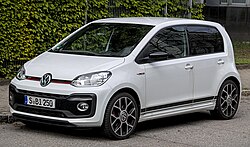
The Up range included the Up GTI, which was previewed by the GT Up concept. Released in January 2018, the Up GTI feature a turbocharged version of the 1.0-litre three-cylinder engine producing 115 PS (113 bhp; 85 kW).[18][19] An electric hybrid Up — which would be badged Blue-e-motion — was planned for 2014 but never released.[20][21]
Along with the other two rebadged models, Up is the first car in its class to offer an automated braking system, called City Emergency Braking. The system is automatically activated at speeds below 30 km/h (19 mph), when a laser sensor identifies a danger of collision and activates the brakes. In the SEAT model, the system is marketed as the City Safety Assist and in the Škoda model it is called City Safe Drive.[22][21]
The Up won the 2012 World Car of the Year.
-
 Rear view (3-door)
 -
 Rear view (5-door)
 -
 Interior
 -
 Cross Up
 -
 Rear view (Cross Up)


_-_Volkswagen_cross_up!_(DBA-AACHYW).JPG)
_-_Volkswagen_cross_up!_(DBA-AACHYW).JPG)
Marketing
[edit]The Up! is available to order in the United Kingdom since October 2011 for five models – marketed as Take Up, Move Up, High Up, Up Black and Up White.[23] British television show Top Gear presenters mocked the unusual name by calling the model "Up-exclamation-mark".[24]
The Up was introduced on the German market on 3 December 2011. Deliveries to other European markets began in April 2012.[citation needed]
In 2013, Volkswagen introduced the cross up! model, which has 15 mm more ground clearance than the standard model, and comes with plastic side skirts and wheel-arch flares as standard.[25]
In 2014, at the Geneva Motor Show, Seat presented the 2014 Seat Mii by Mango model aimed towards women, made in collaboration with the Spanish fashion company Mango.[26]
The SEAT Mii limited production started in October 2011 for the European market, with sales having started at the end of 2011. The final version was launched in May 2012.
The Up was sold in Australia until 2015, when it was withdrawn due to slow sales. Plans for the Škoda Citigo to be sold in Australia were also shelved.
At the Geneva Motor Show in 2016, the model sold in Europe received a facelift and the new TSI engine, that went on sale in the summer the same year.[27]
The Up was not sold in North America, CIS countries, Middle East, India,[28] China, South Korea, and Southeast Asia. Japanese sales began in October 2012. Due to its small size, the Up was one of Volkswagen's successful introduction in Japan.[29] The Up was also launched in South Africa in March 2015. Two models were offered at launch, both are the 1.0-litre 55 kW three-door variant. The two local options were marketed as Take Up, and the Move Up.[30]
Latin America
[edit]_rear_view.jpg)
In February 2014, Volkswagen introduced a modified version of the Up for Latin America. Built in Brazil, the Latin American Up differs from its European counterpart in length (it is 65 mm (2.6 in) longer), thanks to revisions to the floorpan's rear section to accommodate a larger fuel tank (50 L instead of Europe's 35 L), a full-sized spare wheel and increased cargo space. All versions have revised tailgates with a painted metal section (like the Seat Mii's and Škoda Citigo's) instead of the dark glass trim used in Europe. The five-door Brazilian Up also uses a different rear door design with sectioned glass and wind-down windows. The South American model retains the European version's safety levels with a five-star crash rating[31] and ample use of high-strength steel elements.[32]
In July 2015, Volkswagen introduced a new powertrain for the Up sold in Brazil, using a 1.0-litre, direct fuel injection three-cylinder turbocharged engine.[33]
Up GTI
[edit]In mid-December 2016, Volkswagen presented the Up GTI. It is powered by a 1.0-litre three-cylinder TSI petrol engine, which produces 115 PS (113 bhp; 85 kW). Its top speed is 192 km/h (119 mph) and it is capable of accelerating 0–100 km/h (0–62 mph) in 8.8 seconds with a top speed of 196 km/h (122 mph). Weighing just 997 kg (2,198 lb), Volkswagen claims that it is capable of delivering between 49.6 mpg‑imp (5.7 L/100 km; 17.6 km/L) to 50.4 mpg‑imp (5.6 L/100 km; 17.8 km/L) depending on the specifications, with CO2 emissions between 127 and 129 g/km. It is the only Up to be available with a six-speed manual gearbox. The Up GTI went on sale in January 2018.[19]
In April 2019, ordering for the Up GTI was halted in the United Kingdom, but in January 2020 VW UK started taking orders again for a lightly refreshed version. The refresh included small optional equipment changes, but no alterations to the powertrain, chassis or brakes. As of January 2023, new orders for the Up GTI were closed to allow time to complete orders before the GTI model ceased production.
-
 Up GTI
 -
 Rear view
 -
 Interior


E-up
[edit]First iteration
[edit]In July 2010 VW announced the production version of the E-up electric car, with sales scheduled to begin in 2013,[34] and was subsequently unveiled at the September 2013 International Motor Show Germany.[35][needs update]
The production version has an 18.7 kWh lithium-ion battery able to deliver 160 km (99 miles) on the NEDC cycle, can accelerate from 0-62 mph (100 km/h) in 12.4 seconds[36] and has a top speed of 130 km/h (81 mph). The E-up can be charged with 2.3 kW plugged into any standard 230 V socket, with 3.6 kW via a home-installed wall box or with up to 40 kW plugged into a DC fast-charging station via the optional Combined Charging System (CCS), which allows the battery to charge up to 80% in under 30 minutes.[37] The production version has the same dimensions as the five-door petrol model with seating for four.[38][39]
-
 2012 e-Up
 -
 Powertrain bay


Second iteration
[edit]A second iteration of the e-up was announced on 5 September 2019. It is equipped with a larger 32.3 kWh battery, a range of 260 km (160 mi) and efficiency of 12.7 kWh/100 km (4.89 mi/kWh).[40] 32.3 kWh is the usable (net) capacity, while the total (gross) capacity is 36.8 kWh.
The Škoda version was released as the Škoda Citigo-e iV, with a 36.8 kWh battery capacity and a range of 270 km (165 miles) under WLTP standard, and was mass-produced from autumn 2019. It is the first all-electric car of Škoda Auto and replaced the combustion engine version. Similarly, the petrol-powered Seat Mii was replaced with an electric version, the Mii Electric.[41][42]
-
 2021 e-Up
 -
 Rear view
 -
 Škoda Citigo-e iV
 -
 SEAT Mii Electric


Sales and market
[edit]| Year | Sales (% change from prior year) |
|---|---|
| 2013 | |
| 2014 | |
| 2015 | |
| 2016 | |
| 2017 |
Retail deliveries began in Germany in October 2013, followed shortly after by Denmark, Sweden, France, Norway, and the Netherlands, and the UK at the end of January 2014.[48][37] The E-up! is not sold in the U.S. or Canada.[49]
As of January 2020, Volkswagen have sold 21,000 E-up! Worldwide.[50]
Technical data
[edit]| e-up! (2013)[51] | e-up! (2019) | ||||
|---|---|---|---|---|---|
| Introduced | 2013 | 2019 | |||
| Transmission | Single-speed fixed gear ratio (electric) | ||||
| Power | 60 kW (80 hp) | ||||
| Torque | 210 N⋅m (150 lbf⋅ft) | ||||
| Battery | 18,7kWh (16.8 net) | 36,8kWh (32.3 net) | |||
| Range | 160 km (99 mi) | 258 km (160 mi) | |||
| Average Energy consumption | 11.7 kWh/100 km (NEDC) | 14.9 kWh/100 km | |||
| Drag coefficient Cd | 0.281 | 0.308 | |||
| charge time AC | 9 h (3,3 kW) | 5,5 h (7,1 kW) | |||
| charge time DC | 0.5 h (40 kW) | 0.75 h (40 kW) | |||
| 0–100 km/h
(62 mph) |
12.4 sec | ||||
| Curb weight
All fluids, 50% fuel |
1,139 kg (2,511 lb) | 1,229 kg (2,709 lb) | |||
| Top speed | 130 km/h | ||||
| Dimensions (length/width/height in mm): |
3540/1645/1477mm | 3600/1645/1492mm | |||
| Base price | €26,900 | €21,975 | |||
Powertrain
[edit]Both engines are also available with BlueMotion technologies (SEAT: Ecomotive, Škoda: Green Tech), which incorporates a start-stop system and regenerative brakes to reduce carbon emissions. Depending on markets, some 60PS and 75PS models are available with optional five-speed automatic transmission.
| Version | 1.0 (60 PS) | 1.0 (75 PS) | 1.0 (90 PS) | 1.0 (101 PS) | 1.0 (115 PS) | ||
|---|---|---|---|---|---|---|---|
| Type and number of cylinders | Straight-three engine with multi-point fuel-injection | Straight-three turbocharged engine with direct fuel-injection | Straight-three high-pressure turbo engine with direct fuel-injection | ||||
| Valves | 12 | ||||||
| Displacement | 999 cc (1 L; 61 cu in) | ||||||
| Power | 44 kW (60 PS; 59 hp) @ 5,000 rpm | 55 kW (75 PS; 74 hp) @ 6,200 rpm | 66 kW (90 PS; 89 hp) @ 5,000–5,500 rpm | 75 kW (102 PS; 101 hp) @ 5,000 rpm | 85 kW (116 PS; 114 hp) @ 5,000 rpm | ||
| Torque | 95 N⋅m (70 lbf⋅ft) @ 3,000–4,300 rpm | 160 N⋅m (118 lbf⋅ft) @ 1,500–3,000 rpm | 164.5 N⋅m (121 lbf⋅ft) @ 1,500 rpm | 200 N⋅m (148 lbf⋅ft) @ 2000 rpm | |||
| Transmission, standard | 5-speed manual | 6-speed manual | |||||
| Transmission, optional | 5-speed automatically shifted manual gearbox (ASG gearbox) | None | |||||
| Top speed | 161 km/h (100 mph) | 171 km/h (106 mph) | 185 km/h (115 mph) | 184 km/h (114 mph) | 192 km/h (119 mph) | ||
| Acceleration, 0–100 km/h (0-62 mph) | 14.4 seconds | 13.2 seconds | 9.9 seconds | 9.1 seconds | 8.8 seconds | ||
| Fuel consumption (combined, EU-norm) |
4.5 L/100 km (63 mpg‑imp; 52 mpg‑US) | 4.7 L/100 km (60 mpg‑imp; 50 mpg‑US) | 4.4 L/100 km (64 mpg‑imp; 53 mpg‑US) | ||||
| CO2 emission, combined (g/km) | 105 (BlueMotion 96) | 108 (BlueMotion 98) | 101 | ||||
| European emission standards | Euro 5 | Euro 6 | |||||
Safety
[edit]Latin NCAP
[edit]In 2014, the Latin-American Volkswagen Up was evaluated under the Latin NCAP assessment and achieved a 5-star security rating for adults and 4-star security rating for children:[52]
| Test | Score | Points |
|---|---|---|
| Adult | 93.29% (5-star) | 15.86 out of 17 |
| Children | 80.69% (4-star) | 39.54 out of 49 |
Euro NCAP
[edit]2011
[edit]In 2011, the SEAT Mii was evaluated for its safety performance under the Euro NCAP assessment scheme and it achieved a 5-star overall rating:[53]
| Test | Points | % |
|---|---|---|
| Overall: | 
| |
| Adult occupant: | 32 | 89% |
| Child occupant: | 39 | 80% |
| Pedestrian: | 17 | 46% |
| Safety assist: | 6 | 86% |
2019
[edit]The Up in its standard European market configuration received 3 stars from Euro NCAP in 2019, with the Mii and Citigo shared its results.[54][55][56]
Environmental performance
[edit]In February 2019 Green NCAP assessed Volkswagen Up GTI with 1.0-litre TSI engine and 6-speed manual gearbox:
| Test | Points | ||||||||||||||||||||||||||||||||||||||||||||||||||||||||
|---|---|---|---|---|---|---|---|---|---|---|---|---|---|---|---|---|---|---|---|---|---|---|---|---|---|---|---|---|---|---|---|---|---|---|---|---|---|---|---|---|---|---|---|---|---|---|---|---|---|---|---|---|---|---|---|---|---|
| Overall: |  
| ||||||||||||||||||||||||||||||||||||||||||||||||||||||||
| |||||||||||||||||||||||||||||||||||||||||||||||||||||||||
| |||||||||||||||||||||||||||||||||||||||||||||||||||||||||


Škoda Citigo
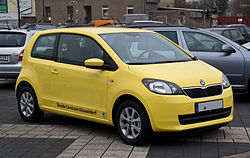
[edit]The Škoda Citigo is a rebadged version of the Up, with slightly different front and rear fascias. The Citigo was launched in the Czech Republic in October 2011. It began sales in other European countries from summer 2012. It was manufactured at the Volkswagen Plant in Bratislava, Slovakia. Plans for sales in Russia and most other CIS countries were cancelled due to its dimensions being deemed too small for the market. The Škoda Citigo was also sold in Israel and New Zealand for a short time. The Citigo was slightly updated with a facelift model in 2017. A fully electric version, the Škoda Citigo-e iV, with a 36.8kWh battery capacity and a range of 270 km (165 miles) under WLTP standard, was mass-produced from autumn 2019 and replaced the combustion engine version.[59] It was the first all-electric car of Škoda Auto. In autumn 2020, Škoda terminated the sale of Citigo electric cars.
| Designation | Displacement, valvetrain / capacity | Motive power at max. rpm | Max. torque at rpm | Gearbox (type), drive | Top speed | 0–100 km/h (0–62 mph) | Comb. consumption (100 km) |
|---|---|---|---|---|---|---|---|
| 1.0 MPI | 999 cm3, 12V | 44 kW (59 hp) at 5000 rpm | 95 N⋅m (70 lbf⋅ft) at 3000–4300 rpm | 5 speed man/aut | 161 km/h (100 mph) | 14.4 s | 4.4 L |
| 1.0 MPI | 999 cm3, 12V | 55 kW (74 hp) at 6200 rpm | 95 N⋅m (70 lbf⋅ft) at 3000–4300 rpm | 5 speed man/aut | 172 km/h (107 mph) | 13.2 s | 4.5 L |
| 1.0 CNG | 999 cm3, 12V | 50 kW (67 hp) at 6200 rpm | 90 N⋅m (66 lbf⋅ft) at 3000 rpm | 5 speed manual | 164 km/h (102 mph) | 16.3 s | 4.4 m3 (2,9 kg) |
| Electric | 36.8kWh | 60 kW (80 hp) | 210 N⋅m (155 lbf⋅ft) | 1 speed | 130 km/h (81 mph) | 12.3 s | 12.8 kWh |
-
 Škoda Citigo (3-door)
 -
 Škoda Citigo (5-door)
 -
 Facelift Škoda Citigo (5-door)
 -
 Facelift Škoda Citigo (5-door)
,_17._M%C3%A4rz_2012,_D%C3%BCsseldorf.jpg)


SEAT Mii
[edit]The SEAT Mii, like the Citigo, is a rebadged version of the Up, with noticeable differences to the front and rear fascias. The Mii was launched in the Spanish home market simultaneously with the Up and Citigo in October 2011. It began sales in other European countries from the second quarter of 2012.[60] It was manufactured at the Volkswagen Plant in Bratislava, Slovakia.[60] Primarily sold in Europe, it received no noticeable facelifts, unlike the Citigo. A fully electric version, the SEAT Mii electric, with a 36.8kWh lithium-ion battery and a range of 205 km (127 mi), was mass produced from 2019 to 2020.[61] In 2020, SEAT decided to discontinue the electric models, following the 2021 discontinuation of the entire Mii lineup.
| Designation | Displacement, valvetrain / capacity | Motive power at max. rpm | Max. torque at rpm | Gearbox (type), drive | Top speed | 0–100 km/h (0–62 mph) |
|---|---|---|---|---|---|---|
| 1.0 MPI | 999 cm3, 12V | 44 kW (60 PS) at 5000-6000 rpm | 95 N⋅m (70 lbf⋅ft) at 3000–4300 rpm | 5 speed man/aut | 161 km/h (100 mph) | 14.4 s |
| 1.0 MPI | 999 cm3, 12V | 55 kW (75 PS) at 6200 rpm | 95 N⋅m (70 lbf⋅ft) at 3000–4300 rpm | 5 speed man/aut | 172 km/h (107 mph) | 13.2 s |
| 1.0 CNG | 999 cm3, 12V | 50 kW (68 PS) at 6200 rpm | 90 N⋅m (66 lbf⋅ft) at 3000 rpm | 5 speed manual | 164 km/h (102 mph) | 16.3 s |
| Electric | 36.8kWh | 60 kW (82 PS) | 210 N⋅m (155 lbf⋅ft) | 1 speed | 130 km/h (81 mph) | 15.8 s |
-
 SEAT Mii (3-door)
 -
 SEAT Mii (5-door)
 -
 SEAT Mii (3-door)


Concept models
[edit]From 2007 through to 2010 Volkswagen showed a number of concept versions of the Up prior to the launch of the production-ready version in 2011.
2007 Up concept
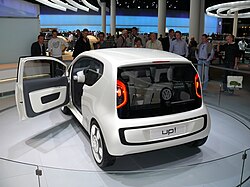
[edit]The two-door Up concept debuted at the 2007 IAA International Motor Show Germany in Germany,[11] with a rear-wheel drive, rear-mounted, boxer engine and 18 inch wheels.[11]
The interior is designed to accommodate four adults, and features flat-folding, air inflatable seats.[11] It also has two monitors on the dashboard, one showing vehicle statistics and the other controlling the in-car multimedia system.[11] The car measures 3.45 metres (11 ft 4 in) in length[11] and has a width of 1.63 metres (5 ft 4 in).[11]

-
 2007 up! concept
 -
 Rear view


2007 Space Up concept
[edit]
The four-door four-seater mini MPV styled space up! concept car debuted at the 2007 Tokyo Auto Show in Japan.[62]
The Space Up concept had all the features of the first concept, but with four-doors and 23 centimetres (9.1 in) longer at 3.68 metres (12 ft 1 in) (15 centimetres (5.9 in) shorter than the Volkswagen Fox).[62] The 'butterfly' doors open in a similar manner to those on the Mazda RX-8; the front doors conventionally hinged at the front, whilst the rears are hinged at the rear from the C-pillar, eliminating the B-pillar.[62] Its wheelbase is also larger at 2.56 metres (8 ft 5 in)[62] but retains the same width as the Up at 1.63 metres (5 ft 4 in).[62]
Also for the first time Volkswagen showed images of its internal combustion engine, a Fuel Stratified Injection (FSI) petrol engine.
2007 Space Up Blue Concept
[edit]The four-seater space up! blue concept, the third variant of the Volkswagen Up concept series, debuted at the 2007 Los Angeles Auto Show.[63]
The Space Up Blue was visually the same as the Space Up and shared its length and width, but it included a different roof with a 150 watt solar cell which recharges the batteries.[63] This means its height increases to 1.57 metres (5 ft 2 in) and the curb weight is a 1,090 kg (2,403 lb).[63]
Twelve lithium-ion batteries give the Space Up Blue 45 kW (61 PS; 60 bhp) of power and a 65 miles (105 km) range.[63] Combined with Volkswagen's world's first hydrogen high temperature fuel cells (HT-FC), range is extended by 155 miles (250 km) giving total range of 220 miles (350 km).[63]
2009 E-up concept car
[edit]The two-door Volkswagen e-up! zero-emissions concept debuted at the 63rd International Motor Show Germany in 2009.[64]
The 3.19 metres (10 ft 6 in) long all-electric E-up uses a 3+1 seat configuration.[64] It uses a 60 kW (82 PS; 80 bhp) (continuously rated at 40 kW (54 PS; 54 bhp)) all-integrated drive electric motor, mounted at the front and drives the front wheels.[64] This electric motor generates a torque turning force of 210 N⋅m (155 lb⋅ft) from rest.[64] Power is sourced from 18 kilowatt-hours (kWh) lithium-ion batteries, which will give a range up to 130 km (81 miles).[64] Quick charging will charge the battery up to 80% in an hour,[64] while a regular 230 volt plug will take five hours.[64][65] The roof of the E-up has a 1.4 square metre solar cell which supplies power to the vehicle's electrics, and when parked can power ventilation fans to help cool the interior when parked in bright sunlight on a hot day.[64] The solar cells can be increased in size to a total area of 1.7 square metre by folding down the sun visors.[64]
With a curb weight of 1,085 kg (2,392 lb), it can accelerate from rest to 100 km/h (62.1 mph) in 11.3 seconds; and should reach a top speed of 135 km/h (83.9 mph).[64] The E-up concept is 3.19 metres (10 ft 6 in) long, 1.64 metres (5 ft 5 in) wide, 1.47 metres (4 ft 10 in) high, and has a wheelbase of 2.19 metres (7 ft 2 in).[64]
Interior equipment includes a touch-screen human machine interface (HMI), one notable feature allows the charge to be delayed within the HMI programming, utilising cheap-rate night-time electricity—and this can also be remotely programmed via an iPhone or similar device.[64]
-
 Volkswagen E-up concept car as shown at the IAA 2009
 -
 Rear view

.jpg)
2009 Up Lite concept
[edit]The Volkswagen up! Lite was revealed at the 2009 Los Angeles Auto Show. It is a four-seater hybrid concept car based on Volkswagen L1 technologies. The Volkswagen Up Lite concept car has a hybrid powertrain with one 0.8 litres (48.8 cu in) two-cylinder Turbocharged Direct Injection (TDI) diesel engine and one 10 kW (14 PS; 13 bhp) electric motor, using a seven-speed dual-clutch transmission. Its technical dimension is about 3.84 metres (12 ft 7 in) in length, 1.60 metres (5 ft 3 in) in width and 1.40 metres (4 ft 7 in) high. It weighs 695 kg (1,532 lb), has a top-speed of 160 km/h (99 mph), and CO2 emission not more than 65 g/km.[66]
-
 Volkswagen Up Lite at the 2009 LA Auto Show
 -
 Rear view


2010 Volkswagen IN
[edit]The Volkswagen IN is a design study created by Brazilian interns of Volkswagen do Brasil which carries a significant resemblance to the Up concept cars. It is a two-seater-plus-luggage sub-compact, capable of adopting a variety of powertrains, including a fully electric one using in-wheels electric engines.[67][68] The mock-up in 1:1 scale was presented to the press on 29 January 2010.
2011 Buggy Up
[edit].jpg)
The Volkswagen Buggy Up! concept debuted at the 2011 Frankfurt Auto Show in Germany.
The Buggy Up is a dune buggy based on the Up platform. It is 3,584 mm (141.1 in) long, 1,672 mm (65.8 in) wide, and 1,288 mm (50.7 in) tall.[69] It has a door-less design, convertible canvas roof, waterproof interior, and a reinforced frame with ride height reduced by 0.8 inches (2.0 cm).[70]
2011 Up Azzurra Sailing Team
[edit]
The Up! Azzurra Sailing Team concept debuted at the 2011 Frankfurt Auto Show in Germany.
The Azzurra was designed to look and feel like a luxury yacht, with a fully waterproof interior, blue and white leather seats, and chrome and wood trim. The rear seats have wooden backs, so when they are folded down the trunk looks like the deck of a yacht. It has no roof, and wooden railings in place of the doors and rear hatch.[71]
Awards
[edit]- Scottish Car of the Year 'Compact Car of the Year' 2012[72]
- Top Gear Magazine 'Small Car of the Year' 2011
- What Car? 'Car of the Year' 2012[73]
- What Car? 'City Car of the Year' 2013[74]
- World Car of the Year 2012[75]
Sales
[edit]| Year | Europe | Brazil | Argentina | ||
|---|---|---|---|---|---|
| VW Up[76] | SEAT Mii[77] | Škoda Citigo[78] | VW Up | VW Up | |
| 2011 | 4,582 | 372 | 419 | ||
| 2012 | 113,827 | 18,827 | 27,673 | ||
| 2013 | 130,039 | 28,608 | 44,851 | 108[79] | |
| 2014 | 124,845 | 24,865 | 40,616 | 58,896[80] | 4,976[81] |
| 2015 | 105,348 | 24,298 | 38,735 | 53,316[82] | 12,705[83] |
| 2016 | 96,836 | 19,882 | 38,664 | 38,358[84] | 11,668[85] |
| 2017 | 100,715 | 15,412 | 35,698 | 34,164[86] | 14,908[87] |
| 2018 | 97,366 | 13,031 | 36,450 | 20,564[88] | 15,677[89] |
| 2019 | 80,048 | 12,641 | 30,786 | 13,463[90] | 7,093[91] |
| 2020 | 59,578 | 7,790 | 14,120 | 6,926[92] | 2,417[93] |
| 2021 | 69,400 | 9,428 | 5,264 | 1,978[94] | 418[95] |
References
[edit]- ^ "Skoda Citigo axed - but an electric replacement is in the works". CAR Magazine. Retrieved 4 December 2021.
- ^ "Seat Mii Electric (2021). End of production on June 18, 2021". Byri. 3 June 2021. Archived from the original on 4 December 2021. Retrieved 4 December 2021.
- ^ a b "Oficial: VW up! sai de linha no Brasil 3 meses após ganhar modelo 2021" [Official: VW up! leaves production line in Brazil 3 months after getting the 2021 model year]. Motor1.com (in Portuguese). Retrieved 9 April 2021.
- ^ US D671034, Bischoff, Klaus; Stefani, Oliver & Pavone, Marco Antonio, "Motor vehicle", published 20 November 2012, assigned to Volkswsagen AG
- ^ a b c "Intel Report: MQB Architecture at Audi and the Volkswagen Group". Fourtitude.com. 17 February 2012. Archived from the original on 9 October 2019. Retrieved 4 March 2012.
- ^ "New Volkswagen up! Includes Natural Gas Variant". NGV Global News. 21 August 2011. Archived from the original on 4 October 2011. Retrieved 31 August 2011.
- ^ a b c d e "Which Model?". Volkswagen UK. Retrieved 12 April 2012.
- ^ a b "New Small Family product decision for Bratislava, April 2009". volkswagen.sk. Volkswagen AG. Archived from the original on 5 January 2012. Retrieved 4 December 2011.
- ^ "Production Plants". Volkswagen AG. Archived from the original on 22 July 2012. Retrieved 11 May 2012.
- ^ Schaal, Sebastian (10 October 2023). "Der VW e-Up ist Geschichte – dieses Mal wohl endgültig" [The VW e-Up is history – and this time it's final]. Electrive (in German).
- ^ a b c d e f g "Volkswagen up! concept". VWvortex.com. Volkswagen AG. 10 September 2007. Retrieved 21 December 2009.
- ^ "Volkswagen Up!: the design". carbodydesign. 28 October 2011. Retrieved 10 July 2016.
- ^ "Interview with the designers of the up!". YouTube. Volkswagen. 4 September 2011. Archived from the original on 12 December 2021. Retrieved 10 July 2016.
- ^ a b "Frankfurt show: VW Up GT concept". Autocar. 13 September 2011. Retrieved 15 September 2011.
- ^ "New VW Up unveiled". Autocar. 21 August 2011. Retrieved 30 August 2011.
- ^ "Volkswagen up to Become New Lupo". 16 July 2010.
- ^ "VW Up! To be Named Lupo in 2011".
- ^ Aucock, Richard (27 January 2012). "Volkswagen GT up! concept - Car Reviews - MSN Cars UK". Cars.uk.msn.com. Archived from the original on 30 January 2012. Retrieved 11 March 2012.
- ^ a b "New 2018 Volkswagen up! GTI: UK prices and specs revealed". Auto Express. Retrieved 25 March 2023.
- ^ "Volkswagen up! Blue E-motion to get 95 mpg - report". Worldcarfans.com. Retrieved 11 March 2012.
- ^ a b "VW Up Blue-e-motion review". www.whatcar.com. Retrieved 25 March 2023.
- ^ "VW Up vs Seat Mii vs Škoda Citigo: which is the better buy?". Recombu. 1 May 2012. Retrieved 16 December 2012.
- ^ "Roll up, roll up...order books open for new Volkswagen up!". www.volkswagen.co.uk. Volkswagen. October 2011. Archived from the original on 15 October 2011. Retrieved 17 October 2011.
- ^ Make way for the Volkswagen T-Roc - Top Gear, 5 March 2014
- ^ Autoevolution (ed.): VOLKSWAGEN cross up! specs, 8 September 2020, retrieved 19 August 2021
- ^ "2014 Seat Mii by Mango – Perfect Car for Ladies". 2015carreviews.com. 10 March 2014. Archived from the original on 16 March 2014. Retrieved 16 March 2014.
- ^ "VW Up! (facelift) launched in Europe". 23 June 2016.
- ^ "Volkswagen Up! will not be launched in India owing to high costs". International Business Times. 31 December 2016. Retrieved 20 August 2018.
- ^ Schmitt, Bertel (5 November 2012). "Volkswagen: "Japan Is Not A Closed Market."". thetruthaboutcars.com. Retrieved 25 March 2023.
- ^ "Volkswagen South Africa". Archived from the original on 11 May 2015. Retrieved 15 March 2015.
- ^ "VW 'up!' joins Latin NCAP's growing 'five star' club of safer cars for adult occupant protection". LatinNCAP. Archived from the original on 14 February 2014. Retrieved 7 February 2014.
- ^ "up! brings the best of VW engineering in a compact, efficient package (IN PORTUGUESE)". Volkswagen do Brasil. Retrieved 7 February 2014.
- ^ "BRAZIL: VW Up TSI makes debut in Brazil before Europe". www.just-auto.com. 31 July 2015. Retrieved 7 December 2015.
- ^ Vijayenthiran, Viknesh (8 July 2010). "All-Electric Volkswagen E-Up Coming To U.S. In 2013". AllCarsElectric.com. Retrieved 7 May 2011.
- ^ Rauwald, Christoph (23 October 2013). "VW CEO Says Germany's 1 Million Electric-Car Goal Is Achievable". www.bloomberg.com. Retrieved 4 April 2023.
- ^ "e-up-nf : Volkswagen UK". 17 February 2014. Archived from the original on 17 February 2014. Retrieved 22 March 2024.
{{cite web}}: CS1 maint: bot: original URL status unknown (link) - ^ a b Volkswagen Media Services (5 July 2013). "XL1 and e-up! electrify the Silvretta E-Car Rally". Volkswagen. Archived from the original on 13 July 2013. Retrieved 13 July 2013.
- ^ "New up! Explore Features : Volkswagen UK". Archived from the original on 3 February 2014. Retrieved 10 February 2014.
- ^ "VW E-Up (2013) review". CAR Magazine.
- ^ "e-up! for everyone – new generation of the electric e-up! with a long range to be launched at a low price". Volkswagen Newsroom. Volkswagen AG. 5 September 2019. Archived from the original on 25 December 2019. Retrieved 7 September 2019.
- ^ "SEAT Mii electric: Long-term test review".
- ^ "Petrol out, electric in as Seat Mii Electric goes on sale". AutoEV. 25 October 2019. Retrieved 18 August 2022.
- ^ Tsakalidis, Anastasios. "Electric vehicles in Europe from 2010 to 2017: is full-scale commercialisation beginning?" (PDF). europa.eu. European Commission. Retrieved 26 April 2020.
- ^ Pontes, José (26 January 2014). "Europe December 2013". EVSales.com. Retrieved 9 March 2014.
- ^ Pontes, José (31 January 2015). "Europe December 2014". EVSales.com. Retrieved 26 April 2020.
- ^ Pontes, José (30 January 2016). "Europe December 2015". EVSales.com. Retrieved 26 April 2020.
- ^ Pontes, José (30 January 2017). "Europe December 2016". EVSales.com. Retrieved 26 April 2020.
- ^ Szostech, Mike. "Volkswagen e-Up Availability". My Electric Car Forums. Retrieved 6 December 2013.
- ^ "Volkswagen e-Up Electric Minicar: Forbidden Fruit For Europe Only". Green Car Reports. 14 March 2013. Retrieved 26 April 2020.
- ^ Randall, Chris (2 January 2020). "Volkswagen adjusts their electric forecast upwards". electrive.com. Retrieved 26 April 2020.
- ^ "VW e-Up! and e-Golf revealed with 99-mile and 118-mile ranges". Autoblog. 10 September 2013. Retrieved 26 April 2020.
- ^ "O VW up! passa a fazer parte do clube de carros "cinco estrelas" em segurança de adultos do Latin NCAP". LATIN NCAP - PARA AUTOS MAS SEGUROS (in European Spanish). Archived from the original on 27 December 2015. Retrieved 7 December 2015.
- ^ "SEAT Mii Euro Ncap 5-star rating". Euroncap.com. Retrieved 27 November 2011.
- ^ "Official Škoda CITIGO 2019 safety rating". www.euroncap.com.
- ^ "Official VW up! 2019 safety rating". www.euroncap.com.
- ^ "Official SEAT Mii 2019 safety rating". www.euroncap.com.
- ^ https://www.euroncap.com/en/results/vw/up!/39809
- ^ "Green NCAP assessment of the VW Up". greenncap.com. 2019.
- ^ Luke Wilkinson. All-electric Skoda Citigo e iV revealed for 2019 with 165-mile range Archived 2 June 2019 at the Wayback Machine. Auto Express. 23 May 2019
- ^ a b "Spanish brand Seat adds its piece to the VW Up city-car puzzle with Mii three-door". GoAuto. 4 October 2011. Retrieved 24 July 2023.
- ^ "SEAT Mii Electric". EV Database.
- ^ a b c d e "Volkswagen space up!". VWvortex.com. Volkswagen AG. 23 October 2007. Retrieved 21 December 2009.
- ^ a b c d e "Volkswagen introduces space up! blue at Los Angeles". VWvortex.com. Volkswagen AG. 14 November 2007. Retrieved 21 December 2009.
- ^ a b c d e f g h i j k l "Volkswagen e-Up! concept". VWvortex.com. Volkswagen AG. 14 September 2009. Retrieved 21 December 2009.
- ^ "3+1 seater Volkswagen up! concept EV". PaulTan.org. 15 September 2009. Retrieved 21 December 2009.
- ^ "LA 2009: Volkswagen Up! Lite Concept teases with practical, lightweight innovation". green.autoblog.com. Weblogs, Inc. 2 December 2009. Retrieved 21 December 2009.
- ^ "Brazilian interns design new Volkswagen city car concept". green.autoblog.com. Weblogs, Inc. 4 February 2010. Retrieved 4 February 2010.
- ^ ""Smart" Volkswagen In Micro Car Concept Crafted by VW Brazil Design Interns". Carscoops. 29 January 2010. Archived from the original on 25 July 2011. Retrieved 4 February 2010.
- ^ "2012 Volkswagen Buggy Up! Concept". conceptcarz.com. Retrieved 11 September 2017.
- ^ "Volkswagen Up! Concepts". caranddriver.com. Retrieved 11 September 2017.
- ^ "Volkswagen on the rise with a variety of Up! concepts". autoblog.com. 14 September 2011. Retrieved 11 September 2017.
- ^ "Scottish car of the Year". Archived from the original on 22 February 2014. Retrieved 14 December 2012.
- ^ "What Car? Car of the Year Awards 2012". What Car?. 11 January 2012. Retrieved 11 May 2012.
- ^ "2013 CCOTY: VW Up!". What Car?. 9 January 2013. Retrieved 9 January 2013.
- ^ Rutherford, Mike (5 April 2012). "VW Up wins World Car of the Year title". The Telegraph. Retrieved 11 May 2012.
- ^ Sales, ModelVolkswagen Car SalesVolkswagen Model (31 January 2014). "Volkswagen Up! European sales figures". carsalesbase.com. Archived from the original on 26 December 2021. Retrieved 7 March 2023.
- ^ "Seat Mii European sales figures". carsalesbase.com. 31 January 2014. Archived from the original on 26 December 2021. Retrieved 7 March 2023.
- ^ "Skoda Citigo European sales figures". carsalesbase.com. 31 January 2014. Archived from the original on 26 December 2021. Retrieved 7 March 2023.
- ^ "Carros mais vendidos do Brasil em 2013". AUTOO. Retrieved 12 March 2021.
- ^ "Carros mais vendidos do Brasil em 2014". AUTOO. Retrieved 12 March 2021.
- ^ "Así fueron las ventas totales de 2014". Motor1.com (in Spanish). Retrieved 29 April 2023.
- ^ "Carros mais vendidos do Brasil em 2015". AUTOO. Retrieved 12 March 2021.
- ^ "Así fueron las ventas totales de 2015". Motor1.com (in Spanish). Retrieved 29 April 2023.
- ^ "Carros mais vendidos do Brasil em 2016". AUTOO. Retrieved 12 March 2021.
- ^ "Así fueron las ventas totales en 2016". Motor1.com (in Spanish). Retrieved 29 April 2023.
- ^ "Carros mais vendidos do Brasil em 2017". AUTOO. Retrieved 12 March 2021.
- ^ "Así fueron las ventas totales en 2017". Motor1.com (in Spanish). Retrieved 29 April 2023.
- ^ "Carros mais vendidos do Brasil em 2018". AUTOO. Retrieved 12 March 2021.
- ^ "Así fueron las ventas totales en 2018". Motor1.com (in Spanish). Retrieved 29 April 2023.
- ^ "Carros mais vendidos do Brasil em 2019". AUTOO. Retrieved 12 March 2021.
- ^ "Así fueron las ventas totales en 2019". Motor1.com (in Spanish). Retrieved 29 April 2023.
- ^ "Carros mais vendidos do Brasil em 2020". AUTOO (in Brazilian Portuguese). 1 January 2016. Retrieved 12 January 2021.
- ^ "Así fueron las ventas totales en 2020". Motor1.com (in Spanish). Retrieved 29 April 2023.
- ^ "Carros mais vendidos do Brasil em 2021". AUTOO (in Brazilian Portuguese). 3 January 2021. Retrieved 11 January 2022.
- ^ "Así fueron las ventas totales en 2021". Motor1.com (in Spanish). Retrieved 29 April 2023.
External links
[edit]
