Hubbry Logo
Vezo peopleVezo peopleMain
Open search
Vezo people
Community hub
Vezo people
logo
8 pages, 0 posts
0 subscribers
Be the first to start a discussion here.
Vezo people
Vezo people
from Wikipedia

The Vezo is the term the semi-nomadic coastal people of southern Madagascar use to refer to people that have become accustomed to live from sea fishing. The Vezo speak a dialect of the Malagasy language, which is a branch of the Malayo-Polynesian language group derived from the Barito languages, spoken in southern Borneo. They currently populate most of the littoral zone along Madagascar's west coast between Toliara and Mahajanga.

Key Information

"Vezo" literally means 'the people who fish', but also has been known to mean 'to struggle with the sea'.[2]

Ethnic identity

[edit]
Distribution of Malagasy ethnic groups. The Vezo are classified with the Sakalava people.

Vezo do not identify with a particular Malagasy ethnic group but instead with their way of life.[3] They currently populate most of the littoral zone along Madagascar's west coast between Toliara and Mahajanga.[4] Like most other Malagasy ethnic groups, their origins can directly be traced to that original mix of Austronesian settlers from Asia and the Bantu migrants from mainland East Africa with Arab-Persian and Indian ancestry since the Middle Ages. They have been known to state emphatically that they need have no common origin or shared essence with one another. Their identity is instead contextual and embodied in learned skills such as fishing or swimming and the calluses they produce, rather than in shared origin.[2][5] Because of their semi-nomadic marine migrations, their population is difficult to determine and has been estimated by counting the dugout canoes called pirogues (lakanas in Malagasy language) around Madagascar. The Vezo tribe is from Southwest Madagascar.

Society

[edit]
Traditional fishing lakana from Madagascar

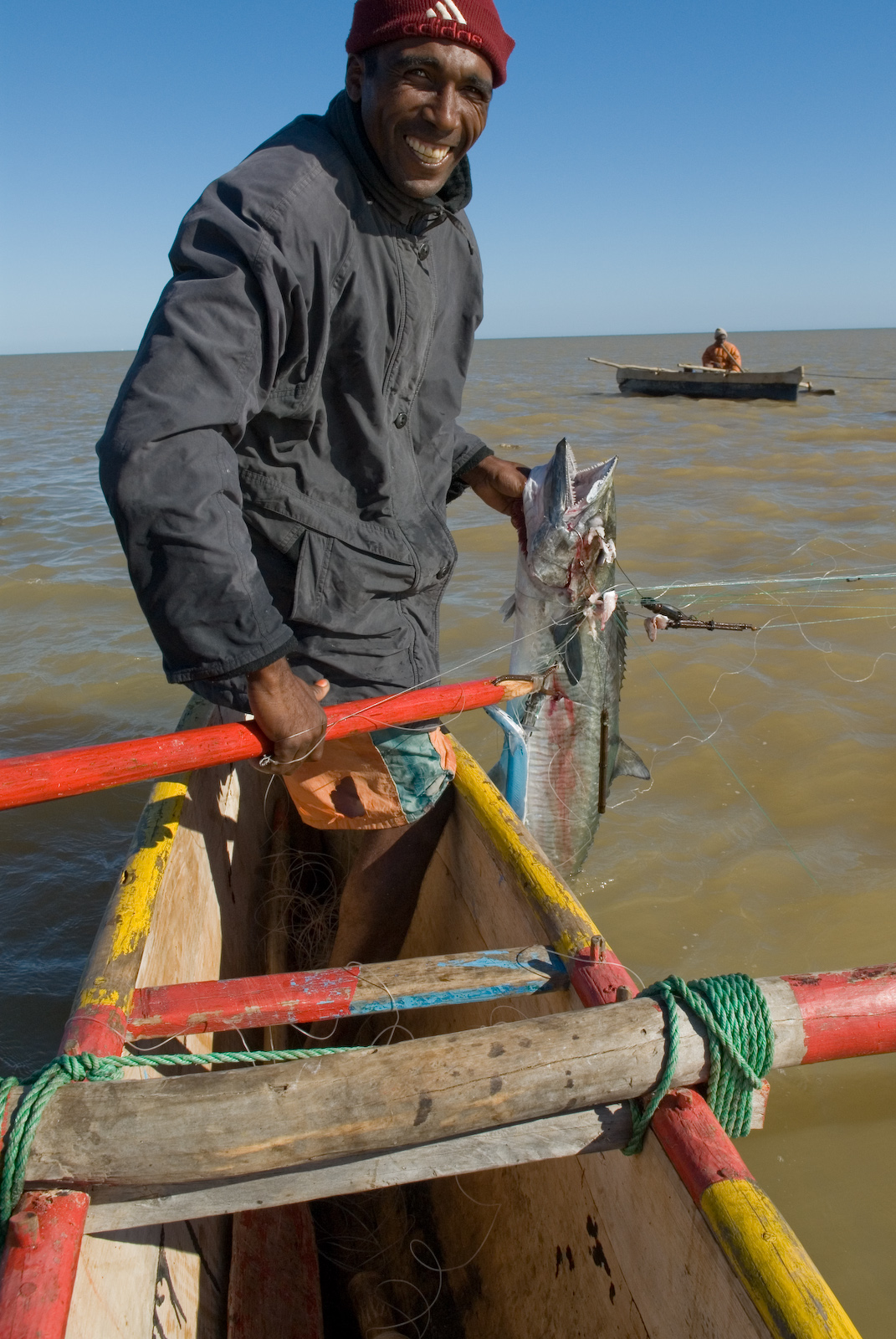
The Vezo are a fishing people who inhabit a coastal belt extending from Intampolo in the south to Morondava in the north of southwest Madagascar. Andavadoaka is a village whose population are of the Vezo tribe. It has a population of 1,200, with over 50% under 15 years of age. Household income is mainly from fishing. Fishermen make use of mangroves for timber, wood, and fishing.[6] The fishers participate in an artisanal fishery reliant on pirogues (canoes, made by hollowing out a large log) powered by sail and paddle, and most fishing occurs 5 km or less from shore. Men predominantly fish with line, nets, and spears. Women glean the reef flats for invertebrates including octopus and sea cucumbers. Fish sales, processing and trade supplement local income, as does tourism and local commerce.

The Vezo traditionally traded with the neighboring agro-foresters, the Masikoro. The Vezo also trade with the Mikea, exchanging fish for honey and tubers.[7] However, increased trade has changed the economy from barter to cash-based.[citation needed] Furthermore, growth in fish export from Madagascar has encouraged fish processing and export companies to the region, such as Murex and Copefrito (now operating in the southwest). Their purchases of marine products have increased fish demand and strengthened the cash economy. Besides gleaning from the reef flats, women are the ones who sell the catches that men bring them. With what they earn, women buy rice, the staple food, as well as other essential foodstuffs and a variety of luxury items.[3] Children go to school in the one village school building, where there are two designated teachers. However, due to the deterioration of public administration in Madagascar, the building and the teachers are hardly ever occupied. Whenever children are in the building, and if the teacher has not run out of chalk, the teaching largely consists in copying letters, numbers, and short sentences from the blackboard onto the child's own A5 size blackboard. Understandably, the many children who do not own a blackboard are allowed to play in the burning heat outside.[3]

Family ties are extremely important among the Vezo and elders are greatly respected in the community. Families often provide for each other with younger members building boats for the elderly to use. Maintaining family ties is important to ensure that one is looked after in old age, or after an accident or ill health. Family relationships are particularly important to Vezo fishers because they determine access to marine resources and fishing gear.[8]

Culture

[edit]
A Malagasy woman wearing masonjoany, a cosmetic paste ubiquitous among Vezo women.

The Vezo have official cultural ceremonies called Fomba. These include Bilo, Tromba, Savatse, Takasy and Soro. All these ceremonies, except Takasy, are practiced (with some variations) by the neighbouring inland Masikoro people.[3]

The circumcision ceremony typically lasts from 4 am until 9 am. The parents ask a wise elder to suggest the best date and time for the ceremony, and identify a nurse or doctor who knows how to perform the circumcision. Family members are invited to attend the ceremony, and one of the uncles holds the child during the ceremony. After the physical cut, there is drinking of alcohol. After the ceremony the child is called savatse.[citation needed]

Fady

[edit]

The community life of the Vezo, as elsewhere in Madagascar, is guided by numerous fady (taboos). During the course of the life of a Vezo man, he is exposed to the danger of catching hanimboky, a very unpleasant disease that only affects men. The name literally means 'swollen/full with food', which makes it considered thus a male pregnancy. A man sick with hanimboky is constipated and this causes his stomach to swell up until it resembles the belly of a pregnant woman. The illness is caused by food that the male kin of a sexually active woman accepted and ate from her. The food is said to be dirty, for it is assumed that the woman had acquired it with 'tangy', the presents her lover gives her for having sex with him. When a man accepts food from one of his female kin, it is therefore as if he were receiving food from the woman's lover; if a man accepted such food, he would be put in a very inferior position. In essence, they are treated as if they were women by their daughter's or sister's lover.[3]

Funeral rites

[edit]

Vezo cemeteries lie in the forest, far away from the villages and are so well hidden by the vegetation that they are considered "invisible to the eye". The cemeteries must be hidden in this way because the sight of tombs makes the people sad and unhappy. Cemeteries are not places the Vezo like to visit very often. One does not simply go for a stroll near the cemetery. The living only approach a cemetery when they bear a corpse or when they have to "work" for the dead, such as digging graves and building tombs.[9]

In western Madagascar, Sakalava and Vezo funerary sculpture is renowned internationally for its erotic wooden figures, often depicted during copulation and showing oversized phalluses and breasts. It is unknown as to why the sculptures have this sort of eroticism, but it may have to do with meeting growing tourist demand.[9]

Even after their ancestors have passed, the Vezo keep them involved in many different affairs. Many events in the productive, reproductive and social life of any Vezo family require that the dead be promptly informed, for example if one intends to move to a temporary fishing location, if one is moving into a newly built house or is launching a new canoe, if one is having a difficult birth or if a newborn is brought out of the house for the first time, if one is about to sit a school exam, if difficult words have been spoken which make people's heart heavy with anger, if the visiting anthropologist arrives or leaves, and so on. It is the responsibility of the senior head of the family to call the dead and talk to them, asking for their protection or their forgiveness, and ensuring that they are kept well informed of life's events – for whenever the dead have reasons to be “surprised," they will want to ask questions, thereby causing trouble for the living.[3]

The dead communicate with their living descendants through the dreams that they induce in them. This is because when a person dies, the breathing stops, the body becomes stiff, cold and soon begins to stink and to decompose. But when a person dies, the ‘spirit’ – known as fanahy up to the moment of death – permanently departs from the body. In its new disembodied, ghostly form, the spirit – now known as angatse – is invisible, and moves around like wind. To be seen by living people, it enters their dreams, where it appears together with its original uncorrupted body, just as it was when the person was alive.

Language

[edit]

The Vezo speak a dialect of the Malagasy language, which is a branch of the Malayo-Polynesian language group derived from the Barito languages, spoken in southern Borneo.[10]

Economy

[edit]

Off the coast of Madagascar, overfishing has become a major issue. The Vezo rely entirely on fishing, who for the past 2,000 years have been navigating the stretch of the Indian Ocean that separates Madagascar from the African continent in hand-carved pirogues. Increasingly, commercial boats, mostly from Asia and Europe, are fishing those same waters. Thus, it is difficult for the traditional fishermen to compete in the market. In response, many Vezo have resorted to fishing hundreds of miles offshore, spending six to nine months a year in rough and dangerous waters in search of sharks and sea cucumbers, both in high demand in Asian seafood markets. Some bring their families and all their possessions and set up camp on sandbars far from civilization.[11]

Fishermen believe that the current fishing practices have to change by keeping successful skills, removing destructive fishing practices and adopting new fishing technologies. The lack of a system allowing local users to have a shared assessment of the fishing conditions and to define a common vision is the main problem for Vezo traditional fishers. They are so good at tracking the changes in fish catches over time and have a better understanding of the multiple uses of the available habitats but when it comes to pooling their knowledge into one system, they just can not make it by themselves. This shows that traditional ways of solving problems have failed to make its way to modern days. Traditional leaders used to play an important role in preserving wealth of the community by providing guidance to resource users according to the best available judgment. This role has been weakened by several factors including his social status.[12]

Even worse, there is no significant improvement of household revenue in short term by setting up a marine reserve, it is hoped that the approach is likely to bring a much bigger impact on targeted fisheries in a mid and long term exploitation. From a biological point of view, a larger female octopus for example tends to lay many more eggs than young ones. By providing a few more months to grow in a closed fishing ground, it allows octopus individuals to get to bigger sizes.[12]

The Vezo have a long history of subsistence turtle exploitation and associated cultural traditions. By local law, turtles are protected under Decree 24 passed in 1923, but this law has seldom been enforced. The low reproductive potential and delayed sexual maturity of turtles make all species unsuitable for intensive harvest. Even as far back as the early twentieth century, it has been reported that turtles play an important role to Malagasy fisheries. There has been a decline in numbers of the hawksbill turtle and the disappearance of nesting populations. The raiding of the turtle nests and hunting for the meat and carapaces are believed to be the fundamental causes of decline for four of the five species in the region.[13]

See also

[edit]

Notes

[edit]

References

[edit]
[edit]
Revisions and contributorsEdit on WikipediaRead on Wikipedia
from Grokipedia
The Vezo are a population residing along the western and southwestern coasts of , whose identity is achieved through performative mastery of sea-based livelihoods rather than ascribed by birth, descent, or fixed . Unlike many other Malagasy groups, Vezo self-conception emphasizes practical competence in navigating and exploiting , allowing individuals of diverse origins to become Vezo by adopting this way of life. They maintain a semi-nomadic existence, employing pirogues for migratory expeditions that follow seasonal fish shoals, often involving free-diving and techniques honed over generations. This adaptive maritime orientation distinguishes them from inland agriculturalist neighbors and underscores their cultural openness to outsiders who demonstrate requisite skills. Contemporary Vezo communities face pressures from , climate variability, and policies that restrict traditional practices, prompting migrations and shifts in livelihood strategies.

Origins and History

Early origins and migrations

The early origins of the Vezo trace to the Austronesian settlement of , a process genetic analysis dates to approximately 1,200 years ago (circa 800–1000 CE), involving a small founding cohort of around 30 Southeast Asian women from regions like or , who carried mitochondrial lineages such as the Malagasy motif at frequencies up to 22% in Vezo mtDNA samples. This migration introduced maritime technologies, including outrigger canoes (lakana), essential for coastal fishing and dispersal, with autosomal ancestry in Vezo populations reflecting about 33% contribution from these Austronesian sources. Unlike descent-based groups, Vezo identity emphasizes behavioral adaptation to sea-harvesting, emerging from mixed coastal communities rather than a singular founding event. Admixture with Bantu-speaking migrants from , arriving via routes, shaped Vezo genetics further, contributing the remaining 67% of autosomal ancestry and occurring roughly 400–800 years ago (circa 1200–1600 CE), prior to European contact. No unique genetic markers distinguish Vezo origins from broader Malagasy admixture patterns, underscoring their formation through cultural specialization in rather than isolated migrations. Archaeological evidence from southwest coastal sites, such as those along the Vezo coast from the Onilahy River to Assassins’ Bay, reveals protohistoric settlements linked to western networks dating to the first millennium CE, with early visitors documented from the AD. These sites indicate initial dispersals southward along the western seaboard, driven by resource exploitation and environmental suitability for marine economies, laying the groundwork for Vezo semi-nomadism. Early Vezo migrations involved seasonal coastal movements in non-motorized vessels, responding to and pressures, a pattern rooted in the Austronesian voyaging heritage but amplified by local ecological demands and population displacements. This mobility, rather than large-scale overland treks, facilitated integration of diverse ancestries into a unified lifestyle, with no evidence of pre-Austronesian or exclusively African origins.

Historical adaptations and interactions

The Vezo have historically adapted to the dynamic coastal environment of southwestern Madagascar through a semi-nomadic lifestyle emphasizing seasonal migrations to exploit shifting fish stocks and avoid resource depletion. This mobility, facilitated by outrigger canoes known as pirogues, allowed them to navigate mangroves, reefs, and open seas, responding to environmental cues like tides, currents, and cyclone impacts that disrupt local fisheries. Archaeological evidence from late Holocene sites reveals settlement patterns that shifted in response to sea-level changes and climatic variability, with temporary campsites indicating flexible habitation strategies rather than permanent villages. Vezo , transmitted orally across generations, underpins these adaptations, encompassing observations of marine behaviors, seasonal patterns, and sustainable harvest techniques such as selective netting and spearing to maintain balance amid fluctuating conditions. This system has enabled resilience against historical pressures like in localized areas, prompting migrations northward or southward along the coast, often spanning hundreds of kilometers in non-motorized vessels targeting like and sea cucumbers. Such practices predate modern conservation efforts and reflect a behavioral identity tied to maritime competence rather than fixed territorial claims. In terms of interactions, the Vezo maintained relative autonomy from inland kingdoms such as the Sakalava, who dominated western until the late , asserting they were never subjects and engaging primarily in barter trade of , , and marine products for , , and iron tools. This peripheral relationship preserved Vezo cultural practices, including avoidance of hierarchical subjugation, while occasional intermarriages with neighboring groups like the Masikoro introduced limited genetic and cultural exchanges without altering core maritime orientation. During the French colonial period (1896–1960), Vezo communities in remote coastal areas faced indirect administration, with policies like forced labor and taxation disrupting migrations but failing to fully integrate them into centralized , as their mobility confounded enforcement efforts.

Ethnic Identity and Demographics

Fluid and behavioral basis of identity

The Vezo conceive of their ethnic identity not as an inherent quality transmitted by descent, but as a competence acquired through ongoing practice and mastery of sea-based livelihoods. Central to this is the notion that "to be Vezo is to know how to live from the sea" (mihinam-bara ho an'ny rano), encompassing skills such as navigation, net , and to marine environments, which individuals learn through and daily engagement rather than . This behavioral foundation allows identity to remain , enabling people from diverse ancestral backgrounds—such as those of inland origin or other Malagasy groups—to adopt Vezo status by demonstrating proficiency in these practices, without regard to . Anthropologist Rita Astuti, drawing from extended fieldwork among Vezo communities in southwestern during the late , documents how Vezo explicitly reject essentialist views of prevalent among neighboring groups like the Masalahy, who prioritize descent from specific ancestors. Instead, Vezo identity manifests performatively in the present: a person "starts from scratch every day" by enacting routines, with past origins dismissed as irrelevant to current capabilities. This contrasts with descent-based systems, as Vezo and social recognition emphasize observable actions over imputed essences; for instance, partners or members evaluate compatibility based on shared practical of the rather than lineage purity. Such fluidity reinforces Vezo adaptability to coastal nomadism, where seasonal migrations and intermarriages with non-Vezo further blur fixed boundaries. This practice-oriented identity also shapes Vezo self-perception relative to others: they describe non-Vezo as lacking sea competence, not as genetically distinct, underscoring a relational difference rooted in . Ethnographic indicates that children raised in Vezo households internalize this through immersion, gradually embodying the identity via acquisition, while adults from other groups can transition by sustained participation in expeditions. Astuti's analysis, grounded in Vezo vernacular discourse, challenges Western ethnic models by highlighting how identity here serves pragmatic ends—facilitating resource access and social alliances—rather than primordial ties.

Population estimates and geographic distribution

The Vezo people primarily inhabit the southwestern coastal , extending along a belt from Morondava in the north to (Tuléar) and further south to areas like Anakao and Intampolo. Their distribution follows the coral reef ecosystems and forests of the Tsimiholelo and Fiherena coasts, with key settlements in villages such as Andavadoaka, Morombe, and Belafay. This range supports their marine-oriented lifestyle, though seasonal migrations for fishing extend their temporary presence northward along the western coast toward . Due to the Vezo's semi-nomadic practices and a fluid ethnic identity defined more by expertise than strict descent, comprehensive censuses are limited and estimates vary. One data aggregation reports approximately 407,000 Vezo individuals in , comprising a subset of the broader Sakalava-related Malagasy groups. Localized studies provide smaller-scale figures, such as 1,200 residents in Andavadoaka as of the 2004-2005 and around 28,000 in 12 coastal villages of Velondriake in 2016, highlighting dense concentrations in fishing-dependent communities. A 2009 assessment noted about 70,000 people in southwestern coastal villages, predominantly Vezo, underscoring regional variability but no national total from governmental sources.

Society and Social Organization

Family structures and kinship

The Vezo exhibit a system among the living, characterized by traced through both maternal and paternal lines without gender distinctions in . Relatedness, termed filongoa, forms expansive, ego-centered kindreds that prioritize shared generational links and life experiences over rigid descent groups. These networks emphasize flexibility and "softness" in social ties, with no binding hierarchies or unilineal affiliations influencing daily interactions; instead, expands indefinitely through remembered or forgotten connections, supported by elders' genealogical knowledge. Family structures are fluid and non-hierarchical, often embedded within broader residential networks rather than isolated nuclear units. Children are raised with minimal to foster a gentle, adaptable character, reflecting Vezo values of and ease in relations. Elders command respect through their role in maintaining memory and mediating rituals, but authority remains practical and context-dependent, with younger kin reciprocating through support like boat-building or caregiving in . Posthumously, kinship transforms into exclusive raza descent groups defined by affiliation and unilineal principles, determined via rituals such as soro that assign burial rights, typically patrilineally unless overridden. This distinction underscores a divide: living Vezo prioritize performative, ungendered bonds, while the dead enforce "kinded" lineages. Marriage practices reinforce network expansion, favoring with olo hafa ("different people") unrelated by close to avoid taboos and broaden alliances. Unions are non-binding and easily dissolved, often requiring only simple s like rum offerings (around 25,000 Malagasy francs in the 1980s-1990s fieldwork era), with virilocal residence normative but uxorilocal arrangements possible and stigmatized as unequal. Wife-givers hold precedence, balanced by ceremonies like soritse that equalize spouses through symbolic exchanges, yet frequent partner changes reflect the impermanence of ties among the living. The soro , performable during or post-birth with paternal consent, integrates children into the father's raza for ancestral purposes, blending biological and affinal links without altering living filongoa.

Settlement patterns and mobility

The Vezo people traditionally inhabit linear coastal villages along the southwest coast of , spanning from to Morombe, where settlements are positioned proximate to the sea to facilitate immediate access to grounds. These villages feature semi-permanent dwellings constructed from local materials such as ravinala leaves and poles, reflecting an adaptive architecture suited to the marine environment and periodic environmental pressures like cyclones. Vezo society exhibits high mobility, characterized by both seasonal and long-distance migrations driven by the pursuit of productive fisheries amid in ancestral areas. Seasonal movements occur from March to November, peaking in August, with fishers traveling in groups of 6–7 aboard 7–8 meter non-motorized canoes to target high-value species like sharks and sea cucumbers for export markets. Long-term migrations, intensifying since the early , have extended Vezo presence northward 300–500 kilometers into the Menabe and Melaky regions, including remote archipelagos like the Barren Isles, and southward to Androy, often resulting in temporary camps built from and grass on islands or beaches. This pattern of mobility traces back to historical micromigrations predating the , with documented expansions to Menabe beginning in the , propelled by push factors such as declining local stocks and pull factors including global demand for marine products. In migration destinations, Vezo fishers may establish semi-permanent bases, integrating through with local populations like the Sakalava, while maintaining fluid settlement strategies that prioritize ecological over fixed territorial claims. Such dynamics underscore the Vezo's behavioral identity as proficient sea nomads, with migrations yielding economic returns, such as approximately $3,000 annually per group in remote fisheries, though they exacerbate resource pressures in new areas.

Culture and Beliefs

Traditional practices and worldview

The Vezo emphasizes adaptability and direct engagement with the maritime environment, where mastery of the defines human capability and identity through practice rather than immutable traits. Unlike more land-bound Malagasy groups, Vezo cosmology places less rigid weight on ancestral descent or fixed traditions, viewing "Vezo-ness" as an achieved state of knowing and living from the , which fosters openness to external influences and behavioral flexibility. This pragmatic lens extends to , perceived as rhythmic and demanding , with the embodying both provider and peril, informed by oral transmission of ecological observations rather than dogmatic lore. Ancestor forms a core element, with the dead regarded as entities whose spirits have irrevocably departed the body upon biological , yet retain influence through rituals designed to satisfy their persistent "longing for " and avert misfortune. Vezo tombs serve to contain and honor these ancestors, preventing their restless interference in the living world, as evidenced by communal maintenance practices and periodic ceremonies that reenact -affirming events. Children as young as age 5 demonstrate an intuitive grasp of mortality as bodily cessation—distinct from continuity—through participation in funerals and offerings, reflecting a compartmentalized framework where specifics are ritual-bound rather than philosophically elaborated. Traditional practices include spirit invocation ceremonies, such as those preceding expeditions, to seek ancestral blessings for safety and bounty, often involving sacrifices or invocations tied to seasonal cycles. These rituals underscore a causal realism in Vezo thought: elements are invoked pragmatically for empirical outcomes like successful catches, without conflating them with everyday biological reasoning. in mermaids or sea-origin myths, tracing Vezo descent from human-ancestral unions with marine beings, reinforces this sea-centric , embedding prohibitions against environmental harm as extensions of with . While some Vezo incorporate Christian elements, ethnic persists, prioritizing rituals that align human actions with ecological and ancestral harmonies over abstract .

Fady and ritual taboos

The Vezo people, like other Malagasy groups, observe fady, a system of ritual taboos rooted in ancestral beliefs and spiritual cautions that prohibit specific actions to avert misfortune, honor spirits, or maintain harmony with the and environment. These taboos often center on marine activities, reflecting the Vezo's identity as skilled fishers whose ties success to respecting forces rather than rigid descent-based customs. Unlike more inland-oriented ethnic groups with extensive ancestral prohibitions, Vezo fady emphasize practical restraints on resource use, such as avoiding sacred sites or oversized catches believed to belong to sea spirits, which inadvertently support ecological by limiting exploitation. Specific fady prohibit interference with designated coastal features near settlements like Andavadoaka. For instance, fishing, touching, or through the arch of Andavadoaka Rock is forbidden, as is any activity around Tern Rock to the north, associated with a legendary giant guardian. On islands such as Nosy Fasy, exiting only from the eastern side is mandated, while defecating on its sandbar is ; similarly, touching the tree on Nosy Hao or the sacred Ambatosambo rock violates prohibitions. The Nosy Mitata bars , tree-cutting, and waste disposal, and contact with the Ampotoa is avoided due to beliefs it summons storms. Larger-than-average fish are often released, viewed as spirit property, curbing overharvest. Post-death delay until burial completion, linking family rituals to taboos. Ritual practices reinforce these taboos through ceremonies invoking ancestors via elders like the hazomanga. The takasy involves shrine offerings—such as carapaces or spears—to thank spirits for successful catches and petition future bounty. Soro sacrifices of or goats seek favor for health or voyages, while fomba rituals, including libations of into the , mark temporary closures of fishing zones. Breaches may trigger bilo exorcisms to expel possessing spirits through multi-day chants and dances. These observances, transmitted orally, underscore a cosmology where sea productivity hinges on ritual compliance, though modernization erodes adherence among younger Vezo.

Funeral and mortuary rites

Vezo funerals typically involve communal wakes featuring shared meals and vigils lasting several days, particularly for elders whose corpses are kept for three to four days to allow gatherings. These events occur frequently in Vezo communities, with participants, including children who often play nearby or view the body under parental guidance, engaging in rituals such as offerings of food and to appease potentially angered ancestors. Burial follows promptly in remote cemeteries, where coffins are transported without children accompanying due to beliefs that the deceased might detain the living from returning. Tombs function as enclosed "houses" for the ancestors, constructed by the family after and marked with crosses to contain the dead and maintain separation from the living. These structures are repaired as needed, often prompted by ancestral communications via dreams signaling dissatisfaction. Allocation to a specific —typically paternal or maternal—hinges on prior rituals; for instance, a child's placement in the 's requires the to have performed the soron'anake offering to the mother's ancestors, ensuring descent-based of mortuary space. Unlike highland Malagasy groups practicing secondary exhumations such as , Vezo mortuary practices emphasize permanent enclosure without re-opening tombs, reinforcing a barrier between biological cessation of life processes and the ongoing spiritual agency of ancestors who influence the living through taboos, health, and misfortune if neglected.

Language

Linguistic characteristics

The Vezo speak the Vezo dialect, a variety of the belonging to the Austronesian family, specifically within the Barito subgroup linked to languages of southeastern . This dialect is classified among the southern dialects of , primarily spoken along the southwestern and northwestern coasts of in regions such as and provinces. Like other Malagasy dialects, Vezo retains the core grammatical structure of Malagasy, including verb-initial syntax (typically VOS order), extensive use of for derivation (e.g., forming nouns from verbs or indicating plurality), and a system of focus marking via affixation that highlights agents, patients, or locations in clauses. Phonologically, Vezo aligns with broader Malagasy patterns, featuring five vowel phonemes (/a/, /e/, /i/, /o/, /u/) and a consonant inventory including stops, nasals, fricatives, and liquids, though regional variations may include softened realizations or slower tempo compared to inland dialects like Masikoro. Lexical differences from standard (Merina-based) Malagasy are modest, primarily in vocabulary related to marine subsistence, such as terms for fishing gear and sea conditions, reflecting Vezo ecological adaptation rather than deep divergence. Phylogenetic analyses of Swadesh lists place Vezo in the South-West branch, clustering closely with neighboring Masikoro and Mikea varieties, with lexical distances indicating minimal isolation-driven drift and no evidence of pre-Austronesian substrate influence in core vocabulary. Vezo exhibits with adjacent dialects but is perceived as distinct by speakers due to subtle prosodic traits, such as softer articulation and deliberate pacing, which align with cultural emphases on fluid, sea-oriented identity over rigid ethnic boundaries. Dialectal studies underscore that variations across Malagasy, including Vezo, stem more from geographic isolation and cultural retention than from separate migration waves, with remaining uniform while shows areal . Comprehensive surveys of over 12,000 terms confirm Vezo's position as a conservative coastal variant without emblematic innovations marking it as fundamentally separate from the Malagasy continuum.

Comparisons to other Malagasy dialects

The Vezo dialect is classified within the southwestern branch of Malagasy dialects, forming a cluster with Masikoro and Mikea varieties based on lexical comparisons from Swadesh lists, while showing greater phylogenetic distance from the central Merina dialect, which serves as the basis for standard Malagasy. This positioning reflects contained dialectal divergence across Malagasy, primarily through recent drift rather than ancient separate migrations, with Vezo exhibiting emblematic features shared among southwestern groups such as the demonstrative pronoun *ihi, the article *te, and the dependence marker ʔe. Phonologically, Vezo retains proto-Malayo-Polynesian *li and *ti sequences—yielding forms like *lìme ('five') and *tìuke ('ten')—unlike the palatalized or affricated realizations in Merina (*dìmi, *tsìuka) or the retroflex series absent in southwestern dialects but present in some eastern varieties like Betsimisaraka. It features a simpler inventory overall, with Bantu influences from coastal contacts (e.g., Comorian) introducing subtle shifts in quality and consonant realizations not as evident in inland Merina, though core structures (predominantly CV) remain consistent across dialects. Lexically, Vezo diverges in pronouns, employing *àzu for the second-person singular oblique form versus *anau in central and eastern dialects, alongside specialized maritime vocabulary potentially enriched by or loanwords due to , contrasting with the more agrarian of highland groups. Grammatically, Vezo aligns closely with other southwestern dialects like Sakalava in retaining certain proto-forms and avoiding the reductive innovations of Merina, but is high with immediate neighbors (e.g., Masikoro, Mikea) while diminishing toward distant eastern dialects, where speakers may require accommodation to standard Merina for full comprehension outside cultivated contexts. These differences underscore Vezo's to coastal , with minimal evidence of pre-Austronesian substrate influence despite hunter-gatherer associations in related groups.

Economy and Subsistence

Primary fishing practices

The Vezo people of western and southwestern primarily engage in small-scale artisanal fishing as their core subsistence activity, utilizing wooden canoes known as pirogues constructed from local species such as Giviotia madagascariensis. These vessels, ranging from 2 to 8 meters in length, are propelled by paddles or square sails and enable access to reef flats, lagoons, mangroves, and offshore waters up to several kilometers from shore. is a communal practice learned from childhood, with approximately 80% of Vezo households dependent on it for protein and income, targeting finfish as the main resource alongside like and . Handline fishing, referred to as maminta, constitutes one of the most common techniques, involving baited hooks on or cotton lines deployed from pirogues in shallow waters (2-10 meters, termed torake) or deeper offshore areas (30-200 meters, tsopoke). This method targets reef-associated species including emperors, snappers, and groupers, allowing for substantial catches that support both household consumption and local trade. with specialized tools, such as the single-pointed voloso for on reef flats or the hooked manambaitse for crabs and in mangroves, is conducted via free-diving or from boats, emphasizing skill in underwater navigation without modern aids like compressors. Reef gleaning, known as mihake, involves walking exposed reef flats at to collect marine organisms using spears or by hand, primarily undertaken by women and children for , sea cucumbers, and shells, serving as a supplementary yet essential low-technology practice integrated into daily routines. Trolling with lures like the turlutte—a pronged wooden imitation—is employed during daytime or nights for catches, typically by one or two fishers in pirogues. While traditional plant-fiber nets have largely been replaced by variants for gillnets and seines, core practices remain labor-intensive and adaptive to tidal cycles and lunar phases, reflecting a deep-seated ecological attunement rather than industrialized approaches.

Supplementary livelihoods and trade

In addition to primary fishing, Vezo people derive supplementary income from processing marine catches, such as drying and salting —a practice known as venga—which preserves products for local sale or extended trade. Women frequently supplement household earnings through on flats at , collecting subsistence resources like clams, crabs, and sea urchins, or commercially viable items including and sea cucumbers harvested on foot. Approximately 29% of Vezo men engage in secondary occupations, such as serving as boatmen for marine tourism, which can yield daily earnings of €5–10, higher than typical income. Trade has long complemented Vezo livelihoods, historically relying on barter exchanges with neighboring agro-pastoralist groups like the Masikoro and Mahafaly, where was traded for inland staples such as , , manioc, and . This system reinforced , as the semi-arid coastal limits Vezo , compelling reliance on partners for crops while providing marine protein in return. Local commerce further augments income through activities like selling fried fish, clothing, or town-sourced merchandise, though these remain secondary to marine-based trade. Since the 1970s, Vezo trade has shifted from subsistence to a cash-based integrated with global markets, with fishers selling an average of 87% of production to local buyers, processors, or exporters. Key commodities include —comprising up to 71% of catches in some years and exported via firms like COPEFRITO (handling 900 tons in 2004), , or Sino-Malagasy networks to and —alongside sea cucumbers and fins, which fetch premiums like €0.40/kg for octopus at sub-harvester levels. This export orientation, accelerated by post-colonial and foreign demand since the , has boosted cash flows but intensified resource pressure, with declining stocks of traded like marine shells by the mid-1990s.

Environmental Relations and Sustainability

Traditional ecological knowledge and practices

The Vezo people possess a sophisticated body of (TEK) centered on marine environments, encompassing classifications of species, habitats, and behavioral patterns that inform sustainable resource use. This , accumulated through generations of , enables fishers to identify over 100 local species, molluscs like horita (), and crustaceans, distinguishing them by edibility, bait value, or non-consumptive uses such as net weights from shells. Habitats are differentiated into lagoons, reef flats, and open ocean, with specific sites like Andravamaike noted for sharks. Fishing practices integrate this TEK through techniques adapted to ecological cues, including hand-lining with or bait, seine nets (jahoto), gillnets (foly), and , often conducted from wooden pirogues. Seasonal cycles dictate activities: abundance peaks from May to September during the cold windy season (April-July), while juveniles appear twice annually, and sea urchins mature in the hot season (November-January). Tides and currents guide outings, with spring tides (tihake) facilitating access to deeper areas, and calm conditions in hot-dry periods enabling night for species like sea cucumbers. Sustainability is embedded in practices via fady (taboos) prohibiting near sacred sites like Andavadoaka Rock or Rock, and restricting resource extraction in mangroves such as Nosy Mitata. Communal ceremonies, including fomba, enforce temporary no-take zones, as seen in the November 2004 octopus closure at Nosy Fasy, reflecting to prevent depletion amid observed declines in catches like sea cucumbers. Elders report environmental shifts, such as sand accretion altering reef habitats and reducing algae-dependent fish populations over decades. Knowledge transmission occurs orally within families and communities, with children acquiring skills through play—constructing toy pirogues—and observation of elders (nahoda). Focus groups and storytelling preserve details, though modernization threatens erosion, prompting efforts to document oral histories for revitalization among youth. This TEK complements empirical data, such as net yields averaging 4,835 grams per person per trip versus 466 grams for lines, underscoring efficient, knowledge-driven exploitation.

Impacts of fishing and resource use

The Vezo people's intensive small-scale practices have contributed to of in western and southwestern , with studies documenting elevated fishing mortality rates exceeding natural mortality for 13 of the 20 most commonly caught in the Menabe between 2010 and 2012. Catch data from 17,161 fishing trips during this period revealed that 66.7% of top were harvested below maturity lengths, including 100% immature individuals for like Gerres unicolor and Mugil cephalus, signaling recruitment driven by increased fishing effort and smaller sizes in nets. Destructive gears such as illegal beach seines exacerbate habitat degradation, damaging coral reefs, seagrass beds, and mangroves—key nurseries for reef —while capturing high proportions of juveniles (68.4% on average with 2.5 cm mesh sizes), which hinders stock replenishment and reduces overall productivity. In Vezo-dependent areas, this has led to sharp declines in catch per unit effort, dropping from 0.6–2 kg per per hour in 1997 to 0.003–0.016 kg per per hour by 2010, compounded by unselective harvesting that removes herbivorous like and risks algal overgrowth on reefs. Although traditional methods like harpoons and handlines target specific species with potentially lower , the proliferation of commercial nets in nearshore habitats including mangroves has accelerated declines in reef-associated populations reliant on these ecosystems for juvenile stages. Resource extraction for fishing support, such as mangrove wood for boat construction and fuel for , further pressures coastal forests, indirectly amplifying marine impacts by altering nursery habitats and increasing into lagoons. and seasonal migrations by Vezo fishers to resource-richer areas have intensified localized depletion, shifting effort northward and creating environmental strain in destination reefs without corresponding management. These dynamics underscore a systemic over-reliance on finite marine stocks, where short-term subsistence needs override long-term replenishment, as evidenced by persistent low proportions of large, reproductively mature in landings.

Modern challenges, conservation efforts, and debates

The Vezo face significant environmental pressures from , with catch per unit effort in western Madagascar's small-scale fisheries declining by 71% over a decade prior to 2020, alongside 66.7% of commonly caught harvested below maturity length, indicating unsustainable exploitation in regions like Menabe where Vezo predominate. exacerbates these issues through ocean warming, that diminishes juvenile fish habitats, and intensified cyclones with reduced rainfall, rendering once-abundant nearshore fish scarcer and disrupting 80% of Vezo households reliant on for subsistence. has driven northward migrations of Vezo fishers seeking export markets for and sea cucumbers, amplifying pressures on distant ecosystems and complicating local management. Conservation initiatives emphasize community involvement, such as the Velondriake locally managed marine area (LMMA) established in 2006 along 40 km of southwest Madagascar's coast, which includes permanent reserves and periodic octopus closures, yielding a 189% increase in biomass within protected zones by 2012 and inspiring over 170 similar LMMAs nationwide. In the Barren Isles, Vezo "ocean monitors" conduct daily freedives since around 2020 to assess reef health and support a proposed 1,660-square-mile (MPA), countering a halving of per-outing yields from 48 to 26 pounds between 2015 and 2023 amid foreign industrial fleets and local poaching. These efforts integrate with restrictions on destructive gear, though reliance on NGO facilitation persists. Debates center on balancing immediate needs against long-term , as Vezo fishers exhibit high discount rates favoring current extraction over future , challenging purely traditional self-regulation without external . Strict top-down MPAs often overlook migration drivers like , potentially displacing Vezo without addressing root scarcities, whereas LMMAs better accommodate mobile fishers but face gaps against outsiders and funding dependencies that question scalability. Critics argue that global market demands and variability undermine local resilience, prompting calls for hybrid models prioritizing Vezo agency over imposed restrictions, though evidence suggests comanagement boosts only where participation and align with community priorities.

Intergroup Relations

Interactions with neighboring ethnic groups

The Vezo maintain economic and social ties with neighboring groups such as the Masikoro and Mikea in southwestern , characterized by routine interdependence without . These interactions primarily involve , with Vezo exchanging for Mikea honey and wild tubers, and Masikoro agricultural products, fostering peaceful cooperation in marketplaces where ethnic signaling diminishes. Despite reliable ethnic markers—such as , , posture, and —used to identify group membership, there is no observed preference for co-ethnics in cooperative tasks like wage labor, indicating that signaling serves functions beyond conflict avoidance or . To the north, the Vezo border Sakalava territory around Morondava and assert historical autonomy from Sakalava kingdoms that dominated western until the colonial era. Vezo narratives emphasize fleeing inland Sakalava control by retreating , preserving their fishing-based identity and avoiding subjugation, rather than direct confrontation. This relationship underscores Vezo distinctiveness, as they reject fixed ethnic categorization in favor of performative competence in maritime skills, even while sharing linguistic and cultural proximities with Sakalava. Overall, Vezo intergroup dynamics prioritize pragmatic exchange and mobility over territorial disputes, reflecting their semi-nomadic lifestyle.

Migrations, conflicts, and cooperation

The Vezo maintain a semi-nomadic lifestyle characterized by coastal migrations driven by the pursuit of optimal grounds, often spanning weeks or months aboard outrigger canoes called lakana. These movements follow seasonal patterns influenced by marine resource availability, with fishers relocating southward or along the western coast of to target species such as sharks and sea cucumbers. Most contemporary migrants originate from southwestern regions and rely on non-motorized vessels, reflecting adaptations to fluctuating and environmental pressures rather than territorial expansion. Historical migrations trace back to early settlements around 2,000 years ago, with Vezo ancestors dispersing in response to ecological opportunities along the Tulear () region's shores, integrating influences from Bantu and arrivals while prioritizing maritime competence over fixed descent. This mobility has shaped their identity as "people of the sea," distinct from inland groups, enabling fluid adaptation without rigid ethnic boundaries. Migrant fishers have significantly influenced use practices in southwestern , contributing to the dynamic seascape through sustained presence in new areas. Intergroup relations among the Vezo and neighbors like the Masikoro, Mikea, and Sakalava are marked by rather than conflict, underpinned by interdependence and cultural overlap. Intermarriage is commonplace across these groups, with genealogies frequently crossing ethnic lines, fostering social ties that prioritize practical alliances over exclusionary markers. Distinct ethnic signals—such as dress or practices—persist without leading to hostility, as groups recognize and accommodate differences while sharing economic pursuits like and . Cooperative exchanges form the core of these interactions, including barter trade where Vezo provide fish in return for Mikea and tubers, facilitating resource flow between coastal and domains. The Vezo's open societal structure, emphasizing lived expertise over ancestral taboos, contrasts with more tradition-bound inland neighbors, promoting integration and mutual benefit in shared landscapes. This relational framework has historically resisted centralized domination, as seen in Vezo-Mikea responses to external authorities, sustaining harmony amid ecological interdependence.

References

Add your contribution
Related Hubs
User Avatar
No comments yet.